Blepharoplasty insurance is decided by one question that has little to do with how the eyelids look: does the skin or lid position interfere with vision in a way a test and a photograph can show? Plans that cover eyelid surgery at all generally cover it as a functional operation, and they ask for measurements, a visual-field result and standardized photos before they say yes. Surgery done to refresh the eyes, with no documented visual problem, is treated as cosmetic.
This page explains how blepharoplasty insurance draws that line, what the published policies ask for, how Medicare’s prior-authorization rules work, what happens when functional and cosmetic work share one operation, and how appeals proceed. What the operation changes in the lids is covered in the blepharoplasty overview, and price anatomy in blepharoplasty cost. Nothing here predicts what your plan will decide.
Why blepharoplasty insurance turns on function, not appearance
The word “blepharoplasty” names a technique, not a reason. The same incision can restore a field of view or soften a tired look, and payers pay attention to the reason. Before looking at any single blepharoplasty insurance policy, it helps to see where the cosmetic line comes from and what counts on the other side of it.
Where the cosmetic exclusion comes from
Medicare’s national exclusion and its exceptions
Each Medicare contractor policy reviewed for this page restates the same federal rule: Medicare does not pay for cosmetic surgery, except to repair an accidental injury or to improve the function of a malformed body member (Social Security Act section 1862(a)(10)). The Novitas policy adds that a procedure done “for the sole purpose of improving appearances” is not reasonable and necessary.
Everything else in these policies is a way of deciding which side of that line a given eyelid falls on. Blepharoplasty insurance cannot pay for an operation because the lids look older. It can pay when the lids measurably limit sight.
How private plans word the same rule
Cigna’s coverage policy for blepharoplasty calls upper or lower eyelid surgery “cosmetic in nature and not medically necessary” when there is no functional impairment or when it is done only to improve appearance. It also states that coverage “varies across plans” and points readers to the benefit plan document. A Kaiser Permanente Washington review criteria document says lower-lid surgery for excess skin that does not correct a functional problem is cosmetic under the member benefit.
ASPS gives the consumer version on its eyelid surgery cost page: most health insurance does not cover cosmetic surgery or its complications, but removing redundant skin that covers the eyelashes may be covered. That second sentence is a possibility, not a rule, which is why the plan’s own blepharoplasty insurance policy text matters more than any general statement.
Which eyelid problems can count as functional
Hooding that blocks the upper visual field
The core functional indication is dermatochalasis, loose upper-lid skin that hangs low enough to cut into the visual field. ASPS lists functional indications for eyelid surgery that include dermatochalasis, blepharochalasis, ptosis, herniated orbital fat and visual field obstruction. Novitas, the Medicare contractor for Colorado, Texas, Pennsylvania and several other states, names symptoms such as eye strain, headache and loss of vision from redundant upper-lid skin.
Chronic dermatitis in the skin fold under overhanging lid skin is a second route in two of the Medicare policies reviewed. Novitas requires that it has not responded to conservative measures such as hygiene education and antibiotics. In practice, blepharoplasty insurance for hooding hinges on this kind of documented problem.
Low lids, low brows and other look-alikes
Several conditions produce a heavy-looking upper lid and are not the same problem. In ptosis, the lid margin itself sits low, and ASPS describes it as an upper margin reflex distance below 2 mm or an asymmetry of more than 2 mm between the eyes. In brow ptosis, a low eyebrow pushes skin down onto the lid.
Each has its own criteria and its own operation, and blepharoplasty insurance may cover one and not another. Which of them applies is an exam finding, discussed in who evaluates as a blepharoplasty candidate. An article cannot sort it out for you.
What studies say about functional benefit
Two reviews, one consistent signal
The thresholds in coverage policies trace back to a small research literature. A 2011 review in Ophthalmology, summarized by the American Academy of Ophthalmology, included 13 articles and found benefit with superior visual field loss of at least 12 degrees or 24 percent, and with a margin reflex distance of 2 mm or less. It concluded that repair improved vision, peripheral vision and activities that affect quality of life.
A later systematic review of functional outcomes after upper eyelid blepharoplasty, read here at abstract level, included 28 studies out of 3,525 assessed. It reported an enlarged visual field and better patient-reported quality of life, including fewer headaches.
Where the evidence runs thin
The same reviews are candid about limits. The 2011 review found little strong data for two indications that some policies list: difficulty wearing a prosthesis and temporal visual-field loss that affects driving. The later systematic review could not pool results into a meta-analysis because studies varied in outcomes and technique, and its findings on dry eye and eyebrow height conflicted.
For a reader, this explains why blepharoplasty insurance policies disagree. The research supports a range of thresholds, not a single number, so each payer picks its own. It also means a result near a cutoff is a conversation with the surgeon, not a verdict.
What a functional blepharoplasty insurance file contains
A reviewer of blepharoplasty insurance requests sees the file, not the patient. Policies therefore read like checklists for the chart: what was reported, what was measured, what was tested and what was photographed. The pieces below recur across Medicare contractors, commercial plans and the specialty societies.
Symptoms, measurements and visual-field testing
A symptom history that names daily tasks
Policies ask that the record document the complaint in functional terms: trouble reading, a sense of lids or lashes in the line of sight, brow fatigue from lifting the forehead to see, eye strain, or a field of view that feels cut off above. The WPS policy for Medicare in Indiana, Michigan and other Midwest states lists reading and seeing upper-lid skin among examples. Kaiser’s criteria ask for documented subjective complaints that justify functional surgery.
The practical point for a patient is specificity. “My lids look heavy” is an appearance statement. “I tilt my head back to read and my lashes block the top of my vision while driving” describes function, and a surgeon can only record what you actually experience.
Margin reflex distance and the taped-lid field test
Margin reflex distance, or MRD, is the distance in millimeters from the center of the light reflex on the cornea to the upper lid margin. A low MRD points to ptosis. For hooding, the Noridian policy describes a “pseudo-MRD,” measured to the edge of the overhanging skin, alongside visual-field testing. The visual-field test is run twice: once with the lids at rest and once with the lid taped or manually lifted to see how much field returns.
ASPS says visual-field assessment is required for functional blepharoplasty and may be done by an optometrist or an ophthalmologist. The WPS policy asks for fields that meet accepted quality standards, such as Goldmann or standardized automated perimetry, with a physician’s interpretation available on request.
Photographs and the policy you are measured against
Photo standards that reviewers apply
In blepharoplasty insurance files, photos are medical records, not before-and-after marketing. Noridian’s policy for California, Nevada, Washington and other western states requires frontal and lateral views for upper-lid surgery, taken in primary gaze with head and camera in parallel planes and the patient’s name and date on each image. It tells reviewers to assume an 11 mm corneal diameter unless a ruler appears in the photo.
ASOPRS adds that photos should not be taken after pharmacologic pupil dilation, which can falsely raise the lid. For how standardized views are used in the consulting room, as opposed to the claim file, see how to read eyelid before-and-after photos.
One pair of eyelids, several verdicts
Because each payer sets its own cutoffs, the same eyelids can satisfy one policy and miss another. The table puts five published policies side by side as they were displayed when accessed on 2026-11-12. Medicare contractor policies are revised on their own schedules, so the version in force on your date of surgery is the one that counts.
| Policy | Visual-field criterion | Margin reflex distance | Photographs | Lower lid |
|---|---|---|---|---|
| WPS, Medicare L34528 (rev. effective 2026) | 12 degrees or more, or 30% superior difference, before versus after lid lift | 2.5 mm or less among listed findings | Not set out; exam and fields on request | Not addressed |
| Novitas, Medicare L35004 (rev. effective 2021) | 12 to 15 degrees or 24% to 30% superior loss | MRD1 of 2 mm or less cited | Not mentioned; separate billing article lists records | Covered only for ectropion, entropion or lid mass signs |
| Noridian, Medicare L34194 (rev. effective 2025) | About 30 degrees or less from fixation; clinical notes preferred to formal fields | 2.0 mm or less, including pseudo-MRD from redundant tissue | Frontal and lateral required, primary gaze, name and date | Described as almost never functional; non-covered |
| Cigna, coverage policy 0045 (shown effective 2026) | 20 degrees or 30% loss, corrected when the lid is taped | No threshold for blepharoplasty; 2.0 mm in ptosis criteria | Frontal photos show blocked light reflex or lid encroaching | Only listed functional causes, such as entropion with corneal injury |
| Kaiser Permanente Washington (review date shown 2026) | Under 20 degrees above fixation, or 10 to 15 degrees laterally, untaped | None for upper blepharoplasty; 2.0 mm in ptosis and brow criteria | Frontal or lateral photos consistent with the field exam | Excess skin without functional correction is cosmetic |
The pattern across the rows is not a single blepharoplasty insurance standard. Thresholds range from 12 degrees to about 30 degrees of field loss, one policy prefers clinical notes to formal testing, and three of the five set a numeric MRD in some form. ASOPRS, the society for eyelid and orbital surgeons, wrote in a 2015 white paper that payers disagree on which objective findings show functional impairment, and that this makes it hard for surgeons to know which cases meet a given plan’s rules.
A 2022 conference abstract at The Aesthetic Meeting, by Badiei and colleagues, counted what private policies do. Of 70 American insurance policies analyzed, 67 (96%) covered blepharoplasty in some form, and 56 (80%) covered dermatochalasis causing functional visual impairment. Of those 56, 53 (95%) required visual-field testing, and more of them required a 30% superior field loss than the 24% the literature suggests. It is a conference abstract on publicly available policies, so it describes policy text and not what any plan pays in practice.

Medicare rules: contractor policies, prior authorization and the surgery center pilot
Original Medicare is the one payer whose blepharoplasty insurance rules are public in full. They also show how much the rules move. Regional contractors write the clinical criteria, and the federal government adds a separate layer of prior authorization on top.
Why blepharoplasty insurance rules differ by region and by year
Three contractors, three versions of the same rule
Medicare divides the country among regional contractors, and each can publish a local coverage determination. The three reviewed here cover different states and use different numbers: WPS lists an MRD of 2.5 mm or less among its findings, Novitas cites 2 mm or less, and Noridian describes a field restriction of about 30 degrees from fixation that corresponds to 2.0 mm. Someone in Texas and someone in Oregon can therefore meet different blepharoplasty insurance tests for the same operation.
The policies are also edited. Noridian’s current text took effect on October 16, 2025 and merged its two jurisdictions into one document. The WPS revision shown took effect on January 1, 2026. Novitas shows 2021. A criterion read in an old patient forum may no longer be the rule.
What can change between consultation and the surgery date
A claim is judged against the criteria in force on the date of service, and several ordinary events can move that target. The table lists five of them with a review point for each.
| What changes | Effect on the claim | Review point |
|---|---|---|
| The policy is revised | Criteria apply by date of service, so a newer version can replace the one used at consultation | Ask the office which policy and effective date it checked, then reread it before surgery |
| The surgery date slips | A Medicare hospital outpatient affirmation is valid for 120 days from the decision | Ask the hospital for the decision date and the expiry date in writing |
| The insurer or plan type changes | A new payer applies its own criteria; Medicare’s hospital program covers fee-for-service only | Request the new plan’s blepharoplasty criteria before relying on an earlier answer |
| The plan adds ptosis, brow or lower-lid work | Noridian says each planned operation is documented individually, which may need separate photo sets | Ask whether each addition needs its own records and its own authorization |
| The eye exam finds something new | Cigna and Kaiser both screen for active eye disease, thyroid disease or unstable conditions first | Tell the surgeon about new symptoms; the plan may change or wait |
Prior authorization in Original Medicare
The hospital outpatient requirement that began in 2020
For dates of service on or after July 1, 2020, CMS requires prior authorization for blepharoplasty in hospital outpatient departments. It was one of the first five service groups, alongside botulinum toxin injections, panniculectomy, rhinoplasty and vein ablation. The code list published in the 2019 final rule covers upper and lower eyelid skin removal, brow ptosis repair and the ptosis repair codes. CMS later removed one lid-retraction code, 67911, from the list, according to a January 2022 American Academy of Ophthalmology report.
Three limits matter to a patient. The program applies only to hospital outpatient departments billing under the outpatient payment system, not to physician offices or critical access hospitals. The hospital is responsible for the request, though the surgeon can submit it on the hospital’s behalf. And CMS’s FAQ says it is only applicable to claims submitted to Original Medicare fee-for-service, so a Medicare Advantage plan follows its own process.
Since January 1, 2025 the standard CMS review takes up to seven calendar days, with a two-business-day expedited track when delay could seriously jeopardize life or health. A provisional affirmation lasts 120 days. A non-affirmation cannot be appealed on its own, though the request can be resubmitted with new documentation and a later claim denial can be appealed.
The ambulatory surgery center demonstration
Blepharoplasty also appears in a separate CMS demonstration for ambulatory surgery centers, a five-year program. Requests for the first phase began January 5, 2026 for dates of service on or after January 19 in California, Florida, Tennessee, Pennsylvania, Maryland, Georgia and New York. The second phase covers Texas, Arizona and Ohio from February 16, 2026. Prior authorization is voluntary: a center that skips it has its claims placed under prepayment medical review. For Medicare patients in the listed states, blepharoplasty insurance at a surgery center may therefore involve a request or a review.
A Noridian page for the demonstration lists the documentation a blepharoplasty request should carry: evidence of excess upper or lower lid skin, preoperative photos, signed clinical notes showing decreased peripheral or upper visual field, and documented patient complaints that justify functional surgery. It also lists visual-field studies, when applicable. The CMS page I read does not say whether the demonstration reaches Medicare Advantage plans.
Mixed plans: when functional and cosmetic work share one operation
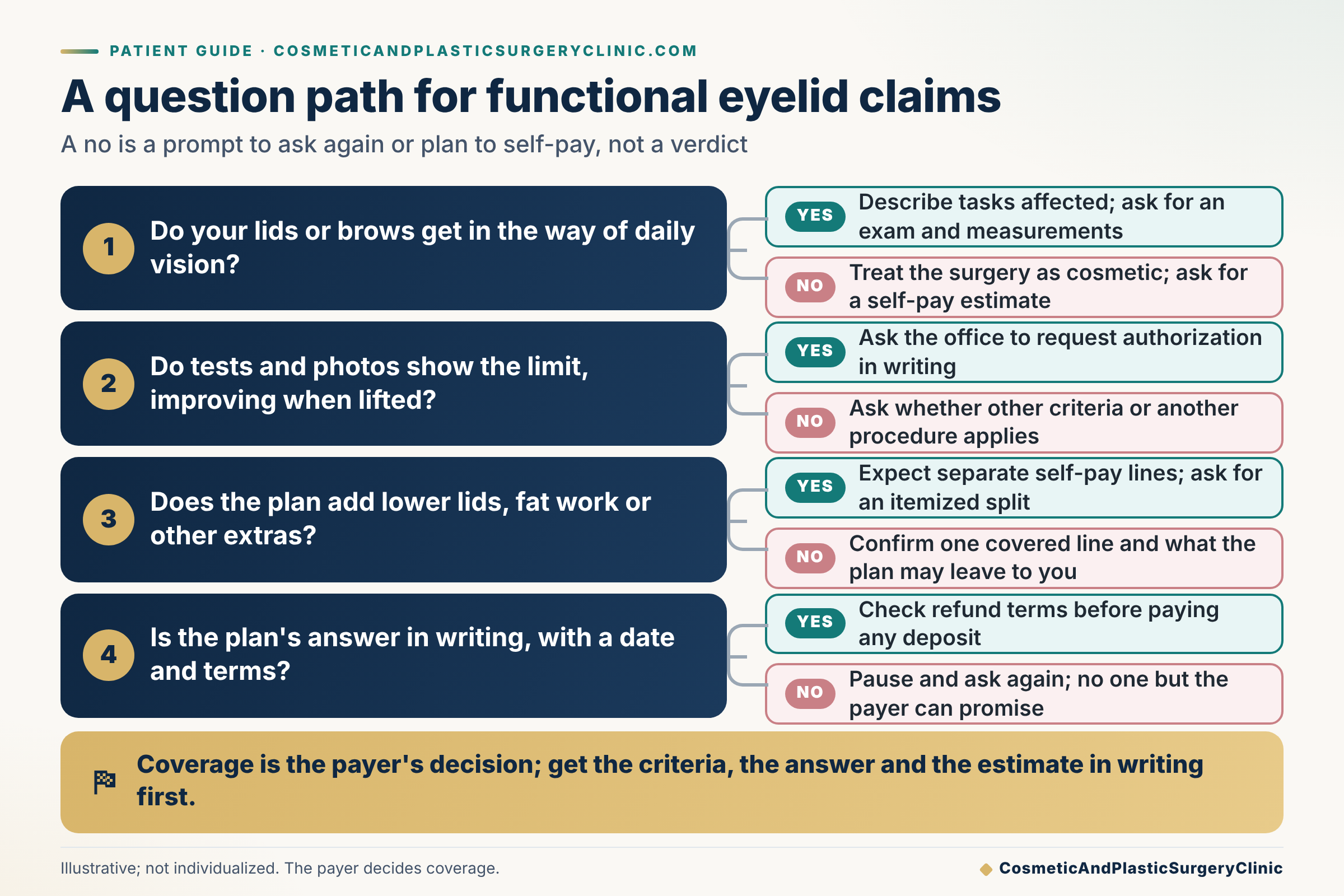
Many people who seek eyelid surgery have both a measurable visual problem and cosmetic wishes. Payers deal with this by splitting the plan into lines, so understanding how blepharoplasty insurance splits a plan is the best defense against a surprise statement.
Upper lids with extra cosmetic steps
Only the covered part is billed to the plan
Noridian states that when a cosmetic procedure is done with a covered one, only the covered procedure is paid. ASPS goes further in its recommended criteria: in purely aesthetic cases insurance should not be billed, and CPT codes alone do not tell cosmetic from reconstructive surgery. The code on a claim is a label; the documented reason is what counts.
The American Academy of Ophthalmology’s 2017 coding guidance describes Medicare’s rules from the surgeon’s side. It says Medicare does not allow charging a beneficiary extra for orbital fat removal during a covered blepharoplasty or ptosis repair, and does not allow treating medically necessary surgery as cosmetic in order to bill the beneficiary. Private plans set their own rules, so the split belongs in writing.
Consider a hypothetical person whose upper-lid skin meets a plan’s criteria and who also wants under-eye puffiness addressed. The plan may pay for the upper-lid operation and nothing for the lower lids. The practice would then show two lines on the estimate, one billed to the plan and one paid directly, and the comparison of the two operations is covered in upper vs lower blepharoplasty.
Lower lids and fat pads under coverage rules
Lower-lid surgery is where blepharoplasty insurance is least likely to apply. Noridian calls lower-lid blepharoplasty almost never functional and non-covered, and Kaiser’s criteria treat lower-lid excess skin that does not correct a functional issue as cosmetic. Bags and fat pads that change appearance without causing a functional problem fall on the cosmetic side.
The exceptions are medical. Novitas covers lower-lid surgery for laxity causing ectropion with irritation, inflammation and tearing, for entropion that puts lashes against the cornea, and for lower-lid edema, tumor or mass producing those signs. Cigna lists similar functional causes, including lid laxity with uncontrolled tearing. Technique choices for the lower lid are explained in lower eyelid surgery.
Ptosis repair and brow position in the same plan
When the brow explains the hooding
If a drooping eyebrow is pushing skin onto the lid, lifting the brow may do what skin removal cannot. Noridian says that if a brow ptosis repair alone would resolve the dermatochalasis, an added upper blepharoplasty is cosmetic. Cigna’s brow criteria require a field loss that cannot be corrected by blepharoplasty or ptosis repair alone, with documentation of the brow’s position.
ASOPRS recommends photos with the brows elevated when both brow and eyelid surgery are planned, so the reviewer can see which structure causes the overlap. How a surgeon distinguishes the two is explained in blepharoplasty vs brow lift.
Ptosis and blepharoplasty on one eye
The AAO’s 2017 article reports that, from October 1, 2017, Medicare pays for a medically necessary ptosis repair even when cosmetic blepharoplasty is done on the same eye in the same encounter. It also notes that billing edits still bundle blepharoplasty and ptosis procedures as mutually exclusive in certain ways, so claims for the two are handled carefully.
For a patient the useful habit is simple: ask what each line on the estimate describes, which operation it belongs to, and which plan criteria that operation is measured against. The table shows how six common situations tend to be handled, as a planning aid and not a prediction.
| Situation | Likely pathway | What may stay out of pocket | Question to ask |
|---|---|---|---|
| Upper-lid skin limits the field, documented | Functional claim with authorization before surgery | Anything the plan labels cosmetic, plus plan cost-sharing | Which criteria will you submit against? |
| Hooding plus under-eye puffiness | Upper lids as a claim, lower lids as a separate cosmetic line | The lower-lid fee, facility and anesthesia share | Can I see the itemized split of both? |
| Bags or tired look, no symptoms | Cosmetic self-pay | The full estimate, and likely any complications | What does the revision policy say in writing? |
| Lid margin sits low (ptosis) | Ptosis repair criteria, which use MRD and differ from hooding criteria | Cosmetic extras added to the same visit | Is this ptosis, hooding or both? |
| Low brow may cause the overlap | Brow criteria, often with brow-elevated photos and testing | An upper-lid operation the brow lift would make unnecessary | Would lifting the brow change the lid plan? |
| Dry eye, thyroid or other eye disease | Evaluation and stabilization first; some plans require it | Depends on the plan’s rules | Does this change timing or the plan? |
From consultation to claim: authorization, estimates and appeals
Most blepharoplasty insurance problems are discovered after surgery, when a statement arrives. The sequence below moves that discovery to the front, when changing the plan, the timing or the practice is still easy.
Steps before a surgery date is set
Six checks to complete first
ASPS’s recommended criteria state that prior authorization is always recommended for functional eyelid surgery. These six checks are what a request depends on, and each one can be confirmed by asking the practice a plain question.
- Your symptoms are recorded in the chart in your own words and tied to daily tasks.
- Measurements and any visual-field testing the policy asks for are done, with and without the lid lifted or taped.
- Photographs meet the payer’s standard, including your name and the date.
- The office can name the exact policy, its version and its effective date.
- A written authorization or pre-service answer is in hand, with its expiry date if it has one.
- The estimate separates covered lines from self-pay lines and says who bills which.
ASPS’s criteria also expect the performing surgeon to hold approved hospital privileges and certification by an ABMS-recognized board, such as the American Board of Plastic Surgery. Verifying those is covered in how to choose a plastic surgeon, and the plastic surgery consultation guide lists what to bring to the first visit.
The table splits the work between you, the practice and the payer, so that nothing is assumed to be “someone else’s job.”
| Task | Usually handled by | What you should hold |
|---|---|---|
| Describing daily vision problems | You, then the surgeon records it | Your own dated notes on tasks affected |
| Eyelid exam and measurements | Surgeon or eye specialist | A copy of the exam note |
| Visual-field testing | An optometrist or ophthalmologist, per ASPS | The printout with its interpretation |
| Standard photographs | The surgeon’s office | A copy of the images sent |
| Submitting the request | The practice; for Medicare hospital outpatient care, the hospital is responsible | The date sent and who sent it |
| Notices and decisions | The payer | Authorization letters, denials and any Medicare ABN |

A written estimate for the parts that stay self-pay
For whatever blepharoplasty insurance will not pay, a written estimate protects you. CMS says people who do not have or do not use health insurance are usually entitled to a good faith estimate, provided at least three business days before the service or on request, and that a bill at least $400 above the estimate may be disputed. The page notes that the No Surprises Act protections took effect on January 1, 2022.
The ASPS eyelid cost page lists average surgeon fees of $3,359 for upper and $3,876 for lower blepharoplasty, with no year, and says the figures exclude anesthesia and the operating facility. Those are anchors for questions, not quotes. How cosmetic pricing works across procedures is explained in plastic surgery cost.
If the plan denies blepharoplasty insurance
Internal appeals and external review on private plans
HealthCare.gov says an internal appeal must be filed within 180 days of the denial notice. The appeal can be a form or a letter with your name, claim number and insurance ID, supported by a letter from your doctor, and a state Consumer Assistance Program can file it for you. Keep the explanation of benefits, the appeal and notes from every call.
For a service not yet received, the page lists 30 days for the insurer’s decision on a standard appeal, and 60 days for one already received. Urgent appeals are decided as quickly as the condition requires and within four business days at most. If the insurer still says no, external review is available. Your denial letter states the deadlines for your plan, and the same appeal mechanics apply to other functional surgeries, such as those described in breast reduction insurance.
Blepharoplasty insurance appeals in Original Medicare
Original Medicare has five appeal levels: redetermination by the contractor, reconsideration by an independent contractor, an administrative law judge hearing, review by the Medicare Appeals Council and federal court. The Medicare.gov page says to file the first appeal by the date printed on your Medicare Summary Notice, and a late request may be accepted for good cause such as illness. The second level must be requested within 180 days of the first decision.
For a hospital outpatient request, the CMS FAQ draws a line that surprises people: a non-affirmation cannot be appealed directly, but a claim denied after one can be. It adds that resubmitting without new documentation will likely produce the same result. The practical move is to ask what was missing and whether more testing, better photos or a clearer note could address it.
What coverage leaves unpaid, and billing warning signs
Blepharoplasty insurance is rarely all-or-nothing. A covered functional claim can still leave a balance, and some billing practices should prompt a second question before any money moves.
Costs that remain after a covered claim
What blepharoplasty insurance leaves to you: add-ons and revision terms
The ASPS cost page says most health insurance does not cover cosmetic surgery or its complications. If a cosmetic step is added to a covered operation, a problem after that step may not be covered either, so the practice’s written revision policy is part of the real price. Ask what follow-up visits and revision work the fee includes.
Also ask what portion of a covered claim falls to you under your plan’s cost-sharing rules, since a covered operation can still produce a statement. Payment plans, loans and deposits are covered in plastic surgery financing, and the line-by-line anatomy of the fee is in the blepharoplasty cost article.
Tax and spending-account questions
IRS Publication 502 (2025) says you generally cannot include cosmetic surgery in medical expenses, and describes it as a procedure directed at improving appearance that does not meaningfully promote proper function or treat illness or disease. Exceptions cover a deformity from a congenital abnormality, an accident or trauma, or a disfiguring disease. Only expenses above 7.5% of adjusted gross income count.
Functional eyelid surgery sits on the other side of that definition from cosmetic work, but whether any expense is deductible is a question for a tax professional. Rules for health spending accounts come from the account’s own plan documents, so ask the administrator in writing before a date is set.
Billing practices that deserve a second look
Cosmetic work presented as functional
ASPS states that in purely aesthetic cases insurance should not be billed. AAO’s coding guidance adds that Medicare does not allow treating a medically necessary operation as cosmetic in order to bill the patient. Medicare has run post-payment reviews of blepharoplasty claims, and a 2015 law-firm summary of one contractor review lists photographs showing visual impairment and visual-field measurements with physician interpretation among the records requested, with 45 days to respond.
Promises about blepharoplasty insurance approval
No one outside the payer can promise coverage. Cigna’s policy says coverage varies by plan, and CMS describes a hospital outpatient affirmation as provisional. Treat any statement that approval is certain, and any pressure to pay a deposit before authorization arrives, as reasons to pause and compare. If a deposit is requested, ask in writing what is refunded if the plan says no.
Waiting a few weeks for an answer costs little compared with an unplanned bill. A second opinion from another board-certified plastic surgeon or an oculoplastic surgeon can also confirm whether the exam findings really support a functional claim.
Frequently asked questions
Is age-related hooding enough to qualify for blepharoplasty insurance?
Age-related skin laxity is the usual cause of functional hooding, but the cause is not what the payer tests. Policies ask whether the skin measurably limits vision, using a symptom history, a visual-field result and photographs. Many people with visible hooding have no field loss and no symptoms, and for them the surgery is cosmetic. Others have clear field loss with little visible change. Neither the mirror nor an article can tell you which group you are in; only an exam and testing can.
How long does blepharoplasty insurance prior authorization take?
It depends on the payer. For Original Medicare hospital outpatient requests, CMS says the standard review takes up to seven calendar days as of January 1, 2025, and an affirmation lasts 120 days. HealthCare.gov’s appeals page lists 15 days for prior-authorization decisions on plans it covers, but your plan’s notice controls. Ask the practice when it sent the request, what reference number was issued and when an answer is due, and schedule surgery only after the response arrives.
Does a borderline visual-field result mean blepharoplasty insurance will deny it?
Not automatically, but it makes the policy’s exact wording matter. Cutoffs in the policies reviewed run from 12 degrees to about 30 degrees, one Medicare contractor prefers clinical notes to formal testing, and ASOPRS says an MRD of 2 mm corresponds to a 12 to 15 degree field loss. Ask the surgeon which policy is being applied and whether the result meets it. Do not pursue surgery to reach a number, and consider a second opinion if the findings are unclear.
Can an optometrist’s visual-field test be used for blepharoplasty insurance?
ASPS’s recommended criteria say visual-field testing may be performed by an optometrist or an ophthalmologist. Payers still set their own rules about the test itself: the WPS policy asks for fields that meet accepted standards, such as Goldmann or standardized automated perimetry, with a physician’s interpretation available on request. Before paying for a test, ask the surgeon’s office whether the testing site’s format and the report it produces satisfy the policy being used, so you do not need to repeat it.
Is blepharoplasty insurance different with a Medicare Advantage plan?
It can be. The CMS prior-authorization program for hospital outpatient departments applies only to Original Medicare fee-for-service claims, according to CMS’s FAQ, so an Advantage plan uses its own process and criteria. The pages reviewed for this article do not describe those plan rules. Ask the plan for its written blepharoplasty criteria and whether authorization is required, and keep the reference number for any answer you are given by phone.
Will blepharoplasty insurance pay if something goes wrong after cosmetic eyelid surgery?
Often not. ASPS says most health insurance does not cover cosmetic surgery or its complications. Whether a particular problem is covered depends on the plan’s wording and on whether the operation was billed as covered or cosmetic. That is why the practice’s revision policy, in writing, belongs next to the price. Ask what follow-up and revision work is included, for how long, and what you would owe if a second operation were recommended.
Can a practice promise that blepharoplasty insurance will pay for my eyelid surgery?
No one but the payer can, and even a payer’s early answer is a preliminary decision about documentation, not a promise about the final claim. Cigna’s policy says coverage varies across plans, and CMS calls a hospital outpatient affirmation provisional. Be cautious about firm assurances, and about pressure to pay a deposit before an answer arrives. Ask for the plan’s written decision, the date it applies to and the refund terms if the answer is no.
Sources and further reading
- CMS Medicare Coverage Database — LCD L34528, Blepharoplasty, Blepharoptosis and Brow Lift (WPS; accessed 2026-11-12) — documentation findings, 12 degrees or 30% field difference, MRD 2.5 mm, cosmetic exclusion
- CMS Medicare Coverage Database — LCD L35004, Blepharoplasty, Blepharoptosis Repair and Surgical Procedures of the Brow (Novitas; accessed 2026-11-12) — field and MRD thresholds, lower-lid indications, dermatitis, sole-purpose-of-appearance language
- CMS Medicare Coverage Database — LCD L34194, Blepharoplasty, Eyelid Surgery, and Brow Lift (Noridian; accessed 2026-11-12) — photo standards, pseudo-MRD, lower-lid and same-session rules, revision dates
- Cigna — Coverage Policy 0045, Blepharoplasty, Reconstructive Eyelid Surgery, and Brow Lift (accessed 2026-11-12) — field criteria, photos, lower-lid and brow criteria, coverage varies by plan
- Kaiser Foundation Health Plan of Washington — Clinical review criteria, Blepharoplasty, Blepharoptosis, and Brow Lift (accessed 2026-11-12) — field criteria, medical-status requirements, lower-lid cosmetic statement
- ASPS — Recommended Insurance Coverage Criteria for Third-Party Payers: Blepharoplasty (re-approved December 2020; accessed 2026-11-12) — visual-field requirement, photography, CPT caution, prior authorization, provider expectations
- ASPS — Eyelid surgery cost (accessed 2026-11-12) — average fees with no year, exclusions, insurance statements
- ASPS — Eyelid surgery overview (accessed 2026-11-12) — functional and cosmetic reasons for eyelid surgery
- ASOPRS — White paper on functional eyelid criteria, January 2015 (accessed 2026-11-12) — criteria, photo guidance, payer disagreement, MRD-to-field correspondence
- Badiei et al., The Aesthetic Meeting 2022 — A Cross-Sectional Analysis of American Insurance Coverage of Upper and Lower Lid Blepharoplasty (conference abstract; accessed 2026-11-12) — 70 policies, 96% coverage, 95% field-testing requirement
- CMS — Prior authorization for certain hospital outpatient department services (accessed 2026-11-12) — blepharoplasty from July 1, 2020, service groups
- CMS — Hospital OPD prior authorization frequently asked questions (accessed 2026-11-12) — settings, review times, 120-day affirmation, non-affirmation and appeals, ABN, Medicare Advantage
- CMS — OPD prior authorization list of services, 2019 final rule table (accessed 2026-11-12) — blepharoplasty, brow and ptosis code groups
- CMS — Prior authorization demonstration for certain ambulatory surgical center services (accessed 2026-11-12) — phases, states, dates, prepayment review
- Noridian JF Part B — Blepharoplasty pre-claim review for ASC services (accessed 2026-11-12) — documentation expected with a request
- American Academy of Ophthalmology — CMS removes lid surgery code from hospital prior authorization (January 2022; accessed 2026-11-12) — removal of CPT 67911
- American Academy of Ophthalmology — How to bill for upper eyelid blepharoplasty and blepharoptosis repair (September 2017; accessed 2026-11-12) — Medicare ptosis payment, billing cautions
- HHS Office of Inspector General — Local Coverage Determinations Create Inconsistency in Medicare Coverage, OEI-01-11-00500 (January 2014; accessed 2026-11-12) — blepharoplasty policies in 32 of 44 states, seven code lists
- Hall Render — Keep your eyes open for blepharoplasty post-payment claim review requests (October 2015; law-firm summary; accessed 2026-11-12) — records requested in a contractor review
- American Academy of Ophthalmology — Review of functional indications and outcomes for blepharoplasty and blepharoptosis repair (Ophthalmology 2011 summary; accessed 2026-11-12) — 13 articles, 12 degrees or 24% field loss, evidence limits
- QxMD — Functional outcomes of upper eyelid blepharoplasty: a systematic review (PubMed 30528286; abstract-level record; accessed 2026-11-12) — 28 of 3,525 studies, visual field and quality-of-life findings, conflicting results
- ASPS — 2025 Plastic Surgery Statistics Report (accessed 2026-11-12) — eyelid surgery counts and methodology
- CMS — Good faith estimates for uninsured or self-pay patients (accessed 2026-11-12) — three business days, $400 dispute threshold
- HealthCare.gov — Internal appeals (accessed 2026-11-12) — 180-day deadline, decision timelines, external review
- Medicare.gov — Appeals in Original Medicare (accessed 2026-11-12) — five appeal levels, notice date, good cause
- IRS — Publication 502 (2025), Medical and dental expenses (accessed 2026-11-12) — cosmetic surgery definition, exceptions, 7.5% threshold