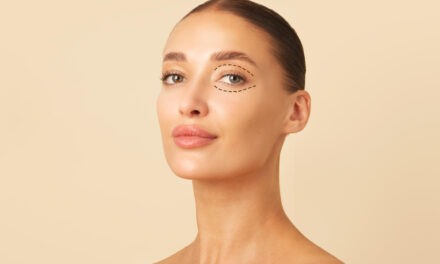
Blepharoplasty photos look easy to read: two pairs of eyes, one with heavy lids and one without. In practice, eyelids are among the hardest areas of the face to compare. A few degrees of chin tilt, a raised forehead, a different flash or a change of mood can alter how much lid shows, how much white appears under the iris and how heavy the upper fold looks, with no surgery involved.
Then add what a photograph cannot record at all: dryness, how well the lids close, and comfort. Add swelling that settles over weeks to months, a brow lift or filler done in the same season, and a gallery picked from many cases.
This page teaches the skills specific to reading blepharoplasty photos: which views to expect, how head tilt, brow tension and light move the lids, how to follow the lower lid and the brow, what the date on an “after” means, and what can hide inside it. The broader rules on consent and advertising are in the guide to reading before and after photos. What the operation changes, and what it cannot, is in the blepharoplasty guide.
What blepharoplasty photos record, and what they cannot separate
Every pair of blepharoplasty photos compresses several decisions into two rectangles. A surgeon chose the plan, a photographer chose the set-up, and a practice chose this pair from many. The American Society of Plastic Surgeons (ASPS) describes eyelid surgery as a procedure to improve the appearance of the eyelids, on the upper lids, the lower lids or both, and notes that it can address functional problems as well as appearance.
Four causes of one heavy-looking eyelid
Skin, fat, brow and lid support can each make an eye look tired, and a camera shows only the combined result. Two people with the same outline in a photograph may need different operations, which is why the caption matters as much as the image.
Hooding from lid skin versus hooding from a lowered brow
ASPS says a surgeon may recommend eyelid surgery, a brow lift or both, depending on whether the brow has dropped and how much extra skin sits on the upper lid. The American Academy of Ophthalmology’s EyeWiki notes that prominent brow ptosis may give the appearance of significant lid skin excess, and describes a manual brow-elevation test to separate the two.
Blepharoplasty photos cannot run that test. Consider a hypothetical “after” that shows a lighter upper lid: if the brow was lifted the same day, the lid skin did not do all the work. How that choice is made is covered in blepharoplasty versus brow lift.
Bags from fat, from lid laxity, or from lost volume
ASPS lists lower-lid concerns as bags under the eyes, drooping lower lids that expose white sclera below the iris, and excess skin with fine wrinkles. The EyeWiki chapter on lower blepharoplasty lists the exam findings that sort these apart: lid laxity, the relationship of the eyeball to the cheekbone, prominent fat, hollowing below the eye, tear trough deformity and loss of cheek fat.
In blepharoplasty photos, those all appear as shadow and bulge. A fat-removal result, a fat-repositioning result and a filler result can look alike, so the technique and the tools used matter. Technique detail lives in lower eyelid surgery.

Which operation the pair actually shows
“Blepharoplasty” is a family of operations, and many galleries file several under one label. Before comparing outlines, find out which maneuvers were used on the pictured case, because your reference cases should name the approach you are being offered.
Upper, lower, both, and the add-ons that travel with them
ASPS describes fat that can be removed or repositioned on either lid, skin that can be removed, and a laser or chemical peel that a surgeon may suggest to reduce lower-lid discoloration. EyeWiki adds that lateral canthopexy, a stitch that supports the outer corner of the lower lid, is often added to the skin-incision approach. Cleveland Clinic notes that both lids can be done together.
Ask for one written list per pictured case: skin, fat, muscle, lid support, laser, injectables and any brow work. The comparison of operating on one lid pair versus both is in upper versus lower blepharoplasty.
Incision placement tells you which scar to look for
ASPS says the upper-lid incision sits in the natural crease, and the lower-lid incision sits just below the lash line or, as an alternative, inside the lid (transconjunctival), where it describes no skin being removed. Cleveland Clinic says the upper incision will be hidden when the eyes are open.
So a transconjunctival case has no outside lower-lid scar to find, and it says little about how the same practice handles loose lower-lid skin. For crease and lash-line cases, a downward-gaze view and a close oblique view are worth requesting, since a healing line is easier to judge there than in a straight-on frame.
The views and settings behind trustworthy blepharoplasty photos
No single protocol governs eyelid photography. A 2025 narrative review of photodocumentation in oculoplastic surgery in the Brazilian journal Arquivos Brasileiros de Oftalmologia (Barbi and colleagues) states bluntly that there is no gold-standard protocol in facial photodocumentation. That makes a set of blepharoplasty photos only as good as its internal consistency, and the sections below show how to check it.
Views to expect in a consultation album
A strong set of blepharoplasty photos is a series of the same views repeated at dated visits. A single flattering frame, however sharp, answers no question about how the eyelids changed.
Straight-ahead gaze, level with the eyes
The review describes a primary-gaze view in which a horizontal line passes through the pupils and the apex of the ears, and uses a 100 mm macro lens at about 1 meter for periorbital views and 3 meters for the full face. EyeWiki’s brow chapter says insurers may ask for photos in primary gaze and at 45 degrees to show the brow position.
Straight-ahead is where you compare how much skin rests on the lashes and how much of the lid platform shows. It is also the frame a payer’s reviewer sees, as explained in blepharoplasty insurance.
Oblique, lateral and gaze views for the lower lid
The same review describes a 45-degree oblique view, a lateral view with the ear apex aligned to the outer corner of the eye, and up-gaze and down-gaze views for lid position. Bags, the junction between lid and cheek and the position of the lower lid against the eyeball are easiest to judge from these angles.
If a practice’s blepharoplasty photos are all straight-on frames, ask whether oblique and lateral versions exist. If you never see the lids closing, ask about that view too, since incomplete closure is a recognized problem to understand before surgery.
Head tilt, forehead tension, light and lens: settings that move an eyelid
Four settings can move an eyelid in blepharoplasty photos without any surgical change. Each is easy to check once you know to look.
Chin position can change the white below the iris
A 2021 study in Aesthetic Surgery Journal Open Forum (Vaca and colleagues) photographed 12 women aged 18 to 40 with the head tilted 15 degrees down, level and 15 degrees up. The distance from the pupil to the lower lid margin fell from 6.74 mm at chin-down to 4.66 mm at chin-up, so more white showed with the chin down. Measures of the upper lid fold and of visible lid skin between lashes and fold rose as the chin went up; the fold at the inner corner went from 4.00 to 9.08 mm.
Eyes with lower-lid bags were rated best at level tilt. The authors recommend controlling tilt when comparing before and after photos and including the tragus (the small flap in front of the ear canal) as a check. The study was small, used 2D photos of young women, and may not apply to older people or to those with hooding.
A raised forehead can hide hooding
EyeWiki advises examining brow position with the forehead relaxed, since patients often compensate by contracting the frontalis muscle. The patient-education site EyePlastics, which says its content is reviewed by oculoplastic surgeons, adds that a resting brow can sit a full centimeter lower than the position people hold during the day.
For photos, that means a “before” taken with a lifted forehead can make the brow look lower in a relaxed “after”, or the reverse. Horizontal forehead lines in one frame and not the other, a surprised look, or a changed eyebrow arch are the clues.
Light, flash and camera distance
The review warns that frontal flash gives harsh light that leaves the photo flat, and that wide-angle or normal lenses at close range distort the face; it recommends a fixed telephoto lens and a single flash bounced from the ceiling. Distortion and flatness change how deep a lid crease or a lower-lid shadow appears.
Practical checks: shadows under the brow ridge and below the lower lashes should fall in the same places, and the eye should be the same size in the frame. A selfie-distance phone shot is not comparable with the fixed set-up behind clinic blepharoplasty photos.
| Variable | How it changes the eyelids | What to compare | Question for the practice |
|---|---|---|---|
| Head tilt | Chin down shows more white under the iris; chin up shows more lid skin above the lashes | Tragus and ear level, and where the lower lid sits against the iris | How is tilt set and checked at each visit? |
| Forehead tension and brow | A lifted forehead raises the brow and can hide hooding; a relaxed brow sits lower | Forehead lines, eyebrow arch and brow position against the bony rim | Was the forehead relaxed in both frames? |
| Gaze direction | Looking up or down changes lid margin and crease visibility | Pupils aimed at the lens in both frames | Are straight, up-gaze and down-gaze views available? |
| Light direction and flash | Frontal flash flattens the lid; top or side light deepens shadow under the brow and lower lid | Shadows beneath the brow ridge and the lower lashes | Is the same lighting used before and after? |
| Lens and distance | A close wide-angle shot distorts the face and can change how large the eye region looks | Eye size in the frame and the face outline | Was a fixed lens and distance used? |
| Expression, makeup, lashes | Mood, a smile, liner, mascara or lash extensions change the visible lid line | Same makeup state, relaxed mouth, no glasses | Are these original, unedited files? |
Table 1 is a quick audit sheet for blepharoplasty photos, not a pass-or-fail test. If most rows match across a pair, the comparison means something. If three or four rows differ, the picture mostly records the photograph.

Brow position and lid support: two details that rewrite the story
Settings aside, two anatomical details change what a pair of blepharoplasty photos seems to prove. The first is where the brow sits in each frame; the second is how well the lower lid is held against the eye. Both can shift for reasons unrelated to the skill of the operation, and both can shift because of it.
Following the brow across a pair
The upper lid is read against the brow above it. If the brow moves between frames, the lid appears to change even when the lid itself did not.
Where the brow sits in each frame
EyeWiki states that the normal eyebrow sits at or above the upper edge of the bony eye socket, and that male brows tend to be lower and flatter than female brows. It adds that insurers may ask for photos at 45 degrees to show a brow below that rim.
Compare the brow against the same landmarks in both frames: the distance from brow to lashes, the position of the outer end of the brow, and the eyebrow shape. A change in brow-to-lash distance tells you more than a change in how the lid looks, and a brow lowered at the outer end in the “after” deserves a question.
What studies say about the brow after upper surgery
A 2015 chart review in the journal Orbit (Dar, Rubinstein and Perry) measured brow height on digital photographs of 19 patients after upper blepharoplasty and found insufficient evidence of a change at the inner, central or outer positions. With so few patients, that wording does not prove no change occurs, and the abstract does not state when the photos were taken.
A 2025 single-surgeon series of sub-brow skin excision in Frontiers in Surgery (49 patients, average follow-up 7.5 months) used a fixed camera set-up, yet its text was not consistent about the direction of brow movement. EyePlastics warns that eyelid surgery in someone who needs brow work can let the brow settle lower and the hooding return. Ask for relaxed-forehead frontal views at three months and at a year, and ask whether brow position was documented before the operation.
Lower-lid support, white below the iris and symmetry
The lower lid is held by tendons at the corners and by the tone of its own tissues. Photos hint at that support through what shows under the iris and how the lid meets the cheek.
White below the iris, round eyes and the lid-cheek line
ASPS lists drooping lower lids that expose white sclera among the reasons for lower-lid surgery. Cleveland Clinic lists eyelid skin folding in or out more than desired among the risks. EyeWiki describes lid retraction as a low-positioned lid tethered to the orbital rim after scarring, and ectropion as a lid that turns outward when a lax lid is left uncorrected or pulling forces go unopposed.
A 2023 case series in Plastic and Reconstructive Surgery Global Open (Klinger and colleagues) described 280 patients and a technique aimed at preventing a “round eye” from outward displacement of the outer lower lid. Surgeons not involved in the operations scored the photos, patients were followed for 10 months, and there was no comparison group. A frame showing more white beneath the iris after surgery may reflect chin-down tilt, early swelling or a change in lid position; only same-tilt photos at later dates can sort these. Risks are covered in blepharoplasty risks.
Asymmetry before surgery, after surgery and in the camera
Asymmetry is the cue most easily misread in blepharoplasty photos. Some of it is present in the “before” frame; some is a head turned slightly toward one side; some is uneven early swelling; and some is a real difference in healing or lid position. EyeWiki’s chapter on double-eyelid surgery calls asymmetry the most common complication of that operation, linking it to marking differences, unequal skin removal and uneven tension.
The lids are also linked to each other. In a 2013 review of before and after photos from 134 ptosis-repair patients in Archives of Craniofacial Surgery (Ha and colleagues), 13 of 50 unoperated lids in patients with a negative dependence test showed lower lid height afterward. That is a different operation, but it shows why a pair that changes only one side deserves a closer look at both. ASPS states that another surgery may be necessary after eyelid surgery.
| What you see in the “after” | Possible explanations | What to ask or request |
|---|---|---|
| Brow looks lower | Forehead relaxed rather than lifted; brow change after the operation; different head tilt | Relaxed-forehead frontal views at three months and a year; was brow position assessed? |
| More white below the iris | Chin-down tilt; early swelling; change in lower-lid position | Same-tilt photos at later dates; how lid support was assessed |
| Eyes look rounder or wider | Change in lower-lid shape or outer-corner position; wider camera angle | Oblique views; whether outer-corner support was part of the plan |
| Puffiness on one side only | Uneven early swelling; pre-existing asymmetry; fat differences | Dated later photos; the “before” frame in matching light |
| Crease higher or different from before | Planned crease height or shape; swelling; forehead tension | Who chose the crease and how; photos with relaxed forehead |
| Smoother skin under the eye | Laser, peel, filler or retouching in addition to eyelid surgery | A written list of every companion treatment for the pictured case |
Table 2 turns an impression from blepharoplasty photos into a question. It does not diagnose anything, and the same appearance can come from several causes in one picture.
Dates on blepharoplasty photos: what swelling and healing do to an after picture
Every “after” among blepharoplasty photos carries a date, even when the caption leaves it out. That date decides whether the picture mostly records swelling and early incision healing or something closer to a settled result.
The first weeks look different from the final result
Eyelid skin is thin, and early swelling shows. The day-by-day arc, with cold compresses, bruising stages and when to call the surgeon, belongs in blepharoplasty recovery; here the point is how it affects blepharoplasty photos.
Days 7 to 14: sutures out, swelling still visible
ASPS says sutures are removed within one week, and EyeWiki gives 5 to 7 days for non-absorbable sutures after lower-lid surgery. ASPS also says most patients are presentable to the public in 10 to 14 days. A pair taken at that point records how the patient looks when ready to be seen, not the finished eyelids.
Consider a hypothetical gallery of blepharoplasty photos that shows only two-week “afters”. The lids look tidy, but nothing in that set speaks to lid height, crease or lower-lid position months later. If a practice has only early photos, the caption should say so.
Months: when blepharoplasty photos start to mean something
ASPS says it may take a few months before final healing is completed, and Cleveland Clinic says full recovery takes a few months. No source consulted for this article gives one date at which every result is final. A 2021 study in Ophthalmic Plastic and Reconstructive Surgery (Cohen and colleagues) measured lid height on photos of 29 blepharoplasty patients before surgery, at one week and at three months.
It found that swelling at one week predicted the final lid height in the blepharoplasty group, which means a lid that sits low at one week may partly reflect swelling. The study was retrospective and small, and it did not report the degree of swelling. For a fair comparison, ask for the same patient at three months, six months and a year or more.

Scars, dryness and what a frame cannot show
Two kinds of healing are largely invisible in pictures: the slow maturing of a thin line, and the eye surface itself.
Crease and lash-line scars mature slowly
An ASPS article on judging before and after photos says incisions in general are often visible for a year or two before they fade, and that a photo with no scar only weeks or months after surgery is not normal. Eyelid incisions are placed in the crease or below the lash line so that they are hidden by the lid fold or the lashes, as Cleveland Clinic and ASPS describe.
That placement makes scars hard to see in a straight-on frame at any date. A close oblique or down-gaze photo, dated, is the fairer view, and a caption that simply promises an “invisible” scar is not.
Comfort and eye-surface problems never appear in a frame
ASPS lists swelling, bruising, irritation, dry eyes and discomfort as part of early healing, and Cleveland Clinic says eyes may feel dry for a few weeks and lists dry eyes and vision problems among the risks. None of this can be seen in a photograph of well-opened lids.
So no gallery can answer the questions that matter most for comfort. Ask the practice how it tracks dry eye, tearing and lid closure after surgery, and how it manages them. The complications themselves are explained in blepharoplasty risks.
What can hide inside the after: added procedures, injectables and editing
A technically honest pair of blepharoplasty photos can still mix several things together. The last two filters on the page concern what else happened to the eye area, and what happened to the picture itself.
Companion procedures that change the eye area
Eyelid surgery is often one part of a larger plan for the upper face, and the part that makes the visible difference is not always the one named in the caption.
Brow lift, ptosis repair and canthal support
EyeWiki says patients with lid skin excess and drooping lids should be evaluated for brow ptosis, and describes an indirect browpexy that can be done at the same time as upper blepharoplasty through the crease incision. ASPS describes brow lift as an option alone or with eyelid surgery. EyeWiki’s lower-lid chapter notes that lateral canthopexy is often added to the skin approach.
Each of these changes the eye. A brighter, more open look may come from a lifted brow, a corrected droop or a supported corner. Face-level surgery adds more; the reading skills for the cheeks and jaw are in facelift before and after, and the same head-position logic applies to the neck, as neck lift before and after explains.
Fillers, laser and peels under the eyes
ASPS says a surgeon may suggest a laser or chemical peel to reduce lower-lid discoloration. Separately, the FDA approved a hyaluronic acid filler on May 28, 2021 for temporarily reducing infraorbital hollowing in adults over 21, and the agency’s page says results may last up to 12 months.
A smoother, less shadowed under-eye in a photo may therefore come from a treatment that is temporary, or from one done in addition to surgery. Ask for the exact list per case. Reading filler pairs on their own is covered in dermal fillers before and after photos.
Edits, filters and the social-media frame
Blepharoplasty photos that reach a screen have been selected, cropped and sometimes smoothed. The problem is not only deliberate retouching; ordinary variation in how pairs are taken is large too.
Measured differences between before and after posts
A 2022 study in Ophthalmic Plastic and Reconstructive Surgery (Maamari and colleagues) analyzed 104 blepharoplasty photo pairs that 35 members of the American Society of Ophthalmic Plastic and Reconstructive Surgery posted on Instagram over four months. Brightness differed by more than 10 percent in 18 pairs (17.3 percent), magnification differed by more than 5 percent in 7, 6 pairs were more than 10 percent off-center, and color balance deviated noticeably in 22.
The authors read this as measurable inconsistency in how posts were photographed, not proof of retouching, and the abstract states no limitations. For a reader, the lesson is practical: even specialists’ social posts can differ from frame to frame, so a mismatch in brightness, size or centering is a reason to ask for the original files, not a verdict on honesty.
AI and filters: why visual tells are not enough
An ASPS article published in October 2026 lists clues such as strange skin texture, warped backgrounds and inconsistent shadows, and wavy lines or pixelation near the face. In the same article, a surgeon cautions against relying on visual tells alone, and recommends looking for a credible body of work that is consistent over time and a photo source that is a legitimate practice website rather than social media.
An earlier ASPS piece, from March 2025, notes that filters can produce effects not possible in reality, and that a polished “after” often has better lighting and skin tone than the “before.” Around the eyes, smoothing of the under-eye skin is one common filter effect. Ask the practice whether its eyelid photos are original, unedited files.
Matching blepharoplasty photos to your eyes, and judging the gallery behind them
The pictured eyes have to resemble yours, and the gallery has to deserve some trust, before either becomes useful evidence. These last filters decide how much weight any single pair carries.
Is the pictured face similar enough to learn from?
A pair is most informative when the starting anatomy is close to yours. Two people can both have “blepharoplasty” and still have little in common.
Age, skin thickness, fold anatomy and starting brow
Consider a hypothetical comparison between a 28-year-old with fat prominence and thick skin and a 68-year-old with hooding and a lowered brow. Both may be shown under one heading, and neither tells the other what to expect. Age, skin quality, fat prominence, brow position and lid laxity all steer the plan.
Fold anatomy matters too. EyeWiki’s chapter on double-eyelid surgery describes differences in how the lid’s lifting muscle attaches in eyes with and without a natural crease, explains that crease height and shape are planned choices, and warns that a high crease on an unsuitable patient can remove natural ethnic characteristics. A pair is a fair reference only if the fold anatomy and the crease goal resemble yours.
Surgeon type: plastic, facial plastic or oculoplastic
Eyelid surgery is performed by plastic surgeons and by oculoplastic surgeons, who per the EyePlastics site complete an ophthalmology residency and a one- to two-year fellowship accredited by the American Society of Ophthalmic Plastic and Reconstructive Surgery. Board certification is checkable: the American Board of Plastic Surgery offers a “Verify Certification” lookup, and the American Board of Medical Specialties offers a search for board-certified doctors.
Check that the surgeon who performed the pictured operations is the one you would see. The mechanics of verification are in how to choose a plastic surgeon, and the meaning of titles in cosmetic surgeon credentials.
| Evidence element | Stronger sign | Weaker sign | Interpretation limit |
|---|---|---|---|
| Case similarity | Many cases with ages, skin and fold anatomy like yours | Only a few young or unusually thin-skinned examples | Similar anatomy still heals differently |
| Time points | Same patient at 3, 6 and 12 months or later | Only two-week “afters” or no dates | Dates show timing, not your own healing |
| Procedure list | Written list: skin, fat, lid support, brow, laser, injectables | “Eyelid lift” with no detail | A list does not prove which step caused the change |
| Edits and consent | Stated as unedited, with patient permission | Filters, no statement, unclear permission | A statement is a promise, not an inspection |
| Complications and revisions | Candid about revision rates and how issues are handled | Only flattering cases; no mention of problems | Galleries are selected samples, not rates |
| Volume and consistency | Large body of similarly photographed cases | A few dramatic images | Volume shows consistency, not outcomes for you |
Table 3 is the gallery-level companion to the pair-level checks for blepharoplasty photos above. Treat a weak sign as a question to ask, not as proof of bad practice.
Consent, privacy and advertising rules for blepharoplasty photos
Pictures of eyes feel anonymous, but they are still medical images of a real person, and they are used to sell a service.
Permission and eyes-only crops
The U.S. Department of Health and Human Services lists “full-face photographs and any comparable images” among the identifiers in its HIPAA de-identification guidance, and the page does not define comparable images. So an eyes-only crop is not automatically anonymous. Practices that post patient images normally obtain a written release.
If you are asked to sign one, read it, ask where the photos will appear and for how long, and ask whether you can limit use to the practice’s own site. You can generally decline without any effect on your care.
Testimonials, “results not typical” and paid connections
The Federal Trade Commission’s health-products guidance, written for product advertising, says testimonials reporting results more dramatic than users can generally expect are likely to be deceptive. It says a “results not typical” disclaimer does not cure that, and that material connections between an endorser and an advertiser must be clearly disclosed.
Apply the logic to eyelid galleries: a dramatic pair should come with a plain statement of what a typical patient can expect, and a post by an influencer or a former patient who received a discount should say so. Before trusting any gallery, bring the pictures to a plastic surgery consultation as questions.
Frequently asked questions
What if a practice only has early blepharoplasty photos to show?
That is common for newer practices, and it is not a reason to rule one out. It does mean those blepharoplasty photos cannot speak to where the lids settle. Ask whether the surgeon can show dated series from earlier cases, or share the practice’s typical follow-up schedule and the point at which it judges a result. Treat any “after” at a few weeks as a record of early swelling and healing, and ask how the practice handles a result that needs adjusting.
Can blepharoplasty photos show whether dry eye or vision problems occurred?
No. A frame of open, well-shaped lids says nothing about tearing, gritty or dry eyes, how fully the lids close, or blurred vision. Cleveland Clinic lists dry eyes and vision problems among the risks of the operation. Ask the practice how often these issues occur in its own patients, how it screens for dry eye beforehand, and what it does if symptoms last. Answers should be specific, not general reassurance.
Why do my eyelids look different in a selfie than in clinic blepharoplasty photos?
A selfie is usually taken close, with a wide lens, held below or beside the face, in uncontrolled light. The photodocumentation review warns that wide-angle lenses at close range distort the face, and the head-tilt study shows that chin position alone changes the white beneath the iris. Holding a phone below the chin tilts the head down, which exposes more white under the iris. A clinic set-up fixes lens, distance, light and head position so that visits can be compared.
Do blepharoplasty photos look different for upper and lower eyelid surgery?
Often yes. Upper-lid incisions sit in the natural crease, and Cleveland Clinic says they are hidden when the eyes are open, so an upper-lid result is judged mainly by skin platform, crease and brow relationship. Lower-lid results are judged by bags, shadow and lid position against the iris, and a transconjunctival approach has no outside scar. That is why the oblique and gaze views matter more for the lower lids.
Is it normal for one eyelid to look different in early blepharoplasty photos?
Early differences between the two sides are common because swelling does not settle evenly, and many people have slight asymmetry before surgery. That does not mean either is a problem. A difference that persists after the months of settling that ASPS describes is worth raising with your surgeon, who can examine you. ASPS also states that another operation may sometimes be necessary. Photos can start the conversation, but they cannot diagnose a cause.
Should I bring my own photos to a blepharoplasty consultation?
Older photos can help. EyePlastics lists family photos from a person’s 20s and 30s showing a higher brow as one sign of brow descent, and a surgeon can compare them with how your lids sit now. Bring a few clear, unfiltered, front-facing images from different years, taken at similar distance with a relaxed face. The photodocumentation review lists medical record-keeping and preoperative planning among the uses of photos, and the surgeon will normally take standardized ones.
Are the photos an insurer asks for the same as blepharoplasty photos in a gallery?
Not exactly. EyeWiki says insurers may require visual-field testing, with and without the lids taped, and photos in straight-ahead gaze and at 45 degrees to show brow position. Those are documentation for a coverage decision, taken to a protocol the payer sets. Gallery photos are marketing and have no such protocol. EyePlastics says functional surgery is often covered when visual-field documentation supports it. The steps are in blepharoplasty insurance.
Are blepharoplasty photos cropped to the eyes anonymous?
Not automatically. HHS lists full-face photographs and comparable images as identifiers and does not define comparable images on its de-identification page. Tattoos, scars, eyebrow shape, and the surrounding setting can also make a person recognizable to people who know them. If you are asked to consent to a photo release, ask exactly what will be shown, where it will appear and whether you can have it removed later.
Sources and further reading
- American Society of Plastic Surgeons — Eyelid surgery (blepharoplasty) overview (accessed 2026-11-12) — upper and lower lid concerns, brow lift versus eyelid surgery
- American Society of Plastic Surgeons — Eyelid surgery procedure (accessed 2026-11-12) — incision placement, fat removal or repositioning, sutures, laser or peel
- American Society of Plastic Surgeons — Eyelid surgery results (accessed 2026-11-12) — presentable in 10 to 14 days, final healing in months, further surgery possible
- American Society of Plastic Surgeons — Eyelid surgery recovery (accessed 2026-11-12) — swelling, bruising, dry eyes, cold compresses, sun protection
- Cleveland Clinic — Eyelid surgery (blepharoplasty) (accessed 2026-11-12) — hidden upper incision, dry eyes, risks, full recovery in months, when to call
- Barbi et al. — Photodocumentation in oculoplastic surgery: an up-to-date overview, Arquivos Brasileiros de Oftalmologia, 2025 (accessed 2026-11-12) — views, lens and distance, flash, no gold-standard protocol
- Vaca et al. — The influence of sagittal head tilt on periorbital appearance, Aesthetic Surgery Journal Open Forum, 2021 (accessed 2026-11-12) — 12 volunteers, lower-lid and upper-lid measures by tilt, tragus check
- Maamari et al. — Quantitative analysis of preoperative and postoperative photographs posted on social media by oculoplastic surgeons, Ophthalmic Plastic and Reconstructive Surgery, 2022 (accessed 2026-11-12) — 104 pairs, brightness, size and color differences (abstract)
- Bernardini, Staiger et al. — Facial recognition pattern before and after periorbital cosmetic surgery (eye tracking), Facial Plastic Surgery Clinics of North America, 2022 (accessed 2026-11-12) — viewing order before and after surgery (abstract)
- Eye News — Effect of postoperative swelling on lid surgery outcomes, summary of Cohen et al., Ophthalmic Plastic and Reconstructive Surgery, 2021 (accessed 2026-11-12) — week-one swelling and final lid height after blepharoplasty
- Dar, Rubinstein and Perry — Eyebrow position following upper blepharoplasty, Orbit, 2015 (accessed 2026-11-12) — 19 patients, brow height on photographs (abstract)
- Wang, Li and Pang — Evaluation of morphological and psychological outcomes after sub-brow blepharoplasty, Frontiers in Surgery, 2025 (accessed 2026-11-12) — fixed photographic method, brow findings, limitations
- Klinger et al. — Surgical tips for aesthetic lower lid blepharoplasty: prevention of round eye, Plastic and Reconstructive Surgery Global Open, 2023 (accessed 2026-11-12) — 280 patients, blinded photo scoring, 10-month follow-up (abstract)
- Ha et al. — Postoperative contralateral blepharoptosis in patients with unilateral blepharoptosis and negative Hering’s law dependence test, Archives of Craniofacial Surgery, 2013 (accessed 2026-11-12) — photo review of 134 ptosis-repair patients
- EyeWiki (American Academy of Ophthalmology) — Brow ptosis and repair (accessed 2026-11-12) — relaxed-forehead exam, brow versus lid skin, insurer photos
- EyeWiki (American Academy of Ophthalmology) — Lower eyelid blepharoplasty (accessed 2026-11-12) — exam findings, techniques, retraction, ectropion, sutures
- EyeWiki (American Academy of Ophthalmology) — Asian blepharoplasty (double eyelid procedure) (accessed 2026-11-12) — crease anatomy, crease height as a planned choice, asymmetry
- EyePlastics — What is an oculoplastic surgeon? (accessed 2026-11-12) — training pathway; patient-education directory, not a society publication
- EyePlastics — Brow lift vs upper blepharoplasty (accessed 2026-11-12) — resting brow position, family photos, sequence of brow and lid surgery
- U.S. Food and Drug Administration — Recently approved devices, P110033/S053 (accessed 2026-11-12) — filler approved for infraorbital hollowing, adults over 21, up to 12 months
- American Society of Plastic Surgeons — What is reality? Determining if a before and after is too good to be true, March 11, 2025 (accessed 2026-11-12) — lighting, filters, scar timing, matching pose and makeup
- American Society of Plastic Surgeons — Can you trust that transformation? Reading before and after photos in the age of AI, October 13, 2026 (accessed 2026-11-12) — signs of editing, timing, views, source checks
- Federal Trade Commission — Health products compliance guidance (accessed 2026-11-12) — testimonials, atypical results, material connections
- U.S. Department of Health and Human Services — Guidance on de-identification of protected health information (accessed 2026-11-12) — full-face photographs and comparable images as identifiers
- American Board of Plastic Surgery — home page and Verify Certification menu (accessed 2026-11-12) — certification lookup
- American Board of Medical Specialties — Is your doctor board certified? (accessed 2026-11-12) — certification search tool