A neck lift is a surgical procedure that reshapes the area under the chin and along the jawline by tightening the muscle beneath the skin, removing or redistributing fat, and trimming loose skin. Plastic surgeons also call it a lower rhytidectomy, and you will see it described as neck rejuvenation surgery on many practice websites. People usually start researching a neck lift after noticing a softer jawline, a “double chin” that does not respond to weight loss, vertical cords that show when they talk or strain, or skin that looks crepey and loose in photographs and video calls.
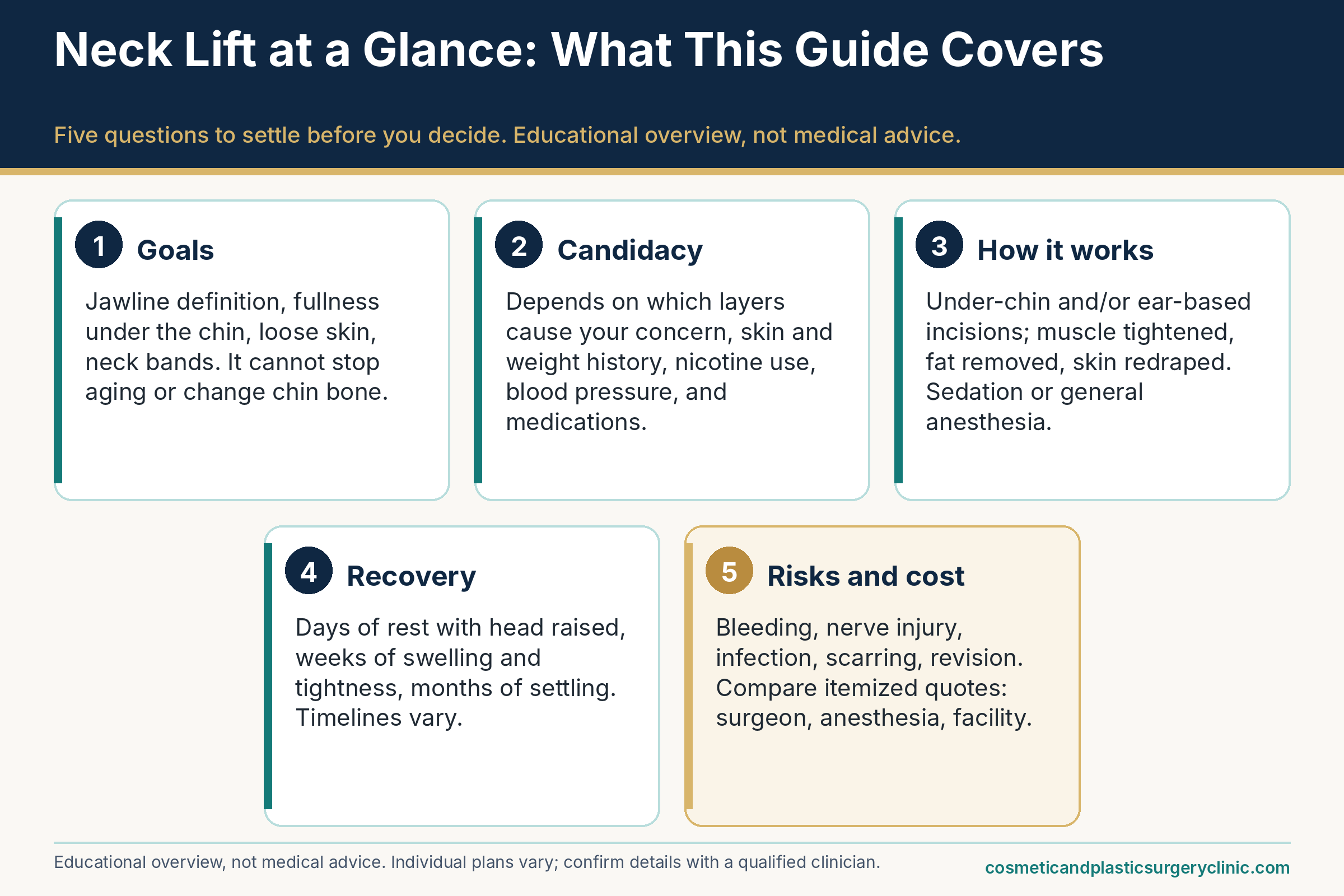
This guide is built for the person who is still deciding. It explains what a neck lift can and cannot change, how surgeons think about the layers of the aging neck, who may be a candidate, how the operation is performed, what recovery tends to involve, what the evidence says about risks and longevity, how pricing works, and which alternatives are worth comparing. It also gives you worksheets and question lists you can bring to a consultation with a qualified clinician.
The guide moves in a deliberate order. It starts with definitions and anatomy, because the vocabulary on consultation forms and price quotes is easier to compare once you know the layers involved. It then covers candidacy, the operation itself, preparation and recovery, results and scars, risks, cost and financing, and finally alternatives and the practical business of choosing a surgeon. Where the site has a deeper article on a single subtopic, such as week-by-week neck lift recovery or how neck lift techniques differ, you will find a link rather than a repeat of that article.
A few ground rules apply throughout. Everything here is general education, not a diagnosis or a recommendation for any individual. Numbers are attached to the year, population, and source they came from, and national averages are never a quote for your own care. Where research is limited or conflicting, the article says so. If you also wonder how a neck lift fits alongside a full facelift, the relevant sections explain the overlap without trying to settle which operation is right for any particular person. That judgment belongs in an in-person examination.
What a Neck Lift Is and What Changes in the Aging Neck
Before comparing surgeons, prices, or techniques, it helps to know what the operation is actually trying to change. The neck is a crowded piece of anatomy, and the visible signs of aging there come from several different layers that age on different schedules. A good consultation sorts those layers out. A poor one treats every neck as a skin problem.
Neck Lift Definition and Terminology
The American Society of Plastic Surgeons (ASPS) defines a neck lift, also called lower rhytidectomy, as a surgical procedure that improves visible signs of aging in the jawline and neck (ASPS neck lift overview). That short definition covers a surprisingly wide range of operations, from a small incision under the chin to a long incision that wraps around each ear.
Neck lift, lower rhytidectomy, and the other terms on consultation paperwork
Plastic surgery vocabulary is inconsistent, and the same operation may appear under three names on three different websites. The word rhytidectomy comes from the Greek for wrinkle, and it is the formal term for a facelift. A “lower rhytidectomy” is the neck-and-jawline portion of that family of operations, which is why ASPS uses the two names interchangeably. When a practice markets “neck rejuvenation surgery,” it is usually describing a neck lift, though the phrase can also stretch to cover liposuction alone or a combination with other treatments. Asking the office to describe the planned steps in plain language is more reliable than relying on the label.
The table below is a terminology map of the words you are most likely to meet. Treat it as a decoder for paperwork and price quotes, not as a menu of options.
| Term | Plain-English meaning | Where you may see it |
|---|---|---|
| Neck lift / lower rhytidectomy | Surgery to improve the jawline and neck by tightening deeper tissue and removing excess skin or fat | Procedure pages, consent forms, quotes |
| Platysma | The thin muscle sheet just under the neck skin that can separate or loosen with age | Operative descriptions, surgeon explanations |
| Platysmaplasty | Tightening, repairing, or repositioning the platysma muscle, often with sutures | Technique descriptions, quotes |
| Platysmal bands | Vertical cords in the front of the neck, visible at rest or when talking or straining | Consultation notes, injectable discussions |
| Submental | “Beneath the chin”; the area where a double chin or fullness sits | Incision descriptions, liposuction, injectables |
| Cervicomental angle | The angle where the underside of the chin meets the front of the neck; a flatter angle reads as less defined | Surgeon explanations, research papers |
| Jowls | Sagging tissue along the lower jaw that blurs the jawline | Consultations, facelift and neck lift pages |
| Short-scar / full-scar | Informal labels for neck lifts with shorter or longer incisions around the ear | Practice websites, technique articles |
One term deserves extra attention: “turkey neck,” or the “turkey wattle” in ASPS wording. It is a patient-friendly description of loose, banded neck skin, and it is useful for search, but it is not a diagnosis, and it does not tell a surgeon which layer is responsible. Two people can describe the same complaint and need very different operations.
The layers of the aging neck: skin, fat, muscle, and deeper structures
A 2021 review in Plastic and Aesthetic Research by Weinstein and Nahai organizes the neck into three layers, which is a helpful mental model even if your surgeon uses different language. The superficial layer is skin and the fat just beneath it. With age, collagen and elastin decline, fine wrinkles and horizontal lines deepen, skin becomes redundant, and fat can accumulate under the chin. The intermediate layer holds the platysma and the fat between its sheets. With age, the supporting ligaments loosen and the muscle can separate in the midline, producing the vertical bands many people notice. The deep layer includes fat beneath the platysma, the digastric muscles under the chin, the submandibular glands, and the bony framework of the jaw, hyoid bone, and spine. Aging in this layer can include fat accumulation, a heavier-looking gland, descent of the hyoid, and gradual loss of bone along the jaw (Weinstein and Nahai, 2021).
The same review points out that the platysma does not meet in the middle the same way in everyone, which is part of why identical-looking necks respond differently to the same technique. StatPearls, an NIH-hosted clinical reference, adds that the platysma is continuous below with the SMAS, a fibrous layer that surgeons lift and reposition during a facelift. That continuity explains why neck lifts and facelifts are so often discussed together (StatPearls cervicofacial rhytidectomy).
Why does the layered model matter to a patient? Because each layer calls for a different kind of fix. Fat under the skin can often be removed with liposuction. Bands and a blunted angle usually involve the muscle. Loose skin is trimmed or redraped. Deeper contributors, such as a prominent gland or a low-set hyoid, are not reliably changed by skin surgery and may need a different plan or a frank conversation about limits. Outside surgery, heredity, sun exposure, smoking, and body weight also influence how quickly the neck changes; MedlinePlus lists genetics, poor diet, smoking, and obesity among the factors that accelerate sagging and wrinkling (MedlinePlus facelift entry).
What a Neck Lift Can and Cannot Change
The honest scope of a neck lift is narrower than the marketing around it. It addresses specific, identifiable structural changes in a defined region. It does not make the neck look like it did at twenty-five, and it does not protect against future aging.
Concerns a neck lift is designed to address
ASPS lists four target concerns: excess fat and skin relaxation in the lower face that creates jowls, excess fatty deposits under the chin, loose neck skin, and muscle banding that creates abnormal contours in the neck. ASPS also notes that candidates often feel not ready for a full facelift because the upper face still looks the way they want, while the neck and jawline have changed more. That description captures a common reason people ask about a neck lift as its own operation (ASPS neck lift overview).
The table matches each concern with the general strategy surgeons discuss, an alternative that may be considered, and a caveat. Real plans are more individualized, and several concerns usually appear together.
| Concern | What surgery may involve | Other tools discussed | Caveat |
|---|---|---|---|
| Fullness under the chin | Liposuction through a small under-chin incision, sometimes with muscle work | Deoxycholic acid injections (FDA-approved for submental fat); weight management | Liposuction alone does not tighten loose skin or bands |
| Vertical neck bands | Platysma repair, suturing, or release through an under-chin incision | Botulinum toxin (FDA-approved for platysma bands since 2024) | Bands can recur; evidence on recurrence is mixed |
| Loose neck skin | Skin redraping and trimming, usually with incisions around the ear | Energy-based devices for mild laxity | Nonsurgical results tend to be modest and are not equivalent to surgery |
| Jowls and blurred jawline | Lower face and neck lift, sometimes within a facelift | Fillers or fat transfer to adjust volume (not for the neck itself) | Jowls often come from the lower face, which a neck-only plan may not fully address |
| Weak chin contributing to a flat angle | Chin implant or bone procedure in addition to neck work | Filler in the chin region (some products are FDA-approved for the chin) | A neck lift does not change chin bone or projection |
Limits: what surgery cannot do for the neck
ASPS is blunt on this point: a neck lift does not change your fundamental appearance and cannot stop the aging process. The tissue that is tightened today will keep aging, and the skin quality you start with sets some of the ceiling. Fine surface wrinkles, horizontal “necklace” lines, brown spots, and sun damage on the neck are mostly skin-surface problems; stretching skin tighter does not smooth them, and they are more often addressed with resurfacing or other skin treatments, which are separate decisions with their own risks.
Skeletal and positional factors are another limit. A recessed chin, a jaw that sits back, or a low hyoid bone can shape the profile in ways that tightening muscle and skin cannot fully offset. This is one reason experienced consultants often assess the profile, not just the front view, and sometimes bring up chin augmentation or other jawline procedures. It is also a reason to be cautious when a plan promises a very sharp angle in every patient.
Weight matters too. Fat that returns after weight gain can soften the contour, and substantial weight loss after surgery can leave new skin laxity. StatPearls lists anticipated weight changes among the factors that complicate planning for facelift-type surgery (StatPearls). If significant weight change is part of your near future, the timing question is worth raising before booking. Readers still weighing surgery against other routes can compare them in the separate article on alternatives to neck lift.
Finally, expectations. A realistic goal for most neck lift patients is a cleaner, more defined jawline and neck that looks like a refreshed version of their own, not a different face. Photographs and video calls can magnify the issue, because camera angles looking down at the neck exaggerate fullness. If a result is judged only by one selfie angle, almost any surgery can look disappointing, so it helps to define your goals in terms you can describe in words and verify in a mirror.
Who May Be a Candidate for a Neck Lift: Anatomy, Health, and Timing
No article can tell you that you are a candidate. That determination rests on an in-person examination, your medical history, and a frank discussion of goals. What a guide can do is lay out the logic surgeons tend to use, so that you can recognize it, test it, and notice when a consultation skips a step. For a deeper treatment of this single question, see the site’s article on whether you might be a candidate for a neck lift.
Anatomy, Skin Quality, and Goals
Candidacy starts with which structures are producing the look you want to change, and how much of the problem is fat, muscle, skin, or framework. The same complaint, such as “my neck looks old,” can trace back to quite different causes.
Matching neck concerns to the conversation you might have
Weinstein and Nahai’s layered approach offers a useful way to see how surgeons reason. In their algorithm, isolated liposuction suits younger people whose main issue is fat under the skin and whose skin still snaps back well. A submental approach, meaning a small incision beneath the chin, addresses problems in the muscle layer and deeper tissue such as bands, fat between muscle sheets, or prominent structures under the chin. Incisions around the ear come into play when there is real excess skin or when the lower face has descended, because those problems cannot be reached from under the chin alone. The authors also distinguish “apparent” skin excess, which looks like extra skin until the deeper contour is corrected and the skin redrapes, from “real” excess that needs trimming (Weinstein and Nahai, 2021).
The following scenarios are illustrative composites for education, not patients or case reports.
Consider someone in their thirties with a rounded fullness under the chin, tight skin, and no bands. Their conversation will probably begin with fat reduction rather than a lift, and it may include whether weight, genetics, or both explain the fullness. A second person in their fifties might see two vertical cords and a mild blunting of the angle but still have fairly firm skin. Their discussion may center on muscle repair through an under-chin incision, with or without liposuction. A third person, in their sixties, may notice jowls, a “waistline” of loose skin, and bands. That plan is more likely to involve incisions that extend behind the ear and possibly a conversation about a facelift or a combined procedure. A fourth might have all of those concerns plus a recessed chin, which brings profile work into the picture.
These pathways overlap and many people do not fit a single box. The practical lesson is to listen for whether the surgeon names the layers they think are responsible, shows you in a mirror or photo what they mean, and explains why a simpler option would or would not be enough.
Skin quality, weight history, and the chin-and-jaw frame
Skin elasticity is difficult to measure but easy to feel: when the skin is gently pinched and released, how quickly does it return? Surgeons use that kind of assessment, along with age, sun history, and smoking, to judge how much a given operation can be expected to tighten. Thin, sun-damaged, or heavily lined skin generally redrapes less predictably than thick, elastic skin, which is one reason two people with the same bands can be offered different plans.
Weight history is the second variable. Many surgeons prefer that weight be stable for a period before elective facial surgery, though the length of that period varies and none of the sources reviewed for this article sets a single cutoff. Fat in the neck responds to overall weight in a way that is hard to predict. Someone who has recently lost weight may have loose skin that will not tighten further, while someone who plans to lose more may see the contour change after surgery. The StatPearls review lists anticipated weight changes among the reasons to approach facelift-type surgery cautiously (StatPearls). People who have taken weight-loss medications or lost a lot of weight quickly should mention it, since the extra skin can alter what is realistic.
The chin and jaw frame is the third piece. Surgeons look at the profile because the underside of the chin forms one edge of the angle they are trying to sharpen. When the chin sits far back, tightening tissue can leave a gentler angle than the person hoped for. Some surgeons address this with a chin implant or a bone procedure, and some patients prefer to skip it and accept a more modest change. Either choice is reasonable if it is made with the profile in view, rather than discovered after surgery.
Health, Lifestyle, and When to Postpone
A neck lift is elective, which gives you the luxury of waiting until conditions are favorable. Health factors do not simply decide yes or no. They shape timing, safety planning, and the type of anesthesia and facility that make sense.
Health factors surgeons commonly weigh
ASPS describes good candidates as healthy individuals without medical conditions that impair healing, who do not smoke, and who have a positive outlook and realistic expectations (ASPS neck lift candidates page). StatPearls adds a longer list of contraindications and cautions for cervicofacial rhytidectomy: smoking, diabetes, immune compromise, steroid use, bleeding disorders, connective tissue disorders, a history of radiation to the area, and anticipated weight change. It identifies smoking as a major risk factor for skin flap necrosis and hypertension as the primary risk factor for hematoma (StatPearls).
Medications are part of the picture as well. MedlinePlus notes that people planning a facelift are asked to share their medications, supplements, and alcohol use, and that aspirin and ibuprofen are commonly stopped about a week before surgery under a surgeon’s direction (MedlinePlus facelift entry). Do not stop prescribed medications on your own; the decision belongs to the prescriber and the surgical team, who weigh the reason you take them against the bleeding risk.
| Factor | Why it matters | Question to raise |
|---|---|---|
| Smoking or nicotine use | Slows wound healing and raises the chance of skin loss and clots | How long should I be nicotine-free, and will you test for it? |
| High blood pressure | Linked with a higher chance of bleeding under the skin (hematoma) | Should my blood pressure be controlled before and after surgery? |
| Blood thinners, aspirin, supplements | Can increase bleeding | Which of my medicines and supplements need your review, and who decides? |
| Diabetes or immune conditions | Can slow healing and raise infection risk | Do I need clearance from my own physician? |
| Recent or expected weight change | Alters fat distribution and skin laxity after surgery | Should I wait until my weight is stable? |
| Prior neck or face surgery, or radiation | Scar tissue and altered anatomy change the plan | Will earlier surgery or treatment change the approach? |
| Realistic goals and support at home | Shapes satisfaction and safe recovery | What will my first week need in terms of help? |
Timing: age, life events, and readiness
There is no single “right age” for a neck lift, and age alone says little about candidacy. ASPS procedure statistics offer a picture of who tends to have the operation, not who should. In the ASPS 2025 report, member-surgeon data extrapolated with a claims dataset estimated 27,315 neck lifts in 2025, compared with 22,592 for 2024 as restated in that report, and most of them were in older age bands: about 10,689 in ages 56 to 65, 10,103 at 66 and older, and 4,706 between 46 and 55 (ASPS 2025 statistics report). The counts are procedures, not people. They also reflect who seeks out ASPS member surgeons, not a recommended age range.
Younger people sometimes ask about neck surgery because of genetics or early fullness. In that case the best option may be less invasive than a full lift, as noted above. Older adults may be excellent candidates if their health is stable and their goals are modest, but their medical history deserves extra attention, since cardiovascular and medication factors accumulate with age.
Life timing matters as much as biological timing. A neck lift commonly calls for several days of dedicated rest and several more weeks of reduced social visibility, which clashes with weddings, major presentations, job transitions, and caregiving duties. Planning the surgery for a window when you can accept visible swelling, rather than racing a deadline, usually produces a calmer recovery. The site’s neck lift recovery timeline covers the planning calendar in more detail.
Finally, ask yourself why you want the change and for whom. People who are comfortable explaining their reasons in concrete terms, such as “I want my jawline to match how I feel,” tend to approach consultations more productively than those responding to pressure from others or to a single unflattering photo. A good surgeon will ask the same question, and a good surgeon will be willing to say when waiting, a smaller step, or no surgery is a reasonable choice.
How a Neck Lift Is Performed: Approaches, Anesthesia, and Surgery Day
Surgeons have developed many variations on the neck lift, and individual practices often have signature methods. For a patient, the useful skill is not memorizing technique names. It is understanding the handful of decisions that separate one plan from another: where the incisions go, what is done to the muscle, how fat and skin are handled, and what kind of anesthesia and facility are involved. This section covers those decisions at overview level; the site’s article on how neck lift techniques differ goes deeper.
Surgical Approaches in Plain English
Think of a neck lift plan as a set of building blocks. Some plans use only one block, such as liposuction under the chin. Others stack several, such as muscle repair, fat removal, and skin trimming with incisions around the ear.
Incision strategies: under the chin, around the ear, or both
ASPS describes two broad patterns. In a traditional neck lift, the incision begins at the hairline near the sideburn, curves around the ear, and ends in the hairline behind the ear, with a separate incision under the chin typically needed. In a limited-incision neck lift, incisions may sit only around the ear; they are shorter, but ASPS cautions that the results may be more limited (ASPS neck lift procedure page). Surgeons also use the term “short scar” for incision plans that stop short of the full pattern, though definitions vary from practice to practice.
The under-chin incision, usually a small cut placed beneath the chin, gives access to the fat and the muscle at the front of the neck. The ear-based incisions allow skin to be lifted and trimmed in a direction that pulls the neck and lower face upward and backward. Which combination makes sense depends on how much skin is truly in excess, whether the jowls have descended, and whether the surgeon needs access to the muscle edges in the midline.
| Approach | Typical incisions | What it mainly addresses | Trade-offs to ask about |
|---|---|---|---|
| Liposuction alone | Small opening(s) under the chin | Fat beneath the skin | Does not tighten muscle or remove skin; skin must retract on its own |
| Under-chin (submental) neck lift | Incision beneath the chin, sometimes with liposuction | Fat, platysma bands, deeper structures | Limited reach for loose skin and jowls |
| Limited-incision (short-scar) neck lift | Around the ear, usually with an under-chin incision | Moderate skin laxity, early jowls, bands | ASPS notes results may be more limited than with longer incisions |
| Traditional neck lift | Sideburn, around the ear, into the hairline behind the ear, plus under the chin | Greater skin excess, jowls, bands, contour | Longer scars hidden in hairline and ear folds; larger recovery footprint |
| Neck lift within a facelift | Facelift incisions, with or without an under-chin incision | Lower face and neck together | Longer operation and recovery; see the facelift guide for comparison |
ASPS lists “separate under-chin incision” as typical for traditional neck lifts when liposuction and muscle work are part of the plan, and notes the shape of the final scar pattern as concealed by the hairline and ear contours. For a fuller look at the larger operation that often shares these incisions, see the site’s facelift guide.
Muscle, fat, and skin: what the technique debates are about
Most of the arguments among surgeons concern the platysma, the muscle that tends to separate in the midline with age. StatPearls describes a typical platysmaplasty: the surgeon extends the under-chin incision, identifies the inner edges of the muscle, frees the tissue beneath it, and sutures the muscle edges together in the midline, sometimes extending below the level of the hyoid bone. In some plans the muscle is also divided horizontally at the hyoid level and the cut edges are suspended, a step intended to improve the angle and reduce banding (StatPearls).
The evidence on which muscle technique lasts longest is thinner than patients might expect. A 2024 systematic review and pooled analysis of 12 studies with 2,106 patients who had platysma transection reported platysma band recurrence of about 1.4 percent, but it rated the evidence as level III and called for standardized reporting of outcomes, noting that redefining the cervicomental angle remains a controversial and complicated area of surgery (Thieme systematic review, 2024). By contrast, Weinstein and Nahai write that recurrence has been reported in over one-third of cases despite complete muscle transection, which is why they favor additional releases (Weinstein and Nahai, 2021). Those two statements do not match, and reading both together is a reminder that methods of counting recurrence, follow-up length, and patient selection differ across studies.
Fat is the second theme. Liposuction can reduce fat above the muscle, and some surgeons also remove fat between or beneath muscle layers. Weinstein and Nahai advise leaving a thin layer of fat beneath the skin to avoid contour deformities, and they warn that aggressive removal of fat beneath the muscle risks a hollowed “cobra” look. Removing a submandibular gland, which some surgeons do for a prominent gland, carries what they call a small but dangerous risk of airway compromise from bleeding beneath the deep neck fascia. Those are specialist judgments, but they show why the how and how much matter as much as the label on the procedure.
Skin is the third. After deeper tissue has been repositioned, the surgeon drapes the skin and trims what is left over. Tension on a closure can work against scars and hair; ASPS scar guidance stresses avoiding tension on healing incisions, and StatPearls lists tension among the causes of hair loss along facelift incisions, so careful closure is a quiet marker of quality. None of these debates has a universal winner. The better question for a consultation is: why this approach for my neck, what are its known downsides, and what is your plan if the bands or fullness return?
Surgery Day
Most of what patients remember about the day is logistics: arrival times, who is waiting, how they feel waking up. Knowing the shape of the day in advance lowers anxiety and helps you ask better questions.
Anesthesia, facility, and preparation before the first incision
ASPS lists intravenous sedation and general anesthesia as the choices for a neck lift. MedlinePlus explains that monitored sedation keeps you relaxed or drowsy without full unconsciousness, while general anesthesia affects the whole body and feels like deep sleep. It lists possible general anesthesia side effects that include heart rhythm problems, breathing difficulties, allergic reactions, temporary confusion especially in older adults, and, rarely, awareness during the procedure (MedlinePlus anesthesia overview). The choice depends on the extent of surgery, your health, and the surgeon and anesthesia team’s practice. It is worth asking who will provide the anesthesia and what their credentials are, as that person is not always the surgeon.
Facility matters, too. ASPS states that its members operate in accredited, state-licensed, or Medicare-certified surgical facilities (ASPS member qualifications). Accreditation organizations such as QUAD A, which has accredited ambulatory and office-based surgical facilities since 1980, publish searchable directories (QUAD A). You can verify a facility yourself before committing, and the later section on choosing a surgeon covers how.
Before anesthesia begins, the team typically confirms your identity, the planned procedure, allergies, medications taken that morning, and the time you last ate or drank. Surgeons commonly examine and mark the planned incision lines while you are awake and upright, since tissues sit differently once you are lying down. This is also the point where you can ask a final question, so write your questions down beforehand rather than trying to remember them.
The operation step by step, and the first hours afterward
According to ASPS, a neck lift involves sculpting or redistributing fat from the jowls and neck, repositioning the tissue under the neck skin, commonly tightening the platysma, often removing fat by liposuction under the chin with muscle repair done at the same time, and then redraping the skin and trimming the excess. Incisions are closed with sutures and perhaps skin glue, and sutures may be dissolving or may need to be removed after a few days (ASPS neck lift procedure page). ASPS does not specify how long the operation takes, and the sources reviewed here give no reliable figure. Duration depends on whether the plan is liposuction only, a standalone neck lift, or part of a larger operation, so ask the surgeon’s office for an estimate based on your plan.
When the surgery ends, the team usually applies a dressing. ASPS says a bandage may be placed around the face and neck to help limit swelling and bruising, and that a drainage tube may be present to carry off excess blood or fluid (ASPS neck lift recovery page). You then wake in a recovery area where nurses monitor breathing, blood pressure, nausea, and pain. Many elective facial procedures are done on an outpatient basis, but this varies with the plan, the facility, and your health, so ask what to expect.
Discharge instructions are the most important handoff of the day. They should cover how to position your head, how to manage the dressing and any drain, which medications to take and when, which symptoms need an immediate call, how to reach the team after hours, and when your first follow-up visit will occur. Ask for them in writing and have your support person listen to them with you, since anesthesia can make it hard to remember what you were told. The recovery guide linked above covers what the days after surgery usually look like.
Preparing for a Neck Lift and Getting Through Recovery
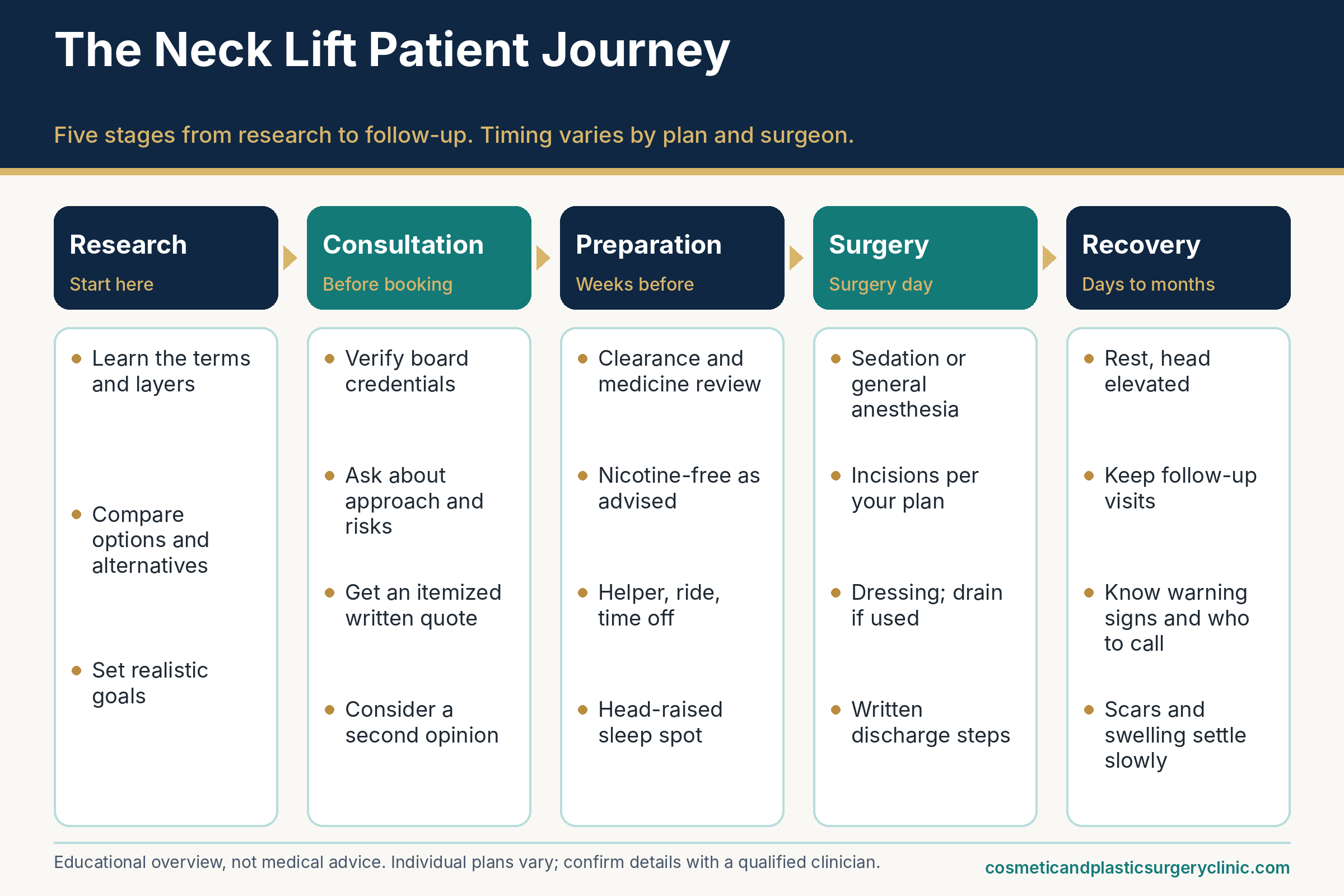
Most of the difference between a rough recovery and a manageable one comes from decisions made before the operation. The surgery itself occupies a few hours. The planning that surrounds it, including health optimization, time off, a helper, and a realistic calendar, determines how the following weeks feel.
Preparation: Medical, Practical, and Logistical
Preparation has two tracks that run in parallel. One is medical and is directed by your surgeon and any physicians who clear you for surgery. The other is practical and is yours to organize.
Medical clearance, medications, and nicotine
Before surgery, most practices review your medical history, current medications, supplements, allergies, and prior anesthesia experiences. Depending on your age and health, the surgeon or facility may ask for blood tests, an electrocardiogram, or a letter from your own physician. The sources reviewed here do not specify a standard test list for neck lift, so the right answer is whatever your surgical team and anesthesia provider require for you.
Medication handling is where well-meant guesswork causes trouble. MedlinePlus advises people preparing for a facelift to tell their care team about medications, supplements, and alcohol use, and says aspirin and ibuprofen are commonly stopped about one week before surgery under the surgeon’s instructions (MedlinePlus facelift entry). That is general information, not an instruction for you. Some blood-thinning and anti-inflammatory medicines are prescribed for serious reasons, and stopping them without guidance can be dangerous. Some herbal products and supplements can also affect bleeding, which is why surgeons ask about everything you take, including things bought without a prescription.
Nicotine deserves its own paragraph because it is the modifiable risk factor with the clearest link to neck lift complications. StatPearls identifies smoking as the most significant risk factor for skin necrosis after cervicofacial rhytidectomy, citing rates of skin sloughing of 7.5 percent in smokers compared with 2.7 percent in nonsmokers (StatPearls). MedlinePlus explains that smoking reduces the oxygen reaching a surgical wound, slows healing, and raises infection and clot risk. It recommends quitting at least four weeks before surgery and notes that stretching the gap to ten weeks lowers the risk of problems further. It also says nicotine gum is not encouraged, because nicotine still interferes with healing (MedlinePlus smoking and surgery). Ask whether your surgeon’s nicotine rules also cover vaping, patches, and gum, since the same healing concern applies, and whether testing is part of the process. The site’s smoking and plastic surgery article covers this in depth. If quitting is hard, tell your surgeon early; support exists, and surgery can wait until you are ready.
Home, work, and support: a pre-op planning timeline
The practical track starts with a helper. Most surgical facilities require a responsible adult to take you home after sedation or general anesthesia, and many surgeons want someone with you for the first night. Even if nobody requires it, help with meals, medications, and noticing changes makes the first days safer. The next questions are work and responsibilities: how many days off you will need, what you will tell colleagues, and who covers childcare, pets, or caregiving duties you normally handle.
The table lays out a planning calendar as an illustration. Your own timeline should be built with your surgeon’s instructions, which override anything here.
| When | Task | Why it matters |
|---|---|---|
| Once you decide to proceed | Stop nicotine in every form and tell the team about any difficulty | Nicotine impairs wound healing; longer nicotine-free periods help |
| Several weeks ahead | Complete any clearance visits or tests; review medicines and supplements with the surgeon | Gives time to adjust medicines safely under supervision |
| A few weeks ahead | Arrange time off, a helper, transport, and coverage for caregiving | Prevents last-minute gaps in the first week |
| One to two weeks ahead | Book hair appointments before surgery; set up a head-elevated sleep spot; stock soft foods | Hair care near incisions is restricted afterward |
| The day before | Confirm arrival time, fasting rules, and ride; prepare questions | Fasting and arrival rules protect anesthesia safety |
| The first nights after | Keep after-hours numbers handy; plan medication schedule with your helper | Quick access to the team if something changes |
Two small items prevent frequent frustrations. First, schedule hair color, cuts, and any chemical services before surgery when possible, because ASPS lists hair treatments among the items to clear with the surgeon after facelift surgery (ASPS facelift recovery). Second, think about wardrobe: button-front tops avoid pulling garments over a sore head and dressing, and loose scarves or high collars can help with privacy, as long as nothing presses on the neck.
What Recovery Generally Looks Like
This section sketches the arc. The detailed phase-by-phase version, with a symptom guide and a planning worksheet, is in the dedicated neck lift recovery timeline.
The first days and weeks
ASPS says to keep the head above heart level and straight, without much twisting or bending, and it specifically warns against applying ice to the neck because that can compromise blood flow and tissue health (ASPS neck lift recovery). That advice sits against the general instinct to ice swelling, so it is worth confirming with your own surgeon.
Published timelines for neck lift specifically are sparse, so the best public numbers come from facelift sources, which share incisions and healing behavior. MedlinePlus says bandages are generally removed within one to five days, stitches are removed in about five to seven days, swelling and bruising last 10 to 14 days or longer, and the face typically looks normal by four to six weeks after a facelift (MedlinePlus). StatPearls describes a support garment for one to two weeks, head elevation for one to two weeks, and avoiding straining and heavy lifting that could raise blood pressure, with showering allowed after 48 hours in its typical protocol (StatPearls). Those are protocols from one reference, not rules, and surgeons’ instructions can differ.
What people feel in these weeks is a combination of tightness, swelling, bruising that moves downward and changes color, numbness around the ears and under the chin, and fatigue. Pain is variable and often described as less sharp than people expect, though experiences differ and numbness can mask discomfort. A drain, if used, is a temporary fluid-management tool. Short, regular walks are commonly encouraged because reduced blood flow from immobility is one of the clot risk factors the CDC lists (CDC blood clot overview).
Months of settling and returning to normal life
After the early weeks, the changes become gradual. Swelling that is visible in the mirror turns into swelling that is felt as firmness. The neck may look better in the morning than at night. Sensation returns unevenly, and it is common to notice tingling or itching as nerves recover. If hair thinning occurs near the incisions, StatPearls notes that telogen effluvium, a temporary shedding phase, typically resolves within about six months.
Work, driving, and exercise typically return in stages. Many people with desk jobs return within weeks, while physically demanding work and vigorous exercise wait longer. The right sequence is individual, so ask for dates tied to specific activities, such as lifting a child, running, or swimming, rather than a generic “back to normal.” Travel needs forethought too, since long periods of sitting raise clot concerns and a swollen neck can make flights uncomfortable. If you live out of town, many surgeons want you near their office for a set period.
The emotional arc is part of recovery. Many people feel anxious or disappointed during the swollen middle weeks, then relieved as contours emerge. Planning a few low-key, social-media-free weeks, and agreeing with your support person on how to talk through doubts, tends to help. If low mood is persistent or severe, tell your surgeon or your own physician.
Neck Lift Results, Longevity, and Scars
Results are where expectations collide with biology. Patients want to know when they will look settled, how long the change will last, and what the scars will look like. The honest answers are ranges, trade-offs, and a few places where the published evidence runs out.
When Results Appear and How Long They Last
Results unfold in layers. The shape change from the operation is present from the start, but swelling, bruising, and tissue tightness hide it for weeks. As those fade, the contour emerges, and then slow changes in scars and sensation fill in over months.
The results timeline and what “natural-looking” means
ASPS says the visible improvements of a neck lift appear as swelling and bruising subside, with incision scars typically concealed within the hairline and the contours of the ear (ASPS neck lift procedure page). For a facelift, MedlinePlus says the face typically looks normal by about four to six weeks and notes that most people are pleased with the results (MedlinePlus facelift entry). Those are general anchors rather than neck lift milestones. A neck that has had liposuction, muscle work, and skin trimming may feel firm and look slightly uneven for longer than the bruising lasts, and the final judgment often comes months later. The companion article on neck lift results goes further into timelines.
The phrase “natural-looking” appears in almost every surgeon’s marketing, so it helps to translate it. In practical terms, it means the improvement fits the rest of the face: the jawline is defined but not stretched, the neck skin looks smooth but still moves like skin, and there is no obvious sign of tension near the ears or hairline. It is an aesthetic goal, not a promise, and it depends on a surgeon’s judgment about how much to tighten and how much volume to remove. Bringing photos of yourself from earlier years, or describing the look you want in your own words, gives the surgeon a better target than an image of someone else’s neck.
When you review a surgeon’s before-and-after photos, keep the limits in mind. Lighting, angle, posture, hair, makeup, and the time elapsed since surgery can all change how a result appears. ASPS’s consultation guidance suggests asking for documented before-and-after photos, including images taken long after surgery (ASPS consultation checklist). Results shown are examples, not predictions.
How long results last: what the evidence shows and where it is thin
No one can tell you how many years your result will last. ASPS notes that a neck lift cannot stop the aging process, so the tissues continue to change after surgery. A common way surgeons frame it is that the operation improves a particular starting point and aging then continues from there, so you will still age, but from a different baseline. That is a framing rather than a measurement.
What does the published evidence say? The best-known studies are modest in size and often come from individual surgeons or small groups. They tend to measure different things at different follow-up points, which makes direct comparison unreliable. The table summarizes several sources reviewed for this guide, along with what each can and cannot tell you.
| Source | Design and population | What was reported | Limits |
|---|---|---|---|
| Thieme systematic review, 2024 | 12 studies, 2,106 patients with platysma transection | Pooled platysma band recurrence about 1.4% | Level III evidence; authors call for standardized outcome reporting |
| Meningaud et al., Aesthetic Plastic Surgery | Prospective, 80 patients, mean follow-up about 6.5 years | No band recurrence at 5 years after total platysma transection | Small sample; authors acknowledge long operating time and a steep learning curve |
| Giampapa et al., Aesthetic Plastic Surgery, 2005 | Retrospective, 100 patients, up to 13 years | Authors reported stable corrections after suture suspension platysmaplasty | Only 6 patients at 13 years; older study of one technique |
| Weinstein and Nahai, 2021 | Narrative review of a layered approach | States recurrence has occurred in over one-third of cases despite complete transection | Expert review, not a pooled analysis; figure not directly comparable with other studies |
Read side by side, these sources do not agree on how often bands return. A pooled analysis reports a low recurrence rate; a surgeon-authored review describes a much higher one; and a small prospective series reports none at five years. Different definitions of recurrence, different techniques, different follow-up lengths, and different patient mixes could all explain the gap. The fair conclusion is that muscle-based neck contouring can hold up for years in many patients, that the exact durability is uncertain, and that optimistic numbers from single-surgeon series deserve caution.
Several things you can influence tend to matter, in general terms: stable weight, sun protection, avoiding nicotine, and realistic expectations about continuing change. Others, such as skin quality, genetics, and the way the platysma behaves, are outside your control. For this guide, the takeaway is that longevity is a range with substantial individual variation, and any surgeon who gives you a precise number of years is stating a belief, not a measured fact.
Scars and the Possibility of Revision
Every neck lift trades a visible problem for a scar. The goal is a scar that is hard to notice, but “hidden” does not mean absent, and some people scar better than others.
Where neck lift scars sit and how they mature
With a traditional neck lift, the scar follows the incision pattern ASPS describes: starting near the sideburn, tracking around the ear, and continuing behind it into the hairline, with a separate small scar under the chin if that incision is used. StatPearls notes that the area behind the ear is the most common location for problematic scarring after cervicofacial rhytidectomy (StatPearls). A limited-incision approach shortens the visible trail but carries the trade-off ASPS mentions.
Scars follow a general healing curve. An ASPS article on scar healing describes a first phase of about two weeks focused on wound protection, a second phase lasting up to roughly six months during which scars often look red and may be treated with silicone products or lasers at a surgeon’s discretion, and a maturation phase from about six months to a year as redness fades and the scar flattens. It advises avoiding direct sun on scars in the first six months and using SPF 50 or higher mineral sunscreen (ASPS scar healing article). Different organizations give slightly different sun and product advice, so follow your own surgeon’s instructions. Thickened or raised scars, called hypertrophic scars or keloids, should be shown to the surgeon, since treatments exist. The site’s neck lift scars article covers location and care in detail.
Hair is part of the scar conversation. Incisions near the temples and behind the ears can affect hair-bearing skin, and ASPS lists temporary or permanent hair loss along incisions as a risk. Ask the surgeon how they plan incision placement relative to your hairline, especially if you wear your hair short or pulled back.
Revision: when a second procedure is discussed
ASPS lists unsatisfactory results requiring revision surgery among the risks of a neck lift (ASPS neck lift safety page). Reasons that a second procedure may come up include returning platysmal bands, residual fullness, contour irregularities, asymmetry, or scars that heal poorly. Not every imperfection warrants revision, and some can be improved by waiting for swelling and scars to mature or by less invasive steps.
Surgeons commonly prefer to wait until tissues have softened before deciding, since early swelling can disguise both problems and improvements. That pause, often many months, can feel frustrating, but acting early can sometimes make things worse. When revision is considered, ask what is realistic, what the new risks are (scar tissue makes secondary surgery more complex), and who bears the costs. Policies on revision fees differ widely, and “free touch-ups” sometimes cover only the surgeon’s fee while leaving facility and anesthesia charges with you. Ask for the policy in writing before surgery, not after.
Neck Lift Risks and Complications
Every surgery carries risk, and a neck lift is no exception. Most people recover without a serious problem, but “most” is not “all,” and the people who do have a complication deserve to have been told about it in advance. This section lays out the recognized risks, the numbers that exist and why they should be read carefully, and the steps that reduce risk. The site’s dedicated article on neck lift risks and complications expands on individual events.
Known Risks and What the Numbers Show
Risk information comes in three flavors: lists of what can happen, estimates of how often, and guidance on what makes events more or less likely. Each has weaknesses, and putting them together gives a more honest picture than any one alone.
The risk list: general surgical, anesthesia, and neck-specific
ASPS lists the following risks for neck lift surgery: anesthesia risks, bleeding, facial asymmetry, a collection of blood under the skin called a hematoma, infection, numbness or other changes in skin sensation, persistent pain, poor wound healing, prolonged swelling, skin irregularities and discoloration, skin loss, suture material that surfaces or irritates, temporary or permanent hair loss along incisions, unfavorable scarring, and unsatisfactory results that require revision. Two items carry the label “rare”: nerve injury causing lower lip weakness, and deep vein thrombosis with cardiac or pulmonary complications (ASPS neck lift safety page).
It helps to sort those into groups. Some risks come with any operation under anesthesia: bleeding, infection, blood clots, and reactions to medications. Others come from the way tissue is lifted and healed: skin loss or delayed healing, prolonged swelling, scars, and contour irregularities. A third group relates to the anatomy of the neck and lower face specifically. The most discussed is injury to the marginal mandibular nerve, a branch of the facial nerve that helps move the lower lip, which can cause an uneven smile or lower lip weakness if it is stretched, bruised, or cut. A related set involves the sensory nerves that give feeling to the skin around the ear and neck, whose temporary numbness is common. A further group is specific to platysma and gland surgery: a salivary fluid collection called a sialoma was reported in the 2024 pooled analysis of platysma transection, and Weinstein and Nahai describe a rare but serious risk of airway compromise from bleeding when a submandibular gland is removed (Weinstein and Nahai, 2021).
MedlinePlus, writing about facelift, adds that nerve damage is usually temporary, a point that matters when interpreting a worrying symptom in the first weeks. It does not mean a nerve problem can be ignored. Anyone who notices a crooked smile or a lip that will not move normally should tell the surgical team promptly so they can evaluate it.
Hematoma, nerve injury, skin loss, and other figures with their caveats
Specific numbers are scarce for neck lift alone, so the figures below come from facelift references and from pooled analyses of neck contouring. They are useful for orientation and risky for prediction.
| Event | Reported figure | Source and population | Caveat |
|---|---|---|---|
| Hematoma (facelift range) | 0.2% to 8% | StatPearls review of cervicofacial rhytidectomy | Wide range reflects definitions and techniques; facelift, not neck lift alone |
| Hematoma (deep plane facelift) | 2.7% overall; 0.97% major | 2025 meta-analysis, 31 studies, 8,841 patients (via summary) | Deep plane facelift only; no adjunct clearly superior |
| Hematoma (platysma transection) | About 1.8% | 2024 pooled analysis, 12 studies, 2,106 patients | Level III evidence; heterogeneous reporting |
| Nerve injury | 0.7% to 2.5% (facelift); about 0.9% (pooled neck) | StatPearls; 2024 pooled analysis | Definitions of temporary versus permanent vary |
| Skin sloughing | 7.5% in smokers versus 2.7% in nonsmokers | StatPearls review of facelift | Underlines nicotine as a modifiable factor |
| Sialoma | About 0.3% | 2024 pooled analysis of platysma transection | Salivary fluid collection; uncommon in reported series |
Why do figures differ so much? Some studies count only hematomas that required a return to the operating room; others include any collection that needed a needle or a drain. Some include only facelifts with deep plane dissection; others mix techniques. Single-practice series, such as a 2025 retrospective report from one team on about 3,000 cervicofacial lifts over 40 years that described hematoma rates falling from roughly 3 to 4 percent historically to about 0.3 percent in recent years with a multimodal protocol, are informative about what is possible, but they cannot be assumed to apply to every surgeon (Lazzeri Domar, Botti and Botti, 2025). The reported 2025 meta-analysis found no clearly better adjunct among tranexamic acid, tissue sealants, and hemostatic nets (ReachMD summary).
The right way to use these numbers is as context for a conversation. Ask your surgeon how often hematomas, nerve problems, and revisions occur in their own practice, how they define them, and what the plan is if one occurs. A surgeon who can answer with specifics, and who is comfortable discussing complications, is giving you more useful information than one who cites a flat statistic.
Reducing Risk and Recognizing Warning Signs
You cannot remove surgical risk, but you can influence parts of it and you can learn what an early problem looks like. Acting quickly on a warning sign is the single most protective habit in the first days.
Risk factors you can change and ones you cannot
Several factors sit within your control. Nicotine in any form is the clearest, given the skin loss figures above and the wound-healing effects MedlinePlus describes. Blood pressure is another: StatPearls identifies hypertension as the main risk factor for hematoma, which is why surgeons ask whether pressure is controlled and often work to avoid spikes after surgery, such as those caused by straining or vomiting. Accurate disclosure matters too, since an unreported supplement or blood thinner can change bleeding risk. Following restrictions on lifting and head position in the early weeks protects the repair.
Choice of surgeon and facility also affects safety. ASPS members must be certified by the American Board of Plastic Surgery and operate in accredited, state-licensed, or Medicare-certified facilities, according to the society. Combining procedures can add anesthesia time, so it is reasonable to ask why each part belongs in the same session; the article on combining a neck lift with other procedures covers that trade-off. Traveling for surgery adds risk of its own. The CDC reviewed consultations from 2014 through 2024 involving travel-related cosmetic procedures and reported infections, suspected or confirmed nontuberculous mycobacteria cases, and four consultations that involved a patient’s death, with gaps in environmental cleaning, hand hygiene, and instrument sterilization found at some facilities (CDC media release, June 2026). That report covered liposuction, abdominoplasty, breast augmentation, and gluteal procedures rather than neck lifts, but the lesson about follow-up care and facility standards applies.
Other factors cannot be changed. Age, skin quality, genetics, anatomy, and the way your body forms scars are set. That is one reason risk estimates are population-level and cannot predict what will happen to a given person.
Warning signs that need a call or emergency care
Blood clots deserve a mention because they can be silent. The CDC says about half of people with a deep vein thrombosis have no symptoms; when symptoms appear, they include swelling, pain or tenderness, warmth, and redness, usually in a leg or arm. A clot that travels to the lungs, called a pulmonary embolism, can cause trouble breathing, chest pain that worsens with a deep breath or cough, a fast or irregular heartbeat, coughing up blood, lightheadedness, or fainting, and needs immediate emergency care (CDC blood clots overview).
Keep your surgeon’s emergency number where you and your helper can find it, and decide ahead of time who will call if you cannot. Calling about something that turns out to be normal is never a mistake; waiting on something that is not can be. These lists are general education, and your written discharge instructions take priority.
Neck Lift Cost, Insurance, and Financing
Price is one of the first things people search for and one of the hardest to answer honestly. A national figure tells you almost nothing about a specific quote, because the number depends on who performs the surgery, where, in what facility, under which anesthesia, and for how long. The sections below separate what the best available public figures actually cover from what they leave out, and then show how to compare real quotes. The site’s neck lift cost article carries the longer pricing discussion, and its facelift cost counterpart covers the larger operation.
What a Neck Lift Costs and Why Quotes Differ
Think of any quote as a bundle of separate charges. Two quotes with the same bottom line can contain different bundles, and two quotes with different bottom lines can describe the same care.
What national figures say, and what they leave out
The ASPS neck lift cost page gives an average of $7,885, described as coming from the society’s latest statistics; the page does not state a year. ASPS says that figure does not include anesthesia, operating room facilities, or other related expenses, and elsewhere on the page it lists the components of a total cost: the surgeon’s fee, anesthesia, the hospital or surgical facility, medical tests, post-surgery garments, and prescriptions (ASPS neck lift cost page). Read together, those statements mean the average is essentially a surgeon-fee figure and that your total could be higher.
A more recent ASPS document gives ranges instead of an average. In the society’s 2024 average surgeon and physician fees list, neck lift appears at $7,500 to $13,000, facelift at $12,000 to $19,000, and submental liposuction at $3,000 to $5,500. ASPS describes the ranges as an aggregate projection based on averages submitted by surveyed member surgeons, covering surgeon and physician fees for procedures performed by ASPS member surgeons, and as reflecting geographic and practice-setting differences (ASPS 2024 average fees document). The equivalent 2025 document returned a not-found error at the same web address when this guide was researched, so the 2024 ranges are the most recent ones verified here.
| Figure | Value | Source and year | What it covers |
|---|---|---|---|
| Average neck lift cost | $7,885 | ASPS neck lift cost page; statistics year not stated | Surgeon-fee-type average; excludes anesthesia and facility |
| Neck lift range | $7,500 to $13,000 | ASPS 2024 average fees document | Projected surgeon and physician fees from surveyed ASPS members |
| Facelift range | $12,000 to $19,000 | ASPS 2024 average fees document | Same method; a different and larger operation |
| Submental liposuction range | $3,000 to $5,500 | ASPS 2024 average fees document | Same method; fat removal under the chin only |
Several cautions follow. These are national figures drawn from member surgeons, not local prices, and they say nothing about practices outside that group. The ranges describe fees, not the total you pay once facility, anesthesia, and aftercare are added. Averages from different years and different methods, such as the single average and the later ranges above, are not comparable with each other, and neither is a prediction for your plan. If you see an unusually low price, ask what is missing from it. If you see a high price, ask what is included.
Anatomy of a quote: what to compare line by line
A complete quote should itemize the pieces. The surgeon’s fee covers the operation itself and, in many practices, routine follow-up for a set period. The anesthesia fee depends on who provides it and for how long. The facility fee covers the operating room, nursing staff, supplies, and recovery space, and it varies by whether the setting is a hospital, an ambulatory surgery center, or an office-based surgical suite. Then come pre-operative tests, garments, prescriptions, and any items your surgeon requires, such as a chin strap or specific dressings.
Plan scope changes everything. A liposuction-only plan, a submental platysma plan, and a long-incision neck lift combined with other work are different operations with different time and facility needs. Experience, geography, and demand also shape fees. Resist treating the lowest quote as the best value or the highest as proof of skill; neither is established by price alone. ASPS itself says the surgeon’s experience and your comfort with the surgeon matter as much as the final cost.
| Line item | What to ask | Why it changes the total |
|---|---|---|
| Surgeon fee | What operation is priced, and which incisions and steps does it include? | Liposuction-only and long-incision plans are different services |
| Anesthesia fee | Who provides it, which type, and is time-based billing used? | Longer or deeper anesthesia can cost more |
| Facility fee | Which facility, is it accredited, and is the fee separate? | Hospital, surgery center, and office settings price differently |
| Tests, garments, prescriptions | Which are required, and who bills them? | Small items add up and are often left out of headline numbers |
| Follow-up care | How many visits are included, and for how long? | Some quotes include routine follow-up; others bill by visit |
| Revision and complications | What happens if a second procedure or treatment is needed, and who pays facility and anesthesia? | Policies range from none to partial coverage |
| Deposits and cancellation | What is refundable, and by when? | Affects financial risk if plans change or surgery is postponed |
Ask the office to provide the quote as a document with the date, the planned procedure, and the validity period. That makes comparison between practices possible and avoids misunderstandings later. A quote that cannot be put in writing is not much of a quote.
Insurance, Taxes, and Financing
Because a neck lift is an elective cosmetic operation, most people pay out of pocket. That makes the money side of planning more consequential, and it makes the fine print on financing more important than it first appears.
Insurance and the cosmetic label
ASPS states that most health insurance plans do not cover neck lift surgery or its complications. The second half of that sentence is easy to miss and deserves attention: if a complication occurs, your health plan may decline to pay for related treatment because the original surgery was elective. Ask your surgeon how complications are handled financially, including who pays if a return to the operating room is needed, and ask your insurer what it would cover if something went wrong. If the practice offers optional complication or revision coverage, read what the policy excludes.
Tax rules are similarly strict. The Internal Revenue Service defines cosmetic surgery as any procedure directed at improving appearance that does not meaningfully promote proper body function or prevent or treat illness or disease, lists face lifts among the examples of generally nondeductible procedures, and allows an exception when surgery is needed to improve a deformity arising from a congenital abnormality, a personal injury from an accident or trauma, or a disfiguring disease (IRS Publication 502 (2025)). Whether a flexible spending or health savings account can be used is a plan-specific question for the account administrator and a tax professional. Do not assume it will be allowed.
Financing, good faith estimates, and deposits
Many practices offer or arrange financing. Some of it is straightforward installment lending; some is a medical credit card with deferred interest. The Consumer Financial Protection Bureau found that medical credit cards commonly advertise deferred-interest periods of 6 to 18 months, after which interest can be charged retroactively on the full original purchase if a balance remains. In its 2023 report, the typical medical card APR was 26.99 percent, compared with a mean of about 16 percent for general-purpose credit cards as of March 2023. The report found that about 20 percent of healthcare purchases on such cards from 2015 to 2020 incurred deferred interest, and that roughly 65 percent of enrollments occur at the provider’s location, where patients may not fully understand the terms (CFPB medical credit cards report, 2023). Those figures describe medical credit products broadly, not neck lift financing specifically.
Before you sign anything, ask for the full terms in writing, compare them with a personal loan or savings plan, and take the paperwork home. A financing offer is not a reason to book sooner, and a discount that expires tomorrow is not a medical reason to operate.
The federal good faith estimate rule may help. The Centers for Medicare and Medicaid Services says that if you do not have or use health insurance, providers usually must give you a good faith estimate of what your care will cost when you schedule in advance or ask for one, and you may be able to dispute a bill that is at least $400 more than the estimate (CMS good faith estimate overview). Whether and how that applies to a specific practice is something to confirm directly. Finally, ask about deposits: how much, what is refundable, and what happens if a medical issue delays surgery.
Neck Lift Alternatives, Choosing a Surgeon, and Making the Decision
A decision this size deserves a comparison set. Some people discover that a smaller step addresses what bothers them most. Others learn that only surgery matches their goal. Either way, the choice is better when it is made against real alternatives and with a surgeon whose credentials you have checked yourself.
Alternatives and Combinations to Compare
Alternatives fall into two groups: treatments that target one piece of the neck, and operations that change a larger area. The trade-off between them is usually degree of change against degree of commitment.
Nonsurgical and minimally invasive options, and what regulators say about them
ASPS lists several nonsurgical options that may be considered for the neck: botulinum toxin for vertical bands, fractionated laser for skin texture, dermal fillers for volume, deoxycholic acid (Kybella) for fat reduction, radiofrequency with microneedling for collagen stimulation, and ultrasound technology for fine lines and wrinkles (ASPS neck lift overview). In its facelift guidance, ASPS adds that minimally invasive treatments cannot achieve the same results as surgery but may help delay the point at which surgery becomes appropriate (ASPS facelift overview).
The regulatory status of these options differs, and the differences matter. The FDA approved a drug, deoxycholic acid, for improving the appearance of moderate to severe fullness associated with submental fat in adults; its original label warns about injury to the marginal mandibular nerve, which can cause an uneven smile or facial muscle weakness, and about difficulty swallowing, and it reports swelling, bruising, pain, and numbness as very common reactions in trials (FDA Kybella label, 2015). A botulinum toxin product, BOTOX Cosmetic, received FDA approval in October 2024 to temporarily improve the appearance of moderate to severe platysma bands in adults, and its labeling carries a boxed warning about spread of toxin effects from the injection site (BOTOX Cosmetic prescribing information). A microfocused ultrasound system was cleared by the FDA in 2013 for lifting the eyebrow and for lifting lax submental and neck tissue (FDA 510(k) summary K132028). Clearance is not the same as approval, and it reflects a determination of substantial equivalence to an existing device rather than a finding of equal results to surgery.
Fillers are a different story. FDA’s page on dermal fillers lists areas such as the nasolabial folds, perioral lines, cheeks, chin, lips, and the backs of the hands, and it does not list the neck. FDA recommends against injecting fillers into the neck, forehead, and several other areas, and it warns that accidental injection into a blood vessel can lead to tissue death, vision problems including blindness, and stroke (FDA dermal fillers page).
| Option | Main target | Regulatory status verified | Limits and cautions |
|---|---|---|---|
| Deoxycholic acid injection (Kybella) | Fat under the chin | FDA-approved for submental fullness in adults (2015 label) | Does not tighten skin or bands; nerve injury and swallowing warnings |
| Botulinum toxin (BOTOX Cosmetic) | Vertical platysma bands | FDA-approved for platysma bands in adults, October 2024 | Temporary; boxed warning on distant spread of toxin effect |
| Microfocused ultrasound | Mild laxity under the chin and in the neck | FDA 510(k)-cleared in 2013 to lift lax submental and neck tissue | Clearance, not approval; effects reported as modest and may need repeat treatment |
| Dermal fillers | Volume loss elsewhere in the face | Neck not listed among FDA-reviewed sites; FDA advises against neck injection | Vascular complications can be severe |
| Radiofrequency, microneedling, lasers | Skin texture and mild tightening | Not verified in this article; status varies by device | Weinstein and Nahai note modest effects, multiple sessions, and burn or nerve risks |
| Liposuction alone | Fat under the chin | Surgical procedure; not a drug or device approval question | Skin must retract on its own; see the chin liposuction guide |
Weinstein and Nahai write that radiofrequency and ultrasound devices often require multiple treatments to achieve modest effects and carry risks including burns and nerve injuries. A fair reading is that nonsurgical options can be reasonable for early or mild changes, for people not ready for surgery, or for those who prefer a gradual path, and that expecting them to match a neck lift sets up disappointment. The site’s article on alternatives to neck lift compares them in more depth.
Chin procedures, liposuction, facelift, and combined surgery
Among surgical alternatives, the lightest is liposuction of the chin and upper neck, covered in the site’s guide to chin liposuction. It can suit people whose main issue is fat, provided the skin is elastic enough to follow. It is a poor fit for bands or loose skin, which liposuction does not address. A chin implant or a bone procedure addresses a different structural issue: a recessed chin that flattens the neck angle. Some people are better served by that than by any amount of neck tightening, and others use it together with a neck lift.
The larger comparison is with a facelift. ASPS describes a facelift as treating relaxed facial skin, deepened nasolabial folds, displaced facial fat, jowls, and loose skin and excess fat of the neck. In ASPS’s framing, the neck is addressed as part of the facelift, while the neck lift is the better fit for people who like their upper face but see neck and jawline changes. A rough way to think about it: if the concerns sit mainly below the jaw, a neck lift or a smaller step may be enough to discuss, and if the concerns extend to the cheeks, midface, and nasolabial folds, a facelift enters the conversation. That is a general orientation, not advice. The facelift guide covers the larger operation and what it includes.
ASPS notes that neck lifts are often combined with other procedures such as a brow lift, fat transfer, or eyelid surgery. Combining reduces the number of recoveries and can be efficient, but it lengthens the operation and widens the recovery footprint. Reasons to combine are practical (one downtime period, shared anesthesia), while reasons to separate are safety-related (shorter anesthesia, a smaller wound area) or emotional (a smaller commitment). Ask your surgeon why they would or would not combine procedures for you, and read the site’s article on combining neck lift with other procedures for the trade-offs.
Choosing a Surgeon and Making the Decision
The surgeon matters more than the technique name. Neck lift outcomes depend on judgment about how much to tighten, how much to remove, and what to leave alone, and judgment is learned through training and repetition.
Verifying credentials and the facility
In the United States, the American Board of Plastic Surgery (ABPS) certifies plastic surgeons, and its website offers a public search by name or location. ABPS describes certification as voluntary, notes that certificates issued since 1995 are valid for 10 years and require meeting renewal requirements, states that an active, unrestricted license is a requirement of certification, and displays an alert pointing to the Federation of State Medical Boards (FSMB) when it receives notice of state medical board action (ABPS certification verification). Use it yourself rather than relying on a practice’s description. ASPS membership requires ABPS certification, at least six years of surgical training including a minimum of three in plastic surgery, annual continuing education that includes patient safety, and operating in accredited, state-licensed, or Medicare-certified facilities, and the society cautions patients about certifications that use the words “cosmetic surgery” (ASPS member qualifications).
Facial plastic surgery is also practiced by surgeons trained in otolaryngology, and some of them perform neck lifts. The American Board of Facial Plastic and Reconstructive Surgery says its credential requires an approved residency in otolaryngology or plastic surgery, prior certification by a board recognized by the American Board of Medical Specialties or the Royal College of Physicians and Surgeons of Canada, a two-day examination, and a peer-reviewed record of at least two years of clinical experience that includes at least 100 facial plastic surgeries (ABFPRS credential FAQ). The ABMS offers a free tool for confirming ABMS board certification in any specialty (Certification Matters). Whatever the specialty, you can ask which board certified the surgeon, in what year, and how many neck lifts they perform.
Verify the facility separately. If the surgery is outpatient, ask for the name of the facility and check its accreditation. QUAD A, for example, offers a searchable directory of accredited facilities. The site’s guide to choosing a plastic surgeon expands on credential checks and red flags.
Consultation questions and a decision worksheet
Go to consultations with a written list and ask the same questions at each. ASPS’s consultation checklist includes whether the surgeon is board certified by the American Board of Plastic Surgery, how often they perform the procedure, what the risks are, what alternatives exist, whether the surgeon will personally perform the entire procedure, what recovery entails, whether you can see results with long-term follow-up photos, and how complications and dissatisfied patients are handled (ASPS consultation checklist). For a neck lift, add questions such as these:
- Which layers do you think are responsible for my concerns, and can you show me on my own neck?
- Would a smaller procedure be reasonable, and what would you expect it to leave unchanged?
- Where will my incisions be, and how do you plan for my hairline?
- What do you do with the platysma, and what happens if bands return?
- Which complications have you managed in neck lift patients, and how do you define them?
- Who provides anesthesia, and where will surgery take place?
- What is included in the quote, and what is your policy on revision and its costs?
- Who do I call after hours, and where do I go in an emergency?
Weigh the answers, not just the personality. Warning signs include pressure to book quickly, claims that results are certain, reluctance to discuss risks, no written quote, or reliance on social media popularity in place of verifiable training. A consultation should leave you better informed even if you decide not to proceed. Taking time, seeking a second opinion, and letting a decision sit are normal and sensible. The site’s article on neck lift consultation questions provides a longer list.
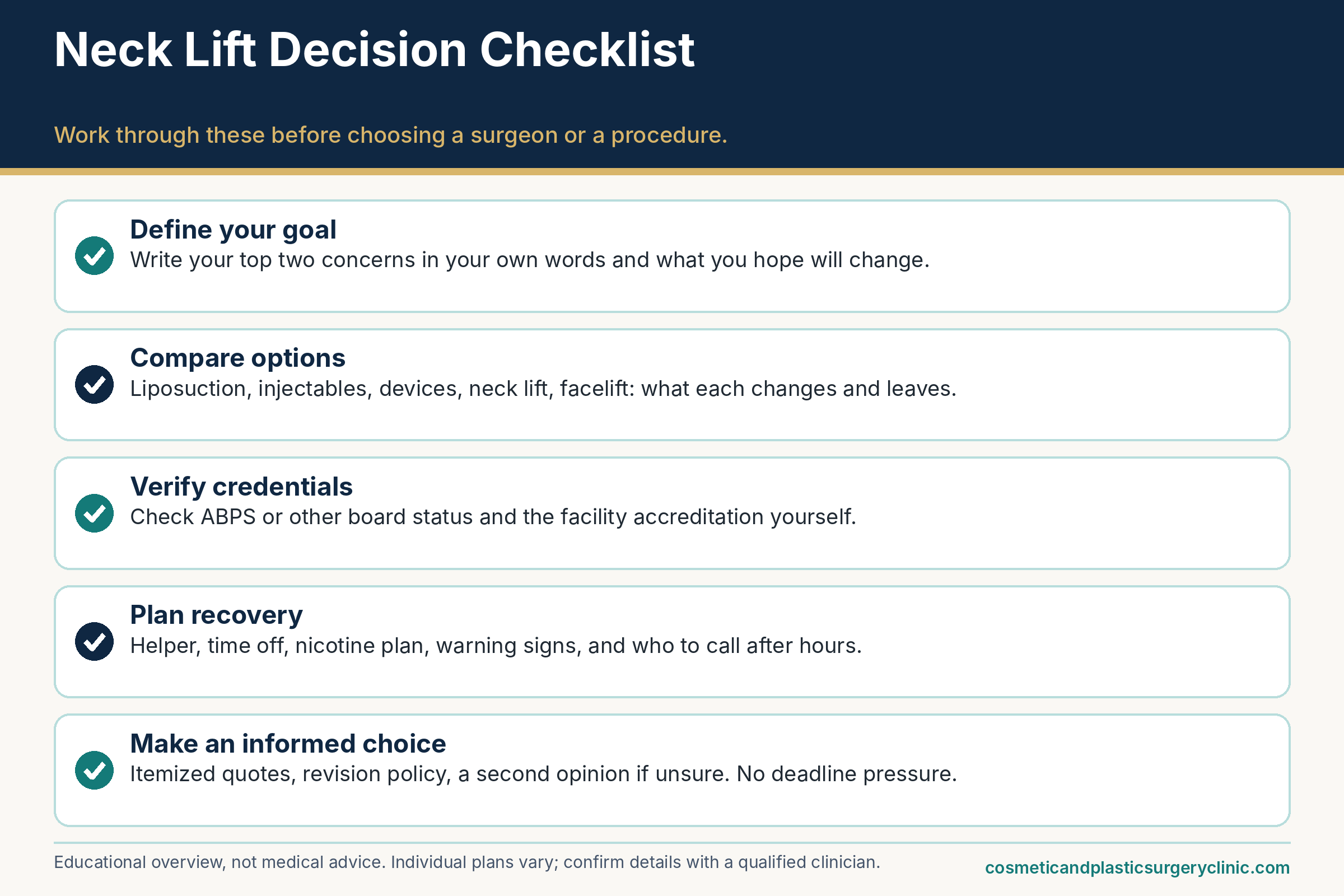
A simple worksheet can organize the decision: write down your top two concerns in your own words, what each option you have considered would change and not change, the recovery you can realistically accommodate, the total cost including facility and anesthesia, and the credentials you have verified. If one column is blank, you are not ready to decide, and that is useful information.
Frequently asked questions about neck lift
How long does neck lift surgery take?
No source reviewed for this guide gives a dependable duration, and ASPS does not state one. The time depends on the plan: liposuction alone is a smaller operation than muscle repair with long incisions, and a neck lift performed as part of a facelift takes longer still. Anesthesia time and preparation add to the total in the facility. Ask the surgeon’s office for an estimate tailored to your plan, including how long you should expect to be at the facility from arrival to discharge, so your helper can plan the day.
What is the difference between a neck lift and a facelift?
A neck lift focuses on the jawline and neck, while a facelift usually treats the cheeks, nasolabial folds, jowls, and neck together. ASPS describes the facelift as addressing facial skin relaxation, fat displacement, jowls, and loose neck skin, and it describes the neck lift as a separate option for people whose upper face still looks the way they want. The operations share incisions and recovery features, and surgeons often combine them. Which one fits depends on where the changes are and how much of the face you want addressed.
Can a neck lift get rid of a double chin?
It can address one kind of double chin, but not every kind. Fullness caused by fat directly under the skin may respond to liposuction, which is often part of a neck lift. Fullness caused by loose skin, separated muscle, a prominent gland, or a recessed chin needs different steps, or may only partly improve. Weight also matters, since fat can return with weight gain. A surgeon can examine the neck and explain which cause seems most likely, and may mention nonsurgical fat-reduction injections as a milder option for suitable cases.
Can a neck lift remove horizontal lines on the neck?
Horizontal “necklace” lines are largely a skin-surface issue, and stretching skin tighter does not reliably erase them. A neck lift may soften their appearance when it changes the underlying tension, but results vary and lines can persist. Treatments aimed at skin texture, such as resurfacing lasers or other skin procedures, are separate decisions with their own risks and recovery. Ask the surgeon specifically whether your lines are expected to change, and ask to see their results with a similar concern, taken after enough time has passed to judge.
Can I have a neck lift after major weight loss or while taking weight-loss medication?
Often the question is timing rather than eligibility. StatPearls lists anticipated weight changes among the factors that complicate facelift-type surgery, because shifts in weight change both fat and skin tension after surgery. Many surgeons prefer a stable weight before operating, and you should tell the surgical team about any weight-loss medication, since teams ask about every medication you take. If you are still losing, a surgeon may recommend waiting. If you have already lost a large amount, extra loose skin may change what operation makes sense.
Is a neck lift safe for people over 65?
Age alone does not decide it. ASPS’s 2025 report estimated 10,103 neck lifts in people 66 and older, a group that is a large share of the total, which shows that older adults do have the operation. What matters is overall health: heart and lung conditions, blood pressure, diabetes, medications, and how someone tolerates anesthesia. MedlinePlus notes that temporary confusion after general anesthesia can occur, especially in older adults. A thorough medical evaluation before surgery, and a plan for help at home, are the practical safeguards.
Do men have different considerations for a neck lift?
Often, yes. Facial hair, hairline position, and thicker skin affect where incisions can be hidden and how scars look, so it is reasonable to ask a surgeon how their plan handles beard-bearing skin and the hairline near the ears. In ASPS’s 2025 report, most counted neck lifts (23,836 of 27,315) were in women, so it is sensible to ask a surgeon how much experience they have with male patients. Men may also have different expectations about how visible scars and tightness should be, so describe the look you want in your own words and ask to see examples of similar anatomy.
If my neck bands only show when I talk or strain, do I need surgery?
Not necessarily. Bands that appear with muscle activity are called dynamic bands, and bands that are visible at rest are static. Weinstein and Nahai classify them separately and plan differently. In October 2024, FDA approved a botulinum toxin product for adults with moderate to severe platysma bands, so an injectable approach exists for some people, although it is temporary and carries a boxed warning about spread of toxin effect. Surgery is a bigger commitment, and many people reasonably begin with a consultation to understand the options.
Should I get a second opinion before booking?
A second opinion is a normal part of choosing elective surgery, and a good surgeon will not take offense. It is useful when two consultations suggest different operations, when quotes differ widely, or when you feel rushed or unsure. Bring your photos, the written quote, and a list of the questions you asked. Compare the explanations of what is causing your concern, what each surgeon proposes, and how they discuss risk. Differences in plans are information, not necessarily a sign that one surgeon is wrong.
Will my surgeon perform the entire operation?
Ask directly, because teams differ. Surgical assistants, nurses, anesthesia providers, and sometimes trainees take part in many operations, and that is not unusual in itself. What matters is that you know who performs which steps, who provides anesthesia, who will manage your care if a problem arises, and whether your surgeon will personally see you at follow-up visits. ASPS’s consultation checklist includes this question explicitly. Get the answer in writing if it influences your decision, and make sure the quote reflects it.
Sources and further reading
- American Society of Plastic Surgeons — Neck lift overview (accessed 2026-10-04) — definition, concerns addressed, limits, nonsurgical options, combinations
- American Society of Plastic Surgeons — Neck lift candidates (accessed 2026-10-04) — healthy nonsmokers with realistic expectations
- American Society of Plastic Surgeons — Neck lift procedure (accessed 2026-10-04) — anesthesia, incision types, surgical steps, closure
- American Society of Plastic Surgeons — Neck lift recovery (accessed 2026-10-04) — bandage, drain, head position, no ice on the neck
- American Society of Plastic Surgeons — Neck lift safety (accessed 2026-10-04) — listed risks, including rare nerve injury and clots
- American Society of Plastic Surgeons — Neck lift cost (accessed 2026-10-04) — $7,885 average (no year stated), exclusions, insurance remarks
- American Society of Plastic Surgeons — 2024 average surgeon/physician fees (accessed 2026-10-04) — neck lift, facelift, and submental liposuction fee ranges
- American Society of Plastic Surgeons — Plastic Surgery Statistics Report 2025 (accessed 2026-10-04) — neck lift and facelift counts, age bands, methodology
- American Society of Plastic Surgeons — Facelift overview (accessed 2026-10-04) — facelift scope, neck involvement, limits, nonsurgical alternatives
- American Society of Plastic Surgeons — Facelift recovery (accessed 2026-10-04) — recovery questions, including hair treatments and exercise
- American Society of Plastic Surgeons — What to expect as a scar heals (accessed 2026-10-04) — scar phases and sun protection
- American Society of Plastic Surgeons — Your consultation checklist (accessed 2026-10-04) — questions for the consultation
- American Society of Plastic Surgeons — Member qualifications (accessed 2026-10-04) — board certification, training, facility standards
- StatPearls (NCBI Bookshelf) — Cervicofacial Rhytidectomy, updated March 2026 (accessed 2026-10-04) — platysmaplasty, contraindications, complication ranges, postoperative care
- Weinstein AL, Nahai F — A layered approach to neck lift, Plastic and Aesthetic Research 2021;8:11 (accessed 2026-10-04) — layered anatomy, treatment algorithm, recurrence and risk comments
- Thieme — Neck Lift to Treat Platysma Bands and Defining Cervical Angle: A Systematic Review and Pooled Analysis (2024; accessed 2026-10-04) — pooled recurrence, nerve, hematoma, and sialoma figures (abstract)
- ReachMD — Systematic review examines hematoma reduction techniques in facelifts (accessed 2026-10-04) — summary of a 2025 deep plane facelift meta-analysis
- Springer — Lazzeri Domar N, Botti G, Botti C. Step-by-Step Guide to Hematoma Prevention After Rhytidectomy, Aesthetic Plastic Surgery (2025; accessed 2026-10-04) — single-practice hematoma experience (abstract)
- PubMed Central — Meningaud JP et al. Facelift: Assessment of Total Platysma Muscle Transection to Prevent the Recurrence of Platysmal Bands, Aesthetic Plastic Surgery (accessed 2026-10-04) — 80-patient prospective series with 5- to 8-year follow-up
- Springer — Giampapa V et al. Long-Term Results of Suture Suspension Platysmaplasty for Neck Rejuvenation: A 13-Year Follow-up Evaluation, Aesthetic Plastic Surgery (2005; accessed 2026-10-04) — long-term follow-up of one technique (abstract)
- U.S. Food and Drug Administration — Kybella (deoxycholic acid) prescribing information, 2015 label (accessed 2026-10-04) — approved indication, warnings, adverse reactions
- AbbVie — BOTOX Cosmetic prescribing information (revised October 2024; accessed 2026-10-04) — platysma band indication and boxed warning
- Healio — FDA approves Botox Cosmetic for platysma bands (October 21, 2024; accessed 2026-10-04) — approval date report
- U.S. Food and Drug Administration — Dermal fillers (soft tissue fillers) (accessed 2026-10-04) — reviewed sites, neck not listed, vascular risks
- U.S. Food and Drug Administration — 510(k) K132028, Ulthera System (decision December 11, 2013; accessed 2026-10-04) — indications for lifting lax submental and neck tissue
- MedlinePlus — Facelift (accessed 2026-10-04) — risks, medications before surgery, drains, swelling, results
- MedlinePlus — Smoking and surgery (accessed 2026-10-04) — wound healing, clots, quit timing
- MedlinePlus — Anesthesia (accessed 2026-10-04) — types of anesthesia and side effects
- Centers for Disease Control and Prevention — Blood clots: signs and symptoms (accessed 2026-10-04) — DVT and PE symptoms, risk factors
- Centers for Disease Control and Prevention — Adverse outcomes linked to travel-related cosmetic procedures (June 2026; accessed 2026-10-04) — infections and facility lapses in travel-related cosmetic surgery
- American Board of Plastic Surgery — Verify certification (accessed 2026-10-04) — public certification lookup, renewal, FSMB alert
- American Board of Medical Specialties — Certification Matters (accessed 2026-10-04) — free ABMS board certification search
- American Board of Facial Plastic and Reconstructive Surgery — ABFPRS credential FAQ (accessed 2026-10-04) — requirements for the facial plastic surgery credential
- QUAD A — About us (accessed 2026-10-04) — accreditation of surgical facilities, accredited facility directory
- Internal Revenue Service — Publication 502, Medical and Dental Expenses (2025; accessed 2026-10-04) — cosmetic surgery deduction rules
- Consumer Financial Protection Bureau — Medical credit cards and financing plans (May 2023; accessed 2026-10-04) — deferred interest, APR, enrollment findings
- Centers for Medicare and Medicaid Services — Good faith estimate (accessed 2026-10-04) — estimates for patients who do not use insurance, dispute threshold