People who research upper vs lower blepharoplasty usually begin with a photograph of their own face, not with anatomy. One person sees a fold of skin resting on the lashes and a heavy, tired look. Another sees puffiness under the eyes that no amount of sleep changes. Both say “my eyelids,” and both may be told they need blepharoplasty, yet the operations behind that one word work on different structures, rely on different support and carry different risks.
This page owns one decision: whether the upper lids, the lower lids or both belong in a surgical plan, and what to ask so the choice follows anatomy instead of a price list. It is general education, not a verdict on any face. The umbrella topic lives in the blepharoplasty overview; this article stays on comparing upper vs lower blepharoplasty.
Upper vs lower blepharoplasty: what each operation is built to treat
Think of the eyelids as two different pieces of architecture. The upper lid is a mobile curtain with a lifting muscle, a firm plate and a crease. The lower lid is a thinner sling that rests against the eye and relies on tendons at the corners for tension. An upper vs lower blepharoplasty comparison starts there, because surgery on a curtain and surgery on a sling raise different questions.
Which concerns sit on which lid
Upper lids: hanging skin, fat pockets and the brow above
The American Society of Plastic Surgeons (ASPS) describes upper eyelid surgery as treating loose or sagging skin that creates folds or disturbs the natural contour of the lid, sometimes impairing vision, along with fatty deposits that look like puffiness. The StatPearls chapter on upper eyelid blepharoplasty (Patel and Malhotra, updated July 2023) calls the skin and muscle laxity dermatochalasis and the fat prominence steatoblepharon, and says both are usually noticed in the fourth decade.
Two look-alikes matter. ASPS notes that drooping upper lids can come from relaxed forehead skin and eyebrows, and that drooping from a stretched lifting muscle is called eyelid ptosis, which “requires a different surgical treatment.” EyeWiki, a reference written by ophthalmologists under the American Academy of Ophthalmology, lists brow position, concurrent ptosis and dry eye among the pre-operative checks, and says significant brow ptosis may need a concurrent brow lift because brow position can worsen upper-lid changes.
So when a surgeon says the problem sits above or behind the lid, the brow-lift or ptosis conversation comes before the upper vs lower blepharoplasty one. The blepharoplasty vs brow lift article covers that boundary in detail.
Lower lids: under-eye bags, loose skin and the tear trough
ASPS lists the lower-lid concerns as excess skin with fine wrinkles, fatty deposits that look like bags, and drooping lower lids that expose the white of the eye below the iris. The Oculofacial Society (ASOPRS) says in a 2025 patient page that lower eyelid bags are often caused by fat pushing forward under the skin, and that aging, sun exposure, loss of cheek volume, loose skin and chronic allergies can make them look worse.
EyeWiki’s lower-lid indications run wider still: skin laxity, relative fat prominence, a pronounced groove between lid and cheek, volume loss in the cheek, malar mounds or festoons, and asymmetry. That list explains why lower-lid planning is rarely a single step. A bag from fat, a groove from volume loss and a sag from lax skin can share one eye, and each points to a different maneuver.
Why one word hides two different jobs
Support and thickness: the anatomy gap
The StatPearls chapter by Rebowe and Runyan (updated July 2023) puts the tarsal plate, the firm plate inside each lid, at about 10 mm tall in the upper lid and about 4 mm in the lower. It counts two fat pads behind the upper septum and three behind the lower, and notes that the nasal pad looks distinctly whiter than the others. The upper chapter adds that upper eyelid skin is about 850 microns thick, a reminder of how little tissue is involved.
A smaller plate and a tendon-dependent sling are one reason surgeons test lower-lid laxity before removing any skin. EyeWiki notes that ectropion, an outward-rolling lower lid, can occur when a lax lower lid is left uncorrected. The upper lid has its own limit, how much skin can go before the eyes struggle to close, but the lower lid adds a support question on top. That is part of why upper vs lower blepharoplasty is not simply the same operation done twice.
What neither operation changes
Several things people hope to fix sit outside both operations. Discoloration, fine surface wrinkles, brow position, true ptosis and the hollow beside the nose are different problems. ASPS says a surgeon may suggest a laser or chemical peel for lower-lid discoloration, which implies that incisions alone do not address it. The Aesthetic Society describes hyaluronic acid filler for the tear trough as giving results that are “varied” and last about six months.
This matters when comparing upper vs lower blepharoplasty, because a person whose real complaint is a dark hollow, not a bag, may be quoted for the wrong operation. Bring the exact complaint to the consultation, not only the procedure name.
| Factor | Upper lids | Lower lids | Basis |
|---|---|---|---|
| Typical indication | Hooding from excess skin, upper-lid fat pockets, sometimes blocked upper vision | Bags, loose skin, volume change, sometimes lid malposition | ASPS; StatPearls; EyeWiki |
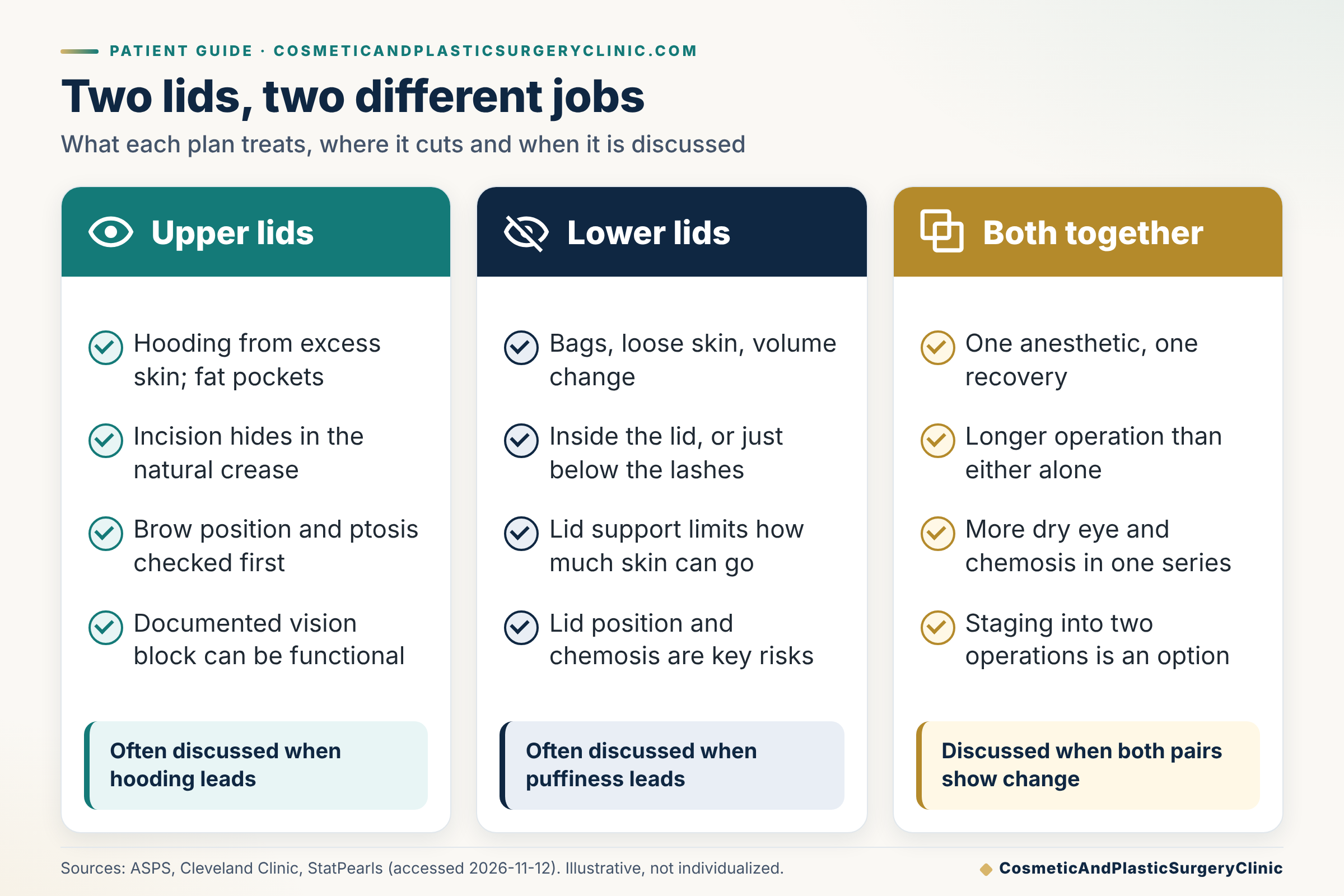
| Incision | Within the natural crease | Just below the lashes, or inside the lid with no skin cut | ASPS; Cleveland Clinic |
| Invasiveness and support | Skin, sometimes muscle and fat; firm 10 mm plate | Skin, fat, sometimes lid tightening; 4 mm plate, tendon-dependent | StatPearls |
| Scars and downtime | Crease scar; most people back to routine in 1 to 2 weeks | Lash-line scar or none; 1 to 2 weeks in ASOPRS wording | ASOPRS 2025; Cleveland Clinic |
| Reversibility | Not reversible; removed skin cannot be put back | Not reversible; removed fat or skin cannot be put back | ASOPRS 2025; general surgical principle |
| Maintenance | Aging continues; touch-ups possible | Durability described as questionable in one chapter | StatPearls lower-lid page |
| Risks that lean this way | Early lid-closure gap, dry eye, crease asymmetry | Lid pulled down or rolled out, chemosis, a registry strabismus signal | StatPearls; ASPS; Oke 2024 |
| Cost logic | ASPS 2024 surgeon-fee range $3,000 to $5,500 | ASPS 2024 surgeon-fee range $3,709 to $6,500 | ASPS 2024 statistics; fees only |
Upper vs lower blepharoplasty: incisions, anesthesia and operating time compared
The two operations differ most visibly in where the cut goes and what lies beneath it. The patterns below come from society, hospital and journal pages; a surgeon’s plan for a specific face can differ from any of them.
Where the incision goes and what it reaches
Upper lids: the crease and what lies beneath it
ASPS says the upper eyelid can be corrected through an incision within the natural crease, and that through it the surgeon can remove or reposition fat, tighten muscles and remove excess skin. Cleveland Clinic adds that the cut is hidden when the eyes are open. The Aesthetic Society describes the same hidden-fold incision and lists skin, muscle and fat as the tissues that may be removed.
How much is removed varies. A 2025 retrospective study in Aesthetic Plastic Surgery by Viscardi and Giordano reviewed 386 consecutive patients who had upper blepharoplasty at Turku University Hospital in Finland between 2015 and 2017. Of these, 335 had skin removed alone and 51 also had orbicularis muscle and fat pads treated. Skin-only surgery averaged 60.2 minutes against 72.2 for the larger version, and patient satisfaction on a 0 to 10 scale was 8.3 for the larger version against 7.0.
The groups were not alike: the larger-resection group was younger and had more smokers, and the study was neither randomized nor large. It compares two upper-lid techniques, not upper vs lower blepharoplasty, so it shows only that “upper” is itself a family of choices. EyeWiki adds a planning rule: leave at least 20 mm of skin between the lid margin and the brow skin, and generally leave the orbicularis muscle intact to reduce dry eye risk.
Lower lids: inside the lid or just below the lashes
ASPS describes two routes. One is an incision just below the lower lash line, through which excess skin is removed and fat can be repositioned or taken out. The other, a transconjunctival incision, is made on the inside of the lower lid and redistributes or removes fat without removing skin. The Aesthetic Society adds a skin-pinch option that removes only a small amount of skin and suits strong lower-lid support with little excess skin.
EyeWiki calls the inside route a great option for people who have fat prolapse without excess lower-lid skin. For the skin route it advises removing a conservative amount of skin to avoid shortage of the front layer of the lid, and says retraction may be more common when the septum is violated from the front. ASOPRS says the inside route leaves no visible scar. The trade-off is simple: with no skin cut there is no skin tightening either. The lower eyelid surgery article takes the technique menu apart in depth.
The inside route has no upper-lid counterpart, and that is one of the clearest differences when comparing upper vs lower blepharoplasty. An upper lid with excess skin has to be cut through skin, while a lower lid with only a fat bag may not need any skin cut at all.
Anesthesia, time and doing both in one session
Sedation, local anesthesia and the length of the operation
ASPS lists intravenous sedation or general anesthesia as the options. The Aesthetic Society describes local anesthesia to numb the area, and StatPearls describes upper-lid surgery under local anesthesia with or without sedation, topped up as needed. Cleveland Clinic describes local anesthetic around the eyes, numbing drops and a sedative through a vein, and says the operation takes 30 minutes to two hours, closer to two hours for upper and lower lids together, and it is outpatient.
These pages disagree because settings and practices differ. For either lid, anesthesia and facility are safety topics, not price lines, so ask who will deliver the anesthesia, where the operation will take place and how it is monitored. The how to choose a plastic surgeon article explains how to verify credentials and accredited facilities.
What a combined session adds
A single-surgeon series in Archives of Facial Plastic Surgery (Prischmann and colleagues, 2012) reviewed 892 blepharoplasties performed between 1999 and 2009. Dry eye symptoms were reported by 26.5% of patients and chemosis, swelling of the membrane over the white of the eye, by 26.3%. Both were more common when upper and lower blepharoplasty were done together (P less than .001) and with skin-muscle flap lower-lid surgery. Canthopexy, a lid-tightening stitch, raised the risk of chemosis (P = .009).
That series is retrospective, from one surgeon, with symptoms recorded from charts, so it describes associations, not proof that combining causes harm. Still, it is the clearest published signal that upper vs lower blepharoplasty has a combined case with its own profile. Combining means one anesthetic, one recovery and a longer operation; staging means two. No source opened compares staged with combined plans, so the order, and whether to split, is a question for the surgeon.
Recovery, scars and revision after upper vs lower blepharoplasty
None of the sources opened compares recovery after upper vs lower blepharoplasty head to head. What exists are parallel descriptions, and they are similar in headline and different in detail.
Downtime and the healing clock
Upper-lid ranges, and one measured number
ASOPRS says in its 2025 patient page that cold compresses help for the first few days and that most people return to normal activities in one to two weeks. Cleveland Clinic gives most people “a week or two” before their usual routine, dry eyes for a few weeks and full recovery over “a few months,” with stitches in about a week. StatPearls says bruising and swelling may last up to two weeks, lid-margin numbness six to eight weeks with some lasting longer, and early incomplete eye closure, in nearly all patients, usually clears within days.
EyeWiki advises frequent ice for the first three days, then warm compresses, and no lifting, bending, straining or exercise for the first ten days, with follow-up in one to two weeks. For a measured figure, the Finnish series above found a mean return to work of 8.0 days after skin-only surgery among patients who were not retired. That is one hospital, an older population and one technique, so it describes a pattern, not a promise.
Lower-lid ranges, and what is missing
ASOPRS gives the same one-to-two-week range for lower-lid surgery and adds that eyelid shape or position may change and that minor lumps or cysts near the incision usually resolve. EyeWiki describes cold compresses for 48 hours, then warm ones, ointment or drops for the first week, strenuous activity avoided for “days or weeks” without a number, non-absorbable stitches out at five to seven days and a visit within a week.
In the upper vs lower blepharoplasty picture, the lower lid differs in swelling of the membrane over the eye and lid position. A 2008 Plastic and Reconstructive Surgery review of 264 transcutaneous lower blepharoplasties with routine lateral support reported chemosis in 12.1%. A 2016 JAMA Facial Plastic Surgery review of 100 patients found the lower lid moved a mean of 0.33 mm after surgery, and 25 patients developed new dry eye symptoms. Neither study includes upper-lid patients, so neither compares upper vs lower blepharoplasty directly. For a day-by-day arc, see blepharoplasty recovery.

Scars, touch-ups and why revision differs
Where the scar sits and how it matures
An upper-lid scar lies in the crease, designed to hide when the eyes are open. The Aesthetic Society says that in most cases there is virtually no detectable scar, a statement from a professional society, not a promise for any face. ASPS lists unfavorable scarring among the risks of eyelid surgery and asks patients to protect healing skin with diligent sun protection and darkly tinted sunglasses until healing is complete.
A lower-lid scar sits just below the lash line when the skin route is used, and does not exist on the skin when the inside route is used. Either way, small lumps or cysts along the incision are described as usually resolving. In a comparison of upper vs lower blepharoplasty, scar visibility is rarely the deciding factor; lid position and dry eye usually matter more.
Why a touch-up looks different on each lid
On the upper lid, ASOPRS notes that removing more skin later is easier than correcting an overcorrection. StatPearls says asymmetry adjustments are rarely made before two months and that creases often settle about 2 mm higher than marked. In the Finnish series, reoperation occurred in 7.7% of the skin-only group and 11.8% of the larger group, a difference that was not statistically significant.
On the lower lid, ASOPRS says touch-up surgery may be needed months later. In the 2008 series, 9 of 264 patients (3.5%) needed surgery for lid malposition even with routine lateral support. A malpositioned lower lid is its own repair: StatPearls describes ectropion as managed conservatively at first and often corrected by surgical tightening. The lower-lid StatPearls page also calls durability “questionable,” so the question to ask is what the surgeon has seen at twelve months, not only at six weeks.
Risk, cost and what group numbers cannot tell you
Risk and price are where an upper vs lower blepharoplasty comparison tends to turn vague. This section separates what is shared, what leans toward one lid, and what a quote does and does not contain.
Material risks, side by side
Risks both lids share
ASPS lists the risks of eyelid surgery as anesthesia risks, bleeding, numbness of the eyelashes or changed skin sensation, difficulty closing the eyes, dry eyes, ectropion, infection, lid lag, persistent pain, sensitivity to sun, swelling and bruising, unfavorable scarring, the possible need for revision, and temporary or permanent vision change with a very rare risk of blindness. Cleveland Clinic’s list is shorter but overlaps: bleeding, infection, dry eyes, skin discoloration, lids folding in or out, scarring and vision problems.
The most serious shared risk is bleeding behind the eye, called retrobulbar hemorrhage. StatPearls calls it “the most feared complication” and describes severe eye pain, a bulging eye and vision complaints, treated as an emergency. A second StatPearls chapter says severe pain after surgery should be treated as hemorrhage until proven otherwise. The blepharoplasty risks article covers each complication, and plastic surgery risks explains how to read a risk figure.
Risks that lean toward one lid
On the upper lid, StatPearls says nearly all patients have some early difficulty closing the eyes, usually resolved within days, and that dryness is common. A 2018 Journal of Craniofacial Surgery study looked at 110 patients who had come to an eye service with complications after oculofacial plastic and cosmetic surgery. After upper blepharoplasty the most common problems were exposure keratitis, drying damage to the cornea, and corneal abrasion.
After lower blepharoplasty the same study found chemosis and ectropion common, with one canalicular laceration. It gives no incidence, because it counts only people who already had a complication. The lower-lid StatPearls page says lower eyelid surgery is “more technically challenging and prone to complications” than the upper-lid operation, and lists 17 possible ones. In upper vs lower blepharoplasty, that is the shape of the difference: not that one lid is dangerous and the other safe, but that the lower lid has more ways to go wrong.
Read the registry result for upper vs lower blepharoplasty as a signal, not a verdict. There was no group of people without eyelid surgery for comparison, so the study cannot say how much of either rate is related to the operation. The cohort’s median age was 69, the models adjusted only for age, sex and region, and the lower-lid group was far smaller. The study also relied on diagnosis codes and could not capture care outside participating practices. It still gives one of the few direct upper vs lower blepharoplasty comparisons drawn from a very large number of people.
Quote structure, fees and coverage
What ASPS fee data cover and what they leave out
The ASPS 2024 statistics report gives projected surgeon-fee ranges of $3,000 to $5,500 for upper blepharoplasty and $3,709 to $6,500 for lower, described as aggregates of averages submitted by surveyed members. The ASPS cost page still shows older single averages without a year, $3,359 upper and $3,876 lower, and says they exclude anesthesia, facility and related expenses. Neither source gives a price for doing both lids in one session.
For scale, ASPS reports 118,978 eyelid surgeries in the United States in 2025, up 19% from 100,185 in 2024, the fifth most common cosmetic procedure and the most popular facial surgery. The report builds national estimates from member-surgeon, CosmetAssure and claims data, and does not split upper from lower. Popularity says nothing about whether either operation suits a particular face.
Consider a hypothetical comparison as of November 2026, with invented figures inside the ASPS ranges. Quote A offers upper and lower together for a surgeon fee of $8,800. Quote B prices upper at $4,300 and lower at $5,200 for separate dates, $9,500 in total, plus a second anesthesia and facility charge. A looks cheaper, but the useful question is what each line includes. Ask for itemized surgeon, anesthesia and facility lines; the blepharoplasty cost article explains each part.
Functional upper-lid surgery and insurance
ASPS says most health insurance does not cover cosmetic surgery or its complications, but adds that when surgery removes redundant skin covering the eyelashes it may be covered, and that the policy should be reviewed carefully. ASOPRS says functional surgery may be covered if certain criteria are met and that cosmetic surgery is not. EyeWiki notes that most insurers and the Centers for Medicare and Medicaid Services do not cover blepharoplasty done for cosmetic reasons.
What counts as functional is documented, not assumed. StatPearls describes visual field testing done with the lids in their normal position and again with tape lifting the excess skin, and lists hooding that impairs upper vision, headaches from constant forehead effort and lash irritation as functional indications. Cleveland Clinic says an eye doctor may recommend upper surgery when drooping lids affect vision, including peripheral vision.
In upper vs lower blepharoplasty, that functional framework attaches to the upper lid. None of the pages opened describes a comparable pathway for lower-lid bags, and the only coverage example ASPS gives involves skin covering the lashes. Policies and Medicare contractor rules vary, and coverage is never certain until a payer approves it. See blepharoplasty insurance for documentation and appeals, and ask how a practice would bill a combined functional and cosmetic operation.
What the upper vs lower blepharoplasty evidence compares, and why averages are not forecasts
Six studies and what each can and cannot show
The table lists the clinical papers opened for this article. Only one compares upper and lower lids directly, and it measures a single outcome. The rest describe one lid, one technique or one surgeon, which is why this page treats them as pieces of a picture, not as a ranking.
| Source | Design and population | Finding | Limit |
|---|---|---|---|
| Oke and colleagues, 2024 | IRIS Registry cohort; 368,623 adults; 3-year follow-up | Strabismus diagnosis 2.0% lower vs 1.5% upper | Codes only; approach not separated |
| Prischmann and colleagues, 2012 | One surgeon; 892 cases, 1999 to 2009 | Dry eye symptoms 26.5%; chemosis 26.3%; higher with both lids | Retrospective; one practice |
| Viscardi and Giordano, 2025 | One hospital; 386 upper-lid patients | Skin-only return to work 8.0 days; reoperation 7.7% vs 11.8% | Upper lid only; groups differ |
| Plastic and Reconstructive Surgery, 2008 | One surgeon; 264 lower-lid patients | Malposition needing surgery 3.5%; chemosis 12.1% | Lower lid only; median follow-up 264 days |
| JAMA Facial Plastic Surgery, 2016 | 100 consecutive lower-lid patients | Mean lid position change 0.33 mm; 25 new dry eye symptoms | Lower lid only; level 3 evidence |
| Journal of Craniofacial Surgery, 2018 | 110 patients seen with complications | Keratitis after upper; chemosis and ectropion after lower | No incidence; selected sample |
Turning group numbers into questions, not forecasts
Every figure above describes a group treated by particular surgeons, with particular techniques, at particular ages. None says what will happen to one person, and several come from single practices that may be unusually skilled or unusually busy. The honest use of a number is to turn it into a question: which of these studies resembles my anatomy, and what does my surgeon’s own record show for people like me?
Group averages can also hide the reasons behind them. Lower-lid laxity, scleral show before surgery and dry eye history all appear as risk factors in the 2012 series, which means the same operation carries different odds in different eyes. That is why a short, specific examination, not a table, decides between upper vs lower blepharoplasty for any one person.

Choosing by scenario: which operation gets discussed first, and what could reverse it
A comparison of upper vs lower blepharoplasty is most useful when it ends in a conversation, not a winner. The scenarios below show how surgeons typically sort anatomy, and each names the single finding that could overturn the first impression.
Six profiles and the finding that could change the call
Reading the upper vs lower blepharoplasty scenario table
Each row pairs a pattern of anatomy and goals with the option usually discussed for it. These are patterns for an upper vs lower blepharoplasty conversation, not diagnoses; an examination, with the lids at rest and in motion, can overturn any row.
| Goal and anatomy | Option usually discussed | Reason | Fact that could reverse it |
|---|---|---|---|
| Skin resting on the lashes, vision partly blocked, brows at a normal height | Upper lids | Excess skin is an upper-lid problem, and visual fields can document it | Ptosis or brow ptosis found on exam |
| Heavy-looking lids with low brows; the fold sits mostly at the outer corner | Brow evaluation first | Brow position can worsen upper-lid changes | Brow height proves adequate once measured |
| Soft bags under the eyes, firm skin, a lower lid that snaps back briskly | Lower lids, possibly the inside route | Fat prolapse without skin excess suits an inside incision | A lax lid on the snap test, which changes the plan |
| A hollow groove and shadow beneath the eye, little puffiness | Volume options discussed first | A groove reflects lost volume, not extra fat | A true fat bag sits beside the groove |
| Hooding and bags together | Both lids, combined or staged | Both zones are involved; one anesthetic against two recoveries | Dry eye history or a health factor that favors staging |
| Mild changes, no strong wish for surgery | Waiting | The operation is elective and aging is gradual | A sudden change in lid position or vision, which needs medical review first |
When both lids are on the table
The fifth row is where most of the planning happens. The Aesthetic Society says a combined approach is used when both lid areas are affected, and may be paired with a brow lift or facelift. The earlier Archives series suggests the combined case carries more dry eye and chemosis, which is a reason to ask about staging, not a reason to refuse it.
Two practical questions help. Which pair would you do first if it were staged, and what finding would make you stage it? And if the lower lids are done second, how would the first operation change the plan? A surgeon who answers from the exam findings is reasoning from anatomy, while one who answers only with a package price may be selling a bundle.
Scenario one: hooding that blocks the view
Why the upper lids lead
Consider a hypothetical 64-year-old who has begun tilting the head back to see traffic lights, with skin resting on the lashes and a feeling of heaviness by evening. StatPearls lists trouble driving or seeing traffic lights, forehead headaches from constant effort and lash irritation as functional indications for upper blepharoplasty. In an upper vs lower blepharoplasty comparison, this picture favors the upper lids; a surgeon would test the visual field with and without taped lids, and the lower lids may not need to come into it.
That pattern is the one the insurance pages describe, which is why the blepharoplasty insurance article matters here. Whether any plan pays depends on the policy and on documentation, never on the story alone.
The finding that could reverse the call
Three findings could change this scenario. If the brows have dropped, a surgeon may discuss brow lifting before, or together with, the lids, and ASOPRS notes that mild to moderate brow ptosis may be corrected through the upper-lid incision or with hyaluronic acid injections. If the lifting muscle has stretched, ptosis repair is a different operation. If the person has dry eyes or thyroid eye disease with a bulging eye, StatPearls lists those as relative reasons for caution.
The blepharoplasty candidate article describes what surgeons evaluate before calling any of this suitable, and the brow-lift comparison covers sequencing. None of it can be settled from a mirror.
Scenario two: puffy lower lids and a small margin for error
Change one variable and the choice changes
Now keep the same hypothetical person and add soft bags beneath both eyes. The question becomes whether to add the lower lids to the upper-lid operation, do them later, or leave them alone. If the bags are fat and the skin and lid support look good, the inside route may be what a surgeon discusses. If the lid is lax or the skin is loose, a lash-line incision or a lid-tightening step enters the plan, and with it the risks listed in the lower-lid sections above.
Change one more variable, a history of dry eyes, and the plan shifts again. The Aesthetic Society says patients with dry eyes get less tissue removed, because exposing more of the eye to the air can worsen symptoms. In the 2012 series, scleral show before surgery and a history of dry eye were each linked to dry eye or chemosis afterward.
Questions that need an examination
Several answers cannot come from an article or a photograph: how well the lower lid snaps back, how much white shows below the iris, whether the eye surface is healthy, where the brows sit and how much skin the upper lids can lose before closing becomes a problem. The StatPearls lower-lid page describes the snap-back test, and laxity is suggested if the lid can be pulled more than 5 mm from the eye.
Ask the surgeon to show these findings on your own face, not only to name them. That turns the upper vs lower blepharoplasty discussion from a recommendation you receive into one you can follow.
Five checks to run before you accept a plan
The questions that test any recommendation
Five checks and the replies that deserve a second look
A plan is only as clear as the answers to a few specific questions. The table pairs five checks with what each one exposes, and with an answer that should prompt a second opinion. The first three concern what will be done; the last two concern the plan if something does not go as hoped.
| Check | Why it matters | A reply that deserves a second look |
|---|---|---|
| 1. Which tissue is the problem: skin, fat, volume, muscle or brow? | Prevents a quote for the wrong operation | “It’s just an eyelid lift,” with no tissue named |
| 2. What did the exam measure: lid support, dry eye, brow height, visual field? | Support and eye-surface findings drive both plans | No findings mentioned, only a price |
| 3. Which incision, and what stays untreated? | Inside route against lash line; skin against fat | A promise that everything under the eye will change |
| 4. Upper, lower, both or staged, and what would change that? | The combined case has its own profile | No alternative or staging option offered |
| 5. What is the plan for lid position, dry eye or asymmetry, and who handles an emergency? | Revision and urgent access are part of safety | “That never happens” |
Who should answer them
For upper vs lower blepharoplasty, both plastic surgeons and oculofacial plastic surgeons operate on eyelids, and ASOPRS pages describe oculofacial plastic surgeons running the tests that document functional need. Credentials, facility accreditation and anesthesia questions are covered in how to choose a plastic surgeon, and the plastic surgery consultation article lists what to bring and how to ask for a second opinion.
One more question helps in any upper vs lower blepharoplasty consult: “What finding would change your recommendation?” A surgeon who can name one is reasoning from anatomy. A surgeon who cannot may be recommending what the practice does most often.
Photos, second opinions and the option of waiting
Reading upper and lower photographs
Upper vs lower blepharoplasty photographs are supporting evidence, not forecasts. For upper lids, look for similar hooding, similar brow height and the date of the after photo; swelling and crease height keep changing for weeks. For lower lids, look for lid position, the white of the eye below the iris, and the groove beside the nose in matched lighting. The blepharoplasty photos article lists the views to request.
If a gallery mixes fillers or other treatments with surgery, the result is harder to attribute; dermal fillers before-and-after photos shows what filler alone can look like. A request for healed photos of similar anatomy at several months is reasonable, and a surgeon who has them will usually be glad to show them.
Waiting, filler and other steps first
Waiting is a legitimate answer. ASPS says the decision to have plastic surgery is extremely personal and that only you can make it, and neither upper nor lower surgery is urgent unless a medical finding makes it so. Tear-trough filler, which the Aesthetic Society describes as lasting about six months with varied results, and brow-focused options are other things to ask about; the facelift alternatives article covers nonsurgical choices for the wider face.
Whatever you decide, a second opinion is a normal part of the process. The upper vs lower blepharoplasty question is easier to answer after two examiners have measured the same face and agreed, or disagreed, on which finding matters most.
Frequently asked questions
Is upper vs lower blepharoplasty an either-or choice, or do most people need both?
ASPS says eyelid surgery can be performed on the upper lids, lower lids or both, and Cleveland Clinic says both can be done at the same time. No source opened gives the share of people who have both, and the ASPS 2025 estimate of 118,978 eyelid surgeries does not split upper from lower. The decision follows which of your concerns sits on which lid, so it can honestly go either way.
Can upper blepharoplasty fix bags under the eyes?
Generally no. Upper surgery works on the upper lid, and ASPS lists under-eye bags as a separate lower-lid concern. If puffiness below the eye bothers you more than hooding does, say so at the start, because it changes which operation, or which nonsurgical option, gets quoted.
Will lower blepharoplasty remove dark circles?
Sources word this differently. The Oculofacial Society says lower eyelid surgery reduces under-eye bags and dark circles, while ASPS says a laser or chemical peel may be suggested for lower-lid discoloration. A reasonable reading is that shadows cast by a bag may soften, but pigment in the skin may not. Ask the surgeon whether your dark circles come from shadow, volume loss or color, and what each would need.
In upper vs lower blepharoplasty, does doing the upper lids first change a later lower-lid operation?
No source opened compares staged and same-day plans. StatPearls lists prior blepharoplasty as a relative contraindication for upper surgery, meaning skin and muscle function need reassessment before any repeat operation. For a staged plan, the useful questions are how long the surgeon would wait, how the first operation changes lid support, and whether the same incisions would be reused. A second examiner can confirm the sequence.
What if I already have dry eyes before upper vs lower blepharoplasty?
Tell the surgeon at the first visit. StatPearls lists severe dryness as a reason to counsel against upper surgery, EyeWiki lists tear film assessment among the pre-operative checks, and the Aesthetic Society says dry-eye patients get less tissue removed. Dry eye is also a recorded after-effect, with 26.5% of patients in the 892-case series reporting symptoms. Bring eye drops, past diagnoses and any eye specialist’s notes.
Does sex or age change the upper vs lower blepharoplasty decision?
Age and sex shape the numbers more than the rules. ASPS 2025 estimates put the most eyelid surgeries at ages 56 to 65 (43,126), then 66 and over (37,862). In the 2016 JAMA Facial Plastic Surgery review, men had a larger lower-lid position change than women, 0.76 mm against 0.30 mm, and the 2012 series linked male sex to chemosis. These are small studies, so a surgeon’s exam matters more than any average.
How long do the results of upper vs lower blepharoplasty last?
No page opened gives a verified number of years for either. Aging continues after any eyelid operation, and the lower-lid StatPearls page calls durability questionable. ASOPRS notes that touch-up surgery may be needed months later. Ask the surgeon what the healed results look like at twelve months and at several years in people with anatomy like yours, and whether the practice tracks its own revision rate.
Sources and further reading
- American Society of Plastic Surgeons — Eyelid surgery overview (accessed 2026-11-12) — upper, lower or both; concerns treated
- ASPS — Eyelid surgery procedure (accessed 2026-11-12) — crease and lash-line incisions, transconjunctival route, anesthesia, sutures
- ASPS — Eyelid surgery recovery (accessed 2026-11-12) — expected early effects, ointment, cold compresses, sun protection
- ASPS — Eyelid surgery safety (accessed 2026-11-12) — list of risks
- ASPS — Eyelid surgery cost (accessed 2026-11-12) — single averages without a year, exclusions, insurance statements
- ASPS — Eyelid surgery candidates (accessed 2026-11-12) — brow and ptosis notes, candidate criteria
- ASPS — Plastic Surgery Statistics Report 2024 (accessed 2026-11-12) — 2024 projected surgeon-fee ranges
- ASPS — Plastic Surgery Statistics Report 2025 (accessed 2026-11-12) — 2025 eyelid surgery estimate, ranking, age groups, methods
- Cleveland Clinic — Eyelid surgery (blepharoplasty) (accessed 2026-11-12) — upper and lower, duration, recovery ranges, functional use
- The Aesthetic Society — Eyelid surgery detailed procedure information (accessed 2026-11-12) — lower-lid approaches, skin pinch, tear-trough filler, dry eye
- Oculofacial Society (ASOPRS) — Lower eyelid bags and blepharoplasty, patient page, 2025 (accessed 2026-11-12) — causes, routes, recovery, risks
- Oculofacial Society (ASOPRS) — Excess eyelid skin, patient page, 2025 (accessed 2026-11-12) — functional against cosmetic, insurance, recovery
- ASOPRS — Excess eyelid skin (dermatochalasis) and droopy brows (accessed 2026-11-12) — brow ptosis options, upper-lid incision
- Rebowe RE, Runyan C — Blepharoplasty, StatPearls (updated July 24, 2023; accessed 2026-11-12) — anatomy, evaluation, complications
- Patel BC, Malhotra R — Upper Eyelid Blepharoplasty, StatPearls (updated July 24, 2023; accessed 2026-11-12) — indications, contraindications, recovery details
- StatPearls — Lower Eyelid Blepharoplasty (continuing education page; authors and date not shown; accessed 2026-11-12) — indications, snap-back test, complications, durability
- EyeWiki — Upper Eyelid Blepharoplasty (accessed 2026-11-12) — brow and ptosis checks, skin margins, recovery
- EyeWiki — Lower Eyelid Blepharoplasty (accessed 2026-11-12) — transconjunctival and skin approaches, retraction, recovery
- Oke I et al. — The Incidence of Strabismus After Upper and Lower Blepharoplasty in the United States, Ophthalmic Plast Reconstr Surg 2024 (publication record; accessed 2026-11-12) — IRIS Registry cohort, strabismus rates
- Prischmann J et al. — Dry Eye Symptoms and Chemosis Following Blepharoplasty, Arch Facial Plast Surg 2012 (abstract reposted; accessed 2026-11-12) — 892-case series
- Viscardi JA, Giordano S — Upper Blepharoplasty for Dermatochalasis With or Without Resection of the Orbicularis Oculi Muscle, Preaponeurotic and Nasal Fat Pads, Aesthetic Plast Surg 2025 (accessed 2026-11-12) — 386-patient upper-lid comparison
- Measurement of Change in Lower Eyelid Position in Patients Undergoing Transcutaneous Skin-Muscle Flap Lower Eyelid Blepharoplasty, JAMA Facial Plast Surg 2016 (abstract page; authors not shown; accessed 2026-11-12) — 100 patients, lid position change
- Primary transcutaneous lower blepharoplasty with routine lateral canthal support: a comprehensive 10-year review, Plast Reconstr Surg 2008 (abstract page; authors not shown; accessed 2026-11-12) — 264 patients, malposition and chemosis
- Ophthalmologic Complications Associated With Oculofacial Plastic and Esthetic Surgeries, J Craniofac Surg 2018 (abstract page; accessed 2026-11-12) — 110 patients seen with complications