After massive weight loss, the skin envelope rarely shrinks evenly. The abdomen, flanks, back, buttocks, thighs, arms and chest can all hold loose tissue, and no single operation reaches every one of them. Staged body contouring is the usual response: a series of separate operations, months apart, each aimed at one region or group of regions. The alternative is a combined session, in which several areas are treated under one anesthetic.
This page is about that choice. It covers how surgeons describe typical sequences, what the published safety data show, why intervals and weight stability matter, and how time off and cost change under staged body contouring. The operation many people picture first is the circumferential lower body lift, also called a belt lipectomy or simply a body lift, which removes loose skin and fat around the lower trunk; the cornerstone guide to body lift after weight loss covers it in depth. Nothing below judges whether any person should have surgery, or which plan would suit them.
What staged body contouring and a combined session mean in practice
The two terms sound opposite, but real plans are often hybrids. Defining them in operating-room terms keeps the rest of the comparison honest, because a “combined” operation can mean two procedures or six.
Why one operation rarely covers the whole body
Massive weight loss, whether from bariatric surgery, medication or diet and exercise, leaves loose tissue in many places at once. The decision about staged body contouring begins with simply counting the regions involved.
Regions that can hold loose tissue
Cleveland Clinic’s overview of excess skin removal lists the usual menu: lower body lift (excess skin and fat from the stomach, buttocks and outer thighs), panniculectomy (the apron of skin hanging below the navel), tummy tuck, thigh lift, arm lift, breast lift and facelift. Each is a separate operation with its own incisions, and several are done in different body positions.
For volume context, the American Society of Plastic Surgeons (ASPS) 2024 statistics report counted 10,957 lower body lifts, 23,527 upper arm lifts and 9,914 thigh lifts by its member surgeons. Those counts include every kind of patient and say nothing about how many people had staged body contouring. For abdomen-only options, see our pages on tummy tuck after weight loss and the panniculectomy versus body lift comparison.
Where a combined session ends and staged body contouring begins
A lower body lift is already a combined operation, because it treats abdomen, flanks, back and buttocks in one anesthetic; our page on the lower body lift explains the design. When studies of massive weight loss patients use the word “combined,” they usually mean several procedure types in one session, such as a lower body lift plus a breast operation or an arm lift.
“Staged” means separate trips to the operating room, each followed by its own recovery. Most real plans mix the two ideas: one large lower-body operation, a second stage that pairs breast and arm work, and a third for the thighs. In staged body contouring, the number of stages is a planning outcome, not a fixed property of any procedure.
Sequences that surgeons describe for staged body contouring
Published orders differ in detail but share a logic: treat the area that bothers the person most, or that sets up the others, first. These are examples from the sources opened, not prescriptions.
Three ways to order staged body contouring
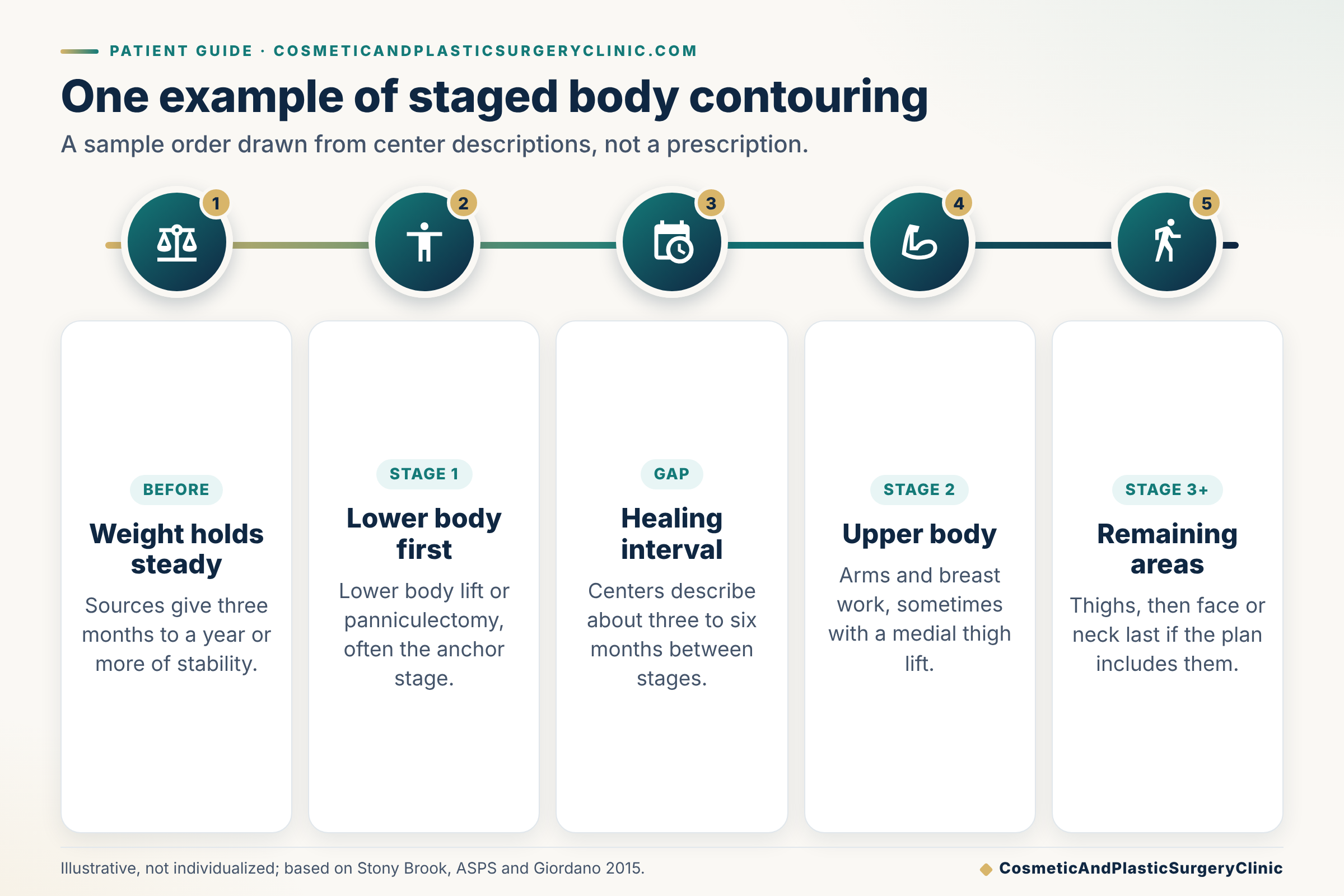
Stony Brook Medicine’s patient FAQ, answered by a plastic surgeon, lists stage one as an abdominal panniculectomy or lower body lift, stage two as breast reduction or lift with an arm lift or medial thigh lift, stage three as whatever remains, and a facelift last if facial laxity is significant. It says all of it is not feasible in one operation.
A 2015 ASPS blog post by one surgeon, Jay Lucas, MD, describes three stages: a lower body lift first, then arms with lateral chest reshaping (often with breast work), then a thigh lift, with breast work sometimes making a fourth operation. In ASPS’s 2023 article on combination procedures, surgeon Michelle Shermak describes treating breasts and arms together, then abdomen, back and thighs.
Why the order is not fixed
Several things move the order around. A 2015 review by Giordano in Open Access Surgery says staged body contouring should follow the patient’s highest-priority areas, and that an upper back lift is usually kept separate from a lower body lift because their lines of tension oppose each other. Insurance can also set the order, as described later on this page.
Personal factors matter as much as anatomy: how much time off is possible, who can help at home, and how weight is behaving. A sequence that suits one person’s priorities can be the wrong one for another, which is why a staged body contouring plan is built after an in-person assessment, not from a page like this.
| Factor | Staged body contouring | Combined session |
|---|---|---|
| When it is considered | Several regions with loose tissue, long plans, or health factors that argue for shorter cases | Fewer, compatible regions in a person judged able to tolerate a longer case |
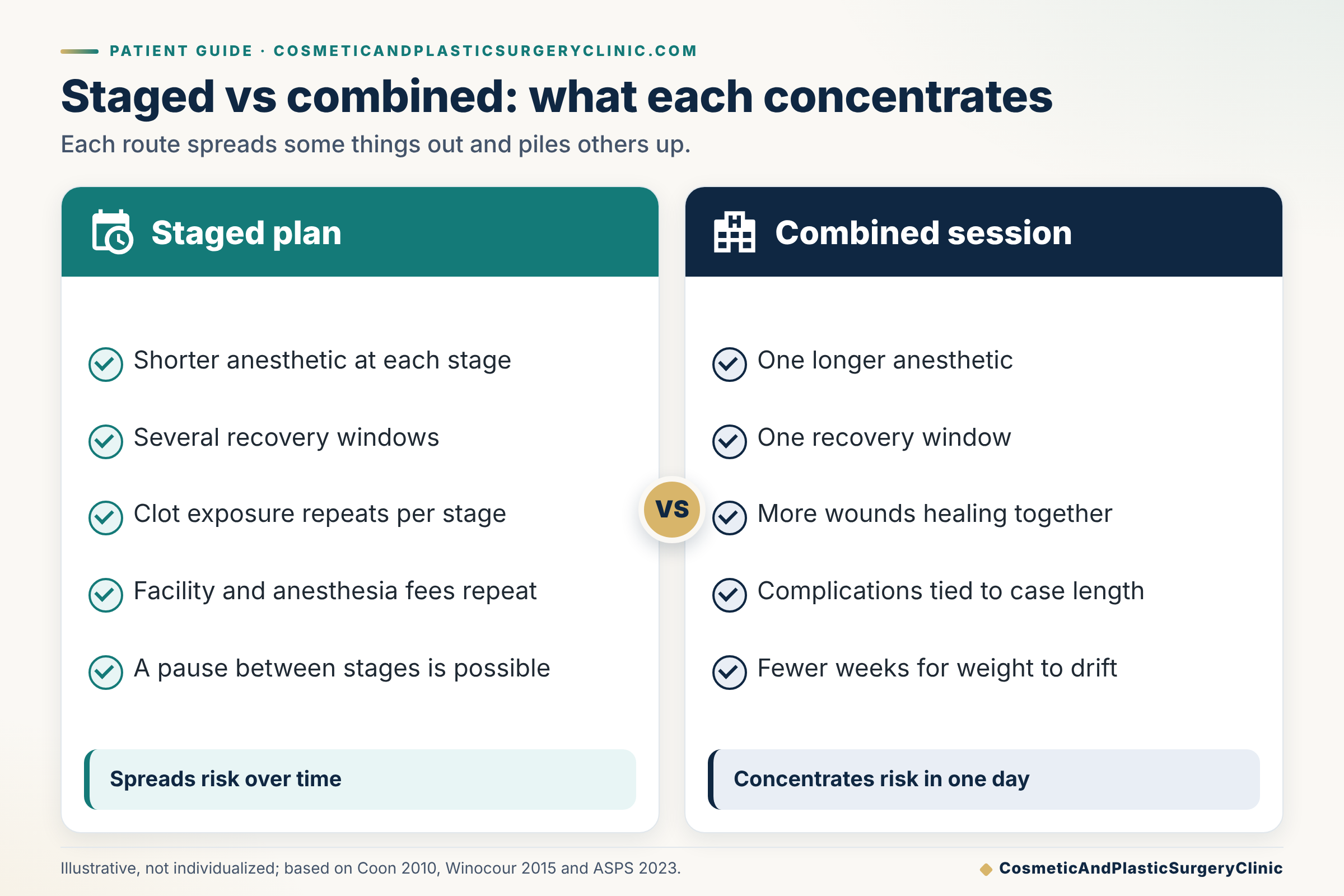
| Invasiveness | Shorter anesthetic each time, but repeated anesthetics and repeated wounds | One longer anesthetic and more wounds healing at the same time |
| Reversibility | A pause between stages is possible; finished operations and scars are not undone | All decisions are made at once; scars are fixed in one step |
| Scar and downtime | Several separate recovery windows, with lifting limits repeating | One longer recovery window with a larger area to protect |
| Maintenance | Weight must stay steady across a long calendar; regain can change later stages | Shorter calendar, so less time for weight to drift |
| Main risks | Each stage carries wound, clot and anesthesia risk of its own | Risks tied to case length and the number of procedures rise together |
| Cost logic | Facility, anesthesia and garment costs repeat per stage | One facility and anesthesia bill, usually for a longer time |
What the safety data say about staged body contouring
The honest summary is that the studies disagree in size, not just in direction. Different populations, different surgeons and different definitions of “complication” produce numbers that cannot be lined up neatly.
How long is too long under anesthesia?
Operative time is the usual reason given for staged body contouring, and it is also the hardest figure to pin down. Sources give soft limits rather than proven thresholds.
The six-hour rule of thumb and where it comes from
ASPS’s 2023 article on combination procedures says most surgeons agree anesthesia time should be no longer than six hours. Giordano’s 2015 review likewise says operative time should preferably stay under six hours, and recommends antibiotic prophylaxis when surgery exceeds three hours or the patient’s anesthesia risk score is 3 or higher. Both are statements of surgeon practice, and none of the sources reviewed for this page cites a trial establishing six hours as a threshold.
Real case lengths vary widely. Lucas describes each of his stages as taking about 6.5 to 7 hours, whereas a 2022 Aesthetic Plastic Surgery series by Zaussinger and colleagues, covering 155 massive weight loss patients who had lower body lifts between 2006 and 2018, reported an average intraoperative time of 178 minutes, which the authors attribute to a refined technique. A single number for “how long a stage takes” does not exist, so ask for the surgeon’s own typical times.
What a longer case adds besides the clock
Time itself is not the only cost. Giordano notes that people with a history of massive weight loss are prone to heat loss in the operating room, defines hypothermia as below 35 degrees Celsius, and says staged body contouring is one way to limit operating time tied to higher complication rates. An ISAPS patient safety update from December 2024 adds that up to half of deep vein thromboses begin during the operation itself.
Longer cases also tire the team and the patient. For the practical side of getting through a long operation and its aftermath, our general page on plastic surgery recovery planning covers help at home and logistics.
Complication numbers that point in different directions
Two kinds of evidence exist: large cosmetic-surgery databases that show risk climbing with each added procedure, and smaller weight-loss series that report reassuring results in selected patients. Neither compares staged and combined plans head to head.
A large cosmetic database: risk rises as procedures are added
Winocour and colleagues analyzed 25,478 abdominoplasties from the CosmetAssure insurance database (2008 to 2013), reported in Plastic and Reconstructive Surgery in 2015. Major complications occurred in 3.1% of abdominoplasties done alone, 3.8% with liposuction, 4.3% with a breast procedure, 6.8% with a body-contouring procedure, and 10.4% with liposuction plus a body-contouring procedure. Adjusted for other factors, multiple procedures carried a relative risk of 1.5.
The patients were 97% women with an average age of 42, in a cosmetic-surgery population rather than a weight-loss series, and the database missed minor complications that clinics manage themselves. The authors suggested staging rather than combining for higher-risk patients. That is a suggestion from observational data, not a measured benefit of staging.
Weight-loss series: minor wound problems climb, major ones may not
The closest evidence on staged body contouring comes from Coon and colleagues in Plastic and Reconstructive Surgery (2010): a five-year prospective database of 609 massive weight loss patients, 661 cases and 1,070 procedures. Hospital stay increased with the number of procedures. Seroma and wound dehiscence rose strongly with procedure count, and tissue necrosis and infection rose too, while hematoma did not. Major complications did not increase in multiple-procedure cases.
The authors concluded that combining was safe in carefully selected patients at a high-volume center. That conclusion hangs on the words “carefully selected” and “high-volume”: it describes who was chosen and where, not what would happen elsewhere. Other single-surgeon series, in the table below, report low complication rates for large combined operations under similar caveats.
| Study | Who and how many | Main finding | Limit |
|---|---|---|---|
| Coon, 2010 | 609 massive weight loss patients, five-year database, one high-volume center | Minor wound problems rose with procedure count; major complications did not | Selected patients; one center; abstract-level reading here |
| Winocour, 2015 | 25,478 abdominoplasties, U.S. cosmetic insurance database | Major complications 3.1% alone, up to 10.4% with liposuction plus body contouring | Cosmetic population, not a weight-loss series; minor events missed |
| Griffin, 2015 | 53 patients, 135 procedures, one London hospital | Combining two or more procedures on one day did not significantly raise complications | Small; one clot event; internal inconsistencies in the paper |
| Cabbabe, 2025 | 137 consecutive patients, one surgeon, drainless lower body lift with adjuncts | Overall complication rate 6.6%; one return to the operating room | No control group; about six months of follow-up |
Clots, wound healing and nutrition across a long plan
Three risks track the length of a plan more closely than the label on it: venous thromboembolism (blood clots), wound breakdown, and the nutritional state that wound healing depends on. Each is worth understanding before comparing schedules.
Blood clot risk across staged body contouring
Clots are the complication that most separates a long operation from a short one, and also the one most affected by what happens between operations.
What an ISAPS update reports
The International Society of Aesthetic Plastic Surgery’s December 2024 patient safety update on deep vein thrombosis (DVT) and pulmonary embolism (PE) says the period of greatest risk for a fatal PE is three to seven days after surgery. It cites a DVT rate of 0.34% for abdominoplasty alone, 2.17% when abdominoplasty is combined with an intra-abdominal procedure, and a clot-risk figure of 3.4% for belt lipectomy. The summary does not give the populations behind those figures, so treat them as rough signals.
The same update notes that the Caprini score is the most widely used risk tool, that no scale has been validated for aesthetic surgery patients, and that extended medication-based prevention is recommended for people with high scores. Whether any of that applies to a given person is a surgeon’s call. Giordano’s review, citing other work, puts overall clot risk after contouring in massive weight loss patients near 2.9%, rising to 8.9% when BMI exceeds 35.
What staged body contouring changes about clot risk, and what it does not
Staged body contouring shortens each anesthetic, which matters because many clots start during surgery. It also means a person passes through the highest-risk days several times, once per stage, with fresh immobility each time. Staging redistributes clot exposure; it does not remove it. Staged body contouring therefore needs a prevention plan at every stage.
That is why surgeons who stage still use prevention at every stage. Lucas, for example, says every patient of his receives a blood thinner for five days after a lower body lift. Prevention plans are individual and set by the surgical team, which is a good reason to ask what the protocol is before the first stage, not before the third. Our overview of plastic surgery risks explains how to read risk figures in general.
Wound healing and weight stability in staged body contouring
After massive weight loss the skin and the body behind it are not in the same condition as in someone who has never lost much weight. That affects healing at every stage.
Why wound problems dominate
Stony Brook’s FAQ names wound infection, wound breakdown and seroma (a fluid pocket) as the most common complications, notes that many patients carry conditions tied to past obesity such as sleep apnea, hypertension and diabetes, and says skin quality after major weight loss can contribute to poor healing and scars that migrate. In Zaussinger’s 155-patient lower body lift series, the two most common complications were wound dehiscence (38 patients) and seroma (18).
Giordano’s review reports that complication risk after massive weight loss runs 60% to 87% higher than in patients who have not lost massive weight, and links minor wound problems to low preoperative albumin and malnutrition. Wound dehiscence means the incision edge opens; how it is managed depends on its size and depth, and exposed tissue is an emergency, as the box below explains.
How long weight should hold before a first stage
Sources differ, and the differences are worth seeing. Cleveland Clinic and Ohio State’s Wexner Medical Center both give six months at a stable weight. Stony Brook says ideally at least twelve months. Giordano describes timing at 12 to 18 months after the bariatric operation plus four to six months without fluctuation. A 2011 Obesity Facts study of 43 respondents by van der Beek and colleagues found that three months of stable weight before surgery was linked to fewer complications (odds ratio 0.24), and that a total complication rate of 27.9% included 8.8% major events.
The honest reading is that there is no universal number, and that stability and a weight close to normal both seem to matter. Our page on body lift candidacy lists what surgeons look at, including nutrition, nicotine and medical clearance. Stony Brook asks patients to be nicotine-free for at least six weeks before and after elective surgery, and Wexner says candidates must not smoke or use nicotine products.
Planning the calendar, time off and cost of staged body contouring
Staged body contouring trades one big disruption for several smaller ones. The calendar and the budget both change shape, and neither is visible in a consultation that focuses on the first operation.
Intervals and recovery windows
The gap between stages exists so tissue can recover, and it competes with everything else in a person’s year.
How long between stages of staged body contouring
Stony Brook states that the period between stages is three to six months. Giordano recommends at least three months for wound healing and scar stabilization. Those are the only interval figures in the sources opened for this page, and none comes from a trial, so treat them as practice norms. Our page on body lift recovery describes the weeks after one stage in more detail.
Cleveland Clinic gives the recovery context: a full recovery can take several months, return to work is generally one to three weeks depending on the procedure, heavy lifting is off the table for at least six weeks, drains may stay a week or two, and final results can take up to two years. That last point means a later stage may be planned before the earlier one has finished changing.
What shifts if life or weight changes mid-plan
A staged body contouring plan that spans a year or more meets ordinary life: a job change, a move, a family illness, a change in coverage. It also meets the body’s own drift. Cleveland Clinic warns that substantial weight regain after body contouring will stretch the skin, and Stony Brook says weight change can affect results and raise the chance of further surgery.
If weight moves by a meaningful amount between stages, surgeons may revise the plan or delay the next stage. Medication-related weight changes are a matter for the prescribing clinician and the surgical team together; see our page on skin removal after GLP-1 for what the labeling and studies say.
| Phase | What happens | Time frame in sources | Logistics to arrange |
|---|---|---|---|
| Before stage one | Weight holds steady; nutrition, nicotine and medical review | Six months to over a year stable, depending on source | Records, referrals, insurance pre-authorization where it applies |
| Stage one | Often lower body lift or panniculectomy | Cases described at roughly 3 to 7 hours | Transport, caregiver, overnight stay questions |
| Healing interval | Scars settle; weight and wounds are rechecked | About three to six months | Time off work, lifting limits, follow-up visits |
| Stage two | Often breast and arm work, sometimes with a medial thigh lift | Same interval logic applies | Childcare, sleep set-up, garment and bra supplies |
| Later stages | Remaining areas; face and neck sometimes last | Results may take up to two years to finalize | Budget check and a fresh weight review |
Money and insurance across staged body contouring
Cost is where staged body contouring surprises people, because the first quote usually covers only the first operation.
Cost lines repeat with every stage
ASPS’s 2024 average surgeon fees, based on figures submitted by surveyed members, run from $10,000 to $16,500 for a lower body lift, $6,000 to $10,500 for an upper arm lift, $6,500 to $11,000 for a breast lift and $7,000 to $12,000 for a thigh lift. The ASPS page does not say whether those ranges exclude anesthesia and facility charges, so ask any quote to list them separately.
Each stage adds its own facility time, anesthesia, garments, supplies and follow-up, and the first-stage price does not predict the rest. A combined session may need only one facility booking and one anesthesia team, though a longer case can cost more per hour of use. In ASPS’s 2023 article, Shermak says combining is cheaper, without giving figures. Ask for itemized quotes for both versions, and see our guides to body lift cost and plastic surgery financing for how to compare them.
Insurance can dictate the order
ASPS’s 2017 recommended coverage criteria say a panniculectomy may be considered reconstructive when it treats documented problems such as recurring skin infection or inflammation under a large hanging apron of tissue, with photographs and treatment history. For a circumferential lower body lift, only the front portion is described as reconstructive; the back, hip and buttock parts are cosmetic. Thigh lifts are usually cosmetic.
The same criteria note that a cosmetic abdominoplasty can be done at the time of a functional panniculectomy or delayed until weight reduction is complete. Coverage rules vary by insurer, so the sequence a plan follows may partly reflect what is authorized first. Our comparison of panniculectomy versus body lift covers that difference in detail.
Choosing between staged body contouring and a combined session
No test sorts people into one group or the other. Surgeons weigh signals, and the same signal can point different ways depending on the rest of the picture. What follows describes the signals, not a verdict for anyone.
Signals that point toward staged body contouring
Staged body contouring is generally favored when something makes a long anesthetic or a large wound area harder to justify.
Health and nutrition signals for staged body contouring
Winocour’s authors suggested staging for higher-risk patients, and in their data the risk factors included age 55 or older, BMI of 30 or more, male sex and multiple procedures. Giordano lists comorbidities, bleeding disorders, low albumin and malnutrition as drivers of wound problems. A person whose nutrition is still being corrected, whose weight is still moving, or who has a clot history has more reasons to keep each stage smaller.
Those are the reasons surgeons give for delay or for smaller stages. Whether any of them applies to staged body contouring for a given person is for the surgeon and the person’s other clinicians to decide after an assessment.
Anatomy and scar-line signals
Some regions pull against each other. Giordano’s explanation for keeping an upper back lift apart from a lower body lift is that their lines of tension oppose each other. Large areas of loose tissue in several regions, such as arms and breasts and thighs, also mean the number of separate incisions grows past what one session can reasonably close and protect.
Anatomy also limits what can be combined at all, because regions differ in access and in how the body must be positioned. This is one reason pages describing “one-day full-body transformations” deserve scrutiny, a point taken up in the last section.
Signals that make a combined session reasonable
Combined sessions are not reckless by default. ASPS’s 2023 article says combining can reduce total operating time, anesthesia time, cost and recovery time, and it cites a 2015 Plastic and Reconstructive Surgery piece saying combinations may reasonably be done with extra care in planning, technique and aftercare. The same article quotes a surgeon saying plainly that combining adds risk.
Compatible, limited areas
A plan that pairs compatible regions, with a total case length inside the surgeon’s usual limit, is what combined sessions generally aim for. A single-surgeon 2025 series by Cabbabe in Aesthetic Surgery Journal Open Forum describes 137 drainless lower body lifts, nearly all with liposuction and buttock fat transfer and some with tummy tuck or breast procedures, all in one session. The overall complication rate was 6.6%, with one return to the operating room. There was no control group, follow-up averaged six months, and operative time was not reported.
The postpartum equivalent, a tummy tuck combined with breast surgery, raises the same question on a smaller scale; see our page on the staged mommy makeover for how that decision differs when no massive weight loss is involved.
Practical limits that are real but secondary
Practical factors matter, and they should not outrank safety. A caregiver who can only take one block of leave, or travel from a distance that makes repeat trips costly, are legitimate reasons to prefer fewer sessions. They are not reasons to extend a case beyond what the surgeon is comfortable with.
The question to ask is how a staged body contouring plan handles complications at home. Those who treat problems after surgery should be reachable and local, which is also part of the case for choosing a surgeon with experience in post-weight-loss patients; see how to choose a plastic surgeon for verification steps.
| Goal and anatomy | Option often favored | Reason | Fact that could reverse it |
|---|---|---|---|
| Loose skin at abdomen, flanks, back and buttocks; little elsewhere | One lower body lift, which is itself a combined operation | Single large region set; nothing else is competing for the schedule | High clot risk or low albumin, which could argue for a smaller first stage |
| Loose skin at lower trunk, arms, breasts and thighs | Staged body contouring, lower body first | Too many regions for one case; arms and breasts often pair in stage two | Weight regain mid-plan, which can reshape the later stages |
| Hanging abdominal apron with skin infections; other areas secondary | Panniculectomy first, other work later | Insurance may cover the functional part; weight reduction can finish first | A plan that does not authorize the first step |
| Two neighboring regions; stable weight; strong help at home | Combined session may be discussed | Short total case; one recovery window | Longer-than-expected case length or a new health finding |
Six checks before agreeing to staged body contouring
These checks keep staged body contouring from becoming an open-ended commitment. Each is a conversation topic, and none is a pass-or-fail test.
- Ask for the whole sequence in writing, including the order, the likely number of stages and what would change it.
- Ask for the surgeon’s typical case length for each stage and their own upper limit.
- Ask what clot-prevention and wound-care protocol applies at every stage.
- Ask how weight change or a health change between stages would alter the plan.
- Ask for itemized costs per stage, including facility, anesthesia, garments and revisions.
- Verify board certification and facility accreditation before stage one, not stage three.
Questions for the surgeon and facility
The first two checks are about the plan itself, and the next four are about the setting. The last is verifiable without asking anyone.
About the staged body contouring plan and sequence
Ask which area comes first and why, what the second stage depends on, and what the plan looks like if the person pauses after stage one. A pause is a legitimate choice, and a sound plan should say what it would cost and whether anything is lost by waiting. Ask, too, what the surgeon considers a reason to delay a stage, such as a new infection or a change in weight.
About safety setup and aftercare
Ask whether stages are done in a hospital or an accredited surgical facility, whether an overnight stay is routine, and who sees the person for problems. Lucas, a single surgeon, says he almost always sends patients home the same night, while Giordano links inpatient procedures with higher major morbidity, which shows how far practice varies. The American Board of Plastic Surgery runs a public certification verification tool.

Overstated pitches to question
Marketing for large plans tends to compress time and flatten risk, and both deserve a second look.
One-session and bundled-price promises
A promise to do the whole body in one session, or at one fixed price, glosses over the case-length limits above. A bundled price is worth reading for what it excludes: facility time, anesthesia, overnight care, garments and revision coverage. If a quote cannot be itemized, the person cannot compare it with a staged alternative, which is the point of the exercise.
Compressed schedules in staged body contouring and pressure to decide
A schedule that squeezes stages closer than the three-to-six-month norm reported by the sources opened here deserves a direct question about why. So does any deadline attached to a discount. Waiting, a second opinion and a smaller first stage all remain legitimate options, and a consultation that treats them as obstacles is a signal worth noticing.
Frequently asked questions
How many operations does staged body contouring usually involve?
No source opened for this page gives a fixed number. The examples describe three stages, with breast work sometimes adding a fourth, and Cleveland Clinic says only that you may need multiple surgeries. The count depends on how many regions carry loose tissue, which ones bother the person most, and what the surgeon judges safe in one session. A plan with fewer areas can be one or two operations, and a whole-body plan can be longer.
Can I stop after the first stage of a staged body contouring plan?
Many plans start with the highest-priority area, and Giordano’s review says the highest-priority areas are treated first. A pause is a legitimate choice, and nothing about a first stage obliges a second. The practical questions are whether weight stays steady, whether the first result looks different once the later areas are treated, and whether coverage or pricing changes. Ask the surgeon how the plan reads if you pause, and what, if anything, a delay could cost.
Is a lower body lift already a combined operation in staged body contouring?
Yes, in the sense that it treats several regions in one anesthetic. Cleveland Clinic describes it as removing excess skin and fat from the stomach, buttocks and outer thighs, and ASPS’s insurance criteria note that only the front portion is considered reconstructive. Whether a lower body lift is then combined with other procedures, such as a breast operation or arm lift, is a separate decision with its own case-length and risk questions.
What happens to staged body contouring if my weight changes between stages?
Cleveland Clinic says substantial weight regain after body contouring will stretch the skin, and Stony Brook says weight change can affect results and raise the chance of further surgery. A surgeon may revise the sequence or postpone a stage after a meaningful change in either direction. If a prescribed medication is involved, any change belongs to the prescribing clinician and the surgical team together, not to a web page or a surgery calendar.
Do insurers pay for the later stages of staged body contouring?
Coverage varies by insurer and by plan. ASPS’s 2017 recommended criteria describe a panniculectomy as potentially reconstructive when documented symptoms and treatment history are present, a lower body lift as reconstructive only in its front portion, and thigh lifts as usually cosmetic. Arm lifts are not addressed in the body of that document. Get pre-authorization decisions in writing for each stage, and ask the office which parts of the plan it expects to be treated as cosmetic.
Will each stage of staged body contouring need an overnight hospital stay?
Practice varies. Lucas, writing as a single surgeon for ASPS, says he almost always sends patients home the same night after a lower body lift, while Giordano’s review links inpatient procedures with higher major morbidity, which suggests that stays differ by patient and by case size. Coon’s 2010 database found hospital stay grew with the number of procedures. Ask what the plan assumes for each stage, who monitors you, and what happens if you need to stay.
Can facial rejuvenation be part of a staged body contouring plan?
Stony Brook lists a facelift as a final stage when facial laxity is significant, and Cleveland Clinic names facelift among the procedures used after major weight loss. Giordano places facial rejuvenation last as well, so the face usually waits. That ordering appears in two of the sources opened, but it is a pattern, not a rule, and a surgeon may order it differently for a given person.
Sources and further reading
- Coon D, Michaels J, Gusenoff JA, Purnell C, Friedman T, Rubin JP — Multiple procedures and staging in the massive weight loss population, Plastic and Reconstructive Surgery (February 2010; abstract, accessed 2026-11-13) — 609 patients, procedure counts, second-stage cases
- Winocour J et al. — Abdominoplasty: risk factors, complication rates, and safety of combined procedures, Plastic and Reconstructive Surgery (November 2015; ASPS listing, accessed 2026-11-13) — CosmetAssure complication rates by combination
- News-Medical — Study assesses abdominoplasty complication rates, risk factors (October 31, 2015; press summary, accessed 2026-11-13) — population, caveats, staging suggestion
- Giordano S — Removal of excess skin after massive weight loss: challenges and solutions, Open Access Surgery 8:51-60 (2015; accessed 2026-11-13) — operative time, intervals, sequence, nutrition, complications
- Stony Brook Medicine — FAQs about body contouring after bariatric surgery and major weight loss (accessed 2026-11-13) — stage order, three-to-six-month interval, weight stability
- American Society of Plastic Surgeons blog — Body contouring completes weight loss journey, Lucas JB (September 23, 2015; accessed 2026-11-13) — one surgeon’s three-stage sequence
- American Society of Plastic Surgeons — For patients seeking combination procedures, time is precious (April 7, 2023; accessed 2026-11-13) — six-hour anesthesia view, combining trade-offs
- ISAPS — Patient safety update: DVT and PE in aesthetic surgery (December 15, 2024; accessed 2026-11-13) — clot timing, Caprini, procedure-specific rates
- American Society of Plastic Surgeons — 2024 plastic surgery statistics report (accessed 2026-11-13) — procedure counts for lifts
- American Society of Plastic Surgeons — Cosmetic procedures average cost, 2024 (accessed 2026-11-13) — surgeon fee ranges for lifts
- American Society of Plastic Surgeons — Recommended insurance coverage criteria for skin redundancy in obese and massive weight loss patients (June 2017; accessed 2026-11-13) — functional versus cosmetic components
- Cleveland Clinic — Excess skin removal (updated November 1, 2021; accessed 2026-11-13) — procedure menu, six-month stability, recovery ranges
- Ohio State Wexner Medical Center — Body contouring after bariatric surgery (accessed 2026-11-13) — six-month stability, multi-stage plan, nicotine
- van der Beek ES, van der Molen AM, van Ramshorst B — Complications after body contouring surgery in post-bariatric patients, Obesity Facts (2011; abstract record, accessed 2026-11-13) — stable weight and complications
- Cabbabe SW — Drainless lower body lift with large-volume liposuction and adjunctive procedures, Aesthetic Surgery Journal Open Forum (July 2025; accessed 2026-11-13) — single-surgeon combined series
- Griffin M et al. — Risk of thromboembolism following body-contouring surgery after massive weight loss, ePlasty 15:e17 (accessed 2026-11-13) — small series on combined procedures
- Zaussinger M et al. — The three-hour lower body lift, Aesthetic Plastic Surgery (2022; abstract, accessed 2026-11-13) — operative time, dehiscence and seroma counts
- CDC — About venous thromboembolism (blood clots) (March 5, 2025; accessed 2026-11-13) — DVT and PE symptoms
- American Board of Plastic Surgery — home page and certification verification (accessed 2026-11-13) — how to verify certification