An arm lift (brachioplasty) removes loose skin and, in many designs, some fat from the underside of the upper arm, then closes the wound so the remaining skin lies flatter. The price of that contour is a scar that usually runs along the inner or back surface of the arm, sometimes from the armpit almost to the elbow, and that takes many months to settle. Few cosmetic operations make the trade between scar and shape as visible as this one does.
This page is the hub of the arm lift and thigh lift cluster. It covers what the operation treats and leaves alone, the anatomy that dictates incision depth, how limited, standard and extended designs differ, when liposuction alone is the better question, published complication data, recovery in outline, cost and insurance, and how to verify a surgeon. Separate guides go deeper on cost, recovery, risks, the thigh, liposuction comparisons and weight loss. Nothing here can tell you whether surgery suits your arms.
What an arm lift treats, and what it leaves alone
Upper arms change with weight swings, age and family build, and the part that bothers most people is the underside, where skin hangs in a fold that keeps moving after the arm stops. An arm lift is designed for that fold. Knowing which tissue the operation addresses, and which it ignores, is the quickest way to judge whether the scar would be a fair price.
The problem an arm lift is built to solve
Skin, fat and supporting tissue under the upper arm
The American Society of Plastic Surgeons (ASPS) describes an arm lift as surgery that reshapes the underside of the upper arm from the underarm region to the elbow. It targets three things: excess skin that droops, the supportive tissue beneath it that gives the arm its outline, and localized pockets of fat. ASPS names weight fluctuations, aging and heredity as causes and says the sagging cannot be corrected through exercise, which is the practical reason people consider an operation at all.
The Aesthetic Society uses the word “batwing” for the look that results when fat and loose skin hang below the arm, and it describes the operation as removing that fat and tightening loose skin, sometimes combined with liposuction. Notice the order. Skin laxity is the main problem an arm lift solves, and fat is a secondary passenger. When fat is the dominant issue and the skin is firm, the conversation shifts toward liposuction, a decision covered further down this page.
Demand has climbed. ASPS reports 26,088 arm lifts in 2025 against 21,524 in 2024, a 21 percent rise, with 25,591 of the 2025 operations in women and 496 in men. The largest age groups were 46 to 55 (7,019) and 56 to 65 (6,789), and the group aged 66 and over grew 52 percent. These are counts, not a measure of satisfaction, and a popular operation is not automatically the right one for a given arm.
Worldwide, the International Society of Aesthetic Plastic Surgery (ISAPS) counted 212,223 upper arm lifts in its 2024 survey. Its report shows a 19.4 percent drop from 2023, but it also notes that participation rose from 1,600 to 2,975 surgeons and that year-on-year comparisons are limited to procedures consistent across years, so the drop should not be read as fading interest.
What an arm lift does not do
An arm lift is not a weight-loss operation, and it is not a muscle-building one. It leaves the biceps and triceps as they are, and ASPS says results last provided weight and general fitness stay stable. It does not treat the forearm, and it reaches the armpit, chest wall or back only when the incision is designed to extend there. Excess that runs onto the side of the chest is a different design problem from excess confined to the arm.
Surface texture is also outside the brief. Stretch marks and crepey skin remain except where the removed ellipse happens to contain them, and no source opened for this article claims an arm lift smooths cellulite-like dimpling. Aging continues afterward. ASPS says it is natural to lose some firmness as the body ages, though most of the improvement should hold, and UF Health states in its weight-loss guidance that skin naturally sags with age and surgery does not stop that.
Neighboring regions belong to other operations. Loose skin on the inner thigh is a thigh lift question, and trunk excess is a tummy tuck or body lift after weight loss question. Sagging breasts and necks are separate again, handled in the breast lift and neck lift guides. Each added region adds a wound, which is why many surgeons divide the work.
Grading how much skin there is
Surgeons rarely describe arms as simply loose. They grade them, and the grade steers the choice among liposuction, a short scar and a long one.
Scales that rank arm laxity and ptosis
The Pittsburgh Rating Scale was described in a 2020 paper in Plastic and Reconstructive Surgery Global Open as the first validated classification of contour deformities after massive weight loss. It scores each body region from 0, a normal appearance, to 3, the most severe deformity. The same paper introduced the PRS Rainbow Classification, which uses the Pittsburgh photographs as reference images across four regions, arms among them, and notes that earlier work found the Pittsburgh scale lacked enough reliability evidence for insurance reimbursement.
In the Rainbow study, 10 plastic surgeons, 7 insurance medical advisors and 10 laypeople rated 200 photographs, and agreement between raters for the arms region was moderate to good (intraclass correlation 0.678). A separate scheme proposed by El Khatib in 2007 and summarized in a 2017 review divides upper-arm ptosis into five stages by the amount of fat and the degree of sagging. You need not memorize any scale. A grade in the chart simply gives you and the surgeon a shared vocabulary, and which grade your arms received is a fair question to ask.
The pinch test and the double-width rule
Two hands-on checks recur in the surgical literature. A 2011 article in Plastic Surgery Practice describes less than 2 centimeters of fat with good skin tone as the profile for liposuction alone, while laxity with fat usually calls for a combined procedure. A chapter in Plastic Surgery Key describes upper-arm skin that more than doubles the expected arm width as the ideal brachioplasty candidate and says oversized arms should often be treated with liposuction first, with brachioplasty possibly following.
These are teaching heuristics from a trade article and a textbook chapter, not diagnostic cutoffs. The same chapter describes marking the arm with the patient seated and the arm raised about 90 degrees, then pinching the excess to set the width of the excision. That is an examination, not a questionnaire, and a photo sent by message cannot reproduce it. The table below turns the common situations into questions you can bring to a consultation.
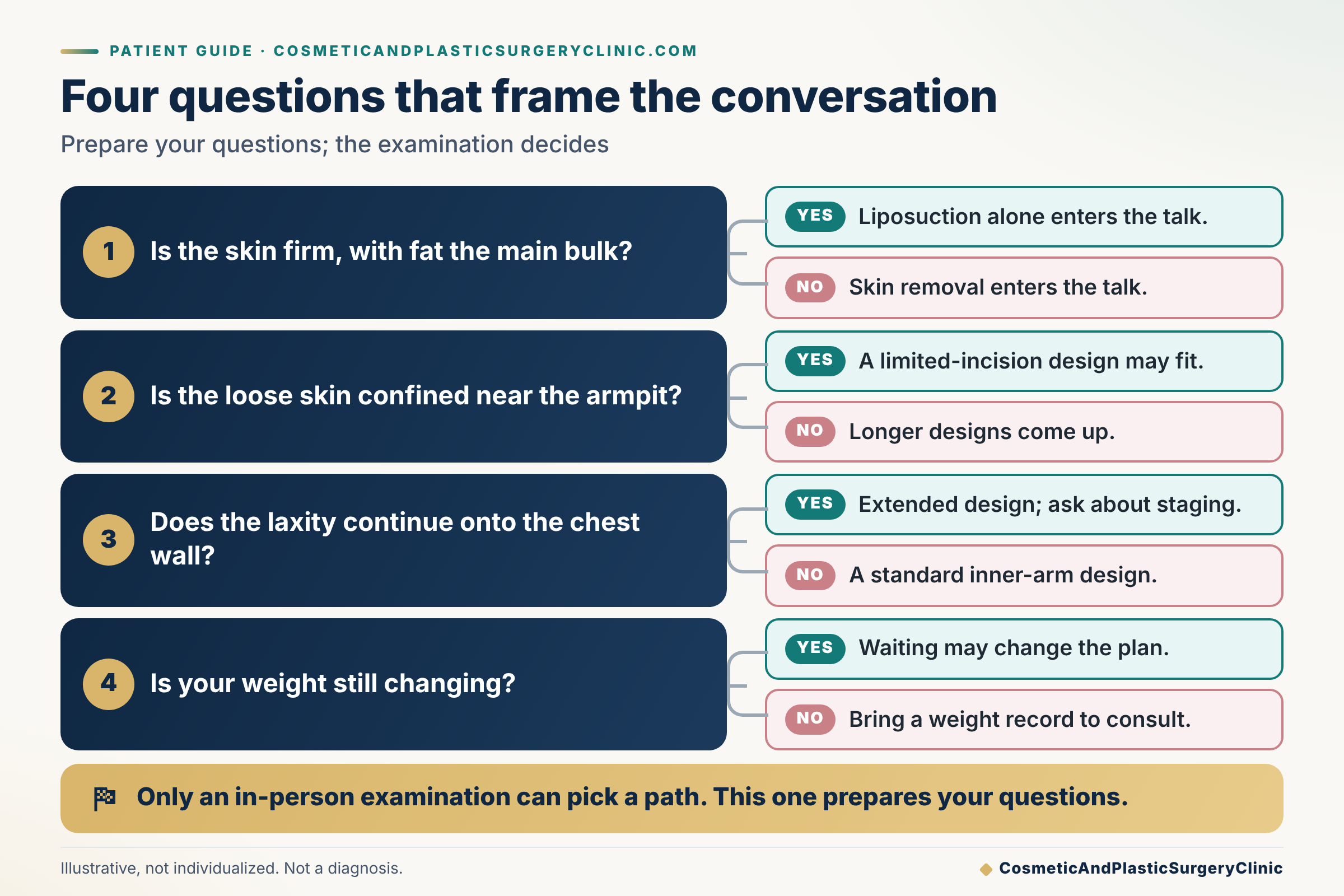
| Situation | Pathway often discussed | What it can offer | Trade-off | Key question |
|---|---|---|---|---|
| Firm skin, localized fat under the arm | Liposuction alone | No long scar; smaller treated area | Skin may not retract as hoped if its tone was overestimated | Is my skin tone good enough to adapt? |
| Mild to moderate laxity, little fat | Limited-incision arm lift | Shorter scar, placed near the armpit | Removes less skin and may not reach the elbow side | How much skin can this design remove? |
| Laxity along most of the upper arm | Standard arm lift on the inner or back arm | Skin removed from armpit toward elbow | Long scar; closure under tension; wound-healing risk | Where does the scar sit, and how long is it? |
| Laxity that continues onto the chest wall | Extended design | Treats the arm and the side of the chest together | Longest scar and the largest wound area | Which areas are in this stage, and what waits? |
| Weight still changing | Waiting, with a weight record | Avoids operating before the arm settles | More time living with the same skin | What stable weight do you want to see first? |
Skin, fat, fascia, nerve and vein: the anatomy that shapes an arm lift scar
An arm lift is a story told in layers. The surgeon passes through skin, then fat, then reaches a firm covering over the muscle, and what happens at each level decides how the scar behaves and which structures are at risk. This is education, not a surgical atlas. The aim is to show why two incisions that look alike on paper can carry different consequences.
Layers between the skin and the muscle
Skin, fat and the superficial fascia as a support
Between skin and muscle lies subcutaneous fat, and within or beneath it a thin connective layer called the superficial fascia. A 2011 article in Plastic Surgery Practice says this fascia supports the fat and reduces tension on the skin when it is included in the closure. According to the Plastic Surgery Key chapter, Lockwood described anchoring the arm flaps with permanent suture to the axillary fascia in 1994, and the trade-article authors credit his fascial work with spreading tension more evenly.
ASPS describes a related idea for limited incisions: the supportive tissue under the skin is tightened with internal sutures, and the skin is then smoothed over the new contour. The practical meaning is that deep stitches take the load so the skin closure carries less, which matters most where the arm is long and tension is greatest. Ask whether your plan includes fascial support and where the deep stitches are anchored.
Why incision depth matters
Depth matters because sensory nerves of the inner arm and forearm run close to the deep fascia. A 2017 review of brachioplasty complications advises protecting the deep fascia and the medial antebrachial cutaneous nerve. Giordano’s 2015 review places the incision posterior to the antebrachial groove, with care to avoid that nerve near the basilic vein in the distal third of the arm. Both statements amount to one instruction: keep the dissection above the deep fascia and away from the vein.
Cautery matters too. The review notes that temporary tingling in the reviewed cases was probably caused by electrocautery near the forearm nerve and resolved within weeks. Knoetgen’s 2006 series, as the review summarizes it, recorded nerve injury in 2 of 40 patients, both involving that nerve. The number is small but not zero, and a sensory change on the inner forearm after surgery is worth reporting rather than waiting out in silence.
Nerves, veins and lymphatics near the incision
The inner arm is a crowded neighborhood. The structures below are the ones surgical papers return to most often, and each one explains a specific question you can ask.
The medial arm nerves and the basilic vein
Papers use two names, medial antebrachial cutaneous and medial brachial cutaneous, for sensory nerves that supply the inner forearm and arm. A cadaver study in ePlasty (Chowdhry and colleagues, 2010) dissected eight fresh arms to map the medial brachial cutaneous nerve. In every dissection it ran alongside the basilic vein. It divided into several branches about 7.8 centimeters above the bony bump at the inner elbow, the medial epicondyle, and branches pierced the muscle fascia about 15.3 centimeters above it, in most arms near mid-arm.
The authors suggested care when raising flaps near those two levels, placing incisions slightly more posteriorly, and caution with liposuction cannulas, which can cause temporary or permanent numbness. Eight arms is a small sample and the paper’s own branch counts are not fully consistent, so the distances illustrate why the inner arm needs respect. They are not a ruler for any individual operation.
Lymphatics and the risk of fluid collections
Lymphatic vessels carry fluid from the arm toward the armpit, and cutting across them can leave fluid collecting under the skin. The 2017 review pooled seroma and lymphedema at 6.94 percent of 1,065 patients, and its authors say liposuction reduces volume while sparing lymphatics, vessels and nerves. The Plastic Surgery Key chapter records that one surgeon paired an axillary Z-plasty with aggressive liposuction beneath the skin to preserve lymphatics, avoiding occasional lymphoceles and rare prolonged edema.
The 2011 Plastic Surgery Practice article treats preexisting lymphatic drainage problems and previous axillary dissection as red flags during planning, and says small lymphoceles can be aspirated in the days or weeks after surgery. If lymph nodes have been removed on either side, say so before anyone draws on your arm. That history can change the design, the timing or the decision itself, and it belongs in the first conversation, not the last.

Limited, standard and extended: arm lift designs and where the scar lands
ASPS says the length and pattern of the incisions depend on how much skin is in excess, where it sits and what the surgeon judges best. In the literature the designs are usually sorted by scar length, from a short cut hidden in the armpit to a line that follows the arm and continues onto the chest wall. Those labels are shorthand here. ASPS’s pages show inner-arm, back-of-arm and minimal-incision patterns and do not use the words standard or extended.
Three families of arm lift incision patterns
Limited and minimal incisions
A limited or minimal-incision arm lift hides the scar in or near the armpit and treats less skin. ASPS says that with more limited incisions the supportive tissue is tightened with internal sutures and the skin smoothed over it, and the Aesthetic Society suggests limited-incision brachioplasty or liposuction when sagging is not excessive. The 2011 trade article ties the choice to skin: an axillary-only scar for minimal excess with excellent tone, a short scar for moderate excess with poor tone.
The Plastic Surgery Key chapter shows the other side of the ledger. Short-scar techniques, among them Teimourian’s 1997 circumferential liposuction with purse-string closure and the lipoplasty-plus-axillary-excision methods of Richards in 2002 and Abramson in 2004, have a limited role when elasticity is poor, as after massive weight loss. A short scar buys little if the skin causing the problem sits mid-arm and is left behind.
Standard and extended designs
A standard design runs along the inner or back arm from the armpit to just above the elbow, the pattern ASPS describes. An extended design continues across the armpit and onto the side of the chest to remove tissue there, and Giordano’s 2015 review notes that the incision can reach the lateral chest wall for batwing deformity. Hurwitz’s inverted-L brachioplasty of 2006 was proposed for severe arm, axillary and chest deformities after massive weight loss.
The trade-off is direct. A longer incision reaches more skin and gives the closure more to work with, but the scar is longer, the wound is larger and the closure sits under more tension. The trade article says an extended scar is the match for significant excess with poor tone, the same group in which short designs work least well. At consultation, the useful request is to see which scar goes with which result.
Where the line sits, and how scars behave
Inner arm, bicipital groove or back of the arm
Placement is not settled. ASPS says incisions are usually on the inner arm or the back of the arm, by surgeon preference, and Duke Health describes a scar on the back or inside of the arm. The 2011 Plastic Surgery Practice article places the anterior incision within the bicipital groove, the furrow between biceps and triceps. The 2017 review reports that some surgeons put the suture line behind the groove to hide it from the front and others place it in the groove, and that a survey by Samra and colleagues in 2013 favored a medially based straight scar.
A 2018 comparison in the Journal of Cutaneous and Aesthetic Surgery chose the medial arm because it is easier to hide. In that series of 31 women, liposuction-assisted brachioplasty with a medial scar was associated with less hypertrophic scarring or keloid than a swallowtail scar, 18 percent against 55 percent. It was a small retrospective review whose statistics section is internally inconsistent, so it supports a question for your surgeon rather than a rule.
Scar quality: hypertrophy, widening and the revision conversation
ASPS states plainly that a scar will remain where the incision was made, and the Aesthetic Society says the scars are visible along the inside of the arm and may run from the armpit to the elbow. In the pooled review, hypertrophic scarring was the most common complication, affecting 115 of 1,065 patients (10.79 percent), and the authors call undesirable, visible scarring the most frequent problem. Revision rates across the included studies ranged from 0 to 21 percent, with residual contour deformity and hypertrophic scarring the main causes.
Scars also change over time. UF Health says in its guidance on surgery after large weight loss that it can take up to two years to see final results and for scars to fade, and ASPS says early results are obscured by swelling and bruising. Scar width, color and thickness at three months say little about the same scar at eighteen. If scar quality matters more to you than contour, say so first. It is a legitimate reason to choose a shorter design or a different route.
| Design | Excess it is usually matched to | Scar pattern | Main trade-off |
|---|---|---|---|
| Liposuction only (not a lift) | Good skin tone with localized fat | Small access incisions | Cannot remove skin; weak tone may leave drape |
| Limited or minimal incision | Minimal to moderate excess near the armpit | Short scar in or near the armpit | Treats less skin; little reach toward the elbow |
| Standard, medial or back of arm | Excess along much of the upper arm | Armpit to just above the elbow | Longest arm scar; closure tension; scar widening |
| Extended onto the chest wall | Excess continuing onto the side of the chest | Arm line plus chest-wall extension | Largest wound; most often discussed after major weight loss |

Arm lift or arm liposuction: reading skin tone, fat and the pinch
Liposuction and an arm lift answer different tissue questions. Liposuction removes fat through small openings and relies on the skin to shrink around what is left; an arm lift removes skin. Choosing the wrong one is a common way to end up disappointed even when nothing technically goes wrong. The full comparison lives in the guide on arm lift vs arm liposuction, and this section gives the logic.
When liposuction alone enters the conversation
Good tone, localized fat and a realistic ask
The Aesthetic Society says limited-incision brachioplasty or liposuction may be considered when sagging skin is not excessive. ASPS makes the same point on its thigh lift page: liposuction alone can work where the skin is elastic enough to adapt to the new contour. A 2011 trade article adds that upper-arm skin is thinner and more mobile than thigh skin, so liposuction alone may not correct the contour of every arm, and that younger patients are generally the best candidates for liposuction-based approaches.
A 2023 case series in Aesthetic Plastic Surgery followed 28 women aged 23 to 42, none of them after bariatric surgery, who had ultrasound-assisted liposuction of the arms. It reported no complications, 85.7 percent very satisfied with arm appearance at six months, and a mean mid-arm circumference reduction of 10.1 centimeters measured at two months. It was retrospective, small, limited to women, short in follow-up and tied to one device at one center. It shows that a selected group can do well with liposuction alone, not that your arms will.
What a mismatch looks like
A mismatch runs in two directions. Because liposuction removes volume but not skin, loose skin has to contract on its own, and if it does not, the arm can look deflated and draped, which may lead to a second operation and a second recovery. An arm lift for fat-dominant arms with firm skin trades a long scar for a result that a smaller procedure might have approximated. Neither error is dramatic in the chart. Both are costly in time and expectation.
The pinch test and an arm-raised examination are how surgeons sort the two. Ask what the plan is if the skin proves looser than judged. Some plans name a staged route, liposuction first and a lift later if needed, which the Plastic Surgery Key chapter describes for oversized arms. A plan that states its fallback at the start is easier to trust than one that treats a single operation as certain.
Combining liposuction with the lift
Many arm lift plans include liposuction of the surrounding arm. Whether that helps, harms or changes nothing is less settled than marketing suggests.
What the evidence says, and where it disagrees
The 2017 review reports that liposuction did not increase complications and did not significantly change outcomes in the studies it cites (Bossert 2013 and Zomerlei 2013), and argues that suction improves tissue mobilization while sparing lymphatics, vessels and nerves. Giordano’s 2015 review is more cautious and says liposuction added to brachioplasty may exacerbate skin laxity, while acknowledging reports that call it safe and efficient. Honest sources therefore disagree about the effect on skin, even where they agree on safety.
In the 2018 Italian series, liposuction-assisted brachioplasty was associated with fewer minor complications (9 percent) than the standard technique (60 percent), but only 11 of the 31 women had the combined operation, and the groups were not randomized. A 2016 database study found a higher major-complication rate for combined procedures than for brachioplasty alone (4.4 against 1.3 percent), though its abstract does not say which procedures were combined. These small, retrospective series cannot settle the question.
How to ask which version you are being offered
The words “liposuction-assisted” cover more than one plan, so ask in specifics. Where on the arm will suction be used, and how much? Will it be done before the skin is cut, and by whom? What does the surgeon expect it to add, and what changes if the arm turns out looser or fuller than it looked at consultation? Written answers are worth requesting because they make quotes comparable.
For technique families such as tumescent, power-assisted and ultrasound-assisted, see the liposuction techniques guide. The risks of suction itself, including contour irregularity and fluid shifts, are covered in the liposuction risks guide, and the main liposuction hub explains what that procedure can and cannot change.
Who surgeons consider for an arm lift, and who is asked to wait
No article can say whether you are a candidate. What it can do is list the questions that surgeons and sources keep returning to, so a consultation covers them early rather than late.
The criteria sources keep repeating
Skin laxity, stable weight and general health
ASPS lists adults with significant upper-arm skin laxity, adults of any age whose weight is relatively stable and who are not significantly overweight, healthy people without conditions that impair healing or raise surgical risk, nonsmokers, and people with a positive outlook and realistic expectations. The Aesthetic Society’s page adds good general health, without untreated conditions such as diabetes or heart disease. Stable weight is the criterion with the widest spread of numbers.
UF Health says weight should have been stable for at least a year, the Aesthetic Society’s weight-loss guidance says at least six months with no further loss expected, and Giordano’s 2015 review cites 12 to 18 months after a bariatric operation plus 4 to 6 months without fluctuation. No interval is universal, and your surgeon sets it. The weight-loss specifics, including bariatric and GLP-1 contexts, belong to the guide on arm lift after weight loss.
Nicotine, medical conditions and wound healing
Wound healing is why nicotine tops most checklists. MedlinePlus says most providers advise stopping cigarettes and tobacco at least 4 weeks before surgery, and that stopping at least 10 weeks before may lower the risk of complications further, because smoking reduces the oxygen reaching the cells in a surgical wound. It also warns that nicotine gum around the time of surgery still interferes with healing, so nicotine replacement is a question for the surgeon, not a workaround.
Other conditions join the same conversation. The 2017 review links diabetes and vascular disease with wound separation and reports that seroma appeared more often with higher body mass index in some studies, though not consistently. In a 2016 analysis of 2,294 brachioplasty patients from the CosmetAssure database, a body mass index of 30 or higher carried a relative risk of any complication of 1.92, and male sex 3.44. Those are associations in a database, not a prediction for one person.
Reasons to wait or to choose another route
Weight still moving, lymphatic history and timing
Three situations commonly push the date back. The first is weight that is still changing. UF Health warns that if you are still losing weight, skin may sag more after surgery, and the Aesthetic Society says weight gain after an arm lift may negatively affect the result. The second is lymphatic history, such as a prior axillary dissection, which the trade article treats as a red flag in planning. The third is a nicotine habit that cannot be stopped in time.
Waiting is rarely wasted time. It lets weight settle, lets a smoker finish a nicotine-free interval, and shows whether a smaller option such as liposuction gets close enough. If a practice presses for a date, treat the pressure as information about the practice. The general decision framework, including how to say not now, is in the plastic surgery guide.
Expectations, motivation and the option of not operating
ASPS lists a positive outlook and realistic expectations among its criteria, and for an arm lift the realistic expectation has a specific shape: a flatter, tighter arm and a visible line. Consider a hypothetical person who avoids sleeveless clothing because of the underarm fold. For that person, a scar on the inner arm, often out of sight when the arm hangs at the side, may be a fair trade. Consider another who mostly dislikes fullness and has firm skin. Liposuction might answer that complaint without a long scar.
Neither scenario is a recommendation. Both show the question to answer first: what exactly bothers you, and which tissue causes it? Not operating is also a complete answer. Clothing choices, tailoring and simply waiting are legitimate. The plastic surgery consultation guide lists what to bring to a first visit, including photographs, medical history and a written list of goals.
Arm lift complications: what the published series report, and how to read them
A complication rate sounds like one number. For an arm lift it is several, depending on who was counted, what counted as a complication and how long people were followed. This section lays out the published figures with their limits. The guide to arm and thigh lift risks goes through each complication in turn.
Expected effects, complications and emergencies
What is expected in the early weeks
Some effects are expected rather than complications. ASPS says there will likely be swelling and bruising after an arm lift and that early results are obscured by them. Sensation changes sit on the border. ASPS lists numbness or other changes in skin sensation among the risks, and the 2017 review reports that temporary tingling in the reviewed cases resolved within weeks. The concern is a change that does not settle.
The line between expected and worrying is the surgeon’s to draw, and it should be drawn for you in writing before surgery: which symptoms are routine, which deserve a call that day and which mean an emergency department. ASPS’s published risk list for the operation includes anesthesia risks, bleeding, damage to deeper structures such as nerves, blood vessels and muscles, fat necrosis, fluid accumulation, infection, poor wound healing, sutures that surface through the skin, unsightly scarring, pain that may persist and possible revision.
Signs that need same-day or emergency care
The Centers for Disease Control and Prevention (CDC) notes that about half of people with a deep vein clot have no symptoms at all, and that moving around as soon as possible after surgery is advised, with a question to your doctor about compression stockings or blood-thinning medication for anyone at risk. The 2011 trade article tells patients to call immediately for tingling or numbness in the fingers or hand or a sudden rise in pain. Your own surgeon’s instructions come first; when unsure, call.
Published numbers, and why they disagree
The figures below come from reviews, a large insurance-backed database and small single-center series. They answer different questions, so they should not be averaged into one rate.
Four sources, four different questions
| Source and year | Population | Reported figure | Limit to keep in mind |
|---|---|---|---|
| Sisti and colleagues, Acta Biomedica 2017 | Literature review of 27 studies, 1,065 patients | Any complication 28.9%; hypertrophic scarring 10.8%; seroma or lymphatic 6.9%; nerve injury 1.5% | Not a meta-analysis; mixed definitions; many studies omitted comorbidities |
| Aesthetic Surgery Journal 2016, CosmetAssure database | 2,294 brachioplasty patients, 2008 to 2013 | Major complications 3.4% in 30 days; infection 1.7%; hematoma 1.1% | Major means emergency visit, admission or reoperation; insured elective patients |
| Neaman and colleagues, ASPS meeting abstract 2011 | 98 patients at one center | Total complications 49% (major 18.4%, minor 40.8%); revision 24.5% | Single center; abstract figures are not fully consistent |
| Di Pietro and colleagues, Journal of Cutaneous and Aesthetic Surgery 2018 | 31 women after massive weight loss | Minor complications 42%; no major complications | Small retrospective review; statistics section inconsistent |
Per-study rates inside the 2017 review ranged widely. The highest complication rate, 53.1 percent, came from a 96-patient series, while the highest revision rate, 21 percent, came from a different 44-patient series. The review’s authors say many studies did not report comorbidities, which limits any attempt to say who is at greater risk.
How to read the spread of arm lift complication rates
A 3.4 percent figure and a 49 percent figure can both be accurate. The database counted only major events within 30 days: an emergency visit, an admission or a return to the operating room. The single-center series also counted minor events, such as small areas of wound separation, and followed patients longer. A minor event may mean an extra dressing visit, but it still matters to the person who has it. When any surgeon quotes a rate, ask which definition sits behind it.
The database study also found that major complications occurred in 4.4 percent of combined procedures and 1.3 percent of brachioplasty alone, with combined procedures making up 66.8 percent of cases and carrying a relative risk of 3.58 for any complication. Its authors concluded that complication rates are much lower than previously reported. Group figures say little about one arm, so ask for the surgeon’s own numbers and how they were counted. General risk literacy is in plastic surgery risks.
Recovery and results after an arm lift: weeks of limits, months of change
Week-by-week recovery belongs in the arm lift recovery guide. What follows is the outline you need for planning, and the reasons it differs from one practice to the next.
The first weeks in outline
Dressings, compression, drains and stitches
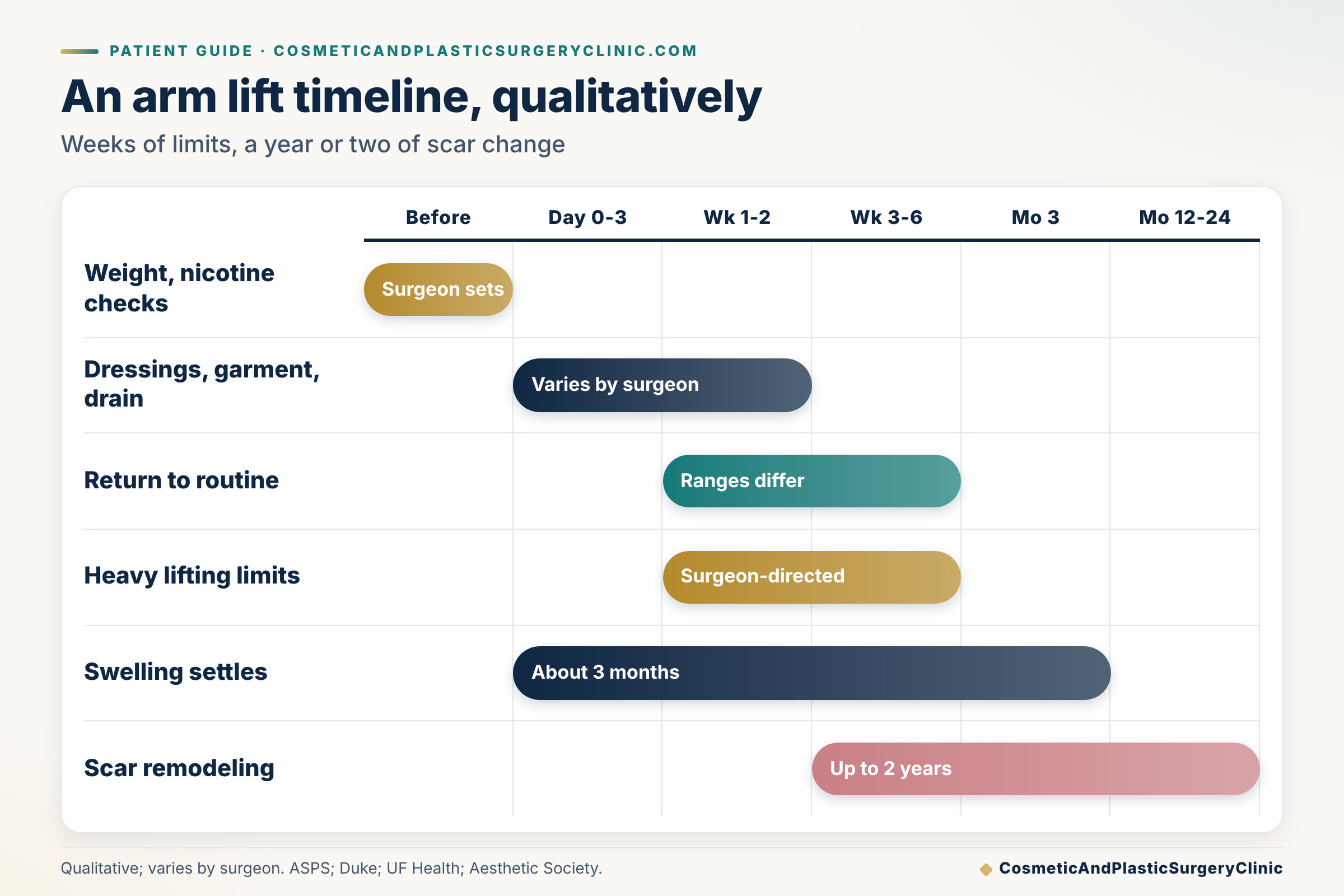
ASPS says dressings or bandages may be applied to the incisions, that the arms may be wrapped in an elastic bandage or compression garment to minimize swelling, and that a small, thin tube may be placed temporarily under the skin to drain blood or fluid. Incisions are closed with absorbable sutures or stitches, and ASPS says stitches will be removed within one to two weeks. Its recovery page gives no drain timing or garment length and lists both as questions for your surgeon.
Institutional pages vary, which is the point. Duke Health describes compression garments for about four to six weeks, a return to normal activities within a week and avoiding major physical activity, especially heavy lifting, for up to six weeks. UF Health describes recovery lasting three to four weeks, work within a week and light exercise usually allowed after six weeks. The Aesthetic Society says recovery is at least one to two weeks and could be longer. Compare these ranges with your surgeon’s written plan, and treat the plan as the instruction.
Swelling, sensation and arm position
Giordano’s 2015 review states that edema is particularly common after surgery on the arms or legs and recommends compressive wrapping and elevation. The trade article adds that compression should be comfortable and that distal pulses and signs of congestion should be checked before discharge, because excessive skin excision can cause distal edema, venous congestion or vascular compromise. Compression that is too tight is a problem, as is compression that is too loose.
Sensation is the other early variable. Altered skin feeling on the inner arm is a listed risk to discuss. Tingling or numbness in the fingers or hand, or a sudden increase in pain, is a reason to call at once, and an emergency department is the next step if the practice cannot be reached. Plan help for the first days with dressings, bathing, lifting and driving; the logistics common to all procedures are in plastic surgery recovery.
Judging the result over time
Weeks to months: when the shape settles
ASPS says the smoother, tighter contour is apparent almost immediately but obscured by swelling and bruising. UF Health’s weight-loss guidance says it takes about three months for swelling to go down and wounds to heal, and up to two years to see final results and for scars to fade. That page concerns surgery after large weight loss, so the timing may run longer than in a smaller arm lift. The arm you have at six weeks is not the arm you will judge.
Photographs are the best protection against impatience. Take your own, in the same light, pose and distance, at set intervals; they show change that daily mirror checks hide. A reasonable schedule is to judge shape at three months, scar at twelve and the whole at eighteen to twenty-four, and to ask your surgeon when and how the result will be assessed in follow-up.
Years later: weight, aging and revision
ASPS says the results of an arm lift will be long-lasting provided weight and general fitness stay stable, and that aging still takes some firmness. The Aesthetic Society warns that weight gain after the operation may negatively affect results. Revision is a real branch of the plan. The pooled review reports revision rates from 0 to 21 percent across studies, the single-center abstract reported 24.5 percent, and the common reasons were residual contour deformity and hypertrophic scars.
ASPS also says it may not be possible to reach optimal results with a single procedure. Ask what a revision policy covers, whether the surgeon’s fee, facility and anesthesia are charged separately for a touch-up, and within what time frame. The table organizes the long-term factors into questions you can put to the practice.
| Factor | Effect on the result | Maintenance or revision implication |
|---|---|---|
| Weight gain or loss after surgery | Can stress or loosen treated skin; ASPS ties lasting results to stable weight | Keep a weight record; ask how much change would reopen the question |
| Scar maturation | Appearance changes for up to two years in one source | Judge at twelve months or later; ask about scar care and revision timing |
| Residual contour irregularity or laxity | Named as a main cause of revision in the 2017 review | Ask whether touch-ups are included and when they can happen |
| Aging of the skin | Firmness continues to decline after surgery | Expect gradual change; surgery resets one point in time |
| Persistent pain or sensation change | ASPS lists pain that may persist and changes in skin sensation | Report early; ask who follows up and for how long |
What an arm lift costs, and what insurance does and does not cover
A price quote for an arm lift is a stack of separate charges, and the number most people see first leaves out most of them. The detail, with worked comparisons, is in the arm lift cost guide. This section covers what a reader needs before asking for any quote.
Reading the quoted number
The ASPS average and what it leaves out
ASPS gives $6,192 as the average cost of an arm lift and calls it only part of the total price. The page cites the society’s latest statistics but states no year, and it says the figure does not include anesthesia, operating room facilities or other related expenses. Because the year is missing, treat the number as a rough anchor, not a quote. Real quotes depend on the design, the surgeon, the facility and whether liposuction or other procedures are added.
The Aesthetic Society’s cost page uses 2022 national databank data, but no upper arm lift figure appeared on it when it was opened for this article, so no second benchmark is offered here. National averages are never a local quote. Ask any practice to put its figure in writing, dated and itemized, and keep the date next to the number when you compare.
The layers behind the number
ASPS lists the parts of the total: the surgeon’s fee, anesthesia fees, hospital or surgical facility costs, medical tests, post-surgery garments and prescriptions. Two more belong on your own checklist, follow-up visits and the revision policy. Consider a hypothetical quote that shows one fee for the surgeon and nothing else. Until it is matched with the facility, anesthesia, garment and revision terms of another practice, the two numbers cannot be compared like for like.
Combined plans change the arithmetic. Adding liposuction, a thigh lift or a breast procedure lengthens anesthesia and facility time but may avoid a second set of facility fees, while staging spreads the work and repeats those fees. The logic of staged versus combined costs is covered in the staged body contouring guide, and the general anatomy of a quote is in plastic surgery cost.
Insurance and paying for it
Cosmetic by default
ASPS states that most health insurance plans do not cover arm lift surgery or its complications. The second half matters as much as the first. A complication that sends you back to the operating room may fall outside a typical plan too, so ask the practice how it handles that cost before you sign. Whether a plan would ever treat skin problems from excess arm skin as medical is a policy-by-policy question, and no source opened for this article states a general rule.
Revision policy is the contract term most often skipped. Ask in writing what is covered if a scar widens, a fluid collection needs drainage or a contour irregularity needs a touch-up: whose time, whose facility fee, and for how many months. A policy that is vague at the quote stage will not become clearer after surgery.
Financing, travel and the cost of a complication
ASPS notes that many plastic surgeons offer patient financing plans, so ask. Financing spreads payments over time; it does not lower the total, and interest, fees and deferred-interest terms can add to it. The mechanics are in plastic surgery financing. A low price abroad shifts costs rather than removing them, since follow-up, a complication far from the operating surgeon and travel soon after surgery all carry costs, which the medical tourism surgery guide examines.
Choosing the surgeon and facility, reading photographs, and deciding whether to wait
The last block of the decision concerns people and proof: who operates, where, what they can show you, and whether to go ahead at all.
Verifying who operates and where
Board certification, license and what to check yourself
ASPS calls selecting a board-certified plastic surgeon the most important step, names certification by the American Board of Plastic Surgery (ABPS) as the check, and warns against official-sounding boards and certifications. It notes that no board recognized by the American Board of Medical Specialties has cosmetic surgery in its name. ASPS members complete at least six years of surgical training after medical school, including at least three years of plastic surgery residency.
The ABPS site lets you search by surgeon name or location, describes certification as voluntary, says certificates issued since 1995 are valid for 10 years, and points to the Federation of State Medical Boards and your state medical board for license status and complaints. Do the lookup yourself, from the board’s site and not from the practice’s website. The steps are in how to choose a plastic surgeon, and the title question is explained in cosmetic surgeon credentials.
Accredited facility, anesthesia and who answers the phone
ASPS says surgery should take place in facilities that are accredited, state-licensed or Medicare-certified, and its accreditation page names the AAAASF, the AAAHC and the Joint Commission. Accreditation generally requires anesthesia by a board-certified or board-eligible anesthesiologist or a certified nurse anesthetist and, for overnight stays, around-the-clock care by at least two licensed staff and a defined emergency transfer plan. You can verify a facility by contacting the accrediting organization directly.
ASPS says arm lift anesthesia options are intravenous sedation and general anesthesia, and that the surgeon recommends the better choice for you. Ask who provides anesthesia, what their credentials are, where the nearest hospital is and who answers the phone at night. Duke Health describes an outpatient arm lift of about one to two hours with same-day discharge, which is one institution’s description, not a standard.
Photographs, questions and the option to wait
Reading arm lift photographs
Before-and-after photographs are evidence about a surgeon’s technique and taste, not a forecast of your arm. A useful arm lift set shows the arm hanging at the side and raised, the inner arm where the scar sits, and the same light, distance and pose before and after. Check the time since surgery, because a scar at six weeks and a scar at eighteen months are different scars. Ask what grade of laxity the person had beforehand so you can match like with like.
Look for people with similar skin laxity, body size and weight history, and for photographs that show the scar rather than cropping it. Ask how photographs were selected and whether each person consented. The viewing skills common to every procedure, including retouching and consent, are in the before and after photos guide, and the scales described earlier give a shared vocabulary for matching grades.
Seven questions to bring, and waiting as a choice
Bring these seven questions to a consultation. They are the seven in this page’s title, and a practice that answers them plainly, in writing, is showing you how it will behave later.
- Which tissue is my main problem, skin or fat, and what grade did you give it?
- Which design do you recommend, where exactly will the scar sit and how long will it be?
- How will you protect the sensory nerves, and do my lymphatics or any earlier armpit surgery change the plan?
- How do you count complications, and what are your own rates for arm lifts?
- Where will surgery take place, who gives the anesthesia and who treats a problem after hours?
- What does the full quote include, and what does the revision policy cover?
- What would make you advise waiting, and what changes if my skin or weight differs from the plan?
Waiting, a second opinion and a decision against surgery are all legitimate outcomes of a good consultation. If your concern is the thigh rather than the arm, the guides on thigh lift cost, thigh lift recovery and thigh lift vs liposuction apply the same tissue logic to the inner and outer thigh.

Frequently asked questions
Can an arm lift fix loose skin on the forearm or the side of the chest?
The forearm is not part of the standard operation, which is built around the upper arm from the armpit toward the elbow. Skin continuing onto the side of the chest can be addressed only if the incision is designed to extend there, as in the extended and inverted-L patterns described for severe cases after major weight loss. That adds scar length and wound area. If chest-wall or back excess bothers you as much as the arm, ask which areas the plan covers now and which are left for a later stage.
Is there a nonsurgical treatment that removes loose arm skin?
No source opened for this article described a nonsurgical method that removes excess skin. ASPS and the Aesthetic Society present the removal of skin as surgical, and they present liposuction or a limited-incision lift as the lighter options when sagging is not excessive. If a clinic markets a device or injection for loose arm skin, ask what tissue it changes, what evidence supports the claim for arms, how many sessions are needed, and whether any skin is actually removed.
Can an arm lift and a thigh lift be done in the same operation?
Some surgeons combine areas and others divide them. Giordano’s 2015 review recommends at least three months between stages because of wound healing and scar stabilization, and in a typical total-body plan it lists arm procedures among the early stages. The deciding factors are operating time, blood loss, your medical risks and the surgeon’s experience. A 2016 database study found more major complications when brachioplasty was combined with other procedures. Ask for the planned stages in writing, and for the reasoning behind each combination.
Do men have arm lifts too?
Yes. ASPS counted 496 arm lifts in men in 2025, up from 332 in 2024, against 25,591 in women, so men are a small but growing share. Male sex was associated with a higher relative risk of any complication (3.44) and of hematoma (8.89) in the 2016 CosmetAssure analysis, but that is an association across a database and not a prediction for an individual. Men should ask the same questions about tissue grade, scar placement, nerve protection and revision terms.
What should I do about numbness in my hand after an arm lift?
Treat new numbness, tingling, coldness, pallor, blue color or severe swelling in the hand or fingers as urgent. A 2011 trade article tells patients to call immediately for tingling or numbness in the fingers or hand, and tight compression or swelling can reduce blood flow to the lower arm. Call your surgeon’s emergency line right away, and if you cannot reach anyone promptly, go to an emergency department or call emergency services. Do not loosen, remove or adjust a garment or dressing unless your surgeon has told you to.
How do I ask a surgeon for their own complication numbers?
Ask for arm lift specifics: how many a year, how many had wound separation, how many needed drainage of a fluid collection, how many returned to the operating room and how many had a revision, and over what follow-up period. Then ask how those events are counted, since the published rates above range from 3.4 to 49 percent depending on definition. A careful surgeon may say that records are informal. That is useful to know, and the way the question is received also tells you something.
Can liposuction be done first and the lift later?
Sometimes. The Plastic Surgery Key chapter says oversized arms should often be treated with liposuction first, with brachioplasty possibly following, and the 2011 trade article describes liposuction alone for good tone with thin fat. The trade-off is two recoveries, and possibly two sets of facility and anesthesia fees. Ask what result at the first stage would make the second unnecessary, what result would make it likely, and how long the surgeon wants between them.
Sources and further reading
- American Society of Plastic Surgeons — Arm lift overview (accessed 2026-11-13) — definition, causes, exercise limits
- American Society of Plastic Surgeons — Arm lift procedure (accessed 2026-11-13) — anesthesia, incision placement, limited incisions, liposuction, stitches
- American Society of Plastic Surgeons — Arm lift cost (accessed 2026-11-13) — $6,192 average with no year, exclusions, insurance statement, cost items
- American Society of Plastic Surgeons — Arm lift risks and safety (accessed 2026-11-13) — listed risks, informed consent
- American Society of Plastic Surgeons — Arm lift recovery (accessed 2026-11-13) — dressings, compression, drain tube, questions for the surgeon
- American Society of Plastic Surgeons — Arm lift candidates (accessed 2026-11-13) — general candidate criteria
- American Society of Plastic Surgeons — Arm lift results (accessed 2026-11-13) — scar statement, longevity and weight, single-operation limits
- American Society of Plastic Surgeons — Choosing a plastic surgeon for an arm lift (accessed 2026-11-13) — board certification, training, accredited facilities
- American Society of Plastic Surgeons — 2025 plastic surgery statistics report (accessed 2026-11-13) — arm lift counts by year, sex and age (read through an automated summary)
- American Society of Plastic Surgeons — Lift procedures led growth in 2025, press release (accessed 2026-11-13) — arm lift growth of 21 percent
- American Society of Plastic Surgeons — Thigh lift overview (accessed 2026-11-13) — liposuction alone where skin is elastic
- American Society of Plastic Surgeons — Accreditation of surgical facilities (accessed 2026-11-13) — accrediting bodies, anesthesia providers, overnight care
- The Aesthetic Society — Upper arm lift (accessed 2026-11-13) — batwing, scar extent, limited incision or liposuction, recovery, weight gain
- The Aesthetic Society — Average plastic surgery costs (accessed 2026-11-13) — 2022 databank data, exclusions; no arm lift figure listed
- The Aesthetic Society — Plastic surgery after dramatic weight loss (accessed 2026-11-13) — six months of stable weight, scarring, protein, recovery length
- Sisti A and colleagues — Complications associated with brachioplasty: a literature review, Acta Biomedica 2017 (accessed 2026-11-13) — 27 studies, 1,065 patients, complication rates, history, techniques, nerve and lymphatic notes
- Chowdhry S and colleagues — Avoiding the medial brachial cutaneous nerve in brachioplasty: an anatomical study, ePlasty 2010 (accessed 2026-11-13) — eight cadaver arms, nerve beside the basilic vein, branching levels
- Aesthetic Surgery Journal 2016;36(7):792-803 — Incidence and risk factors of major complications in brachioplasty, 2,294 patients (record page; accessed 2026-11-13) — CosmetAssure database, major complication rate, relative risks
- Neaman KC and colleagues — Brachioplasty: association of concomitant procedures with complication rate, ASPS meeting abstract 2011 (accessed 2026-11-13) — 98 patients, 49 percent total complications, revision 24.5 percent
- Di Pietro V and colleagues — Arm contouring after massive weight loss: liposuction-assisted brachioplasty versus standard technique, Journal of Cutaneous and Aesthetic Surgery 2018 (accessed 2026-11-13) — 31 women, minor complications, scar and satisfaction
- El-Fahar MH and El-Gharbawi AH — Ultrasound-assisted liposuction arm contouring in non-post-bariatric patients, Aesthetic Plastic Surgery 2023 (accessed 2026-11-13) — 28 women, satisfaction, circumference change, limits
- Plastic Surgery Key — Brachioplasty chapter (accessed 2026-11-13) — technique history, ideal candidate, marking, short-scar limits
- de Vries CEE and colleagues — The PRS Rainbow Classification for assessing postbariatric contour deformities, Plastic and Reconstructive Surgery Global Open 2020 (accessed 2026-11-13) — Pittsburgh scale grades, arms rater agreement
- Petro J, Ansari F, DeChiara SC — Improving brachioplasty results, Plastic Surgery Practice 2011 (accessed 2026-11-13) — pinch test, scar types, nerves, lymphatic red flags, hand symptoms
- Giordano S — Removal of excess skin after massive weight loss: challenges and solutions, Open Access Surgery 2015 (accessed 2026-11-13) — incision placement, edema, staging interval, weight-stability intervals
- University of Florida Health — Considering plastic surgery after a large weight loss (accessed 2026-11-13) — one year of stable weight, three months of swelling, up to two years for final results
- University of Florida Health — Brachioplasty (upper arm reduction) (accessed 2026-11-13) — recovery range, activity limits, risks, candidacy
- Duke Health — Arm lift (brachioplasty) (accessed 2026-11-13) — outpatient setting, compression duration, lifting limits
- International Society of Aesthetic Plastic Surgery — Global survey 2024 (accessed 2026-11-13) — worldwide upper arm lift count, participation and comparison caveats
- Centers for Disease Control and Prevention — About blood clots (accessed 2026-11-13) — deep vein clot and pulmonary embolism symptoms, movement after surgery
- American Board of Plastic Surgery — Verify certification (accessed 2026-11-13) — voluntary credential, ten-year certificates, license status lookup
- MedlinePlus — Quitting smoking before surgery (accessed 2026-11-13) — four-week and ten-week timing, wound healing, nicotine gum