A body lift after weight loss is an operation that removes loose skin and fat from around the lower trunk, then closes the wound under tension so the remaining tissue sits higher and tighter. Surgeons usually mean a circumferential lower body lift, also called a belt lipectomy: a cut that runs around the waist or hips, tissue removed from the abdomen, flanks, back and buttocks, and sometimes the outer thighs. It is a large operation with a long scar and a wound-healing record that deserves honest numbers.
This page is the hub for the body lift after weight loss cluster. It explains what the operation treats and leaves alone, the anatomy behind the scar, how weight stability, nutrition and nicotine change the plan, how it differs from a panniculectomy or tummy tuck, what published series say about complications, recovery, staging, cost and how to pick a surgeon. Separate guides cover the operation itself, cost, recovery, candidacy, risks, photographs, GLP-1 medicines and staging. Nothing here can say whether surgery suits your body.
What a body lift after weight loss treats, and what it leaves alone
Large weight loss changes the skin envelope faster than skin can recoil. What remains is a ring of loose tissue that hangs, folds and often rubs. A body lift after weight loss is built for that ring, not for the fat that diet or medication already removed. Knowing the line between what the operation treats and what it leaves behind keeps expectations honest from the first consultation.
The problem a body lift is built to solve
Circumferential excess of the lower trunk
The American Society of Plastic Surgeons (ASPS) describes a body lift as an operation that removes excess sagging skin and fat and improves the shape and tone of the tissue that supports them. Treated areas include the abdomen, which may extend around the sides and into the lower back, plus the buttocks and thighs. ASPS adds that body lifts are not intended mainly for fat removal; liposuction alone may be enough where skin elasticity is good.
After massive weight loss, the excess is rarely confined to the front. It spreads across the waist, hips, flanks and lower back, and often drags the buttocks and outer thighs downward. A body lift after weight loss works on that whole ring in one connected design, which is why a tummy tuck alone can leave back rolls and flank folds untouched.
Names that overlap: body lift, lower body lift and belt lipectomy
In this series, body lift means a circumferential lower body lift, also called a belt lipectomy: an incision encircling the lower trunk with tissue removed and lifted from front, sides and back. Surgeons draw fine distinctions between the names. A 2016 systematic review in Aesthetic Plastic Surgery found that every technique it examined derived from either belt lipectomy or lower body lift, and noted differences in scar position and in which areas each corrects best.
An upper body lift treats the back, bra-line and sometimes the breast area. A panniculectomy removes the hanging apron at the front only. Because the terms are used loosely in marketing, ask any practice to name the exact incisions and the exact tissue being removed. The lower body lift guide covers the operation step by step.
What stays outside the operation
Weight, cellulite, arms, breasts and inner thighs
A body lift after weight loss is not a second weight-loss method. A 2018 ASPS blog post by a member surgeon, which the society notes does not necessarily reflect its own position, says plastic surgery is not a way to lose weight and that significant weight swings can worsen outcomes and raise complication risk. The operation also does not treat cellulite reliably, and it does not reach the upper arms, the breasts, the inner thighs or the face. Those areas are separate operations, often planned as later stages.
Skin quality matters too. The Aesthetic Society notes that skin continues to sag with ordinary aging and that results cannot return the body to its earlier state. A body lift after weight loss resets the tissue at one point in time; it does not freeze it. Pregnancy, further weight change and years all keep acting on the result.
Goals and tools: a planning table
The table sorts common goals by whether a body lift after weight loss addresses them. It draws on ASPS and Aesthetic Society descriptions and the 2016 systematic review, and it is a conversation aid for a consultation, not a diagnosis.
| Goal | Does a body lift after weight loss address it? | Other route that may matter | Question to ask |
|---|---|---|---|
| Hanging skin around the waist, flanks and lower back | Yes; this is the core target | Tummy tuck if excess is mostly in front | Is my excess circumferential or mostly at the front? |
| Sagging buttocks and outer thighs | Partly; the lift can raise tissue, depending on design | Separate thigh lift for the inner or lower thigh | How far down will the lift act, and what stays? |
| Loose arms or bra-line back rolls | No, except an upper body lift for the back | Arm lift; upper body lift | Which areas are in stage one, and which come later? |
| Sagging breasts | No | Breast lift or reduction | Can breast work be staged without delaying healing? |
| Cellulite and surface dimpling | Not reliably | Discuss options with a dermatologist or surgeon | What evidence supports any claim made for my dimples? |
| Further weight loss | No | Medical weight care with your own clinician | What weight does the plan assume I will hold? |
Skin, fat and fascia: the anatomy behind a body lift scar
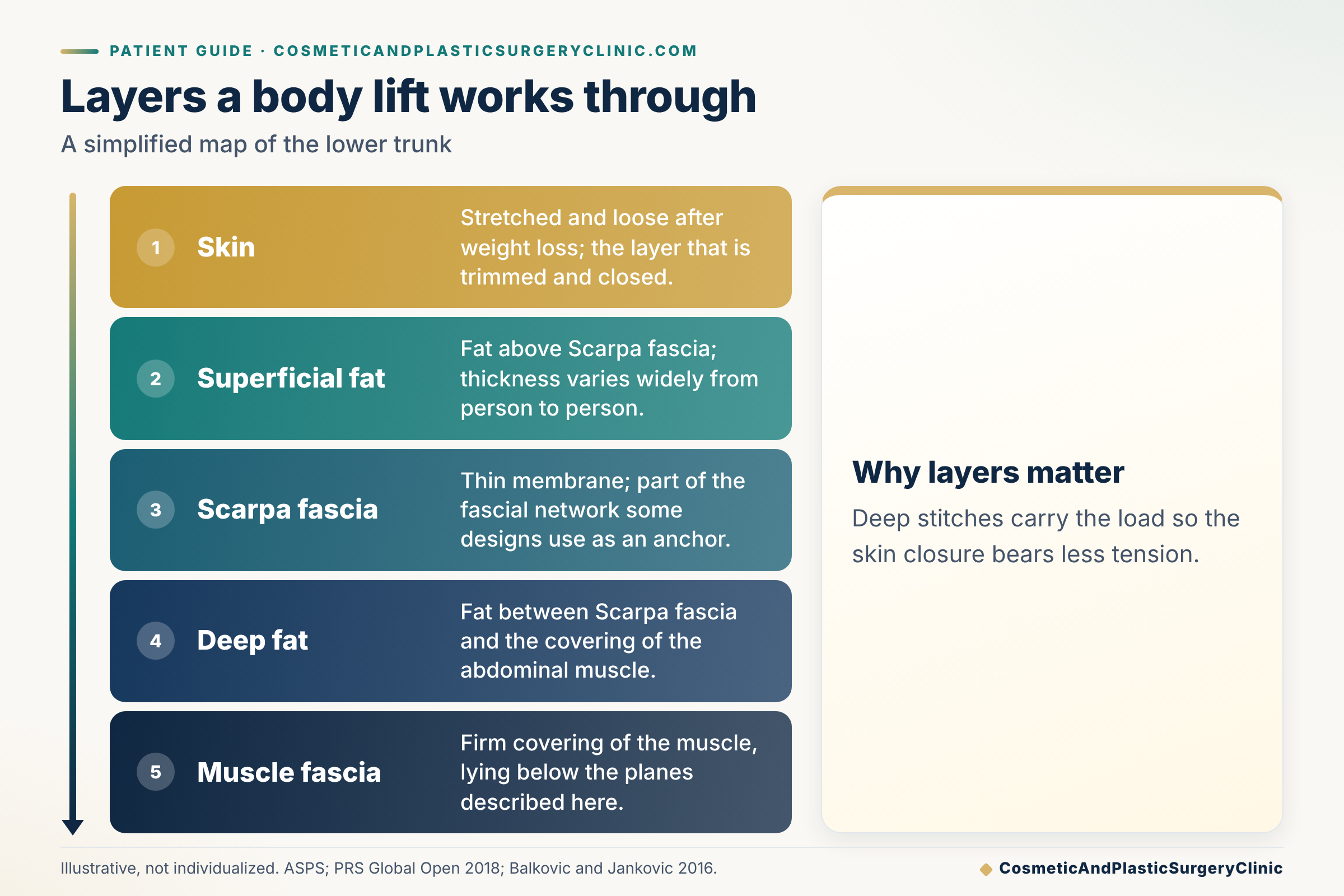
A body lift after weight loss is a story about layers. The surgeon cuts through skin, passes through the fat, reaches a firm connective layer, and then pulls and anchors. How that anchoring is done, and where the final line falls, explains both the lift and the scar. A basic map of the layers makes the consultation language easier to follow.
The layers a surgeon works through
Skin, superficial fat and Scarpa fascia in a body lift after weight loss
Below the skin of the abdomen lies fat, then a thin membrane called Scarpa fascia, then deeper fat, then the fascia covering the muscle. A 2018 paper on liposuction-assisted abdominoplasty in Plastic and Reconstructive Surgery Global Open describes working just deep to Scarpa fascia, splitting it in the midline to protect its vessels and lymphatics, and suggests that preserving lymphatic tissue may help prevent seroma. The authors present that idea as probable, not proven.
Massive weight loss leaves these layers stretched and thinned in uneven ways, which is one reason the same incision plan does not behave identically in two people. Surgeons assess how much tissue is loose, how thick the fat layer is and how well the fascia holds a stitch before choosing a design.
The superficial fascial system as an anchor
A 2016 history chapter by Balkovic and Jankovic credits the surgeon Lockwood with describing the lower body lift and with using the superficial fascial system, the network of fascia running through the fat layer, to anchor tissue after excisional lifting. The idea is that sutures placed in firm fascia hold the lift better than sutures placed only in skin, which may stretch again.
For a reader, the practical meaning is simple. The deep stitches carry the load, and skin closure carries as little as possible. ASPS describes the same logic: deep sutures in the underlying tissue support the new contours, and the skin closes over them. Ask which layers will be anchored and how the surgeon limits tension on the skin closure.
Where the scar of a body lift after weight loss goes, and what it costs
A line that circles the body, with a back portion
ASPS says a complete lower body lift can use a bikini-style pattern and that a circumferential incision removes an apron of excess skin and fat; advanced techniques aim to place incisions where most clothing and swimwear can conceal them. The Aesthetic Society says the scar is hidden in the bikini line. The 2016 systematic review adds that belt lipectomy leaves a posterior scar at the waistline and corrects hip and back rolls better.
Concealed does not mean absent. A scar that goes around the body is long, and parts of it sit where you cannot see them without a mirror. Photographs taken only from the front hide it completely, which is why the body lift before-and-after guide insists on rear and side views.
Contour versus scar: the trade stated plainly
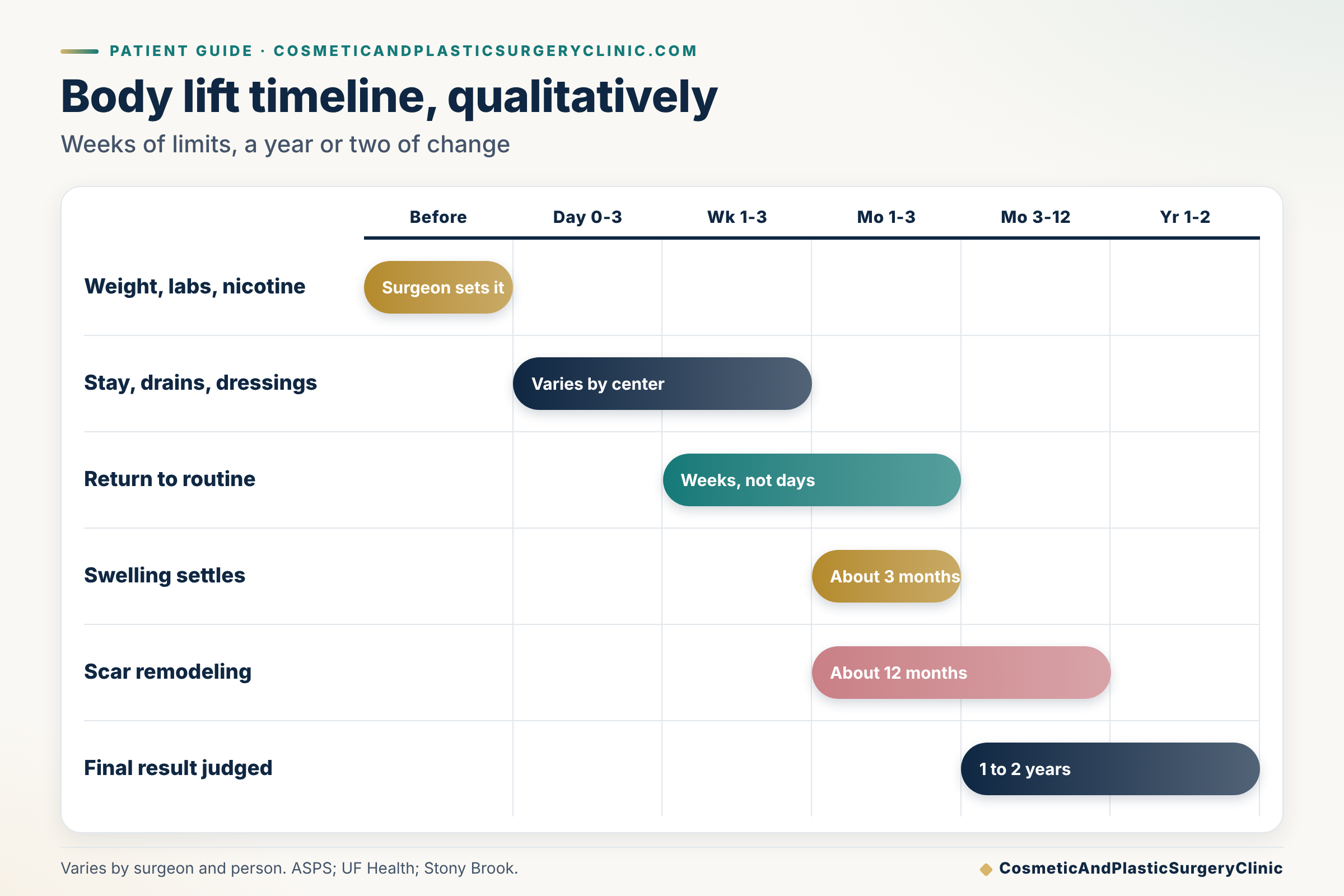
The Aesthetic Society states that scarring is permanent, although surgeons try to place scars in body creases. A Stony Brook Medicine patient page says scars take about 12 months to remodel and are often visible during the first year, and that scar migration can occur later. ASPS says final results of a body lift may take as long as one to two years.
The trade is real. A body lift after weight loss replaces an enormous amount of loose skin with a long line, and the line is the price of the new contour. Some people accept that readily; others find the scar harder than the folds were. Both reactions are reasonable, and the decision is yours to weigh slowly.
Before any date is booked: weight stability, nutrition and nicotine
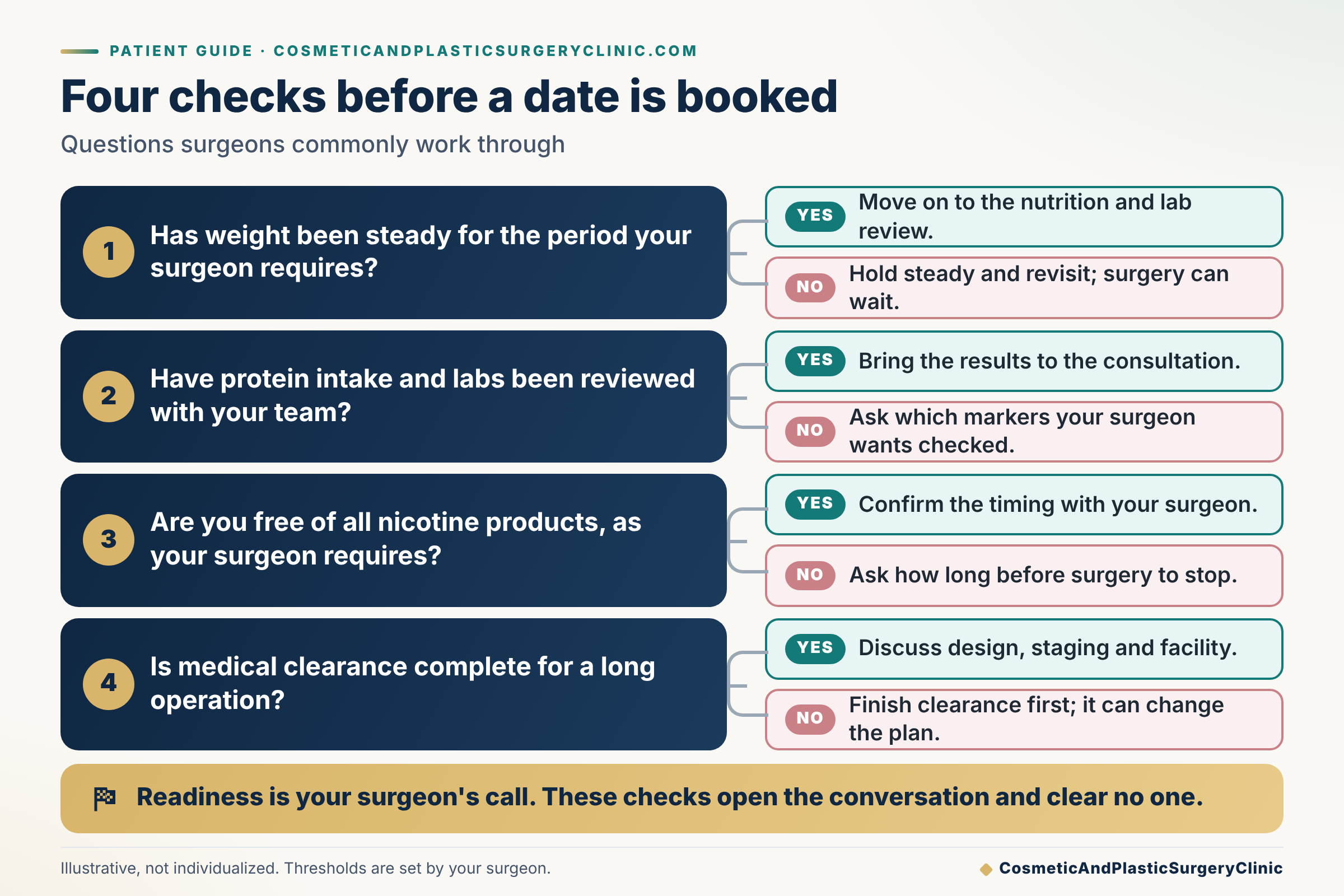
Most of what surgeons check before a body lift after weight loss is not about the skin at all. It is about whether the body can heal a large, tense, long wound. Weight, protein, nicotine and chronic conditions all feed that question, and they are the areas where a person can often act well before a consultation. The body lift candidate guide goes deeper on how surgeons evaluate fitness.
Weight stability: the intervals sources actually state
Stated waiting times before a body lift after weight loss
There is no single standard interval. Sources opened for this article give different waiting times, shown below with what each source is. Treat the spread as information: the field has no universal rule, and the person with the most relevant answer is the surgeon who will operate, together with whoever manages the weight loss.
| Source and type | Stated interval | What it adds |
|---|---|---|
| van der Beek and colleagues, Obesity Facts 2011 (43 patients reviewed) | Stable at least 3 months linked to fewer complications | Odds ratio 0.24; a small retrospective study |
| Giordano, Open Access Surgery 2015 (review) | 4 to 6 months without fluctuation; 12 to 18 months after a bariatric operation | Describes these as recommendations in the literature |
| Aesthetic Society weight-loss page (modified 2023) | Stable at least 6 months; about 2 years after starting a large weight-loss effort | Notes skin shrinks and nutrition stabilizes over time |
| Ohio State Wexner Medical Center patient page (2026 copyright) | At least 6 months stable | Also requires no nicotine and medical screening |
| Aesthetic Society lower body lift page (modified 2023) | Stable for at least a year | Advises waiting about two years after a major weight-loss program |
| Stony Brook Medicine patient page (2026 copyright) | At least 12 months stable | Plans stages three to six months apart |
What the spread, BMI and weight-loss method mean for a body lift after weight loss
The range from three months to more than a year reflects different goals. Short intervals aim to confirm that weight has plateaued; long ones also allow skin to settle and nutrition to normalize. Giordano’s 2015 review says the best candidates are those with a body mass index of 32 or less after stability, and that lower BMI at the time of surgery tends to bring better results and fewer complications. It reports that as the literature’s view, not a rule for any one person.
Two further findings show why BMI history matters. In a 2013 prospective study of 50 lower body lift patients after massive weight loss, complications were significantly related to the highest lifetime BMI and to age. In a 2016 series of 100 patients, pre-surgery BMI showed a linear relationship with complications. Neither study offers a cut-off that clears or blocks anyone.
How the weight came off does not exempt anyone. In Constantine’s 2014 chart review, every route to massive weight loss was associated with more wound problems: gastric bypass carried an odds ratio of 3.01, diet and exercise 2.72 and restrictive bariatric operations 2.31, compared with patients who had not lost massive weight. The abstract does not say these differences are significant between routes, so read them as a shared pattern, not a ranking.
Nutrition, nicotine and the wound
Protein, labs and supplements: what reviews say
Weight loss, especially after a bariatric operation, can leave nutritional gaps. The Aesthetic Society says protein deficiency can interfere with healing. Giordano’s review reports a perioperative protein goal of 70 to 100 grams a day, a pre-operative work-up that includes hematocrit, hemoglobin, a basic metabolic panel and prealbumin, and often-prescribed iron, vitamin B12, calcium and multivitamins after gastric bypass. That is a review’s description, not a target for you.
Your surgeon, your bariatric team or a dietitian decides what applies to you. A reasonable pre-consultation step is to bring recent lab results and a list of supplements, and to ask which markers the surgeon wants repeated before a date is set. Do not change a diet or medication on the strength of a published figure.
Nicotine, conditions and wound healing in a body lift after weight loss
MedlinePlus says most health care providers advise stopping cigarettes and tobacco at least four weeks before surgery, that stretching the gap to at least ten weeks lowers problems further, and that smoking reduces oxygen reaching the wound so healing is slower and infection more likely. It also says nicotine gum is not encouraged around surgery, because nicotine still interferes with healing.
The evidence for a body lift after weight loss points the same way. In the 100-patient 2016 series, smoking showed a large but statistically imprecise association with complications. A 2020 series of 323 lower body lifts found tobacco use significantly associated with complications. ASPS lists non-smokers as the candidates it describes. If you use nicotine in any form, say so at the first visit; surgeons can only plan around what they know.
Other conditions matter alongside nicotine. A 2023 claims analysis of 243,886 patients across nine body contouring procedures from 2010 to 2021 found obesity, tobacco use, diabetes and hypertension each linked to higher odds of wound dehiscence within 90 days; lower body lift was not analyzed as its own category. Controlled blood pressure and diabetes care are part of the medical clearance discussed in the readiness path above.
Panniculectomy, tummy tuck or body lift after weight loss: three answers to loose skin
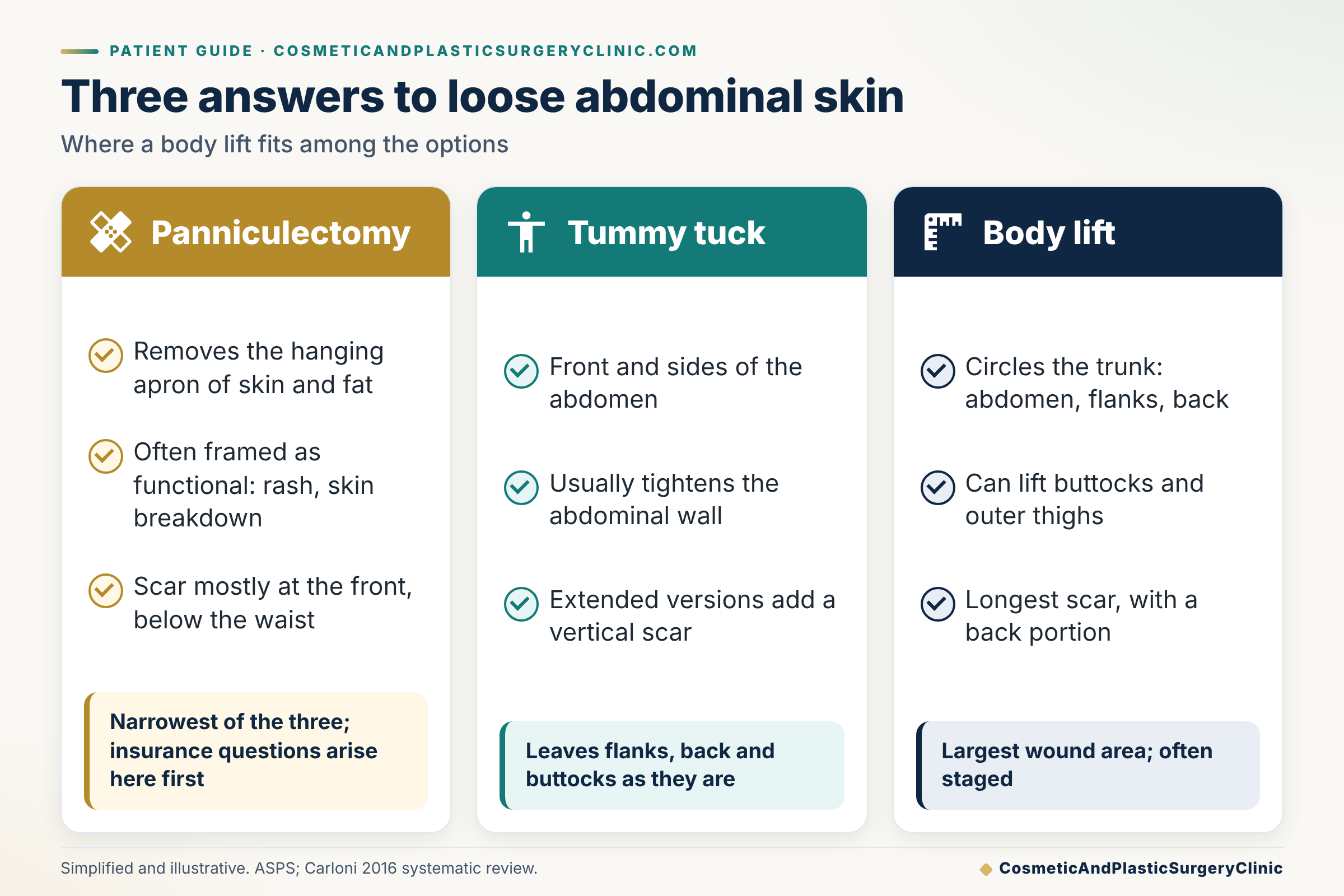
Loose abdominal skin after weight loss can be treated three ways, and which one fits depends on where the excess sits and what it does to daily life. This section sketches the three so that a body lift after weight loss can be placed among them; the comparison itself belongs to the panniculectomy versus body lift guide.
The abdomen-only options in brief
Panniculectomy: removing the hanging apron
A panniculectomy removes the apron of skin and fat that hangs from the lower abdomen. It is the operation most often framed as functional, because the apron can cause rashes, skin breakdown and trouble with hygiene or movement. Stony Brook Medicine says abdominal panniculectomy is the procedure most commonly covered by insurance among post-weight-loss operations, while noting that coverage varies and that more insurers are excluding body contouring.
Surgeons generally treat a panniculectomy as a narrower operation than a tummy tuck or a body lift after weight loss: it addresses the apron, not the waist, flanks or back. Whether the navel, abdominal muscles or surrounding fat are involved differs by surgeon and technique, so ask for a description of exactly what will and will not change.
Tummy tuck after weight loss: front and sides
An abdominoplasty, or tummy tuck, removes excess skin and fat and, in its usual form, tightens the abdominal wall. After large weight loss, surgeons often use extended or fleur-de-lis patterns that add a vertical component. The tummy tuck after weight loss guide and the fleur-de-lis tummy tuck guide cover those designs, and the mini versus full tummy tuck guide explains why a mini version rarely suits a large excess.
A tummy tuck, however modified, works from the front. If the problem includes flank rolls, a drooping lower back or sagging buttocks, an abdomen-only design leaves them in place. That gap is the usual reason a surgeon raises the circumferential option.
The circumferential option: where a body lift fits
What makes a body lift after weight loss different
A body lift after weight loss treats the abdomen, flanks, back and buttocks in a single connected plan, and sometimes the outer thighs. The 2016 systematic review of 42 articles and 1,748 patients found that belt lipectomy leaves a posterior scar at the waistline and corrects hip and back rolls better, while the lower body lift technique works better for buttock and lateral thigh ptosis. The choice between designs is the surgeon’s, based on where your tissue sits.
The price of treating the whole ring is a bigger operation: a longer scar, more raw surface to heal and more time under anesthesia. That is why many surgeons ask whether the front-only option, or a staged approach, would meet your goals with less wound area at once. Both are legitimate answers, and neither is a lesser version of care.
A comparison table for the three operations
| Operation | Main area treated | Scar, in general terms | Why it is usually considered |
|---|---|---|---|
| Panniculectomy | Hanging apron of the lower abdomen | Mostly at the front, below the waist | Skin problems or functional limits caused by the apron |
| Tummy tuck, standard | Front of the abdomen, usually with abdominal wall tightening | Low horizontal line; may extend to the hips | Excess skin and fat limited mainly to the front |
| Tummy tuck, extended or fleur-de-lis | Front plus sides, with a vertical component for width | Horizontal plus a vertical line | Excess in both directions after large weight loss |
| Body lift (belt lipectomy or lower body lift) | Abdomen, flanks, back and buttocks; sometimes outer thighs | Circles the trunk with a back portion | Circumferential excess that front-only designs leave behind |
The operation day and the complication record of a body lift after weight loss
A body lift after weight loss is long, and the honest number to carry into a consultation is the complication rate in people who lost a lot of weight. Published figures vary by definition, by center and by how complications were counted. This section lays out the day itself, then the numbers, then how to read them without either panic or false comfort.
The day of surgery: anesthesia, position and time
Anesthesia, turning and operating time
ASPS lists IV sedation or general anesthesia as the options for a body lift after weight loss and says the surgeon recommends the better fit for each person. Because the incision encircles the trunk, many designs involve work on both the front and the back, so the team may reposition you during the operation. Ask how long the plan is expected to take, how the team protects pressure points and how they limit time under anesthesia.
Giordano’s 2015 review suggests keeping operating time preferably under six hours when staging procedures. That figure is a staging consideration reported in a review, not a promise about any individual operation. If a plan seems to need much longer than that, a reasonable question is whether it should be divided, an issue the staged body contouring guide, linked below, develops.
Hospital stay, drains and who watches you overnight
Practices differ. The Aesthetic Society describes one to three days of hospitalization or nursing care at home after a lower body lift. A patient page from Ohio State Wexner Medical Center says body contouring there is usually outpatient with same-day discharge in most cases, with a driver and an adult staying overnight. ASPS says small drains may be placed under the skin to collect blood and fluid, and that you should ask when they come out.
No source here sets a single standard. What matters is that the setting matches the size of the operation: accredited, staffed for monitoring and clear about what happens if something goes wrong at night. ASPS expects its members to use accredited or licensed facilities for anything beyond local anesthesia or mild oral sedation, as covered further below.
What published series report about complications
The numbers from post-weight-loss series
The table collects figures from the studies opened for this article. They are not comparable line by line, because populations, definitions and follow-up differ. Read each as a description of one group of patients, not a forecast for a particular person.
| Study, year and design | Who was studied | What was counted | Reported result |
|---|---|---|---|
| Kitzinger and colleagues, 2013; prospective | 50 lower body lift patients after massive weight loss | Any complication; wound dehiscence; seroma; major needing surgical revision | 70% any; 60% dehiscence; 34% seroma; 10% major |
| Poodt and colleagues, 2016; retrospective | 100 postbariatric lower body lifts; follow-up 6 months | Any, major and minor complications | 78% any; 22% major; 56% minor; 1 pulmonary embolism |
| Losco and colleagues, 2020; retrospective | 323 lower body lifts after bariatric surgery over 10 years | Any complication; most frequent type | 42% any; seroma 35%; no infections or skin necrosis reported |
| Gupta and colleagues, 2016; CosmetAssure cohort | 127,961 aesthetic surgery patients, 2008 to 2013 | Major complications: emergency visit, admission or reoperation within 30 days | 8.8% after lower body lift; 3.5% after abdominoplasty |
| Constantine and colleagues, 2014; chart review | 450 body contouring patients, 124 with massive weight loss | Wound problems, compared with other patients | Odds ratio 2.69 for massive weight loss; 3.98 above 100 lb lost |
How to read a 70 percent figure for a body lift after weight loss
The Kitzinger and Poodt percentages look alarming, and they are real, but they count everything from a small area of wound separation to a return to the operating room. In Kitzinger’s group, 10 percent had a major complication needing surgical revision; in Poodt’s, 22 percent had a major one, defined by the modified Clavien-Dindo scale, and 13 percent needed surgical revision. Minor wound problems were far more common than major ones.
Aly and Mueller’s 2014 review of belt lipectomy states that the most common complications are small wound separations and seromas. The 2016 systematic review agrees that wound dehiscence is reported most often. The Gupta figure is lower because it counts only events that sent patients to an emergency department, hospital or operating room within 30 days, and its abstract does not make clear whether the lower body lift rate covers all patients or only the overweight subgroup.
Two more points keep the numbers honest. The 2016 review found only two studies at level II evidence out of 42, so the field rests mostly on single-center case series. And Constantine’s 2014 chart review found that losing 50 to 100 pounds did not significantly raise wound-problem risk, while losing more than 100 did. Your own risk depends on weight history, nutrition, nicotine, conditions and the team; these tables describe groups. Pair this section with the body lift risks guide and the general plastic surgery risks guide.
Consider a hypothetical comparison. Surgeon A says complications are rare and shows only front-view photographs. Surgeon B says small wound separations are common in their own post-weight-loss patients, states how often a patient needed a return to the operating room, shows back views and explains the drain and follow-up plan. Surgeon B’s answer sounds less comforting and is far more useful. For a body lift after weight loss, a surgeon who can state real rates of wound separation and seroma in similar patients is a better guide than one who calls the whole operation routine.
Blood clots and other serious events
Venous thromboembolism: a wide range of estimates
Clots in leg veins, and clots that travel to the lungs, are the complication surgeons guard against hardest in long body contouring operations. Giordano’s review reports a venous thromboembolism rate of about 2.9 percent for body contouring overall, rising to 8.9 percent when BMI is above 35, with a general range of 1 to 9.3 percent after postbariatric procedures. A 2024 review of abdominoplasty safety says rates may reach 9.4 percent in circumferential abdominoplasty.
A 2011 national survey of 596 ASPS surgeons, with a response rate of 14.6 percent, found that 40 percent reported a deep vein thrombosis and 34 percent a pulmonary embolism among their body contouring patients, and 7 percent reported at least one patient who died of a pulmonary embolism. Those are surgeon-reported experiences across a career, not patient-level rates. They show why prevention protocols are discussed at length before surgery.
Warning signs to know before a body lift after weight loss
The Centers for Disease Control and Prevention (CDC) lists swelling, pain or tenderness, warmth and redness in one leg as deep vein thrombosis signs, and says about half of people with a clot have no symptoms. For a pulmonary embolism it lists difficulty breathing, a fast or irregular heartbeat, chest pain that worsens with a deep breath or cough, coughing up blood and lightheadedness or fainting. Knowing these in advance is part of recovery planning.
Recovery after a body lift after weight loss: the first weeks and the year that follows
Recovery from a body lift after weight loss is measured in weeks of reduced activity and months of change, not days. The details depend on the design, the facility and your own healing, and the sources opened here give few exact schedules. This section outlines the arc and the questions to settle beforehand; the body lift recovery guide goes week by week.
The first weeks: drains, dressings and movement
What practices describe for the early period
ASPS says small drains may be placed to remove excess blood and fluid, dressings are applied over the incisions, and you should ask when each comes off. The Aesthetic Society describes recovery after a lower body lift as lengthy, with two to three weeks before a normal routine, while its weight-loss page says at least two weeks and possibly longer. Ohio State Wexner Medical Center lists follow-up visits weekly or every other week in the first month.
These are the descriptions of three sources, not a schedule for you. Ask your surgeon for written instructions on drains, dressings, positioning, walking, garments, showering and lifting, and ask who answers the phone at night. Compare the answer with the general logistics in the plastic surgery recovery planning guide, and with the shorter tummy tuck recovery arc for contrast.
Moving, eating and watching the wound
Movement matters for clots. The CDC advises moving around as soon as possible after being confined to bed, such as after surgery, and says to talk to your doctor about compression stockings or blood-thinning medication if you are at risk. Your surgeon decides what is safe for your wound and when. Do not improvise your own activity plan around tension on the incision.
Nutrition continues to matter during healing. The Aesthetic Society says protein deficiency can interfere with healing, and a 2018 ASPS blog post by a member surgeon advises avoiding dieting during recovery and eating enough of the right foods. Wound separation is the most commonly reported complication in the body lift after weight loss series above, so ask what a normal-looking wound looks like, which changes to report the same day and what the practice does if a section opens.
Months one to twenty-four: how the result is judged
Swelling, scar remodeling and the timing of the final shape
A University of Florida Health care sheet reviewed in 2022 says swelling typically subsides and wounds heal in about three months, and that final results and scar fading can take up to two years. Stony Brook Medicine says overall cosmetic results usually take at least three months to become apparent and scars about 12 months to remodel. ASPS adds that a body lift after weight loss can take one to two years to reach its final result.
For planning, that means early photographs mislead. Swelling hides the contour for weeks, and the scar is at its reddest and most raised before it matures. Judging a body lift after weight loss at six weeks is like judging a haircut while the stylist is still cutting. Schedule follow-up visits, and take your own standardized photographs at each one.
Satisfaction and quality of life: what the evidence supports
Satisfaction in the series is generally high. The 2016 systematic review reported high patient satisfaction and quality-of-life scores across studies, and a 2018 review in Obesity Surgery found body contouring after bariatric weight loss associated with improved physical functioning, psychological wellbeing and social functioning. The abstracts available here did not give study counts or effect sizes.
Read those findings with care. The studies are mostly observational, people who choose surgery differ from people who do not, and early enthusiasm can fade as the scar and the cost of recovery become familiar. High satisfaction on average does not predict any one person’s feelings, and it coexists with the complication rates described earlier.
Years later: weight change, aging and touch-ups
Weight change and aging skin after a body lift after weight loss
ASPS lists skin that becomes loose again over time among the risks of a body lift. The Aesthetic Society says a lower body lift can lose its tightness if weight changes afterward, and advises reaching your goal weight before the operation. A University of Florida Health care sheet adds that regaining weight can stress the surgical site. None of these sources gives a figure for how much tightness is lost per pound.
Aging continues regardless. The Aesthetic Society notes that skin keeps sagging with normal aging and that pregnancy can stretch it again, so surgeons may advise postponing surgery if you plan to have children. A body lift after weight loss resets the tissue at one moment. Planning for stable habits, rather than for a fixed result, is more realistic than expecting the contour to stay unchanged for decades.
Revision, scar issues and the second look
ASPS lists the possible need for another operation, scarring that turns out poorly, and stitches that surface or need removal among the risks. Stony Brook Medicine says altered skin quality after massive weight loss can lead to poor healing, scar migration, skin laxity and a higher need for revisions. In the 100-patient 2016 series, 13 percent needed surgical revision; in the 2013 series of 50, 10 percent had a major complication that required it.
Ask before surgery how the practice handles a scar that spreads, a dog-ear at the end of the incision, a wound that heals slowly or an area that needs a touch-up. Ask who pays for the facility and anesthesia if a second operation is needed, and when the surgeon would consider one. Waiting at least until the scar has matured is common advice, and your surgeon sets the timing.
Staging a body lift after weight loss: dividing the work across operations
Few people who lose a very large amount of weight have loose skin in only one place. Arms, breasts, thighs, back and face may all be involved. Surgeons rarely fix all of them in one operation, and the reasons are about wound area, time under anesthesia and safe healing. The staged body contouring guide is the detailed resource; this section gives the core logic.
Why surgeons divide the work
Operating time, wound area and healing
Giordano’s 2015 review recommends operating time preferably under six hours and at least three months between stages. Stony Brook Medicine states that stages are typically spaced three to six months apart to allow for recovery and healing. The logic is simple: each stage creates fresh wounds that need blood supply, protein and time, and stacking too many raises the load on all of them.
Single-stage plans exist. A 2004 report in Annals of Plastic Surgery described a single-stage total body lift in eight patients followed 4 to 31 months, with seven of eight satisfied and complications that included three seromas, two minor infections and one minor skin separation. A series that small shows feasibility in carefully selected people, not a safety record that other patients can assume. Ask any surgeon proposing a long single stage for their own numbers.
Sequences are examples, not prescriptions
Sources suggest different orders. Giordano’s review describes a lower body lift with breast or arm procedures first, then the medial thigh and the upper back, with facial procedures last. Stony Brook Medicine lists an abdominal panniculectomy or lower body lift as stage one, breast work combined with an arm lift or medial thigh lift next, the remaining procedure as a third stage and a facelift often last if facial laxity is significant.
The difference between those sequences shows that no single correct order exists. Surgeons choose by which area bothers you most, where the tissue sits, medical risks and what the body can heal. Ask for a written draft plan with stages, rough intervals and what changes between each. The staged mommy makeover guide shows a different staging logic for contrast, and breast lift work often appears as a later stage here.
Consider a hypothetical plan, offered only to show the shape of one. Stage one is a body lift after weight loss. At least three months later, once healing and weight have been rechecked, arm and breast work follows in stage two. Medial thigh surgery comes in stage three, and a facial procedure is considered last if it matters to the person. Each date is set only after the surgeon confirms healing, weight and nutrition, and any date can move.
Counts, trends and the GLP-1 question
How often related lifts are done
ASPS’s 2025 statistics report, released in 2026, gives national counts for the United States. It lists lower body lifts and upper body lifts as separate categories and does not count body lift after weight loss as such. ASPS also says its procedural statistics do not establish a causal relationship between GLP-1 use and growth in any specific procedure category.
| Procedure | 2025 count | 2024 count | Change |
|---|---|---|---|
| Lower body lift | 10,868 | 10,495 | Up 4% |
| Upper body lift | 6,438 | 5,260 | Up 22% |
| Arm lift | 26,088 | 21,524 | Up 21% |
| Thigh lift | 11,866 | 9,901 | Up 20% |
| Tummy tuck | 173,251 | 170,544 | Up 2% |
The same report counts 1,345 men among the 10,868 lower body lifts in 2025, up from 1,076, and puts the largest age group at 46 to 55. The International Society of Aesthetic Plastic Surgery’s 2024 survey counts 119,706 lower body lifts worldwide in 2024 and 137,118 in 2023, but the number of surgeons supplying data changed between years, so it is not a trend line.
GLP-1 medicines, skin and the consultation room
The ASPS 2025 report says more than four in five member surgeons reported consultation requests related to GLP-1 medication use, and that consultation requests do not necessarily translate into completed procedures. By share of surgeons, it lists tummy tuck at 88 percent, arm lift 84, thigh lift 80, panniculectomy 67 and body lift 62 among procedures discussed. The FDA-approved Wegovy label, revised in May 2026, states that semaglutide lowers body weight with greater fat mass loss than lean mass loss.
Those are the facts available here. Whether and when a person on such medicine should plan surgery, change a dose or stop is a question only the prescribing clinician can answer, together with the surgeon, and nothing on this page should alter treatment. The skin removal after GLP-1 guide examines what studies and labeling do and do not say about skin and body composition.
What a body lift costs, and what insurance does and does not cover
A body lift after weight loss is a long operation, so facility time, anesthesia and often an overnight stay or nursing support weigh heavily in the total. The sources opened here give one national average and a few insurance statements, and every figure comes with limits. The body lift cost guide breaks down a quote in detail.
Reading a body lift quote
The ASPS average and what it leaves out
The ASPS cost page cites an average of $11,397 for lower body lift surgery, based on ASPS statistics. The page shows no year for the figure, and says it excludes anesthesia, operating room or facility charges and other related expenses. A January 2025 clinician primer that summarizes a 2024 review in Cureus gives a much wider range of $7,000 to $30,000 for body lift, which shows how far real quotes can sit from any average.
A national average for a body lift after weight loss is not a local price and is not a total. Rather than compare a quote to $11,397, compare it to a second written quote for the same design, in the same kind of facility, with the same inclusions. The general method sits in the plastic surgery cost guide.
The layers behind the number
ASPS lists the cost factors as the surgeon’s experience, the type of procedure, the geographic location, and possible additions for anesthesia, hospital or surgical facility costs, medical tests, post-surgery garments and prescriptions. For a body lift after weight loss, add the length of facility time, any overnight or nursing stay, drains and supplies, repeat lab work, and each follow-up visit.
Ask how a revision, a wound problem or a readmission would be billed, and whether the surgeon’s fee changes if staging adds a second operation. Ask the same questions of every quote, in writing. A low number that excludes the facility or anesthesia describes less surgery, not a bargain.
Insurance: functional versus cosmetic
What published coverage rules look like
ASPS says most health insurance does not cover body lift surgery or its complications. Coverage questions usually concern panniculectomy instead. One example is a Blue Cross and Blue Shield of North Carolina policy, last reviewed in August 2026. It calls panniculectomy medically necessary only when the pannus hangs at or below the pubic symphysis and either skin complications persist after at least three months of non-surgical treatment or a documented functional impairment exists, with stable weight for at least six months and, after bariatric surgery, at least 18 months since the operation.
The same policy calls abdominoplasty cosmetic and not medically necessary, and does not address body lift or belt lipectomy at all. One insurer’s rules are not yours: criteria differ by plan and change with time. Ask your own plan for its written policy before assuming coverage or exclusion, and keep photographs and documentation of any skin problems with dates.
Financing, travel and the cost of a complication
If you finance, the question is total cost, not the monthly figure; the plastic surgery financing guide covers loans, deferred interest and refund terms. If you consider traveling for a lower price, remember that this is an operation with high published rates of wound problems, so the question of who treats a complication at home matters more than usual; see the medical tourism guide before booking.
Choosing a surgeon, reading photographs and deciding whether to wait
Because a body lift after weight loss carries real complication rates, who operates and where matter more than the price or the clinic’s marketing. The checks below are the ones that can be verified from public sources before the first consultation, along with the photograph and decision tools that keep a high-stakes choice unhurried.
Verifying who operates and where
Board certification, license and relevant experience
The American Board of Plastic Surgery (ABPS) calls certification a voluntary credential and provides a search by name or location. Certificates issued since 1995 are valid for ten years, and a status of “See FSMB” signals a state medical board action worth reading. Use the Federation of State Medical Boards directory and your state board for licensure and complaints. The choosing a plastic surgeon guide gives the full workflow, and the cosmetic surgeon credentials guide explains the title question.
Certification confirms training and standing, not experience with massive weight loss patients. Ask how many circumferential body lifts the surgeon performs each year, how many of those patients lost massive weight and what the surgeon’s own rates of wound separation, seroma, readmission and return to the operating room are. A careful surgeon will answer with real numbers and will not claim there are none.
Accredited facility, anesthesia and overnight care
ASPS says that for anything beyond local anesthesia or mild oral sedation, its members must use a facility that is accredited by AAAASF, AAAHC or the Joint Commission, Medicare certified or state licensed. It expects anesthesia by a board-certified or board-eligible anesthesiologist or a certified registered nurse anesthetist, trained staff and advanced monitoring. For overnight stays in specialty post-surgical facilities, it expects round-the-clock care by at least two licensed staff and a plan for transfer to a hospital.
The Aesthetic Society’s lower body lift safety page says the overall complication rate is low when an experienced, board-certified surgeon operates in an accredited facility, but gives no number. The published postbariatric series above are higher, which is why asking for the surgeon’s own figures is reasonable. Accreditation lowers some risks; it does not remove wound-healing risk.
Photographs, questions and the option to wait
Reading photographs and severity scales
Photographs are evidence of what one person’s tissue did, not a forecast of yours. The Pittsburgh Rating Scale, published by Song and colleagues in Plastic and Reconstructive Surgery in 2005, grades contour deformities in 10 body regions from 0 (normal) to 3 (most severe), based on full-body photographs of over 300 women. Researchers use it to describe starting severity, though a 2013 study in the Netherlands judged it not entirely suitable for classifying deformities there. A gallery that never states starting severity makes comparison hard.
Look for matched anatomy, similar starting weight history, standardized front, side and back views and the time since surgery. The series guide to body lift before-and-after photos shows how to read these images, and the general photo guide covers retouching, selection and consent.
Questions to bring, and waiting as a choice
Bring a short list to a body lift after weight loss consultation: which design and why, what the plan is for staging, what the surgeon expects the scar to look like and where, what weight and nutrition they want first, how complications are handled and what it all costs. The consultation questions guide offers a longer list and shows what an evasive answer sounds like.
Support and expectations belong on the list too. ASPS describes good candidates as people with a positive outlook, realistic goals and a commitment to a healthy lifestyle including nutrition and fitness. Ohio State Wexner Medical Center asks for a driver and an adult who stays at least the first night. Think about who can help with the first weeks, how you will feel about a visible scar and what you would do if the result differs from your hopes.
Waiting is a legitimate option for a body lift after weight loss. You can hold weight steady longer, quit nicotine, repeat labs, get a second opinion, or decide that the folds are tolerable and the scar is not. If you want a broader frame for deciding whether any elective operation is worth its trade-offs, start with the plastic surgery decision guide.

Frequently asked questions
Can a body lift after weight loss be done at the same time as arm or breast surgery?
Some surgeons combine areas and some divide them, and the sources disagree on sequence. Giordano’s 2015 review describes a lower body lift together with breast or arm procedures as an early stage, while Stony Brook Medicine places breast work with an arm lift or medial thigh lift in a second stage. What can be combined depends on operating time, blood loss, your medical risks and the surgeon’s experience. Ask for the planned stages in writing, along with the reasoning for each combination.
How long should weight stay steady before a body lift after weight loss?
No universal figure exists. Sources opened for this article state anything from at least three months to at least twelve, and one review mentions 12 to 18 months after a bariatric operation plus 4 to 6 months without weight fluctuation. The surgeon who will operate sets the interval for you, usually working with the team managing your weight. Bring a record of your weight over the past year, because a trend line is more informative than a single number.
Does the scar fade completely after a body lift after weight loss?
No. The Aesthetic Society says scarring is permanent, though surgeons try to place scars in body creases. Stony Brook Medicine says scars take about 12 months to remodel and can migrate, and ASPS says final results may take one to two years. Scars often flatten and pale over time, but the line remains. Ask to see scars at one year and later in a surgeon’s own patients, from the back and side, not only the front, and ask about scar care that your surgeon directs.
Will insurance pay for a body lift after weight loss or other skin removal?
It may pay for a panniculectomy that meets its criteria, and it usually does not pay for a body lift after weight loss. According to ASPS, most plans exclude body lift surgery and the complications that follow it. One published insurer policy, last reviewed in August 2026, requires a pannus at or below the pubic symphysis, documented skin or functional problems and stable weight. Policies differ, so request your plan’s written criteria and keep dated photographs and notes of skin problems.
Why do surgeons ask about vitamin and protein levels?
Large weight loss can leave nutritional gaps, and wound healing needs protein and certain nutrients. The Aesthetic Society says protein deficiency can interfere with healing, and Giordano’s 2015 review lists labs such as hematocrit, hemoglobin, prealbumin and a metabolic panel in a pre-operative work-up. The review mentions iron, vitamin B12, calcium and multivitamin use after gastric bypass. What applies to you is a decision for your surgeon, bariatric team or dietitian, not something to adjust from an article.
Is a body lift after weight loss safe for someone who has had bariatric surgery?
Many people who have had bariatric surgery have a body lift after weight loss, and published series report high satisfaction, but they also report high complication rates, mostly minor wound problems. A 2020 series of 323 patients found 42 percent with any complication and none with infection or necrosis; a 2016 series of 100 patients found 78 percent. Safety depends on stable weight, nutrition, nicotine status, conditions and the team. No article can call it safe for you.
What is the difference between a body lift after weight loss and a tummy tuck?
A tummy tuck works from the front and sides of the abdomen. A body lift after weight loss circles the trunk and also treats the flanks, back and buttocks, sometimes the outer thighs. The 2016 systematic review says belt lipectomy leaves a posterior scar and corrects hip and back rolls better, while lower body lift suits buttock and lateral thigh sagging. The right choice depends on where your excess skin sits, so ask the surgeon to show on your body which areas each design changes.
How should I choose between a hospital and an accredited surgery center?
Compare what each offers for a long operation and a possible overnight stay. ASPS expects an accredited, licensed or Medicare certified facility with trained staff, monitoring and anesthesia by a qualified provider. Ask whether you stay overnight, who watches you through the night, how emergencies are handled and where you would be transferred. The Aesthetic Society describes one to three days of hospitalization or nursing care after a lower body lift, and practices differ, so ask for the specific plan in writing.
Sources and further reading
- American Society of Plastic Surgeons — Body lift overview (accessed 2026-11-13) — definition, treated areas, liposuction limits
- American Society of Plastic Surgeons — Body lift procedure (accessed 2026-11-13) — anesthesia options, circumferential incision, deep sutures, one to two years for final results
- American Society of Plastic Surgeons — Body lift cost (accessed 2026-11-13) — $11,397 lower body lift average with no year, exclusions, insurance statement
- American Society of Plastic Surgeons — Body lift risks and safety (accessed 2026-11-13) — listed risks, informed consent
- American Society of Plastic Surgeons — Body lift candidates (accessed 2026-11-13) — general candidate criteria, non-smokers
- American Society of Plastic Surgeons — Body lift recovery (accessed 2026-11-13) — drains, dressings, emergency symptoms
- American Society of Plastic Surgeons — 2025 plastic surgery statistics report (accessed 2026-11-13) — lower and upper body lift, arm lift, thigh lift and tummy tuck counts; GLP-1 consultation shares (read through an automated summary)
- American Society of Plastic Surgeons — Lift procedures led growth in 2025, press release, 1 September 2026 (accessed 2026-11-13) — 82 percent of surgeons, no causal claim
- American Society of Plastic Surgeons blog — When is the time right for body contouring after major weight loss, Kaufman, 13 July 2018 (accessed 2026-11-13) — weight stability, not a weight-loss method, member opinion
- American Society of Plastic Surgeons — Accreditation of surgical facilities (accessed 2026-11-13) — accrediting bodies, anesthesia, overnight facility expectations
- The Aesthetic Society — Plastic surgery after dramatic weight loss (modified 2023; accessed 2026-11-13) — six months stable, about two years, protein, permanent scars, recovery length
- The Aesthetic Society — Lower body lift (belt lipectomy) (modified 2023; accessed 2026-11-13) — bikini-line scar, one to three days of care, two to three weeks, a year of stable weight
- The Aesthetic Society — Lower body lift risks (2021; accessed 2026-11-13) — risk list, clot and weight-change risks, no numbers
- American Board of Plastic Surgery — Verify certification (accessed 2026-11-13) — voluntary credential, ten-year certificates, FSMB status
- International Society of Aesthetic Plastic Surgery — Global survey 2024 (accessed 2026-11-13) — worldwide lower body lift counts, survey scope
- Constantine RS, Davis KE, Kenkel JM — Effect of massive weight loss status, amount and method on body contouring outcomes, Aesthetic Surgery Journal 2014;34(4):578-583 (accessed 2026-11-13) — 450 patients, odds ratios for wound problems
- Giordano S — Removal of excess skin after massive weight loss: challenges and solutions, Open Access Surgery 2015;8:51-60 (accessed 2026-11-13) — stability intervals, BMI, protein, labs, venous thromboembolism, staging
- Song AY and colleagues — A classification of contour deformities after bariatric weight loss: the Pittsburgh Rating Scale, Plastic and Reconstructive Surgery 2005 (Europe PMC record; accessed 2026-11-13) — 10 regions, grades 0 to 3
- PMFA Journal — Review of the Pittsburgh Rating Scale in the Netherlands, 1 October 2013 (accessed 2026-11-13) — scale judged not entirely suitable there
- Carloni R and colleagues — Circumferential contouring of the lower trunk: a systematic review, Aesthetic Plastic Surgery 2016 (Europe PMC record; accessed 2026-11-13) — 42 articles, 1,748 patients, belt lipectomy versus lower body lift
- Kitzinger HB and colleagues — Prospective study on complications following a lower body lift after massive weight loss, Journal of Plastic, Reconstructive and Aesthetic Surgery 2013 (record page; accessed 2026-11-13) — 50 patients, 70 percent any complication
- Poodt IGM and colleagues — Complications of lower body lift surgery in postbariatric patients, Plastic and Reconstructive Surgery Global Open 2016 (accessed 2026-11-13) — 100 patients, 78 percent any complication, BMI and smoking
- Losco L and colleagues — Lower body lift after bariatric surgery: 323 consecutive cases, Aesthetic Plastic Surgery 2020 (record page; accessed 2026-11-13) — 42 percent any complication, seroma 35 percent
- Gupta V and colleagues — Safety of aesthetic surgery in the overweight patient, 127,961 patients, Aesthetic Surgery Journal 2016;36(6):718-729 (record page; accessed 2026-11-13) — major complications within 30 days, lower body lift and abdominoplasty rates
- van der Beek ESJ and colleagues — Complications after body contouring surgery in post-bariatric patients, Obesity Facts 2011 (record page; accessed 2026-11-13) — three months of stable weight, odds ratio 0.24
- Garoosi K and colleagues — Comorbid conditions and complications in body contouring surgery, Aesthetic Surgery Journal Open Forum 2023 (accessed 2026-11-13) — 243,886 patients, dehiscence and comorbidity odds ratios
- Stein MJ, Karaev S, Matarasso A — A primer on abdominoplasty safety, Plastic Surgery 2024 (accessed 2026-11-13) — venous thromboembolism range, wound problems after massive weight loss
- Brauman D, van der Hulst RRWJ, van der Lei B — Liposuction assisted abdominoplasty, Plastic and Reconstructive Surgery Global Open 2018 (accessed 2026-11-13) — Scarpa fascia, vessels and lymphatics
- Aly A, Mueller M — Circumferential truncal contouring: the belt lipectomy, Clinics in Plastic Surgery 2014 (Europe PMC record; accessed 2026-11-13) — common complications are small wound separations and seromas
- Clavijo-Alvarez JA, Pannucci CJ, Oppenheimer AJ — Prevention of venous thromboembolism in body contouring surgery, survey of 596 ASPS surgeons, Annals of Plastic Surgery 2011 (Europe PMC record; accessed 2026-11-13) — surgeon-reported clots, 14.6 percent response
- Lockwood T — Lower body lift with superficial fascial system suspension, Plastic and Reconstructive Surgery 1993 (Europe PMC record; accessed 2026-11-13) — 10 patients, minor complications in half
- Hurwitz DJ — Single-staged total body lift after massive weight loss, Annals of Plastic Surgery 2004 (Europe PMC record; accessed 2026-11-13) — eight patients, complications listed
- Balkovic M, Jankovic I — The history of body contouring surgery, IntechOpen 2016 (accessed 2026-11-13) — Somalo and Gonzalez-Ulloa, Lockwood, superficial fascial system
- Blugerman G and colleagues — New concepts on safer abdominoplasty, IntechOpen 2016 (accessed 2026-11-13) — reference to Gonzalez-Ulloa’s 1960 belt lipectomy paper
- Toma T and colleagues — Does body contouring after bariatric weight loss enhance quality of life? Obesity Surgery 2018 (repository record; accessed 2026-11-13) — quality-of-life domains, abstract level
- Physician’s Weekly — A plastic surgery primer for clinicians counseling on cosmetic procedures after weight loss, Part 1, 10 January 2025 (accessed 2026-11-13) — summary of a 2024 Cureus review, body lift cost range (secondary summary)
- Stony Brook Medicine — FAQs about body contouring after bariatric surgery and major weight loss (2026 copyright; accessed 2026-11-13) — 12 months stable, stages three to six months apart, insurance, scar remodeling
- Ohio State Wexner Medical Center — Body contouring after bariatric surgery (2026 copyright; accessed 2026-11-13) — six months stable, outpatient discharge, follow-up schedule
- University of Florida Health — Considering plastic surgery after a large weight loss (reviewed 10 April 2022; accessed 2026-11-13) — healing in about three months, results up to two years
- Blue Cross and Blue Shield of North Carolina — Abdominoplasty and panniculectomy corporate medical policy (last review 08/2026; accessed 2026-11-13) — one insurer’s panniculectomy criteria, abdominoplasty considered cosmetic
- Centers for Disease Control and Prevention — About blood clots (accessed 2026-11-13) — deep vein thrombosis and pulmonary embolism symptoms, movement after surgery
- MedlinePlus — Quitting smoking before surgery (accessed 2026-11-13) — four-week and ten-week timing, wound healing
- U.S. Food and Drug Administration — Wegovy prescribing information, revised 05/2026 (accessed 2026-11-13) — section 12.2 statement on fat mass and lean mass