A body lift cost quote usually arrives as one large number for what is really a bundle: a long operation under anesthesia, tissue removed from several regions, and a recovery that may begin in a hospital bed or at home with a nurse.
A body lift (also called a circumferential lower body lift or belt lipectomy) removes loose skin and fat in a ring around the trunk, most often after major weight loss, and lifts the tissue of the lower back, hips, buttocks and abdomen. The ring is long, so much of the price comes from time and setting rather than from any single fee.
This page takes a body lift cost apart. It covers what national averages measure, what a quote should itemize, how staging and insurance move the total, and how to compare two quotes fairly. The operation itself is described in the guide to lower body lift, the wider decision in body lift after weight loss, and the complication evidence in body lift risks. Nothing here judges any person’s plan or budget.
What the published body lift cost figures measure
Several numbers circulate for body lift cost, and they answer different questions. Before using any of them as a budget, it helps to know who collected the figure, in which year, and which parts of the bill it was meant to cover.
Three published figures that do not agree
The three sources below are the ones that name a lower body lift specifically. Each is an average of what surgeons reported, so none is a price list, and none measures the cost of the whole episode of care.
| Source | Data year | Figure | What it says it covers | Limits |
|---|---|---|---|---|
| ASPS average cost sheet | 2024 | $10,000 to $16,500 for a lower body lift | Surgeon fee range; no wording on inclusions | Aggregate projection of averages from surveyed members; no panniculectomy line |
| ASPS body lift cost page | Not stated | $11,397 average for lower body lift surgery | Does not include anesthesia, operating room facilities or related expenses | No data year on the page; part of the total only |
| The Aesthetic Society cost page | 2021 | $7,269 for a lower body lift | Surgeon and facility fees; may omit anesthesia, tests, prescriptions, garments | National databank average; varies by surgeon, region and technique |
Why the Aesthetic Society and ASPS numbers cannot be stacked
A figure that includes the facility ($7,269) sitting below a figure that excludes it ($11,397) is a warning that the two come from different surveys, different years and different populations of surgeons. Neither page publishes the respondent counts needed to reconcile them. The sensible reading is a wide plausibility band for the surgeon’s share of a body lift cost, not a price and not a total.
What a fee range is, and is not
ASPS describes its sheet as reflecting “a projected range rather than a single price,” built from “an aggregate projection based on averages submitted by surveyed members.” The 2024 sheet puts a lower body lift at $10,000 to $16,500, a tummy tuck at $8,000 to $13,500, a thigh lift at $7,000 to $12,000 and an upper arm lift at $6,000 to $10,500. A quote far under the band raises the question of what was moved to another line. A quote far over it raises the opposite question, which lines are folded in.
Why one national number fits this operation poorly
Most cosmetic operations have a fairly standard scope. A body lift cost is harder to pin down because the scope itself varies from one person to the next, and the largest cost drivers are hours and hospital days rather than a set technique.
One label, several operations
A circumferential lift can be limited to the trunk’s belt line or paired with liposuction, and ASPS notes that surgical body lifts “may require liposuction to achieve an improved contour.” Some plans add buttock volume using the person’s own fat or tissue, which adds surgeon time and its own considerations.
After a 100-pound loss the volume of excess tissue is different from after a 40-pound loss. The ASPS sheet has no field for any of that, which is why a body lift cost estimate is only as good as the surgeon’s written description of what will be done.
Operative time and tissue removed: two published reference points
Operating time is the body lift cost driver that varies most between teams. A 2022 abstract in Aesthetic Plastic Surgery (Zaussinger and colleagues) reported 155 massive-weight-loss patients operated on from 2006 to 2018 by one Austrian team, with a mean operative time of 178 minutes and a mean of 3,056 g of tissue removed.
A surgeon-written post hosted by ASPS describes a lower body lift protocol of about 7.5 hours of anesthesia time. Those numbers describe different teams, techniques and extras, and speed is not a quality measure either way. They show that a time-based line on a quote can differ by more than double.
For volume context, ASPS’s 2025 statistics report counted 10,868 lower body lifts in 2025 against 10,495 in 2024 (up 4%), and 6,438 upper body lifts against 5,260 (up 22%). The report builds national estimates from member-surgeon data, insurance-claim data and other datasets covering more than 3,000 board-certified plastic surgeons. Counts describe how often the operation is done, not what it costs.
Line by line: what a body lift cost quote should itemize
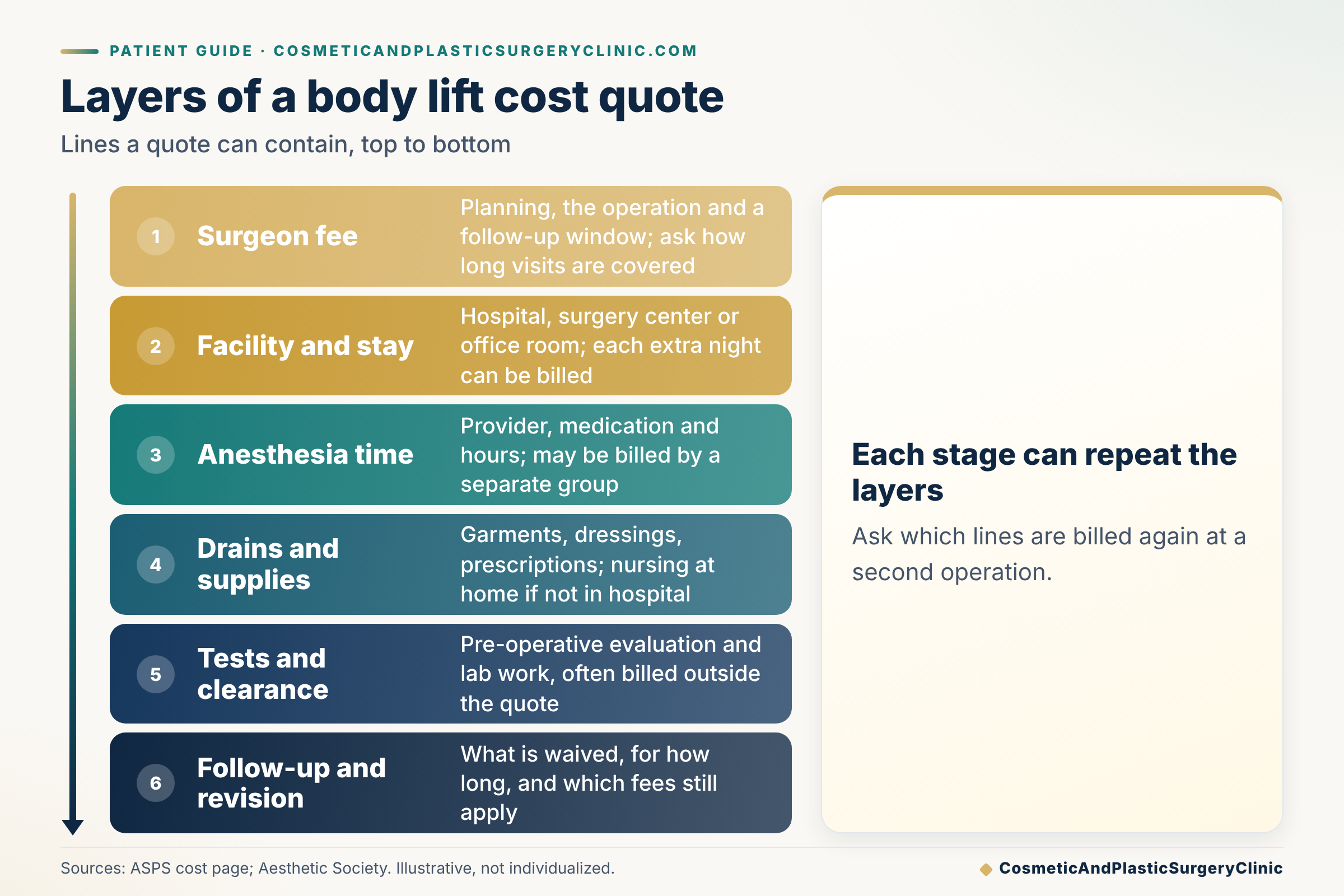
A usable quote is dull to read. It names who operates, where, under whose anesthesia, for how many hours and nights, with which supplies, and what happens if something needs fixing. The ASPS cost page lists the components a patient may pay for: the surgeon’s fee, hospital or surgical facility costs, anesthesia fees, medical tests, post-surgery garments and prescriptions. A body lift cost quote missing any of those lines is incomplete, not cheaper.
| Line item | Why it may be charged | What changes it | Often billed separately? | Question to ask |
|---|---|---|---|---|
| Surgeon fee | Planning, the operation and a follow-up window | Extent of the plan, adjuncts such as liposuction, surgeon experience | No, but visits after the window may be | Which regions are included, and for how many months of visits? |
| Facility fee | Operating room, recovery area, nursing, equipment | Hospital, surgery center or office room; case length; length of stay | Yes, usually a separate bill | Which facility, which accreditation, and what if the stay runs longer? |
| Anesthesia | Provider’s time, medication and monitoring | Hours under anesthesia; provider type; pricing method | Yes, often by a separate group | Who gives it, and is the fee time-based, flat or capped? |
| Hospital or nursing days | Monitoring and drain care after surgery | Technique, protocol, health history, how drains are managed | Sometimes inside the facility fee, sometimes not | Where will recovery happen, and who pays for each extra night? |
| Drains, garments, supplies | Compression garments, dressings, prescriptions | Number of garments, drain days, dressing needs | Often yes | What is supplied, and what must be bought? |
| Tests and clearance | Pre-operative evaluation and any lab work | Health history, medications, what the facility requires | Often yes, by outside labs or physicians | Which tests are expected, and who bills them? |
| Follow-up and revision terms | Wound checks, drain removal, later touch-ups | Policy of the practice; time limits; what is waived | Terms sit under every line | What is waived, for how long, and which fees remain? |
The three large lines: surgeon, facility and anesthesia
Together these usually make up most of a body lift cost. They also look the most different from one quote to the next, because each depends on how long the operation is expected to run and where it will take place.
Surgeon fee and the length of the follow-up window
The surgeon’s fee should say what regions it covers: abdomen only, the full belt, added liposuction or buttock work. It should also say how long the postoperative visits are included. Wound checks and drain removal happen over weeks, and a practice that stops covering visits at 90 days prices differently from one that covers a year. A body lift cost quote that says only “body lift” has not yet described an operation. The consultation questions in the guide to plastic surgery consultations include several that turn a vague scope into a written one.
Facility fee, hospital days and where the operation happens
Setting changes both price and backup. The Anesthesia Patient Safety Foundation (APSF) says hospitals usually have the most resources and tend to cost more, freestanding surgery centers are often cheaper and more convenient, and office procedure rooms are the most convenient and least costly but have the fewest staff and limited backup. It adds that patients with complex health problems should consider a hospital setting. Its list of questions starts with where the procedure will happen and whether the facility is accredited, and by whom.
Length of stay is the part most often missing from a body lift cost estimate. The Aesthetic Society says a patient will probably need one to three days of hospitalization or nursing care at home. A surgeon writing on an ASPS-hosted blog describes an outpatient protocol.
A 2019 retrospective study in Aesthetic Plastic Surgery (Meal and colleagues, 130 patients) compared a lipo-body lift technique with a classical lower body lift and found significantly shorter drainage and hospital stay with the first, with comparable outcomes; the abstract gives no day counts. Stay, in other words, depends on technique and protocol, and each night is a billable line.
Accreditation is worth checking as part of the price, not after it. ASPS names three accrediting bodies for surgical facilities in the United States, the Joint Commission, AAAHC and AAAASF, and notes that accreditation is optional. The steps for verifying a facility and a surgeon’s board certification are in how to choose a plastic surgeon; this page only needs the facility named in writing on the quote.
Anesthesia: who gives it, and how the fee is counted
ASPS lists intravenous sedation and general anesthesia as the choices for a body lift, with the surgeon recommending one. Medicare’s published payment formula counts anesthesia by time: base units plus time units, with one time unit for each 15 minutes, multiplied by a conversion factor. Private payers and self-pay arrangements may count differently, so the practical question is whether the quoted anesthesia fee is a flat amount, an hourly rate, or an estimate for a stated number of hours.
That question matters more for body lift cost than for a shorter operation. If the quote assumes four hours and the operation runs seven, a time-based line moves with it. APSF also suggests asking who is providing anesthesia (physician anesthesiologist, nurse anesthetist or anesthesia assistant) and whether the facility uses permanent anesthesia staff or temporary staffing. A quote that names no anesthesia provider and no fee is a question, not a bargain.
Smaller lines that still change the total
After the three large lines, a handful of smaller ones can add a few thousand dollars in total, mostly because each is easy to leave off a quote.
Drains, garments and help at home
Compression garments, dressings and prescriptions are on ASPS’s list of components. Drain care matters for this operation in particular, since the 2019 Meal abstract found that drainage duration differed by technique. If the plan is nursing care at home rather than a hospital night, that care is a cost the facility’s invoice will not show; the planning side of that is in body lift recovery. Ask what the practice supplies and what must be bought elsewhere.
Pre-operative evaluation, tests and medical clearance
APSF notes that a pre-procedure evaluation matters most for people with conditions such as high blood pressure or diabetes, or who take blood thinners. For someone who has lost a great deal of weight, a surgeon may also order laboratory work or ask for input from other physicians.
Those visits and tests are sometimes billed by outside clinics and labs, outside the surgeon’s quote, and insurance may handle them differently from the operation. The point for budgeting is only to ask which are expected and who bills them. What a surgeon looks for medically is covered in body lift candidate.
One stage or several: how staging changes the total
After major weight loss, many people want the abdomen, back, buttocks, thighs, arms and breasts addressed. Surgeons seldom do all of it at once. How the plan is divided changes a body lift cost more than the choice of operation does, because some charges repeat with every stage and others grow with every hour.
Why a longer operation raises more than the anesthesia line
Operating time is a safety variable as well as a billing one, so the cost logic and the clinical logic point in the same direction: more hours and more procedures at one sitting mean more of almost everything.
Procedure count, hospital stay and the six-hour rule of thumb
A 2010 study in Plastic and Reconstructive Surgery (Coon and colleagues) reviewed 609 massive-weight-loss patients who had 661 operations involving 1,070 procedures. Seroma and wound separation were strongly correlated with the number of procedures, tissue death and infection were also correlated, and length of hospital stay rose with the number of procedures. Major complications did not increase in multiple-procedure cases, and second-stage operations had similar complication rates and stays. The authors described staging as a viable alternative for people who cannot undergo combined procedures. This is an abstract-level reading of a single-center review.
A 2005 trade article in Outpatient Surgery magazine states a general rule that six hours of surgery is enough at one time and that contouring after weight loss should proceed in stages, typically every three to six months. That is an older, non-peer-reviewed statement and may not match current practice, but it explains why quotes for a large plan are often built in installments. How surgeons actually order the stages is covered in staged body contouring.

What a wound problem adds to the bill
Wound separation and fluid collection are the complications most often discussed for a belt-style lift. In the Zaussinger series, 38 of 155 patients had wound dehiscence and 18 had a seroma, over a mean follow-up of 8.2 years, in one team’s hands. ASPS’s safety page lists poor wound healing, fluid accumulation, skin loss, bleeding, infection and deep vein thrombosis among the risks it asks patients to weigh. The full risk picture, with the patient-level factors that change it, is in body lift risks.
What matters for body lift cost here is who pays. ASPS’s cost page says most health insurance does not cover body lift surgery or its complications. A 2023 study in Aesthetic Surgery Journal Open Forum (Hery and colleagues) looked at 41 patients treated at one institution after surgery elsewhere, most often abdominoplasty and liposuction, with seroma in 56% and infection in 51%.
Admissions judged necessary averaged $16,911 per patient in institutional cost against $3,828 for unnecessary ones. Those patients were mostly publicly insured and the study captured only people with complications, so it cannot give a rate. It does show that fixing a problem can cost more than the original fee.
Comparing one operation with a staged plan on cost
Neither route has a lower body lift cost by default. A staged plan trades one long case for several shorter ones, and the arithmetic depends on which lines repeat.
Lines that repeat at every stage
At each operation there is usually a new facility fee, a new anesthesia fee, new garments or supplies, and possibly new pre-operative visits or tests. The surgeon’s fee for later stages may be quoted separately and priced per operation. A one-stage plan has a single set of these lines but longer time-based charges and, according to the Coon review, a longer stay as the number of procedures rises. Ask any practice proposing stages for a written estimate of each stage and the total, with the interval between them.
Comparing staged and combined plans from different practices needs the same discipline as comparing two quotes. Put them on one scope: which regions, how many operations, what interval, what total hours under anesthesia. The same line-by-line method is applied to an abdomen-only plan in tummy tuck cost.
Time off and the calendar as cost
Each stage carries its own recovery. The Aesthetic Society describes the recovery from a lower body lift as lengthy and says it could take two to three weeks to get back to a normal routine. Two or three operations spaced months apart can therefore mean several separate absences from work and several periods needing help at home.
That is a real cost even though no invoice lists it, and it is part of why some people prefer fewer, longer operations and some prefer shorter ones. The right balance is a surgeon-directed safety decision, not a budgeting trick.
Insurance, panniculectomy and the cosmetic label
Whether a health plan pays toward a body lift cost is mostly a question of how the plan classifies each part of the operation. The classification is not the surgeon’s to decide, and it can differ between the front and back of the same incision.
Where payers and professional societies draw the line
Both the plastic surgery societies and the public programs use the same underlying test: does the procedure restore function or treat disease, or does it improve appearance?
What ASPS recommends payers consider
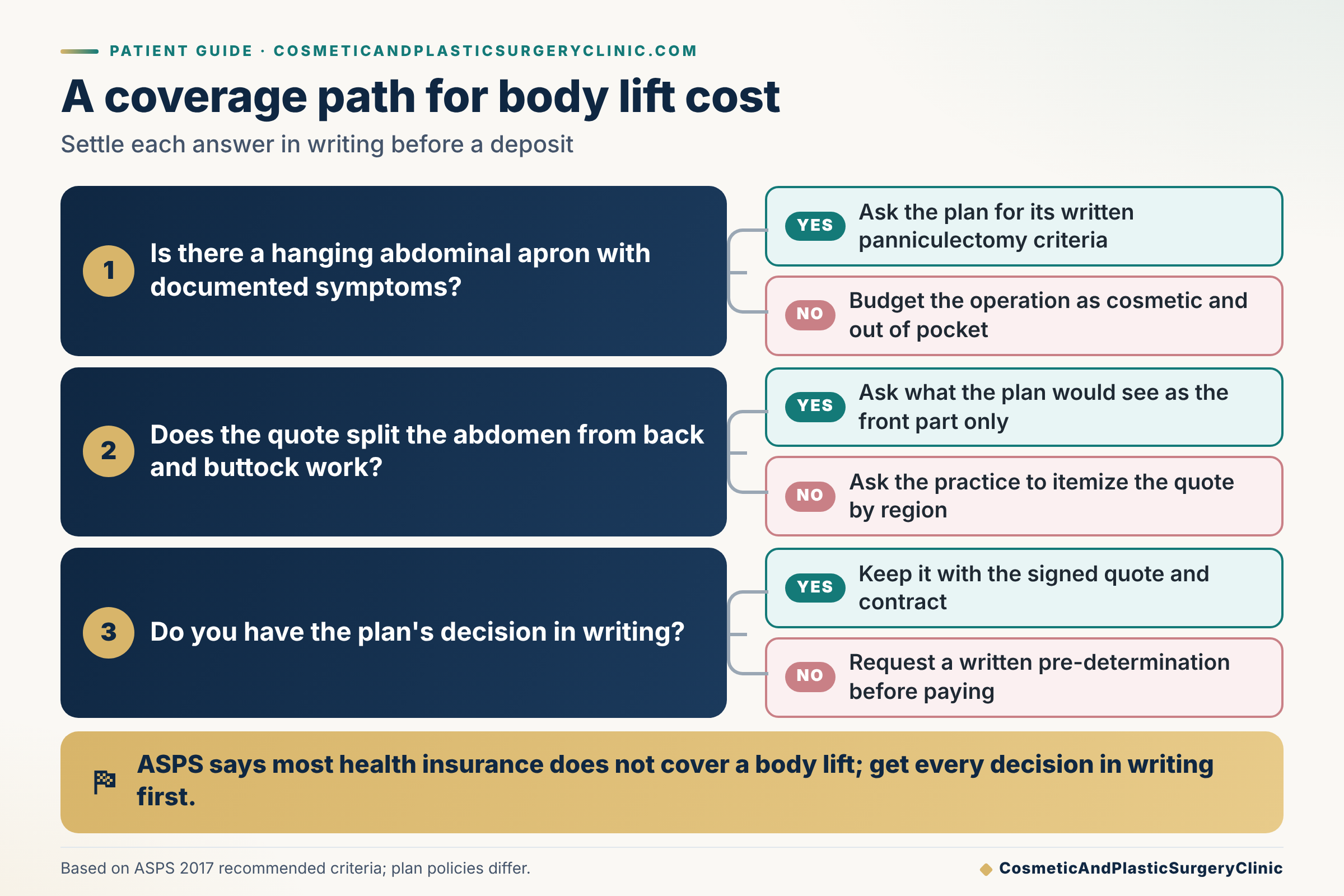
ASPS publishes recommended coverage criteria for payers. Its June 2017 paper on skin redundancy after obesity and massive weight loss says that when a panniculectomy removes a large hanging abdominal apron, at least in part to relieve symptoms, it is considered reconstructive. For circumferential procedures it says only the anterior portion would be considered reconstructive, and the back, hip and buttock components are cosmetic. It adds that buttock, thigh and arm lifts are needed for functional problems only in rare circumstances, and that improvement in daily activities alone should not be considered an indication for panniculectomy.
A separate ASPS paper, approved in 2006 and re-approved in 2019, adds that an abdominoplasty or panniculectomy done solely to improve appearance, with no functional signs or symptoms, is cosmetic and not compensable unless the patient’s own policy says otherwise. Those are recommendations to payers, not rules, so each plan’s written policy is what applies. The panniculectomy-versus-body-lift decision is laid out in panniculectomy vs body lift.
| Operation | ASPS recommended view (2017, 2019) | Documentation the papers mention | Budget note |
|---|---|---|---|
| Panniculectomy (hanging abdominal apron) | Reconstructive when it relieves symptoms or corrects structural or skin problems | Type and duration of symptoms and treatment; photographs; back evaluation for back pain | May be partly covered; decided by the plan’s written policy |
| Circumferential lift (belt lipectomy) | Only the anterior portion considered reconstructive | Same abdominal documentation for the front part | Back, hip and buttock work is treated as cosmetic |
| Abdominoplasty (tummy tuck) | Typically cosmetic | None listed for a purely cosmetic indication | Plan on paying out of pocket |
| Buttock, thigh and arm lifts | Usually cosmetic; function only in rare cases (medial thigh only in severe cases) | Case-specific; not routinely met | Budget as cosmetic unless a plan says otherwise |
Medicare’s wording and the IRS rule for cosmetic surgery
The Medicare Benefit Policy Manual says cosmetic surgery, defined as any surgical procedure directed at improving appearance, is not covered, with two exceptions: prompt repair of accidental injury and improvement of the functioning of a malformed body member. The Internal Revenue Service’s Publication 502 for 2025 likewise says that cosmetic surgery generally cannot be included in medical expenses, with an exception where it is necessary to improve a deformity from a congenital abnormality, an accident or trauma, or a disfiguring disease. This is general information, not tax advice; a tax professional can say how it applies.
What a coverage conversation can and cannot settle
An insurer’s answer about body lift cost is only useful in writing, and only for the specific codes and facts that went into the request.
Questions for the plan and for the practice
Ask the plan for its written policy on panniculectomy and on body contouring after weight loss, and what documentation it requires. Ask the practice whether it will submit a request before surgery and whether the quote separates the abdominal part from the back, hip and buttock part. Ask what happens to the facility and anesthesia lines if only part of the operation is approved, because a split approval can leave a patient responsible for a large share of those time-based charges.
Budgeting when the answer is cosmetic
A 2014 study in Plastic and Reconstructive Surgery (Hawa and colleagues, 58 patients after bariatric surgery) found that 10 patients (17%) had body contouring, that 95% of those who had not had it wanted it, and that 88% of those without it cited cost.
It is a small single-clinic study and cannot be generalized, but in that sample most of those who wanted skin removal did not have it, and cost was the reason most gave. For someone in that position, the honest budgeting question is whether the full body lift cost, including time off and help at home, can be met without borrowing in a way that adds a larger bill than the operation.
Comparing two body lift cost quotes on the same terms
Two body lift cost quotes that differ by several thousand dollars rarely describe the same operation. The aim of comparing is not to find the lower number but to make both quotes describe the same work, in the same place, with the same protection afterward.
Put both quotes on one scope
Start with a blank page and one row for each of the seven lines in the table above. Fill in what each quote says, what it leaves out, and what it leaves blank.
What each quote includes, excludes and leaves blank
Mark each cell as stated, excluded or blank. A blank is not a zero: it means unknown, and it needs a written answer before any comparison. Common blanks on a body lift cost quote are the anesthesia provider, the number of hospital or nursing nights, the garments, the pre-operative tests and the length of the follow-up window. A short quote may simply have more blanks, because it has not yet been asked the questions a longer one has already answered.
A worked example with hypothetical numbers
The figures below are invented round numbers for arithmetic only. They are not market prices, and they do not describe any real practice.
| Line | Quote A as written | Quote A after questions | Quote B as written |
|---|---|---|---|
| Surgeon fee | $11,000, visits not specified | $11,000, visits for 3 months | $14,000, visits for 12 months |
| Facility and stay | Blank | $12,000 for a hospital, one night | $6,500 surgery center plus $1,800 nursing at home |
| Anesthesia | Blank | $5,500, billed by time | $3,200, named group, up to six hours |
| Supplies and tests | Blank | $1,000 garments and tests | $1,000 garments and tests |
| Revision terms | Not stated | Surgeon fee waived for a year; other fees apply | Same, stated in the contract |
| Total on paper | $11,000 | $29,500 | $26,500 |
In this invented case Quote A looked $15,500 cheaper and turned out $3,000 more expensive once the blanks were filled, with the hospital night and the time-based anesthesia doing most of the work. Reverse the facts and A could just as easily win. The method matters, not the numbers: only quotes on the same scope can be compared on price, and the others are still open questions. A quote from a practice that will not itemize is itself a data point.
Revision, deposits and cancellation terms
Terms in the contract can matter more than a gap in body lift cost, since they decide who pays when the first operation does not go as planned or when the date moves.
What “revision included” can leave out
A 2023 paper in Aesthetic Surgery Journal Open Forum (Moura and colleagues) reviewed one academic program’s no-cost revision policy and surveyed similar practices; 20 responded, 3 (15%) offered revisions at no cost, and 9 (45%) waived the surgeon’s fee but still charged anesthesia or facility fees.
The program’s own revision rate was 8.4% of 1,491 aesthetic procedures, with thigh lifts at 13.6%. The sample is small and the practices were connected to the authors’ institution, so it shows a pattern in policy, not a norm. For a body lift, where facility and anesthesia are the biggest lines, “revision included” can leave most of the bill.
Deposits, postponement and weight changes
Ask how much of a deposit is refundable, by what date, and what happens if the pre-operative evaluation changes the plan or the surgeon advises waiting. Because surgeons ask for a stable weight before operating (the Aesthetic Society says stable for at least a year, with no further loss expected), a date can move for reasons unrelated to the contract. Ask whether a quote expires, whether it is re-issued if the plan changes, and whether staged operations hold their quoted price. The answers are for the contract, and no source sets a standard.
Paying for it, and when the numbers say wait
Once a body lift cost quote is complete, the remaining questions are how to pay without losing track of the total, which costs sit outside the invoice, and what to do if the total does not fit. A decision to wait is a legitimate outcome of the arithmetic.
Financing a body lift without losing the total
Loan and card mechanics belong to the general guide, plastic surgery financing. Two points are specific enough to a large body lift cost to repeat here.
Ask for a written estimate before scheduling
For people who do not have or do not use insurance, the federal No Surprises Act framework generally requires a good faith estimate. CMS says providers must give one when a patient requests it or schedules services at least three business days in advance, and a patient may be able to dispute a bill that is at least $400 more than the estimate.
Whether a given cosmetic practice is covered, and how the rule applies to separately billed anesthesia or facility charges, should be confirmed with the practice. A written estimate covering facility, anesthesia and surgeon is a reasonable thing to request in any case.
Deferred interest and the monthly-payment trap
A large body lift cost makes a low monthly payment attractive and makes the terms behind it more important. In December 2013 the Consumer Financial Protection Bureau (CFPB) ordered a health-care card issuer to refund up to $34.1 million over deferred-interest enrollment.
As the CFPB described it, interest at 26.99% accrued throughout a promotional period of six to 24 months, and a cardholder who had not paid the full balance by the end became liable for all of the accrued interest. A 2023 CFPB report on deferred-interest health-care cards says such products have largely replaced low-cost informal payment plans and can leave patients paying more. Ask for the total repaid, not the monthly figure.
Body lift costs outside the invoice
Some of the largest expenses of a body lift never appear on a quote, because they belong to the patient’s life rather than the practice’s price list.
Traveling for a lower quote
A lower body lift cost elsewhere changes the lines rather than removing them. The CDC’s Yellow Book (page dated April 2025) says costs for cosmetic procedures abroad are usually out of pocket, that complications and revisions can compound the initial cost, that some facilities charge substantial fees for follow-up care, and that medical tourists should not fly for 10 days after chest or abdominal surgery.
In the Hery study above, patients who had surgery out of state or abroad and then needed admission generated a total financial burden that the study put at $523,272 across 41 patients. The decision logic is in medical tourism and surgery abroad.
Time off, help at home and the weight calendar
Surgeons commonly ask for a stable weight before a body lift, and the Aesthetic Society says people should not undergo body contouring until two years after the start of a massive weight-loss program. That means the calendar before surgery may already include months. Used well, that time can go toward collecting itemized quotes, asking the plan for its written criteria and finding out whether the person who will help at home is available for the recovery weeks. Whether and when someone is medically ready is a surgeon’s judgment, not a budget item.
When the figures point to waiting or another route
The total can say something about the plan as well as the budget.
A body lift cost budget that only works with the cheapest quote
If the plan fits only with the lowest offer, with no room for a hospital night, an anesthesia estimate that runs long, or a repair, the quote is probably carrying more risk than the price shows. The options are to wait while the budget grows, to ask each practice what a narrower first stage would cost, or to get a second opinion on scope. A written, itemized body lift cost from a board-certified plastic surgeon in an accredited facility gives a firmer base than the lowest figure found by searching.
Narrower operations that change the price list
Some people find that the abdomen is the main concern. The 2024 ASPS surgeon-fee range for a tummy tuck ($8,000 to $13,500) overlaps the lower body lift range ($10,000 to $16,500), so the gap between the two may sit mainly in the time-based lines; that is an inference, not a published comparison. The abdomen-only options after weight loss are covered in tummy tuck after weight loss, and a hanging apron with symptoms is a different question again in panniculectomy vs body lift. A narrower operation is a different operation, not a discount.
Frequently asked questions
Does body lift cost depend on how the weight was lost?
The sources opened do not tie price to the method of weight loss. What they do tie to cost is the extent of the operation, hours under anesthesia, the setting and the length of stay. Insurers may ask for weight history as part of documentation for the front, abdominal part of the operation, so the plan’s written policy is the place to look. Ask each practice whether its quote assumes any particular starting point and what changes if the plan changes after the examination.
Is a body lift cost quoted per area?
The ASPS fee sheet lists a lower body lift as a single line, not as a sum of regions, and it lists thigh lifts and arm lifts separately. Practices differ in how they package adjuncts: ASPS says surgical body lifts may require liposuction for an improved contour, so ask whether liposuction is inside the surgeon fee or billed apart. Also ask whether extra regions, such as thighs or arms, would be a separate operation with its own facility and anesthesia lines.
Why would two surgeons quote very different body lift costs from the same photos?
Photos do not fix the plan. One surgeon may plan a longer operation with more regions, a hospital stay or a staged sequence, and another a shorter one in a surgery center. The quotes may also bundle different things: one may include anesthesia and facility, another only the surgeon. Ask both to describe the planned operation, expected hours, setting and follow-up window in writing, and compare line by line using the quote table on this page before drawing any conclusion.
What if I need to stay extra nights after a body lift?
No source opened gives a typical price for an extra night or a transfer. The Aesthetic Society says a patient will probably need one to three days of hospitalization or nursing care at home, and APSF notes that surgery centers usually rely on ambulance transfer to a hospital for serious problems. Ask in writing what the quote assumes, who decides on an extended stay, which facility would take you, and whether the practice’s body lift cost quote covers the added cost or leaves it to you and your plan.
Can a body lift cost be paid with an HSA or FSA?
The sources opened do not settle this. IRS Publication 502 (2025) generally excludes cosmetic surgery from medical expenses, with an exception for correcting certain deformities, and plan administrators apply their own rules to tax-advantaged accounts. A panniculectomy that a health plan treats as functional may be handled differently from a cosmetic belt lift. Ask the account administrator in writing and keep the answer with the signed quote, and ask a tax professional about any deduction.
Is body lift cost lower if I have a tummy tuck now and a body lift later?
The sources opened contain no data on savings from splitting or sequencing these operations. A later body lift would be its own operation with its own surgeon, facility and anesthesia lines; whether a different order is appropriate is a surgeon’s decision. If cost is the reason for considering it, ask the surgeon for itemized estimates of each route and the combined total, rather than assuming the first operation will be credited against the second.
Does the amount of tissue removed change the body lift cost?
Published series report tissue weights, for example a mean of 3,056 g in a 2022 Austrian series of 155 patients, but none of the sources opened links weight removed to price. Quotes tend to follow the planned extent, the expected hours and the setting. Ask whether the estimate assumes a particular scope and what happens to the fees if more or less work is done on the day. The answer is a contract term, not a fixed formula.
Sources and further reading
- American Society of Plastic Surgeons — Cosmetic procedures average cost, 2024 (accessed 2026-11-13) — lower body lift, tummy tuck, thigh lift, arm lift and liposuction fee ranges; projection wording
- American Society of Plastic Surgeons — Body lift cost page (accessed 2026-11-13) — average figure, exclusions, cost components, insurance and financing statements
- The Aesthetic Society — How much does a lower body lift cost? (accessed 2026-11-13) — 2021 databank figure, inclusions and omissions, insurance and panniculectomy statement
- The Aesthetic Society — Lower body lift (accessed 2026-11-13) — hospital or nursing care days, recovery length, weight-stability guidance
- American Society of Plastic Surgeons — Plastic surgery statistics report, 2025 (accessed 2026-11-13) — lower and upper body lift counts, estimation method
- American Society of Plastic Surgeons — Body lift procedure page (accessed 2026-11-13) — anesthesia options, incisions, liposuction as an adjunct
- American Society of Plastic Surgeons — Body lift safety page (accessed 2026-11-13) — listed risks including wound healing, fluid accumulation, skin loss and deep vein thrombosis
- American Society of Plastic Surgeons — Recommended insurance coverage criteria: skin redundancy for obese and massive weight loss patients, June 2017 (accessed 2026-11-13) — reconstructive versus cosmetic classification of panniculectomy and circumferential procedures
- American Society of Plastic Surgeons — Recommended insurance coverage criteria: panniculectomy, 2006, coding updated 2019 (accessed 2026-11-13) — functional versus cosmetic panniculectomy and abdominoplasty
- Centers for Medicare & Medicaid Services — Medicare Benefit Policy Manual, Chapter 16, section 120 (accessed 2026-11-13) — cosmetic surgery exclusion and its two exceptions
- Internal Revenue Service — Publication 502, Medical and dental expenses, 2025 (accessed 2026-11-13) — cosmetic surgery rule and exception
- American Society of Plastic Surgeons — Body contouring after obesity surgery: effective but expensive, September 2014 (accessed 2026-11-13) — Barcelona cost study of 100 patients, complication cost, patient underestimation
- American Society of Plastic Surgeons — Costs are main barrier to body contouring after bariatric surgery, May 2014 (accessed 2026-11-13) — Hawa study of 58 patients, cost barrier
- Zaussinger M et al. — The three-hour lower body lift, Aesthetic Plastic Surgery, 2022 (accessed 2026-11-13) — abstract: operative time, tissue removed, dehiscence and seroma counts
- Meal C et al. — Lipo-body lift compared with classical lower body lift, Aesthetic Plastic Surgery, 2019 (accessed 2026-11-13) — abstract: hospital stay and drainage duration
- Coon D et al. — Multiple procedures and staging in the massive weight loss population, Plastic and Reconstructive Surgery, 2010 (accessed 2026-11-13) — abstract: procedure count, complications, stay, staging
- Outpatient Surgery Magazine — Body contouring after massive weight loss, 2005 (accessed 2026-11-13) — session-length rule of thumb, stage intervals, payer attitudes
- American Society of Plastic Surgeons — Common body contouring questions answered, surgeon-authored blog (accessed 2026-11-13) — outpatient protocol and anesthesia time described by one surgeon
- Anesthesia Patient Safety Foundation — Outpatient surgery: choosing a location (accessed 2026-11-13) — hospital, surgery center and office trade-offs, anesthesia staffing, questions
- American Society of Plastic Surgeons — Why an accredited surgery center matters, 2016 (accessed 2026-11-13) — accrediting bodies named
- First Coast Service Options (Medicare) — How anesthesia reimbursement is calculated (accessed 2026-11-13) — base units plus time units formula
- CMS — Good faith estimate for uninsured or self-pay patients (accessed 2026-11-13) — estimate timing and $400 dispute threshold
- Consumer Financial Protection Bureau — CareCredit order, December 2013 (accessed 2026-11-13) — deferred-interest mechanism
- Consumer Financial Protection Bureau — Medical credit cards and financing plans, May 2023 (accessed 2026-11-13) — shift from informal payment plans to financing products
- Moura SP et al. — Offering no-cost cosmetic revisions, Aesthetic Surgery Journal Open Forum, 2023 (accessed 2026-11-13) — revision-fee policy survey and limits
- Hery D et al. — Plastic surgery tourism: complications, costs, and unnecessary spending, Aesthetic Surgery Journal Open Forum, 2023 (accessed 2026-11-13) — cost of admissions after surgery elsewhere, study limits
- CDC — Yellow Book, Medical tourism (accessed 2026-11-13) — out-of-pocket costs, follow-up fees, flying after abdominal surgery