Whether someone is a body lift candidate gets decided in an examination room, not by a number on a scale or an online quiz. A body lift (a circumferential lower body lift, also called a belt lipectomy) removes a band of loose skin and fat that wraps around the torso, then lifts the tissue of the lower back, buttocks, hips and outer thighs. The operation is long and the scar is long, so surgeons look closely at who is ready for it and when. See the lower body lift page for how the operation itself works.
This page follows the order a body lift candidate review usually takes: weight stability, nutrition and blood work, nicotine and medical conditions, the type of skin excess, goals and scars, and support at home. Each section says what published sources report and where they disagree. The wider picture of skin removal after major weight loss sits in body lift after weight loss. Nothing below is a verdict on any individual; that takes an in-person examination.
Body lift candidate review: a clinical judgment, not a quiz score
Online checklists squeeze a decision that depends on tissue, health and timing into a yes or no. Professional societies describe general traits, then say the plan is individual. The useful way to read any body lift candidate list is as a set of questions for the examination.
What a body lift treats, and what it leaves alone
Candidacy only makes sense against the problem the operation is built for. A body lift is aimed at one pattern: loose skin and fat that circle the torso, usually after weight loss.
The skin-and-fat band around the torso
ASPS describes a body lift as reshaping and tightening the tissue beneath the skin and fat, with drooping skin and fat removed, in the abdomen (locally or extending around the sides into the lower back), the buttocks and the thighs. It names aging, sun damage, pregnancy, large weight fluctuations and genetics as reasons elasticity falls. After weight loss from surgery or lifestyle changes, ASPS says, skin often cannot conform to the smaller body, which is the situation a circumferential incision addresses.
ASPS also states that body lifts are not intended strictly for removing fat. Liposuction alone may be enough when skin is elastic enough to follow the new contour, which is why the liposuction candidate criteria, firm and elastic skin among them, describe nearly the opposite of the typical post-weight-loss body.
Problems a body lift does not address
A body lift does not cause weight loss, and it does not tighten the arms, breasts, face or inner thighs. ASPS lists those among separate operations in body contouring after major weight loss, along with the lower body lift and tummy tuck, and says contouring is often done in stages. How surgeons sequence them is covered in staged body contouring. A candidate for one stage is not automatically a candidate for the whole plan.
ASPS adds that results may take as long to complete as the weight loss did: if the loss took two years or more, final contours may need a similar time. It also says every body contouring operation needs large incisions that may be extensive and are not always hidden by clothing. Candidacy includes accepting that trade, not only qualifying for the operation.
Two questions inside every body lift candidate evaluation
A consultation answers two different questions, and mixing them up causes much of the confusion in forums. Someone can be a body lift candidate on the first and need to wait on the second, or the reverse.
Can the operation reach the problem?
This is mostly anatomy. Surgeons look at where the excess sits (front only, or also flanks, back, buttocks and outer thighs), how much is skin and how much is fat, how the tissue moves when you stand, and what earlier surgery has changed. If the excess is mainly in the lower abdomen, an abdomen-only operation may fit, and tummy tuck after weight loss covers that route in detail.
Should it happen now?
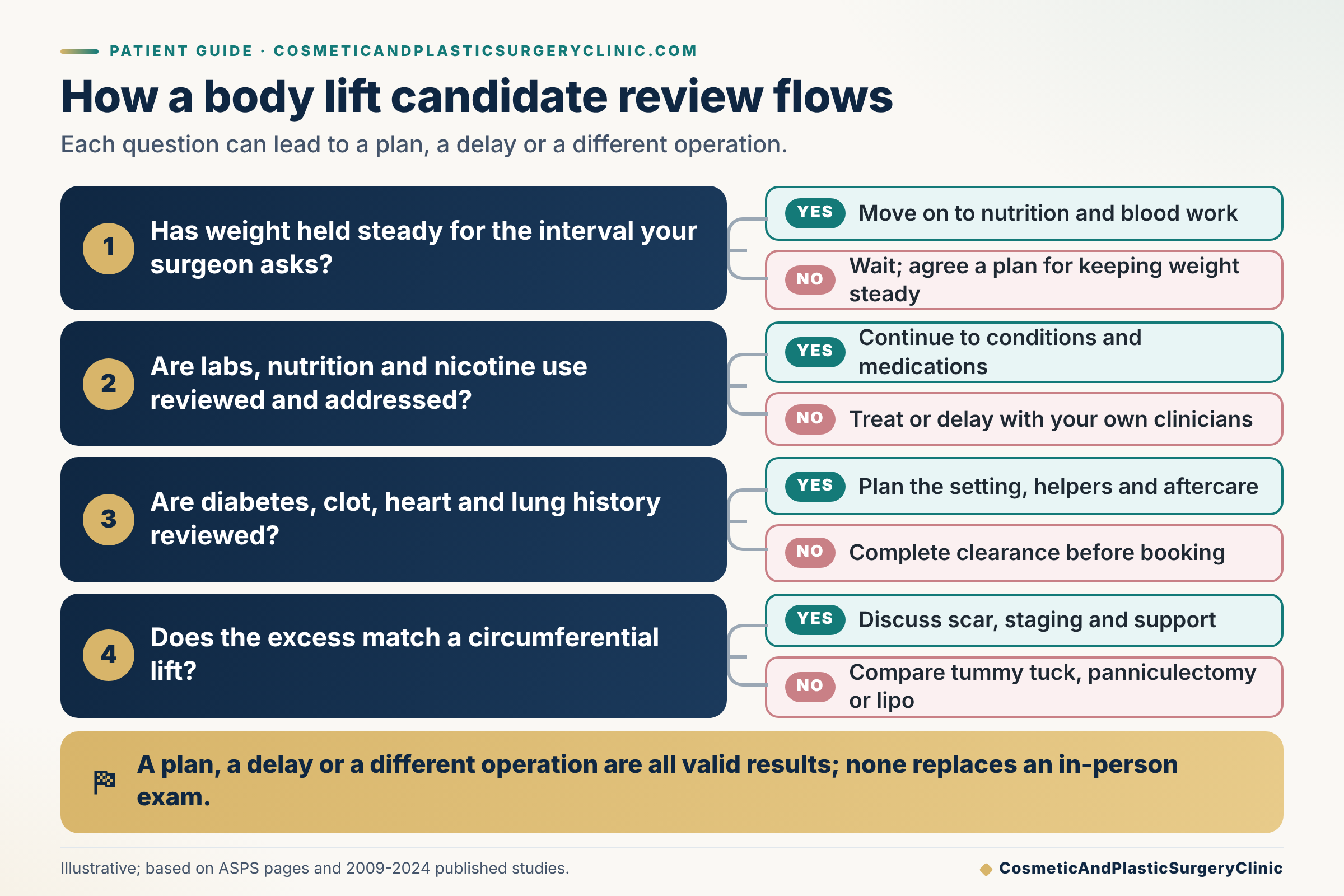
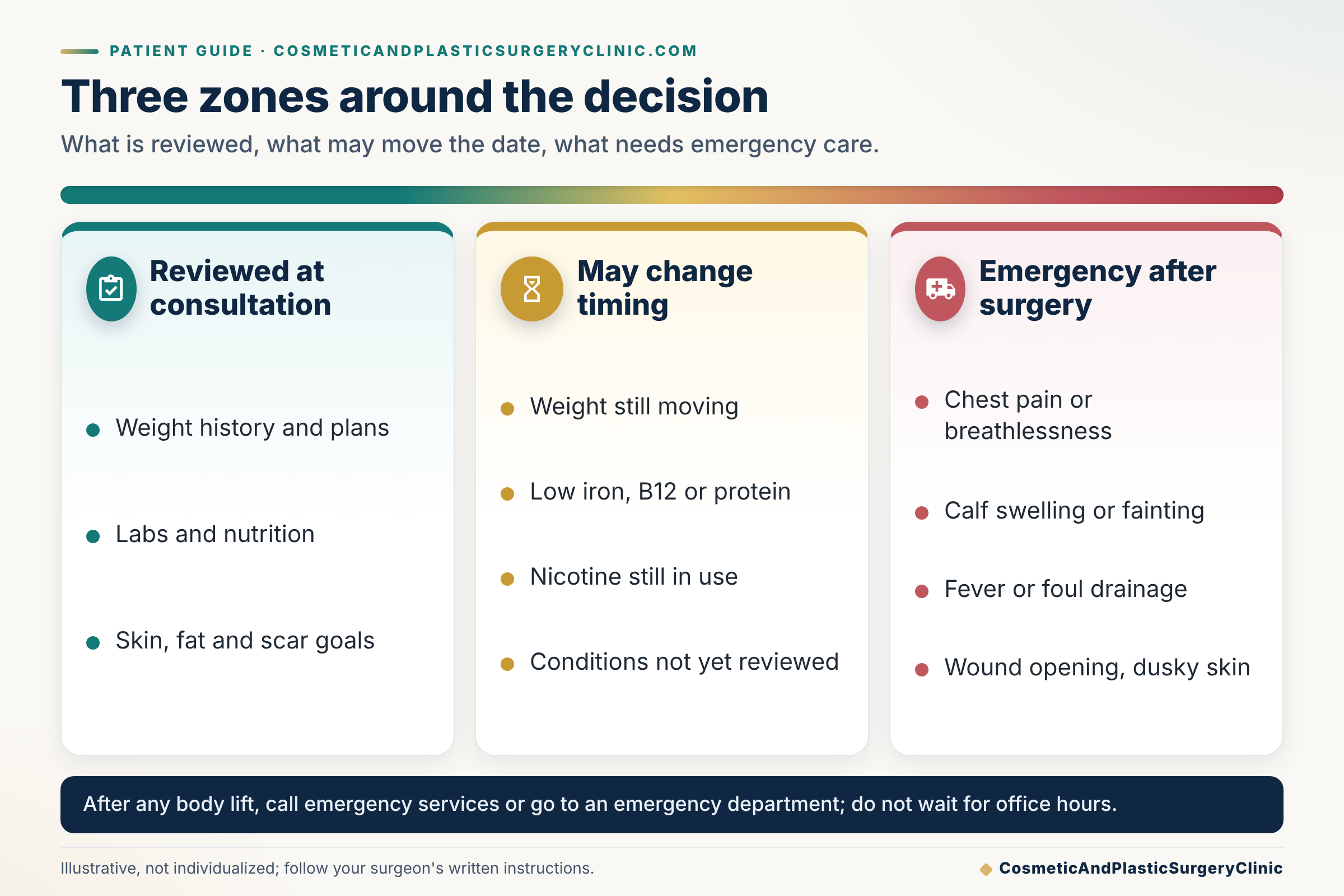
This is health and timing: weight pattern, nutrition, nicotine, blood sugar, clot history, medications and support at home. Several of these can change in weeks or months, so “not yet” is a legitimate outcome, not a rejection. ASPS says people considering body contouring after major weight loss should expect to be cleared by their bariatric surgeon, their primary care doctor, or both.
Weight stability and BMI: what the published numbers say
ASPS lists a weight that has leveled off among the traits of body contouring candidates, but does not say for how long. Its body lift candidate page does not mention weight stability at all. The numbers people quote online come from journal articles and national funding rules, and they are not interchangeable.
How long weight should hold before a body lift candidate is considered
Surgeons ask for stability because skin removed while weight is still falling can end up loose again, and because published series link a steadier weight to fewer complications. For a body lift candidate, the sources agree on the direction but not on the interval.
Intervals cited in the literature
A 2015 review in Open Access Surgery by Giordano recommends surgery 12 to 18 months after the bariatric operation and after 4 to 6 months without fluctuation, and says stable weight lowers complication rates. A 2011 Obesity Facts study of 43 post-bariatric patients found that weight stable for at least 3 months was associated with fewer complications (odds ratio 0.24, 95% confidence interval 0.07 to 0.79). The table below sets these beside other findings.
None of the sources opened defines how large a fluctuation still counts as stable. That is a question to put to the surgeon directly: stable within what range, measured how, and over what stretch of time?
Why a steady scale does not close the question
Weight can keep moving for years. In the LABS-2 study of 1,406 adults after gastric bypass, reported in JAMA in 2018, maximum weight loss came about two years after surgery on average, roughly 20% of participants kept losing beyond four years, and at five years people kept an average of 73% of their maximum loss. Those figures describe gastric bypass in one research cohort, not every route to weight loss.
The practical point for a body lift candidate is that a surgeon may ask what the plan is for the next few years, because regained weight stretches the new contour. Any change to medications that affect weight belongs with the prescribing clinician.
BMI as a risk marker, not a gate, for a body lift candidate
Forums treat BMI cutoffs like rules. The research treats BMI as one risk marker among several, and the cutoffs that exist come mostly from health-system funding criteria.
Cutoffs proposed in different countries
Giordano’s review states that no clear BMI cutoff exists, notes that some authors suggest a current BMI of 32 or less, and lists national criteria as examples: a BMI under 28 and over 75% excess weight loss in the United Kingdom, a BMI cutoff of 32 in Finland, a stable BMI under 30 in Sweden for abdominoplasty, and BMI under 30 with a large BMI drop in Denmark. These were criteria for publicly funded surgery in those countries, not rules for a private U.S. consultation.
What studies link to complications
Studies describe selected groups and report associations. In a 2009 Annals of Surgery analysis of 449 patients and 511 operations after bariatric surgery, Coon and colleagues found that maximum lifetime BMI and the size of the BMI change were associated with complications overall, while current BMI mattered mainly in single-procedure cases. In a 2016 series of 100 lower body lifts in Eindhoven, higher BMI before surgery was associated with more complications. No study opened gives a BMI at which surgery becomes unsafe. The body lift risks page covers the complications themselves.
| Source and year | Who was studied | What it reported | Limit to keep in mind |
|---|---|---|---|
| Giordano, Open Access Surgery, 2015 | Narrative review, post-bariatric contouring | Wait 12 to 18 months after bariatric surgery plus 4 to 6 months stable; no firm BMI cutoff | One author’s synthesis; national criteria were for funded care |
| van der Beek et al., Obesity Facts, 2011 | 43 post-bariatric patients reviewed retrospectively | Stable 3 months or more linked to fewer complications; overall rate 27.9% | Small, one center; mostly abdominoplasty and breast operations |
| Coon et al., Annals of Surgery, 2009 | 449 patients, 511 operations | Maximum BMI and BMI change linked to complications | Registry of mixed procedures, not body lifts alone |
| Poodt et al., PRS Global Open, 2016 | 100 lower body lifts, stable at least 1 year | Higher BMI before surgery linked to more complications | One hospital, 6-month follow-up, single-variable analysis |
| LABS-2 cohort, JAMA, 2018 | 1,406 adults after gastric bypass | Kept 73% of maximum loss at 5 years on average | Gastric bypass only; not a body lift study |
Nutrition and blood work in a body lift candidate review
Large wounds heal on what the body has available. After major weight loss, especially after bariatric surgery, intake and absorption can both be low, which is why nutrition gets its own step in a body lift candidate review instead of a line in the health history.
Why deficiencies are common after major weight loss
A body lift candidate can hold a stable, lower weight and still be short on protein or iron. The two coexist, and a surgeon cannot tell by looking.
Intake, protein and micronutrients
A December 2008 report in Plastic and Reconstructive Surgery, summarized by News-Medical, described food intake of about 1,000 calories a day one year after bariatric surgery. A 2021 narrative review in Nutrients (Toninello and colleagues) collected deficiency figures from other studies: in one series of 379 gastric bypass patients, iron deficiency was found in 43.9% before body contouring, thiamine in 29% and vitamin D in 68.1%. It also cites protein deficiency in about 13% of post-bariatric patients and vitamin B12 deficiency of up to 65% after some bypass operations.
These are figures from different studies, procedures and years, gathered in a review that notes how few large, well-designed studies exist. They show that deficiencies are common enough to check for, not how likely any one person is to have one.
What the evidence does and does not show
The 2008 report compared 75 patients treated from 2001 to 2005 without supplementation, in whom complications and wound problems occurred in 66%, with 37 patients treated from 2006 who were monitored and supplemented, whose major complication rate was 19%. The groups come from different periods and the two figures count different outcomes, so the comparison suggests a benefit without proving it.
Markers are imperfect too. The Nutrients review says albumin may not directly predict wound complications, while Giordano’s review links low preoperative albumin and malnutrition to higher odds of minor wound problems. A single lab value is a prompt for questions, not a verdict.
Blood work as a conversation, not a pass-or-fail test
ASPS says people preparing for body contouring may be asked to get a lab test or medical evaluation. Which tests a body lift candidate is asked to take, and what a surgeon does with the results, varies by practice and by the history behind the weight loss.
Markers surgeons commonly review for a body lift candidate
Giordano’s review lists hematocrit and hemoglobin to screen for anemia, a basic metabolic panel and prealbumin, and notes that people after gastric bypass often take iron, vitamin B12, calcium and a multivitamin. Starting with low hemoglobin leaves less margin if blood loss runs higher than planned, which is why anemia is worth finding before a long operation instead of after it.
For protein, the Nutrients review cites 60 grams a day in 2013 bariatric guidelines and 60 to 120 grams in others, and Giordano cites 70 to 100 grams a day around surgery after gastric bypass. These are population figures for bariatric patients, not a personal target. Your surgeon, bariatric team or dietitian sets any target for you.
Why self-correcting before the visit backfires
Two impulses cause trouble: starting large doses of supplements to look eligible, and stopping a prescription to look healthier. Neither belongs to the patient alone. Some herbal products and supplements affect bleeding, and ASPS says surgeons may ask patients to avoid aspirin, anti-inflammatory drugs and herbal supplements before body lift surgery. Bring a complete list of everything you take to the consultation, as described in plastic surgery consultation questions, and let the team decide what changes.

Nicotine, diabetes, clots and medicines that can move the date
Health history is where a body lift candidate review often turns into a timing conversation. Most of these factors are not permanent exclusions. They are reasons to resolve something first, with the right clinician.
Nicotine and the body lift candidate: the clearest rule
Of all the factors surgeons review, nicotine is the one with the most consistent advice across sources, because it is both common and changeable.
What the sources say about stopping
MedlinePlus says smoking reduces oxygen reaching the cells of a surgical wound, which slows healing and makes infection more likely, and that smokers who have surgery are more likely to form clots in the legs. Most providers advise stopping at least 4 weeks before surgery, and MedlinePlus says stopping at least 10 weeks before can reduce risk further. ASPS lists non-smoking among body lift candidate traits, and Giordano’s review says surgery should be deferred for all active smokers, with a urine cotinine test about a month before to confirm.
In the 100-patient Eindhoven series, smoking was associated with more complications (odds ratio 7.74), but the confidence interval ran from 0.98 to 61.16. The direction fits the other sources; the size is too imprecise to rely on.
Vaping, patches and other nicotine
MedlinePlus applies its advice to nicotine products including e-cigarettes, and says nicotine gum is not encouraged around the time of surgery because nicotine still interferes with healing. Practices differ in how they test and which products they count, so ask before you plan a date. Quitting aids are worth discussing with your own clinician.
Diabetes, blood pressure, clots and the heart and lungs
Giordano’s review says diabetes, cardiac disease, obstructive sleep apnea and venous thromboembolism risk all need evaluation before body contouring. None of them settles whether someone is a body lift candidate by itself; each changes how carefully the plan and the facility are chosen.
Blood sugar and other long-term conditions
A 2024 educational article in Clinical Diabetes notes that some institutions use an A1C of 8% or lower as a goal before elective surgery where possible, and that data to guide perioperative diabetes care are limited. That is an institutional convention, not a body lift rule, and your own clinicians set your target. In the Eindhoven series, 7 of 100 patients had diabetes and comorbidities were not significantly linked to complications, though a series that small cannot rule an effect out.
Clot history and long operations
The CDC lists major surgery, limited movement, estrogen-containing contraceptives or hormone therapy, pregnancy and the three months after it, heart or lung disease, a previous clot, an inherited clotting disorder, a family history of clots, older age, and overweight or obesity among clot risk factors. Tell the surgeon about all of them.
Giordano’s review reports a clot rate of about 2.9% across body contouring and 8.9% for people with a BMI over 35, within a range of 1% to 9.3% across studies, and suggests keeping operating time under about 6 hours. Those are review-level figures from mixed series. Body lift specifics are covered elsewhere on this site.
Medications, supplements and GLP-1 drugs for a body lift candidate
Medication questions are where a patient’s own prescriber matters most, because a surgeon sees only part of the picture.
Medicines that affect bleeding
ASPS says people preparing for body contouring may be asked to take certain medications or adjust current ones, and to avoid aspirin, anti-inflammatory drugs and herbal supplements that can raise bleeding risk. Giordano’s review says antiplatelet drugs and NSAIDs are stopped at least two weeks before surgery. Never stop a prescribed medicine on your own to look eligible; ask the prescriber and the surgical team together.
GLP-1 drugs and the candidacy conversation
An October 2024 multisociety guidance from the AGA, the American Society for Metabolic and Bariatric Surgery, the American Society of Anesthesiologists and others says most patients may continue GLP-1 receptor agonists before elective procedures, with individual risk assessed and a 24-hour liquid diet advised for people at high risk of significant gastrointestinal side effects. That guidance concerns anesthesia safety, not skin or contour results.
The ASPS 2025 statistics report adds that 62% of surveyed member surgeons received GLP-1-related consultation requests for body lift, though requests do not equal completed procedures. Decisions about any GLP-1 medicine belong to the prescriber; skin removal after GLP-1 explains the context.
Skin excess, scars and goals: matching the operation to the problem
Excess tissue is not one thing. Skin that has lost its snap, fat that sits in pockets, an apron of tissue that rubs and a lax abdominal wall can all coexist, and each has its own best-fitting operation. Part of being a body lift candidate is that the problem on the exam table matches what a circumferential lift is designed to do.
Skin versus fat: why the kind of excess changes a body lift candidate’s plan
The same weight loss leaves different tissue behind in different people, which is why a friend’s result or a gallery photo cannot stand in for an examination.
How elasticity changes the answer
ASPS says liposuction alone may be enough when skin is elastic enough to adjust to a new contour, and that a body lift combined with liposuction may be recommended when elasticity is poor. It lists aging, sun damage, pregnancy, large weight fluctuations and genetics as reasons elasticity falls. Those factors differ widely between two people with the same weight history, so skin quality is judged on the person, in person, standing and moving.
When another operation fits the problem better
The table lays out common situations, the route a surgeon may discuss for each, and the question worth asking. It describes options that exist, not a recommendation for anyone. For an apron of skin that causes rashes, the panniculectomy versus body lift comparison covers when each operation is discussed, and ASPS describes panniculectomy as reconstructive when it is done to improve skin health within the fold beneath the pannus.
| Situation | Pathway a surgeon may discuss | Possible benefit | Trade-off | Key question |
|---|---|---|---|---|
| Loose skin mainly below the navel | Abdomen-only operation, such as a tummy tuck variant | Treats the front without a scar around the back | Flanks, back and buttocks are left as they are | Which areas stay untreated, and will they bother me? |
| A hanging apron causing rashes or skin breakdown | Panniculectomy, framed as functional surgery | Targets the fold that is causing the skin problem | Does not lift the flanks or buttocks; coverage rules vary | What documentation would my plan or surgeon require? |
| Excess wraps the flanks, back, buttocks and outer thighs | Circumferential body lift | Treats the full band in one operation | Long scar around the body and a long operation | Where does the scar run, and how does it sit against clothing? |
| Small firm fat pockets with elastic skin | Liposuction instead of a lift | Removes fat without removing skin | Skin may stay loose if it does not retract | How well is my skin expected to follow the new contour? |
| Excess also in the arms, breasts or inner thighs | Staged plan across several operations | Each operation is shorter than one combined session | More recoveries, more scars, a longer timeline | In what order, and how many months between stages? |
| Weight, labs or nicotine use still unsettled | Wait, then re-evaluate | Time to improve the conditions for healing | Skin discomfort and appearance concerns continue meanwhile | What exactly would need to change, and how will we check? |
Goals, scars and psychological readiness
Surgeons ask about goals because the operation trades one problem for another: a smoother contour for a long scar and a long recovery. A body lift candidate who has thought about that trade in advance is better placed to judge the answer.
The contour-versus-scar trade-off
ASPS says incision length and pattern depend on how much excess skin there is and where, and that advanced techniques can place incisions where most clothing hides them but not always. Giordano’s review says patients should be told these operations are complex, leave large scars, involve long recoveries and carry wound-healing risks, and that the results are mostly functional and may not match those of aesthetic surgery. In one study it cites, 36.4% of patients had very high expectations of how contouring would change their appearance.
Ask to see scars from the back and side in standardized photos, with the time since surgery stated. The body lift before and after page explains how to read those albums.
Mental health, body image and outside pressure
Giordano’s review recommends screening for body dysmorphic disorder and follow-up for any psychiatric diagnosis beyond simple depression. The evidence on routine screening is thin: a 2020 review in Revista Brasileira de Cirurgia Plastica found only four clinical studies, and three did not identify a benefit from screening. One reported better body satisfaction and appearance after contouring without an overall psychological benefit.
That points to a modest, honest expectation: the body may look and function differently, while mood and confidence follow their own course. ASPS’s liposuction and tummy tuck candidate pages also say the decision should be your own, not driven by other people’s wishes or an ideal image. If bariatric-team counseling is available to you, it is a reasonable place to talk this through.
Support, setting and timing: when to book and when to wait
The last part of a body lift candidate review has nothing to do with tissue. It asks who will be with you, where the operation happens and whether the timeline fits your life.
Support at home and the place of surgery
Recovery from a large operation depends on logistics that people tend to arrange last. They are part of candidacy because an operation without them is a different, riskier operation.
Help, a driver and overnight cover
ASPS says that if the operation is outpatient, you should arrange for someone to drive you to and from surgery and to stay with you for at least the first night. It adds that body lift surgery may take place in an accredited office-based facility, an ambulatory surgical center or a hospital. Ask whether an overnight stay is planned and who answers calls at 2 a.m. Week-by-week logistics are in body lift recovery.
Surgeon, facility and clearance
Lower body lifts are far less common than tummy tucks. The ASPS 2025 statistics report counts 10,868 lower body lifts in 2025 against 10,495 in 2024, compared with 173,251 tummy tucks in 2025, from member surgeons, an endorsed partner and a claims dataset. Experience therefore varies, so ask how many post-bariatric body lifts the surgeon performs and where complications are treated.
Verify board certification through the American Board of Plastic Surgery and confirm the facility’s accreditation, using the steps in how to choose a plastic surgeon. Get clearance from your bariatric surgeon, primary care doctor or both, as ASPS advises.
When waiting or a second opinion makes sense
A delay is information, not failure. The question is whether the reason for the delay can be fixed, and by whom.
Signals that a body lift candidate may need to pause
Several situations commonly lead a surgeon to suggest waiting, or lead a patient to seek another opinion before committing:
- Weight is still falling, or has risen recently, and no maintenance plan exists yet.
- Nicotine in any form is still in use, or the practice’s required interval has not passed.
- Blood counts, protein, iron or B12 are low and treatment has not started.
- Diabetes, blood pressure or sleep apnea has not been reviewed by the clinician managing it.
- No one is available for the first nights, or time off cannot be arranged.
- A pregnancy or another large life change is planned, or the practice pushes a quick booking deadline.
Consider a hypothetical person whose weight has held for five months, who vapes daily and whose hemoglobin came back low. Each item can be worked on, so the realistic first outcome of a visit is a dated plan, not a surgery date. Cost can also drive rushed choices; body lift cost explains what a quote should itemize.
A discussion checklist, not self-approval
Take these questions to the examination. They need an exam to answer, and a good answer names specifics:
- How long should my weight be steady before surgery, and how do you define steady?
- Which labs do you want, and who will treat anything abnormal?
- How do you handle nicotine, including vaping, before and after surgery?
- Is my excess mostly skin, fat or both, and which operation does that point to?
- Where will the scar run, and what will be left untreated?
- Would you stage the plan, and in what order?
- Where will surgery take place, and what happens if I need emergency care at night?
- What would make you postpone or decline to operate?
The wider list of consultation questions is in the consultation guide linked earlier.
Keeping the result: what changes after a body lift
Being a body lift candidate also covers the years after surgery. A lift sets a new contour; it does not stop weight change, aging or the need for follow-up.
Weight, nutrition and nicotine after surgery
The table links each long-term factor to what it can mean for the result and for any later revision. ASPS lists recurrent skin looseness and a possible need for revision surgery among body lift risks, so planning for maintenance is a normal part of the conversation, not a sign of doubt.
| Factor | Effect on the outcome | Maintenance or revision implication | Review point |
|---|---|---|---|
| Weight regain or further loss | Changes how the new contour looks and fits | Regain may stretch tissue; a later revision or extra stage may be discussed | Agree with your care team how often to review weight |
| Nutrition and protein intake | Affects healing and strength during recovery | Deficiencies can return after bariatric surgery, so monitoring may continue | Repeat labs when your clinicians advise |
| Nicotine | Slows wound healing | Restarting before a later operation raises the same concern | Disclose any use before every procedure |
| Skin quality and aging | Elasticity keeps changing with age, sun and pregnancy | A lift does not stop later looseness; touch-ups may be considered | Photograph from the same angles on a regular schedule |
| Scars | Width, color and position change as they mature | Scar revision may be possible in some cases | Ask what the surgeon offers and when it is considered |
| Other planned stages | Order and timing decide when each area is judged | A later stage may change how earlier areas look | Keep a written timeline of stages and intervals |
Scars, laxity and revision
ASPS says results can take as long to complete as the weight loss did, so early photos at a few weeks show swelling more than shape. A surgeon who offers a revision policy in writing, and says plainly what it covers, is giving you something to compare. ASPS lists possible revision surgery among the risks, so it is a recognized possibility, not proof that the first operation failed.
Frequently asked questions
Can I be a body lift candidate if I lost weight without bariatric surgery?
Yes, the same questions apply. ASPS describes loose skin after weight loss from surgery and from lifestyle changes alike. The 12 to 18 month interval cited after bariatric operations does not carry over, so a surgeon assessing you as a body lift candidate will focus on how long your weight has held, your nutrition and your health history. Tell the surgeon how fast the loss happened and how long ago it stopped, because that history shapes skin quality and timing.
Does a body lift candidate need to have lost a set number of pounds?
ASPS gives no weight-loss figure on the pages opened. Giordano’s 2015 review mentions that some public insurance criteria consider a loss of over 20 kg and a BMI drop of over 10, but those are public-funding criteria described in that review, not private-practice rules. In private practice the question is the amount and type of loose tissue and its effect on you, which only an examination can judge.
How long should a body lift candidate stay off vaping before surgery?
MedlinePlus says most providers advise at least 4 weeks off cigarettes and tobacco before surgery, covers e-cigarettes in the same advice, and says 10 weeks or more lowers risk further. Giordano’s review describes a cotinine test about a month before surgery. Interval and testing policy vary, so ask the practice for its rule in writing before choosing a date, and ask your own clinician about quitting support.
Can a surgeon decide I am a body lift candidate from photos or a video call?
A remote review can screen for obvious mismatches, but it cannot judge skin elasticity, scar tissue, the abdominal wall, or how tissue moves when you stand. A surgeon also needs your history, medications and labs. Treat a remote answer as a reason to book an examination, and be cautious about any practice that confirms candidacy and offers a date without examining you.
What if labs for a body lift candidate review show low iron or vitamin B12?
It is common after major weight loss. The 2021 Nutrients review cites iron deficiency in 40% to 75% of bariatric patients and vitamin B12 deficiency of up to 65% in some bypass groups. It usually becomes a treatment-and-recheck step with your bariatric team or primary care doctor, and it may move the surgery date. Do not self-dose high-strength supplements; ask who should manage it.
Do I need my bariatric surgeon’s approval to be a body lift candidate?
ASPS says people preparing for body contouring after major weight loss should be cleared by their bariatric surgeon, their primary care doctor, or both. Clearance does not replace the plastic surgeon’s own evaluation, and the plastic surgeon may ask for different tests. If your bariatric program has closed or moved, your primary care doctor can coordinate clearance and share records.
Can I be a body lift candidate if I still plan to lose weight?
Often the answer is to wait. Giordano’s review suggests that patients still hoping to lose weight wait about six more months, or sagging skin may recur. The decision depends on how much more you expect to lose and on any weight-related medication, which the prescriber manages. Some people use the time to plan stages, labs and support so the schedule is ready when weight settles.
If I am a body lift candidate, can several areas be done in one session?
That is the surgeon’s call. ASPS says body contouring is often done in stages, and Giordano’s review suggests keeping operating time under about 6 hours. Longer operations raise questions about blood loss, clots and anesthesia time, which the surgeon weighs against how many separate recoveries you would face. Staged contouring plans weigh those trade-offs case by case.
Sources and further reading
- American Society of Plastic Surgeons — Body lift: candidates (accessed 2026-11-13) — candidacy traits listed by ASPS; weight stability not addressed
- American Society of Plastic Surgeons — Body lift (accessed 2026-11-13) — treatment areas, elasticity factors, body lift versus liposuction
- American Society of Plastic Surgeons — Body lift: safety (accessed 2026-11-13) — risk list including poor wound healing, recurrent looseness, revision
- American Society of Plastic Surgeons — Body lift: preparation (accessed 2026-11-13) — labs, medications, smoking, driver, facility types
- American Society of Plastic Surgeons — Body contouring after major weight loss: procedure (accessed 2026-11-13) — staging, incisions, circumferential lower body lift, time to results
- American Society of Plastic Surgeons — Body contouring after major weight loss: candidates (accessed 2026-11-13) — leveled-off weight, health, nonsmoking, expectations
- American Society of Plastic Surgeons — Body contouring after major weight loss: preparation (accessed 2026-11-13) — clearance by bariatric surgeon or primary care doctor, medication advice
- American Society of Plastic Surgeons — Tummy tuck: candidates (accessed 2026-11-13) — candidacy traits; decision should be the patient’s own
- American Society of Plastic Surgeons — Liposuction: candidates (accessed 2026-11-13) — firm, elastic skin as a liposuction trait
- American Society of Plastic Surgeons — 2025 Plastic Surgery Statistics Report (accessed 2026-11-13) — lower body lift and tummy tuck counts; GLP-1 consultation survey; methodology
- American Society of Plastic Surgeons — Recommended insurance coverage criteria: panniculectomy (2019 coding update; accessed 2026-11-13) — functional framing of panniculectomy
- Giordano S — Removal of excess skin after massive weight loss: challenges and solutions, Open Access Surgery (2015; accessed 2026-11-13) — weight stability, BMI proposals, labs, smoking, expectations
- van der Beek ESJ et al. — Complications after body contouring surgery in post-bariatric patients: the importance of a stable weight close to normal, Obesity Facts (2011; abstract record, accessed 2026-11-13) — 43-patient series, stable weight and complications
- Coon D et al. — Body mass and surgical complications in the postbariatric reconstructive patient: analysis of 511 cases, Annals of Surgery (2009; record page, accessed 2026-11-13) — BMI measures and complications
- Poodt IGM et al. — Complications of lower body lift surgery in postbariatric patients, Plastic and Reconstructive Surgery Global Open (2016; accessed 2026-11-13) — 100-patient series, BMI, smoking, comorbidity
- Newswise — Amount of weight regain after bariatric surgery helps predict health risks, on the LABS-2 study in JAMA (2018; accessed 2026-11-13) — maximum loss timing and regain at five years
- Toninello P et al. — Nutritional support for bariatric surgery patients: the skin beyond the fat, Nutrients (2021; accessed 2026-11-13) — deficiency prevalence, protein figures, albumin caveat
- News-Medical — Plastic surgeons warn of malnutrition in body contouring patients, on a Plastic and Reconstructive Surgery report (November 2008; accessed 2026-11-13) — intake after bariatric surgery; supplemented versus unsupplemented groups
- MedlinePlus — Smoking and surgery (accessed 2026-11-13) — healing, infection, clots, 4 and 10 weeks, nicotine products
- Centers for Disease Control and Prevention — Risk factors for blood clots (accessed 2026-11-13) — clot risk factor list
- American Gastroenterological Association — Most patients can continue GLP-1 anti-obesity drugs before surgery, on the multisociety guidance (October 2024; accessed 2026-11-13) — continuing GLP-1 drugs, individual risk, liquid diet
- Aung NL — A1C: Episode 3, Clinical Diabetes (2024; accessed 2026-11-13) — A1C goal before elective surgery at some institutions
- Kitzinger HB et al. — After massive weight loss: patients’ expectations of body contouring surgery, Obesity Surgery (2012; abstract record, accessed 2026-11-13) — desire for contouring, surplus skin, satisfaction
- Nunes e Silva D et al. — Strategies for early detection of psychopathologies in candidates for post-bariatric plastic surgery, Revista Brasileira de Cirurgia Plastica (2020; accessed 2026-11-13) — four clinical studies of psychological screening
- American Board of Plastic Surgery — home page and certification verification link (accessed 2026-11-13) — how to verify certification