Body lift before and after photos persuade quickly, because the change looks large and a smooth waistline beside a hanging fold needs no caption. They are also hard to read. A body lift (a circumferential lower body lift, also called belt lipectomy) removes a band of excess skin and fat around the lower trunk and lifts the tissue that remains, so the operation, the scar and the result wrap around the whole body, while a photograph shows one side at a time.
This article is about reading body lift before and after photos: which views you need, where the scar should appear, how a picture changes between week six and year two, and which questions belong in a consultation rather than a gallery. The operation is described in lower body lift, the wider decisions are in body lift after weight loss, and the rules that apply to any album are in reading before and after photos.
What body lift before and after photos can and cannot establish
A gallery pair of body lift before and after photos looks like evidence about the operation. In practice it bundles a procedure name, a starting point, a body-weight history and a choice by the practice about which pair to publish. Separating those pieces comes before judging any contour.
One label, several different operations
The words “body lift” cover more than one procedure, and a caption rarely says which one is pictured.
Lower, upper or circumferential: ask which one is shown
The ASPS statistics glossary defines body lift as upper, lower or circumferential procedures, and the 2025 report counts lower and upper body lifts on separate rows: 10,868 lower body lifts (up 4% from 10,495 in 2024) and 6,438 upper body lifts (up 22% from 5,260). The report gives no split by reason, so it cannot say how many followed massive weight loss.
The ASPS patient page uses the term more loosely, listing the abdomen (locally or extending around the sides into the lower back), the buttocks and the thighs as areas a body lift may include. A gallery headed “body lift” might therefore show a belt-style operation, an abdomen-only one or a thigh-focused one. Abdomen-only operations are compared in panniculectomy vs body lift, and a different incision pattern means a different scar to look for.
Add-ons and staged operations sit inside the result
ASPS says liposuction may be added to a body lift to improve contour, and that body lift techniques may be combined with liposuction when skin elasticity is poor. A picture credited to one operation can also include the effect of others. In a 2023 Plastic and Reconstructive Surgery Global Open paper on planning body contouring incisions, one figure is labeled as a woman photographed 4.5 months after a lower body lift and 1 month after an extended arm lift with a breast lift. One image, two operations, two healing clocks.
So ask what else was done and when. Planned sequences of procedures are covered in staged body contouring. If a buttock looks fuller in the “after”, ask whether tissue was repositioned, fat was transferred or an implant was placed, because those are separate operations with their own risks.
The starting point is half of the comparison
Two people can both have “loose skin after weight loss” and still start from very different places. Body lift before and after photos only help if the “before” resembles your own situation.
Grading the “before”: the Pittsburgh scale and its limits
Surgeons have tried to put numbers on how severe a post-weight-loss contour deformity is, so that body lift before and after comparisons start from similar ground. The Pittsburgh Rating Scale, described in Plastic and Reconstructive Surgery in 2005, grades 10 body regions from 0 (normal) to 3 (most severe) using full-body photographs. Twelve trained observers rated 25 patients twice; the mean kappa was 0.68 and overall agreement across the two sessions was 69%. The authors called that good validity, but it also means trained raters with a written scale did not always give the same grade twice.
A 2020 Plastic and Reconstructive Surgery Global Open study paired patient photos with reference photos from that scale. Ten surgeons, seven insurer advisors and ten laypeople rated 200 images; agreement was moderate to good for the arms, abdomen and medial thighs (intraclass correlation 0.66 to 0.69) and poor for the breasts (0.37). The practical lesson for body lift before and after pairs is that “similar to me” is an approximate judgment. Ask the surgeon how the “before” in a photo compares with your own, region by region.
The weight history behind the photograph
In body lift before and after pairs, a “before” taken at the highest weight overstates the change an operation produced, and an “after” taken while weight is still moving can mislead in the other direction. Ask for the weight, or at least the weight trend, at each date. The Aesthetic Society notes that a large weight gain followed by loss can stretch the skin out again and affect results, and an ASPS blog post says significant weight fluctuations can worsen outcomes and may raise the risk of complications.
Regain is common. A retrospective Plastic and Reconstructive Surgery study reported in November 2023 followed 121 people after abdominoplasty, panniculectomy or circumferential lipectomy for an average of 42.9 months. Weight rose from the lowest point by 11.81% in those with prior bariatric surgery and 7.56% in those without. That figure comes from a news summary of a single-center study, so read it as a direction, not a rate. What surgeons look for before operating is covered in body lift candidate.
Scar position: the line body lift before and after photos have to show
The scar is the price of the operation, and body lift before and after photos are the only way to see it before deciding. It runs around the body, so one view never shows all of it.
Where a circumferential scar runs, view by view
The Aesthetic Society describes the lower body lift scar as permanent and noticeable, encircling the lower trunk. Its exact height and shape depend on the plan, so use the photos to see the plan in action.
Front and side views: the low abdominal line
According to the Aesthetic Society, the scar sits low on the stomach, just above the pubic hair area, and extends around the hip bones. The surgeon can place it higher or lower to suit the patient’s preferences. ASPS says advanced techniques aim to put incisions where most clothing and swimsuits hide them, and the 2023 incision-planning paper describes placing scars at borders between body regions, in creases and where clothing can cover them.
When you look at front and side views in body lift before and after photos, ask whether the line sits below the waistband or swimwear edge the person is wearing, and whether the photo uses the same garment before and after. A scar that is hidden in a bikini bottom but visible in a different cut of swimwear is still information.
Rear view: the half of the scar many galleries leave out
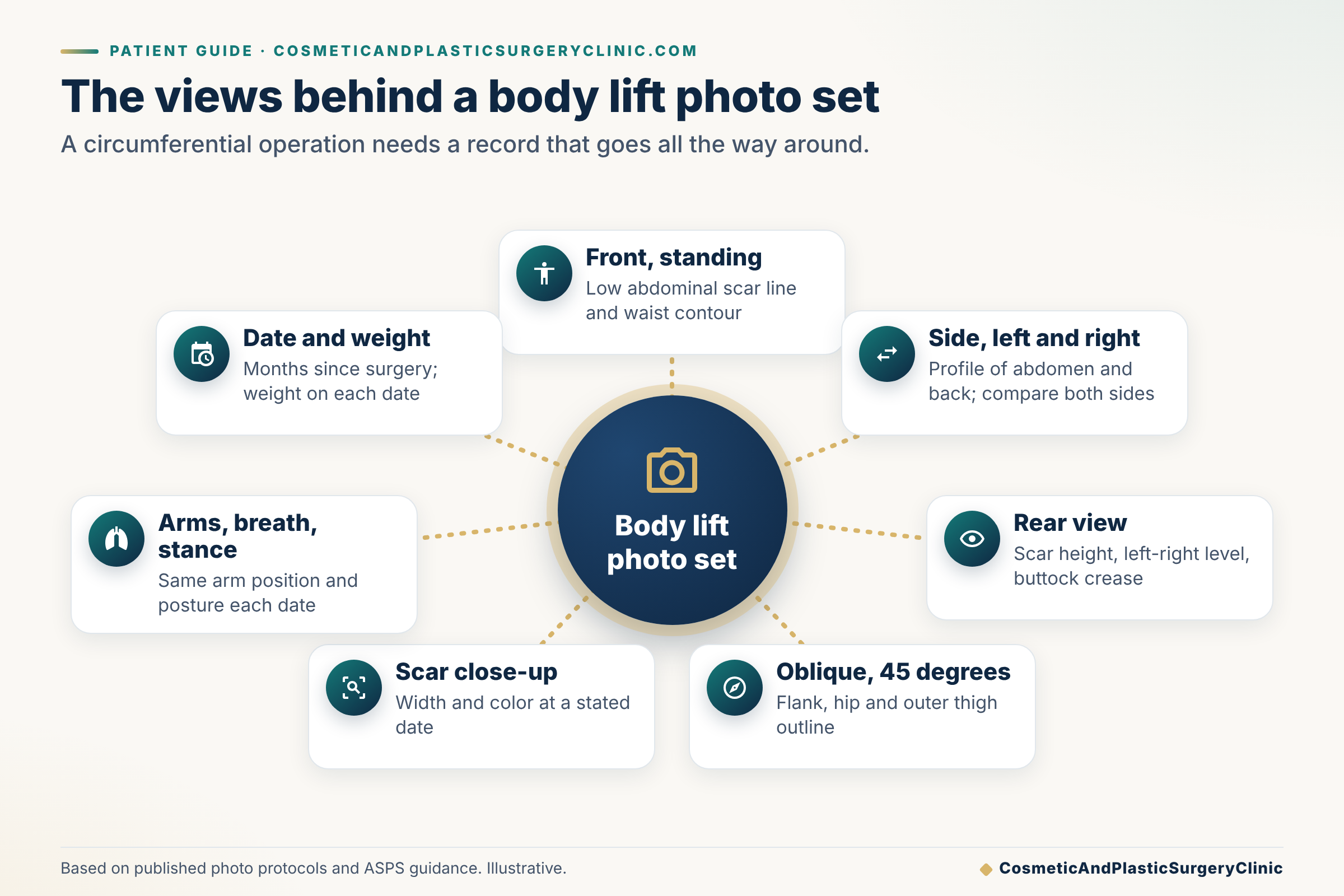
The same Aesthetic Society page says the scar continues past the top of the buttock crease and meets the incision on the other side. A pair of front views therefore shows only part of it. The rear view is where you can judge how high the line rides across the lower back, whether it is level from left to right, and how it relates to the buttock crease.
Asymmetry is one of the risks ASPS lists for body lift, and it is easiest to see from behind. If a gallery shows only front views, ask whether rear views exist for the same cases and why they were not published. The table below turns this into a view-by-view reading guide.
| View | Scar and contour to look for | What it cannot tell you | Basis |
|---|---|---|---|
| Front, standing | Low abdominal line near the pubic hair area; waist and lower abdomen contour | Anything behind the hip bones, including the rear half of the scar | Aesthetic Society scar description |
| Side, left and right | Whether the line rises toward the hip; abdominal and lower-back profile | Left-versus-right differences if only one side is shown | Aesthetic Society; ASPS incision overview |
| Rear, standing | Scar height across the lower back, level of the two sides, relation to the buttock crease | Volume added or not; depth of any dimpling or contour step | Aesthetic Society scar description |
| Oblique, about 45 degrees | Flank, hip and outer thigh outline, and where the scar turns around the body | Posture effects, if the stance differs between photos | Photographic protocol papers, 2014 and 2020 |
| Close-up of the scar | Width, color and texture at a stated date | How your own skin will scar | ABCS 2025 scar timeline |
How a scar looks at three months, one year and two years
A scar in a body lift before and after photo has an age, and a date on the “after” is the only way to know it.
Red, raised and wide before it settles
The American Board of Cosmetic Surgery (ABCS) wrote in November 2025 that scar maturation can take 12 to 18 months, that incisions start red and raised, and that what looks raised or discolored at three months may flatten and fade considerably by one year. The Aesthetic Society says body lift scars fade over about twelve months, while MedlinePlus says it can take up to two years to see the final result and for scars to fade. An ASPS surgeon quoted in 2025 said incisions are often visible for a year or two before they fade.
Those ranges differ, which is itself useful. A scar photographed at four months is a work in progress, and a scar at two years is closer to the finished line. ABCS also warns that sun exposure on healing scars can darken them permanently, so a recent tan around a scar changes how it reads.
No scar at all is a reason for questions
ASPS states that some visible scars will remain after a body lift. A surgeon quoted in its March 2025 article on edited photos said that a picture showing zero scars only weeks or months after surgery is not normal. A body lift before and after pair with an invisible scar usually has one of three explanations: a much later date than the caption implies, a different and smaller operation, or editing.
None of the sources opened for this article gives a typical scar length, so a number quoted in a gallery should be asked about, not assumed. Ask to see close-ups of the scar at a stated date, and ask the surgeon to explain what is typical for the plan being discussed.
Multiple views: why body lift before and after photos must go all the way around
A circumferential operation needs a circumferential record. The number of views in a set of body lift before and after photos tells you how much of the result the practice is willing to show.
Which views make a fair set
No single standard decides this. ASPS noted in 2024 that there is no industry-wide standard for how before and after photos are taken, so the useful test is whether the set covers the whole region that was operated on.
Front-only pairs favor the operation
A 2014 paper in Annals of Plastic Surgery from the University of California, Davis, titled “Photographic Standards for the Massive Weight Loss Patient,” found that existing plastic surgery photo standards did not capture the circumferential excess common after massive weight loss. The authors recommended documentation every 45 degrees around the body, with arms held out at 90 degrees. A 2020 protocol paper for torso photography likewise used 45-degree steps from frontal through 315 degrees.
Those are proposals from specific teams, not rules every practice follows. They do show what a complete record looks like. When a body lift before and after gallery offers one or two angles, remember how much of the trunk is out of frame: the flank, the lower back and the buttock, which is where the operation does much of its work.
Flank, thigh and buttock: what each angle adds
From behind you can judge the flank roll, the buttock position and the scar height. From the side you can judge the profile of the abdomen and lower back. An oblique view shows the outline of the hip and outer thigh, where a second set of folds often sits. Differences between the left and right sides matter, so ask for both side views instead of the more flattering one.
Contour and volume are different things. ASPS describes a body lift as improving the shape and tone of the tissue that supports skin and fat, with excess skin and fat removed; it does not describe it as adding volume. A 2022 paper that built a photo-based Objective Buttocks Assessment Scale rated skin laxity, stretch marks, cellulite, skin indentations and projection ratios from front, rear and side photographs. It was validated in 650 women with a body mass index of 19.7 to 29.9, not in people after massive weight loss, so it shows what photos can capture but not how to grade a post-weight-loss result.
Pose, arms, breath and light: the setup behind the picture
Even when body lift before and after photos include all the views, the person can stand differently, breathe differently or be lit differently between the two dates. Those differences move folds and shadows without any surgical change.
Arms, breath and posture
The UC Davis authors found that arm position changed shadowing, obstruction and distortion of circumferential excess, and that every position traded visibility against distortion. ASPS gave a practical example in 2024: a surgeon described a patient whose arms were raised in the “after” photo, which made the result look better.
The 2020 torso protocol took each image after a gentle exhalation, because breathing in shifts landmarks, and asked people to close their eyes during rotation to limit twisting. Its authors reported positional error of about 1%, measured on their own paid models. A clinic’s body lift before and after photo will not match a research setup, but the principle holds. A belly held in, a hip pushed out or a deep breath in the “after” can change the outline by itself.
Distance, light, garments and gowns
An ASPS article from October 2026 advises checking lighting, camera distance and image scale, and says the same clothing and background should appear in both images if possible. A surgeon quoted in the March 2025 ASPS article warned about a “before” with poor lighting, a gown and an unhappy expression paired with an “after” with makeup, nice clothing and a smile.
For body lift photos, also look at what is worn. Underwear that is pulled up in one image and down in the other moves the apparent scar line. A compression garment, which the Aesthetic Society says is worn for several weeks, leaves marks on early photos. And a picture taken on the operating table shows the body lying down; ABCS cautions that such images do not show how gravity affects the result and that healing takes months. The table below lists the variables and the question to put to the practice for each.
| Variable | How it can change the picture | What to compare | Question for the practice |
|---|---|---|---|
| Arm position | Arms can shadow, hide or distort the flank and torso | Position of both arms in each image | Were the arms in the same position on both dates? |
| Breath and posture | Held breath, tilted pelvis or a relaxed belly changes the outline | Shoulder height, chest, lower-back curve | Was the same stance used each time? |
| Rotation and angle | A small turn changes how hip, flank and scar line up | Matching angles, such as side and 45-degree views | Can I see every angle for both dates? |
| Distance and scale | Distance changes apparent proportions and image scale | Body size against background and floor lines | Was the camera at the same distance and height? |
| Light and shadow | Light direction changes which folds and hollows show | Shadow direction under the buttock and along the scar | Was the same room and lighting used? |
| Garment and gown | Waistbands and garment marks shift the apparent scar and waist | Same underwear or swimwear style and position | Is anything different about clothing or styling? |
| Lying down or standing | Gravity moves tissue; on-the-table images look different | Whether both images are standing, in clinic | Were any images taken in the operating room? |
Time point: reading the date on a body lift before and after photo
The most common mismatch in body lift before and after galleries is time. A photo from week six and a photo from year two are both labeled “after”, and they show different things.
What the calendar does to a body lift before and after photo
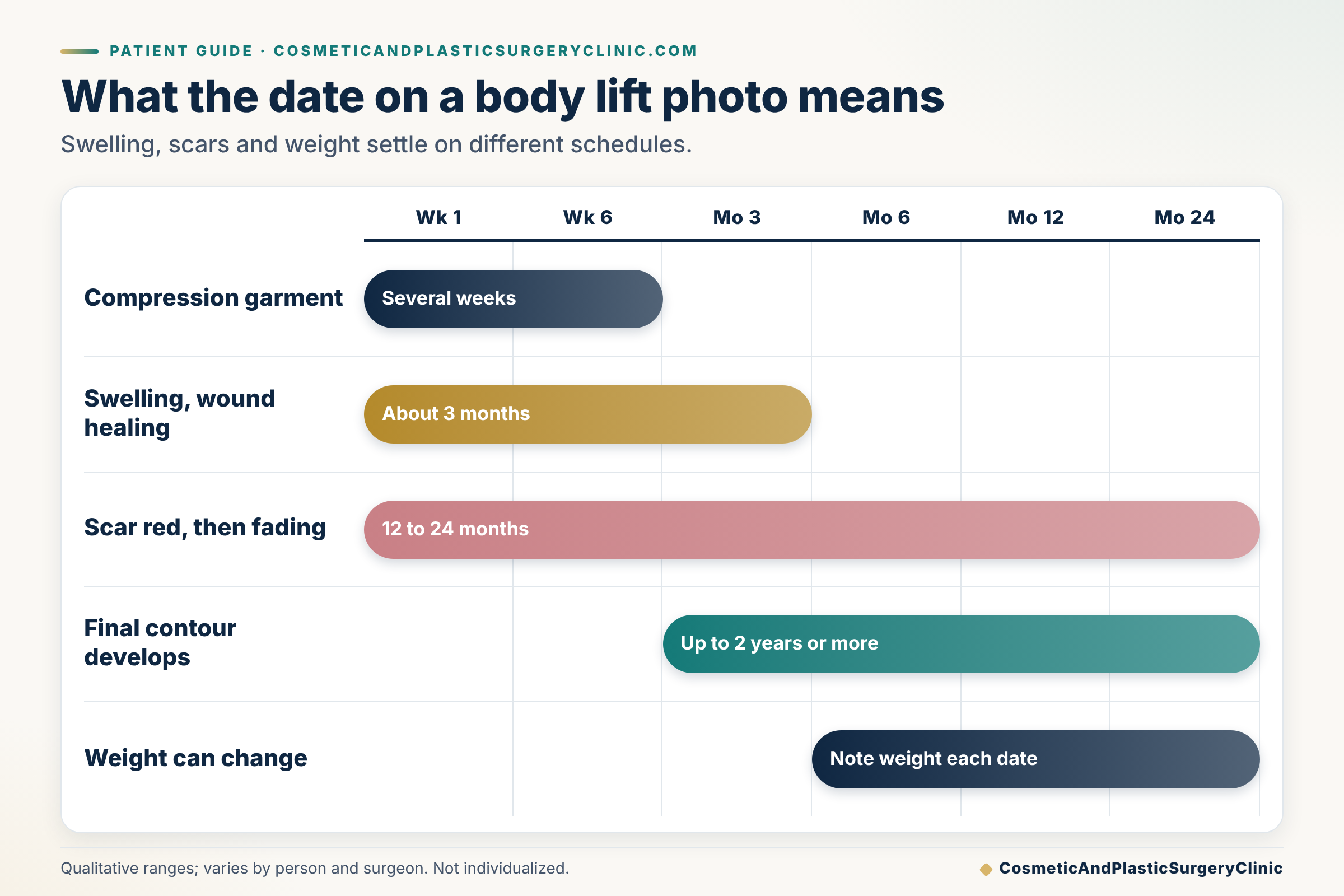
Different parts of the picture settle on different schedules. Swelling, scars and weight each follow their own clock, and the sources opened for this article give ranges, not single dates.
Weeks 1 to 6: swelling, garments and drains
The Aesthetic Society’s recovery page describes redness, bruising and swelling that usually resolve in one to three weeks, a wide compression garment worn for several weeks, drains usually removed three to fourteen days after surgery, and incision healing that may take four weeks or longer. Time off work and activity limits are listed there too. The recovery arc is in body lift recovery.
ASPS says results are visible almost immediately, which is why early body lift before and after photos look striking. A photo at this stage shows a body still under dressings, garments and fluid, with scars at their reddest. It can show that skin was removed. It cannot show the final contour or the final scar.
Months 3 to 12: shape settles and scars mature
MedlinePlus says swelling and wound healing take about three months after body contouring after weight loss, and that results continue to improve as swelling resolves. The ABCS timeline puts scar maturation at 12 to 18 months. A body lift before and after photo at three months is a better indicator of shape than one at three weeks, but its scar is still young.
None of the sources opened names one correct month for an “after” photo, and ASPS says only that it may take two years or more for final results of a body lift to fully develop. That is the reason to ask for a dated series, not a single image. The figure below puts these ranges on one timeline.
Year 2 and later: weight, aging and what “final” means
ASPS says most of the initial improvement should last if weight stays stable and general fitness is maintained, and that some loss of firmness with age is natural. The Aesthetic Society adds that tightened skin will gradually loosen again with age. MedlinePlus says surgery can improve shape but will not restore the body’s pre-weight-gain appearance, and that regaining weight can stress the surgical area.
An “after” photographed at six months cannot show any of that. Look for body lift before and after cases at one and two years or more, with the weight noted. If a practice has only early photos, that is a fact about its follow-up, and you can ask whether later images exist.
One dramatic pair versus a dated series
A single pair of body lift before and after photos is a decision by the practice. A series is evidence about healing.
Ask for the same person at several dates
A 2024 ASPS article suggests asking how long after surgery photos were taken, and an October 2026 ASPS article quotes a surgeon saying a result at six weeks differs from one at a year. Ask for the same person at an early date, around three months, around six months and at a year or later, in the same views each time.
A series also exposes what a pair hides: a scar that widened and then narrowed, a flank that looked tight early and settled later, or a contour step that appeared after swelling went down. The same logic is applied to abdomen-only operations in tummy tuck before and after; a circumferential operation needs at least as many views.
Weight and life events on each date
Write down what changed between photos. Weight is the main item. The Aesthetic Society’s weight-loss page also says pregnancy may stretch the skin and compromise results, so a later pregnancy would change what later photos show. Another operation between dates, as in the 2023 figure caption above, changes the picture without any change in the body lift. If a caption lists none of this, ask for the details in writing.
Edits, selection and consent: testing the gallery behind body lift before and after photos
Matched views and honest dates in body lift before and after photos still leave three questions: was the image altered, was it chosen from many, and did the person pictured agree to be shown. Each has a practical test.
Retouching and staging
Waist and hip lines are simple curves, which makes subtle reshaping hard to spot. The signs of editing are worth knowing, along with how little they prove.
Editing cues, and how little they prove
An ASPS article from October 2026 lists cues from two surgeons: strange skin texture, warped backgrounds and inconsistent shadows, wavy lines or pixelation around the body (especially with morphing software), and proportions that look too good to be true. One surgeon warns against relying on visual tells alone, because editing keeps improving, and ABCS says manipulated images are increasingly difficult to spot.
For a body lift photo, apply the background test. A door frame, tile line or window edge that bends near the waist or hip is the kind of warped background those surgeons describe. The sturdier test is procedural: ask whether the practice keeps unedited originals, whether filters were used on any gallery image, and whether you can see the full series on the practice’s own screen in the consultation.
A staged “before” and a styled “after”
Editing is not the only way to exaggerate. A surgeon quoted by ASPS in March 2025 described the contrast of a “before” with poor lighting, a gown and an unhappy expression against an “after” with makeup, nice clothing and a smile. Posing and styling can alter how much of a change appears without touching a pixel.
In body lift photos this often shows up as a different swimwear style, a tan, hair and makeup, or a softer room. If the setup differs in obvious ways, treat that pair as inspiration and ask the practice for a matched pair instead.
Selection, consent and money
Every gallery is a selection. The question is how wide the selection is, and who was paid or promised something.
Best work versus the full range of results
ASPS wrote in 2024 that surgeons usually show their strongest cases, and that highlighted cases may not reflect the average result or the surgeon’s experience with the procedure. The same article suggests looking at the volume of work, not only the most dramatic transformations. A surgeon quoted in October 2026 put it this way: a credible body of work is much harder to fake than a single compelling image.
The operation is also far less common than its neighbors: ASPS counted 10,868 lower body lifts in 2025, against 173,251 tummy tucks. If a practice shows dozens of cases under one heading, check whether they are body lifts or a mix that includes liposuction before and after photos and abdomen-only cases. People with abdomen-only plans may learn more from tummy tuck after weight loss.
| Evidence line | What a useful gallery shows | What it cannot tell you |
|---|---|---|
| Case similarity | Several people with a comparable starting contour, weight history and plan | How your own skin, tissue and healing will behave |
| Time point | The same person at an early date, around three to six months and at a year or more | Whether the result lasted past the last photo |
| Procedure list | The operation named, with add-ons and any staged procedures dated | Operating time, setting and anesthesia plan |
| Edits and consent | A statement on retouching, plus written permission to publish | Whether unflattering cases were left out |
| Revision disclosure | At least one case with a wound-healing issue, a revision or a slow recovery | How often these happen overall |
| Number of cases | A body of post-weight-loss work, not a handful of striking pairs | How many body lifts the surgeon performs each year |
Consent, privacy and paid posters
The US Department of Health and Human Services lists full-face photographs and any comparable images among identifiers to be removed when health information is de-identified, along with any other unique identifying characteristic. A torso photo may show no face, but a distinctive tattoo or birthmark could still identify someone. HHS also says the Privacy Rule generally requires written authorization for marketing uses of health information.
The Federal Trade Commission says a connection that would affect how people weigh an endorsement must be disclosed, and that free or discounted services given with an expectation of promotion count. It also says an incentive such as a discount cannot be conditioned on a positive review, and that endorsements reporting exceptional results need proof they are typical or a clear statement of what is generally expected. Ask whether people in the album gave written permission and whether any received a discount. ABCS adds a caution about live operating-room posts, which it says can compromise patient safety and privacy.
What no photograph can show: healing, safety and the consultation
A settled, well-lit “after” tells you nothing about whether the weeks between were smooth. For an operation of this size, that gap is the part to understand.
The healing course behind a clean “after”
Body lift before and after photos capture an endpoint. The risks sit in the path to it.
Published complication data from post-weight-loss lower body lifts
ASPS lists the risks of body lift as including poor wound healing, fluid accumulation, infection, bleeding, skin loss, fat necrosis, numbness, asymmetries, unfavorable scarring, blood clots and the possible need for revision. Rates vary by study. A 2016 Plastic and Reconstructive Surgery Global Open paper reviewed 100 post-bariatric lower body lifts at one Dutch hospital with six months of follow-up and found 78% had at least one complication, though the authors counted every wound dehiscence (a wound edge that opens) as a complication.
In that series wound dehiscence occurred in 61 patients, infection in 44 and seroma (a fluid pocket) in 32; 22% had major complications, 13% needed surgical revision and one patient had a pulmonary embolism. It was retrospective and from a single center, so it is one data point. The Aesthetic Society says major complications from lower body lifts are infrequent and the overall complication rate is low with an experienced, board-certified surgeon in an accredited facility. The two sources count differently, and the society page gives no figures, so neither is a prediction. More detail is in body lift risks.
Warning signs that photos will never show
Pain that may persist, numbness, leg swelling and wound problems do not appear in a gallery image. Neither do the quieter experiences of a long recovery.
Taking the photos into the consultation
Use the pictures to generate questions, not to choose. A set of body lift before and after photos that passes the checks above has shown what one surgeon’s work can look like. It has not shown how the operation was planned, where it was done or what happens when something goes wrong.
Questions to ask while you look at the album
- Operation: Which operation and incision pattern is this, and which add-ons or staged procedures were included?
- Views: Can I see front, side, rear and oblique views of the same person at the same dates?
- Scar: Can I see close-ups of the scar at a stated date, and what is typical for this plan?
- Dates and weight: How long after surgery is each “after”, and what was this person’s weight on each date?
- Originals: Are these unedited, and did each person give written permission?
- Range: Do you have cases that resemble my starting point, and one that needed revision or healed slowly?
- Experience: How many post-weight-loss operations of this kind do you perform, and where?
- Complications: Who treats a wound problem or blood clot after hours, and where?

Reading the answers: proceed, pause or look elsewhere
Clear, specific answers, a dated series of body lift before and after photos with rear views and a willingness to show an imperfect case are reasons to continue the conversation. Gaps in dates, no rear views, vague consent or reluctance to discuss complications are reasons to pause and ask in writing. If answers stay vague on experience, setting or complication care, look elsewhere.
Verifying credentials is a separate task from reading photos. ASPS’s October 2026 article suggests checking board certification, training, procedure-specific experience and how a surgeon manages complications, and the American Board of Plastic Surgery runs a public lookup that confirms certification and shows state board alerts. Steps are in how to choose a plastic surgeon, and the consultation questions guide explains how to judge answers. Waiting, getting a second opinion or deciding against surgery are all legitimate outcomes.
Frequently asked questions
How many body lift before and after photos should I ask to see?
None of the sources opened for this article gives a target number, so treat the number of body lift before and after photos as a question for the practice. What matters more is the mix: several people with starting points like yours, each shown at more than one date and from every side, plus at least one case that healed slowly or needed more work. ASPS suggests looking at the volume of a surgeon’s work and not only the most dramatic transformations. A handful of matched series is usually more informative than a larger number of single pairs.
Should I bring body lift before and after photos of someone else to my consultation?
You can bring body lift before and after photos as references, but be ready for a frank answer. A surgeon quoted by ASPS in 2025 said some people bring filtered images or ones where contours were edited in, which the surgeon called unlikely to be achievable, and stressed that realistic expectations are key. A surgeon quoted in 2026 said a good surgeon should explain your anatomy and what is realistically possible. Say what appeals to you, such as waist, flank or buttock position, instead of asking for a copy of another person.
What if a practice shows only front-view body lift before and after photos?
Ask whether rear, side and oblique views exist for the same cases, and why they are not in the gallery. Because the scar and much of the tissue change sit beyond the front view, a front-only set of body lift before and after photos is incomplete for a circumferential operation. A practice may keep fuller series for consultations. If it cannot show them at all, that tells you something about how it documents its work, and a second consultation elsewhere is a reasonable step.
Are body lift before and after photos on social media reliable?
Treat them as leads. ASPS advises looking for photos on a legitimate practice website instead of social media or unverified posts by people who say they are patients. A post rarely states the date, the add-on procedures, the weight or the consent, and those details decide whether a picture is readable. ABCS also warns about surgeons who mostly post immediate results from the operating room. Find the practice, verify the surgeon, then ask to see the case as a dated series.
Can body lift before and after photos show whether I might need a second operation?
Only partly. ASPS says optimal results may not be possible with one operation and that a second surgery may be needed, and it lists asymmetries, skin loss and recurrent looseness of skin among the risks. A gallery that includes revised cases shows how a practice handles that. A gallery without any cannot rule it out. Ask what the practice’s revision policy is and what it covers, and read the details in the risks article before deciding.
Does a strong gallery mean a surgeon is experienced with post-weight-loss patients?
Not by itself, even when the body lift before and after photos are excellent. ASPS notes that highlighted photos do not show how experienced a surgeon is with a procedure. Experience shows in how many comparable cases are shown, how long after surgery they were photographed and how the surgeon talks about complications. The Aesthetic Society links low complication rates to an experienced, board-certified surgeon operating in an accredited facility, so verify certification and the facility separately from the photos. Ask how many operations like yours the surgeon does in a typical year.
What do body lift before and after photos not show that ASPS lists as a risk?
Several of the risks ASPS lists are invisible in a photograph: pain that may persist, numbness or other changes in skin sensation, persistent swelling in the legs, and deep vein thrombosis with cardiac and pulmonary complications. A photo at one year cannot say whether any of these happened. If those outcomes matter to you, ask the surgeon how often patients report them, what the practice does about each, and whether former patients are willing to speak with you.
Sources and further reading
- American Society of Plastic Surgeons — Body lift overview (accessed 2026-11-13) — what body lift covers, liposuction combination, limits
- American Society of Plastic Surgeons — Body lift procedure (accessed 2026-11-13) — circumferential incision, hidden-scar aim, liposuction add-on
- American Society of Plastic Surgeons — Body lift results (accessed 2026-11-13) — visible soon, final results up to two years or more, scars remain
- American Society of Plastic Surgeons — Body lift risks and safety (accessed 2026-11-13) — listed risks
- American Society of Plastic Surgeons — Body lift recovery (accessed 2026-11-13) — drains, dressings, warning signs
- American Society of Plastic Surgeons — Plastic Surgery Statistics Report 2025 (accessed 2026-11-13) — lower and upper body lift counts, glossary
- American Society of Plastic Surgeons — Can you trust before and after photos? March 1, 2024 (accessed 2026-11-13) — best-work bias, no photo standard, timing
- American Society of Plastic Surgeons — What is reality? Determining if a before-and-after is too good to be true, March 11, 2025 (accessed 2026-11-13) — missing scars, staged contrast, scar visibility
- American Society of Plastic Surgeons — Can you trust that transformation? Reading before-and-after photos in the age of AI, October 13, 2026 (accessed 2026-11-13) — editing cues, consistency, body of work
- American Society of Plastic Surgeons — When is the time right for body contouring after major weight loss? blog, July 13, 2018 (accessed 2026-11-13) — weight fluctuation effects
- The Aesthetic Society — Lower body lift (published April 28, 2020; modified August 14, 2023; accessed 2026-11-13) — belt lipectomy definition, areas treated
- The Aesthetic Society — Lower body lift incisions and scars (October 22, 2021; accessed 2026-11-13) — scar course around the trunk
- The Aesthetic Society — Lower body lift aftercare and recovery (October 22, 2021; accessed 2026-11-13) — garments, drains, swelling and healing ranges
- The Aesthetic Society — Lower body lift results (October 22, 2021; accessed 2026-11-13) — weight change, aging, photo review
- The Aesthetic Society — Lower body lift risks and safety (October 22, 2021; accessed 2026-11-13) — infrequent major complications, surgeon and facility
- The Aesthetic Society — Plastic surgery after weight loss (published April 28, 2020; modified August 14, 2023; accessed 2026-11-13) — pregnancy and skin stretch
- MedlinePlus — Body contouring after weight loss patient instructions (accessed 2026-11-13) — swelling, final results, regain
- PubMed — Song AY et al., A classification of contour deformities after bariatric weight loss: the Pittsburgh Rating Scale, Plastic and Reconstructive Surgery 2005 (accessed 2026-11-13) — 10 regions, grades 0 to 3, observer agreement
- Song AY et al. — A Classification of Contour Deformities after Massive Weight Loss: Application of the Pittsburgh Rating Scale, Seminars in Plastic Surgery 2006 (accessed 2026-11-13) — grade definitions, scale origin (copy hosted by a clinic)
- de Vries CEE et al. — The PRS Rainbow Classification for Assessing Postbariatric Contour Deformities, Plastic and Reconstructive Surgery Global Open 2020 (accessed 2026-11-13) — rater agreement by region
- Wong MS, Vinyard WJ — Photographic Standards for the Massive Weight Loss Patient, Annals of Plastic Surgery 2014 (accessed 2026-11-13) — 360-degree documentation, arm positions
- Teplica D, Schuleman D, Masri V — Highly Standardized Rotational Photography of the Torso, Journal of Biocommunication 2020 (accessed 2026-11-13) — 45-degree steps, exhalation, error
- Kirwan L — Aesthetic Units and Zones of Adherence, Relevance to Planning Incisions in Body Contouring Surgery, Plastic and Reconstructive Surgery Global Open 2023 (accessed 2026-11-13) — scar placement principles, dated captions (three patients)
- Poodt IGM et al. — Complications of Lower Body Lift Surgery in Postbariatric Patients, Plastic and Reconstructive Surgery Global Open 2016 (accessed 2026-11-13) — 100-patient complication review
- HealthDay — Long-term weight regain common after body contouring surgery, November 27, 2023 (accessed 2026-11-13) — news summary of a 121-patient study
- The Objective Buttocks Assessment Scale (2022; university repository copy; accessed 2026-11-13) — photo-based rating items, 650-woman validation
- American Board of Cosmetic Surgery — How to look at cosmetic surgeons’ social media, July 3, 2024 (accessed 2026-11-13) — on-the-table photos, editing, operating-room posts
- American Board of Cosmetic Surgery — Top tips for post-surgery scarring, November 16, 2025 (accessed 2026-11-13) — scar maturation, sun exposure
- Federal Trade Commission — FTC’s Endorsement Guides: What People Are Asking (last modified July 15, 2025; accessed 2026-11-13) — material connections, typical results
- US Department of Health and Human Services — Guidance on de-identification of protected health information (accessed 2026-11-13) — photographs as identifiers
- US Department of Health and Human Services — Marketing under the HIPAA Privacy Rule (accessed 2026-11-13) — written authorization for marketing
- American Board of Plastic Surgery — Is your surgeon certified? (accessed 2026-11-13) — certification lookup, state board alerts