Most people planning surgery after children land on the same fork: one long operation or several shorter ones. A staged mommy makeover splits the plan into separate surgeries with healing time in between. A combined plan puts the abdomen, the breasts and any liposuction on one operating schedule. The American Society of Plastic Surgeons (ASPS) says on its mommy makeover page that the procedure “is typically performed as a single-stage procedure,” so staging is the variation that needs a reason, not a sign of half-hearted commitment.
Neither route is the cautious one by default. Combining trades two anesthetics and two recoveries for one longer anesthetic and one bigger recovery, and a staged mommy makeover does the reverse. This page weighs that trade with published data and household logistics, and nothing in it tells you which plan fits your body. For what a mommy makeover includes in the first place, start with the main mommy makeover guide.
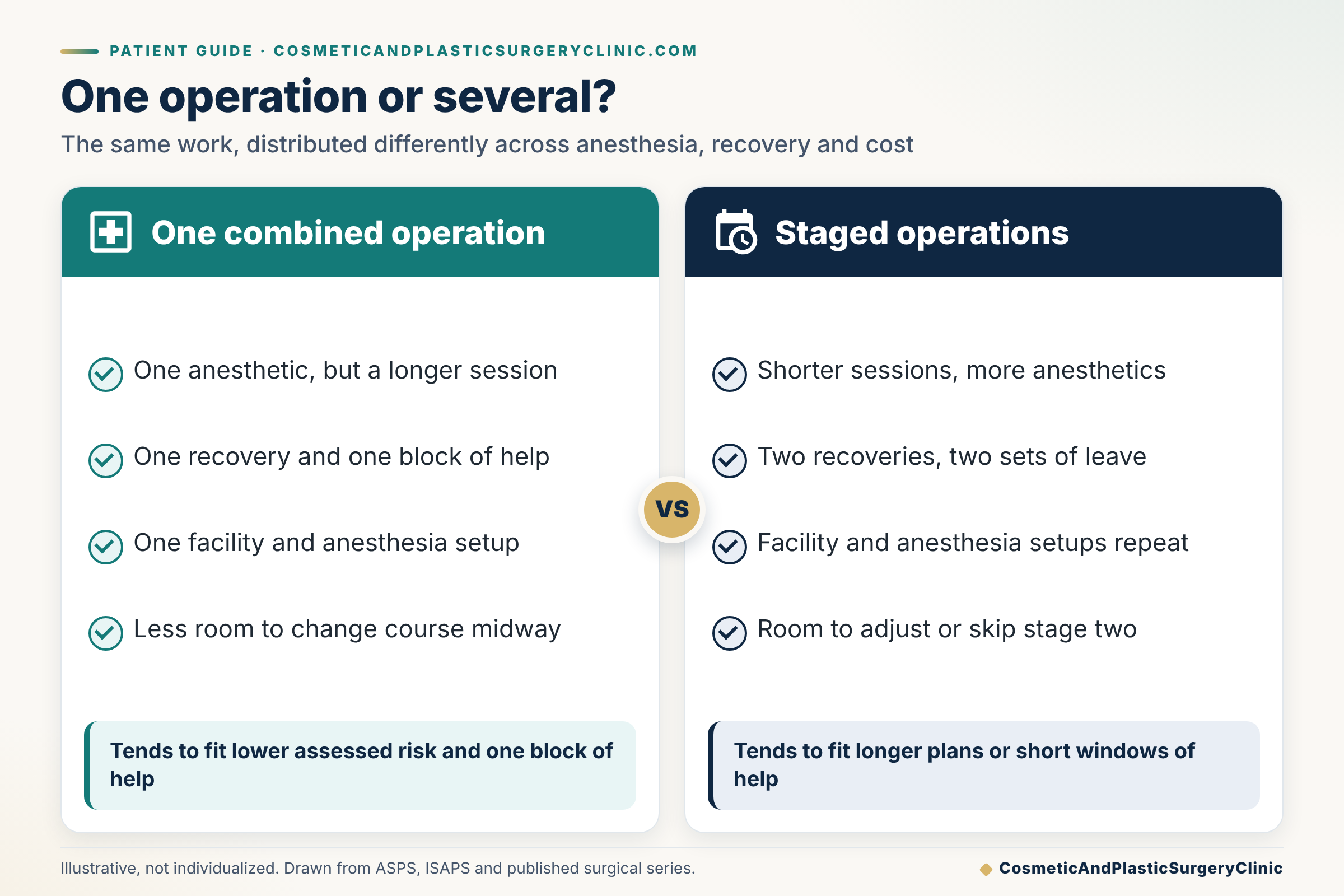
What a staged mommy makeover is, and what one combined operation means
How a staged mommy makeover divides the plan
Body first, breasts second, or the reverse
In the most common version of a staged mommy makeover, one operation addresses the abdomen (a tummy tuck, with or without liposuction) and a later one addresses the breasts (a lift, an implant, a reduction, or a lift with an implant). Surgeons choose the order by what bothers the patient most, which part carries the longer or riskier operation, and their own habits.
The sources reviewed for this page do not rank either order as safer, so, in a staged mommy makeover, “which first?” is a question to put to your surgeon along with the reason for the answer. A surgeon who can explain the sequence in terms of your anatomy and your priorities is giving you more than one who says “this is how we always do it.”
Why the number of stages is a planning choice, not a standard
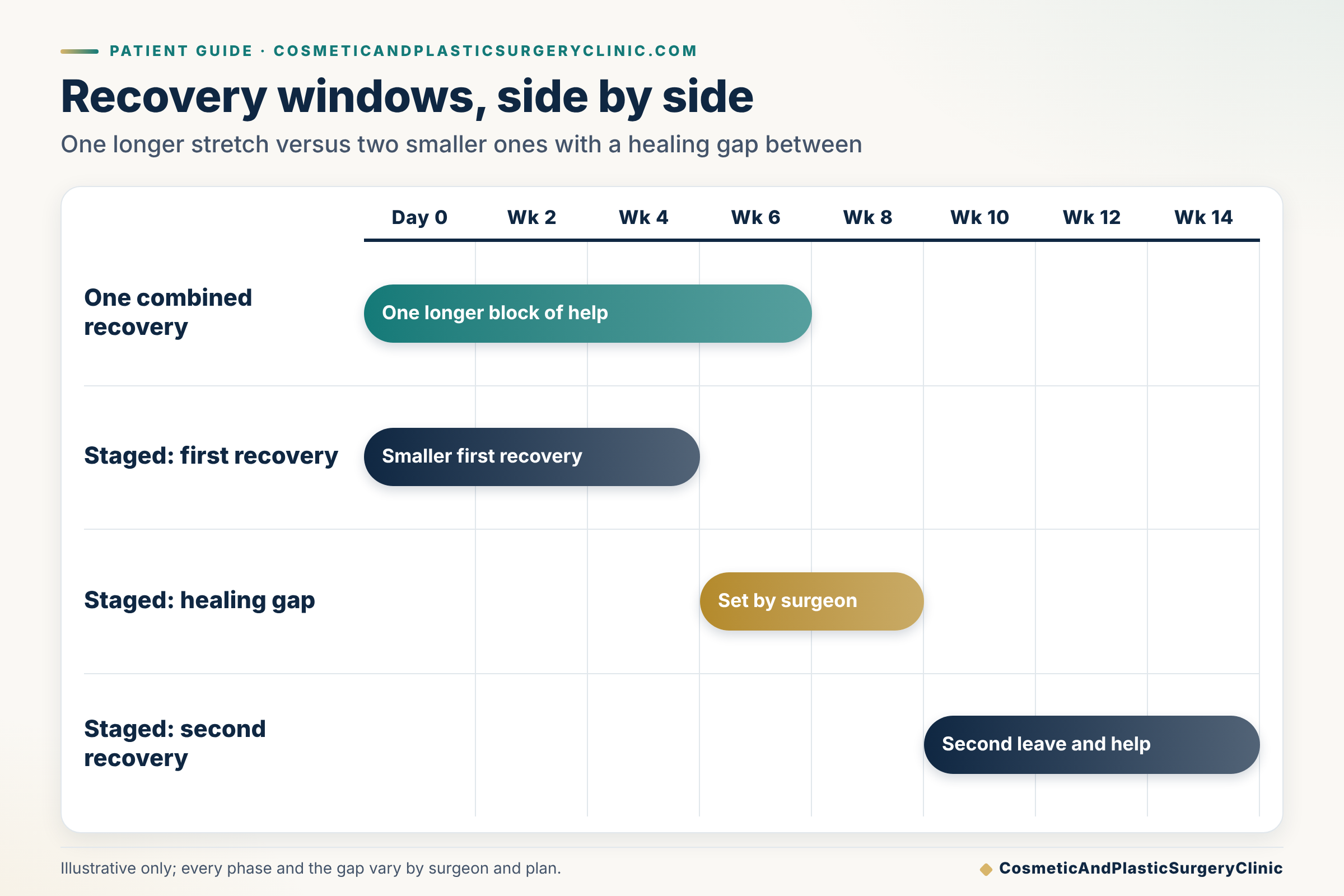
Two stages is the picture most people hold of a staged mommy makeover, but a plan can have three: a tuck, a breast operation, and a later liposuction or arm or thigh procedure. Each stage carries its own consent form, anesthetic, facility booking and recovery. The interval between stages is set by the surgeon and by how the first area heals; none of the sources reviewed gives a standard number of weeks or months.
A separate clock sits in front of all of this. Surgeons quoted in ASPS articles describe waiting at least six months after pregnancy, and longer after breastfeeding, before starting at all. That timing question belongs to the page on mommy makeover after pregnancy; this page assumes the body has settled and the question is how to divide the work.
What a single-session plan puts on one operating schedule
A typical combination: tummy tuck, breast surgery and liposuction
An ASPS article on postpartum surgery describes the usual pairing as a tummy tuck with breast surgery, with liposuction added by some women. Mayo Clinic says abdominoplasty usually involves general anesthesia and “often” takes less than four hours. One single-center series of 404 tummy tucks (Aesthetic Surgery Journal, 2012) reported an average operating time of 100 minutes.
A 2009 series of 268 patients who had a tummy tuck plus breast surgery, 77% with added liposuction, averaged 165 minutes, with a range of 60 to 330. These come from different centers and years, so they are not a like-for-like comparison. They do show the general shape: adding breast work to a tuck lengthened the average operation in these series.
Why two people with the same label can have very different workloads
“Mommy makeover” covers everything from a breast lift alone to a full tummy tuck, an augmentation with a lift, and liposuction in one booking. The workload, and the risk that goes with it, differs accordingly. A large insurance-database study found that the major complication rate after abdominoplasty rose from 3.1% when done alone to 4.6% with liposuction plus breast surgery, and to 10.4% when combined with liposuction and another body-contouring procedure.
So “combined” is not one risk category. The menu of components is laid out in the guide to mommy makeover procedures; what matters here is that the more you stack, the more the staged mommy makeover question deserves a real answer rather than a default.
Operating time, anesthesia and clots: the safety question at the center
What published studies say about combining abdominal and breast surgery
Registry and insurance data point in different directions
Two large data sets look at tummy tucks done with other procedures, and they do not agree. The CosmetAssure insurance database (2008 to 2013) counted major complications only and found that multiple procedures carried a relative risk of 1.5 compared with abdominoplasty alone. A registry analysis of 58,756 women (2002 to 2014) counted any 30-day complication and found no significant difference between combined breast-and-abdominal surgery and abdominal surgery alone.
Both are real findings from large groups. They differ in what counts as a complication, how long patients were followed, and which procedures were combined, so their percentages cannot sit on one scale. For anyone weighing a staged mommy makeover, the table lines them up with the smaller studies that matter to this decision.
| Study | Who and what | Main finding | Limit to keep in mind |
|---|---|---|---|
| CosmetAssure analysis, Plastic and Reconstructive Surgery, 2015 | 25,478 abdominoplasties, 2008 to 2013; 8,975 alone, 16,503 with other procedures | Major complications 3.1% alone, 4.3% with a breast procedure, 4.6% with liposuction plus breast, 10.4% with liposuction plus another body-contouring procedure | Major complications only; minor problems treated in clinic were not counted |
| TOPS registry analysis, Aesthetic Surgery Journal, 2015 | 58,756 women, 2002 to 2014; 3,693 had combined breast and abdominal surgery | 30-day complications about 9% to 10% combined, about the same for abdominal-only, about 3% for breast-only | Thirty days of follow-up; self-reported registry data; no direct staged comparison |
| Stevens and colleagues, Aesthetic Surgery Journal, 2009 | 268 patients, one outpatient surgery center, 1997 to 2007; tuck plus breast surgery | About a third had a complication (90 of 268 patients); 13% had revision surgery; no clots or deaths reported | Retrospective, single practice; staged rates were estimated from other studies |
| Wolf and colleagues, Israel Medical Association Journal, 2025 | 726 patients; about 15% had tuck plus breast surgery | After adjustment, no difference in adverse events versus isolated tummy tuck | One surgeon’s patients; staging not studied |
| Calobrace and colleagues, Plastic and Reconstructive Surgery, 2013 | 430 breast lifts, 332 with implants at the same time | Complications about 23% combined; reoperation about 13% versus about 10% for lift alone, not significantly different | Press-release summary; results worse in secondary (repeat) surgery |
Single-practice series and why they flatter the combined option
Most of the reassuring numbers for combined surgery come from experienced teams reporting their own patients. Those patients were chosen by the surgeon, and the surgeon decides whom to steer toward fewer procedures, so the people who had a combined operation may be a healthier group than everyone who asks for one. None of these series had a concurrent control group of people who had a staged mommy makeover.
The 2013 study of simultaneous breast lift and augmentation illustrates the gap. Its press release is headlined “simultaneous versus staged,” yet the comparison was between combined surgery and a lift alone. The authors concluded that a one-stage operation “can be safely performed with acceptable complication and reoperation rates” and that patients “overwhelmingly prefer not to undergo a staged procedure.” Preference is a fair reason to weigh; it is not a safety measurement.
Why a longer operation changes the clot conversation
Where clots begin and why timing matters
The Centers for Disease Control and Prevention (CDC) describes deep vein thrombosis as a clot in a deep vein, most often in the lower leg, thigh or pelvis, and pulmonary embolism as a piece of that clot traveling to the lungs. CDC adds that about half of people with a deep vein clot have no symptoms. Its prevention advice after surgery starts with moving as soon as you can.
A December 2024 safety update from the International Society of Aesthetic Plastic Surgery (ISAPS) reports that up to half of deep vein clots begin during the operation itself, and that the highest-risk window for a fatal lung clot falls three to seven days after surgery. It applies its risk-assessment advice to operations longer than 60 minutes under general anesthesia. A longer combined session spends more time in that category; the sources reviewed here do not put a risk figure on each additional hour.
Risk scores and staging as a pressure valve
ISAPS states that no validated risk scale exists specifically for aesthetic surgery, that the Caprini score is the most widely used stand-in, that 79% of surveyed physicians judged the available methods insufficient for aesthetic patients, and that there is no consensus on when to start or how long to continue clot-preventing medication. So your surgeon’s clot assessment is judgment informed by a score, not a measurement.
The registry authors built a seven-point tool to sort combined patients. Among those scoring zero (about 77% of the combined group), 9.78% had a 30-day complication; at one to three points it was 16.63%; at four to seven points, 38.46%, but that last group had only 13 people.
For low-risk patients the authors wrote that a combined operation can spare a second surgery without added harm. For high-risk patients they advised against surgery or doing only the single most important procedure, which is a different answer from “stage it.” The tool needs prospective validation, so treat it as an illustration of how surgeons reason, not a score to work out for yourself.
The CosmetAssure authors made a related remark: some high-risk patients might be better served by staged rather than combined procedures. Reading the two together, a staged mommy makeover is one of several levers, alongside doing fewer procedures, doing none yet, and addressing modifiable risk factors first. For how risks are sorted across all operations, see the general plastic surgery risks page, and for the combined-procedure specifics, the mommy makeover risks page and the tummy tuck risks page.
Recovery windows, childcare and work: one long stretch or several short ones
Recovery is where the two plans feel most different at home. A combined plan asks for one concentrated period of limited lifting and borrowed help. A staged mommy makeover asks for the same thing twice, in smaller doses, with a normal-life gap between. Which is easier depends less on the operation than on who is in your house and how movable your calendar is. Surgeon-directed timelines always override anything general on this page.
What one combined recovery asks of your household
One block of help, and a bigger one
For a tummy tuck alone, Mayo Clinic describes walking as early as the day after surgery, an abdominal binder for about six to eight weeks, no lifting, straining or quick bending at the waist for about six weeks, no sports for at least eight weeks, and a return to work in about two to four weeks depending on the job. An ASPS article quotes a surgeon placing recovery from a breast reduction or tummy tuck at about four to six weeks.
The ASPS breast lift recovery page gives no time-off or lifting figures and tells readers to ask the surgeon. None of the sources reviewed says how much a combined recovery extends the longer of its two parts. Ask your surgeon for the schedule that applies to your specific plan, in days and weeks, rather than assuming the longest component sets the pace.
Lifting, carrying and the toddler problem
Lifting limits turn abstract recovery advice into daily friction. Consider a hypothetical parent of a two-year-old who is told not to lift anything heavier than a small bag of groceries for several weeks. A toddler, a car seat, a stroller to fold and a laundry basket all exceed that, and the child still wants to be picked up.
The useful step is to ask for the limit as a number of pounds, then weigh your child and your usual gear against it. An ASPS article quotes surgeons telling patients to “expect to be babied for some time” and to “give up the role of caregiver” during recovery. For a combined plan that means two adults for the early stretch, or a helper who can stay overnight; the mommy makeover recovery page covers the household side in more detail.
What a staged mommy makeover asks of your household
Two sets of leave, two sets of help
Splitting the plan into a staged mommy makeover shortens each recovery but multiplies the logistics. Each stage needs its own time off work, its own ride home, its own helper schedule and its own set of supplies. If your helper is a relative who can take a single month off, one combined recovery may fit their calendar better than two separate commitments. If your helper can manage a week or two at a time, the reverse may be true.
There is a kinder side to staging as well. A smaller operation often means fewer incisions to protect at once, and the lifting problem is limited to one body area at a time. General planning tools for the household, from meal prep to a recovery spot on the main floor, are covered in the plastic surgery recovery planning guide.
The gap between stages: healing, weight and life events
The interval between stages is not dead time. Swelling settles, the surgeon sees how the first area healed, and weight changes show up. Mayo Clinic notes that ideally weight should be stable for six to 12 months before a tummy tuck, and that a large loss afterward can change results. A long gap in a staged mommy makeover gives weight, and life, more time to move.
Pregnancy is the largest of those events. ASPS articles say a tummy tuck or mommy makeover generally waits until childbearing is complete, and that a future pregnancy can undo results. If another child is plausible in the next few years, a staged mommy makeover with a long gap deserves an honest conversation; so does a decision to wait. The page on mommy makeover candidacy lists what surgeons usually review here.
Cost: one facility fee or two, and what a quote leaves out
Where the money goes in a combined plan and in a staged one
Surgeon, facility and anesthesia lines
ASPS lists the ingredients of a tummy tuck cost as the surgeon’s fee, anesthesia, hospital or surgical-facility costs, medical tests, post-surgery garments and prescriptions. Its cost page gives an average of $8,174 for the operation, without stating a year, and says the figure leaves out anesthesia, operating room facilities and related expenses. Treat it as a floor for one component, not a price for a plan.
In a combined plan, the facility and anesthesia lines are billed once, but for a longer session; how that time is priced, as a flat block or by the hour, varies by facility and the sources reviewed do not say which is typical. In a staged mommy makeover, those lines appear again for each stage, with their own setup charges and, for some facilities, a fresh minimum booking. Whether surgeons discount a combined surgeon’s fee, or bundle a staged package, differs by practice; ask for both versions itemized. More on cost anatomy is in the mommy makeover cost page.
Costs outside the quote: time off, childcare and complications
A staged mommy makeover means two recoveries, so two rounds of unpaid or reduced work, two rounds of paid childcare or favors, and possibly two trips if the surgeon is out of town. Pre-operative tests and garments may repeat. On the other side, one longer recovery concentrates the same loss into a single stretch, and a complication in a combined operation can affect both body areas at once.
ASPS notes that most health insurance plans do not cover a tummy tuck or its complications. That makes the revision and complication policy for each stage part of the price: ask what the surgeon’s fee, the facility and the anesthesia provider will each charge if something needs a return to the operating room. Payment options are the subject of the guide to plastic surgery financing.
A hypothetical comparison, priced in November 2026
Reading the example
The numbers below are invented round figures to show how the lines move, not quotes and not averages. They assume a tummy tuck plus a breast lift with the same surgeon and facility, done either in one operation or as two. Your quotes will differ in every line, and the direction of the total can flip if a surgeon discounts the combined fee or charges a premium for a long session.
| Line item | One combined operation | Two staged operations (stage 1 + stage 2) | Why the lines differ |
|---|---|---|---|
| Surgeon’s fee | $14,000 | $9,000 + $6,500 = $15,500 | Some practices discount a second component done in one session |
| Facility | $6,000 (one longer booking) | $4,000 + $3,000 = $7,000 | Two room setups and two minimum bookings |
| Anesthesia provider | $2,500 | $1,600 + $1,200 = $2,800 | Billed for time, plus a second evaluation |
| Garments, medications, tests | $900 | $500 + $400 = $900 | Each stage may need its own garment and tests |
| Total on the quote | $23,400 | $26,200 | Staged costs $2,800 more here, before lost work and childcare |
In this invented case the staged mommy makeover costs about 12% more on paper, and the difference is mostly the second facility and anesthesia setup. Change the assumptions, for example a surgeon who charges a premium for a six-hour session, and the gap shrinks or reverses. The lesson is to compare totals, not individual lines, and to put lost income and help at home beside the quote.
Questions that expose package terms
Several contract terms matter more with a staged mommy makeover than with a single operation. A written answer to each is worth having before a deposit changes hands:
- Is the stage-two price locked, and for how long?
- What happens to the deposit if you postpone or cancel stage two?
- Does the revision policy cover each stage separately, and for how many months?
- If a complication after stage one delays stage two, who pays for the delay?
- Is the anesthesia provider the same for both stages?
The general rules for reading a quote are in the plastic surgery cost guide.
Which pieces pair well and which are often separated
Pairings with the most published support
Liposuction with a tummy tuck
A 2018 meta-analysis of 17 trials and 14,061 patients (Aesthetic Plastic Surgery) compared lipoabdominoplasty, a tuck with liposuction in the same operation, with standard abdominoplasty. Overall complications were lower with lipoabdominoplasty (relative risk 0.85), as were seroma (0.69) and hematoma (0.56), and the authors found no evidence of higher complication rates. The paper was read at abstract level, and pooled studies of this kind mix designs and surgeon techniques.
The insurance-database study above reported a slightly higher major-complication rate when liposuction accompanied a tuck: 3.8% versus 3.1% alone. The two do not contradict each other so much as ask different questions. Putting both in view, adding liposuction to a tuck is not by itself the step that usually forces a staged mommy makeover, though the volume removed can be. The relationship between the two operations is explained in the comparison of liposuction and tummy tuck.
Breast lift with augmentation: a staging question inside the breast
Combining a lift and an implant has its own staging debate that is separate from the abdomen. In the 2013 study of 332 combined cases, the overall complication rate was about 23%, most often capsular contracture, scarring and recurrent drooping, with tissue-related reoperation near 13%. Results were worse in secondary cases, where the patient had had earlier cosmetic breast surgery, and the authors said the technical challenges should be discussed before surgery.
A 2016 series of 297 patients from one surgeon reported revision in 12.4% of combined augmentation-mastopexy cases versus 7.97% for augmentation alone, a difference that was not statistically significant. Both sets of authors favored the one-stage approach, which is worth reading as expert opinion from experienced teams rather than a controlled comparison. Detailed trade-offs for each breast option belong to the procedure-by-procedure comparison.
Add-ons that tip the balance
Large-volume liposuction, body lifts and other extras
The extras matter more than the label. In the CosmetAssure data, pairing a tuck with another body-contouring operation raised the major complication rate to 6.8%, and adding liposuction to that pair raised it to 10.4%. ASPS says “special considerations are needed” when large amounts of fat, usually more than five liters, are suctioned.
A plan that adds buttock procedures, arm or thigh lifts, or a body lift to the tuck and breast work moves toward the highest-risk rows of those tables. That is the version of the plan where a staged mommy makeover is most likely to be proposed, and where asking the surgeon to rank which pieces matter most to you can shorten the list. The cost of dropping a piece is that it may not get done at all, which can be the right trade.
A staged mommy makeover does not remove the need for further surgery
Authors of two series noted that a staged approach means a second operation by design: “in staged procedures, 100% of patients will have at least a second operation,” as the 2009 paper put it. That is an argument for combining. But a combined plan has its own return-to-surgery rate: 13% had revision surgery in that same series, and 12.4% in the 2016 augmentation-mastopexy group.
The honest comparison is a planned second operation against a possible unplanned one, each with its own anesthetic. A staged plan also lets a surgeon see how the first area healed before finalizing the second, which is a plausible advantage that none of the sources reviewed here confirms or measures. Weigh it as a reasonable question for the surgeon, not as evidence.
Deciding between a staged mommy makeover and one combined plan
A matrix and five hypothetical situations
The decision matrix, factor by factor
The table sorts one combined operation and a staged mommy makeover by the factors that tend to decide the question. It describes tendencies, not rules, and every cell can change with your anatomy, your risk assessment and your surgeon’s technique.
| Factor | One combined operation | Staged operations |
|---|---|---|
| When it tends to fit | Low assessed risk, a clear plan, one block of help available | Longer or heavier plan, elevated risk score, or help available only in short windows |
| Invasiveness per session | Highest: several areas, one longer anesthetic | Lower per session, but more sessions in total |
| Ability to change course | Limited once done; the plan is carried out as a whole | Higher: results and life events can reshape stage two, or end it |
| Scars and downtime | All incisions heal together in one recovery | Incisions and downtime arrive in separate periods |
| Maintenance and life events | Shorter exposure to weight change or pregnancy before it is finished | A longer gap gives weight change or pregnancy more time to intervene |
| Risk logic | One anesthetic; longer time under it; published data mixed | Two or more anesthetics; shorter sessions; no direct data showing lower total risk |
| Cost logic | One facility and anesthesia setup, longer session | Repeated setups, but each smaller; lost work and childcare repeat |
Five hypothetical situations and the fact that could flip each
These are invented illustrations of how surgeons and patients reason, not advice for any real person. Each one ends with the single piece of information that could reverse the leaning.
| Hypothetical situation | Route usually favored | Reason | Fact that could reverse it |
|---|---|---|---|
| Abdominal and breast changes both bother her; medically low risk; two helpers for four weeks | Combined | One anesthetic and one leave; help is available | A projected operating time the surgeon considers long, or a higher clot score |
| Same goals, but an elevated clot or complication score on the surgeon’s assessment | Staged, fewer procedures, or waiting | Shorter sessions; registry authors advise against a full combined plan at high risk | A modifiable factor that changes the score after months of preparation |
| A parent of two toddlers with one helper available for ten days | Staged, or a later date | The lifting limits collide with the childcare load | A second helper or paid support for the first weeks |
| Another pregnancy is plausible within a few years | Wait before either route | ASPS articles say a future pregnancy can undo results and childbearing should be complete | A firm decision that childbearing is finished |
| Breast surgery after earlier implants or an earlier lift, plus a tuck | Staged discussion | Secondary breast cases fared worse in one study | An exam showing a simple, low-complexity breast plan |

Questions to bring and exits worth keeping
Questions to bring to a consultation
Bring the questions that make the plan visible: how many hours would the combined operation run, and how does that compare with each stage alone? How is my clot risk assessed, and what would change it? Where is the surgery performed, who gives the anesthesia, and is the setting accredited? Which parts of the plan matter most, and what happens if I drop the last one?
For wording and what a good answer sounds like, see the guide to plastic surgery consultation questions. Facility accreditation, board certification and anesthesia provider checks are covered in the guide to choosing a plastic surgeon; ASPS itself names board certification as a key safety decision.
When waiting, or doing only one part, is the better answer
A staged mommy makeover is not the only alternative to a combined plan. Doing only the part that bothers you most, doing nothing yet, or seeking a second opinion on the plan are all legitimate outcomes of a consultation. ASPS articles describe waiting for the body to settle and for breastfeeding to end, and Mayo Clinic describes stable weight as an ideal starting condition.
If a surgeon pushes the biggest version of the plan, offers a discount that expires, or cannot explain why one operation beats two for you, a second consultation costs little compared with the decision. Nobody is obliged to choose a plan on the day it is first presented.
Frequently asked questions
Can a staged mommy makeover have more than two stages?
Yes. Some plans separate the tummy tuck, a breast operation and a later liposuction or arm or thigh procedure into three steps. Each added stage brings another anesthetic, another facility booking and another recovery, so the logistics and cost grow with each one. The sources reviewed do not describe a standard number of stages, which means the number is a planning decision between you and your surgeon, based on your anatomy, your risk assessment and your household.
Is it safer to do the tummy tuck first or the breast surgery first?
The sources reviewed for this page do not rank one order as safer. Surgeons often decide by which concern is larger, which operation is longer, and how each area’s healing might affect the other. Ask your surgeon to explain the reasoning for your staged mommy makeover, including what would change the order. If the explanation is only habit, a second opinion on sequence is reasonable.
Does a surgeon discount a combined operation compared with a staged mommy makeover?
Practices differ. Some reduce the second component’s surgeon fee when it is done in the same session, some bundle a staged package, and some charge each component at its usual rate. Facility and anesthesia charges follow time and setup, so a combined session often changes those lines too. The only reliable method is to request itemized quotes for both versions from each surgeon and compare totals, including what the revision policy covers.
What if I want only the breasts now and the tummy tuck later?
That is a staged mommy makeover with the second stage left open, and it can be a sensible way to start when the breast concern is larger or the time available is short. Ask whether the price for the later stage is held, whether changes in weight or another pregnancy could alter the abdominal plan, and what the cancellation terms are if you decide not to proceed. Leaving the door open should not obligate you to walk through it.
How long should the gap between stages be?
No source reviewed gives a standard interval, and it depends on how the first area heals, whether swelling has settled, your weight, and the surgeon’s practice. Rather than asking for a number in the abstract, ask what the surgeon looks for before scheduling stage two and what findings would postpone it. In a staged mommy makeover, a gap long enough for healing but short enough to avoid life changes is the aim.
Does a staged mommy makeover mean more anesthesia risk than one longer anesthetic?
The sources reviewed do not answer that directly. Combining places more time under one anesthetic, and clot guidance from ISAPS singles out operations lasting longer than 60 minutes under general anesthesia. Staging adds a separate anesthetic, with its own pre-operative evaluation, for each stage. Anesthesia risk depends on your health, the type of anesthesia and the provider, so ask who will provide it, how they assess you, and how the plan changes if you are ineligible for a long session.
Can pregnancy during a staged mommy makeover affect the plan?
It can. ASPS articles say a future pregnancy can undo results and that mommy makeovers generally wait until childbearing is complete. A staged plan lengthens the time during which pregnancy might happen, which may mean pausing before stage two or changing it. If pregnancy is a real possibility in the next few years, raise it at the first consultation so the plan is built around it. Pregnancy timing details belong to the page on mommy makeover after pregnancy.
Sources and further reading
- American Society of Plastic Surgeons — Mommy makeover (accessed 2026-11-12) — definition, procedure list and the statement that it is typically performed as a single-stage procedure
- American Society of Plastic Surgeons — Mommy makeovers: what women should know about postpartum surgical procedures (accessed 2026-11-12) — usual pairing of tummy tuck and breast surgery, surgeon timing comments, help at home
- American Society of Plastic Surgeons — Post-pregnancy plastic surgery: what can you do now and what needs to wait (accessed 2026-11-12) — waiting for completed childbearing, breastfeeding interval, four to six weeks of recovery quoted
- American Society of Plastic Surgeons — Combined breast lift and augmentation is safe, suggests study in Plastic and Reconstructive Surgery, news release (accessed 2026-11-12) — 2013 study of 430 breast lifts, complication and reoperation rates
- American Society of Plastic Surgeons — Tummy tuck complications: study looks at rates and risk factors, news release (accessed 2026-11-12) — CosmetAssure population, definitions, limits and the note on staging for high-risk patients
- Plastic and Reconstructive Surgery (2015) — Abdominoplasty: Risk Factors, Complication Rates, and Safety of Combined Procedures, abstract via QxMD (accessed 2026-11-12) — complication rates by procedure combination and relative risks
- Aesthetic Surgery Journal (2015) — Combining Abdominal and Cosmetic Breast Surgery Does Not Increase Short-term Complication Rates, PubMed Central (accessed 2026-11-12) — 58,756-patient registry analysis and the seven-point risk tool
- Aesthetic Surgery Journal (2009) — Safe and Consistent Outcomes of Successfully Combining Breast Surgery and Abdominoplasty: An Update, PDF copy (accessed 2026-11-12) — 268-patient series, operating time, complication and revision rates, staged estimate
- Israel Medical Association Journal (2025) — A Comparative Analysis of the Complication Rate in “Mommy Makeover” Procedures and Abdominoplasty (accessed 2026-11-12) — 726-patient comparison with isolated tummy tuck
- Plastic and Reconstructive Surgery (2016) — The Subtleties of Success in Simultaneous Augmentation-Mastopexy, abstract via QxMD (accessed 2026-11-12) — revision rates for combined versus isolated augmentation
- Aesthetic Plastic Surgery (2019) — Safety of Lipoabdominoplasty Versus Abdominoplasty: A Systematic Review and Meta-analysis, abstract via Springer Medizin (accessed 2026-11-12) — 17 trials, 14,061 patients, relative risks
- Aesthetic Surgery Journal (2012) — Venous Thromboembolism in Abdominoplasty: A Comprehensive Approach to Lower Procedural Risk, abstract (accessed 2026-11-12) — 404 tummy tucks at one center, operating time
- International Society of Aesthetic Plastic Surgery — Patient safety update: DVT and PE in aesthetic surgery, December 2024 (accessed 2026-11-12) — timing of clots, risk scoring limits, operations longer than 60 minutes
- Centers for Disease Control and Prevention — About blood clots (accessed 2026-11-12) — DVT and PE symptoms, moving after surgery
- Mayo Clinic — Abdominoplasty (tummy tuck) (accessed 2026-11-12) — anesthesia, usual duration, recovery restrictions, weight and pregnancy considerations
- American Society of Plastic Surgeons — Tummy tuck cost (accessed 2026-11-12) — average figure without a stated year, cost components, insurance statement
- American Society of Plastic Surgeons — Tummy tuck recovery (accessed 2026-11-12) — drains, garments and questions to ask about recovery
- American Society of Plastic Surgeons — Breast lift recovery (accessed 2026-11-12) — support bra, drains, questions about activity
- American Society of Plastic Surgeons — Liposuction safety (accessed 2026-11-12) — risk list and the note on large-volume liposuction
- American Society of Plastic Surgeons — Patient safety (accessed 2026-11-12) — board certification as a safety decision