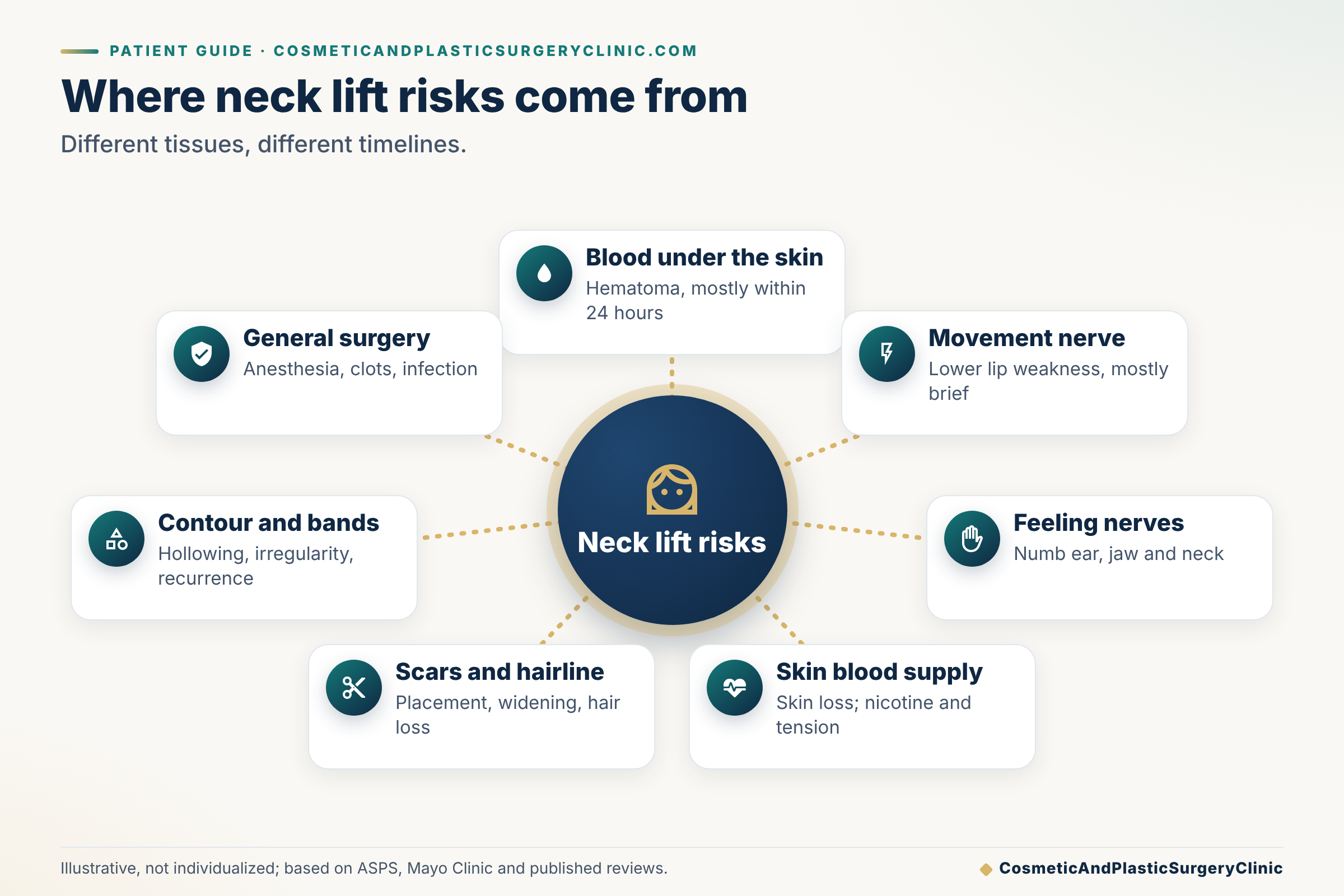
A neck lift works in a narrow, crowded space. Skin is lifted off the platysma muscle, the muscle may be tightened or divided, fat may be removed, and all of it happens within a few centimeters of small blood vessels, sensory nerves, a facial nerve branch that moves the lower lip and, in some operations, the salivary glands under the jaw. Neck lift risks follow from that anatomy, and most of them are uncommon.
This page sorts neck lift risks into what is expected, what is a complication and what is an emergency, then takes each major risk in turn with the published numbers and their limits. How the operation works is covered in the neck lift overview, healing in neck lift recovery, and who surgeons consider suitable in neck lift candidate. Nothing here predicts what will happen to your neck.
Expected, complication or emergency: sorting neck lift risks
Most worry about neck lift risks comes from not knowing which bucket a symptom belongs in. A tight, bruised neck on day three and a tight, bruised neck that is growing on one side can feel alike to the person wearing them. The sorting below is general education drawn from patient pages and published reviews. It does not replace the written instructions a surgeon gives.
Why the anatomy of the neck shapes its risks
A thin skin flap, a muscle sheet and a crowd of small structures
In most neck lift techniques the skin is separated from the platysma, a thin sheet of muscle running from the jaw toward the collarbone. The surgeon may tighten or divide that muscle, remove fat above or below it, and sometimes reduce part of the submandibular glands. Branches of the facial nerve lie close to this plane, and sensory nerves that supply the ear, jaw and neck skin cross it. Each structure has its own way of being irritated, which is why neck lift risks form a list and not a single number.
Lifted skin also depends on blood vessels entering from its edges. Dibbs and colleagues, in a 2021 review of revision facelifts and neck lifts, note that skin flaps closed under tension can produce scars that migrate and distort nearby anatomy. Skin loss, scar quality and the aftercare rules covered later all trace back to that blood supply.
Why a blood collection matters more here than in most places
The neck is a confined region where swelling has few places to go, and the airway runs through the middle of it. A 2021 article in the Anesthesia Patient Safety Foundation (APSF) newsletter describes how bleeding after other neck operations, thyroid surgery in particular, can compress low-pressure veins and lymph channels, letting fluid leak into the tongue, throat and voice box. That source concerns non-cosmetic operations, so it explains the mechanism and says nothing about how often it happens after a neck lift. The mechanism is the reason hematoma has its own section below.
What is expected after a neck lift
Swelling, bruising and a tight, banded feeling
Mayo Clinic says to expect swelling and bruising after a neck lift, lasting several weeks to months, and that a compression garment may be used. The American Society of Plastic Surgeons (ASPS) describes a bandage around the face and neck and, in some cases, a thin tube that drains fluid collecting under the skin. The Aesthetic Society adds that numbness and tightness usually improve within a few months.
Expected does not mean comfortable. It means the direction is right: each week a little less swelling and tenderness, a little more ease turning the head. Week-by-week detail sits in the recovery timeline; this page is about the neck lift risks that break the pattern.
Numb skin and an odd, stiff neck
Lifted skin loses feeling because tiny sensory nerves in it are stretched or divided. The lower ear, the angle of the jaw and the neck are the usual places. Numbness is among the expected neck lift risks, and feeling generally returns gradually and unevenly. How long that takes varies, and published timelines come mostly from the facelift literature, so ask your surgeon which areas are likely to feel numb for your planned incisions and for roughly how long.
When a finding becomes a complication or an emergency
Changes worth reporting the same day
A complication among neck lift risks is defined mostly by direction and function. Swelling that is growing or firmer on one side, pain that rises instead of settling, a change in drain output, a smile that pulls to one side, dark or blue skin at an edge, fever, pus or spreading redness all justify calling the surgical team that day. The APSF article lists early signs of a neck hematoma as increased neck pain, a change in neck size or symmetry, changed drain output, tightness and painful swallowing.
Emergencies that should not wait
| What you notice | Often expected when | Complication when | Action level |
|---|---|---|---|
| Swelling and bruising | Easing over days to weeks, fairly even | Growing, firm or one-sided | Call the same day if growing |
| Pain | Soreness that follows the surgeon’s plan | Rising, sharp or one-sided pain | Call right away |
| Neck size and drain output | Output falling; neck softening | Neck tightening or output changing suddenly | Call right away; 911 if breathing is affected |
| Breathing, voice, swallowing | No new difficulty | Any new difficulty, drooling or voice change | Call 911 |
| Lower lip and smile | Stiffness from swelling in the first days | Weakness that persists or appears later | Tell the surgeon promptly |
| Feeling | Numb ear, jaw or neck slowly improving | Burning or shooting pain, or no change over months | Raise at follow-up visits |
| Skin at the edges | Bruising that yellows and fades | Dark, blue or blistered skin; an open edge | Call the same day |
| Fever or redness | None | Fever, pus or spreading redness | Call the same day |

Hematoma: the neck lift risk that sets the rules for the first night
Hematoma comes first among neck lift risks because it has the shortest clock and is the one most affected by decisions made before surgery. It is also the risk where published numbers differ most in what they count.
How often hematoma is reported
Pooled figures for neck lift risks and published ranges
A 2025 systematic review and pooled analysis in Facial Plastic Surgery (Cambiaso-Daniel and colleagues) pooled 12 articles covering 2,106 patients who had platysma work as part of a neck lift, and reported hematoma in 1.8%. A 2025 narrative review in the Journal of Clinical Medicine (Boyd and Ceradini) cites a systematic review of deep neck lift procedures, 57 studies and more than 8,600 patients, with hematoma between 0.2% and 4% across studies. A 2021 review in Plastic and Aesthetic Research gives 0.2% to 8%.
The same 2021 review says minor hematomas of 2 to 10 cc often resorb within one to two weeks. That detail is a reminder that hematoma covers a wide range, from a small collection that is watched in the office to a large one that sends a patient back to the operating room.
Why the figures disagree
Ranges differ because studies define hematoma differently (any collection versus one needing surgery), use different techniques and adjuncts, and follow patients for different periods. The pooled analysis was rated Level of Evidence III, and its authors called for standardized complication reporting. A pooled 1.8% is an average across mixed methods; like most published neck lift risks figures, it is not a probability for one neck.
In the 2020 gland-reduction review by Benslimane and colleagues (602 patients), flap-related hematoma was reported at 1.4%, and hematoma attributed to the gland itself was a single case, 0.08%.
What raises the odds of bleeding
Blood pressure, medicines and supplements
The 2021 review reports that systolic pressure above 160 mmHg before surgery, or above 150 mmHg afterward, raises bleeding risk, which makes it one of the few neck lift risks that can be addressed before surgery. Mayo Clinic says aspirin and other blood-thinning medicines are generally stopped several days before a neck lift, naming warfarin, heparin and ibuprofen as examples.
Do not stop or start any medicine on your own. The plan belongs to the surgeon and the clinician who prescribes the medicine, and a complete written list of medicines and supplements should reach the surgeon before the operation.
Activity, head position and aftercare rules
ASPS tells patients to keep the head elevated above the heart and straight, and to avoid twisting or bending the neck. The 2021 review adds avoiding strenuous activity for four weeks as part of its own prevention protocol. Protocols differ between surgeons, but the logic is shared: the first days’ rules are bleeding-prevention rules, and following them is one of the few risk factors the patient controls.
Why the first night and first day matter
Timing and early signs
The 2021 review says complications typically appear about 24 hours after surgery. The APSF article, drawing on other neck operations, says most neck hematomas present within 24 hours. Later signs of a growing collection include drooling, a swollen tongue, shortness of breath and noisy breathing, which is why early signs should not be waited out. Mayo Clinic advises having someone stay with you the first night after a neck lift.
A hypothetical plan for the first 24 hours
Consider a hypothetical patient who lives 45 minutes from the surgical facility. Before surgery she asks who answers the surgeon’s after-hours number, which emergency department would receive her, whether the surgeon or a covering colleague would see her there, and who can stay overnight and recognize a swelling that is growing. None of these answers lowers a risk figure. They shorten the time between a symptom and a response.
The wider logic of facility choice and emergency coverage is in how to choose a plastic surgeon.
Nerves: lip movement, ear numbness and the jaw
Nerve injury draws the most specific fear among neck lift risks: a crooked smile. Two different groups of nerves are involved, and mixing them up makes the numbers confusing. Some nerves move muscles; others carry feeling.
Movement: the marginal mandibular branch and the lower lip
What the pooled figures show
ASPS lists a rare nerve injury that could weaken the lower lip among neck lift risks. The marginal mandibular branch of the facial nerve runs along the jaw and moves part of the lower lip and the corner of the mouth, so when it is irritated the smile can look lopsided. The 2025 pooled analysis put nerve damage at 0.9%. The deep neck lift review cited by Boyd and Ceradini reported neuropraxia, a temporary loss of nerve function from stretch or bruising without a cut nerve, in 0.2% to 12% of cases depending on the study.
In the gland-reduction review, transient marginal mandibular weakness appeared in 4.7% of cases and no permanent motor nerve damage was reported. A spread from 0.2% to 12% means nobody can honestly give one number. Studies differ in technique, in how carefully weakness was looked for, and in when patients were examined.
Temporary versus lasting weakness
Most weakness in these reports is temporary. The 2021 review describes marginal mandibular injury as usually temporary and related to traction. The 2026 systematic review of revision neck lifts found transient weakness and no permanent nerve deficits among 188 cases, although inconsistent reporting kept its authors from pooling the data.
The qualifiers matter: “usually” and “in these series.” Small retrospective case series can miss rare lasting injuries. Ask the surgeon how lip movement is checked before surgery, who will examine it afterward, and what happens if weakness appears.
Feeling: the great auricular nerve and numb skin
Why the ear and the angle of the jaw go numb
The great auricular nerve supplies feeling to the lower ear and the skin over the angle of the jaw, and it crosses the large muscle at the side of the neck, close to where neck lift dissection happens. The 2021 review reports great auricular injury in about 6% of cases, often temporary and resolving within 6 to 12 months. Numbness can also come from small skin nerves that are stretched or divided without any one named nerve being injured.
When numbness turns into pain
Persistent burning, shooting or trigger-point pain behind the ear or along the neck is not the same as ordinary numbness. Lewin and Tsur described neuromas, painful nodules where a cut nerve end heals into the skin flap, in two patients at one and two years after surgery, and reported that nerve repair, at the original operation or years later, had a very favorable prognosis. That is a 1976 report of a few cases, so it supports asking the question rather than expecting the problem.
If numbness has not changed at all after several months, or pain appears where numbness was, say so at follow-up instead of assuming it is routine.
What shows: skin loss, scars, hairline and contour
Some neck lift risks are invisible to everyone but the patient. The ones in this section are visible in photographs, in the mirror and, for scars, in how a person chooses to wear their hair or their collars.
Skin loss and slow healing
Blood supply, tension and nicotine
Skin loss, called necrosis, is one of the neck lift risks tied to blood supply: it happens when lifted skin does not receive enough blood. The 2021 review cites it in 1% to 3% of rhytidectomies, a figure for facelifts rather than isolated neck lifts, and says smoking can raise the risk 12 to 20 times. A 1984 study in Plastic and Reconstructive Surgery attributed a significant share of skin sloughs after face lifts to cigarette smoking. The 2025 pooled neck analysis lists skin necrosis only among less common complications and gives no rate for it in its abstract.
Mayo Clinic says smoking slows healing and that the surgeon will likely ask you to quit before a neck lift. Surgeons set their own rules, and the 2021 review’s protocol is four weeks before and after surgery. Ask whether the rule covers every nicotine product, not only cigarettes, and whether testing is part of the plan.
Why ice, a familiar swelling remedy, is warned against
The ASPS neck lift recovery page is blunt: do not apply ice to the neck, because it can compromise blood flow and cause skin death. That runs against instinct, since ice is the default for swelling elsewhere. The lesson is that neck lift aftercare rules are written around the skin’s blood supply, and a tip from a friend, a forum or another kind of surgery should give way to the surgeon’s written plan.
Scars and hairline change
Where incisions sit and how scars mature
Incision placement depends on technique. A neck lift may use an incision under the chin, one that runs behind or around the ears and into the hair, or both; the choices are compared in neck lift techniques. Mayo Clinic says incision lines may take up to a year to fade. Scar quality depends partly on planning and closing tension, partly on healing, and partly on the individual, which is why no surgeon can promise how a particular scar will look.
Hair loss and hairline distortion
ASPS lists temporary or permanent hair loss along the incisions among neck lift risks. Dibbs and colleagues describe sideburn and hairline distortion from aggressive flap advancement or poor incision design, and an occipital step-off deformity from improperly placed posterior incisions. These descriptions come from revision surgery, so they show what can go wrong rather than how often.
Ask where the incision would sit relative to your hairline, whether the plan changes if you wear your hair short, and to see unretouched photographs of healed incisions, as discussed in how to read neck lift photos.
When the shape is the problem: bands, irregularity and over-treatment
Returning platysma bands, and why the rate is uncertain
Platysma bands are the vertical cords that show in the front of the neck and are among the earlier signs of the neck aging again. The pooled analysis counted recurrence in 26 of 2,106 patients, 1.4%. Its authors still called for longer-term outcome reports, and the 2026 revision review lists returning platysmal bands among the most common reasons patients had a second neck lift.
A figure from studies with short follow-up cannot say what happens over many years. Ask how long the surgeon follows patients and whether they show results at one year and beyond.
Hollowing and irregular contour after fat removal
Removing too much fat can leave irregular contours and loose skin, according to a surgeon quoted in a 2025 ASPS article on double chin liposuction. Dibbs and colleagues describe hollowing between the digastric muscles, sometimes called cobra neck, from overly aggressive submental liposuction and defatting, and suggest fat grafting, typically 6 to 12 months after the primary operation.
Fat removed cannot be put back with a stitch, so ask how conservatively your surgeon removes fat. Whether fat, muscle or skin is driving your contour is the question in chin liposuction vs neck lift.
Gland work and deep-neck steps
What the gland-reduction series reported
Gland work adds its own entries to the list of neck lift risks. Some operations reduce part of the submandibular gland when a surgeon judges gland fullness to be part of a bulge under the jaw. The 2020 systematic review covered six studies, 602 patients and 1,200 partial gland resections. It reported gland-related hematoma in one case (0.08%), flap-related hematoma at 1.4%, sialoceles, which are collections of saliva, at 1.3%, transient marginal mandibular weakness at 4.7%, and no deaths, permanent motor nerve damage or dry mouth. The authors called the complications minor and self-limiting.
What that does and does not tell you
Six studies of one add-on step make a thin base, and the authors asked for prospective controlled studies. The 2026 revision review found gland reduction in only 13% of revision cases and described it in just one study. If a surgeon proposes gland work, ask why your anatomy calls for it, how often they do it, and what the plan is if a saliva collection forms. The pooled analysis across platysma-based lifts put sialoma at 0.3%.
Anesthesia, clots, infection and revision: risks shared with other surgery
Not every item on a consent form is unique to the neck. This section covers the general surgical risks that sit beside neck lift risks, and the question of what happens when the result is not what was planned.
Anesthesia, infection and fluid collections
Anesthesia choice and the facility
Anesthesia risks head the ASPS list of neck lift risks. An ASPS article from 2025 describes chin liposuction done alone under local anesthesia, while larger operations may bring in sedation or general anesthesia. Which fits depends on the plan and your health history, and the choice belongs to the surgeon and the anesthesia provider.
A 2016 ASPS blog post by Dr. Paul Vitenas describes accreditation by the Joint Commission, AAAHC or AAAASF, and says ASPS requires member surgeons to operate in a facility that is accredited, Medicare-participating or state-licensed. The post is an opinion piece without outcome data, so treat accreditation as a question to ask, not as proof of low risk.
Infection, seroma and open wounds
Mayo Clinic lists infection and open wounds among neck lift risks. The Aesthetic Society lists hematoma or seroma, a collection of fluid under the skin that may need to be removed, and says significant complications from neck lift surgery are infrequent. None of the patient pages gives a neck lift infection or seroma rate, so none is stated here. Fever, spreading redness, pus or a wound edge that opens are the findings to report.
Blood clots and the general-surgery list
What the clot literature says and does not say about neck lifts
ASPS lists a rare risk of deep vein thrombosis (DVT) with heart or lung consequences. The International Society of Aesthetic Plastic Surgery (ISAPS) patient safety update of December 2024 says DVT can be silent and hard to diagnose clinically, that risk is high in the first two weeks and stays elevated for about two to three months, and that 79% of physicians in a consensus study considered the available risk scores insufficient for aesthetic patients.
The update quotes procedure-level clot rates for other operations, such as 0.59% for liposuction, but none for neck lift, so no figure for neck lift risks is given here. Surgeons weigh risk scores, early walking and, case by case, compression devices or blood thinners.
Chest pain, breathlessness and leg swelling
Sudden shortness of breath or chest pain after any surgery is an emergency, whichever operation came before it. Pain or swelling in one leg is a reason to call the surgeon the same day. This is general education; the ASPS neck lift page does not publish a symptom list of its own. A fuller view of general operative risk, across procedures, is in plastic surgery risks.
Asymmetry, unsatisfactory results and revision
What revision studies show
ASPS lists facial asymmetry and unsatisfactory results, which may require revisional surgery, among neck lift risks. The systematic review of revision neck lifts by Şibar, Erdal and Genç (Aesthetic Plastic Surgery, 2026) found five retrospective case series totaling 188 patients, mostly women aged 31 to 77, and rated the evidence Level IV, with outcomes mostly qualitative and surgeon-reported.
The reasons for revision were returning platysmal bands, lingering fullness under the chin and sagging submandibular glands, which are results problems as much as complications. Revision complications were rare and mostly temporary, with isolated hematoma and transient marginal mandibular weakness the main ones.
Time, second opinions and the cost of a revision
No source reviewed here gives a standard waiting period before a neck lift revision. The one specific timing, fat grafting for hollowing typically 6 to 12 months after the primary operation, comes from Dibbs and colleagues. A second opinion from a surgeon who did not perform the first operation can help separate healing that is still unfinished from a result that needs a new plan.
Before surgery, ask in writing what the surgeon’s revision policy covers, and whether facility and anesthesia fees would apply to a touch-up. Fee anatomy is in neck lift cost.
Using the numbers: your own neck lift risks and the checks worth making
A risk figure is a measurement of a group. The useful skill is knowing what it was measuring, and then deciding which questions remain for your own surgeon.
Reading neck lift risks figures without turning them into a forecast
Four questions to put to any number
Ask what was counted (every small collection or only those needing surgery), who was counted (neck lifts alone or combined with facelifts), for how long they were followed, and who reported the results (surgeons describing their own work or independent review). The table below shows how the figures in this article answer those questions.
| Source and year | Population | What it reports | Main limit |
|---|---|---|---|
| Cambiaso-Daniel et al., Facial Plastic Surgery, 2025 | 12 articles, 2,106 patients; platysma work | Hematoma 1.8%, nerve damage 0.9%, band recurrence 1.4%, sialoma 0.3% | Level III evidence; follow-up and reporting vary |
| Boyd and Ceradini, J Clin Med, 2025 | Cites a review of 57 studies, over 8,600 patients | Hematoma 0.2% to 4%; neuropraxia 0.2% to 12% | Narrative review reporting another review; wide ranges |
| Benslimane et al., Aesthetic Plast Surg, 2020 | 6 studies, 602 patients, 1,200 gland resections | Flap hematoma 1.4%, sialoceles 1.3%, transient lip weakness 4.7% | One add-on step; no controlled data |
| Şibar et al., Aesthetic Plast Surg, 2026 | 5 case series, 188 revision neck lifts | Complications rare and mostly temporary; no permanent nerve deficits | Level IV evidence; data could not be pooled |
| Viterbo and Secanho, Plast Aesthet Res, 2021 | Narrative review | Hematoma 0.2% to 8%; great auricular nerve about 6%; skin necrosis 1% to 3% | Some figures come from facelift series |
Why mixed facelift and neck data blur the picture
Many series pool neck work with facelifts, and several figures above, notably skin necrosis and the smoking multiples, come from facelift literature. The pooled neck analysis and the deep-neck review help, but neither compares a neck lift alone with a facelift head to head. The facelift side of these questions, with its own numbers, is in facelift risks, and neck lift vs facelift compares what each operation treats.

Personal and team factors behind neck lift risks
Factors with published support
Three personal factors tied to neck lift risks have support in the sources reviewed: nicotine (skin loss and slow healing), high blood pressure (bleeding) and blood-thinning medicines and supplements (bleeding). Other conditions may matter to an individual surgeon’s judgment, such as prior neck surgery or radiation or a bleeding disorder, but the sources reviewed here do not quantify them for neck lifts. Suitability is a conversation with the surgeon, not a checklist.
| Factor | Why it matters | Question to ask | Uncertainty |
|---|---|---|---|
| Nicotine | Reduced blood supply to lifted skin; slower healing | Does the rule cover every nicotine product, and for how long? | No agreed interval; figures come mainly from facelifts |
| Blood pressure | Higher pressure is linked with bleeding | What readings do you aim for, and how will they be managed? | Thresholds come from one review |
| Blood thinners and supplements | May increase bleeding | Which of my medicines and supplements should be reviewed, and by whom? | Individual decisions; never self-adjust |
| Extent of the operation | Gland reduction and deep platysma work add steps and risks | Which steps does my anatomy require, and why? | Thin comparative evidence |
| Facility and anesthesia | Determines monitoring, backup and transfer arrangements | Who gives anesthesia, and where would I be transferred in an emergency? | No neck-lift-specific outcome data opened |
| Surgeon experience | Technique and judgment affect dissection and fat removal | How many neck lifts do you perform, and what do your healed results look like? | Volume is not a proven predictor in these sources |
Procedure and team factors worth separating
A neck lift limited to chin liposuction and a platysma stitch carries a different list of risks than one that adds gland reduction, skin redraping and ear-side incisions. The more steps an operation includes, the more of the risks in this article apply to it. A good consultation sorts your list from the general one, as described in plastic surgery consultation questions.
Six checks on neck lift risks before you agree to surgery
Questions about the plan and the team
A surgeon who can explain neck lift risks for your own operation sounds specific: this step, for this reason, with this fallback. Vague answers sound like reassurance with no content. The first three checks in the table below concern the plan, the team and the facility. Take the same questions to a second consultation, because answers that change from one surgeon to the next show where the real uncertainty lies.
Questions about after-hours care and revision
The last three checks concern what happens when something goes wrong: who responds, where you go, and what the revision policy covers. None of these questions suggests a surgeon is careless. They make the answer to a bad night easier to find.
| Check | A clear answer includes | Warning sign |
|---|---|---|
| 1. Risks of my operation | Which steps are planned and which risks attach to each | Only “rare” with no detail |
| 2. My own risk factors | Nicotine, blood pressure, medicines and history reviewed in writing | No questions about medicines or smoking |
| 3. Facility and anesthesia | Accreditation or licensure, anesthesia provider, transfer plan | Cannot name the receiving hospital |
| 4. After-hours coverage | A named number, who answers, who sees you in an emergency | Voicemail only, or “go to any ER” |
| 5. Nerve and numbness plan | How lip movement is checked and what follow-up looks like | Numbness described as “nothing to worry about” |
| 6. Revision policy | What is covered, for how long, and which fees still apply | Policy given only verbally |
Frequently asked questions
How long can a weak lower lip last among neck lift risks?
The sources reviewed here do not give a standard duration. They describe marginal mandibular weakness as usually temporary and traction-related, and the revision review reported no permanent nerve deficits among 188 cases. A 2020 review of gland reduction found transient weakness in 4.7% and no permanent motor damage. A surgeon can track recovery over visits and explain what would change the plan.
Are neck lift risks higher or lower than facelift risks?
No head-to-head comparison was found in the sources reviewed. Pooled neck data and facelift data come from different studies with different definitions, so setting one beside the other can mislead. Several figures quoted for neck surgery, such as skin necrosis, come from facelift series. The fair answer is that risks depend on the steps performed, which is why the plan matters more than the label.
Does local anesthesia lower neck lift risks?
Local anesthesia avoids the risks of deeper sedation, but it only suits some operations. ASPS describes chin liposuction done alone under local anesthesia. A neck lift that includes muscle tightening, skin redraping or gland work is a larger operation, and the anesthesia plan depends on its extent, your health history and the anesthesia provider. Ask which type is planned and why.
Will the numbness after a neck lift go away?
The Aesthetic Society says numbness and tightness usually improve within a few months. A 2021 review reported that great auricular nerve injury, about 6% of cases in its figures, often resolves within 6 to 12 months. Improvement can be uneven. Numbness that does not change, or pain that appears where numbness was, deserves a conversation at follow-up rather than patience alone.
Do neck lift scars fade?
Per Mayo Clinic, fading can take up to a year, and it depends on where the incisions sit, how much tension was on the closure, sun protection, and individual healing. Scars along the hairline or behind the ears can be harder to hide than those beneath the chin. Ask to see unretouched photographs of healed incisions at one year.
Why would a surgeon say not to use ice on my neck?
ASPS says not to apply ice to the neck after a neck lift because it can compromise blood flow and cause skin death. Elevation and the other steps in your written instructions are the surgeon’s tools for swelling. If your instructions differ from this page, follow your instructions.
Can supplements or over-the-counter medicines affect neck lift risks?
Mayo Clinic says aspirin and other blood-thinning medicines are generally stopped several days before a neck lift, with warfarin, heparin and ibuprofen named as examples. Because bleeding is the earliest serious risk, give the surgeon a written list of everything you take, including vitamins and herbal products. Do not stop a prescribed medicine on your own.
How soon can a neck lift be revised if the result disappoints?
No standard waiting period appeared in the sources reviewed. Dibbs and colleagues suggest fat grafting for hollowing typically 6 to 12 months after the primary operation, and swelling and numbness take months to settle, which makes early judgments unreliable. A second opinion can help. Ask any surgeon about the revision policy and fees before the first operation, not after.
Sources and further reading
- American Society of Plastic Surgeons — Neck lift safety (accessed 2026-11-12) — risk list, rare nerve injury and DVT, no numbers
- American Society of Plastic Surgeons — Neck lift recovery (accessed 2026-11-12) — bandage, drain, head position, no ice on the neck
- American Society of Plastic Surgeons — Double chin liposuction (Frankeny, 2025-09-02; accessed 2026-11-12) — contour irregularity from over-removal, local anesthesia when done alone
- American Society of Plastic Surgeons — Why an accredited surgery center matters (Vitenas, 2016; accessed 2026-11-12) — accreditation bodies; opinion piece
- The Aesthetic Society — Neck lift safety considerations (accessed 2026-11-12) — infrequent complications, hematoma or seroma, numbness and tightness
- Mayo Clinic — Neck lift (accessed 2026-11-12) — risks, swelling, scars, smoking, blood thinners, first night
- Cambiaso-Daniel J, Giordano S, Agnelli B, Bella L, Gualdi A — Neck lift to treat platysma bands and defining cervical angle: a systematic review and pooled analysis, Facial Plastic Surgery (2025; abstract via Europe PMC, accessed 2026-11-12) — pooled hematoma, nerve damage, band recurrence, sialoma
- Boyd CJ, Ceradini DJ — Current trends in facelift and necklift procedures, Journal of Clinical Medicine (2025; accessed 2026-11-12) — deep neck lift review: hematoma and neuropraxia ranges
- Viterbo F, Secanho MS — An update about neck rejuvenation and complications, Plastic and Aesthetic Research (2021; accessed 2026-11-12) — hematoma range, blood pressure, great auricular nerve, skin necrosis, smoking
- Benslimane F, Kleidona IA, Cintra HPL, Ghanem AM — Partial removal of the submaxillary gland for aesthetic indications, Aesthetic Plastic Surgery (2020; accessed 2026-11-12) — 602 patients, hematoma, sialoceles, lip weakness (abstract)
- Şibar S, Erdal AI, Genç G — Revision neck lift surgery: a systematic review, Aesthetic Plastic Surgery (2026; accessed 2026-11-12) — 188 revision cases, indications, complications (record)
- Dibbs RP, Chamata E, Ferry AM, Friedman JD — Revision facelift and neck lift, Seminars in Plastic Surgery (2021; accessed 2026-11-12) — scars, hairline, band recurrence, cobra neck, fat grafting timing
- Lewin ML, Tsur H — Injuries of the great auricular nerve in rhytidectomy, Aesthetic Plastic Surgery (1976; accessed 2026-11-12) — nerve injury frequency, neuroma, repair (abstract)
- Anesthesia Patient Safety Foundation — Postoperative anterior neck hematoma: timely intervention is vital (Gerasimov, Lee, Bittner; 2021-02-01; accessed 2026-11-12) — mechanism, timing and signs after other neck operations
- International Society of Aesthetic Plastic Surgery — Patient safety update: DVT and PE (December 2024; accessed 2026-11-12) — silent DVT, risk window, scoring limits
- Rees TD, Liverett DM, Guy CL — The effect of cigarette smoking on skin-flap survival in the face lift patient, Plastic and Reconstructive Surgery (1984; accessed 2026-11-12) — smoking and skin slough (abstract)