Few questions in cosmetic surgery get answered with more confidence than how long does facelift last, and few have thinner evidence behind the confidence. One clinic page says five years, another says ten, and a surgeon quoted in a magazine says twenty. Those numbers describe different techniques, different faces and different definitions of “lasting,” and most arrive without a study attached.
This article treats the question as a measurement problem. It explains what the clock means after a facelift, what the long-term studies actually measured, how skin quality, age, sun, smoking and weight move the timeline, where touch-ups and repeat surgery come up, and which questions to ask a surgeon. It cannot predict one person’s result. That takes an in-person exam by a board-certified plastic surgeon. For the operation itself, start with the main facelift guide.
Defining the question: how long does facelift last when the face keeps aging?
The clock restarts from a different position
Aging continues after the operation
The American Society of Plastic Surgeons (ASPS) says a facelift “does not change your fundamental appearance and cannot stop the aging process.” Mayo Clinic is blunter: face-lift results are not lifelong, and the skin on the face may begin to sag again with age. Both statements point to the same idea, and it frames the whole question of how long does facelift last. A facelift repositions tissue that has descended, and then the same biology that caused the descent carries on.
That is why “how long does facelift last” can be answered in two different ways. One answer asks how long the face stays better than it was before surgery. The other asks how long until it looks the way it did before surgery. A person can be many years past the operation, still look younger than the old photographs show, and also see changes they did not have at month six. Both observations are normal, and mixing them up is where much of the confusion starts.
Settling comes first, and it is not wearing off
ASPS says it takes two to three months for the face to feel normal again in texture, sensation and tightness, and that improvements become visible as swelling and bruising subside. A face that looked tight and high at week two and softer at month six has behaved the way surgeons describe. That is early settling, not an early failure. The facelift recovery guide covers the week-by-week arc.
The useful boundary for how long does facelift last is therefore the first year. Changes during that period belong to healing. Changes that build slowly across the following years, such as jowls re-forming or neck contour softening, belong to the long-term clock that the rest of this article is about.
Four ways to decide whether a lift has held
Photographs and measured landmarks
The most objective method is standardized photographs taken before surgery and again years later, with fixed points on the face measured by software. A 2012 study in Plastic and Reconstructive Surgery used this approach to track jowl height and the angle between chin and neck. Measured landmarks do not depend on anyone’s mood, which makes them the strongest evidence on how long does facelift last.
Their weakness is practical. Photographs only count if lighting, angle, expression and head position match across years, and clinics rarely have that for every patient. Rohrich and Narasimhan noted in a 2016 review of their own 25-year experience that uniform photography was lacking before the 1990s and that follow-up beyond three years was hard to obtain. The facelift before-and-after guide explains how to read such images.
Raters, algorithms and the mirror
Other studies ask people to judge. In the 2012 photo review, a plastic surgeon, an aesthetic nurse and two lay people rated cropped images, and their impressions agreed with the computer measurements. A 2021 study of 50 women, average age 58.7, compared four age-estimating neural networks with the patients’ own ratings at least one year after surgery. The software estimated an age reduction of 4.3 years. The patients rated 6.7 years.
The gap is a reminder that satisfaction and measured change are different things. The study’s author suggested that emotional and financial investment may color self-ratings, which is an interpretation and not a tested finding. Satisfaction still matters, since the operation is elective, but it is a poor stand-in for how long does facelift last.

What follow-up studies can and cannot tell you about how long does facelift last
Photo studies from five to ten years
A 5.5-year deep plane photo review
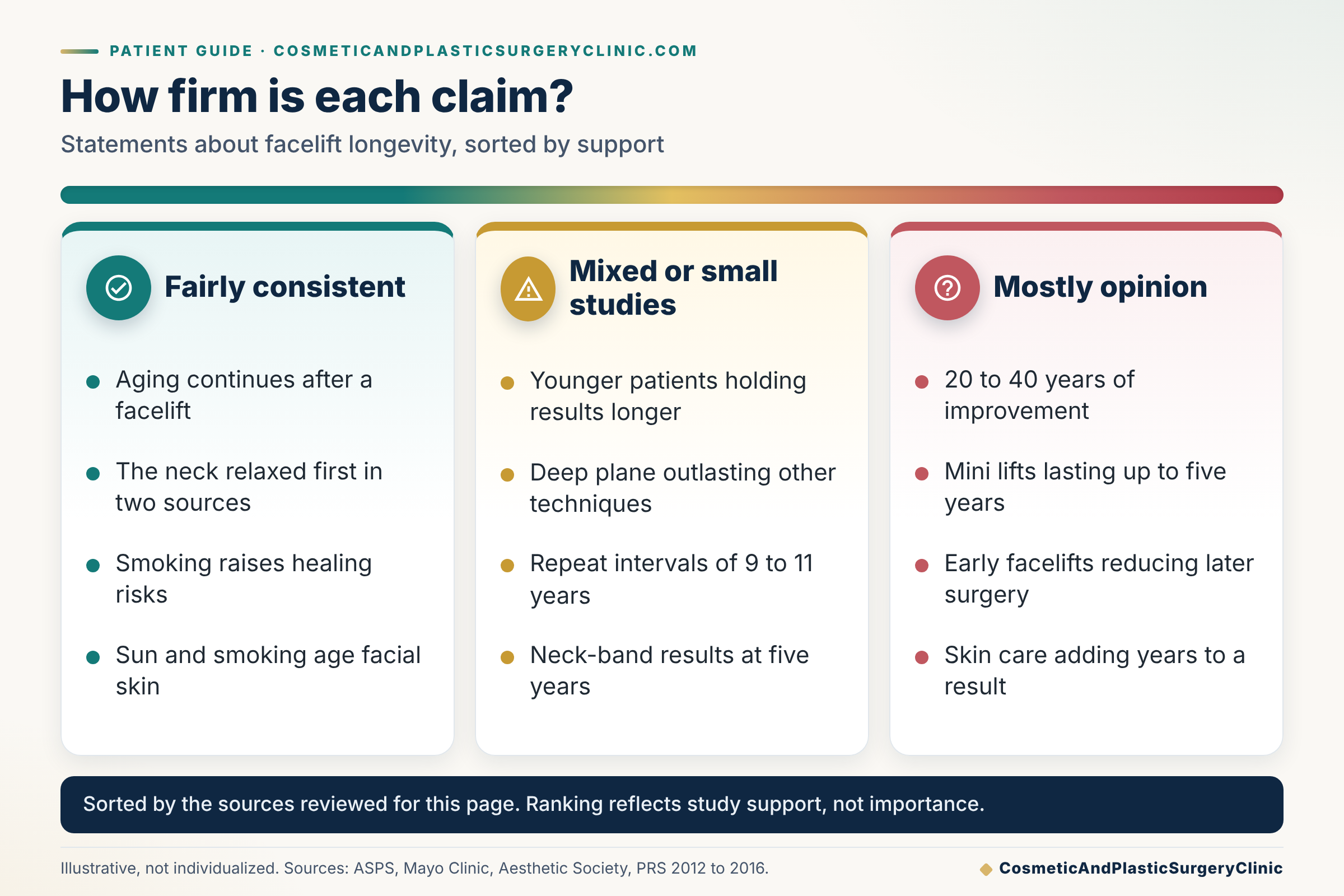
Jones and Lo reported 50 patients photographed an average of 5.5 years after surgery (Plastic and Reconstructive Surgery, 2012, as described in an ASPS news release). Jowl height improvement had decreased by about 20 percent. The chin-to-neck angle showed the largest loss, with about 70 percent of its improvement gone. A global score judged that 76 percent of patients still looked younger than before surgery, and the authors saw no significant sign of continued aging in the key facial areas other than the neck.
A related ASPS blog post describes the sample. The 50 patients came from more than 1,700 deep plane facelifts by one surgeon between 2001 and 2011, and they were included because they returned for unrelated reasons and agreed to be re-photographed. That is a convenience sample from one practice with no control group, so as evidence on how long does facelift last it shows what can happen, not how often it happens. The author hoped benefits might last ten years or more but said this needs study.
A decade of follow-up sorted by age at surgery
A smaller study by Liu and Owsley, reported in a December 2011 ASPS news release, followed patients at least ten years after surgery and grouped them by age at the operation: under 50, 50 to 60, and over 60. Patients under 50 gave ratings of 4 or 5 out of 5 across facial areas and showed what the authors called remarkable maintenance on photographs. Ratings in the 50-to-60 group ranged from 2 to 5. Patients over 60 rated their results 2 or 3 and showed regression in the areas graded, although they still looked more youthful than others their age.
The release does not give the sample size, only that the study was small, and it does not describe how photos were scored. Treat it as a direction on how long does facelift last by age: results seemed to hold better when the starting tissue was younger. It does not say that someone in their sixties will be disappointed, and it does not say that the under-50 group avoided later change forever.
Repeat facelifts as a rough clock for how long does facelift last
Intervals of nine to eleven years, and who is missing
Some of the clearest numbers come from series of people who had a second facelift. A 2013 Plastic and Reconstructive Surgery study of 60 secondary facelifts reported that the first facelift’s results lasted an average of about nine years before a repeat was sought.
A 2026 paper in Facial Plastic Surgery & Aesthetic Medicine states that literature on deep plane longevity is limited. Only part of its PubMed abstract could be opened, but a summary of it reports a mean of 10.9 years between a first and a revision deep plane facelift in 93 patients, with a longer interval (12.4 years) for those at or below about 53 at the first operation than for older patients (9.3 years). I could not open the full abstract to confirm the cutoff.
These intervals are useful but have a built-in blind spot. They count only people who came back. Someone who was content at year twelve, or who decided against a second operation at year seven, does not appear. A repeat-surgery interval is therefore a measure of when some patients and surgeons judged another operation worthwhile, not a direct answer to how long does facelift last.
Why the neck often shows change first
On the question of how long does facelift last in different parts of the face, two sources in this review point the same way. In the 5.5-year photo series, the neck lost more of its improvement than the lower face. Rohrich and Narasimhan reported in 2016 that patients with fuller necks had higher relapse rates, and that opening and treating midline platysmal bands reduced recurrence of neck deformity. The platysma is the thin muscle sheet under the jaw and neck, and bands in it can reappear when it is not addressed.
A 2024 Aesthetic Plastic Surgery series of 80 patients used a more extensive neck step, total platysma transection, with a facelift and submental fat removal. The authors reported no platysmal band recurrence at five years, with a mean follow-up of 78.7 months. It was a single-surgeon series without a comparison group, scored on the authors’ own photo scale, and the authors said it should be reserved for highly motivated patients because of long operating time and a steep learning curve. The neck lift guide covers neck-specific options.
| Study (journal, year) | Who and how long | What it reports | Main limit |
|---|---|---|---|
| Jones and Lo (Plast Reconstr Surg, 2012) | 50 patients, average 5.5 years | Jowl gain down about 20%; chin-neck angle gain down about 70% | One surgeon’s practice; patients who returned for other reasons |
| Liu and Owsley (Plast Reconstr Surg, 2012) | Small group, at least 10 years | Under-50 group rated results highest and held best | Sample size and scoring not given in the release |
| Rohrich et al. (Plast Reconstr Surg, 2013) | 60 secondary facelifts | About nine years to a repeat; ten third facelifts | Only counts patients who returned |
| Rohrich and Narasimhan (Plast Reconstr Surg, 2016) | 1,089 patients over 25 years | Younger, fuller-faced patients did better; fuller necks relapsed more | Follow-up past three years was hard; photos not uniform early on |
| Meningaud et al. (Aesthet Plast Surg, 2024) | 80 patients, mean 78.7 months | No platysmal band recurrence at five years | Single surgeon; authors’ own scale; no comparison group |
| Levin et al. (Facial Plast Surg Aesthet Med, 2026) | 93 revision patients, as summarized | Mean 10.9 years between deep plane facelifts | Full abstract not opened; counts only returning patients |
Six factors behind how long does facelift last
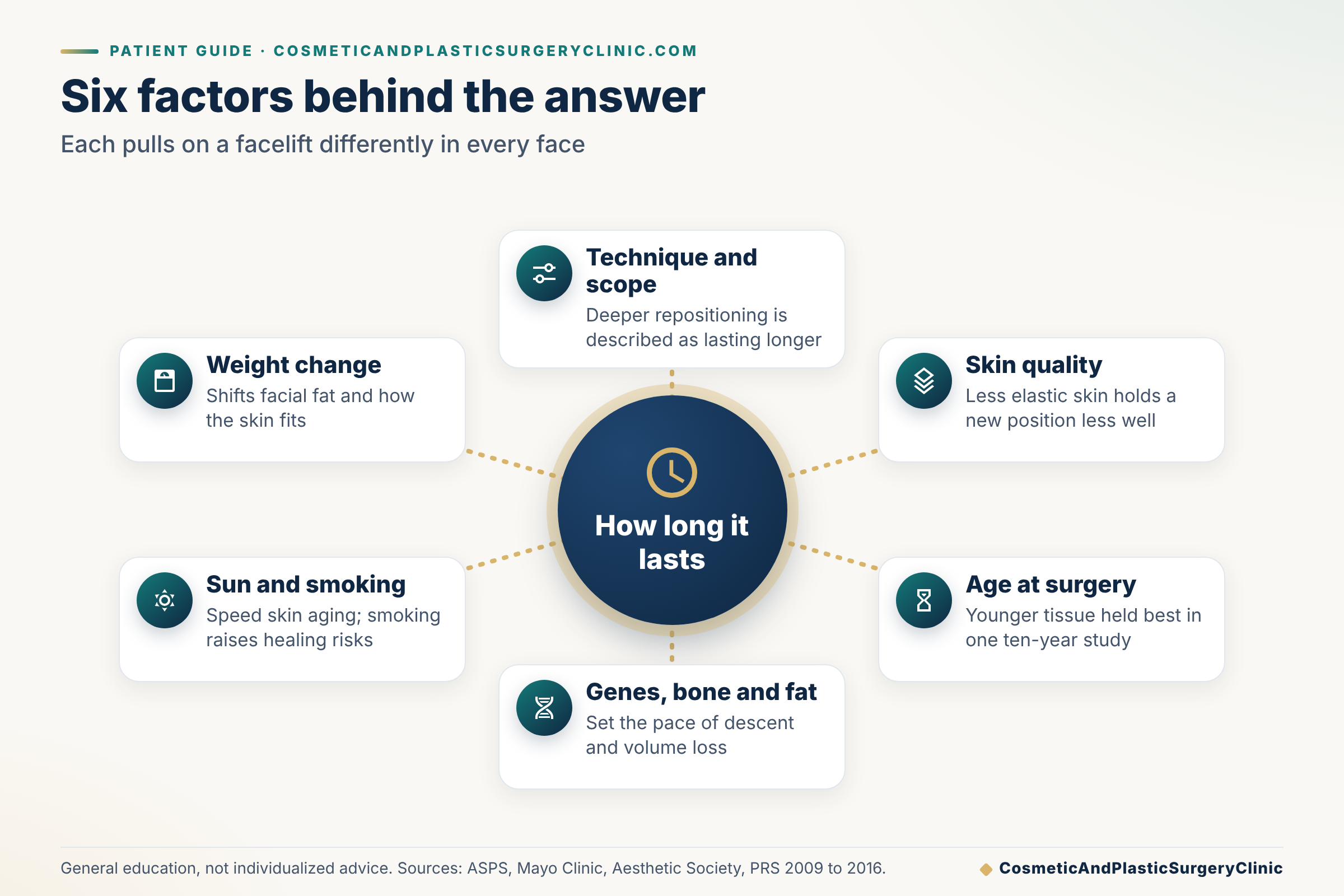
Surgeons and societies agree that no single factor decides how long does facelift last. The six below show up repeatedly in the sources reviewed, and they are sorted by when they act: with the operation and the tissue, or afterward through biology and habits.
What the operation and the tissue bring
Technique and scope: does a bigger operation change how long does facelift last?
The Aesthetic Society’s results page calls technique “the number one factor” in how long a result lasts. It says a minimal “lunchtime” lift lasts the least time, a mini facelift can last up to five years, and a full or classic facelift generally lasts over ten years. A 2019 article from the same society gives a range of five to ten years depending on technique, and it cites no study for the range.
Those descriptions are consistent with the idea that deeper, wider repositioning lasts longer, but no head-to-head trial in the sources reviewed tests it. One 2020 report followed four patients who had a deep plane facelift after an earlier subcutaneous or limited SMAS facelift, and the authors judged that correction appeared to last equally long or longer. Four patients is an observation, not a comparison. The choice between technique families belongs to the deep plane versus SMAS facelift guide and to mini facelift versus facelift.
Skin quality and its role in how long does facelift last
A facelift moves tissue, and skin that has lost elasticity holds a new position less willingly. MedlinePlus says changes in connective tissue reduce skin strength and elasticity, and that the layer of fat under the skin thins with age. The National Institute on Aging notes that skin gets thinner, paler and less stretchy, and that sun damage adds up over time.
Rohrich and Narasimhan reported that skin resurfacing and topical retinoids improved long-term results in their experience. That is a surgeon’s observation, not a controlled trial, and the sources reviewed do not give an effect size. For a given person, a surgeon assesses skin quality in person, and the answer shapes both technique and expectations.
Age at the time of surgery
For how long does facelift last, age is a stand-in for several things at once: tissue elasticity, how much descent has happened, and how much volume has been lost. In the ten-year photo study, patients under 50 held their results best and those over 60 showed the most regression. Rohrich and Narasimhan likewise found that younger patients with fuller faces did better.
ASPS estimates that about 77,933 facelifts were performed in the United States in 2025, up 13 percent from 69,097 in 2024. By age, 33,004 were in people 66 and older and 30,332 in people 56 to 65, while 2,620 were in the 36-to-45 group. These are national estimates from member, partner and claims data, not outcomes. They show how the age mix of patients is shifting, not how long any result lasted.
What biology and habits add afterward
Genes, bone and fat
Facelift surgery works on the soft tissue envelope. The bone beneath it also changes. A 2011 Plastic and Reconstructive Surgery study of CT scans found that the eye sockets widen with age and that the upper jaw angle and lower jaw length and height decrease. A facelift does not alter these changes, and the authors suggested skeletal augmentation might help in some rejuvenation plans.
Genes set the pace of how long does facelift last. The ASPS facelift page lists heredity alongside sun, smoking and stress as reasons contours are lost. Nobody can read a personal rate from a family photograph, but family patterns of early jowling or heavy necks are a fair thing to mention at a consultation.
Sun and smoking
MedlinePlus calls sun exposure the greatest single factor in skin aging. A 2009 study of 186 pairs of identical twins found that longer smoking history and greater sun exposure were associated with an older appearance, with more wrinkles and discoloration with smoking. Twins share their genes, so differences between them point toward environment and habits.
Smoking also matters before and during healing. Mayo Clinic says smoking greatly raises the risk of poor wound healing, hematomas and skin loss after a face-lift, and that smokers are among those a surgeon may advise against operating on. The National Institute on Aging lists broad-spectrum sunscreen of SPF 15 or higher, reapplied at least every two hours outdoors, as general skin-care guidance. Nothing reviewed measured how much sunscreen changes how long does facelift last, in years.
Weight change and facial volume
Mayo Clinic says a history of repeated weight gain and loss can affect the shape of the face and the condition of the skin. Large weight loss also removes facial fat. ASPS articles from 2023 and 2026 quote surgeons who describe volume loss as aging and report more patients seeking fat grafting, with facial fat grafting up 39 percent in 2025 to 34,117 procedures. Those articles are expert opinion and survey data; they do not measure how weight change affects a facelift’s durability.
The practical point is simple. A facelift tightens and repositions, and it does not replace lost volume. If weight is still changing, raise it at the first visit, because how surgeons weigh it is part of candidacy, a topic the facelift candidacy guide takes up. Timing is a decision for the surgeon and patient, not a general rule.
| Factor | Effect on the result | Maintenance or revision implication | Review point |
|---|---|---|---|
| Technique and scope | Deeper, wider repositioning is described as longer lasting; head-to-head data are lacking | A limited lift may be discussed again sooner | Ask which structures were lifted and why |
| Skin quality | Less elastic skin holds a new position less well | Skin treatments may be planned alongside surgery | Skin that looks looser than at the one-year photo |
| Age at surgery | Younger tissue held results best in a ten-year study | Earlier surgery means more years in which aging can resume | Compare each year’s photo with the one-year baseline |
| Genes, bone and fat | Set the pace of descent and volume loss | Volume restoration may be considered separately | Hollowing that a lift cannot address |
| Sun and smoking | Speed skin aging; smoking raises healing risks | Sun protection is general guidance; smoking is a surgical safety issue | Smoking history before any planning |
| Weight change | Alters facial fat and skin fit | Fat grafting or revision may enter the conversation | Noticeable weight change since the baseline photo |
Touch-ups, revisions and second facelifts: where the timeline meets the next decision
Smaller steps that come before another operation
Minor revisions after the first lift
Published series treat a minor revision and a second facelift as different events. The 2013 secondary-facelift study excluded minor revisions from its count, which means the “nine years” figure says nothing about how often small adjustments happen sooner, and it is not the whole story on how long does facelift last. The sources reviewed give no reliable rate for them.
What a practice will do, and what it charges, varies and belongs in writing before surgery. Ask what the surgeon’s revision policy covers, for how long, and whether facility and anesthesia fees apply if a small procedure is needed. The facelift cost guide lists the line items that tend to be left out of a first quote.
Volume and skin treatments added later
Some people reach for something smaller than surgery as the years pass. The Aesthetic Society’s 2019 article lists dermal fillers, botulinum toxin, intense pulsed light, peels and nonsurgical skin tightening as maintenance options after a facelift, and it advises waiting several months before talking to your doctor about resuming injectables, because swelling changes during healing. It cites no studies for any of them. ASPS says some minimally invasive options marketed as facelifts, such as stem cell facelifts, are of unproven benefit.
These treatments address different problems than a facelift does. Mayo Clinic notes that a face-lift does not treat fine lines, sun damage, creases around the nose and upper lip, or skin color changes. The facelift alternatives guide sets out what each option can and cannot be expected to do.
When a second facelift enters the conversation
What a repeat operation involves
In the 2013 series, secondary facelifts were typically done about a decade after the first. The authors described a “five R’s” approach for repeat operations: resect, release, reshape, refill and redrape, and noted that secondary procedures may need techniques different from the first. They reported a complication rate of about 5 percent, similar to primary facelifts, and no increase in facial nerve injury. That is one surgeon’s series, so it does not describe every practice. The facelift risks guide covers complications and how to interpret rates.
For the longevity question, the point is that repeat surgery is a recognized path and not a failure. A first facelift that holds for years and then gets a second operation has behaved the way the series describe.
Does starting earlier mean fewer operations?
An ASPS article from November 2025 quotes surgeons who offer “early intervention” facelifts to people in their late twenties through forties. One says younger tissue “responds better, heals faster and holds results longer,” and another says later touch-ups are simpler. The article cites no study or follow-up data for those claims. Liu and Owsley, in their ten-year study, concluded that a maintenance facelift should be offered to younger patients, with the same small-sample limits described earlier.
Consider a hypothetical comparison, not a prediction. If a repeat discussion tends to come about ten years after the first operation, a first facelift at 45 leads to that discussion near 55, while a first facelift at 60 leads to it near 70. The earlier path may involve more operations over a lifetime, and the later path involves more descent before the first. The sources reviewed do not show which is better for any one person, or whether starting earlier changes how long does facelift last overall.
| Situation | Pathway to discuss | Benefit | Trade-off | Key question |
|---|---|---|---|---|
| Jowls re-forming some years after a limited lift | Compare with baseline photos; discuss revision or fuller repositioning | Decision rests on documented change | More aging before action; another recovery | Which structures did my first lift address? |
| Neck fullness or bands returning, lower face holding | Neck-focused plan, such as platysma work or a neck lift | Targets the area that tends to relax first | May not address jowls or cheeks | Would the platysma be treated? |
| Hollowing after major weight loss | Volume restoration, alone or with a lift | Addresses volume a lift does not replace | A separate procedure and recovery | Is my weight stable enough to plan? |
| Skin texture and sun damage changing, contour holding | Skin-care and resurfacing discussion | Treats what a facelift does not | Evidence for many devices is limited | What evidence supports this treatment? |
| Considering a first facelift in the forties | Consultation, baseline photos, alternatives and timing | Informed choice about timing | More years for aging to resume; no data on fewer operations | What would a later revision involve? |
Claims about how long does facelift last: five years, ten years, twenty years
Reading the ranges
Society pages that give different ranges
The Aesthetic Society’s results page says a mini facelift can last up to five years and a classic facelift generally lasts over ten. Its 2019 article says five to ten years depending on technique. The ASPS blog on the 5.5-year photo study says the author hopes benefits last ten years or more but that this needs study, and Mayo Clinic gives no number, saying only that results are not lifelong. Each statement is reasonable, and none of them is a measured average of how long does facelift last.
For someone deciding whether to operate, the sensible reading is that results of a full facelift are described as lasting years and not months, that nobody has a verified number for a general patient, and that the range depends heavily on whose face is being described. A range from a society page is a starting point for questions.
Surgeon estimates without data
Surgeon interviews can sound more precise. In the November 2025 ASPS article, one surgeon says a facelift “typically takes at least 10 years off your face, sometimes 20,” and estimates total improvement of “about 20 to 40 years,” after which aging resumes. These are individual estimates. The article cites no studies or patient follow-up data.
They also blend two ideas. “Years younger” describes how the face looks right after healing, which software and patients rated differently in the 2021 study, at 4.3 and 6.7 years. “Years of improvement” describes how long the result holds. The sources reviewed contain no uniform photographic follow-up of a facelift group at twenty years.
Turning a number into evidence
Five questions to ask when someone tells you how long does facelift last
When a clinic page, brochure or surgeon gives a number of years, five questions test it. How many patients were in the group, and what share were followed up? How long after surgery were they examined? What was measured, whether standardized photographs, ratings by other people, or satisfaction? Who judged the results, and did they know which photos were before and which were after? Which technique, which surgeon and which patient ages does the number describe?
A claim that answers all five can be compared with the studies above. A claim that answers none is hard to tell apart from marketing, whatever its authority sounds like. Asking calmly, without accusation, is normal at a consultation, and a practice that tracks its outcomes can usually answer. The consultation guide lists other questions worth bringing.
Why short follow-up flatters every technique
A 2025 Frontiers in Surgery series of 784 patients who had an endoscopic lift reported stable results with no significant sagging recurrence, but its minimum follow-up was one year. A one-year minimum cannot say how long does facelift last or how a lift looks at year ten, and its authors list retrospective design, lack of objective patient-reported measures and mostly single-surgeon data as limits. The point is not that the technique fails. It is that results at one or two years describe healing and early durability, not the long run.
Rohrich and Narasimhan said the same difficulty applied to their own 25-year practice: follow-up beyond three years was hard to get. Many published series share that pattern of good early photographs and few late ones.
Planning around uncertainty: records, questions and alternatives
Records and questions to bring
Dated photographs and a stable baseline
The best personal tool for tracking how long does facelift last is a set of consistent photographs. Take them in the same light, at the same distance, with a relaxed expression, hair back and head level, at the one-year point and then once a year. Compare each with the one-year photo and not with the pre-surgery picture, since the question after healing is whether the face is changing from where it settled.
Ask the practice whether it keeps standardized photographs and whether you may have copies. Consistent records make it possible to tell a gradual change from the way a face looks on a tired day, and they give a surgeon something concrete to discuss.
Asking for long-term cases
At a consultation, ask to see patients operated on by the same surgeon with the same technique, in a similar age range and with similar skin, photographed at three, five or more years. Ask how those photographs were selected and how many patients from that period are not included. Fewer long-term photographs than short-term ones is common, and a plain answer on that point is informative either way.
Also ask how the surgeon would decide that a result had lost enough ground to discuss revision, and what the options would be. Credentials matter for this conversation; the guide to choosing a plastic surgeon explains how to verify them.
When the timeline stops being routine, and when waiting is reasonable
Changes that deserve a call and not patience
Slow sagging over several years is a different matter, and it is the part of how long does facelift last that no one can avoid. It is the expected clock, not an emergency, and it fits a routine visit.
Waiting, partial steps and cost over decades
For some people the reasonable answer to how long does facelift last is to wait. Waiting keeps all options open, and it lets weight stabilize, skin care and sun habits take effect, and expectations settle. Partial approaches, such as eyelid surgery (see blepharoplasty cost), a neck lift or volume restoration, address one area without moving the whole face. Each carries its own recovery and its own limits.
Think about cost over decades as well as at the first operation, because how long does facelift last shapes how many operations you might budget for. A repeat procedure, maintenance treatments and revision policies all affect lifetime cost, and none of them can be forecast from a national average. Whether you are a candidate at all is a clinical judgment made in person.
Frequently asked questions
Does a facelift really take ten years off?
Not in any measured study reviewed here. In a 2021 study of 50 women at least one year after surgery, four age-estimating programs found an average reduction of 4.3 years, while the patients themselves rated 6.7 years. “Ten years younger” is a common phrase, but it blends how the face looks with how the patient feels. Neither figure says how long the effect lasts, and neither predicts an individual result. Standardized before-and-after photographs and the surgeon’s examination are better guides than a headline number.
How long does facelift last compared with a mini facelift?
The Aesthetic Society says a mini facelift can last up to five years and a classic facelift generally more than ten, and it describes the minimal “lunchtime” lift as lasting the least time. No head-to-head trial in the sources reviewed tests those ranges. A smaller operation lifts less tissue, so a shorter timeline is plausible, but the ranges are not measured averages. The right procedure depends on anatomy and goals, which is something only an in-person examination can assess.
How long does facelift last for someone with a smoking history?
No source reviewed measured the duration of a facelift in smokers. Mayo Clinic says smoking greatly raises the risk of poor wound healing, hematomas and skin loss after a face-lift, and that a surgeon may suggest against surgery for smokers. A 2009 study of identical twins linked longer smoking history with an older-looking face. Tell the surgeon your full history, including any nicotine product, and ask what they require before operating. Do not change any medication or treatment without medical advice.
Is there a minimum wait before a second facelift?
No source reviewed sets one. In a 2013 series, secondary facelifts were typically done about a decade after the first, and the authors treated them as a distinct operation from minor revisions. Repeat timing depends on how the first result has changed, on skin and scar tissue, on health, and on the surgeon’s assessment. A useful first step is to compare your current photographs with your one-year photographs and bring both to a consultation.
How long does facelift last when eyelids or brows are also treated?
A facelift works on the cheeks, jawline and neck, so the eyes and brows are discussed separately. In the 2026 revision study summary, repeat surgery often included eyelid surgery, brow lifts and rhinoplasty, which suggests those areas are often considered at different times. No source reviewed measured how combined procedures change duration. The eyelid surgery cost guide describes what is involved in that part of the plan.
Do sunscreen, skin care or devices make a result last longer?
ASPS says continuing daily sun protection and a healthy lifestyle will help extend facelift results. Its own facelift page says some minimally invasive options, such as stem cell facelifts, are of unproven benefit. The Aesthetic Society’s 2019 article lists several maintenance treatments but cites no studies. None of the sources reviewed gives an effect size in years, so treat these as general skin health measures, not as a way to buy extra time.
How long does facelift last for men compared with women?
In their 2016 review of 1,089 facial surgery patients over 25 years, Rohrich and Narasimhan reported that male and female patients had similar results and revision rates. That is one surgeon’s experience, and the sources reviewed contain no larger comparison. Skin thickness, hair pattern and beard growth can change surgical planning, so those details are worth discussing at a consultation, but the available evidence does not point to a different clock for either sex.
What if my results seem to be fading sooner than expected?
First compare standardized photographs from the one-year visit with current ones, taken in the same light and posture. Fatigue, weight change and lighting can mimic change. If the difference holds up, book a visit with the operating surgeon and ask what has changed and what the options are, including waiting. Sudden swelling, severe pain or trouble breathing are different and need urgent care. A second opinion from another board-certified plastic surgeon is also reasonable.
Sources and further reading
- American Society of Plastic Surgeons — Journal report finds patients still look younger five years after facelift surgery (Jones and Lo, Plastic and Reconstructive Surgery, 2012; accessed 2026-11-12) — 50 patients, 5.5 years; jowl and neck angle changes
- American Society of Plastic Surgeons — How we determined patients still look younger five years after facelift surgery (author blog; accessed 2026-11-12) — sample selection, raters, limits
- American Society of Plastic Surgeons — Patients under 50 get best long-term results from facelift surgery (Liu and Owsley; news release 2011; accessed 2026-11-12) — ten-year follow-up by age group
- American Society of Plastic Surgeons — Secondary facelift achieves good results (Rohrich et al., Plastic and Reconstructive Surgery, 2013; accessed 2026-11-12) — 60 secondary facelifts; intervals; complication rate
- UT Southwestern — Rohrich and Narasimhan, Long-term results in face lifting, Plastic and Reconstructive Surgery 2016 (record; accessed 2026-11-12) — 1,089 patients; neck relapse; selection
- PubMed — Levin et al., Thirty years of deep plane facelifts: characterizing outcomes and longevity, Facial Plastic Surgery & Aesthetic Medicine 2026 (accessed 2026-11-12) — record confirms limited longevity literature; abstract only partly opened
- Omnicuris — Deep plane facelift longevity study summary, 2026 (accessed 2026-11-12) — secondary summary of intervals and age groups
- American Society of Plastic Surgeons — Artificial intelligence and age reduction after face-lift surgery (Plastic and Reconstructive Surgery, 2021; accessed 2026-11-12) — 50 women; 4.3 versus 6.7 years
- Meningaud et al. — Total platysma transection with facelift, Aesthetic Plastic Surgery 2024 (PMC; accessed 2026-11-12) — 80 patients; five-year platysmal band results
- Archives of Otolaryngology and Rhinology — Natural facelift longevity in a deep plane case series, 2020 (record; accessed 2026-11-12) — four-patient within-patient comparison
- Gennai et al. — 22 years of minimal incision vertical endoscopic lift, Frontiers in Surgery 2025 (accessed 2026-11-12) — 784 patients; one-year minimum follow-up
- Guyuron et al. — Factors contributing to the facial aging of identical twins, Plastic and Reconstructive Surgery 2009 (record; accessed 2026-11-12) — smoking, sun exposure, BMI
- News-Medical — Aging linked to changes in eye sockets, jaw bones (Shaw et al., Plastic and Reconstructive Surgery 2011; accessed 2026-11-12) — facial skeleton changes on CT
- Mayo Clinic — Face-lift (accessed 2026-11-12) — results not lifelong; smoking; hematoma; what a face-lift does not treat
- American Society of Plastic Surgeons — Facelift (accessed 2026-11-12) — cannot stop aging; causes of lost contours; unproven options
- American Society of Plastic Surgeons — Facelift results (accessed 2026-11-12) — two to three months to settle; sun protection
- The Aesthetic Society — How long will my facelift results last? (accessed 2026-11-12) — duration ranges by technique; technique as main factor
- The Aesthetic Society — Facelift results: a longer lasting facelift is up to you (2019; accessed 2026-11-12) — five to ten years; maintenance treatments; no cited studies
- American Society of Plastic Surgeons — Why early intervention facelifts are becoming popular (2025-11-04; accessed 2026-11-12) — surgeon estimates; no data cited
- American Society of Plastic Surgeons — The GLP-1 effect: from body to face (2026-09-04; accessed 2026-11-12) — facial volume loss; fat grafting volume
- American Society of Plastic Surgeons — Will you need a facelift after Ozempic? (2023-12-05; accessed 2026-11-12) — weight loss and facial volume; opinion
- American Society of Plastic Surgeons — 2025 plastic surgery statistics report (accessed 2026-11-12) — facelift counts by age; methodology
- American Society of Plastic Surgeons — Lift procedures led growth in 2025 (accessed 2026-11-12) — 13 percent facelift growth; restoration demand
- MedlinePlus — Aging changes in skin (accessed 2026-11-12) — sun as greatest factor; elasticity; fat layer
- National Institute on Aging — Skin care and aging (reviewed 2025-02-11; accessed 2026-11-12) — skin changes; sunscreen guidance