Facelift before and after photos are among the most persuasive images in cosmetic surgery, and among the easiest to misread. A face is three-dimensional and it moves. It is photographed by a camera whose distance, light and angle can reshape a jawline before any surgeon is involved. Add swelling that settles over months, plus fat or skin procedures done in the same session, and one gallery pair can blend what the operation did with what the photograph did.
This page teaches the facelift-specific skills for reading those pairs: which views to expect, how the date changes the picture, how to follow the jawline, cheek, neck and ear scar, and what companion procedures and editing can hide. Consent law and advertising rules for any gallery are covered in the guide to reading before and after photos. What the operation changes and cannot change is in the facelift guide.
What a facelift before and after pair actually represents
Every facelift before and after pair compresses a string of decisions into two rectangles. A surgeon chose the plan, a photographer chose the setup, and a practice chose this pair from many. The American Society of Plastic Surgeons (ASPS) describes a facelift as addressing sagging skin, deeper lines between the nose and the corners of the mouth, lost or fallen facial fat, jowls, and loose neck skin or excess neck fat. It calls the operation restorative: it cannot stop aging. A fair pair should show those targets, and nothing in the caption should claim more.
Match the operation and the plan to your question
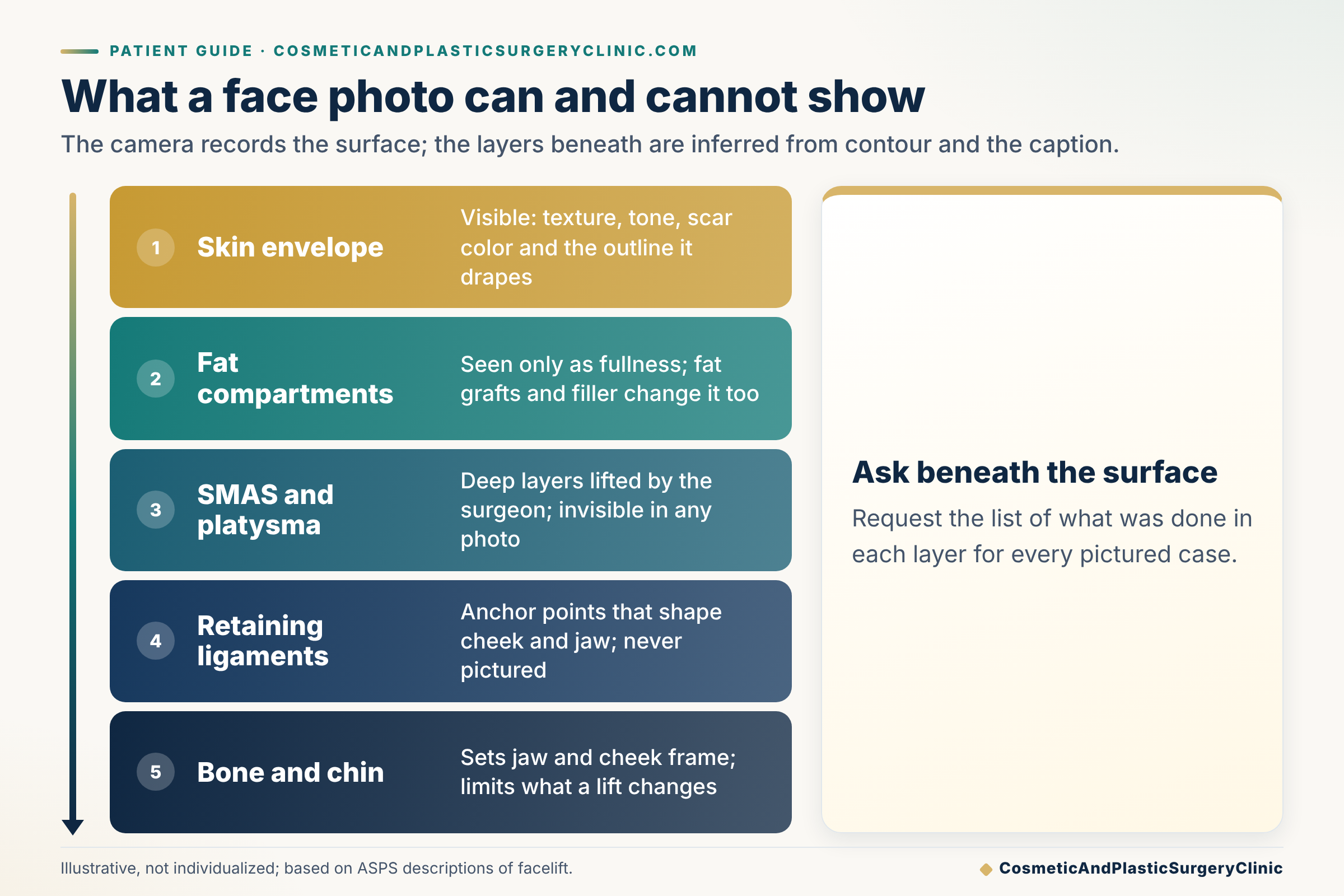
“Facelift” is a family of operations. ASPS says deeper facial layers and muscles are lifted, the skin is redraped over the new contours, excess skin is trimmed and fat may be reshaped or moved. A second incision under the chin may be needed for the neck. A pair showing a crisp lower jaw answers a different question than a pair showing softer cheeks, and neither tells you which maneuvers produced the change.
A facelift before and after caption should list every procedure
Look for a written list beside each case instead of the single word “facelift”: the technique, any neck work, fat grafting, skin resurfacing, eyelid or brow surgery, and the time since surgery. Real series are rarely pure. In a 2023 study of 20 patients who had a high SMAS facelift (Boonipat and colleagues, Plastic and Reconstructive Surgery Global Open), most also had fat grafting, a brow lift or eyelid surgery in the same operation. A caption that omits those add-ons gives the facelift credit that belongs to several procedures.
Technique and incision length change what you are seeing
ASPS describes a traditional incision that begins in the hairline at the temples, continues around the ear and ends in the lower scalp, and a limited-incision version with shorter incisions at the temples and around the ear. Those are different amounts of access, so a photo from a limited-incision case should not be read as a preview of a full operation. The trade-offs are in mini facelift versus full facelift, and the layer-by-layer difference is in deep plane versus SMAS facelift. For photos, your reference cases should name the technique you are being offered.
Match the starting face in facelift before and after photos
Two people can share a goal, such as a cleaner jawline, and start from very different anatomy. A facelift before and after pair informs you only when the starting face resembles yours in the ways that limit what surgery changes.
Skin quality, jowl weight and neck anatomy differ more than age does
ASPS lists thinning skin, facial fat loss, gravity, sun damage, smoking, heredity and stress as contributors to the changes a facelift addresses. Each shows up differently in a photo. Heavy jowls on thin skin, a full neck over a small chin and banded neck muscles all behave differently in surgery, and a stated age says little about any of them. Consider a hypothetical reader with a full neck and a receding chin who studies pairs of lean, firm-necked patients. The pairs may be honest and still answer a different question.
Prior fillers, weight change and hairstyle belong to the “before”
Ask whether the “before” was taken after recent filler, which can puff or smooth the cheeks, or at a different weight than the “after.” A few pounds can change the neck and jaw outline on their own. Hairstyle matters too: hair down over the ears and temples hides the very area where a facelift scar sits. Matching history is part of matching anatomy, and a good gallery caption tells you.
Read the date: swelling, settling and fat that keeps changing
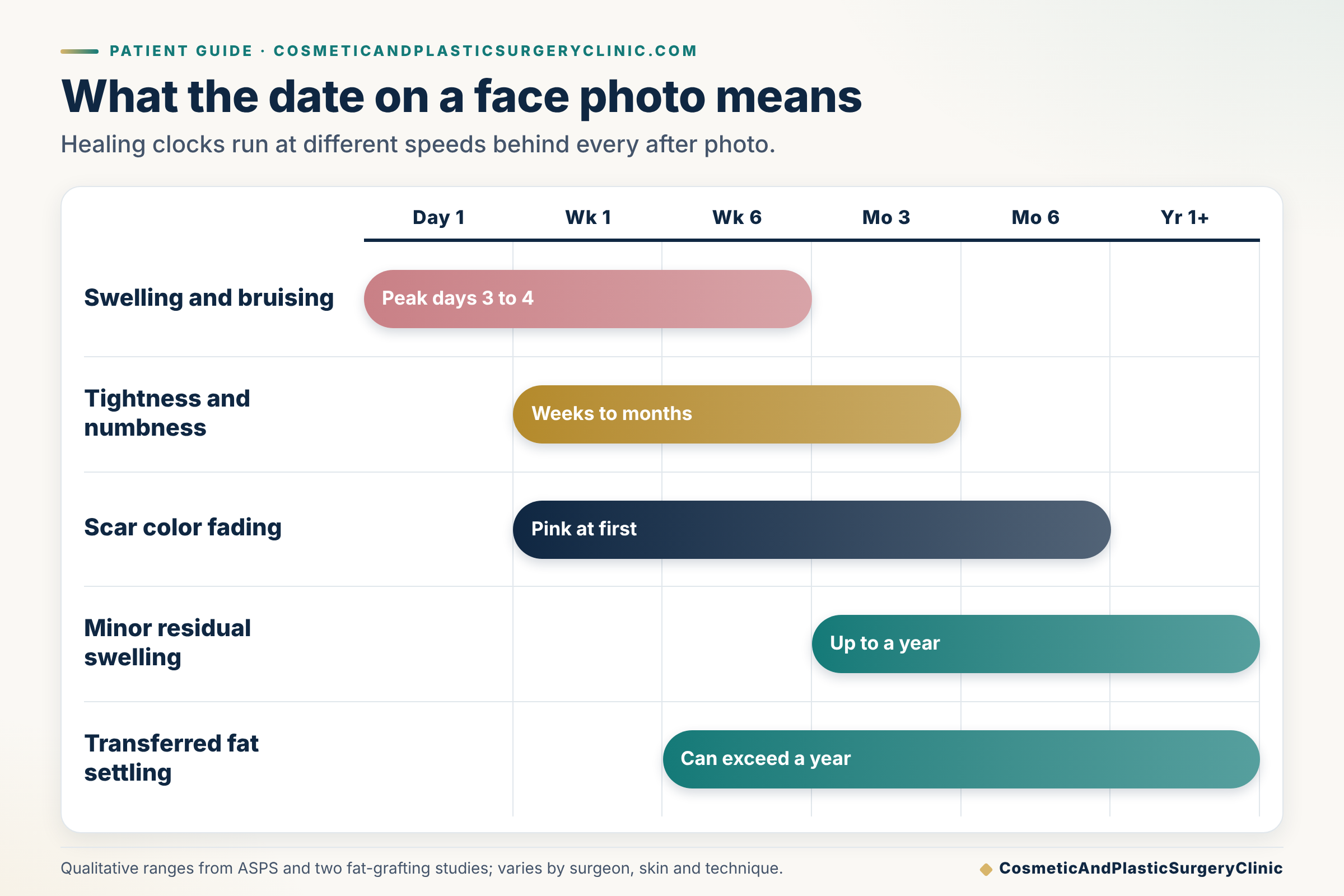
The date on a facelift before and after photo matters more than any other caption detail, because a face heals on several clocks at once. Skin swelling, bruising, tightness, numbness, scar color and the volume of any transferred fat all move at different speeds. An “after” taken at three weeks and one taken at eighteen months are two different views of the same operation, which is why every facelift before and after pair needs a date.
What the calendar does to a facelift before and after pair
Published timelines are general and vary by surgeon and patient. They still give you the shape of the curve, which is what matters when you read a date.
Weeks one to six: peak swelling, bruising and tight skin
An ASPS blog post by a plastic surgeon (Improta, 2018) says swelling and bruising usually reach their height around day 3 or 4 and may last several more weeks. Between about days 7 and 14 some swelling, numbness, tingling or tightness may remain, and incisions can look pinkish-red. ASPS’s results page says most people are presentable in 10 to 14 days. It adds that it takes 2 to 3 months for the face to feel back to normal in texture, sensation and firmness. A week-three photo may look composed yet still be mid-healing.
Months three to twelve and beyond: contour, texture and fat settle
The same ASPS post says very minor swelling, bruising, tightness and numbness can take up to a year to resolve and are usually noticeable mainly to the patient, with final results appearing over a few months. No source opened for this article gives one date when every facelift is final. Researchers do measure the process: a 2025 paper in Facial Plastic Surgery and Aesthetic Medicine proposes a system for quantifying post-facelift edema, so swelling is not only a matter of impression. When someone says “final result,” ask at what month the photo was taken.
Fat can keep changing long after swelling is gone. In a 2020 Aesthetic Surgery Journal study using 3D photometry (Cohen and colleagues), midfacial volume after a facelift with simultaneous fat grafting averaged about 49.6% of the injected volume at 1 to 2 months and about 73.6% at 18 to 24 months. The series was tiny, six women and twelve regions with no control group, so treat it as a demonstration of change over time, not a prediction.
Why one dramatic pair is the wrong unit
A single pair is the most flattering way to present any operation and the least informative. Face shape, expression and light are all frozen at one moment. Evidence about a surgeon’s work comes from a run of consecutive, comparable cases, not from one pair chosen for impact.
Ask for a dated series of the same patient
Request the same person at about 3 months, 6 months and a year or more, under the same setup. A series shows you whether jowl definition holds, whether the neck line stays clean, and whether scars fade. If a practice has only early “after” images because it is new or because patients do not return, a candid answer is itself useful. The question of how long the effect lasts belongs in how long a facelift lasts.
Be careful with on-the-table and first-week images
Photos taken in the operating room or in the first days show a face that is stretched and swollen, often with dressings or surgical markings, rather than a healed result. Treat any image without a stated date as unusable for comparison, and prefer pairs where the practice lists the interval to the day or month.
Audit the photography before you judge the jawline
Standardization exists to hold every variable still except the one you want to see. Two 2010 reviews in Facial Plastic Surgery Clinics of North America (Swamy and Most; Archibald and colleagues) say accurate photodocumentation depends on strict, consistent equipment, lighting, room setup, patient positioning and camera settings. A 2024 review in Aesthetic Surgery Journal Open Forum (Thornton and colleagues) notes that smartphones and social media have contributed to declining photo standards. The facelift before and after galleries you meet online are therefore a mix of clinical-grade and casual images, and you have to sort them.
Views, distance and light in facelift before and after galleries
A face lives in three dimensions, and the jawline in particular is a profile feature. One frontal photograph cannot document it.
Frontal, oblique and lateral views, plus the neck views galleries skip
A standard facial series includes frontal, oblique and lateral views of each side. A chapter on photography for aesthetic surgeons (Behr, Aitson and Hoffman, in Essentials of Aesthetic Surgery) also lists supplemental views for neck work: a teeth-gritting view for platysmal banding and a head-down “reading” view that accentuates submental fat. A facelift before and after album with only frontal images hides how the jowl and neck line change from the side, so ask for obliques and laterals at both dates.
Light direction and lens distance redraw the jowl line
The same chapter describes dual strobe lighting, a background kept consistent, and a longer lens: about 80 mm effective focal length at roughly one meter for face and neck series, because a lens that is too short causes barrel distortion. A phone held at arm’s length does the opposite of that setup.
Light matters in a quieter way. A 2021 Aesthetic Surgery Journal Open Forum paper notes that light and shadow change how the eyelid-cheek junction reads, and the same logic applies along the jowl and under the chin: overhead or side light can deepen or soften those shadows. Compare the shadow pattern on the cheek and under the jaw before you compare the jaw in any facelift before and after pair.
| Variable | How it changes the face | What to compare | Question for the practice |
|---|---|---|---|
| Camera distance and lens | A short lens or close camera bends the lower face and enlarges the chin and nose | Face size in the frame, ear shape and background lines | Was one fixed camera position and focal length used at every visit? |
| Light direction | Top or side light deepens or erases jowl, fold and under-chin shadows | Shadow beside the mouth, under the jaw and below the earlobe | Is the lighting set up the same way at each session? |
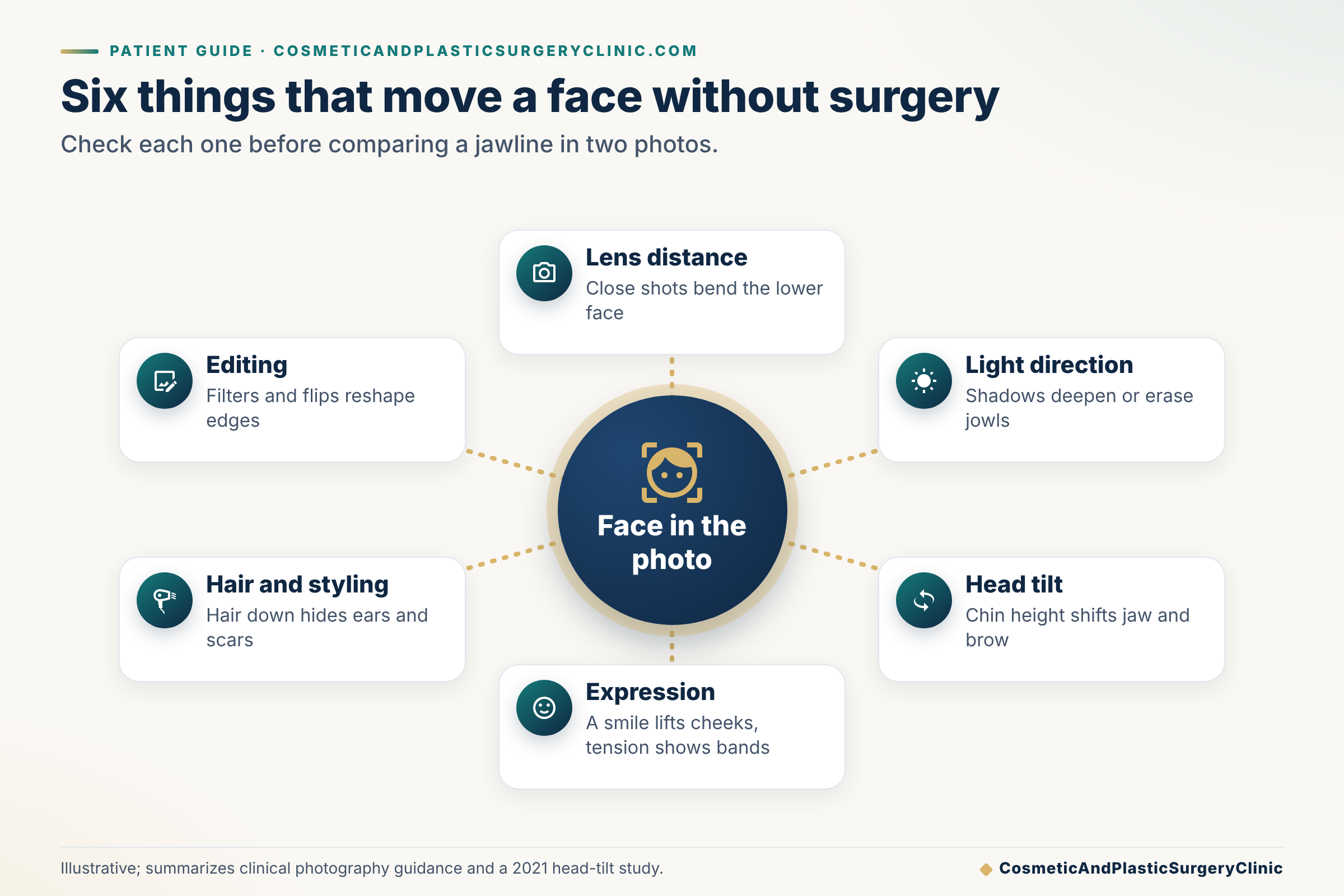
| Head tilt and chin height | Chin up tightens the neck line; chin down adds fullness under the jaw | Tragus-to-eye alignment and the angle of the lower lip to the chin | How is head position controlled and documented? |
| Expression and mouth | A smile lifts the cheeks and bunches the jowl area; tension shows neck bands | Relaxed mouth and brow in both photos | Are there neutral-expression versions of each view? |
| Hair, makeup and clothing | Hair down hides scars; contour makeup, glasses or a collar change edges | Ears visible, same grooming, collar turned away from the neck | Are these original files, and were any edited? |
Head position, expression and styling
The head moves, the chin moves and the mouth moves, and each shifts the lines a facelift is meant to change.
A chin tilt can move a brow seven millimeters
That study concerned the eyes, but head tilt moves the lower face and neck as well.
Behr and colleagues note that the Frankfort plane, a head position used by some surgeons, can change jaw definition and submental soft tissue, and they prefer the natural horizontal facial plane. They also say neck flexion exaggerates submental fat while extension can improve the jawline. A chin lifted in the “before” and level in the “after” can therefore flatter the “before,” and the reverse is also common. The 2021 authors suggest including the tragus in the frame as a simple way to document head tilt; if you can see the ear and tragus, you can judge it.
Hair, makeup, collars and a closed mouth
The photography chapter recommends a relaxed, non-smiling face, hair pulled back with a neutral headband, no distracting jewelry, glasses or heavy makeup, and turtlenecks folded down with collars turned away from the neck. For a facelift this is not fussiness. It is the only way to see the ear, the sideburn area and the neck line at the same time. If the “after” shows hair down over the ears, the practice has chosen not to show you the scar.
Read the jawline, midface and neck cues without fooling yourself
With the setup checked, you can look at the anatomy. A facelift before and after comparison is easiest to read zone by zone, and each zone has its own ways of looking better or worse than it is.
| Zone | What to look for | How a photo can mislead | Question to ask |
|---|---|---|---|
| Jawline and jowls | A continuous line from chin to jaw angle, with less sag below the mouth corner | Chin height, a smile or side light can sharpen or soften the line | Can I see this jawline in a lateral view at 12 months? |
| Midface and cheeks | Cheek position and fullness, and the fold from nose to mouth | Transferred fat, filler or makeup can supply volume that a lift did not | Was fat or filler added, and how much of this is lift versus volume? |
| Neck | A cleaner angle under the chin and fewer visible neck bands at rest | Neck flexion, clothing and chin position change the angle | Was neck work done separately, and from what incision? |
| Ear, temple and scar line | Natural ear and earlobe shape, even sideburn, and a hairline without steps | Hair down, early pink scars or distance hide the line | Can I see close-ups with hair back at six months or later? |
Jawline and jowls in facelift before and after photos
The jawline is the feature most people mean when they ask what a facelift does, and it is the one most affected by photography.
Follow the line from chin to jaw angle
Trace the lower border of the face in profile. In a real change the line looks more continuous and the tissue below the mouth corner looks lighter.
One research group (Jacono and colleagues, Aesthetic Surgery Journal, 2019) used 3D photography to measure a “mandibular defining line” in 89 patients after an extended deep plane modification, reporting a rise from 7.1 to 9.8 cm at an average of 19 months. It was one team’s technique and the level of evidence was low (level 4). It shows that jawline change can be measured, and that the usual gallery gives you no number at all.
Perceived age is a rating of the photo, not of the operation
It is tempting to read a facelift before and after pair as a before-and-after in years. In the 2023 Boonipat study, 40 lay observers estimated the 20 patients’ ages from frontal photos at rest. The average estimate fell from 54 to 48.6 years, while the patients’ true average age was 57.4, and trait ratings such as attractiveness and trustworthiness rose. The authors listed small size, one surgeon, one practice, frontal views only, concurrent procedures and uncontrolled lighting, hair and makeup as limits. The number describes how those faces were rated, not what a facelift subtracts.
Midface and cheeks: lift, fat and filler can look alike
Cheek fullness is where companion procedures most often get mistaken for a lift.
Fat grafting can supply the fullness a pair seems to credit to the lift
In a 2020 Plastic and Reconstructive Surgery Global Open series (Swanson), 100 patients had a sub-SMAS facelift, 61 with malar fat injection and 39 without. Standardized photographs at 1, 3 and 6 months showed about 3 mm more malar projection in the fat group, compared with under 1 mm in the others, and an estimated fat retention near 34%. That is a retrospective single-surgeon comparison, but it makes the point: a plumper cheek in an “after” may be fat, not lift. ASPS lists fat transfer or fillers among the options used to restore lost volume.
Ask which layers each technique reaches
Whether a technique repositions the midface, as opposed to the lower face and jowl, varies by method and by surgeon, and a gallery caption rarely says. Ask whether the cheek change in a photo came from deep layers, from fat, or from both. The answer tells you what to expect from the technique on offer rather than from the images alone.
Neck and the scars that frame the face
The neck and the ear are the least-photographed parts of a facelift gallery, which is why they deserve the closest look.
The neck line is a separate question
ASPS notes a second incision under the chin may be needed for the neck, and neck work can be done alone or alongside a facelift (see neck lift). A 2019 study validated a five-grade photographic Rainbow Scale for the cervicomental angle, the angle under the chin. Seven surgeon panelists rated 15 reference photographs with good agreement. It exists because no standard photographic measure of that angle had been available, so a gallery that shows the neck in a consistent pose is already ahead of most.
Scars at the temple, ear and behind the ear
ASPS says facelift incision lines are well concealed in the hairline and the natural contours of the face and ear. A 2021 review of revision facelift in Seminars in Plastic Surgery (Dibbs and colleagues) lists the ways that can fall short: a displaced sideburn from a poorly placed temporal incision, a step in the hairline behind the ear, tragal distortion, an earlobe pulled toward the cheek (“pixie ear”), widened or thickened scars and hair loss within a scar. It gives few numbers for how often.
Ask for close-ups of the temple, ear and behind-the-ear scar in facelift before and after photos, with the hair pulled back, at six months or later. A scar that looks pink at six weeks is not yet informative.
When other procedures, editing and selection change the picture
Even a well-lit, well-dated pair can mislead if the story around it is incomplete. Three things most often explain a result that looks too good: other procedures that share the credit, image editing, and a gallery that only shows the best cases.
When other procedures share the credit in facelift before and after pairs
The eye cannot separate lift from volume, texture or eyelid shape. A viewer simply registers “younger.”
Fat grafting, resurfacing and fillers
ASPS lists fat transfer, fillers and skin treatments such as intense pulsed light, dermabrasion, peels or laser among the options used with or instead of a facelift. Resurfacing changes texture and tone, which the eye reads as younger independently of tissue position, and fillers can add fullness for months. A facelift before and after caption that omits them overstates the lift. Filler results have their own reading rules in dermal filler before and after photos.
Eyelids and brows
Eyelid and brow surgery is commonly done in the same session, as the ASPS overview and the Boonipat series both show. A rested upper eyelid or a lifted brow changes the whole upper third of the face, and viewers credit the facelift. A 2022 audit of 104 blepharoplasty posts by oculoplastic surgeons on Instagram (Maamari and colleagues) found luminosity in the eye region differed by more than 10% between before and after in 17.3% of sets, so even eyelid galleries vary in light. Healing for that surgery is in blepharoplasty recovery.
Editing, simulation and selection
Most readers cannot tell an edited image from an unedited one, and the studies below suggest practice websites and social feeds are uneven.
Retouching, mirroring and AI-made images
ASPS has warned that filters, Photoshop and edited before-and-after posts can distort expectations, and one surgeon quoted in a 2024 ASPS article urged patients to look at such photos “with a discerning eye.” Mirroring an image or flipping one side can hide asymmetry, and retouching can soften a jawline. Detection by eye is unreliable: in a 2024 study in Aesthetic Plastic Surgery (Knoedler and colleagues), 101 laypeople identified a computer-generated rhinoplasty outcome correctly in 52.5% of cases, close to chance. That was a nose, not a face, but the lesson carries. Ask whether pairs are unedited originals.
What audits of facial photos have found
A 2021 Aesthetic Surgery Journal study (Vaca and colleagues) scored 291 Instagram facial surgery before-and-after posts on lighting, expression, makeup, head position and framing. Conditions favored the postoperative image in 282 posts, none favored the preoperative image, and the average bias score was 1.71 on a scale of -5 to +5. Plastic surgeons wrote 27.5% of the top posts, and bias did not differ by specialty or board certification. A separate audit of physician websites (Meekins and colleagues) reported 51.3% of before-and-after images failing at least one standardization criterion, including 56% of the face-lift images.
Consent, privacy and advertising rules
The face is the most identifiable part of a person, and that makes a facelift gallery an ethics question as well as a visual one. The general rules are in the guide mentioned at the start; here is what stands out for faces.
A face photograph is an identifier
The U.S. Department of Health and Human Services lists full-face photographs and comparable images among the identifiers removed under HIPAA’s Safe Harbor de-identification method, so a pictured face usually means the patient agreed to be shown. A 2018 article in AMA Journal of Ethics adds that patients may refuse online use, that models must be labeled as models, and that a posted image may remain discoverable. A practice should be able to say that each pictured patient consented in writing.
“Results not typical” does not cure a misleading pair
The Federal Trade Commission’s health products guidance (2022) says testimonials reporting more dramatic results than users can generally expect are likely deceptive, and that a disclaimer such as “results not typical” does not cure the problem. It also calls for clear disclosure of any material connection, meaning any personal or financial tie consumers would not expect. Consider a hypothetical patient who received a discount for a glowing post: that is a material connection to ask about.
Turn a gallery into consultation questions, not a promise
A facelift before and after gallery is best used as a question generator. It cannot predict your result, but it can show you what a surgeon is willing to document and discuss.
Compare ranges rather than standouts
One striking facelift before and after pair shows the best case; a range shows what the practice is actually likely to deliver.
Look for many comparable cases, including ordinary ones
Ask for several cases whose starting anatomy, age range, technique and companion procedures resemble yours. Look at how much they vary. Some change will be subtle, and a sensible surgeon will say so. Photographs also miss what patients feel. The FACE-Q Aging Appraisal Scale and Patient-Perceived Age scale, developed with 288 patients and reported by Panchapakesan and colleagues in 2013, exist because how a person rates their own appearance and age is a separate measure from how a photo looks.
Ask about revisions and slow-healing cases
ASPS says there can be no assurance of results and that optimal results are sometimes not achieved in one procedure, so another operation may be needed. A trustworthy album includes at least one case that healed slowly or needed an adjustment, with an explanation of what was done and when. Ask what the practice’s revision policy covers, including fees. Complication types and their handling are covered under facelift risks above, and non-surgical routes for those who prefer to wait are in facelift alternatives.
Pair photos with credential checks and your own baseline
Facelift before and after photos are one input. Verification and your own records are the others.
Verify the surgeon and facility independently
A gallery badge or a “board-certified” label is not verification. The American Board of Plastic Surgery offers a Verify Certification lookup, and the American Board of Medical Specialties runs a search tool for any board-certified doctor. Because the Instagram audit above found bias scores did not vary by board certification, checking credentials and checking photographs are separate jobs. How to do the first one, including facility accreditation, is in how to choose a plastic surgeon and cosmetic surgeon credentials.
End with a facelift before and after worksheet
Use the table below for each case you plan to cite at a consultation. Bring your own dated baseline photos too: front, both obliques and both profiles, taken in the same light with a relaxed face and hair pulled back. They give your surgeon a common reference and give you something to compare against later in the same conditions.
| Evidence item | What to look for | Limit on interpretation | Question to ask |
|---|---|---|---|
| Case similarity | Skin quality, jowl and neck anatomy, age range and goals like yours | A different starting face answers a different question | Which cases here most resemble me, and why? |
| Time point | Dates at about 3, 6 and 12 or more months, same patient | An early “after” is still healing | Can I see this patient at one year or later? |
| Procedure list | Technique, neck work, fat, resurfacing, eyelids and brows named | Unlisted add-ons inflate credit for the lift | Exactly what was done in each pictured case? |
| Views and scars | Frontal, oblique and lateral, with ear and hairline close-ups | Hair down or distance hides the scar line | Where are the ear and behind-ear views? |
| Edits and consent | Statement on retouching, original files, written patient permission | You cannot reliably detect edits by eye | Are these unedited, and did each patient agree? |
| Revision disclosure | A few slower or adjusted cases shown and explained | A gallery of tidy results is a selection | How often do you revise, and may I see an example? |
None of this requires distrust of a practice that shows its work. A surgeon who is comfortable with these questions usually has the records to answer them. A surgeon who is not may still be capable, and you can ask for time, a second opinion, or a different practice before deciding.
Frequently asked questions
How many months should a facelift before and after photo be taken after surgery?
No single month is accepted as final, and the sources used here describe a spread. Most visible swelling and bruising ease over the first weeks, ASPS says it takes 2 to 3 months to feel back to normal, and minor tightness or numbness can last up to a year. A photo at about 3 months, another at 6 and one at a year or later gives a fairer picture than one early “after.” If fat was transferred, even later images may be informative.
Why does my face look different in a selfie than in clinic facelift before and after pictures?
Distance, lens and angle. A phone held near the face enlarges closer features and can bend the lower face, while a clinic uses a fixed camera, a longer lens and set lights. Your head tilt, expression and hair change the jawline too. For your own record, use a fixed spot, the same distance and light, a level head, a relaxed face and hair pulled back, and compare only photos taken that way.
Can facelift before and after photos show whether the scars will be visible?
Only partly, in most facelift before and after photos. Early scars look pink or red and fade over time, and many photos are taken at a distance or with hair covering the ears. Ask for close-ups of the temple, the front and back of the ear and the hairline behind the ear, with hair pulled back, at six months or later. Even then, scars vary from person to person, so a photo is a cue to discuss placement and healing with a surgeon, not a forecast.
Is a facelift before and after pair of someone my age a good guide to my result?
Age alone is a weak match in facelift before and after photos. Skin thickness and elasticity, how much fat and laxity sit in the jowls and neck, bone structure, sun exposure, smoking history and prior filler all differ between people of the same age. Look for pairs whose anatomy and goals resemble yours, shot at the same interval, and treat any resemblance as a starting point for a conversation about what a surgeon thinks is realistic for you.
Should I trust facelift before and after photos on social media?
Treat them as marketing until proven otherwise. A 2021 audit of 291 Instagram facial surgery posts found photography conditions favored the postoperative image in 282 of them. Check for dates, a full procedure list, matching views, written consent and a statement about editing. Verify the surgeon’s certification separately, because a feed full of impressive images says nothing about training, and neither does a follower count.
Do facelift before and after photos show numbness, feel or comfort?
No. A photograph records appearance on one day. It does not show numbness, tightness, how the face feels or moves, or how the patient rates their own look. Patient-reported tools such as the FACE-Q scales were created to measure those things. If a practice tracks patient-reported outcomes or uses a validated questionnaire, ask to see how, and ask how long numbness and tightness usually take to fade.
What should I bring to a consultation about facelift before and after results?
Bring three or four gallery cases you find relevant, noting the dates and procedures where you know them, plus your own dated photos in front, oblique and profile views, with hair pulled back. Add a short written goal in one sentence, a list of medications and past procedures such as fillers or neck surgery, and your questions. Ask the surgeon to point out what in each case is achievable for you and what is not.
Can AI or a simulation predict my facelift before and after result?
Not reliably for a facelift before and after result. A simulation can help a conversation about shape and goals, but it is a drawing, not a forecast. In a 2024 study, 101 laypeople identified a computer-generated rhinoplasty outcome only 52.5% of the time, showing how convincing such images are. Facelift healing, skin response and fat behavior cannot be computed from one preoperative photograph. Treat any simulated image as an illustration to discuss, and ask what it assumes.
Sources and further reading
- American Society of Plastic Surgeons — Facelift overview (accessed 2026-11-12) — what a facelift addresses and cannot do; related fat, filler and skin treatments
- American Society of Plastic Surgeons — Facelift results (accessed 2026-11-12) — presentable in 10 to 14 days; 2 to 3 months to feel normal; further surgery may be needed
- American Society of Plastic Surgeons — Facelift procedure (accessed 2026-11-12) — incision paths, limited incision, neck incision
- American Society of Plastic Surgeons — Facelift recovery (accessed 2026-11-12) — bandages, drains, questions to ask the surgeon
- ASPS blog (Improta) — Your facelift recovery explained from Day 1 to Day 30, 2018 (accessed 2026-11-12) — swelling peak, scar color, minor swelling up to a year
- ASPS — 2025 plastic surgery by the numbers (accessed 2026-11-12) — facelifts up 13 percent
- ASPS — The prevalence of TikTok and its impact on plastic surgery procedures, 2024 (accessed 2026-11-12) — filters, edited before and after posts
- Boonipat et al. — Impact of surgical rejuvenation on visual processing and character attribution of faces, Plastic and Reconstructive Surgery Global Open, 2023 (accessed 2026-11-12) — 20 high SMAS facelift patients, 40 raters, perceived age
- Vaca et al. — The influence of sagittal head tilt on periorbital appearance, Aesthetic Surgery Journal Open Forum, 2021 (accessed 2026-11-12) — 12 volunteers, tilt measurements, tragus suggestion
- Swanson — Photographic comparison of malar projection in 100 facelift patients treated with and without fat injection, Plastic and Reconstructive Surgery Global Open, 2020 (accessed 2026-11-12) — about 3 mm vs under 1 mm; fat retention near 34%
- Cohen et al. — Progressive improvement in midfacial volume 18 to 24 months after simultaneous fat grafting and facelift, Aesthetic Surgery Journal, 2020 (accessed 2026-11-12) — 3D volume over time; small series
- Jacono et al. — A novel extended deep plane facelift technique for jawline rejuvenation and volumization, Aesthetic Surgery Journal, 2019 (accessed 2026-11-12) — 89 patients, 3D jawline measurement (abstract)
- Dibbs et al. — Revision facelift and neck lift, Seminars in Plastic Surgery, 2021 (accessed 2026-11-12) — hairline, tragus, earlobe and scar problems
- Vaca et al. — Photographic misrepresentation on Instagram after facial cosmetic surgery, Aesthetic Surgery Journal, 2021 (accessed 2026-11-12) — 291 posts; also lists the Meekins et al. website audit (51.3% failure; journal and year not shown on the page)
- Maamari et al. — Quantitative analysis of preoperative and postoperative photographs posted on social media by oculoplastic surgeons, Ophthalmic Plastic and Reconstructive Surgery, 2022 (accessed 2026-11-12) — 104 blepharoplasty posts
- Thornton et al. — Picture perfect: standardizing and safekeeping clinical photography in plastic surgery, Aesthetic Surgery Journal Open Forum, 2024 (accessed 2026-11-12) — declining photo standards; storage and HIPAA
- Swamy and Most — Pre- and postoperative portrait photography, Facial Plastic Surgery Clinics of North America, 2010 (accessed 2026-11-12) — consistency of equipment, lighting and positioning (abstract)
- Archibald, Carlson and Friedman — Pitfalls of nonstandardized photography, Facial Plastic Surgery Clinics of North America, 2010 (accessed 2026-11-12) — uniformity requirements (abstract)
- Behr, Aitson and Hoffman — Photography for the aesthetic surgeon, Essentials of Aesthetic Surgery (accessed 2026-11-12) — lens, lighting, head position, hair, neck views (free excerpt)
- Panchapakesan et al. — Development and psychometric evaluation of the FACE-Q Aging Appraisal Scale and Patient-Perceived Age Visual Analog Scale, Aesthetic Surgery Journal, 2013 (accessed 2026-11-12) — patient-reported outcome tools, 288 patients
- The Rainbow Scale for the assessment of the cervicomental angle, 2019, PubMed record 31165144 (accessed 2026-11-12) — five-grade photographic neck scale, 15 reference photos, 7 panelists (journal not named on the page)
- Lawrence et al. — Postoperative edema following rhytidectomy: a new system for quantifying lymphedema after facelift, Facial Plastic Surgery and Aesthetic Medicine, 2025 (accessed 2026-11-12) — record page only; abstract not available
- Knoedler et al. — AI-powered pre-operative outcome simulation in rhinoplasty surgery, Aesthetic Plastic Surgery, 2024 (accessed 2026-11-12) — 101 raters, 52.5% correct
- Federal Trade Commission — Health products compliance guidance, 2022 (accessed 2026-11-12) — testimonials, typical results, material connections
- U.S. Department of Health and Human Services — Guidance on de-identification of protected health information (accessed 2026-11-12) — full-face photographs as identifiers
- Gutierrez and Johnson — Can plastic surgeons maintain professionalism within social media? AMA Journal of Ethics, 2018 (accessed 2026-11-12) — consent, models, discoverability, ASPS code of ethics
- American Board of Plastic Surgery — home page and Verify Certification menu (accessed 2026-11-12) — certification lookup
- American Board of Medical Specialties — Is your doctor board certified? (accessed 2026-11-12) — certification search tool