Neck lift before and after photos look simple: one neck, two pictures, a visible difference. In practice they may be the hardest cosmetic surgery images to read. The neck is a curved, mobile column.
A few degrees of chin height can change the line under the jaw, a collar can hide an incision, and a muscle band may appear in one frame and vanish in the next. Add swelling that fades over months and procedures done in the same operation, and a pair can mix what surgery did with what the photographer did.
This page teaches the neck-specific skills: which views to expect, how head position and light move the jawline, how to follow the angle under the chin and the platysma bands, what the date on the “after” means, and what companion procedures can hide. The broader rules on consent and advertising are in the guide to reading before and after photos. What a neck lift changes, and what it cannot, is in the neck lift guide.
What a neck lift before and after pair actually represents
Every neck lift before and after pair compresses several decisions into two rectangles. A surgeon chose the plan, a photographer chose the setup, and a practice chose this pair from many. The American Society of Plastic Surgeons (ASPS) describes a neck lift, which it also calls a lower rhytidectomy, as a procedure that improves visible signs of aging in the jawline and neck. It cannot change a person’s fundamental appearance or stop aging. A fair neck lift before and after pair shows those targets, and the caption claims nothing more.
One neck, several problems: what a neck lift before and after photo cannot separate
A neck that looks “older” can be loose skin, fat under the chin, bands from the platysma muscle, fullness from deeper structures, or a jaw and chin that sit far back. ASPS lists excess fat and relaxed skin in the lower face, fatty deposits under the chin, loose neck skin and muscle banding as the things a neck lift addresses. Each one needs a different maneuver, and each one reads differently in a photograph.
Skin, fat and platysma show as shape, not as layers
A camera records the surface. A plastic surgery textbook chapter on the neck lists the factors behind an aging neck as lost skin elasticity, descending fat under the chin, weakened platysma attachments, muscle thinning and drooping of the submandibular glands, with skin thickness, bone structure and chin projection also shaping the result. In a photo you see only the outline those layers produce. Two necks with the same outline can need different operations, so the caption matters as much as the picture.
Hyoid position and chin projection limit what any photo can promise
The same chapter describes a normal hyoid position as a trait of ideal candidates and a low hyoid as difficult to correct, and it says a recessed chin can limit the result and may prompt a discussion of chin augmentation.
A 1980 paper in Plastic and Reconstructive Surgery on visual criteria for a youthful neck made a related point: its authors believed most patients, including those with a low hyoid, could meet their criteria with careful platysma work. A neck lift before and after pair cannot show where anyone’s hyoid sits, but it can show whether the “after” neck belongs to a person with a recessed chin or a stronger one.

Which operation a neck lift before and after photo is really showing
“Neck lift” is a family of operations, and many neck lift before and after galleries file several of them under one label. Before comparing outlines, find out which maneuvers were used on the pictured case. The technique menu itself is covered in neck lift techniques; for photos, the point is that your reference cases should name the same approach you are being offered.
A neck lift before and after caption should list every procedure done that day
ASPS notes that a neck lift may be combined with a brow lift, fat transfer or eyelid surgery, and Cleveland Clinic says the neck can be treated alone or together with the jowl and cheek area. Each companion can change the picture. A sharper jawline might come from a facelift component, a chin implant or liposuction.
Ask for one written list per case: liposuction, platysma work, skin removal, gland work, facelift, chin augmentation, fat transfer, and any injectable or skin treatment. The trade-offs of doing both neck and cheek work are in neck lift versus facelift, and the face-side reading skills are in facelift before and after.
Incision plan decides which scars the photo should show
ASPS describes a traditional incision that begins in the hairline at the sideburn and continues down and around the ear, a limited version with incisions only around the ear, and a separate incision under the chin that is often needed for liposuction and muscle repair.
Cleveland Clinic describes a chin-incision approach in which no skin is removed, and a zig-zag chin incision for some older adults with no incisions near the ears. A pair from a chin-only case says little about the ear-area scar you might have. See chin liposuction versus neck lift for how the choice follows the anatomy.
Auditing neck lift before and after photography before judging the neck
The camera has opinions too. Plastic surgeons use standardized photography precisely because small changes in position and light alter how a jaw and neck look. A 2024 review in Aesthetic Surgery Journal Open Forum (Thornton and colleagues) says photography standards have slipped as smartphones and social media took over, which is why a neck lift before and after gallery of casual shots deserves more caution than a gallery with a fixed setup.
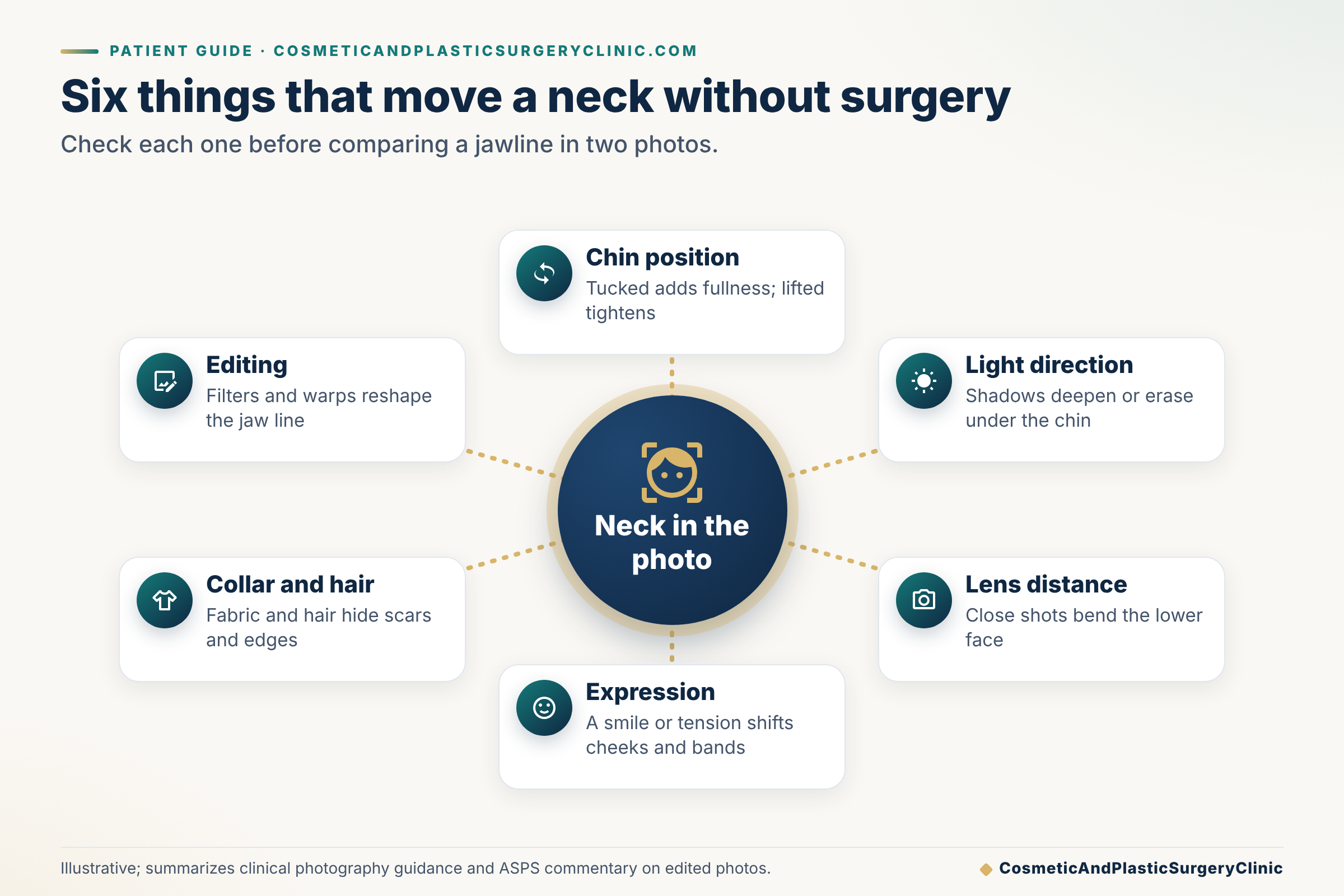
Head and chin position move a neck without surgery
The neck is the part of the body that most obviously rearranges itself when the head moves. Surgeons know this, which is why textbook protocols spend so much effort on head position.
Flexion adds fullness and extension tightens the line
A photography chapter for aesthetic surgeons (Behr, Aitson and Hoffman) says neck contour varies with head and shoulder position: flexion or retraction of the head enhances fat under the chin and the jowl line, while extension improves the jowl line. It also warns that neck retraction can overemphasize submental soft tissue. In a before and after pair, an “after” with the chin lifted slightly and a “before” with the chin tucked produces an improvement the operation did not make.
Choose the natural horizontal plane, and watch for the reading pose
The same chapter prefers the natural horizontal facial plane, in which the patient looks straight ahead as if into a mirror at eye level, over the Frankfort plane (a line from the tragus to the lower rim of the eye socket) because the Frankfort plane can change jaw definition and soft tissue under the chin.
It suggests checking that the earlobes look level from the front. It also describes a “reading view,” head down, that accentuates fullness under the chin. A lateral view in which the eyes look down or the chin is tucked is a warning that the photographer, not the operation, is working.
Light, lens, collar and expression
Head position is only one variable. Four others are easy to check once you know to look.
Top light and side light create or erase shadow under the chin
Light from above casts a shadow beneath the jaw that looks like extra fullness; light from the front or below can flatten it. This is general photographic reasoning, not a finding from a neck lift study. A surgeon quoted by ASPS in 2025 makes a similar point about before and after pairs: a “before” with poor lighting and an “after” with better lighting can signal an unfair comparison. Compare the shadow beside the mouth, under the jaw and below the earlobe in both frames.
Collars, hair, jewelry and a smile change the edges
The Behr chapter advises folding down turtlenecks and turning collars away from the neck, pulling hair back, removing jewelry and glasses, and asking the patient to relax without smiling. Every item on that list is a way a casual photo can hide an incision or shift a line. A pair in which the “before” shows a collar at the jaw and the “after” shows a bare neck, or one in which hair covers the ear in only one frame, is not a standardized pair, however good it looks.
| Variable | How it changes the neck | What to compare | Question for the practice |
|---|---|---|---|
| Chin height and head tilt | Chin tucked adds fullness under the jaw; chin lifted tightens the line | Eye level, earlobe symmetry and the angle of the lower lip to the chin | How is head position set and documented at each visit? |
| Light direction | Overhead light deepens the shadow beneath the jaw; frontal light flattens it | Shadow under the chin, beside the mouth and below the earlobe | Is the same lighting set-up used before and after? |
| Camera distance and lens | A close camera or wide lens bends the lower face and enlarges the chin | Face size in the frame and background lines | Was one fixed camera position and focal length used? |
| Expression and tension | A smile or clenched jaw changes the cheek and can reveal or hide neck bands | Relaxed mouth in both frames, plus a separate banding view | Are there neutral and animated versions of each view? |
| Collar, hair and jewelry | Fabric, hair or a necklace cover scars and move the visible edge | Ears visible, neck bare, collar turned away | Are these original files, and were any edited? |
Table 1 is a quick audit sheet for neck lift before and after photos, not a pass or fail test. If most rows match across the pair, the comparison is meaningful. If three or four rows differ, the picture is mostly a record of the photograph.
Reading a neck lift before and after pair: angle, jawline, bands and fullness
Once the photography matches, you can look at the neck. Four cues carry most of the information in neck lift before and after photos: the angle under the chin, the jawline from chin to ear, bands in the platysma, and fullness beside or below the chin. Each can be judged in a lateral or oblique view, and each has a way of fooling the eye.
The angle under the chin and the line of the jaw
Surgeons judge a neck lift largely by the shape of the profile between the chin and the neck. That shape has a name and, in some research, a scale.
The cervicomental angle gives the eye something to measure
The cervicomental angle is formed between a line along the underside of the chin and a line down the front of the neck. A textbook chapter on neck rejuvenation describes a youthful neck as having an acute angle of roughly 105 to 120 degrees, which aging blunts, and describes surgery as aiming to re-establish it. Those figures are a teaching reference, not a target for any individual; a jaw and chin set the starting point.
In 2020, researchers in Aesthetic Surgery Journal (van de Lande and colleagues) published a five-grade photographic scale for this angle, built from 15 reference photographs of women, three per grade. Seven surgeon panelists scored them three times, and agreement was reported as high, with a mean weighted kappa of 0.93 within raters and about 0.80 to 0.87 between raters.
The scale shows that angle can be graded consistently from standardized photos, and that is the condition a neck lift before and after gallery must meet before its pictures can be read this way.
Follow the jawline from chin to ear in lateral and oblique views
In a lateral view, trace one continuous line from the chin point back along the jaw to the angle below the ear. A clean, uninterrupted line suggests the soft tissue below the jaw has been addressed; a notch, a bulge below the mandible or a sag just in front of the jaw angle suggests it has not. Oblique views add the jaw-to-neck transition, which front views hide. Do the same in the “before” photo, because a good jawline in the “after” may simply have been there already.
The cervicomental angle also moves with head position, which is why a number from one picture rarely transfers to another.
Bands, fullness and what lives under the jaw
The platysma is a thin sheet of muscle that runs from the jaw down over the neck. When its inner edges separate, vertical cords can show beneath the chin. Fullness, meanwhile, can come from fat or from deeper tissue.
Platysma bands change with tension, so ask for more than one frame
A photography chapter for aesthetic surgeons recommends supplemental neck views, including a banding view with the teeth gritted, because bands that are invisible at rest can stand out when the muscle tightens.
In 2015, researchers in Aesthetic Surgery Journal (Gupta and colleagues) described a validated five-point scale for platysmal banding in the female neck, built from three-dimensional standardized photographs of more than 100 volunteers; the abstract reported moderate to excellent agreement between raters. For a gallery, the practical rule is simple: a case that shows the neck only at rest, or only with a smile, cannot show whether banding was treated.
Fullness beside the chin can be fat, muscle or gland
A bulge under the jaw is not always fat. In a 2015 review in Plastic and Reconstructive Surgery, Mendelson and Tutino reported that one surgeon performed submandibular gland reduction in 112 of 736 consecutive facelifts between 2002 and 2013, about 13 percent of primary and 25 percent of secondary cases.
Studies of neck outcomes also score gland visibility alongside bands and skin laxity, as a 2022 hammock-flap study in Aesthetic Surgery Journal did. These are single-surgeon reports, and gland work is not a routine part of every neck lift. What matters for you is that a caption which says only “neck lift” may omit gland work. Ask whether it was done on the pictured case.
| Zone | What to look for | How a photo can mislead | Question to ask |
|---|---|---|---|
| Angle under the chin | A clearer, sharper turn from chin to neck in a true lateral view | Chin lifted or head pushed forward sharpens it without surgery | Can I see this lateral view with the head in a documented position? |
| Jawline | A continuous line from chin to jaw angle, with less sag in front of the angle | Side light, a smile or a facelift component can sharpen the line | Was the cheek or jowl area treated at the same time? |
| Platysma bands | Fewer vertical cords at rest and when the muscle is tightened | Relaxed face, soft light or a toxin injection can hide bands | Is there a banding view with the teeth gritted? |
| Fullness under the chin | Less bulk below the chin and beside it, in lateral and oblique views | Neck flexion adds it; swelling in a recent photo can mask it | Was fat, muscle or gland treated, and by what incision? |
| Ear and chin scars | Fine lines hidden in the ear contours and under the chin | Hair, collar or an early photo can hide them | Can I see close-ups with hair back at six months or later? |
Table 2 turns the cues in neck lift before and after photos into questions. Bring it, or a version of it, to the practice. A team that has standardized photographs will usually answer each one without effort.
What the date on a neck lift before and after photo means
The most common gap in neck lift before and after galleries is the date. A photo taken at two weeks and a photo taken at a year are different pictures of the same operation, and a gallery that does not say which is which is asking you to guess.
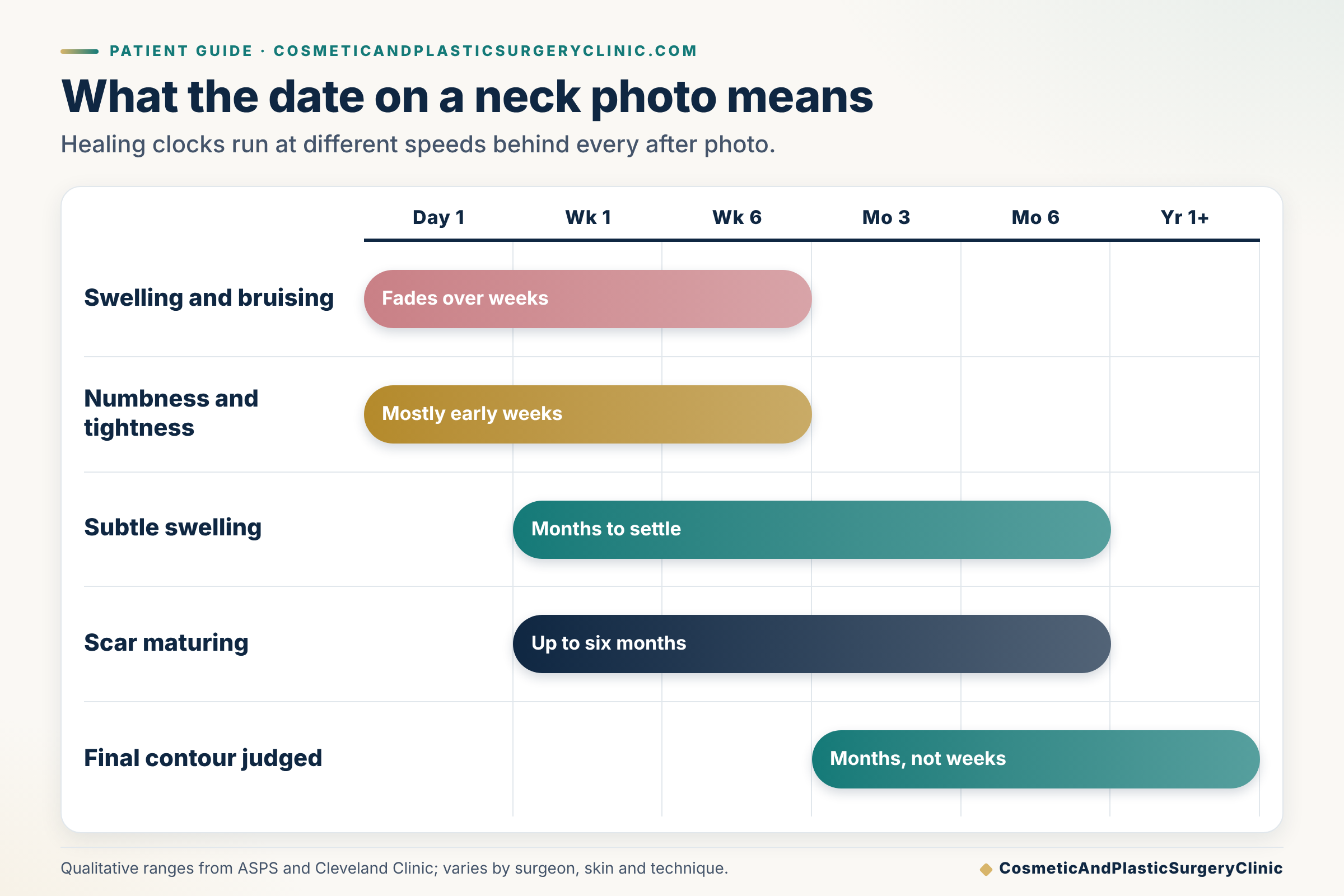
Several healing clocks run at once
Swelling, tightness, numbness and scar color do not recover on the same schedule. Reading a photo means knowing which clock is still ticking.
Swelling and firmness fade over weeks to months
ASPS says visible improvement appears as swelling and bruising settle, and that it may take several weeks to months for swelling to fully dissipate. Cleveland Clinic says results are visible almost immediately but final results may take several months as subtle swelling subsides, and that a compression bandage is usually worn day and night for at least five to seven days.
For neck lift before and after photos, that means an “after” at two or three weeks mostly shows a swollen neck that has only just come out of dressings, not the settled contour. Details of the recovery path are in neck lift recovery.
Scars mature slowly, and early photos can look better or worse than the end
ASPS says incision lines can take up to six months to mature. A surgeon quoted in a 2025 ASPS article advises that a photo labeled a few weeks or months after surgery should not show zero scars, because incisions are often visible for a year or two before they fade.
An early photo with the hair down may hide the ear-area scar entirely, and a photo that shows a completely invisible scar after a few weeks deserves a question. The same scar may look different again at a year. Ask for close-ups with hair pulled back.
Long-term photos exist, but they are rare and mostly surgeon-run
Most neck lift before and after galleries stop at a few months. A few published series follow necks for years, and they show both the promise and the limits of photo evidence.
What the longer follow-up series scored from photographs
A 2024 study in Aesthetic Plastic Surgery (Meningaud and colleagues) followed 80 patients who had a facelift with total platysma transection, treated by one surgeon. Three blinded evaluators scored photographs taken before surgery, at one year and at five years using the authors’ own scale; mean follow-up was 6.5 years, and the authors reported that no patient was dissatisfied because of band recurrence at five years.
A 2022 prospective study in Aesthetic Surgery Journal of 123 patients scored two-dimensional photographs before surgery and more than 12 months after an extended deep-plane facelift with a platysma hammock flap, and reported lower scores for banding, skin laxity and gland visibility.
Why those studies do not describe an average neck lift
Both are series from surgeons describing their own techniques, with no comparison group, and both involved facelift-based operations rather than a stand-alone neck lift. The Meningaud study’s scoring scale was developed by the study team, and the authors list single-surgeon design and a small cadaver sample among its limits. They show that a documented photo series at several time points is possible. They do not predict how long a result lasts for you, a question taken up in neck lift risks and in your own surgeon’s consent discussion.
Matching the pictured neck to yours, and spotting edits, selection and consent gaps
A technically honest pair can still be the wrong pair for you. The last two filters are about whether the pictured neck resembles yours, and whether the gallery it came from can be trusted as a body of evidence.
Is the starting neck similar enough to learn from?
Two people can share a goal, such as a cleaner jawline, and start from different anatomy. A neck lift before and after pair informs you only when the starting neck resembles yours in the ways that limit what surgery changes.
Skin quality, fat and band pattern matter more than age
A stated age says little about how a neck behaves. Skin thickness and elasticity, how much fat sits under the chin, whether the platysma has separated, and how far back the chin sits all vary independently. Consider a hypothetical reader with fullness under the chin, thin skin and a recessed chin who studies pairs of lean, firm necks with a strong chin. The pairs may be honest and still answer a different question. Look first for a “before” that matches your pattern, then read the “after.”
Weight, injectables and chin work belong in the caption
ASPS lists botulinum toxin for neck bands, fractionated laser, dermal fillers, deoxycholic acid injections, radiofrequency with microneedling and ultrasound among nonsurgical options for the neck, and says they cannot achieve the same results as surgery but may delay it or complement it.
A band softened by toxin before the “after” photo, a filler-smoothed chin, or a few pounds lost between frames all change the picture without any surgical effect. Compare the ideas in neck tightening versus neck lift, and see dermal filler before and after photos for how injectable cases are read.
Selection, editing and consent behind a neck lift before and after gallery
A neck lift before and after gallery is a selection. Understanding how the selection works is as important as reading any single picture.
Online galleries lean toward the flattering frame
In a study of Instagram posts after facial cosmetic surgery (Vaca and colleagues, Aesthetic Surgery Journal), researchers queried more than 3.4 million posts across 19 hashtags and analyzed the 291 top posts with before and after images. In 282 of them, the photography favored the postoperative result. Plastic surgeons made up 27.5 percent of the top posts.
The same ScienceGate listing mentions a separate audit of physician websites in which 51.3 percent of images failed at least one standardization element and 56 percent of face-lift images did; the journal and year of that audit were not shown, so treat it as indicative only. None of this is specific to neck lift before and after photos, but the pattern applies.
Filters, warping and artificial intelligence leave clues
ASPS published a 2026 article on reading before and after photos in the age of AI. Surgeons quoted there point to strange skin texture, warped backgrounds, inconsistent shadows, and wavy lines or pixelation around the body or face as signs of editing, and say consistency across a surgeon’s work is harder to fake than any single image.
In a neck photo, check whether the edge of a collar, a door frame or the jaw outline bends where it should be straight. A surgeon quoted in a 2023 ASPS article also says phone portrait mode makes people look better, which is one reason a patient’s own selfie rarely matches a clinic photo.
Consent, models and advertising rules
The Federal Trade Commission says testimonials that report results more dramatic than users can generally expect are likely to be deceptive, and that a “results not typical” disclaimer does not cure that. It also says a material connection that consumers would not reasonably expect must be disclosed clearly. The U.S. Department of Health and Human Services lists full-face photographs and comparable images among the identifiers covered by the HIPAA privacy rule’s de-identification standard.
A 2018 article in the AMA Journal of Ethics adds that ASPS requires patient consent for images used online and that model images must be labeled as models. The general rules are in reading before and after photos; the point here is simple. A neck lift before and after pair should come with permission, a label and no claim that the result is typical.
| Gallery element | What a complete record shows | Why it matters | Limit on interpretation |
|---|---|---|---|
| Case similarity | Age range, skin quality, fat and band pattern, chin position and sex of the patient | Anatomy limits what any operation can change | No gallery matches you exactly; use as a loose guide |
| Time point | Dated “before” and “after” at three months, six months and a year or more | Swelling, firmness and scars change for months | Even a one-year photo is not a lifetime result |
| Procedure list | Every operation and injectable done, including facelift, chin work and fat transfer | Companions can change the jawline and the neck angle | Few galleries list everything; ask for it in writing |
| Photography details | Same views, head position, light, distance, background and collar treatment | Position and light alone can move a neck line | Standards vary and may not be documented |
| Edits, consent and revisions | A statement of no retouching, written permission, and disclosure of any revision case | Shows whether the pictures are original and ethical | A statement is not proof; compare many cases |
Table 3 is the gallery checklist. A practice that can supply every row for several cases is showing you something its portfolio can be judged on, and a gallery that supplies only the images is asking for more trust than a medical decision should rest on.
Turning neck lift before and after photos into consultation questions
Photos earn their keep at the consultation, where you can ask what was done, what was not done and what would differ for you. Used that way, even an imperfect gallery is useful.
What to bring and what to request
A short, specific list makes a consultation more productive than a general request to see “results.”
Build a three-case neck lift before and after comparison set
Pick three cases from the practice’s own gallery that resemble your neck in skin, fat, band pattern and chin position, and ask for the same case at several dates, in lateral, oblique and front views, with a banding view if bands are your concern.
Bring your own recent photos taken with a neutral head position, the same light and the same distance, so you and the surgeon are discussing the same neck. The questions in Tables 1 to 3 give you the wording. A practice that answers these plainly is giving you data about itself as well as about the pictures. See plastic surgery consultation for what else to bring.
Check who treated the pictured patients
ASPS surgeons quoted in the 2026 article suggest asking whether the photos sit on an ASPS member’s practice website or appear only in social media posts from unverified “patients,” and whether the surgeon shows many cases photographed similarly over time. Verify the surgeon’s own credentials through the American Board of Plastic Surgery’s Verify Certification tool or the American Board of Medical Specialties search page. The mechanics are covered in how to choose a plastic surgeon, and the meaning of titles in cosmetic surgeon credentials.
When photos should not carry the decision
A gallery is a prompt for questions. It is not a substitute for an examination, a conversation about risks, or the option to wait.
A neck lift before and after photograph shows one neck, not a forecast
ASPS says that good results are expected but cannot be assured, and that a single surgery may not always achieve optimal results, so another operation is sometimes needed. It also says a neck lift does not change a person’s fundamental appearance and cannot stop the aging process. Both statements apply to every gallery: the pictured neck is evidence of what was possible once, not a promise about yours.
Not operating, or doing something smaller, is an acceptable answer
A neck lift is elective. Some people leave a consultation deciding to wait, to try a smaller step, or not to have surgery. If a gallery makes you feel rushed, or if a practice answers questions about its photos with pressure to book, that is useful information. Photos support a decision; they do not make one.
Frequently asked questions
How many months after surgery should neck lift before and after photos be taken?
No single date applies to everyone. ASPS says swelling can take several weeks to months to settle, and Cleveland Clinic says final results may take several months. For a fair comparison, ask to see the same patient at three months, six months and a year or more, in matching views. A photo at two or three weeks mostly records swelling and the early healing of incisions. If a practice has only early photos, that limitation should be stated in the caption.
Why does my neck look different in a selfie than in clinic neck lift before and after pictures?
A selfie is taken with a short lens, usually held below the chin or off to one side, in uncontrolled light, often with a phone filter or portrait mode. Each of those can enlarge the lower face and deepen the shadow under the jaw. Clinic photographs use a fixed distance, light and head position so that two dates can be compared. If you want to track your own neck, use one pose, one light and one distance each time rather than comparing a selfie to a gallery image.
Can neck lift before and after photos show whether platysma bands will come back?
Not directly. A short follow-up photo cannot show whether bands recur, and recurrence depends on technique, anatomy and healing. A few published series follow necks for years, such as a 2024 study with photographs at one and five years, but they are surgeon-run series without comparison groups. If bands are your main concern, ask what technique was used on the pictured case, whether the muscle was cut or sutured, and whether any photos exist from several years out.
Is a neck lift before and after pair of someone my age a good guide to my result?
Age is a weak match. Skin thickness and elasticity, fat under the chin, band pattern, hyoid position, chin projection and weight history all shape the outcome, and two people of the same age can differ on every one. A better match is a “before” neck that resembles yours in those features. Even then, treat the “after” as a general illustration of what was possible, and let your surgeon explain how your anatomy differs from the pictured patient.
Should I trust neck lift before and after photos on social media?
Treat them as marketing until you can check who performed the surgery and what was done. Research on Instagram posts after facial cosmetic surgery found that photography favored the postoperative result in 282 of 291 top before and after posts. ASPS surgeons say to look for consistent lighting and poses, plausible scars for the stated time, and a body of work rather than one dramatic pair. Verify the surgeon’s board certification before you rely on any image.
Do neck lift before and after photos show numbness, tightness or comfort?
No. A photograph cannot record how a neck feels. Cleveland Clinic describes numbness as normal in the first few weeks after surgery and lists tightness, tingling, and burning or pulling sensations as possible, and ASPS says to follow your surgeon’s instructions on dressings and head position. Ask your surgeon how long each sensation tends to last in their practice. For a recovery outline, see the recovery page, and do not use a gallery to judge your own healing.
What should I bring to a consultation about neck lift before and after results?
Bring three or four gallery cases you find relevant, your own neutral-position photographs from the front, side and three-quarter views, a list of medications and past procedures including injectables, and a short list of questions. Ask for the list of procedures done on each pictured case, the dates, and whether any case needed a revision. Also ask who will operate, and where. It helps to take notes or bring a companion, since the discussion covers a lot.
Can a practice post my neck lift before and after photos without my permission?
Photos used in marketing normally require your written consent. HHS lists full-face photographs and comparable images among identifiers covered by the HIPAA privacy rule, and the AMA Journal of Ethics reports that ASPS requires patient consent for image use online. Posted images can be hard to remove, so read any release carefully, ask whether you can limit use, and ask whether your face will be visible. You can usually decline without affecting your care.
Sources and further reading
- American Society of Plastic Surgeons — Neck lift (lower rhytidectomy) overview (accessed 2026-11-12) — what a neck lift addresses, limits, nonsurgical options, combined procedures
- American Society of Plastic Surgeons — Neck lift procedure steps (accessed 2026-11-12) — incisions, platysma, chin incision, liposuction, concealment
- American Society of Plastic Surgeons — Neck lift results (accessed 2026-11-12) — swelling timeline, scar maturation, limits on certainty
- American Society of Plastic Surgeons — Neck lift recovery (accessed 2026-11-12) — bandage, drain, head position, questions for the surgeon
- Cleveland Clinic — Neck lift (accessed 2026-11-12) — chin-incision and zig-zag approaches, swelling, numbness, timing of results
- Plastic and Reconstructive Surgery 1980;66(6):826-837 — Visual criteria for success in restoring the youthful neck, PubMed record (accessed 2026-11-12) — platysma adjustment, low hyoid, sling; authors not shown on the page
- Sommer and Mendelsohn — Pitfalls of nonstandardized photography in facial plastic surgery patients, Plastic and Reconstructive Surgery, 2004 (accessed 2026-11-12) — neck flexion, extension and head position change jawline and submental appearance (abstract)
- Behr, Aitson and Hoffman — Photography for the aesthetic surgeon, Essentials of Aesthetic Surgery (accessed 2026-11-12) — head position, neck views, banding view, collars, hair, expression (free excerpt)
- Techniques for rejuvenation of the neck platysma, Plastic Surgery Key textbook chapter (accessed 2026-11-12) — neck aging factors, cervicomental angle reference, hyoid and chin limits, standard views
- van de Lande et al. — The Rainbow Scale for the assessment of the cervicomental angle, Aesthetic Surgery Journal, 2020 (accessed 2026-11-12) — five-grade photographic scale, 15 reference photographs, seven panelists, reliability
- Gupta et al. — Development and validation of a clinical assessment tool for platysmal banding, Aesthetic Surgery Journal, 2015 (accessed 2026-11-12) — five-point banding scale from 3D photographs (abstract)
- Meningaud et al. — Facelift: assessment of total platysma muscle transection to prevent recurrence of platysmal bands, Aesthetic Plastic Surgery, 2024 (accessed 2026-11-12) — 80 patients, photographs at one and five years, single-surgeon limits
- The effect of a novel platysma hammock flap during extended deep plane facelift on the signs of aging in the neck, Aesthetic Surgery Journal, 2022 (accessed 2026-11-12) — 123 patients, two-dimensional photographs, banding, laxity and gland visibility scores
- Mendelson and Tutino — Submandibular gland reduction in aesthetic surgery of the neck: review of 112 consecutive cases, Plastic and Reconstructive Surgery, 2015 (accessed 2026-11-12) — gland work frequency, complications, deep neck bleeding as an emergency
- Vaca et al. — The influence of sagittal head tilt on periorbital appearance, Aesthetic Surgery Journal Open Forum, 2021 (accessed 2026-11-12) — head tilt must be controlled in clinical photography; two-dimensional photos did not capture neck flexion
- Vaca et al. — Photographic misrepresentation on Instagram after facial cosmetic surgery, Aesthetic Surgery Journal, 2021 (accessed 2026-11-12) — 291 posts, 282 favoring the postoperative result; website audit figures (journal not named on the page)
- Thornton et al. — Picture perfect: standardizing and safekeeping clinical photography in plastic surgery, Aesthetic Surgery Journal Open Forum, 2024 (accessed 2026-11-12) — declining photo standards; storage security
- American Society of Plastic Surgeons — What is reality? Determining if a before and after is too good to be true, March 11, 2025 (accessed 2026-11-12) — lighting, filters, scar timing, matching pose and setting
- American Society of Plastic Surgeons — Can you trust that transformation? Reading before and after photos in the age of AI, October 13, 2026 (accessed 2026-11-12) — signs of editing, timing, views, source checks
- American Society of Plastic Surgeons — Navigating social media’s influence on plastic surgery decisions, June 29, 2023 (accessed 2026-11-12) — filters, portrait mode, consultation over social media
- Federal Trade Commission — Health products compliance guidance (accessed 2026-11-12) — testimonials, atypical results, material connections
- U.S. Department of Health and Human Services — Guidance on de-identification of protected health information (accessed 2026-11-12) — full-face photographs as identifiers
- Gutierrez and Johnson — Can plastic surgeons maintain professionalism within social media? AMA Journal of Ethics, 2018 (accessed 2026-11-12) — consent, models, discoverability, ASPS code of ethics
- American Board of Plastic Surgery — home page and Verify Certification menu (accessed 2026-11-12) — certification lookup
- American Board of Medical Specialties — Is your doctor board certified? (accessed 2026-11-12) — certification search tool