A soft fullness under the chin can be treated through a few small openings or through a longer operation that repairs the neck muscle and lifts the skin. The neck lift vs chin liposuction question is really a question about which layers are producing the shape and which of them each operation is able to touch. Choosing the smaller one is reasonable for some necks. For others it solves part of the problem and leaves the rest.
The anatomy of fat, muscle and skin, and how surgeons grade a double chin, is walked through in chin liposuction vs neck lift, so this page does not repeat it. It starts from the other side of the neck lift vs chin liposuction decision: what chin liposuction leaves behind, how skin response decides whether it is enough, whether doing liposuction first and a neck lift later is sound, and how recovery, risk and cost compare. For the full procedure background, see the neck lift overview.
The American Society of Plastic Surgeons (ASPS) 2025 statistics report estimates 27,315 neck lifts (up 21% from 2024) and 18,842 chin liposuctions (up 7%), figures extrapolated from member-surgeon surveys, a partner database and claims data. They show that people choose both operations. They say nothing about which one fits a particular neck.
Where neck lift vs chin liposuction diverge: what each operation can reach
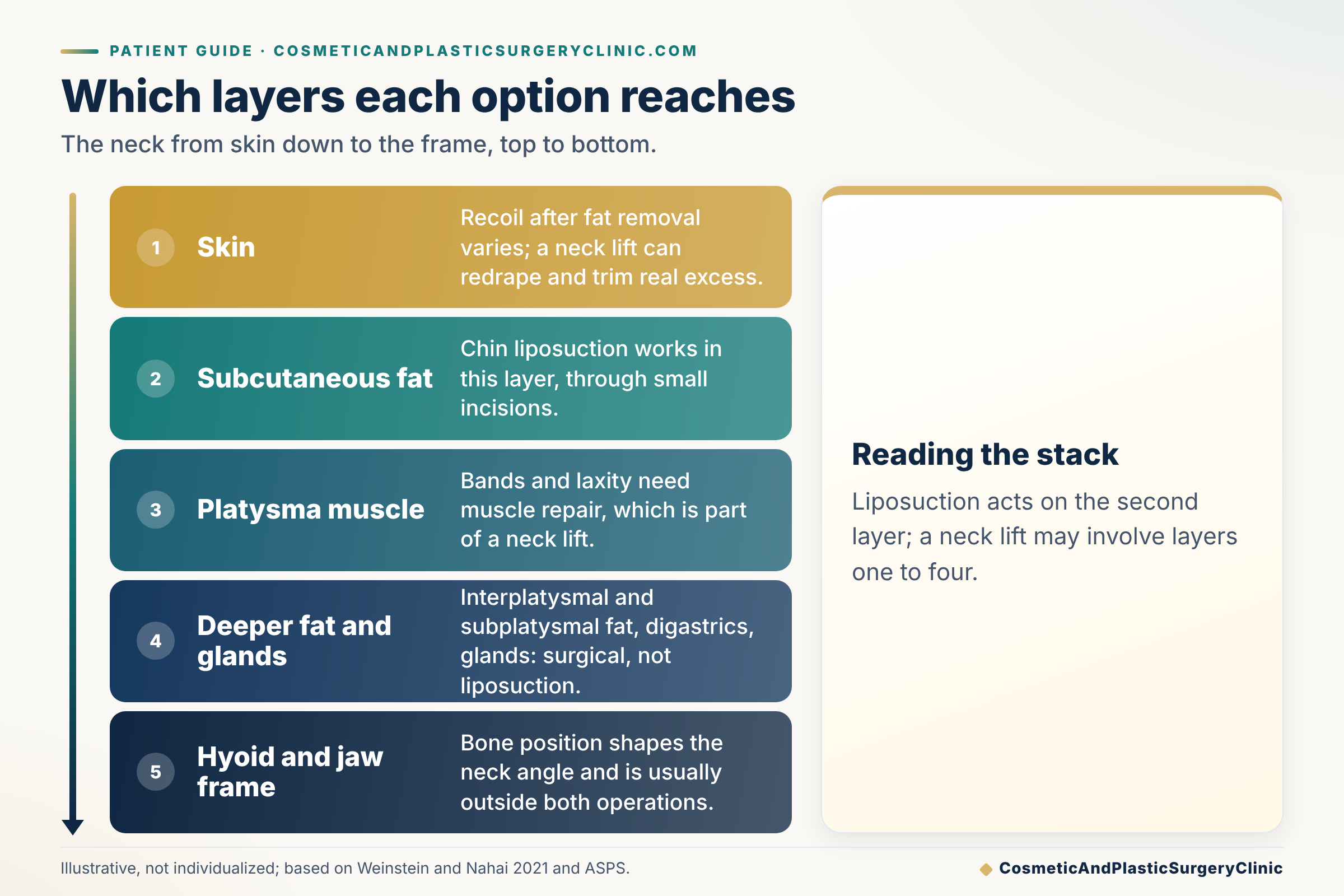
Both operations are aimed at the area between the jawline and the neck crease, so they are easy to treat as two sizes of the same thing. They are closer to two different tools. One works on the outer layers and the other works on the structure underneath them, and the gap between those layers explains many disappointing results. A fair neck lift vs chin liposuction comparison therefore starts with layers, not with incision length.
What chin liposuction removes, and what it leaves in place
Fat above the muscle is the layer it reliably reaches
A 2021 layered review by Weinstein and Nahai in Plastic and Aesthetic Research describes subcutaneous fat as the layer lying between the skin and the platysma, and states that liposuction addresses only that layer. Surgeons leave a thin cushion of fat attached to the skin, which the authors put at no less than 3 to 5 millimeters in their own practice. A 2021 review by Viterbo and Secanho notes that over-removal can cause a hollowed or rippling appearance.
That makes chin liposuction a precise tool for one problem: soft, pinchable fat that sits above the muscle. It is generally done through small incisions, and one 2023 series of 66 patients used tumescent local anesthesia without sedation. ASPS lists irregular contours, rippling or loose skin and fluid accumulation among liposuction risks.
Bands, deeper fat and gland fullness stay out of reach
Beneath the platysma the neck is more crowded. The Weinstein and Nahai review lists interplatysmal fat, which is fibrous and bulges between the inner edges of the muscle, followed by subplatysmal fat in several compartments, the digastric muscles that attach to the jaw and hyoid bone, and the submandibular glands. It says interplatysmal fat is removed surgically rather than by liposuction.
A pinch test is one of the bedside checks surgeons use to sort these out: fat that lifts away from the muscle between the fingers is generally the superficial kind. A review in the Journal of Oral and Maxillofacial Surgery (Fattahi, 2012) concluded that isolated liposuction helps only an isolated group of patients, and its abstract does not define that group.
What a neck lift adds to the same chin
Platysma repair and deeper contouring
Cleveland Clinic describes a neck lift as surgery that removes some fat, removes sagging skin and tightens the platysma, the thin sheet of muscle running from the collarbones toward the lower face. In practice that means the surgeon can address vertical bands, fat between and beneath the muscle edges and, in selected necks, gland or digastric prominence. Which maneuver is chosen depends on how the anatomy presents. The menu is laid out in neck lift techniques.
The depth of the work is also a limit. Weinstein and Nahai advise taking subplatysmal fat only down to the digastric muscles, because over-resection leaves a submental depression. A bigger operation is not automatically a better one; it is a different set of decisions.
Skin redraping and the incision that comes with it
Cleveland Clinic says neck lift incisions run near the sideburn and around the ear as well as under the chin, and sometimes only around the ear. Weinstein and Nahai tie that choice to the skin: real excess calls for an incision near the ear, while apparent excess that disappears after deep contouring may be handled through the chin incision alone. That is one reason scar length belongs in any neck lift vs chin liposuction discussion.
Longer incisions bring their own list of issues. ASPS names unfavorable scarring, temporary or permanent hair loss along the incisions, and sutures that surface through the skin among neck lift risks. If the jowls and jawline border are also blunted, the review says a concomitant facelift is typically needed, a case taken up in neck lift vs facelift.
Skin retraction decides whether chin liposuction alone is enough
Fat can be seen and pinched. Skin response cannot be seen in advance, and it is a variable that can turn a satisfactory result into a partial one. After fat is removed, the skin has to recoil over a smaller volume. How well it does depends on its quality, and no examination predicts it exactly. That uncertainty sits at the center of the neck lift vs chin liposuction decision for many necks.
What published series say about who does well with fat removal alone
Localized midline fullness versus crepe-paper skin
The most useful series for this question is a 2003 report in Plastic and Reconstructive Surgery by Gryskiewicz: 132 patients aged 21 to 73, 67% over 40, with a median follow-up just over one year. Every patient improved on the five Ellenbogen-Karlin visual criteria for a youthful neck, meeting three to five of them. But the 11 patients over 64 had less satisfactory results, often with redundant or crepe-paper skin.
The author found that localized midline fullness predicted a good result better than age or skin tone did, while crepe-paper skin before surgery was the best predictor of failure. The caveats are real: the series is retrospective, 95.5% female, one surgeon’s series, and follow-up was short by neck lift standards. It supports a rule of thumb for the neck lift vs chin liposuction choice, not a promise.
Energy-assisted liposuction and the skin-tightening claim
Ultrasound, laser and radiofrequency add-ons are often presented as skin tighteners. The evidence read for this page is small. A 2008 series in Aesthetic Plastic Surgery combined ultrasound-assisted liposuction with a limited-incision platysmaplasty in 15 women and reported that none needed skin reduction, but the muscle was repaired too, so skin and muscle effects are mixed together.
A 2023 series of 66 patients using bipolar radiofrequency-assisted liposuction excluded severe platysma bands and reported first- or second-degree burns in 5 patients (7.58%), nodules in 5, and temporary lower-lip nerve weakness in 3. Neither series compared the device with plain liposuction. Weinstein and Nahai warn that energy devices can leave contour irregularities or scarring that complicate later surgery. In a neck lift vs chin liposuction decision, a device add-on is a question to ask about, not a reason to skip the comparison.
Signs that fat removal alone may not be enough
Findings a surgeon weighs before any operation
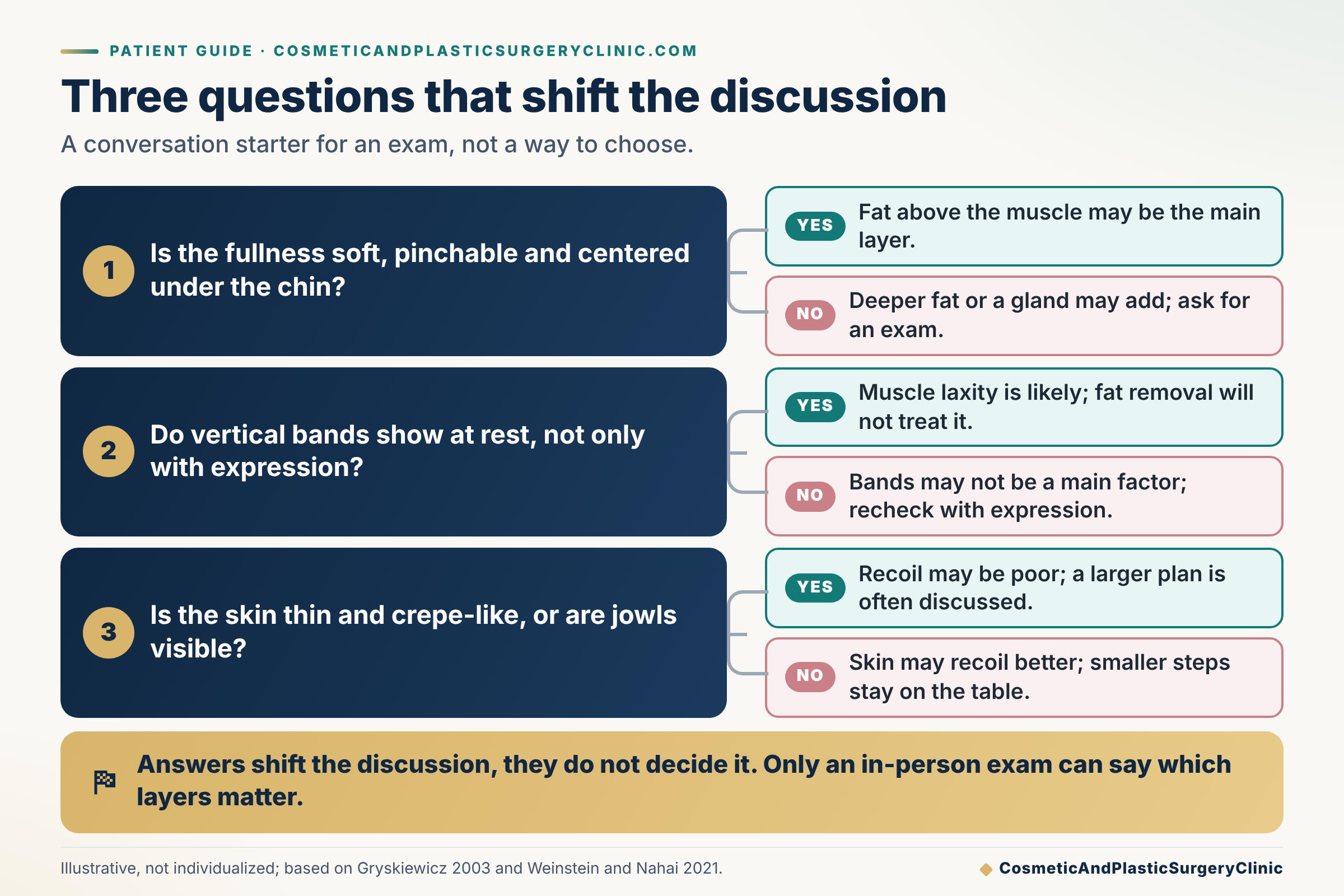
Several findings tend to move the discussion from fat alone toward the muscle or the skin. None is decisive by itself, and an in-person exam beats any list. The table below turns the literature into questions you can ask rather than conclusions you can draw from a mirror.
| Finding | What it can suggest | What it does not prove | Question to ask |
|---|---|---|---|
| Vertical bands at rest | Muscle laxity that fat removal does not treat | That bands will worsen or that surgery is needed | Are the bands visible at rest, or only with expression? |
| Thin, crepe-like skin | Poorer recoil after fat removal (Gryskiewicz 2003 predictor) | How a given neck will respond | What do you expect my skin to do, and why? |
| Fullness that stays when pinched | Fat or tissue beneath the muscle, or a gland | Which structure it is without an exam | Which layer do you think the fullness is in? |
| Blunted jawline or jowls | A problem above the neck that neck work alone may not change | That a facelift is required | Would a lower-face procedure change the plan? |
| Low hyoid or recessed chin | A skeletal contribution neither operation moves | That results will be poor | How much of my neck angle is bone position? |
What can show up after chin liposuction
Early swelling hides the answer. ASPS describes liposuction swelling as continuing to improve from week 6 onward, and Gryskiewicz followed patients a median of just over a year, so a three-week photograph is not a verdict on a neck lift vs chin liposuction plan. No source opened for this page gives a standard waiting interval before judging skin response.
Findings that persist or appear later include visible bands, loose or rippled skin, and hollowing. ASPS lists rippling or loose skin and the need for revision among liposuction risks, and notes that secondary procedures may sometimes be recommended to reduce excess skin. A 2026 systematic review of revision neck lifts found recurrent platysmal banding and persistent submental fullness among the most common reasons for a second operation.
Chin liposuction first, neck lift later: what staging can and cannot settle
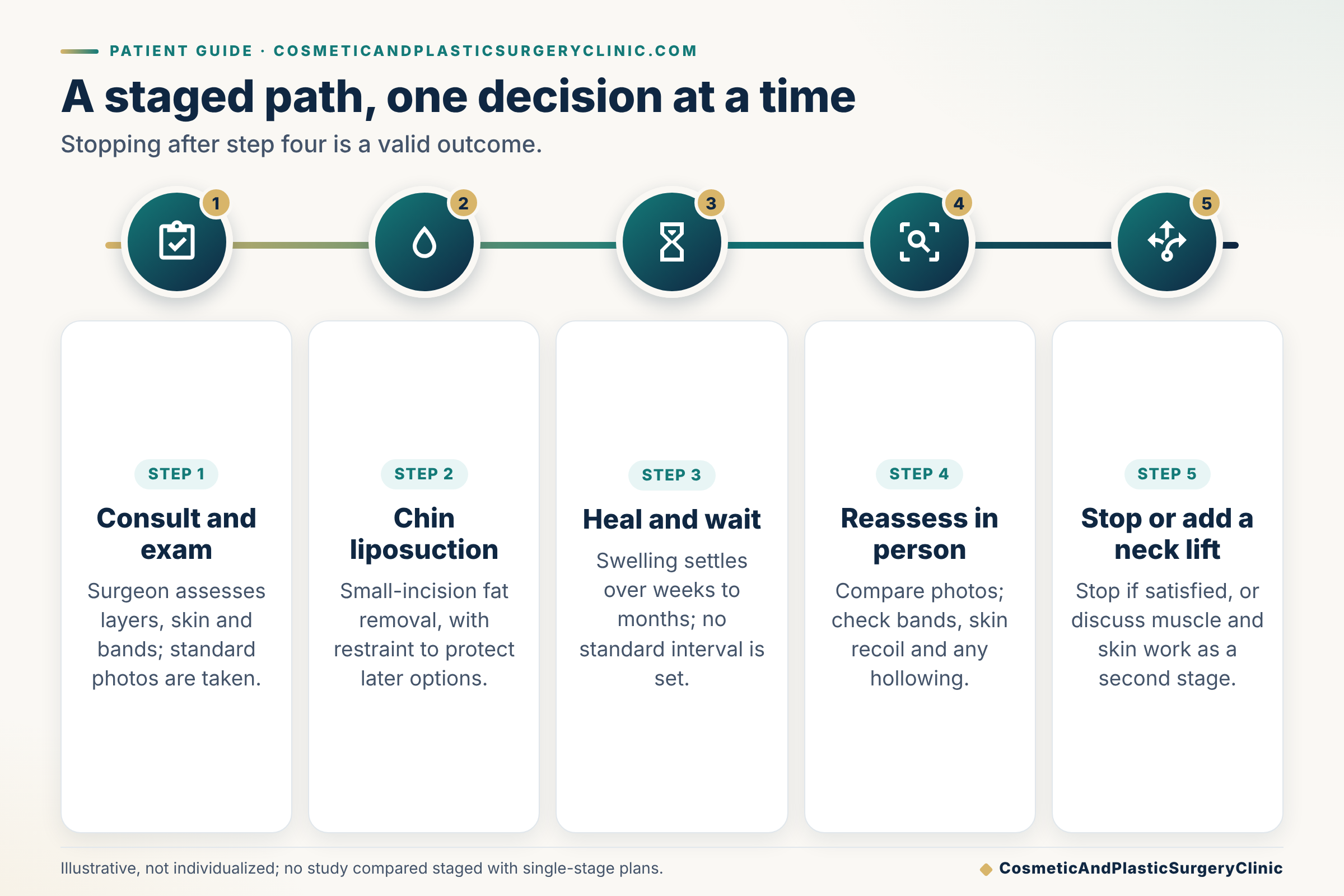
Some people choose chin liposuction first and keep a neck lift in reserve. The logic is easy to state and hard to prove. No source opened for this page compares a staged plan with a single-stage plan, so what follows is a set of trade-offs, not evidence that one sequence gives better results. Treat it as one possible path through the neck lift vs chin liposuction decision, not as a recommendation.
Why a two-step neck lift vs chin liposuction plan appeals
Letting the skin answer the question first
Because skin recoil cannot be predicted precisely, waiting to see it is a straightforward way to make the second decision with real information. If the neck tightens enough, the larger operation may never be needed. If it does not, the plan for the neck lift vs chin liposuction choice is built on how that particular skin behaved, not on an average.
A revision review by Dibbs and colleagues (Seminars in Plastic Surgery, 2021) takes a similar stepwise stance for recurrent platysma bands after earlier neck surgery, saying conservative subcutaneous and submental defatting should be performed initially. And Gryskiewicz framed liposuction without platysmaplasty as a deliberate choice for people who were poor candidates for a facelift, including those with uncontrolled hypertension, heavy smoking, anticoagulant use, or concerns about cost and recovery.
What a two-step plan costs: two recoveries and two sets of fees
A staged neck lift vs chin liposuction plan is not free. Each operation has its own anesthesia, facility time and healing period, and a person who ends up having both goes through two recoveries. ASPS 2024 surgeon-fee ranges, drawn from surveyed members, run $3,000 to $5,500 for chin liposuction and $7,500 to $13,000 for a neck lift. Adding the two ranges gives $10,500 to $18,500 in surgeon fees alone, before two sets of facility and anesthesia charges. That is arithmetic on two ranges, not a quote.
The ASPS neck lift cost page says its average fee excludes anesthesia, operating room facilities and related expenses. Ask whether a neck lift quote already includes fat removal, since Cleveland Clinic describes some fat removal as part of the operation, and whether a first-stage fee is credited later. Neck lift cost breaks down the line items, and plastic surgery cost covers how to compare quotes in general.
How earlier liposuction changes a later neck lift
Scar tissue, hollowing and over-resection
The first operation can narrow the options for the second. Dibbs and colleagues attribute some submental hollowing to overly aggressive liposuction and defatting, and describe anterior neck irregularity from scarring and adherence as hard to correct. Weinstein and Nahai add that energy-device injury can leave contour irregularities or scars that complicate later surgery.
For a person weighing a staged plan, the practical point is restraint. A first-stage plan that removes less fat, or avoids high-energy devices where the benefit is unproven, leaves a neck that is easier to operate on later. It is a fair question to put to a surgeon: how would you protect the option of a neck lift?
What revision series report about the second operation
A 2026 systematic review in Aesthetic Plastic Surgery (Şibar, Erdal and Genç) pooled five retrospective series with 188 revision neck lifts. Recurrent platysmal banding, persistent submental fullness and submandibular gland ptosis were the most common reasons. Complications were uncommon and mostly transient, chiefly temporary marginal mandibular nerve weakness and isolated hematoma, with no permanent nerve deficits reported.
The evidence is graded Level IV, outcomes were mostly surgeon-reported and the abstract read for this page does not say how many patients had earlier liposuction. Dibbs and colleagues add that fat grafting for a hollowed neck should wait at least 6 to 12 months after the primary procedure. Revision is possible, but it is a larger decision than the first operation looked like.
Injections as a third lane between doing nothing and surgery
Deoxycholic acid injection is the nonsurgical fat option with a specific US prescribing label. Its mechanics, trial results and the other cooling and device options are covered in the sibling articles, including neck tightening vs neck lift. This section keeps to one narrow question: how it bears on the neck lift vs chin liposuction decision.
What the deoxycholic acid label covers and what it excludes
Scope: submental fat in adults, and nothing else
The FDA-approved prescribing label for deoxycholic acid injection (Kybella, 2022 revision) states the indication as improvement in the appearance of moderate to severe convexity or fullness associated with submental fat in adults. Its limitations of use say safety and effectiveness for subcutaneous fat outside the submental region has not been established and is not recommended.
That wording matters for the comparison. The injection is a fat treatment, and the label draws no claim about bands, loose skin or jowls. A neck whose main problem is one of those is outside what the product was approved to treat.
Nerve, swallowing and vessel warnings
The label warns against injecting into or near the marginal mandibular branch of the facial nerve, which controls part of the lower lip and smile. It also reports that difficulty swallowing occurred in trials and advises avoiding use in people with current or prior dysphagia, and it cautions against injecting into an artery or vein.
Nerve injuries reported in the trials presented as an asymmetric smile or facial weakness and resolved on their own. A nonsurgical option still has risks that need the same plain discussion as an operation.
How injections change the neck lift vs chin liposuction decision
A series of visits instead of one operation
The label permits up to six single treatments at least one month apart. A 2021 consensus article in Plastic and Reconstructive Surgery Global Open (Teller and colleagues, funded by the manufacturer) describes typical courses of two to four treatments spaced about six to eight weeks apart. That trades one larger recovery for several short ones, and the number of sessions is not fixed in advance.
The consensus article is an expert-panel statement, and most of its authors disclosed ties to the manufacturer, so its practical guidance is best read as informed opinion, not a trial result.
Where injections stop helping
The same consensus article lists screening points that overlap with the surgical decision: fat location, a low hyoid position, prominent platysmal bands and a small lower jaw. It says patients with severe laxity or excess fat beneath the platysma may do better with other therapies, and that prior submental surgery or scarring may make someone a poor candidate.
That list reads like the layer chart in reverse. Injections suit fat above the muscle, in skin that does not need to be lifted. For bands and loose skin, the realistic comparison returns to the neck lift vs chin liposuction pair, or to the nonsurgical neck tightening options compared with surgery.
Neck lift vs chin liposuction on recovery, scars, risk and cost
Once the anatomy points one way in the neck lift vs chin liposuction decision, the practical differences decide whether the operation is a good fit for a life. They are easier to compare when recovery, scars, reversibility, risk and money are held side by side, with the evidence limits marked.
Recovery, scars and what can be revised
Downtime and incision burden in neck lift vs chin liposuction
Cleveland Clinic’s double chin page puts discomfort, swelling, bruising and tight skin at about two weeks, with most people back at work and daily activities within a week or two, and incisions taking several months to heal fully. It also says a neck lift is more extensive than a chin tuck and that recovery after the smaller procedure is generally faster. Its neck lift page adds that muscle tightness can last several months.
ASPS’s neck lift recovery page mentions a bandage around the face and neck, a thin drain in some cases, and keeping the head elevated and straight. Exact timelines are the surgeon’s to set. Week-by-week detail is in neck lift recovery.
| Factor | Chin liposuction | Neck lift | Evidence note |
|---|---|---|---|
| Layers treated | Subcutaneous fat above the platysma | Muscle, fat in several layers, skin redraping | Weinstein and Nahai 2021 (review) |
| Skin and bands | Does not remove skin or repair bands | Can tighten muscle and remove excess skin | ASPS; Cleveland Clinic |
| Incisions | Small access points | Under the chin, often around the ears too | Cleveland Clinic; Yen 2023 |
| Anesthesia | Local anesthesia without sedation in one series | General anesthesia or IV sedation | Yen 2023; Cleveland Clinic |
| Recovery | Shorter; about two weeks of swelling and tightness | Longer; muscle tightness may last months | Cleveland Clinic (general page) |
| Revision | Scar-related irregularity is hard to correct; fat grafting for hollowing | Revision series report mostly transient problems | Dibbs 2021; Şibar 2026 (Level IV) |
| Cost logic | Lower surgeon fee; two stages double facility charges | Higher surgeon fee; one facility fee | ASPS 2024 survey ranges |
Reversibility, maintenance and revision
Neither operation stops the neck from aging; ASPS says so plainly for the neck lift. Weinstein and Nahai list band recurrence, in over one-third of cases despite complete transection of the muscle, among neck lift complications, and Dibbs and colleagues note that botulinum toxin can camouflage recurrent bands. Cleveland Clinic says results can last years and vary with genetics, smoking, sun exposure and whether recovery had complications.
Fat removal is not undone the way a filler can be dissolved. If too much is taken, one repair described in the revision literature is fat grafting after healing, and the general principles for correcting a disappointing liposuction result are covered in liposuction revision. A smaller first step is easier to build on than to reverse.
Risk and cost in the same frame
Different layers, different risks in neck lift vs chin liposuction
ASPS lists, for liposuction, irregular contours, rippling or loose skin, fluid accumulation, burns from ultrasound energy and numbness that may persist. For a neck lift it lists hematoma, rare weakness of the lower lip from nerve injury, skin loss, hair loss along incisions and sutures that surface. The two lists overlap on infection, anesthesia and poor healing.
Numbers are scarce for a head-to-head comparison. Viterbo and Secanho (2021) report neck rejuvenation hematoma rates of about 0.2% to 8.0% and great auricular nerve injury of about 6%, often transient, but their review is narrative, draws on older single-center cohorts and gives no comparison with liposuction. Treat those as ranges for different groups, not forecasts. Neck lift risks separates expected effects from complications and emergencies.
Reading a quote: what each line covers
Two quotes for neck lift vs chin liposuction can look far apart because they cover different work. A chin liposuction line might include only fat removal, while a neck lift line might fold in defatting, muscle repair and skin work. The table lists the lines to match before comparing totals; the ASPS neck lift cost page says its average fee excludes anesthesia, facility and related expenses, and most health plans do not cover neck lift surgery or its complications.
| Quote line | Chin liposuction | Neck lift | What to compare |
|---|---|---|---|
| Surgeon fee | $3,000 to $5,500 (ASPS 2024 range) | $7,500 to $13,000 (ASPS 2024 range) | Which maneuvers are included |
| Facility | Charged per operation | Charged per operation | Accredited or hospital setting; staged plans pay twice |
| Anesthesia | Separate from the surgeon fee | Separate from the surgeon fee | Who provides it and what it covers |
| Garment and follow-up | Included or itemized; varies | Included or itemized; varies | Number of visits included |
| Revision policy | Varies by practice | Varies by practice | Fee, timing and facility charge for a second operation |
Two neck profiles for neck lift vs chin liposuction, with one variable changed
The neck lift vs chin liposuction comparison is easier to hold in mind through examples. The two profiles below are hypothetical, built from the published findings above, and cannot tell any reader what their own neck needs.
Same fullness, different skin and muscle
Profile one: soft midline fullness and firm skin
Consider a hypothetical 38-year-old whose fullness is soft, centered under the chin, easy to pinch, with firm skin and no bands at rest or when swallowing. This pattern resembles the localized midline fullness that predicted good results in the Gryskiewicz series, and chin liposuction is a reasonable first option to discuss. The reason is fit: the problem sits in the layer the operation reaches.
The facts that could reverse that plan are findings the examination may reveal: bands that appear with expression, skin thinner than it looks, a low hyoid or recessed chin, or a prior neck scar. Any of them moves the conversation toward the layers liposuction does not reach.
Profile two: the same fullness with visible bands and looser skin
Now consider a hypothetical 58-year-old with similar fullness, but with vertical bands at rest and skin that folds. Liposuction would remove fat and leave the bands, and the loose skin would have less to recoil over. A neck lift, which can repair the muscle and redrape the skin, is a reasonable option to discuss. If jowls and a blunted jawline are also present, a lower facelift enters the conversation.
Age was not what changed. In the Gryskiewicz series, skin quality and the pattern of fullness predicted outcomes better than age did. Someone who understands the limits and prefers the smaller step may still choose liposuction, accepting that a partial change is possible. That is a legitimate decision, and so is waiting.
| Goal and anatomy | Option a surgeon may discuss | Reason | Finding that could reverse it |
|---|---|---|---|
| Soft midline fat, firm skin, no bands | Chin liposuction | Fat above the muscle is the problem layer | Bands with expression or a low hyoid |
| Fat plus vertical bands at rest | Neck lift | Bands need muscle work that fat removal skips | Medical reasons to avoid a longer operation |
| Fat with crepe-like, loose skin | Neck lift, or a smaller step with limits | Poor recoil predicted partial results in one series | Patient preference for the smaller operation |
| Fullness that stays when pinched | Neck lift if surgery is chosen | Deeper fat or glands lie beyond liposuction | Exam shows mainly superficial fat |
| Jowls and a blunted jawline | Lower facelift with neck work | The problem extends above the neck | Goal limited to the area under the chin |
Six checks before settling neck lift vs chin liposuction
Checks about your anatomy and expectations
- Ask which layer the surgeon believes holds the fullness and which finding, such as the pinch test, bands at rest or a side photograph, supports that.
- Ask what your skin is expected to do after fat removal, and what finding would make the surgeon change the plan. Ask whether an energy-assisted device is proposed and what evidence supports it for the neck.
- Ask whether jowls, chin position or hyoid position change the plan. Neck lift candidate explains what surgeons assess.
Checks about staging, risk and the quote
- Ask what happens if the result is partial: the revision options, the practice’s policy and fee, and how a conservative first stage protects a later neck lift.
- Ask for risks by layer, sorted into expected effects, reportable problems and emergencies, and who answers after hours. The plastic surgery consultation page covers how to judge the answers.
- Compare quotes line by line, as in the second table, and verify credentials using how to choose a plastic surgeon.
Frequently asked questions
Does a neck lift include chin liposuction, or is it billed separately in a neck lift vs chin liposuction quote?
Sources describe the overlap but not the billing. Cleveland Clinic says a neck lift removes some fat, while the ASPS neck lift page does not mention liposuction at all. So what is included depends on the surgeon’s plan and the practice’s way of quoting. Ask the quote to name each maneuver: fat removal, muscle repair and skin excision. The ASPS 2024 surgeon-fee ranges for the two operations are surveyed separately, which does not tell you how a combined plan is priced.
Is age the deciding factor in neck lift vs chin liposuction?
Not by itself. In the Gryskiewicz series, 67% of patients were over 40, and age mattered less than the pattern of fullness and skin quality for predicting results. But the 11 patients over 64 had less satisfactory outcomes, often with crepe-paper skin, so age and skin quality tend to travel together. A surgeon who relies on age alone, without examining skin recoil and the muscle, is giving you less information than the published findings suggest.
What if my double chin appeared after major weight loss, and how does that affect neck lift vs chin liposuction?
Loose neck skin after significant weight loss is one of the situations Cleveland Clinic lists for a neck lift. Chin liposuction removes fat but not skin, and ASPS notes that secondary procedures may sometimes be recommended to reduce excess skin after liposuction. Bring your weight history to the consultation, including how long your weight has been stable, and ask how it changes the plan. If the skin has lost elasticity, the question becomes whether a smaller operation is likely to leave you with a partial result.
Can radiofrequency or ultrasound added to liposuction replace a neck lift?
The evidence read for this page does not show that. One 2008 series paired ultrasound-assisted liposuction with a limited-incision platysmaplasty, so the muscle was repaired as well. A 2023 radiofrequency series excluded severe platysma bands and reported burns in 7.58% of patients. Neither compared the device with plain liposuction. Weinstein and Nahai warn that energy devices can cause burns, nerve injury and scarring. Ask which device is proposed, why, and what happens if the skin does not tighten.
How long should I wait after chin liposuction before judging the result or planning a neck lift?
No source opened for this page gives a standard interval. ASPS describes liposuction swelling as continuing to improve from week 6 onward, and the Gryskiewicz series followed patients a median of just over a year. A revision review recommends waiting at least 6 to 12 months before fat grafting a hollowed neck after the first operation. Ask your surgeon when they judge results and what findings, such as persistent bands or loose skin, would prompt a conversation about a second stage.
Does insurance cover a neck lift vs chin liposuction?
Usually not. ASPS says most health insurance plans do not cover neck lift surgery or its complications, and Cleveland Clinic says most insurers do not cover cosmetic chin and neck surgery. Many practices offer payment plans, and the mechanics of loans and medical credit cards are covered in plastic surgery financing. Ask whether any fee is refundable if you postpone, and get the scope of each quoted procedure in writing before you compare totals.
Does neck lift vs chin liposuction change which type of anesthesia is used?
Cleveland Clinic lists general anesthesia or IV sedation for a neck lift. In the 2023 radiofrequency-assisted liposuction series, patients were treated under tumescent local anesthesia without sedation. Those are one page and one series, not rules, because the choice depends on how extensive the work is, the surgeon’s practice, the facility and your health. Ask who provides anesthesia, what type they plan and why, and what the facility’s emergency arrangements are.
Can bands come back after a neck lift, and does doing liposuction first make that more likely?
Bands can recur. Weinstein and Nahai report recurrence in over one-third of cases despite complete transection, and the 2026 revision review lists recurrent banding as a leading reason for a second operation. No source opened shows that having liposuction first changes that risk. Dibbs and colleagues say botulinum toxin can camouflage recurrent bands. Ask your surgeon how they handle recurrence and whether they discuss it at the first visit.
Sources and further reading
- American Society of Plastic Surgeons — Neck lift (accessed 2026-11-12) — what the procedure treats, what it cannot do
- American Society of Plastic Surgeons — Neck lift risks and safety (accessed 2026-11-12) — listed risks
- American Society of Plastic Surgeons — Neck lift recovery (accessed 2026-11-12) — bandage, drain, head position
- American Society of Plastic Surgeons — Neck lift cost (accessed 2026-11-12) — fee exclusions, insurance, financing
- American Society of Plastic Surgeons — Cosmetic procedures average cost, 2024 (accessed 2026-11-12) — surgeon-fee ranges
- American Society of Plastic Surgeons — Plastic surgery statistics report, 2025 (accessed 2026-11-12) — neck lift and chin liposuction volumes, methodology
- American Society of Plastic Surgeons — Liposuction recovery (accessed 2026-11-12) — swelling timeline
- American Society of Plastic Surgeons — Liposuction risks and safety (accessed 2026-11-12) — listed risks, skin statements
- Cleveland Clinic — Double chin surgery (accessed 2026-11-12) — chin liposuction vs neck lift, recovery, coverage
- Cleveland Clinic — Neck lift (platysmaplasty) (accessed 2026-11-12) — what the operation includes, incisions, anesthesia
- Weinstein AL, Nahai F — A layered approach to neck lift, Plastic and Aesthetic Research (2021; accessed 2026-11-12) — layers, when liposuction alone is insufficient
- Viterbo F, Secanho MS — An update about neck rejuvenation and complications, Plastic and Aesthetic Research (2021; accessed 2026-11-12) — complication ranges, over-removal
- Gryskiewicz JM — Submental suction-assisted lipectomy without platysmaplasty, Plastic and Reconstructive Surgery (2003; accessed 2026-11-12) — 132 patients, predictors of outcome (abstract)
- Fattahi T — Submental liposuction versus formal cervicoplasty, Journal of Oral and Maxillofacial Surgery (2012; accessed 2026-11-12) — narrative review (abstract)
- Rooijens PPGM, Zweep HP, Beekman WH — Ultrasound-assisted liposuction with limited-incision platysmaplasty, Aesthetic Plastic Surgery (2008; accessed 2026-11-12) — 15 patients, aspirate volumes (abstract)
- Yen S et al. — Bipolar radiofrequency-assisted liposuction for cervical contouring in Eastern Asians, Aesthetic Surgery Journal Open Forum (2023; accessed 2026-11-12) — 66 patients, aspirate volume, burns
- Dibbs RP, Chamata E, Ferry AM, Friedman JD — Revision facelift and neck lift, Seminars in Plastic Surgery (2021; accessed 2026-11-12) — hollowing, bands, fat grafting timing
- Şibar S, Erdal AI, Genç G — Revision neck lift surgery: a systematic review, Aesthetic Plastic Surgery (2026; accessed 2026-11-12) — 188 revision cases (record)
- US Food and Drug Administration — Prescribing information for deoxycholic acid injection (2022 label; accessed 2026-11-12) — indication, limitations of use, warnings, dosing
- Teller CF et al. — Best clinical practices with ATX-101 for submental fat reduction, Plastic and Reconstructive Surgery Global Open (2021; accessed 2026-11-12) — screening points, course length (manufacturer-funded consensus)
- Visual criteria for success in restoring the youthful neck, Plastic and Reconstructive Surgery (1980; accessed 2026-11-12) — origin of the visual criteria (abstract)