Most people who weigh a neck lift vs facelift start from a mirror, not from anatomy. The jawline looks softer, a vertical band shows when they talk, or the neck seems older than the cheeks. The two operations overlap, share incision paths around the ear and are often done together, so the choice is less about picking a winner than about locating the problem. Cheeks and folds, the jowls and jawline, and the neck below the jaw each age differently, and each responds to different surgical steps.
This page owns one decision: whether the neck alone, the face and neck together, or neither needs a surgical plan, and what to ask so that a label does not make the choice for you. It is general education, not a verdict on any face or neck. The wider maps sit in the neck lift overview and the facelift overview; this article stays on the neck lift vs facelift comparison.
Neck lift vs facelift: shared incision paths, different jobs
Picture three zones stacked from cheekbone to collarbone: the cheeks and folds, the jowls and jawline, and the neck below the jaw. A neck lift vs facelift comparison is really a question about how many of those zones need work, because the two operations are defined by their reach, not by a clean boundary.
Which operation reaches which zone
Cheeks, folds and jowls sit on the facelift side
The American Society of Plastic Surgeons (ASPS) lists what a facelift treats: relaxed facial skin, deepened folds between the nose and the corners of the mouth, fat that has fallen or disappeared, jowls, and loose neck skin and fat that can look like a double chin or “turkey neck.” An ASPS article from October 2023 puts the face side simply: a facelift aims at the mid and lower face, including deep nasolabial folds and sagging cheeks.
Neither description promises everything. ASPS says a facelift cannot stop the aging process, and Cleveland Clinic adds that it cannot treat superficial wrinkles, sun damage or uneven skin color. If surface texture is the main complaint, a neck lift vs facelift question may be the wrong place to begin.
Under-chin fat, bands and loose neck skin sit on the neck side
ASPS describes a neck lift, also called a lower rhytidectomy, as surgery that improves visible aging in the jawline and neck: excess fat and relaxed skin that form jowls, fat under the chin, loose neck skin and muscle banding that distorts the contour. Its 2023 article adds that the operation reshapes the angle between jaw and neck, removes excess skin, tightens neck muscles and can reduce fat under the chin.
The muscle involved is the platysma, a thin sheet that runs from the collarbones to the lower face, according to Cleveland Clinic. ASPS notes that it can split into bands as it ages and that tightening it is a common part of the operation. How the surgeon does that is the subject of the neck lift techniques article.
Why the labels overlap more than people expect
A lower rhytidectomy is a neck lift that includes the jawline
Notice that ASPS counts jowls under neck lift. Its traditional neck lift incision starts at the hairline near the sideburn, runs down and around the ear and ends in the hair behind it, usually with a separate cut under the chin. A limited version stays around the ear, but ASPS cautions that results may be more limited. Mayo Clinic describes a similar path: it starts in front of the earlobe, wraps the ear and includes a small cut under the chin.
That route overlaps the lower half of a facelift incision. So a neck lift as ASPS defines it already touches the lower face, and the practical difference from a facelift is mostly whether the cheeks and midface are lifted as well.
What “facelift” includes depends on the plan, not the word
ASPS defines a facelift as improving signs of aging in “the face and neck,” and Mayo Clinic notes that many patients have a neck lift at the same time. A facelift that tightens the platysma, treats fat under the chin and uses an incision beneath the chin is, in function, a facelift plus a neck lift, whatever the quote calls it. A short-scar lift may barely reach the neck, so the same name can describe very different amounts of neck work.
The takeaway is practical. Ask the surgeon to list the structures treated, not to name the operation: skin, fat, platysma, deeper tissue, and whether there is an incision under the chin.
| Factor | Neck lift | Facelift | Basis |
|---|---|---|---|
| Main target | Fat under the chin, platysma bands, loose neck skin; often the jawline near the ear | Cheeks, nasolabial folds, jowls, plus neck skin and fat | ASPS procedure pages; ASPS 2023 article |
| Incisions | Sideburn hairline around the ear, often plus under the chin; ear-only version more limited | Temple hairline around the ear into the lower scalp; sometimes under the chin | ASPS; Mayo Clinic |
| Anesthesia and time | IV sedation or general anesthesia; typically outpatient | IV sedation or general; Mayo cites 3 to 6 hours, longer with other procedures | ASPS; Cleveland Clinic; Mayo Clinic |
| Reach into the neck | Direct: fat, platysma, sometimes deeper structures | Depends on the plan; neck steps are often added | Boyd and Ceradini 2025; StatPearls 2026 |
| Downtime | Tightness may last several months; no return-to-work range on ASPS or Cleveland pages | Bruising and swelling about 2 to 3 weeks; feeling normal 2 to 3 months | Cleveland Clinic |
| Reversibility | Not reversible; scars remain, placed in hairline and ear contours | Not reversible; scars remain, placed in hairline and ear contours | Mayo Clinic; ASPS |
| Maintenance | Results can last years; aging continues | Often described as 7 to 10 years; aging continues | Cleveland Clinic |
| Risk profile | Same families: hematoma, nerve injury, numbness, infection, wound problems | Same families; rates differ by technique and series | ASPS safety pages; Mayo Clinic |
| Cost logic | ASPS 2024 surgeon-fee range $7,500 to $13,000 | ASPS 2024 surgeon-fee range $12,000 to $19,000 | ASPS 2024 statistics; surgeon fees only |

Why surgeons so often combine the two
The anatomy that links jawline to neck
One sheet of tissue runs from cheek to neck
The StatPearls chapter on deep plane facelift (updated January 2026) explains the link: the superficial musculoaponeurotic system, or SMAS, is contiguous with the platysma in the neck, and sagging of the platysma produces vertical neck bands. A neck lift can be added through the same subcutaneous plane, and some surgeons use limited dissection under the skin together with work beneath the platysma, an approach called a preservation rhytidectomy.
A 2025 narrative review by Boyd and Ceradini notes that experts still debate whether the SMAS is a true anatomic layer or a surgically defined flap. Either way, tissue pulled upward along the jaw is attached to tissue that becomes the neck, which is why a neck lift vs facelift plan often shares one dissection. The deep plane vs SMAS facelift article compares the layers in detail.
What the volume numbers can and cannot tell you
ASPS reported national estimates for 2025 of 77,933 facelifts and 27,315 neck lifts. The report built those figures from member-surgeon information, CosmetAssure data and a claims dataset, then extrapolated them. That works out to roughly three facelifts for every neck lift. Volume says little about whether a neck lift vs facelift choice suits a particular person, and the totals do not say how many facelifts included neck work, or how many neck lifts included lower-face lifting.
One surgical team gives a glimpse of a practice built around the neck. In a 2021 report in Plastic and Aesthetic Research, Auersvald and Auersvald reviewed 1,019 consecutive neck lift patients treated between 2011 and 2020: about 92% had a facelift (rhytidoplasty) at the same time, and 80 patients, 7.8%, had a neck lift alone. That is one team’s pattern, not a rule, and it is retrospective with no comparison group.
What a facelift does to the neck on its own
Evidence that facelift technique can move the neck
A retrospective series in the Annals of Plastic Surgery, summarized by ReachMD in December 2025, followed 53 patients over ten years of one surgeon’s practice after an extended SMAS facelift. Sagging of the submandibular gland fell from an average of 8.9 mm to 0.1 mm, and the cervicomental angle, the angle between the chin and the neck, narrowed from an average of 152 degrees to 121 degrees. Average follow-up was 8.4 months.
The limits are plain: one practice, no control group, short follow-up and a secondary summary of the paper. For scale, a 2024 textbook chapter by Maia and Araujo gives 105 to 120 degrees as the range its authors consider desirable. The series shows that lifting the SMAS and platysma together can reshape the neck, which supports asking what a facelift plan includes, not assuming it includes nothing.
Why late neck failures keep appearing in the literature
A 2020 review in Facial Plastic Surgery, titled “Another Look at Platysmaplasty in Facelifting,” states that long-lasting neck results remain hard to achieve and that late failures are a common problem for patients and surgeons. It emphasizes rebuilding an upper-neck platysma “sling” to reduce bands and define the jawline, and it proposes an evaluation framework that matches maneuvers to the individual neck.
The lesson for a neck lift vs facelift comparison is about specificity. A lower-face lift that does not name its neck steps may leave the neck to chance, while a neck-focused plan that skips the jowls may leave the lower face behind. Neither failure is inevitable; both are questions to ask before agreeing to a plan.
When a neck lift alone is the better-matched plan
Anatomy that tips a neck lift vs facelift choice toward the neck
A neck that has aged faster than the face
ASPS states the situation directly: some people hold off on a full facelift because the upper face still looks good, and when the neck does not match the upper face, a neck lift may be a good solution. A surgeon quoted in the 2023 ASPS article says the neck is the first thing to age for many women; that is an observation, not a measured rate, but it matches the pattern that leads to isolated neck surgery.
Consider a hypothetical 52-year-old whose cheeks and jowls look supported, but who has two vertical bands and a soft line under the chin. A surgeon might discuss liposuction, platysma tightening and a small incision under the chin, and might find the case suits a neck-only plan. That is a pattern, not a recommendation; an examination decides.
Skin laxity, not only the angle, sets the ceiling
A 2018 conference abstract from Cleveland Clinic (Surek and colleagues, Plastic and Reconstructive Surgery Global Open) reviewed 27 patients who had a neck lift through a submental incision. Blinded evaluators graded photographs taken an average of 24.7 months later: the cervicomental angle improved by an average of 1.0 grade on the Knize scale, and apparent age fell by an average of 3.6 years. The authors concluded that success depended more on the degree of skin laxity than on the severity of the angle.
The abstract has no control group and relies on photo grading. Maia and Araujo, by contrast, write that skin excision is the least important step and a well-defined cervicomental angle the most important result. The two views are not contradictory but they weigh skin differently, which is a good reason, in any neck lift vs facelift discussion, to ask how your surgeon reads yours.
Where an isolated neck lift stops
Jowls and the lateral jawline: the gray zone in a neck lift vs facelift plan
ASPS places jowls within a neck lift, yet the Cleveland abstract says improvement from the submental approach was mainly in the neck profile and limited to below the jawline. Both can be true: a plan with incisions around the ear can reach farther along the jaw than an under-chin incision alone. Cheeks and nasolabial folds stay outside either version, since ASPS assigns them to the facelift.
The question to ask is specific: which incisions are planned, and how much change in the jowls and along the jaw should be expected? The neck lift candidate article describes what surgeons examine to answer it.
Structures under the muscle that skin-and-platysma work may not change
Maia and Araujo describe submandibular gland bulging as arising from ptosis, poor position or true enlargement, and list observation, botulinum toxin, fat grafting, implants, repositioning and partial resection as options, with resection “reserved only for severe cases.” They also describe the hyoid, the small bone above the larynx, as a factor in the cervicomental angle.
Deeper work carries its own risks. Mendelson and Tutino reported 112 gland reductions among 736 consecutive facelifts by one surgeon (2002 to 2013): 1.8% needed early reoperation for hematoma, one of them potentially fatal, and the authors warn that deep bleeding can compress the airway. About 4.5% developed a salivary collection and 4.5% a temporary jaw-nerve weakness, both resolved by three months. Neither a neck lift nor a facelift treats these structures automatically, so they belong in the neck lift vs facelift conversation.

When a facelift is the better-matched starting point
Anatomy that tips a neck lift vs facelift choice toward the facelift
Midface descent and deep folds
A neck lift does not lift the cheeks or soften the folds beside the nose and mouth, and ASPS assigns those to the facelift. Cleveland Clinic recommends a traditional facelift for moderate to significant aging, describes a mid-facelift as repositioning cheek fat and tightening cheek skin, and says a deep plane lift raises the SMAS, fat and skin as one unit.
The StatPearls chapter lists malar fat pad descent, nasolabial folds and jowling among deep plane indications, and says that releasing the retaining ligaments that tether skin to bone matters for folds and jowls. In a neck lift vs facelift comparison this is the clearest case for the facelift side: a plan limited to the neck cannot reach any of that, however well it is done.
Jowls and a blurred jawline in the lower face
StatPearls attributes jowling to fat that herniates forward and to SMAS descent just behind the mandibular ligaments, and calls releasing that ligament critical for reducing jowls in a deep plane lift. When jowls lead the complaint and the neck is secondary, the usual conversation is a lower-face lift with some neck steps. When the neck leads and jowls are minor, the conversation tilts toward the neck.
That boundary is where a neck lift vs facelift choice is hardest to call from a photograph. Ask the surgeon which of the two, the jowl or the neck, is expected to improve more, and why.
Why a facelift without a neck plan can disappoint
Ask whether platysma and fat are part of the operation
The 2023 ASPS article says facelift patients also need attention to the neck because neck skin is thinner and more affected by gravity and sun damage; the claim is the article’s, but the logic is plain. A neck lift vs facelift quote that says only “facelift” deserves this question. If it does not mention the platysma, fat under the chin or an incision beneath it, bands and fullness may be left alone while the cheeks and jowls change.
The fix is a single sentence at the consult: “Which neck steps are in this plan, and which are not?” The answer should name structures, not adjectives.
The technique family shapes the neck as well
Boyd and Ceradini list three platysma strategies: vertical plication, lateral myotomy with suspension, often called a platysmal hammock, and complete transection with suspension. They note that experts disagree on whether lateral myotomy is necessary. They also cite a 183-study meta-analysis that found higher odds of temporary facial-nerve weakness with deep plane lifts (odds ratio 2.22) than with SMAS plication, and no difference in permanent injury.
None of this ranks one strategy above another for every neck. It shows that “facelift” covers several operations with different neck behavior and different risk profiles, which is why a neck lift vs facelift choice also involves a technique family. The facelift overview explains those from the face side.
Comparing the burden: scars, recovery, risk and cost
Scars, anesthesia and recovery
Incision maps side by side
ASPS describes a traditional facelift incision as starting in the hairline at the temples, continuing around the ear and ending in the lower scalp, with a limited-incision version for people with less skin relaxation that is less rejuvenating. Its neck lift incision begins in front of the earlobe and wraps behind the ear to end in the hair there, with a second incision under the chin when needed.
The main scar difference in a neck lift vs facelift comparison is therefore the temple hairline, which a neck lift skips. Both can include a scar beneath the chin. ASPS says closed incisions end up hidden in the hairline and the natural contours of the ear; Mayo Clinic states that facelift scars do not go away. Both statements hold: hidden is not the same as absent.
Published recovery ranges and what they leave out
Cleveland Clinic gives facelift ranges: bruising and swelling for about two to three weeks, feeling normal in two to three months, return to work in about two to three weeks for a traditional lift and no strenuous exercise for at least three weeks. Mayo Clinic adds stitches out around a week and follow-up for two months. For the neck, Cleveland Clinic says muscle tightness can last several months, and ASPS advises head elevation, avoiding neck twisting and not applying ice.
Neither ASPS nor Cleveland Clinic gives a return-to-work range for a neck lift, so no neck lift vs facelift recovery comparison exists in these sources. Cleveland calls a neck lift less invasive, which is not the same as short. Read the neck lift recovery article for week-by-week detail, and the facelift recovery article for the longer face-side arc.
Risk and cost when two operations share one day
What combining adds to the risk picture
ASPS lists the neck lift risks: bleeding, fluid collection (hematoma), asymmetry, infection, numbness, persistent pain, poor wound healing, prolonged swelling, skin loss, scarring, a rare nerve injury that could weaken the lower lip, a rare risk of deep vein thrombosis and the chance of revisional surgery. Mayo Clinic calls hematoma the most common facelift complication, usually forming within 24 hours.
Published ranges are wide. Boyd and Ceradini cite a systematic review of deep neck lift procedures (57 studies, over 8,600 patients) in which neuropraxia ranged from 0.2% to 12% and hematoma from 0.2% to 4%, and they report overall hematoma incidence of 1% to 14% across the literature. StatPearls reports deep plane hematoma under 2%, up to about 8% in men, and great auricular nerve injury up to 7%. Definitions differ, so these ranges describe groups, not forecasts, and none of the studies compares a neck lift vs facelift directly. See neck lift risks for the fuller picture.
How combined quotes are built, with a hypothetical
ASPS 2024 statistics give projected surgeon-fee ranges of $7,500 to $13,000 for a neck lift and $12,000 to $19,000 for a facelift; ASPS procedure pages still show older single averages without a year ($7,885 and $11,395). The single averages exclude anesthesia, facility and related costs, and the 2024 ranges are surgeon fees only. ASPS says most health insurance does not cover either operation or its complications.
Consider a hypothetical neck lift vs facelift price comparison as of November 2026, with invented figures inside those ranges. Quote A is a neck lift at $9,000; Quote B is a face-and-neck lift at $17,000. If the neck component were priced alone at $9,000, Quote B would put about $8,000 on the cheek and jowl work. Some practices price a combined plan below the sum of its parts and some do not; no source opened here says how often. Ask for itemized surgeon, anesthesia and facility lines. The neck lift cost and facelift cost articles explain each part.
Choosing by scenario instead of by label
Six profiles and the facts that could change the call
Reading the neck lift vs facelift scenario table
Each row of the table pairs a pattern of anatomy and goals with the option surgeons commonly discuss for it, plus the single finding that could reverse the call. These are patterns for a neck lift vs facelift conversation, not diagnoses. A real examination, with the head in neutral and the muscles at rest and active, can overturn any row.
| Goal and anatomy | Option usually discussed | Reason | Fact that could reverse it |
|---|---|---|---|
| Vertical bands and under-chin softness; cheeks and jowls look supported | Neck lift | The problem sits below the jaw, in platysma and fat | Jowls extend farther than expected on exam |
| Jowls and deep nasolabial folds; neck smooth | Facelift | The cheeks and folds are outside a neck lift’s reach | Subtle bands or fat appear when the chin is raised or tensed |
| Jowls, bands and loose neck skin together | Facelift with a named neck plan | One sheet of tissue links jaw and neck; incisions overlap | Health factors that make a longer operation unwise |
| Neck skin loose after weight loss; face well supported | Neck lift | Excess skin below the jaw may need removal | Weight is still changing |
| Mild fullness under the chin, firm skin | Smaller steps first | Chin liposuction or nonsurgical options may fit | Platysma bands or lax skin on exam |
| Early changes, no strong wish for surgery | Waiting | Surgery is optional; aging is gradual | A fast change, or a neck lump needing medical review |
When neither operation is the first step
If fullness under the chin is mostly fat and the skin is firm, the chin liposuction vs neck lift article describes how surgeons separate fat, bands and skin. Nonsurgical tightening has its own evidence limits, explored in neck tightening vs neck lift. Maia and Araujo write that nonsurgical treatments can delay the need for a facelift but are less effective on the neck.
In a neck lift vs facelift decision, waiting is also a legitimate answer. ASPS notes that minimally invasive treatments may delay surgery, and neither operation is urgent. A new lump or one-sided swelling in the neck is different: it needs medical evaluation first, not cosmetic planning.
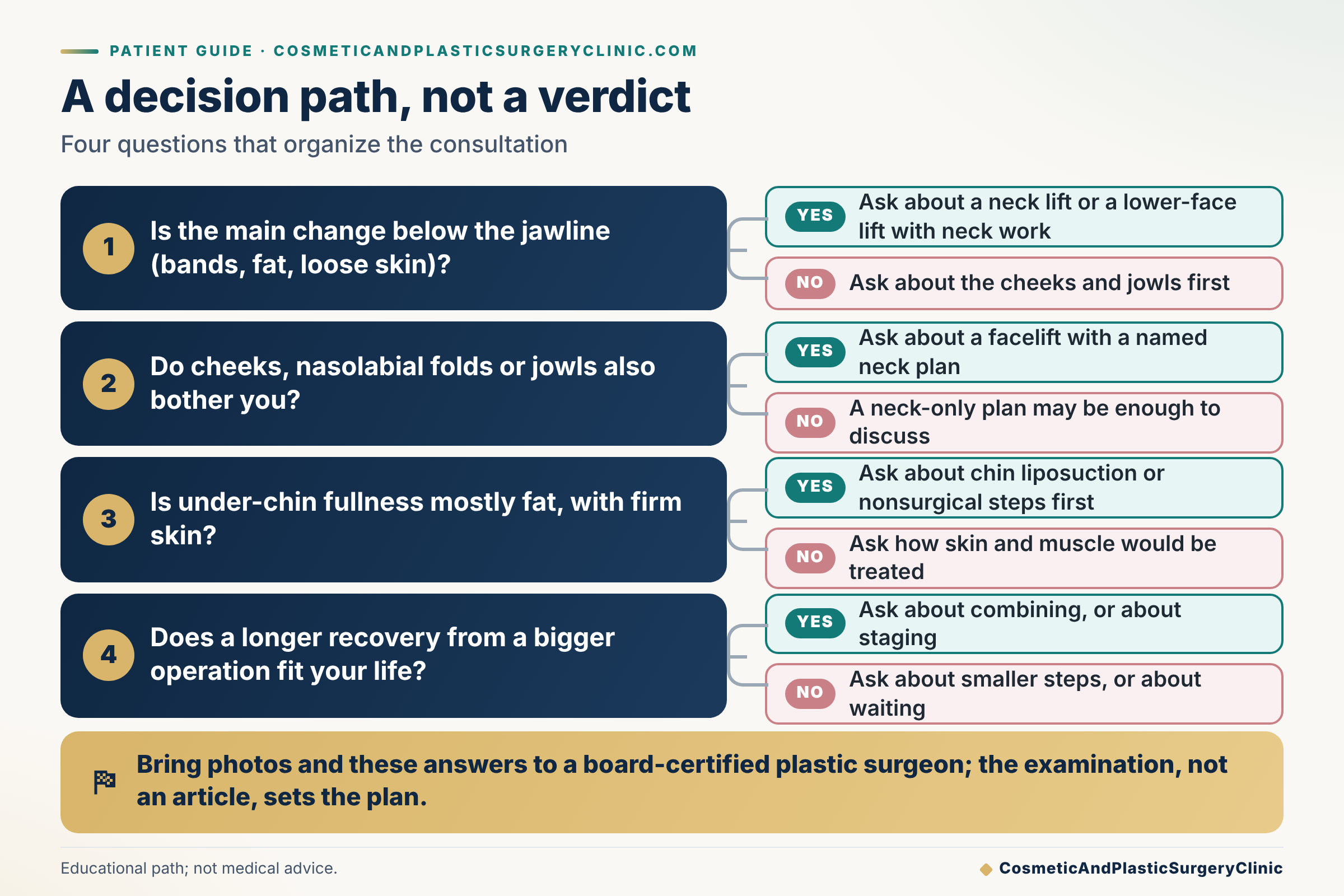
Six questions that test any neck lift vs facelift recommendation
Questions about the plan
A plan is only as clear as the answers to a few specific questions. The table pairs each question with what it exposes and with an answer that deserves a second look. Questions one to three concern what will be done; four to six concern proof and the fallback.
| Question | Why it matters | A reply that deserves a second look |
|---|---|---|
| 1. Which structures will you treat: skin, fat, platysma, deeper layers? | Turns a label into a list of real steps | “It’s just a standard lift,” with no structures named |
| 2. Is there an incision under my chin, and why or why not? | Shows how directly the neck can be reached | No explanation, or an under-chin scar never mentioned |
| 3. How much change should I expect at the jawline and cheeks, and what will stay? | Sets limits on jowl and cheek results | A promise of change in every zone |
| 4. What is the plan if bands or fullness return? | Late neck failures appear in the literature | “That never happens” |
| 5. Which parts add operating time or risk, and could they be staged? | Combined plans lengthen surgery | No mention of added time or a staging option |
| 6. Can I see healed photos of similar anatomy at 6 and 12 months? | Photos are supporting evidence, not forecasts | Only best-case images, or none of the neck from the side |
Questions about proof and the fallback
Question six is easier to use after reading neck lift before and after photos with the right views in mind. Credentials and facility questions are covered in how to choose a plastic surgeon, and the plastic surgery consultation article lists what to bring and how to ask for a second opinion.
One more question helps in any neck lift vs facelift consult: “What finding would change your recommendation?” A surgeon who can name one is reasoning from anatomy. A surgeon who cannot may be recommending what the practice does most.
Frequently asked questions
Can a facelift fix the neck without a separate neck lift?
Sometimes the neck changes with a facelift, and one 2025 retrospective series reported a narrower cervicomental angle after an extended SMAS lift. But “sometimes” depends on the plan. Ask whether platysma tightening, fat treatment and an under-chin incision are included. If they are not, bands and fullness may remain, and that gap is the most common reason a neck lift vs facelift quote needs clarifying.
Does the neck lift vs facelift decision differ for men?
The anatomy question is the same, but one risk differs. StatPearls reports that men develop hematoma about twice as often as women, up to roughly 8%, and the 2016 CosmetAssure analysis found male sex raised hematoma risk (relative risk 3.9). Blood pressure control and a clear plan for warning signs matter more. A surgeon can explain how these averages apply to a specific person.
In a neck lift vs facelift plan, should the two operations be staged?
Staging is possible, and it means two recoveries and two rounds of anesthesia, while a combined operation means one longer day. No source opened for this article compares staged and combined plans. Mendelson and Tutino noted higher jaw-nerve weakness in secondary neck lifts in their gland-reduction series. Ask a surgeon which order, if any, suits the anatomy, and how a second operation would reuse the first scars.
Will a mini facelift handle my neck?
Sources disagree. Cleveland Clinic says mini-facelifts lift the lower face and neck, while ASPS notes that limited-incision lifts are usually reserved for people with less skin relaxation and give less rejuvenation than a full facelift. The practical answer depends on incisions and which layers are lifted. The word “mini” covers several different operations, so ask for the incision and the layers.
Does weight loss change the neck lift vs facelift choice?
It can change the plan. Cleveland Clinic lists loose skin after weight loss among reasons people seek a neck lift, and Maia and Araujo start the exam with the skin. Surgeons generally want weight to be stable before operating, since further change alters the result. Weight stability, health factors and nicotine are the usual starting points of the consult.
Can a neck lift fix a weak chin or change my jaw shape?
A neck lift works on soft tissue: skin, fat and muscle. ASPS says neck lift does not change your fundamental appearance. Maia and Araujo list the mandibular border among the features surgeons assess, which suggests jaw structure is judged separately from the soft tissue. Chin projection is a different conversation, and any change to it would be a separate procedure to discuss with the surgeon.
Does insurance pay for a neck lift or a facelift?
ASPS says most health insurance plans do not cover neck lift surgery or its complications, and it says the same about facelift surgery. Both are generally treated as cosmetic. Many practices offer payment plans; ask for the total cost in writing, including anesthesia and facility, before you sign.
Sources and further reading
- American Society of Plastic Surgeons — Neck lift overview (accessed 2026-11-12) — lower rhytidectomy, what it treats and its limits
- ASPS — Neck lift procedure (accessed 2026-11-12) — anesthesia, incisions, platysma and under-chin work
- ASPS — Neck lift cost (accessed 2026-11-12) — single average without a year, exclusions, insurance
- ASPS — Neck lift recovery (accessed 2026-11-12) — bandage, drains, head position, no ice
- ASPS — Neck lift safety (accessed 2026-11-12) — list of risks
- ASPS — Facelift overview (accessed 2026-11-12) — what a facelift treats and its limits
- ASPS — Facelift procedure (accessed 2026-11-12) — traditional, limited and neck lift incisions
- ASPS — Facelift cost (accessed 2026-11-12) — single average without a year, exclusions, insurance
- ASPS — Lifting the veil on face and neck lifts (October 10, 2023; accessed 2026-11-12) — facelift versus neck lift, combining them, surgeon comments
- ASPS — Neck lift patient brochure preview (2023; accessed 2026-11-12) — platysma bands, “not ready for a full facelift”
- ASPS — Plastic Surgery Statistics Report 2024 (accessed 2026-11-12) — 2024 projected surgeon-fee ranges
- ASPS — Plastic Surgery Statistics Report 2025 (accessed 2026-11-12) — 2025 facelift and neck lift national estimates, methods
- Cleveland Clinic — Neck lift (platysmaplasty) (accessed 2026-11-12) — platysma, incisions, tightness, longevity, risks
- Cleveland Clinic — Facelift (accessed 2026-11-12) — types, recovery ranges, 7 to 10 years
- Mayo Clinic — Face-lift (accessed 2026-11-12) — neck lift at the same time, incisions, hematoma, recovery
- Hohman MH, Raggio BS, Patel BC — Deep Plane Facelift, StatPearls (updated January 31, 2026; accessed 2026-11-12) — SMAS-platysma continuity, ligaments, complication ranges
- Maia M, Araujo MC — Surgical Techniques for Treatment of the Aging Neck, in Neck Rejuvenation (Thieme, 2024; sample chapter; accessed 2026-11-12) — layered assessment, angle range, glands, hyoid
- Boyd CJ, Ceradini DJ — Current Trends in Facelift and Necklift Procedures, J Clin Med 2025;14(12):4273 (accessed 2026-11-12) — narrative review; platysma strategies; complication ranges
- Auersvald LA, Auersvald A — Sternohyoid muscles plication and sternocleidomastoid muscles rejuvenation in neck lift, Plast Aesthet Res 2021;8:4 (accessed 2026-11-12) — 1,019-patient series, share combined with facelift
- Mendelson BC, Tutino R — Submandibular gland reduction in aesthetic surgery of the neck, Plast Reconstr Surg 2015;136(3):463-471 (accessed 2026-11-12) — gland reduction series, complications
- Surek CC et al. — Necklift through a submental incision: does it really work? Plast Reconstr Surg Glob Open 2018;6(9S):90-91, conference abstract (accessed 2026-11-12) — 27-patient review, skin laxity, limit below the jawline
- Another Look at Platysmaplasty in Facelifting, Facial Plast Surg 2020;36(4):395-403 (PubMed record; accessed 2026-11-12) — late neck failures, platysma sling
- Preoperative Risk Factors and Complication Rates in Facelift: Analysis of 11,300 Patients, Aesthet Surg J 2016;36(1):1-13 (PubMed record; accessed 2026-11-12) — CosmetAssure data, combined procedures, hematoma
- ReachMD — Extended SMAS facelift and submandibular gland ptosis, summary of an Annals of Plastic Surgery study (December 31, 2025; accessed 2026-11-12) — 53-patient series, angle and gland position