Labiaplasty is surgery that reduces or reshapes the labia minora, the inner folds of skin beside the vaginal opening, and in many operations it also reduces extra folds of the clitoral hood. Almost everything about the decision turns on one question: is something causing physical trouble or lasting personal distress, and has that been looked at properly before anyone picks up a scalpel? Labial size and shape vary enormously among healthy adults, so variation alone is not a diagnosis.
This page is the hub of the labiaplasty and intimate cosmetic surgery cluster. It covers what the operation changes, what measurement studies say about normal variation, why people consider it, the main techniques, what published studies report about satisfaction and complications, a recovery outline, who surgeons evaluate and who they ask to wait, childbirth, non-operative alternatives, cost, and how to check who operates. Separate guides go deeper on each. Nothing here can say what your own anatomy needs or whether surgery suits you.
The operation is not rare and not new to the statistics. The International Society of Aesthetic Plastic Surgery (ISAPS) estimated 210,633 labiaplasty procedures worldwide in 2024, and the American Society of Plastic Surgeons (ASPS) counted 10,658 in the United States in 2025. Popularity says something about demand and nothing about whether labiaplasty is right for any one person, which is why this guide spends as much time on evaluation and on the option of waiting as on technique.
Labial variation first: what labiaplasty changes and what counts as normal
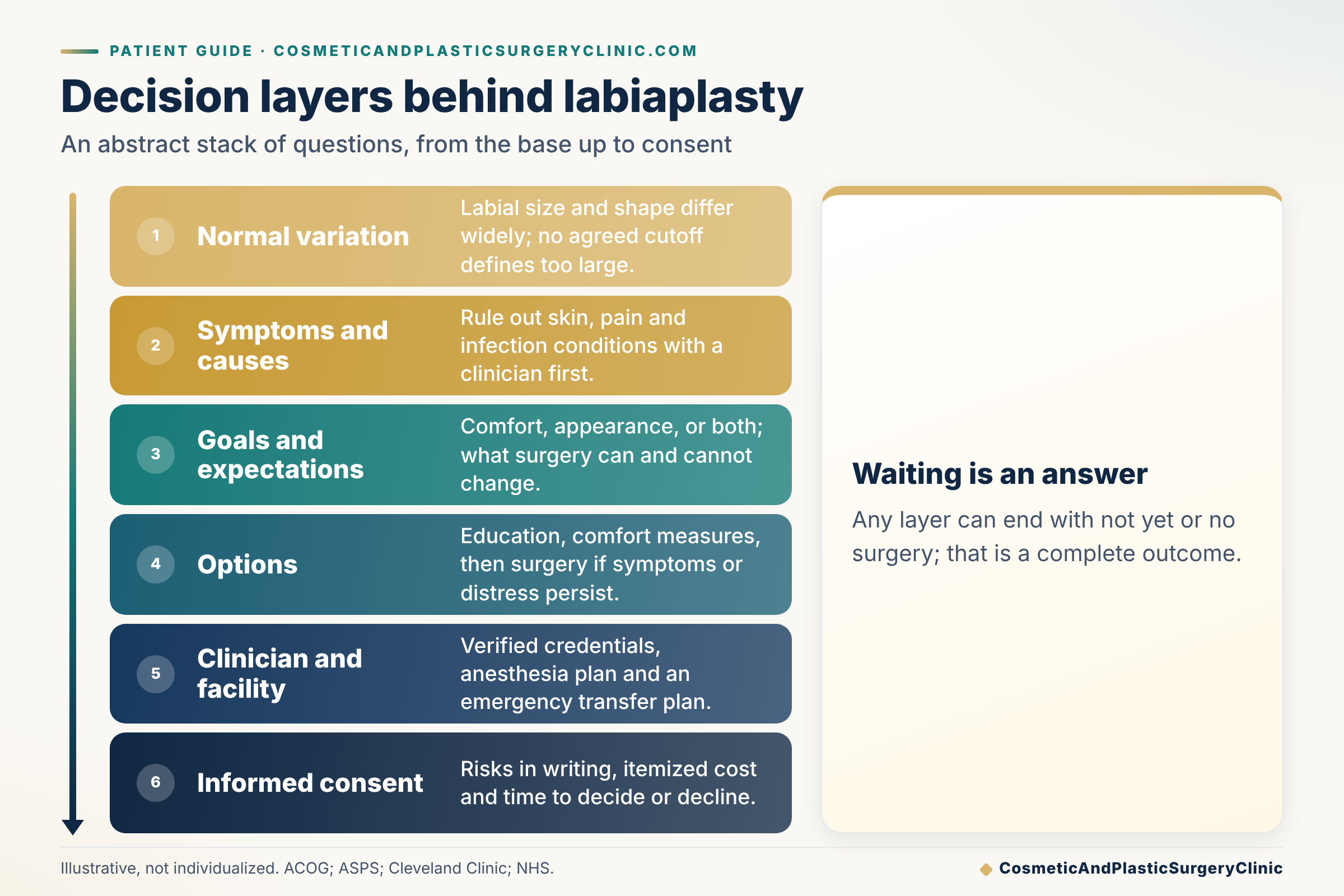
Any honest discussion of labiaplasty has to begin with the anatomy and with the fact that no single appearance is the reference. The operation modifies a small set of tissues. The research on measurements explains why a clinician cannot read a ruler and announce that someone is too large.
What the operation actually changes
The inner folds, and sometimes the clitoral hood
ASPS describes labiaplasty as reducing the length of the labia minora, with the usual goal of shortening them so they no longer hang below the outer folds, the labia majora. It can address asymmetry, but more often both sides are shortened. The ASPS page adds that excess folds of the clitoral hood can be reduced in the same operation, and an October 2024 ASPS article quotes a surgeon who often includes clitoral hood reduction as part of the plan.
Cleveland Clinic gives a slightly wider definition: surgery that changes the size or shape of the labia, usually by reducing the labia minora, and sometimes by adding volume or reconstructing tissue. The rest of this guide uses the narrower and far more common meaning, reduction and reshaping of the labia minora. It does not cover vaginal canal procedures, which are a separate topic with a separate regulatory warning discussed later.
Names that get mixed up
Several terms circulate around labiaplasty and they are not interchangeable. Labia majoraplasty reduces or adds volume to the outer folds. Clitoral hood reduction is its own step. Monsplasty addresses the pubic mound. An ASPS article describes “vaginal rejuvenation” as a broad term that manufacturers and influencers use inconsistently, which is one reason this guide avoids it except when quoting a regulator.
The American College of Obstetricians and Gynecologists (ACOG), in Committee Opinion 795, groups labiaplasty, clitoral hood reduction, hymenoplasty, labia majora augmentation and vaginoplasty under “elective female genital cosmetic surgery” and notes that standardized terminology and published data are lacking. When a clinic advertises a bundle with a catchy name, ask for each component in plain words and for what tissue each one touches.
What the measurement studies say about normal
The largest measurement study, and what it found
A 2018 study in BJOG, from Lucerne Cantonal Hospital in Switzerland, measured 657 Caucasian women aged 15 to 84 between 2015 and 2017. Labia minora length ranged from about 5 to 100 millimeters, with a mean near 42 millimeters, and width ranged from about 1 to 61 millimeters, with means around 13 to 14 millimeters. Some table cells in the copy of the paper available for this article were garbled, so treat the exact decimals as approximate and the wide range as the point.
The authors said the data are a baseline for what a normal Caucasian vulva looks like and that measurements should be interpreted individually rather than used as strict diagnostic cut-offs. They also noted that the findings apply only to the group they studied. A review of ten measurement studies by Hayes and Temple-Smith, published in the Australian and New Zealand Journal of Obstetrics and Gynaecology, found lengths from 5 to 100 millimeters and widths from 1 to 60 millimeters across studies and concluded that no international normal range can be set, because methods and populations differ too much.
Why “too large” has no agreed cutoff
The same review reports that right and left sides often differ, that protruding labia minora were more common than not in several studies, and that in a Danish study of 244 women, 87.5 percent considered their own vulva normal. A 2018 review in Nature Reviews Urology states the practical consequence: no criteria define labia minora hypertrophy, and perceptions of normal vary by woman, clinician and culture.
Cleveland Clinic puts it in one sentence, noting that there is no labial appearance considered normal. That matters for the consultation. A surgeon who describes a measured dimension as the threshold for surgery is applying a personal convention, not a published standard, and a patient is entitled to ask what that convention is, where it comes from, and what the plan would be if the answer to “should I operate” were “not yet.”
Why people consider labiaplasty, and what to rule out first
People come to labiaplasty from different directions: a physical problem during exercise or intimacy, a long-standing concern about appearance, or both at once. The evidence on motives is mixed, and the same research shows how much can be explained by something other than the labia themselves. Looking at those explanations first is part of good care, not a barrier to it.
What the motivation research shows
Comfort and function
ASPS lists pain from twisting and tugging during cycling or intercourse, itching and irritation among the reasons patients seek labiaplasty. Surgeons quoted in the October 2024 ASPS article describe tissue caught in clothing, difficulty wearing leggings or swimwear, irritation and discomfort during sex. Cleveland Clinic adds that extra tissue can make cleaning harder and, in its words, may harbor bacteria that can lead to urinary tract infections. These are symptoms, and symptoms deserve an examination that looks at causes as well as at the tissue itself.
A 2025 systematic review in Plastic and Reconstructive Surgery Global Open pooled 16 studies with 1,143 adults who had labiaplasty. Functional complaints were the most common reason at 52.2 percent, then appearance concerns at 46.3 percent, psychological reasons at 26.9 percent and sexual reasons at 20.5 percent. Categories overlapped, so the figures do not add to 100. The deeper treatment of symptom-driven surgery is in functional labiaplasty.
Appearance, and the images that shape it
The picture is not the same across the literature. The 2018 Nature Reviews Urology review concluded that women seek surgery mainly because of dissatisfaction with genital appearance rather than functional complaints, and noted that media images mostly show altered labia. The Hayes and Temple-Smith review points to idealized images in online pornography and in textbooks, to marketing by cosmetic providers and to hair removal that makes the vulva more visible as influences on what feels normal.
Different review methods can explain why one finds function first and another finds appearance first. For a reader, the practical point is that both motives are recognized, neither is illegitimate, and a good evaluation separates them because they lead to different plans. If distress comes mostly from comparison with images, the useful conversation may be about normal variation. If it comes from pain, the useful conversation starts with what is causing the pain.
What a clinician should look at before anything cosmetic
Skin, pain and infection conditions
Symptoms that people attribute to labial size sometimes have other causes. The NHS describes lichen sclerosus as itchy white patches, most often on the genitals, with skin that is easily damaged and sometimes painful sex because the vulva may shrink or tighten. It says the condition is not caused by poor hygiene. The NHS also describes vulvodynia as vulval pain lasting at least three months without an identifiable cause, with a normal-looking vulva, and advises seeing a doctor for ongoing or recurring pain.
Neither condition is fixed by trimming tissue, and surgery on inflamed or scarred skin raises its own healing questions. Irritation from products, infections and pelvic floor muscle problems also produce similar complaints. A gynecologic or dermatologic evaluation before a cosmetic consultation is not a delay tactic. It protects against operating for the wrong reason and against missing a condition that needs its own treatment.
Psychological screening is not a judgment
ACOG’s opinion expects gynecologists to recognize sexual function problems, depression and anxiety, to assess for body dysmorphic disorder when indicated, and to refer patients for evaluation before surgery if psychological concerns are suspected. ACOG’s opinion on adolescents likewise says patients should be screened for body dysmorphic disorder. Cleveland Clinic lists a psychological exam covering depression and anxiety as part of pre-surgical preparation, and the NHS notes that a doctor may suggest a counselor or psychologist.
Screening is a safeguard, not an accusation. Body dysmorphic disorder is a recognized condition in which concern about appearance is out of proportion to what others notice, and ACOG says referral to a mental health professional is the appropriate step when it is suspected. A surgeon who asks about mood, relationships, how much time the concern takes up each day and what the person hopes will change is doing the job. A clinic that skips the questions and moves to scheduling deserves a second opinion.
How common labiaplasty is, and how to read the volume numbers
Global and U.S. counts, with their limits
ISAPS’s 2024 survey, released in June 2025, estimated 210,633 labiaplasty procedures worldwide, up 3.7 percent from 203,038 in 2023 and up 48.2 percent from 142,119 in 2020, about 1.2 percent of all surgical procedures. Brazil reported the most (29,237), then the United States (18,490) and France (13,440). Worldwide totals are extrapolated from the survey’s 2,975 responding surgeons, so they are estimates, not registries.
ASPS reports different figures for a different population. Its 2025 statistics report lists 10,658 labiaplasty procedures in the United States in 2025, up 9 percent from 9,778 in 2024. The ISAPS and ASPS U.S. numbers differ by a wide margin, and neither source explains the gap, so treat both as indicators of direction rather than exact counts. Neither number says how many people had symptoms, how many had a second operation, or how satisfied anyone was.
The age pattern behind the total
The ASPS age table is the more interesting part. Counts fell in the youngest groups between 2024 and 2025 and rose in older ones. The table sets out the figures as reported, without interpretation, because the report does not explain why.
| Source and year | Scope | Reported figure | What it cannot tell you |
|---|---|---|---|
| ISAPS Global Survey, procedures in 2024 | Worldwide, extrapolated from 2,975 surgeons | 210,633 labiaplasty procedures; up 3.7% vs 2023; up 48.2% vs 2020 | Estimate, not a registry; no outcome or indication data |
| ASPS Procedural Statistics, 2025 | United States, ASPS-reported | 10,658 in 2025 vs 9,778 in 2024 (up 9%) | Differs from the ISAPS U.S. figure; reasons not given |
| ASPS age table, 2025 vs 2024 | United States, by age group | Ages 18 to 25: 1,002 (down 13%); 36 to 45: 3,237 (up 3%); 46 to 55: 2,320 (up 51%) | Why older groups grew is not stated |
| ASPS age table, older groups | United States, ages 56 and up | 56 to 65: 968 (up 75%); 66 and over: 210 (up 144%) | Small base numbers exaggerate percentage change |
One caution on the percentages: a 144 percent increase in the 66-and-over group means 210 procedures against 86, a small base. The ASPS 2025 report also does not list an average surgeon fee for labiaplasty, so cost is handled separately below and in labiaplasty cost.
Labiaplasty techniques: what each approach removes and where the scar sits
Technique talk can sound like a menu of brand names, but the underlying question is simple: which tissue is removed, and along which line does the surgeon close? Everything else, including healing risk and the look of the edge, follows from that. A dedicated comparison is in trim vs wedge labiaplasty; this section stays at the overview level.
Trim and wedge, the two workhorses
Edge trim: the most common approach
ASPS calls the trim the most common approach to labiaplasty: excess tissue along the free edge is removed and the cut edges are closed directly. Cleveland Clinic describes the same idea as removing excess tissue from the outer edge. The scar follows the edge itself, which is why the pigmented, ruffled border that some people have may be removed along with the excess, and why surgeons discuss whether preserving that border matters to the person.
ASPS says trim procedures generally recover faster than wedge procedures. In the 2024 Aesthetic Surgery Journal meta-analysis, the category closest to a trim, edge resection, showed satisfaction of about 95.9 percent and swelling of about 2.9 percent. The authors did not find that satisfaction differed significantly between techniques, so “most common” does not mean “best.” It means familiar to many surgeons.
Wedge: keeping a natural border, with a healing trade-off
In a wedge, a pie-shaped or V-shaped section is removed from the thickest part of the fold and the two cut edges are stitched together. ASPS says the wedge is the second most common approach and that its purpose is to keep a natural border. Cleveland Clinic describes it as removing a pie-shaped piece from the inner area. Because the closure runs through the body of the tissue, it is described as sparing the natural edge.
The trade-off is healing. ASPS states that wedge procedures carry a higher risk of healing problems, especially with exposure to substances that constrict blood vessels, and nicotine is the familiar example, since MedlinePlus says smoking reduces the oxygen reaching a surgical wound. The meta-analysis found pooled wound separation, called dehiscence, of about 8.4 percent for wedge resection, and about 4.2 percent for wedge techniques that preserve blood and nerve supply. Those figures come from varied studies, so use them to frame questions, not predict your result.
Other approaches, add-ons and instruments
A crowded field with no gold standard
Edge trim and wedge are the two most common, but not the only techniques. A 2015 systematic review identified eight techniques, including deepithelialization, which removes a strip of the outer skin layer and leaves the underlying tissue, W-plasty and a composite approach that combines methods. A 2018 review counted eleven. The 2024 meta-analysis found composite reduction had a low dehiscence rate of about 2.7 percent but a swelling rate near 13 percent, with very wide uncertainty on both numbers.
Wide uncertainty is the recurring theme. Individual techniques often rest on a handful of studies, and some of the figures in the pooled analysis come from only a few reports. When a clinic says its own variation is superior, it is making a claim the published comparisons do not settle. The honest consult answer sounds like this: here is the approach I use for your anatomy, here is why, and here is what my results look like.
Clitoral hood work, laser and scalpel
Clitoral hood reduction is a frequent companion step, because redundant hood folds sit close to the labia minora and can be addressed through the same planning. ASPS says it can be done during the same operation. It adds an incision and a scar line and, like every step, deserves its own consent discussion about sensation and scarring.
The instrument is another variable. Cleveland Clinic lists scalpel, scissors or laser, and closure with absorbable sutures. In the meta-analysis, laser was linked to lower hematoma (about 1.4 percent against 4.9 percent with scalpel) and lower bleeding (0.9 against 3.0 percent), but only 5 of the studies used laser compared with 48 that used scalpel, and satisfaction, dehiscence and infection did not differ significantly. A device does not replace surgical judgment, and a marketing claim that a laser makes the operation gentler or gives better results goes beyond the evidence.
The operating day: anesthesia, setting and accreditation
Local with sedation, or general anesthesia
ASPS says labiaplasty can be performed under local anesthesia with oral sedation or under general anesthesia. Cleveland Clinic lists intravenous sedation with local anesthetic or general anesthesia and estimates the operation takes under two hours. An October 2024 ASPS article quotes a surgeon describing about an hour with local anesthetic, with roughly half of that surgeon’s patients choosing an oral sedative. The NHS gives 1 to 2 hours and says many people go home the same day.
Which option fits is a decision for the surgeon, the anesthesia provider and the patient, based on health, anxiety, the extent of the operation and whether other procedures are combined. Ask what is planned, who administers and monitors it, what happens if you need more sedation than expected, and how the facility handles an emergency transfer.
Why an office is not automatically an accredited facility
ASPS requires its member surgeons to operate in facilities that are accredited by AAAASF, the Accreditation Association for Ambulatory Health Care or the Joint Commission, or that are Medicare certified or state licensed. Anesthesia must be given by a board-certified or board-eligible anesthesiologist or a certified nurse anesthetist. The same ASPS page says the requirement covers all procedures except those using only local anesthetic or mild oral sedation.
That exception matters here, because many labiaplasty operations are planned with exactly that anesthesia. A surgeon can operate in an unaccredited room and remain within the rule. It is still reasonable to ask about monitoring equipment, emergency medications, staff training and the plan for transfer to a hospital. A longer discussion of verifying people and places appears at the end of this guide and in how to choose a plastic surgeon.

What labiaplasty can change, what it leaves alone, and what the evidence cannot yet say
A fair expectation sits between “nothing changes” and “everything about comfort and confidence is solved.” The operation reshapes tissue and, for many, relieves specific physical complaints. It does not change the underlying cause of pain from another condition, and it does not carry a published promise about sexual function. The evidence that exists is mostly self-reported and uneven.
Comfort, appearance and satisfaction figures
What the pooled numbers report
ASPS says most patients with twisting or tugging symptoms find relief and cites satisfaction of over 90 percent across multiple studies, without giving a year or sample. The 2024 Aesthetic Surgery Journal meta-analysis pooled 3,954 patients aged 10 to 72 (mean 29.4) and reported satisfaction of about 94 percent, with a 95 percent confidence interval of 93 to 95 percent. A 2008 series of 407 patients reported an average satisfaction score of 9.2 out of 10 and that 98 percent of questionnaire respondents would have the surgery again.
Read the 2008 series with care: 123 patients were examined and 166 answered a questionnaire, from 407 treated. Respondents are not the whole cohort, and people who are unhappy are less likely to reply. The same series reported 93 percent self-reported improvement in self-esteem and 95 percent in discomfort, and, as a self-report, 71 percent in sex life. Those are numbers about what a group said, not measurements of anyone’s outcome.
Why those numbers carry less weight than they seem
The meta-analysis was graded Level of Evidence 3, and its authors state that data are scarce and heterogeneous and that satisfaction questionnaires are not standardized, so results are largely subjective. The 2018 Nature Reviews Urology review made the same point from the other side: small samples, few reports on satisfaction or complications and little long-term data. ACOG’s opinion cites a lack of high-quality data on effectiveness and limited data on risks and benefits.
None of this means labiaplasty does not work. It means the strength of the claim should match the strength of the data. High satisfaction in self-reported studies, a pooled complication figure around 9 percent and a 2025 review in which self-esteem improved but most sexual outcomes were not statistically significant describe a field that is probably reasonably safe in careful hands and under-studied. That is a different message from “proven.”
Sensation and sexual function: where claims outrun the data
What sources say about nerves, sensation and intercourse
The sources do not fully agree, which is itself informative. Cleveland Clinic states the procedure changes appearance, not function, that nerves are not cut or moved, and that sensation, lubrication and orgasm are not expected to change significantly. The NHS lists reduced genital sensitivity among the risks. ACOG’s consent language includes altered sensation and dyspareunia, meaning pain with intercourse, among the complications patients should be counseled about.
ASPS names over-resection as the most common complication and links it to chronic dryness, scarring near the vaginal opening and pain with intercourse. The 2025 systematic review of 16 studies found most sexual outcomes trended positive but were mostly not statistically significant, and noted that assessment tools varied. The fair summary: sensation changes are possible, they are usually not expected, how often they occur is not well measured, and no source supports a promise of better sexual function.
Claims worth questioning
ACOG’s opinion says procedures that alter sexual appearance or function outside clinical indications are not medically indicated and that safety and effectiveness have not been established, while excluding procedures done for clinical reasons such as pain with intercourse. In plain terms, surgery for a physical problem and surgery advertised to enhance sexual response sit in different categories, and the second has the weaker footing.
Watch for language that promises heightened sensation, improved orgasm or a better relationship. Ask the clinic what published evidence supports each claim, in which population, measured how. If the answer is a set of before-and-after testimonials or a vague reference to satisfaction surveys, treat the claim as marketing rather than medicine. A related discussion of regulatory warnings about energy devices appears later in the guide.
Scars, symmetry and staying power
Scars and symmetry
Cleveland Clinic says scarring is usually minimal and that reduction results are generally long-lasting. ASPS notes that surgery may address asymmetry but that the more common goal is to shorten both sides. Neither source promises matching sides, and ACOG’s adolescent opinion, as summarized in a 2017 commentary, says surgeons cannot promise symmetry and that further labial growth may occur. Natural asymmetry is common, as the measurement review found, so an exact match is not the benchmark for success.
Healing varies from person to person. A raised, widening or painful scar, a notch along the edge or tightness near the vaginal opening deserves an early conversation with the surgeon, not a wait-and-see approach. Because sources say residual swelling can last up to six months, revision decisions are generally not made in the first weeks.
Stretching, aging and revision
Cleveland Clinic warns that skin does not regrow after surgery but can stretch again, especially during childbirth. That is why many surgeons ask about pregnancy plans, a topic covered in labiaplasty after childbirth. The measurement review adds an age effect: in one study labia minora were wider in premenopausal women than postmenopausal women, a reminder that tissue changes over a lifetime and that results are not frozen in time.
Reoperation is a stated consent item in ACOG’s opinion. In the 2008 series, 12 of 407 patients (2.9 percent) had a second operation, though that is one report. Ask whether the surgeon charges for revisions, how long the clinic waits before judging a result, and what counts as a revision candidate. The table turns those long-term factors into review points.
| Factor | Effect on the result | Maintenance or revision implication | Warning sign or review point |
|---|---|---|---|
| Pregnancy and childbirth | Tissue can stretch again after surgery | Surgeons often ask about plans; timing is surgeon-directed | New looseness or discomfort after delivery |
| Nicotine exposure | Slows healing; ASPS links vessel-constricting exposures to wedge healing problems | Stopping before surgery is a standard request | Wound edges that separate or darken |
| Scar maturation | Scars soften over months; varies by person | Revision considered late, not early | A raised, widening or painful scar |
| Natural asymmetry and healing differences | Sides rarely match exactly, before or after | Small differences are judged after swelling settles | A clear, bothersome difference once healed |
| Hormonal and age changes | Tissue width differs by life stage in measurement studies | Results are not frozen; appearance can shift | New symptoms years later, which need evaluation |
| Skin conditions such as lichen sclerosus | Can scar and tighten tissue regardless of surgery | Diagnosis and treatment come first | Itchy white patches, easy tearing, pain |
Labiaplasty recovery in outline: weeks of limits and months of settling
Recovery is the part of labiaplasty that people ask about most quietly and plan for least. Published ranges are short enough to sound easy and long enough to disrupt cycling, intimacy and sometimes work. They also differ, because techniques differ and because each surgeon sets a protocol. The dedicated week-by-week guide is labiaplasty recovery, and general logistics sit in plastic surgery recovery.
The arc from the first days to the first months
Days one to fourteen
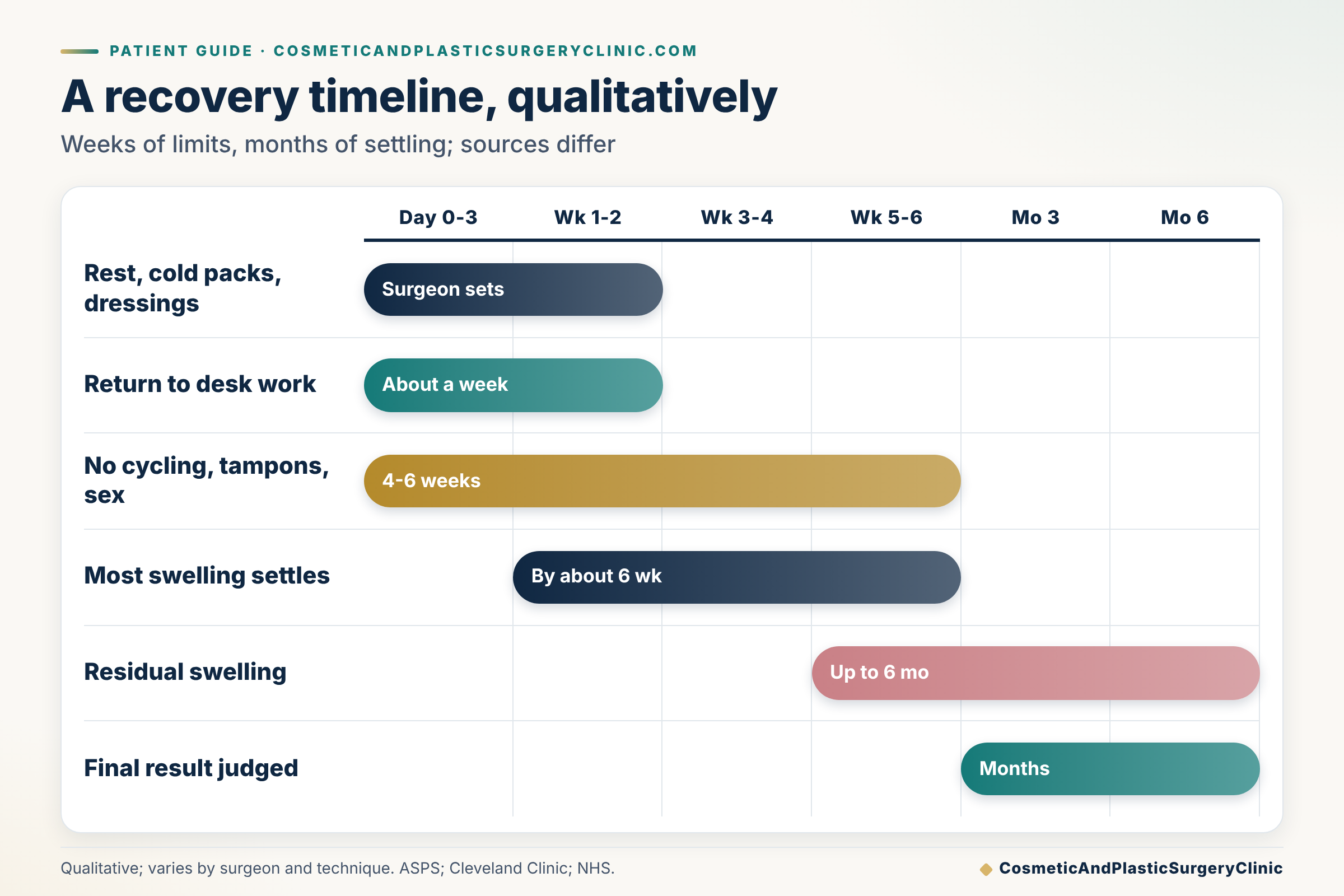
The October 2024 ASPS article lists swelling, bruising and mild discomfort as expected symptoms and describes initial healing of about one to two weeks. Cleveland Clinic says pain is usually manageable with acetaminophen or a prescription medicine for about a day and that minor bleeding can last up to about a week. ASPS describes cold packs placed between underwear and a compression garment in cycles of twenty minutes on and twenty off, and elevating the hips to reduce swelling.
The NHS paints a slightly more cautious picture: soreness, bruising and swelling typically last up to two weeks, with discomfort when urinating and sitting. These are descriptions of what sources report, not instructions. Your surgeon’s written plan for dressings, medication, washing and activity replaces anything printed in a general article. If that plan is unclear, ask before the operation, not at midnight afterward.
Weeks three to six, and the months after
ASPS says most distorting swelling resolves by about six weeks but residual swelling may last up to six months. Cleveland Clinic gives the same six-week point for most swelling and four to six months for full results. The NHS says the skin takes a couple of months to heal fully. That gap between feeling mostly normal and looking final is where impatience leads to premature judgments and unnecessary worry about asymmetry that may simply be swelling.
Final appearance is therefore a months-long question. Photographs from the first weeks show swelling as much as shape, which is a reason to be cautious about any image labeled with a very short timeframe. The photo-reading skills this raises are covered in labiaplasty before and after.
Planning without replacing your surgeon’s instructions
Work, clothing, sitting and hygiene
Sources point to roughly a week away from work for many people: ASPS says most patients take about one week, an ASPS surgeon’s 2019 blog says plan for at least one week with routine resuming within one to two weeks, and the NHS says up to two weeks. Cleveland Clinic notes many people return after a few days, with physically demanding jobs needing longer. Desk work and standing work differ, and so does commuting time, so ask what your own job allows.
Clothing and hygiene details come from the surgeon, but the sources mention a few common themes. The NHS advises keeping the area clean and wearing loose clothing, and Cleveland Clinic describes washing with lukewarm water and patting dry. Have a plan for childcare or household help in the first days, because sitting can be uncomfortable and bending and lifting are awkward when swollen. The ASPS 2019 blog suggests arranging help with young children before surgery.
Exercise, tampons and intimacy
Restrictions are the least negotiable part. ASPS says tampons and intercourse can resume after four to six weeks, with trim procedures generally recovering faster. Cleveland Clinic lists strenuous exercise, cycling, running, swimming and sexual intimacy as off-limits for four to six weeks or until the surgeon clears you. The NHS says to avoid sex for at least four weeks and strenuous activity for four to six weeks, and the ASPS 2019 blog says at least six weeks for intercourse.
Ranges overlap but differ at the edges, and clearance is a decision for the surgeon based on how the wound looks at follow-up. Cycling and long rides deserve a specific question for those who ride, since the sources list cycling among the activities to avoid. A person who returns early because a source said four weeks is not following their own plan if their surgeon said six.
Stitches, follow-up and when to judge the result
Dissolving sutures and early check-ups
ASPS says closure is usually with absorbable sutures, and the NHS describes dissolvable stitches. That means there is typically no appointment to remove them, but it does not remove the need to be seen. Ask when the first check-up is, what the surgeon looks at, which findings are normal for that surgeon’s technique, and what number to call outside office hours.
Judging the result and deciding about revision
Because swelling can persist, the sensible time to judge symmetry, edge shape and scars is months after surgery. If something looks different from what was planned, ask the surgeon to explain whether it is swelling, healing or a technical issue, and what the usual approach is for each. A clinic that offers revisions should state its policy in advance: timing, fees and who performs it.
| Source | Time off work | Exercise, tampons, intercourse | Swelling and healing |
|---|---|---|---|
| ASPS labiaplasty page | About one week for most patients | Tampons and intercourse after four to six weeks; trim generally recovers faster | Most distorting swelling by about six weeks; residual up to six months |
| ASPS article, October 2024 | Initial healing about one to two weeks | Exercise and intercourse avoided during full recovery of up to six weeks | Swelling, bruising or mild discomfort expected |
| ASPS surgeon blog, 2019 (author’s views) | At least one week; routine in one to two weeks | No intercourse for at least six weeks | Results develop over weeks and months |
| Cleveland Clinic, updated June 2023 | Many return after a few days; heavy jobs longer | Strenuous exercise, cycling, intimacy avoided four to six weeks or until cleared | Most swelling by about six weeks; full results four to six months |
| NHS, United Kingdom | Up to two weeks | No sex for at least four weeks; strenuous activity four to six weeks | Soreness and swelling up to two weeks; skin fully healed in a couple of months |
Labiaplasty risks, published complication figures and the emergency line
Complications have their own guide, so this section keeps to what shapes a decision: how large the published numbers are, why they disagree, what is expected, and what is an emergency. Risk-by-risk reading is in labiaplasty risks, and general risk literacy is in plastic surgery risks.
Published figures and how to read them
Five sources, five reasons not to treat them as your number
No single complication rate exists for labiaplasty. Studies define complications differently, use different techniques and follow patients for different lengths of time. Most of the evidence comes from case series, which is a limit of the field and not of any one paper. The table lists five published sources with the reason each cannot be taken as a personal probability.
| Source and year | Population | Reported figure | Why it is not your number |
|---|---|---|---|
| Meta-analysis, Aesthetic Surgery Journal, 2024 | 3,954 patients, ages 10 to 72, studies through October 2023 | Complications about 8.9%; dehiscence 5.9%; hematoma 3.3%; infection 3.0% | Level 3 evidence; heterogeneous studies; subjective outcomes |
| Systematic review, 2015 | 38 studies, 1,981 patients, 1971 to 2014 | “Few postoperative complications”; a small number needed revision | No pooled rate given in the abstract |
| Case series, Plastic and Reconstructive Surgery, 2008 | 407 patients, ages 13 to 63, 2005 to 2006 | Complications about 4%; reoperation 12 of 407 (2.9%) | One report; 123 examined, 166 answered a questionnaire |
| Review, Nature Reviews Urology, 2018 | Published literature on labiaplasty | Complications uncommon and mostly minor; severe ones possible | Small samples and little long-term data |
| ASPS labiaplasty page | Not described | Satisfaction over 90% across studies; over-resection the most common complication | No year, sample or rate given |
What moves the numbers
Some variation has identifiable causes. In the meta-analysis, wedge resection had higher dehiscence (about 8.4 percent) than other approaches, and wedge techniques preserving blood and nerve supply had about half that rate. Composite reduction and wedge showed higher complication rates overall, and the authors recommended individualizing the technique. ASPS ties wedge healing problems to exposure to substances that constrict blood vessels, and MedlinePlus says most providers advise stopping nicotine at least four weeks before surgery and that ten weeks can lower the risk further.
Definitions change the count too. Swelling, bruising and minor wound edge separation can be recorded as complications in one paper and as normal healing in another. The age range in the pooled data begins at 10, which means it includes children and teenagers whose tissue and decisions differ from an adult’s. Read each percentage as describing a group of studies, not as a forecast for any one person.
Complications by name
Early problems: bleeding, hematoma, infection and wound separation
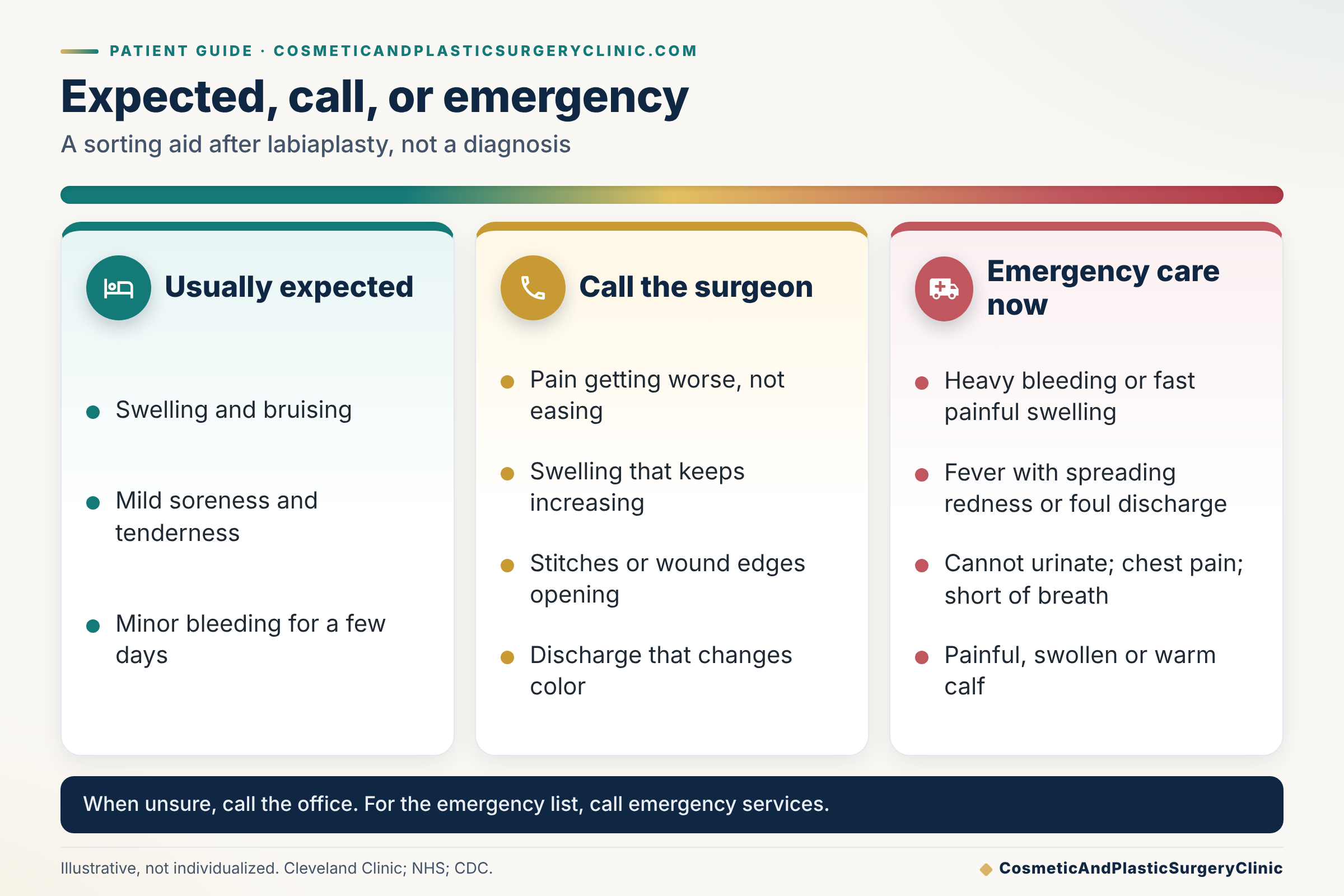
ASPS lists bleeding, hematoma and infection as general surgical risks. In the meta-analysis, pooled hematoma was about 3.3 percent, bleeding about 2.2 percent, infection about 3.0 percent and dehiscence about 5.9 percent. A hematoma is a collection of blood in the tissue, which presents as rapidly increasing painful swelling and sometimes needs drainage. Wound separation can heal by itself or need further care, depending on size and depth.
Cleveland Clinic describes these complications as infrequent, and includes wound breakdown. The NHS adds a small risk of a blood clot or allergic reaction to the anesthetic. The CDC notes that about half of people with a deep vein clot have no symptoms, and advises moving around as soon as possible after being confined to bed, for example after surgery. Nothing here is a reason to avoid surgery, but each is a reason to know the warning signs.
Later problems: over-resection, scarring, sensation, pain and reoperation
The later problems cluster around over-resection, which ASPS calls the most common complication. Tissue removed cannot be put back, so over-resection is the one to ask a surgeon about directly, along with how a plan avoids it. Cleveland Clinic lists removing too much or too little tissue, scarring, ongoing pain, pain during sex and loss of sensitivity among infrequent risks.
ACOG’s consent list is the most complete: pain, bleeding, infection, scarring, adhesions, altered sensation, dyspareunia and need for reoperation. It also asks surgeons to share their own experience and outcomes. That last point is useful practically: ask how many of these operations the surgeon performs each year, how often a patient needed a second operation, and how those cases were managed.
Expected effects versus emergencies
What is usually expected, and what warrants a call
Swelling, bruising, soreness and minor bleeding are expected after labiaplasty and are not complications by themselves. A call to the surgeon, rather than an emergency visit, is reasonable for pain that worsens instead of easing, swelling that keeps increasing, stitches or wound edges that open, or discharge that changes color. Cleveland Clinic lists excessive swelling, worsening pain, increased bleeding, discolored discharge, severe pain with urination or bowel movements, fever and an opening wound as reasons to contact the surgeon.
Which signs mean an emergency
Who surgeons evaluate, who is asked to wait, and what sits beside surgery
Candidacy is a clinical judgment made in person, and an article cannot make it. What an article can do is list what evaluators commonly weigh, so that a consultation feels like a conversation instead of a verdict. A fuller treatment is in labiaplasty candidate. The rest of this section covers three pieces that shape the first decision: age and health, the options beside surgery, and childbirth.
What an evaluation covers
Symptoms, goals and the question of age
Cleveland Clinic says most patients are between 18 and 50, and the NHS says labiaplasty should not be done on people under 18 because the labia keep changing into early adulthood. ACOG’s adolescent opinion, as summarized in a 2017 commentary, describes surgery as appropriate only for a mature adolescent who understands long-term consequences and has not benefited from conservative treatment. A 2013 British statement reproduced by the RACGP says the risk of harm is greater under 18 and that rising requests are not explained by medical need.
The statements differ in tone, which is itself informative. Evaluation of adolescents is specialist-led, and it starts with anatomy education, reassurance about normal development and attention to distress, not with an operation. For adults, a good evaluation asks about symptoms, when they happen, what has already been tried, what the person hopes will change and how much of that hope depends on appearance as opposed to comfort.
Health factors that change the plan
Surgeons commonly screen for factors that affect healing and safety. ASPS and MedlinePlus point to nicotine, which slows healing. Cleveland Clinic lists a psychological exam and, depending on the case, blood work, urinalysis and a chest X-ray as presurgical steps. The NHS advises seeing a doctor first because a treatable condition may be the cause or surgery may be unsuitable. Skin disease, active infection, bleeding disorders and blood-thinning medicines are the kinds of items a pre-operative review commonly looks at.
Pregnancy plans belong on the list. Cleveland Clinic says surgeons often suggest waiting until childbearing is complete, because pregnancy and childbirth can stretch the labia. That is guidance about timing, not a rule, and it interacts with symptoms: a person in significant pain may weigh it differently than a person whose concern is appearance. Labiaplasty after childbirth takes that decision apart.
Options that sit beside surgery
Comfort measures and treating other causes
The adolescent statements both describe conservative steps first: discussing ways to manage labial discomfort, natural diversity in appearance and the distorted images common in popular culture. For adults the same logic applies. If chafing happens during exercise, a clinician may explore clothing, activity and skin care. If pain is burning or constant, the evaluation looks for skin disease, nerve pain or infection. The full range of non-operative options is covered in labiaplasty alternatives.
None of the sources opened for this article lists a non-surgical product that reduces labial size. Counseling and education about normal variation can help when the concern is mainly appearance, though a qualitative study of clinicians cited in the Hayes and Temple-Smith review found reassurance did not satisfy every adolescent. Not satisfying everyone is a reason to take distress seriously, not a reason to skip the conversation.
Energy devices, fillers and “rejuvenation” claims
Marketing for labiaplasty often sits beside marketing for laser and radiofrequency treatments. The U.S. Food and Drug Administration (FDA) issued a safety communication on July 30, 2018, and a commissioner statement, warning about energy-based devices marketed for vaginal “rejuvenation,” cosmetic vaginal procedures, or treating menopause, urinary incontinence or sexual function symptoms. The FDA said it found numerous reports of vaginal burns, scarring, pain with intercourse and recurring or chronic pain, and that it had not cleared or approved these devices for such uses.
That warning concerns devices used inside and around the vaginal canal, not surgical labiaplasty, but it shows how easily regulated claims and marketing claims drift apart. ASPS’s nonsurgical page describes devices that use radiofrequency or laser energy to induce collagen tightening and fillers sometimes injected into the clitoris or the “G-spot,” and the page text opened here does not address FDA statements. Ask any clinic offering these treatments what the device is cleared for, what evidence exists for this use and what happens if a problem occurs. Related general information is in dermal fillers.
Childbirth, timing and combined operations
Why surgeons ask about pregnancy plans
The October 2024 ASPS article notes that some people seek labiaplasty after pregnancy but that many patients have not had children, with one surgeon reporting that about half of her patients had not. So childbirth is one trigger among several, not the main one. Birth can stretch tissue and can leave tears or scars, and those scars are an issue separate from labial size.
Pelvic floor weakness, prolapse and pain with intercourse after delivery are also different conditions with different care pathways, usually through gynecology or pelvic health. Labiaplasty does not treat them. Any plan to have more children should be said aloud at the consultation. Timing relative to delivery, breastfeeding and hormonal changes is a surgeon-directed decision, covered in detail in the childbirth guide.
Labiaplasty alongside a mommy makeover
Some people consider labiaplasty as an add-on to a combined body-contouring plan after pregnancy. Combined plans add operating time, anesthesia time and recovery demands, and they change the sequence in which things are judged. The general planning decisions are in mommy makeover, and timing questions are in mommy makeover after pregnancy. Whether labiaplasty belongs in the same session is a case-by-case surgical judgment, and the honest answer may be a separate, shorter operation.
| Situation | Pathway often discussed | What it can offer | Trade-off | Key question |
|---|---|---|---|---|
| Rubbing or pain during exercise or cycling | Evaluation, comfort measures, then surgery if symptoms persist | May relieve a mechanical problem | Recovery limits activity for weeks | What else could cause this, and what has been tried? |
| Long-standing concern about appearance, no symptoms | Education on variation; counseling if distress is high | Clarity about what is typical | Surgery cannot change how images affect comparison | What do I hope will change, and is it surgical? |
| Itch, burning, white patches or constant pain | Gynecologic or dermatologic diagnosis first | Treats the actual cause | Delays a cosmetic decision | Who is diagnosing this, and when? |
| Pregnancy planned or recent delivery | Discuss timing with surgeon and obstetric provider | Avoids operating on tissue about to change | Waiting means living with symptoms | How would another delivery affect the result? |
| Offered a laser or filler “alternative” | Ask what the device is cleared for | Possibly nothing beyond marketing | Risk of burns, scarring or pain per the FDA | What evidence supports this use? |
| Person under 18 | Specialist-led evaluation and conservative support | Education and reassurance | Tissue may still be changing | Who is the specialist, and what is the plan? |
Cost, coverage and how to check who operates
Price and credentials are separate questions, but both are easier to answer before falling for a promotional offer. The pricing mechanics have a dedicated page in labiaplasty cost, so this section covers only what changes a decision.
What the price does and does not include
Published averages and what they leave out
The ASPS labiaplasty page says the average cost is $3,919 per its latest statistics, gives no year and says the figure excludes anesthesia, operating room facilities and other related expenses. The 2025 ASPS statistics report lists no surgeon fee for labiaplasty. The NHS says private treatment in the United Kingdom costs about £4,000, with consultations and follow-up care possibly extra. Neither number is a local quote, and neither is a U.S. total.
A complete quote names surgeon fee, facility fee, anesthesia fee, any pathology, follow-up visits and the revision policy, each line separately. Ask for the date of the quote and how long it holds. A single package number with no breakdown makes comparison impossible. General cost mechanics are in plastic surgery cost.
Package pricing, financing and pressure
Discounts for booking the same day, bundles that add unrelated procedures and time-limited offers do not belong in a medical decision. A clinic confident in its evaluation can wait while you think and can put terms in writing, including what happens to deposits if you decide not to proceed. Financing carries its own costs, covered in plastic surgery financing.
Travel for a lower price adds a follow-up problem: complications can appear after the flight home, and a local clinician may not know the technique used. The trade-offs are covered in medical tourism surgery. ISAPS counts show Brazil reporting the most labiaplasty procedures of any country in 2024, which says where volume is, not where care is best.
Coverage and the functional case
What the sources say about insurance
The NHS says labiaplasty is rarely available through the public system and usually only for medical reasons, while it names reasons such as abnormal labia, repair of childbirth tears or removal of tissue affected by cancer. None of the U.S. sources opened here describes insurance rules for labiaplasty, so no coverage claim is made. Policies differ, and prior authorization, if available at all, depends on documentation.
Where surgery is considered for physical symptoms, ask the surgeon’s office how they document them and ask the insurer, in writing, what criteria apply and whether a gynecologic or dermatologic evaluation is required first. ACOG’s opinion treats surgery for clinical indications as a different category from cosmetic surgery, which is a framing worth knowing but not a coverage promise. Functional labiaplasty covers symptom-driven pathways.
Hidden costs beyond the fee
Beyond the quoted operation, budget for time away from work, any help at home, follow-up appointments, supplies and the possibility of revision or a second opinion. The NHS notes that follow-up care may cost extra. Ask whether post-operative visits are included, for how long, and whether revisions carry fees for the surgeon, the facility or both.
Checking people and places
Surgeon and gynecologist credentials
Both plastic surgeons and gynecologists perform labiaplasty; ASPS publishes patient information on it and ACOG has published opinions on it. Board certification in the clinician’s own specialty is a starting point, not proof of skill with this operation. The American Board of Plastic Surgery’s verification page says certification is voluntary, requires training and written and oral exams, and requires an unrestricted medical license, and it offers a name or location search. State medical boards show licenses and disciplinary actions.
Ask how many labiaplasty procedures the clinician performs each year, which techniques they use and why, what their revision rate is and whether they have operated on someone with your situation. The wider question of titles and training is explored in cosmetic surgeon credentials, and verification steps are in the earlier guide on choosing a surgeon.
Informed consent, photographs and red flags
ACOG’s opinion expects counseling on complications including pain, bleeding, infection, scarring, adhesions, altered sensation, dyspareunia and reoperation, and expects surgeons to share their experience and outcomes. Consent is a process, not a signature at the door of the operating room. Ask for the consent form in advance and ask what you would do differently if an item surprised you.
Consult albums are useful when read carefully, with attention to standardized views, timing since surgery and similar anatomy, as labiaplasty before and after explains and before and after photos covers in general. Red flags include pressure to decide quickly, promised outcomes, claims about sexual enhancement, reluctance to discuss complications and refusal to put a plan in writing.
Eight questions for the consultation, and the option of waiting
A consultation is the point where general information meets one person’s anatomy. Going in with written questions keeps the visit from being steered by whichever topics the clinic prefers. The questions below are ordered from the problem to the operation to the aftermath, and the last section is about the decision not to operate.
Eight questions to bring
About the problem and the plan
- What is causing my symptoms, and what else have you ruled out?
- Which technique do you recommend for my anatomy, and why that one rather than the alternatives?
- What will the scar line be, and what happens to the natural edge?
- What are the realistic limits of this operation for my goals, in words I can repeat to someone else?
If an answer arrives as a promise, ask for the evidence behind it. A good answer states what is likely, what is uncertain and what would change the plan. Avoid consultations where the answer to every question is that the surgeon does it differently and better.
About the operation and the aftermath
- Where will it be done, who gives the anesthesia, and what is the emergency transfer plan?
- What are your own rates of the complications listed in the consent, and how were they handled?
- What does the quote include, and what are the revision policy and its fees?
- When can I resume work, exercise, tampons and intimacy, and who clears me?
Write down the answers during the visit, or ask for them in writing. A second consultation with an unrelated clinician is a normal part of a major elective decision, and good clinicians expect it. General consultation technique is in plastic surgery consultation.
Waiting, second opinions and not operating
What waiting preserves
Waiting keeps options open. Tissue changes with age and childbirth, discomfort sometimes eases with other measures, and distress about appearance sometimes shifts with education and time. Waiting is not harmless if symptoms are significant, and nobody is obliged to endure pain, but a short pause to complete a gynecologic evaluation, finish a pregnancy or stop nicotine often improves the safety of an eventual operation.
The decision not to operate is a complete outcome of a consultation, not a failed one. If a clinician says that surgery is not indicated, ask what they would do about the symptoms or distress instead. If two evaluations disagree, the disagreement is information, and a third opinion from a clinician with a different specialty can help.
Using the cluster to go deeper
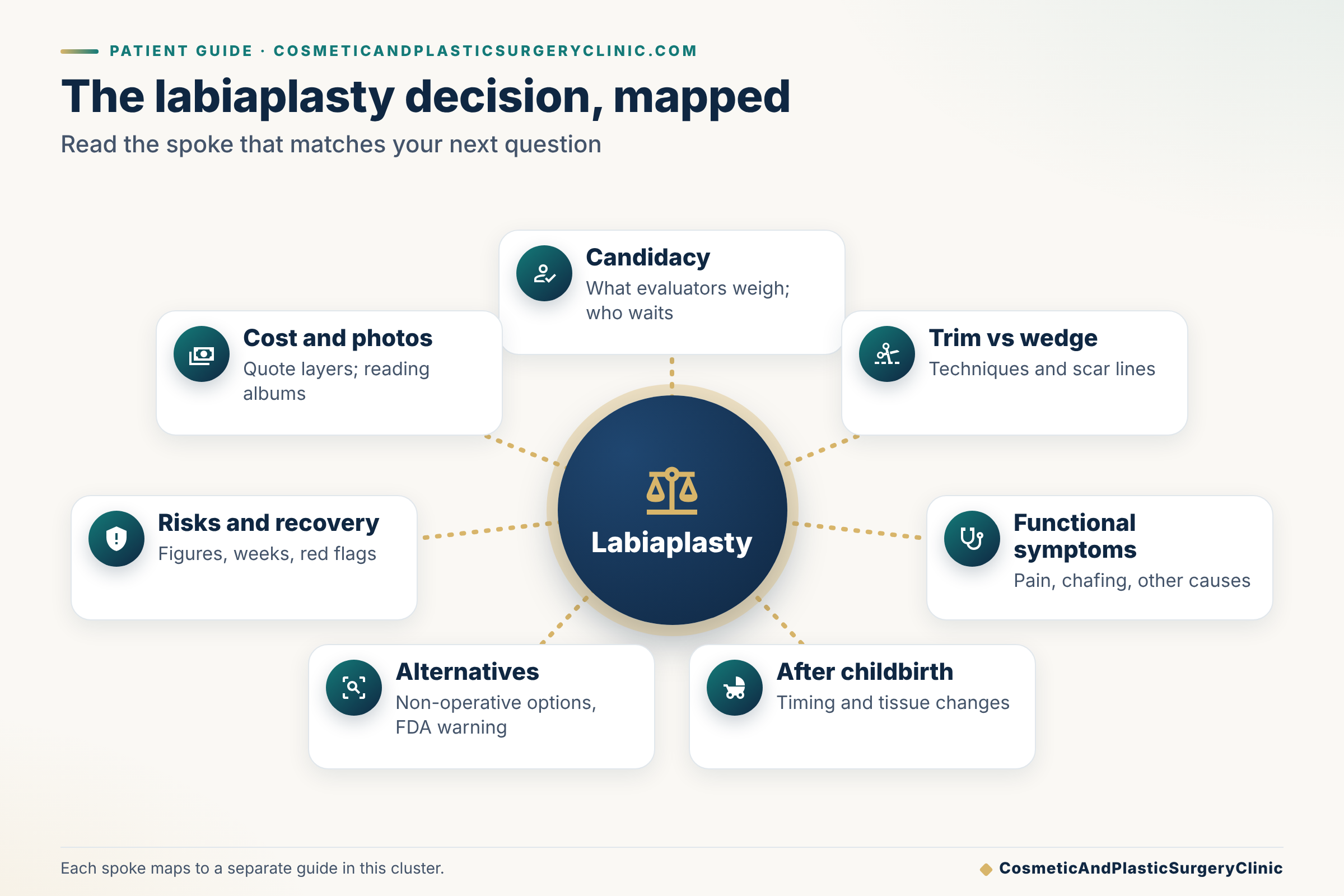
Each part of the decision has its own guide. The map below links the questions that come up next: who is evaluated, what symptoms count, how childbirth changes things, what non-operative options exist, and how to read risk, recovery, cost and photos. If you are earlier in the process, start with plastic surgery for the broader elective-surgery framework and return here when labiaplasty is the question.
Frequently asked questions
Is labiaplasty the same as vaginal tightening or rejuvenation?
No. Labiaplasty reshapes the outer edges of the inner folds, while “rejuvenation” is a broad marketing term that an ASPS article says manufacturers and influencers use inconsistently. The FDA’s 2018 warning concerned energy-based devices marketed for vaginal rejuvenation and cosmetic vaginal procedures, and it reported burns, scarring and pain with intercourse. The FDA said it had not cleared or approved those devices for such uses. If a clinic bundles labiaplasty with a device treatment, ask for each component’s evidence and clearance separately.
Can labiaplasty be done with local anesthesia only?
ASPS says labiaplasty can be performed under local anesthesia with oral sedation or under general anesthesia, and Cleveland Clinic lists intravenous sedation with local anesthetic or general anesthesia. A surgeon quoted by ASPS in 2024 described about an hour under local anesthetic, with roughly half of her patients taking an oral sedative. Whether local alone is suitable depends on the extent of the operation, other procedures and the person’s comfort. Ask what is planned, who monitors you and what happens if more sedation is needed.
Does labiaplasty affect vaginal delivery later?
None of the sources opened for this article answers that question, so no claim is made. What the sources do say is that surgeons often suggest waiting until childbearing is complete because childbirth can stretch the labia, and that skin does not regrow but can stretch again. If you plan pregnancy, raise it with both the surgeon and an obstetric provider before scheduling, and ask each how they would approach delivery and any later revision. The childbirth guide in this cluster covers timing in more detail.
What if only one side bothers me?
Some asymmetry is common. The Hayes and Temple-Smith review reports right and left sides often differ, and in one adolescent study, width differed between sides in 55 percent. ASPS says labiaplasty may address asymmetry but more often shortens both sides. A study cited in that review examined 33 women seeking labiaplasty; three had marked asymmetry and were offered one-sided surgery. Ask how a surgeon decides between one side and both, and how they would match the result.
Can I have labiaplasty if I smoke or vape?
That is a decision for the surgeon, but sources raise cautions. ASPS ties higher healing risk after wedge procedures to substances that constrict blood vessels, and MedlinePlus says nicotine products, including e-cigarettes, can impair wound healing and that most providers advise stopping at least four weeks before surgery, with ten weeks lowering risk further. MedlinePlus adds that nicotine gum around the time of surgery is not encouraged. If you use nicotine, say so at the first visit and ask what timeline the surgeon requires.
Should a gynecologist or a plastic surgeon perform labiaplasty?
Both specialties perform it, and both have professional statements on it. ACOG’s opinion expects gynecologists to screen for sexual function problems and psychological concerns, while ASPS describes labiaplasty as an aesthetic genital plastic surgery. Neither specialty label proves skill with this operation. Ask each clinician about board certification in their own field, how many labiaplasty procedures they perform yearly, which techniques they use and what their revision rate is. Verify certification yourself with the relevant board and your state medical board.
What should I do if I am unhappy with the result?
Start by waiting through the swelling period, because ASPS says residual swelling can last up to six months and Cleveland Clinic says full results take four to six months. Photograph and document concerns, then ask the surgeon what is expected, what is a healing issue and what could be a revision candidate. Ask about the revision policy before surgery. A second opinion from an unrelated clinician is reasonable, and pain, discharge or a wound that opens needs prompt contact with the surgeon.
Will labiaplasty be covered by U.S. insurance?
The sources opened for this article do not describe U.S. coverage rules for labiaplasty, so the answer is not given here. The NHS says labiaplasty is rarely funded in the United Kingdom and usually for medical reasons only. In general, policies treat elective cosmetic procedures differently from care for diagnosed conditions. Ask your insurer in writing which criteria apply, what documentation and evaluations they require and whether prior authorization is possible, and ask the surgeon’s office how they record functional symptoms.
Sources and further reading
- American Society of Plastic Surgeons — Labiaplasty (accessed 2026-11-13) — definition, trim and wedge, anesthesia, recovery, risks, average fee without year
- American Society of Plastic Surgeons — Labiaplasty: what is it and is it for you? (October 28, 2024; accessed 2026-11-13) — reasons, procedure length, healing, nonsurgical options
- American Society of Plastic Surgeons — What to expect at every stage of your labiaplasty (2019 surgeon blog, author’s views; accessed 2026-11-13) — time off work and intercourse restrictions
- American Society of Plastic Surgeons — Plastic Surgery Statistics Report 2025 (accessed 2026-11-13) — labiaplasty counts and age table
- American Society of Plastic Surgeons — 2025 plastic surgery by the numbers (accessed 2026-11-13) — labiaplasty growth of 9 percent
- American Society of Plastic Surgeons — Nonsurgical aesthetic genital procedures (accessed 2026-11-13) — radiofrequency, laser and filler descriptions
- American Society of Plastic Surgeons — Accreditation (accessed 2026-11-13) — facility accreditation and anesthesia provider standards
- American College of Obstetricians and Gynecologists — Committee Opinion 795, Elective Female Genital Cosmetic Surgery (repository record, abstract level; accessed 2026-11-13) — evidence limits, consent items, screening
- Contemporary OB/GYN — ACOG guidelines at a glance: breast and labial surgery in adolescents (June 2017 commentary; accessed 2026-11-13) — adolescent counseling and screening
- Royal Australian College of General Practitioners — Adolescents and FGCS requests (accessed 2026-11-13) — reproduced 2013 British statement
- U.S. Food and Drug Administration — Commissioner statement on devices marketed for vaginal “rejuvenation” (accessed 2026-11-13) — adverse events and clearance status
- International Urogynecological Association — FDA safety communication summary (accessed 2026-11-13) — July 30, 2018 date and safety statement
- Medsafe New Zealand — Energy-based devices for vaginal rejuvenation (2018; accessed 2026-11-13) — restates the FDA warning
- International Society of Aesthetic Plastic Surgery — Global Survey 2024 (accessed 2026-11-13) — worldwide labiaplasty counts and methodology
- Kreklau A and colleagues — Measurements of a normal vulva in women aged 15-84, BJOG 2018 (copy of the paper; accessed 2026-11-13) — 657 women, measurement ranges
- News-Medical — The shape of your vulva is unique and normal (July 2018; accessed 2026-11-13) — summary of the Lucerne study
- Hayes JA, Temple-Smith MJ — What is the anatomical basis of labiaplasty? (author manuscript, Australian and New Zealand Journal of Obstetrics and Gynaecology; accessed 2026-11-13) — review of normative datasets
- Özer M and colleagues — Labiaplasty: motivation, techniques, and ethics, Nature Reviews Urology 2018 (key points page; accessed 2026-11-13) — techniques, evidence limits, motivation
- Plastic and Reconstructive Surgery Global Open 2025 — Behind the decision: motivations, and psychological and sexual outcomes of labiaplasty (record; accessed 2026-11-13) — 16 studies, motivation percentages
- Aesthetic Surgery Journal 2024 — Comprehensive assessment of labiaplasty techniques and tools, satisfaction rates, and risk factors (accessed 2026-11-13) — pooled satisfaction and complication figures
- PubMed — Systematic review of labia minora reduction techniques, 2015 (abstract; accessed 2026-11-13) — 38 studies, eight techniques
- Plastic and Reconstructive Surgery 2008 — Aesthetic labia minora and clitoral hood reduction using extended central wedge resection (abstract; accessed 2026-11-13) — 407-patient series
- Cleveland Clinic — Labiaplasty (updated June 2023; accessed 2026-11-13) — candidates, recovery, risks, results
- NHS — Labiaplasty (accessed 2026-11-13) — age, funding, recovery, risks, choosing a surgeon
- NHS — Lichen sclerosus (accessed 2026-11-13) — a condition that can mimic labial complaints
- NHS — Vulvodynia (accessed 2026-11-13) — chronic vulval pain without visible cause
- MedlinePlus — Quitting smoking before surgery (accessed 2026-11-13) — nicotine, healing and timing
- Centers for Disease Control and Prevention — About blood clots (accessed 2026-11-13) — clot symptoms and emergency guidance
- American Board of Plastic Surgery — Verify certification (accessed 2026-11-13) — what certification means and how to check it