Functional labiaplasty is the name for reducing or reshaping the labia minora, the inner folds of the vulva, because of physical symptoms such as friction in clothing, irritation during exercise, difficulty with hygiene or discomfort during intercourse, rather than because of appearance alone. The label sounds precise. In practice it is loose, because many people have physical and appearance reasons at once, and the same symptoms can come from skin disease, infection or pain conditions that an operation on the labia does not treat.
This page is about the decision, not the operation. It follows six checks in a sensible order: name the symptom, get other causes examined, try conservative care, read the evidence for relief honestly, weigh the risks, and test the plan with questions. The operation itself is explained on the labiaplasty overview, and how clinicians judge who is a reasonable fit is covered in labiaplasty candidate.
Labial size and shape vary widely, and variation is normal. Nothing here can say whether your symptoms come from your anatomy, and a persistent symptom deserves an exam rather than a guess. Choosing against functional labiaplasty, waiting, or getting a second opinion remains a legitimate outcome at every step.
The six checks this page walks through:
- Name the symptom: what happens, when, and how often.
- Have other causes examined: skin, infection and pain conditions.
- Try conservative care and keep notes while you do.
- Read the evidence for symptom relief with its limits in view.
- Weigh the risks, including ones that can mimic the original symptom.
- Choose the clinician and test the plan with specific questions.

Check 1: name the symptom behind functional labiaplasty
Before any option is compared, the complaint has to be specific. “It bothers me” can mean pulling in tight pants, a raw feeling after a run, trouble keeping the area clean during a period, or something that happens only during intercourse. Each points toward different explanations and different fixes.
What people report when they seek functional labiaplasty
Clothing, exercise and sport
The most consistent complaints in published series involve clothing and movement. A 2008 retrospective chart review by Miklos and Moore in the Journal of Sexual Medicine covered 131 women at one urogynecology practice who had labia minora reduction between 2005 and 2007. Of the 82 whose reasons included function, 55 percent reported discomfort wearing clothing and 46 percent reported discomfort with exercise or activity.
A series by Rouzier and colleagues from 2000, reported in a 2025 systematic review, looked at 163 women. In that group 64 percent reported discomfort in clothing and 26 percent discomfort in sports. Both are single-practice series that describe why people came in, not what surgery achieved, so they show the shape of the complaint that leads to functional labiaplasty, not how often the operation resolves it.
The American College of Obstetricians and Gynecologists (ACOG) gives similar examples in its opinion on adolescents, discussed in a 2017 commentary: vulvar irritation when walking or playing sports, difficulty inserting a tampon, and appearance-related anxiety during activities. That list mixes physical and emotional items, which is a theme throughout this page.
Hygiene, intercourse and other reported complaints
Among Miklos and Moore’s functional group, 60 percent reported painful or uncomfortable intercourse, and 54 percent reported more than one functional symptom. The Rouzier series is the one in the 2025 review that mentions hygiene, especially during menstruation, and it reports that 43 percent described protruding tissue turning inward, which the authors called invagination.
The same 2025 review lists other complaints that appear in the literature: itching, difficulty reaching orgasm when tissue folds inward, recurrent urinary infections and a deflected urinary stream. The authors also question how physical some of these are, suggesting that functional discomfort may be shaped by psychological factors that come from a cultural ideal of appearance. They do not claim that symptoms are imaginary. Their point is that the sources cannot separate friction from distress.
Why functional labiaplasty and cosmetic labiaplasty rarely separate cleanly
What the motivation studies found
In the Miklos and Moore series, 37 percent gave aesthetic reasons only, 32 percent functional reasons only, and 31 percent both. Counting both groups, about 63 percent named a functional reason. The review from 2025 pooled only three eligible studies, including Miklos and Moore, Rouzier and a 14-person interview study by Sharp and colleagues from 2016, and concluded that most patients hold mixed motives, with function often presented as the main one.
The limits are the authors’ own. Only three studies qualified, sample sizes were small, the studies did not use validated measures of motivation, and many samples also included other genital procedures such as clitoral hood reduction. A label of functional labiaplasty is therefore a description of what a person says, collected at a clinic visit, not an objective category.
Why the label still matters for planning, consent and coverage
ACOG’s 2020 Committee Opinion 795 on elective female genital cosmetic surgery says that procedures performed to alter sexual appearance or function, apart from clinical indications the opinion lists, are not medically indicated, carry substantial risk, and have no established safety or effectiveness. That wording makes the reason for surgery a clinical and documentation question, not just a personal one.
A clinician who writes down “pain with exercise, tried these measures, examined for these causes” is describing a different situation from one who writes down “wants a different look.” Either can be a valid reason for an adult to ask about surgery. The first can be tested against the exam; the second is a values decision, and the labiaplasty alternatives page covers the options that do not involve an operation.
| Situation | Pathway usually discussed | Possible benefit | Trade-off | Key question |
|---|---|---|---|---|
| Friction or twisting in tight clothing or at the gym | Clothing and skin-protection changes first; surgical consult if it persists | May reduce the trigger without an operation | Takes time and may not be enough | What exactly have I changed, and for how long? |
| Burning, itching, raw or white skin | Exam for dermatitis, infection or a skin condition before any surgical talk | A treatable cause may be found | Surgery would not treat a skin disease | Has anyone examined the skin? |
| Pain with intercourse | Evaluation of many possible causes, then a joint plan | Cause-directed care may help | Surgery can itself cause pain or scarring | Is the pain at the opening or deeper? |
| Distress about appearance, with mild physical symptoms | Counseling on normal variation, then an informed decision | Clarity about motives | Evidence for emotional benefit is mixed | What result would I count as success? |
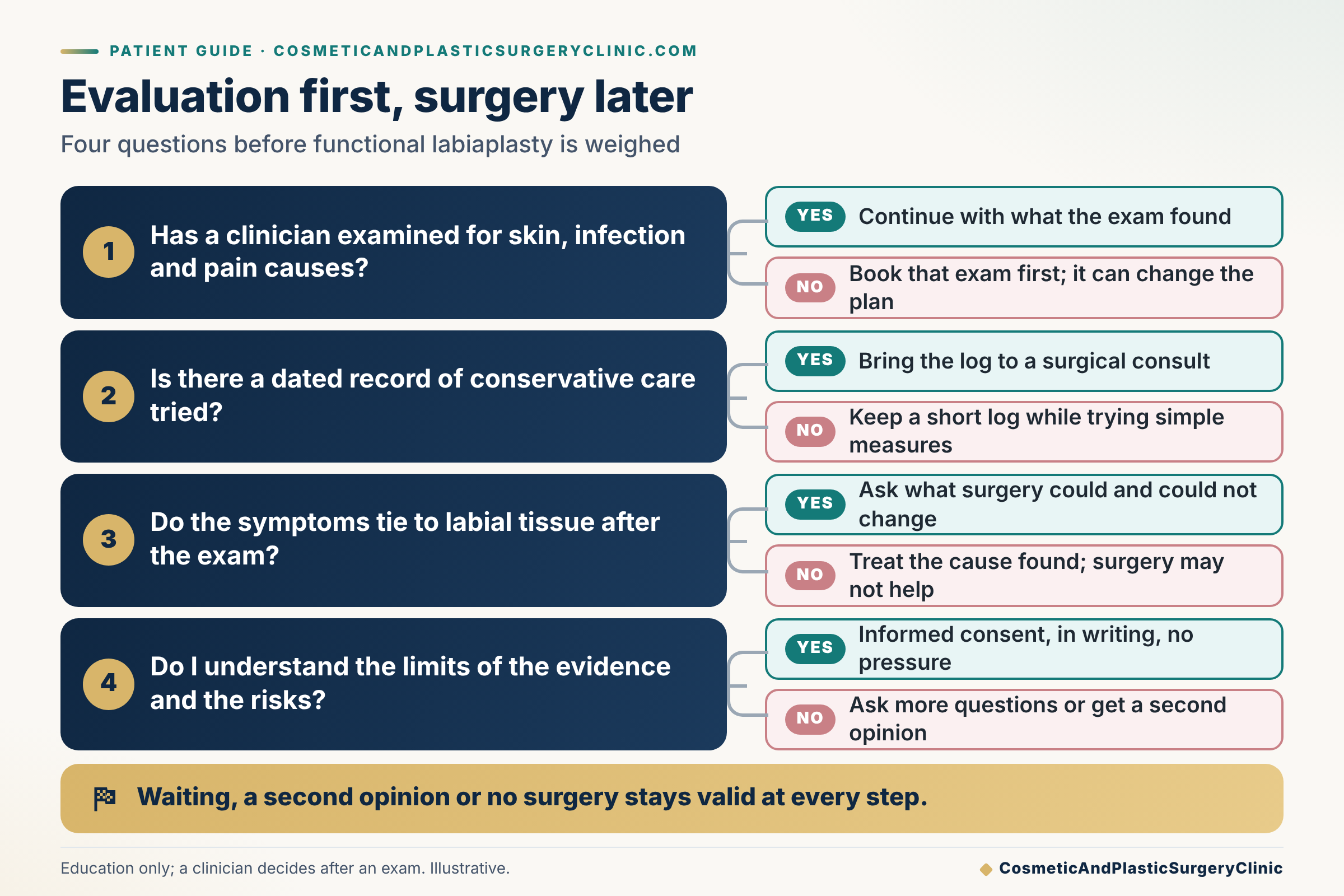
Check 2: get other causes examined before functional labiaplasty is on the table
The UK National Health Service says discomfort around the vulva may come from a treatable condition and advises speaking with a general practitioner first, who can check for one and judge whether surgery would be suitable. In the United States the first visit is usually with a primary care clinician, a gynecologist or a dermatologist. Functional labiaplasty is a question that comes after that exam, not instead of it.
Skin and infection causes that can look like a labial problem
Irritation and contact dermatitis
University of Iowa Health Care describes vulvar contact dermatitis as skin that becomes sensitive to contact irritants. The page lists body soaps, dyed clothing, fabric softeners, detergents, lotions, douches, deodorants and wipes, and also names nylon underwear. Symptoms include burning or itching, redness, swelling, a raw feeling and dampness, and pain can occur with tampon insertion or intercourse.
That symptom list overlaps with what people describe when they ask about functional labiaplasty. A clinician can examine for dermatitis and test discharge for infection. If the cause is an irritant or an infection, changing the exposure or treating the infection is a different path from surgery on the labia.
Lichen sclerosus and other skin conditions
The Merck Manual professional edition describes lichen sclerosus as an inflammatory skin disease whose hallmark is itching, with thin, white or fragile skin, fissures and bruising. In long-standing or severe disease it can scar and distort vulvar anatomy. It is most common in postmenopausal women. Diagnosis is usually clinical, biopsy is recommended when a skin problem does not clear with mild treatment or an area thickens or ulcerates, and first-line treatment is a potent topical corticosteroid used long term with follow-up.
The same page notes an association with squamous cell carcinoma, which is why monitoring is advised. The practical point for this page is narrow: changes in the labia that come from a skin disease are examined and treated as a skin disease, and a surgeon who proposes functional labiaplasty without anyone having looked at the skin has skipped a step.
Pain and intercourse-related causes
Vulvar pain when the skin looks normal
Mayo Clinic defines vulvodynia as pain or discomfort around the vulva lasting at least three months without a clear cause. It is often described as burning, stinging, rawness or soreness, and the vulva usually looks normal. Contributors include nerve sensitivity, inflammatory or immune changes and pelvic floor muscle tension, and risk factors include recurrent yeast infections and other chronic pain conditions.
Mayo’s diagnostic page describes a pelvic exam, a cotton swab test that maps painful spots, and a biopsy if the skin looks abnormal. Its surgery section is revealing: a vestibulectomy, which removes painful tissue near the vaginal opening, is reserved for cases that do not respond to other treatment and carries risks including scarring or worse pain. That is a reminder that surgery for pain is a late and cautious step even in the condition where it is an accepted option.
Painful intercourse has many sources
Mayo Clinic’s page on painful intercourse separates entry pain at the vaginal opening from deeper pain. Entry pain can come from low estrogen, certain medicines, irritation or injury, childbirth tears or episiotomy scars, infections, skin conditions such as eczema, and muscle spasm. Deep pain has a different list, including endometriosis and pelvic floor disorders. Emotional factors, including body image concerns, can contribute to either.
Mayo says treatment depends on the cause and that treating the cause can often stop or ease the pain. Because Miklos and Moore found that 60 percent of their functional group reported painful or uncomfortable intercourse, this check carries weight: a labial explanation, and so functional labiaplasty, is one possibility among several, and several have their own treatments. Scars from childbirth are a related topic covered on labiaplasty after childbirth.
Check 3: try conservative care and keep notes before deciding on functional labiaplasty
Conservative care means changes that do not involve an operation. In functional labiaplasty planning it is the middle step in most professional descriptions of the pathway, and it is also the step where evidence is thinnest. The measures below are general education drawn from the sources opened for this page, not instructions for any individual.
Measures that the sources list
Clothing, underwear and moisture
The ACOG adolescent opinion, as described in the 2017 commentary, lists supportive underwear, emollients and arranging the labia minora before exercise. The University of Iowa page advises avoiding nylon underwear, changing damp underwear and not sleeping in underwear. Mayo’s self-care list for vulvar pain suggests loose 100 percent cotton underwear, avoiding tight pants, and changing out of wet exercise clothes or swimwear promptly.
These come from different conditions, so they are not a tested protocol for labial tissue. They do show what clinicians typically reach for when friction and moisture are the problem, and they cost little to try. The labiaplasty alternatives page covers non-operative options in more detail, including claims made for devices and injections.
Skin protection and treating a skin condition
For irritated skin, the University of Iowa page suggests oil, petrolatum or zinc oxide ointment to protect the skin and says steroid ointment should be used only as prescribed, since overuse can thin the skin. Mayo lists plain petroleum jelly as a fragrance-free barrier and advises gentle washing with plain water. If a skin disease is found, treating it is part of conservative care and not a separate matter.
For skin that is itching, burning or raw, an exam should come before products, because treating the wrong problem with the wrong product can add irritation. Mayo advises against self-treating with over-the-counter yeast products without a checkup.
A sensible rule that has not been put to a trial
What ACOG and the studies say about trying other options first
The 2017 commentary on ACOG’s adolescent opinion says surgery is considered only after conservative measures fail. For adults, ACOG’s 2020 opinion focuses on counseling, psychological screening and honest disclosure rather than on how long conservative care should last. Furnas and colleagues, in a 2020 study of 62 women, said their results show that the common recommendation of nonsurgical treatment is inadequate, according to an American Society of Plastic Surgeons (ASPS) press release.
That statement deserves careful reading. It comes from a surgeon-authored series with no comparison group, and the release does not say which nonsurgical measures were tried, for how long, or how many women tried none. It is an interpretation, not a head-to-head finding.
What a fair trial of conservative care can look like
No source opened for this page sets a minimum duration for conservative care, so any number would be invented. What can be described is a method: keep a short log of which symptom happens in which situation, change one thing at a time, note the result, and bring the log to the exam. A log also helps separate friction in tight clothing from burning that follows a new soap.
That record has a second use. If functional labiaplasty is later discussed, a surgeon can tie the plan to documented symptoms instead of a general impression, and an insurer, if one is asked, sees what was tried. Specific, dated notes are more persuasive to both than a summary such as “it hurts.”
Check 4: read the evidence for symptom relief after functional labiaplasty
This is the check most likely to be skipped, because marketing prefers satisfaction percentages to study designs. The evidence on functional labiaplasty is real but small, and it answers narrower questions than most people ask of it.
The studies that exist, and what each one measured
A before-and-after symptom survey of 62 women
Furnas and colleagues published “Comparison of Patient Symptomatology before and after Labiaplasty” in Plastic and Reconstructive Surgery in 2020. According to the ASPS press release, 62 women aged 17 to 61 completed a questionnaire before surgery in 2016 and 2017 and again in 2019, and 82.2 percent had a trim technique while 17.7 percent had a wedge. Every woman had at least one of 11 listed symptoms before surgery, averaging 6.5 each, and 58 of 62 (93.5 percent) had none afterward.
Individual items moved a long way. Discomfort in tight pants fell from 56.5 to 4.8 percent, twisting in clothing from 58.1 to 3.2 percent, and pain with intercourse from 43.5 to 1.6 percent. The release does not report hygiene or urinary symptoms separately, does not say how women were recruited or the exact follow-up interval, and does not discuss limitations. The study has no comparison group and relies on self-report, so it shows that most of these women reported fewer symptoms, not that surgery was the reason. The full paper was not read for this page.
A controlled study with six months of follow-up
Sharp, Tiggemann and Mattiske reported a controlled prospective study in Plastic and Reconstructive Surgery in 2016. Thirty-five Australian women aged 18 to 56 who had labiaplasty were compared with 30 gynecologic patients not seeking surgery, using questionnaires before surgery and at six months. Of the 24 labiaplasty participants who completed follow-up, 20 (83.3 percent) were moderately or extremely satisfied with labial appearance and 21 (87.5 percent) with labial physical function.
The same abstract reports that 8 of those 24 (33.3 percent) had complications, including pain and infections. Only one measured outcome changed significantly against the comparison group: satisfaction with genital appearance. There were no significant effects on relationship quality, psychological well-being or quality of life. The abstract’s participant counts do not fully reconcile with each other, and follow-up was incomplete, so treat the exact figures with caution.
Reviews, and what ACOG concluded from the whole field
A 2015 systematic review by Motakef and colleagues in Plastic and Reconstructive Surgery covered 19 studies and 1,949 patients. It found labiaplasty generally safe with high patient satisfaction, reported satisfaction of 94 to 100 percent across seven techniques, and named wound dehiscence, meaning the incision partly opening, as the most common complication at 4.7 percent. The authors called practice exceedingly diverse and asked for randomized studies using a standard classification.
A 2020 systematic review and meta-analysis by Sharp and colleagues in the Aesthetic Surgery Journal looked at self-esteem. It found five studies, two prospective and three retrospective, with labiaplasty the most studied procedure, and a pooled positive effect. All five used different measures, only one used a validated measure both before and after, and heterogeneity was substantial. ACOG’s 2020 opinion tells clinicians to say that high-quality data on effectiveness are lacking.
| Source type | Example read for this page | What it can support | What it cannot show |
|---|---|---|---|
| Professional society opinion | ACOG Committee Opinion 795, 2020 (abstract) | What counseling and screening to expect; where evidence is judged weak | How likely relief is for one person |
| Systematic review | Motakef 2015; Sharp 2020 | Pattern across studies, common complications, gaps | Cause and effect, because the studies inside are small and uneven |
| Prospective patient survey | Furnas 2020; Sharp 2016 | Self-reported change after surgery over months | Whether surgery or other changes caused the change |
| Retrospective chart review | Miklos and Moore 2008 | Why people sought surgery | What surgery achieved; the study reports no outcomes |
| Clinic gallery or testimonial | Not a source; included for contrast | That some patients are pleased | How many patients, how long afterward, what went wrong |
Reading these numbers honestly
What these designs cannot show about functional labiaplasty
Several limits recur. None of the studies randomized anyone, so none compares surgery with a documented course of conservative care. Outcomes are mostly self-reported. Follow-up in the studies read for this page is short or not stated. Samples are small, many include women whose motives were partly or wholly aesthetic, and some include other genital procedures. High satisfaction can also reflect who chooses surgery, since people who proceed have already decided it is worth the trade-offs.
A 2017 narrative review by Gulia and colleagues in the International Urogynecology Journal adds a different caution. Its authors suggest that most enlarged labia fall within the normal range of size variation, generally advise against surgical treatment, and would consider it where specific medical conditions are present or the psychological impact is deemed particularly negative. A narrative review is not a systematic one and includes expert opinion, but the position is useful as a counterweight.
What stronger evidence on functional labiaplasty would look like
Based on what the authors above ask for, stronger evidence would use validated measures that keep physical symptoms apart from appearance, include a comparison group that receives documented conservative care, follow people for years, have someone other than the operating surgeon collect outcomes, and report complications as prominently as satisfaction. That list is this page’s synthesis, not a quotation, but each element appears in the calls for standard measures and randomized studies in the sources.
Until then, the honest summary of the functional labiaplasty evidence is modest. Many women in small studies report fewer symptoms after surgery, some have complications, and the studies cannot say how much of the change is due to the operation. A decision made on those terms is informed. A decision made on a percentage from a clinic website is not.
Check 5: weigh the risks, including the ones that can mimic the symptom
An operation chosen to relieve a physical symptom should be judged by whether it could add to that symptom. For functional labiaplasty, that is not a theoretical worry: the complications that clinical bodies list include pain and discomfort during intercourse, the same problems that bring many people to the question.
What published sources list, and how often
Complications named by ACOG and the NHS
ACOG’s 2020 opinion tells clinicians to counsel patients about pain, bleeding, infection, scarring, adhesions, altered sensation, painful intercourse and the need for reoperation. The NHS lists bleeding, infection, scarring and reduced genital sensitivity, a small risk of a blood clot in a vein, and a small risk of an allergic reaction to the anesthetic. It also warns that the result cannot be promised and that surgery may not change how someone feels about their body.
The ACOG adolescent commentary adds that surgeons cannot promise symmetry, that further tissue growth may occur in younger patients, and that long-term effects on sexual satisfaction are unknown. The full list of risks and how they are weighed is on labiaplasty risks, and general risk literacy for any elective operation is on plastic surgery risks.
Numbers, and why they do not settle the question
The 2015 review by Motakef and colleagues reported wound dehiscence in 4.7 percent of cases across its 19 studies. The 2016 controlled study by Sharp and colleagues reported complications in 8 of 24 women at six months, including pain and infections. The two figures differ by a wide margin. They come from different designs, populations and definitions of complication, and neither can be applied to one person.
Technique may matter, but the evidence on it is limited. The 2015 review counted seven techniques and called practice exceedingly diverse, and how edge-trim and wedge approaches differ is the subject of trim vs wedge labiaplasty. For functional labiaplasty, the safe reading is that complications are neither rare enough to ignore nor common enough that every patient has one.
When the treatment can reproduce the symptom
Pain, sensation and scarring
Pain with intercourse is both a reported reason for functional labiaplasty and a listed complication. In Furnas and colleagues’ survey, pain with intercourse fell from 43.5 to 1.6 percent, while in the Sharp study some women reported pain as a complication. Both can be true at once: the sources do not show how often each happens in the same clinic.
A patient can ask the surgeon to explain how they would judge whether a symptom is likely to improve, what they do about scar placement and tissue that is left behind, and how they would handle persistent pain afterward. Mayo’s description of vestibulectomy, which can bring scarring or worse pain, shows the same trade-off acknowledged even for an operation that is an accepted option for vulvar pain.
Time, change and the planning questions that follow
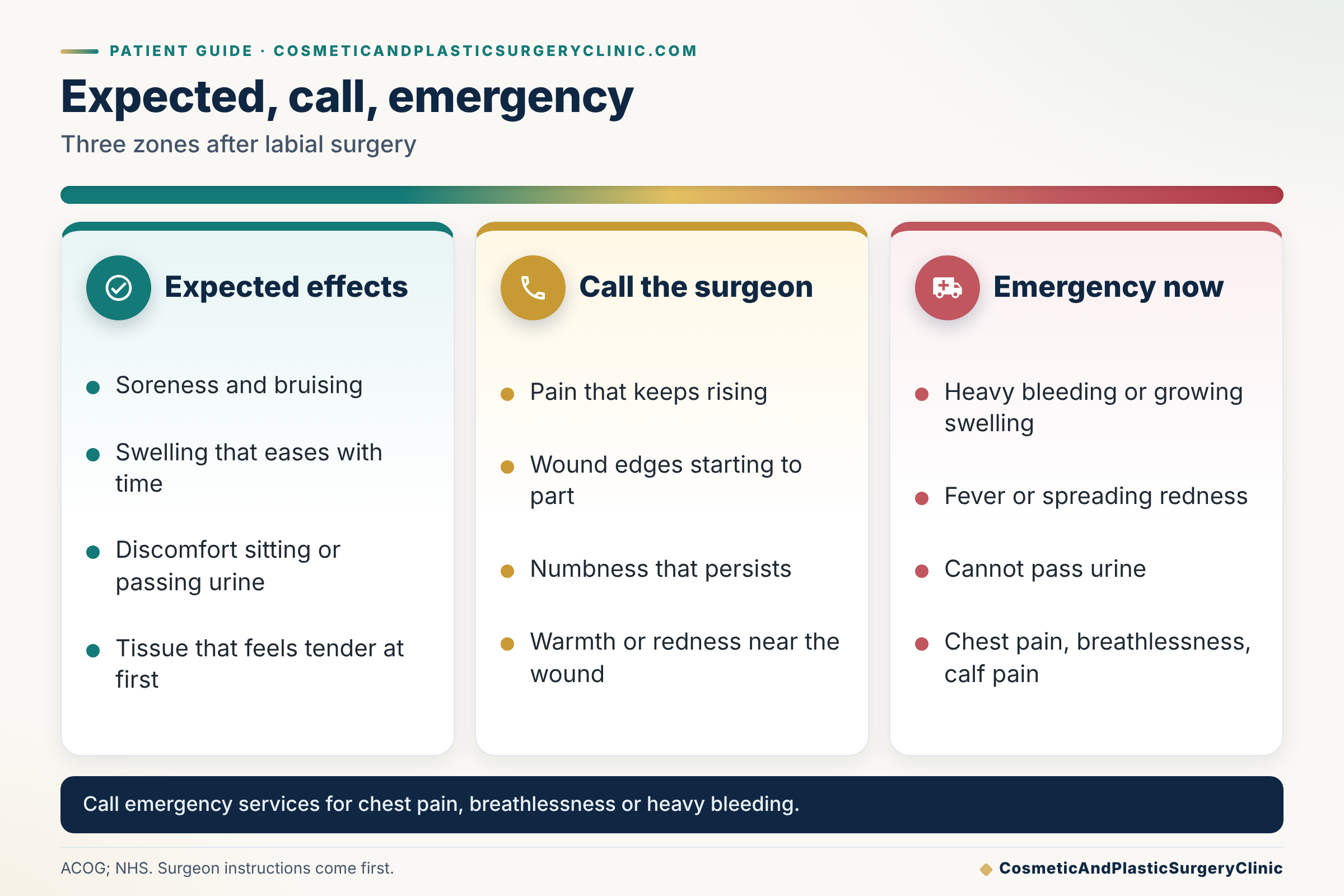
The NHS describes soreness, bruising and swelling for up to two weeks, with uncomfortable urination and sitting, and the ACOG adolescent commentary says recovery can take up to six weeks. Surgeon-directed timelines for work, exercise and intercourse are covered on labiaplasty recovery. The table below turns the long view into review points rather than promises.
| Factor | Effect on the outcome | Maintenance or revision implication | Warning sign or review point |
|---|---|---|---|
| Healing of the incision | Edges can separate; dehiscence was the most common complication in a 2015 review (4.7 percent) | May need dressings, time or a repeat procedure; ACOG lists reoperation | Wound edges opening or pain increasing |
| Sensation | Altered or reduced sensation appears on ACOG and NHS lists | Not always predictable; ask how it is documented and followed | Numbness or oversensitivity that persists |
| Type of symptom | Friction, skin disease and intercourse pain respond to different things | If another cause was missed, the symptom can continue | The same symptom at the follow-up visit |
| Age and further growth | A 2017 ACOG commentary notes tissue may keep growing in younger patients | Ask what the surgeon does if change continues | New change months after surgery |
| Goals beyond comfort | In the 2016 controlled study appearance satisfaction rose, but well-being did not change significantly | If distress is the main issue, counseling may need its own plan | A gap between the goal and the result |
Check 6: choose the clinician and test the functional labiaplasty plan with questions
The last check is about people and paperwork: who evaluates, who operates, what the quote and the insurer say, and which questions make a vague promise specific.
Who does what in a functional labiaplasty evaluation
The evaluation team: gynecology, dermatology, pelvic floor therapy
ACOG’s 2020 opinion says obstetrician-gynecologists should be able to recognize sexual function disorders, depression and anxiety, assess for body dysmorphic disorder when indicated, and refer for psychological evaluation before surgery when concerns exist. Mayo lists pelvic floor physical therapy among the treatments for vulvar pain and painful intercourse. A dermatologist or gynecologist comfortable with vulvar skin disease handles the conditions described under Check 2.
None of this implies that a person with physical symptoms has a psychological problem. Screening is standard because mood, anxiety and body-image concerns can coexist with, and shape, physical complaints, and because they affect how surgery is experienced afterward.
The surgical consultation
When symptoms persist and other causes have been addressed, a consultation with a board-certified plastic surgeon, or a gynecologist with relevant surgical training, in an accredited facility is the next step. Choosing a plastic surgeon explains how to verify credentials, and the plastic surgery consultation guide covers the visit itself. ACOG says surgeons should disclose their experience and outcomes, so asking for them is normal.
Pressure is a red flag in functional labiaplasty sales as in any elective surgery. A same-day deposit, a discount that expires today, a package that bundles several genital procedures, or a surgeon who dismisses the idea of an exam for other causes should prompt a pause and a second opinion.
Cost and coverage, briefly
What one insurer’s policy says about labiaplasty
Coverage policies differ by plan, and none can be predicted from an article. As one example, Aetna’s Clinical Policy Bulletin on cosmetic and reconstructive surgery, which shows a review date of June 2026, lists aesthetic alteration of the female genitalia, including labiaplasty, among cosmetic procedures and says some plans make exceptions, so the member’s benefit plan should be checked. The sections read contained no medical-necessity criteria for labiaplasty.
The takeaway is practical: ask the plan for its written policy before the consultation, and keep the symptom log and examination notes from Checks 1 to 3. The cost line items, and why package pricing deserves questions, are on labiaplasty cost. For how symptom documentation works for another operation that straddles function and appearance, see breast reduction insurance and functional rhinoplasty.
Popularity is not suitability
ASPS estimates 10,658 labiaplasty procedures in 2025, up 9 percent from 9,778 in 2024, built from member surgeon input, CosmetAssure data and a claims-based dataset. The age group with the most procedures in 2025 was 36 to 45, at 3,237. The tables read give counts by age and sex, not by reason for surgery, so the report cannot say how many were functional.
Questions that test the plan
Questions about the symptom and the evidence
- Which of my symptoms do you expect surgery to change, and which might continue?
- What did you examine to rule out skin, infection and pain conditions?
- What conservative measures do you consider a fair trial, and how long?
- What results do you have for patients with symptoms like mine, measured how, and for how long?
Questions about risks, alternatives and consent
- Which complications have you seen in your own practice, and how did you handle them?
- If my pain or sensation is worse afterward, what is the plan and who is responsible for it?
- What happens to the quote if a revision is needed?
- What would you advise if I waited, or if I wanted a second opinion first?
A clinician who welcomes these questions is showing something useful. One who bristles at them is also showing something.
Frequently asked questions
Is functional labiaplasty covered by insurance?
It depends on the plan, and no article can predict it. One national insurer’s cosmetic surgery bulletin, showing a June 2026 review date, lists labiaplasty among cosmetic procedures while noting that some plans make exceptions. Ask the plan for its written policy and any pre-approval steps before the consultation, and ask the surgeon’s office how it documents symptoms. A symptom log and examination notes from other clinicians give the plan more to review than a general statement of discomfort.
Does functional labiaplasty change sexual sensation or comfort?
The sources point both ways. ACOG lists altered sensation and painful intercourse among complications, and the NHS lists reduced genital sensitivity. In the 2020 symptom survey, items about tugging and pain during intercourse fell sharply after surgery, but the data were self-reported without a comparison group. The 2016 controlled study found no significant effect on relationship quality. ACOG’s adolescent commentary says long-term effects on sexual satisfaction are unknown. Ask the surgeon how they discuss this risk of functional labiaplasty and what they have seen.
What if my symptoms only appear during exercise or cycling?
Exercise discomfort appeared in 46 percent of Miklos and Moore’s functional group and 26 percent of the Rouzier series. Sources suggest clothing and moisture are worth examining first: Mayo advises changing out of wet exercise clothing promptly, and ACOG’s adolescent commentary mentions supportive underwear, emollients and arranging the tissue before exercise. No source read tests specific sports or equipment. A clinician can examine for friction injury, dermatitis or other causes before functional labiaplasty is weighed as an option.
Can a teenager have functional labiaplasty?
Evaluation of adolescents is specialist-led, and ACOG addresses it in a separate opinion. The 2017 commentary says clinicians should reassure patients that anatomical differences are normal during puberty, try conservative measures first, screen for body dysmorphic disorder and consider surgery only when a mature patient makes an autonomous decision after those measures fail. It notes that tissue can keep growing. A parent or teen should start with a pediatric or adolescent gynecologist, not a surgical sales visit.
Is there a size at which labia count as needing functional labiaplasty?
No agreed threshold exists. The 2025 systematic review notes that the definition of labial hypertrophy remains imprecise, citing older papers that used widths over 5 cm in 1976 and over 4 cm in 2000, and a 2017 review concludes that most enlarged labia fall within normal variation. Size alone does not define a functional problem. What matters in a consultation is the link between a specific symptom, an examined cause and a proposed operation, plus whether alternatives have been tried.
Will functional labiaplasty help hygiene problems or recurrent urinary infections?
The evidence is thin. A 2025 review lists hygiene, especially during menstruation, as something one older series mentioned, and lists recurrent urinary infections among reported complaints in the literature. The 2020 symptom survey did not report hygiene or urinary outcomes separately. Urinary infections have their own causes and treatments, which a primary care clinician or urologist can examine. Treat any claim that functional labiaplasty resolves these problems as unproven until a surgeon can show outcome data measured for them.
What should I bring to a functional labiaplasty consultation?
Bring the dated symptom log, a list of products and clothing you have tried, any diagnoses or exam notes from a gynecologist or dermatologist, your medicines and allergies, and the insurer’s written policy if you have asked for it. Add your questions in writing and note the answers. If a surgeon proposes a plan, ask for the symptoms it targets, the risks and the revision policy in writing before any deposit, and take the time you need to decide.
Sources and further reading
- Schnatz P, Boardman LA; ACOG Committee on Gynecologic Practice. ACOG Committee Opinion No. 795: Elective Female Genital Cosmetic Surgery. Obstetrics and Gynecology, 2020 (accessed 2026-11-13) — citation details and abstract-level reading; the ACOG page itself could not be opened
- ACOG Committee Opinion Number 795: Elective Female Genital Cosmetic Surgery — abstract record, CORE (accessed 2026-11-13) — evidence statement, complication list, screening and referral wording
- Contemporary OB/GYN — ACOG guidelines at a glance: breast and labial surgery in adolescents, 1 June 2017 (accessed 2026-11-13) — commentary on ACOG Committee Opinion 686: conservative measures, examples of symptoms, recovery, growth
- Ortega-Sánchez I, Lucha-López MO, Monti-Ballano S. Motivational factors for labiaplasty: a systematic review of medical research. Journal of Clinical Medicine, 2025 (accessed 2026-11-13) — motivation studies, listed complaints, definition problem, limits
- Miklos JR, Moore RD. Labiaplasty of the labia minora: patients’ indications for pursuing surgery. Journal of Sexual Medicine, 2008 (accessed 2026-11-13) — 131-patient chart review: indications and symptom percentages
- American Society of Plastic Surgeons — New study explores symptomatology and quality of life before and after labiaplasty, 26 August 2020 (accessed 2026-11-13) — press release on Furnas et al., Plastic and Reconstructive Surgery, 2020; full paper not read
- Sharp G, Tiggemann M, Mattiske J. Psychological outcomes of labiaplasty: a controlled prospective study. Plastic and Reconstructive Surgery, 2016 (accessed 2026-11-13) — abstract-level reading: satisfaction, complications, null effects
- Sharp G, Maynard P, Hudaib A-R, Hamori C, Oates J, Kulkarni J, Sarwer D. Do genital cosmetic procedures improve women’s self-esteem? A systematic review and meta-analysis. Aesthetic Surgery Journal, 2020 (accessed 2026-11-13) — five studies, heterogeneity, measurement limits
- Motakef S, Rodriguez-Feliz J, Chung MT, Ingargiola MJ, Wong VW, Patel A. Vaginal labiaplasty: current practices and a simplified classification system for labial protrusion. Plastic and Reconstructive Surgery, 2015 (accessed 2026-11-13) — systematic review of 19 studies: satisfaction and dehiscence
- Gulia C and colleagues. Labia minora hypertrophy: causes, impact on women’s health, and treatment options. International Urogynecology Journal, 2017 (accessed 2026-11-13) — narrative review abstract: normal variation and cautious position on surgery
- NHS — Labiaplasty, reviewed 27 September 2023 (accessed 2026-11-13) — normal folds, treatable conditions, risks, recovery, availability in the UK
- Merck Manual Professional Version — Lichen sclerosus, updated November 2025 (accessed 2026-11-13) — features, diagnosis, treatment, monitoring
- University of Iowa Health Care — Contact dermatitis of the vulva, reviewed 1 December 2025 (accessed 2026-11-13) — irritants, symptoms, skin-care measures
- Mayo Clinic — Vulvodynia: symptoms and causes (accessed 2026-11-13) — definition, contributors, when to see a clinician
- Mayo Clinic — Vulvodynia: diagnosis and treatment (accessed 2026-11-13) — exam, self-care list, vestibulectomy caution
- Mayo Clinic — Painful intercourse: symptoms and causes (accessed 2026-11-13) — entry versus deep pain causes, emotional factors
- Mayo Clinic — Painful intercourse: diagnosis and treatment (accessed 2026-11-13) — evaluation, cause-directed treatment, pelvic floor therapy
- American Society of Plastic Surgeons — 2025 plastic surgery statistics report (accessed 2026-11-13) — labiaplasty volume, age tables, data sources
- Aetna — Clinical Policy Bulletin: Cosmetic and reconstructive surgery, review date shown 25 June 2026 (accessed 2026-11-13) — one insurer’s classification of labiaplasty