Labiaplasty risks cluster around the wound itself and around what the healed tissue feels and looks like. The wound can separate, bleed or become infected in the first weeks. Later, the edges can end up uneven, scarred or more or less sensitive than expected, and some people need a second operation. Most published series report these events as uncommon, but the evidence is thin and uneven. This page sorts labiaplasty risks into expected effects, complications and emergencies, and gives each number with its source, year and population.
Labiaplasty reshapes the labia minora, and sometimes the clitoral hood; the labiaplasty overview covers what it changes and why people consider it. For how absolute and relative risk work across all procedures, read plastic surgery risks. Nothing here diagnoses a symptom, says whether surgery suits you, or replaces a consultation.
Labiaplasty risks in three tiers: expected effects, complications and emergencies
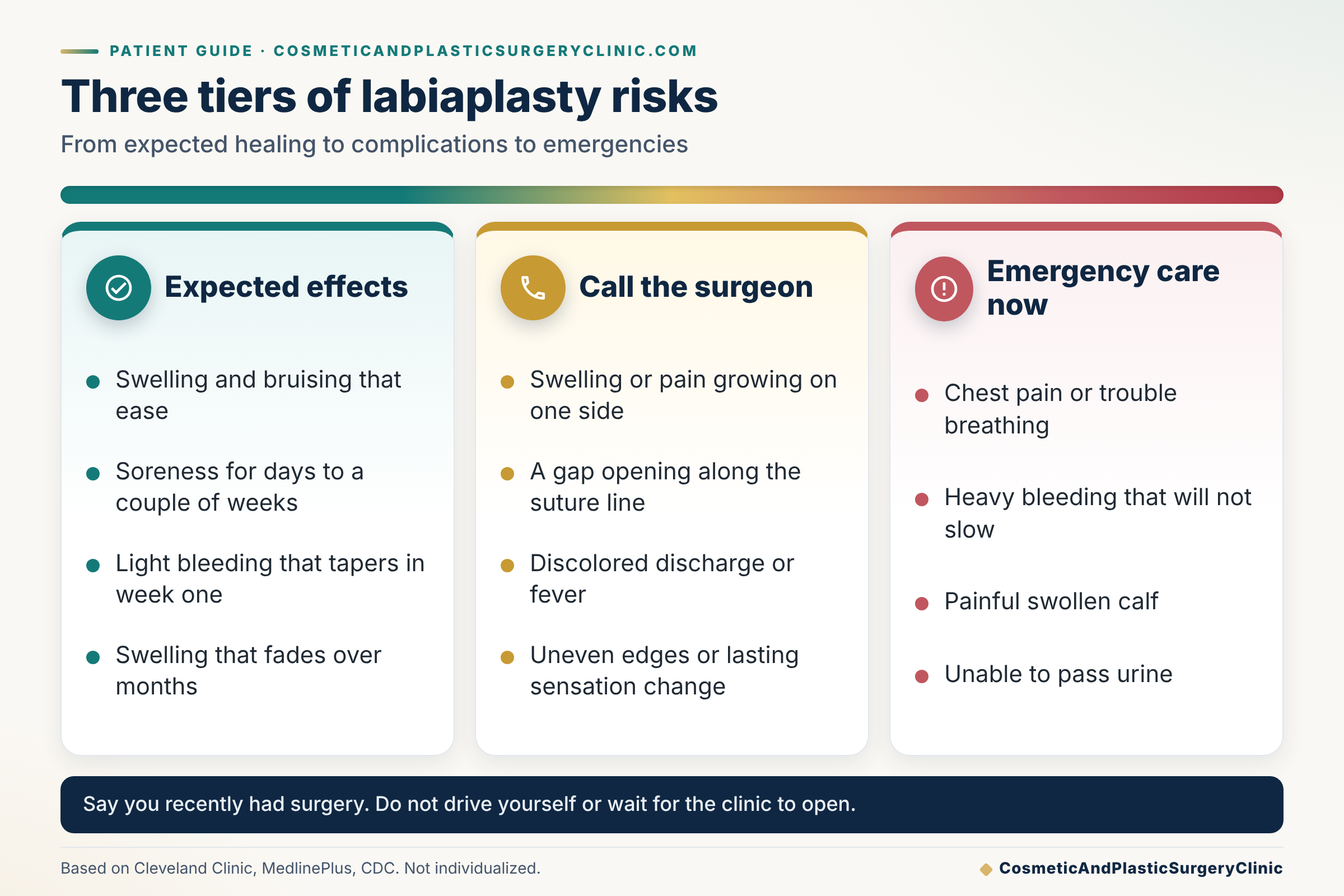
The word “risk” covers very different events. Soreness on day two and a blood clot in the lung can both appear on a consent form, yet they call for opposite responses. Sorting labiaplasty risks into three tiers is the quickest way to tell whether a change means follow the aftercare sheet, call the surgeon’s office today, or go to an emergency department now.
Expected effects that are not complications
Swelling, bruising and soreness that ease
Cleveland Clinic’s labiaplasty page (updated June 2023) describes swelling, discomfort and mild tenderness in the first few days, with bleeding that may last up to about a week and swelling, soreness and discoloration decreasing over the first two weeks. It says most swelling is gone by about six weeks but that the last of it can take four to six months, so the final appearance may not be visible until then. The International Urogynecological Association’s patient site (IUGA, page modified March 2024) says soreness, bruising and swelling can last up to two weeks.
Those ranges come from patient-information pages, not from trials, so they describe typical healing rather than measured labiaplasty risks, and individual surgeons set their own restrictions. The labiaplasty recovery article covers the week-by-week arc, so this page concentrates on the labiaplasty risks that depart from it.
When a normal symptom becomes a worrying one
What turns an expected effect into a complication is direction, size and symmetry. Swelling that is easing differs from a tense area that keeps growing on one side, and soreness that is improving differs from pain that is spreading or sharpening. Cleveland Clinic lists excessive swelling, worsening pain, increased bleeding or clumps of blood, discolored pus or discharge, fever and the surgical wound opening among the reasons to contact the surgeon’s office.
Consider a hypothetical patient on day four whose swelling is the same on both sides and slowly easing, and another whose swelling on one side has doubled since morning and throbs. The first is following the usual arc. The second needs a call now. No page read for this article gives numeric thresholds, so the written discharge instructions come first.
Complications that need a call to the surgical team
Wound separation, bleeding and infection
The Aesthetic Society’s labiaplasty safety page (October 2021) says significant complications are infrequent, and names infection, bleeding, scarring and extreme swelling among the procedure-specific risks. Cleveland Clinic adds wound breakdown and hematoma, which is blood collecting in a space because it cannot drain, as its own page on hematomas explains (updated November 2024).
Wound separation, also called dehiscence, means part of the suture line opens. The IUGA page notes a possible wound rupture along the incision after wedge excision. Each of these is a reason to call the same day, because early assessment may let the team choose between watching, local care and a return to the operating room.
Asymmetry, scarring and sensation changes
The American College of Obstetricians and Gynecologists (ACOG), in its January 2020 committee opinion on elective female genital cosmetic surgery, asks clinicians to counsel about pain, bleeding, infection, scarring, adhesions, altered sensation, painful intercourse and the possibility of reoperation. Cleveland Clinic lists removing too much or too little tissue, ongoing pain, pain with sex and loss of sensitivity.
None of these labiaplasty risks is an emergency alone. Each is a reason to book a visit, and several take months to judge because early swelling hides the final shape. Later sections give the published frequencies.
Emergencies: when labiaplasty risks mean emergency care now
Chest, lungs and legs
If any of these appears after your operation, call emergency services and say that you recently had surgery. Do not drive yourself, and do not wait for the clinic to open.
Heavy bleeding, fever and trouble urinating
Table 1 puts the tiers side by side. It is a reading aid and a prompt for the pre-operative visit, not a way to diagnose yourself.
| What is noticed | Category | General response | Basis |
|---|---|---|---|
| Swelling, bruising and soreness that ease over days to weeks | Expected effect | Follow written aftercare; mention changes at follow-up | Cleveland Clinic, 2023; IUGA, 2024 |
| Spotting or light bleeding in the first days, tapering | Expected effect | Follow written aftercare; call if it increases | Cleveland Clinic, 2023 |
| Swelling or pain that is growing, worse on one side, or bleeding with clumps | Complication, possibly urgent | Call the team at once; same-day assessment may be needed | Cleveland Clinic, 2023 and 2024 |
| A visible gap or opening along the suture line | Complication | Call the team the same day | Cleveland Clinic, 2023; IUGA, 2024 |
| Discolored discharge, fever, or severe pain when urinating | Complication, possibly urgent | Call the team now; emergency department if unreachable | Cleveland Clinic, 2023 |
| Uneven edges, numbness or hypersensitivity that lasts, pain with sex | Complication, often judged later | Raise at follow-up; call sooner if pain is increasing | ACOG, 2020; Cleveland Clinic, 2023 |
| Chest pain, breathlessness, fainting, painful swollen calf | Emergency | Call emergency services; say you had surgery | MedlinePlus, 2025; CDC, 2025 |
What published studies report about labiaplasty risks
Reading the literature is less reassuring and less alarming than headlines suggest. ACOG’s 2020 opinion states that published studies are scarce, terminology is not standardized, and high-quality data on effectiveness are lacking. The studies below are therefore a map of reported labiaplasty risks, not a forecast. The American Society of Plastic Surgeons (ASPS) 2025 statistics report counted 10,658 labiaplasties in 2025, up 9% from 9,778 in 2024, which says how often the operation is done, not how safe it is for any one person.
Two pooled reviews that do not agree
Escandón 2022: 46 studies and 3,804 patients
A meta-analysis in Plastic and Reconstructive Surgery (2022) pooled 46 studies covering 3,804 patients, searching through October 2020. Pooled satisfaction was 99%. Dehiscence was highest after laser-assisted labiaplasty (5%) and wedge resection (3%), hematoma highest after W-shaped resection (8%, with a very wide confidence interval), and 169 patients needed revision, mainly for dehiscence and aesthetic concerns. Three cases of flap necrosis were recorded.
On labiaplasty risks, the authors concluded that the operation is safe but that serious complications requiring surgical management do occur, and that surgeon experience and technique chosen to fit the individual matter. I read this study at abstract level only.
Géczi 2024: 53 studies with quantitative data
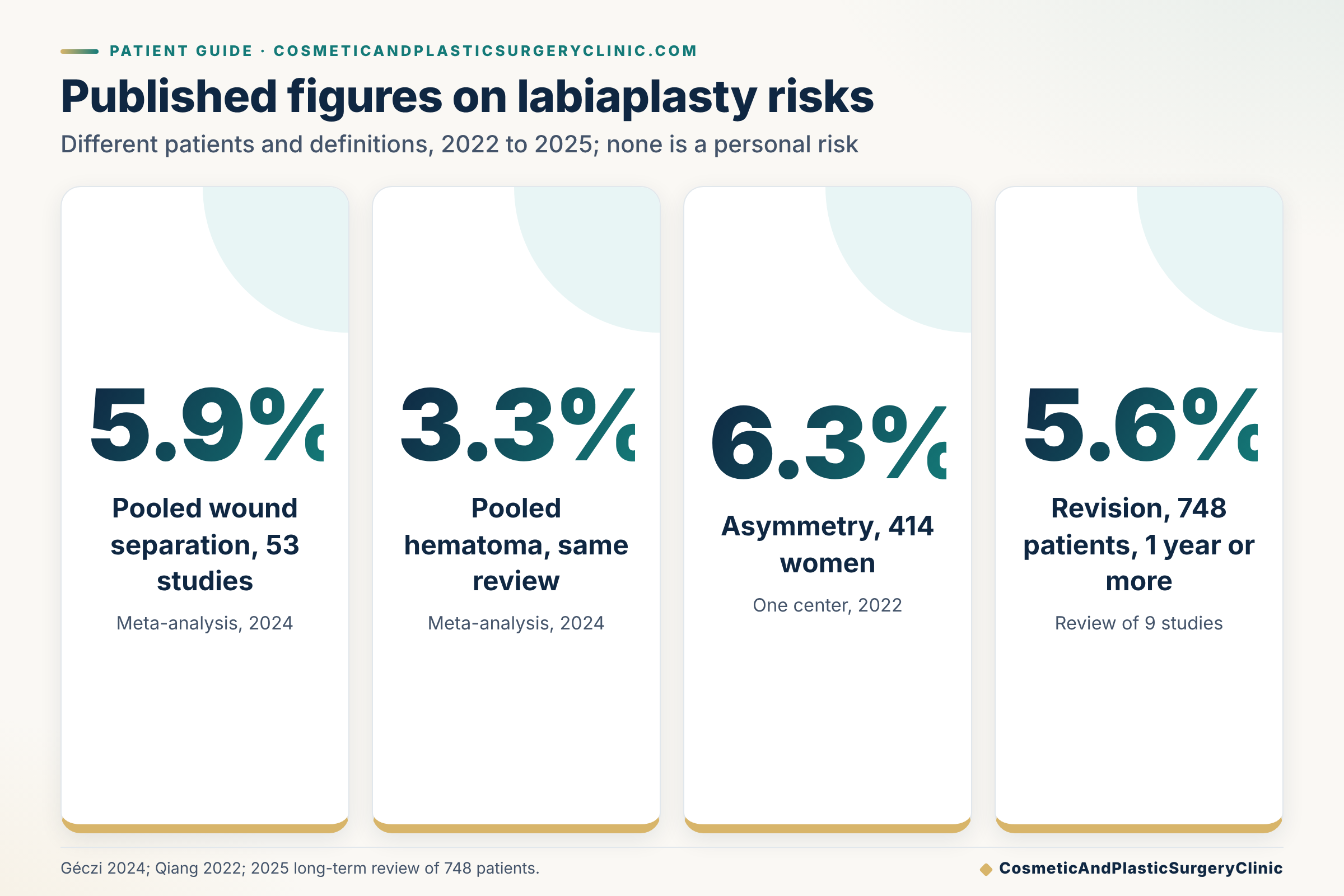
A meta-analysis in Aesthetic Surgery Journal (2024) searched through October 2023, found 86 eligible studies, and pooled quantitative data from 53. It reported these labiaplasty risks: hematoma at 3.3%, dehiscence 5.9%, swelling 4.0%, bleeding 2.2%, infection 3.0% and any complication 8.9%. Dehiscence after wedge resection was 8.4%, and the confidence interval for Z-plasty was very wide. Pooled satisfaction was about 94%. Scalpel use was linked to significantly more bleeding, swelling and hematoma than laser.
The two reviews pooled different studies and report wedge dehiscence at 3% and 8%. Géczi’s authors call the evidence heterogeneous, and the Escandón analysis reported substantial heterogeneity for satisfaction (I-squared 63%). Technique differences are the subject of trim versus wedge labiaplasty; here the point is that the same technique can carry a published figure nearly three times higher in one review than in another.
Single-practice and multicenter series
Lista 2015, Köle 2024 and Qiang 2022
A 2015 chart review from one Toronto practice followed 113 women after edge-excision labiaplasty. Transient swelling, bruising or pain occurred in 13.3%, bleeding in 0.8%, and revision in 3.5%; the authors reported no major complications. Mean follow-up was only 61 days, and just 12.4% were seen beyond 90 days, so later labiaplasty risks may have been missed.
A 2024 multicenter retrospective study from Turkey (2,594 patients, 43 surgeons) found wound separation the most common complication, mostly after wedge resection. Complications by technique were 26 of 753 for wedge (3%), 5 of 395 composite (1.2%), 1 of 123 Z-plasty (0.8%) and 7 of 1,323 trimming (0.5%); adding the counts gives 39 events, about 1.5% overall, which is the editors’ arithmetic. A 2022 single-center study of 414 women in China found asymmetry the most common complication (6.28%) and revision in 1.69%.
The long-term view: 748 patients at least a year out
A literature review of outcomes at least one year after surgery (Aesthetic Surgery Journal, volume 45, searched to December 2023) found nine studies reporting complications in 748 patients. Postoperative asymmetry occurred in 45 (6.02%), revision in 42 (5.61%) and scarring in 14 (1.87%); 621 of 748 had no reported complication. The review’s authors rated the evidence Level 3 (therapeutic). Long-term labiaplasty risks look different from the early ones: asymmetry and revision lead, not bleeding.
Reading labiaplasty risks figures without being misled
Why the wedge-resection figure is 3% in one study and 8% in another
Figures for labiaplasty risks depend on who is counted and what counts. Some studies are one surgeon’s own cases; others are pooled across many techniques. Follow-up lengths differ, definitions of dehiscence (partial or complete) are rarely stated, and surgeons usually report their own results. A 3% figure in one study and 8.4% in another, both for wedge resection, are not contradictions so much as different questions asked of different groups.
That is why a surgeon’s answer matters more than a pooled number: ask for their own rate, how they define it, and over how many cases. Table 2 sets the studies side by side.
| Study and year | Who was counted | Reported | Main limit |
|---|---|---|---|
| Escandón, 2022 (meta-analysis) | 46 studies, 3,804 patients | Dehiscence 3% wedge, 5% laser; 169 revisions | Heterogeneous studies; abstract read only |
| Géczi, 2024 (meta-analysis) | 53 studies with quantitative data | Dehiscence 5.9%; hematoma 3.3%; infection 3.0%; any 8.9% | Non-standard outcome measures; few laser studies |
| Köle, 2024 (multicenter) | 2,594 patients, 43 surgeons | Wedge 3%, trim 0.5% complications | Retrospective; interview-based data |
| Lista, 2015 (one practice) | 113 women, edge excision | Bleeding 0.8%; revision 3.5% | Mean follow-up 61 days; two surgeons |
| Qiang, 2022 (one center) | 414 women, 2008 to 2020 | Asymmetry 6.28%; revision 1.69% | Retrospective; single center |
| Long-term review (volume 45) | 9 studies, 748 patients, at least 1 year | Asymmetry 6.02%; revision 5.61%; scarring 1.87% | Level 3 evidence; few studies |
What the figures leave out
Three gaps limit what any labiaplasty risks figure can tell you. First, satisfaction is subjective, and Géczi’s authors note it is assessed without a standard scale; Lista’s team used no validated measure. Second, pain with intercourse and sensation are inconsistently measured, so a low complication count can simply mean nobody asked. Third, most data are retrospective and surgeon-reported.
High satisfaction and complications also coexist. In the 414-woman series, 8.94% were dissatisfied, and people whose motive was appearance only were less satisfied than those with functional or combined concerns. Dissatisfaction is itself one of the labiaplasty risks.
Wound separation, bleeding and infection: the early labiaplasty risks
The first weeks decide whether the incision closes cleanly. Wound problems feature on every list of labiaplasty risks. Surgeons commonly point to the region’s moisture and constant movement with walking and sitting, though none of the sources read tests that explanation. Being on the list does not make a problem likely: the pooled figures above put each of them in the low single digits.
The suture line and why it can open
Dehiscence: partial, complete and what it can lead to
In the Turkish multicenter series, complete dehiscence made up the largest single share of complications, and it occurred most often after wedge resection. In the Escandón meta-analysis, dehiscence was among the main reasons the 169 revision patients went back for surgery. A partial opening may simply be dressed and watched; a complete one can change the edge shape. No source read gives the proportion of each, so ask how your surgeon manages it.
Most surgeons advise limiting friction, heat, sitting pressure and strenuous activity while the line heals; Cleveland Clinic says to avoid strenuous exercise, cycling, running, swimming and sexual activity for four to six weeks unless the surgeon clears you, and IUGA gives three to four weeks for strenuous activity and four to six for intercourse. Those ranges differ, which is a reminder that your own surgeon’s written timeline is the one to follow.
Tension, tissue blood supply and healing
Tension on the closure and blood supply to the remaining edge are general surgical principles in wound healing. Escandón’s meta-analysis recorded three cases of flap necrosis, two after wedge resection. Neither page opened for this article quantifies how tension or technique changes the dehiscence rate, so treat any surgeon who promises that a particular method avoids wound separation with caution; the honest answer names a rate and a plan.
Hematoma, bleeding and infection
Bruising versus a collecting hematoma
Bruising is expected. A hematoma is different: blood pooling in a space, which can swell the tissue and cause pain out of proportion to the day. In Géczi’s pooled data, hematoma was 3.3% and postoperative bleeding 2.2%. In Lista’s 113 women, one (0.8%) bled and was treated with a stitch under local anesthesia. Escandón reported the highest hematoma rate after W-shaped resection, with a very wide interval, so it should not be read as a ranking.
The practical rule is the one in Table 1: a swelling that is growing, tense and one-sided is a call to the team, not something to wait out overnight.
Infection: what it looks like and how often it is reported
Among labiaplasty risks, Géczi’s pooled infection rate was 3.0%. Cleveland Clinic lists discolored pus or discharge, fever and worsening pain as reasons to call. Infection can be superficial or deeper, and a fever with spreading redness belongs in the urgent tier, not the wait-and-see tier.
Hygiene and dressing instructions differ between surgeons, so follow the written plan. Ask in advance whether you will receive antibiotics, and whether any existing skin or gynecologic condition should be treated first. No source read shows that antibiotic use changes the infection rate for this operation, so that question is for your surgeon.
Sensation, pain and sexual function: the labiaplasty risks studies measure least
Altered sensation and pain with intercourse are on ACOG’s counseling list, on Cleveland Clinic’s complication list and on the IUGA list, which names clitoral or labial nerve damage, tissue hypersensitivity and painful intercourse. They matter most to the people deciding, and they are the least consistently measured labiaplasty risks in the literature.
What the evidence covers on sensation
Altered, reduced or heightened sensitivity
Reports describe both directions: numbness or reduced sensitivity, and hypersensitivity. Lista’s authors suggested that incisions in highly innervated vulvar skin may cause neuroma-like hypersensitivity, and a 2023 Journal of Lower Genital Tract Disease paper is titled “Treatment of Symptomatic Labia Minora Neuroma after Labiaplasty to Prevent Recurrence,” so painful nerve-related problems have been described in the literature. I could read only its title, not its abstract, so it gives no frequency.
Painful nerve problems and when to ask for help
Pain that is increasing rather than fading, burning or electric sensations at the scar, or touch that has become unbearable are reasons to contact the surgeon rather than wait for the three-month visit. Whether sensory change is temporary or lasting, and how often, has not been established in the sources opened here.
If pain was the reason for considering surgery, it is worth knowing that the cause of pain in this region can be skin, nerve, muscle or infection related, which is why a gynecologic evaluation comes before the decision; see functional labiaplasty.
What studies cannot tell you about intercourse and sexual function
Pain with sex as a reported complication
ACOG lists painful intercourse, adhesions and reoperation among items to discuss, and Cleveland Clinic lists pain with sex. Lista’s authors report that none of their 113 patients described dyspareunia and contrast this with another study in which persistent dyspareunia occurred in 1.8%, attributing the difference partly to technique. That comparison comes from the discussion section of one paper, and the 1.8% study was not itself opened.
Surgeons usually advise a pause in intercourse after surgery, with ranges of about four to six weeks in the patient pages read here. Whether the incision location or scar tissue changes comfort later is something to ask about at consultation, not something a general article can answer.
Sexual function claims deserve scrutiny
The long-term review found that seven studies reporting psychological outcomes all showed sustained improvement in genital appearance scores, aesthetic satisfaction and sexual satisfaction. That is encouraging but should be read with the evidence rating (Level 3) and ACOG’s statement that procedures done to change sexual appearance or function are not medically indicated and have not had their safety and effectiveness established, with exceptions for clinical reasons such as pain with intercourse.
The practical conclusion is to treat any promise of improved sexual function, or of low labiaplasty risks without data, as a marketing claim until a surgeon can show data, and to expect your own consultation to explore the symptoms honestly, including whether the goal can be reached without surgery.
Asymmetry, scarring, over-resection and revision: the labiaplasty risks you see later
These labiaplasty risks take months to judge. Early swelling hides the final contour, and the long-term review lists asymmetry and revision as the most common problems beyond a year.
Contour and symmetry
Asymmetry before and after surgery
A review of normative anatomy (Hayes and Temple-Smith, 10 population-based studies, journal and year not shown on the page I read) found that right-to-left asymmetry of the labia is common. That matters because surgery starts from asymmetric tissue, and a small remaining difference is not automatically a failure. Postoperative asymmetry was the most common complication in the 414-woman series (6.28%) and in the long-term review (6.02%). Neither source gives a size threshold.
Ask the surgeon how much difference they consider acceptable, when they judge symmetry, and what they would do about a remaining difference.
Too much or too little tissue
Cleveland Clinic lists removing too much or too little as a complication. Over-resection is hard to reverse, because removed tissue cannot simply be replaced. Lista’s team reported no over-reduction in 113 patients and revision in four (3.5%), all to remove more tissue for persistent redundancy or asymmetry.
Correcting too much is therefore harder than correcting too little, and how conservative a surgeon intends to be at the first operation is a reasonable question to raise.
Scars, edges and revision
Scar quality and edge appearance
Scarring was reported in 14 of 748 patients (1.87%) in the long-term review. The position of the scar and what happens to the natural edge and pigment differ by technique, a topic the trim-versus-wedge article treats in depth. A 2015 review of 38 studies (1,981 patients, eight techniques) judged all of them satisfactory on examination and described complications as few, but gave no percentage.
No source read gives a timeline for how scars here mature, and the before-and-after labiaplasty photos article explains why photos at a few weeks say little about scars at a year.
Revision rates and what a second operation involves
Revision was reported in 1.69% of 414 women, 3.5% of 113, and 5.61% of 748 in the long-term review. Escandón recorded 169 revision patients, mainly for dehiscence and aesthetic concerns. These figures differ because definitions and follow-up differ. Revision is one way studies count how often later labiaplasty risks needed correction.
The timing of a revision is the surgeon’s call. No source read gives an interval, though Cleveland Clinic says swelling can take four to six months to resolve. Ask the practice what revision costs, whether surgeon, facility and anesthesia fees are charged again, and what the written policy says; the labiaplasty cost article itemizes those pieces.
Why labiaplasty risks differ from person to person
Labiaplasty risks differ even between two people having the same operation. The sources opened for this article name only a few modifiers, and they quantify fewer. What follows separates what a source says from what is general surgical reasoning, which is also the line to look for when a clinic explains your own risks.
Patient factors
Nicotine and tissue blood flow
The ASPS practice reference on smoking and nicotine (issued October 2024) states that patients who smoke or use any form of nicotine are at higher risk of postoperative complications, describes nicotine’s narrowing of blood vessels as especially concerning where healing depends on blood flow, and links smoking to wound-healing problems and tissue necrosis. It recommends stopping generally four to eight weeks before surgery and for at least four weeks afterward, and says urine testing may help decide whether to delay.
The reference is not specific to labiaplasty, and no source read reports a labiaplasty-specific figure. Because wound separation is one of the main labiaplasty risks, ask your surgeon for their nicotine rule rather than assume vaping or patches are exempt; the ASPS reference includes other nicotine products.
Clotting history, medications, skin and gynecologic conditions
The CDC (reviewed March 2025) says slow blood flow from limited movement raises clot risk and advises moving around as soon as possible after surgery. Tell the surgeon about any past clot, blood thinners, hormonal medicines and supplements, because those change the clearance and the clot-prevention plan; the sources read give no labiaplasty-specific odds.
ACOG advises clinicians to recognize sexual function disorders, depression, anxiety and other psychiatric conditions, to assess for body dysmorphic disorder when indicated, and to refer for evaluation before surgery is considered. Skin conditions, infections and gynecologic problems can also produce the symptoms that lead people to consider surgery, which is a general clinical point rather than an ACOG finding. No source opened measures how any of these change the complication rate, so the evaluation, not a statistic, is the safeguard. The labiaplasty candidate article explains what clinicians look at.
Procedure, anesthesia and facility factors
Technique, combined procedures and anesthesia
Technique changes the profile: Géczi found scalpel use linked to more bleeding, swelling and hematoma than laser, while Escandón found laser-assisted labiaplasty had the highest dehiscence (5%), and only five laser studies were available to Géczi. Those findings point in different directions and neither study proves a cause. In Lista’s series, 25.6% of patients had another procedure at the same time and 99.1% had general anesthesia.
MedlinePlus (updated September 2025) says anesthesia is generally safe but that risks are higher with general anesthesia, including heart rhythm and breathing problems, allergic reactions, temporary confusion and, rarely, awareness. Cleveland Clinic describes labiaplasty as an outpatient operation usually taking under two hours. Combining it with other surgery adds operative time and wound burden; the mommy makeover risks and tummy tuck risks articles discuss how combinations change risk in general.
Surgeon experience versus marketing claims
Escandón’s authors stress surgical experience, knowledge of female genital anatomy and technique selection tailored to each patient. ACOG advises surgeons to share their experience and outcomes with prospective patients. The ASPS patient-safety page emphasizes selecting a board-certified plastic surgeon and attention to the facility, and the Aesthetic Society makes the same recommendation about board certification; how to choose a plastic surgeon walks through verification.
A gallery, a “signature technique” or a high procedure count is marketing, not outcome data. Verified credentials, a specific answer about your own labiaplasty risks, and written policies on complications are the signals worth weighing. Pressure to book quickly, or a bundled package offered before a full evaluation, is a reason to pause.
| Factor | What the sources say | Question to ask |
|---|---|---|
| Nicotine in any form | ASPS 2024: higher complication risk, necrosis; stop 4 to 8 weeks before | What are your nicotine rules, and do you test? |
| Clot history or blood thinners | CDC 2025: slow blood flow raises clot risk; move early after surgery | What clearance and clot-prevention plan do you use? |
| Skin, infection or pain conditions | ACOG 2020: assess clinical and psychological factors; no complication figure found | Should a cause be evaluated or treated before surgery? |
| Technique and tool | Géczi 2024: scalpel more bleeding than laser; Escandón 2022: laser dehiscence 5% | Why this technique for my anatomy, and what is your rate? |
| Combined procedures | Lista 2015: 25.6% had another procedure; no separate rate | Is a second procedure advisable at the same time? |
| Anesthesia and setting | MedlinePlus 2025: risks higher with general anesthesia; Cleveland Clinic: outpatient | Who gives anesthesia, and where is it done? |
Eight questions that turn labiaplasty risks into specific answers
General statistics help you ask better questions; they cannot replace a surgeon’s answers about your anatomy. The questions below are built to separate a team that has thought through labiaplasty risks from one that is reciting reassurance. A specific answer, with a number or a plan attached, is the signal. The plastic surgery consultation article covers how to judge what you hear.

Questions about numbers, technique and causes
Ask for the surgeon’s own rates and definitions
Ask for the surgeon’s own numbers on labiaplasty risks: what rates of wound separation, hematoma, infection and revision they have seen, how each is defined, and over how many cases and how long. A surgeon who says “almost none” without definitions has not answered. Ask also which complication they see most often and what they changed after the last one.
Then ask which technique they recommend for your anatomy and why not the alternative. A good answer refers to your tissue and to the trade-offs in trim versus wedge labiaplasty, not to a brand name.
Ask what else could explain the symptoms
If discomfort, irritation or pain is the reason for considering surgery, ask what evaluation the surgeon wants first: examination for skin conditions or infection, a gynecologic review, and whether conservative measures should be tried. ACOG’s exceptions to its general statement cover procedures done for clinical reasons such as pain with intercourse, which points to evaluating the cause before choosing surgery.
If the reason is appearance, ask how the surgeon explores expectations and whether they screen for distress that surgery might not relieve. A surgeon who skips these questions is skipping part of the risk discussion. Labiaplasty alternatives describes the options that do not involve an operation.
Questions about health, the safety net and waiting
Health clearance, anesthesia, after-hours cover and revision terms
Ask what your own health history changes (nicotine, clot history, medications), who gives anesthesia and what credentials they hold, and where the operation will be done and whether the facility is accredited. Ask who you call at 2 a.m. when swelling is getting bigger, and how the practice handles a complication if you traveled for surgery; medical tourism and surgery covers the continuity-of-care issues.
Finally, ask what a revision costs if needed, whether the surgeon’s fee, facility and anesthesia are charged again, and what the written policy says. Cost questions beyond revision belong to the cost article already linked above.
When waiting, more evaluation or no surgery is reasonable
ACOG’s January 2020 opinion says that high-quality evidence for effectiveness is lacking and that procedures to alter appearance or sexual function are not medically indicated. Waiting, a second opinion or a medical evaluation are therefore reasonable and keep every option open. Signs to pause include pressure to decide the same day, deposits tied to a discount that expires, unclear answers about complications, a surgeon who will not discuss their own results, or unstable health.
If you decide against surgery, nothing about that choice is a failure. Wanting information first is a sound reason to book a consultation without committing to an operation.
Frequently asked questions
Is some bleeding normal after labiaplasty?
Some is expected. Cleveland Clinic says bleeding may last up to about a week, and its page lists increased bleeding or clumps of blood as a reason to contact the surgeon. The difference is trend and amount: light spotting that tapers differs from bleeding that soaks pads or grows heavier. Heavy bleeding is an emergency. Ask beforehand what amount your surgeon considers normal, and what to do overnight, because labiaplasty risks include a hematoma that may need drainage.
Can labiaplasty cause permanent loss of sensation?
It is listed as a possible risk, but how often is not established in the sources read. ACOG lists altered sensation among items for counseling, and Cleveland Clinic lists loss of sensitivity. A 2016 cadaver study of four specimens found no significant difference in nerve density between zones, yet that cannot predict living outcomes. Ask the surgeon how often these labiaplasty risks occur in their own patients, how they limit nerve injury, and what they advise if sensation changes.
Does laser labiaplasty have fewer risks than a scalpel?
Not clearly. The 2024 Géczi meta-analysis linked scalpel use to significantly more bleeding, swelling and hematoma than laser, but only five studies used laser. The 2022 Escandón analysis found dehiscence highest after laser-assisted labiaplasty (5%). Neither proves that a tool causes the difference. Ask for the surgeon’s own rates with the tool they plan to use rather than a general claim.
How often is a second operation needed?
Published revision figures run from about 1.7% to 5.6%: 1.69% of 414 women in a 2022 single-center study, 3.5% of 113 in a 2015 chart review, and 5.61% of 748 patients in a long-term review. They differ because definitions and follow-up differ, so no single figure sets your labiaplasty risks. Reasons named include persistent redundancy, asymmetry, dehiscence and appearance concerns. Ask a practice what its revision policy is in writing before you book.
How long should I avoid nicotine before surgery?
The ASPS 2024 practice reference recommends stopping generally four to eight weeks before surgery unless an emergency requires less, and staying nicotine-free for at least four weeks afterward. It treats patches, vaping and other products as nicotine too, and says urine testing may be used near the surgery date. It is a general reference, not specific to labiaplasty. Your surgeon sets the rule, and some will postpone surgery rather than operate on tissue with reduced blood flow.
Do labiaplasty risks change if it is combined with another procedure?
It may, but no source read gives a separate rate. In a 2015 series, 25.6% of the 113 patients had another procedure at the same time. Combining surgeries lengthens operating and anesthesia time and adds wounds, which are general reasons surgeons discuss staging. Ask whether the second procedure is advisable at the same time, and how the plan changes if recovery from one makes the other harder.
What warning signs mean I should not wait until my next visit?
Cleveland Clinic lists excessive swelling, worsening pain, increased bleeding or clumps of blood, discolored pus or discharge, severe pain when urinating or having a bowel movement, fever and the wound opening. Chest pain, breathlessness, fainting, a painful swollen calf, heavy bleeding or being unable to urinate need emergency care. Keep your surgeon’s after-hours number where you can find it, and ask before surgery who answers it.
Sources and further reading
- American College of Obstetricians and Gynecologists — Committee Opinion 795, Elective Female Genital Cosmetic Surgery, Obstetrics and Gynecology, January 2020 (record and abstract at Tower Health Scholar Commons; the ACOG page itself did not load; accessed 2026-11-13) — year, evidence limits, recommendations
- CORE — ACOG Committee Opinion Number 795, abstract (accessed 2026-11-13) — risks to counsel, clinical exceptions
- Cleveland Clinic — Labiaplasty (updated June 15, 2023; accessed 2026-11-13) — complication list, recovery ranges, when to call
- Cleveland Clinic — Hematoma (updated November 14, 2024; accessed 2026-11-13) — definition and post-surgery causes
- The Aesthetic Society — Risks associated with labiaplasty (October 2021; accessed 2026-11-13) — procedure-specific risks; infrequent significant complications
- International Urogynecological Association, Your Pelvic Floor — Labiaplasty (page modified March 2024; accessed 2026-11-13) — risk list, wedge wound rupture, activity ranges
- Escandón et al. — Maximizing Safety and Optimizing Outcomes of Labiaplasty, Plastic and Reconstructive Surgery 2022 (abstract record; accessed 2026-11-13) — 46 studies, 3,804 patients
- Géczi et al. — Comprehensive Assessment of Labiaplasty Techniques and Tools, Satisfaction Rates, and Risk Factors, Aesthetic Surgery Journal 2024 (accessed 2026-11-13) — pooled complication rates
- Géczi et al. 2024 — abstract record, BVS (accessed 2026-11-13) — wedge dehiscence, scalpel versus laser
- Köle et al. — Labiaplasty Outcomes and Complications in Turkish Women: A Multicentric Study, International Urogynecology Journal 2024 (accessed 2026-11-13) — 2,594 patients by technique
- Lista, Mistry, Singh and Ahmad — The Safety of Aesthetic Labiaplasty: A Plastic Surgery Experience, Aesthetic Surgery Journal 2015 (accessed 2026-11-13) — 113-woman chart review
- Lista et al. 2015 — abstract record, QxMD (accessed 2026-11-13) — evidence level and conclusions
- Qiang et al. — Long-Term Follow-up in Labiaplasty in 414 Women, Annals of Plastic Surgery 2022 (accessed 2026-11-13) — asymmetry, revision, dissatisfaction
- Long-term Functional and Aesthetic Outcomes of Labiaplasty: A Review of the Literature, Aesthetic Surgery Journal, volume 45 (institutional mirror of the journal page; accessed 2026-11-13) — 748 patients, at least one year
- Labia minora reduction techniques: a comprehensive literature review, Aesthetic Surgery Journal 2015 (abstract record; accessed 2026-11-13) — 38 studies, eight techniques
- Hayes and Temple-Smith — What is the anatomical basis of labiaplasty? A review of normative datasets for female genital anatomy (University of Melbourne repository; accessed 2026-11-13) — asymmetry is common
- The Safe Labiaplasty: A Study of Nerve Density in Labia Minora and Its Implications, Aesthetic Surgery Journal 2016 (abstract record; accessed 2026-11-13) — four cadaver specimens
- Kelishadi et al. — The Safe Labiaplasty: A Study of Labia Minora Nerve Density and Its Implications, ASAPS Aesthetic Meeting 2014 abstract (accessed 2026-11-13) — zone trend
- Gravina et al. — Treatment of Symptomatic Labia Minora Neuroma after Labiaplasty to Prevent Recurrence, Journal of Lower Genital Tract Disease 2023 (bibliographic record; accessed 2026-11-13) — title only; no abstract available
- American Society of Plastic Surgeons — 2025 Plastic Surgery Statistics Report (accessed 2026-11-13) — labiaplasty counts 2024 and 2025
- American Society of Plastic Surgeons — Managing the risks of smoking and nicotine, practice reference (2024; accessed 2026-11-13) — nicotine and cessation timing
- American Society of Plastic Surgeons — Patient safety (accessed 2026-11-13) — board certification and facility choices
- MedlinePlus — Pulmonary embolus (reviewed October 21, 2025; accessed 2026-11-13) — symptoms and emergency advice
- CDC — About blood clots (reviewed March 5, 2025; accessed 2026-11-13) — clot symptoms and moving after surgery
- MedlinePlus — Anesthesia (updated September 30, 2025; accessed 2026-11-13) — types and risks