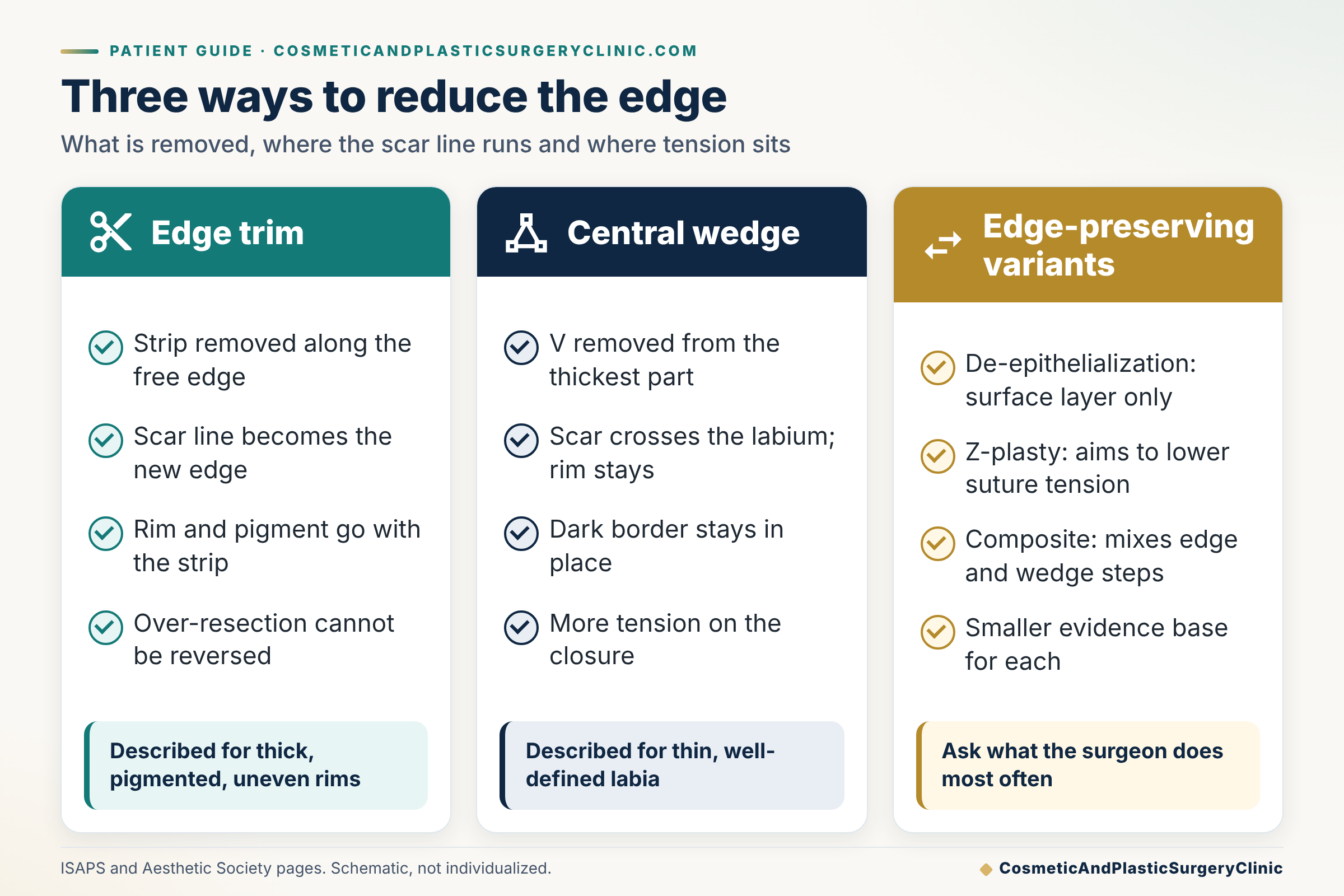
Trim vs wedge labiaplasty is a choice about where the scar line falls and what happens to the natural edge of the labia minora. In a trim, also called edge resection, the surgeon removes tissue along the free edge. In a wedge, a V-shaped piece comes out of the thickest part and the edge stays in place. Other approaches, such as de-epithelialization and composite reduction, borrow ideas from both. A trim can take away a darker or uneven rim but puts the suture line on the edge; a wedge keeps the rim but asks more of the closure.
This page compares trim vs wedge labiaplasty by tissue pattern, scar location, edge appearance, published complication data, recovery, revision and cost logic, then closes with six checks for a consultation. It cannot say which technique fits any one person; that takes an examination by a clinician with relevant training. Symptoms such as pain, irritation or repeated infections can have causes unrelated to labial size, so a gynecologic or dermatologic evaluation often comes first. The operation as a whole is covered on the labiaplasty overview, so it is not repeated here.
Trim vs wedge labiaplasty starts with where the scar line falls
Both operations in trim vs wedge labiaplasty are reductions: tissue leaves, the remaining edges are closed with dissolvable stitches, and a scar forms. What differs is which tissue goes. The Aesthetic Society says the technique chosen determines the incision locations and resulting scars, and that the operation can also include the clitoral hood. It names a trim and a wedge as the two options without defining either, so the definitions below come from ISAPS and the surgical literature.
How an edge trim removes tissue
A cut along the free edge, and what it takes with it
ISAPS describes the trim, or edge technique, as a longitudinal cut that removes pigmented labia minora tissue extending past the labia majora, and says it suits thick, pigmented labia with uneven, bulging edges. In a 2017 technique report from Stanford, Furnas marks a gentle arc from the frenulum toward the posterior labium, removes the strip, and closes in layers with dissolving sutures, aiming for a smooth, flat scar.
Because the cut runs along the edge, the scar line becomes the new edge. Alter, whose name is attached to the wedge, wrote in 1998 that the traditional approach amputated the protruding tissue and oversewed what remained. He argued in 2008 that this loses the normal labial contour and pigmentation. That is the case for a competing technique made by its developer, so treat it as an argument rather than a finding.
What a trim cannot keep, and where evidence thins
A trim does not preserve the natural rim or its color. For some patients that is the point: ISAPS says removal of the pigmented border is a main reason patients choose the trim. For others it is the cost. Furnas lists scalloped edges, over-resection, scar contracture and painful or hypersensitive scars among the risks, and notes that cutting across the frenulum can heal as a small ball-like lump.
A 2011 symposium report on Alter’s talk adds that trimming is technically easier but can leave an abrupt frenulum, a large hanging clitoral hood, asymmetry or scalloping. These statements come from one surgeon and no controlled comparison backs them. The Furnas paper is an expert technique description with an operative video and no outcome data, so it shows how a trim is done, not how well it works.
How a central wedge removes tissue
A V from the thickest part, with the edge left in place
ISAPS describes the wedge, or V technique, as a V-shaped incision that reduces size and length, suited to thinner labia with well-defined borders. In Alter’s 1998 report, a wedge was excised and the labial edges brought together, with the stated aim of preserving the normal labial edge and color.
His 2008 series describes the V taken from the most protuberant part of each labium, with the outer arm usually curved laterally and forward to remove redundant lateral tissue and excess clitoral hood, then closed in at least three layers. The scar runs across the labium rather than along its edge, and ISAPS notes that some authors consider it less noticeable. Alter’s own interview estimates about 1.5 to 2 hours of operating time for a wedge against about 30 minutes for a trim; that is a proponent’s figure, not a measured comparison.
Why closure tension is the wedge’s weak point
Taking out the middle of a labium and sewing the two sides together puts tension on the closure. ISAPS says the wedge carries a higher rate of wound dehiscence, meaning the wound edges separate, because of that tension, and that it does not remove the pigmented border.
Alter’s 2008 series of 407 patients, as read in a copy of the paper, recorded edge separations in 12 patients, of whom 4 needed revision, and stretching of the scar in 17 patients, 7 of them revised. Only 123 patients (30%) had an examination at two weeks or later, so the true figure may be higher, as the author acknowledges. Wound separation is the main thing to ask about in any trim vs wedge labiaplasty discussion.
The other approaches, in brief
De-epithelialization and composite reduction keep the rim by other means
ISAPS describes de-epithelialization, attributed to Choi, as removing the surface layer over the central part of the labium to reduce excess vertical tissue, and says it preserves sensation. The page gives no data for that claim. Composite reduction combines elements of wedge and edge techniques; in the 2024 meta-analysis discussed below, ten composite studies pooled a dehiscence rate of 2.7%, with swelling reported at 13.1% but with a very wide interval.
In a 2010 algorithm paper by Ellsworth and colleagues, 5 of 12 procedures used de-epithelialization, 4 an edge excision and 3 an inferior wedge, chosen by degree of excess and the patient’s preference for edge color and contour. Twelve procedures is a design sketch, not evidence of superiority.
Z-plasty, W-plasty, flask and fenestration vary the tension
ISAPS says Z-plasty reduces suture tension and leaves the shape and color of the free edge unchanged. A 2015 literature review by Oranges and colleagues counted eight named techniques across 38 studies: edge resection, wedge resection, de-epithelialization, W-plasty, laser labiaplasty, custom flask, fenestration and composite reduction.
Small groups can mislead. The 2024 meta-analysis pooled one Z-plasty study with a dehiscence rate of 13.3% and a confidence interval from 3% to 41%, while a 2024 survey of 123 Z-plasty patients counted one complication. Same technique, wildly different numbers. Treat the less common variants as options to ask about, not as proven upgrades to trim vs wedge labiaplasty.
Which anatomy points toward which technique, and where each one stops
No source read for this page gives a rule that maps a labial shape to one side of trim vs wedge labiaplasty. ISAPS says no single technique is best and that the best one is whichever the surgeon is most comfortable with. A 2023 algorithm paper by Lange, Hage and colleagues frames the choice as five decisions: whether to remove or partly keep the free rim, how much width to take, the blood supply, how to prevent thickening, and how to preserve sensation.
Trim vs wedge labiaplasty when the rim is thick, dark or uneven
Mechanism: removing the rim removes the tissue that bothers the patient
When the complaint is about the edge itself, a thick, darkly pigmented or rough rim, a trim addresses it directly because that tissue is what leaves. Furnas makes the same point, writing that the trim suits patients who dislike thick, dark or rough edges. In this setting, the trim vs wedge labiaplasty question is less about scar length than about whether a wedge would leave the very rim the patient wants gone.
Limit: the new edge is a scar line
The limit is the same fact seen from the other side. Once the rim is removed, the scar is the edge, and no one can put rim tissue back. The risks Furnas names, scalloping, over-resection and scar sensitivity, concentrate there. A very thin labium leaves little to remove, so a trim planned from a photo may take more than intended; the plan has to be checked against the examination.
Trim vs wedge labiaplasty when the labia are thin and well defined
Mechanism: the wedge reduces size while the rim stays
If the edge looks acceptable and the concern is projection or length, a wedge reduces size without touching the rim. ISAPS gives this as the setting where the wedge is a strong option. The same page notes that some authors consider the wedge scar less noticeable.
A 2014 systematic review abstract from Motakef and colleagues proposed sorting protrusion into three classes by the distance from the lateral edge of the labia minora to that of the labia majora: up to 2 cm, 2 to 4 cm and over 4 cm. It said technique selection should depend on the degree of protrusion and patient preference, and called for randomized studies. That classification has not become a universal standard.
Limit: pigment, tension and a longer operation
The wedge leaves the pigmented border, so a patient who wants a lighter edge may not get it. In trim vs wedge labiaplasty, the wedge asks more of the closure, which is where separation happens. Alter himself says it takes longer and is more demanding than a trim. A thicker labium or a large excess makes a tension-free closure harder, which is one reason surgeons modify the wedge or choose another route.
When the question is bigger than the labial edge
The clitoral hood, the labia majora and asymmetry
In a 2015 article in Aesthetic Surgery Journal, Hunter recommends evaluating the whole region rather than the labia minora alone, and lists three basic reduction methods: edge excision, wedge excision and central de-epithelialization. Excess hood tissue, a fuller labium majus or marked asymmetry can change the plan more than the trim vs wedge labiaplasty label does. Ask what the surgeon sees beyond the labial edge.
Blood supply, thickening and sensation
The Lange algorithm treats blood supply, avoiding postoperative thickening and preserving sensation as decision points of their own, and describes modified wedge and de-epithelialization techniques that use flaps. The 2024 meta-analysis pooled only two studies of a wedge with preserved vessels and nerves. No source read here shows how any technique changes sensation, and ACOG lists altered sensation among the possible complications of these operations.
| Factor | Edge trim | Central wedge | Edge-preserving variants |
|---|---|---|---|
| Setting described as a fit | Thick, pigmented, uneven rim (ISAPS) | Thinner labia with well-defined borders (ISAPS) | Surgeon-dependent; central excess with rim kept |
| Scar line | Follows the free edge | Crosses the labium; some authors call it less visible | Varies by method; often central |
| Natural rim and pigment | Removed along with the strip | Kept, including a dark border | Kept, by design |
| Operating effort | Described as simpler; Alter cites about 30 minutes | Longer; Alter cites 1.5 to 2 hours | Not compared in sources read |
| Reversibility | Removed tissue is not put back | Same | Same |
| Wound-separation signal | Lower in a 2024 survey (7 of 1,323 complications); not significant in a small 2017 comparison | Higher per ISAPS (tension); 26 of 753 in the 2024 survey | Composite 2.7% pooled; Z-plasty data too thin |
| Cost logic | No technique price list found; ask for itemized time, facility and anesthesia lines | Same; a longer operation may add time-based lines | Same; ask if a device or flap adds charges |
What the studies say about trim vs wedge labiaplasty, and what they cannot say
The evidence comes in three layers: pooled reviews, a few direct comparisons, and series from individual surgeons. ACOG’s 2020 committee opinion on elective genital cosmetic surgery tells clinicians to counsel patients about the lack of high-quality data supporting effectiveness, and that caution applies to every trim vs wedge labiaplasty number below.
Pooled reviews report high satisfaction and no clear winner
The 2015 review and the 2014 meeting abstract
Oranges, Sisti and Sisti reviewed 38 studies published from 1971 to 2014, covering 1,981 patients and eight techniques. They concluded that all eight gave good outcomes with high satisfaction and low morbidity, judged largely from clinical examination. The record read for this page gives no per-technique figures.
A 2014 meeting abstract from Motakef and colleagues covered 19 studies, 1,949 patients and seven resection techniques. Wedge resection was the most common, in 6 studies with 620 patients and a 94.3% satisfaction rate. Wound dehiscence was the most frequent complication at 4.7%, followed by hematoma at 0.8% and infection at 0.7%. It is an abstract, not a full paper, and it asks for randomized studies.
The 2024 meta-analysis of 3,954 patients
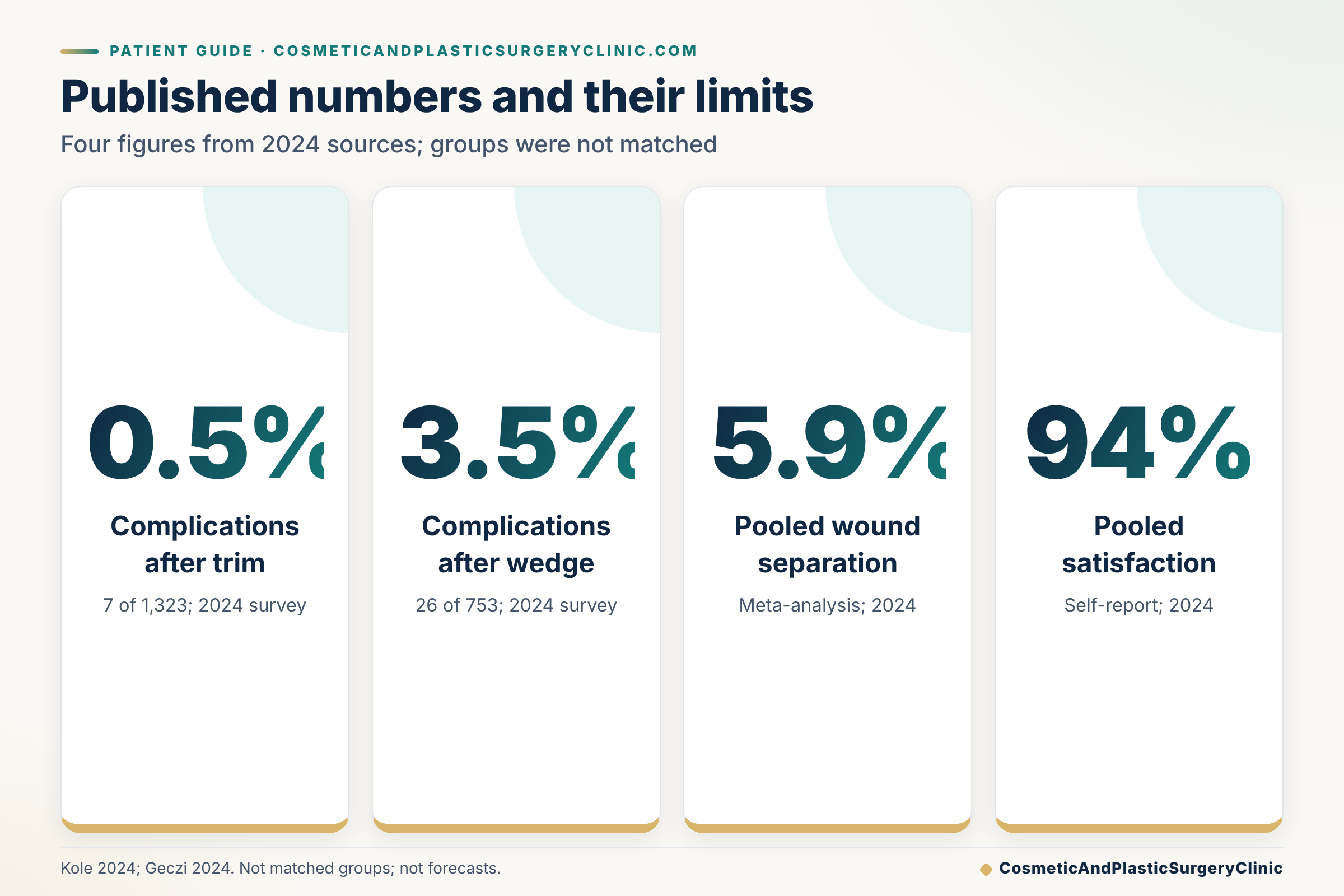
Géczi and colleagues (Aesthetic Surgery Journal, 2024) pooled 53 studies of 3,954 patients aged 10 to 72. Overall satisfaction was 94.4%, with edge resection at 95.9% across 13 studies and wedge resection at 95.7% across 15; differences between techniques were not significant. Overall wound separation was 5.9% and did differ by technique (P = .0001), with 8.4% for wedge and 2.7% for composite reduction.
The table read for this page gives no dehiscence figure for edge resection, so the review cannot answer the central trim vs wedge labiaplasty question about separation. The authors call the data scarce and heterogeneous, rate the evidence level 3 and note that satisfaction was mostly subjective questionnaire data. The article also contains counting inconsistencies, such as 86 versus 87 eligible studies, so its figures are best read as approximate.
Head-to-head trim vs wedge labiaplasty comparisons are few and imperfect
A 2024 survey of 43 surgeons and 2,594 patients
Köle and colleagues (International Urogynecology Journal, 2024) interviewed 43 surgeons in Turkey about 2,594 patients aged 18 to 50. Reported complications were 7 of 1,323 after trim, 5 of 395 after composite reduction, 1 of 123 after Z-plasty and 26 of 753 after wedge resection. Dividing those counts gives about 0.5% for trim and 3.5% for wedge. Wedge accounted for 16 of the complete dehiscence cases, and complete dehiscence was the most common complication overall.
This is the largest direct trim vs wedge labiaplasty comparison found, and it is a retrospective study built on surgeon interviews. Case mix, surgeon experience and the number of operations per surgeon were not matched, and technique is tangled up with who chose it. A low trim figure may reflect which patients and surgeons favored trimming. Only the abstract was readable, so sensation and satisfaction outcomes are unknown here.
A 2017 French comparison of 64 patients
Ouar and colleagues compared 42 wedge and 22 edge resections done by two surgeons between 2009 and 2016, with a mean follow-up of 5.3 months. By the counts in the abstract, 8 patients had a complication at one month, 6 after wedge and 2 after edge. There were 7 revisions: 5 for wound separation (4 wedge, 1 edge) and 2 for hematoma, one in each group.
Three patients had partial separation involving less than half of the wound, and all three healed without re-suturing. The authors saw a trend toward more separation after a wedge than after a trim, which was not statistically significant. Two surgeons, small groups and short follow-up limit it, and the abstract’s percentages do not match its own counts, so only the counts are used here.
Single-surgeon series show how trim vs wedge labiaplasty is done, not which is better
Alter’s 407-patient wedge series
In the 2008 series, questionnaires came back from 166 of 407 patients (41%); respondents rated satisfaction 9.2 out of 10 on average, and 98% of them said they would have the surgery again. Only 123 patients had an examination at two weeks or later. The author developed the technique, worked alone and reported about 4% complications. High numbers from a single developer, with most patients unexamined, tell a reader what is possible, not what is typical.
Other single-surgeon accounts of trim vs wedge labiaplasty follow the same pattern. Hunter’s 2015 article reports high satisfaction and low complications from a large personal experience. In Ellsworth’s 12 procedures, 92% of patients were very satisfied, three had minor wound problems that resolved on their own, and one patient who had an edge excision was unhappy because of over-reduction.
Group averages are not personal forecasts
The numbers that compare trim vs wedge labiaplasty use different definitions of complication, different follow-up, and patients and surgeons that were not randomized. A pooled complication rate describes a pool, and a satisfaction score describes the patients who answered. Neither says what will happen to one person with one surgeon.
ACOG’s opinion says surgeons should share their own experience and outcomes with prospective patients. So the useful question in a trim vs wedge labiaplasty consultation is: what are your own rates of wound separation and revision for each technique, how do you define them, and how long do you follow patients?
| Source | Population | What it reports | Limit to keep in mind |
|---|---|---|---|
| Köle et al., Int Urogynecol J 2024 | 2,594 patients, 43 surgeons | Complications: trim 7/1,323; wedge 26/753; composite 5/395; Z-plasty 1/123 | Retrospective interviews; groups not matched; abstract-level reading |
| Géczi et al., Aesthet Surg J 2024 | 53 studies, 3,954 patients | Satisfaction about 94% in all; wedge dehiscence 8.4%; overall 5.9% | No edge-resection dehiscence figure; counts inconsistent |
| Ouar et al., Ann Chir Plast Esthet 2017 | 64 patients: 42 wedge, 22 edge | Complications 6 wedge vs 2 edge; difference not significant | Two surgeons; 5.3-month follow-up; percentages inconsistent |
| Motakef et al., ASPS meeting abstract 2014 | 19 studies, 1,949 patients | Wedge 94.3% satisfaction in 620 patients; dehiscence 4.7% | Abstract only; mixed techniques and definitions |
| Alter, Plast Reconstr Surg 2008 | 407 patients, one surgeon | Reoperation 2.9%; 41% questionnaire response | Developer of the technique; 30% examined after 2 weeks |
| Oranges et al., Aesthet Surg J 2015 | 38 studies, 1,981 patients | Eight techniques; all described as high satisfaction, low morbidity | No per-technique figures on the record read |
Recovery, scar maturation and revision after a trim or a wedge
None of the sources read for this page timed trim vs wedge labiaplasty recovery separately for each technique, so be wary of any claim that one approach heals with zero disruption or on a shorter curve. The full week-by-week arc is on the labiaplasty recovery page; this section covers only what depends on the technique.
The first weeks and the months after
Swelling, stitches and limits come from the surgeon, not the technique label
The Aesthetic Society says the procedure may be done in an operating room or an office-based surgical suite under local or general anesthesia, with dissolvable stitches. For one surgeon’s trim protocol, Furnas advises taking it easy for a week, avoiding tampons and intercourse for four weeks and resuming cycling at six weeks, and notes that swelling can last three to six months. Those are one surgeon’s instructions, not a standard; your surgeon’s written plan governs.
Closure tension is the technique-specific piece. A wedge closed under more tension may call for more caution early, and a trim’s long edge scar may be tender longer. Neither idea is timed in the sources read, so ask the surgeon what to expect for the technique planned.
Scar maturation and the edge
Scars change for months. Furnas describes aiming for smooth, flat scars, and lists contracture and painful or hypersensitive scars among the risks of a trim. Alter’s 2008 series recorded scar stretching in 17 of 407 patients, 7 of whom had revision, and seven with mildly visible scars after wedge resection.
The edge itself looks different over time: early on, swelling and stitches make any edge look irregular. Photos taken in the first weeks say little about the result, and the labiaplasty before and after guide covers how timing changes what a picture shows.
Wound separation, revision and who treats it
What wound separation is and how it is usually handled
Wound dehiscence means the closed edges come apart, partly or fully. In the French comparison, three patients had partial separation of less than half the wound, and all three healed without re-suturing, through what surgeons call secondary intention. Five of the 64 patients had a revision operation for separation. ACOG lists pain, bleeding, infection, scarring, adhesions, altered sensation, painful intercourse and reoperation among the possible complications of these procedures.
How much separation matters depends on the extent, location and symptoms, and that judgment belongs to the treating surgeon. Ask what the clinic does if the wound opens: who sees you, how soon and whether revision visits are charged.
How revisions differ after a trim and after a wedge
No source read compares revision rates for trim vs wedge labiaplasty. Alter’s 2008 series reports 12 reoperations in 407 patients, 2.9%. In the 2017 comparison, 7 of 64 patients (11%) had a revision, most for separation. These samples differ too much to line up.
Tissue logic still applies. After a trim, over-resection cannot be undone by taking more, and ISAPS and Furnas both name over-resection as a risk. After a wedge, a separated closure may need re-closing. In an interview, Alter says about a third of his practice is revising earlier labiaplasty, mostly after trimming; that is a self-selected referral practice, not a rate. Choosing a surgeon who also handles revisions is covered on the choosing a plastic surgeon page.
Cost, quotes and predictability in trim vs wedge labiaplasty
No source opened for this page gave a price for trim vs wedge labiaplasty, and fee data for the whole operation belongs to the labiaplasty cost article. What a technique can change is the shape of the quote, not a fixed fee difference.
Reading a quote for trim vs wedge labiaplasty
Fee lines that move with operating time and setting
Alter says a wedge takes about 1.5 to 2 hours against 30 minutes for a trim, and any surgeon charging by operating time or facility time would reflect that. Anesthesia choice, from local anesthesia to general, and the setting, whether an operating room or an office suite as the Aesthetic Society describes, change the lines too. Ask for the surgeon fee, facility fee, anesthesia fee, any pathology, follow-up and revision policy as separate items. The plastic surgery cost page explains how to compare two quotes like for like.
Why package pricing and pressure deserve questions
A quote that bundles the trim vs wedge labiaplasty choice into a single figure makes it hard to see what changes if the surgeon switches from a trim to a wedge during the operation. Time-limited discounts, requests for a deposit before an examination and pressure to decide on the day are red flags in any elective procedure. A good answer names the technique planned, the circumstances in which it could change and what that does to the fee.
Group averages are not personal forecasts
Reading a complication percentage
A percentage needs a denominator, a definition and a follow-up time. Seven of 1,323 and 26 of 753 are counts from different surgeons treating different anatomy. A fair reading is that wedge resection shows up with more wound separation in several sources, including ISAPS’s tension explanation, and that how much more, for whom and with which surgeon is unknown.
Reading a satisfaction score
Satisfaction scores in this literature are mostly patient questionnaires. Alter’s 41% response rate and the meta-analysis authors’ note about subjective measures mean the scores describe patients who answered, at the time they answered. A score near 95% on both sides of trim vs wedge labiaplasty tells you that most responders were content, not that the choice does not matter for your anatomy.
Scenarios instead of a winner in trim vs wedge labiaplasty
Tissue picks the tool in many operations, as the gynecomastia lipo vs excision comparison shows for a different body area. The two hypothetical trim vs wedge labiaplasty scenarios below show how a different anatomy or goal moves the discussion. They are illustrations, not advice, and a clinician has to examine the person first. Whether surgery fits at all is the subject of the labiaplasty candidate article.
Scenario one: a thick, darker and uneven rim
Why a trim is the usual discussion
Consider a hypothetical adult whose main concern is a thick, darker, ruffled edge, not the overall length. The edge is the problem tissue, and a trim removes it; ISAPS and Furnas both describe the trim as the technique for that complaint. In trim vs wedge labiaplasty terms, the surgeon would likely discuss a trim or a composite approach that removes the rim.
The finding that would reverse it
If the examination shows thin tissue, so that removing the rim would take most of the labium, the plan shifts. The same is true if the person decides they would rather keep the natural color, which a wedge or de-epithelialization could preserve. A 2010 algorithm paper chose among edge excision, wedge and de-epithelialization by labial size and by the patient’s preference for edge color and contour, so preference is a legitimate input.
Scenario two: thin, well-defined labia with a long protrusion
Changing one variable: the closure would be tight
Now picture thin, well-defined labia with a long central protrusion and an edge the person likes. ISAPS describes the wedge as a strong option here. In trim vs wedge labiaplasty, Alter’s series and the meta-analysis suggest that the wedge’s weak point is closure tension. Make the excess larger, and a tension-free closure gets harder. A surgeon might modify the wedge, use a de-epithelialization or flap method, or discuss different priorities with the patient.
Questions that require a clinician
Two questions cannot be answered from an article. First, are the symptoms, if any, actually caused by labial size, or by skin conditions, infection or something else? The functional labiaplasty article covers when symptoms drive the question. Second, is surgery needed at all? The labiaplasty alternatives page covers non-operative options. Evaluation of adolescents is specialist-led and outside the scope of this page.
| Goal or anatomy | Option usually discussed | Reason | Fact that could reverse it |
|---|---|---|---|
| Thick, darker, uneven rim the person wants gone | Edge trim, or a composite approach | The rim is the tissue that leaves (ISAPS, Furnas) | Tissue is thin, or the person prefers to keep rim color |
| Thin, well-defined labia, edge acceptable | Central wedge | Size and length drop while the rim stays (ISAPS) | Large excess makes a tension-free closure unlikely |
| Central bulk, rim wanted, healing a concern | De-epithelialization or Z-plasty variants | Aim to keep the rim and lower tension (ISAPS) | Surgeon has little experience; outcome data are thin |
| Asymmetry with extra clitoral hood tissue | Either, combined with hood work | Aesthetic Society: the operation can include the hood | Examination shows the hood is not part of the concern |
| Mainly irritation or pain symptoms | Evaluation and non-operative measures first | Other causes are common; ACOG advises assessment | No other cause found and symptoms persist |
Six checks to put to a surgeon about trim vs wedge labiaplasty
These trim vs wedge labiaplasty checks separate a clear plan from a vague one. They sit alongside the general list on the plastic surgery consultation page, and they are numbered so you can take them into an appointment. Ask a gynecologic clinician to look at pain, irritation or recurrent infection first when those are the reason for coming.
Checks about the plan and the edge
Check 1: what tissue comes out, and why this technique for my anatomy?
A useful answer describes your labia in plain words, thickness, edge, pigment, protrusion and any hood or asymmetry, and says how those findings lead to a trim, a wedge or another method. The Lange algorithm’s five decisions are a good frame: keep or remove the rim, how much width, blood supply, thickening, sensation.
An evasive answer is “I do the same technique for everyone” without a reason, or a recommendation that arrives before an examination.
Check 2: where will the scar sit, and what happens to the natural edge and color?
Ask the surgeon to show where the scar line will run and whether the rim and its pigment stay or go. The answer should match the technique: a trim removes the rim, a wedge leaves it, and variants differ. Ask what the surgeon would do if the edge looks scalloped or uneven after healing.
Check 3: what if the wound separates, and does revision cost extra?
Separation is the most commonly reported complication in the sources read, so the answer should be specific: who you call, how soon you are seen, whether partial separation is simply watched and healed from the bottom up, and whether re-closing is charged. Ask for the revision policy in writing before surgery.
Checks about the surgeon, results and quote
Check 4: what are your own outcomes with each technique?
ACOG says surgeons should share their experience and outcomes with prospective patients. Ask how many trims and wedges the surgeon has done in the last few years, their own rates of separation and revision and how they define them, and for photos of anatomy like yours at stated times after surgery. The labiaplasty before and after guide covers how to read them.
Check 5: who operates, and where?
Look for a board-certified plastic surgeon, or a gynecologist with relevant training, who operates in an accredited facility with a qualified anesthesia provider. Verify certification yourself: the American Board of Plastic Surgery home page links to a public verification tool. The steps are on the choosing a plastic surgeon page.
Check 6: is the quote itemized, and is there pressure to decide?
Ask for an itemized quote with the planned technique named, and for informed consent in writing, including the risks ACOG lists: pain, bleeding, infection, scarring, adhesions, altered sensation, painful intercourse and reoperation. Package prices, deposits before an examination and countdown discounts are red flags. Waiting, a second opinion and deciding against surgery are all reasonable results of a consultation.

Frequently asked questions
Can the plan change from trim to wedge in the operating room?
It can, which is why the consent form matters. Tissue is sometimes thinner or thicker than it looked at the examination, and surgeons may adjust. The sources read for this page describe the techniques but not how often plans change during surgery. Ask whether your trim vs wedge labiaplasty consent names a first-choice technique and a fallback, who decides during the operation, and whether the fee or the facility time changes if the plan does.
Does trim vs wedge labiaplasty change how visible the scar is?
No source read measured scar visibility in trim vs wedge labiaplasty. ISAPS says some authors consider the wedge scar less noticeable, and Alter says it runs across the labium instead of along the edge. Furnas aims for a smooth, flat trim scar, and Alter says wide vertical scars after trimming can cause chronic discomfort. All of that is expert opinion, and the French and Turkish comparisons did not report scar appearance. Scar visibility depends on healing and technique, so ask for photos at stated times after surgery.
Does trim vs wedge labiaplasty affect sensation?
The sources read do not show that trim vs wedge labiaplasty changes sensation. ACOG lists altered sensation among possible complications of genital cosmetic surgery. ISAPS says de-epithelialization preserves sensation, but gives no data, and the 2023 Lange algorithm treats sensation as a decision point without reporting results in the abstract read. The 2024 meta-analysis did not report sensation outcomes. If preserving sensation matters to you, say so, and ask the surgeon what changes they have seen with each technique and for how long.
Can either technique be combined with clitoral hood reduction?
Yes. The Aesthetic Society says labiaplasty can include surgery on the clitoral hood, and in Alter’s 2008 wedge series almost all patients had some lateral hood excision. A trim can be combined with hood work as well. Hood work adds incisions, operating time and its own risks, so it should show up as a separate line in the plan and the quote. Ask what the surgeon sees in the hood, why it is or is not included and how that changes the trim vs wedge labiaplasty plan.
Does laser or radiofrequency change the trim vs wedge labiaplasty choice?
The tool is a different question from the pattern of tissue removed. The 2024 meta-analysis compared scalpel (48 studies) with laser (5 studies) and found lower hematoma and bleeding rates with laser, but no significant difference in total complications, and the authors called the laser group small. Radiofrequency had one study. A tool does not decide between a trim and a wedge; ask what the surgeon uses, why, and what experience supports it.
How many procedures should my surgeon have done?
No source sets a number. ACOG says surgeons should share their experience and outcomes with prospective patients, so asking is reasonable. Useful questions are how many trims and how many wedges the surgeon has done recently, the surgeon’s own rates of wound separation and revision, and how long patients are followed. Vague answers, or “no problems at all”, are worth a second opinion. The cosmetic surgeon credentials article explains what credentials do and do not show.
How do I compare two surgeons who recommend different techniques?
With trim vs wedge labiaplasty, ask each surgeon to describe your tissue in plain terms and to say what finding would make them recommend the other technique. The disagreement often comes down to whether the rim should stay, how tight the closure would be, or the surgeon’s habit. Ask for their own separation and revision rates, photos of similar anatomy and written revision policies. Bring both plans to a third opinion if the gap remains. Neither answer is wrong simply because it differs; a clear reason is what matters.
Is waiting, or choosing no surgery, a reasonable result of this comparison?
Yes. ACOG’s opinion describes elective genital cosmetic procedures as not medically indicated, with substantial risk and unestablished safety and effectiveness, while excluding procedures done for clinical reasons. Labial size and shape vary from person to person, and some people decide that information and reassurance are enough. If symptoms are driving the question, a gynecologic or dermatologic evaluation may find a different cause. The labiaplasty overview covers normal variation and the reasons people consider surgery.
Sources and further reading
- Géczi et al., Aesthetic Surgery Journal 2024 — Comprehensive assessment of labiaplasty techniques and tools, satisfaction rates and risk factors: systematic review and meta-analysis (accessed 2026-11-13) — pooled satisfaction and dehiscence by technique
- Köle et al., International Urogynecology Journal 2024 — Labiaplasty outcomes and complications in Turkish women: a multicentric study, abstract page (accessed 2026-11-13) — complications by technique, 2,594 patients
- Ouar et al., Annales de Chirurgie Plastique Esthétique 2017 — Postoperative complications of labia minora reduction: comparative study between wedge and edge resection, record page (accessed 2026-11-13) — 64-patient comparison
- Oranges, Sisti and Sisti, Aesthetic Surgery Journal 2015 — Labia minora reduction techniques: a comprehensive literature review, abstract record (accessed 2026-11-13) — 38 studies, eight techniques
- Oranges et al. 2015 — bibliographic record with authors and reference list (accessed 2026-11-13) — authorship and citation details
- Motakef et al., ASPS annual meeting 2014 — Vaginal labiaplasty: a systematic review, simplified classification system, and standardized practice guidelines, abstract (accessed 2026-11-13) — 19 studies, protrusion classes
- Alter, Annals of Plastic Surgery 1998 — A new technique for aesthetic labia minora reduction, record page (accessed 2026-11-13) — first wedge report, four patients
- Alter, Plastic and Reconstructive Surgery 2008 — Aesthetic labia minora and clitoral hood reduction using extended central wedge resection, abstract (accessed 2026-11-13) — 407-patient series
- Alter 2008 — copy of the full paper in an ASAPS 2019 session handout (accessed 2026-11-13) — technique detail, complication counts, limits
- The Aesthetic Guide — report on Alter’s talk at The Cutting Edge 2011 symposium (accessed 2026-11-13) — one surgeon’s view on trim vs wedge
- The Aesthetic Guide — interview with Gary J. Alter (accessed 2026-11-13) — operating-time and revision-practice claims, opinion only
- Furnas, Plastic and Reconstructive Surgery Global Open 2017 — Trim labiaplasty (accessed 2026-11-13) — technique description, risks, one surgeon’s recovery advice
- Ellsworth et al., Aesthetic Plastic Surgery 2010 — Techniques for labia minora reduction: an algorithmic approach, record page (accessed 2026-11-13) — three techniques, 12 procedures
- Lange, Hage, Karim and Amant 2023 — An algorithm for labia minora reduction based on anatomical, configurational and individual considerations, record page (accessed 2026-11-13) — five decision steps
- Hunter, Aesthetic Surgery Journal 2015 — Labia minora, labia majora and clitoral hood alteration: experience-based recommendations, record page (accessed 2026-11-13) — three basic techniques; whole-region evaluation
- ISAPS — Labia minora reduction patient information (accessed 2026-11-13) — trim, wedge, de-epithelialization and Z-plasty descriptions
- The Aesthetic Society — Labiaplasty: what are my options (accessed 2026-11-13) — trim and wedge named; stitches, hood, anesthesia
- ACOG Committee Opinion 795 (2020) — Elective female genital cosmetic surgery, repository record with abstract (accessed 2026-11-13) — counseling, evidence limits, complications
- ACOG Committee Opinion 795 — second repository record with abstract (accessed 2026-11-13) — screening and disclosure wording
- American Board of Plastic Surgery — home page and certification verification link (accessed 2026-11-13) — verifying a surgeon