Dermal fillers are gels or particle suspensions injected beneath the skin to add volume, soften folds and reshape contours. The FDA classifies them as medical device implants, not cosmetics, which is why labels, age limits and approved areas exist at all. Most are absorbed over months, so the decision repeats; a few last longer and are harder to undo. What dermal fillers can do for a face depends less on the brand than on three things: what is actually missing, where in the tissue the product is placed, and who places it.
This page is the hub for the dermal fillers cluster. It covers the main materials, what fillers change and what they leave alone, the facial layers and blood vessels that turn placement into a safety question, the visit itself, duration, the difference between expected effects and complications, who is told to wait, and how to judge an injector. Lips, price, photographs, complications, product families, cheeks, dissolving and the under-eye area each have their own guide, linked where you would need them next. Nothing here can say whether treatment suits your face.
What dermal fillers are made of and what the FDA has approved them to do
In its 2024 statistics report, the American Society of Plastic Surgeons (ASPS) counted 5,331,426 hyaluronic acid (HA) filler procedures and 932,861 non-HA filler procedures, about 6.26 million in all and the second most popular minimally invasive treatment after neuromodulators. The 2025 report published no filler counts but again ranked HA fillers second, at 30 percent of minimally invasive treatments, and said 23 percent of those HA treatments were for lip augmentation. In the 2024 data, half of HA filler patients were 40 to 54. Popularity describes demand, not suitability, and the figures count procedures, not people or outcomes.
Medical devices with age limits and approved areas
Why the FDA regulates fillers as devices
The FDA describes dermal fillers as “medical device implants approved by the FDA for use in helping to create a smoother and/or fuller appearance in the face,” and lists the nasolabial folds, cheeks, chin, lips and back of the hands among the treated areas. Its consumer page says that having filler injected “should be considered a medical procedure, not a cosmetic treatment.” That classification is the reason every product has a label: an approved area, a minimum age, contraindications and warnings drawn from clinical trial data.
It also explains why the FDA tells consumers never to inject themselves and to avoid buying filler online, since products sold that way may be counterfeit or unapproved. The agency states that no filler is approved for over-the-counter use and that needle-free injection devices are not approved for fillers. If dermal fillers are described to you as a simple beauty service with no label worth reading, that description conflicts with the regulator’s own.
Age floors and the areas named on labels
The FDA’s consumer page says approved uses of absorbable fillers apply to adults 22 and older, while individual labels in the approval list state 21 or 22 depending on the product. Two labels approved in 2026, one for midface volume in May and one for lips in July, name adults 22 and older and adults over 21 respectively. The FDA also says safety is unknown in patients under 22. ASPS still counted 9,528 HA filler procedures in patients 19 and under in 2024, a reminder that real-world use extends past what trials studied.
Each approval names an area, and the list of areas has grown one at a time. The table below summarizes what the FDA’s approval list shows and where the labels stop; anything outside a label is off-label, which is a legal and common practice but one that moves the risk-benefit judgment onto the injector and you.
| Area | Material families with a labeled indication | First entry in the FDA list | Worth asking |
|---|---|---|---|
| Nasolabial folds and facial wrinkles | HA, CaHA, PLLA, PMMA in a collagen gel | Collagen 1981; first HA gel 2003 | Is the target the labeled fold or a neighboring area? |
| Lips and perioral lines | HA gels, placed submucosally on labels | 2011 | Which lip label applies, and how much of it is used? |
| Cheeks and midface | HA; PLLA for cheek wrinkles (2023) | 2013 | Is deep placement planned, and why that depth? |
| Back of the hand | CaHA, HA | 2015 | Is there joint, tendon or vessel disease to disclose? |
| Chin | HA | 2020 | Does my profile need projection, or something else? |
| Jawline | HA, CaHA | 2021 | Is the loss of definition a volume or a skin problem? |
| Infraorbital hollows | HA | 2021 | Is this a hollow, or puffiness or pigment? |
| Temples | HA | 2023 | Who treats a vascular problem here, and how fast? |
| Glabella, nose, forehead, neck, décolletage | None on labels; the FDA recommends against several of these sites | Not applicable | Who is accepting the off-label risk, and what is the plan? |
The list behind the table is the appendix to the FDA’s briefing document for an August 2025 advisory panel, current through May 2025, plus two 2026 labels read directly. It is not exhaustive and labels change, so the label for the exact product is the document to ask for. The same briefing states that no dermal filler is currently approved for the décolletage.
Five families of dermal fillers, two ways of working
Hyaluronic acid: a space-filling gel
The FDA describes hyaluronic acid as a sugar present in body tissues; in gel form it binds water and swells, producing a smoothing or filling effect, and some versions are chemically cross-linked to last longer. A review in the Journal of Drugs in Dermatology (2024) found 28 HA fillers in the FDA approval database and described all current US HA products as biodegradable. HA was first used in fillers in 1989 and originally came from rooster combs; the FDA notes that some current products use material produced by bacterial fermentation.
Because HA is a molecule the body already makes, an enzyme called hyaluronidase can break it down. That property separates HA gels from every other family of dermal fillers below, and it is part of why every labeled lip and infraorbital-hollow indication in the FDA list is an HA product. The FDA gives about 6 to 12 months as the typical effect of HA, though individual labels report trial durations by area.
Calcium hydroxylapatite, poly-L-lactic acid and PMMA
Calcium hydroxylapatite (CaHA) is a mineral found in teeth and bones, supplied as particles in a gel carrier; the FDA gives about 18 months for its effect. The FDA and the manufacturer’s label both note that CaHA particles are visible on x-rays and CT scans, which matters if you have imaging later. Poly-L-lactic acid (PLLA) is a man-made, biodegradable polymer given as a series of injections; the FDA says its effects may last up to two years, and ASPS says it stimulates the body’s own collagen, so results build over weeks instead of appearing at once.
Polymethylmethacrylate (PMMA) microspheres are non-absorbable and suspended in a gel containing bovine collagen. The FDA calls it the only approved product made from a material the body does not absorb, and approves non-absorbable fillers only for nasolabial folds and cheek acne scars. The collagen-stimulating group is often called biostimulatory, and how it differs from HA is the subject of the guide to hyaluronic acid versus biostimulatory fillers. Polycaprolactone fillers sometimes appear in that conversation, but none is in the FDA approval list through May 2025, so check the FDA database before accepting a claim of approval.
What dermal fillers can change, and what they leave alone
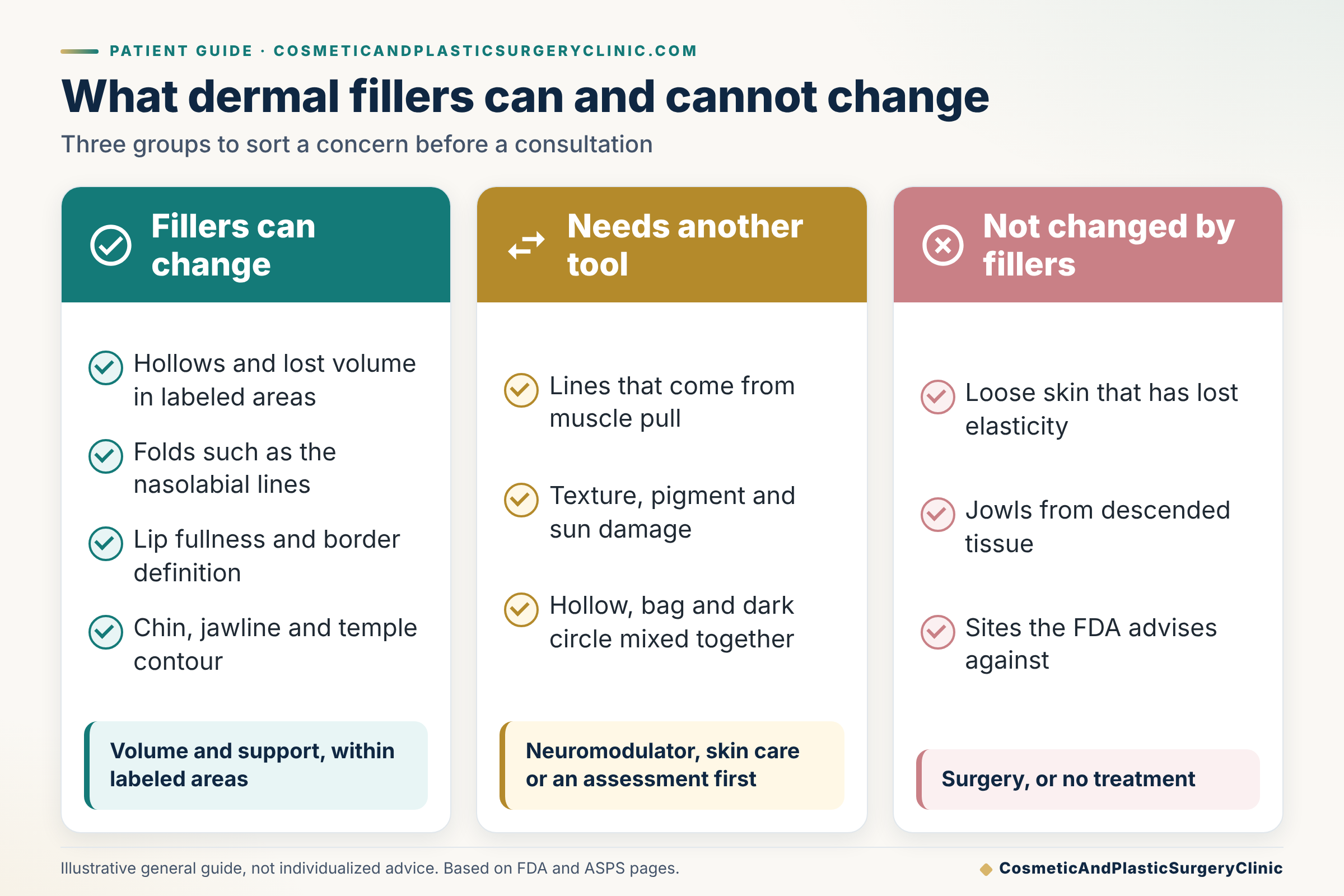
ASPS attributes many age-related facial changes to lost subcutaneous fat and describes dermal fillers as a way to diminish facial lines and restore volume and fullness. That framing is useful because it sorts concerns into those a filler addresses and those it does not. The sorting question is simple to state and harder to answer in a mirror: is the problem missing volume or support, loose skin, muscle pull, or the surface of the skin?
Where dermal fillers do their best work
Hollows, folds and thin lips
ASPS lists plumping thin lips, enhancing shallow contours, softening creases and wrinkles, improving the look of recessed scars and reducing lower-lid shadowing among the uses of dermal fillers. What these share is a localized deficit: a hollow, a fold, a lip thinner than its owner wants. A gel can fill a defined space; it cannot change the tissue around it.
Lips have their own anatomy, goals and swelling timeline, covered in the lip filler guide, and the comparison with a neuromodulator technique that changes how the lip sits is in lip flip vs lip filler. This page stays with the shared principles.
Contour in the cheeks, chin, jawline and temples
The labels for chin, jawline, temple and cheek products are recent, and they describe gels and CaHA placed deeper, often down to the bone surface, to change the shape of a region rather than the line in a crease. Contour work changes proportions, and proportions are personal. A chin that is mildly retruded in a trial population says little about whether added projection would improve your profile.
Photographs from the front and both sides in even light, taken before treatment, make it possible to judge later what actually changed. How to read such images, including the swelling window and common retouching cues, is the subject of the guide to dermal filler photos.
What dermal fillers cannot reach
Loose skin, jowls and gravity
ASPS says that for some people surgery such as a facelift, brow lift or eye lift may be the best approach, and that minimally invasive treatments cannot achieve the same results but may help delay when a facelift becomes appropriate. A filler adds something beneath the skin. It does not remove excess skin or reposition tissue that has moved downward, so dermal fillers used to chase sagging can leave the underlying problem in place.
Where the boundary sits is a clinical assessment made in person. The facelift alternatives guide sets out nonsurgical options and their limits, and the facelift guide explains what the operation changes and what it does not.
Movement lines, texture and sun damage
Lines that deepen with expression come from muscle pull, which a neuromodulator addresses and a filler does not; the Botox guide covers that tool. Fine texture, brown spots, redness and enlarged pores sit in the skin itself and respond to skin care, sun protection and resurfacing, not to volume placed underneath.
Lines that are present at rest often have more than one cause, so plans for them may involve more than one tool. The FDA notes that the safe use of fillers in combination with neuromodulators or other treatments has not been evaluated, so ask any injector who proposes a combined plan how the treatments will be sequenced and spaced.
A decision table, and how to use it
Real faces rarely match one row. Use the table as a list of questions to bring to a consultation, not as a verdict about what you need.
| Situation | Likely pathway | Benefit | Trade-off | Key question |
|---|---|---|---|---|
| A hollow under the cheek or along the temple, skin otherwise firm | HA or CaHA filler placed deep, within a labeled indication | Restores support without an incision | Repeat visits; deeper placement sits near vessels | Which product, which depth, and is it labeled for this area? |
| A fold from nose to mouth with sagging jowls | Filler for the fold only if the jowl is minor; surgical assessment otherwise | Softens the fold | Does not reposition descended tissue | Is the fold a symptom of descent? |
| Thin or uneven lips | HA lip filler, or a neuromodulator technique for how the lip sits | Fullness and border definition | Early swelling; risk of an overfilled look | What shape do I want at rest and in profile? |
| Lines between the brows or across the forehead | Neuromodulator first; fillers are not approved for these sites | Treats muscle pull | The FDA recommends against filler in the glabella and forehead | Why is a filler being proposed here? |
| Dark or hollow-looking lower lids | Assessment of hollow versus bag versus pigment, then a labeled hollow product or surgery | Matches the tool to the cause | Higher-stakes anatomy near the eye | Is this a hollow, and what is the plan if blood flow is affected? |
| Loose skin and descended tissue | Surgical consultation; filler may delay but not replace | ASPS says it may delay surgery | Cannot match surgical results | What will a filler not do for me? |
Rows that point away from a filler
Several rows end in a different tool: muscle pull points to a neuromodulator, sagging to a surgical opinion, texture to skin treatment. A clinic that offers dermal fillers for every row is selling one tool to every problem, and the question in the last column of the forehead and glabella row is worth asking out loud.
Rows that call for a combined plan
Others, such as lower lids, mix a volume problem with skin quality and fat position. The under-eye filler risks guide, linked in the next section, explains why that region needs its own risk discussion, and the lower eyelid surgery guide shows where surgery may fit better.
Facial layers, blood vessels and why anatomy matters for dermal fillers
The same gel placed at two depths can produce two different faces and two different risk profiles. Anatomy is the reason labels specify a plane, the reason some sites sit outside the labels, and the reason an injector’s training matters more than the name on the syringe.
From skin to bone: where the product goes
The depths named on labels
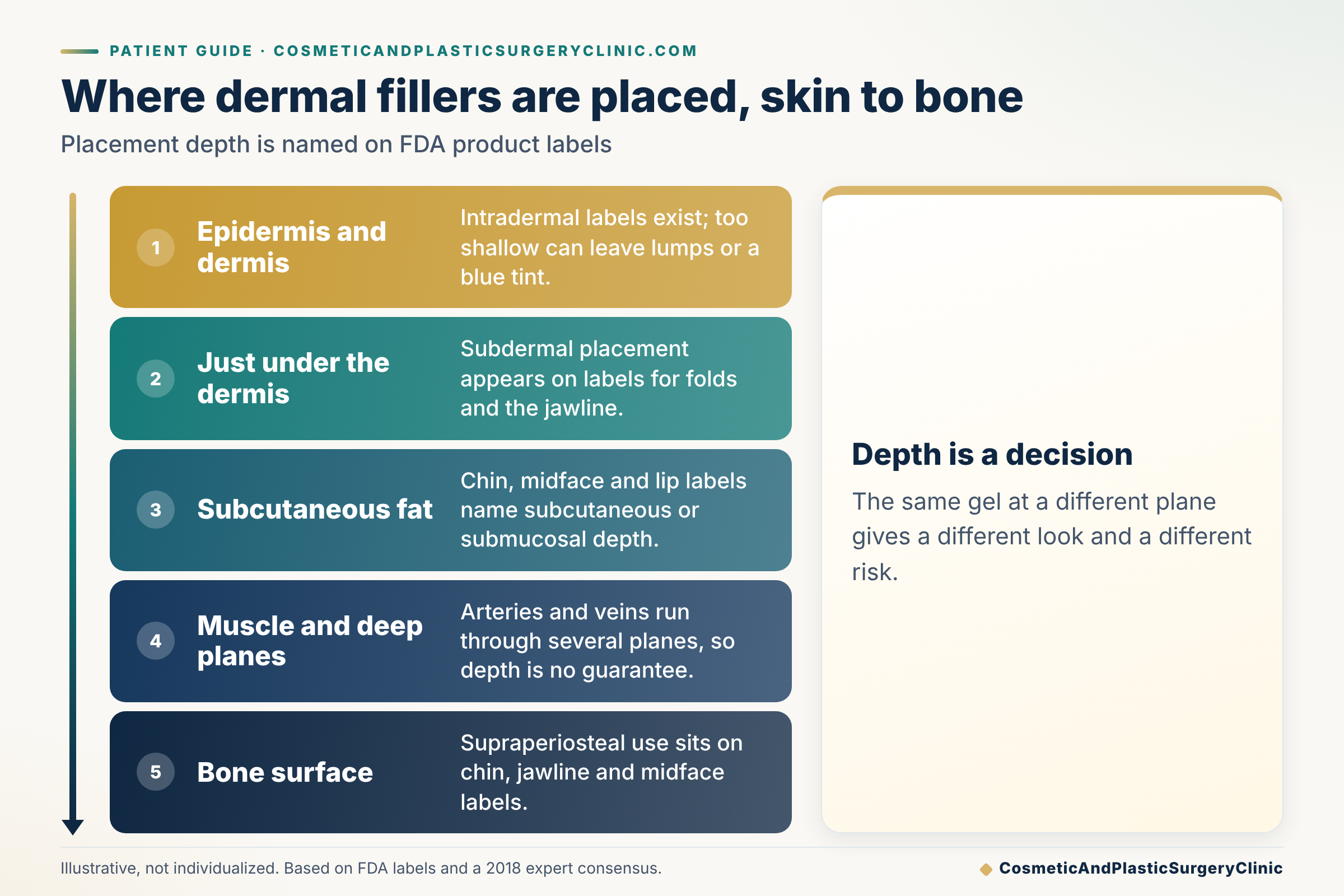
Label wording shows how many planes are in play. One cheek product is labeled for intradermal use to improve skin smoothness. Others name subdermal, subcutaneous or supraperiosteal placement, meaning just under the dermis, in the fat beneath it, or directly on the surface of bone. The 2025 chin label says subcutaneous and/or supraperiosteal, the 2026 midface label says deep subcutaneous and/or supraperiosteal, the CaHA jawline label says subdermal and/or supraperiosteal, and the 2026 lip label says submucosal and/or subcutaneous.
Depth is chosen for the job. Surface lines and skin quality are treated shallowly, structural volume deeply. When you plan dermal fillers for an area, ask which plane the injector intends to use and whether that matches the label for the product in the syringe.
Too shallow, too deep: what depth changes
A 2018 expert consensus in Aesthetic Plastic Surgery describes the Tyndall effect, a bluish hue that appears when particulate HA is placed too superficially and that can persist for years if untreated. The Sculptra label warns against superficial injection because it is associated with more local adverse events. At the other end, the FDA’s panel briefing reports three serious-injury device reports of bone resorption after supraperiosteal injection, a signal drawn from voluntary reports, not a rate.
The consensus also ties early lumps that do not hurt mostly to technique, such as too much product, too shallow a plane or the wrong product for the indication. It links malar edema, a swelling of the cheek below the eye, to the malar septum and advises deep, immediate pre-periosteal placement there. These are expert recommendations built mostly on case reports, not trial results, but they show why depth, volume and product are one decision.
Blood vessels and the danger zones
How vascular occlusion happens
The FDA calls the most concerning risk of dermal fillers unintentional injection into a blood vessel, which can block the vessel and cut off the blood supply to tissue. Depending on the vessel, the result can be tissue death, vision problems including blindness, or stroke. The agency lists the warning signs as blanching of the skin, a change in vision, signs of a stroke, or unusual pain.
Vessels of the face connect with one another. EyeWiki, a clinician-written reference maintained by the American Academy of Ophthalmology, notes that branches of the ophthalmic artery join facial arteries, so a blockage from an injection at a distant site can still reach the eye. It adds that arterial blockage usually causes symptoms right away, while venous compression can produce symptoms that build over many hours, with 36 hours the longest interval reported.
Where the reports cluster
A 2015 review in Dermatologic Surgery by Beleznay and colleagues gathered 98 published cases of filler-related vision loss. The most common injection sites were the glabella (38.8 percent), the nasal region (25.5 percent), the nasolabial fold (13.3 percent) and the forehead (12.2 percent). Autologous fat was the most common material (47.9 percent), followed by HA (23.5 percent). Most vision loss did not recover, and the authors found no treatment that worked consistently.
These are published case reports, so they show where serious events were recorded, not how likely any injection is to cause one. A 2021 survey of 370 US dermatologists in JAMA Dermatology found that lips and nasolabial folds were the most often occluded sites, that the glabella had the highest severity, and that about 85 percent of occlusions left no lasting effects. Both sources describe a rare event with a serious tail, which is why site, depth and preparation matter.
Where the label and the marketing diverge
The nose, forehead and glabella
The FDA recommends against injecting dermal fillers into the glabella, nose, forehead, periorbital area and neck. The FDA summary for a 2025 chin approval adds that in many events requiring intervention the patient was injected in the highly vascularized areas of the glabella, nose and periorbital area, which are outside the indications for use. That does not mean no one injects there; it means the label offers no trial data for those sites and the injector is relying on skill and judgment.
If an injector proposes one of these sites, fair questions are what experience they have with that exact area, what the vascular-event plan is, and whether another approach would fit better. Filler used to reshape the nose is one of the options weighed in the guide to rhinoplasty alternatives.
Around the eyes
The FDA consumer page, current as of July 2023, lists the periorbital area among sites without approval. The approval list shows labeled indications for infraorbital hollows from 2021, with more in 2023, which suggests reading the consumer page’s blanket wording as applying to unlabeled uses around the eye. The wording of those labels matters: they address hollowing under the eye, not puffiness, bags or pigment, and EyeWiki cautions that tear-trough fillers carry a higher risk of malar edema.
Hollows, bags, festoons and dark circles overlap in real faces and have different treatments. The guide to under-eye filler risks covers who may be a poor candidate and how problems in this region are handled, and it is worth reading before any under-eye appointment.
The dermal fillers visit, step by step
ASPS says the whole process may be as short as 15 minutes or as long as an hour, depending on the number of areas treated. A short dermal fillers appointment hides a sequence of decisions, and most of them are made before the syringe is opened.
Before any needle: history, mapping and consent
What to disclose and what to ask
The American Academy of Dermatology (AAD) says to tell your dermatologist about allergies, bleeding disorders, cold sore breakouts, heart conditions, easily irritated skin and previous cosmetic treatments, including other injections and implants. It also asks you to list every prescription and non-prescription medicine, vitamin and herbal remedy, naming warfarin, aspirin, ibuprofen, vitamin E, St. John’s wort and garlic or ginger supplements. The FDA adds allergies to collagen, eggs, animal products, lidocaine and bacterially derived materials, and any active skin inflammation or infection.
The AAD’s list of questions makes a good script: is the filler FDA-approved for this use, how long has the provider used it, how many patients have they treated, can you see before-and-after photos, and what will it cost. Medication changes are decisions for the prescriber, not the injector or a web page. If you take a blood thinner, the useful question is how your prescriber and injector will coordinate.
Mapping, photos and the consent form
ASPS describes the provider assessing the face and skin tone, marking the injection points and taking photographs. Mapping is where goals turn into a plan: which areas, in what order, with how much product. An injector who begins drawing up syringes before asking what bothers you has skipped the step that defines the plan.
ASPS also notes that you will sign consent forms after the risks are explained. Read the form for the product name, the areas, the vascular warning and the follow-up contact, and ask for a copy. The general consultation guide covers what to bring, how to judge answers and how to resist pressure to decide on the spot.
Numbing, needle or cannula, and placement
Numbing and what it feels like
ASPS says the sites are cleaned with an antibacterial agent and discomfort can be reduced with a very cold instrument, numbing ointment or a local anesthetic injection, and that the injections are usually easily tolerated. Many HA gels in the FDA list contain lidocaine in the syringe itself, which is why their labels contraindicate use in people with a known allergy to amide-type local anesthetics.
Injection takes only a few moments per site, and ASPS says each site is injected, massaged and evaluated, with more filler added if needed. The Sculptra label states a related rule for that product: do not overcorrect or overfill. A conservative first visit with a planned review is a reasonable thing to ask for when you are new to dermal fillers.
Needle versus cannula: what the evidence can and cannot say
A needle has a sharp tip; a cannula has a blunt tip and is passed through a small entry point. The FDA summary for the 2025 chin approval notes that its trial used a 29-gauge needle or a blunt cannula. In the JAMA Dermatology survey, 176 occlusions occurred among 1,128,192 needle syringes (about 1 in 6,410) and 13 among 531,466 cannula syringes (about 1 in 40,882), and cannula use was associated with 77.1 percent lower odds of occlusion after adjustment.
The limits are real. The data were retrospective, self-reported and unaudited, came only from board-certified dermatologists, and had no separate category for blindness. Occlusions happened with both devices, so neither is a safeguard on its own. Treat the numbers as a reason to ask why the injector chooses a device for each area, not as a rule that one is always better.
After the visit: the first two weeks
The first 48 hours
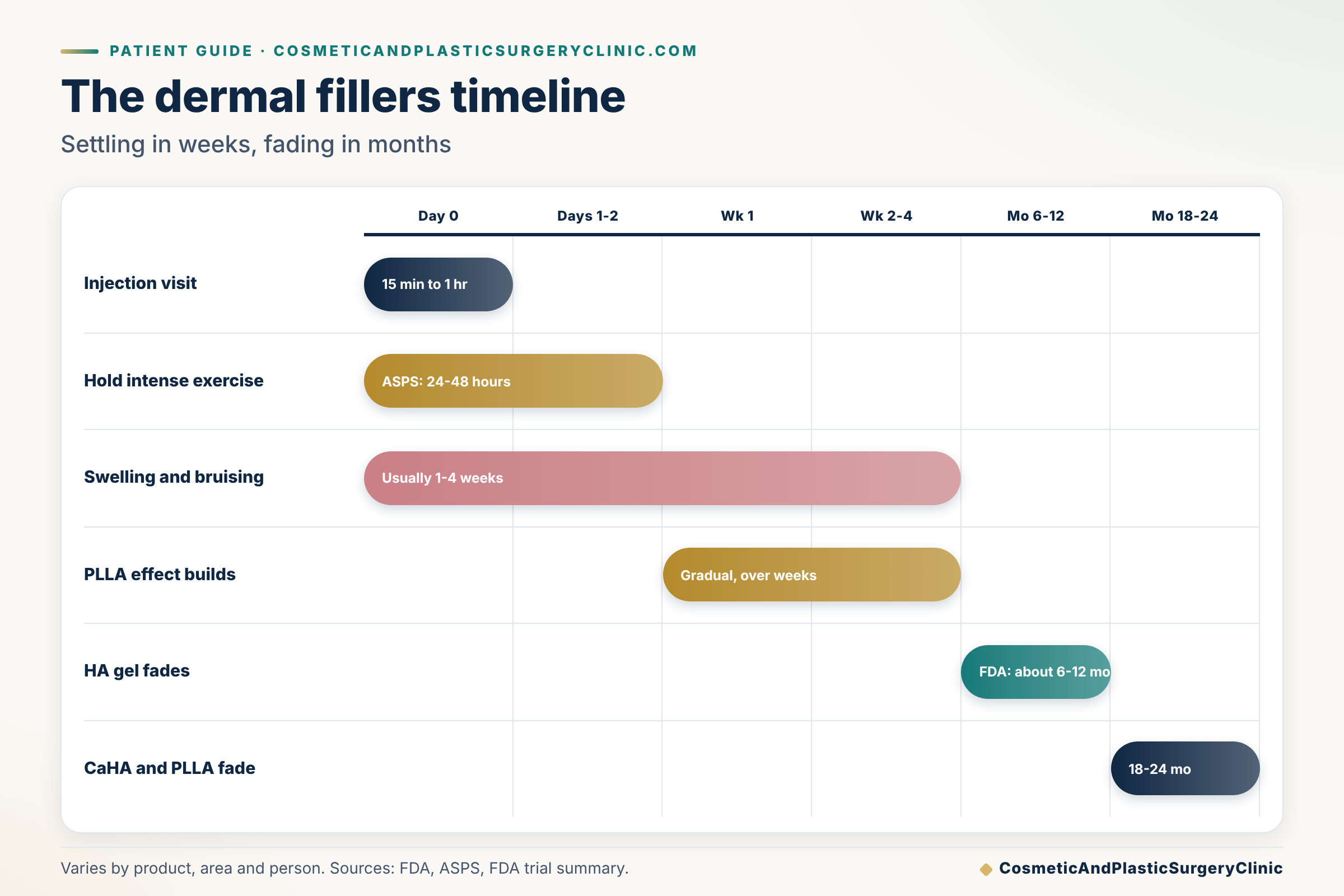
ASPS advises avoiding intense physical activity for 24 to 48 hours to limit swelling and bruising, says most other activities can resume right away, and notes the area may stay tender for a day or two. In the 2025 chin trial summarized by the FDA, the median time to feel comfortable returning to social engagement was 6.7 hours after the first treatment, and bruising, swelling, redness and pain usually resolved within one to four weeks.
Sources differ on touching the area. ASPS says swelling or bruising often responds to icing and massage, while the American Society for Dermatologic Surgery (ASDS) says to avoid firm pressure on the treatment area and to skip lip products right after a lip treatment. Follow your injector’s written instructions over any single page, and ask for them before the visit instead of after it.
Lumps, asymmetry and the review visit
ASPS lists an overfilled look, temporary numbness or redness, and palpable lumps or hard areas as common early effects of dermal fillers. The 2018 consensus says early lumps usually do not hurt and are often related to technique, and for lumps that are improving it advises observation. That is one reason to ask when the review visit is, what counts as a reason to call sooner, and who answers the phone after hours.
| Stage | What happens | What to ask or watch |
|---|---|---|
| Consultation | History, medicines, allergies and goals are reviewed | Is this product labeled for this area, and what are the alternatives? |
| Mapping and consent | Sites are marked, photos taken and risks explained | Which plane and device are planned, and may I have a copy of the form? |
| Numbing and injection | Skin is cleaned and numbed; each site is injected and evaluated | Is hyaluronidase on hand, and what is the vascular-event plan? |
| Leaving the clinic | Ice may be offered; markings are cleaned off | Do I have written aftercare and an after-hours number? |
| First 48 hours | Tenderness, swelling and possible bruising | Which activities wait, and which signs mean call or go to emergency care? |
| Weeks 1 to 4 | Swelling settles; early lumps are watched | When is the review, and who adjusts or dissolves a problem? |
The planner is a template, not a script. A clinic that follows a different order can still be careful, but the right-hand column shows the questions whose answers you should have before you sit down, not after the first injection.
How long dermal fillers last, and what can be undone
ASPS says the results of dermal fillers are apparent immediately and last from several months to several years, depending on the filler and the person. That is an honest answer and an unhelpful one, so the sources are worth reading one family at a time.
Duration of dermal fillers by material, in the sources
Absorbable gels: months to about two years
The FDA gives roughly 6 to 12 months for HA. The 2024 Journal of Drugs in Dermatology review put biodegradable fillers at about 3 to 24 months across products, and the ASDS says the effect typically lasts six months to two years. The spread is wide because products differ in cross-linking, because labeled areas differ, and because trials measure different things.
ASPS adds that overall health and consistent skin care can improve results and longevity, and it describes dermal fillers as temporary treatments for facial aging that need ongoing treatment for long-term results. A duration quoted in a clinic should come with its source: a label, a trial or the injector’s own experience. Those are three different kinds of evidence.
Longer-acting families and the trial window
The FDA gives about 18 months for CaHA and up to two years for PLLA. The CaHA jawline label reports that 67.3 percent of responders kept their response at 48 weeks, and its nasolabial fold data extend to three years for the product without lidocaine. The PLLA label reports a controlled phase to 13 months with an extension to 25 months, and states that effects beyond three years have not been investigated.
ASPS describes a PLLA course as about three monthly treatments, with the full effect four to six weeks after each, and occasional touch-ups. Longer-acting does not mean better; it means a commitment that is harder to adjust, which is the core of the hyaluronic vs biostimulatory fillers comparison.
Why the same product lasts differently
The area, the label and the person
Duration is not one number even within a product. The CaHA label reports 48 weeks for the jawline and up to three years for nasolabial folds, because each indication was studied separately, in different groups, with different endpoints. ASPS says results depend on the filler and the individual patient. Trials also enroll narrow groups: in the premarket studies the FDA reviewed since February 2021, average age ranged from 44 to 61.
That is why a friend’s result is a weak forecast for yours, and why a list of typical months is a starting point for a conversation, not a contract. Ask what the label reported for your area and how the trial defined a result that was still present.
Maintenance of dermal fillers as a recurring decision
The FDA says the safety of fillers used repeatedly over a long period has not been evaluated, and its panel briefing says long-term effects of repeated use have not been established. That is not a finding of harm; it is a gap in the evidence. It means a multi-year plan for dermal fillers is a series of individual choices that you can pause at any point.
| Factor | Effect on the result | Maintenance or revision implication | Review point |
|---|---|---|---|
| Material family | HA is absorbed over months; CaHA and PLLA last longer; PMMA is not absorbed | Only HA responds to hyaluronidase, so longer-acting products are harder to adjust | Which family, and what is the plan if I dislike it? |
| Area and depth | Labels report different durations by indication | Different areas may need different intervals | What did the trial for my area report? |
| Amount and pace | Overcorrection can look overfilled; one label warns against overfilling | Staged visits leave room to adjust | Can we start smaller and review at a set date? |
| Skin quality and habits | ASPS says skin care and overall health may improve longevity | Skin care and sun protection are part of the plan | What should I be doing between visits? |
| Other treatments over time | The FDA says combined use with other treatments has not been evaluated | Sequencing and spacing need a plan | What goes first, and how far apart? |
| Changing goals | Faces and preferences shift across years | HA fades if you stop; other families do not simply fade | When do we review whether to continue? |
The table shows why a yearly plan is better treated as a set of small decisions than as a subscription. Each visit is a chance to continue, change or stop.
What can be reversed and what cannot
Hyaluronidase and HA gels
Hyaluronidase breaks down HA, which is why it is the standard rescue tool for HA dermal fillers. The FDA’s panel briefing says no product is approved to treat filler-related symptoms and that off-label hyaluronidase is clinically accepted for HA filler removal. It also reports 83 adverse event reports since 2011 linked to hyaluronidase used with fillers, most commonly swelling, burning, redness, excessive volume loss and lack of effect.
EyeWiki says hyaluronidase should be on hand during an HA filler procedure, and the 2018 consensus recommends injecting it immediately when blood flow is compromised, regardless of the filler used. The process, the timing, the swelling afterward and what happens to the HA your body makes naturally are covered in the guide to dissolving lip filler, which applies to other areas too.
Non-HA dermal fillers and the limits of undoing
No enzyme dissolves CaHA, PLLA or PMMA. The FDA says removing filler may be difficult or impossible, especially non-absorbable products and fillers that are not made of HA, and that side effects can appear weeks, months or years after injection. In the FDA briefing’s removal reports, 742 mentioned surgical excision, a reminder that the fallback for a non-HA problem can be an operation.
For anyone weighing a first treatment, the practical rule is to ask what the plan would be if the result were unwanted. For HA, the answer starts with waiting and may involve hyaluronidase. For other families, the honest answer is more limited, and it belongs in the consent conversation before treatment, not after.
Dermal fillers safety: expected effects, complications and emergencies
The FDA sorts the risks of dermal fillers into tiers. Common effects are bruising, redness, swelling, pain, tenderness, itching and rash. Less common are nodules or granulomas, infection, open wounds, allergic reactions and tissue death. Rare are anaphylaxis, migration, leakage or rupture, hard nodules that persist, vascular injury including blindness or stroke, and death. ASPS says severe complications from dermal fillers are uncommon and that satisfaction with the result is never assured.
Effects that are expected and usually settle
Bruising, swelling, tenderness and itching
In the 2025 chin trial the FDA summarized, 97.3 percent of participants given the study filler recorded expected events on the treatment day, such as pain, tenderness, redness, bruising, swelling, itching or lumps, and all symptoms had resolved by day 28. At least one adverse event was recorded in 24.3 percent of treated participants and 28.8 percent of controls; treatment-related events occurred in 7.0 percent and 5.1 percent, the most common being bruising (2.6 percent), and all were mild.
One trial of one product in one area, with participants chosen by protocol, is not a forecast for every filler. It does show what expected looks like when it is measured: common, short-lived and mostly mild. ASPS adds that swelling or bruising ranges from mild to severe, and that some reactions need stronger treatment than ice.
Overcorrection, asymmetry and who fixes it
ASPS’s risk list for dermal fillers includes asymmetry and under- or over-correction. Early on it is hard to tell swelling from product, so a judgment on the day can be wrong in either direction. A review at a set date, with a stated policy on adjustments, turns a vague worry into a plan; how touch-up visits are priced is covered in the dermal filler cost guide.
The Sculptra label states a rule that applies as a principle to every family: do not overcorrect. A clinic that treats a request to start conservatively as a problem is telling you something about how it handles adjustments later.
Problems to report to the injector promptly
Nodules, inflammation and infection
The 2018 consensus classes complications as immediate (up to 24 hours), early (24 hours to 4 weeks) and delayed (beyond 4 weeks). It says delayed nodules are usually inflammatory and may be linked to infection or biofilm, and it cautions that infection must be considered before steroids are used. Foreign-body granulomas are described as very rare, at 0.01 to 1.0 percent, a range the authors drew from the literature, not from a single study.
The Restylane summary describes delayed-onset inflammation near past injection sites following viral or bacterial illness, infection, vaccination or dental procedures; most cases responded to treatment or resolved on their own. If swelling, redness or tenderness appears near an old filler site after an illness or a dental visit, tell the injector, because delayed reactions are a recognized pattern.
Tyndall effect, migration and hypersensitivity
The Tyndall effect is the bluish tint described earlier; the consensus names hyaluronidase as its first-line treatment. The ASDS lists migration of filler to another site and inflammatory reactions among uncommon effects. The consensus describes two allergic patterns: early angioedema, which is IgE-mediated, and delayed reactions, which are T-cell mediated and typically appear about a day after injection.
None of these is a reason to skip treatment by itself, and none is a reason to wait it out in silence. Each is a reason to know whom to call. The guide to filler complications goes through them one at a time, and the general risk guide explains how to read risk numbers across procedures.
Emergencies, and how to read the numbers
Blanching, pain, vision change: act the same hour
The FDA says to seek immediate medical attention for unusual pain, vision changes, a white, gray or blue appearance of the skin near the injection site, or signs of a stroke. The 2018 consensus describes arterial occlusion as typically sudden and severe, out of proportion to the findings, and says retinal artery occlusion lasting more than 60 to 90 minutes can cause irreversible blindness. Both an eye emergency and a skin emergency run on short clocks.
If any of these happen after you leave the clinic, call emergency services or go to emergency care and tell staff that filler was injected. Also call the injector, who should have a plan for treatment or referral, as the FDA advises providers to have. Waiting for clinic hours is the wrong call with any of these signs.
What the FDA’s report counts do and do not say
The FDA’s panel briefing counted 17,768 serious-injury reports for dermal fillers in its device-report database through November 2024, with yearly counts of 786 in 2014, 1,478 in 2023 and 1,179 in 2024 through November. The most common serious events were abscess (1,235 reports), nodules (1,038), obstruction or occlusion (986) and granulomas (846).
These are reports, not rates. The briefing itself cites under-reporting, incomplete or duplicate records and no information on how often the devices are used, so true event rates cannot be calculated from them. Read counts like these as a catalogue of what can go wrong, then use label trials and the dermatologist survey for a sense of frequency, with their own limits.

Who should wait, and how to choose an injector and a setting for dermal fillers
Candidacy is never decided from an article, and this section does not decide it. It lists what regulators, labels and professional societies say about when to pause, and how to check who is holding the syringe.
Reasons to pause or ask a doctor first
What the FDA says is unknown
The FDA states that the safety of dermal fillers is unknown in people who are pregnant or breastfeeding, in patients under 22, in people prone to excessive scarring such as keloids or hypertrophic scars, when fillers are combined with neuromodulators or other treatments, and when they are used repeatedly over a long period. The Sculptra and CaHA labels likewise say safety in pregnancy and lactation has not been evaluated or established. Unknown is not the same as unsafe, but it is the honest state of the evidence.
If you are pregnant, trying to become pregnant or breastfeeding, the sources reviewed give no waiting period and no reassurance either way. That decision belongs with your own obstetric clinician and a qualified injector, and waiting is a legitimate choice.
Conditions and circumstances the sources flag
The FDA advises delaying treatment if the skin is inflamed or infected and asks you to disclose bleeding disorders and severe allergies. The labels for several products list bleeding disorders, severe allergies including a history of anaphylaxis, and allergy to lidocaine as contraindications. The ASDS lists current oral herpes or a similar infection, uncontrolled diabetes, blood-clotting problems and lupus or other connective tissue disorders as situations where fillers are not recommended.
ASPS describes good candidates for dermal fillers as physically healthy non-smokers with realistic goals, and says some people may be better served by surgery. The ASDS page says people who take blood thinners such as aspirin or ibuprofen may be advised to stop about two weeks before injection, but only with the approval of the prescribing doctor. Candidacy is individual, and only a clinician who has examined you can decide it.
Credentials, scope and state rules
What the FDA, ASPS and AAD each say
The FDA advises choosing a licensed provider with dermatology or plastic surgery experience who is trained in filler injection. ASPS says it is important to be in the care of a board-certified plastic surgeon who understands the risks and is prepared to manage complications, and the AAD directs people to dermatologists. Each society naturally favors its own members, so read these as overlapping views, not one neutral standard.
State law adds another layer. A 2023 opinion piece in Dermatology Times by a physician assistant says no state requires dermatology or plastic surgery training to inject, that standards vary by state and by license, and, quoting the American Med Spa Association, that injections fall under the practice of medicine in all states. The author argues for tighter regulation, so treat the piece as advocacy; its basic point agrees with the FDA’s, that a title alone does not settle who is qualified.
Checking a credential
The American Board of Plastic Surgery runs a public tool to verify certification and says an active, unrestricted license is a requirement for it. State licensing boards are the place to look up license status for nurses, physician assistants and physicians. Whatever the title, ask who supervises, what training in filler injection the person completed, and what happens if a complication occurs.
The guides to choosing a plastic surgeon and cosmetic surgeon credentials walk through verification steps and what titles do and do not mean. Those steps apply to injectors with small changes.
The setting, the syringe and a plan for trouble
A medical setting and the product trail
The FDA warns that fillers bought online may be counterfeit or unapproved, and its page points to counterfeit-product alerts issued in March 2017, July 2018 and October 2018. It also warns providers and patients not to use certain Juvederm Ultra products labeled 2, 3 or 4, which are not approved in the United States. A clinic that shows you the box, names the product and lets you read the patient labeling is easy to verify. One that will not is telling you something.
Unusually low prices deserve the same questions about product source that they would for any injectable. The cost guide explains how to compare quotes without mistaking a discount for a bargain.
Hyaluronidase on hand and a vascular-event plan
EyeWiki says hyaluronidase should be on hand during an HA filler procedure, and the FDA tells providers to stop injecting immediately if signs of a blocked vessel appear and to have a plan for treatment or referral. Those two statements turn into a plain question: if my skin blanches or my vision changes, what do you do in the next few minutes, and whom do I call that night?
A good answer names the enzyme, says where it is stored, describes the referral path and gives an after-hours number. A vague answer is not proof of poor care, but it is cheaper to find out before treatment than after.
| Check | A sound answer sounds like | Worth questioning |
|---|---|---|
| 1. Product and label | Names the product and the area on its label, and shows the packaging | “Premium filler” with no name, or a refusal to show the label |
| 2. Who injects | Names the injector, license, filler training and who supervises | A title only, or no clear owner for complications |
| 3. The setting | A medical office with records, clean technique and follow-up access | A home, pop-up or event setting with no way to reach anyone later |
| 4. Safety plan | Hyaluronidase on hand, written steps for blanching or vision change, after-hours number | No plan, or “that never happens” |
| 5. Depth and amount | Explains plane, needle or cannula choice, and a conservative first session | Pressure for large volume or many areas on day one |
| 6. Follow-up and records | Written aftercare, a review date and an adjustment policy | No review visit, no record of what was injected |
None of the answers in the middle column ensures a good result, but a missing answer in the right-hand column is far cheaper to act on before the appointment than after it.
Dermal fillers alongside other treatments, and deciding well
Few people considering dermal fillers treat one thing in isolation. Lines, volume, skin quality and sagging coexist, and each has a different tool. The decision is easier when it is staged: what is the problem, what is the least invasive tool that fits, and what would change my mind.
Pairing dermal fillers with neuromodulators, devices and surgery
Neuromodulators and skin treatments
Neuromodulators and dermal fillers are different products: a drug that relaxes muscle and a device implant that adds volume. Plans that pair them exist, but the FDA says the safe use of fillers in combination with neuromodulators or other treatments has not been evaluated. That is a reason to ask about sequence and spacing, not a reason to refuse a combined plan. The Botox guide linked earlier explains neuromodulators, and reading their results differs from reading filler results.
Energy-based and resurfacing treatments act on skin, not volume. None of the sources reviewed gives a standard interval between a laser or similar device and filler. The Restylane chin trial required participants to avoid other facial procedures during the study, which was a study rule, not clinical advice. Ask the injector for the sequence in writing.
Fat grafting and surgery as alternatives or additions
Fat is the other tool for facial volume. ASPS reported 34,117 facial fat grafting procedures in 2025 against 24,605 in 2024, a 39 percent rise, and quoted a surgeon who said patients want longer-lasting options. In ASPS’s survey of member surgeons about techniques used for facial rejuvenation, 69 percent reported using HA fillers, 49 percent autologous fat and 33 percent biostimulatory injectables. The survey counts which techniques surgeons use, not how many procedures, and members are not a random sample of everyone who injects.
How filler and fat compare for the cheeks is the subject of cheek filler vs fat grafting. When the problem is descent more than volume, ASPS says surgery may be better and that fillers may only delay it, which is the territory of the facelift alternatives guide and the facelift guide linked earlier.
Budget, time and the option of not starting
Cost as a recurring line
Because dermal fillers fade, the real commitment is a recurring one. Pricing varies by product, syringe volume, area and injector, and a national average is not a quote. The guides to dermal filler cost and lip filler cost explain how to compare quotes like for like, and the general cost guide covers the mechanics shared with surgery.
Consider a hypothetical person who treats one area about once a year and another about twice a year. That is three visits in a twelve-month span, each with its own swelling window, its own review date and its own small risk. The budget is only part of the cost; every visit repeats the time, the recovery and the decision.
Saying “not yet”
Nothing in the sources suggests a person must treat any feature at any age. ASPS describes good candidates as having realistic goals and says fillers may help people with early signs of aging. Waiting, skin care and sun protection are legitimate parts of the same conversation, and the AAD notes that a consultation may reveal that another cosmetic procedure is more appropriate.
A clinic that respects “not yet” is giving you useful information about itself. One that attaches a time-limited discount to a decision about injecting your face is applying commercial pressure to a medical choice, and you are free to leave and think it over.
Where to go next
Lips, cheeks and the area-specific guides
Each area carries its own decisions. Lip augmentation accounted for 23 percent of HA filler treatments in the ASPS 2025 data, and the lip filler guide covers its anatomy, timeline and expectations. If a result needs to be softened, the dissolving lip filler guide linked earlier explains the process. The cheek and eye areas have the guides linked above, and the hub below collects every branch in one place.
Photos, complications and product families
Before-and-after images need their own reading skills, set out in the photo-reading guide linked earlier, with the general ethics in the before-and-after photos guide. Problems and how they are handled are in filler complications, and the families of product are compared in the hyaluronic acid and biostimulatory guide linked earlier.
None of these pages can examine you. What they can do is let you arrive at a consultation knowing which questions are yours to ask.

Frequently asked questions
Do dermal fillers hurt?
ASPS describes the injections as usually easily tolerated, and discomfort can be reduced with a very cold instrument, numbing ointment or a local anesthetic injection. Many HA products in the FDA list also contain lidocaine in the gel. The area may stay tender for a day or two. Sensitivity varies by area and person, so if you are anxious, ask which numbing options the clinic offers before the appointment, not during it. Pain that is sudden, severe or out of proportion afterward is different from soreness and is an emergency.
How old do you have to be to get dermal fillers?
US labels for dermal fillers name adults, with 21 or 22 as the minimum age depending on the product, and the FDA says safety is unknown under 22. ASPS still counted 9,528 HA filler procedures in patients 19 and under in 2024, so treatment below label ages does happen. If a younger person is being offered treatment, the questions are what the label says, what the injector is relying on instead, and whether waiting costs anything.
Can dermal fillers be used in the neck, breasts or buttocks?
The FDA recommends against filler for body contouring, including breast, buttock and foot enlargement, and lists the neck among sites without approval. It says injectable silicone is not approved for any aesthetic use. Its August 2025 panel briefing states that no filler is currently approved for the décolletage, and the most common event in its neck and chest reports was nodule formation. A proposal to inject these areas deserves the questions about off-label risk raised earlier.
Can I have dermal fillers and Botox on the same day?
Some clinics offer both in one visit, but the FDA’s consumer page says the safe use of dermal fillers in combination with neuromodulators or other treatments has not been evaluated. That is not a prohibition. It is a prompt to ask the injector why they prefer a same-day or a spaced approach, what the sequence is, and how they would tell which product caused a problem if one arose. Ask for the plan in writing.
How can I tell whether the syringe is genuine?
You cannot verify a product from the chair alone, but you can reduce the chance of a counterfeit. The FDA says dermal fillers sold online may be counterfeit or unapproved and points to counterfeit alerts from 2017 and 2018. Ask for the product name and whether it is FDA-approved for the planned use, as the AAD suggests, and ask to see the packaging and patient labeling, which providers can supply. If the clinic cannot or will not answer, treat that as the answer.
Can dermal fillers cause problems years later?
The FDA says side effects from dermal fillers may appear weeks, months or years after injection. The Restylane summary describes delayed-onset inflammation near old injection sites after viral or bacterial illness, vaccination or dental procedures, and most cases responded to treatment or resolved on their own. If swelling, redness or a new lump appears long after a treatment, contact the injector who treated you. Problems can also be reported to FDA MedWatch at 1-800-FDA-1088.
Do dermal fillers show up on imaging?
Some dermal fillers do. The FDA and the CaHA label say calcium hydroxylapatite particles are radiopaque, visible on CT scans and possibly on plain x-rays, and may obscure underlying features, so tell any radiology team about prior treatment. The FDA briefing also describes one study of large volumes injected for pectus excavatum, in which 67 percent of the filler was visible on MRI at 12 months and 58 percent at 24 months; those volumes were far larger than typical facial treatments, so it is a caution, not a prediction.
How do I report a problem with a dermal filler?
The FDA asks patients and providers to report problems with dermal fillers to MedWatch at 1-800-FDA-1088 or online. A report does not replace urgent care or a call to the injector; it adds to the pool of device reports the FDA reviews. Keep the product name, the date and the area treated, which a good clinic records in your chart. As the safety section explained, report counts show what can go wrong, not how often.
Sources and further reading
- U.S. Food and Drug Administration — Dermal fillers (soft tissue fillers), content current 7 July 2023 (accessed 2026-11-12) — device definition, approved areas, areas not approved, risk tiers, warning signs, unknowns, counterfeit alerts
- U.S. Food and Drug Administration — FDA-approved dermal fillers (accessed 2026-11-12) — material families, durations, x-ray visibility, unapproved products
- U.S. Food and Drug Administration — Executive summary for the General and Plastic Surgery Devices Advisory Committee panel, 13 August 2025 (accessed 2026-11-12) — approval list with dates, device-report counts, hyaluronidase, removal, ASPS volume figures
- U.S. Food and Drug Administration — Restylane Lyft with Lidocaine summary and labeling, PMA P040024/S142, chin approval of 4 November 2025 (accessed 2026-11-12) — trial adverse events, recovery, contraindications, vascular and delayed-onset warnings
- U.S. Food and Drug Administration — Belotero Intense (+) Lidocaine labeling, PMA P250016, lip approval of 9 July 2026 (accessed 2026-11-12) — recent lip indication, age, placement depth
- U.S. Food and Drug Administration — Belotero Volume (+) labeling, PMA P250020, midface approval of 19 May 2026 (accessed 2026-11-12) — recent midface indication, age, placement depth
- American Society of Plastic Surgeons — 2025 Plastic Surgery Statistics Report (accessed 2026-11-12) — filler ranking and shares, surgeon survey, facial fat grafting counts
- American Society of Plastic Surgeons — 2024 Plastic Surgery Statistics Report (accessed 2026-11-12) — filler procedure counts and age bands
- American Society of Plastic Surgeons — Press release on the 2025 statistics report, 1 September 2026 (accessed 2026-11-12) — neuromodulators and HA fillers as 80 percent of minimally invasive procedures
- American Society of Plastic Surgeons — Dermal fillers overview (accessed 2026-11-12) — uses, subcutaneous fat loss, role beside surgery
- American Society of Plastic Surgeons — Dermal fillers types (accessed 2026-11-12) — filler families and PLLA course
- American Society of Plastic Surgeons — Dermal fillers procedure (accessed 2026-11-12) — mapping, numbing, injection and appointment length
- American Society of Plastic Surgeons — Dermal fillers recovery (accessed 2026-11-12) — activity, swelling, early effects, urgent care
- American Society of Plastic Surgeons — Dermal fillers results (accessed 2026-11-12) — onset and duration
- American Society of Plastic Surgeons — Dermal fillers candidates (accessed 2026-11-12) — candidate traits and surgical alternatives
- American Society of Plastic Surgeons — Dermal fillers safety (accessed 2026-11-12) — risks, vascular occlusion, injector advice
- American Academy of Dermatology Association — Fillers: preparation (accessed 2026-11-12) — disclosures, medicines named, questions to ask
- American Society for Dermatologic Surgery — Dermal fillers (accessed 2026-11-12) — duration range, who is advised against fillers, side effects, aftercare
- The Aesthetic Society — Fillers overview (accessed 2026-11-12) — anesthesia, dependence of results on the injector
- Beleznay K, Carruthers JD, Humphrey S, Jones D — Avoiding and treating blindness from fillers: a review of the world literature, Dermatologic Surgery 2015 (accessed 2026-11-12; abstract-level record) — 98 cases, sites, materials, outcomes
- Alam M and colleagues — Rates of vascular occlusion associated with using needles vs cannulas for filler injection, JAMA Dermatology 2021 (accessed 2026-11-12) — survey rates, sites, limitations
- EyeWiki, American Academy of Ophthalmology — Complications of hyaluronic acid fillers (accessed 2026-11-12) — vessel connections, time courses, hyaluronidase on hand
- Urdiales-Gálvez F and colleagues — Treatment of soft tissue filler complications: expert consensus recommendations, Aesthetic Plastic Surgery 2018 (accessed 2026-11-12) — onset classes, Tyndall, nodules, hypersensitivity, vascular compromise
- Merz — Radiesse (+) Lidocaine instructions for use, 2025 (accessed 2026-11-12) — indications, durations in trials, radiopacity, contraindications, pregnancy statement
- Galderma — Sculptra instructions for use, 2023 (accessed 2026-11-12) — indications, overcorrection and superficial-injection warnings, trial follow-up, pregnancy statement
- Journal of Drugs in Dermatology — Review of hyaluronic acid dermal fillers in the United States, 2024 (accessed 2026-11-12; abstract only) — number of HA fillers, duration range, history
- Block R — Rules and regulations on cosmetic procedures: where are they? Dermatology Times, 16 May 2023 (opinion; accessed 2026-11-12) — state variation in who may inject
- American Board of Plastic Surgery — Verify certification (accessed 2026-11-12) — certification lookup and license requirement