A body that has carried and delivered a child can feel unfamiliar in places nobody warned about, and the vulva is one of them. Some people notice soreness that outlasts the first weeks, a scar that pulls, a labium that looks or feels different, or chafing that was never there before. A few start searching for labiaplasty after childbirth, and a few of those wonder whether it is too soon, or too early to plan around another baby.
This page is about the decision to consider labiaplasty after childbirth, not about the operation in general, which is covered in our overview of labiaplasty. It sorts what childbirth can change from what it often gets blamed for, looks at the evidence on timing and on delivering after surgery, and ends with questions for a consultation. The aim is to help you ask better questions, not to say whether anyone should have surgery. Not now, and not at all, remain reasonable answers.
For scale, the American Society of Plastic Surgeons (ASPS) counted 10,827 labiaplasty procedures by its member surgeons in 2024, up 2% from 10,631 in 2023. That count does not say how many of those followed a birth, so no number on this page tells you how common labiaplasty after childbirth is.
What childbirth changes in the vulva, and what it does not prove
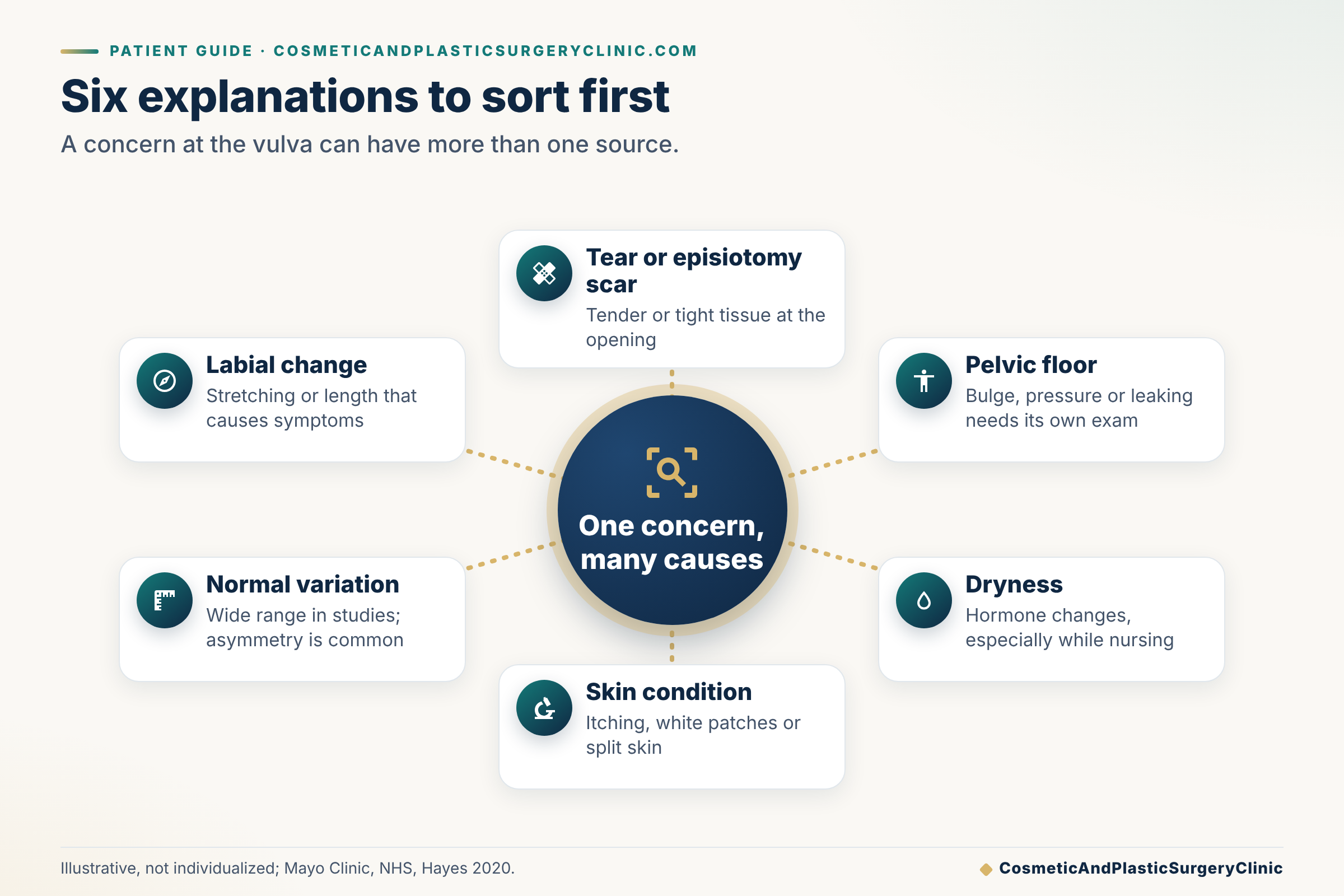
Childbirth involves stretching, swelling and sometimes tearing of tissue, and healing usually continues for weeks. What remains afterward depends on the injury, the repair and the person. Sorting which structure was involved is the first step in deciding whether labiaplasty after childbirth even addresses the concern.
Tears, stitches and scar tissue
Most of the language around birth injury refers to the perineum, the area between the vaginal opening and the anus. The labia are a separate structure with their own injury pattern and far less research behind it.
Perineal tears and labial trauma are different injuries
An obstetric summary of the American College of Obstetricians and Gynecologists (ACOG) Practice Bulletin 198, published by the ObG Project in 2022, grades perineal tears from first degree (skin only) through fourth degree (through the anal sphincter and lining). It reports that about 53% to 79% of people have some laceration during vaginal delivery. Third-degree tears were estimated at 3.3% and fourth-degree at 1.1%.
Labial trauma is tracked far less often. A 2021 paper in the journal Midwifery by Sanders and colleagues describes it as common and weakly guided by evidence, with the figures set out in the fact box later in this article. Practice varies on whether to stitch it, so a person with a labial tear may have healed with or without sutures, and may not know which.
How often tears cause lasting pain
Lasting pain after a tear is the exception in the one large series opened here. Ventolini and colleagues (Journal of Reproductive Medicine, 2014) reviewed 1,617 first-time mothers who delivered vaginally without episiotomy at one urban hospital. Just over half (51.7%) had no tear, and 6 patients (0.4%) had painful intercourse afterward. Four of the twelve patients with vulvar pain or painful intercourse needed a vulvoplasty before the pain resolved.
That series describes vulvar and vaginal lacerations in general, not labial injury specifically, and has no comparison group. It does show two things at once: most tears heal without lasting trouble, and a small number of people go on to need a surgical fix for pain. Whether labiaplasty after childbirth would have helped any of them is a different question that the study does not answer.
Stretching, hormones and what anatomy studies say about parity
Many people assume that vaginal delivery enlarges the labia minora. The measurement studies are less tidy than that assumption.
Parity and labial size: no consistent pattern
A 2020 scoping review by Hayes and Temple-Smith in the Australian and New Zealand Journal of Obstetrics and Gynaecology found ten population-based studies of labial dimensions. Length and width varied widely, left-right asymmetry was common, and differences in methods stopped the authors pooling the data. One of those studies, Lloyd and colleagues (BJOG, 2005; 50 women), found no statistically significant link between labial size and either age or number of births.
A 2023 Frontiers in Surgery study of 400 women at a Chinese genital plastic surgery center, 243 of them nulliparous, reached the same kind of result: shape measurements did not differ significantly by parity. A 2023 clinic-based study of 113 women in Archives of Gynecology and Obstetrics (Derebasinlioglu and colleagues) went the other way on some measures, reporting protruding labia minora in 54.3% of nulliparous women versus 13% of women with two or more pregnancies. These are single-site, cross-sectional snapshots, and none follows one person across a birth.
None of them settles whether labiaplasty after childbirth is a response to the birth itself.
Hormones, breastfeeding and changes that may be temporary
Mayo Clinic notes that hormone changes after birth can leave the vagina dry and sore, especially while breastfeeding, and that many people need lubricant for a while. Dryness, tenderness and tissue that feels thin are not the same complaint as a labium that hangs lower or catches on clothing, but they can overlap, and they can change as breastfeeding patterns change.
One Dallas practice page says labial tissue changes with pregnancy hormones and may not settle for six months to a year, but it cites no studies, so treat it as one clinician’s view. The sensible reading is that some change may be temporary and that an early decision about labiaplasty after childbirth can age badly.
| Situation | Pathway often discussed | Possible benefit | Trade-off | Key question |
|---|---|---|---|---|
| Soreness under a few months after delivery | Postpartum follow-up and watchful waiting | Allows ordinary healing to finish | Waiting can feel long | Is this still improving week to week? |
| Pain with sex or tampons near a tear or episiotomy scar | Gynecologic exam, pelvic-floor care, scar assessment | Finds the actual source | May need several visits | Is the problem scar, muscle, dryness or labial tissue? |
| Chafing or twisting of a labium during exercise | Conservative measures first; surgery discussed if they fail | Targets a mechanical complaint | Scar, sensation and healing risks | What did you already try, and for how long? |
| Appearance distress, no physical symptoms | Counseling on normal variation; elective option only after evaluation | May ease self-consciousness | ACOG says evidence of benefit is limited | Would this concern exist if no one else saw it? |
| Another pregnancy planned or possible | Usually deferring the decision is discussed | Avoids operating on tissue that may change again | Symptoms continue meanwhile | Is waiting safe for what bothers you now? |
| Bulge, pressure or leaking | Pelvic-floor or gynecologic evaluation | Treats a different condition properly | Not a cosmetic fix | Who examines the pelvic floor? |
Postpartum problems that get mistaken for a reason for labiaplasty after childbirth
Before anyone discusses labiaplasty after childbirth, a clinician usually needs to separate several conditions that share symptoms. This is why an examination, not a photograph or an article, decides what is going on.
Pelvic floor, prolapse and painful sex are different conditions
The pelvic floor is the sling of muscle and connective tissue that supports the bladder, uterus and bowel. Childbirth can strain it, and the problems that follow are managed by gynecologists and pelvic-health specialists, not by reshaping the labia.
A bulge, pressure or leaking points to pelvic-floor evaluation, not labiaplasty after childbirth
Mayo Clinic describes pelvic organ prolapse as one or more pelvic organs dropping from their usual position, causing a bulge in the vagina. Symptoms it lists include feeling a bulge at or beyond the vaginal opening, pelvic pressure or heaviness, trouble keeping a tampon in place, urinary or bowel changes, and pain during sex. It names vaginal childbirth as the most common cause.
Some of those symptoms resemble a labial concern, particularly a feeling of something at the opening. They need a pelvic examination. Labiaplasty after childbirth does not treat prolapse, and a surgeon who skips this question is skipping a step.
Pain with intercourse after birth has several possible sources
Mayo Clinic lists dryness, scar tissue, healing tears and episiotomy as causes of painful sex after a baby. It says there is no required waiting period, that the usual advice is to wait until the postpartum checkup, and that a repaired tear should be confirmed as healed. It suggests lubricant and, where muscles were stretched or injured, pelvic-floor exercises or physical therapy.
ACOG’s patient guidance on postpartum pain says a tear or episiotomy can mean more severe pain and slower healing, and to call the ob-gyn about pain that does not go away or gets worse. Several causes can sit side by side, which is why sorting by cause matters before sorting by procedure. For symptoms driven by activity, see our page on functional labiaplasty.
Skin and scar problems that need a diagnosis first
A change in the look or feel of vulvar skin is not always a change in labial size. Several skin and scar conditions can alter tissue, and treating them is different from treating anatomy.
Itching, white patches and fragile skin
The NHS describes lichen sclerosus as a skin condition causing itchy white patches, most often on the genitals, with skin that may be fragile, bleed or hurt. It says scarring over time can make the vulva shrink and that the labia minora are often affected. It can occur at any age and is much more common over 50. It is treatable, not curable, and the NHS advises seeing a doctor for an itchy white patch.
These conditions are not specific to the postpartum period, so a new change can have nothing to do with the delivery. If skin looks pale, thin, split or scarred, a dermatologic or gynecologic diagnosis comes before any discussion of labiaplasty after childbirth, because operating on inflamed or scarring skin can change how it heals.
Old tear or episiotomy scars
The ObG Project summary of ACOG Practice Bulletin 198 favors restrictive rather than routine episiotomy, and says mediolateral episiotomy may carry more perineal pain and painful intercourse than midline, though with fewer severe tears. A scar from either can be tender, tight or visible, even when the repair was done well.
A scar at the vaginal opening is a different surgical question from a long labium. Surgeons and gynecologists treat scar tenderness with their own tools, and the two problems can coexist. Ask the examiner to point to which structure causes the symptom, and to explain whether labiaplasty after childbirth would touch it at all.
| Concern after birth | Possible explanations | Usual first clinician | What the visit may include |
|---|---|---|---|
| Pain with intercourse | Dryness, healing tear, scar, pelvic-floor tension | Ob-gyn or pelvic-health clinician | Exam, lubricant advice, pelvic-floor therapy referral |
| Bulge or pressure | Pelvic organ prolapse | Gynecologist or urogynecologist | Pelvic exam, nonsurgical options first |
| Itching, white or split skin | Skin disease such as lichen sclerosus, infection | Dermatologist or gynecologist | Skin exam, sometimes a small biopsy |
| Tender or tight scar | Tear or episiotomy repair | Ob-gyn who knows the birth | Scar assessment, delivery records |
| Labial shape or length bothers daily life | Normal variation, stretching, asymmetry | Gynecologist, then surgeon with relevant training | Symptom history, exam, counseling on options |
Timing labiaplasty after childbirth: recovery first, evidence second
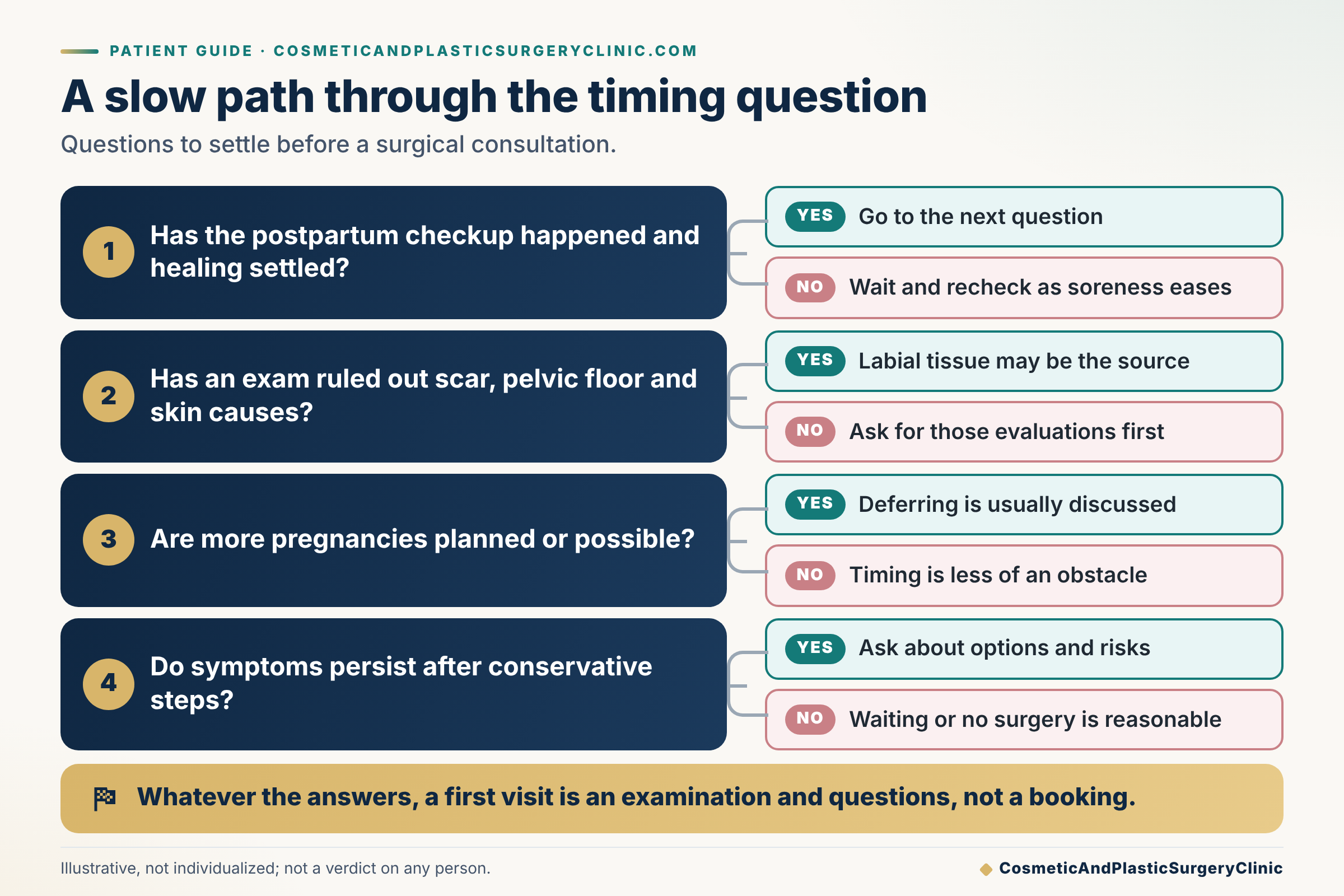
The question people ask most about labiaplasty after childbirth is how long to wait. The honest answer is that nothing opened for this article sets an interval, so timing rests on medical recovery, on what the tissue is doing, and on the surgeon’s judgment. Each of those can be checked, which is better than a number.
How long to wait after delivery
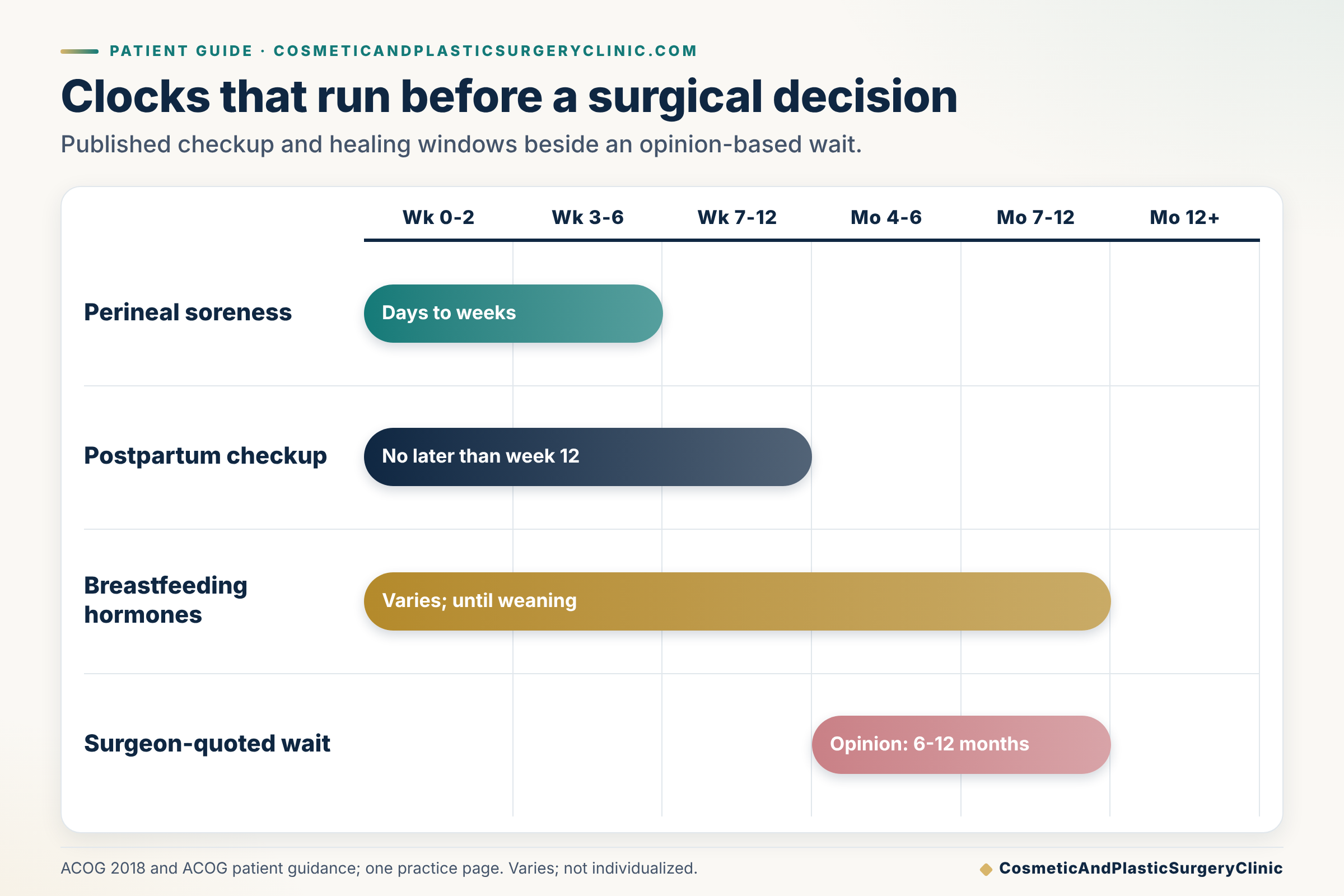
Two kinds of clock apply to labiaplasty after childbirth: the clock of the birth injury and the clock of the surgeon’s preferences. They are not the same, and only the first is anchored in guidance.
The postpartum checkup is the first gate
ACOG Committee Opinion 736 (2018) says the comprehensive postpartum visit should happen no later than 12 weeks after birth, and that it should cover physical recovery, sexual health, mood, sleep and contraception. That visit is the natural place to raise a vulvar concern, because the clinician who delivered the baby knows what the tear or repair involved.
Mayo Clinic adds that healing takes time and that tears should have healed before sex resumes. ACOG’s patient guidance says perineal swelling and pain commonly last a few weeks, longer after a tear or episiotomy. If the area is still changing from week to week, it is too early to judge what has settled, and an operation would be aimed at a moving target.
What surgeons quote, and why those numbers are opinion
The only timing advice found for labiaplasty after childbirth came from a single Dallas practice page, which suggests waiting at least six months to a year after delivery and, for breastfeeding patients, until weaning. The page cites no studies. The ASPS labiaplasty page and a 2017 ASPS blog post by Dr. Heather Furnas do not address timing relative to pregnancy at all.
Healthline (2020) quotes Dr. Furnas that childbirth and aging can both lengthen the labia, and states that data on how childbirth and menopause affect labiaplasty results are lacking. Treat any specific interval as a clinician’s habit rather than a finding. For body procedures that follow similar tissue-settling logic, our guide to mommy makeover after pregnancy explains why surgeons often wait.
Breastfeeding, anesthesia and hormones
Lactation affects both the examination and the anesthesia plan, and neither is a reason to panic. They are reasons to tell every clinician that you are nursing.
What the Academy of Breastfeeding Medicine says about anesthesia
The Academy of Breastfeeding Medicine’s Clinical Protocol 15 (2017) covers analgesia and anesthesia for nursing parents. It says mothers of healthy term or older infants can usually resume breastfeeding once awake, stable and alert, that local anesthetics such as lidocaine are considered safe, and that opioids should be used sparingly. It also advises considering postponing elective procedures until the child is older and the breastfeeding relationship is well established.
That is guidance for clinicians, not a personal instruction. It means the anesthesia plan for labiaplasty after childbirth, or any elective operation while nursing, should be discussed in advance, including how milk will be expressed and who cares for the baby afterward. Our plastic surgery recovery page covers general logistics.
Why weaning can change what an examination shows
Mayo Clinic says hormone changes can leave tissue dry and sore, especially while breastfeeding. A labial examination before labiaplasty after childbirth during lactation may therefore show tissue in a different state than the same exam months after weaning. Some surgeons prefer to wait for that reason, which is the logic behind the weaning advice on the Dallas page, though that page offers no data on it.
The practical point is that “I want it fixed now” and “I can tell what needs fixing now” are different statements. A first consultation can be only an examination and a conversation, with the decision made later, and reasonable clinicians will not object.
Future pregnancies: what is known about delivery after labiaplasty
Most people asking about labiaplasty after childbirth are asking two things at once: is it safe to deliver again, and will another delivery undo the result? The first has a small body of evidence. The second has almost none.
The delivery evidence for labiaplasty after childbirth and before it
The best-known study of labiaplasty and later delivery is a retrospective phone survey from one surgeon’s practice. It is worth reading carefully for what it can and cannot show.
What the 2020 Kearney survey reported
Kearney and colleagues (Aesthetic Surgery Journal, published online January 2020) surveyed patients who had in-office labiaplasty with the senior author from 2007 to 2018. Of 204 respondents, 70 had children before labiaplasty and 33 after. The vaginal delivery rate was 91.8% in the group that delivered after labiaplasty and 82.6% in the group that delivered before. The reasons for cesarean deliveries are not given in the abstract.
Tear or episiotomy occurred in 17.8% of vaginal deliveries after labiaplasty and 3.1% of those before it. Among women who delivered only after labiaplasty, 7 of 39 vaginal deliveries (17.9%) involved a tear or episiotomy. The authors concluded that over 90% of patients had successful vaginal deliveries after labiaplasty, and that for patients with no prior births the tear or episiotomy risk appeared comparable to or lower than in the general population.
What a single-surgeon phone survey cannot show
Only the abstract was readable for this article, and it does not give the general-population rates used for comparison. ACOG Practice Bulletin 198, as summarized by the ObG Project, reports that about 53% to 79% of vaginal deliveries involve some laceration, but definitions differ between sources, so those figures cannot be set beside the 17.8% without knowing what each counted.
The design also has limits that the authors themselves would recognize. It relied on people who answered a phone call, it had no matched comparison group, it came from one surgeon’s practice, and it cannot say how a labiaplasty scar behaved during labor in any single person. It reduces one worry without settling it. It also says nothing about whether a later delivery changes the cosmetic result.
Finish the family first, or treat symptoms now
Timing labiaplasty after childbirth around future pregnancies is a trade between two real costs: operating on tissue that may change again, and living with symptoms longer. Neither cost is imaginary.
The case for waiting until pregnancies are complete
The practical argument for waiting is simple. Another pregnancy brings new hormones, swelling and possible tearing, so a result judged after one delivery might be judged again after the next. The Dallas practice page makes this case and says a pre-pregnancy labiaplasty could be partly affected by delivery. No study opened for this article measures how often that happens.
Mayo Clinic notes that some research suggests waiting at least 18 months between pregnancies, which is one reason timelines for a second baby are often longer than people expect. Telling both your obstetric provider and any surgeon about pregnancy plans gives both of them the information they need to plan.
The case for not postponing labiaplasty after childbirth indefinitely
The ASPS labiaplasty page lists physical reasons people seek surgery, including pain from twisting and tugging of the labia during activities such as cycling or intercourse, itching and irritation. If those symptoms are persistent and nonsurgical measures have failed, waiting years for a family that may or may not grow can be its own cost. The Dallas page itself says distant or uncertain pregnancy plans should not mean indefinite delay.
That is a real trade-off with no universal winner. A symptom-driven case and an appearance-driven case can reasonably be timed differently, and our page on labiaplasty candidacy covers how clinicians weigh them. Where the main complaint is physical, our article on functional labiaplasty looks at the symptom evidence.
| Factor | Effect on the outcome | Maintenance or revision implication | Review point |
|---|---|---|---|
| Another pregnancy or vaginal delivery | New swelling, hormones and possible tearing; effect on a prior result not measured | A revision conversation may follow if shape or comfort changes | Tell the obstetric provider about prior surgery before delivery |
| Breastfeeding status | Dryness and tissue state may differ while nursing | Surgeons may prefer to examine after weaning | Reassess after weaning, not only after delivery |
| Scar quality | Scars firm, then soften over months, per ASPS blog guidance | Tender or tight scar is reported to the surgeon, not self-managed | Follow-up visits at the surgeon’s set intervals |
| Over-resection | ASPS lists it as the most common complication, with dryness and painful intercourse | Corrective options exist but are not simple | Ask how the surgeon plans to avoid taking too much |
| Menopause and aging | Healthline reports data lacking on later change | Appearance and comfort may keep changing for reasons unrelated to surgery | Revisit goals if symptoms or priorities change |
Labiaplasty after childbirth and a mommy makeover: one plan or two
Parents who are already weighing body procedures after pregnancy sometimes ask whether labiaplasty after childbirth belongs in the same plan. It can be raised, but it changes the arithmetic of a combined operation.
How combined planning changes the picture
A combined plan is a scheduling and safety decision first. The procedures do not become more or less appropriate because they share a date.
What adding labiaplasty after childbirth to a larger plan changes
A mommy makeover is a planned combination of procedures, such as abdominal and breast surgery, rather than a single operation. Our overview of the mommy makeover explains how combining affects operative time, anesthesia and recovery. Adding another site means another wound to care for and another set of restrictions to follow, at a time when the household may already be stretched.
Anesthesia time and recovery demands are the usual concerns in any combined plan. For labiaplasty specifically, ASPS says the operation can be done under local anesthesia with oral sedation or under general anesthesia, which means the anesthesia choice could differ from the rest of the plan. Ask which is proposed and why.
Questions about sequencing
Whether to do an intimate procedure at the same time or separately is a surgeon-specific judgment, and no opened source compares the two. Reasonable questions are whether the surgeon has done this combination before, how the anesthesia and positioning change, and what would trigger a split into two operations.
It is also reasonable to ask whether the timing for each component is different. Body procedures, breast procedures tied to weaning, and any labial surgery may each have their own earliest sensible date, which can push a combined plan later than any single one would need.
Recovery logistics with a small child
Recovery from labiaplasty is not long by surgical standards, but it comes with restrictions that matter in a house with a young child.
Published ranges and where they disagree
ASPS says most patients take about a week off work, that tampons and intercourse can typically resume after four to six weeks, that most distorting swelling is gone by about six weeks and that residual swelling can last up to six months. A 2018 ASPS blog post by Dr. Shruti Tannan says swelling usually peaks around days 2 to 3, activity resumes at about 2 to 4 weeks, dissolvable stitches typically disappear by 3 to 4 weeks, and intercourse waits about 6 to 8 weeks.
The two ASPS sources overlap and differ, which shows that the ranges are approximate and that the surgeon’s own instructions govern. Lifting restrictions, sitting and carrying a child are not addressed in the sources opened, so ask for them in writing. Our labiaplasty recovery page covers the weekly arc.
Emergency signs and problems to report the same day
Less urgent problems, such as a stitch line that opens, itching that persists, or pain that is getting worse instead of better, should reach the surgeon the same day. Our page on labiaplasty risks separates expected effects from complications.
A consultation framework for labiaplasty after childbirth
A good consultation turns a vague wish into specific, answerable questions. The framework below uses two hypothetical cases and a short list of checks to bring to an examination.
Two hypothetical cases show how one changed fact moves the decision
These scenarios are invented for illustration and describe no real person. They are not recommendations.
Case A: labiaplasty after childbirth for exercise symptoms, family complete
Consider a hypothetical parent eight months after a vaginal delivery with a second-degree tear that healed well. They are no longer breastfeeding and do not plan more children. One labium twists and chafes during running, and the problem has persisted despite clothing changes and activity adjustments. Pelvic and skin examinations found nothing else.
In this case, timing is not the obstacle and the symptom is mechanical. A conversation about labiaplasty after childbirth is reasonable, including trim and wedge technique, risks such as over-resection and wound separation, and the 2018 case series from one surgeon that found 12.06% complications, mostly under-resection. Our labiaplasty alternatives page lists what to try first.
Case B: labiaplasty after childbirth for an appearance concern, more children planned
Now consider a hypothetical parent five months after delivery who is breastfeeding, plans two more children, and dislikes how the labia look but has no physical symptoms. Labiaplasty after childbirth raises different issues here: tissue that may still be changing, anesthesia during lactation, likely repeat deliveries, and evidence that ACOG describes as lacking for cosmetic indications.
Two facts would move this case: pregnancy plans and whether symptoms develop. If the family stays unfinished, deferring is usually discussed. If a physical symptom appears, the case starts to resemble Case A. If the distress is substantial and lasting, ACOG recommends screening for body dysmorphic disorder where indicated and referring for evaluation of suspected psychological concerns before surgery.
Questions, records and a slow-down rule
The goal of a first visit about labiaplasty after childbirth is information, not a booking. These checks are meant to be asked of both a gynecologist and a surgeon.
Seven checks to bring to a labiaplasty after childbirth visit
- Cause: Which structure is responsible for the symptom, and can the examiner show you?
- Timing: How long since delivery and weaning, and is the area still changing?
- Other conditions: Has the pelvic floor been examined, and have skin conditions been ruled out?
- Pregnancy plans: How would future pregnancy and delivery be handled, and will the obstetric provider be told?
- Outcomes: What are the surgeon’s own complication and revision numbers, and how many labiaplasties are done each year? ACOG says surgeons should share their experience and outcomes.
- Setting: Which anesthesia and facility are proposed, and what is the lactation plan?
- Alternatives: What are the nonsurgical options, and what does doing nothing look like?
Credentials matter too. A 2024 Cureus survey of 96 U.S. obstetrics and gynecology residents found 87.5% disagreed that they would feel comfortable performing cosmetic gynecology independently after graduation, so training in this area varies. Our guide to choosing a plastic surgeon explains how to verify board certification, and the American Board of Plastic Surgery site has a certification lookup.
Pressure signs and when to slow down
Slow down if a consultation produces a date before an examination, a package price tied to booking quickly, a promise of a specific result, no interest in your delivery records, or dismissal of your questions about pregnancy plans. Pressure of any kind is a red flag for an elective operation such as labiaplasty after childbirth, and a second opinion is a normal part of the process.
Our page on the plastic surgery consultation covers how informed consent works and what to bring. If the first answer you hear is “now,” asking for a written plan and sleeping on it costs very little.
Frequently asked questions
Can childbirth alone make the labia look different, and does that call for labiaplasty after childbirth?
Childbirth may change how the vulva looks or feels, but the studies opened here do not show a consistent link between number of births and labial size, and none follows the same person across a birth. Some change may settle as swelling, hormones and breastfeeding change. A change that bothers you is worth an examination, but it does not by itself mean surgery is needed or advisable.
Is it safe to have a vaginal delivery after labiaplasty?
The one study opened on this, a 2020 phone survey from a single surgeon’s practice, reported that 91.8% of patients who delivered after labiaplasty did so vaginally. It is a small cohort without a matched comparison group, and the abstract does not say why cesareans occurred. Tell your obstetric provider about any prior labial surgery so delivery plans can account for it.
Does a cesarean birth change whether labiaplasty after childbirth makes sense?
A cesarean does not involve the vaginal tissues in the same way, but pregnancy hormones and swelling still occur. One 2023 clinic study found protruding labia minora in 25.8% of women after vaginal delivery and 60% after cesarean, in a small single-site sample, so no tidy rule follows. The Dallas practice page claims lower risk to results after cesarean but cites no data.
How long should I wait after having a baby before considering labiaplasty?
No source opened here gives a verified minimum. ACOG says the postpartum visit should occur no later than 12 weeks, and a Dallas practice suggests six months to a year and waiting until weaning, without citing studies. Many surgeons also want pregnancy plans settled. Treat any number as an opinion and ask the surgeon for the reasoning behind theirs.
Can I have labiaplasty while breastfeeding?
The Academy of Breastfeeding Medicine’s 2017 protocol says nursing parents can usually resume breastfeeding once awake and alert after anesthesia, and that local anesthetics are considered safe. It also advises considering postponing elective procedures until the child is older and breastfeeding is well established. Whether to proceed during lactation is a decision for you, your surgeon and an anesthesia professional.
Will insurance pay for labiaplasty after childbirth?
ACOG says these procedures are not medically indicated when done for cosmetic reasons, and many plans treat labiaplasty as elective. Coverage of symptom-driven labiaplasty after childbirth varies by plan and by documentation, and no policy was opened for this article. Ask the insurer for the exact criteria in writing before any consultation fee or deposit. Our labiaplasty cost page covers price components.
What if my pain after delivery is from a scar and not from the labia?
Then labiaplasty may not address it. Mayo Clinic lists healing tears, scar tissue and dryness as causes of painful sex after a baby, and the ObG Project summary of ACOG guidance notes that mediolateral episiotomy may bring more perineal pain. A gynecologist or pelvic-health clinician can examine the scar, suggest pelvic-floor therapy and tell you which structure is the source.
Sources and further reading
- Schnatz P, Boardman LA; ACOG Committee on Gynecologic Practice — Committee Opinion No. 795: Elective Female Genital Cosmetic Surgery, Obstetrics and Gynecology (January 2020; abstract record, accessed 2026-11-13) — limited evidence, risks, counseling, screening
- ACOG Committee Opinion No. 795 — Elective Female Genital Cosmetic Surgery (abstract record, accessed 2026-11-13) — scope and recommendations
- Kearney AM, Turin SY, Placik OJ, Wattanasupachoke L — Incidence of Obstetric Lacerations and Episiotomy Following Labiaplasty, Aesthetic Surgery Journal (2020; abstract, accessed 2026-11-13) — delivery after labiaplasty, 204 respondents
- Labiaplasty: A 24-Month Experience in 58 Patients: Outcomes and Statistical Analysis, Annals of Plastic Surgery (2018; abstract record, accessed 2026-11-13) — complications, satisfaction, parity
- Sanders J et al. — Childbirth Related Labial Trauma: Time for evidence based practice, Midwifery 97:102950 (2021; accessed 2026-11-13) — incidence, suturing, evidence gaps
- Hayes JA, Temple-Smith MJ — What is the anatomical basis of labiaplasty? A review of normative datasets for female genital anatomy, Australian and New Zealand Journal of Obstetrics and Gynaecology (2020; abstract, accessed 2026-11-13) — scoping review abstract
- Hayes JA, Temple-Smith MJ — review of normative datasets for female genital anatomy (full-text copy, accessed 2026-11-13) — study-level measurements and parity findings
- Lloyd J, Crouch NS, Minto CL, Liao LM, Creighton SM — Female genital appearance: normality unfolds, BJOG 112:643-646 (2005; Italian-language abstract, accessed 2026-11-13) — 50 women, no association with age or parity
- Che K et al. — Quantitative analysis of the labia minora morphology in 400 Chinese women, Frontiers in Surgery (2023; accessed 2026-11-13) — no significant differences by parity
- Derebasinlioglu H, Karaca SN, Yildiz C — Women’s Aesthetic Perceptions of the Genitalia and Their Association with Anatomical Measurements (preprint page; published in Archives of Gynecology and Obstetrics, 2023; accessed 2026-11-13) — protrusion and asymmetry by parity and delivery mode
- American Society of Plastic Surgeons — Labiaplasty (accessed 2026-11-13) — reasons, recovery ranges, risks, anesthesia
- American Society of Plastic Surgeons blog — Understanding aesthetic genital plastic surgery, Furnas (March 30, 2017; accessed 2026-11-13) — reasons, techniques, author’s views
- American Society of Plastic Surgeons blog — Four common questions women have about recovery after labiaplasty, Tannan (January 17, 2018; accessed 2026-11-13) — swelling, stitches, activity, intercourse timing
- American Society of Plastic Surgeons — 2024 Plastic Surgery Statistics Report (accessed 2026-11-13) — labiaplasty counts, member surgeons only
- Ventolini G et al. — Obstetric vulvar lacerations and postpartum dyspareunia, Journal of Reproductive Medicine 59(6):560-565 (2014; record, accessed 2026-11-13) — 1,617 first-time mothers, tear distribution
- The ObG Project — Obstetric lacerations at vaginal delivery: definitions and key management points (summary of ACOG Practice Bulletin 198; April 8, 2022; accessed 2026-11-13) — tear grades, frequency, episiotomy
- American College of Obstetricians and Gynecologists — Postpartum pain management (accessed 2026-11-13) — perineal pain duration and when to call
- ACOG Committee Opinion No. 736: Optimizing Postpartum Care, Obstetrics and Gynecology (2018; abstract record, accessed 2026-11-13) — postpartum visit by 12 weeks
- Mayo Clinic — Sex after pregnancy: set your own timeline (accessed 2026-11-13) — dryness, painful sex, healing, birth spacing
- Mayo Clinic — Pelvic organ prolapse: symptoms and causes (accessed 2026-11-13) — symptoms and childbirth as a cause
- NHS — Lichen sclerosus (accessed 2026-11-13) — vulvar skin changes and when to see a doctor
- Academy of Breastfeeding Medicine — Clinical Protocol #15: Analgesia and Anesthesia for the Breastfeeding Mother (2017; accessed 2026-11-13) — anesthesia and nursing
- Centers for Disease Control and Prevention — About blood clots (accessed 2026-11-13) — clot symptoms
- Healthline — Labiaplasty (Kassel; medically reviewed by Hannan; January 29, 2020; accessed 2026-11-13) — childbirth and evidence gaps
- Women’s Wellness Institute (Dallas) — Should I wait until after pregnancy to have labiaplasty? (single-practice page, no sources cited; accessed 2026-11-13) — an example of surgeon-quoted timing
- Sinha A et al. — Cosmetic Gynecology: Is There Enough Exposure in the Obstetrics and Gynecology Residency? Cureus 16(7):e65564 (2024; accessed 2026-11-13) — resident training survey
- American Board of Plastic Surgery — home page and certification lookup (accessed 2026-11-13) — how to verify certification