The honest answer to when a mommy makeover after pregnancy makes sense is that no single date fits everyone, and the calendar is only one of several things a surgeon looks at. Tissue keeps changing for months after delivery, breasts keep changing for as long as milk is being made and for a while afterward, and weight often takes longer to settle than people expect. Add a baby who wakes at night and a body that has just recovered from birth, and timing turns into a planning problem rather than a date.
This page is about the timing of a mommy makeover after pregnancy and nothing else. It gathers what surgeon guidance, obstetric sources and published studies say about the postpartum months, the weaning interval, weight and future pregnancies, then turns them into questions you can ask. For what the combined operation includes, see the mommy makeover overview; for the wider question of fit, see what surgeons evaluate in a candidate. Nothing here can tell you whether you are ready.
Why a mommy makeover after pregnancy runs on three clocks, not one
Most timing advice for a mommy makeover after pregnancy collapses into a single number of months. A more useful frame is three clocks that run at different speeds: the tissue clock (what the abdomen and breasts are still doing), the medical clock (how far your body has come back from childbirth, and whether your weight has settled) and the household clock (sleep, mood, and who lifts the baby while you cannot). A surgeon’s date is usually set by whichever clock is slowest, not by the average of the three.
The tissue clock: what keeps changing after delivery
The abdominal wall narrows early, then slows
The best-known measurements come from ultrasound work by Coldron and colleagues, published in Manual Therapy in 2007. They scanned 115 postnatal women at day one, two months, six months and twelve months, and compared them with 69 women who had never been pregnant. The gap between the two rectus muscles narrowed over the first two months, but on average it had not returned to the comparison values by twelve months. The design was partly cross-sectional, so different women were scanned at different times.
Two practical readings follow. A measurement in the first weeks says little about where the gap will end up, because most of the early narrowing happens then. And waiting alone should not be expected to close it fully. How the gap is measured and repaired is covered in the diastasis recti tummy tuck article, which this page deliberately does not repeat.
Breast size and shape follow the milk, not only the calendar
Breast tissue keeps changing while hormones and milk production are active. One surgeon quoted in the ASPS article says it can take four to six months for the breasts to contract to their post-pregnancy size and shape, and that breast surgery should wait until a woman is certain her breasts have stopped changing. Another says that once breastfeeding ends, hormones tend to return to normal. The logic is practical: a lift or implant size chosen while volume is still shifting is chosen for a moving target.
ASPS procedure pages list pregnancy, breastfeeding and weight change among the reasons breasts lose volume or shape. They also note that augmentation restores volume but does not correct severely drooping breasts, which may call for a lift in the same operation or a separate one. That choice depends on a shape that has finished changing, which is another reason a mommy makeover after pregnancy can carry a later date for the breasts than for the abdomen.

The medical clock: finishing recovery from birth first
The first twelve weeks belong to postpartum care
The American College of Obstetricians and Gynecologists (ACOG) describes postpartum care in Committee Opinion 736 (2018) as an ongoing process rather than one visit: contact within three weeks of birth, a comprehensive visit no later than twelve weeks, and attention to mood, sleep, fatigue and physical recovery. A date for a mommy makeover after pregnancy set before that visit has happened skips a check that already exists for this stage.
There is also a clotting reason for patience in the earliest months. The CDC says people are especially at risk of blood clots during pregnancy, childbirth and the three months after delivery, and that pregnancy raises the risk about fivefold. Clot considerations for combined operations are covered in mommy makeover risks. The surgeon quoted for the longer six-month floor ties it to something else: hormones that keep fluctuating for months and affect tissue integrity and wound healing.
Weight: steady matters more than low
Surgeons talk about a stable weight more than a target number. Mayo Clinic suggests keeping weight steady for at least six to twelve months before a tummy tuck and notes that major weight loss afterward can alter the result. One ASPS-quoted surgeon prefers patients to be at or near a goal weight, or back to their baseline body mass index (BMI).
Postpartum weight rarely follows a tidy line. In a prospective Australian study of 152 women (Martin and colleagues, Maternal & Child Nutrition), 77.5 percent of the 129 women measured at six months were still above their pre-pregnancy weight, and follow-up ended at twelve months. The study was single-site, used self-reported pre-pregnancy weight and lost participants over time, so read it as an illustration of variability rather than a norm. The takeaway is modest: six months after birth is often early to call a weight stable.
The household clock: sleep, mood and who lifts the baby
Mood and exhaustion deserve attention before a surgical date
The CDC reports that about 1 in 8 women with a recent live birth have symptoms of postpartum depression; its page does not state the data year. ACOG’s comprehensive postpartum visit includes mood, sleep and fatigue for that reason. A mommy makeover after pregnancy is not a treatment for any of this, and a major operation layered on top of untreated exhaustion or low mood makes both harder. One quoted surgeon wants the patient to feel emotionally ready; another suggests waiting for some stability and routine in the new family’s life.
Recovery with a small child is a logistics problem
A surgeon quoted by ASPS puts recovery from a breast reduction or tummy tuck at usually four to six weeks. Mayo Clinic’s tummy tuck guidance adds that heavy lifting and straining are avoided for about six weeks and that many people return to work in two to four weeks. A baby or toddler is the heaviest, most frequent lift in your day, so the real question is who covers it. The surgeon quoted even suggests waiting until children are in school, which is not realistic for everyone. Plan around the actual household in mommy makeover recovery.
What surgeons quote as the earliest date for a mommy makeover after pregnancy
The ranges you will hear: six months, nine to twelve, a full year
What the June 2026 ASPS article reports
An ASPS article published June 18, 2026, written by freelance writer Alia Willson, quotes three surgeons. Kristy Hamilton, MD, recommends a minimum of six months for most procedures and ideally nine to twelve, longer if a mother is breastfeeding. Karen Horton, MD, recommends waiting up to a full year before considering any plastic surgery procedure. Umbareen Mahmood, MD, says mothers who are still breastfeeding should consult an experienced ASPS member surgeon.
The same article says some care does not need to wait: Mahmood notes that injectables, light chemical peels, microneedling and skincare can restart soon after birth. Hamilton’s framing is a useful one to keep: “Give yourself a timeline, not a deadline.” The article offers no numeric weight threshold and no specific waiting period after a cesarean.
Why a quoted minimum is not a target date
For a mommy makeover after pregnancy, a quoted minimum is the earliest date at which the calendar stops being the main reason to wait. It is necessary, not sufficient. Someone who is nursing, still losing weight or planning another child can pass six months and still be well short of what a surgeon wants to see. Someone who is none of those may be ready sooner than the ideal range, or may simply prefer to wait until a calmer season of life.
It also helps to know what kind of evidence sits behind these numbers. They come from surgeon interviews in a patient-education article, not from a trial comparing surgery at six months with surgery at twelve. None of the sources opened for this page reports such a comparison, so treat the ranges as shared clinical habit that a surgeon may reasonably adjust either way for your anatomy and health.
Breastfeeding changes the arithmetic
The weaning interval: a clock that starts when milk production stops
Hamilton says she prefers to wait at least three months after weaning before breast surgery, and Horton notes that hormones tend to return to normal once breastfeeding ends. Put those together and the breast portion of a mommy makeover after pregnancy is anchored to the day nursing stops, not to the birthday. A mother who nurses for eighteen months may reach a lift or implant discussion well after the abdomen is ready for its own, which is one reason some people ask about operating in stages rather than all at once.
If you might breastfeed a future child, ask about that directly. The FDA says some women who have breast augmentation can breastfeed successfully and some cannot, and that implants are not considered lifetime devices, so reoperation over the years is possible. Whether breastfeeding later is realistic after a particular technique is a question for your surgeon, not something a general page can settle.
Anesthesia and nursing: what lactation guidance says
The Academy of Breastfeeding Medicine’s 2017 protocol on analgesia and anesthesia covers mothers who need surgery while nursing. It says mothers of healthy term or older infants can generally resume breastfeeding once they are awake, stable and alert, and that milk does not necessarily need to be discarded. It advises the lowest effective opioid dose for the shortest time, with another adult watching the baby for sedation. It also recommends considering postponing elective procedures until the child is older.
Medication and anesthesia choices belong to your surgeon and the anesthesia team, who need to know you are nursing. What the protocol adds to a timing decision is a reminder that surgery during lactation is possible but adds logistics: pumping or expressing, a second caregiver, and a plan for the first night.
Weight and future pregnancies: two plans that can undo a mommy makeover after pregnancy
When your weight is still moving, the date moves with it
How surgeons use the word stable
ASPS candidacy guidance for a tummy tuck lists being physically healthy and at a stable weight, along with realistic expectations and not smoking. Mayo Clinic gives the only duration among the sources opened here: steady for at least six to twelve months. Neither page defines how much fluctuation still counts as steady, and no universal cutoff turned up in the research for this page. That is a question to put to the surgeon, with your own weight history on paper.
Loose skin is a moving target while weight changes
When planning a mommy makeover after pregnancy, if weight is still falling, the skin excess a surgeon measures today may not match the skin excess in six months, and a result planned around it can end up under- or over-corrected. If weight is climbing, new gains can erode what the operation achieved. In both cases the plan gets better with a longer, flatter stretch of data. The evaluation side of this question, including how BMI and weight history are read, sits in tummy tuck candidacy.
If another pregnancy is possible, the whole plan changes
Opinion, not data: what surgeons advise about waiting
Hamilton says she strongly advises waiting until a woman’s family is complete, particularly before a tummy tuck, because a future pregnancy can undo the results. Mayo Clinic likewise says surgeons may advise against a tummy tuck for people considering a future pregnancy. Hamilton’s stated worry is whether the result will hold; the Mayo page does not give its reasoning.
No verified rate for how much of a result survives a later pregnancy turned up in the sources opened for this page. So the advice rests on anatomy and clinical habit: the abdominal wall and skin stretch again, breast volume and position shift again, and weight changes again.
When you are undecided about another baby
Being undecided about another baby is a legitimate position when planning a mommy makeover after pregnancy, and surgeons hear it often. Reasonable options to raise include waiting until the question is settled, asking whether any smaller step makes sense now, or discussing whether a staged plan keeps choices open. Each has a cost in time, money or an extra operation, and each looks different for the abdomen than for the breasts.
Ask, too, what would be at stake: which components would be repeated if pregnancy came later, and how a surgeon’s revision policy handles a result changed by pregnancy. A written answer is worth more than a verbal reassurance.
Who may be asked to wait longer before a mommy makeover after pregnancy
Several signals can push a mommy makeover after pregnancy past the ranges above. The full evaluation, including how surgeons weigh them together, belongs to the candidacy article; this section covers only how each one moves the calendar.
Health and healing signals
Nicotine, including vaping
Mayo Clinic notes that smoking lessens blood flow in the skin and can slow healing. The ASPS 2024 policy on smoking in plastic surgery patients says cessation should generally begin 4 to 8 weeks before surgery and continue at least 4 weeks afterward, and treats e-cigarette nicotine as presumed to carry similar risks. It also says surgeons may use a urine cotinine test to decide whether to delay. For someone who smoked or vaped through pregnancy or the postpartum months, the nicotine-free interval can be the step that sets the date of a mommy makeover after pregnancy.
Medical history and recovery from the birth itself
Mayo Clinic lists reasons a surgeon may advise against a tummy tuck: plans for significant weight loss, a future pregnancy, serious long-term conditions such as heart disease or diabetes, a need for blood-thinning medicine or high clot risk, a BMI of 30 or higher, smoking, and past abdominal surgery that left significant scar tissue. Any of these may need attention before a surgical date is set. A complicated delivery or ongoing symptoms are questions for your obstetric provider first, ahead of a plastic surgeon’s calendar.
Life signals
Support at home and a stable routine
Recovery from a mommy makeover after pregnancy needs another adult for lifting, driving and the first nights. A surgeon quoted by ASPS says waiting until there is some stability and routine in the family’s life is helpful. That does not mean a calm house, only a plan that holds up if the baby is sick the week of surgery. Ask who the backup is for the backup.
A recent cesarean
Hamilton says a tummy tuck done at the same time as a cesarean is not a good idea medically or aesthetically, because tissue cannot be contoured well when a patient is swollen and not at baseline weight. How a prior cesarean scar, adhesions and timing shape a later operation is the subject of mommy makeover after a C-section.
| Factor | How it can move the date | What to review with your surgeon |
|---|---|---|
| Still nursing | Breast surgery is often discussed for at least about three months after weaning (one quoted surgeon). | Your expected weaning date, and whether abdomen-only timing differs. |
| Weight still changing | Skin excess and breast volume are harder to judge while weight is moving. | Your weight history in writing, and how long it has held steady. |
| Another pregnancy possible | A later pregnancy can change the result, according to quoted surgeons. | What would be repeated, and how the revision policy treats it. |
| Nicotine or vaping | Policy guidance calls for 4 to 8 weeks nicotine-free before and at least 4 weeks after. | Whether a cotinine test is used and what happens if it is positive. |
| Recent cesarean | Surgery is not combined with the cesarean; abdominal scarring may alter the plan. | Scar position, adhesions and the surgeon’s preferred interval. |
| Limited help at home | Lifting limits and driving restrictions cannot be met without another adult. | Who covers each week, and what the fallback is. |
| Low mood or exhaustion | Surgery can wait until mood and sleep have been assessed in postpartum care. | Whether your obstetric or primary care clinician has screened you recently. |
Three hypothetical calendars for a mommy makeover after pregnancy
The scenarios below, all about timing a mommy makeover after pregnancy, are invented to show how the same facts produce different questions. None describes a real person, none is a recommendation, and a real surgeon would need your history, an exam and your goals before saying anything specific.
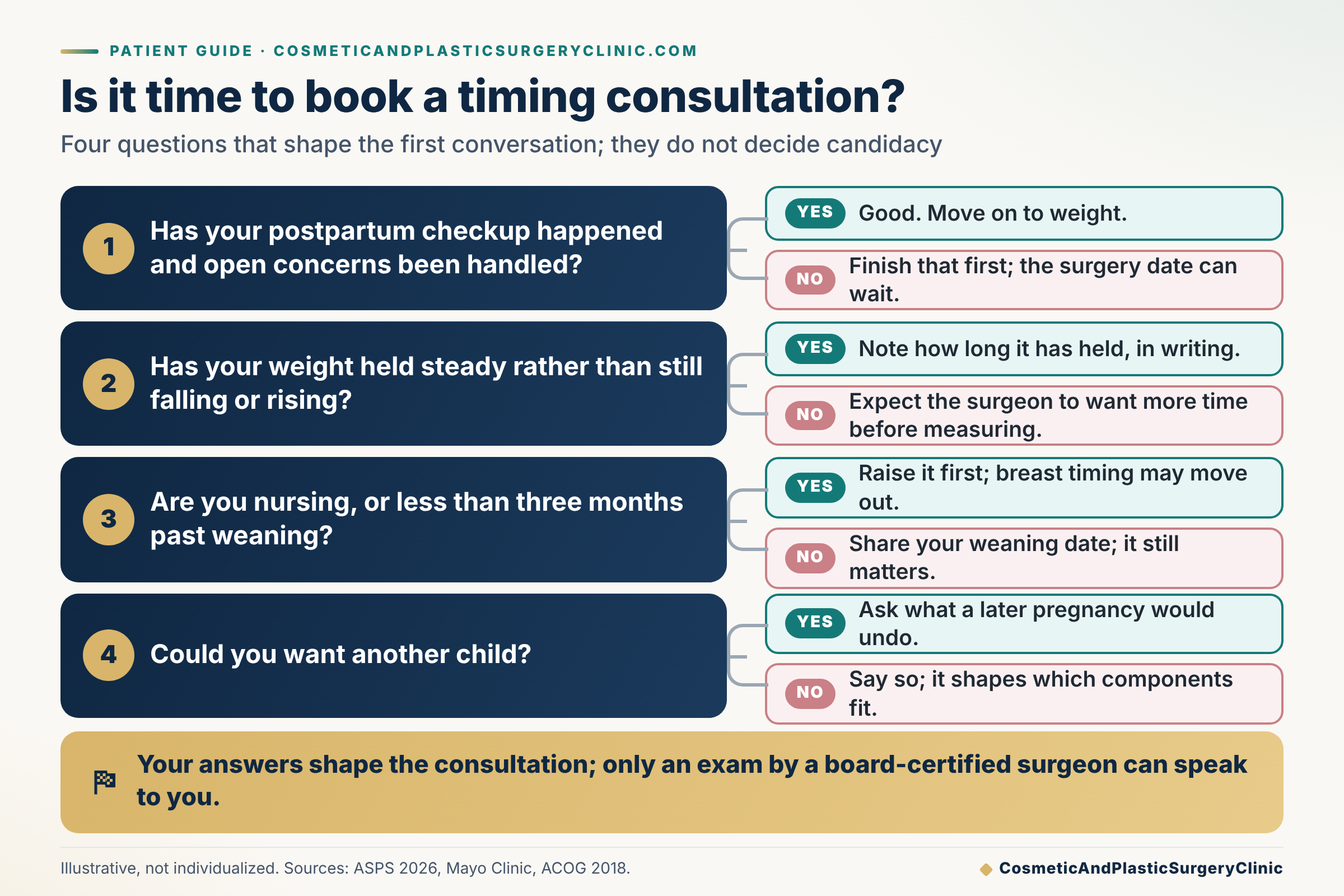
Reading three situations side by side
Consider a hypothetical: still nursing a nine-month-old
A mother nursing a nine-month-old past the six-month mark is past the quoted minimum for the abdomen but not for the breasts, which are still producing milk. The useful questions are about sequence: whether the abdomen and breasts need to be handled at the same time, what weaning date she has in mind, and whether the surgeon works with her around nursing. The answer may be to book a consultation now and an operation later.
Consider a hypothetical: weaned for over a year, weight steady, family complete
This person has cleared most of the calendar-based hurdles quoted in the ASPS article: more than three months since weaning, well past twelve months since delivery, a stable weight and no future pregnancy planned. The questions shift from when to what: which components are worth combining, how long the operation would run, and what recovery help is lined up. Timing a mommy makeover after pregnancy is then mostly about the household, not the body.
Consider a hypothetical: cesarean seven months ago, weight still dropping
Seven months clears the six-month floor in the quoted ranges, but the weight is still moving and a cesarean scar is in the way. A surgeon may reasonably want weight to hold for months before measuring skin excess, and will want to see the scar and understand the delivery. The likely conversation is about interval and monitoring rather than an operating date, covered further in the C-section article linked above.
The three situations in one table
| Situation | Pathway to discuss | Benefit | Trade-off | Key question |
|---|---|---|---|---|
| Nursing a nine-month-old | Consult now, schedule after weaning | Time to plan; breasts have finished changing | Months more with current body | How long after weaning do you want the breasts assessed? |
| Weaned long ago, weight steady, family complete | Compare combined and staged plans | Fewest calendar obstacles | Longer operation if combined | Which components matter most to you? |
| Cesarean seven months ago, weight dropping | Wait, re-measure, review the scar | Planned on a settled body | Open-ended wait | What weight pattern would you want to see first? |
| Undecided about another child | Wait, or discuss a smaller first step | Keeps options open | May mean an extra operation | What would a later pregnancy undo? |
Working the calendar backward from a surgery date
Lead times that stack up
A date only works if the steps before it fit. Work backward from the surgery day: the nicotine-free window of 4 to 8 weeks the ASPS policy describes, if it applies; consultations and, for many people, a second opinion; your obstetric clearance conversation; childcare arranged for the first weeks; and a return-to-work plan, remembering Mayo’s two to four weeks off work after a tummy tuck, depending on how physical the job is. Lined up honestly, these steps can stretch a “six-month” plan considerably.
Questions to ask while building that calendar are collected in the consultation guide, and the checks on a surgeon’s credentials sit in choosing a plastic surgeon.
What waiting costs, and what it does not
The honest cost of waiting is mostly personal: more months in a body that bothers you, or a life change that makes a later date harder. Money matters too; if surgery is split, each stage may carry its own facility and anesthesia fees, a trade-off set out in mommy makeover cost.
What waiting does not appear to cost is the option of a mommy makeover after pregnancy itself. None of the sources opened for this page describes a deadline after which surgery stops being possible, and one quoted surgeon calls it safe to wait six months to a year for breast surgery. That is not a promise about any individual, but it does take pressure off a decision that sometimes feels time-limited.
Questions for a timing consultation, and six timing mistakes to avoid
Questions that show how a surgeon is thinking about your dates
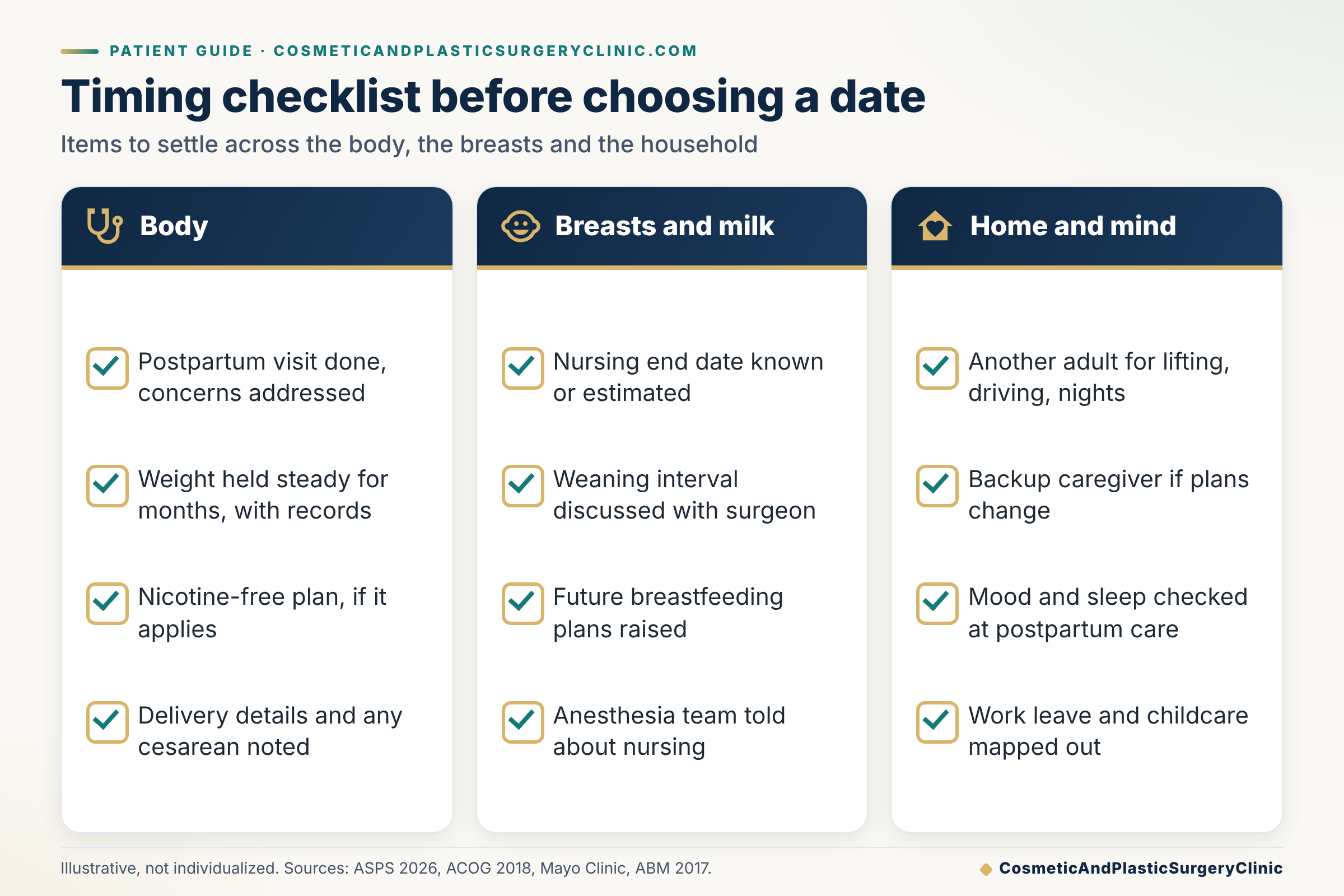
Questions about your body and your dates
Bring your delivery date or dates, the date nursing stopped or will stop, a weight history, and any complications from the birth. Then ask:
- Which of my dates sets the earliest date for the abdomen, and which for the breasts?
- How long would you want my weight to hold before measuring, and what range counts as holding?
- How does the timing for a mommy makeover after pregnancy change if I have a prior cesarean?
- What do you want from my obstetric provider before scheduling?
Questions about the plan and the fallback
- If I want another child, which parts of this plan would you do now, later or not at all?
- How does your revision policy treat changes caused by a later pregnancy or weight change?
- If I am still nursing, what do you do differently, and how do you coordinate with anesthesia?
- What would make you postpone my date even after I have booked it?
A good answer names specifics and gives reasons. An answer that is only a number of months, or one that pushes you to book before the questions are settled, is worth a second opinion. Take that second opinion without apology.
Six timing mistakes to avoid
The six mistakes at a glance
| Mistake | Why it backfires | A better question |
|---|---|---|
| Treating six months as the date | It is a quoted minimum; nursing, weight and plans can push it out. | What would have to be true for the date to hold? |
| Counting from birth when nursing continues | Breast timing is anchored to weaning in the surgeon guidance quoted. | How long after weaning will you assess my breasts? |
| Booking while weight is still moving | Skin excess and volume change after the plan is made. | How long should my weight hold first? |
| Skipping the postpartum visit | Mood, sleep and recovery are checked there, not in a surgical consult. | Has my comprehensive postpartum visit covered this? |
| Setting the date before the support is lined up | Lifting limits and driving restrictions need another adult for weeks. | Who covers each week, and who is the backup? |
| Ignoring a possible future pregnancy | Quoted surgeons say a later pregnancy can undo results. | What would be repeated if I have another child? |
How to use the list
Read it as a pre-consultation filter, not a score. Plenty of people hit two or three of these and still end up with a sound plan once a surgeon has asked the right questions. The point is to find them early, while changing the date costs nothing. For the broader picture of risks that come with combined operations, the general risk article sets the baseline.
Frequently asked questions
Can I have a mommy makeover after pregnancy while I am still breastfeeding?
Surgeons may differ on whether to plan the abdomen first and leave breast surgery until after weaning, or to wait and do everything together. One surgeon quoted by ASPS in 2026 says mothers who are still breastfeeding should consult an experienced surgeon, and the Academy of Breastfeeding Medicine suggests considering postponing elective procedures until the child is older. If you do operate while nursing, anesthesia and pain-medicine choices need to account for it. This is a decision for you, your surgeon and the anesthesia team.
How long after weaning can breast surgery be done as part of a mommy makeover after pregnancy?
One surgeon quoted in the June 2026 ASPS article says she prefers at least three months after weaning before breast surgery; another says hormones tend to return to normal once breastfeeding stops and that breasts should have stopped changing. No verified guideline fixes a single interval. The practical test is whether breast size and shape have stopped shifting, which a surgeon judges by examining you.
Does waiting more than a year make a mommy makeover after pregnancy harder to do?
None of the sources opened for this page describes a point after which a mommy makeover becomes unavailable, and the surgeons quoted by ASPS describe waiting as reasonable. Age, weight changes, further pregnancies and health conditions can change the plan, which is why the question is individual. If you are weighing a longer wait, ask a surgeon what in your situation could change the options, and what would not.
Can nonsurgical treatments start sooner than a mommy makeover after pregnancy?
An ASPS article quotes a surgeon saying injectables, light chemical peels, microneedling and skincare can restart soon after birth, and another describing noninvasive treats such as a facial or massage as fine immediately after birth. Those are not substitutes for surgery on stretched muscle, excess skin or changed breast shape. If you are nursing, ask the clinician about each product or treatment, since not every option suits every stage.
Should I talk to my obstetric provider or a plastic surgeon first about a mommy makeover after pregnancy?
Your obstetric provider knows your delivery, your postpartum recovery and your mood, and ACOG says postpartum care continues beyond a single visit. A plastic surgeon knows the operations. Many people start with the postpartum visit and bring the surgical question to it, then book a surgical consultation once weight and nursing plans are clearer. Either order is reasonable; the surgeon will want your obstetric history in any case.
How long should I stay nicotine-free before a mommy makeover after pregnancy?
The ASPS 2024 policy on smoking in plastic surgery says cessation should generally begin 4 to 8 weeks before surgery and continue at least 4 weeks after, and that e-cigarette nicotine is presumed to carry similar risks. Your own surgeon sets the actual interval and may ask for a cotinine test. Tell your surgeon about every nicotine product you use, since the policy’s concern is nicotine itself.
Can a mommy makeover be done at the same time as a cesarean?
One surgeon quoted by ASPS says a tummy tuck at the same time as a cesarean is not a good idea medically or aesthetically, because the tissue is swollen and not at baseline weight and contouring cannot be done to the degree wanted. That quote concerns the tummy tuck specifically. What a previous cesarean changes for a later operation, including scars and timing, is covered in the C-section article.
Sources and further reading
- American Society of Plastic Surgeons — Post-pregnancy plastic surgery: what can you do now, and what needs to wait (June 18, 2026, accessed 2026-11-12) — surgeon-quoted minimums, weaning interval, weight, cesarean and future-pregnancy advice
- American Society of Plastic Surgeons — Mommy makeover (accessed 2026-11-12) — goal and components of the combined operation
- American Society of Plastic Surgeons — Breast lift (accessed 2026-11-12) — pregnancy, breastfeeding and weight change as causes of breast change
- American Society of Plastic Surgeons — Breast augmentation (accessed 2026-11-12) — volume restoration versus drooping; lift in same or separate operation
- American Society of Plastic Surgeons — Tummy tuck candidates (accessed 2026-11-12) — stable weight, nonsmoking and realistic expectations
- American Society of Plastic Surgeons — Managing the risks of smoking in plastic surgery patients (issued October 9, 2024, accessed 2026-11-12) — nicotine-free intervals, e-cigarettes, cotinine testing
- Mayo Clinic — Tummy tuck (January 2025, accessed 2026-11-12) — stable weight, future pregnancy, reasons to advise against, recovery ranges
- Coldron and colleagues — Postpartum characteristics of rectus abdominis on ultrasound imaging, Manual Therapy 2007 (University of Southampton record, accessed 2026-11-12) — 115 postnatal women, 69 controls, gap over twelve months
- Rinker, Veneracion and Walsh — Breast ptosis: causes and cure, Annals of Plastic Surgery 2010 (Europe PMC abstract record, accessed 2026-11-12) — 132 patients; breastfeeding not a significant risk factor for ptosis
- LiveScience — Breastfeeding does not make breasts sag, study suggests (November 2, 2007, accessed 2026-11-12) — news report of the same research group’s presentation to ASPS
- Academy of Breastfeeding Medicine — Clinical Protocol #15: Analgesia and anesthesia for the breastfeeding mother (2017, accessed 2026-11-12) — resuming nursing after anesthesia, opioids, postponing elective surgery
- U.S. Food and Drug Administration — Risks and complications of breast implants (current as of 12/15/2023, accessed 2026-11-12) — breastfeeding after augmentation, reoperation, implant lifespan
- American College of Obstetricians and Gynecologists — Committee Opinion No. 736: Optimizing postpartum care, 2018 (abstract record, accessed 2026-11-12) — three-week contact, twelve-week comprehensive visit
- Centers for Disease Control and Prevention — Blood clots and pregnancy (accessed 2026-11-12) — elevated risk through three months after delivery; clot warning signs
- Centers for Disease Control and Prevention — Urgent maternal warning signs and symptoms (accessed 2026-11-12) — signs needing urgent care in the year after delivery
- Centers for Disease Control and Prevention — Depression during and after pregnancy (accessed 2026-11-12) — about 1 in 8 reporting symptoms; help lines
- Martin and colleagues — Predictors of post-partum weight retention in a prospective longitudinal study, Maternal & Child Nutrition (PubMed Central, accessed 2026-11-12) — 152 Australian women, weight above pre-pregnancy at six months