Being a labiaplasty candidate is not a label a person can earn by measuring herself or by passing an online quiz. It is the outcome of a conversation with a clinician who has examined her, heard what is bothering her, checked whether something else explains it, and talked through what an operation can and cannot change. Plenty of people leave that conversation with a plan for surgery. Plenty leave with reassurance, a treatment for a skin problem, or a decision to wait.
This page explains what clinicians weigh when they decide whether someone is a labiaplasty candidate for a surgical discussion: the symptoms, the anatomy, the health checks, the psychological and practical questions, the stage of life, and the alternatives. It is general education and cannot tell any reader whether she qualifies. The procedure itself is covered in labiaplasty, and the general visit checklist lives on the plastic surgery consultation page.
Check 1: Is this a clinical decision or a quiz result? How labiaplasty candidate status is actually set
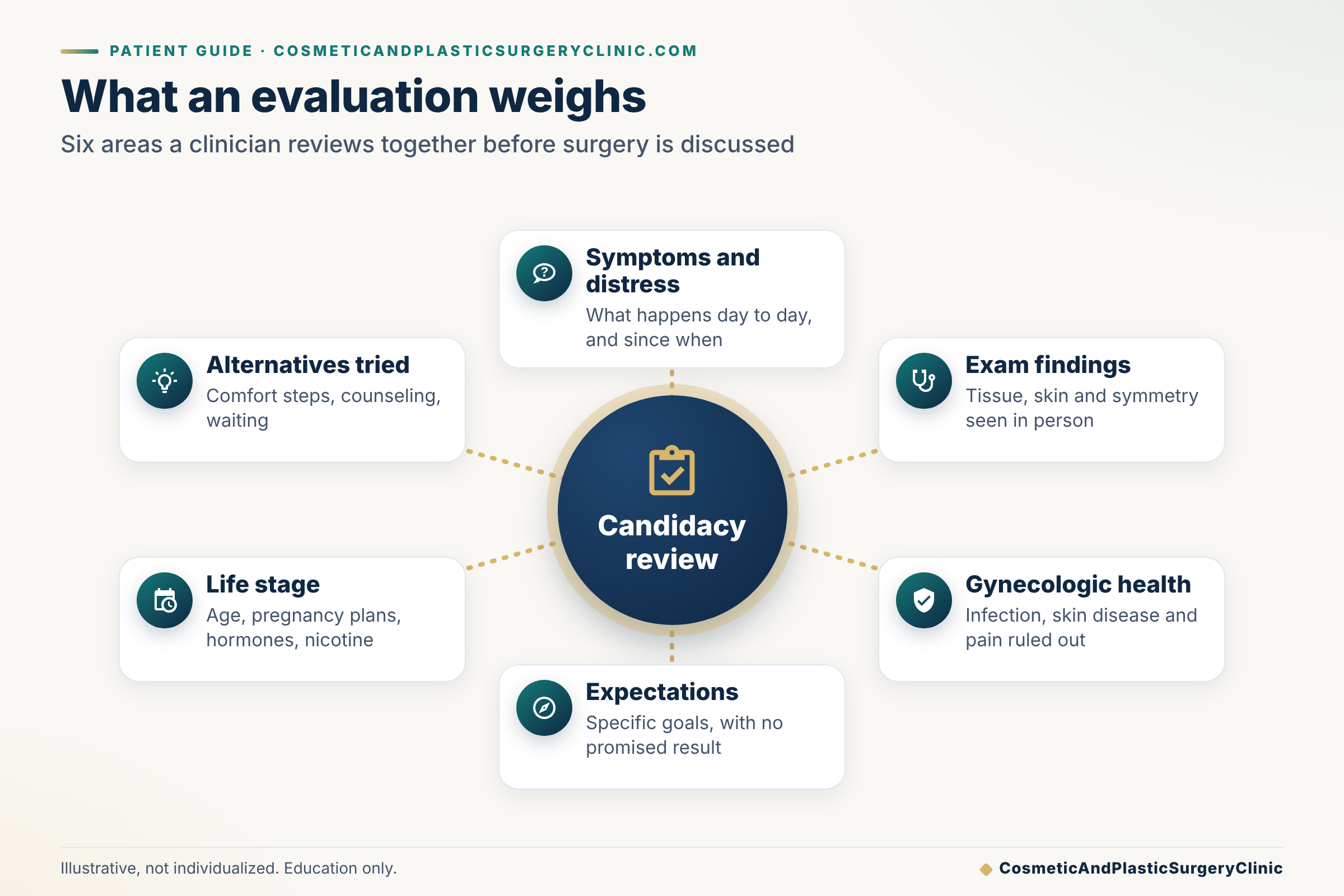
The phrase “labiaplasty candidate” suggests a threshold, as if a certain labial width or a certain score flips a switch. The published material says otherwise. Clinicians form a judgment from several kinds of information, and the weight each carries differs from one person to the next.
Why no single measurement or age settles it
The missing definition of “enlarged”
A 2015 review in ePlasty by Gowda, Chopra and Khalifeh states that there are no widely accepted guidelines for labiaplasty and no established anatomic standard, and that older cutoffs for “abnormal” labial distance from the midline vary between authors. Women’s Health Victoria, which runs the Labia Library, uses similar wording on its page for practitioners: there is no clinical definition of normal labia, and hypertrophy of the labia minora remains poorly defined.
That page also reports that recorded labia minora lengths span roughly 5 to 100 millimeters and that 30% to 50% of women have labia minora that extend past the labia majora. The point of those figures is not to tell anyone where she sits. It is that a wide range is ordinary, so a number alone cannot make someone a labiaplasty candidate.
What an evaluation combines
The Aesthetic Society says the surgeon decides whether you are a suitable candidate from your goals, your physical characteristics and your medical history. An American Society of Plastic Surgeons (ASPS) blog post from 2019, written by a plastic surgeon, lists good general health, not smoking, a size or shape that affects confidence or daily activities, and expectations for the result. The same post adds that not every woman will be a good candidate.
Read together, those statements describe a labiaplasty candidate review built on four things: what the person experiences, what the exam shows, her health and habits, and what she hopes surgery will do. The sections below take them in turn.
Two starting points: physical symptoms and appearance
Discomfort that shows up in daily activity
Cleveland Clinic describes physical reasons as tissue that can twist, get pinched or cause discomfort during exercise, cycling, running and intercourse, and hygiene difficulty with cleaning. Other sources add irritation with tight clothing. These are descriptions of what patients report, not proof that the labia are the cause, which is why the next check, ruling out other explanations, comes before any surgical plan. The symptom-led path has its own page: functional labiaplasty.
Consider a hypothetical cyclist who notices soreness on long rides and wonders whether she is a labiaplasty candidate. Chafing from seams, moisture or hair removal can look the same as soreness from anatomy. A clinician who asks about gear and grooming first is not dismissing her; the answer changes what helps.
Appearance and distress: a valid concern with a different evidence base
Cleveland Clinic says plainly that cosmetic reasons are valid while the variation itself is considered normal. ACOG Committee Opinion 795 (2020) takes a more cautious position on the science: procedures that alter genital appearance are not medically indicated and carry risk, and high-quality evidence of effectiveness is lacking. Both statements can be true together. A person may have real distress about appearance, and the evidence for surgery as the fix may still be limited.
Research on motivations shows the two often overlap. In a study of 131 patients summarized in the 2015 ePlasty review, about 32% sought relief of function, 37% sought a change in appearance and 31% gave both reasons. A 2014 controlled study in Psychological Medicine by Veale and colleagues grouped motivations into cosmetic, functional and sexual categories. Surgery planning differs by motive, so a candid answer from a labiaplasty candidate helps.
Check 2: Health screening that comes before any labiaplasty candidate decision
Symptoms in this area have many causes, and a good labiaplasty candidate review starts by asking whether labial anatomy is the cause at all. The NHS advises discussing the idea with a general practitioner first, because a treatable condition may be responsible for the discomfort or the operation may not suit the person.
Ruling out other explanations for symptoms
Skin conditions that change the tissue
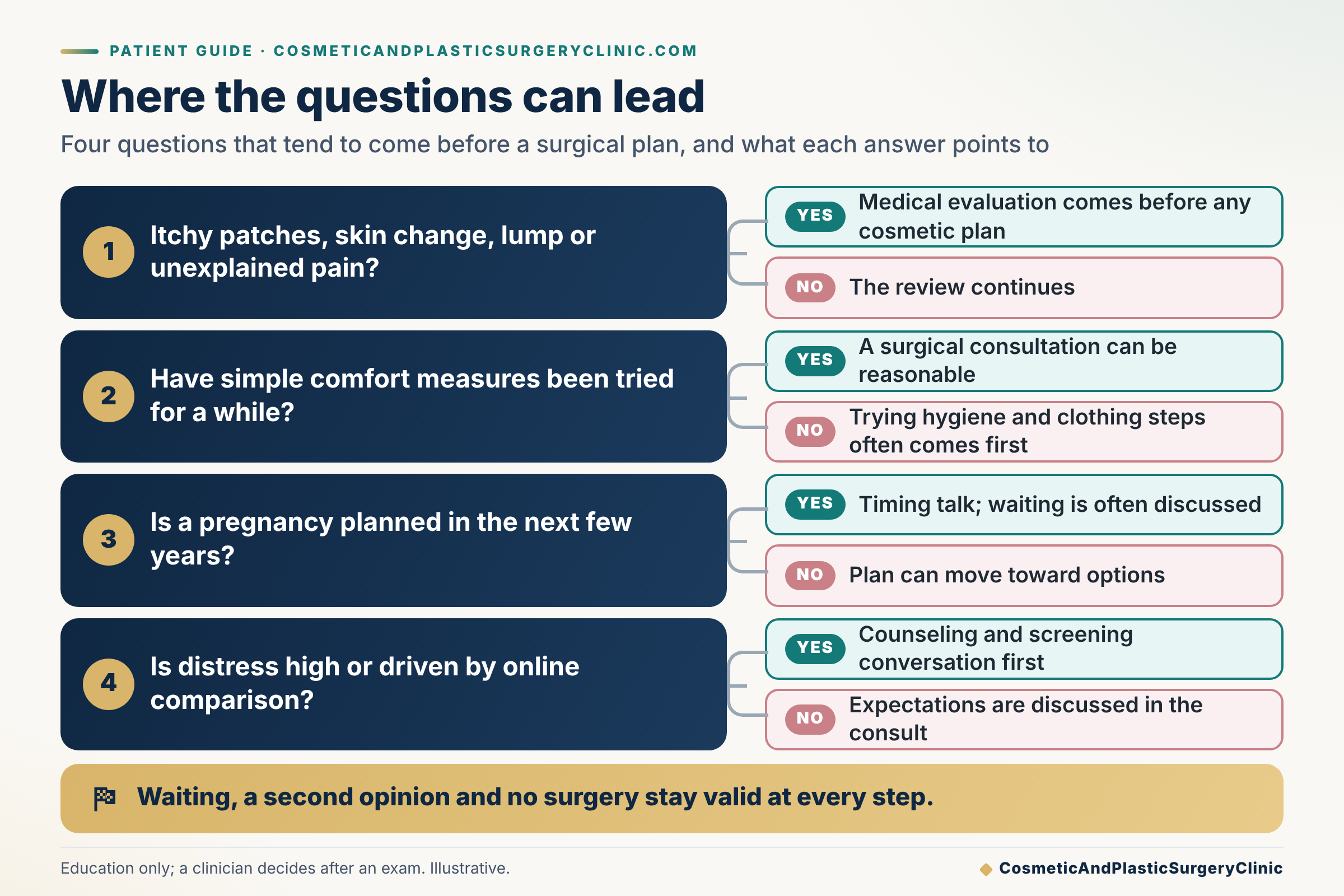
Lichen sclerosus is the example worth knowing. The NHS describes it as a skin condition that causes itchy white patches, mostly on the genitals, that can affect people of any age and is more common after 50. Over time, scarring can involve the clitoris and the labia minora, and the vulva may tighten. Treatment is usually a prescription steroid ointment. Surgery to reshape tissue is a different question from treating an active skin disease.
Vulvar pain, irritation and infection
ACOG’s patient page on vulvodynia, long-lasting vulvar pain not caused by infection or skin disease, says a gynecologist first rules out more common causes through history, an exam, sometimes a discharge sample and sometimes a skin biopsy. Treatments it lists include gentle care, medicines, pelvic floor physical therapy and counseling. Surgery appears only for pain limited to the vestibule after other treatments have failed.
Women’s Health Victoria warns clinicians against “medicalising” chafing linked to grooming or clothing, saying simple education and reassurance often suffice. A Greater Glasgow and Clyde NHS guideline likewise tells gynecologists that, if the exam finds no abnormality and no skin disorder needing treatment, the patient should be reassured and discharged. For a labiaplasty candidate, an unresolved infection or untreated skin condition is a reason to pause, not to push ahead.
Health factors and habits that affect healing
Nicotine and wound healing
The ASPS post names smoking as a factor because it can interfere with recovery. The American Society of Anesthesiologists explains why: smoking reduces blood flow, which slows healing and raises the chance of infection at the incision. It advises quitting preferably a week or more before surgery, and also notes that earlier is better and that avoiding nicotine during recovery helps. A surgeon’s own instructions for timing come first.
Wound separation is a recognized problem after labial surgery, and the 2015 ePlasty review lists dehiscence, hematoma, unsatisfactory scarring and superficial infection among the most common complications. For a labiaplasty candidate who uses nicotine, that makes the cessation conversation a central part of timing. The full risk picture is in labiaplasty risks.
Medical history, medicines and gynecologic history
The Aesthetic Society asks patients to bring their full history: prior surgeries, medical and gynecologic conditions, allergies, current medications, and pregnancy history or plans. Each item has a purpose. Allergies and medicines bear on anesthesia and bleeding, gynecologic history bears on the cause of symptoms, and prior surgery can change how tissue heals. Bring the list in writing, including supplements, and do not stop any prescribed medicine without asking the prescriber.
Cleveland Clinic adds that a psychological evaluation for depression and anxiety is part of the process before surgery, which leads to the third check.
| Situation | Pathway often discussed | What it offers | Trade-off | Key question |
|---|---|---|---|---|
| Soreness or chafing, cause unclear | Exam and review of gear, grooming and skin first | May find a treatable cause without surgery | Takes time; may not fully settle the symptom | What else could explain this? |
| Itchy white patches, skin change or lump | Gynecologic or skin evaluation before any cosmetic plan | Identifies a condition that needs its own treatment | Surgical planning pauses | Who will examine this, and when? |
| Lasting distress about appearance, healthy skin | Counseling on variation; screening conversation; surgery discussion if distress persists | Addresses worry and sets expectations | Evidence that surgery relieves distress is limited | What do you hope will feel different? |
| Daily discomfort that persists despite simple measures | Surgical consultation about reduction options | Reduces tissue that is pinched or twists | Scar, healing time and rare complications | Which finding on my exam points to surgery? |
| Pregnancy planned within a few years | Timing discussion; often waiting | Avoids operating before tissue changes again | Months or years of the same concern | How would a future delivery affect the result? |
The table shows paths, not verdicts: no row makes anyone a labiaplasty candidate or rules her out. Which row fits depends on an exam that no article can perform.
Check 3: Psychological readiness and expectations for a labiaplasty candidate
Questions about mood, body image and expectations are sometimes taken as a suspicion that the patient is imagining a problem. They are better understood as the same kind of safety check a surgeon runs on the heart or the medication list. Both ACOG and Cleveland Clinic place them before surgery, and they protect each labiaplasty candidate as much as the clinic.
What screening looks for and what it does not
Body dysmorphic disorder, explained plainly
Mayo Clinic defines body dysmorphic disorder as a mental health condition in which a person cannot stop thinking about one or more perceived flaws in appearance, often flaws that seem minor or are not visible to others. It lists genitals among the common areas of focus, notes that many people with the condition seek repeated cosmetic procedures and that relief is often temporary, and says treatment can include cognitive behavioral therapy and medication.
ACOG Committee Opinion 795 (2020) says patients should be assessed for the disorder when indicated and that, if psychological concerns are suspected, referral for evaluation should come before surgery is considered. In the 2014 Veale study of 55 women seeking labiaplasty and 70 comparison women, 10 of the 55 met criteria for the disorder. That is one small clinic-based sample, not a rate for every labiaplasty candidate or every person who asks about surgery.
Where the pressure to change comes from
A 2016 study in Aesthetic Surgery Journal by Sharp, Tiggemann and Mattiske compared 35 women seeking labiaplasty with 30 who were not. The women seeking surgery reported more exposure to images of female genitalia online and in advertising, and more internalization of those images. Concern about labial appearance was the most common stated motivation, and the two groups did not differ on relationship quality.
The Labia Library page adds a practical point: online images may be airbrushed or retouched, so what a viewer sees may not be what surgery can produce. A clinician who asks where the worry started is trying to understand the problem, and answering openly makes the conversation more useful.
What a realistic goal sounds like
Specific goals that can be discussed
Goals that work for a labiaplasty candidate in a consultation are concrete. “My labia are pinched under cycling shorts and I want less tissue there” or “I want the two sides to be closer in size, and I understand they may not match” gives a surgeon something to plan. Vague aims such as “normal” or “tidy” do not, because there is no clinical definition of either term.
Another useful test is whether the goal can be checked afterward. Comfort in a named activity can be observed. A feeling that the body looks the way someone else’s does cannot, and photos of other people only communicate a wish, not a result. More on reading images is in labiaplasty before and after.
Promises that should raise a question
ACOG’s 2017 Committee Opinion 686 on adolescents, as summarized in a Contemporary OB/GYN commentary, says surgeons cannot promise symmetry and that labia may continue to grow. Any office that offers a sure match, a fixed result or a transformation with no caveats is saying something no professional statement supports. The same applies to claims about sexual function. A labiaplasty candidate should hear what is uncertain, not only what is possible.
What surgery cannot control
Scar, asymmetry, sensation and sexual function
ACOG lists pain, bleeding, infection, scarring, adhesions, altered sensation, painful intercourse and reoperation among the points to discuss. On sexual claims, sources diverge in tone. A Clinician.com summary of U.S. labiaplasty data states there is no evidence the procedure will improve sexual function or libido, and Women’s Health Victoria says there is no evidence supporting claims of improved self-image, self-esteem or sexual function. Cleveland Clinic says research suggests no significant change in sensation, lubrication or orgasm.
Those statements are compatible: absence of proven benefit is not the same as proven harm, and absence of evidence of harm is not proof of safety. The honest summary is that high-quality evidence is limited in both directions, which is a reason for any labiaplasty candidate to ask how the surgeon knows what they tell her.
Why photos cannot establish candidacy
A photograph, a video visit or a form cannot show how tissue behaves when it moves, how the skin feels, how the two sides differ in depth or whether a skin condition is present. The Aesthetic Society’s guidance says the surgeon should provide an approach, expected outcome, cost, risks and photos of similar cases after the consultation. Labiaplasty candidate status comes from an exam.
Treat any practice that names someone a labiaplasty candidate from an emailed picture as a reason to ask more questions.
Check 4: Life stage and timing for a labiaplasty candidate
Tissue changes over a lifetime, so timing is part of being a labiaplasty candidate. Cleveland Clinic notes that labia can enlarge with puberty, menopause and hormonal change, pregnancy and childbirth, weight change and genetics. Surgery removes tissue at one moment, while the body continues to change afterward.
Age: adults, and why adolescence is specialist-led
Adolescents and the question of development
The NHS says labiaplasty should not be done on anyone under 18 because the labia keep developing into early adulthood, and the Greater Glasgow and Clyde guideline says it should not normally be offered under 18 for the same reason. ACOG’s 2017 opinion contemplates surgery only in selected cases, and only after an autonomous decision by the adolescent, a trial of conservative measures such as supportive underwear and emollients, and screening for body dysmorphic disorder.
Women’s Health Victoria advises referring anyone under 18 who asks about labiaplasty to a specialist adolescent gynecologist, and says most concerns in this age group can be managed with education and counseling. For readers in this group or their parents: this is a specialist-led evaluation, not a decision to take from an article.
One database analysis summarized by Clinician.com, covering 2016 to 2019 U.S. ambulatory surgery data from hospital-owned centers, found about 19% of labiaplasty patients were under 18. The database does not record why surgery was done, so it says nothing about whether those operations were functional, and it cannot be read as typical practice.
Adult age ranges in practice
Cleveland Clinic says most patients are between 18 and 50, and the same database summary reported most patients aged 18 to 35. The ASPS 2025 procedural statistics offer a more recent picture of adult ages, as the next box shows. Age by itself does not decide who is a labiaplasty candidate. A 24-year-old and a 58-year-old are both evaluated on symptoms, anatomy, health and goals.
Pregnancy, childbirth and hormonal change
Plans for children
Both Cleveland Clinic and the Aesthetic Society say some people wait until childbearing is complete, because pregnancy and delivery can change the area and affect results. Cleveland Clinic adds that skin does not regrow after surgery but can still stretch, so a future pregnancy may alter an earlier result. Pregnancy plans are among the most common reasons for a clinician to ask a labiaplasty candidate to wait.
A hypothetical example: a 29-year-old with daily discomfort who plans a pregnancy within two years may be offered conservative measures now and a re-evaluation afterward. That is not a refusal. It is a way of matching the operation to the tissue she will have later. Details for those already past delivery are in labiaplasty after childbirth, and the broader postpartum planning questions parallel those in mommy makeover after pregnancy.
Menopause, weight change and the absence of universal cutoffs
Hormonal change after menopause and large changes in body weight appear on Cleveland Clinic’s list of reasons tissue can change. No source opened for this article gives a universal waiting period, weight threshold or age limit, and a clinician who states one as fact is going beyond the published guidance. What should be stable is the concern itself: a symptom or a worry that has persisted for a meaningful period and is not tied to a temporary event.
| Factor | Effect on outcome | Maintenance or revision implication | Review point |
|---|---|---|---|
| Future pregnancy or delivery | Tissue may stretch or change again | An earlier result may look different; more surgery is possible but not routine | Before booking, if pregnancy is planned |
| Hormonal change, menopause or weight change | Tissue volume and skin quality can shift over years | Results are not fixed in time; follow-up matters | At each yearly check-up |
| Nicotine use | Slower healing; higher chance of wound problems | Wound separation may need extra care or repeat treatment | Weeks before surgery, and during recovery |
| Underlying skin condition | Active disease can affect healing and scarring | Ongoing treatment is separate from surgery | When symptoms flare |
| Expectation of symmetry | Natural differences between sides may persist | Asymmetry is a reason for revision discussions, not a promise of correction | At the early post-operative visits |
The table is a planning aid. Surgeons set the review points, and a person’s own records matter more than any generic list.
Check 5: Alternatives, and who is usually asked to wait before a labiaplasty candidate plan
An honest labiaplasty candidate review includes the options that do not involve an operation, and it names the situations in which waiting is the sensible step. Surgery is elective, so no deadline applies unless a medical problem creates one.
Options that do not involve surgery
Comfort measures for physical symptoms
The 2017 ACOG adolescent opinion, in the Contemporary OB/GYN commentary, names supportive underwear, emollients and arranging the labia before exercise as conservative steps to try first. The Clinician.com summary says functional complaints with sitting, exercise, sex or tight clothing may improve with vulvar hygiene and by avoiding tight clothing. Women’s Health Victoria recommends washing with warm water or mild soap, without scrubbing, douching or antibacterial washes.
These measures are modest, but they are low-risk and they answer a useful question: if the symptom improves, anatomy may not have been the main driver. If it does not, the case for a surgical consultation is stronger and better documented. The full menu of non-operative paths is in labiaplasty alternatives.
Counseling and information for distress about appearance
For appearance concerns, professional statements point first to information. ACOG’s adolescent guidance and the Scottish guideline both call for explaining the range of normal vulvar appearance, and the Labia Library says seeing diverse images is enough to ease concerns for many people, while high anxiety should be taken seriously. The NHS suggests that a general practitioner may recommend a counselor or psychologist before a person decides.
Counseling is not a way of dismissing a labiaplasty candidate’s request. The NHS page notes that surgery does not necessarily make people feel better about their bodies, and the Veale study found greater avoidance behavior in women seeking labiaplasty, which the authors suggest could itself be a target for psychological help.
Situations in which clinicians commonly suggest waiting
Unresolved workup, life timing and untreated concerns
Pulling together the sources opened for this article, the usual reasons to pause are an active infection or skin condition that has not been evaluated, symptoms not yet checked for other causes, a pregnancy planned in the near term, ongoing nicotine use, and psychological concerns that have been flagged but not assessed. A recent life event or a relationship comment that triggered the wish for change is another reason to take more time, because the feeling may settle.
None of these is permanent. Each ends when the issue is resolved, and a clinician who explains what would change the answer is giving the patient something to work toward.
Pressure, packages and the second opinion
Be cautious of a deposit due today, a discount that expires, a package that bundles unrelated procedures, or a plan offered before an exam. Elective surgery has no medical deadline. The Aesthetic Society tells patients that if they are unsure, they can ask follow-up questions or consult another surgeon, and a good practice expects that. The Labia Library notes that surgeons may have a financial interest in recommending surgery, which is one reason a gynecologic opinion can add perspective.
Check 6: Taking the labiaplasty candidate question into a consultation
A consultation is where the earlier checks meet an exam. A labiaplasty candidate gets the most from it by arriving with a written list and treating the answers as information, not a verdict. The general structure of any consultation is on plastic surgery consultation; the points below are specific to this procedure.
Questions that need an exam to answer
Anatomy, technique, risk and alternative questions
Useful questions include: What on my exam leads you to suggest surgery, and what would lead you to suggest waiting? Which technique do you propose for my anatomy, and why that one instead of another? The ASPS blog describes a trim approach that removes tissue along the edge and a wedge approach that removes a V-shaped piece and closes the edges, and the comparison belongs to trim vs wedge labiaplasty.
Ask what the realistic risks are for someone like you and how often the surgeon sees them, how asymmetry would be handled, and what the surgeon would do if a wound opened. Ask also what the alternative to surgery would be and what result would count as success. A surgeon who answers with reasons tied to your exam is showing a plan.
What cannot be answered from photos or a phone call
A price, a technique, a recovery time and a promise about appearance all depend on tissue seen in person. The Aesthetic Society says consultations are in-depth and often involve a fee. That is a reasonable thing to ask about when booking, and so is whether a gynecologic exam has been done recently, because a surgeon cannot interpret symptoms in isolation.
| Clinician | What they can assess | What they cannot settle | Useful when |
|---|---|---|---|
| Primary care clinician | First look at symptoms; referral; mood and general health review | Surgical technique or cosmetic outcome | Symptoms are new or unexplained |
| Gynecologist | Exam, infection, skin findings, vulvar pain, pregnancy plans | How a plastic technique would heal in your tissue | Before a surgical consult, or as a second view |
| Plastic surgeon | Anatomy, technique options, scar placement, risks | Whether another medical condition explains the symptom | After the other causes are considered |
| Mental health clinician | Body-image distress, body dysmorphic disorder, anxiety, mood | Whether surgery is physically suitable | Distress is high, or concerns are flagged |
| Pelvic floor physical therapist | Muscle tension and pain patterns | Skin conditions or tissue excess | Pain is a main symptom |
Choosing who evaluates you, and how consent works
Credentials, accreditation and records
ASPS states that its members are certified by the American Board of Plastic Surgery or its Canadian counterpart, that certification involves at least six years of surgical training with at least three in plastic surgery, and that surgery should take place in an accredited, state-licensed or Medicare-certified facility. It also warns that no recognized board has “cosmetic surgery” in its name. The ABPS site lets anyone check a surgeon by name and notes that certification requires an active, unrestricted license.
The Aesthetic Society adds that experience with the procedure itself matters, so ask how many labiaplasties the surgeon has performed. Credentials and the verification steps are covered in choosing a plastic surgeon, and the general risk framework in plastic surgery risks.

Consent as a process, ending with a discussion checklist
The American Medical Association’s ethics code describes consent as a process of communication, not a single signature. It says physicians should disclose the burdens, risks and expected benefits of all options, including forgoing treatment, and that patients have the right to ask questions. For a labiaplasty candidate, that means the option of no surgery should be explained with the same care as the operation.
Before leaving a consultation, a short written checklist can replace self-approval: Was I examined? Were other causes of my symptoms considered? Did I hear the risks and the evidence limits in plain language? Do I know the alternatives and what would change the advice? Do I have the estimate and the revision terms in writing? A “no” to any of these is a reason to ask, not to book. What the weeks after surgery involve has its own page: labiaplasty recovery.
Frequently asked questions
Is there a minimum labia size to be a labiaplasty candidate?
No published guideline sets one. The 2015 ePlasty review says there is no established anatomic standard, and the Labia Library says there is no clinical definition of normal labia. Clinicians look at symptoms, the exam and how the person is affected instead of a millimeter threshold. If a practice quotes a firm cutoff, ask what evidence supports it and what happens for someone just under it.
Does a labiaplasty candidate need to see a doctor or gynecologist before a plastic surgeon?
Practice varies by country. The NHS advises discussing the idea with a general practitioner first, and the Greater Glasgow and Clyde guideline routes cosmetic requests through gynecology. The Aesthetic Society asks patients to bring a gynecologic history to a surgical consultation. The sources opened here describe no U.S. requirement for a prior evaluation, but one can rule out causes of irritation or pain and make the surgical visit more productive.
Can hair removal, shaving or clothing explain my discomfort?
They can contribute. The Labia Library tells clinicians to ask about exercise gear, pubic hair removal methods and how the person feels about their genital appearance, and warns against treating grooming-related chafing as a surgical problem. The Clinician.com summary also links demand to pubic hair removal and online comparison. Changing a product or routine for a few weeks is a low-risk test before drawing conclusions about anatomy.
Does menopause or older age rule someone out as a labiaplasty candidate?
Age alone is not a published exclusion. Cleveland Clinic says most patients are 18 to 50, and the ASPS 2025 statistics estimate rises in the 56 to 65 and 66-and-older groups. What matters is health, healing, symptoms and goals. Hormonal change can alter tissue, so a surgeon may discuss skin quality and healing. Bring a full medical and medication history, and ask how your own circumstances change the plan.
What if a labiaplasty candidate has had a genital procedure or childbirth injury before?
Tell the surgeon and bring any records. Prior surgery can change how tissue heals, and the Aesthetic Society asks about prior surgeries and pregnancy history. ACOG’s statement on elective genital cosmetic surgery excludes procedures done for clinical indications such as obstetric injury, which are a separate conversation. A gynecologist may be the right first clinician for scars or pain after delivery, and the surgeon can coordinate with them.
What if I am told I am not a labiaplasty candidate?
Ask what finding led to that advice and what, if anything, would change it. It may be a treatable skin or pain condition, a pregnancy plan, nicotine use or a need for psychological evaluation, each of which can be addressed. It may also mean the exam found no tissue concern. Seeking a second opinion is reasonable, and a written summary of the reasons helps another clinician understand the first assessment.
Is a surgeon’s yes the same as surgery being right for me?
No. A yes means a surgeon believes the operation is technically possible and acceptable on their exam. It does not settle whether the benefit justifies the risks and recovery for you, which only you can weigh. The AMA ethics code says disclosure should include all options, including forgoing treatment. Take time, compare the alternatives, and treat pressure to commit quickly as a reason to slow down.
Can a partner’s comment or a social media image make someone a labiaplasty candidate?
Those may be the reason someone starts asking, but they are not a clinical indication. The 2016 Sharp study linked greater exposure to genital images with the wish for surgery, and ACOG’s adolescent guidance asks clinicians to clarify who prompted the visit. A candid discussion of where the worry began is a normal part of evaluation, and counseling can be a better first step than surgery if the pressure is external.
Sources and further reading
- Contemporary OB/GYN — ACOG Guidelines at a Glance: Breast and Labial Surgery in Adolescents (Committee Opinion 686, 2017) (accessed 2026-11-13) — adolescent counseling, conservative measures, screening
- ACOG Committee Opinion No. 795, Elective Female Genital Cosmetic Surgery, 2020 — abstract record (accessed 2026-11-13) — evidence gaps, counseling points, psychological assessment
- Fierce Healthcare — Doctors need to educate teens who seek breast and genital surgery (accessed 2026-11-13) — ACOG adolescent guidance, education and alternatives
- Clinician.com — Labiaplasty in the United States (accessed 2026-11-13) — 2016 to 2019 ambulatory data, age mix, counseling points
- Veale et al., Psychological Medicine 2014 — Psychological characteristics and motivation of women seeking labiaplasty, abstract (accessed 2026-11-13) — 55 and 70 women, motivations, body dysmorphic disorder
- QxMD — Veale 2014 record (accessed 2026-11-13) — second record confirming design and results
- Sharp, Tiggemann and Mattiske, Aesthetic Surgery Journal 2016 — Factors that influence the decision to undergo labiaplasty, abstract (accessed 2026-11-13) — media exposure, relationships, well-being
- Gowda, Chopra and Khalifeh, ePlasty 2015 — Indications, techniques and complications of labiaplasty (accessed 2026-11-13) — no accepted guidelines, motivations, complications
- American Society of Plastic Surgeons — What to expect at every stage of your labiaplasty, 2019 (accessed 2026-11-13) — candidacy factors, trim and wedge
- American Society of Plastic Surgeons — 2025 procedural statistics report (accessed 2026-11-13) — labiaplasty totals, age table, methodology
- American Society of Plastic Surgeons — Choose a plastic surgeon you can trust (accessed 2026-11-13) — board certification, training, facility
- The Aesthetic Society — Labiaplasty: how to find a surgeon you can trust (accessed 2026-11-13) — consultation content, history to bring, questions
- The Aesthetic Society — Labiaplasty (accessed 2026-11-13) — candidate description, postponing for pregnancy
- Cleveland Clinic — Labiaplasty (accessed 2026-11-13) — reasons, normal variation, life stages, warning signs
- NHS — Labiaplasty (accessed 2026-11-13) — age under 18, discussing with a general practitioner first
- NHS Greater Glasgow and Clyde — Female genital cosmetic surgery, Gynaecology 626 (accessed 2026-11-13) — assessment pathway, counseling, age
- Women’s Health Victoria, Labia Library — Thinking about cosmetic surgery (accessed 2026-11-13) — diversity, retouched images, hygiene
- Women’s Health Victoria, Labia Library — Information and advice for health practitioners (accessed 2026-11-13) — measurements range, assessment, referral of under-18s
- NHS — Lichen sclerosus (accessed 2026-11-13) — skin changes, labia involvement, when to see a doctor
- American College of Obstetricians and Gynecologists — Vulvodynia FAQ (accessed 2026-11-13) — evaluation, gentle care, treatments
- Mayo Clinic — Body dysmorphic disorder (accessed 2026-11-13) — definition, focus areas, treatment
- American Society of Anesthesiologists — Smoking and surgery (accessed 2026-11-13) — healing, infection, quitting before surgery
- American Board of Plastic Surgery — Verify certification (accessed 2026-11-13) — lookup, license requirement
- American Medical Association — Code of Medical Ethics, informed consent (accessed 2026-11-13) — consent as a process, disclosure of all options