Labiaplasty recovery has a loud first phase and a quiet second one. The loud part is soreness, swelling and bruising during the first two weeks. The quiet part is the stretch when stitches dissolve, the tissue still feels tender and your surgeon’s rules about exercise, tampons and intimacy continue to apply. Published timelines for labiaplasty recovery vary because they come from society pages and practice handouts, not from controlled comparisons.
This page follows labiaplasty recovery from the first night to roughly the sixth month: what the early days feel like, how to keep the area clean, when work, driving, exercise and sexual activity come back, and which signs mean the course is no longer routine. It does not decide who should have surgery or how the techniques differ; the labiaplasty overview covers the procedure itself. Every range below names the page it came from, and your surgeon’s written instructions outrank all of them.
The first days of labiaplasty recovery: rest, ice, pain and what is normal
The first 72 hours set the tone, and most of the practical decisions are made before surgery: who drives, who stays, what is in the cupboard, and what the written instructions say. Sources agree on the broad picture of labiaplasty recovery and differ on details, so the sections below give ranges and name the question to settle with the surgeon.
Surgery day and the first night at home
Setting, anesthesia and the ride home
Cleveland Clinic describes labiaplasty as an outpatient procedure that typically takes less than two hours, done with either IV sedation plus local anesthetic or general anesthesia. An American Society of Plastic Surgeons (ASPS) blog post by Jennifer Harrington, MD (2019) says patients should be able to go home the same day. One Atlanta practice says no hospital stay is needed for labiaplasty alone, although a catheter is occasionally used: it reports fewer than 5 percent of cases, with removal after 3 to 7 days.
Anesthesia affects the first evening of labiaplasty recovery more than the operation does. Plan on a responsible adult for the ride and the first night, and ask whether you will leave with a catheter, a pad, a dressing or nothing at all. The general recovery planning page covers logistics that apply to every operation.
Rest, elevation and cold packs
Healthline (medically reviewed, updated March 2023) says to expect to lie low for a day or two and to elevate the hips on a couple of pillows during the first 48 hours. Cleveland Clinic and a Virginia practice handout both describe icing on a 20-minutes-on, 20-minutes-off schedule, and Cleveland Clinic and Healthline put a cloth or a pad between the ice pack and the skin. The Virginia handout limits icing to the first few days up to a week and says not to use heating pads on the area.
Ice is comfort care during labiaplasty recovery, not a treatment for complications. A swollen area that keeps growing despite rest and cold is a reason to call, not a reason to add more ice. Ask which products the surgeon allows near the incisions, because an ASPS blog post by Shruti Tannan, MD (2018) mentions witch hazel pads while also saying to ask before putting anything on the surgical area.
Pain, itching and early drainage
How much pain the sources describe
Cleveland Clinic says most people report only mild pain or tenderness for a few days, and that acetaminophen or a prescription medicine may be needed for a day or so. Healthline says many people need only a couple of doses of acetaminophen and that narcotics are rarely needed. Practice handouts are more cautious: one Atlanta practice expects most patients to be off narcotics within a week, and a Beverly Hills practice handout says discomfort typically peaks at 7 to 10 days.
Those differences reflect surgeons’ habits and the extent of surgery, not a verdict on whose pain is real. Ask what will be prescribed, what to take first, and what the safe daily limit is for every medicine on the list. Handouts warn that some prescription tablets already contain acetaminophen, so the combination is something to check with the pharmacist, not guess.
Itching, light bleeding and discharge that can be routine
Tannan (ASPS blog, 2018) says itching is common in the first week and that itching that persists should prompt a visit, since yeast, a bacterial infection or a medication allergy can be behind it. The Virginia handout calls blood-tinged drainage normal for the first week; Cleveland Clinic says bleeding may continue for up to a week or so and that a pad can absorb it. Healthline adds that some staining of underwear or pads is expected.
Discharge needs care in the wording. The Atlanta practice says yellow, odorous discharge can come from dissolving internal stitches and is normal, while Cleveland Clinic lists discolored pus or discharge among reasons to call. The two statements are compatible only if the surgeon has told you what to expect, so ask early what your own normal looks like and when a smell should prompt a phone call.
Labiaplasty recovery week by week: swelling, bruising and stitches
Swelling, bruising and stitch dissolution each run on their own clock in labiaplasty recovery. Treat the week-by-week arc as three overlapping curves rather than one countdown, and expect your surgeon’s version to differ from any published one by days or weeks.
Days 0 to 14: the loud phase
Swelling that peaks early and fades slowly
Tannan (ASPS blog, 2018) says swelling peaks at two to three days and then subsides gradually, with swelling, early pain and itching easing dramatically after the first week. The Virginia handout says to expect swelling for weeks and sometimes months. Cleveland Clinic’s description is the longest: swelling falls over the first couple of weeks, is mostly gone by about six weeks, and can take four to six months to resolve fully.
A Pennsylvania practice blog notes that swelling is sometimes greater on one side. That is a common observation, not a reassurance for every case: one-sided swelling that grows quickly, tightens and hurts more each hour is described in handouts as a possible hematoma and needs a same-day call or emergency care.
Bruising: color changes and what is different about a hematoma
The Virginia handout says bruises usually heal in two to three weeks, changing from purple to yellow-green. The Atlanta practice says incisions may look dark red or purple at first and fade over time. Cleveland Clinic lists bruising (hematoma) among complications, which is a reminder that ordinary bruising and a collection of blood are different things.
The handouts draw the line similarly. A Beverly Hills practice handout asks patients to call immediately for severe pain that medication does not control, significant swelling or excessive, growing bruising.
What normal healing looks like, and why surprises add worry
Much of early labiaplasty recovery anxiety comes from not knowing whether swelling, discoloration and tenderness are on schedule. Ask whether the practice gives written or visual guidance on typical healing, how to report a concern between visits, and how any photos you send are kept private.
Weeks 3 to 12 and beyond: the quiet phase
When stitches dissolve, and why sources disagree
Sources give four different answers. A Beverly Hills practice handout says visible stitches dissolve within 10 to 14 days, with some deep sutures taking up to three months. Tannan and a Pennsylvania practice blog say typically gone by weeks three to four. The Aesthetic Society says most sutures dissolve in about six to eight weeks. The Virginia handout adds that too much ointment can make stitches dissolve early.
None of the sources explains the spread. The practical message is the same everywhere: do not pull at loose ends, and report stitches that are tugged out with bleeding or an opening wound, because Healthline lists pulled stitches among reasons to contact the surgeon.
When swelling, sensation and scar finish changing
The Pennsylvania practice blog says most healing happens in the first six weeks, with residual swelling continuing for a few more weeks. Healthline says full labiaplasty recovery typically takes 12 weeks, with some people seeing a final result before three months and others a few weeks after six. Cleveland Clinic gives four to six months for results to appear as swelling resolves, and says scarring is usually minimal.
Tannan describes scars becoming firm after stitches dissolve, then softening over several months. The Aesthetic Society mentions temporary numbness early on. IUGA’s patient site says skin may take a couple of months to heal fully and lists nerve damage and hypersensitivity among risks. Numbness that lasts, or sensitivity that is worsening instead of fading, is a follow-up question, covered on the labiaplasty risks page.

| Phase | Common changes | Practical limits reported | Planning issue | Red flag |
|---|---|---|---|---|
| Days 0 to 3 | Soreness, swelling peaking, blood-tinged drainage | Rest, elevation, icing over cloth; short walks | Driver, first night, who answers the phone | Soaked pad, rapidly growing swelling |
| Days 4 to 14 | Bruising yellows; itching eases; first visit | Desk work from about day 5 to 7 for many; no lifting | Work schedule, sitting comfort, hygiene routine | Fever, pus, spreading redness |
| Weeks 3 to 4 | Comfort improves; visible stitches fading | Light exercise returns for some; tampons and intercourse still held | Exercise and cycling clearance | Opening incision, pulled stitches |
| Weeks 5 to 6 | Most swelling gone; tenderness remains | Many handouts clear tampons and intercourse here, if the surgeon agrees | Periods, partner conversation, lubricant | Burning, stinging or bleeding with first attempts |
| Weeks 7 to 12 | Scar firm, then softening; residual swelling | Normal activity once cleared; some sources hold intimacy up to 8 weeks | Check-in on sensation and symmetry | Pain that worsens instead of easing |
| Months 4 to 6 | Result settles as final swelling resolves | No routine limits; surgeon decides on any revision talk | Pregnancy plans, weight stability | Persistent numbness or pain |
Hygiene, wound care and clothing during labiaplasty recovery
Surgeons give very specific wound-care instructions for labiaplasty recovery, and they do not match each other. That is not a sign that one is wrong; it reflects different dressings, closure methods and habits. The sources below show the range, so you can recognize an instruction as ordinary and know what to ask when yours differs.
Washing, drying and the bathroom
Showers, rinsing and what goes on the incisions
Healthline says showering is typically allowed on day one, two or three, and to ask which your provider prefers. The Virginia handout permits a shower with assistance the day after surgery and asks patients to keep dressings in place until the follow-up visit. A Beverly Hills practice handout tells patients to clean the area three times daily with water and apply antibiotic ointment for about a week. Cleveland Clinic advises lukewarm water without soap and patting dry after urinating rather than rubbing.
Products are where handouts diverge most. The Virginia handout says no hydrogen peroxide on incisions, and Healthline says not to use everyday face or body creams on the area, only a provider-approved ointment.
Bowel movements, straining and constipation
Cleveland Clinic says to avoid straining during bowel movements and notes that surgeons may recommend medication or dietary changes to prevent constipation. The Virginia and Beverly Hills handouts each name an over-the-counter laxative or stool softener to start early, which is easy to forget when pain medicine is the focus. Opioids in particular can slow the bowel, so constipation planning belongs on the same list as the pain plan.
Ask whether to start a stool softener before surgery or only if needed, and how to handle the first bowel movement while the area is sore. Severe pain with urination or a bowel movement is on Cleveland Clinic’s list of reasons to call, so a hard stool that hurts more than expected is worth reporting rather than enduring.
Clothing, soaking and hair removal
Loose clothing versus compression underwear
Cleveland Clinic and the Virginia handout both recommend loose-fitting pants and breathable undergarments, because tight clothing creates friction and can slow healing. Healthline takes the opposite approach and says compression underwear is recommended to help speed healing.
Garments are routine after procedures such as the ones on the liposuction recovery page, but there is no single standard in labiaplasty recovery. Ask which kind of underwear to buy before surgery, how many pairs you will need, and what to do with pads, since a Virginia handout asks patients to wear a panty liner and change it as needed.
Baths, pools, saunas, waxing and shaving
The Aesthetic Society says to avoid soaking tubs, hot tubs, saunas, waxing and shaving until you are fully healed. Healthline says to avoid pools, hot tubs and oceans for at least one month and suggests a sitz bath instead. The Virginia handout says no soaking in baths or jacuzzis until all incisions have fully healed. The Atlanta practice lists tub baths and swimming among restrictions with timing set at the pre-op visit.
Hair removal is easy to overlook. If you shave or wax routinely, ask whether to do it before surgery and when it is safe to resume, because a nicked incision or a waxed healing edge is a wound problem, not a grooming problem.
Labiaplasty recovery timelines for work, driving, exercise, tampons and intimacy
This is the section most readers came for. The dates below are ranges drawn from several sources, not entitlements, and they describe typical labiaplasty recovery after the operation done alone. If the operation includes clitoral hood reduction or other procedures, the Atlanta practice says recovery can be longer, putting its release from restrictions at about six weeks for labiaplasty plus hood or clitoral work.
Work, sitting, driving and travel
Time off by job type
The Aesthetic Society says some patients return to work within five to seven days, depending on the extent of surgery and activity level. The Virginia handout says most need about 5 to 7 days off, with a light or part-time schedule at first. Healthline says about one week, and Harrington (ASPS blog, 2019) tells readers to plan on at least a week. Cleveland Clinic says most people return to work and light activity after a few days, with a longer break for physical or lifting jobs.
A Beverly Hills practice handout splits it by job: desk work sooner, light-activity jobs after one to two weeks, and heavy-activity jobs when comfortable. Seated work needs a separate question, since the Virginia handout advises avoiding prolonged upright sitting during the first week.
Driving, long car trips and flying
The Virginia handout says not to drive or make important decisions until you have been off prescription pain medicine for 24 hours, and to avoid long car trips for about two weeks. The Beverly Hills handout says not to drive while taking pain medication other than acetaminophen. The Atlanta practice says patients from more than about 100 miles away can travel the day after surgery.
For flights, the CDC’s travel guidance on medical tourism says to delay air travel for 10 to 14 days after major surgeries, noting that flying after surgery can raise clot risk. Labiaplasty is not necessarily a major operation, so ask the surgeon directly. If you are traveling for surgery, the medical tourism page explains why follow-up at home needs a plan before booking.
Exercise, cycling and lifting
Walking, gym work and lifting limits
Tannan (ASPS blog, 2018) says people usually return to active lifestyles and fitness routines two to four weeks after surgery. Healthline says walking and tai chi are fine before then and vigorous exercise typically begins around four weeks. IUGA’s patient site says to avoid strenuous activity for three to four weeks, and Cleveland Clinic says four to six weeks for strenuous exercise, cycling, running and swimming or until the surgeon clears you.
Lifting has its own rule in at least one handout: the Beverly Hills practice sets a limit of 10 pounds for three weeks. That matters for anyone caring for a toddler, carrying groceries or lifting weights, so ask for a number, not just permission to resume normal activity. Cleveland Clinic warns that early activity can tear stitches and delay healing.
Cycling, riding and other friction-heavy activity
Sources disagree sharply here. The Virginia handout says light exercise, including straddling activities such as cycling and horseback riding, may resume two to three weeks after surgery, and that swelling may temporarily worsen with exercise. Cleveland Clinic says to avoid cycling for four to six weeks. The Atlanta practice lists straddling activities such as motorcycle, bicycle and horse riding among limited activities, with dates given at the pre-op visit.
Friction and pressure on healing tissue matter more than cardiovascular effort, so a bike ride loads healing tissue differently than a brisk walk. Ask when each specific activity you do is allowed, not when exercise as a category resumes.
| Activity | Ranges reported | Who sets the date | Question to ask |
|---|---|---|---|
| Desk work | About 5 to 7 days; up to 2 weeks for some | Surgeon, plus job demands | Can I start part-time or sit less in week one? |
| Driving | After 24 hours off prescription pain medicine; avoid long trips about 2 weeks | Surgeon; medication plan | Which medicines count, and how long is a long trip? |
| Light exercise | 2 to 4 weeks in several sources; walking earlier | Surgeon at follow-up visit | What is my lifting limit and from which date? |
| Cycling and riding | 2 to 3 weeks in one handout; 4 to 6 weeks in another | Surgeon, tissue healing | When can I use my own bike or saddle? |
| Tampons | About 6 weeks in one handout; pads for the first periods in another | Surgeon | What do I use if my period starts early? |
| Intercourse | 4 to 8 weeks across the sources, after clearance | Surgeon, plus your comfort | What counts as cleared, and what do I do if it hurts? |
| Soaking and pools | Until fully healed; at least 1 month in one source | Surgeon | Do pools, the ocean and hot tubs follow one rule? |
Tampons, periods and sexual activity
When sources say intercourse can resume, and the conditions attached
The ranges are consistent enough to see the pattern. A Beverly Hills practice handout says at least four weeks; Healthline, IUGA and Cleveland Clinic say four to six weeks; the Virginia handout, the Pennsylvania practice and Harrington (ASPS blog, 2019) say six weeks or more; Tannan says six to eight weeks for scars to be strong enough; and the Aesthetic Society says up to eight weeks. Every one of them attaches a condition: surgeon clearance, healed incisions or both.
Healthline adds that when you resume, you should start slowly and stop at once if there is stinging, burning or bleeding, then contact the surgeon. Cleveland Clinic says to ask at follow-up which lubricant to use and when to start it, and the Beverly Hills handout expects the incisions to remain sensitive for a while. Intimacy without genital contact is an option while healing, according to Healthline. Talking with a partner about the timeline before surgery keeps the wait from becoming a source of pressure.
Tampons, periods and menstrual products
The Virginia handout says not to use tampons for six weeks and to wear a pad if a period starts. IUGA says to use pads rather than tampons for the first few periods. The Atlanta practice lists tampons among restricted items without a date, and the Pennsylvania practice says tampons and intercourse may need to wait another few weeks beyond weeks three to four. Cleveland Clinic does not address tampons and tells readers to ask.
Periods do not wait for surgical schedules, so ask in advance what to use during labiaplasty recovery if one arrives early. No source opened mentions menstrual cups or discs, so the question to ask is whether they fall under the same rule as tampons. Whether an expected period should shift the surgery date is another question for the surgeon’s office.
| Source | Work | Exercise | Intercourse |
|---|---|---|---|
| Aesthetic Society | 5 to 7 days | Surgeon advises; no dates given | Up to 8 weeks |
| Cleveland Clinic | A few days; longer if physical | Strenuous, cycling, swimming: 4 to 6 weeks | 4 to 6 weeks or until cleared |
| ASPS blogs (2018, 2019) | At least a week off | Active again in 2 to 4 weeks | 6 to 8 weeks; at least 6 weeks |
| Healthline (2023) | About 1 week | Vigorous about 4 weeks | 4 to 6 weeks |
| IUGA patient site | Not given | Strenuous: avoid 3 to 4 weeks | 4 to 6 weeks |
| Virginia handout | 5 to 7 days | Light exercise 2 to 3 weeks | 6 weeks or until cleared |
| Beverly Hills handout | About 1 week; desk sooner | 10-pound limit for 3 weeks | At least 4 weeks |
| Pennsylvania practice blog | Possible in week 2 | Strenuous in weeks 3 to 4 | Cleared by week 6 |
When labiaplasty recovery stops being routine
Most labiaplasty recovery follows a recognizable path, and most calls to a surgeon’s office turn out to be about things on the expected list. The skill is knowing which changes need a same-day call and which need an ambulance, and having the number written down before you need it.
Same-day calls and emergencies
Call the surgical team the same day
Cleveland Clinic lists the reasons to call during labiaplasty recovery: excessive swelling or worsening pain, increased bleeding or clumps of blood, discolored pus or discharge, severe pain when urinating or having a bowel movement, fever, and an incision that opens. The Virginia and Atlanta handouts put the fever line at 101 degrees Fahrenheit and add spreading redness, warmth and increasing or pus-containing drainage. Healthline adds fiery redness, seepage and pulled stitches.
Persistent itching belongs on the list too, since Tannan (ASPS blog, 2018) says it can point to yeast, a bacterial infection or a medication reaction. A Beverly Hills handout asks patients to call about any drug reaction, including rash or vomiting. If you cannot reach the office, an urgent care or emergency department can examine you and phone the surgeon; do not wait until Monday to ask about a fever.
Go to emergency care
The CDC describes the clot symptoms: leg swelling, pain, tenderness, warmth or redness for a deep vein clot, and difficulty breathing, a fast or irregular heartbeat, chest pain that worsens with a deep breath, coughing blood or lightheadedness for a lung clot. About half of people with a deep vein clot have no symptoms, so the CDC also advises getting up and moving as soon as possible after surgery. Walking in the first days of labiaplasty recovery is protective as well as comfortable.

Wound separation, hematoma and infection
What published rates say about a wound opening
In a 2015 systematic review in Plastic and Reconstructive Surgery (Motakef and colleagues; 19 studies, 1,949 patients), wound dehiscence was the most common complication, at 4.7 percent. A 2024 meta-analysis in Aesthetic Surgery Journal (Géczi and colleagues; 86 eligible studies, 53 with quantitative data) pooled dehiscence at 5.9 percent, with a rate of 8.4 percent for wedge resection and 2.7 percent for composite reduction. The figures are from published series, not forecasts for one person.
The authors of the 2024 review describe the data as scarce and heterogeneous, with no standardized outcome measures, and the paper does not pool recovery times. The technique comparison belongs on the trim versus wedge labiaplasty page. For labiaplasty recovery, what matters is the response: report any opening, pulled stitch or new bleeding promptly, because the Atlanta practice calls separation rare and asks to be contacted if it happens.
Hematoma and infection in the handouts’ own words
The Beverly Hills handout lists the hematoma signs as severe pain unresponsive to medication, significant swelling and excessive or growing bruising, and tells patients to call immediately. The Géczi review pooled hematoma at 3.3 percent and infection at 3.0 percent. The labiaplasty risks page covers complications in more detail; this page only needs you to know the early signs.
Infection signs overlap with ordinary labiaplasty recovery at first: warmth, redness and tenderness all occur in a normal wound. What separates them is direction. Healing signs improve day by day; infection and hematoma signs worsen, spread or return after improving. When in doubt, compare today’s picture with yesterday’s, and call with specific observations: when it started, where it is, how fast it changed, and your temperature.
Planning, follow-up and judging the result of labiaplasty recovery
Good labiaplasty recovery planning is mostly about information you can gather before surgery. The ranges in this article are only a starting point; the surgeon’s own protocol, in writing, is what you will follow at 2 a.m. with a question.
Setting up before surgery
A home and schedule checklist built from the sources
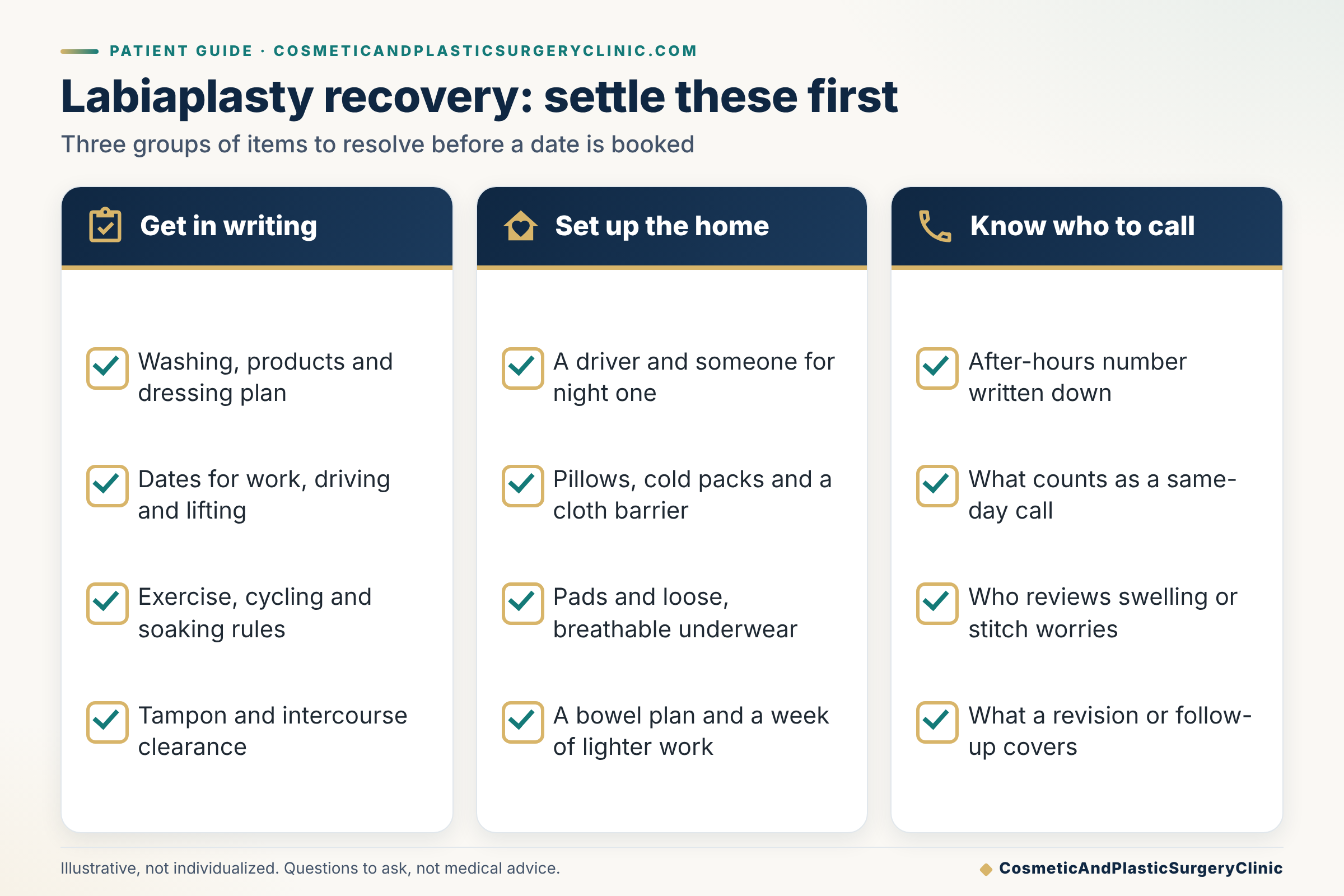
Assembling the list from the sources above gives a short set of items: a driver and someone to stay the first night; pillows for elevating the hips; cold packs with a cloth or pad barrier; pads or liners and loose, breathable underwear; the approved ointment, if one is prescribed; a stool softener plan; a week or more of reduced work; and the office’s after-hours number. None of these is individualized, so confirm each with the surgical team.
Cleveland Clinic suggests an absorbent pad for minor bleeding, and Healthline suggests intimacy without genital contact as an option, which is worth raising with a partner before the date is set.
Nicotine, alcohol and the healing wound
MedlinePlus says most providers advise stopping tobacco at least four weeks before surgery, and that stopping at least 10 weeks before may lower complication risk further. It explains that smoking reduces oxygen reaching the cells in a surgical wound, slowing healing and raising infection risk, and that nicotine gum around the time of surgery is not encouraged. Smokers also face a higher chance of leg clots after surgery.
Healthline adds that alcohol, smoking and other substances should be avoided for two weeks before and two weeks after. Any change to a prescription medicine is a conversation with the prescriber, not a decision made from a handout. If quitting nicotine looks hard, tell the surgeon early, because the timeline of surgery, not just the recovery, may need to change.
Follow-up visits and the long view
Visits, written instructions and photo check-ins
The Beverly Hills handout expects a visit within one week of surgery. The Aesthetic Society says patients should return to the surgeon’s office for follow-up evaluations at prescribed times and whenever they notice changes. Tannan (ASPS blog, 2018) lists attending follow-up visits among the things that speed healing. A good written plan for labiaplasty recovery names the first visit, the dates when restrictions are reviewed, and who answers calls outside office hours.
Ask about cost as well. If a wound reopens or a revision is discussed, what does the original fee cover? The labiaplasty cost page lists the line items, and a clear policy on follow-up and revision is a sign of an organized practice, not a reason for suspicion.
When the result is judged, and what the evidence cannot say
Cleveland Clinic gives four to six months for final results as swelling resolves and describes reduction labiaplasty as generally a one-time, long-lasting procedure, adding that skin can stretch during childbirth and that many people wait until they have finished having children. The Aesthetic Society ties lasting results to avoiding significant weight fluctuation or pregnancy. See the labiaplasty after childbirth page for timing questions.
Sensation is where sources differ in tone. Cleveland Clinic says research shows no significant change in sensation, lubrication or orgasm. The American College of Obstetricians and Gynecologists (ACOG), in Committee Opinion 795 (Obstetrics and Gynecology, 2020), says high-quality data on these procedures are limited and that clinicians should counsel about pain, infection, scarring, altered sensation and reoperation. Both can be true of a population while one person’s experience differs. Judge photos and your own result by months, not weeks, as the labiaplasty before and after page explains.
Choosing who supports your recovery
Credentials, facility and a calm consent process
ACOG’s opinion also says surgeons should disclose their experience and outcomes. IUGA’s patient site says procedures should be done by a specialist such as a gynecologist, urogynecologist or plastic surgeon, with realistic expectations and time to consider. The practical rule is a board-certified plastic surgeon or a gynecologist with relevant training, operating in an accredited facility, and a gynecologic check first if symptoms such as pain, irritation or infection could have another cause. The surgeon selection page shows how to verify credentials.
Informed consent should cover the labiaplasty recovery plan as well as the risks. A package price, a deadline discount or pressure to book before a consultation ends is a red flag in any elective operation, and more so for an intimate one. Waiting, getting a second opinion or deciding not to operate all remain legitimate choices. Combined operations, such as those on the mommy makeover recovery page, change the schedule, so ask for a combined plan in writing.
Questions to bring to the first follow-up call
Write the questions down: which restrictions apply on which dates, what counts as a same-day call, which products are allowed, what a normal discharge looks like in my case, and when tampons and intimacy are allowed. Add a final question about the long view: when is the result judged, and what happens if something looks uneven or healing stalls?
Frequently asked questions
Is it normal to feel nervous about labiaplasty recovery and the first look afterward?
It is common to worry about what normal labiaplasty recovery looks like. The 2026 BMC Women’s Health study found lower early concern scores when patients saw a standardized recovery atlas, though it was nonrandomized. One Healthline surgeon advises not inspecting the area for the first month. Practices differ, so ask what your surgeon recommends, how to report a worry between visits, and whether photos you send are kept private. If anxiety about the result or your body is persistent, a clinician can help sort out whether counseling would add support.
Can I sit at a desk for a full day after labiaplasty recovery begins?
Sources say desk work often resumes after about 5 to 7 days, but the Virginia handout advises avoiding prolonged upright sitting during the first week. That suggests short sitting periods, standing breaks and a part-time start rather than a full day on day five. Ask whether a cushion, a different chair or remote work for the first week would help. No source opened gives a cushion type, so that is a surgeon-specific answer. Sitting that increases pain or swelling is a cue to lie down and ask.
What if my period starts during labiaplasty recovery?
The Virginia handout says to wear a pad if a period starts, and IUGA says to use pads rather than tampons for the first few periods. Tampon dates in handouts cluster around six weeks. Ask in advance whether menstrual cups or discs fall under the same rule, because none of the sources opened mentions them, and whether the surgery date should take an expected period into account. Heavy bleeding that saturates a pad within an hour is not a period question: that is an emergency.
Is one side swelling more than the other a problem?
A Pennsylvania practice blog says swelling is sometimes greater on one side, and it can be part of normal healing. What matters is direction and pain. Swelling that is soft, stable or slowly shrinking fits the pattern. Swelling that grows quickly, feels tight and hurts more each hour fits the hematoma signs the Beverly Hills handout lists, and needs a same-day call or emergency care. Describe when it started, how it changed and whether bruising is spreading, and avoid adding heat.
Does labiaplasty recovery take longer when other procedures are done at the same time?
It can. The Atlanta practice says recovery is about six weeks for labiaplasty plus clitoral hood or clitoral procedures, and longer when more procedures are combined, with an overnight stay encouraged if vaginoplasty is done at the same time. Combining operations adds anesthesia time and more than one area to care for, so ask for one written plan that covers every site, including driving, lifting and who helps with children. Another page on this site covers mommy makeover planning.
How should I handle lifting a toddler or heavy bags?
The Beverly Hills handout sets a lifting limit of 10 pounds for three weeks, which rules out many toddlers. Other sources do not give a number, so ask for one. Cleveland Clinic says physical or lifting jobs may need a longer break and warns that activity too early can stress the wound and tear stitches. Plan help for the first weeks.
Can I fly home after labiaplasty?
The CDC’s travel guidance on medical tourism says to delay air travel for 10 to 14 days following major surgeries and warns that flying after surgery can raise the risk of blood clots. Whether that applies to labiaplasty is a question for the surgeon. The CDC also says follow-up care after returning home can be costly and may not be covered by insurance, so confirm who would treat a complication near home before you travel.
How can I tell my labiaplasty recovery is on track?
No single measure does it. Pain that eases after the first week, bruising that fades over two to three weeks, drainage that tapers and swelling that gradually falls match the labiaplasty recovery ranges in the sources. Pain that rises, swelling that grows, fever or a wound that opens do not. A short daily note of pain, bleeding, temperature and swelling makes a call to the office faster and more specific.
Sources and further reading
- The Aesthetic Society — How long does it take to recover from labiaplasty surgery? (accessed 2026-11-13) — work, intercourse, suture dissolution, soaking and hair removal
- The Aesthetic Society — How long will my labiaplasty results last? (accessed 2026-11-13) — durability, weight and pregnancy, follow-up visits
- ASPS blog, Shruti Tannan, MD — Four common questions women have about recovery after labiaplasty (January 17, 2018; author’s views; accessed 2026-11-13) — swelling peak, itching, stitches, scar, activity, intercourse
- ASPS blog, Jennifer Harrington, MD — What to expect at every stage of your labiaplasty (August 13, 2019; accessed 2026-11-13) — outpatient setting, week off work, intercourse timing
- Cleveland Clinic — Labiaplasty (accessed 2026-11-13) — anesthesia, swelling timeline, hygiene, restrictions, reasons to call, sensation statement
- Healthline — Labiaplasty recovery (medically reviewed, updated March 17, 2023; accessed 2026-11-13) — 12-week course, showers, clothing, pools, activity, sex, call list
- Claytor Noone Plastic Surgery — Let’s talk labiaplasty recovery (practice blog; accessed 2026-11-13) — week-by-week arc, stitches, tampons and intercourse
- Virginia Facial Plastic Surgery — Labiaplasty post-operative instructions (practice handout; accessed 2026-11-13) — ointment, ice, showering, sitting, driving, exercise, tampons, call and emergency list
- Practice handout linked from bevhills.com — Labiaplasty post-op instructions (accessed 2026-11-13) — lifting limit, work by job, intercourse, stitches, hematoma signs
- Miklos and Moore — Labiaplasty post-op recovery FAQs (practice page; accessed 2026-11-13) — catheter, discharge, restrictions, combined procedures, bleeding threshold
- International Urogynecological Association — Your Pelvic Floor: Labiaplasty (page modified March 22, 2024; accessed 2026-11-13) — recovery ranges, pads versus tampons, risks, who should operate
- Motakef et al. — Vaginal labiaplasty: current practices and a simplified classification system for labial protrusion (Plastic and Reconstructive Surgery, 2015; abstract, accessed 2026-11-13) — 19 studies, 1,949 patients, dehiscence 4.7 percent
- Géczi et al. — Comprehensive assessment of labiaplasty techniques and tools, satisfaction rates, and risk factors (Aesthetic Surgery Journal, 2024; accessed 2026-11-13) — pooled dehiscence, hematoma, infection, limits of the evidence
- ACOG — Committee Opinion No. 795: Elective female genital cosmetic surgery (Obstetrics and Gynecology, 2020; record and abstract, accessed 2026-11-13) — limited data, counseling about complications, disclosure of experience
- ACOG — Committee Opinion Number 795: Elective female genital cosmetic surgery (summary record, accessed 2026-11-13) — recommendations on counseling, screening and disclosure
- Qi et al. — Association of a standardized postoperative recovery atlas with early recovery-related concerns after female genital cosmetic surgery (BMC Women’s Health, 2026; early-share version, accessed 2026-11-13) — 132 patients, week-1 concern scores, limits
- CDC — About blood clots (accessed 2026-11-13) — clot symptoms, moving after surgery, silent clots
- CDC Travelers’ Health — Medical tourism (accessed 2026-11-13) — flying after surgery, follow-up care at home
- MedlinePlus — Smoking and surgery (accessed 2026-11-13) — stopping tobacco before surgery, wound healing, nicotine gum