A chest that still looks different from the one you expected, months after male breast reduction, raises an uncomfortable question: is this healing that has not finished, or a result that needs another operation? Revision gynecomastia surgery is the umbrella term for the operations and non-operative steps aimed at what remains or has changed after a first procedure: firm tissue behind the nipple, a hollow where too much was removed, uneven sides, a pulled or puffy nipple, or a scar or skin fold that bothers the person who has it.
It is a different decision from the first operation. The tissue has already been suctioned or cut once, scar tissue is part of the picture, and the most useful question is usually why the chest looks the way it does. This page sorts the complaints, explains why timing and records come first, compares the realistic paths, looks at how risk changes, and ends with questions for a consultation. The basics of the operation itself are covered in our overview of gynecomastia surgery.
The American Society of Plastic Surgeons (ASPS) counted 26,430 male breast reduction procedures by its member surgeons in 2024. That count does not separate first operations from repeat ones, so no number here says how common revision gynecomastia surgery is. Nothing below judges whether you need, or are suited to, a second operation.
When revision gynecomastia surgery is the right label, and when it is something else
The word covers at least four different problems. A firm disk, a hollow, a lopsided nipple and a wide scar call for different tools, so sorting the complaint comes before choosing any operation.
Too much left, too much taken, or uneven
Most requests for revision gynecomastia surgery are about appearance. Two patterns dominate: tissue that was not fully treated, and tissue that was treated too aggressively. Unevenness can sit on top of either.
Residual gland or fat: the undercorrected chest
Mayo Clinic describes the core distinction in plain terms: liposuction removes breast fat but not the breast gland tissue itself, while mastectomy removes the gland, and the two are sometimes combined. A chest treated mainly with suction, when the problem was firm glandular tissue, can keep a disk of that tissue under the nipple. StatPearls adds that fibrosis in long-standing gynecomastia may limit how well liposuction works.
So revision gynecomastia surgery for leftover tissue begins by asking what the tissue is: gland, fat or a mix. That is the same question explored in our comparison of gynecomastia and chest fat. In a 2021 reoperation series from a hospital in Seoul, the authors concluded that the most common cause of undercorrection was incomplete removal of fibroglandular tissue.
Too much removed: saucer or crater deformity and a tethered nipple
Over-resection leaves a depression, sometimes with a visible step where the treated area meets untreated chest. One plastic surgeon’s practice page, answering a reader’s question, attributes a crater deformity to removal of so much tissue that nothing remains between the nipple and the chest wall, so the nipple can pull inward and scar. The same page says the appearance may look worse with age if surrounding chest fat increases.
That is one surgeon’s explanation of a mechanism, not a measure of how often it happens. The Seoul reoperation series pointed to a specific site: the most common cause of overcorrection was excessive removal of the retromammary fat at the lower-outer edge of the pectoralis major muscle. ASPS lists both breast asymmetry and contour irregularities among the risks of gynecomastia surgery, and the possibility of revision surgery as a risk in its own right.
Before-surgery photos matter when judging asymmetry, because some difference between the two sides may have been present from the start.
Findings that need a clinician before anyone talks about cosmetics
Some changes after surgery are health findings first and cosmetic problems second. They should reach a clinician promptly.
A new, firm, one-sided or changing lump
Mayo Clinic lists swelling, pain or tenderness, nipple discharge, a firm or hard lump, and dimpled skin as reasons to see a doctor. Scar tissue after any operation can feel firm, which is why an examination, and sometimes imaging, sorts out what a lump is. A lump that is new, growing, one-sided, painful or accompanied by skin changes should be examined rather than watched indefinitely.
Pathology belongs in the file too. In a 2015 analysis in Annals of Plastic Surgery of 5,113 surgically removed breasts in a Dutch national registry, invasive carcinoma was found in 0.11%, carcinoma in situ in 0.18% and atypical ductal hyperplasia in 0.4%, with the youngest invasive cancer in a 65-year-old. The authors concluded that malignancy is rare but becomes more common with age. This is population-level education, not a statement about any individual chest. It is the reason the first operation’s pathology report is worth requesting.
Fluid, a hematoma or early swelling: not yet a revision gynecomastia surgery question
A seroma is a pocket of fluid under the skin, and a hematoma is a collection of blood. Both are on the ASPS list of risks. Early lumpiness, tightness and uneven swelling in the first weeks are part of ordinary healing, and judging the result then is premature. Our guide to gynecomastia surgery recovery covers that arc week by week.
A fluid pocket that is growing, or swelling that expands quickly on one side, is a different matter. It should be reported to the surgeon promptly, and the emergency signs in the paragraph below mean emergency care, not a call to the office.
Why a revision gynecomastia surgery plan starts with waiting, a cause check and records
The instinct after a disappointing result is to fix it quickly. The better-supported instinct is to let tissue finish changing, ask whether something is still driving it, and collect the facts about what was done. Each step makes revision gynecomastia surgery safer and better targeted, if it turns out to be needed.
What the waiting period is for
Waiting is not a delay tactic. It gives the surgeon a stable result to judge, and it gives the body time to resolve problems that were never going to need surgery.
Swelling hides the result you are judging
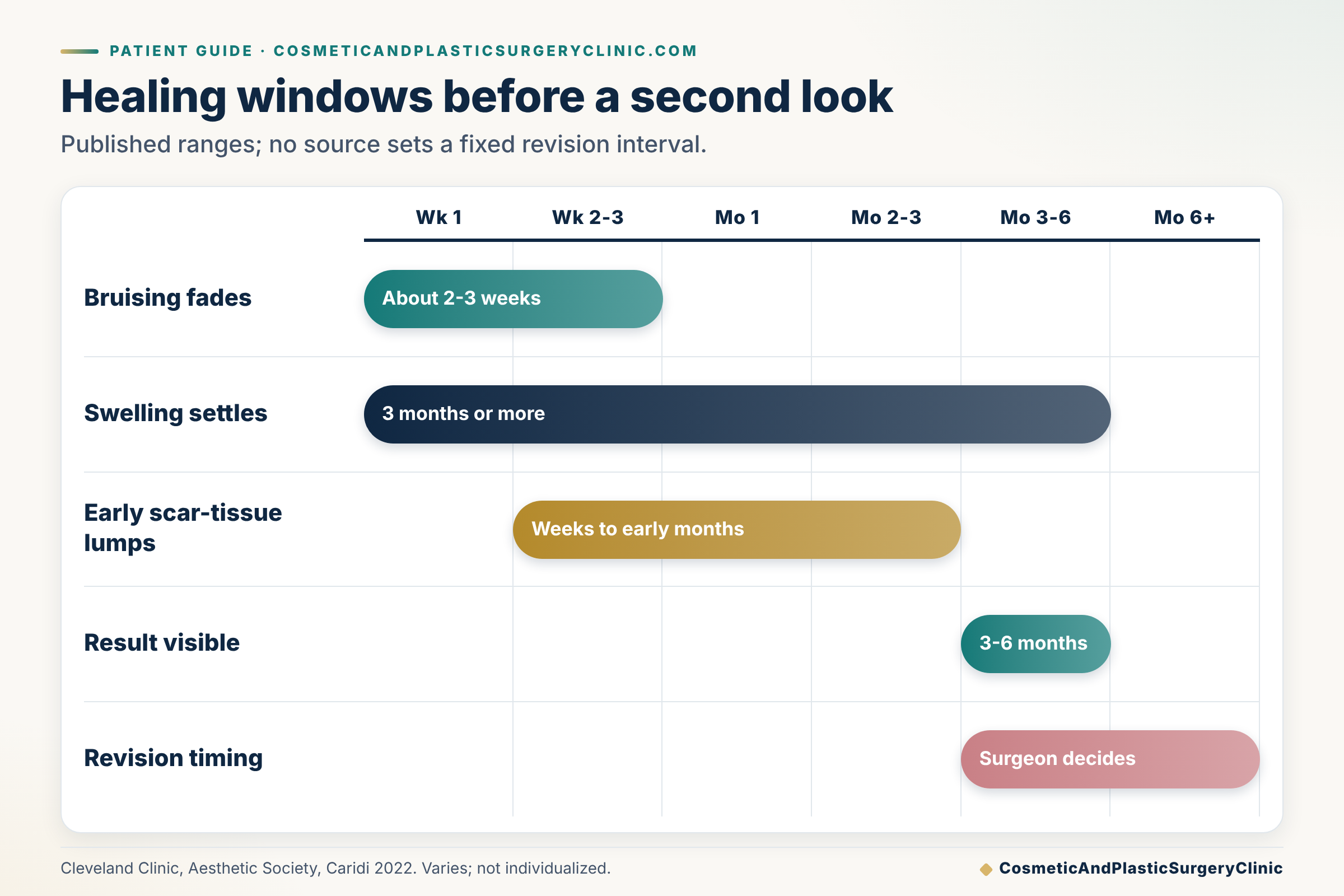
Cleveland Clinic says that you may not see results for about three to six months while tissue heals and swelling decreases. The Aesthetic Society’s recovery page says it may take three months or more before swelling decreases and the final results can be seen, with bruising typically fading within two to three weeks. A chest that looks full or uneven at six weeks may simply be swollen unevenly.
None of the sources opened for this page sets a universal minimum interval before revision gynecomastia surgery, and the surgeon-authored series cited here do not report one. The sensible reading is that timing is a surgeon-directed judgment tied to how the tissue looks and feels. A useful question is: what will you be looking for before you operate again?
Scar tissue that shows up early
Some firm areas are new tissue rather than leftover tissue. In a 2022 case series in Plastic and Reconstructive Surgery Global Open, one Texas surgeon described 567 patients, mean age 31, and reported nine revisions (1.6%), all for accumulation of palpable scar tissue. The author said these appeared as new growth in the weeks to early months after treatment. He also reported no revisions for contour depression.
The study was retrospective, written by the operating surgeon, and used no validated outcome measures, so the figures describe one practice. They do show that a firm area at three months and a firm area at eight months can have different explanations, which is another reason a hurried second operation can miss the point.
Looking for the cause when tissue comes back
If tissue returns on a chest that was fully treated, repeating the same operation treats the symptom and ignores the driver. Gynecomastia has causes, and a surgeon cannot see them on the operating table.
Weight, medications and substances
The ASPS recovery page says that when gynecomastia resulted from certain prescription medications, drugs including steroids, or weight gain, you must be free from those substances and remain at a stable weight to maintain your results, and it asks readers to talk to their physician before changing any prescription. Mayo Clinic’s list of associated medicines and substances is long, and includes anti-androgens, anabolic steroids, some HIV medicines, some antidepressants, heart medicines, alcohol, marijuana and opioids.
Nobody should stop or start a medicine because of a web page. If a medicine is the cause, Mayo Clinic says a doctor may stop it or switch to another, and that is the prescriber’s decision. A history of anabolic steroid or other substance use is a medical conversation, and surgeons need the information to plan, not to judge.
When a medical work-up comes before another operation
StatPearls outlines the usual work-up: history, examination, and, depending on the findings, hormone and organ-function tests, with imaging if a mass is suspected. It also says healthy men with gynecomastia lasting more than 12 months and no other findings need no further work-up, and that medical therapy usually does not work in long-standing cases. Mayo Clinic notes that drugs such as tamoxifen and anastrozole are approved for other conditions, not specifically for gynecomastia.
For a person who is seeing tissue return, the practical point is narrow: ask whether anyone has checked for a cause since the first operation. The exam and questions you can expect are described in our guide to the gynecomastia consultation.
Building the file before a revision consultation
A second surgeon starts with less information than the first one had. The examination shows the tissue as it is today. It does not show what was removed, how, or why.
Records, photos and imaging worth requesting
Ask for these early, even if you are not ready to decide. Records get harder to track down as time passes, and a request is easier while the first operation is recent.
| Record | Why it matters | Where to ask |
|---|---|---|
| Operative report | Shows whether gland was excised or only suctioned, incision site, and any drains | First surgeon’s office or facility records department |
| Pathology report | Documents what the removed tissue was; absent if nothing was sent | Surgeon’s office or the pathology laboratory |
| Before and follow-up photos | Show change over time and any pre-existing asymmetry, from matching angles | Your own phone plus the first surgeon’s chart |
| Medication and supplement list | Flags causes of gynecomastia and items that affect bleeding and healing | Your pharmacy and prescribers |
| Imaging or lab results | Document lumps, fluid collections, or hormone testing already done | Imaging center or the ordering clinician |
Why the first operation’s approach changes the plan
If the first surgery was liposuction alone and firm tissue remains, residual gland is an obvious question. If gland was removed and a hollow formed, the question flips to what was taken and from where. The operative report answers this, and the facility often holds it even when the first surgeon has moved or retired.
Revision gynecomastia surgery pathways, matched to the problem
No single operation fixes every complaint that leads to revision gynecomastia surgery, and no source opened for this page ranks the options. What the literature does offer is a logic: the tissue found at examination decides the tool. The table sorts common situations by that logic, and the sections after it explain each pathway.
| Situation | Pathway often discussed | Possible benefit | Trade-off | Key question |
|---|---|---|---|---|
| Firm gland still present | Gland excision, often with liposuction | Removes tissue suction cannot | New incision and scar tissue | What did the first operation leave, and how will you find it? |
| Soft fullness, no firm gland | Liposuction alone | Smaller procedure | Will not treat gland if it is there | Is the tissue fat, and how do you know? |
| Hollow or step-off | Fat grafting, sometimes open release | Adds volume where it was lost | Graft survival varies; may need repeats | Where will the fat come from, and how many sessions? |
| Tethered or puffy nipple | Case-specific reshaping, grafts | Addresses the nipple directly | Nipple-area healing and sensation | What is pulling or protruding, and why? |
| Loose skin or dog-ears | Skin excision, longer scars | Removes excess skin | Trades contour for scar length | Which scar pattern, and where will it sit? |
| Firm area that is still changing | Observation, then examination | Avoids operating on healing tissue | Waiting can feel long | What finding would change the plan? |
Removing what remains: gland, fat and scar tissue
The tissue found at examination decides whether a surgeon reaches for suction, excision or both, so the first job is to identify it.
Liposuction alone, gland excision or both
In the Seoul series of reoperations for unsatisfactory aesthetic results, patients with undercorrection who still had fibroglandular tissue were treated with simultaneous excision of that tissue and liposuction, while those with no residual gland were treated with liposuction alone.
The fact above also explains a caution. A second surgeon who assumes “still full” means “gland left behind” can plan the wrong operation, and one who assumes it is only fat can miss a firm disk. Our comparison of gynecomastia lipo vs excision sets out the tissue-based decision in full, and suction-related contour problems in other body areas are covered in liposuction revision.

Tangential excision and thin, muscular chests
A small 2011 report in the Journal of Muhammad Medical College, by one UK surgeon, described 41 patients, 39 primary and two secondary. Four of the 39 primary cases (about 10%) needed further surgery, and the two secondary cases were treated with tangential excision of residual tissue plus suction. The author presented the approach as an option for undercorrected gynecomastia, particularly in athletic patients with little subcutaneous fat.
The paper is retrospective, has no comparison group, reports complications unsystematically and notes its own inconsistencies, so it is best read as a description of one surgeon’s thinking, not proof that the technique works better than others. A surgeon who proposes it should be able to say why it suits your tissue and how they will protect the contour.
Restoring volume where too much was removed
When the problem is a hollow, revision gynecomastia surgery reverses the task: tissue has to be added or released rather than taken away. This is the hardest group to fix, because replacing what was lost is less predictable than removing what is extra.
Fat grafting and release of a tethered nipple
In the Seoul series, most overcorrected chests were treated with autologous fat grafting. The practice page cited earlier describes an alternative for a severe crater: open release of the scarred nipple area with dermal-fat grafts, which need a donor site, commonly the lower abdomen. It says injected fat would likely require multiple treatments for the best result, and that suction may help refine the contour around the nipple.
Nothing opened for this page measures how much grafted fat survives in the chest, so any promised “one session” is a claim to question. Ask how the surgeon will judge whether more fat is needed, and how many sessions the quote assumes.
Prevention worth knowing: filling dips during the first operation
A 2025 retrospective study in the Turkish Journal of Surgery looked at 24 men, nine of whom received fat grafted during the first operation from breast tissue harvested in the same field. Intraoperative contour irregularities appeared in those nine (37.5% of the series) and were corrected with a median of 8 cc of fat. At a mean follow-up of 12.4 months across the series, none of the nine had contour irregularities or needed a second graft.
The study is tiny, the groups were defined by whether irregularities occurred, and follow-up was about a year, so it supports a question, not a conclusion. Still, it reframes revision gynecomastia surgery: contour dips are sometimes visible on the operating table, and a surgeon who checks for them is reducing the chance of a second operation.
Skin, scars and the nipple-areola complex
Not every result that leads to revision gynecomastia surgery is a tissue-volume problem. Some are about the envelope around the tissue: skin that did not retract, a scar that healed wide or raised, or a nipple that sits differently than expected.
Loose skin and dog-ears
StatPearls grades gynecomastia from I to III and describes open excision with possible skin resection for moderate cases with excess skin. Cleveland Clinic describes excision as using larger incisions that can remove skin as well as fat and tissue, and says the nipple and areola can be repositioned. The 2011 report above included excision of dog-ears (small folds of skin at the end of a scar) in two patients who needed further surgery.
Skin removal is a trade: smoother skin in exchange for a longer scar. Ask where the scar will sit, how long it will be, and what the surgeon expects the skin to do on its own over several months before committing.
Scars: nonsurgical steps usually come first
ASPS lists unfavorable scarring among the risks of gynecomastia surgery, and Cleveland Clinic notes that scars from breast reduction procedures fade but never go away completely. The American Academy of Dermatology describes options for raised scars and keloids in general, not specifically for the male chest: silicone gel sheets worn daily, often for months; corticosteroid injections, which studies show can reduce a scar’s size by 50% or more, usually over more than one treatment; and surgery, usually only when other treatments fail, with the caveat that a scar can return.
Whether any of those fits a given scar is a question for a clinician. A scar that is wide, raised, itchy or painful is a conversation to have early, not something to hold for a second operation.
What changes about the risks in revision gynecomastia surgery
The risks of revision gynecomastia surgery are the same ones listed for the first operation. What changes is the terrain: scar tissue, altered planes and less predictable bleeding and healing. For this operation specifically, see gynecomastia surgery risks.
The same risk list on less predictable ground
ASPS lists anesthesia risks, bleeding, blood clots, infection, persistent pain, poor wound healing, fluid accumulation, fat necrosis, changes in nipple or breast sensation, asymmetry, contour irregularities, unfavorable scarring and the possibility of revision surgery. All of those can apply to revision gynecomastia surgery.
What published first-operation numbers show, with dates
All of the figures below describe first operations, not revisions, and none can be applied to any individual. A 2022 systematic review in Aesthetic Plastic Surgery of 94 articles and 7,294 patients found complication rates of 14.87% for aspiration, 30.64% for surgical excision and 11.76% for combined techniques, with hematoma the most common complication (22.88% of complications). The authors noted that excision was used more often in severe cases, which could confound the comparison.
Single-practice series report lower numbers. Caridi’s 2022 series of 567 patients reported a 5.8% overall complication rate, with seroma in 2.3% and hematoma in 1.9%. A 2026 series of 4,560 consecutive patients, known only from its abstract record, reported hematoma in 0.9%, seroma in 2% and re-exploration in 0.31%. A 2025 UnitedHealthcare Community Plan policy summary reports reoperation rates of 0.6% to 25% across studies of liposuction-assisted surgery.
That roughly 40-fold range is the real lesson. Definitions, patient mix, surgeon experience and follow-up differ so much that a single number is not a forecast. It is a reason to ask your own surgeon what they count, how long they follow patients, and how often they revise their own work.
What no source measured for revision
No source opened for this page reports complication rates specific to revision gynecomastia surgery, and none reports how often a revision itself needs another revision. That is a gap in the evidence, not a sign that the risk is low or high. A surgeon who quotes a revision complication rate should name the series it comes from, its size and its follow-up.
Modifiers a surgeon will ask about
Certain factors change how tissue heals. Discussing them is a safety step, not a judgment.
Nicotine and wound healing
An ASPS blog by a member surgeon says nicotine shrinks small blood vessels, can delay wound healing, and can cause thick, wide scars and tissue death. It recommends quitting three to six weeks before surgery through three to six weeks after, and warns that patches, gum and e-cigarettes still deliver nicotine. Cleveland Clinic similarly says tobacco slows healing. The surgeon’s own instructions govern the real window for any revision gynecomastia surgery date.
Blood thinners, steroids and weight changes
Cleveland Clinic notes that some people may need to stop blood thinners before surgery. Whether that applies to a given person is a decision for the surgeon and the prescriber together, never for the patient alone. Anabolic steroid history belongs in the conversation because it can bear on both the cause of the tissue and the plan, and a stable weight matters because ASPS ties maintaining results to it.

Choosing who performs revision gynecomastia surgery, and where
Revision gynecomastia surgery on a scarred chest leaves less room for improvisation than the first operation. The surgeon’s training, the setting and the habit of explaining findings matter more than any technique name on a website.
Credentials, setting and revision experience
Verifying a surgeon is a mechanical task, and it is covered step by step in our guide to choosing a plastic surgeon. Two points are specific to revisions.
Board certification and an accredited facility
The American Board of Plastic Surgery (ABPS) site lists a Verify Certification page and a surgeon search tool, and it is the quickest way to confirm that a surgeon holds ABPS certification. Ask which facility will be used, whether it is accredited and by whom, and who will provide anesthesia. ASPS lists anesthesia risks and says the options include intravenous sedation and general anesthesia, so the plan should be explained before the day of surgery.
Asking to see revision cases, not only first operations
Many surgeons show tidy first-operation galleries. A useful request is photographs of revision gynecomastia surgery patients with a similar problem: residual tissue, a hollow or a nipple issue, shown from matching angles and at least several months after surgery. Photos support questions; they do not forecast your result. Our page on gynecomastia before and after explains lighting, pose and timing,.
The original surgeon or a new one
Either choice can be sensible, provided the decision is made with the records in hand.
Asking the original team first
The original surgeon knows what was done and often has the photographs. Some practices offer a written policy for revision gynecomastia surgery, and it is reasonable to ask what it covers, for how long and which costs remain yours. It is equally reasonable to ask for a copy of the records and to see another board-certified plastic surgeon for an independent examination. Asking for records is a routine request.
When the first operation was far from home
If surgery was done in another city or country, ask the first team who is responsible for follow-up and how to reach them. The new surgeon will need the operative report, and a chest examined without it is examined with less information. Our page on medical tourism and surgery abroad covers continuity of care, and the same logic applies whether the distance is 200 miles or 2,000.
Cost and coverage logic for revision gynecomastia surgery
Revision gynecomastia surgery is usually priced differently from a first operation, and the published numbers cover first operations only. What follows is a way to read a quote, not a price list.
Building a revision quote
The general mechanics of surgeon, facility and anesthesia fees are in our plastic surgery cost page, and those specific to this operation are in gynecomastia surgery cost. Two points apply to a second operation.
What one published fee range does and does not say
The ASPS 2024 statistics report lists male breast reduction at a projected surgeon-fee range of $5,000 to $9,000, built from averages submitted by surveyed ASPS members. The report does not say what the fee includes. It does not break out revisions, and it is a national range, not a local quote. A revision may cost less, the same or more depending on scope, so a quote has to be itemized.
Written policies for revision gynecomastia surgery
Ask for a written quote that names the surgeon fee, facility, anesthesia, pathology, garments and follow-up visits. If a policy offers a reduced fee or a credit for a second operation, ask what window applies, what conditions qualify, and whether facility and anesthesia charges are included. A policy that exists only as a verbal promise is hard to rely on.
Insurance: why revision is a separate question
Gynecomastia surgery is often treated as cosmetic by insurers, and revision gynecomastia surgery adds a further layer: a plan may ask whether the first operation was covered, what the new problem is, and whether it counts as a complication or a cosmetic refinement.
What one payer policy shows
UnitedHealthcare’s Community Plan policy CS051.Q, effective August 1, 2025, covers mastectomy for gynecomastia only when listed criteria are met. They include stage II, III or IV gynecomastia with moderate to severe chest pain causing a functional or physical impairment, glandular tissue as the primary cause rather than fatty deposits, an appropriate evaluation of medical causes, and persistence after medicines are stopped. It says inability to take part in sports or social activities is not counted as impairment.
That policy applies only to its plan type and states, and its coverage criteria do not address revision or reoperation. Other insurers write different rules, so it illustrates the kind of documentation that gets asked for, not what any plan will pay. Our page on gynecomastia surgery insurance covers the criteria and appeals in more depth.
Pre-authorization and what an office can promise
Ask the insurer in writing whether a revision of a previous cosmetic or covered operation is evaluated under the same criteria, and ask the surgeon’s office what it will submit and when. An office can describe what it has submitted and how past requests were handled. It cannot promise approval.
A decision framework for revision gynecomastia surgery, including not now
The decision about revision gynecomastia surgery is rarely a single yes or no. It is a sequence: wait, examine, find the cause, compare options, and review. Each step can end with a reasonable decision to stop.
Long-term factors that keep changing the result
A result that is judged at one year can still shift with weight, aging, medications and scar maturation. The table below links each factor to what it means for planning.
| Factor | Effect on the result | Maintenance or revision implication | Review point |
|---|---|---|---|
| Weight change | Chest fat can increase or decrease and change contour | ASPS ties maintaining results to a stable weight | Weigh at each visit; photograph from the same angles |
| Medicines and substances | Some are linked to gynecomastia and may drive tissue back | A cause may need a prescriber’s review, not repeat surgery | Bring a full list to every consultation |
| Scar maturation | Scars fade but never fully disappear; firm areas can form early | Nonsurgical scar care is usually tried before surgery | Re-examine at the interval your surgeon sets |
| Aging and skin | Skin and chest fat change; a hollow can look different later | Skin laxity may later raise a skin-excision question | Compare photos yearly |
| Nicotine use | Slows healing, can widen scars | Affects timing of any further operation | Discuss before any date is set |
Weight, aging and what stays stable
The practice page cited earlier says a crater can look worse with age if surrounding chest fat increases, and Mayo Clinic lists obesity and older age as risk factors for gynecomastia. A result should be judged against a stable baseline, not against the swollen chest of month two.
When to review and who to call
Set review dates in writing at the first consultation, and ask who handles questions after hours. New lumps, pain, fluid, redness or any change in a previously stable chest should prompt a call to the surgeon. The emergency list earlier on this page means emergency care, not a call to the office.
Two hypothetical scenarios and seven checks
The scenarios below are invented to show how one changed fact can change the plan. They are not forecasts and describe no real person.
Two hypothetical scenarios
Consider a hypothetical man of 28 whose first operation was liposuction alone. At seven months a coin-sized firm area remains behind the right nipple, and photographs from before surgery show that side was fuller to begin with. If an examination finds firm gland, a surgeon may discuss excision. If the area is soft, suction may be enough. If the firm area appeared at three months and is growing, evaluation comes first.
Now consider a hypothetical man of 41, thin and athletic, whose gland was removed through an incision at the edge of the areola. At fourteen months the nipple looks drawn in, with a step-off below it. Fat grafting, release or watching may all be discussed. A weight gain of several kilograms since surgery, a steroid history or a new medicine would each change the conversation, which is why the facts come before the technique.
Seven checks before booking revision gynecomastia surgery, and when not now is the answer
Use these as a short list to bring to a consultation about revision gynecomastia surgery.
- Has enough time passed for swelling to settle, and has a surgeon examined you in person?
- Do you hold the operative report, pathology report and photographs from before and after?
- Has anyone checked for a cause such as a medicine, weight change or a hormone issue?
- Which tissue is the problem (gland, fat, skin, scar, nipple), and how did the surgeon decide?
- What does the plan assume about fat grafting sessions, scars and recovery, and what would change it?
- Who treats complications, in which facility, and what does the written policy cover?
- What happens if you decide to wait or to get a second opinion?
Not now is a legitimate answer. If a consultation produces a date before an examination, pressure to decide quickly, a promise of one-session correction, or no interest in your records, slow down. Waiting for the tissue to declare itself costs little, and a second opinion is a normal part of any elective operation.
Frequently asked questions
Does a lump after gynecomastia surgery mean I need revision gynecomastia surgery?
Not necessarily. Scar tissue, a fluid pocket or fat that has been injured can all feel firm, and ASPS lists fluid accumulation and fat necrosis among the risks. In one 2022 series, nine of 567 patients had revisions for scar tissue that appeared in the weeks to early months after surgery. A lump that is new, growing, painful, one-sided or comes with skin changes should be examined by a clinician rather than watched. Tell the examiner when and how you were operated on.
Can gynecomastia come back after surgery, and is that a case for revision gynecomastia surgery?
Tissue can return when the original driver is still present or has changed. ASPS says maintaining results depends on staying free of medicines or drugs linked to the condition, including steroids, and on a stable weight. Return of tissue also raises the question of whether it is new growth or leftover tissue, which an examination can help sort out. A cause check usually comes before any decision about revision gynecomastia surgery. Never change a prescription without talking to your prescriber.
Can fat grafting fix a crater after male breast reduction?
It is one option discussed in the literature. A 2021 Seoul series treated most overcorrected chests with autologous fat grafting, and one surgeon’s practice page describes dermal-fat grafts for a severe crater and says injected fat may need several treatments. No source opened measures how much grafted fat survives in the chest, so ask how many sessions the quote assumes and what happens if the first one is not enough.
Is revision gynecomastia surgery riskier than the first operation?
No opened source compares them directly, so the honest answer is that the data are missing. The risk list is the same as for a first operation, but scar tissue and altered planes can change how tissue heals and bleeds. Published complication numbers describe first operations and vary widely between studies. A surgeon who says revision is lower risk, or the same risk, should explain the basis for the statement and name their own experience with second operations.
Should I return to my original surgeon for revision gynecomastia surgery?
You can, and many people do. The original surgeon has the operative details and often the photographs, and some practices have a written revision policy. It is also reasonable to ask for a copy of your records and see another board-certified plastic surgeon for a second opinion. Whichever route you choose, get the quote itemized and the policy in writing, and make sure someone is responsible for follow-up visits.
Will insurance pay for revision gynecomastia surgery?
It depends on the plan and on why the revision is needed. One 2025 UnitedHealthcare Community Plan policy covers primary mastectomy only when specific criteria are met, and its criteria do not address revision. A complication that needs treatment may be handled differently from a cosmetic refinement. Ask your insurer in writing how a revision is reviewed, and ask the surgeon’s office what it will submit. Do not assume coverage before a written answer.
What can be done about a raised or wide scar without another operation?
The American Academy of Dermatology describes options for raised scars and keloids in general: silicone gel sheets worn daily, often for months, corticosteroid injections that can reduce a scar by 50% or more over several treatments, and surgery only when other treatments fail. That page is not specific to the male chest, so ask your surgeon or a dermatologist what fits your scar. Early assessment is easier than waiting for a second operation.
Sources and further reading
- American Society of Plastic Surgeons — 2024 Plastic Surgery Statistics Report (accessed 2026-11-13) — male breast reduction count and projected surgeon-fee range, 2024
- American Society of Plastic Surgeons — Gynecomastia surgery: safety and risks (accessed 2026-11-13) — risk list including revision, asymmetry, contour irregularity
- American Society of Plastic Surgeons — Gynecomastia surgery: recovery (accessed 2026-11-13) — maintaining results, medications, steroids and weight
- American Society of Plastic Surgeons — Gynecomastia surgery: the procedure (accessed 2026-11-13) — liposuction, excision, combined approach, anesthesia
- Mayo Clinic — Enlarged breasts in men (gynecomastia): diagnosis and treatment (accessed 2026-11-13) — liposuction versus mastectomy, medicines, testing
- Mayo Clinic — Enlarged breasts in men (gynecomastia): symptoms and causes (accessed 2026-11-13) — causes, risk factors, when to see a doctor
- Vandeven HA, Pensler JM — Gynecomastia, StatPearls (updated 2023-08-08; accessed 2026-11-13) — work-up, grading, fibrosis, observation and surgery
- Cleveland Clinic — Gynecomastia surgery (accessed 2026-11-13) — timeline to results, risks, need for further surgery, scars
- The Aesthetic Society — Gynecomastia aftercare and recovery (accessed 2026-11-13) — swelling and bruising timeline
- Lee SR, Lee SG — Reoperation because of dissatisfaction with the aesthetic results of gynecomastia surgery, Aesthetic Plastic Surgery (2021; accessed 2026-11-13) — 98-patient reoperation series
- Caridi RC — Total gynecomastia removal with layered closure: a study of 567 cases, Plastic and Reconstructive Surgery Global Open (2022; accessed 2026-11-13) — complications and scar-tissue revisions
- Innocenti A, Melita D, Dreassi E — Incidence of complications for different approaches in gynecomastia correction: a systematic review, Aesthetic Plastic Surgery (2022; accessed 2026-11-13) — complication rates by technique
- Ramasamy K et al. — Patterns of intraoperative bleeding in gynecomastia surgery (2026; abstract record, accessed 2026-11-13) — hematoma, seroma and re-exploration in 4,560 patients
- Khan UD — Open tangential excision of gynecomastia: a surgical option for revision gynecomastia surgery, Journal of Muhammad Medical College (2011; accessed 2026-11-13) — small revision series
- Ersan M, Yavuz E — Proactive fat grafting from the breast area in gynecomastia surgery, Turkish Journal of Surgery (2025; accessed 2026-11-13) — contour irregularities and grafting during the first operation
- Lapid O, Jolink F, Meijer SL — Pathological findings in gynecomastia: analysis of 5113 breasts, Annals of Plastic Surgery (2015; abstract, accessed 2026-11-13) — pathology of removed tissue
- UnitedHealthcare — Gynecomastia Surgery, Community Plan medical policy CS051.Q (effective 2025-08-01; accessed 2026-11-13) — example coverage criteria; reoperation range
- Eppley Plastic Surgery — Gynecomastia revision surgery (single-practice page; accessed 2026-11-13) — crater deformity mechanism and graft options
- American Academy of Dermatology — Scars: treatment (accessed 2026-11-13) — silicone, injections and surgery for raised scars
- American Society of Plastic Surgeons blog — How nicotine sabotages plastic surgery, Furnas (December 12, 2016; accessed 2026-11-13) — nicotine and healing
- American Board of Plastic Surgery — home page and certification verification (accessed 2026-11-13) — how to verify certification