Most people weighing hyaluronic vs biostimulatory fillers are really asking two questions: can this be undone if I dislike it, and how long will it last? The first has a clear answer. Hyaluronic acid (HA) is a gel that fills space and can be broken down with an enzyme. Calcium hydroxylapatite (CaHA), poly-L-lactic acid (PLLA) and similar “biostimulatory” fillers are particles that the body reacts to over weeks, and no matching enzyme is described for them. The second question is murkier, and this page shows why.
This page owns one decision: how the two families differ in mechanism, reversibility, evidence and risk. The general explanation lives in the dermal fillers overview, and lips, cheeks, under-eye skin, pricing and complications each have their own pages. Nothing here ranks products, names a best filler or says what suits a particular face; that conversation belongs with a licensed clinician who has examined you.
Hyaluronic vs biostimulatory fillers: what each material does once it is under the skin
Reversibility and timing both follow from mechanism, so it helps to separate what each material is before comparing outcomes. The word “filler” covers products that behave very differently after the needle comes out.
A gel that fills space versus particles that ask for a response
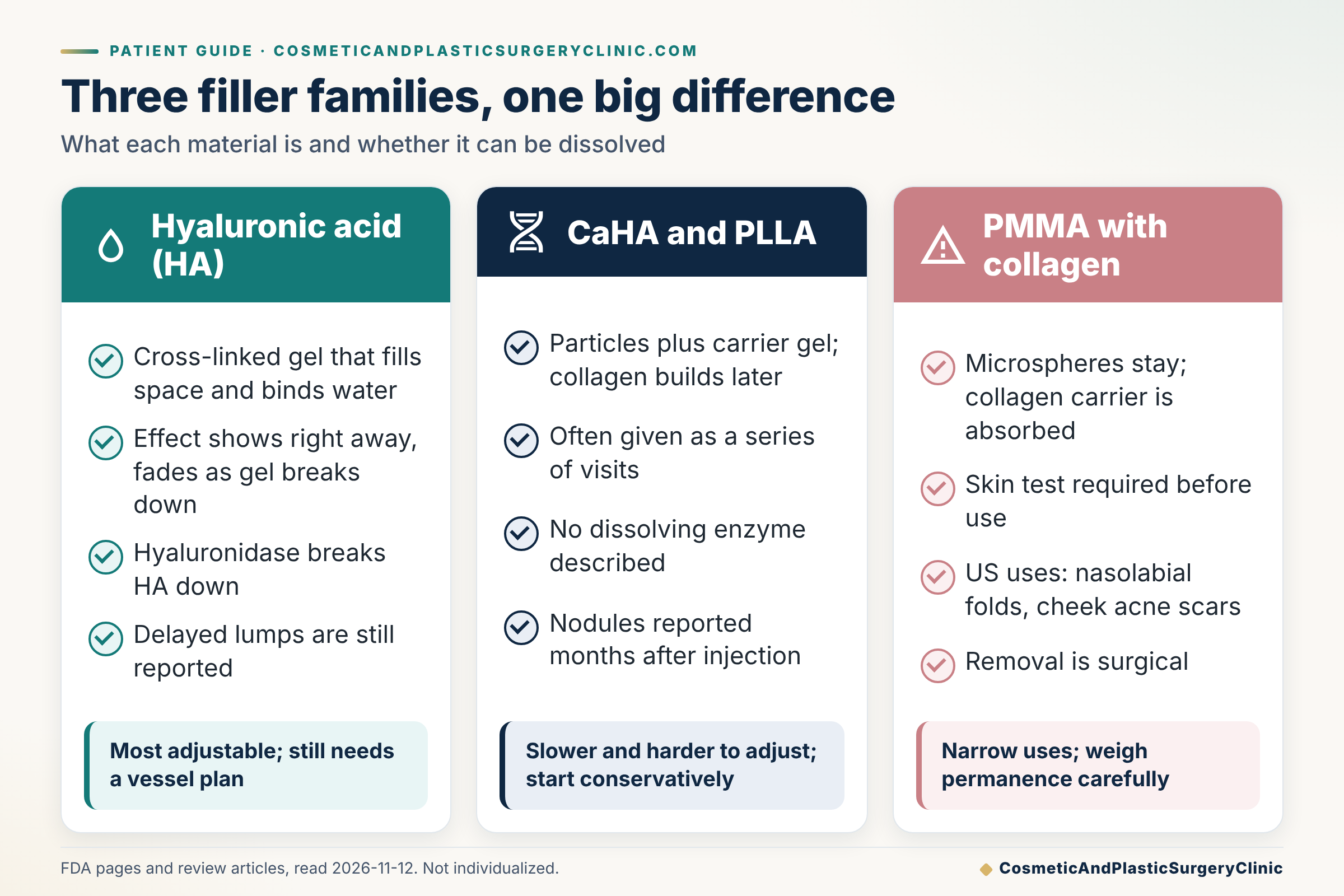
Hyaluronic acid: volume and water held in a gel
HA is a sugar-based molecule that occurs naturally in skin. The American Society for Dermatologic Surgery notes its highest natural concentrations are in joints, eyes and skin. Filler gels use cross-linked HA made by bacterial fermentation; the FDA summary for one cheek product describes cross-linked HA at 20 mg/mL with lidocaine added. A 2024 review in the Journal of Drugs in Dermatology says HA entered filler use in 1989 and counted 28 HA fillers in the FDA’s premarket approval database, all of them biodegradable.
What you see after an HA injection is mostly the gel itself plus the water it binds, which is why the effect appears immediately and fades as the gel breaks down. Products differ in cross-linking and particle size, so a gel designed for lips behaves differently from one designed for deep cheek placement. In hyaluronic vs biostimulatory fillers, “hyaluronic” is a family of dozens of products, not a single material.
Popularity is not suitability. The American Society of Plastic Surgeons (ASPS) 2025 statistics release called HA fillers the second most requested minimally invasive treatment, about 30% of that category, which says what people book, not what fits any one person.
CaHA and PLLA: a scaffold and a signal
Radiesse is synthetic CaHA, in particles of 25 to 45 microns, suspended in a gel of glycerin, sodium carboxymethylcellulose and water, according to the FDA summary for its 2026 approval. A 2023 narrative review in Aesthetic Surgery Journal says the gel supplies immediate volume and clears within 6 to 8 weeks, while the CaHA particles can persist up to 30 months and act as scaffolding that fibroblasts respond to. The lead author works for the manufacturer, which funded the paper.
Sculptra is a different material: microparticles of PLLA with carboxymethylcellulose and mannitol, mixed with sterile water before injection. The American Board of Cosmetic Surgery says its gel dissipates within days and the lasting result comes from new collagen. A 2020 review in Plastic and Reconstructive Surgery Global Open describes PLLA and PMMA microspheres as stimulating collagen formation over about three months.
That delay explains the treatment pattern. In the Sculptra cheek study, summarized by the FDA, subjects had up to four sessions about four weeks apart and averaged 3.6. Judging the result on the day of injection tells you little, which is a point worth raising in any hyaluronic vs biostimulatory fillers consultation.
Where PMMA and polycaprolactone fit in the comparison
PMMA with collagen: the non-absorbable option
Bellafill combines polymethylmethacrylate (PMMA) microspheres with bovine collagen and a little lidocaine. According to a trade-press report of the FDA decision, it was first approved in 2006 for nasolabial folds and in December 2014 for moderate to severe, atrophic, distensible cheek acne scars in adults over 21. A skin test is required before use, and a positive result is a contraindication.
An FDA overview of dermal fillers states that PMMA microspheres can only be removed surgically. The FDA’s consumer page says non-absorbable fillers are approved only for nasolabial folds and cheek acne scars. For most people weighing hyaluronic vs biostimulatory fillers, PMMA is a separate and much narrower conversation.
Polycaprolactone: marketed abroad, unconfirmed here
Polycaprolactone (PCL) fillers, sold internationally under the name Ellansé, are described as a carboxymethylcellulose gel carrying PCL microspheres. A 2018 Practical Dermatology article reported the product was available in Europe since 2009 and was not yet FDA approved. I could not confirm a current US approval; a registry record shows a US trial of Ellansé-S for nasolabial folds, with a CaHA filler as a comparator, started in March 2025.
If a clinic offers a PCL product, ask which regulator cleared it and for which area. The FDA’s approved-filler list is the place to check, and the answer should be on paper.
| Material (example brand) | How it works | Can it be dissolved? | Delayed-lump profile in sources | FDA-listed US uses (examples) |
|---|---|---|---|---|
| Hyaluronic acid (Restylane, Juvéderm) | Cross-linked gel fills space and binds water | Yes, hyaluronidase breaks down HA | Lumps weeks to months later reported; hyaluronidase was used in a cheek-filler trial | Folds, lips, cheeks, chin, back of hands |
| Calcium hydroxylapatite (Radiesse) | Gel gives volume; particles act as scaffold | No enzyme described in sources opened | Nodules in 6.2% in a hand study; attributed to accumulation in one review | Folds, hands, jawline, décolleté, HIV facial fat loss |
| Poly-L-lactic acid (Sculptra) | Microparticles trigger collagen over months | No enzyme described in sources opened | Nodules mostly months later, up to 14 months; granulomas reported | HIV facial fat loss, nasolabial folds, cheek wrinkles |
| PMMA with collagen (Bellafill) | Microspheres stay; collagen carrier is absorbed | No; removal is surgical | Lumps listed among side effects; skin test required | Nasolabial folds, cheek acne scars |
| Polycaprolactone (Ellansé abroad) | PCL microspheres in a gel carrier | Not established in sources opened | Not assessed here | No US approval confirmed |
Reversibility in hyaluronic vs biostimulatory fillers: the difference that matters when something goes wrong
An elective injection should come with an exit plan. Of everything in the hyaluronic vs biostimulatory fillers comparison, the exit options differ the most, and they are worth understanding before the first syringe rather than after a problem. The hyaluronic vs biostimulatory question is, in large part, an exit-plan question.
What hyaluronidase can and cannot do
HA: an enzyme exists for it
Hyaluronidase is an enzyme that breaks down HA in connective tissue; the Hylenex label describes exactly that in its mechanism section. An FDA clinical overview of dermal fillers states that the effects of HA fillers may be reversed with hyaluronidase, “as advocated by some professional societies.” Published protocols for a blocked blood vessel also rely on repeated hyaluronidase, according to the 2020 Plastic and Reconstructive Surgery Global Open review. In the Juvéderm Voluma pivotal study, hyaluronidase was among the treatments used for two serious lump events about seven months after injection, and both resolved.
Two cautions keep this from sounding like an undo button. The Hylenex label lists three adjuvant uses (fluid administration, dispersing other injected drugs, and subcutaneous urography), and dissolving filler is not among them, so filler use is off-label, which is common but deserves a direct conversation. The same label carries a contraindication for known hypersensitivity, and reports of hives or swelling under 0.1%, with rare anaphylactic-like reactions after some routes of injection. The page on dissolving lip filler covers the process in detail.
CaHA, PLLA and PMMA: no matching enzyme in the hyaluronic vs biostimulatory comparison
The FDA’s consumer page states that removal “may be difficult or impossible, especially for permanent fillers and non-HA fillers.” None of the pages I opened describes an enzyme that dissolves CaHA or PLLA. The Sculptra summary says some injection-site nodules persisted up to two years and some required surgical excision, and the FDA overview says PMMA microspheres can only be removed surgically.
In hyaluronic vs biostimulatory fillers, the biostimulators are not permanent in the way PMMA is. CaHA particles are described as biodegradable and PLLA is absorbed over time. But “fades eventually” is a slow process with no tested way to hurry it, and an unwanted result from a biostimulator is something to be waited out, monitored or treated case by case. That asymmetry is the strongest practical argument for a conservative first session whenever hyaluronic vs biostimulatory fillers are on the table.
Lumps, nodules and granulomas: different timing, different questions
Early swelling versus late nodules
The FDA lists bruising, redness, swelling, pain and itching as common after any filler, and nodules, granulomas, infection and allergic reactions as less common. Side effects, the agency adds, can appear weeks, months or years after injection. The 2014 FDA consumer update said most common effects resolve within about two weeks.
Numbers from the approval summaries show how much the area and product matter, and why they cannot be compared directly. In the Voluma cheek study, 18.9% of 270 treated subjects had a treatment-site mass and 0.7% had a nodule. In the Sculptra cheek study, nodules appeared in 1.0% of treated subjects in the base study, in one person 180 days after the last injection, and post-marketing reports put onset between 1 and 14 months.
In the Radiesse hand study, 7 of 113 treated subjects (6.2%) had nodules lasting 17 to 312 days, while the 2006 Radiesse facial fat loss study of 100 people reported none.
Why technique changes the nodule question
The 2023 CaHA review argues that nodules with Radiesse come mainly from product that accumulates through poor technique, not from true granuloma formation, and that even dispersion is the safeguard. That is a manufacturer-funded view and a reasonable question to put to any injector. The Sculptra summary adds that granulomas usually appear several months after injection, with hospitalization in some cases tied to injection under the eye or in the lip.
For a consultation, this turns into four concrete questions about a biostimulator: which area, how deep, how much per session and how many sessions. A plan that spreads treatment over visits leaves room to stop; a single heavy session does not. The filler complications page lays out expected effects versus problems in more detail.
Blocked vessels do not care which family a filler belongs to
What the FDA says every filler can do
“The most concerning risk associated with the use of dermal fillers is unintentional injection into a blood vessel,” the FDA states, listing tissue death, vision abnormalities including blindness, and stroke, some of which may be permanent. The Sculptra and Radiesse summaries both list vascular compromise or occlusion and visual impairment among reported events. The warning applies equally across hyaluronic vs biostimulatory fillers.
Why the rescue plan still differs
With HA, a clinician has an enzyme to use if circulation is threatened. For other materials, the sources I opened describe no equivalent rescue, so prevention carries more weight. The FDA tells providers to know the signs of blood-vessel injection, to stop injecting at once if blanching or a vision change appears, to inject slowly with the least pressure needed, and to have a treatment plan ready. For a patient, the useful version of that guidance is a question: what will you do if this happens, and is the rescue product in the room?
In its 2026 approval of Radiesse for the décolleté, the FDA required the manufacturer to run a training program covering that area’s vasculature and the management of intravascular complications. That condition reflects how the agency sees the risk.
Longevity in hyaluronic vs biostimulatory fillers: what “lasts up to” rests on
Duration claims in hyaluronic vs biostimulatory fillers are the easiest numbers to quote and the hardest to compare. Sources disagree because they are measuring different things in different places, and an honest answer starts with that.
Published ranges vary by reader and by year. An FDA overview lists Belotero Balance at 6 months and Juvéderm Voluma at 24 months for HA, up to 2 years for Sculptra and about one year for Radiesse. The American Board of Cosmetic Surgery gives HA at 6 to 12 months or longer, CaHA at about 12 months and PLLA at more than 2 years. A 2020 review table lists Radiesse at 12 to 15 months and Sculptra at 12 to 24. A 2024 review says biodegradable fillers can last 3 to 24 months and non-biodegradable ones nearly five years.
Reading the trial numbers without lining them up
What the longest checks actually measured
The approval summaries are the closest thing to direct evidence, and each measures a different outcome on a different scale. The table pulls the longest follow-up point from each summary I opened.
| Product and area | What was measured | Longest reported check | Limit to keep in mind |
|---|---|---|---|
| Juvéderm Voluma XC, cheeks (HA) | At least 1-grade gain on a 6-point midface volume scale | 67.1% responders at month 24 (112 of 167 assessed) | 235 were treated; fewer were assessed at 24 months |
| Sculptra, cheek wrinkles (PLLA) | At least 1-grade gain on a cheek wrinkle scale at rest | 70.7% at month 12 vs 25.9% untreated; 76.9% at month 24 in the extension | 96.6% female, mean age 60.7; 111 subjects entered the extension |
| Radiesse, décolleté (CaHA) | At least 1-point gain on a décolleté wrinkle scale at rest | 71.2% vs 6.3% untreated at week 24; 60.7% at week 60 | 152 women aged 32 to 65; three sessions plus optional retreatment |
| Radiesse, back of hands (CaHA) | At least 1-point gain on a hand grading scale | 15 of 22 (68.2%) at month 12 after first treatment | Only 22 subjects assessed at that point |
Why one product’s 24 months is not another’s
These rows are not a league table for hyaluronic vs biostimulatory fillers. The scales differ, the faces and ages differ, the areas differ, and the untreated comparison groups run for different lengths. The Voluma number counts only people assessed at month 24, and the hand number rests on 22 people. A product that reports a higher percentage at a later check may simply have been measured on an easier outcome.
There is a second gap between “lasts up to” and “still visible.” The CaHA review says the particles can persist up to 30 months, but a particle that remains in tissue is not the same as a visible improvement. When a clinic says a biostimulator lasts two years or more, a fair follow-up is: measured how, in which area, and in whom?

Maintenance and money in hyaluronic vs biostimulatory fillers, kept to the structure
A series versus top-ups
The treatment rhythm differs. The Sculptra and décolleté Radiesse studies used planned series: up to four sessions about four weeks apart in the first, and three treatments over twelve weeks in the second. In the Sculptra study, 96.8% of sessions used one vial. A series means more visits, more chances to stop early and a slower reveal than a single appointment, which is another way the hyaluronic vs biostimulatory choice changes the experience.
That rhythm changes what a quote looks like. HA is commonly quoted per syringe, while a series may be quoted per course or per session, which is why a single-visit comparison misleads. The ASPS 2025 statistics release gave no fee data for fillers, so no national figure is quoted for hyaluronic vs biostimulatory pricing; the dermal filler cost page and the general plastic surgery cost page explain how to read quotes.
A hypothetical comparison: November 2026 arithmetic, not a market price
To see why yearly cost matters more than visit cost, consider invented numbers only. Suppose Clinic A quotes $700 per HA syringe and recommends two, repeated every 12 months, which is an assumption. That is $1,400 a year. Suppose Clinic B quotes $900 per PLLA vial for a three-session course expected to last 24 months, also an assumption. That is $2,700 up front and $1,350 a year.
The yearly figures look similar, but the cash needed on day one, the reversibility and the evidence behind the assumed intervals are not. If the interval is shorter than assumed, the arithmetic changes with it. Ask for the quote in writing, with the number of sessions, and what a follow-up visit costs if the first plan needs adjusting.
Matching the material to the problem instead of picking a winner
No source I opened ranks one family above the other, and the FDA lists indications by product and area rather than by “better.” Scenarios are a more honest frame for hyaluronic vs biostimulatory fillers than a verdict, and the facts that could reverse each scenario matter as much as the scenario itself.
Three problems that look alike in the mirror, and what hyaluronic vs biostimulatory fillers can offer each
Hollowing and folds: a volume problem
When the problem is lost volume in a cheek or a deep fold, the FDA’s approved-use lists include products from both families: HA gels for cheeks, folds, lips and chin, and CaHA and PLLA for nasolabial folds. The choice often comes down to adjustability, since HA offers an enzyme and the others do not, and to how much volume loss is present. Where the loss is large, the discussion may widen to fat transfer; the cheek filler vs fat grafting page covers that branch.
The fact that could reverse the plan is a bad earlier experience, a lump history or an area near the eye, each of which pushes toward the more reversible option or toward waiting.
Crepey texture and early laxity: a tissue-quality problem
Skin that looks thin or finely wrinkled is not simply short of volume, and this is where biostimulators have been studied most recently. Sculptra gained a cheek fine-line and wrinkle indication in April 2023, and Radiesse diluted 1:2 with saline gained a décolleté wrinkle indication on March 31, 2026. Both pivotal groups were mostly women in their fifties and sixties, with a mean age of 60.7 and 53.6, so the results say little about other ages or skin types.
Lines caused by muscle movement, such as frown lines, are outside the hyaluronic vs biostimulatory question and respond to a different class of product; the Botox overview explains the distinction.
Sagging and jowls: a position problem
Descent of tissue is a position problem, and ASPS states that fillers cannot match the results of a facelift, brow lift or eye lift, though they may delay the point at which surgery is appropriate. Adding volume to tissue that has dropped can make a face look heavier rather than lifted, which is a judgment call for an examining clinician. The facelift alternatives page compares the options, and the facelift page covers the surgery.
Areas where the family question changes
Lips and the skin under the eye
ASPS 2025 estimates put lip augmentation at 23% of HA filler treatments but only 10% of non-HA filler injections, which fits the idea that most lip work uses HA. The Sculptra summary links granulomas needing hospitalization to injection under the eye or in the lip. The FDA also recommends against injecting fillers into the periorbital area, among other sites, because no filler is approved there.
For anyone weighing hyaluronic vs biostimulatory fillers for these areas, the reversible option is usually the one under discussion. Read lip filler and under-eye filler risks before booking, and see lower eyelid surgery if bags rather than hollows are the concern.
Imaging, pregnancy and the open questions
CaHA is opaque. When the FDA approved Radiesse for the hands in 2015, its advisory panel raised concerns about radiopacity and the approval required a 20-subject study with hand X-rays read by blinded radiologists. For the décolleté, a manufacturer release says a study found no Radiesse visible on mammograms or breast ultrasound; that is a sponsor statement, not independent evidence. Anyone who has had a biostimulator should tell a radiologist before imaging of that region.
Several groups sit outside what the trials tested. The FDA also says safety has not been established for fillers in pregnancy, in breastfeeding, under age 22, in people prone to keloids or hypertrophic scars, with long-term repeated use, or when used together with neuromodulators such as Botox. Those are published gaps, not verdicts.
| Goal or anatomy | Family discussed first | Why | Fact that could reverse it |
|---|---|---|---|
| Cheek hollowing, first treatment | HA, with biostimulators as an option | Reversible if the result disappoints | Large volume loss may point toward fat transfer or surgery |
| Lips | HA | Most lip use is HA; an enzyme exists | Prior lumps or reactions in the area change the plan |
| Under-eye hollows | HA, if filler at all | FDA lists the periorbital area as unapproved; reversibility matters most | Puffiness or thin skin may favor another route |
| Fine cheek wrinkles, thin skin | PLLA studied; CaHA used elsewhere | Collagen response targets texture, not only volume | Wanting results you can adjust in days |
| Jowls and sagging | Neither alone | ASPS says fillers cannot match a lift | Mild descent may suit a small volume plan |
| A permanent fix is requested | PMMA raised only cautiously | Removal is surgical; uses are narrow | Waiting or an absorbable trial first |
Questions to settle before anyone picks up a syringe
A clear conversation about hyaluronic vs biostimulatory fillers should produce written answers. The questions below are meant for any licensed injector, and a calm, specific reply is the signal worth trusting. Those questions apply equally to either side of hyaluronic vs biostimulatory fillers.
Verifying the product and the person
Which exact product, for which area, with what label?
Dermal fillers are regulated as devices approved for specific uses, and the FDA recommends against using any filler in the glabella, nose, periorbital area, forehead or neck, among other sites. Ask for the product name, whether the area is on its label, and, if not, who is accountable for that choice. Ask to see the packaging and note the lot number.
Tell the injector about allergies to collagen, lidocaine, eggs, animal products or bacteria-derived materials, and about bleeding disorders and infection, which the FDA lists. If PMMA with collagen is proposed, ask about the required skin test.
Who is injecting, and what is the plan if a vessel is blocked?
The FDA advises choosing a licensed provider with dermatology or plastic surgery experience and training in filler injection, and ASPS says that provider should be prepared to deal with complications. The verification steps for choosing a surgeon apply to anyone holding a syringe. Ask where hyaluronidase is stored, who gives it and how quickly, and what happens after hours.
For a biostimulator, add one more question: what is the plan if a nodule appears months later? The consultation questions article covers the wider visit.
Marketing phrases worth slowing down for
“Collagen booster,” “liquid facelift” and “dissolvable”
Marketing for hyaluronic vs biostimulatory fillers borrows several phrases. “Collagen stimulator” is an accurate description of how PLLA and CaHA are proposed to work, but it is not a promise of a particular amount of collagen or a particular look. “Dissolvable” is true only for HA. “Liquid facelift” runs against ASPS’s statement that fillers cannot match a surgical lift. A clinic that uses these phrases should be able to say what was measured, in whom and for how long.
A before-and-after album for a biostimulator should state the months since the last session, because the collagen response builds slowly; the dermal filler photos page explains how to read them.
Bargain syringes and online products
The FDA states that no dermal filler is approved for over-the-counter use and advises against buying fillers online, because products may be counterfeit or not approved in the US. The agency also issued counterfeit alerts in 2017 and 2018. A very low quote is a reason to ask what is in the syringe and who supplies it; the plastic surgery risks page covers how to think about risk generally.

Frequently asked questions
Can a biostimulatory filler be reversed the way hyaluronic acid can?
The sources I opened describe no enzyme that dissolves CaHA or PLLA, and the FDA says removal may be difficult or impossible for non-HA fillers. What clinicians do about an unwanted result is individual. The FDA’s Sculptra summary notes that some nodules persisted up to two years and some needed surgical excision. In hyaluronic vs biostimulatory fillers, that gap is why a conservative first session and a plan for follow-up carry extra weight with a biostimulator.
Is a collagen-stimulating filler the same as a permanent one?
No. PLLA is absorbed over time and CaHA is described as biodegradable, with its particles reported to persist up to 30 months in one review. PMMA microspheres are the non-absorbable material, and the FDA says non-absorbable fillers are approved only for nasolabial folds and cheek acne scars. Slow fading is not the same as a tested way to undo a result, which is the more useful distinction when comparing hyaluronic vs biostimulatory fillers.
How many sessions does a biostimulator usually take?
It depends on the product, the area and the clinician. In the pivotal Sculptra cheek study, subjects had up to four sessions about four weeks apart and averaged 3.6; in the Radiesse décolleté study, three treatments over twelve weeks. Those are trial schedules, not instructions for any person. Hyaluronic vs biostimulatory fillers also differ in what a session means, since results from the collagen response build gradually over the following months.
Does a biostimulator show up on X-ray, CT or mammography?
CaHA is described as opaque. At the 2015 hand approval, the FDA advisory panel raised concerns about radiopacity, and the agency required an X-ray study afterward. A manufacturer says its décolleté trial found nothing visible on mammograms or breast ultrasound, but that is a sponsor claim. Tell any imaging team about prior fillers. This is one practical difference between hyaluronic vs biostimulatory fillers that people rarely hear before treatment.
Do I need an allergy test before filler?
PMMA with collagen requires a skin test, and a positive result is a contraindication. For other fillers, the sources I opened do not describe a routine skin test, but the FDA asks patients to tell the provider about allergies to collagen, eggs, animal products, lidocaine or bacteria-derived materials. Sculptra’s contraindications include hypersensitivity to any component and a history of severe allergies with anaphylaxis. Raise your history early when comparing hyaluronic vs biostimulatory fillers.
Are polycaprolactone fillers available in the United States?
I could not confirm an FDA-approved PCL filler. A 2018 trade article called Ellansé not yet approved, and a registry record shows a US trial of Ellansé-S for nasolabial folds started in March 2025. Availability and status can change, so ask any clinic offering one which regulator cleared it and for which area, and check the FDA listing yourself. PCL sits outside the hyaluronic vs biostimulatory fillers evidence reviewed here.
Can I combine different filler families in one visit?
Clinicians do combine products, but the FDA page I opened says safety has not been established for fillers used together with neuromodulators, and none of the approval summaries I read tested a combined plan. Whether to combine, and in what order, is an individual judgment. If someone proposes it, ask what the plan is if one product causes a problem. Layering raises the stakes for hyaluronic vs biostimulatory fillers because only one family can be dissolved.
Should I choose by how long it lasts?
Longer is not automatically better. A longer-lasting filler also means a longer wait if the result is unwanted, and the duration figures come from different studies. Many people weighing hyaluronic vs biostimulatory fillers do better asking which choice leaves the most room to adjust, then deciding how much permanence they want. Waiting a few months and revisiting the question is a reasonable choice too.
Sources and further reading
- FDA — Dermal Fillers (Soft Tissue Fillers) (accessed 2026-11-12) — approved uses, unapproved sites, blood-vessel risk, removal, safety gaps, advice on buying fillers
- FDA — Sculptra (P030050/S039) approval page (accessed 2026-11-12) — cheek wrinkle indication, 2023 approval
- FDA — Summary of Safety and Effectiveness, Sculptra P030050/S039 (accessed 2026-11-12) — pivotal study, nodules, granulomas, vascular warnings, sessions
- Innolitics — FDA device listing for Sculptra P030050 (accessed 2026-11-12) — 2004 original approval for HIV facial fat loss and registry condition
- FDA — Summary of Safety and Effectiveness, Radiesse P050037 (accessed 2026-11-12) — December 2006 approval, single-arm study, nodule reporting
- FDA — Summary of Safety and Effectiveness, Radiesse P050052/S049, hands (accessed 2026-11-12) — 2015 approval, nodules, 12-month results, radiopacity concern
- FDA — Summary of Safety and Effectiveness, Radiesse P050052/S162, décolleté (accessed 2026-11-12) — 2026 approval, composition, trial results, post-marketing events, training condition
- FDA — Summary of Safety and Effectiveness, Juvéderm Voluma XC P110033 (accessed 2026-11-12) — cross-linked HA, 24-month responder rates, lumps, hyaluronidase use
- FDA — Clinical Overview of Dermal Fillers, CDRH presentation (undated; accessed 2026-11-12) — filler classes, Restylane 2003, durations, HA reversal, PMMA removal
- FDA — Advisory committee materials, Radiesse in the décolleté, sponsor presentation (August 2025; accessed 2026-11-12) — dilution, post-market imaging statement
- DailyMed — Hylenex recombinant (hyaluronidase) prescribing information (accessed 2026-11-12) — indications, mechanism, hypersensitivity
- Akinbiyi T et al. — Better Results in Facial Rejuvenation with Fillers, Plastic and Reconstructive Surgery Global Open 2020 (accessed 2026-11-12) — classification, collagen stimulation, durations, hyaluronidase for vascular compromise
- Aguilera SB et al. — The Role of Calcium Hydroxylapatite (Radiesse) as a Regenerative Aesthetic Treatment, Aesthetic Surgery Journal 2023 (accessed 2026-11-12) — mechanism, persistence, nodule view; manufacturer-funded
- Shah R et al. — Current Landscape of Hyaluronic Acid Filler Use in the United States, Journal of Drugs in Dermatology 2024 (accessed 2026-11-12) — 28 HA fillers, durations, history
- American Society of Plastic Surgeons — Plastic Surgery Statistics Report 2025 (accessed 2026-11-12) — HA share of minimally invasive treatments, lip share
- American Society of Plastic Surgeons — Dermal fillers (accessed 2026-11-12) — temporary nature, limits versus surgery
- American Society of Plastic Surgeons — Dermal filler safety (accessed 2026-11-12) — risks, vascular occlusion, provider preparedness
- American Board of Cosmetic Surgery — Injectable Dermal Fillers Guide (accessed 2026-11-12) — duration claims, PLLA mechanism
- American Society for Dermatologic Surgery — Skin treatments, fillers (accessed 2026-11-12) — HA occurrence, Sculptra and Bellafill approval years
- MDedge — Dermal filler approved for treating acne scars (trade-press report of the December 2014 FDA decision; accessed 2026-11-12) — Bellafill composition, skin test, trial
- FDA Consumer via Drugs.com — Filling in Wrinkles Safely (August 2014; accessed 2026-11-12) — resolution of common effects, absorbable versus non-absorbable
- Practical Dermatology — Filling Us In: A Global View of Fillers (2018; accessed 2026-11-12) — polycaprolactone status then
- Biotech Hunter — trial record NCT06984835, Ellansé-S for nasolabial folds (accessed 2026-11-12) — US trial start, size, comparator
- Merz Aesthetics via Business Wire — Radiesse décolleté approval release (April 8, 2026; sponsor statement; accessed 2026-11-12) — mammography and ultrasound claim