Cheek filler vs fat grafting is a choice between two ways of putting volume back into a flat or hollow midface: a manufactured gel injected during a clinic visit, or your own fat, harvested from another part of the body and placed in the cheek. The two share a goal and little else. A hyaluronic acid gel can be adjusted over several visits and dissolved if needed. Fat takes a small operation, behaves less predictably and may last longer where it survives.
This page compares the two on anatomy, what the evidence actually measures, recovery, upkeep, revisions, risk and cost. Many of the numbers come from one FDA-reviewed filler trial or from reviews that pool uneven studies, so each is read at its real strength. Product-by-product detail sits in the dermal fillers overview and in the comparison of hyaluronic vs biostimulatory fillers, which leaves this article free to stay on the cheek filler vs fat grafting decision. Nothing here says which option suits you.
Cheek filler vs fat grafting starts with what is actually missing
Three findings that look alike in the mirror
Why cheek filler vs fat grafting addresses volume, not sagging or skin quality
A flat or hollow-looking cheek can come from less volume under the skin, from tissue that has slid downward, from looser skin, or from a mix. The cheek filler vs fat grafting question applies only to the first. ASPS describes facial fat loss with age as one reason lines and folds become more visible, and the FDA record for Juvederm Voluma XC, one FDA-approved cheek product, is written for “age-related volume deficit in the midface.” Sagging and loose skin are separate findings with separate answers.
ASPS says fillers cannot match the results of a facelift but may delay the point at which a lift becomes worth considering. In a July 2026 ASPS article, surgeon Gene Lee said that when volume loss comes with significant descent or skin laxity he commonly recommends pairing volume restoration with a facelift and neck lift. The facelift alternatives article sorts those options. A useful first question at any consultation is which finding dominates on your face, in the clinician’s own words.
Why rising demand for cheek filler vs fat grafting is not evidence of fit
The ASPS 2025 statistics report counts 34,117 facial fat grafting procedures in 2025 against 24,605 in 2024, a 39% rise, and says soft tissue and hyaluronic acid fillers made up 30% of minimally invasive treatments. There is a catch. ASPS’s own 2024 report listed 34,260 facial fat grafting procedures for 2024, counting member surgeons only, while the 2025 report draws on member surveys, CosmetAssure data and a national claims dataset. Part of the 39% may be method.
Either way, counts say how many procedures were done, not how well they worked or for whom. Treat both sets of figures as context for the cheek filler vs fat grafting decision, not as a vote. A rising number can reflect marketing, wider availability or a changed counting method as easily as better results.
What the visit involves for cheek filler vs fat grafting
Cheek filler: mapping, small amounts and a possible touch-up
The patient labeling for Juvederm Voluma XC, a hyaluronic acid filler approved by the FDA in 2013 for cheek augmentation, describes injection with a small needle, deep in the cheek, in small amounts until the aesthetic goal is reached. The physician labeling adds small aliquots of 0.1 to 0.2 mL, withdrawing the plunger to check the needle is not in a vessel, and stopping if the skin blanches immediately.
In the FDA pivotal study, treatment volumes ranged from 1.2 to 13.9 mL with a median of 6.6 mL, and 82% of subjects had a touch-up at one month. Those are trial figures, not amounts anyone should expect. A company-reported trial of Restylane Contour compared needle and cannula on opposite sides of the face and reported comparable efficacy and safety. In the cheek filler vs fat grafting comparison, the filler visit takes place in a clinic, with no donor site to heal.
Fat grafting: harvest, processing and blunt-cannula placement
Fat comes from a donor area, which ASPS articles name as the abdomen, flanks or thighs. Surgeon Jay Lucas, writing in a 2015 ASPS blog post, describes gentle liposuction under local anesthesia for harvest, minimal processing and reinjection through blunt cannulas, chosen to protect fat cells and lower the chance of entering a vessel. A 2024 ASPS article adds that harvested fat is separated from other fluids and purified before it goes back in.
ASPS calls the procedure minor surgery that can be done in a treatment room or an operating room, with extra discomfort at the donor site. That donor area is its own small liposuction wound, a burden that cheek filler vs fat grafting does not share. Nanofat, a finely emulsified form, is described by one quoted surgeon as improving skin quality without adding volume, so it is a different tool from the fat used to fill a hollow cheek.

Cheek filler vs fat grafting: where each option fits and where it stops
Cheek filler vs fat grafting when adjustable, reversible volume is the priority
Cheek filler vs fat grafting for modest volume: the case for filler
ASPS surgeon Michael Dobryansky describes fillers as quick, relatively low-commitment and reversible, and Dr. Lee says they work well for subtle, targeted correction. The strongest numbers come from the FDA summary for Voluma XC (P110033, approved October 2013): 235 treated adults and 47 untreated controls, whose treatment was delayed six months. At month 6, 85.6% of treated adults evaluated improved by at least one grade on a midface volume scale, against 38.9% of controls.
Of the treated adults evaluated, 85.2% (172 of 203) still met that bar at month 12 and 67.1% (112 of 167) at month 24. “Reversible” has a specific meaning here. The patient labeling describes hyaluronidase as an enzyme that breaks down hyaluronic acid, and a 2021 clinical guideline calls it the mainstay of treatment for filler-related vascular blockage. The dissolving filler article covers how that works in practice.
What keeps filler from being the default answer
Filler is temporary by design; ASPS says ongoing treatments are needed for long-term results. The same FDA trial recorded treatment-site responses in 98.1% of subjects after the first treatment: tenderness in 92.1%, swelling in 85.7%, firmness in 82.3%, lumps or bumps in 81.1% and bruising in 77.7%. About 20% had responses lasting beyond 30 days. Rates of adverse events rose with injected volume and age, and were higher above 9 mL and in people over 60.
Large plans carry another cost. Dr. Lee warns of an overfilled look when too much filler is used to rebuild a face, and no filler tightens skin. The filler complications article covers lumps, delayed swelling and other problems in more depth. In the cheek filler vs fat grafting trade-off, the filler side of the ledger is repeat visits and local reactions. These trial figures describe one product in one study population; they are not a forecast for any individual face.
Cheek filler vs fat grafting when volume loss is broad or surgery is planned
Why surgeons consider fat for global volume loss
In a July 2026 ASPS article, Dr. Lee said that patients with global volume loss after substantial GLP-1-associated weight loss often get a more natural, comprehensive result from fat grafting, which can soften hollows, rebuild support in the cheeks and temples and avoid the overfilled look. Lucas, in 2015, noted that fat costs less than manufactured materials, is in relatively unlimited supply and is soft rather than exerting force on the skin. He also adds fat during a facelift, when it is easy to do under anesthesia.
These are individual surgeons’ views, published as such by ASPS, not trial results. The ASPS patient page says about half of injected fat survives and that the surviving fat then persists. That durability is the main reason to weigh fat in the cheek filler vs fat grafting comparison, and it comes with the trade-offs described next.
Cheek filler vs fat grafting on predictability: where fat falls short
A 2020 meta-analysis in Aesthetic Plastic Surgery (Lv and colleagues) pooled 27 studies of facial fat grafting covering 1,011 patients. Pooled retention was 47% (95% confidence interval 41% to 53%), single studies ranged from 26% to 83%, and mean follow-up was 3 to 24 months. The way volume was measured changed the reported rate, and the authors called retention unpredictable. Surgeon estimates differ again: 50% in a 2024 ASPS article, 65% to 70% in the 2026 one.
Lucas called fat “more technically demanding and unforgiving” than filler, and ASPS says multiple transfer procedures are typically needed to reach the result. Dr. Lee notes that some fat is reabsorbed during healing, and the same ASPS article says treating too early can lead to under- or overcorrection as volume keeps changing. These figures come from mixed face-wide studies, not cheek-only trials, and none compared fat head to head with filler. Table 1 sets the two options side by side.
| Factor | Cheek filler (hyaluronic acid) | Fat grafting |
|---|---|---|
| What it is | Manufactured gel injected deep in the cheek | Your own fat, harvested by liposuction, processed and injected |
| Setting | Clinic visit; no donor site; some products contain lidocaine | Minor surgery: local anesthesia in an office or treatment room, or an operating room |
| Invasiveness | Injections only | Donor-site liposuction plus injections; two areas to heal |
| Reversibility | Hyaluronidase can break down hyaluronic acid; non-HA fillers are harder to remove | Hyaluronidase does not act on fat; problems often need a revision procedure |
| Upkeep | Temporary; repeat treatment; FDA trial showed 67% improved at month 24 | Surviving fat persists; ASPS says multiple sessions are typical |
| Main risks | Swelling, lumps, bruising; rare blood-vessel blockage | Prolonged swelling, irregularities, fat necrosis; rare blood-vessel events |
| Cost logic | Lower fee per visit, repeated over the years | Higher fee once, plus facility and anesthesia; a second session is possible |
Cheek filler vs fat grafting over the years: recovery, upkeep and revisions
Recovery and upkeep in the cheek filler vs fat grafting comparison
Downtime in cheek filler vs fat grafting: aftercare compared
For filler, the Voluma XC patient labeling says treatment-site responses typically resolve within two to four weeks, and advises minimizing strenuous exercise and exposure to extensive sun or heat for the first 24 hours. Nearly everyone in the trial had at least one such response, so some swelling or tenderness is the expected course, not a sign of failure.
Fat grafting recovery runs on a longer clock. ASPS surgeon Katerina Gallus said in 2024 that swelling can last about two weeks, and a separate 2024 ASPS article advises avoiding direct pressure on injected areas for at least six weeks so the fat keeps its shape. Final volume takes several months to settle, and a 2015 ASPS survey found refinement procedures were sometimes done at four to six months. Every timeline here is set by the surgeon and varies by person.

Upkeep, stopping and weight change
Upkeep means different things for each option. With filler, it means going back: ASPS describes dermal fillers as temporary, and in the FDA trial the share of evaluated adults still improved fell from 85.2% at month 12 to 67.1% at month 24. Stopping simply lets the gel fade. Nothing in the sources opened for this article reports worse-than-baseline hollowing after a filler fades, but the studies were not designed to look for it.
Fat is living tissue, so it follows the body. Dr. Dobryansky says fat that integrates can enlarge with weight gain and shrink with weight loss, and Dr. Rhoad, quoted in a 2024 ASPS article, says significant weight loss after the procedure could jeopardize the graft. Both sources advise a stable weight, which matters for anyone still losing on a GLP-1 medicine. In the cheek filler vs fat grafting choice, neither option halts aging; the face keeps changing around whatever was added.
Revisions and later surgery
Dissolve, wait or operate: how corrections differ
If a hyaluronic acid filler looks lumpy, overdone or uneven, hyaluronidase is the usual correction. The Voluma XC labeling says persistent side effects beyond 30 days may be treated with antibiotics, steroids or hyaluronidase, and FDA’s filler page warns that removal may be difficult or impossible for fillers not made of hyaluronic acid. A guideline for blood-vessel blockage calls hyaluronidase the mainstay of rescue treatment, which is why its availability on the day matters.
Fat has no equivalent. A 2022 systematic review in the Journal of Clinical Medicine (Schiraldi and colleagues) grouped hypertrophy, necrosis, cysts, irregularities and asymmetry as moderate problems that often need a revision procedure. ASPS also says multiple sessions are typically needed to reach the desired result, so a second procedure can be part of the plan rather than a failure. Ask whether touch-up surgery is included in the fee, and when.
Planning a later facelift around earlier volume work
Many people who add cheek volume now will weigh a lift later. A 2015 ASPS survey of 309 member surgeons, published in Plastic and Reconstructive Surgery, found 85% used fat grafting during facelifts, most often in the cheek, below the lower eyelids and in the nasolabial folds. So fat and lifting are often combined, and an earlier cheek filler vs fat grafting decision does not rule out surgery.
No source opened for this article measured how earlier filler or fat affects a later operation, so treat that as an open question for the surgeon. Keep the dates, products and approximate amounts of every injection, and bring them to any facelift consultation. The facelift overview covers what the operation changes and what it leaves alone.
Cheek filler vs fat grafting risks: expected, serious and urgent
Expected effects and common complications
Cheek filler: swelling, lumps, bruising and late nodules
Some effects are part of normal healing, some are complications, and a few are emergencies. In the FDA Voluma XC study, most treated adults had tenderness, swelling, firmness or bruising in the first weeks. About 20% had responses lasting beyond 30 days, which the FDA summary classified as adverse events. Two subjects (0.7%) had serious related events (inflammation, nodularity and lumps) that resolved with treatment. The patient labeling says lumps can, rarely, appear weeks to months after injection.
ASPS’s list of filler risks adds acne-like eruptions, asymmetry, bleeding, infection, filler that can be felt under the skin, skin loss, itchy rash and under- or over-correction. Fillers that stimulate collagen behave differently: the FDA summary for Sculptra, approved for cheek wrinkles in April 2023, reports nodules that mostly appeared months after injection, sometimes lasted up to two years and occasionally needed surgical removal. The filler families comparison explains why.
Fat grafting: irregularities, prolonged swelling and necrosis
A 2022 systematic review in the Journal of Clinical Medicine (Schiraldi and colleagues) pooled 298 adverse events from facial fat grafting studies. By share of those events, prolonged swelling made up 24.5%, irregularities 19.1%, acne flares 16.8%, intravascular injection 13.4%, graft hypertrophy 7.4%, fat necrosis 7% and asymmetry 4.3%. These are slices of reported events, not chances per patient. Average complication rates across the included studies ranged from 1.5% to 81.4%.
The authors said the commonly cited rate of about 2% may not reflect the truth, because studies define and report problems inconsistently. The 2020 retention meta-analysis found complications in 2.8% of patients across its 27 studies, and ASPS notes extra discomfort at the donor site. The practical lesson for cheek filler vs fat grafting is to ask which problems a quoted figure counted and over how long. The plastic surgery risks article explains how to read risk numbers.
Rare blood-vessel events in cheek filler vs fat grafting
Vascular occlusion and vision loss after filler or fat
The FDA calls unintentional injection into a blood vessel the most concerning risk of dermal fillers, with possible tissue death, vision abnormalities including blindness, and stroke. ASPS calls severe complications uncommon. In the Voluma XC summary, vascular blockage did not occur in the pivotal study, yet post-marketing vision reports followed injections in the nose, glabella, periorbital area and cheek, with onset from immediately to one week afterward.
Fat can do this too. A 2012 review in Plastic and Reconstructive Surgery (Lazzeri and colleagues) found 32 patients blinded by facial cosmetic injections, 15 of them after fat. A 2014 review said fat was the most frequent filler behind reported blindness. By 2024 the picture shifted: Doyon and colleagues counted 365 new cases from 2018 to March 2023, 79.6% involving hyaluronic acid and 13.5% fat, though fat carried about seven times the odds of a concurrent stroke and worse visual outcomes. In 318 cases with outcomes, 68.2% had no recovery.
Case counts have no denominators, and hyaluronic acid is injected far more often than fat, so these figures cannot rank cheek filler vs fat grafting by risk per injection. Most reported cases involved the nose, forehead and glabella rather than the cheek, but the cheek is not exempt.
Injector, setting and rescue plan
The FDA says having filler injected is a medical procedure, not a cosmetic treatment, and advises seeing a licensed provider with experience in dermatology or plastic surgery. ASPS says complications are significant enough that care should come from a board-certified plastic surgeon trained and prepared to handle them. The FDA also warns against buying fillers online because they may be counterfeit. The guide to choosing a plastic surgeon walks through verification.
Before filler, ask who stocks hyaluronidase and what happens if the skin blanches, since rescue is time-sensitive. Before fat grafting, ask about the anesthesia provider, the facility and how placement is done. Lucas describes blunt cannulas as chosen partly to avoid entering vessels, but no source opened here shows that any needle or cannula removes the risk. The under-eye filler risks article covers the neighboring area, where the margin is thinner.
Cheek filler vs fat grafting cost and predictability: what quotes and averages leave out
How each option is priced
Pricing a cheek filler vs fat grafting plan over five years
The ASPS cost page gives an average cost of $715 for hyaluronic acid dermal fillers and $901 for non-hyaluronic acid fillers, citing its latest statistics. It states no year, does not say what the figures include and does not say whether they describe one syringe, one area or one visit. ASPS also notes that health insurance does not cover dermal fillers and that many surgeons offer financing. In cheek filler vs fat grafting cost terms, a single visit price understates the total because filler fades.
Table 2 below turns those averages into a five-year comparison. The plans are hypothetical, the intervals are assumptions to test with an injector and not predictions, and the arithmetic was done on 2026-11-12. In the FDA trial a majority of subjects held a response to 24 months with one product, but intervals vary by product, amount and person.
| Plan (assumption) | Sessions in five years | Fee arithmetic | What the number leaves out |
|---|---|---|---|
| Filler every 12 months | 5 (months 0, 12, 24, 36, 48) | 5 x $715 = $3,575 | Syringe count per visit, touch-ups, injector level, price changes |
| Filler every 18 months | 4 (months 0, 18, 36, 54) | 4 x $715 = $2,860 | Same items as above |
| Filler every 24 months | 3 (months 0, 24, 48) | 3 x $715 = $2,145 | Same items as above |
| Fat grafting, one session | 1 | $3,000 to $5,500 (ASPS 2024 surgeon fee range) | Facility, anesthesia, garments and follow-up are not stated in the ASPS table |
| Fat grafting, two sessions | 2 | $6,000 to $11,000 | Same items; ASPS says multiple sessions are typically needed |
Fat grafting quotes: one procedure, several line items
The ASPS 2024 statistics report lists a facial fat grafting surgeon fee of $3,000 to $5,500, described as an aggregate projection from averages submitted by surveyed members. The fee table carries no note on whether facility or anesthesia charges are included, so read it as a surgeon-fee range at most. A real quote should itemize the surgeon, the facility, anesthesia, the donor area or areas, dressings or garments, follow-up visits and the policy on a second session.
To compare two quotes fairly, match the number of sessions, the facility type and the anesthesia plan, and check whether a filler quote names the product, the syringe count and whether a touch-up is included. The plastic surgery cost article explains the line items, dermal filler cost covers per-syringe pricing, and financing options cover payment plans.
Predictability in cheek filler vs fat grafting without personal forecasts
Retention and responder numbers side by side
The figures in Table 3 measure different things and cannot be lined up directly. A filler “responder” is a person whose midface scale score improved by at least one grade, rated by blinded evaluators. Fat “retention” is the share of injected volume that remains, and the method of measuring it changes the answer. An 85% responder rate is not the opposite of a 47% retention rate.
| Source | What it measured | Figure | Main limit |
|---|---|---|---|
| Lv and colleagues, 2020 meta-analysis | Facial fat retention in 27 studies, 1,011 patients | 47% pooled; 26% to 83% in single studies | Measurement method changed results; face-wide, follow-up 3 to 24 months |
| ASPS article, 2024 | Average fat survival, as stated by a quoted surgeon | About 50% | Expert statement; the article cites no study |
| ASPS article, 2026 | Long-term fat survival, as stated by a quoted surgeon | About 65% to 70% | Expert statement in a weight-loss context; no study cited |
| FDA summary, Voluma XC (2013) | Filler responders at month 6 vs delayed-treatment controls | 85.6% vs 38.9% | One product, 15 sites, evaluated subjects only |
| FDA summary, Voluma XC (2013) | Filler responders at months 12 and 24 | 85.2% and 67.1% | Fewer subjects evaluated later; no fat comparison |
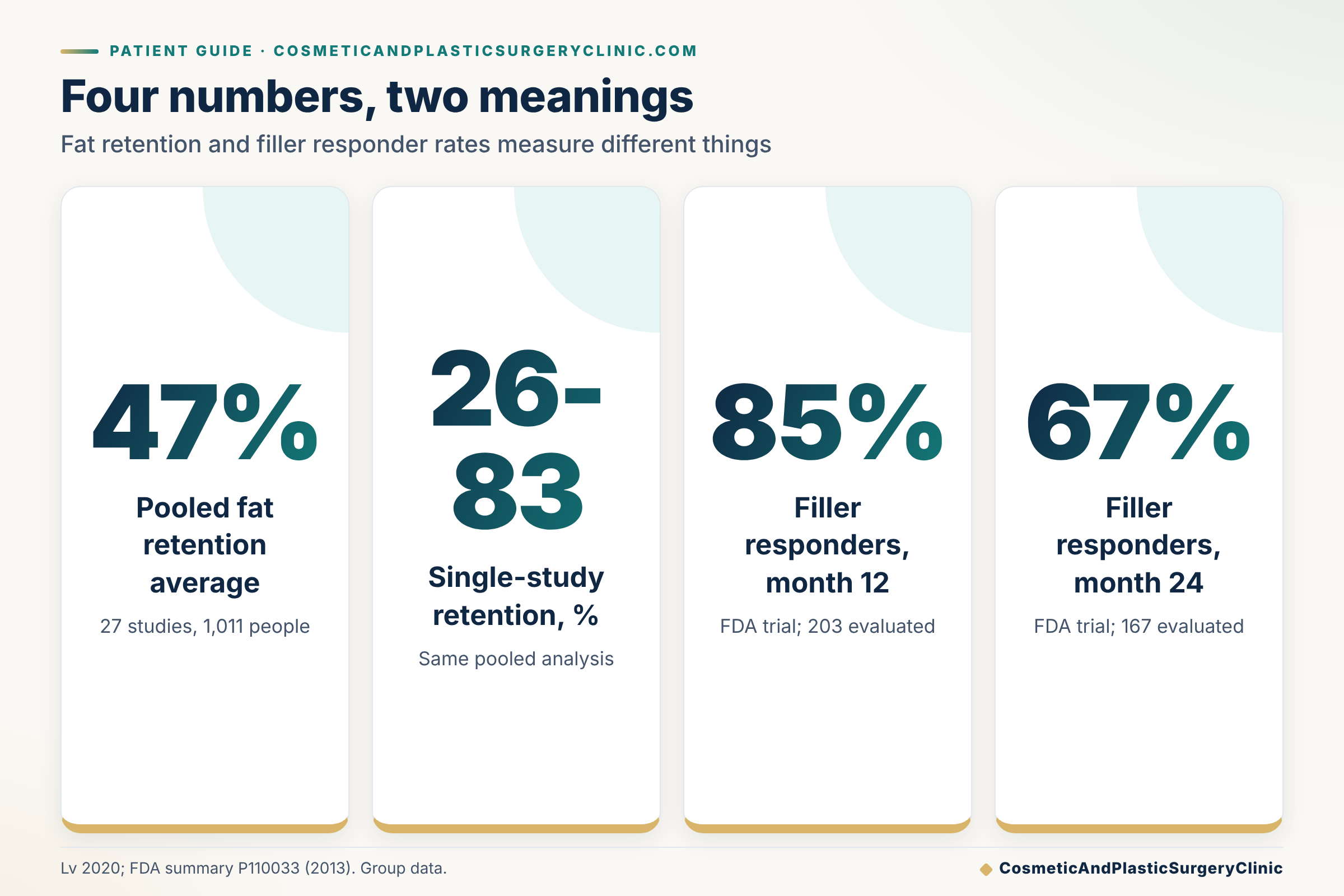
Group averages describe the group. A retention range of 26% to 83% means two people given the same technique can land far apart, and a responder rate of 67% at two years means about a third of those evaluated no longer met the bar. Nobody can tell from these numbers which side of any figure you would fall on.
Questions that expose a quote’s assumptions
A price only means something once its assumptions are visible. Before comparing cheek filler vs fat grafting on cost, ask the practice to answer these in writing:
- How many sessions or visits does this price assume, and what happens if the first is not enough?
- How much product or fat is included, and who decides when to stop?
- Are the facility fee, anesthesia and follow-up visits inside this number?
- What is the policy and cost if a correction, dissolving or touch-up is needed?
- Who treats a complication, where, and at whose expense?
Scenarios for cheek filler vs fat grafting, and what could change them
The profiles below are hypothetical and exist to show how reasoning changes when one fact changes. They are not candidacy decisions, and a real recommendation needs an examination. Table 4 summarizes four of them, with the fact that could reverse each leaning.
| Goal and anatomy | Option that may be favored | Reason | Fact that could reverse it |
|---|---|---|---|
| Mild, early flattening; weight stable; wants to try without committing | Cheek filler | Adjustable in steps, hyaluronic acid can be dissolved, no donor site | Dislikes repeat visits and the cost that builds up over five years |
| Broad hollowing of cheeks and temples after substantial weight loss | Fat grafting, possibly after weight settles | Surgeons quoted by ASPS report a more natural result for global loss | Weight is still changing; surgeons advise waiting for stability |
| Cheek volume loss with visible jowls and loose skin; a lift already under discussion | Lift with fat, or lift with filler | Surgeons commonly pair volume with a lift; 85% of surveyed surgeons graft fat during facelifts | Prefers to avoid surgery; filler may delay a lift but cannot lift tissue |
| Hollowing that runs into the groove under the lower eyelid | Depends on the injector or surgeon | Hyaluronic acid is preferred by one surgeon for smoothing the lid-cheek junction | The problem is a puffy bag rather than a hollow, which filler may not suit |
Scenario one: mild flattening in an adult with a stable weight
Why a reversible start may fit
Consider a hypothetical adult who notices flatter cheeks in recent photos, sees no real sagging and has held a steady weight for years. In the cheek filler vs fat grafting comparison, a hyaluronic acid filler may fit because it can be built up in steps (82% of subjects in the FDA study returned for a touch-up at one month), it can be dissolved, and it needs no donor site or surgery.
It also keeps later options open. Choosing filler now does not rule out fat grafting or a lift later, and ASPS surgeons describe fillers as a common starting point for people new to aesthetic treatment. That is a reasoning pattern, not advice for any real person, and it holds only if the clinician’s examination agrees that the problem is volume.
The fact that could reverse the plan
Cost is the likeliest reversal. Table 2’s arithmetic shows filler every 12 months adding up to $3,575 over five years at the ASPS average, which overlaps the $3,000 to $5,500 surgeon-fee range for one fat grafting session, before facility or anesthesia. If repeat visits sound tiresome, the cheek filler vs fat grafting comparison tightens.
Two other facts could change the plan. An examination that finds descent or loose skin rather than lost volume points toward lift-based options rather than more volume. And an injector who cannot say who stocks hyaluronidase, or what happens if the skin blanches, is a reason to pause and get a second opinion.
Scenario two: broader hollowing with descent or recent weight loss
How the answer shifts when loss is global
Now consider a hypothetical adult who has lost substantial weight and sees hollow cheeks and temples with a softer jawline. Filling that much volume with gel means many syringes; the FDA study’s median was 6.6 mL for the cheek alone, and adverse events were more frequent above 9 mL. Dr. Lee says fat grafting often gives patients with global loss a more natural result, and a lift may belong in the plan if tissue has descended.
In scenario two, timing matters as much as technique. Dr. Dobryansky advises waiting for a stable weight, because fat that integrates changes with weight. So the sensible sequence may be to wait, then reassess, with filler as a small interim step if the person wants one. Whether that sequence fits is a surgeon’s call, based on an examination this article cannot perform.
Six cheek filler vs fat grafting questions that need a qualified clinician
Take these to a consultation with a board-certified plastic surgeon or another licensed, experienced injector. The consultation questions article adds what to bring and how to judge the answers.
- Which finding dominates on my face: volume loss, descent, loose skin or a mix?
- Which option would you consider for me and which would you not, and why?
- Which product, or which donor area and processing method, would you use, and what evidence supports it in the cheek?
- How long do you expect results to last, and what happens if I stop or my weight changes?
- Who treats a complication, is hyaluronidase on hand, and what would a correction cost?
- What is the full price at the number of sessions you expect, including facility, anesthesia and follow-up?
Ask to see photos of people with similar anatomy photographed at the same time after treatment; the dermal filler photos article explains how to read them without over-trusting a single image.
Frequently asked questions
Is cheek filler vs fat grafting an either-or choice, or can both be combined?
Yes, surgeons do mix them. A 2015 ASPS blog post by surgeon Jay Lucas describes using hyaluronic acid for fine areas such as the eyelid-cheek junction and fat for larger volume loss, and calls the choice case by case. No source opened for this article gives a standard protocol or a waiting interval between the two. If you have had filler before surgery, tell the surgeon the product, the dates and the approximate amounts, and ask how they would sequence any new treatment.
What happens to fat-grafted cheeks if my weight changes?
Surgeons quoted by ASPS say the graft follows the body. In a July 2026 article, Dr. Dobryansky said fat that integrates can enlarge with weight gain and shrink with weight loss, and he suggests being at or near a stable weight, with a plan for any GLP-1 medicine, before grafting. Dr. Rhoad, in 2024, said significant weight loss could jeopardize the graft. If your weight is still moving, ask whether the surgeon would wait, and for how long.
Is nanofat a substitute for cheek filler?
Not for volume. In a 2024 ASPS article, a quoted surgeon described nanofat, fat emulsified into a fine solution, as said to improve skin quality without increasing volume. That makes it a different tool from the larger-particle fat used to fill a hollow cheek. The sources opened here report no trial of nanofat against filler for cheeks. If a practice proposes it, ask what it is meant to change, what evidence supports that and whether it replaces or accompanies standard fat placement.
Can I dissolve cheek filler if I dislike the result?
Only if it is hyaluronic acid. The Voluma XC labeling describes hyaluronidase as an enzyme that breaks down hyaluronic acid, while the FDA warns that removal may be difficult or impossible for fillers not made of it. That makes the product name a key fact, so ask what was used and keep a record. Whether and when to dissolve is the injector’s decision after an examination, and the dissolving filler article covers the process.
Does insurance cover cheek filler vs fat grafting?
For filler, ASPS says health insurance does not cover dermal fillers, though many surgeons offer financing plans. ASPS counts facial fat grafting among cosmetic procedures, and the sources opened for this article do not describe coverage for it. Reconstructive situations, such as correcting a defect after injury or surgery, are assessed differently by plans. Ask your insurer and the practice before treatment, and get the answer in writing if coverage matters to your decision.
Does the cheek filler vs fat grafting choice change during pregnancy or breastfeeding?
The patient labeling for Voluma XC says safety has not been established in pregnant or breastfeeding women. The sources opened here do not address fat grafting in either situation. Because both options are elective and can usually be scheduled later, many people discuss timing with their obstetric clinician and the treating clinician before booking. The decision belongs to you and your care team, and postponing is a legitimate choice.
Is a cannula safer than a needle for cheek filler?
No source opened for this article shows that either tool removes the risk of blood-vessel injection. A company-reported Restylane Contour trial found needle and cannula comparable in efficacy and safety, and the Voluma XC labeling describes a small needle with aspiration before injecting. Surgeon Jay Lucas says blunt cannulas are used for fat to avoid injury to fat cells and vessels. Ask the injector why they choose one tool, and what their plan is if skin blanches.
Sources and further reading
- U.S. Food and Drug Administration — Dermal Fillers (Soft Tissue Fillers) (content current as of 2023-07-06; accessed 2026-11-12) — approved uses, vascular risk, provider advice, removal limits
- U.S. Food and Drug Administration — PMA database record P110033, Juvederm Voluma XC (approval 2013-10-22; accessed 2026-11-12) — cheek indication wording and approval date
- U.S. Food and Drug Administration — Summary of Safety and Effectiveness Data, Juvederm Voluma XC, P110033 (accessed 2026-11-12) — pivotal study design, responder rates, adverse events
- U.S. Food and Drug Administration — Voluma XC physician labeling, P110033 (accessed 2026-11-12) — injection technique, warnings, hyaluronidase for adverse events
- U.S. Food and Drug Administration — Voluma XC patient labeling, P110033 (accessed 2026-11-12) — volumes used, side-effect timing, touch-up rate, pregnancy statement
- U.S. Food and Drug Administration — Summary of Safety and Effectiveness Data, Sculptra cheek wrinkles, P030050/S039 (approval 2023-04-18; accessed 2026-11-12) — cheek wrinkle indication, nodule reports
- Practical Dermatology — FDA Approves New Cheek Filler from Galderma (2021-06-29; accessed 2026-11-12) — Restylane Contour pivotal trial, needle vs cannula (company-reported)
- American Society of Plastic Surgeons — Plastic Surgery Statistics 2025 (accessed 2026-11-12) — filler share of minimally invasive treatments, facial fat grafting growth
- American Society of Plastic Surgeons — 2025 plastic surgery statistics report (accessed 2026-11-12) — facial fat grafting counts for 2025 and 2024, data sources
- American Society of Plastic Surgeons — 2024 procedural statistics release (accessed 2026-11-12) — facial fat grafting counts and surgeon-fee range, survey method
- American Society of Plastic Surgeons — Dermal fillers cost (accessed 2026-11-12) — average fees (year not stated), insurance statement
- American Society of Plastic Surgeons — Dermal fillers risks and safety (accessed 2026-11-12) — risk list, vascular risk, board-certification advice
- American Society of Plastic Surgeons — Dermal fillers overview (accessed 2026-11-12) — temporary nature, comparison with facelift
- American Society of Plastic Surgeons — Fat injections as dermal fillers (accessed 2026-11-12) — fat survival statement, multiple sessions, setting, donor-site discomfort
- Lucas J., American Society of Plastic Surgeons blog — Facial fat grafting vs facial fillers (2015-12-02; accessed 2026-11-12) — harvest, cannulas, where each is preferred; author’s views
- American Society of Plastic Surgeons — An exploration of facial rejuvenation through fat grafting (2024-08-21; accessed 2026-11-12) — swelling duration, recovery
- American Society of Plastic Surgeons — The future of facial augmentation (2024-01-18; accessed 2026-11-12) — processing, nanofat, 50% survival statement, six-week pressure advice
- American Society of Plastic Surgeons — Beyond filler: how fat grafting restores the face after GLP-1 weight loss (2026-07-06; accessed 2026-11-12) — surgeon views on fillers vs fat, weight stability
- American Society of Plastic Surgeons — Most plastic surgeons now use fat grafting as part of facelift surgery (2015 survey of 309 members; accessed 2026-11-12) — 85% use, common sites, refinement timing
- Lv et al., Aesthetic Plastic Surgery — Volume Retention After Facial Fat Grafting and Relevant Factors: A Systematic Review and Meta-analysis (2020; abstract; accessed 2026-11-12) — 47% pooled retention, study range, complications
- Schiraldi et al., Journal of Clinical Medicine — Facial Fat Grafting (FFG): Worth the Risk? A Systematic Review of Complications and Critical Appraisal (2022; abstract; accessed 2026-11-12) — adverse-event shares, rate range, reporting limits
- Lazzeri et al., Plastic and Reconstructive Surgery — Blindness following Cosmetic Injections of the Face (2012; record and abstract; accessed 2026-11-12) — 32 patients, 15 after fat
- Carruthers et al., Plastic and Reconstructive Surgery — Blindness caused by cosmetic filler injection: a review of cause and therapy (2014; record and abstract; accessed 2026-11-12) — autologous fat most frequent in reports then
- Doyon et al., Aesthetic Surgery Journal — Update on Blindness From Filler: Review of Prognostic Factors, Management Approaches, and a Century of Published Cases (2024; accessed 2026-11-12) — 365 new cases, materials, sites, outcomes
- Murray et al., Journal of Clinical and Aesthetic Dermatology — Guideline for the Management of Hyaluronic Acid Filler-induced Vascular Occlusion (2021; accessed 2026-11-12) — hyaluronidase as mainstay, urgency
- IMCAS — Evolution of lipofilling (accessed 2026-11-12) — Neuber 1893, decline of the technique, Coleman-era revival
- The PMFA Journal — History of fat grafting (2013 summary of Mazzola and Mazzola, Journal of Craniofacial Surgery; accessed 2026-11-12) — Neuber 1893, Peer 1955 cell-survival finding