Dermal filler cost is quoted in units that do not line up. One practice posts a price per syringe, a second sells a flat fee for the lips or cheeks, and a third offers a package of several syringes. A syringe is not a fixed amount of product either, so $650 and $800 can describe different quantities, different materials and different follow-up.
This page is about reading a dermal filler cost estimate: what published averages measure, how syringe, area and package pricing differ, which lines belong on a written quote, and how to turn two quotes into one comparable figure. What fillers do and where they help is in the dermal fillers overview; lip-only pricing has its own page, lip filler cost. Nothing here predicts what a given practice will charge, and every dollar figure in the worked examples is an invented illustration.
What published dermal filler cost figures measure, and what they leave out
Search results for dermal filler cost are crowded with national averages, many of them unsourced. Two professional societies publish figures, and they differ in ways that matter before any number goes into a budget.
Two societies, different definitions of dermal filler cost
ASPS: $715, $901 and $743, with no year attached
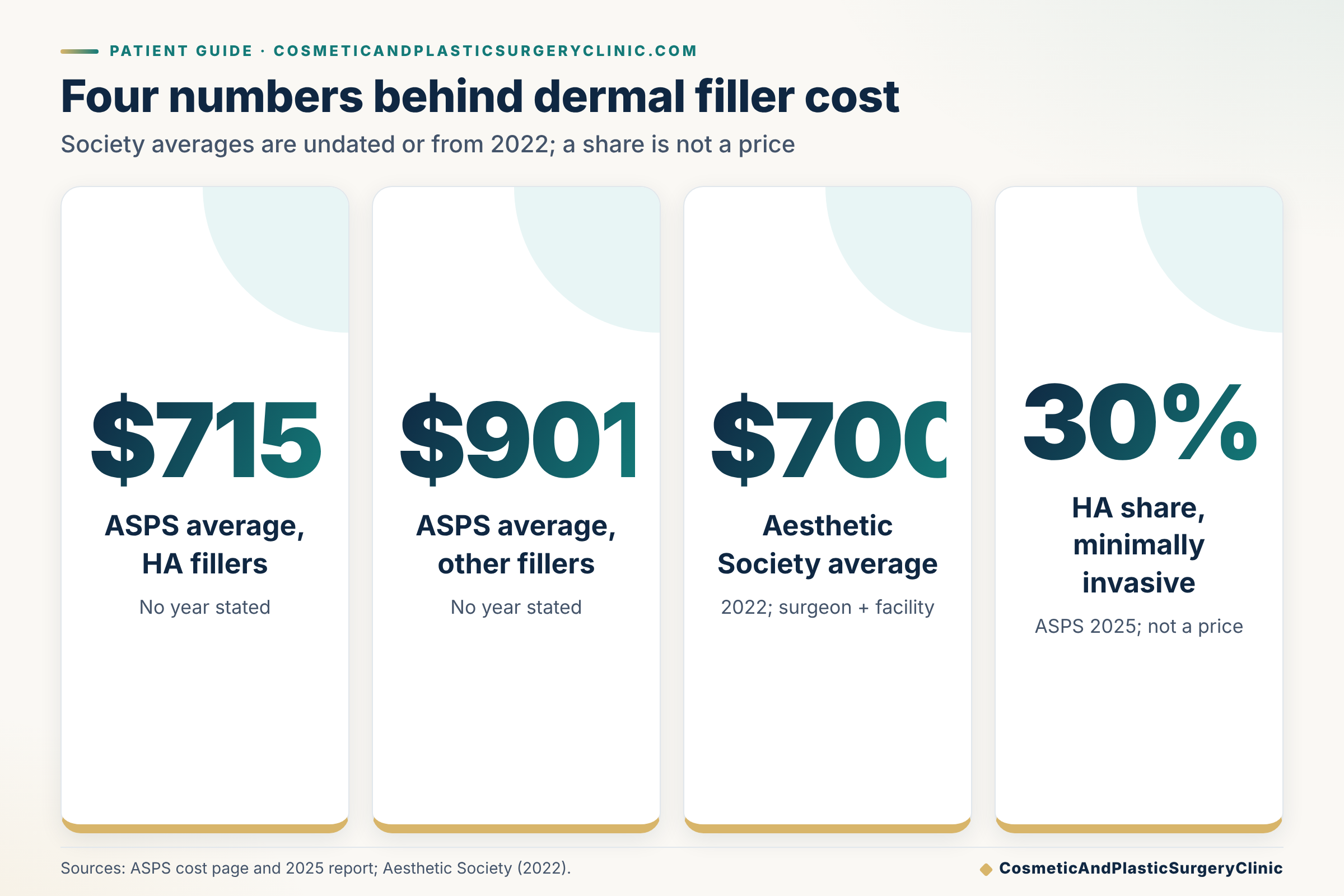
The ASPS dermal filler cost page, citing the society’s latest statistics, gives an average of $715 for hyaluronic acid fillers, $901 for non-hyaluronic fillers and $743 for lip augmentation with fillers. It names Juvéderm, Voluma and Restylane as hyaluronic acid examples, and Radiesse, Sculptra, Bellafill and Renuva as non-hyaluronic ones. It states no year and does not say whether a figure covers a consultation, numbing or a touch-up visit.
ASPS’s own 2024 fee table, which lists surgeon-fee ranges for many procedures, has no filler line at all. The only nearby entry is facial fat grafting, a different treatment that uses a patient’s own fat. So the $715 stands alone and undated. It works as a rough marker of one treatment, not as the dermal filler cost to expect on your own estimate.
The Aesthetic Society: $700 for 2022, and an older per-syringe figure
The Aesthetic Society lists $700 for fillers, drawn from its 2022 national databank. The page says the figure reflects standard procedure costs, meaning surgeon and facility fees, and may leave out medical tests, prescriptions, garments and other costs. It adds that filler cost varies by surgeon and region and by the number and location of areas treated.
Only one ASPS source gives a per-syringe number: a December 2019 article by a plastic surgeon, Eric Mariotti, MD, quoting 2018 ASPS data of $682 per syringe for hyaluronic acid fillers. It is seven years old, and the article says its views are the author’s rather than the society’s. Use it to confirm that fillers are priced by syringe, not as a current benchmark.
Why a national average cannot predict your own dermal filler cost
Demand says nothing about price
The ASPS 2025 statistics report says hyaluronic acid fillers made up 30 percent of minimally invasive treatments in 2025, second only to neuromodulators. Of those filler treatments, 70 percent were for facial rejuvenation and 23 percent for lip augmentation. ASPS built the estimates from member surgeons, an endorsed partner and a claims-based dataset, and it reported shares rather than counts or fees.
Popularity shows that the treatment is routine. It does not show that a quote is reasonable, and the report does not say who performed the injections or what they charged.
The factors the societies actually name
ASPS says price varies with the expertise and qualifications of the person treating you, the type of procedure, the time and effort it takes and the office’s location. The Aesthetic Society adds the number and location of areas, notes that treating a larger area takes more product and costs more, and says some surgeons give discounted rates to high-volume filler patients.
Look at what is missing: neither list ranks the brand on the box first. Volume and skill come first, and both depend on a plan that only an in-person assessment can produce. The plastic surgery cost overview explains the same drivers for operations.
Syringes, areas and packages: three ways a filler price gets built
A practice has to turn a product into a price. How it does that decides whether you can compare its dermal filler cost with the practice across town.
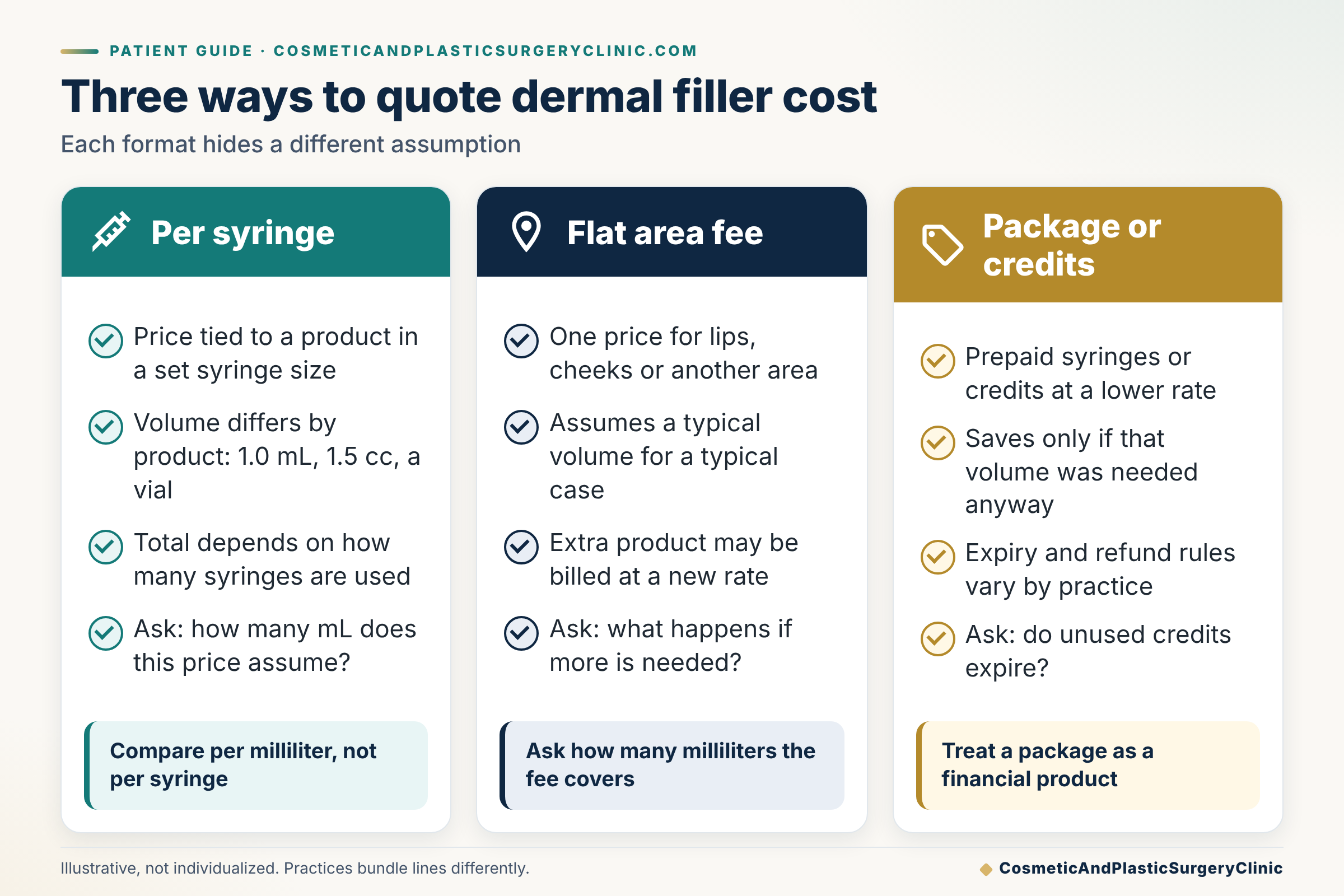
Dermal filler cost per syringe: why a syringe is not a standard unit
What the labels say about volume
Syringe sizes differ by product. The National Library of Medicine’s device database lists Juvéderm Voluma XC as 1.0 mL syringes, two to a box. The Radiesse (+) instructions for use describe a 1.5 cc syringe. Sculptra is not a syringe at all: the label describes a 367.5 mg vial of powder that is reconstituted before use and is meant for one patient in one session.
A hypothetical shows the consequence. A $700 syringe of a 1.5 mL product and a $700 syringe of a 1.0 mL product are the same sticker price for different amounts. A per-syringe dermal filler cost figure only becomes comparable once the volume in milliliters and the product are on the quote.
Why the number of syringes is the real unknown
The 2019 ASPS article says most people need more than one syringe. The label data point the same way: the cheek study described further down this page used a wide range of volumes within a single product. A per-syringe price multiplied by an unknown number of syringes is not yet a total.
That is why a dermal filler cost quote should say how many syringes or how many milliliters it assumes, and what happens if the injector judges at the visit that more or less is needed.
Flat area fees, packages and loyalty pricing
What a flat area fee assumes about volume
A single price for “cheeks” or “smile lines” can be a fair convenience because it removes the arithmetic. It also carries a hidden volume assumption. Ask how many milliliters the fee covers, what the practice does if more product is judged necessary, and whether a second syringe is billed at the same rate or a different one.
The Aesthetic Society says larger areas need more medication and cost more. A flat dermal filler cost for an area therefore describes a typical amount in a typical case, not your face. Treating more than one area usually changes the quote, so ask whether areas are priced one by one or as a combined plan.
Multi-syringe discounts, packages and expiry dates
The 2019 ASPS article lists multi-syringe discounts, packaged surgical and nonsurgical discounts, loyalty programs and financing as ways practices lower the price. A package is prepaid treatment, which makes it a financial product as well as a medical one. Ask whether credits expire, whether unused credits are refundable and what happens if the practice closes or you move.
A discount is only a saving if you would have bought that volume anyway. Paying for three syringes to save on each is a loss if the plan only needed two.
| Line item | Why it may be charged | What changes it | Billed separately? | Question to ask |
|---|---|---|---|---|
| Product and volume | The filler itself, priced per syringe, per milliliter or inside an area fee | Product named, syringe size, number of syringes | Usually the core line | Which product, and how many milliliters does this price assume? |
| Consultation or assessment | Time spent examining and planning before any injection | New versus existing patient; who examines you | Sometimes, sometimes credited | Is the fee credited toward treatment if I go ahead? |
| Numbing | Topical anesthetic or a product that contains lidocaine | Method, practice policy | Sometimes | Is numbing included, and is the product premixed with it? |
| Injector and setting | Training, supervision and a medical office’s overhead | Clinician type, location, practice setting | Built into the rate | Who will inject me, and what is their license? |
| Touch-up visit | A second look to adjust an area that is under-corrected or uneven | Window length, whether added product is billed | Often, after a free exam | What is the window, and is extra product charged? |
| Package or membership | Prepaid syringes, credits or loyalty pricing | Term length, expiry, refund rules | Yes, as a purchase | Do unused credits expire, and can I get a refund? |
Product family, duration and injector: why two syringes can cost differently
Two quotes for the same volume can still sit far apart, and the gap usually comes from what is in the syringe, how long it is expected to last and who is holding it.
Product family and the treatment plan it implies
What the hyaluronic and non-hyaluronic averages do not explain about dermal filler cost
ASPS lists $715 for hyaluronic acid fillers and $901 for non-hyaluronic ones, a gap of $186. The page does not say why, and the two numbers cannot be treated as a price list for the two families. The gap could reflect syringe volume, the areas treated, the injector or the mix of procedures behind each average. The comparison of hyaluronic and biostimulatory fillers explains how the materials behave; for dermal filler cost, the useful point is that they come with different plans.
The Sculptra label, for example, describes one to four sessions at three-week intervals in its studies, so the plan is a series, not one visit. The Radiesse (+) and Juvéderm Voluma XC labels describe an optional touch-up about four weeks or one month after the first treatment. A quote should say which pattern it assumes.
Duration claims and the yearly math
Fillers are temporary, so a one-time price understates the cost of keeping a result. The 2019 ASPS article puts hyaluronic acid fillers at roughly 6 to 18 months. Label studies give narrower, product-specific figures: in the Voluma cheek study, responders (a gain of at least one grade on a midface volume scale) were 85.2 percent of subjects at 12 months and 67.1 percent, or 112 of the 167 still being followed, at 24 months. In the Radiesse (+) jawline study, 67.3 percent of 113 subjects retained treatment success at 48 weeks.
Those are study-population figures with their own definitions of success, and the Voluma protocol allowed follow-up to end early for some subjects. They are not predictions for one face. They support only a cautious statement: duration varies, and a yearly dermal filler cost depends on an interval you assume. The table below shows the arithmetic with invented numbers.
| Assumed interval | Visits per year | Cost at 2 syringes per visit | What the assumption hides |
|---|---|---|---|
| Every 9 months | 1.33 | $2,000 per year | Faster fading, or a wish to top up early |
| Every 12 months | 1.00 | $1,500 per year | A middle assumption, not a typical case |
| Every 18 months | 0.67 | $1,000 per year | Slower fading, and no touch-ups in between |
The injector, the room and what a higher or lower price may reflect
Training, licensing and the setting
The FDA describes fillers as medical device implants and says injection should be treated as a medical procedure, advising patients to look for a licensed provider with dermatology or plastic surgery training. The Juvéderm Voluma XC, Radiesse (+) and Sculptra labels each say the product should be used only by health care professionals with appropriate training and experience in the approved indication.
ASPS’s 2019 article recommends a board-certified plastic surgeon and a sterile medical office. Who may legally inject depends on state law, which varies. A higher dermal filler cost can reflect training, supervision and a medical setting, and a lower one can reflect less of each, or simply a different business model. The checks for confirming credentials are in choosing a plastic surgeon, and cosmetic surgeon credentials explains what titles do and do not mean.
Price is a weak signal in both directions
A December 2023 ASPS article says paying more does not necessarily mean better quality, and that an unusually cheap quote ought to raise an eyebrow. Both statements point the same way: a dermal filler cost figure alone does not tell you who is injecting, what is in the syringe or what happens if something goes wrong.
Use the estimate to start a conversation. A practice that names its product, volume and injector and explains its follow-up terms is giving you information a lone price never will. The consultation questions page lists what to ask in person.
That risk belongs in a cost conversation for a practical reason: ask whether the practice has a plan for it, including whether it keeps hyaluronidase on hand and whether treating a problem after your visit is billed. What problems look like and how they are managed is covered in filler complications.
Dermal filler cost, insurance, tax accounts and payment plans
Most filler pricing questions end at the same point: who pays, and on what terms. The answers depend less on the product than on why it is being used.
Cosmetic self-pay and the narrow exceptions
What the societies and the FDA say about coverage
ASPS states that health insurance does not cover dermal fillers, and the Aesthetic Society says that because fillers are an elective cosmetic treatment, insurance does not cover the cost. Both are broad statements about cosmetic use and neither is a plan document.
The FDA’s page lists one approved use that is medical in character: certain fillers are approved to restore facial fat loss in people with HIV. Whether a plan pays for that is a coverage question for that plan, and nothing in the sources opened for this page establishes that it will. Ask the insurer in writing and keep the answer.
Tax-favored accounts: ask before you pay
IRS Publication 502 (2025) says that, generally, cosmetic surgery cannot be counted as a medical expense, with an exception for surgery necessary to improve a deformity arising from a congenital abnormality, a personal injury or a disfiguring disease. The cosmetic-surgery passage names face lifts, hair transplants, electrolysis and liposuction; it does not name fillers.
Publication 969 (2025) ties health savings account spending to medical care as defined in section 213(d) of the tax code and describes a health flexible spending account as reimbursing medical expenses. Neither passage says whether dermal filler cost qualifies for a particular account. Ask the account administrator before paying, and a tax professional about your own situation.
Payment plans and the cost of waiting to pay
Medical credit cards and deferred interest
A small, repeated expense is an awkward fit for credit. The Consumer Financial Protection Bureau’s May 2023 report says the typical medical credit card carries a 26.99 percent APR, against roughly 16 percent for general-purpose cards that March. Promotional periods commonly run six to eighteen months, and if the balance is not cleared, interest is owed on the full original purchase, not just the remainder.
The CFPB found that between 2015 and 2020, 20 percent of healthcare deferred-interest purchases were assessed interest. ASPS notes that many plastic surgeons offer financing plans, and the plastic surgery financing guide works through the mechanics. If a dermal filler cost does not fit your budget as cash, a longer interval or fewer areas deserves a look before a loan does.
Good faith estimates, deposits and cancellation terms
The federal No Surprises information from CMS says that uninsured and self-pay patients can ask a provider for a good faith estimate at any time, and that providers generally must supply one when care is scheduled at least three business days ahead. If a final bill is at least $400 above the estimate, the page says you may be able to dispute it.
That is a federal consumer tool, and the page does not list what an estimate must itemize, so treat it as a reason to ask for a written figure rather than proof of one. Before paying a deposit, read whether it is refundable, whether it converts to credit, and what happens if you cancel or the injector decides not to treat you.
Turning two dermal filler cost quotes into one comparable figure
A low price is not an error, and a high one is not a verdict. What matters is whether the two estimates describe the same product, the same amount and the same follow-up, and whether the product came from a legitimate source.
Reading a low price: product source and the practice itself
What the FDA says about where fillers come from
The FDA states that no fillers are approved for over-the-counter sale, that needle-free injectors are not approved for delivering dermal fillers, and that counterfeit filler products are a concern, urging providers to inspect packaging for authenticity and telling consumers not to buy fillers online. It adds that injectable silicone is not approved for any aesthetic use and that people should not inject themselves.
The FDA page does not tie low prices to counterfeits, and a low dermal filler cost is not proof of anything. It is, though, a reason to ask which product is used, who purchased it and where. The medical tourism guide covers a related trade-off, where a lower price abroad has to be weighed against follow-up care at home.
Red flags the ASPS article lists
The 2019 ASPS article names prices that seem too good to be true, missing information or before-and-after photos, refusal to show product packaging or labeling, and a dirty or disorganized office. It also warns against bargain hunting, citing untrained, unlicensed injectors who caused lasting damage.
Each is a question you can ask in plain words: may I see the syringe and its packaging before it is opened, and what are the product name and lot number? A practice with nothing to hide usually answers without friction. If it does not, you can decline and keep the deposit conversation for a different day.
Normalizing two hypothetical quotes line by line
A worked example with invented numbers
Consider a hypothetical comparison dated 2026-11-12, with every figure invented. Quote A offers $599 per syringe and quote B offers $749 per syringe, each for two syringes. On the face of it, A is $150 cheaper per syringe and $300 cheaper overall. The estimate sheets leave out the facts that decide whether that holds.
Quote A does not name the brand or the syringe size, does not name the injector and charges $150 for a touch-up visit plus product. Quote B names a product in 1.0 mL syringes, names a nurse practitioner supervised by a physician, and includes a free exam within 30 days. The table puts the two side by side and adds the question each gap raises.
| Line | Quote A (invented) | Quote B (invented) | Missing or conditional item |
|---|---|---|---|
| Headline price | $599 per syringe, 2 syringes: $1,198 | $749 per syringe, 2 syringes: $1,498 | A looks $300 cheaper before anything else is known |
| Product and size | “Hyaluronic filler,” brand and milliliters not stated | Named product, 1.0 mL syringes | A: brand and mL. If A’s syringes are 0.5 mL, its price per mL is $1,198, not $599 |
| Injector and setting | Not named; setting not stated | Named nurse practitioner, physician supervising, medical office | A: name, license type and where treatment happens |
| Follow-up | $150 touch-up visit plus product | Free exam within 30 days; added product at $749 | Whether A’s $150 is credited if product is added |
| Payment terms | Medical card, 12-month deferred interest | Pay at the visit | Interest if A’s balance is not cleared in time |
| Safety note | No mention of a vascular-event plan | States hyaluronidase is stocked | A: rescue plan and whether treatment of a problem is billed |
How one missing line can reverse the ranking
A simple habit keeps the comparison honest: divide each quote’s total by the milliliters it contains, then add every conditional line to the quote that charges for it. The resulting dermal filler cost per milliliter, with follow-up and payment terms beside it, is the figure to compare. If a practice cannot say how many milliliters it is selling, the comparison stops there, and asking is the next step.
Take the case where A’s syringes turn out to hold 0.5 mL. Then A’s two syringes contain 1.0 mL for $1,198, while B’s contain 2.0 mL for $1,498. Per milliliter, A costs $1,198 and B costs $749. To buy the same 2.0 mL from A, you would need four syringes at $599, which is $2,396 against $1,498.
If A’s syringes hold 1.0 mL, the ranking survives: A is $300 cheaper, or $150 cheaper once a touch-up visit is added, and the remaining questions are about the injector and the rescue plan. The point is not that the cheaper quote loses. It is that the ranking cannot be read from the headline price until the volume line is filled in.
One caution about volume itself. In the Voluma label, adverse events in the cheek study were reported more frequently in subjects who received more than 9 mL, and the label limits any Juvéderm gel to 20 mL per 60 kg of body mass per year, adding that the safety of greater amounts has not been established. More product is not simply better value, and the amount for any person is a clinical decision.
A written estimate worth accepting
Pressure tactics and vague answers
Pressure shows up as a deposit due today to hold a price, a discount that vanishes if you leave to think, or a plan that expands once you are in the chair. The Aesthetic Society warns that coupon offers are often meant to encourage impulse buys, and a price you cannot sleep on is not much of a price. If a practice will not email the estimate, that is the answer to a different question about transparency.
You can also ask whether treatment happens at the first visit. A practice that insists on a separate assessment before injecting is not slowing you down for sport, and a first visit is the place to ask about everything above.
The estimate checklist
A dermal filler cost estimate that is worth comparing names the product and syringe size, states the number of syringes or milliliters it assumes, names the injector and license type, says where the visit takes place, itemizes numbing and the consultation, gives the touch-up window and what it costs, and spells out the terms of any package, deposit or payment plan.
Add two lines of your own: what the practice does if a problem arises after the visit, and whether that care is billed. If the estimate cannot be written down, the number in it is not a quote yet.

Frequently asked questions
How much does one syringe of dermal filler cost?
There is no single national price to quote. The only ASPS per-syringe figure found was $682 from 2018 data, quoted in a 2019 article, and it is out of date. The current ASPS averages ($715 for hyaluronic acid, $901 for non-hyaluronic) carry no year and do not say whether they are per syringe or per visit. Ask any practice for the product, milliliters per syringe and what the price includes, then compare per milliliter.
Is dermal filler cost the same for lips and cheeks?
Not necessarily. ASPS lists $743 as an average for lip augmentation with fillers, against $715 for hyaluronic acid fillers overall, but the page does not say what separates them. Practices may price lips per syringe or as an area, and cheeks may involve more product and a different product family. Compare area quotes by milliliters and product, and see lip filler cost for lip-specific questions.
Does dermal filler cost include a touch-up visit?
It depends on the practice. The Juvéderm Voluma XC label describes touch-up about 30 days after the first treatment and the Radiesse (+) label about four weeks, but those are study designs, not billing rules. A practice may include a free exam and bill added product, charge a visit fee, or include neither. Ask for the touch-up window and what it costs before the first injection, and get the answer in writing.
Is dissolving filler part of dermal filler cost, and what does it cost?
Policies vary, and the sources opened for this page give no price for it. The FDA notes that removing filler can be difficult or impossible, especially with non-absorbable products. Ask what happens, and what is charged, if a problem needs treatment after your visit, and whether the practice keeps hyaluronidase on hand. The process is explained in dissolving lip filler.
Is cheaper filler bought online or from a wholesaler safe to use?
The FDA says no fillers are approved for over-the-counter sale, that counterfeit filler products are a concern, and that consumers should not buy fillers online. It also says people should not inject themselves. A practice’s price may reasonably reflect where it buys, but you can ask who the supplier is, see the packaging and note the lot number. If a practice will not show you the box, that is a reason to decline.
Is a larger volume at one visit better value?
Not by default. A discount per syringe helps only if you would have bought that volume anyway. The Voluma label reports adverse events more often in cheek-study subjects who received more than 9 mL and states that the safety of exceeding 20 mL per 60 kg of body mass per year has not been established. The amount that suits one person is a clinical decision made after an examination, not a purchasing one.
How does dermal filler cost compare with surgery for a similar concern?
They treat different problems, so the totals are not directly comparable. The ASPS 2024 projected range for facial fat grafting is $3,000 to $5,500 as a surgeon fee, with inclusions not stated, while a filler is repeated over time. Work out a yearly figure for fillers and weigh it against a one-time cost plus recovery. For options, see cheek filler vs fat grafting and facelift alternatives.
Why does Botox pricing look so different from filler pricing?
They are different products sold in different units. The 2019 ASPS article describes Botox as priced per unit and fillers as priced per syringe, so the two cannot be compared directly. The distinction matters when a practice bundles both into one visit. Ask for each line separately, and see Botox cost for how neuromodulator quotes are built.
Sources and further reading
- ASPS — Dermal fillers cost (accessed 2026-11-12) — $715, $901 and $743 averages with no year, cost factors, insurance and financing
- ASPS — 2024 average surgeon/physician fees (accessed 2026-11-12) — no filler line, facial fat grafting range, projected-range method
- ASPS — Plastic surgery statistics report 2025 (accessed 2026-11-12) — hyaluronic acid fillers at 30 percent of minimally invasive treatments, lip share, data sources
- ASPS — Dermal fillers overview (accessed 2026-11-12) — treatable areas and the temporary nature of fillers
- ASPS — Dermal fillers safety (accessed 2026-11-12) — provider choice and vascular occlusion risk
- ASPS — What’s behind the cost of Botox and injectable fillers (Mariotti, December 2019; accessed 2026-11-12) — per-syringe pricing, 2018 figure, duration range, red flags, discounts
- ASPS — Understanding plastic surgery costs in the United States (December 2023; accessed 2026-11-12) — price versus quality, low-price caution
- The Aesthetic Society — Average plastic surgery costs (accessed 2026-11-12) — $700 filler average from the 2022 databank, inclusions and exclusions
- The Aesthetic Society — Fillers associated costs (accessed 2026-11-12) — cost factors, high-volume discounts, insurance, financing
- The Aesthetic Society — Plastic surgery costs (accessed 2026-11-12) — coupon and impulse-buy caution, consultation fees
- FDA — Dermal fillers (soft tissue fillers) (accessed 2026-11-12) — device regulation, approved uses, counterfeit and online-purchase warnings, vascular risk, emergency signs
- AbbVie — JUVÉDERM VOLUMA XC directions for use (accessed 2026-11-12) — cheek study volumes, touch-up timing, responder rates, annual volume limit, practitioner statement
- National Library of Medicine — AccessGUDID, Juvéderm Voluma XC (accessed 2026-11-12) — 1.0 mL syringe size, two per box
- Merz — RADIESSE (+) instructions for use (accessed 2026-11-12) — 1.5 cc syringe, indications, four-week touch-up, 48-week jawline data
- Galderma — Sculptra instructions for use (accessed 2026-11-12) — 367.5 mg vial, series of sessions, study follow-up, trained-professional statement
- IRS — Publication 502 (2025), Medical and Dental Expenses (accessed 2026-11-12) — cosmetic surgery exclusion and deformity exception
- IRS — Publication 969 (2025), Health Savings Accounts and Other Tax-Favored Health Plans (accessed 2026-11-12) — HSA medical-care definition, FSA description
- CFPB — Medical credit cards and financing plans (May 2023; accessed 2026-11-12) — typical APR, deferred-interest terms, share assessed interest
- CMS — Understanding costs in advance: good faith estimates (accessed 2026-11-12) — estimate timing and the $400 dispute threshold