
If you have been searching for rhinoplasty alternatives, you are probably weighing a real question: is there a way to change how my nose looks, or how it works, without a full nose job? The honest answer is that it depends on what you want to change. Some goals can be approached with injectable fillers, thread-based lifts, makeup, photography habits, or treatment of the chin and cheeks. Other goals, especially making a nose smaller or fixing a blocked airway, generally call for a different kind of care, and sometimes for nose surgery after all.
This guide is organized by goal rather than by product. It compares nonsurgical choices, narrower surgical choices, and the option of waiting, and it spends real time on what each approach cannot do. It also covers the FDA’s position on filler in the nose, because that is the alternative most people hear about first and the one with the most serious safety conversation attached.
Nothing here is a diagnosis or a recommendation for any one person. Individual anatomy, skin thickness, breathing, health history, and goals all change which options are reasonable, and only a qualified clinician who examines you can sort that out. Use this page to arrive at that visit with better questions. For a deeper look at the surgery these options are being compared against, see the complete rhinoplasty guide.
A note on language. Patients say “nose job,” “nose surgery,” “nonsurgical nose job,” and “liquid rhinoplasty,” while clinicians say rhinoplasty, septoplasty, septorhinoplasty, and filler augmentation. The terms overlap but are not interchangeable, and the differences matter when you compare plans. Wherever a common term is used in this article, the clinical term is explained next to it.
Start With the Goal: What You Want to Change Decides What Can Substitute for Surgery
Most confusion about alternatives comes from treating “the nose” as one problem. It is at least three: how the nose looks on its own, how it sits among the other features, and how air moves through it. An option that helps one of these may do nothing for the others, which is why a goal-first approach saves time and money.
Cosmetic Shape Goals and What Each One Requires
Mapping common concerns to the kind of change they need
People describe cosmetic nasal concerns in a handful of ways: a bump on the bridge, a low bridge, a tip that looks wide, round, droopy, or rotated, a nose that looks too large or too long for the face, nostrils that flare, and a nose that is off-center or uneven. The American Society of Plastic Surgeons (ASPS) describes surgery as able to lower a hump, refine and rotate the tip, narrow a wide base or flaring nostrils, and shorten a long nose, with results that depend heavily on the nose’s anatomy, particularly skin, and on the surgeon’s judgment.
The useful question is not “which procedure treats a bump?” but “does this concern require adding tissue, taking tissue away, or repositioning what is already there?” A hump is a surplus of bone and cartilage in one spot. A low bridge is a shortage of height. A wide tip is usually a matter of cartilage shape and the soft tissue covering it. Asymmetry can come from bone, cartilage, the septum, or the skin, and often from several at once.
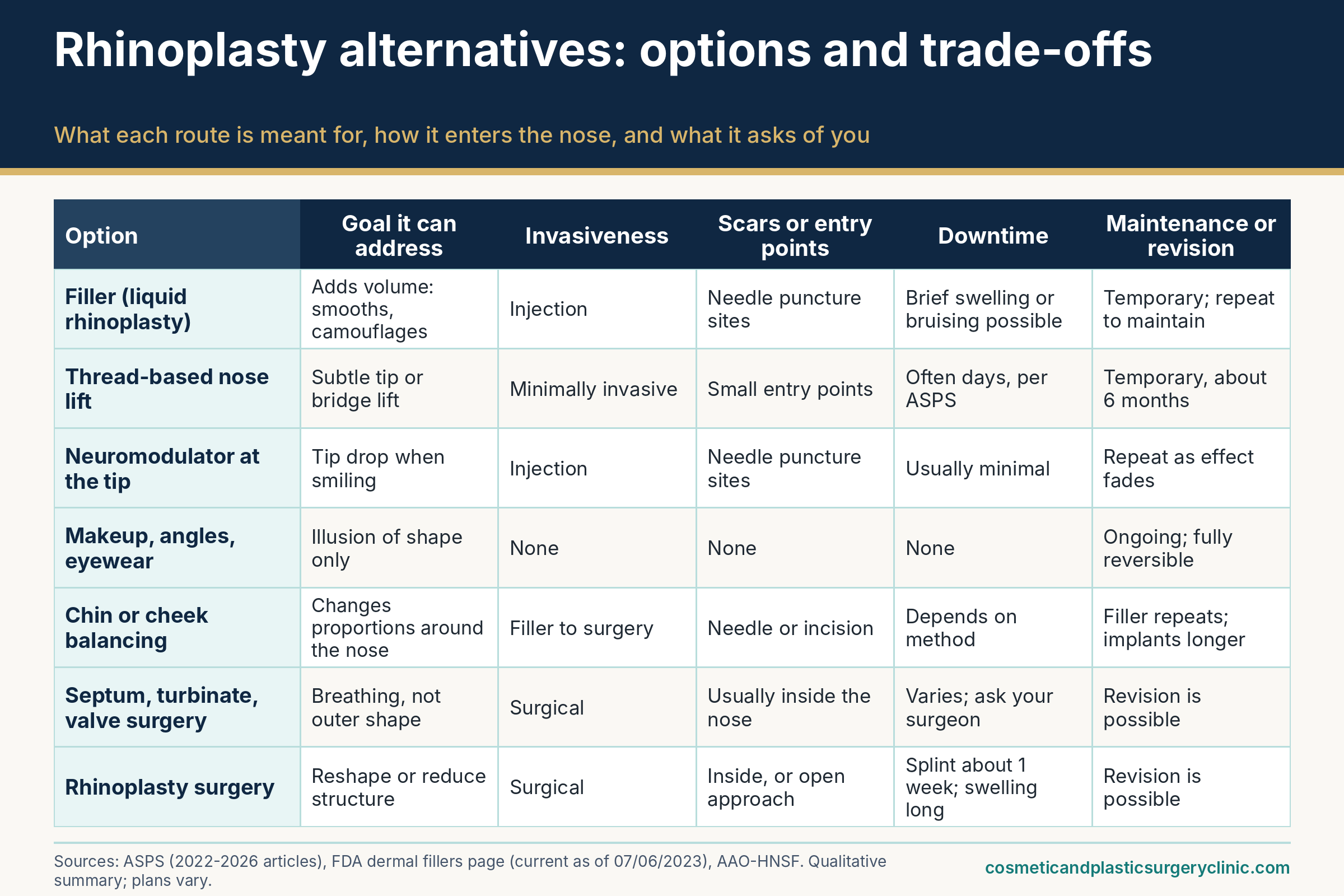
That framing sorts the alternatives quickly. Anything injected adds volume. Anything lifted with a thread repositions soft tissue slightly. Makeup and photography change perception without changing anatomy. Only surgery removes or restructures. The table below puts those relationships side by side. It is a general map, not a plan for any individual nose, and the “possible” entries describe approaches that clinicians discuss, not promises that they will work.
| Concern | Kind of change it needs | Nonsurgical approaches discussed | Surgical approach | Main limit of the nonsurgical route |
|---|---|---|---|---|
| Dorsal hump | Reduce, or camouflage | Filler placed above and below the bump to smooth the profile | Lowering the hump | Does not remove the bump; can make the nose look larger overall |
| Low or flat bridge | Add height | Filler; threads for subtle definition | Grafting or implant-based augmentation | Temporary; added volume is absorbed over time |
| Wide or bulbous tip | Reshape cartilage, reduce bulk | Limited; filler can add definition but not narrow | Tip refinement | Cannot reduce width; may widen if overfilled |
| Drooping tip | Rotate or support the tip | Filler, threads, or neuromodulator for tip drop on smiling | Tip rotation and support | Evidence is limited; effects are modest and temporary |
| Nose looks large for the face | Reduce size or rebalance proportions | Chin or cheek treatment; makeup; camera habits | Overall reduction | Nothing injected makes a nose smaller |
| Asymmetry or crookedness | Straighten structure | Filler can camouflage mild contour differences | Reshaping bone, cartilage, septum | Cannot straighten a deviated structure |
Why “add” versus “remove or reposition” is the dividing line
The single most reliable rule in this topic is that fillers add volume. An ASPS article on liquid rhinoplasty published in 2026 states it directly: because filler adds volume, it can refine contours and create the illusion of a straighter profile, but it cannot make the nose smaller. A 2024 review of nonsurgical rhinoplasty in the journal Plastic and Aesthetic Research says the same thing in nearly the same words, adding that fillers cannot straighten a deviated septum or realign the nasal pyramid.
Camouflage is the mechanism worth understanding. When a clinician places filler at the low point just above a bump (the radix, near the eyebrows) and just below it, the profile line from forehead to tip looks straighter even though the bump is unchanged. The result is an optical effect created by contrast. The cost of that trick is that the nose gets a little bigger in absolute terms, and for a nose that already feels too large, the trade can defeat the purpose.
Skin matters here as well. Thick, oily, or less elastic skin tends to blur small structural changes, while thin skin shows every contour and edge. That is one reason ASPS ties results to skin and expertise, and it helps explain why two people with the same stated goal can be steered toward different options. A clinician who recommends filler for one person and surgery for another is not being inconsistent; the soft tissue envelope is part of the decision.
A practical way to use this idea before a consultation: write your concern as a verb. “I want it reduced” points toward surgery. “I want it lifted a bit” or “I want a straighter line from the side” opens the nonsurgical conversation. “I want to breathe better” is a separate track entirely, covered next. Putting the goal in your own words also makes it easier to notice when a proposed plan does not actually address it.
Functional Goals: Breathing Is a Different Problem
Septum, turbinates, and nasal valve: where breathing trouble usually sits
Nasal obstruction has its own anatomy. The septum is the wall of cartilage and bone dividing the two nasal passages. The turbinates are shelf-like structures along the side walls that warm and humidify air and can swell. The nasal valve is the narrowest part of the airway, behind the nostril, and can narrow or collapse when its supporting cartilage is weak or has been altered. The American Academy of Otolaryngology–Head and Neck Surgery Foundation (AAO-HNSF) notes that roughly 80 percent of people have a septum that sits off-center, which is why a visible deviation alone does not establish that something is wrong.
The surgical vocabulary follows the anatomy. Septoplasty straightens or repositions the septum and, according to AAO-HNSF patient information, is typically performed through the nostrils without external bruising, often taking in the neighborhood of an hour to an hour and a half, and sometimes combined with rhinoplasty or sinus procedures. Turbinate reduction lessens the bulk of enlarged turbinates. Spreader grafts, an ASPS article explains, are cartilage grafts that help keep the internal valve open. When breathing surgery and shape surgery are done together, the combined operation is called septorhinoplasty.
Because these are different problems with different fixes, a cosmetic alternative cannot stand in for them. Filler does not straighten a septum. A thread lift does not shrink a turbinate. ASPS specifically lists significant structural issues and breathing problems among the reasons a thread-based nose lift is not suitable. If the reason you are thinking about changing your nose includes trouble breathing, the most useful first step is an examination that looks at function, not a search for cosmetic substitutes. The companion guide on alternatives to septorhinoplasty covers the options for that specific combined operation.
Guidelines also lean toward trying conservative measures first. A 2015 AAO-HNSF clinical consensus statement on septoplasty describes the indication as persistent nasal obstruction with septal deviation after a trial of conservative treatment, including over-the-counter medication and steroid nasal sprays, and recommends relying on symptoms and examination rather than imaging alone. The point for readers is that “alternatives” in the breathing context often means medical treatment tried before surgery, which a physician decides based on an exam.
When cosmetic and functional goals overlap
Cosmetic and functional goals are tangled more often than people expect. Narrowing the nose or removing a hump can change internal dimensions. ASPS notes that narrowing the nose during hump removal, which involves breaking and repositioning bone, can impair or restrict airflow. Surgeons manage this with techniques such as spreader grafts. The reverse also happens: an operation done mainly to restore breathing can change the outside slightly, and external nose shape change is listed among septoplasty’s possible effects by AAO-HNSF.
The overlap matters when comparing alternatives, for two reasons. First, someone with a mild cosmetic goal and a quiet breathing problem might assume a filler session is the lowest-commitment path, when a few minutes of airway evaluation could change the picture. Second, a nonsurgical treatment could, in principle, interact with breathing. The 2024 review of liquid rhinoplasty lists internal valve support as a use that clinicians have explored, but also describes complications such as vascular compromise. Anything placed near the valve deserves a conversation about both the possible benefit and the possible trade-off.
Insurance sometimes enters at this point. ASPS says that when rhinoplasty addresses a breathing problem from airway obstruction, it may be considered reconstructive and may be covered by insurance, though coverage depends on documented examination findings and prior authorization from the insurer. Cosmetic reshaping generally is not covered. If both goals exist, ask the office how a plan would be itemized and documented, and what the insurer would require. The rhinoplasty cost guide goes deeper on fees and financing.
Finally, sequencing is a legitimate topic. Some people address breathing first and revisit appearance later; others combine both so they recover once. Neither is universally better. What you want is a clinician who explains why they propose a given sequence, and who is willing to say plainly which parts of your concern an alternative would leave untouched.
Nonsurgical Rhinoplasty With Injectable Filler: What It Is and What the FDA Says
Injectable filler is the best-known of the rhinoplasty alternatives, and it is the one most often described in marketing as quick and low-commitment. Both of those descriptions are partly true. It is also the option where the regulatory picture and the safety picture deserve the most careful reading, so this section separates the practical questions from the regulatory ones.
What Liquid Rhinoplasty Is and What It Can Change
How filler reshapes the look of the nose
Liquid rhinoplasty, also called nonsurgical rhinoplasty or the “nonsurgical nose job,” uses dermal filler injected in small amounts at chosen points on the nose to change its contours. In most discussions the product is a hyaluronic acid (HA) filler, a gel made from a sugar-based molecule that occurs naturally in skin and that the body gradually breaks down. ASPS describes the treatment as using injectable filler to smooth uneven areas and add subtle shape, performed in minutes rather than hours.
The injector is working with a small canvas. Typical aims include smoothing a small irregularity, filling a dip beside a bump, adding height at the top of the bridge, supporting a tip that sits low, or increasing the angle between the nose and upper lip. ASPS lists smoothing dorsal humps, enhancing tip projection and definition, improving symmetry, creating a straighter-looking profile, and adding volume to a low bridge as the changes people seek. A 2024 review adds correction of irregularities that remain after earlier surgery to that list.
Because the injected gel sits on top of existing structures, the outcome is the sum of two things: what was there and what was added. Soft tissue thickness, the position of the bump, the shape of the tip, and the person’s resting expression all influence how a given amount of filler reads in a mirror and in a photograph. Small changes in volume can look large on a small feature, which is one reason experienced injectors describe a conservative approach as standard. The article on natural-looking liquid rhinoplasty looks at what subtle actually means in practice.
It also helps to understand that “reversible” has a specific meaning here. Hyaluronic acid filler can be dissolved with an enzyme called hyaluronidase, which is not true of every filler material. That is part of why HA products dominate in this area, and it is why a person considering the treatment should ask which product is planned and whether it can be dissolved.
What it can and cannot do
ASPS says liquid rhinoplasty suits people who want subtle contour refinement with goals that can be reached by adding volume, and also some people who cannot have surgery for medical reasons. The same ASPS article draws the boundary clearly: filler cannot make the nose smaller. The 2024 review states that fillers are not reductive, cannot straighten a deviated septum, and cannot realign the nasal pyramid, and it notes that patient satisfaction tends to be higher when the self-rated defect is less severe.
In plain terms, the more a goal depends on removing or moving tissue, the less filler can offer. A person who wants a visibly smaller nose, a markedly narrower tip, or a much straighter structure is asking for something the material cannot do. A person who wants a slightly smoother side profile and accepts that the nose may be a bit fuller is asking for something the material can approximate. Those two people may sit in the same chair and need different conversations.
Breathing is another boundary. The 2024 review mentions internal valve support among uses clinicians have explored, but nothing in the ASPS or FDA material treats filler as a treatment for breathing difficulty, and a deviated septum remains a structural problem that filler cannot correct. Anyone with blocked breathing should have that evaluated separately, and any filler plan should consider whether additional volume near the airway could matter.
The table summarizes the practical boundaries. Treat it as a checklist for questions rather than a prediction. Whether a given nose can safely and attractively accept filler is a clinical judgment, and the answer may well be no.
| Goal | Can filler influence it? | Why | What to ask |
|---|---|---|---|
| Smoother profile near a small bump | Possibly, as camouflage | Filler fills the dips around the bump; the bump remains | Will the nose look larger from the front? |
| More height at the top of the bridge | Possibly | Adds volume where bridge is low | How much height is realistic with my skin? |
| Tip definition or projection | Possibly, modestly | Volume can support the tip but adds fullness | What are the risks at the tip specifically? |
| Smaller nose or narrower tip | No | Filler only adds; it cannot reduce tissue | Would another approach address this? |
| Crooked or deviated nose | Mild contour camouflage only | Structure is not moved | Is the crookedness structural or a surface contour? |
| Blocked breathing | No reliable role | Airway problems are structural or mucosal | Should an ENT or surgeon examine my airway first? |
Regulatory Status, Safety, and Why the Nose Is Treated as High-Risk
What the FDA says about filler in the nose
The FDA describes dermal fillers as medical device implants approved to help create a smoother or fuller appearance in the face. Its dermal filler page lists approved uses that include the nasolabial folds, the cheeks, the chin, the lips, perioral lines around the mouth, and the backs of the hands. The page also has a section on unapproved uses and names the glabella (the area between the eyebrows), the nose, the area around the eyes, the forehead, and the neck, stating that these uses are not approved by the FDA. At the time of this research cut, the page showed content current as of July 6, 2023.
It helps to be precise about what that does and does not mean. Approval and clearance relate to what a manufacturer has shown for a specified, labeled use. Using an approved product for a purpose that is not in its labeling is called off-label use. In general, off-label use is a decision a clinician and patient can make, and it occurs across many areas of medicine, but it means the FDA has not reviewed the evidence for that particular use. Saying that filler in the nose is off-label is therefore accurate and neutral; it is not the same as saying it is illegal or that every injector who does it is acting improperly. It does mean the patient is relying on the individual clinician’s training and judgment more than on regulator-reviewed evidence for this site.
The FDA’s patient advice is short and worth repeating. It recommends seeking a licensed health care provider with experience in dermatology or plastic surgery, warns against injecting yourself or buying filler online, asks people to report problems through the MedWatch program, and advises getting medical attention immediately for vision changes, skin discoloration, or signs of stroke. It also notes that because some fillers are absorbed over time, patients may need to repeat treatment. More on the regulator’s framework is in the guide to dermal filler FDA status and safety questions.
For readers comparing alternatives, the practical takeaway is not to avoid the topic but to treat the nose as a special case. A clinician who is comfortable with filler in the lips or cheeks is not automatically positioned to work in the nose, and a reasonable consultation includes a direct discussion of the off-label status, the specific risks, and the plan if something goes wrong.
Vascular occlusion, skin necrosis, and vision loss
The FDA calls the most concerning risk of dermal fillers unintentional injection into a blood vessel, which can block the vessel. The consequences it lists include vision abnormalities including blindness, stroke, and necrosis, meaning death of skin or other tissue, along with infection, allergic reaction, and filler migration. In the nose, the blood supply is dense and small vessels connect with arteries that reach the eye region, so a misplaced injection has fewer places to be harmless. ASPS describes the nose as a higher-risk area because of its vascular anatomy and says that accidental injection into a blood vessel can lead to skin loss or, in rare cases, blindness.
The numbers are worth stating carefully. A 2024 review in Aesthetic Surgery Journal by Doyon and colleagues collected 365 newly published cases of vision loss after filler injection between September 2018 and March 2023 and combined them with 146 earlier cases, for 511 cases published across more than a century. The nose was the single most common injection site in the series, accounting for roughly four in ten of the newer cases, and hyaluronic acid was the filler involved in about 80 percent of the newer cases that reported the product. In that series, vision recovered fully in 6.0 percent, partly in 25.8 percent, and not at all in 68.2 percent, and better initial vision predicted better outcomes.
These figures describe published case reports, not how often the problem occurs per treatment. Because the denominator, the number of nasal filler procedures performed, is unknown, this kind of data cannot be turned into an individual risk percentage, and it would be a mistake to try. The authors call blindness from filler rare. What the case series does show is where, when it happens, the nose is over-represented, and that outcomes after vision loss are often poor. That is the reason the nose is described as high-risk even though serious events are uncommon.
Hyaluronidase deserves a calm explanation. It is an enzyme that breaks down HA, and a 2021 guideline in the Journal of Clinical and Aesthetic Dermatology describes it as the emergency intervention used when filler has entered a blood vessel, and ASPS says nasal filler should be done only where reversal medication is immediately available. The same guideline notes that, in the United States and United Kingdom, using hyaluronidase to dissolve cross-linked HA filler is outside its labeled indications. And it does not eliminate every risk. The Doyon review found that none of the commonly used treatments, including subcutaneous hyaluronidase, was significantly associated with vision improvement in the cases analyzed. Skin necrosis and other injuries may also not be fully reversible once tissue has been deprived of blood. Dissolvability is a safety net with holes, not an assurance. For a broader look at complications, see the guide to dermal filler risks and complications.
Threads, Neuromodulators, Optics, and Facial Balancing: The Less Obvious Alternatives
Filler gets the headlines, but several other approaches sit alongside it. Some change the nose in a small way, some change how the nose is perceived, and some change the face around it. They differ a great deal in how much evidence supports them, and that variation is worth stating openly.
Threads and Neuromodulators: Evidence-Careful Notes
Thread-based nose lifts
A thread-based nose lift uses dissolvable sutures, commonly made of polydioxanone (PDO), placed under the skin through a needle or cannula to lift, define, or slightly reshape the nose. An ASPS article published in 2025 explains that the threads may stimulate collagen as they dissolve, which is thought to support the new shape. The same article says the approach can offer subtle improvement in tip projection and bridge definition and may help with mild tip drooping, while stating that it will not reduce a hump, narrow wide bones, or permanently reshape cartilage.
ASPS says results last about six months, similar to other PDO threads, and that most people return to normal activity within one to three days after the procedure, with minor swelling, redness, tenderness, and mild bruising. It suggests avoiding rubbing the nose and avoiding pressure from eyeglasses for one to two weeks. The complications it names include threads that work their way out through the skin (extrusion), tracks of scar tissue, and infection. It describes the technique as unsuitable for significant structural problems such as a large hump or a crooked nose, for breathing problems or a deviated septum, and for people who want permanent results.
The evidence base is where caution comes in. A 2025 systematic review in Dermatologic Surgery covering absorbable facial thread lifts, based on 12 studies and 818 participants, found short-term improvement across aesthetic scales and described serious complications as unlikely, but also concluded that long-term efficacy data are lacking, with the longest follow-up being two years. That review concerns facial lifting, not the nose specifically, and it does not mean nasal threads have been equally studied. This article could not confirm FDA labeling that specifically covers threads for use in the nose, and readers should ask any provider which product is being used, what the product is cleared for, and whether the nasal use is off-label.
In practice, then, threads are best understood as a modest, temporary, lightly studied option for mild tip or bridge definition in someone without structural or breathing concerns. They are not a stand-in for reduction, and because they are placed under the skin, the question of what happens if the effect disappoints or the thread causes irritation is worth asking before the first appointment.
Botulinum toxin for a tip that drops when you smile
Some people notice that the tip of the nose moves downward when they smile or talk. A muscle called the depressor septi nasi pulls the tip and the base of the nasal septum downward, and injecting a small amount of botulinum toxin into it has been proposed as a way to reduce that motion and give the tip a slightly more lifted appearance. This is a movement-related concern rather than a structural one, and it is the only nasal concern in this guide that a neuromodulator addresses at all.
The published evidence is thin. A 2013 study in Clinica Terapeutica by Cigna and colleagues compared 40 people, half receiving botulinum toxin and half placebo injected into the depressor septi nasi, measured changes at baseline and at 7, 15, and 30 days, and reported an increase in the distance between the columella and the upper lip in the treated group. Its authors concluded the approach is a quick, targeted option for people with a plunging tip who do not need rhinoplasty. That is a small study with a follow-up of about a month, and it cannot tell readers how long the effect lasts, how it compares with other approaches, or how it performs in different noses.
Regulatory status matters here as well. The prescribing information for BOTOX Cosmetic, revised in October 2024, lists its indications as temporary improvement of moderate to severe glabellar lines, lateral canthal lines, forehead lines, and platysma bands. The nose is not among them, so using it to lift the nasal tip is off-label. The label also carries a boxed warning about distant spread of toxin effect. Other neuromodulator products have their own labels, and none of this was checked product by product for this article.
A fair summary is that a toxin tip lift is a low-volume, temporary approach for a specific dynamic concern, supported by limited evidence, and not a substitute for structural change. It also wears off, so it becomes an ongoing maintenance decision, which the article on how long liquid rhinoplasty lasts discusses for filler and which follows a similar pattern for any temporary treatment.
Optics and Facial Balance: Changing the Frame Instead of the Nose
Makeup contouring, camera angles, and eyewear
Many people who ask about alternatives are reacting to how their nose looks in a particular setting, often a phone camera or a video call. ASPS reported in 2023 that, in a surgeon’s words, patients are coming in more often than not because they do not like their appearance in selfies or on social media. That observation points to a lower-stakes lever: how the nose is captured.
A study by Ward and colleagues in JAMA Facial Plastic Surgery in 2018, titled “Nasal Distortion in Short-Distance Photographs: The Selfie Effect,” examined how close-range photography changes the apparent size of the nose compared with photographs taken from farther away. Later letters to the journal raised questions about the study, and this article did not open the original paper, so it does not repeat specific percentages. The general optical principle, that a camera held near the face exaggerates the features closest to the lens, is widely understood in photography. Holding the phone farther away, using the rear camera, or using a longer focal length setting changes the proportions in the image without changing the face.
Makeup contouring uses shading and highlighting to suggest a narrower bridge or a more defined tip. It is temporary, reversible, and carries essentially no medical risk beyond skin irritation or product reactions, which makes it a useful low-stakes way to explore what a different nose line would feel like. There is little formal research on it, so the honest description is that it is a cosmetic styling tool rather than a clinical treatment. Lighting works similarly, since overhead light and flash flatten the face while side light adds depth.
Eyewear is a practical consideration in both directions. Frame shape, bridge width, and nose-pad position can emphasize or soften the apparent width and length of the nose. These effects are about styling, not anatomy, and no clinical evidence is cited here. The practical significance is for people planning surgery or thread treatment, since ASPS advises limiting pressure from glasses for a period after a thread lift, and surgeons commonly give instructions about eyewear during healing.
Facial balancing with the chin and cheeks
The nose is judged in relation to the rest of the face, especially the profile. ASPS states that the size of the chin may magnify or minimize the perceived size of the nose, and that chin procedures are often suggested alongside rhinoplasty to improve the balance of the chin, jaw, cheeks, and forehead. A small or recessed chin can make a nose appear larger by contrast, and a stronger chin may make the same nose look more proportionate. That is an optical relationship, not a change to the nose.
The ASPS chin surgery page describes two broad surgical approaches, placing a shaped silicone implant on the bone or moving the jawbone’s chin segment forward through a genioplasty, and also mentions FDA-approved gel fillers as an alternative to surgery. The FDA’s list of approved filler areas includes the chin and the cheeks, so using filler there is within labeled uses in a way that the nose is not. ASPS says that after chin augmentation, mild swelling may last a few days and most patients can return to work within about a week, though individual recovery varies. For more on these options, see the guides to chin augmentation and chin filler.
The evidence-careful point is that balancing the face is a strategy that may change how a nose is perceived, not a treatment of the nose, and the effect varies from person to person. It makes the most sense when a profile assessment suggests the chin or cheeks are contributing to the concern. It makes much less sense if the main concern is a bump, a tip shape, or breathing. Be cautious with any plan that begins with a large addition elsewhere on the face to “fix” the nose; the right question is what the whole profile needs, not what produces the quickest change in one measurement.
The table lists the indirect options side by side with what each can and cannot do. None of them modifies nasal structure.
| Approach | What it changes | What it does not change | Permanence | Evidence note |
|---|---|---|---|---|
| Makeup contouring | Visual shading of bridge and tip | Nasal structure | Washes off | Styling tool; little formal research |
| Camera distance and angle | Apparent nose size in photos | Nasal structure | Choice each time | Selfie-effect study published 2018 and debated |
| Chin filler | Chin projection and profile balance | Nose size or shape | Temporary; absorbed over time | Chin is an FDA-approved filler area |
| Chin implant or genioplasty | Chin position and projection | Nose size or shape | Longer-lasting; surgery | ASPS links chin size to perceived nose size |
| Cheek filler | Mid-face fullness and contour | Nose size or shape | Temporary | Cheeks are an FDA-approved filler area |
Surgical Rhinoplasty Alternatives and Narrower Operations: When the Answer Is Still an Operation
For some goals, the alternative to a full rhinoplasty is a smaller or differently targeted operation, not a nonsurgical treatment. For others, the nonsurgical route is a temporary step that makes the later surgical decision better informed. This section covers both, along with revision considerations and the people who may still end up needing surgery.
Functional Surgery and Limited Procedures
Septoplasty, turbinate reduction, and valve repair without reshaping the outside
If the reason for considering a nose job is mostly breathing, a functional operation may address it without a plan to change appearance. Septoplasty targets the septum. AAO-HNSF patient information describes it as usually done through the nostrils without external bruising, with deviated portions removed or repositioned, and lists risks that include anesthesia complications, bleeding, infection, septal perforation, numbness, and, rarely, cerebrospinal fluid leak. The same page notes that the shape of the outside of the nose can change as an effect of the surgery, which is worth raising in a consultation if you want the exterior to stay as is.
Turbinate reduction and nasal valve procedures are separate decisions. ASPS describes turbinectomy as reducing turbinate bulk to increase airflow and spreader grafts as cartilage grafts that keep the internal valve open. Which of these, if any, is reasonable depends on an examination, usually including looking inside the nose with a small scope. The 2015 AAO-HNSF consensus statement says endoscopy is recommended in most cases, and that imaging such as a CT scan is not a necessary step simply to document a deviated septum.
Insurance often treats these operations differently from cosmetic surgery. ASPS says that rhinoplasty performed for breathing impairment from airway obstruction may be considered reconstructive and may be covered by insurance, with documentation and prior authorization needed. That does not mean coverage is automatic or that every plan follows the same rules. A reasonable question for the surgeon’s office is how they document functional findings and what the insurer has asked for in similar situations.
It is also worth being clear that a functional operation is its own goal, not an alternative way to get a cosmetic result. Someone who wants both an easier airway and a different profile is describing a combined operation, septorhinoplasty, and the question becomes whether to do one or both. The guide on alternatives to septorhinoplasty compares those paths in more detail, including medical management that may be tried first.
Targeted cosmetic surgery, and who may still need a full rhinoplasty
Surgery is not all-or-nothing. A rhinoplasty can be extensive or conservative, and the plan should follow the problem. ASPS describes the modern approach as “less is more,” respecting the nose’s unique healing pattern, and says that changes should fit the face and preserve function. In some situations, the goal is limited to one region, such as the tip or the nostril base, and the operation reflects that. In others, the structure underneath is the issue and a limited operation would leave the main concern in place.
The incision approach is another variable. ASPS patient information describes closed rhinoplasty as using incisions inside the nose only, and open rhinoplasty as adding an incision along the bottom of the nose, across the narrow strip of tissue between the nostrils (the columella). Which approach suits a given nose is a technical decision. The overview of rhinoplasty techniques explains how approaches differ and why surgeons choose among them.
Who may still need surgery? Based on the limits described above, people whose primary goals fall into any of these groups are unlikely to be well served by an injectable or thread-based alternative: wanting the nose to be smaller or narrower; wanting a hump removed rather than disguised; having a notably deviated or crooked structure; having breathing problems that stem from structure; wanting a permanent change; or having asymmetries that extend into the bone and cartilage. None of this is a diagnosis. It simply tracks the mechanism: reduction, straightening, and permanent structural change are things only surgery does.
A further group is people for whom previous filler or other treatment has changed the tissue, and for whom the sensible next step is surgical. A clinician will want to know what was injected, when, and where, because remaining filler or scar tissue can affect surgical planning. Being open about prior treatments is part of the safety conversation, not a confession. If you are early in thinking about surgery itself, the guide to rhinoplasty candidacy and timing explains the factors surgeons typically weigh.
Staging, Trial Runs, and Revision
Using a temporary option first, or surgery first
One of the more appealing features of filler is that it can act as a preview. ASPS reported in 2023 that patients value nonsurgical rhinoplasty partly because it avoids downtime and lets them try changes before committing to surgery. There is a sensible logic to this: if a modest volume change in the bridge feels right in the mirror and in photographs, that tells you something about your preferences. If it feels wrong, you learn that without an irreversible step.
The preview idea has limits. A filler preview shows what adding volume looks like. It does not show what removing a hump or narrowing a tip would look like, because those are different changes. A person who tries filler to “see” a surgical result can end up misjudging, in either direction, how a reduction would appear. Computer imaging in a surgical consultation has similar limits: it shows a possibility, not a promise, and it should not be treated as a contract about the final shape.
Staging can also run the other way. Some people have surgery first and use small amounts of filler later for minor irregularities. The 2024 literature review lists post-rhinoplasty deformities among the uses of filler, and in that situation the filler is a refinement, not an alternative. Whether it is appropriate depends on the timing and the state of healing, since swelling after surgery can take a long time to settle. ASPS describes final results as taking one to two years, with the tip staying swollen longest, especially after open rhinoplasty. Treating a nose that is still changing can make it hard to tell what is swelling and what is shape.
Questions to put to a clinician about staging: What would this step teach me? What would it rule out later? How long should I wait between steps? If I later choose surgery, will any earlier filler change the plan? Good answers are specific rather than reassuring. The article on rhinoplasty recovery helps in estimating how long each stage tends to take.
Revision considerations and what alternatives cannot undo
ASPS lists the need for revision surgery and unsatisfactory nasal appearance among the possible rhinoplasty complications, and difficulty breathing is on the same list. A person who already had a nose job and is unhappy is not choosing between surgery and no surgery; the question is how to approach a nose that has already been altered. Options include waiting while swelling settles, small injectable corrections for minor contour irregularities, and revision surgery. The guide to revision rhinoplasty covers when a second operation may be considered and how it differs from a first.
Alternatives interact with revision in a particular way. The more a nose has been altered, the more important it is to understand what remains: scar tissue, grafts, thinner skin, or weakened support. Filler in this setting is typically discussed for small, well-defined irregularities rather than for structural problems. The vascular concerns described earlier still apply, and some clinicians consider scarred tissue a special concern for injection, so discussing this directly with an experienced clinician is essential. This article could not verify specific statistics on that point, and it makes no claim about relative risk.
A word on what alternatives cannot undo. A filler that has been dissolved leaves the nose as it was, but a thread that has been placed or a surgery that has been done cannot simply be rewound. Surgery changes structure, and revision is a new operation with its own risks and recovery. When a choice cannot be reversed, the case for taking extra time grows. This is the stronger form of the argument for trial and staging: it is not that surgery is bad or that alternatives are safe, but that permanence deserves a longer look.
Finally, set expectations about “touch-ups.” A small residual irregularity after surgery does not always mean a revision is needed, and injecting a nose that is still healing may not be wise. Patience, a clear photographic baseline, and a surgeon who agrees on what counts as a problem are better guides than a calendar. If revision is on your mind, the page on alternatives to revision rhinoplasty explores the choices in that specific situation.
Accepting, Waiting, and Keeping Your Own Features: The Alternatives That Involve No Treatment
Doing nothing, or doing nothing yet, is a legitimate option that rarely gets space in articles written around procedures. It is also the only alternative with no medical risk. This section treats it as a real choice and looks at how cultural identity, social media, and personal timelines shape that choice.
Waiting as a Deliberate Choice
Reasons a pause can be the right move
Several situations make a pause sensible. The first is that the concern is recent. If it started after a particular photo, a comment, a filter, or a run of video calls, it may be worth seeing whether it fades on its own. ASPS noted in 2023 that patients often arrive because they dislike how they look in selfies or on social media, and a surgeon quoted in that piece cautioned that small nasal maneuvers done inappropriately can have serious cosmetic and functional consequences. A concern shaped mainly by a screen may be better addressed by changing the screen habits first.
The second situation is a nose that is still changing. Injury, a recent procedure, or ongoing healing can alter the shape, and treating it too early can mean treating a moving target. ASPS describes the swelling after rhinoplasty as taking one to two years to resolve fully, with the tip being the slowest to settle. A similar principle applies after any trauma: shape in the first weeks and months is not necessarily shape in the long run.
A third situation is life logistics. Surgery needs recovery time away from some activities; even minor treatments need planning around events. The ASPS recovery article says most patients take about a week off work, avoid strenuous exercise for at least six weeks, and have the splint and sutures removed in the first week, with under-eye bruising mostly resolving by the one-week point. If a wedding, a job change, a pregnancy, a move, or a major deadline sits on the calendar, waiting is a scheduling decision as much as a medical one, and the guide to rhinoplasty recovery planning is useful for mapping it out.
Waiting does not mean ignoring a problem. If the concern is breathing, bleeding, pain, or an injury, a pause is not the answer, and an examination is. If the concern is purely about appearance, a deliberate pause with a defined review date turns indecision into a plan. Many people find that writing down the concern, the date, and what would make them proceed helps separate a stable preference from a passing reaction.
Checking the motivation before changing anything
A few reflection questions can be more useful than any treatment comparison. Would the concern remain if no one photographed you? Is it about one feature, or has it grown into something that occupies a lot of your day? Who else would notice the change, and does their opinion matter to your decision? Is there a specific feature you would keep unchanged? What would you expect to feel differently after the change, and is that expectation something a nose can deliver?
None of these questions has a right answer. They are tools for hearing yourself clearly. Surgeons and injectors vary in how much they discuss motivation, and it is reasonable to expect a thoughtful consultation to include some of it. A clinician who moves straight from your first sentence to a price quote has skipped something that matters.
If the distress about your nose feels out of proportion to how others perceive it, or if it is persistent, interferes with daily life, or does not ease after a change, it may help to speak with a primary care clinician or a mental health professional before any procedure. This is not a suggestion that your concern is imagined or that wanting a change is a symptom. It is an acknowledgment that appearance concerns sometimes track with anxiety or mood, and that support for those can coexist with decisions about the nose. A good surgeon will not be offended by the question.
Finally, remember that facial asymmetry is ordinary. The ASPS rhinoplasty overview points out that everyone’s face is asymmetric to some degree, which means that exact symmetry may not be achievable and may not be what looks natural. Noticing small differences in the mirror is common. What matters for decision-making is whether the difference is something you want to change after considering its costs, and not whether it exists.
Cultural Identity, Heritage Features, and Respectful Goals
Preserving identity is a valid goal
People’s noses reflect family, ancestry, and community, and many people want a change that leaves those connections visible. Others want a bigger change. Both are legitimate. This guide does not assume that any nose shape needs correcting, and it does not describe any group’s features as a problem to be fixed. When a plan is described as “natural-looking,” the useful question is: natural to whom, and in relation to which features?
Words like “refined” or “ideal” carry assumptions that deserve scrutiny. A clinician who shows a single template to every patient may be steering toward a standard that has little to do with your face. A better pattern is a plan that starts from your existing proportions and asks which specific elements you want to keep, soften, or adjust. Saying “I want to keep this” is as valid an instruction as “I want to change that.”
Anatomy does vary between people, including skin thickness, cartilage strength, and nasal tip shape, and these variations affect which techniques make sense. This guide deliberately avoids generalizations about particular populations, because the sources reviewed here do not support sweeping statements and individual variation is large. What a reader can do is ask any clinician how many noses similar to theirs they have worked on, how they approach skin and cartilage differences, and how they will check that the result still looks like the same person. The page on natural-looking rhinoplasty discusses what subtle results mean across different goals.
The same principle applies to nonsurgical choices. Adding volume to a bridge can change the face’s character as much as removing a hump. Reversible does not mean inconsequential in terms of how you feel looking at yourself. If preserving a family resemblance matters, it belongs in the first sentence of the consultation, not an afterthought.
Handling pressure and sales tactics
Pressure shows up in consultations in subtle ways. A coordinator might suggest that the “special” price is available only for the day. A provider might propose add-ons that were not part of your goal. A before-and-after gallery may present exceptional results as typical. Social media may feed the impression that everyone has had something done. None of this reflects on your decision, and you are entitled to slow down.
A dramatic testimonial or an exceptional before-and-after photo shows what happened to one person; it does not establish what is typical. In a consultation, that principle translates into questions: What is typical? What is the range? Are the photos from patients with noses like mine? How were they taken? Were they altered? A clinician confident in the work will usually answer without defensiveness.
Imaging software deserves its own caution. Morphed images can help communicate preferences, but they are not a forecast. If a consultation includes them, treat them as a vocabulary tool: “I like the profile line in this one, but not the tip rotation in that one.” Avoid choosing a clinician because they showed you the most appealing digital result. Ask what the image does and does not account for, such as skin thickness and healing.
You can end a consultation without booking. Taking written notes, asking for the plan, the products, and the total in writing, and leaving to think it over is normal. A second opinion from a clinician with a different specialty background, such as one from facial plastic surgery and one from plastic surgery, may clarify differences in approach. If anyone refuses to put key details in writing, discourages a second opinion, or minimizes the risks you ask about, consider that information about the practice.
Comparing Downtime, Risk, Longevity, and Cost Across the Options
Once you have narrowed down which options fit your goal, the next layer is comparison. The tables in this section are qualitative on purpose. Published figures for downtime and complications vary by study and by definition, and there is no single authoritative dataset that compares all of these options head to head, so this guide describes what the sources state and flags where they stay silent.
Healing, Maintenance, and Risk Side by Side
Downtime and maintenance
Downtime is the most visible difference between the options, and the most easily misjudged. Injectable and thread-based treatments are generally described as involving little time away from routine activity, and surgery involves more. But “little” is not “none,” and it helps to look at the specific sources. ASPS says people who have a thread-based nose lift commonly return to normal activity in one to three days, with minor swelling, redness, tenderness, and mild bruising for a time. ASPS describes liquid rhinoplasty as appealing to those who want subtle changes without much downtime, but does not itemize recovery in the article reviewed here.
For surgery, ASPS describes sutures and the splint being removed within the first week, under-eye bruising largely resolving by around one week, about half of swelling resolving by six weeks, and the final appearance taking roughly one to two years, with most patients taking about a week off work and avoiding strenuous exercise for at least six weeks. Those are general descriptions that vary by person and by technique.
Maintenance is the other half of the downtime picture. A treatment that needs minimal downtime but is repeated every several months adds up to repeated appointments over the years. ASPS says liquid rhinoplasty results typically last six months to one year, and a 2024 review describes a typical duration for many classic HA fillers of three to twelve months, with newer products reaching one to three years. ASPS says thread-based results last about six months. Neuromodulator effects are temporary, but the nasal-tip study reviewed above followed participants for only about a month, so no duration for this use can be taken from it.
The table brings these together with a column on reversibility, a feature that influences how much trial-and-error is reasonable. It reports qualitative descriptions drawn from the sources cited, and it should be read as a map of questions, not a forecast for a given person.
| Option | Healing and activity limits | How long the effect lasts | Reversibility |
|---|---|---|---|
| HA filler in the nose | Brief swelling or bruising possible; activity limits set by the injector | Often months to about a year; some newer products longer | HA can be dissolved with hyaluronidase; other filler types cannot |
| Thread-based nose lift | Normal activity often within one to three days; avoid rubbing and glasses pressure for one to two weeks | About six months, per ASPS | Absorbs over time; extruding threads may need removal |
| Neuromodulator at the tip | Minimal; clinician instructions apply | Not established in the nasal study reviewed | Wears off; cannot be actively reversed |
| Chin filler | Depends on product and injector | Temporary; absorbed over time | HA types can be dissolved |
| Chin augmentation surgery | Mild swelling for days; most return to work within about a week, per ASPS | Long-lasting; implant or bone repositioning | Surgical removal or revision needed |
| Septoplasty and related surgery | Varies with extent and combined procedures | Intended to be long-lasting | Revision possible; not simply reversible |
| Rhinoplasty | Splint and sutures out in week one; about a week off work; no strenuous exercise for six weeks or more | Intended to be long-lasting; swelling settles over one to two years | Revision possible; not simply reversible |
Risk context across the options
Risk comparisons deserve more caution than downtime comparisons, because the numbers behind them are weaker. This guide does not offer complication percentages across options, since the available figures come from different kinds of studies, use different definitions, and cover different populations. What can be done honestly is to describe what the sources name as risks, which are not interchangeable, and note that rarity and severity are different things.
For filler in the nose, the sources named earlier describe a range from minor effects like redness, bruising, nodules, and visible bluish tint, to infection, vascular compromise, and blindness. The 2024 review in Plastic and Aesthetic Research reports an overall complication rate of approximately 2 percent and patient satisfaction above 80 percent, but those are summary figures from a literature review and cannot capture how often rare events occur; the vision-loss literature shows that rare events can have lasting consequences. For threads, ASPS names extrusion, scar tracks, and infection. For surgery, ASPS names anesthesia risks, changes in skin sensation, difficulty breathing, infection, septal perforation, poor wound healing or scarring, the need for revision surgery, skin discoloration and swelling, and an unsatisfactory nasal appearance.
Looked at as a whole, the risk profiles differ in kind. Filler and thread risks are concentrated in local tissue and blood supply issues; surgical risks add anesthesia and a larger tissue change, with structural and functional consequences. A smaller procedure is not automatically lower in risk for every complication type; a rare vascular event from an injection can be more severe than a common minor surgical complication. Conversely, an operation carries risks that a thread or injection does not. The honest framing is that each option has a distinct risk profile, and the question is which risks you are prepared to accept, with which clinician and which safeguards.
The risk table groups the sources’ statements so that the differences are easier to see. Rarity is deliberately not graded, because the available data do not support comparing frequencies across options. For fuller treatments of specific risks, see rhinoplasty risks and complications.
| Option | Risks named in the sources reviewed | What drives the concern | Safeguard to ask about |
|---|---|---|---|
| Filler in the nose | Bruising, redness, nodules, infection, skin loss (necrosis), vascular compromise, and in rare cases vision loss | Dense small blood vessels; off-label site per the FDA | Reversal medication on hand; emergency plan; experienced injector |
| Thread-based lift | Thread extrusion, scar tracks, infection | Foreign material under thin nasal skin | Product name and labeling; removal plan |
| Neuromodulator at the tip | Product warnings include distant spread of toxin effect (boxed warning on one product label) | Off-label site; limited evidence | Which product, what dose, who injects |
| Chin or cheek filler | Same filler risk categories, in FDA-approved areas | Vascular risk exists in any filler area | Same safeguards as above |
| Septoplasty | Anesthesia, bleeding, infection, septal perforation, numbness, rare cerebrospinal fluid leak, external shape change | Surgery inside the nasal framework | Surgeon training; facility; anesthesia plan |
| Rhinoplasty | Anesthesia risks, sensation change, breathing difficulty, infection, septal perforation, scarring, need for revision, unsatisfactory appearance | Structural change to a small, complex organ | Board certification; facility; revision policy in writing |
Cost Framing and the Long Game
What goes into the cost, and what repeats
Cost comparisons between a temporary option and surgery often miss the structure of the spending. A single filler or thread session usually costs less than a surgical fee, and for that reason it can look like the cheaper path. But a temporary treatment that is repeated for years can approach or exceed a one-time surgical cost, and may have no end date. Conversely, a surgery that needs revision introduces a second set of costs that were not in the original quote. Both effects are possible. This guide does not state dollar amounts, because prices vary widely by region, clinician, product, and practice, and national averages are not local quotes.
The components differ by option. For filler, the cost typically reflects the product (how much is used), the injector’s fee, any follow-up visits, and potentially the cost of dissolving or adjusting. For threads, it reflects the product and the number of threads, plus follow-up. For surgery, ASPS notes that its published average surgeon’s fee excludes anesthesia, operating room facilities, and related expenses such as medical tests, post-surgery garments, and prescriptions, so the total can differ meaningfully from a single headline number. The article on rhinoplasty cost breaks the fee stack down.
Insurance changes the picture for functional care only. As noted, breathing-related surgery may qualify as reconstructive, whereas cosmetic reshaping and cosmetic injectables are generally paid out of pocket. Financing, if offered, adds interest or fees to the total, and it deserves the same scrutiny as the procedure itself. When comparing quotes, line up what is included, such as follow-up, touch-ups, dissolving, revision, anesthesia, facility, and complication coverage, and compare totals only when the inclusions match.
A useful exercise is to sketch your own cost timeline: initial treatment, expected maintenance for a defined period such as five years, and a contingency for adjustment or correction. The numbers will be yours, taken from written quotes, and the exercise forces the recurring costs into view. It does not decide the question, but it frequently changes which option feels reasonable.
Bridge or destination: how long the choice is meant to last
Every option in this guide can be framed as either a bridge or a destination. A bridge is temporary by design: it carries you through a period, an event, or a decision. A destination is meant to be the end state. Filler, threads, and tip injections are bridges whether or not they are presented that way, because they wear off. Makeup and camera habits are bridges that you control entirely. Surgery is intended as a destination, although revision and aging mean the nose continues to change.
The distinction clarifies a common trap, which is using a bridge as though it were a destination without planning for the long haul. Someone who chooses filler because it is reversible, then keeps repeating it for years, has effectively chosen a maintenance program, and the question becomes whether that program fits their budget, schedule, and risk tolerance in year three the way it did in month one. For filler specifically, the article on how long liquid rhinoplasty lasts examines duration and upkeep.
The opposite trap is picking a destination to escape the burden of a bridge. A person tired of repeated appointments may choose surgery to be done, and then find that surgery brought its own recovery period and uncertainties about the final shape. Neither path is wrong. What matters is that the choice matches the actual preference: a stable change with an operation behind it, or a flexible change with maintenance in front of it.
There is also the question of timing in life. Noses change with age, weight, and injury, and a result that is satisfying at one stage may be revisited later. Considering what you might want at different stages, not just the next six months, is part of the long game. Having an honest conversation with a clinician about what happens at each stage, and what keeping the status quo looks like, is a good test of whether they are guiding you or selling to you.
Choosing a Qualified Clinician and Making the Decision
With nonsurgical options, the choice of who performs the treatment can matter as much as the choice of treatment, because training, product knowledge, anatomy, and emergency readiness vary widely. With surgery, the same is true. This section covers how to verify credentials without implying that one credential is the only legitimate one, what to ask, and how to turn all of the above into a decision you can defend to yourself.
Verifying Credentials and Matching the Clinician to the Option
Board certification, licensure, and what each tells you
Start with the distinction between a license and board certification. A medical license, issued by a state, authorizes a clinician to practice. Board certification is a separate, voluntary credential that signals additional training and examination in a specialty. A licensed physician can legally perform many procedures without certification in the relevant specialty, so a license alone says little about specific training in nasal surgery or injection.
For plastic surgery, the American Board of Plastic Surgery (ABPS) offers a public search at its website to verify certification, and states that ABPS-certified surgeons have completed appropriate training and passed written and oral examinations. The ABPS page describes certification as including ongoing self-assessment and practice improvement, and notes that the American Board of Medical Specialties (ABMS) is the umbrella organization of recognized specialty boards. You can verify an ABPS credential at the ABPS surgeon verification search.
Plastic surgeons are not the only physicians who perform nasal surgery. Otolaryngologists, who are ear, nose, and throat surgeons, are certified by the American Board of Otolaryngology, which certifies physicians in otolaryngology–head and neck surgery and has a section for verifying a physician’s certification. Some surgeons additionally pursue facial plastic and reconstructive surgery credentials. The American Board of Facial Plastic and Reconstructive Surgery (ABFPRS) states that its credential requires completion of an approved residency in otolaryngology–head and neck surgery or plastic surgery, prior board certification in one of those specialties, a two-day examination, and documented experience that includes at least 100 facial plastic surgeries. It offers a Physician Finder. This article did not find a statement on the ABFPRS page about whether ABFPRS itself is an ABMS member board, so readers who care about that distinction should check it directly.
The ABMS runs a free “Is My Doctor Board Certified?” lookup through its Certification Matters website, which can confirm certification by ABMS member boards. In short: several legitimate pathways exist, and the point is to verify the specific credential a clinician claims, not to assume that one title means the same thing as another. Be wary of vague titles such as “cosmetic surgeon,” which describe a type of practice and not a certification. Also confirm that the person who will actually perform the procedure is the one whose credentials you checked.
Who should perform nasal injections, and what safety readiness looks like
The FDA advises seeking a licensed health care provider with experience in dermatology or plastic surgery for dermal filler treatment. ASPS adds, in its liquid rhinoplasty article, that nasal filler should be performed only by an experienced professional with appropriate reversal medication immediately available and a clear plan for urgent evaluation. Taken together, these suggest several things worth asking about before an appointment is booked.
Ask who will inject and what their training is. Who is allowed to inject filler, and under what supervision, varies by state, and the rules for nurses, physician assistants, and others differ, so the state medical board and the practice can tell you how the arrangement works locally. Ask how many nasal filler treatments the clinician performs and whether they have managed vascular complications. Ask which product will be used and whether it can be dissolved. Ask whether hyaluronidase is physically in the office and how quickly it would be used.
Ask what the emergency plan is for skin color change, severe pain, or vision change, and who you would call. The FDA says people should seek immediate medical attention for vision changes, skin discoloration, or signs of stroke. A practice with a thought-out plan should be able to describe it in plain terms, including after-hours access and a connection to emergency or eye care. If answers are vague, that is information.
Finally, ask about the setting. A medical office with a physician on site differs from a spa or a pop-up event, and a price that seems unusually low may reflect shortcuts in training, product sourcing, or safety planning. This is a place to take the FDA’s warnings seriously, including its advice not to buy filler online or self-inject. For a procedure-focused question list, the liquid rhinoplasty consultation guide goes deeper.
Consultation Questions and a Decision Framework
Questions to bring to any consultation
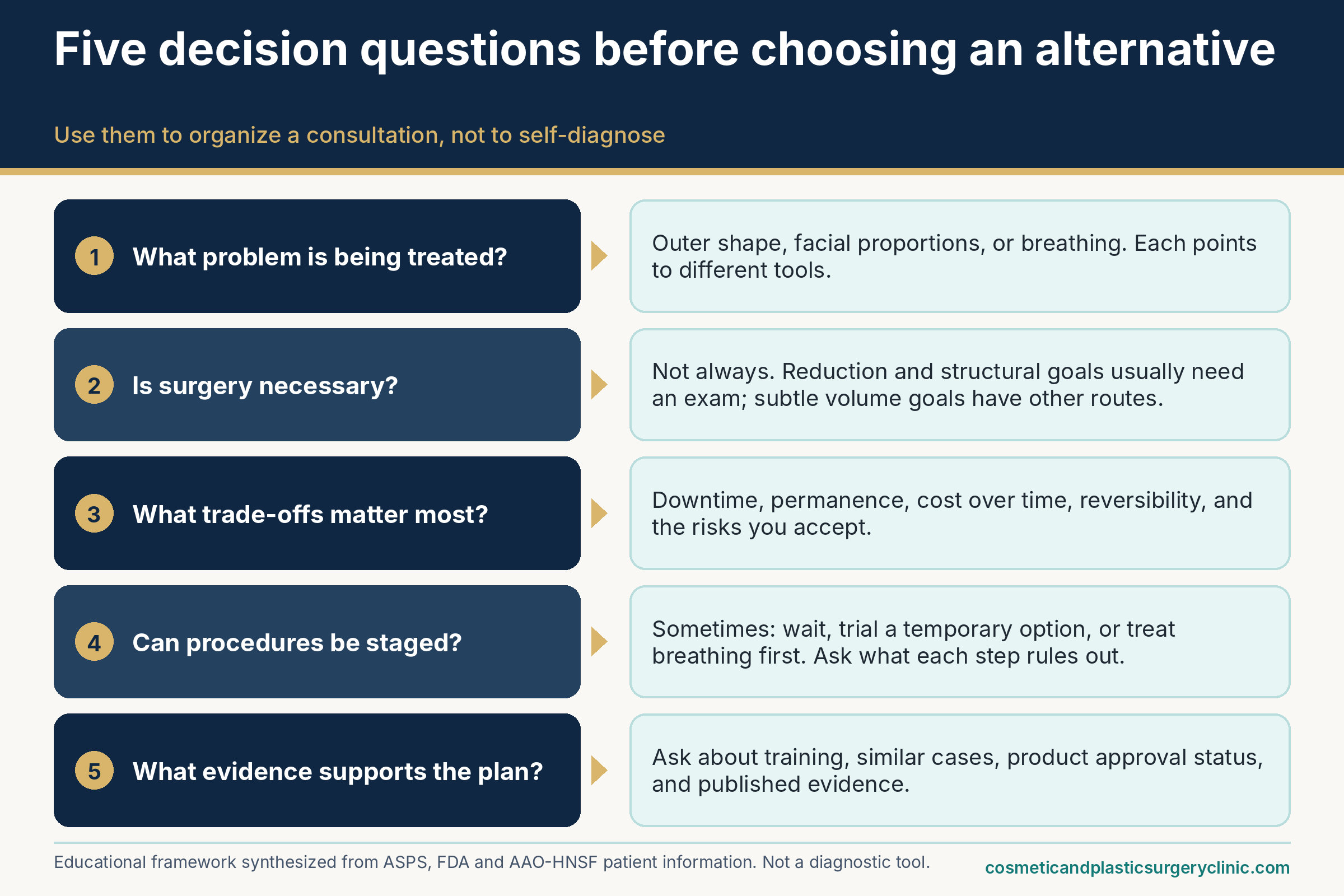
Whether the consultation is for filler, threads, a functional operation, or rhinoplasty, a core set of questions applies. Begin with the goal: Based on my goal, which options are reasonable, and which are not? What can each realistically change? What will remain the same? Ask the clinician to describe the plan in terms of your own priorities. If you want to preserve certain features, say so and ask how that will be protected.
Next, ask about the evidence and the regulatory status. Is this use approved by the FDA, or is it off-label? What studies or experience support it for the nose? What are the typical outcomes and the range? How often do patients need revisions or corrections? What do you do when a result does not meet expectations?
Ask about safety and recovery: What are the main risks of this particular plan for someone like me? What symptoms should prompt a call or emergency care, and what is the number? What is the recovery schedule, and what restrictions apply to work, exercise, eyewear, sleep position, and travel? For surgery, ask about anesthesia, the facility, and who will be in the room.
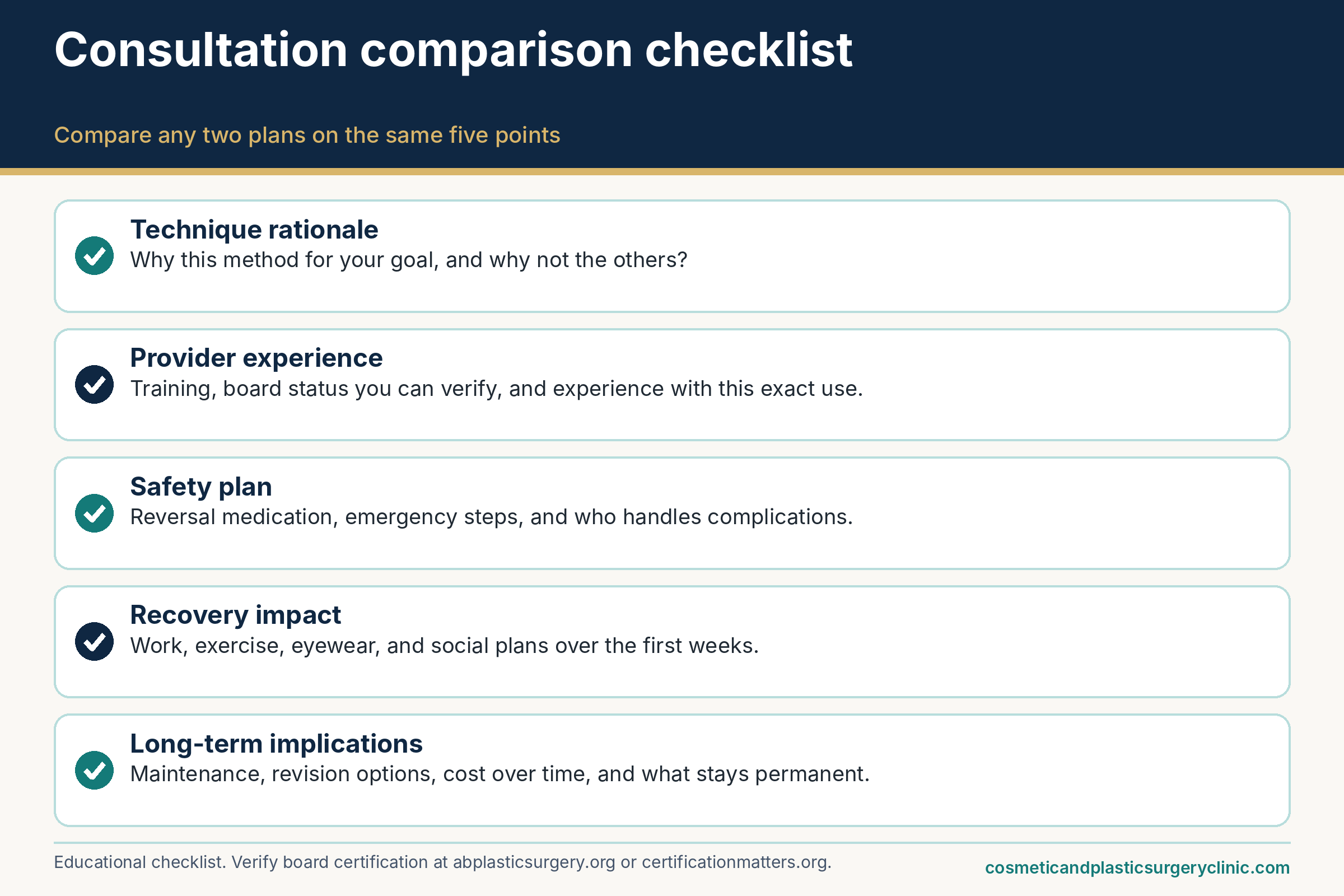
Close with logistics and long-term issues: What is the total, and what is included? What happens if I want to dissolve or reverse? What does maintenance look like over five years? What is the policy on revisions, and is it in writing? Can I speak with the surgeon or injector directly before booking? The table converts the main points into a worksheet for comparing two or three plans.
| Question | Why it matters | Plan A notes | Plan B notes |
|---|---|---|---|
| Which goal does this plan address, and which does it leave untouched? | Prevents paying for a change that does not match your concern | ||
| Is this use FDA-approved or off-label? | Shows how much rests on clinician judgment rather than reviewed evidence | ||
| What credential can I verify, and who performs the procedure? | Ties the plan to a specific person | ||
| What is the safety and emergency plan? | Reversal medication, urgent evaluation, after-hours contact | ||
| What recovery and activity limits apply? | Lets you plan work, exercise, eyewear, and events | ||
| What are the total cost and the five-year cost? | Reveals maintenance and contingency costs | ||
| What is the revision or correction policy? | Clarifies who bears the cost if adjustments are needed |
Putting it together: scenario walk-throughs
The following scenarios are invented illustrations of reasoning, not patient stories or recommendations. They show how the same framework can lead to different conversations. In each case, the final answer belongs to an individual examination.
First scenario: a person dislikes a small bump seen in profile photos and wants minimal downtime for an event in two months. The goal is camouflage-compatible, and the questions are about whether added volume will make the nose look larger from the front, who injects, whether the nose is an off-label site, and what the plan is if blood flow is compromised. Waiting until after the event, or using photography changes, are legitimate options on the same list. If the person actually wants the bump gone, that points toward surgery, and the event timing may argue for scheduling surgery later, not rushing.
Second scenario: a person has noticed breathing trouble on one side and also dislikes the tip. The first conversation is functional: an examination of the septum, turbinates, and valve, medical management as the guidelines suggest trying first, and a discussion of whether a combined operation makes sense. Filler for the tip would not address breathing and may complicate later surgery. The relevant resources are the septorhinoplasty guide and the rhinoplasty overview.
Third scenario: a person finds their nose looks large in selfies and in profile and has a recessed chin. The conversation might include camera habits, a profile assessment that considers chin balance, and options such as chin filler or chin surgery, which the sources describe as altering the perceived size of the nose. A reduction rhinoplasty remains a separate question if the person wants the nose itself to be smaller.
Fourth scenario: a person had a rhinoplasty a few months ago and sees a small dip. Swelling may still be settling, so the first step is a conversation with the operating surgeon about timing. A small filler correction may be discussed later, or a revision if the issue is structural. The revision guide applies.
Fifth scenario: a person wants to keep a family-typical nose shape and only soften a slight asymmetry. Here, the most valuable answer may be a very conservative plan or no treatment, and a clinician who respects that instruction is a good sign.
If you are ready to take the next step, verify the credential of any clinician you are considering through the ABPS or ABMS lookups above, bring the question list to a consultation, and compare at least two plans using the worksheet. There is no deadline that should push you into deciding faster than you want to. For surgery-specific questions, see the rhinoplasty consultation question guide.
Frequently asked questions
Is there a nonsurgical way to make my nose smaller?
No injectable or thread-based option reduces the size of the nose. ASPS states that filler adds volume, so it can refine contours and create the look of a straighter profile but cannot make the nose smaller. Threads, according to ASPS, will not reduce a hump or narrow wide bones. What nonsurgical approaches can do is change perception: balancing a recessed chin or flat cheeks, adjusting camera distance, or using makeup can make a nose look more proportionate without changing it. If actual reduction is the goal, that is a surgical conversation with a qualified clinician.
Does the FDA approve dermal filler for the nose?
The FDA’s dermal filler page lists approved uses such as the nasolabial folds, cheeks, chin, lips, perioral lines, and backs of the hands, and it names the nose among areas where filler use is not approved. Content on that page was current as of July 6, 2023 when reviewed. Using an approved filler in the nose is off-label, which clinicians can and do choose, but it means the FDA has not reviewed the evidence for that site. Ask any injector whether the planned use is approved or off-label and why they believe it is appropriate for you.
How long does liquid rhinoplasty last?
ASPS says results typically last six months to one year. A 2024 review describes a usual range of three to twelve months for many classic hyaluronic acid fillers, with some newer products lasting one to three years. Duration depends on the product, the amount, the location, and the person, so these are ranges, not promises. Because the effect fades, it becomes a maintenance decision, and the cumulative cost and the number of treatments belong in your comparison. See the dedicated guide on how long liquid rhinoplasty lasts for more detail.
Can nose filler be dissolved if I do not like it?
Hyaluronic acid filler can be broken down with an enzyme called hyaluronidase, and a 2021 guideline describes it as the standard approach to reversal and to emergencies involving blocked blood vessels. It is not a complete undo button: brands differ in how readily they dissolve, there are no standardized doses, and in vision-loss case reports hyaluronidase was not significantly associated with better vision outcomes. Other filler types cannot be dissolved this way. Ask which product is planned, whether hyaluronidase is on site, and what the plan is if dissolving is needed.
Can filler fix a deviated septum or help me breathe better?
Filler does not straighten a deviated septum, and a 2024 review states that fillers cannot realign the nasal pyramid. The same review mentions internal valve support as a use clinicians have explored, but breathing problems are best evaluated by a clinician who examines the airway. AAO-HNSF guidance on septoplasty emphasizes trying conservative treatment first, such as medicated nasal sprays, and using symptoms and examination to guide decisions. Anyone with persistent blockage, bleeding, or pain should seek an evaluation instead of relying on a cosmetic treatment.
Do thread-based nose lifts work?
ASPS describes thread-based nose lifts as offering subtle, temporary improvement in tip projection and bridge definition, lasting about six months, and unsuitable for large humps, crooked noses, or breathing problems. A 2025 systematic review of absorbable facial thread lifts, which was not nose-specific, found short-term improvement but said long-term efficacy data are lacking. Complications ASPS lists include thread extrusion, scar tracks, and infection. Ask the provider which product is used and what it is labeled for, since this article could not confirm labeling for nasal use.
Can Botox lift the tip of the nose?
Botulinum toxin injected into the depressor septi nasi muscle has been studied for a tip that drops when smiling. A 2013 study of 40 people reported increased columella-to-lip distance in the treated group, with follow-up of about 30 days. That is limited evidence. The BOTOX Cosmetic label, revised October 2024, lists glabellar lines, lateral canthal lines, forehead lines, and platysma bands as its indications, so nasal use is off-label. The effect is temporary and addresses movement, not structure. Discuss the product, dose, and expected duration with an experienced injector.
Will changing my chin make my nose look smaller?
It may change how the nose is perceived, though not its actual size. ASPS says the size of the chin may magnify or minimize the perceived size of the nose, and chin procedures are often suggested alongside rhinoplasty for facial balance. Options include FDA-approved chin filler and surgical approaches such as implants or genioplasty. The effect varies by person and by profile, and it is not a treatment for a bump, a wide tip, or breathing issues. A profile assessment by a qualified clinician is the way to find out whether the chin matters in your case.
Can I try filler first to decide whether I want surgery?
Some people do, and ASPS notes that the appeal of nonsurgical rhinoplasty includes trying a look without much downtime. The limitation is that filler previews an added-volume look, not a reduction or narrowing, so it may not predict how a surgical result would appear. Prior filler can also matter to a later surgeon, so disclose what was injected and when. If you plan to try it, choose a clinician experienced with the nose, discuss the off-label status and risks, and consider whether a defined waiting period would serve you better.
What warning signs after nasal filler need immediate attention?
The FDA advises seeking immediate medical attention for vision changes, skin discoloration, or signs of stroke after dermal filler. In the nose, those can reflect a blocked blood vessel, which is time-sensitive, so waiting to see whether symptoms pass is not advisable. Severe or increasing pain, a blanched, dusky, or mottled patch of skin, or any change in vision should prompt contacting the injector and emergency care right away. Before treatment, ask the clinician what symptoms to watch for, who to call, and how after-hours problems are handled.
Will insurance cover any of these options?
Cosmetic injectables, threads, and cosmetic rhinoplasty are generally paid out of pocket. ASPS says that rhinoplasty performed to correct breathing impairment from airway obstruction may be considered reconstructive and may be covered, but coverage requires documentation and prior authorization, and plans differ. Septoplasty for a deviated septum is a functional operation and is usually evaluated by an insurer on medical grounds. Ask the surgeon’s office how they document functional findings and verify the benefit directly with your insurer before relying on coverage. The cost guide explains fee components.
Which type of clinician should perform nasal filler?
The FDA says to seek a licensed provider with experience in dermatology or plastic surgery, and ASPS says nasal filler should be done only by an experienced professional with reversal medication available and a plan for urgent evaluation. Several specialties, including plastic surgery, facial plastic surgery within otolaryngology, and dermatology, include filler training, and rules about who may inject vary by state. Verify the specific clinician’s license and board credentials through public tools, and ask about their experience with nasal injections specifically instead of relying on a title.
Sources and further reading
- U.S. Food and Drug Administration — Dermal Fillers (Soft Tissue Fillers) (content current as of 07/06/2023; accessed 2026-10-03) — approved and unapproved uses, vascular risks, patient advice
- Doyon et al., Aesthetic Surgery Journal 2024;44(10) — Update on blindness from filler (accessed 2026-10-03) — case series: injection sites, outcomes, treatments
- Murray et al., Journal of Clinical and Aesthetic Dermatology 2021 — Guideline for the safe use of hyaluronidase in aesthetic medicine (accessed 2026-10-03) — mechanism, off-label status, limitations
- Erwin and Stallworth, Plastic and Aesthetic Research 2024 — Non-surgical (liquid) rhinoplasty (accessed 2026-10-03) — indications, limits, duration ranges
- American Society of Plastic Surgeons — The nonsurgical nose job: Is liquid rhinoplasty for you? (2026; accessed 2026-10-03) — scope, duration, vascular risk, provider readiness
- American Society of Plastic Surgeons — Understanding the thread-based nose lift (2025; accessed 2026-10-03) — threads: scope, duration, complications
- Riopelle et al., Dermatologic Surgery 2025 — Update on absorbable facial thread lifts (accessed 2026-10-03) — facial thread evidence and limits
- Cigna et al., Clinica Terapeutica 2013 — Botulinum toxin in the treatment of plunging nose (accessed 2026-10-03) — small study on nasal tip
- AbbVie — BOTOX Cosmetic prescribing information (revised 10/2024; accessed 2026-10-03) — labeled indications and boxed warning
- Correspondence on Ward et al., JAMA Facial Plastic Surgery 2018 — Nasal distortion in short-distance photographs (accessed 2026-10-03) — citation and critique of the selfie-effect study (original article not opened)
- American Society of Plastic Surgeons — Chin surgery (accessed 2026-10-03) — chin implants, genioplasty, filler, relationship to perceived nose size
- American Society of Plastic Surgeons — Can a nose job change the way you breathe? (2024; accessed 2026-10-03) — septoplasty, turbinectomy, spreader grafts
- American Society of Plastic Surgeons — What to expect from your rhinoplasty recovery (2022; accessed 2026-10-03) — recovery milestones
- American Society of Plastic Surgeons — Realistic changes in a typical rhinoplasty (2018; accessed 2026-10-03) — features surgery can change; role of skin
- American Society of Plastic Surgeons — Rhinoplasty overview, risks and cost pages (accessed 2026-10-03) — risk list, fee exclusions, insurance note
- American Society of Plastic Surgeons — Refreshing your profile (2023; accessed 2026-10-03) — selfie and social media motivation
- ENTtoday — Clinical consensus statement on septoplasty released (AAO-HNSF, 2015; accessed 2026-10-03) — indications, conservative treatment first
- AAO-HNSF ENT Health — Deviated septum (reviewed August 2018; accessed 2026-10-03) — septum, septoplasty, risks
- American Board of Plastic Surgery — Verify certification (accessed 2026-10-03) — public verification search
- American Board of Medical Specialties — Certification Matters (accessed 2026-10-03) — “Is My Doctor Board Certified?” lookup
- American Board of Facial Plastic and Reconstructive Surgery — What the credential signifies (accessed 2026-10-03) — requirements and Physician Finder
- American Board of Otolaryngology — Home (accessed 2026-10-03) — otolaryngology certification and verification section