Rhinoplasty, which most people call a nose job or simply nose surgery, is an operation that changes the shape, size, or internal structure of the nose. Some people have it to alter how the nose looks. Others have it to open a blocked airway, repair an injury, or do both in a single operation. If you are searching for rhinoplasty because you are deciding whether to move forward, how long you would be out of commission, or what it costs, this guide is built to answer those questions in a clear order and to say plainly what the procedure cannot do.
The nose is a small structure with an outsized job. It sits at the center of the face, so tiny changes are visible, and it also carries air, filters it, warms it, and supports the sense of smell. That double role is why rhinoplasty is both a cosmetic and a functional operation, and why a good plan has to respect both.
This page is general education, not a diagnosis or a recommendation for any one person. Your anatomy, skin, health history, and goals decide what is reasonable, and only a qualified clinician who examines you can sort that out. Read it as preparation for a consultation. If you are still weighing nonsurgical routes first, the guide to rhinoplasty alternatives compares fillers, threads, and other options in more detail than this page does.
A note on vocabulary. Patients say nose job, nose surgery, nose reshaping, and sometimes nonsurgical rhinoplasty, which refers to injectables rather than an operation. Clinicians distinguish rhinoplasty, septoplasty, septorhinoplasty, and revision rhinoplasty. Wherever a common term appears here, the clinical term is explained beside it so you can follow a surgeon’s notes and a quote with confidence.
Rhinoplasty (Nose Job) Explained: What It Is, What It Changes, and What It Cannot
The word rhinoplasty combines the Greek roots for nose and shaping, and the plain translation is accurate: it is surgery that reshapes the nose. What gets confusing is how much sits under that single label. A small refinement of the tip and a rebuild of a nose damaged in an accident are both rhinoplasty. So is an operation done mainly to improve nasal breathing. Understanding where your goals fall on that range is the first step toward a sensible conversation with a surgeon.
Defining rhinoplasty: cosmetic, functional, and combined operations
A terminology map: rhinoplasty, septoplasty, septorhinoplasty, and revision
The American Society of Plastic Surgeons (ASPS) describes rhinoplasty as surgery that can improve facial harmony and the proportions of the nose, and that can also correct breathing problems caused by structural defects. That two-part definition matters because insurers, surgeons, and patients often use the same word for different operations. Before you compare quotes, it helps to translate the vocabulary.
Septoplasty straightens or repositions the septum, the wall of cartilage and bone that divides the nose into two airways. It targets breathing, not appearance, and is typically done through the nostrils. Septorhinoplasty combines septoplasty with reshaping of the outside of the nose, so it addresses airflow and appearance in one operation. Revision rhinoplasty (also called secondary rhinoplasty) is an operation on a nose that has already had surgery, whether to refine a result, fix a complication, or restore function. Cleveland Clinic also lists nonsurgical rhinoplasty in its overview, which means filler used to change contours temporarily. That is an injectable treatment, not an operation, and it follows different rules.
The table below maps the common terms to what they mainly address. Treat it as a glossary, not a decision tool: real operations often blend categories, and a surgeon’s notes may use a different label than the one you hear on a consultation call.
| Term | Plain-English meaning | Main goal | Usual access |
|---|---|---|---|
| Cosmetic rhinoplasty | Reshapes the outside of the nose: bridge, tip, width, nostrils, length | Appearance and proportion | Inside the nose (closed) or with a small incision across the columella (open) |
| Functional rhinoplasty | Improves airflow by correcting structures that block or narrow the airway | Breathing | Varies; may be internal |
| Septoplasty | Straightens or repositions the septum without a plan to change the outer shape | Breathing | Through the nostrils |
| Septorhinoplasty | Septum correction plus reshaping of the outer nose in one operation | Breathing and appearance | Open or closed |
| Revision (secondary) rhinoplasty | Operation on a nose that has had previous surgery | Refinement, repair, or restoring function | Often open; depends on the problem |
| Nonsurgical rhinoplasty | Injectable filler used to alter contours temporarily; not surgery | Subtle contour change | Needle |
One practical consequence: when a clinic advertises a price for “rhinoplasty,” ask what is included. A quote for cosmetic reshaping may not include a septum correction, and a functional operation billed through insurance follows a different path than a cosmetic one. The sections on cost and insurance later in this guide return to that point.
What “changing shape, size, and proportion” means in practice
ASPS lists the features that rhinoplasty can address: nose size relative to the rest of the face, the width of the bridge, the size and position of the nostrils, a visible hump or a depression along the bridge, a tip that is enlarged, bulbous, drooping, upturned, or hooked, and asymmetry. In a related ASPS article, a surgeon explains the same ideas in everyday language: a hump on the bridge can be lowered, a wide or poorly defined tip can be refined and rotated, flaring nostrils can be narrowed, and a long nose can be shortened.
It helps to think of these changes as three kinds of moves. Some are subtractive, such as lowering a hump or trimming cartilage from a tip. Some are additive, such as raising a low bridge or adding support under the tip with cartilage grafts. Others are rearrangements, where the tissue already present is repositioned and held with sutures or grafts. Most operations use a mix. A single goal such as “make the tip less droopy” might involve all three: reducing some cartilage, adding a support, and re-aiming what remains.
Proportion is the part that trips people up. The nose is judged in relation to the forehead, cheeks, lips, and chin. The same nose can look prominent on one face and balanced on another, and the viewing angle changes the impression. ASPS notes that modern thinking in rhinoplasty leans toward restraint, respecting the underlying anatomy rather than pushing it to an ideal. A related ASPS statement is worth keeping in mind: everyone’s face is asymmetric to some degree, and complete symmetry may not be achievable. Noses that start with a deviated bridge or uneven nostrils can be improved without ever being mirror images.
None of this means a normal nose needs fixing. Plenty of people feel at home with their profile, and that is a legitimate answer. The point of knowing what the operation changes is to ask whether a specific feature bothers you enough, and consistently enough, to accept the trade-offs of surgery.
Nasal anatomy basics: what the surgeon is actually working with
Bone, cartilage, skin, septum, turbinates, and valves in plain English
A rough map of the nose makes every later section easier to follow. The external nose is built from bone, cartilage, and a covering of skin and soft tissue. Cleveland Clinic divides the visible nose into the root between the eyes, the dorsum (the bridge) in the middle, and the apex or tip at the bottom where the nostrils are. StatPearls describes the framework in thirds. The upper third is bony, formed by the nasal bones and parts of the upper jaw. The middle third is cartilage: the upper lateral cartilages, which attach to the nasal bones and the septum. The lower third is the tip, shaped by the lower lateral cartilages, which have medial and lateral limbs (crura) that give the tip its form and support.
Inside, the septum divides the nose into left and right passages. According to StatPearls, it consists of quadrangular cartilage at the front, plus bone behind and below it: part of the ethmoid bone, the vomer, and contributions from other facial bones. The septum is also the main source of cartilage for grafts, which is why surgeons talk about preserving enough of it for support. ENT Health, the patient site of the American Academy of Otolaryngology-Head and Neck Surgery Foundation, notes that an off-center septum is very common, estimated at about 80 percent of people, so a crooked septum alone is not automatically a problem.
Along the side walls of each passage run the turbinates, three paired structures that increase the surface area of the airway so the nose can warm, moisten, and filter air. When the lowest ones are enlarged, airflow can suffer, and surgeons sometimes reduce them as part of a breathing-focused plan.
Then there are the nasal valves, which deserve more attention than they usually get. The internal nasal valve is the narrowest part of the airway. StatPearls describes it as formed by the upper lateral cartilage, the septum, and the head of the inferior turbinate. Cleveland Clinic notes that the internal valve is the more common site of valve collapse, with the external valve, near the nostril opening, affected less often. Valve narrowing can come from anatomy, injury, aging, or prior surgery. Because the valve sits where cosmetic work often happens, narrowing the middle of the nose or removing a hump can affect it. ASPS explains that spreader grafts, small strips of cartilage placed alongside the septum, are one way surgeons keep the internal valve open.
Finally, the skin and soft tissue envelope drapes over the whole framework. StatPearls notes that it tends to be thinnest over the junction of bone and cartilage in the middle of the bridge and thicker, with more oil glands, toward the tip. That variation matters for what a result can look like, which is the subject of the next section.
What rhinoplasty cannot change: skin, structure, and the face around the nose
The most honest part of any consultation is the part about limits. Three limits come up repeatedly.
First, skin. ASPS says the outcome depends largely on the anatomy of your nose, particularly the skin, and on the surgeon’s judgment. Skin acts like a drape over a tent: it can only conform to the frame beneath it to a degree. Thick, oily skin tends to mask fine definition in the tip, so a very sharp, chiseled look may not be achievable no matter how precisely the cartilage is shaped. Very thin skin can show every edge and graft, which raises different concerns. Surgeons cannot swap the skin for a different kind, though they can plan the structure beneath it with that in mind.
Second, underlying structure. A nose with very weak cartilage, a markedly deviated bony pyramid, or tissue lost in earlier surgery has less to work with. Reducing a nose is easier than rebuilding support that was removed. That asymmetry is one reason surgeons favor cautious reduction, and it is also why revision operations are more complex than first-time ones.
Third, the rest of the face. A nose that reads as large may partly reflect a small or recessed chin, and ASPS notes in its chin surgery information that chin size can make the nose look bigger or smaller. A rhinoplasty will not change the chin, the cheeks, or the lips, and it cannot make the nose look the way it would on someone else. The table below summarizes what is commonly addressed, what is possible within limits, and what depends on anatomy.
| Concern | How surgery may help | What limits the result | Useful question for the surgeon |
|---|---|---|---|
| Hump on the bridge | Hump can be lowered by reshaping bone and cartilage | Bridge shape, skin thickness, effect on the internal valve | How will you protect my airway while lowering the bridge? |
| Wide, round, or drooping tip | Cartilage can be reshaped, supported, and rotated | Thick or oily skin can soften definition | What tip result is realistic with my skin? |
| Low or flat bridge | Augmentation with grafts or implants can add height | Graft source, skin tension, long-term stability | Which graft material, and what are its trade-offs? |
| Flared or wide nostrils | Nostril base can be narrowed with incisions in the natural creases | Scar position, symmetry, effect on airflow | Where would the incisions go, and how do they usually heal? |
| Crooked or asymmetric nose | Improvement may be possible; full symmetry is unlikely | Bone, cartilage, septum, and skin may all contribute | Which structures cause the asymmetry in my nose? |
| Blocked breathing | Septum, turbinates, or valves can be treated | Allergy, inflammation, or mucosal causes are not fixed by reshaping | Have you examined my airway and tried medical treatment first? |
The pattern across the table is consistent: surgery can move and add and remove, but the skin, the available cartilage, and the face around the nose set the boundaries. A surgeon who tells you the boundaries up front is giving you useful information, not being pessimistic.
Who May Be a Candidate for Rhinoplasty, and When Waiting Makes Sense
Candidacy is not a pass-fail test that a website can administer. It is a judgment a surgeon makes after hearing your goals, examining your nose inside and out, and reviewing your health. What a general guide can do is show you which questions a thoughtful surgeon is likely to ask, so you can think through your own answers before the appointment and notice if a consultation skips them.
Candidate factors: goals, anatomy, health, and lifestyle
Goals and anatomy: aligning what you want with what can change
ASPS describes a good candidate as someone with a positive outlook and realistic goals, and it stresses that the operation should be for yourself, not to satisfy someone else or to chase an ideal image. That language lines up with a clinical practice guideline from the American Academy of Otolaryngology-Head and Neck Surgery Foundation (AAO-HNSF), published in 2017, whose first recommendation is that clinicians ask every rhinoplasty candidate about their motivations and expectations for the outcome, and document that conversation.
Realistic goals tend to be specific and visible from a particular angle. “I’d like the bump on my bridge to be less prominent in profile” is a goal a surgeon can work with. “I want a nose that makes me look like someone else” is not, and neither is “I want it to look good,” which is too open to guide anything. If you struggle to name what bothers you, that is useful information too. Photos taken from several angles, in even light and without a lens close to your face, can help you separate a stable concern from one that appears only in certain selfies.
Anatomy shapes what is feasible. Thick skin, a short or weak septum, flat nasal bones, or earlier surgery each change the menu of options. The same goal, say a more refined tip, can be approached differently depending on whether the existing cartilage is strong or weak. This is one reason ASPS calls rhinoplasty highly individualized. Reading a stranger’s before-and-after story tells you little about your own result; the guide to who is a rhinoplasty candidate goes deeper on the factors that tend to matter, and the article on evaluating rhinoplasty before-and-after photos covers how to read photographs critically.
Breathing belongs in the candidacy conversation even if your goals are purely cosmetic. The AAO-HNSF guideline recommends that the surgeon, or a designee, evaluate every rhinoplasty candidate for nasal airway obstruction during the preoperative assessment. The reason is straightforward: operations that reshape the nose can narrow the airway, and knowing your starting point protects you from blaming the surgery for a problem that was already there, or from missing a problem that should be treated at the same time.
Health, breathing, and lifestyle factors surgeons look at
On the health side, ASPS lists being physically healthy and not smoking among candidate characteristics. The AAO-HNSF guideline goes further and recommends that clinicians assess candidates for conditions that could modify or contraindicate surgery. It names obstructive sleep apnea, body dysmorphic disorder, bleeding disorders, and chronic use of topical vasoconstrictor drugs (nasal decongestant sprays or other substances applied inside the nose). StatPearls’ rhinoplasty chapter adds uncontrolled depression and active cocaine use to its list of contraindications, and treats sleep apnea as a relative concern.
These are not moral judgments; they are about healing and safety. Nicotine narrows small blood vessels, and ASPS has advised avoiding all forms of nicotine, including vaping, patches, and gum, for roughly three to six weeks before and after surgery because it can impair wound healing. ASPS lists loss of skin and tissue among the wound-healing problems nicotine can contribute to, and reshaped noses depend on good blood flow to heal. Bleeding tendencies matter because the nose is a vascular area and a surgeon needs to know about conditions and medications that affect clotting. Mayo Clinic advises avoiding aspirin and ibuprofen for two weeks before and after surgery, and ASPS surgeons also mention fish oil and other supplements. Never stop a prescribed medication on your own; give the surgical team your complete medication and supplement list and let them tell you what to change and when.
Sleep apnea deserves a sentence of its own. The AAO-HNSF guideline recommends counseling candidates with documented sleep apnea about how surgery and the nasal splints or packing may affect their airway, and about perioperative management. If you snore heavily, wake unrefreshed, or have been told you stop breathing at night, mention it. It can change anesthesia planning and how you sleep during the first days.
Lifestyle matters in a more ordinary way. Your job, your caregiving duties, whether you wear glasses all day, whether you play a contact sport, and who can drive you home all affect how workable a recovery will be. None of these is a barrier by itself, but each shapes the timing, which the recovery sections address.
Age, growth, and reasons to postpone
Age and facial growth: what the sources say and what they do not
ASPS does not set a minimum age; it says facial growth should be complete. Growth completes at different times in different people, so a fixed birthday is a poor yardstick. StatPearls says rhinoplasty is typically done after skeletal maturity and gives roughly 15 for girls and 17 for boys as the ages when that is usually reached, but those are rules of thumb rather than thresholds, and a surgeon may judge maturity from history, examination, and sometimes imaging. Emotional readiness is a separate question from skeletal growth. A teenager considering surgery benefits from a surgeon who speaks to them directly, checks that the motivation is their own, and involves a parent or guardian in a real discussion rather than a signature.
At the other end of the age range, there is no cutoff. ASPS’s 2025 statistics report, which draws on ASPS member surgeons, CosmetAssure data, and national claims-based datasets, recorded 43,116 nose-reshaping procedures in the United States for 2025, down 5 percent from 2024. The report breaks the 2025 total into age bands from 18-25 through 66 and older, and every band contains thousands of cases; the 66-plus group, at 2,252 procedures, was among the smaller ones but grew by 34 percent. Those are counts of procedures, not outcomes, and they say nothing about whether surgery was appropriate for any person. They simply show that people of many ages pursue this operation, and the age of your nose is not by itself a verdict.
Older noses do present their own considerations. Skin loses elasticity, tip support can weaken with time, and general health conditions become more relevant to anesthesia. A surgeon may also need to discuss whether the main concern is the nose itself or a change in the whole midface. Age and timing questions look somewhat different when breathing is the main reason for surgery, and the surgeon will weigh both.
Reasons to pause or postpone: a decision aid
Postponing is not the same as declining. Sometimes the right answer is “not yet,” and a surgeon who says so is protecting you. The situations in the table below are common reasons to slow down, based on the AAO-HNSF guideline, StatPearls, ASPS, and Mayo Clinic. They are discussion points, not rules, and a qualified clinician will weigh them for you.
| Situation | Why it matters | What to discuss with a clinician |
|---|---|---|
| Nicotine or vaping | Narrows blood vessels and can impair wound healing | A quit plan with timing before and after surgery; ASPS cites roughly 3-6 weeks on each side |
| Facial growth not finished | The nose and face may still change | How the surgeon judges maturity and whether to wait |
| Intense preoccupation with a small or unseen flaw | May signal body dysmorphic disorder, where surgery often does not relieve distress | An evaluation by a mental health professional before any elective surgery |
| Breathing trouble with an unclear cause | Allergy, inflammation, septum, valves, or turbinates need different treatments | An airway exam and, often, a trial of medical treatment first |
| Bleeding disorder, or blood-thinning medicine or supplements | Raises bleeding risk during and after surgery | A complete medication list and instructions on what to hold, from the surgical team |
| Recent nasal injury or very recent surgery | Tissue is still swollen and healing | How long to let the nose settle before judging or operating |
| Major life stress or time pressure | Recovery requires planning, rest, and follow-up | Whether another season of life allows better recovery conditions |
The mental health row deserves care in how it is read. Mayo Clinic describes body dysmorphic disorder as a condition in which a person cannot stop thinking about perceived flaws in their appearance that others may not notice, and it notes that people with the condition often seek repeated cosmetic procedures, which tends to bring temporary relief at best. The AAO-HNSF guideline lists it among the conditions to assess for, and StatPearls lists it as a contraindication. Having feelings about your nose does not mean you have this condition. Most people who want a nose change do not. But if worry about one feature consumes hours of your day, or if you have repeatedly sought surgery and felt no better, it is worth talking with a therapist or physician before booking an operation, and a good surgeon will welcome that step.
Finally, some pauses are practical. If breathing is the main concern and allergies or swollen nasal lining could be the cause, the AAO-HNSF consensus on septoplasty describes trying conservative measures such as nasal sprays before surgery. If the motivation arrived last month after a video call or a photo filter, a defined waiting period, followed by a fresh look at your goals, costs little and can clarify a great deal.
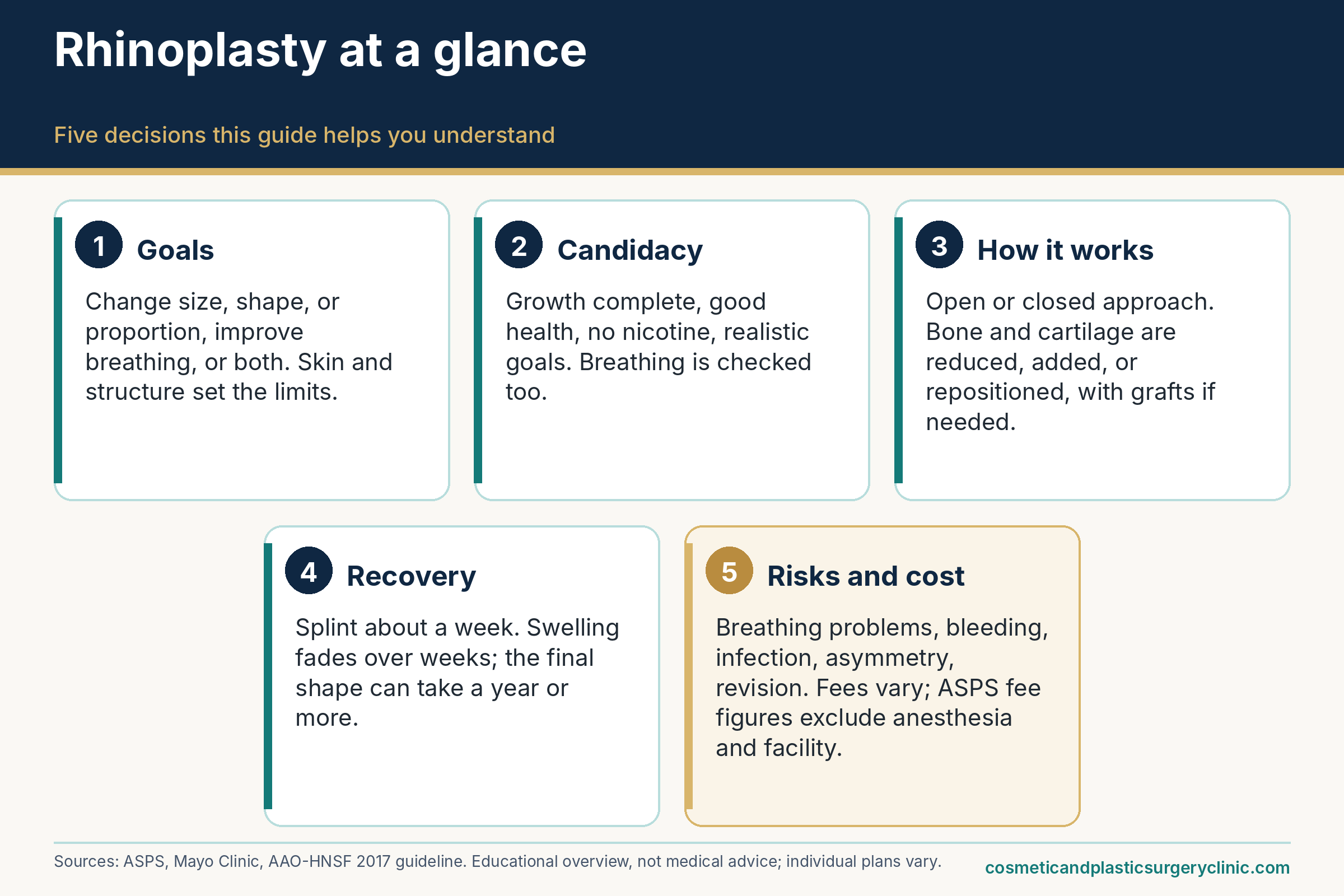
How Rhinoplasty Is Done: Approaches, Techniques, Grafts, and Design Philosophies
Every rhinoplasty answers the same three questions: how will the surgeon reach the structures, what will be removed, added, or repositioned, and how will the result be held in place while it heals. The answers differ by nose and by surgeon, which is why two people with the same stated goal may be offered different plans. This section explains the building blocks at the depth a hub page can offer. The dedicated guide to rhinoplasty techniques goes further into individual maneuvers.
Open and closed approaches, reduction and augmentation
Open versus closed rhinoplasty: what actually differs
The most visible choice is the approach. In an open rhinoplasty, the surgeon makes a small incision across the columella, the narrow strip of tissue between the nostrils, and connects it to incisions inside the nostrils. The skin and soft tissue can then be lifted off the framework like a hood, giving a direct view of the cartilage and bone. In a closed (endonasal) rhinoplasty, all incisions stay inside the nostrils and the surgeon works through them without lifting the skin as far. ASPS describes both options, and Cleveland Clinic frames open surgery as the usual route for more extensive reshaping and closed surgery for more limited changes.
StatPearls summarizes the trade-off in terms surgeons would recognize. Open exposure is excellent and is often preferred for tip work, at the cost of a small scar across the columella. The endonasal approach avoids an external scar but limits direct visualization of the tip. A variant called tip delivery brings the tip cartilages into view through the nostrils without a columellar incision. The columellar incision is small, but scar healing varies from person to person. Surgeons quoted by ASPS note that the tip tends to stay swollen the longest, particularly after an open approach.
It is tempting to ask which approach is better. The evidence says the question is poorly framed. A 2022 systematic review of 20 studies comparing closed and open rhinoplasty found no definitive superiority of either, high satisfaction with both, and concluded that outcomes depend more on the surgeon’s skill than on the technique label. Some findings leaned in different directions: open approaches may have lowered revision rates in complex nasal fracture cases, while closed approaches were associated with less loss of sensation at the columella. An earlier systematic review of 49 articles, which pooled more than 11,000 operations, reported a reoperation rate of 2.73 percent for primary open and 1.56 percent for primary closed rhinoplasty, a difference that was not statistically significant. Its authors rated 98 percent of the included studies at the lowest evidence grade, and about nine in ten primary cases were open, so the comparison is unbalanced. The takeaway is not that one approach is safer. It is that surgeons choose based on the problem to be solved and on what they do best.
| Feature | Open approach | Closed (endonasal) approach |
|---|---|---|
| Incisions | Small incision across the columella plus incisions inside the nostrils | Incisions entirely inside the nostrils |
| Visibility of structures | Direct view of tip and framework | More limited view; relies on surgeon experience |
| Typical use | More extensive reshaping, complex tips, many revisions | More limited changes, selected noses |
| Visible scar | Small scar across the columella; healing varies | No external scar from the approach |
| Swelling | Tip may stay swollen longer, per surgeons quoted by ASPS | Varies; swelling still occurs |
| Evidence summary | No definitive superiority in a 2022 review of 20 studies | No definitive superiority; surgeon skill emphasized |
When you hear a surgeon recommend one approach, a useful follow-up is why it suits your nose, what scars or numbness to expect, and how many operations like yours they perform each year. Those questions turn a label into a rationale.
Reduction, augmentation, osteotomies, and tip work in plain terms
Whatever the approach, the operation is a sequence of structural decisions. Reduction removes tissue. ASPS says an overly large nose may be reduced by removing bone or cartilage. A dorsal hump, for example, is traditionally lowered by shaving or rasping the excess bone and trimming the cartilage beneath it. Because that opens the roof of the nose, the surgeon then usually closes it again, and may use small spreader grafts or sutures so the bridge does not collapse inward and the airway stays open.
Osteotomies are controlled cuts in the nasal bones. They let the surgeon narrow a wide bony base or close an open roof after hump removal by moving the sidewalls toward the midline. StatPearls describes lateral and medial patterns that surgeons combine to match the nose. An ASPS article quotes a surgeon explaining that narrowing the nose in this way involves breaking and resetting bone and can restrict airflow if done without attention to the airway. One way surgeons try to reduce the swelling and bruising from osteotomies is with a piezoelectric ultrasonic instrument instead of a traditional chisel. A 2024 meta-analysis of 12 randomized trials found less early swelling, bruising, and pain with the ultrasonic method, fewer injuries to the nasal lining, and no difference in operating time or bleeding. The authors noted that long-term data were still needed, so the method is a reasonable choice a surgeon may offer rather than a proven necessity.
Tip work is the most intricate part, because the tip is held together by small, springy cartilages. Surgeons use sutures to narrow, rotate, or project the tip, and they sometimes trim a portion of the cartilage. StatPearls notes that removing the upper edge of the lower lateral cartilage can reduce fullness above the tip but may also rotate the tip upward. When more support is needed, a surgeon may add a columellar strut under the tip, a septal extension graft to increase projection, or small batten grafts to hold open the nostril wings. The more of these supports a nose needs, the more cartilage is required, which links tip work to the next topic, where graft material comes from.
Augmentation adds volume or support. Raising a low bridge, lengthening a short nose, or rebuilding a damaged one all call for graft material or implants. And nostril work, which narrows flared bases, is done through incisions that ASPS says may be placed in the natural creases of the nostrils. A person with a tidy, narrow request, such as lowering a small hump, may need only reduction. A person who wants a bridge raised and a tip refined may need both, plus a graft source. Understanding which moves apply to you makes quotes easier to compare, because the number and type of maneuvers drives time in surgery, graft needs, and cost.
Grafts, implants, and the structural versus preservation debate
Where graft material comes from: septum, ear, rib, and implants
ASPS says cartilage from the septum is used when augmentation is needed, occasionally cartilage from the ear, and rarely a section of rib cartilage. StatPearls likewise lists septal cartilage as the preferred material, with ear (auricular) and rib (costal) cartilage, fascia, and bone as alternatives. Septal cartilage is convenient because it comes from the same operative field, it is straight, and it avoids a second incision, but the supply is limited and a supporting L-shaped strip must be left behind to keep the nose stable. Ear cartilage is curved and soft, which is useful for some tip and nostril contours but less so for structural support. Rib cartilage is plentiful and strong, which makes it valuable for major reconstruction and revision, at the cost of a chest incision and a separate recovery.
Implants made of synthetic materials, such as silicone, are a different branch. An ASPS release on Asian rhinoplasty notes that silicone implants are more common in parts of Asia while Western surgeons tend to favor a patient’s own tissue, and that each approach has its own advantages and complications. A 2022 review of earlier systematic reviews on grafts in septorhinoplasty found that costal cartilage grafts showed more warping, some resorption, and donor-site problems, while synthetic implants showed higher rates of infection, extrusion, and removal operations in the included work. The authors noted that heavy overlap among the underlying studies prevented a pooled analysis, so those comparisons are directional, not definitive. The table summarizes the main options.
| Material | Typical uses | Main advantages | Main considerations |
|---|---|---|---|
| Septal cartilage | Spreader grafts, tip support, septal extension | Same operative field; firm and straight; no extra incision | Limited supply; support strip must remain; may be insufficient for large rebuilds |
| Ear (auricular) cartilage | Tip and nostril contouring, some augmentation | Soft, curved; easy to reach | Less rigid for structural support; donor-site healing at the ear |
| Rib (costal) cartilage | Major augmentation, rebuilding, many revisions | Abundant, strong | Chest incision; donor-site discomfort; can warp or be resorbed |
| Synthetic implants (for example, silicone) | Raising a low bridge, used more in some regions | No donor site; shaped in advance | Higher reported rates of infection, shifting, or removal in reviews |
| Fascia or processed grafts | Softening edges, camouflage, selected dorsal work | Avoids cartilage harvest in some cases | Evidence and handling vary by type; ask what is planned and why |
If a plan includes grafts, ask where they would come from, what happens if the septum turns out to be too weak, and whether a back-up source is consented in advance. That last point prevents surprises on the operating table, such as an unplanned rib harvest.
Structural and preservation rhinoplasty: what the evidence can and cannot say
Two design philosophies dominate current discussion. Structural rhinoplasty is the long-standing approach in which the surgeon removes or reduces tissue as needed, then rebuilds support with grafts and sutures so the nose is stable. Preservation rhinoplasty is a family of techniques that aims to keep as much native cartilage, ligament, and bone architecture intact as possible. A 2023 systematic review in Facial Plastic Surgery defined it as techniques that minimize disruption of the native cartilage and soft tissue, with three components: preserving the lateral crura of the tip cartilages by using sutures instead of cutting, preserving the soft tissue envelope and its ligaments, and preserving the dorsum by treating the bony and cartilaginous midvault as one unit during hump reduction. In dorsal preservation, the surgeon lowers the bridge by repositioning it (sometimes called push-down or let-down) instead of rasping the hump away.
The same review is candid about the evidence. It identified 70 studies, found that 11.4 percent were level II evidence and the rest level III or IV, found no level I evidence, and noted that only about half used standardized outcome measures. Only four studies compared preservation directly with conventional technique, and their results were mixed: one favored preservation on aesthetics, and two found no significant difference. The authors concluded that evidence-based outcomes for preservation rhinoplasty are lacking. A 2026 systematic review limited to five comparative studies (three randomized trials and two cohort studies, 556 patients in total) found comparable safety and functional outcomes at about one year, and a possible aesthetic advantage in carefully selected patients, but it also pointed to differences in methods across studies. A separate 2023 analysis of 59 published patient images reported that dorsal contour irregularities and residual humps were common after preservation techniques. Because those were selected published images, they cannot be read as complication rates, but they underline that the technique has learning curves and shortcomings, as the authors themselves wrote.
What does this mean for a patient? Preservation is a legitimate and increasingly popular option for suitable noses, particularly those with a smooth, straight bridge and a modest hump. It is not suitable for every nose, and it is not proven superior. Structural rhinoplasty remains a well-established approach with a longer track record. A surgeon who is enthusiastic about one philosophy should still be able to explain why it fits your anatomy, what would make them switch strategies mid-operation, and how they have handled irregularities that appear afterward. Be wary of any pitch that treats a technique name as proof of a better result.
Goals, Identity, and Planning Tools: Cultural Considerations, Imaging, and the Surgeon’s Judgment
Before the operation is booked, two planning questions deserve more time than they usually get. The first is whose idea of a good nose the plan follows: yours, the surgeon’s, or a template. The second is how you will know, in advance, what you are agreeing to. Cultural background, family resemblance, and personal style all feed into the first question. Digital imaging and the surgeon’s own aesthetic eye shape the second.
Cultural background, identity, and anatomical variation
A respectful starting point: there is no single “ideal” nose
The nose is one of the most identity-carrying features on the face. It can echo a parent, a grandparent, or a community. For some people that resemblance is a source of pride; for others it is a feature they would like to soften; for many it is both at once. All of those are legitimate, and none requires a justification.
ASPS’s briefing paper on plastic surgery for patients of different ethnic backgrounds makes the central point directly: patients typically want refinement that keeps their features recognizably their own. It gives the example of a Black patient who may want a smaller nose in balance with other features without wanting a nose that looks European. It warns that applying a single universal standard of beauty leads to poor outcomes and says surgeons should consider what the individual patient finds attractive, based on personal or cultural ideals, and adapt their techniques when possible. An ASPS release on Asian rhinoplasty makes the same observation: the aim for many patients is to enhance, not to replace, the look of their face, and the release cautions that considerable variation exists within any broad group. A 2012 ASPS release on a study of Indian American patients reported that all of the patients in that study wanted to preserve their ethnic identity.
Two practical lessons follow. First, a good plan starts from your goals, in your words, and not from a catalog of preset shapes. Bring photos of noses you like and, as importantly, noses you do not want, and explain what you notice about them. Second, a surgeon’s comfort with a range of noses is a legitimate selection criterion. ASPS suggests choosing a surgeon who has experience with the procedure on the skin types and features involved. That is not a reason to hunt for a surgeon who shares your background; it is a reason to ask to see how they have approached noses like yours, using their own consented photographs, and to listen for whether they describe those results in terms of the patient’s goals.
It also helps to keep labels loose. Broad terms such as “ethnic rhinoplasty” can erase the differences between individuals, and many people have mixed ancestry. Population-level descriptions in the surgical literature describe tendencies. They do not predict any one person’s nose, and a surgeon who skips the examination in favor of assumptions deserves a polite second look.
Anatomy-related planning: skin, support, materials, and healing
Some anatomical tendencies do shape planning, as long as they are treated as starting points to verify rather than conclusions. The ASPS release on Asian rhinoplasty notes that a flatter nasal bridge and different tip anatomy are common among Asian patients, and that many patients in that group seek augmentation of the bridge and tip projection more often than reduction. It adds that a standard set of tip techniques may be less effective for some nose types, and that the choice between synthetic implants and a patient’s own tissue differs by region and by surgeon. The ASPS release on Indian American patients, by contrast, reported that the most common concern in that group was a hump on the bridge when viewed in profile. These differences are not rules. They illustrate why the same operation can look very different, in goals and in technique, from one patient to the next.
Skin and scarring deserve a direct conversation. ASPS notes that raised scars (keloids and hypertrophic scars) are more common in people of African and Asian descent. For rhinoplasty, that bears mostly on external incisions: the columellar incision of an open approach and any nostril-base incisions used to narrow flared nostrils. It does not mean those incisions are off-limits. It means the surgeon should ask about your scarring history, explain where incisions would go, and discuss how they would manage a scar that thickens. If you have formed keloids before, say so early.
Skin thickness and cartilage strength matter for everyone, and they vary within every population. Thicker skin can blur definition, a point returned to in the results section, and weaker cartilage may call for grafts to add support. A surgeon can only tell you which applies to you after palpating the nose and looking at it from several angles. Be skeptical of any description of your nose based on your appearance or name rather than an examination, and equally skeptical of a plan that would erase features you value without asking whether you want that.
Imaging tools and the surgeon’s artistic judgment
What digital imaging and morphing can and cannot do
Mayo Clinic notes that surgeons may take photographs and use computer software to show possible outcomes during the preoperative visit. These tools, often called morphing or simulation, digitally alter a photograph of your face to illustrate a possible change. Two-dimensional versions edit a flat photo. Three-dimensional versions build a model of your face from scans and can be rotated.
The research on them is modest. A 2019 study in Plastic and Reconstructive Surgery Global Open surveyed 172 rhinoplasty patients who saw both kinds of simulation; most considered the 3D version more helpful than the 2D version, and the two surgeons involved found 3D useful for a smaller share of patients than the patients themselves reported. A 2010 study in the Archives of Facial Plastic Surgery, as reported by HealthDay, sent preoperative computer images and six-month postoperative photographs of 38 patients to a surgeon panel; the panel rated the images as only moderately accurate, patients rated them somewhat higher, and the patients who judged the images accurate tended to report more satisfaction. Only 11 of the 38 patients responded to the satisfaction survey, which limits what can be concluded. A small 2023 pilot study of 51 primary rhinoplasty patients in Saudi Arabia reported higher satisfaction in the group that had seen simulation before surgery. None of these studies shows that imaging improves the actual surgical outcome. At best they suggest that imaging can help align expectations.
That suggests how to use the tools. An image is a communication aid: a way to show the surgeon what you mean and to hear what they think is feasible. It does not capture skin thickness, swelling, healing quirks, or the fact that cartilage will not always move where a software slider does. Ask the surgeon which changes shown in the image they consider achievable, which are not, and why. Ask whether the picture was made by the surgeon or by staff. Keep a copy, and treat it as an illustration of an intended direction, not a promise. If a simulation looks better than anything you have seen from that practice, ask to see consented postoperative photographs of similar noses. Reading consented before-and-after photographs critically is a skill in its own right, and the candidacy section above points to a guide on it.
When your goals and the surgeon’s judgment differ: questions that help
Rhinoplasty is an art practiced inside medical constraints. Two excellent surgeons can disagree about the ideal tip angle, and a surgeon may decline to do something that, in their judgment, would look odd or compromise breathing. ASPS notes that results depend on the surgeon’s expertise and judgment, and that modern practice leans toward conservative, balanced change. That judgment is part of what you are paying for, but it should work for your goals, not replace them.
A helpful distinction is between disagreements about function and disagreements about style. If a surgeon says that a requested narrowing would likely compromise your airway, that is a safety judgment, and it deserves serious weight. If the disagreement is about how much the tip should rotate or how straight the profile should be, that is closer to taste, and your preferences deserve to lead, within what your anatomy allows. A surgeon who cannot tell you which category a disagreement falls into may not have thought it through.
Phrases that tend to surface the real issues without creating conflict include: “What would you change about my goals if you were designing this nose without my input, and why?” “What is the smallest change that would address my main concern?” “What would make you decide partway through the operation to do something different from the plan?” “How would we handle it if I’m unhappy with the shape once the swelling has settled?” It is also reasonable to seek a second opinion, particularly if the plan involves major reshaping, graft harvest from the rib, or revision. Two plans from two surgeons can differ in useful ways, and comparing them is part of informed consent, not disloyalty. The phrase “natural-looking” comes up in nearly every consultation, and it helps to translate it into specifics, as the results section later suggests.
Surgery Day: Preparation, Anesthesia, Facility, and the Step-by-Step Sequence
For many people, the operating day is the part they can least picture. Knowing the order of events takes away some of the uncertainty and helps you ask better questions about the parts that vary: where the surgery happens, who gives the anesthesia, what goes on and in the nose when you wake up, and who you call after hours.
Preparing for surgery and what the operating day involves
Preoperative preparation: medications, nicotine, and logistics
Mayo Clinic describes the preparation as a medical history, a physical examination, and photographs of the face, which also serve as the baseline for judging your results later. It advises avoiding aspirin, ibuprofen, and similar medicines for two weeks before and after surgery because they can raise bleeding risk, stopping smoking or vaping beforehand, and arranging for someone to drive you home and to help during the first day or two. An ASPS recovery article adds that some surgeons also ask patients to avoid fish oil and certain supplements for a similar period, and that some mention arnica or bromelain, though evidence for those is a topic to discuss with the surgical team rather than assume. Because the specifics differ by surgeon, treat your own written instructions as the authority, and do not stop or start any prescribed medicine without the team telling you to. The rhinoplasty preparation checklist goes into the practical details.
The AAO-HNSF guideline recommends that the surgeon, or a designee, educate patients before surgery about what to expect afterward and about ways to manage discomfort. Take that seriously: a prepared patient tends to cope better with the stuffy, swollen first week. Practical steps that most people find useful include stocking soft foods and drinks within reach, setting up a place to sleep with the head raised, arranging time off, deciding who will help with children or pets, and clearing your calendar of photographs and events for a few weeks. If you wear glasses daily, ask the surgeon how to manage them, since resting frames on the healing bridge is usually restricted for a time.
Mention nicotine honestly. ASPS recommends avoiding all forms for roughly three to six weeks before surgery through about the same period afterward, and that includes vapes, patches, and gum. Mention any recreational substances that are used in or around the nose as well. Surgeons ask because healing and anesthesia are affected, not because they are judging you.
Anesthesia, facility, and the sequence of an operation
ASPS says the choices are intravenous (IV) sedation or general anesthesia. Mayo Clinic frames the same choice as local anesthesia combined with sedation, in which you are drowsy and comfortable but not fully asleep, or general anesthesia, in which you are asleep and a breathing tube is used. Cleveland Clinic gives the same two options and describes operating times of about one to three hours. Time depends on the plan: a limited refinement is shorter than a combined septum and rib-graft operation.
Each option has trade-offs that belong in a conversation with the anesthesia professional, not a website. The choice depends on the planned operation, your health, and the preferences of the surgeon and anesthesia team. Ask who will administer the anesthesia, what training they have, who monitors you throughout, and what emergency equipment is available. The guide to anesthesia in plastic surgery covers those questions more broadly. On facilities, ASPS says its members are expected to operate in accredited, state-licensed, or Medicare-certified surgical facilities. Whether that is a hospital outpatient department, an ambulatory surgery center, or an accredited office operating room, ask what accreditation it holds and what happens if you need to be transferred.
The steps themselves follow a recognizable order, although each surgeon adapts it:
- Anesthesia is started, and the nose and surrounding area are prepared. Surgeons often inject a local anesthetic into the nose to numb tissue and reduce bleeding.
- Incisions are made, inside the nostrils for a closed approach or with the added columellar incision for an open approach. The skin and soft tissue are lifted to expose the framework.
- If grafts are needed, cartilage is harvested from the septum, ear, or rib, as described earlier.
- The framework is reshaped: bone or cartilage may be reduced, osteotomies performed, a deviated septum straightened, and the tip supported or refined.
- The skin is redraped over the new framework, and the incisions are closed. ASPS adds that extra incisions in the nostril creases may be used to change the size of the nostrils.
- Splints, tape, and dressings are applied to hold the structures in place while healing begins.
Many rhinoplasties are outpatient operations, so after a period in recovery, most people go home the same day, though your surgeon will tell you what applies to your plan. Your first meal, your first hours at home, and your first night all happen in a swollen, congested nose with a splint on it, which is why the next section describes those devices in some detail.
Splints, packing, dressings, and the first days
What goes on and in the nose: splints, packing, tape, and dressings
ASPS says that for a few days, splints and gauze packing may support the nose as it begins to heal. Its recovery page describes a splint, packing, or both placed inside the nose, with an external splint or bandages on the outside to support the new structures. Mayo Clinic specifies that internal bandages or splints typically stay for one to seven days and the external splint for about one week. An ASPS recovery article from 2020 describes the same pattern: packing or splints inside, bandages outside, for roughly a week.
Not every surgeon uses packing. The AAO-HNSF guideline recommends against routinely placing packing in the nasal cavity at the end of rhinoplasty, which reflects a view that it is not needed in every case and can add discomfort. Soft internal splints are used more often when the septum has been operated on, since StatPearls’ chapter on septoplasty notes that silicone splints can reduce the chance of scar bands (adhesions) forming inside the nose. So the answer to “will I have packing” is “it depends on your operation and your surgeon,” and the question is worth asking in advance.
The external splint is a rigid or semi-rigid shell, usually taped over the bridge. Its job is to protect the nose from bumps and to hold the shape while the tissues settle. It is not a cast in the sense of immobilizing a broken bone, although people often call it one. Small strips of tape beneath it may stay on for a time. A gauze pad under the nostrils often catches drainage in the first day or so. Keep dressings dry, and do not remove or adjust the splint yourself. Splint removal usually happens at a follow-up visit around the end of the first week, and surgeons quoted by ASPS describe sutures and splint coming out in the first week.
The first days at home: comfort, breathing, bleeding, and red flags
Expect the first days to feel like a bad head cold. Swelling inside the nose, splints, and sometimes packing mean you will breathe through your mouth, and your mouth may feel dry. An ASPS article says pain and swelling are usually most pronounced in the first week, and one surgeon quoted in an ASPS article describes needing pain medication for only a day or two, although experience varies. Cleveland Clinic advises keeping the head elevated, including while sleeping, which helps swelling drain. Cleveland Clinic cautions against blowing the nose after surgery. Sneeze with your mouth open if you can. Follow your surgeon’s instructions on saline sprays, ointments, and cleaning around incisions.
Some oozing of blood-tinged fluid is expected early on. What is not expected is bleeding that soaks through dressings repeatedly or does not slow. The AAO-HNSF guideline also recommends against routine antibiotics beyond 24 hours after surgery, which means you may not be given a long course; if you are, that is the surgeon’s call, and it is worth understanding the reasoning rather than adding or stopping anything on your own.
Call the surgical team promptly for heavy or persistent bleeding, rising pain that medication does not control, fever, increasing redness or discharge from an incision, a splint that shifts or becomes loose, new difficulty breathing beyond the expected congestion, or any sudden change in vision. Treat chest pain, shortness of breath, or severe swelling and pain in one leg as emergencies that need emergency services, not a callback. Ask in advance for the after-hours number and what the practice considers urgent. A plan for who answers the phone at night is a reasonable part of the preoperative visit.
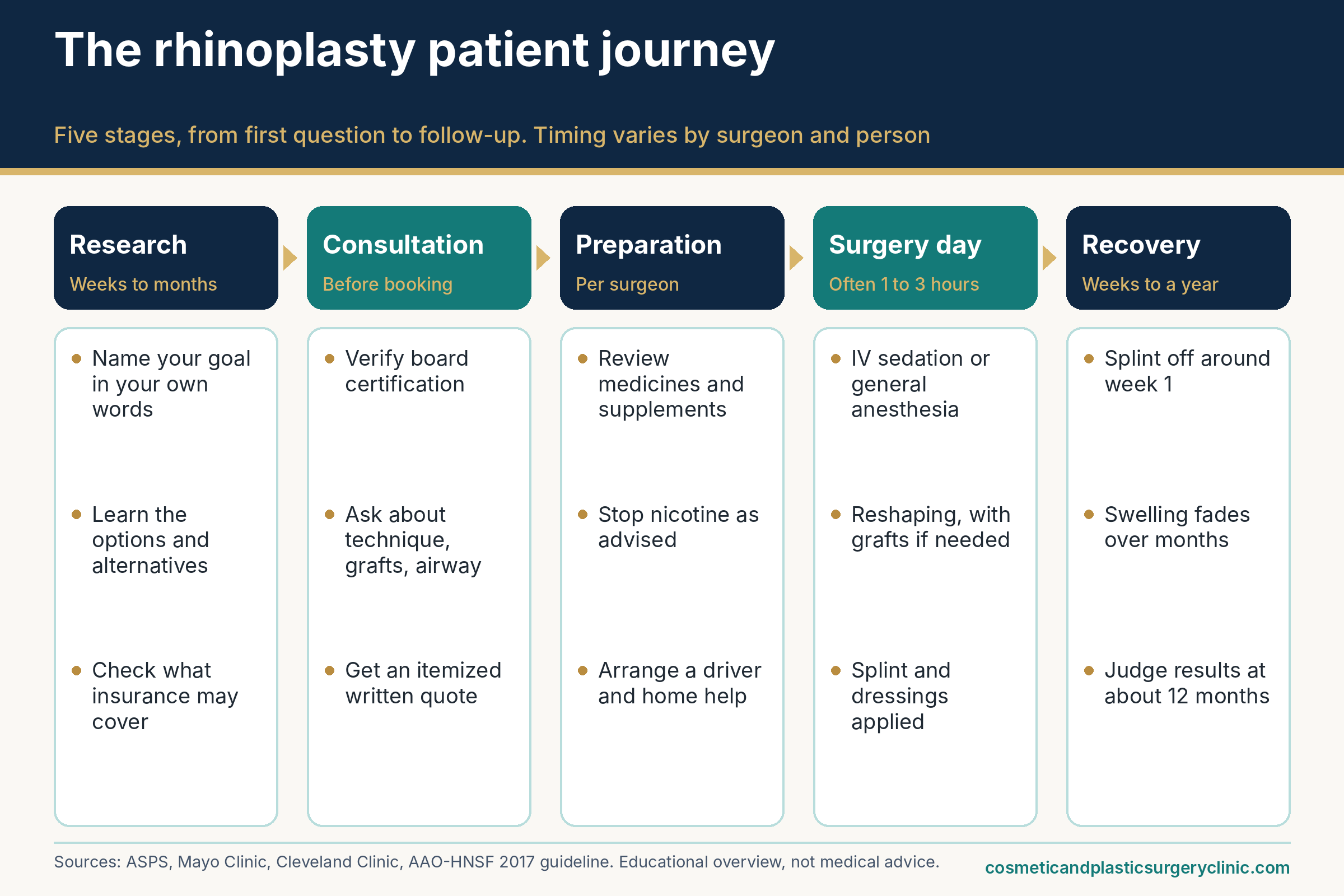
Rhinoplasty Recovery: Timeline, Swelling, and Return to Daily Life
Recovery from rhinoplasty has two clocks running at once. The first is the practical clock: how long until the splint comes off, the bruises fade, and you can go back to work and to the gym. The second is the healing clock, which is slower, and which determines when the nose settles into its lasting shape. Most confusion comes from mixing the two. A person can look presentable at three weeks and still have a nose that will continue to change for many months. The dedicated rhinoplasty recovery guide expands on week-by-week detail; this section gives the framework and the planning logic.
A recovery timeline with realistic ranges
The first two weeks: splint, bruising, and early swelling
Sources agree on the broad shape of the early period, and they differ a little on details, which is itself informative. ASPS says initial swelling subsides within a few weeks. An ASPS article quotes one surgeon saying that sutures and the splint typically come out within the first week and that bruising under the eyes is mostly resolved by about one week. Another ASPS article describes bruising and tenderness of the cheeks and under the eyes lasting a week or two, with pain and swelling most pronounced in the first week. Mayo Clinic gives about one week for the external splint and notes that most people can return to most activities after about a week, with all activities resuming after two to four weeks. Cleveland Clinic describes the splint staying on and bruising and swelling being visible during the first one to two weeks, with return to work possible during that period.
Put together, a reasonable planning assumption is that the first week is the hardest and the most visible, that the splint comes off around the end of that week, and that bruising is fading by the end of the second week, with wide individual variation. The tip, the area around the nostrils, and the eyelids tend to hold swelling longest. The table gives a calendar view built from these descriptions. It is a planning aid, not a prediction for any individual.
| Window | What is commonly described | Planning notes |
|---|---|---|
| Days 0 to 2 | Congestion, swelling, drainage; splint and possibly internal splints or packing in place | Rest with the head elevated; have help at home; keep the after-hours number handy |
| Days 3 to 7 | Peak swelling and bruising around the eyes and cheeks; pain and swelling most pronounced in the first week | Avoid exertion and nose blowing; attend the first follow-up; splint typically removed around the end of the week |
| Weeks 2 to 3 | Bruising fading; nose still visibly swollen; some people return to work or school | Light activity may resume if the surgeon approves; social plans may still feel premature |
| Weeks 4 to 6 | Noticeable swelling decrease; about half of swelling resolved by six weeks per one ASPS-quoted surgeon | Many surgeons restrict strenuous exercise until about six weeks; confirm your own date |
| Months 2 to 3 | Cleveland Clinic describes about 90 percent of swelling resolved by three months; the tip may remain fuller | Avoid judging the shape; the tip may still look full |
| Months 6 to 12 | Refinement continues; swelling may come and go and be worse in the morning during the first year (ASPS) | Revision conversations usually wait until healing is mature; Mayo says at least a year |
| Year 1 and beyond | Most swelling is gone within a year (Mayo); ASPS surgeons say full healing can take one to two years | Follow-up photos and a final assessment at about 12 months fit the AAO-HNSF guidance |
Two caveats are worth underlining. The 90 percent figure at three months comes from a patient information page and describes an overall impression rather than a measured threshold, and the “half by six weeks” figure comes from a single surgeon quoted by ASPS. Treat both as illustrations of the pace, not as milestones to compare yourself against.
Weeks three through twelve, and the long tail of swelling
After the first couple of weeks, recovery becomes quieter and slower. The dramatic bruising is gone, but the nose still looks and feels different. It may be broader than you expect, the tip may seem blunt or upturned, and one side may look fuller than the other. ASPS says the nose may appear crooked or asymmetrical during healing and that this often evens out over the course of a year. Salemy, writing in an ASPS article, noted that a marked reduction in swelling is often visible at three to four weeks, that most patients see initial results after about a month, and that the final shape may take up to a year to emerge.
Surgeons commonly explain the long tail of swelling this way: the skin is tightly bound to the framework beneath it, so fluid has little room to spread, and surgery disturbs the usual drainage pathways. The skin over the tip is thicker than the skin over the bridge. In an open approach the dissection is wider, and surgeons quoted by ASPS say the tip tends to stay swollen longest, particularly after open surgery. Fluid can also shift with the time of day and with position: ASPS notes swelling may come and go and be worse in the morning during the first year, which many people find reassuring once they know it is expected.
Some people find this stage emotionally harder than the first week. The initial focus on logistics has passed, the nose still doesn’t look finished, and photos of other people’s results can sharpen the impatience. StatPearls lists postoperative low mood among the possible complications, which is worth mentioning to your surgical team if it persists. Many people find it helpful to take standardized photographs at set intervals, such as one month, three months, six months, and one year, taken in the same light and at the same angles, so that changes can be judged from images rather than from mirror impressions on a bad morning.
The AAO-HNSF guideline recommends documenting satisfaction with both appearance and nasal function at a minimum of 12 months after surgery. That timeframe is a useful anchor. It tells you that clinicians who study outcomes treat the first year as the period over which a result should be judged, and it suggests asking your surgeon when they schedule follow-up visits and what they check at each.
Planning work, exercise, glasses, sleep, travel, and sun
Work, exercise, glasses, sleep, travel, and sun: practical rules of thumb
Work and school. ASPS surgeons describe taking about a week off at first, and ASPS has also reported that most people can return to work and light activity after about three weeks, with longer for strenuous jobs. Mayo Clinic’s range is about a week for most activities. Reconcile these by looking at the job, not the calendar: a desk job where you can work without a camera on may be workable in week one or two, while a job involving lifting, bending, heat, or close contact with other people may need longer.
Exercise. One surgeon quoted by ASPS advises avoiding strenuous exercise for at least six weeks, and heavy workouts and contact sports for longer. Cleveland Clinic advises against heavy lifting for roughly four to six weeks. Mayo Clinic’s broader range of two to four weeks for all activities shows that practices differ, so use your own surgeon’s date. Exertion raises blood pressure and can increase the chance of bleeding and swelling, and a bump to a healing nose can displace the structures, which is why contact sports are usually the last activity to return.
Glasses. Cleveland Clinic cautions about pressure from eyeglasses on the bridge. Many surgeons suggest contact lenses, or a lightweight way to keep frames off the nose, for a period they specify. If you cannot see without glasses, ask in advance what the plan is rather than improvising on day three.
Sleep. Keep the head raised, as Cleveland Clinic advises, and avoid sleeping on your face or side if the surgeon asks you to, since pressure can shift a healing nose. Many people prop themselves with pillows or sleep in a recliner for the first nights.
Travel. Ask whether and when flying or long drives are acceptable, and whether you should stay within reach of the surgeon’s office for the first week, when the splint comes off and early problems are most likely. If you live far from where you have surgery, build in a hotel stay and a follow-up visit on the way home.
Sun. Cleveland Clinic advises limiting sun exposure. Swollen, healing skin can burn or darken more easily, and a sunburned nose is slow to settle. Ask your surgeon when it is appropriate to use sunscreen on the nose and what kind, and plan on shade and hats in the meantime.
Bruising, numbness, smell, and three illustrative recovery plans
Other effects are common enough to anticipate. Bruising around the eyes may change color as it fades. Numbness or altered sensation of the tip and upper lip is possible, which is why ASPS lists change in skin sensation, numbness or pain, among the risks. Mayo Clinic lists permanent numbness and altered sense of smell as possible, and StatPearls’ chapter on septoplasty reports that reduced smell after septum surgery is usually temporary and typically resolves within about six months. Tell the team if any change seems out of proportion or is not improving over the weeks.
The three scenarios below are illustrative, not predictions or recommendations. They show how the same recovery framework looks in different lives.
Illustrative scenario one: a remote worker with flexible hours. This person arranges surgery on a Thursday, spends the weekend and the first few days resting with a raised head, takes video calls with the camera off in week one, and returns to ordinary desk work around the splint removal visit. Their main planning issue is the appearance of bruising and the splint on camera, plus keeping glasses off the bridge. Exercise waits for the surgeon’s all-clear.
Illustrative scenario two: a person whose job involves lifting or working with children. This person needs longer off work and a plan for the first few weeks. Lifting, bending over, and the risk of a child’s head or elbow striking the nose are the specific hazards. They arrange help with childcare and delay a full return until the surgeon agrees that the nose is stable enough, which may be several weeks.
Illustrative scenario three: a daily glasses wearer and recreational athlete. Their issues are practical. They plan contact lenses or a frame solution in advance, stay out of ball sports and group classes until cleared, and accept that the return to running, lifting, and sparring happens in stages. They also plan for the fact that the nose may look bulkier at the tip longer than they would like.
Recovery planning is easier when you write down a worst-case calendar: the longest time you might realistically need, set against your obligations. If that calendar does not work, the answer is to change the surgery date, not to rush the recovery.
Rhinoplasty Results, Longevity, Risks, and Revision
This is the section most worth reading slowly. Results and risks are two views of the same fact: the nose is a small, delicate, highly visible structure, and every change is a trade-off between what you gain and what could go differently than planned. A trustworthy source will state both without hedging in either direction.
Judging results and understanding longevity
When results can be judged, and what “natural-looking” means
ASPS says that swelling subsides within a few weeks but that full refinement can take up to a year. Mayo Clinic says most swelling is gone within a year and that final results take time to assess because the nose keeps changing. Surgeons quoted by ASPS describe full healing as taking one to two years. These statements are consistent: you may see the broad shape within weeks to months, but you cannot fairly judge the tip and the fine contours until much later. The AAO-HNSF guideline reflects this by recommending that clinicians document both satisfaction with appearance and satisfaction with nasal function at a minimum of 12 months.
The phrase “natural-looking” appears in almost every rhinoplasty conversation and is worth unpacking, because it is an aesthetic goal, not a technical specification. For some people it means a nose that does not draw attention. For others it means a nose that fits their face and heritage. For others still it means that no one can tell surgery happened. These are different goals and they lead to different plans. A good way to translate the phrase is to describe what you want in behaviors: “I’d like to look at a profile photo and see my own face first, not my nose.” Your surgeon can then say whether that is achievable with your anatomy. ASPS notes that modern rhinoplasty tends toward restraint, preserving the nose’s own character. The article on natural-looking rhinoplasty results explores the idea further.
Skin matters again here. ASPS says outcomes depend heavily on the anatomy, particularly the skin. Thick skin can mute fine definition even after careful cartilage work, and thin skin can reveal small edges or graft outlines. Neither is a flaw; they are characteristics a surgeon should assess before surgery and explain candidly. If a surgeon promises a very sharp tip on very thick skin, or a very smooth bridge on very thin skin, ask how they will achieve it and what the downsides are.
How long results last: what changes after the operation
Structural changes made in rhinoplasty, such as removing a hump or reshaping cartilage, are intended to be lasting. Cleveland Clinic describes rhinoplasty as a permanent change to the nose. That is a fair summary of the intent, but it deserves two qualifiers.
First, the nose keeps living. Skin loses elasticity with age, tissues continue to settle, and the cartilage that supports the tip can weaken over decades. A nose that was balanced at 30 may look somewhat different at 60, with or without surgery. Second, grafts and sutures can behave differently from how the surgeon expected. Rib cartilage can warp, some graft material can be resorbed, and a nose that is injured later can shift. Those events are the reason a small share of people need revision, and the reason surgeons build in structural support meant to hold the shape under tension.
It is therefore more accurate to say the surgery is lasting in intention and subject to ordinary aging and healing in practice. If longevity is central to your decision, say so in the consultation and ask what the surgeon has observed in noses they operated on years earlier. Compare that with a nonsurgical option, such as filler, which is temporary by design. The article on how long rhinoplasty results last covers the topic in more depth.
Risks and complications, and revision rhinoplasty
Risks and how they are described: a context table
ASPS lists the risks of rhinoplasty as anesthesia risks, change in skin sensation (numbness or pain), difficulty breathing, infection, nasal septal perforation, poor wound healing or scarring, the possibility of revision surgery, skin discoloration and swelling, and unsatisfactory nasal appearance. Mayo Clinic adds bleeding, permanent numbness, an asymmetrical appearance, prolonged discoloration, and altered sense of smell. StatPearls adds specific contour problems, such as a saddle-shaped loss of bridge height when septal support is inadequate, an over-full area above the tip sometimes called a polly beak, an inverted-V shape at the middle of the nose, and retraction of the nostril rims. The AAO-HNSF guideline focuses on nasal airway obstruction and sets out how clinicians should assess and counsel patients about it before surgery.
None of these sources gives a single complication rate that applies to every operation, and this guide does not either. Rates depend on how a complication is defined, how long patients are followed, and how complex the operation is. The table below describes each risk in plain terms and notes what a careful team does to lower the chance or catch it early. It is not a measure of how likely any one of these is for you.
| Risk | What it means | What may reduce the chance or catch it early |
|---|---|---|
| Breathing difficulty | New or worse nasal obstruction, often from narrowing at the internal valve or an unaddressed septal or turbinate problem | Airway assessment before surgery; valve-supporting grafts or sutures; follow-up that asks about breathing |
| Bleeding | Early bleeding, or a collection of blood in the septum (septal hematoma) after septum surgery | Stopping blood-thinning medicines as directed; avoiding strain early; prompt contact for heavy bleeding |
| Infection | Bacterial infection of the incisions, the tissue, or a graft or implant | Sterile technique; wound care instructions; early evaluation of fever, redness, or discharge |
| Septal perforation | A hole in the septum; ASPS calls it rare and notes it can be impossible to correct | Careful technique on both sides of the septum; reporting whistling, crusting, or bleeding that persists |
| Asymmetry or contour irregularity | Uneven sides, bumps, hollows, or visible graft edges | Realistic goals; surgeon experience; waiting for swelling to settle before judging; standardized photographs |
| Numbness or sensation change | Reduced feeling in the tip, lip, or teeth; altered sense of smell | Informed consent; tracking improvement over weeks to months |
| Skin discoloration, swelling, or scarring | Prolonged bruising or redness; thickened scar at the columella or nostril incisions | Sun protection; scar history shared early; follow-up if a scar thickens |
| Anesthesia complications | Reactions to medications or airway and heart events during sedation or general anesthesia | Health screening; qualified anesthesia professional; accredited facility |
| Unsatisfactory appearance or need for revision | The result does not match goals, or a problem needs a second operation | Clear goal-setting; consistent imaging and photography; understanding the surgeon’s revision policy |
Three of these deserve emphasis. Breathing problems are the complication most easily overlooked in a cosmetic-focused consultation, which is why the AAO-HNSF guideline asks that every candidate be evaluated for obstruction. Cleveland Clinic lists prior rhinoplasty as a risk factor for nasal valve collapse, so a nose that looked fine after surgery can later feel blocked. Contour problems are the most common reason for dissatisfaction, and they often cannot be fairly judged for months. And septal perforation is rare but can be lasting, as ASPS notes. A deeper treatment of this topic is in the guide to rhinoplasty risks and complications.
Smoking and nicotine raise the risk of healing problems, and anesthesia carries its own risks that depend on your health and on the setting. Those are the two risk factors that you can most directly influence before surgery. The rest comes down to the surgeon’s technique, your anatomy, and chance.
Revision rhinoplasty: how often, why, and when
Revision rhinoplasty is surgery on a nose that has had surgery. People pursue it for different reasons: a contour problem, an asymmetry, a bridge that has collapsed, a tip that rotated more than planned, or a breathing problem. Some revisions are small touch-ups; others are major rebuilds that need rib cartilage and a long operation. Mayo Clinic notes that revision surgery should wait at least a year, since the nose needs time to finish healing before anyone can judge what needs changing. The guide to revision rhinoplasty covers the process in detail.
How often does it happen? The honest answer is that published figures vary widely, and no single number is authoritative. Cleveland Clinic’s patient page states that about 15 percent of people need a follow-up operation to make small changes, and the StatPearls chapter on rhinoplasty cites revision rates of up to 15 percent. A 2020 study of 9,172 rhinoplasties recorded in a Florida ambulatory surgery database between 2009 and 2014 found that 4.4 percent of initial rhinoplasty patients had a revision in that data. A 2017 systematic review that pooled more than 11,000 operations reported reoperation rates of about 1.6 to 2.7 percent for primary operations, but 98 percent of the underlying studies were at the lowest evidence grade.
Why such a spread? Several reasons are plausible, and they are worth understanding because they apply when you hear any number from a clinic. Definitions differ: a “revision” might mean any later procedure or only a major re-operation. Follow-up differs: some studies track patients for a year, others for a few months, and some revisions occur years later. Data sources differ: a state ambulatory surgery database can miss operations done elsewhere, and series from a single surgeon or center may not reflect other settings. The practical message is that revision is a real possibility, that it is not rare enough to dismiss and not common enough to assume, and that your own risk depends on your anatomy, the complexity of the operation, and the surgeon.
That is why it is fair to ask any surgeon three questions: What is your own revision rate, how do you define it, and what is your policy on fees if a revision is needed? Practices differ: some reduce or waive the surgeon’s fee, some charge facility and anesthesia costs, and some have no written policy at all. Get it in writing. Also notice what the 2020 Florida study found about patient behavior: among the 380 patients who had two or more rhinoplasty procedures, 30.8 percent changed surgeons for the later operation. If you consider changing, bring all your records and operative reports to the new surgeon, and choose someone experienced in revision, since the work is generally more complex than a first-time operation.
Rhinoplasty Cost, Insurance, Alternatives, and Choosing a Qualified Surgeon
The final decision stage mixes money, risk, and trust, and it is the stage where people are most likely to be rushed by a calendar or a promotion. Slowing it down means separating questions that tend to get blurred: what the published numbers do and do not tell you, what insurance might cover, what the realistic alternatives are, and how to verify the person who would operate on your nose.
What rhinoplasty costs and when insurance may apply
Cost anatomy: the surgeon’s fee, the rest of the bill, and what national averages mean
Start with what has been verified. The ASPS rhinoplasty cost page states an average cost of $7,637 and attributes it to the society’s latest statistics, without naming a year on the page. That figure matches ASPS’s 2023 table of average surgeon and physician fees, where rhinoplasty is listed at $7,637 for 2023 and $6,324 for 2022. For 2024, ASPS changed its format and published a projected range for rhinoplasty of $7,500 to $12,500, described as an aggregate projection based on averages submitted by surveyed members, and limited to ASPS member surgeons. An ASPS fee document for 2025 could not be located during this research. Because the format changed between years, the 2022-to-2023 average and the 2024 range should not be read as a trend. And it is critical to understand what these figures leave out: the ASPS cost page says the average does not include anesthesia, operating room facilities, or other related expenses.
In other words, those numbers describe the surgeon’s fee as reported by a group of board-certified plastic surgeons in the United States. They are not a price quote, not an offer, not a local average, and not a total cost. Your total could be higher or lower depending on where you live, who operates, where the surgery is done, and what the operation involves. The rhinoplasty cost guide breaks the components down further, and the septorhinoplasty cost guide addresses the combined operation.
The bill generally has several layers. The ASPS cost page lists anesthesia fees, hospital or surgical facility costs, medical tests, prescriptions, and the surgeon’s fee. Pulling these apart helps you compare quotes honestly:
- Surgeon’s fee. Reflects experience, complexity, and what is bundled in, such as follow-up visits and the splint removal visit.
- Facility fee. Differs among hospital outpatient departments, ambulatory surgery centers, and office-based operating rooms.
- Anesthesia fee. Often billed by time and by the type of professional involved; general anesthesia and sedation may be priced differently.
- Pre- and post-operative costs. Medical clearance, prescriptions, and any follow-up beyond the included period.
- Contingencies. The revision policy, charges for a graft source such as rib cartilage, and whether a combined septum operation is priced separately.
A lower headline price can reflect a different bundle, not a better deal: a quote that leaves out anesthesia and the facility is not comparable to one that includes them. A higher price does not ensure a better result either. What helps is a written, itemized quote from each practice, listing what is and is not included, the planned technique and grafts, the anesthesia type and who provides it, the facility, the follow-up period, and the revision policy. ASPS notes that many surgeons offer financing plans, so ask about terms, interest, and fees, and compare them against the total you would pay. Avoid financing arrangements that you could not afford if the operation required a second procedure.
Finally, remember that cost is also time. Weeks of reduced activity, lost income, transportation, lodging if you travel for surgery, and possible revision all belong in a realistic budget. If you are weighing a distant practice because of price, add up what a problem would cost in travel and follow-up, and ask how complications would be handled if you are far from the surgeon.
Insurance, functional repair, and documentation
Cosmetic rhinoplasty is generally not covered by health insurance. Functional repair is different in principle. ASPS says that when rhinoplasty is performed to improve breathing, the cause is most commonly an obstructed airway, and that such surgery is considered reconstructive and may be covered by insurance. The word “may” carries a lot of weight. Mayo Clinic states that coverage depends on individual policies and that prior authorization is advisable. Each insurer sets its own criteria for what counts as a medically necessary airway operation, and those criteria can involve documented symptoms, an examination, a trial of medical treatment, and sometimes endoscopy or other testing.
The AAO-HNSF consensus statement on septoplasty is a useful window into how clinicians approach this. It describes the usual indication as persistent nasal obstruction from a deviated septum after a trial of conservative treatment, such as nasal sprays, and the panel did not consider imaging such as a CT scan necessary in most cases. That does not set insurance rules, but it shows what clinicians typically document: symptoms, examination findings, and what has been tried. The ENT Health patient site likewise advises that medical treatment be tried before surgery for a deviated septum.
When a patient wants both breathing correction and a cosmetic change, the operation is a septorhinoplasty, and billing can be split: the functional portion is submitted to insurance and the cosmetic portion is paid out of pocket. How that split is documented and itemized differs among practices and insurers, and the insurer decides, not the surgeon. Ask the office: Do you submit to insurance, and how is the functional portion defined? What do you document? If the insurer denies, what happens to the schedule and the bill? Get answers before you commit to a date.
On taxes, the IRS publication on medical and dental expenses (2025 edition) states that cosmetic surgery generally cannot be deducted, with exceptions when the procedure corrects a deformity from a congenital abnormality, a personal injury, or a disfiguring disease. Whether any of that applies to you is a question for a tax professional. For the purposes of planning, treat cosmetic rhinoplasty as an out-of-pocket expense unless the insurer or a tax advisor tells you otherwise in writing.
Alternatives and choosing a qualified surgeon
Alternatives in brief: what they can and cannot replace
Many people look for a way to change the nose without an operation. The detailed comparison belongs in the separate alternatives guide linked near the top of this page; here is the short version.
Injectable filler, often called liquid rhinoplasty or a nonsurgical nose job, adds volume. It can camouflage a small bump or lift a drooping tip visually, but it cannot reduce a nose or straighten a septum. On regulation, the FDA’s dermal filler page, last modified on July 6, 2023, lists the nose among uses that are not approved, and it identifies unintentional injection into a blood vessel as the most concerning risk, with complications that can include tissue death, vision loss, and stroke that may be permanent. That makes the nose a place where the experience and training of the injector matter a great deal. Thread-based nose lifts, according to ASPS, produce subtle, temporary change lasting about six months, and are not a substitute for surgical rhinoplasty because they will not reduce a hump or narrow wide bones.
Other approaches do not involve the nose directly: balancing the chin or cheeks, changing photography habits, or simply waiting. And a functional operation, such as septoplasty without reshaping, is its own alternative when breathing is the real concern. The common theme is that alternatives suit some goals and not others. If your goal is smaller, narrower, straighter, or permanently different, surgery is the pathway that addresses it. If your goal is a subtle, temporary adjustment, an alternative may be reasonable. Neither is better in the abstract.
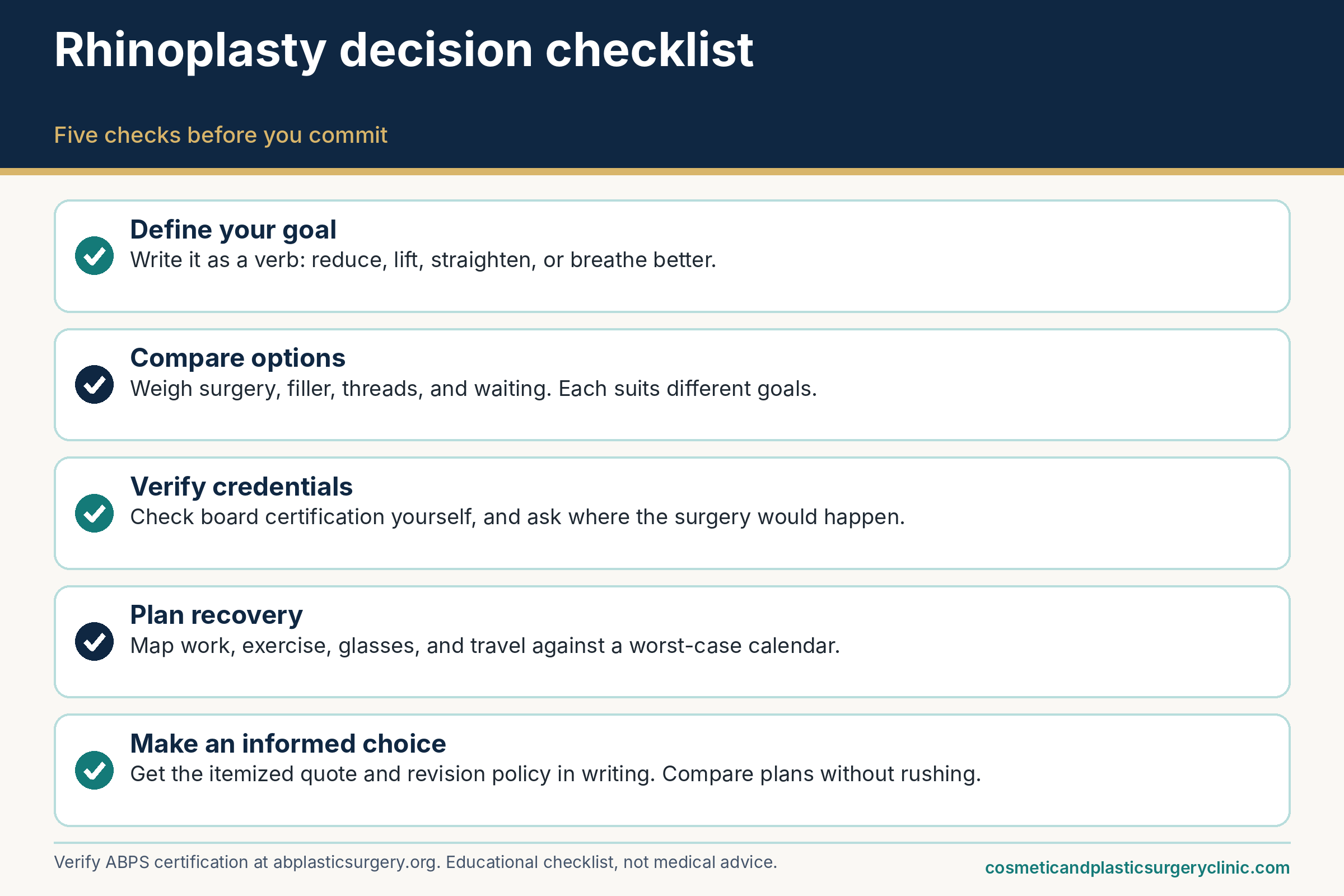
Verifying credentials and questions for the consultation
Rhinoplasty is performed by surgeons from more than one training path, and the word “specialist” on a website does not tell you which. Two paths are common. Plastic surgeons train in plastic surgery, and board certification in that specialty comes from the American Board of Plastic Surgery (ABPS). ASPS says its member surgeons must be ABPS-certified (or certified by the Royal College of Physicians and Surgeons of Canada) after at least six years of surgical training, including a minimum of three years of plastic surgery residency, and must operate in accredited, state-licensed, or Medicare-certified facilities. Otolaryngologists, also called ENT or head and neck surgeons, train in otolaryngology-head and neck surgery, certified by the American Board of Otolaryngology (ABOto). Both of those boards are among the 24 member boards listed by the American Board of Medical Specialties (ABMS).
A third credential causes confusion. The American Board of Facial Plastic and Reconstructive Surgery (ABFPRS) states that its certification requires prior certification in otolaryngology or plastic surgery through the ABMS or the Royal College in Canada, a two-day examination, and a log of at least 100 facial plastic surgery cases. It was not listed among the ABMS member boards on the ABMS page reviewed for this article, and the ABFPRS page does not say otherwise, so it is best understood as an additional credential held by surgeons who are already certified through a primary board. This guide does not rank these paths. Excellent rhinoplasty surgeons come from each, and your question is what a particular surgeon’s training, certification, and experience are.
Verification is simple and worth doing yourself. The ABPS offers a public search by name and location, and describes certification as voluntary, with certificates issued since 1995 valid for 10 years and an active, unrestricted medical license required. For otolaryngology, the ABOto website has a section for verifying a physician’s board certification, and ABFPRS maintains a physician finder. The ABPS tool also points to the Federation of State Medical Boards for license status and any state actions. ASPS warns not to be confused by official-sounding boards and notes that there is no ABMS member board with “cosmetic surgery” in its name. See the guide to ABPS board-certified plastic surgeons for a step-by-step approach, and verify at the ABPS verification page.
The table below turns the main issues into questions you can bring to a consultation. A related article on the rhinoplasty consultation goes deeper. There is no single correct answer to each question; the point is to hear whether the answer is specific, consistent with your anatomy, and comfortable about uncertainty.
| Topic | Question to ask | Why it matters |
|---|---|---|
| Credentials | Which board certifies you, and how can I verify it? Where do you operate, and is it accredited? | Certification and facility standards are verifiable, unlike general claims |
| Experience | How many rhinoplasties like mine do you do each year, and may I see consented photographs? | Helps you gauge how relevant their experience is to your nose |
| Plan | Open or closed, and why? Reduction, augmentation, or both? What techniques and grafts, from where? | Lets you compare quotes and spot unplanned graft needs |
| Airway | Have you examined my breathing? How will the plan protect or improve my airway? | Breathing problems are a recognized complication and are easy to miss |
| Limits | What can my skin and structure realistically achieve, and what can’t they? | Aligns expectations with anatomy |
| Imaging | If you use simulations, what do they leave out? | Images are illustrations, not promises |
| Anesthesia | Who gives it, what type is planned, and who monitors me? | Anesthesia is a distinct risk with its own qualifications |
| Recovery | When does the splint come off, what are the restrictions, and who answers after hours? | Prevents improvisation during the riskiest days |
| Revision and cost | What is your revision policy, in writing? What is included in the itemized fee? | Clarifies total cost and how problems are handled |
One more point about tone. A good consultation is a two-way exchange. If you feel rushed, if the surgeon dismisses questions about risk, if a deposit is demanded the same day with a “limited-time” discount, or if the plan seems to come from a template and not from your nose, those are signals to pause. It is entirely reasonable to leave without booking and to get a second opinion. Rhinoplasty is not an operation that rewards urgency.
Frequently asked questions
How common is rhinoplasty in the United States, and who has it?
ASPS’s 2025 statistics report counted 43,116 nose-reshaping procedures for 2025, down 5 percent from 45,213 in 2024. Women accounted for 36,229 of the 2025 procedures and men for 6,886, and every age band from 18-25 through 66 and older included thousands of cases. The report draws on ASPS member surgeons, CosmetAssure, and national claims-based datasets, so it is not a census of every nose operation, and ASPS has restated prior-year numbers when its methods changed. These counts show how often the operation is performed, not whether it suits any individual.
How long does the operation take, and will I stay overnight?
Cleveland Clinic gives a range of about one to three hours, and the length depends on the plan. Adding a septum correction, harvesting rib cartilage, or doing extensive tip work lengthens it. Mayo Clinic describes local anesthesia with sedation as an outpatient option, with general anesthesia as the alternative, but whether you go home the same day depends on your health, the anesthesia, the facility, and your surgeon’s protocol. Ask in advance, and plan for a responsible adult to drive you home and stay with you for the first night.
How painful is rhinoplasty?
Experience varies. The AAO-HNSF guideline recommends that surgeons educate patients before surgery about strategies to manage discomfort, which is a good prompt to ask what pain control the plan includes. One surgeon quoted by ASPS described needing pain medication for only a day or two, but a rib graft harvest adds a second surgical site with its own discomfort. Mayo Clinic advises avoiding aspirin and ibuprofen around the time of surgery because of bleeding, so ask what to take for pain and when to call if it escalates.
Will rhinoplasty change my sense of smell or my voice?
Mayo Clinic lists an altered sense of smell among possible complications. StatPearls’ chapter on septoplasty reports that reduced smell after septum surgery is usually temporary, typically resolving within about six months. An ASPS article notes that nasal size and shape affect voice quality, which makes the question reasonable, although no source reviewed for this guide gave data on how often voice changes after rhinoplasty. If you sing, speak professionally, or depend on smell for your work, say so in the consultation and ask how the surgeon would weigh those concerns.
Can rhinoplasty fix snoring or sleep apnea?
Rhinoplasty is not a treatment for sleep apnea. Sleep apnea can involve the throat, tongue, jaw, and other structures beyond the nose, and the AAO-HNSF guideline recommends that candidates with documented obstructive sleep apnea be counseled about how surgery may affect airway obstruction and about perioperative management. StatPearls lists sleep apnea as a relative contraindication to rhinoplasty. A blocked nose can worsen sleep, and nasal surgery may be part of a broader plan for some people, but that is a decision for a sleep physician and a surgeon working with your examination and test results.
Will I have visible scars?
A closed approach leaves no external scar from the approach because the incisions are inside the nostrils. An open approach adds a small incision across the columella, the strip of tissue between the nostrils, and ASPS says incisions to change nostril size are placed in the natural creases of the nostrils. ASPS lists poor wound healing or scarring among the risks, and it notes that keloids and hypertrophic scars are more common in people of African and Asian descent. Tell the surgeon about any history of thick scars, and ask where each incision would go.
I broke my nose. How soon can I have surgery?
A fresh injury is a medical evaluation first and a cosmetic question later. Heavy bleeding, difficulty breathing, clear drainage, vision changes, or an obvious change in shape after trauma warrants prompt assessment by a clinician. Mayo Clinic notes that rhinoplasty can be done to correct effects of injury. When and how to operate depends on swelling, healing, what the bones and septum look like, and whether early repositioning is appropriate, so no general timetable applies. A surgeon will tell you when the nose has settled enough to plan reconstruction or refinement.
What if I don’t like how my nose looks while it is still swollen?
Swelling hides the result for months. An ASPS article notes that the nose may look crooked or asymmetrical during healing and that this often evens out over about a year, and ASPS says swelling may be worse in the morning during the first year. Photograph the nose at set intervals and share your concerns at follow-up visits rather than waiting silently. Mayo Clinic says revision generally waits at least a year. Breathing trouble, signs of infection, or sudden changes should not wait, and you should contact the surgical team promptly about them.
Should I get a second opinion, and how do I ask for one?
A second opinion is routine for elective surgery and does not offend a confident surgeon. Request your records or photographs if you have had prior nasal surgery, and bring the same list of questions to each consultation so you can compare answers. Different surgeons may propose different techniques, such as open versus closed or structural versus preservation approaches, and a 2022 systematic review concluded that outcomes depend more on the surgeon’s skill than on the technique label. Compare the reasoning, the itemized quote, and how candid each surgeon is about limits.
What should I bring to a rhinoplasty consultation?
Bring photographs of your nose from several angles, including older pictures from before any injury, plus images of noses you like and dislike with notes on what you see in them. Bring a complete list of medications and supplements, the names and dates of any prior nasal surgery or filler, and a summary of your breathing symptoms and allergies. Mayo Clinic describes the evaluation as a medical history, physical examination, and photographs. If breathing is part of your reason for surgery, ask whether to bring documentation of treatments you have already tried, and bring written questions.
What to carry forward from this guide
- Define the goal in your own words, separating how the nose looks from how it works, and treat breathing as part of every plan.
- Ask for the reasoning behind each technique and graft choice, and for a candid account of what your skin and structure can and cannot do.
- Plan for a long recovery curve: the splint comes off in about a week, but the final shape can take a year or more.
- Get an itemized, written quote, and ask about the revision policy before you commit.
- Verify the surgeon’s board certification yourself, and feel free to take your time and compare more than one plan.
Sources and further reading
- American Society of Plastic Surgeons — Rhinoplasty (nose reshaping) overview (accessed 2026-10-03) — definition, features rhinoplasty can address
- American Society of Plastic Surgeons — Rhinoplasty procedure steps (accessed 2026-10-03) — anesthesia options, open and closed incisions, graft sources, splints and packing
- American Society of Plastic Surgeons — Rhinoplasty recovery (accessed 2026-10-03) — splints, swelling over the first year
- American Society of Plastic Surgeons — Rhinoplasty safety and risks (accessed 2026-10-03) — risk list, septal perforation, revision
- American Society of Plastic Surgeons — Rhinoplasty candidates (accessed 2026-10-03) — facial growth, health, nonsmoking, realistic goals
- American Society of Plastic Surgeons — Rhinoplasty cost (accessed 2026-10-03) — average fee, exclusions, insurance note for breathing-related surgery, financing
- American Society of Plastic Surgeons — 2023 average surgeon/physician fees (accessed 2026-10-03) — rhinoplasty $7,637 (2023) and $6,324 (2022)
- American Society of Plastic Surgeons — 2024 average surgeon/physician fees (accessed 2026-10-03) — projected range $7,500-12,500 and methodology note
- American Society of Plastic Surgeons — 2025 Plastic Surgery Statistics Report (accessed 2026-10-03) — nose reshaping counts by year, age band, and sex
- American Society of Plastic Surgeons — What to expect from your rhinoplasty recovery (2022; accessed 2026-10-03) — recovery milestones quoted from surgeons
- American Society of Plastic Surgeons — What to expect during your rhinoplasty recovery (2020; accessed 2026-10-03) — splint week, bruising, return to work, final shape
- American Society of Plastic Surgeons — Realistic changes in a typical rhinoplasty (2018; accessed 2026-10-03) — features surgery can change; role of skin
- American Society of Plastic Surgeons — Can a nose job change the way you breathe? (2024; accessed 2026-10-03) — septum, turbinates, spreader grafts, internal changes
- American Society of Plastic Surgeons — Briefing paper: Plastic surgery for ethnic patients (undated; accessed 2026-10-03) — identity, individualized goals, scarring
- American Society of Plastic Surgeons — Culture and anatomy in Asian rhinoplasty (2014; accessed 2026-10-03) — anatomy tendencies, identity, implant versus graft practice
- American Society of Plastic Surgeons — Rhinoplasty in Indian Americans (2012; accessed 2026-10-03) — patient goals and identity preservation in one study
- American Society of Plastic Surgeons — How nicotine sabotages plastic surgery (2016; accessed 2026-10-03) — nicotine forms and timing
- American Society of Plastic Surgeons — Thread-based nose lift (2025; accessed 2026-10-03) — comparison with surgical rhinoplasty
- American Society of Plastic Surgeons — Member qualifications (accessed 2026-10-03) — board certification, facility standards
- American Society of Plastic Surgeons — Choose a plastic surgeon you can trust (accessed 2026-10-03) — training years and cautions about official-sounding boards
- Mayo Clinic — Rhinoplasty (accessed 2026-10-03) — preparation, anesthesia, splint timing, risks, swelling, revision timing, insurance
- Cleveland Clinic — Rhinoplasty (updated November 3, 2022; accessed 2026-10-03) — types, duration, recovery timeline, revision statement
- Cleveland Clinic — Nasal valve collapse (updated May 10, 2023; accessed 2026-10-03) — internal and external nasal valve, prior rhinoplasty as a risk factor
- Cleveland Clinic — Nose anatomy and function (updated July 29, 2024; accessed 2026-10-03) — external and internal structures
- Mayo Clinic — Body dysmorphic disorder (accessed 2026-10-03) — definition and relation to cosmetic procedures
- AAO-HNSF Bulletin — Clinical practice guideline: Improving nasal form and function after rhinoplasty (2017; accessed 2026-10-03) — ten key action statements
- StatPearls — Rhinoplasty (updated September 2, 2024; accessed 2026-10-03) — anatomy, techniques, grafts, complications
- StatPearls — Anatomy, head and neck, nasal cavity (updated July 24, 2023; accessed 2026-10-03) — septum, turbinates, internal valve
- StatPearls — Septoplasty (updated November 8, 2022; accessed 2026-10-03) — indications, complications, smell, splints
- AAO-HNSF ENT Health — Deviated septum (reviewed August 2018; accessed 2026-10-03) — prevalence estimate, medical treatment first, septoplasty
- ENTtoday — Clinical consensus statement on septoplasty released (AAO-HNSF, 2015; accessed 2026-10-03) — conservative treatment and imaging
- Crosara et al. — Rhinoplasty complications and reoperations: systematic review (Int Arch Otorhinolaryngol 2017;21(1):97-101; accessed 2026-10-03) — reoperation rates and evidence grade
- Crawford et al. — Change in surgeon for revision rhinoplasty (Laryngoscope Investig Otolaryngol 2020; accessed 2026-10-03) — Florida database revision rate and surgeon change
- Gupta et al. — Outcomes of closed versus open rhinoplasty: a systematic review (Arch Plast Surg 2022; accessed 2026-10-03) — open versus closed comparison
- State of the evidence for preservation rhinoplasty: a systematic review (Facial Plast Surg 2023;39(4):333-361; accessed 2026-10-03) — definition and evidence quality
- Barnawi et al. — Preservation versus conventional rhinoplasty: a systematic review (Front Surg 2026; accessed 2026-10-03) — five comparative studies, one-year outcomes
- Guyuron et al. — Common dorsal flaws following preservation rhinoplasty (Aesthetic Plast Surg 2023; accessed 2026-10-03) — analysis of published images
- Nandakumar et al. — Grafts in septorhinoplasty: a systematic review and future directions (Aust J Otolaryngol 2022; accessed 2026-10-03) — graft and implant complications
- Piezosurgery versus conventional osteotomy in rhinoplasty: systematic review and meta-analysis of RCTs (J Clin Med, June 2024; DOAJ record; accessed 2026-10-03) — swelling, bruising, pain, mucosal injury
- HealthDay — Computer imaging adds to nose job satisfaction: study (reporting Arch Facial Plast Surg 2010; accessed 2026-10-03) — small imaging accuracy study
- Three-dimensional morphing in rhinoplasty consultation (Plast Reconstr Surg Glob Open, January 2019; DOAJ record; accessed 2026-10-03) — patient and surgeon views of 2D and 3D simulation
- Obeid et al. — Use of simulated digital photography in rhinoplasty to increase patient satisfaction (Eur J Plast Surg 2023; accessed 2026-10-03) — pilot study of 51 patients
- U.S. Food and Drug Administration — Dermal fillers (soft tissue fillers) (page modified July 6, 2023; accessed 2026-10-03) — nose not an approved use; vascular risks
- American Board of Plastic Surgery — Verify certification (accessed 2026-10-03) — public verification search
- American Board of Medical Specialties — Member boards (accessed 2026-10-03) — list of 24 member boards
- American Board of Facial Plastic and Reconstructive Surgery — Certification requirements (accessed 2026-10-03) — prerequisites, exam, case log
- American Board of Otolaryngology — Home (accessed 2026-10-03) — otolaryngology certification and verification section
- Internal Revenue Service — Publication 502, Medical and Dental Expenses (2025; accessed 2026-10-03) — cosmetic surgery deduction rules