Breast augmentation is surgery that adds volume to the breasts, most often with an implant placed through a small incision. It does one job well: it makes breasts larger and, depending on the device and the pocket, fuller at the top or rounder overall. It does not lift sagging tissue, make two breasts match, or last for life. In 2025 the American Society of Plastic Surgeons (ASPS) counted 304,234 breast augmentation procedures in the United States, first-time and revision operations combined, up 11 percent from 2024.
Popularity is not a reason to proceed, and it is not a warning either. It simply means the operation is common enough that the marketing around it can drown out the decisions that actually shape the outcome: which tissue you start with, what the implant is made of, where it sits, how big it is, which scar you accept, and what you agree to monitor for years afterward.
This page is the hub for those decisions. Size, fill, pocket, cost, recovery, candidacy and photos each have a dedicated page on this site and appear here in summary with a link. Nothing below can tell you whether surgery fits your body or your plans. That takes an in-person examination by a board-certified plastic surgeon, and leaving a consultation without a booking is a legitimate result.
What Breast Augmentation Changes, and What It Leaves Alone
The cleanest way to think about breast augmentation is as a volume operation. Breast shape, though, has at least four separate parts: how much tissue there is, where that tissue sits, how well the skin holds it, and how symmetrical the two sides are. An implant addresses the first and influences the others only indirectly. Most disappointment starts when someone expects it to fix all four.
Volume, projection and balance: the job an implant does
What an implant adds to the breast
ASPS describes breast augmentation as using implants or fat transfer to increase breast size, restore volume lost after weight loss or pregnancy, create a rounder shape, or soften a natural size difference between the two breasts. It lists increased fullness and projection and a better balance between breast and hip contours as typical aims. Mayo Clinic adds a related reason: evening out unevenness left by earlier breast surgery.
Notice the verbs. An implant adds, fills and projects. It is a device sitting behind or under your own tissue, so the final look is a partnership between the device and what covers it. Thin natural coverage lets the implant’s outline show; thicker coverage hides it. That is why the same implant can look different on two people.
What breast augmentation does not correct
ASPS states plainly that breast augmentation does not correct severely drooping breasts. When the nipple sits low and the skin is stretched, adding volume behind it can fill the skin without raising the breast, and a breast lift (mastopexy) may be needed instead of, or together with, an implant. ASPS says a lift can often be done at the same time as augmentation or may need a separate operation. Its breast lift page adds the mirror image: a lift does not significantly change breast size or round out the upper breast.
Consider a hypothetical comparison. Two people each say they want to look fuller in a fitted top. The first has small, symmetric breasts, nipples above the fold and firm skin. The second has the same volume, but the nipples point downward and the skin is loose after nursing. The wish is identical and the anatomy is not, so a surgeon may reasonably discuss an implant alone for the first person and a lift, an implant, or both for the second. The mirror, not the request, drives the plan.
Other things an implant leaves alone include nipple and areola size, stretch marks, the shape of the rib cage, and natural asymmetry beyond what a different implant size can partly offset. Weight gain, weight loss, pregnancy and aging will keep changing the breasts around the device. Mayo Clinic notes that these changes can mean further surgery later.
| Finding at the consultation | Does an implant address it? | What else may enter the plan | Key question to ask |
|---|---|---|---|
| Small, evenly shaped breasts with little sag | Yes, this is the core use of breast augmentation. | Choice of fill, size, pocket and incision. | How much natural tissue will cover the implant? |
| Volume lost after pregnancy or weight loss | Partly: it restores volume, not skin tone. | A lift if the nipple has dropped or the skin is loose. | Where is my nipple relative to the fold? |
| Clearly drooping breasts | Not on its own, according to ASPS. | Breast lift, with or without an implant, in one or two operations. | Would one operation or two be safer for me? |
| One breast noticeably smaller or shaped differently | Partly: unequal implants or pockets can narrow the gap. | Realistic goals; asymmetry rarely disappears entirely. | What will still be different after surgery? |
| Wide-set breasts or a narrow or uneven chest wall | Only partly: the implant must fit the base. | Implant width and profile chosen to the chest, not to a cup goal. | Which implant width suits my chest? |
The U.S. numbers, and what they hide
Who is having breast augmentation
The ASPS 2025 statistics report puts breast augmentation and implant revision second among cosmetic surgical procedures, behind liposuction at 317,196. By age, the largest group was 36 to 45, at 96,016 procedures, followed by ages 46 to 55 at 65,410 and 26 to 35 at 57,821. The youngest group, 18 to 25, fell 13 percent to 15,292, while patients aged 66 and over rose 34 percent to 24,946.
The pattern runs against the stereotype. Breast augmentation is not mainly an operation of one’s early twenties, and the growth is in midlife and later. It also means many people are choosing implants at ages when mammography, menopause and hormone changes are already part of the conversation.
What the counts cannot tell you
ASPS counts procedures, not people, and the augmentation figure mixes first-time operations with revisions. It cannot tell you how many implants were removed or replaced for a given person, how satisfied patients were, or what any individual should expect. The same report counted 45,773 implant removals among augmentation patients in 2025, essentially unchanged from 45,780 in 2024, so removal is a routine part of the picture rather than a rarity.
Use these numbers as context for how common the operation is. They are not a forecast of your outcome and they are not a measure of safety.
The Anatomy Behind Breast Augmentation Planning
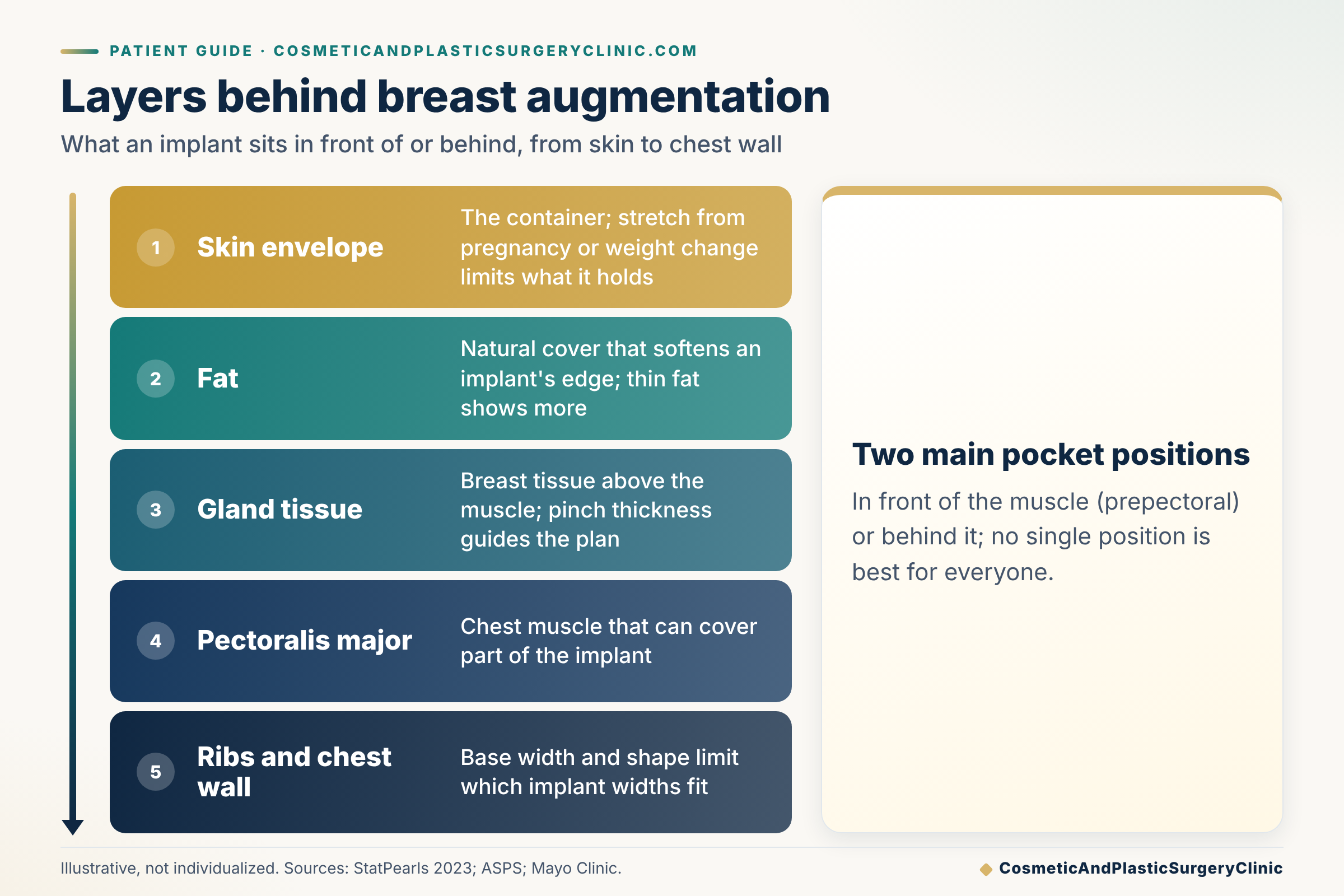
Every decision about breast augmentation starts with anatomy that you can partly check yourself in a mirror and that a surgeon measures in person. Understanding the layers explains why surgeons talk about pockets, coverage and folds, and why two people choosing the same implant can end up with different results.
The tissue envelope: skin, fat and gland
How much natural tissue covers the implant
The breast itself is glandular tissue and fat wrapped in skin. How much of that tissue you have decides how much covers an implant. With a generous layer, an implant disappears into the breast and the edge is hard to feel. With a thin layer, the edge, and in some cases ripples in the shell, can show. Surgeons assess this by pinching the tissue above the fold, which is one reason a consultation involves hands-on measurement rather than photos alone.
Coverage also feeds into the pocket decision. Where tissue is thin, many surgeons place the implant partly beneath the chest muscle to add a layer of soft tissue. The pocket decision, covered in the decisions section below, is where that trade-off gets settled.
Skin elasticity and the stretch limit
Skin is the container, and it has a limit. Skin that has been stretched by pregnancy, breastfeeding or large weight swings may hold a larger implant less well, and over time heavier implants load that skin. That is one reason surgeons caution against choosing size from a number alone. If the skin envelope is loose, the plan may need a lift, a smaller implant, or both. How width, tissue and volume interact is the subject of the size decision described below.
Muscle, fold and chest wall
The pectoralis muscle and the implant pocket
Behind the gland lies the pectoralis major, with the smaller pectoralis minor beneath it. StatPearls describes these muscles as the back boundary of the breast. An implant can be placed in front of the muscle (subglandular or prepectoral) or behind it (submuscular), and combinations exist in which the muscle covers only the upper part of the implant. StatPearls states that no single placement method is uniformly accepted as the best location. The choice depends on anatomy, surgeon preference and shared decision-making.
Evidence on pocket choice exists but is imperfect. A 2025 meta-analysis in Aesthetic Surgery Journal Open Forum pooled 24 studies and found lower capsular contracture odds with subpectoral placement than with prepectoral placement, while noting that most studies were non-randomized and about half dated from the 1980s and 1990s. The comparison is useful context, not a rule for any one person.
The inframammary fold, base width and chest shape
The inframammary fold is the crease beneath the breast, formed in StatPearls’ description by fusion of fascial layers. It anchors the lower edge of the breast and is the landmark for one of the three standard incision routes. The width of the breast base on the chest wall, together with chest shape and any rib-cage asymmetry, limits which implant widths fit. An implant wider than the base can spill toward the armpit or the breastbone; one that is too narrow can look pinned to the center of the chest.
These measurements are why planning conversations talk about centimeters and tissue, and why the question “what size do I want?” is only half of the real question.
The Implant as a Device: Fill, Shell, Shape and Profile
Breast implants are regulated medical devices. The FDA says two types are approved for sale in the United States, saline-filled and silicone gel-filled, and that both have a silicone outer shell. They differ in fill, shell thickness, surface texture and shape. Understanding the device in plain terms makes every later conversation about breast augmentation more precise.
Fill: saline and silicone gel
Saline implants
A saline implant is a silicone shell filled with sterile salt water. Some arrive pre-filled and others are filled during surgery; Mayo Clinic notes that the surgeon places them empty and then fills them. ASPS says that if a saline implant leaks, it collapses and the body absorbs the saltwater, so a rupture is usually visible as one breast deflating. That is why the FDA’s screening guidance recommends no routine imaging for saline implants.
The FDA approves saline implants for breast augmentation in women age 18 or older. ASPS also describes a structured saline implant with an inner structure meant to feel more natural. Saline implants have their own trade-offs, mainly in feel and visible rippling in thin-tissue patients, which the fill decision below takes up.
Silicone gel implants and the FDA age rule
A silicone gel implant is a silicone shell filled with silicone gel. ASPS says it feels a bit more like natural breast tissue, and that a leaking silicone implant does not collapse: the gel may stay inside the shell or spread into the pocket. For that reason a rupture can be silent. The FDA approves silicone gel implants for breast augmentation in women age 22 or older.
The FDA’s 2020 labeling guidance recommends that asymptomatic patients with silicone implants have a first ultrasound or magnetic resonance imaging (MRI) scan at 5 to 6 years after surgery and then every 2 to 3 years. Mayo Clinic repeats that schedule. The FDA also warns that insurance may not cover these exams. Budget for them as part of owning the device, not as an optional extra.
Shell surface, shape and profile
Smooth versus textured shells
Both fills come with smooth or textured shells. ASPS says smooth shells have the softest feel and may move with the pocket but can show rippling, while textured shells let scar tissue grip the implant and may lower the risk of a tight scar capsule. The tension in that trade-off is real: the FDA states that the risk of breast implant-associated lymphoma is higher with textured implants than with smooth ones, and on July 24, 2019 it asked a manufacturer to voluntarily recall certain textured implants and tissue expanders.
The 2025 meta-analysis noted earlier found higher capsular contracture odds with smooth implants than textured ones (odds ratio 2.80), with high heterogeneity between studies. So the surface decision involves two different risks pulling in different directions, and it is a question to put to the surgeon directly rather than assume.
Round, shaped and profile: how the same volume can look different
Round implants look fuller at the top than shaped implants, and because they are the same all the way around, rotation is less of a concern, according to ASPS. Shaped (form-stable or teardrop) implants keep their shape even if the shell breaks, are firmer, have more projection at the bottom, and may need a separate procedure if they rotate. ASPS adds that they need a slightly longer incision.
Profile describes how far an implant projects for a given width. A higher-profile round implant projects more, but projection is only one of three dimensions, alongside width and volume. Two implants of the same volume can look quite different on the same chest, which is why comparing implants by cubic centimeters alone is misleading.
| Feature | Common options | What it mainly changes | Question to ask the surgeon |
|---|---|---|---|
| Fill | Saline; structured saline; silicone gel. | Feel, rupture visibility, imaging schedule, eligible age. | Which fill suits my tissue, and what follow-up does it need? |
| Shell surface | Smooth; textured. | Movement in the pocket, rippling, a lymphoma association with texture. | Why this surface for me, and what are its specific risks? |
| Shape | Round; shaped (teardrop, form-stable). | Upper-breast fullness, firmness, rotation risk, incision length. | Would a shaped implant change my result enough to justify the trade-offs? |
| Width and profile | Several widths; moderate to higher projection. | Fit to the chest base and how far the breast projects. | Which width fits my chest, and why this projection? |
| Volume | Measured in cubic centimeters (cc). | Overall size; cup labels are not a medical standard. | How does this volume relate to my tissue and base? |
Breast Augmentation Decisions, Mapped to the Page That Answers Each
The planning for breast augmentation comes down to six decisions. Each is a different kind of question with a different kind of evidence, which is why this site gives most of them their own page. Here they are in the order surgeons usually raise them, so you can see how they depend on each other.
- Fill: saline or silicone gel, which shapes feel, imaging and eligible age. See saline vs silicone implants.
- Shell and shape: smooth or textured, round or shaped, covered above.
- Size: volume, width and projection chosen to your tissue and chest. See breast implant size.
- Pocket: in front of or behind the chest muscle. See over vs under muscle implants.
- Incision: under the breast, around the areola or through the armpit.
- Route: implants, fat transfer, a lift, or no surgery. See breast implant alternatives.

Choices that depend on each other, and routes that sit apart
Size and pocket move together
Size and pocket cannot be settled independently. A larger implant needs more coverage and a wider, more elastic base; a thin-tissue patient may need a pocket that adds muscle coverage whatever the size. This is also the point where shared decision-making matters: a surgeon who offers one size for everyone is not planning. A surgeon who explains why one width and projection fit your chest is.
Consider a hypothetical patient with thin natural tissue, a narrow breast base and a wish for clearly visible fullness. A wide, high-projection implant may look dramatic on a catalog page but would overhang that base and show its edges through thin skin. A narrower implant with more projection, in a pocket that adds muscle coverage, may serve the same wish with fewer visible trade-offs. The goal stayed fixed; the device, pocket and size all moved to fit the anatomy.
Incision and fill depend on access
Mayo Clinic lists three incision sites: the crease under the breast (inframammary), around the nipple (periareolar) and under the arm (transaxillary). Silicone implants arrive prefilled, while saline implants are placed empty and filled afterward, and ASPS says shaped implants need a slightly longer incision, so fill and shape can affect which routes are practical. Mayo says scars fade but do not fully disappear. Ask which incision your surgeon uses most often, and look at healed scars of that type.
Fat transfer, a lift, or no surgery
When fat transfer enters the conversation
ASPS defines breast augmentation as using implants or fat transfer, and its cost page lists separate average fees for each. Fat transfer moves your own fat, usually harvested by liposuction, into the breasts. It has a different volume ceiling, a different follow-up burden, and a different set of imaging questions than an implant. The page on fat transfer vs implants compares them directly.
Fat transfer is not a cheaper shortcut or a gentler version of the same thing. It adds a donor site, and ASPS’s cost page lists a higher average fee for fat grafting than for implants. Both figures leave out facility and anesthesia charges, so they are not a like-for-like comparison of total cost.
When a lift is the real question
If your main concern is position rather than size, the right operation may be a lift, not an implant. A lift raises the breast and removes excess skin; ASPS says it does not significantly change size. When both position and volume are concerns, surgeons may combine an implant with a lift in one operation or stage them in two.
Cost and scar details are on the page about breast lift cost, and the page on breast lift photos shows how to read results. If you are also considering abdominal or body work after children, see mommy makeover procedures for how breast surgery is combined with other operations.
| Situation | Pathway to discuss | Main benefit | Main trade-off | Key question |
|---|---|---|---|---|
| Small breasts, little sag, wants clear volume gain | Implants | Predictable volume added in one operation. | Device that needs monitoring and may need replacement. | How would I feel about future surgery? |
| Wants a modest, natural increase and has donor fat | Fat transfer, or a combination | Uses your own tissue; no device. | Limited volume and some fat may not survive. | How much volume can fat realistically give me? |
| Low nipple position and loose skin after pregnancy | Lift, with or without an implant | Corrects position, not just size. | More scars and a longer operation. | One operation or two? |
| Wants a change but is unsure, or recently pregnant or breastfeeding | Wait and reassess | Tissue and priorities settle; no commitment. | Delay without certainty about the result. | What would make waiting a better choice? |
| Wants to avoid surgery and device risks entirely | Non-surgical options | No operation, no implant monitoring. | Temporary and limited change. | Which goals can a non-surgical route meet? |
How Surgeons Plan Breast Augmentation Before the Operating Day
Planning is where most of the quality in breast augmentation is made. A consultation that is mostly a catalog of implants and a price is thin. One that is mostly measurement, history and a discussion of trade-offs is closer to what the FDA’s patient decision checklist assumes.
Measuring the breast, not just the wish
Width, tissue pinch and fold position
A planning exam usually includes the width of the breast base, the thickness of tissue that can be pinched above the fold, the distance from the nipple to the fold under stretch, and the skin’s give. These numbers narrow the list of implants that fit. They are also why an in-person exam is not replaceable by photos you text a clinic.
One common approach, often called tissue-based planning, chooses an implant that the measured tissue can cover and the base can accommodate, then looks at the volume that results. The reverse approach starts from a volume or cup-size goal and works backward, which can lead to an implant the tissue cannot comfortably support. Neither approach promises a result, but a surgeon who can show the measurements behind a recommendation is giving you something to evaluate.
Asymmetry, nipple position and chest wall
Most people have some asymmetry in breast size, nipple height and chest wall shape, and implants can make it more noticeable or less. A good planning visit points out the asymmetries you already have, shows them to you in a mirror, and says which ones surgery can narrow and which it cannot. If you only hear about it after surgery, ask why it was not discussed first.
Previewing the result without over-trusting the preview
Sizers, 3D images and photos
Sizers are trial implants placed in a bra to approximate volume, and 3D simulations project a possible outcome on an image of your torso. Both can help you communicate with a surgeon. Neither is a promise, since they cannot show how your tissue will settle or how a pocket will behave. Photos of other patients serve a similar role, with similar limits. How to read them is covered later in this page, and the general guide to before-and-after photos covers ethics and consent.
Health history, medicines and the FDA decision checklist
The FDA requires that the patient decision checklist be reviewed with you by your provider, and that you have the chance to initial and sign it; the implanting physician signs as well. The checklist example in the FDA’s 2020 guidance says a person is not a candidate with an active infection, untreated breast cancer or pre-cancer, or pregnancy or nursing, and that certain conditions, medicines and smoking raise risk.
Mayo Clinic adds that a baseline mammogram may be needed, that some medicines such as aspirin may need to be stopped, and that smokers are asked to quit for about 4 to 6 weeks before and after surgery.
These are general points, and your surgeon sets the plan. The point to take from them is that preparation starts weeks before the operation. The page on who is a breast augmentation candidate goes through what surgeons evaluate, and the plastic surgery consultation guide covers what to bring and ask.
Surgery Day and the Months After Breast Augmentation, in Outline
The mechanics of breast augmentation are less variable than the decisions around it, so the outline can be short. Details of the first days, weeks and months, including sleeping, driving, exercise and what drainage or garments are used, belong to the page on breast augmentation recovery; general logistics such as help at home are in the guide to plastic surgery recovery planning.
What the operation involves
Anesthesia, setting and length
Mayo Clinic says breast augmentation is done in a surgery center or hospital outpatient facility, that most people go home the same day, and that anesthesia may be local or general. Which setting and which anesthesia are right depends on the plan and your health, and the facility and anesthesia provider are safety topics, not billing details. The guide to choosing a plastic surgeon covers how to verify credentials, facility accreditation and who administers the anesthetic.
Incision, pocket, implant, closure
In outline, the surgeon makes the planned incision, creates a pocket in front of or behind the pectoralis muscle, places the implant and centers it behind the nipple, then closes the incision. Mayo Clinic says closure is usually with sutures, covered with skin adhesive and surgical tape. Some stitches do not dissolve, and drains may be used; either needs a follow-up visit for removal. Because the operation changes the breast pocket, each step is a place where technique, sterility and judgment matter, and none of them can be judged from the outside.
From swelling to a settled result
The first weeks
Soreness, swelling and bruising are likely for a few weeks, according to Mayo Clinic, and a compression bandage or sports bra may be used for support. Mayo advises avoiding straining activity or anything that raises your pulse or blood pressure for at least two weeks, with a surgeon directing exactly when to resume. Arrange a ride home and someone to stay with you at least the first night.

Months of settling, and scars that keep changing
Early swelling hides the later shape, and the look and feel of the breasts keep changing as healing proceeds. Scars fade but, as Mayo says, do not fully disappear. Judging a result at two weeks is like judging a haircut while the stylist is still holding the scissors. Plan follow-up visits, take your own dated photos in the same light, and be wary of anyone who asks you to evaluate a result before it has had months to settle.
Risks of Breast Augmentation: Common, Rare and Urgent
Every operation has risks, and breast augmentation adds the ones that come from owning a device. The FDA states that complications occur in at least 1 percent of breast implant patients at any time, and that the longer you have implants, the more likely complications become. The general framework for weighing risk is in the page on plastic surgery risks; what follows is specific to implants.
Local complications and the likelihood of another operation
Capsular contracture, rupture, malposition and the early problems
The body forms a thin scar capsule around any implant. In capsular contracture that capsule tightens, and the FDA describes Baker grades III and IV as severe, sometimes needing reoperation. Its cause is not known; StatPearls notes that skin bacteria have been isolated in studies. Rupture is a tear or hole in the shell, and the FDA lists capsular contracture and compression during mammography among the causes. Mayo adds implant position changes, breast pain, infection and altered nipple or breast sensation.
Early problems after surgery include bleeding that collects as a hematoma, infection, fluid pockets (seroma), asymmetry and unexpected scarring. Several of these show up in the first days or at follow-up visits, which is one reason to keep every appointment. Sensation changes in the nipple or breast are listed by Mayo Clinic and StatPearls without a rate, so ask your surgeon how often they see lasting changes with the incision they plan to use. The FDA also says calcium deposits near an implant can be mistaken for cancer on a mammogram, leading to additional surgery.
Reoperation and removal numbers from the FDA
No one can predict when an implant will need to be replaced or removed, and the FDA says to assume you will need additional surgeries. Its 2011 summary of the manufacturers’ Core Studies reported reoperation in between 20 and 40 percent of augmentation patients during the first 8 to 10 years, and that as many as one in five primary augmentation patients needed an implant removed within 10 years. Those are study figures for specific devices and follow-up periods, not a personal forecast.
Rates in this field come with fine print. A figure may count patients or implants, may cover primary augmentation only or mix in revision and reconstruction, and may reflect two years or ten. The FDA’s guidance says the percentages in its example checklist are illustrative only and that manufacturers must use figures for their specific implants. Ask to see the device-specific numbers in the checklist you will sign, and ask your surgeon for their own complication and reoperation rates, with the follow-up period stated.
Evidence quality deserves a paragraph of its own. The 2025 meta-analysis found that only four of its 24 studies were randomized, double-blinded trials, that two had ties to implant manufacturers, and that about half dated from the 1980s and 1990s. Its authors called for large randomized trials. In practice, confident claims that one pocket, surface or fill is clearly best for everyone go beyond what the data show.
The FDA also notes that removal without replacement may leave dimpling, chest wall concavity, puckering or loss of breast tissue, so “just take them out” is not always a return to the starting point. It further says insurance may not cover removal or replacement, even with complications. That belongs in any lifetime cost estimate.
| Risk | What it is | What the sources say | Question to ask |
|---|---|---|---|
| Capsular contracture | Scar capsule tightens around the implant. | FDA: Baker III and IV are severe; a 2025 meta-analysis found lower odds with subpectoral placement and textured shells. | What is your contracture rate and how do you manage it? |
| Rupture or deflation | A tear or hole in the shell. | Saline deflates visibly; silicone can rupture silently and needs scheduled imaging. | Which imaging schedule do you recommend for my implant? |
| Reoperation or removal | Further surgery for any reason. | FDA 2011: 20 to 40 percent reoperation, up to one in five removal, within 8 to 10 years. | What does a revision cost, and what does your policy cover? |
| BIA-ALCL | A lymphoma that can form around implants. | FDA: higher with textured implants; 1,380 reported cases and 64 deaths through June 2024. | Is my implant smooth or textured, and what are its risks? |
| Systemic symptoms | Fatigue, joint pain, brain fog reported by some patients. | FDA: poorly understood; Mayo: not shown to be caused by implants. | What would you do if I develop these symptoms? |
| Infection, hematoma, sensation change | Early surgical complications. | Listed by Mayo and StatPearls without a single agreed rate. | What are the signs, and whom do I call after hours? |
BIA-ALCL, capsule cancers and systemic symptoms
BIA-ALCL and textured shells
Breast implant-associated anaplastic large cell lymphoma (BIA-ALCL) is, in the FDA’s words, not breast cancer; it is a non-Hodgkin lymphoma, a cancer of the immune system. The FDA first identified a possible association in 2011, and the World Health Organization designated it a T-cell lymphoma in 2016. Typical signs are persistent swelling, a mass or pain around the implant, often appearing years after surgery. Most patients are treated with surgery to remove the implant and the surrounding scar capsule, and some also receive chemotherapy or radiation.
The FDA’s reporting database, which cannot measure incidence, listed 1,380 unique cases and 64 deaths worldwide through June 30, 2024. Of the 1,050 cases with a known surface, 1,010 involved textured implants and 40 smooth. A separate 2023 FDA communication described 19 cases of squamous cell carcinoma in the capsule from the literature and 24 device reports as of January 15, 2023, and said that without symptoms the FDA does not recommend removing implants solely for that concern.
Systemic symptoms and the boxed warning
Some people with implants report fatigue, memory loss, rash, brain fog and joint pain, often called breast implant illness. The FDA says these symptoms and their causes are poorly understood and that some people report relief after removal without replacement. Mayo Clinic says studies have not shown that implants cause them. Both statements can be true at once, and the honest summary is that the cause is unresolved.
Since October 27, 2021, FDA-required labeling has included a boxed warning. In the FDA’s 2020 guidance example, it states that implants are not considered lifetime devices, that BIA-ALCL occurs more often with textured implants and some patients have died, and that systemic symptoms have been reported. Ask to read the warning and the checklist in full, at a visit and again at home, before any date is set.

Living With Implants: Imaging, Mammograms and Replacement
The part of breast augmentation that is least advertised is the part that lasts longest. An implant is a device that stays in the body and is monitored, not a one-time cosmetic fix. Planning for that at the start is what keeps the later decisions calm.
Imaging schedules and mammograms
Silicone gel and saline: who gets scanned, and when
For asymptomatic patients with silicone gel implants, the FDA’s 2020 guidance recommends a first ultrasound or MRI at 5 to 6 years after surgery and then every 2 to 3 years. For symptomatic patients, or when an ultrasound is equivocal, an MRI is recommended at any time. The FDA calls MRI the most effective method for detecting silent rupture and ultrasound an acceptable alternative for screening. For saline implants, the guidance recommends no screening because a rupture is detectable without it.
Older advice differed: the FDA’s 2011 summary recommended a first MRI at 3 years and every 2 years after that. Some references still quote it, and one StatPearls entry lists inconsistent intervals within the same article. When you see a different number online, check the date, and ask the surgeon which schedule they follow and who orders the scans.
Mammograms with breast implants
The American Cancer Society (page revised July 23, 2026) says people with implants should still have regular screening mammograms, unless they had a bilateral mastectomy before getting implants. Implants can make it harder to see the tissue in line with them, so the technologist takes 4 additional images, 2 per breast, on top of the 4 standard views. These implant displacement views push the implant back toward the chest wall and pull the breast forward over it.
The views can be uncomfortable when scar tissue has tightened around an implant, and the ACS says they are easier when implants sit under the chest muscle. Very rarely, the process can rupture an implant. Tell the facility about your implants when you book and again before the images start, and mention any other breast surgery. The FDA adds that calcium deposits near an implant can be mistaken for cancer.
Pregnancy, aging and replacement
Breastfeeding and future pregnancies
The FDA says some women who have breast augmentation can breastfeed successfully and some cannot, and Mayo Clinic says feeding may be affected. ASPS lists not being pregnant or breastfeeding as part of the usual starting profile. If you expect pregnancies, ask your surgeon how they approach timing, and read the page on timing surgery after pregnancy and breastfeeding, since breast tissue and volume keep changing for a time after weaning.
Records to keep for the decades ahead
Keep the operative report, the implant manufacturer, style and size, the signed patient decision checklist, and any implant identification card the office provides. The FDA checklist includes recommended follow-up imaging and registries among its sections, and an imaging center, a new surgeon or an emergency clinician may need these details years later, possibly after your original surgeon has retired or moved.
Implants are not lifetime devices
The FDA says implant life varies by person and cannot be predicted. Mayo Clinic’s patient page says implants last about 10 years, and a StatPearls entry gives a range of 10 to 15 years in one section and 10 to 20 in another. Treat these as rough guideposts at most; they conflict, and an individual implant can last a shorter or longer time. What the sources agree on is the direction: the longer implants stay in, the more likely they are to be removed or replaced.
When that time comes, the options are to replace the implant, remove it, or remove it and add a lift. The FDA warns that removal without replacement may leave dimpling or changes to the chest wall, and Mayo says removal may require further surgery such as a lift. ASPS counted 45,773 implant removals among augmentation patients in 2025, so this is a well-trodden path with its own planning questions.
| Factor | Effect on the result | Maintenance or revision implication | Review point |
|---|---|---|---|
| Implant age | Complication and replacement chances rise the longer implants stay in, per the FDA. | Plan for possible replacement; insurance may not cover it. | Ask at each annual visit what has changed. |
| Silicone gel fill | Rupture can be silent. | Ultrasound or MRI at 5 to 6 years, then every 2 to 3 years. | Put the schedule in your calendar and records. |
| Weight change or pregnancy | Breast volume and skin shape shift around the implant. | May lead to a lift, a size change or removal. | Discuss before planning a pregnancy or major weight change. |
| Aging skin and tissue | Coverage thins and position can drift. | May prompt revision or a lift years later. | Compare to your own dated photos each year. |
| Mammography | Implants hide some tissue; extra images are taken. | Tell every imaging facility; ask for implant-experienced staff. | Keep your implant card and operative record. |
| New symptoms | Swelling, a mass, pain or a change in shape. | Needs evaluation, not watching, per the FDA. | Call the surgeon or provider promptly. |
Making the Decision: Cost, Candidacy, Photos and the Consultation
By this point the shape of the decision should be visible: choices about the device, a plan built on your anatomy, a risk profile that continues for years, and a follow-up schedule. The last piece is how to move from reading to asking, and where to find the deeper answers.
Where the cost, candidacy and photo questions are answered
Cost and financing in brief
ASPS’s cost page lists an average of $4,875 for breast augmentation with implants and $5,719 for fat grafting, without a stated data year, and says the figures exclude anesthesia, operating room facilities and other expenses. Those omissions are often most of the bill, and the page says most insurance plans will not pay for another surgery to revise the appearance of your breasts. Itemized quotes, device warranty questions and lifetime cost are on the page about breast augmentation cost. For general fee anatomy see plastic surgery cost, and for loans and payment plans see plastic surgery financing.
Surgeon, location and photos
Because implants need monitoring for years, who will see you after surgery matters as much as who operates. That is a particular question for anyone weighing travel for price; the guide to medical tourism for surgery covers the follow-up and emergency-care issues. On credentials, how surgeon titles differ explains what to verify. When you evaluate photos, the page on breast augmentation photos shows what to match: implant type, size, pocket, starting anatomy and months since surgery.
A consultation framework, including the choice to wait
Questions to settle before booking
ASPS lists a healthy person, not pregnant or breastfeeding, with realistic expectations and fully developed breasts, as a typical profile, and adds that it is important to be doing it for yourself and not for someone else. The FDA says to ask about the surgeon’s experience with implant surgery, share previous surgeries, and discuss expectations. Turn those into specific questions for the consultation:
- Which implant fill, surface, shape and size do you recommend for my tissue and chest width, and why not the alternatives?
- Where will the pocket be, and what is the trade-off for my anatomy?
- Which incision do you use most, and can I see healed examples?
- Do I need a lift now, later, or never?
- What are your own rates of capsular contracture, reoperation and complications, and over what follow-up?
- What imaging schedule do you expect, and who orders and interprets it?
- What does your revision policy cover and for how long?
- Where will surgery take place, who gives the anesthesia, and how is the facility accredited?
- What happens if I want the implants removed in the future?
Watch for the signs of a consultation that is selling rather than planning: a quote before any examination, one recommended size for everyone, deadline discounts, vague answers about risks, or no mention of the decision checklist. None proves bad intent, but each is a reason to slow down. A good consultation includes measurements, a candid discussion of what surgery cannot change, and time to go home and think.
If a consultation leaves you with more questions than answers, that is information too. Write them down, compare them against the FDA and ASPS pages listed below, and take them to a second surgeon whose recommendation you can then compare line by line.

Waiting, a second opinion or no surgery
There is no deadline attached to breast augmentation. If you are pregnant, breastfeeding, recently changed weight, or unsure about the lifelong follow-up, waiting is a reasonable answer, and the page on breast implant alternatives describes routes that involve no implant. A second opinion from a different board-certified plastic surgeon costs a consultation fee and can reveal whether the first plan fit your anatomy or the surgeon’s habits. The broader question of whether elective surgery is worth it is in the guide to plastic surgery decisions.
Frequently asked questions
Does breast augmentation include a breast lift?
No. They are separate operations that can be performed together. An implant adds volume and some upper-breast fullness; a lift repositions the breast and removes excess skin. If the nipple sits low or the skin is loose, a surgeon may suggest a lift alone, an implant alone, or both in one session or two. Ask which finding in your exam drives the recommendation, and ask what the plan would look like if you chose only one of the two procedures.
Can I still breastfeed after breast augmentation?
Sometimes. The FDA says some women who have breast augmentation can breastfeed successfully and some cannot, and no one can promise which group you will fall into. Incision location and the surgeon’s technique may matter, so raise it before surgery rather than after. Also ask when your surgeon prefers to operate relative to pregnancy and weaning, since tissue and volume continue to change for a time after breastfeeding ends.
How long do breast implants last?
Nobody can say for a particular implant. The FDA says implant life varies and cannot be predicted, and that the longer implants are in place, the more likely they are to need removal or replacement. Some patient pages quote about 10 years as a rough average, but that is a convenience figure, not a warranty. Think in terms of a monitoring plan and a likely future operation, and ask what your surgeon’s revision policy covers.
Do saline implants need MRI screening?
The FDA’s 2020 labeling guidance recommends no screening for saline implants, because when one ruptures the breast visibly deflates and the saltwater is absorbed. That does not remove the need for follow-up visits, mammograms on the usual schedule, or prompt evaluation of any change. Silicone gel implants are different because a leak can be silent, so the guidance recommends ultrasound or MRI starting at 5 to 6 years.
Does breast augmentation make mammograms harder or less safe?
Implants make some breast tissue harder to see, so imaging centers take extra implant displacement views, and the American Cancer Society says screening is still recommended. Compression can very rarely rupture an implant, which is why you tell the facility first. If you have a contracture, the images can be more uncomfortable. Choose a center that regularly images patients with implants, and keep your implant details on hand.
What happens if I decide to remove my implants later?
Options include removal alone, removal with a lift, or replacement with new implants. The FDA notes that removal without replacement may leave dimpling, puckering, chest wall changes or loss of breast tissue, and Mayo Clinic says a lift may be needed. Insurance may not cover removal or replacement unless there is a covered medical reason. A good plan from the start includes what you would want if you changed your mind in ten years.
Is breast augmentation covered by insurance?
Generally not when it is done for cosmetic reasons. Mayo Clinic says insurance usually does not cover implants unless medically necessary, such as after a mastectomy, and the FDA says insurance may not pay for removal, replacement, or the MRI or ultrasound screening. Ask your insurer in writing what, if anything, it covers, and ask the surgeon’s office for a full written quote that includes follow-up imaging and revision terms.
What is the minimum age for breast augmentation?
The FDA’s approvals set the floor: saline-filled implants for breast augmentation in women age 18 or older, and silicone gel-filled implants for women age 22 or older. ASPS adds that the breasts should be fully developed. Age alone does not make someone ready. Surgeons also look at health, timing and motivation, and the page on breast augmentation candidacy goes through what they evaluate.
Sources and further reading
- U.S. Food and Drug Administration — Risks and complications of breast implants (content current Dec. 2023; accessed 2026-11-12) — not lifetime devices; capsular contracture, rupture, BIA-ALCL, systemic symptoms, breastfeeding, MRI and ultrasound
- FDA — Things to consider before getting breast implants (content current March 2023; accessed 2026-11-12) — assume reoperation; removal without replacement; insurance; boxed warning and checklist dates
- FDA — Types of breast implants (content current Oct. 2019; accessed 2026-11-12) — saline and silicone gel, smooth or textured, approved ages 18 and 22
- FDA — Update on the safety of silicone gel-filled breast implants (2011), executive summary (accessed 2026-11-12) — Core Study reoperation, removal and follow-up figures
- FDA — Breast implants: certain labeling recommendations to improve patient communication, guidance (Sept. 29, 2020; accessed 2026-11-12) — boxed warning, decision checklist, rupture screening schedule
- FDA — What to know about breast implants, consumer update (content current Jan. 31, 2025; accessed 2026-11-12) — screening, mammography facility advice, questions for the surgeon
- FDA — Breast implant-associated anaplastic large cell lymphoma (BIA-ALCL) (content current Oct. 2019; accessed 2026-11-12) — description, 2011 and 2016 milestones, textured association, symptoms, treatment
- FDA — Medical device reports of BIA-ALCL (content current Feb. 2025; accessed 2026-11-12) — 1,380 cases and 64 deaths through June 30, 2024; limits of reporting data
- FDA — Update: reports of squamous cell carcinoma in the capsule around breast implants, safety communication (March 2023; accessed 2026-11-12) — case counts and patient advice
- FDA — Breast implants overview (accessed 2026-11-12) — approved types, Oct. 27, 2021 actions, July 24, 2019 textured implant recall request
- American Society of Plastic Surgeons — 2025 plastic surgery statistics report (accessed 2026-11-12) — 304,234 augmentation procedures, age breakdown, removals, rank among cosmetic surgeries
- ASPS — Breast augmentation (accessed 2026-11-12) — definition, implants or fat transfer, does not correct severely drooping breasts, lift timing
- ASPS — Breast augmentation candidates (accessed 2026-11-12) — health, pregnancy and breastfeeding, expectations, fully developed breasts
- ASPS — Breast augmentation implants (accessed 2026-11-12) — saline, structured saline, silicone, round and shaped, smooth and textured
- ASPS — Breast augmentation cost (accessed 2026-11-12) — average fees (year not stated), exclusions, insurance on revisions
- ASPS — Breast lift (accessed 2026-11-12) — what a lift does and does not change; combining with augmentation
- Mayo Clinic — Breast augmentation (published Sept. 10, 2024; accessed 2026-11-12) — reasons, risks, incisions, pocket, recovery basics, mammograms, insurance
- American Cancer Society — Mammograms for women with breast implants (revised July 23, 2026; accessed 2026-11-12) — implant displacement views, screening still recommended
- StatPearls — Breast augmentation (Fardo et al., updated July 2023; accessed 2026-11-12) — anatomy, pocket planes, incisions, no uniformly best placement
- StatPearls — Breast implants (Patel et al., updated Nov. 2025; accessed 2026-11-12) — Baker classification, longevity ranges, inconsistent screening intervals
- Aesthetic Surgery Journal Open Forum 2025 — Capsular contracture after breast augmentation: a systematic review and meta-analysis (accessed 2026-11-12) — 24 studies; subpectoral, textured and fill comparisons; limitations