
Over vs under muscle implants sounds like a coin flip, but it is really a choice among several pockets: in front of the chest muscle, partly behind it, or fully behind it. Each pocket changes how much of your own tissue lies between the implant and the surface, how the chest muscle behaves around the implant, how the first weeks feel, and how mammograms and later revisions go. None of those differences is big enough to make one pocket right for everyone.
This page covers over vs under muscle implants and nothing else. For what the operation involves, start with the breast augmentation overview; for volume, see how implant size is decided, and for fill material, saline vs silicone implants. Nothing below can say which pocket suits your chest. That judgment needs an examination by a surgeon.
Over vs under muscle implants: four pockets, one muscle and several confusing names
What lies between the skin and the rib
Gland, fascia and the pectoralis major
From the surface inward, the layers are skin, a layer of fat, the breast gland, a thin sheet of fascia, and then the pectoralis major, the fan-shaped chest muscle that attaches near the breastbone and runs toward the upper arm. Ribs and chest wall lie beneath. An implant pocket is a space the surgeon creates in one of those planes. Mayo Clinic puts the choice simply: the pocket is made behind or in front of the outer muscle of the chest wall.
The muscle does not cover the whole breast. It sits most naturally over the upper and inner part, which is why so many “under the muscle” plans leave part of the implant in contact with gland rather than muscle. That detail drives most of the terminology used in talk about over vs under muscle implants.
The four pocket names in plain terms
Surgeons use four main labels. Subglandular means behind the breast tissue but in front of the muscle. Subfascial means the pocket is made beneath the fascia that covers the muscle, so the implant is still in front of the muscle with one extra thin layer over it. Dual-plane means partial muscle coverage with gland contact below. Submuscular means behind the muscle (and, in Tebbetts’ description, a neighboring chest wall muscle, the serratus).
| Where the implant sits | Muscle contact | Other names you may see | |
|---|---|---|---|
| Subglandular | Behind the gland, in front of the pectoralis | None | Retromammary; prepectoral; “over the muscle” |
| Subfascial | Beneath the fascia, in front of the pectoralis | None; one fascial layer over the implant | Prepectoral; “over the muscle” |
| Dual-plane | Upper part behind muscle, lower part behind gland | Partial | Partial retropectoral; biplane; often just “under the muscle” |
| Submuscular | Behind the pectoralis (plus serratus in some descriptions) | Most of the implant | Total submuscular; retropectoral; “under the muscle” |
Dual-plane and “prepectoral”: two terms that cause most of the mix-ups
What dual-plane combines, and what the original series covered
John Tebbetts described the dual-plane approach in Plastic and Reconstructive Surgery in 2001, and the journal republished it in 2006. His abstract frames three classic pockets (retromammary, partial retropectoral and total submuscular), each with its own indications and trade-offs, and presents the dual plane as combining retromammary and partial retropectoral placement in one patient. The aim was to keep the benefits of each pocket while limiting the downsides.
His series covered 468 patients treated between January 1992 and March 1998, all as outpatients under general anesthesia. He aimed the method at a wide range of breast types, especially glandular ptotic (drooping) breasts and constricted lower pole breasts, which he said a single pocket handles poorly. This was one surgeon describing his own cases, so it shows the idea and the rationale, not a head-to-head comparison.
Why “under the muscle” often means partly under
In everyday talk, both dual-plane and total submuscular placement get called “under the muscle.” Websites and consent forms may use “prepectoral” as an umbrella for any pocket in front of the muscle, which covers subglandular and subfascial. A clinic page that says “under the muscle” without naming the version leaves open how much of the implant has muscle on it. In the 2026 pooled analysis of over vs under muscle implants discussed later, dual-plane and submuscular were counted as separate groups for exactly that reason.
The sources I opened describe the dual-plane idea but not the exact release steps, and surgeons vary in how much of the muscle’s lower attachment they free. Treat that as a question for the consultation rather than a settled recipe.

How the pocket changes what the surface shows
Coverage in over vs under muscle implants: edges, rippling and the upper slope
Thin tissue lets an implant’s edges and folds show
In over vs under muscle implants decisions, tissue is the first variable: the more of your own tissue sits over the implant, the less its outline can show through. In a thin-tissue breast, a pocket in front of the muscle leaves only skin, a little fat and a thin gland over the implant, so the upper edge may be visible and the surface may ripple. ASPS lists “wrinkling of the skin over the implant” among the recognized risks of augmentation and does not tie it to one pocket.
Comparative data lean the same direction. A 2024 meta-analysis in Aesthetic Surgery Journal pooled ten studies (three randomized trials and seven comparative cohorts) and found less rippling, less hematoma and less capsular contracture with subfascial placement than with subglandular placement. Every included study carried a high risk of bias, and the authors asked for stronger randomized evidence. A fascial layer is a modest amount of extra coverage, so the finding fits the logic without proving it.
Muscle coverage softens the upper slope, within limits
Placing part of the implant behind the pectoralis puts a living, thicker layer over the upper pole. Tebbetts stated the goal of his dual-plane method as ensuring adequate soft-tissue coverage while improving how implant and tissue interact. Surgeons commonly describe the aim as a gentler slope from collarbone to fullest point, but that is a goal, not a measurement, and it depends on how thick your tissue already is and how large the implant is relative to it.
Early upper-pole fullness is a related point. A 1982 report from Mahler and colleagues on 52 patients who had a retropectoral approach noted some superior bulging after surgery that resolved within four to six weeks, leaving a normal contour. It is one older, small series, so read it as an illustration that early shape can change, not as a rule. More on that in the breast augmentation recovery article.
Position over time: the lower pole, drooping and lifts
Why one pocket rarely solves every breast shape
Breast shape matters as much as thickness when weighing over vs under muscle implants. Tebbetts’ abstract notes that glandular ptotic breasts and breasts with a constricted lower pole are difficult to treat with any single pocket. The dual-plane method was designed with those shapes in mind: it gives the upper part of the implant some muscle support while letting the lower part meet the gland and the lower pole.
That is the reason dual-plane exists, and also why even a well-chosen pocket does not stop gravity or skin stretch. Two otherwise similar chests can respond differently to the same pocket because skin quality, not just muscle, holds the result.
When the issue is skin and nipple position, not the pocket
If the nipple already points downward or sits below the breast fold, the pocket choice cannot raise it. A lift, done at the same time or in a separate operation, is sometimes part of the plan, and no choice between over vs under muscle implants can replace it; the breast lift cost article explains the fee components, and mommy makeover procedures covers how augmentation and lift are paired after pregnancy.
The FDA’s risk page adds a related planning point: women who have large implants inserted on top of the chest muscles (subglandularly) may be left with a major cosmetic deformity if they remove the implants and do not replace them. The page does not explain why, but stretched skin and tissue plausibly do not always recoil. Thinking about a possible future removal belongs in the discussion of over vs under muscle implants, not only in the revision conversation.
What the complication data say about over vs under muscle implants
Capsular contracture and reoperation across 91 studies
The pooled figures by pocket
Capsular contracture is the tightening of scar tissue around an implant. The FDA grades it from Baker I to IV, calls grades III and IV severe, says the cause is unknown, and notes that it has not cleared any device to treat or reduce it. Whether over vs under muscle implants differ on it is one of the most argued questions in this topic, so a large pooled analysis is worth reading closely.
Alderhali and colleagues published one in Aesthetic Plastic Surgery in 2026: a meta-analysis of primary breast augmentation covering 91 studies and 51,524 patients (submuscular 22,764, dual-plane 15,480, subglandular 7,870, subfascial 5,410). Pooled capsular contracture was highest with subglandular placement. In pairwise comparison, subglandular carried a higher risk than submuscular (relative risk 2.84), and subfascial was protective compared with subglandular (relative risk 0.24).
| Patients pooled | Capsular contracture | Reoperation | |
|---|---|---|---|
| Subglandular | 7,870 | 6.85% | 2.8% |
| Subfascial | 5,410 | 2.80% | 2.34% |
| Dual-plane | 15,480 | 1.99% | 2.39% |
| Submuscular | 22,764 | 1.83% | 4.13% |
Look at the right-hand column before concluding anything. Submuscular placement had the lowest pooled capsular contracture but the highest pooled reoperation rate (4.13 percent versus 2.34 to 2.8 percent for the other three). The same analysis reported that animation deformity and implant malposition combined, which it did not separate, occurred in 1.69 percent of submuscular cases. Hematoma did not differ between subglandular and submuscular placement.
Why those numbers are not a promise about your result
The authors list the limits themselves. The analysis found substantial heterogeneity, follow-up ranged widely, many comparative studies had a serious risk of bias from confounding (for instance, surgeons may choose a pocket because of the patient’s anatomy), and most designs were retrospective. The inclusion window also spanned more than 25 years, over which implants, surfaces and techniques changed. No pairwise comparison was possible for dual-plane, and rare complications were reported inconsistently, which leaves wide confidence intervals. For this article the study was read at page and abstract level, not table by table.
The practical reading for over vs under muscle implants: the pooled figures suggest a difference in capsular contracture between subglandular and the muscle-covered pockets, with the muscle-covered pockets lower, but they cannot say how much of that gap belongs to the pocket itself and how much to implant surface, filler type, infection control or surgeon habits.
Single-surgeon series on over vs under muscle implants: useful descriptions, weak comparisons
What the dual-plane and multiplane series add
Most detailed descriptions of the newer pockets come from one surgeon’s own cases. Tebbetts’ 468-patient dual-plane series is one. Another, from Vogt and colleagues in the European Journal of Plastic Surgery (2021), described a multiplane pocket that combines a submuscular plane with scoring of the glandular fascia in 867 patients (1,734 implants) treated since 2008. The authors reported an overall complication rate below 5 percent, bottoming out in 0.45 percent and grade III or IV capsular fibrosis in 0.91 percent.
A smaller prospective series by Stodell and colleagues (Plastic and Aesthetic Research, 2016) followed 35 women with a biplane muscle-splitting technique for 9 to 21 months and recorded no capsular contracture or dynamic deformity, though the authors said a larger, longer series was needed and had only used the technique in grade I and II ptosis.
What such series cannot tell you
None of these series had a comparison group. Vogt’s long-term analysis covered only 33 patients, follow-up figures were reported inconsistently, the work came from a single surgeon, and the authors acknowledged that the technique needs independent confirmation. Series like these show that a method can be performed with low complication rates in expert hands. They do not show that the method beats the alternatives, or that a different surgeon will reproduce the numbers.
That is why a surgeon’s own results with over vs under muscle implants matter more than any pooled figure. Ask for their complication, reoperation and satisfaction experience by pocket, over what follow-up period, and whether the photos they show come from the same technique they propose for you. The plastic surgery risks article explains how to read a risk number, and how to choose a plastic surgeon covers verifying credentials before you ask.
Muscle-specific effects: animation, strength and training
Animation deformity in over vs under muscle implants: what it is and how often patients report it
What patients reported in one surgeon’s series
Animation deformity is visible movement or distortion of the breast when the pectoralis major contracts, which can happen with an implant behind the muscle. It is the drawback most often raised in discussions of over vs under muscle implants. One photograph-and-questionnaire study on it is Spear and colleagues’ outcome assessment of breast distortion after submuscular augmentation (Aesthetic Plastic Surgery, 2009).
In photographs of 40 consecutive patients, observers rated 22.5 percent as having no distortion, 62.5 percent minimal, 10 percent moderate and 5 percent severe. A questionnaire went to 195 patients and 69 replied, a 35 percent response rate; 82 percent reported mild or no distortion, 10 percent moderate and 7 percent severe. Lifting weights (24 percent) and exercising (19 percent) were the activities most often affected. Only one patient said they would not recommend the subpectoral position.
The authors concluded that animation deformities exist but nearly all patients in the study would still choose subpectoral placement, and they suggested that a pocket in front of the muscle may suit people for whom exercise is central to daily life. All procedures came from one senior surgeon and about two-thirds of the invited patients did not answer, so the figures describe that practice, not all practices.
What reconstruction data hint at about the trade-off
Randomized comparisons of over vs under muscle implants in cosmetic augmentation are scarce, but post-mastectomy reconstruction has been studied more. A 2025 meta-analysis in Annals of Breast Surgery (Pumilia and colleagues) pooled 47 studies and 8,350 patients and found animation deformity significantly more common with submuscular placement, rippling and seroma more common with prepectoral placement, and no significant difference in capsular contracture or unplanned reoperation. A 2022 review in Cancers (Mégevand and colleagues; nine studies, 1,119 patients) found seroma higher with prepectoral implants as well.
Reconstruction patients have had breast tissue removed and often radiation, so their coverage and healing differ from a cosmetic patient’s. Still, the pattern is a useful reminder that no pocket removes the trade-off: muscle covers edges but moves, while an implant in front of the muscle stays still but shows more of its outline.
Athletes and anyone who uses the chest muscles hard
What fitness competitors reported
A retrospective survey by Jurat and Wenzel (Aesthetic Plastic Surgery, 2022) reached 81 female fitness competitors with breast implants, recruited through social media over six months. About 73 percent had submuscular augmentation. Most said their pectoral strength was unchanged or better after surgery regardless of pocket, and recovery time, training time, pain, rippling and firmness did not differ significantly between pockets.
Implant movement during pectoral exercises, however, was about 2.5 times more likely with a submuscular pocket (p = 0.038). Satisfaction was high: 92.6 percent were satisfied or very satisfied with the look at rest, and 79 percent during training. The data are self-reported recollections from a self-selected group, so they describe a pattern worth discussing in any talk about over vs under muscle implants, not a rule.
Questions to settle about over vs under muscle implants if you train hard
If you do push-ups, bench presses or climbing, tell the surgeon at the first visit, and ask for a plain answer to three questions. How much of the muscle will be lifted or released, and what does that mean for movement during contraction? What would a pocket in front of the muscle mean for visible edges in your tissue? And if the result moves more than you accept, can the pocket be changed later, and at what cost and risk? The breast augmentation candidate article covers the other factors that shape a plan.

Recovery, imaging and revisions: where over vs under muscle implants still differ years later
The first weeks after surgery
Pain and swelling: what the sources say about pocket differences
It is common to hear that going under the muscle hurts more. The sources opened for this article do not settle it for over vs under muscle implants in cosmetic augmentation. ASPS says acute pain typically subsides after one to five days, with soreness and swelling for a few weeks, and its recovery page does not discuss whether placement changes that. In the fitness-competitor survey above, pain did not differ significantly between pockets.
The closest pooled data come from reconstruction. In the 2022 Cancers review, seven of nine studies reported less pain with prepectoral implants, but when three studies using a standard pain scale were pooled, the difference was not statistically significant and the studies disagreed widely (heterogeneity of 96 percent). Those patients had mastectomies, so the result may not carry over. A fair summary is that a muscle pocket may feel sorer for some people, and no source here puts a number on it for augmentation.
Restrictions come from your surgeon, not from the pocket label
General recovery guidance is similar across sources. Cleveland Clinic says stitches usually come out in about a week, advises avoiding heavy lifting for at least four weeks and puts full recovery at about six to eight weeks on average. Mayo Clinic says not to strain for at least two weeks, and that people with desk jobs may return to work within a few weeks. Neither page attaches those ranges to a pocket.
If the muscle has been lifted, some surgeons give arm and chest-muscle limits that are different from those for a pocket in front of the muscle. That instruction is the surgeon’s to give. Ask for the written version for your specific plan.
Mammograms, screening and later surgery
Mammography with over vs under muscle implants
Any implant changes how screening mammography is done. The American Cancer Society says women with implants get four extra pictures (two per breast), called implant displacement views, on top of the standard four: the implant is pushed back toward the chest wall and the breast is pulled forward and compressed. The ACS adds that these views are easier when the implants sit behind the chest muscles and harder and sometimes uncomfortable when scar tissue has tightened around the implant. It also says a mammogram can very rarely rupture an implant, which is why you should mention implants when booking.
How much tissue an implant hides varies. A 1988 study of six sets of film mammograms (Hayes and colleagues, Plastic and Reconstructive Surgery) estimated that between 22 and 83 percent of the glandular tissue was hidden by the implant, and the authors questioned the reliability of routine film screening in that situation. The report did not compare pockets and predates digital mammography, so it is best used to show that visibility differs from person to person. Mayo Clinic notes that mammograms with implants need more views and that a baseline mammogram may be needed before surgery.
Screening schedules, reoperation and changing pockets later
Separately from mammograms, silicone gel implants carry a rupture-screening recommendation that does not depend on the pocket: the FDA’s 2020 labeling guidance recommends a first ultrasound or MRI five to six years after surgery and every two to three years after that for patients without symptoms, with MRI at any time for symptoms. Saline implants have no screening schedule. The saline vs silicone implants article explains that choice.
The FDA also states that breast implants are not considered lifetime devices, that the longer you have them the more likely they will need removal or replacement, and that reoperations can include replacement, capsule removal, scar revision and repositioning. Whether a pocket can be changed later depends on the reason and the tissue, and results from reoperation are not assured. Insurers may not cover removal or replacement, so choosing between over vs under muscle implants is a decision about the first operation and the likely second.
Matching a pocket to your anatomy and your life
Two tables on over vs under muscle implants to bring to a consultation
Comparing the pockets factor by factor
The matrix below pulls the earlier sections on over vs under muscle implants into one view. The capsular contracture and reoperation cells come from the 2026 pooled analysis and carry all the caveats listed above. The other cells are qualitative and reflect the sources cited, not a prediction for any one person.
| Factor | In front of the muscle (subglandular, subfascial) | Dual-plane | Fully submuscular |
|---|---|---|---|
| Tissue over the implant | Only your own gland, fat and skin (subfascial adds a fascial layer) | Muscle above, gland below | Muscle across most of the implant |
| Edge visibility and rippling | More exposed in thin tissue; subfascial showed less rippling than subglandular in a 2024 pooled analysis | Muscle adds coverage over the upper part | Most coverage |
| Movement with the chest muscle | Not expected from muscle contraction | Possible; depends on release | Reported most often; 2.5 times more implant movement in one survey of athletes |
| Pooled capsular contracture, 2026 analysis | 6.85% subglandular; 2.80% subfascial | 1.99% | 1.83% |
| Pooled reoperation, 2026 analysis | 2.8% subglandular; 2.34% subfascial | 2.39% | 4.13% |
| Mammography views | Implant displacement views still needed | Same extra views | ACS says these views are easier behind the muscle |
Four scenarios and the fact that could flip each
These are hypothetical starting points, not recommendations. Each row names the pocket a surgeon might discuss first, the logic behind it, and the finding that could reverse the discussion.
| Starting point | Pocket often discussed | Why | Fact that could reverse it |
|---|---|---|---|
| Thin tissue, small frame, wants a gradual upper slope | Dual-plane or submuscular | Muscle adds coverage over the upper implant edge | Heavy chest training where movement would bother you |
| Thicker tissue, regular weight training or climbing | In front of the muscle | Avoids muscle-driven movement | Upper-pole tissue too thin to hide edges or rippling |
| Drooping breast with a low nipple, wants more volume | Dual-plane, with or without a lift | Tebbetts designed it for ptotic and constricted lower poles | Skin excess that only a lift, not a pocket, can address |
| May breastfeed in the future | Behind the muscle is often discussed | Cleveland Clinic says it usually affects milk production less than above the muscle | FDA says breastfeeding outcomes vary; surgeon’s incision and gland plan |
Six checks before you agree to over vs under muscle implants
The six questions that prevent surprises
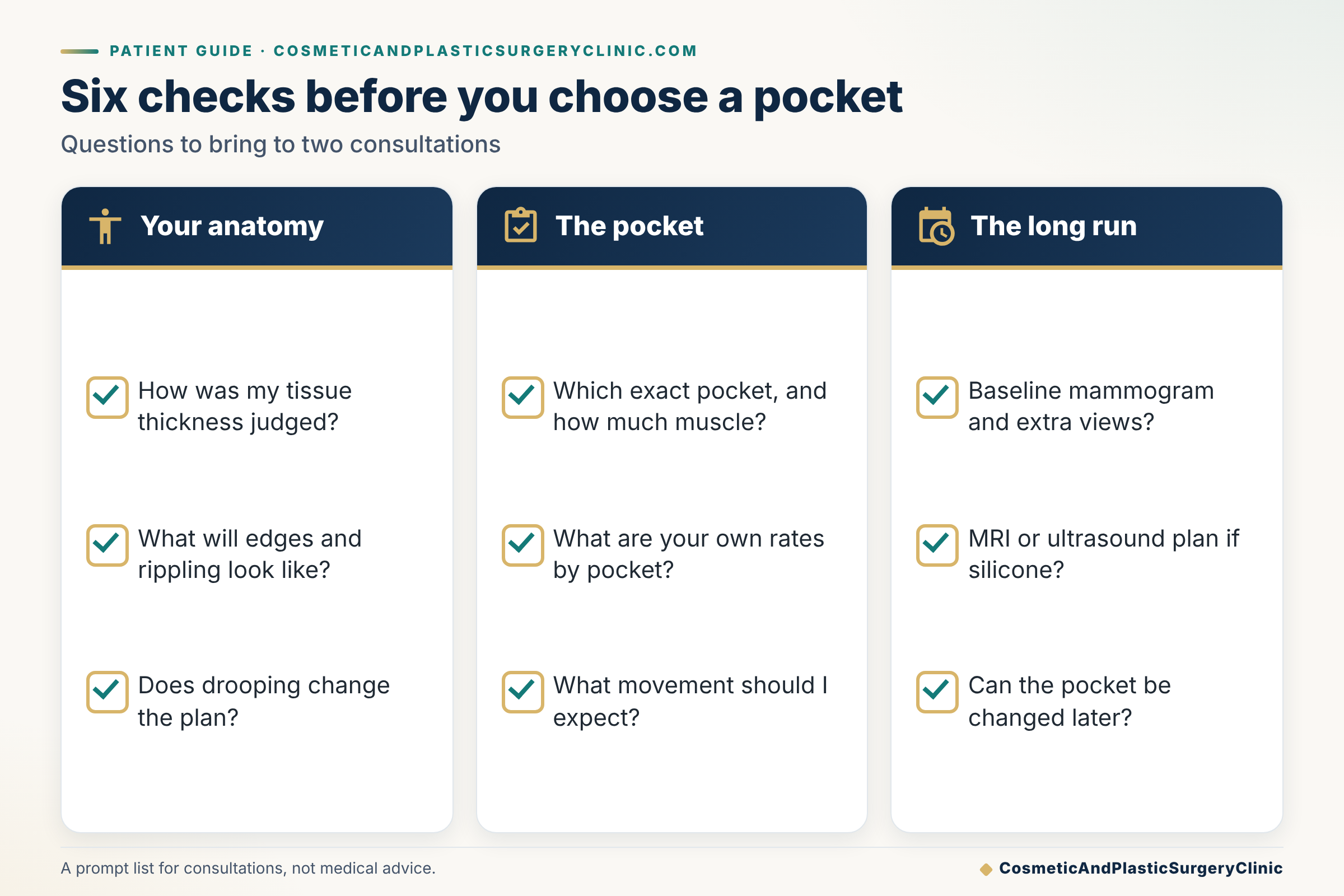
Use these when comparing over vs under muscle implants, and write the answers down. A surgeon who welcomes them is easier to plan with than one who answers “it depends” with no follow-up.
- Which exact pocket? Ask for the name (subglandular, subfascial, dual-plane or total submuscular) and how much of the muscle will be released.
- How was my tissue judged? Ask how thickness over the upper breast was assessed and what that predicts about edges and rippling.
- What are your own numbers? Ask for the surgeon’s experience with capsular contracture, reoperation and animation by pocket, and over what follow-up.
- What movement should I expect? Describe your training and work, and ask to see photos with the chest muscle flexed.
- What happens to imaging? Ask about a baseline mammogram, extra views, and the MRI or ultrasound schedule if the implant is silicone.
- Can the pocket be changed later? Ask what a second operation would involve, what it could cost and what insurance may not cover.
The FDA’s patient decision checklist, described in its 2020 labeling guidance, asks the physician to confirm that the planned surgical approach and the risks and benefits of other implanted products were discussed. It does not specifically address whether the implant goes over or under the muscle, so raise that question yourself rather than assuming it was covered by the form. The plastic surgery consultation article has a wider question list.
Reading before-and-after photos by pocket
A gallery of over vs under muscle implants is only comparable if you know the pocket behind each picture. Ask which pocket, implant size and fill were used for every photo, and prefer patients whose starting tissue and breast shape resemble yours. Photos taken at rest hide animation, so ask whether flexed-chest images exist. For ptosis cases, compare with the breast lift before-and-after photos guide, and see breast augmentation photos for general reading skills and before-and-after photos for consent and marketing issues.
Frequently asked questions
Is there a clear winner in over vs under muscle implants?
Not on the evidence available. The largest pooled analysis (Aesthetic Plastic Surgery, 2026) found lower capsular contracture with muscle-covered pockets but more reoperations and more animation or malposition with fully submuscular placement. It also drew mostly on observational studies with serious confounding. The more useful frame for over vs under muscle implants is which trade-off you can live with: visible edges and rippling in front of the muscle, or movement and a possible need for revision behind it. Your tissue thickness, shape and training habits decide which trade-off weighs more.
What does subfascial mean, and is it the same as over the muscle?
Subfascial pockets are still in front of the pectoralis major, so people often group them with “over the muscle.” The difference is that the surgeon creates the pocket beneath the thin fascia that covers the muscle, so one more tissue layer lies over the implant. In the 2024 Aesthetic Surgery Journal pooled analysis, subfascial placement showed less rippling, hematoma and capsular contracture than subglandular placement, though every included study had a high risk of bias. Ask clinics to say which version they use.
Do over vs under muscle implants change breastfeeding?
Cleveland Clinic says implants below the muscle usually affect milk production less than implants above it, but that is a general statement, not a promise, and incision site and gland handling also matter. The FDA says breastfeeding outcomes vary after augmentation, and it describes two human studies that found no increased risk of birth defects and one that reported low birth weight, which may have other explanations. Tell your surgeon about any plan to nurse in the future, since it may influence incision and pocket discussions.
Do over vs under muscle implants differ in rippling?
They can. Thin tissue over a pocket in front of the muscle leaves less cover, and in the 2024 pooled analysis subfascial placement showed less rippling than subglandular. In reconstruction patients, prepectoral implants showed more rippling than submuscular ones in a 2025 meta-analysis, though those patients differ from cosmetic patients. Fill type, implant size and your own tissue also affect rippling, so the pocket is only one factor. The fill material is a separate decision.
If I lift weights or run, should I rule out a pocket behind the muscle?
The studies do not support a blanket rule. In one surgeon’s series, 24 percent of patients reported lifting weights as affected by distortion and nearly all still chose the subpectoral position. Among 81 fitness competitors, most reported pectoral strength unchanged or improved regardless of pocket, but implant movement during chest exercises was about 2.5 times more likely with submuscular placement. With over vs under muscle implants, describe your training in detail and ask what movement to expect with each pocket you are offered.
Does having the implant behind the muscle make mammograms easier?
Somewhat, according to the American Cancer Society: the extra implant displacement views are easier to take when implants sit behind the chest muscles and harder when scar tissue has tightened around an implant. Every woman with implants still needs those extra views, and the implant can hide tissue. A 1988 study of six film mammogram sets estimated 22 to 83 percent of glandular tissue was hidden. Book at a facility that has experience with implants and mention yours when you make the appointment.
Why do some clinics say over vs under muscle implants has one right answer?
Because simple messages market well, and because many surgeons have a pocket they use most. The evidence does not support a universal answer: the 2026 pooled analysis included only two randomized trials among 91 studies and its authors called for individualized pocket selection. When a clinic page claims one pocket is always better, ask for the source, ask whether it was a randomized trial, and ask what that surgeon does for patients with your tissue and activities.
Sources and further reading
- Alderhali R, Jamel WA, Dehnadi S, et al. — Implant Pocket Plane Selection in Primary Breast Augmentation: A Meta-Analysis and Systematic Review of Complication Profiles, Aesthetic Plastic Surgery (2026, accessed 2026-11-12) — 91 studies, 51,524 patients, pooled rates by pocket, limitations
- Outcomes in Subfascial Versus Subglandular Planes in Breast Augmentation: A Systematic Review and Meta-analysis, Aesthetic Surgery Journal (2024), abstract record (accessed 2026-11-12) — ten studies, three randomized, rippling, hematoma and capsular contracture
- Tebbetts JB — Dual plane breast augmentation: optimizing implant-soft-tissue relationships in a wide range of breast types, Plastic and Reconstructive Surgery (2001, accessed 2026-11-12) — pocket definitions, 468-patient series
- Tebbetts JB — Dual plane breast augmentation (republication), Plastic and Reconstructive Surgery (2006, accessed 2026-11-12) — dual plane for ptotic and constricted lower pole breasts
- Spear SL, Schwartz J, Dayan JH, Clemens MW — Outcome Assessment of Breast Distortion Following Submuscular Breast Augmentation, Aesthetic Plastic Surgery (2009, accessed 2026-11-12) — photo ratings and questionnaire on animation deformity
- Jurat D, Wenzel D — Breast Augmentation in Athletic Women: A Retrospective Survey, Aesthetic Plastic Surgery (2022, abstract record, accessed 2026-11-12) — 81 fitness competitors, strength and implant movement
- Pumilia A, et al. — Implant-based breast reconstruction: prepectoral versus submuscular placement, Annals of Breast Surgery (2025, accessed 2026-11-12) — reconstruction meta-analysis of animation deformity, rippling, seroma
- Mégevand V, et al. — Comparison of Outcomes Following Prepectoral and Subpectoral Implants for Breast Reconstruction, Cancers (2022, accessed 2026-11-12) — pain and seroma pooled data in reconstruction
- Vogt PM, Mackowski MS, Dastagir K — Implant-based multiplane breast augmentation, European Journal of Plastic Surgery (2021, accessed 2026-11-12) — 867-patient single-surgeon series and its limits
- Stodell M, McArthur G, James M — Bi-plane breast augmentation: a case series, Plastic and Aesthetic Research (2016, accessed 2026-11-12) — 35-patient case series
- Mahler D, Ben-Yakar J, Hauben DJ — The retropectoral route for breast augmentation, Aesthetic Plastic Surgery (1982, accessed 2026-11-12) — early superior bulging that resolved
- Hayes H, Vandergrift J, Diner WC — Mammography and breast implants, Plastic and Reconstructive Surgery (1988), abstract record (accessed 2026-11-12) — share of glandular tissue hidden by implants
- American Cancer Society — Mammograms for women with breast implants (accessed 2026-11-12) — implant displacement views, effect of placement, rupture caution
- U.S. Food and Drug Administration — Risks and complications of breast implants (current as of 12/15/2023, accessed 2026-11-12) — capsular contracture, reoperation, implants not lifetime devices, subglandular remark
- U.S. Food and Drug Administration — Things to consider before getting breast implants (accessed 2026-11-12) — boxed warning, patient decision checklist, imaging cost
- U.S. Food and Drug Administration — Breast Implants: Certain Labeling Recommendations to Improve Patient Communication (2020 guidance, accessed 2026-11-12) — checklist content, rupture-screening schedule
- U.S. Food and Drug Administration — Breast implants (accessed 2026-11-12) — implants under breast tissue or chest muscle, 2021 safety actions
- Mayo Clinic — Breast augmentation (accessed 2026-11-12) — pocket definition, incisions, mammogram views, recovery, warning signs
- Cleveland Clinic — Breast augmentation (accessed 2026-11-12) — placement options, milk production statement, recovery timing
- American Society of Plastic Surgeons — Breast augmentation recovery (accessed 2026-11-12) — pain duration, support bra, surgeon-directed activity
- American Society of Plastic Surgeons — Breast augmentation safety (accessed 2026-11-12) — risk list, screening recommendation


