Breast lift cost is rarely one number. It is a stack of bills that arrive from different places: the surgeon, the facility, the anesthesia provider and, depending on the plan, an implant supplier, a laboratory and a pharmacy. The figure most people find first, a national average, describes only one layer of that stack, and it comes from surveys of surgeons who may practice very differently from the one you are consulting.
This page is about reading a breast lift cost estimate: what each line pays for, which choices in the operating plan move which lines, what insurance and financing change, and how to put two quotes side by side without comparing unlike things. It does not explain the operation itself, which sits in the breast lift overview, and general cost mechanics are in plastic surgery cost. Nothing here predicts what a given practice will charge.
What a complete breast lift cost estimate contains
A breast lift cost quote that says “one price” may be honest and still be hard to compare, because the same two words can mean different operations in different settings. The first job is to turn the quote into lines you can read one at a time.
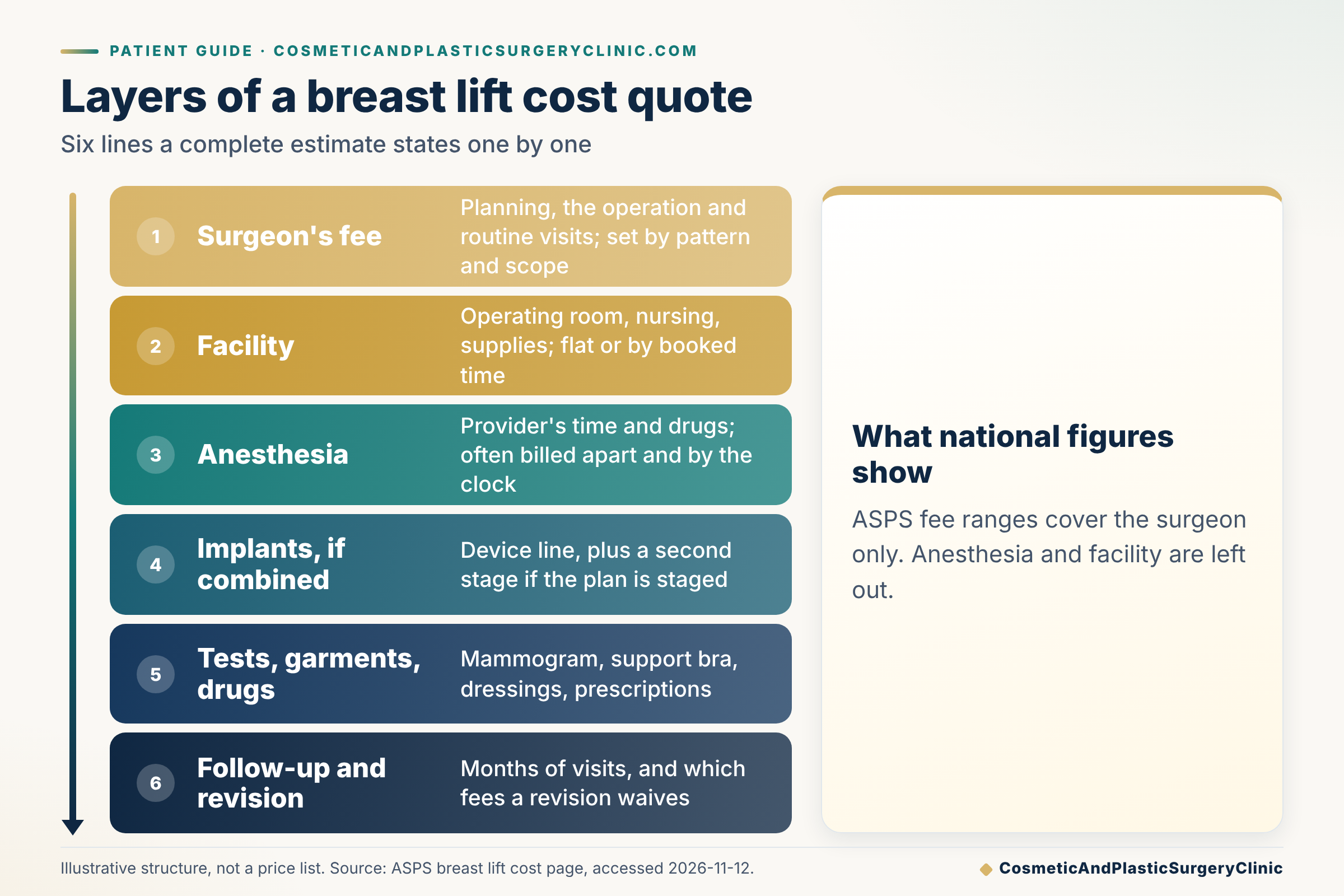
Seven lines every breast lift cost quote should state
Surgeon’s fee: the line most breast lift cost figures report
The surgeon’s fee is the line most national statistics report. It generally covers the consultation work, the operation itself and routine postoperative visits, though practices define “routine” differently and some bill later visits separately. ASPS says surgeon fees depend on experience, the type of procedure used and the geographic location of the office, so two quotes for the same pattern can differ before any other line is added.
Ask what the fee assumes: which incision pattern, whether an implant or a second procedure is already counted, how many months of visits are included and what happens to the fee if the plan changes in the operating room.
Facility and anesthesia: two bills that follow the clock
The facility charge pays for the operating room, nurses, instruments and recovery space. Anesthesia is billed by the provider, who may be a physician anesthesiologist or a nurse anesthetist, and in many practices it arrives as a separate invoice. Both usually track how long you are in the building and in the room, which is why booked operating time is worth asking about. The section on the setting and on anesthesia billing below explains the mechanics.
ASPS says its national fee figures do not include anesthesia, operating room facilities or other related expenses. A quote that bundles all three should say so in writing.
Everything else: devices, tests, garments, medications and revision terms
Mayo Clinic notes that a surgeon may ask for a baseline mammogram before a lift and another a few months afterward, and that patients wear a surgical support bra after the operation. Prescriptions and dressings belong here too. If implants are part of the plan, the device is its own line and carries its own long-term costs, covered below and in breast augmentation cost. The seventh line, revision and follow-up terms, decides what a second operation would cost, and it gets its own section.
| Quote line | What it pays for | What tends to change it | Ask before paying |
|---|---|---|---|
| 1. Surgeon’s fee | Planning, the operation, routine visits | Experience, incision pattern, added procedures, region | Which pattern and procedures does this fee assume? |
| 2. Facility | Operating room, nursing, supplies, recovery | Hospital, surgery center or office suite; booked time | Flat fee or hourly, and who sends the bill? |
| 3. Anesthesia | Provider’s time and drugs | Type of anesthesia, case length, provider group | Who is the provider, and is the charge a flat sum? |
| 4. Implants or devices | Implant pair, only if combined with a lift | Fill, size, one-stage or two-stage plan | Who buys the implants, and what happens to the cost if the plan changes? |
| 5. Tests and pathology | Mammogram, labs, lab review of tissue if sent | Age, history, surgeon and facility policy | Which tests are required, and who bills them? |
| 6. Garments and medications | Support bra, dressings, prescriptions | Surgeon’s protocol, pharmacy prices | Are they in the quote or bought separately? |
| 7. Follow-up and revision | Visits and any later correction | Written policy, time window, cause of the problem | Which fees does a revision waive, and for how long? |
What the published national figures include and leave out
ASPS breast lift cost data: a 2023 average, then a 2024 range
The American Society of Plastic Surgeons cost page for breast lift gives an average of $6,816 and does not print a year. The same $6,816 appears in ASPS’s 2023 average-fee release, labelled as the average surgeon or physician fee, with procedure counts limited to ASPS member surgeons. For 2024, ASPS changed the format: it now shows a projected range, $6,500 to $11,000 for a breast lift, described as an aggregate projection from averages submitted by surveyed members.
Read these breast lift cost figures as surgeon-fee benchmarks from one society’s members. ASPS itself says they leave out anesthesia, facility fees and other related expenses, and a survey of member averages is not a price list for any one practice. For scale, the same 2024 release lists a range of $4,575 to $8,000 for implant placement in breast augmentation and $7,000 to $12,500 for aesthetic breast reduction.
The Aesthetic Society’s $5,324 and why it cannot sit beside ASPS’s
The Aesthetic Society’s breast lift cost page gives an average of $5,324, attributed to its 2022 national databank statistics, and says that figure covers surgeon and facility fees while anesthesia, tests, prescriptions and garments may be extra. So its figure is lower than ASPS’s 2023 average yet claims to include more. The sources differ in year, in which surgeons were surveyed and in what was counted, which is why neither number should be used to judge whether a quote is high or low.
A better use of both is as a reminder of scope: national breast lift cost figures describe an operation and a surgeon, not a bill. Volume context is separate. ASPS counted 156,131 breast lifts in 2025, up 8 percent from 144,003 in 2024, drawing on member surgeons, a complications-insurance partner and a claims dataset it says represent more than 3,000 board-certified plastic surgeons. High demand does not make any single quote reasonable.
How the operating plan changes the breast lift cost
Two quotes can both say “breast lift” and describe different amounts of surgery. Scope is the biggest reason a breast lift cost estimate moves, and scope is decided by anatomy and by what you want changed, not by a price list.
Incision pattern and the tissue work behind it
Periareolar, vertical and inverted-T: what each pattern is generally used for
StatPearls, the NCBI clinical reference, describes the common patterns by the amount of excess skin and the degree of ptosis. A periareolar approach, with the incision around the areola, is generally for mild or moderate ptosis with little skin excess and moves the nipple by at most about two centimeters. A vertical pattern adds a scar down to the fold and is listed for any degree of ptosis.
The inverted-T, with an added scar along the fold, is generally used for severe ptosis, or for poor skin quality or fatty tissue, at the price of a larger scar burden. The scars themselves are the subject of breast lift scars.
That logic matters for breast lift cost because the pattern follows the plan, not the other way round. A practice that quotes one price for every patient may be selling a package; a surgeon who quotes after examining how far the nipple sits below the fold and how much skin there is can price the case in front of them.
Why a larger pattern may add to breast lift cost, and how to ask
No national source reviewed for this article publishes a price difference between patterns, so none should be assumed. The reasoning is mechanical: more skin and tissue reshaping can mean more operating time, and operating time feeds the facility and anesthesia lines. Ask whether the quote assumes one pattern and what happens if the surgeon changes to another after marking you standing up or after seeing the tissue.
Also ask whether nipple repositioning, areola reduction or any added support material for the lower breast is included in the fee. Those are parts of the plan, and a quote that lists them is easier to compare than one that does not.
Add-ons that turn the lift into a different operation
Implants: a breast lift cost line now and decisions for years after
ASPS notes that a lift does not significantly change breast size or round out the upper part of the breast, and that it can be combined with augmentation. When it is, the quote gains an implant line and often a longer case.
How the lift and implants are sequenced matters: StatPearls describes single-stage surgery as suited to mild or moderate ptosis, soft breasts with good skin elasticity and augmentation under about 360 cc, and two-stage surgery for severe ptosis, large vertical skin excess or marked augmentation. Two stages mean two facility bookings and two anesthesia sessions, which is a cost reason to ask about it early. The technical trade-offs are covered in breast lift with implants.
The device then carries costs after the operation. The FDA says breast implants are not lifetime devices, that patients should assume they will need additional surgeries, and that periodic MRI or ultrasound screening for silicone gel implants may not be covered by insurance. None of that belongs in the first-year quote, but all of it belongs in a ten-year budget. Whether a lift alone or a lift with implants fits is a surgical decision, weighed in the breast lift vs implants comparison.
Reduction, fat transfer and other procedures in the same session
ASPS says a lift can also be paired with breast reduction for patients who want smaller breasts. Fat transfer, tummy tuck or liposuction may be proposed in the same session. Each addition can change the surgeon’s fee, lengthen the case and push the facility and anesthesia lines upward, and a bundled discount does not always survive a change in plan. For the combined version of that arithmetic, see mommy makeover cost.
| Plan | What is different | Quote lines that may move | Question to ask |
|---|---|---|---|
| Lift alone, periareolar | Smallest incision; limited nipple movement | Operating time, if less tissue is reshaped | Is this pattern chosen for my anatomy or for the package? |
| Lift alone, vertical | Scar from areola to fold | Surgeon’s fee, time | Would the plan change to inverted-T after marking? |
| Lift alone, inverted-T | Added scar along the fold; used for greater excess | Surgeon’s fee, time, follow-up visits | What is the fee if I need drains or extra visits? |
| Lift with implants, one stage | Device placed during the lift | Implant line, case length, anesthesia | What is the revision policy if the implant needs adjusting? |
| Lift with implants, two stages | Two operations, months apart | Two facility and two anesthesia bills | Is the second stage priced now, and at what fee? |
| Lift with reduction or other procedures | More tissue work or a second body area | Fee, time, supplies | Which parts are bundled, and what if one is dropped? |

Where the operation happens and who provides the anesthesia
Setting and anesthesia belong in any breast lift cost discussion because they are safety decisions that also happen to carry price tags. The cheapest line is not a reason to relax either one.
The facility: three billing models and one safety check
Hospital, surgery center or office suite: where breast lift cost is billed
Mayo Clinic says a lift can be done in a hospital or as an outpatient procedure, using local anesthesia with sedation or general anesthesia, that it typically takes about two hours and that people often go home the same day.
Where the case is booked changes how it is billed. A hospital outpatient department or a freestanding surgery center usually sends its own facility invoice. An office-based operating suite may fold the room charge into the surgeon’s fee, or list it separately. Neither arrangement is better or worse on its face; the problem is a quote that does not say which one applies.
Ask for the facility’s name in writing. A quote that says “facility fee included” without naming the facility cannot be checked, and the same sentence can describe very different rooms.
Verifying accreditation before a deposit
ASPS requires its member surgeons to operate in a facility that is accredited, Medicare-certified or state-licensed for anything beyond local anesthesia and mild oral sedation, and it lists AAAASF, AAAHC and the Joint Commission among the accrediting bodies. ASPS also says accreditation generally requires anesthesia to be given by a board-certified or board-eligible anesthesiologist or a certified nurse anesthetist, and it advises checking accreditation directly with the accrediting organization rather than relying on a logo on a website.
Surgeon credentials are verified the same way: with the certifying board, not the practice’s brochure. The American Board of Plastic Surgery runs a public certification lookup, and the steps are laid out in choosing a plastic surgeon. Verification costs nothing and belongs before the deposit, not after it.
Why a longer case raises the breast lift cost in two places
How anesthesia is billed: base units, time units and the payer
An AORN Outpatient Surgery explainer describes the standard anesthesia billing model: a base number of units fixed for the type of operation, plus time units counted in 15-minute blocks from the moment the provider enters the room until report is given to the recovery nurse. The dollar value of a unit depends on who pays; that article’s examples ran at about $50 a unit for a private insurer and about $22 for Medicare, which shows how much the payer matters and says nothing about self-pay.
The article does not address self-pay pricing, and neither does any national figure reviewed here. For a self-pay lift, the useful question is practical: is the anesthesia charge a flat sum for the planned case, or an hourly rate with a base fee, and what happens if the case runs long?
What thirty extra minutes can mean for the facility bill
A 2018 JAMA Surgery analysis by Childers and Maggard-Gibbons of California hospital financial reports, summarized by the American Journal of Managed Care, put operating room cost at roughly $36 to $37 a minute on average across 302 facilities with data from 2005 to 2014. That is the cost to the facility, not a charge to the patient, it comes from California hospitals only, and the summary says earlier reports ranged from about $7 to over $100 a minute depending on location.
Used carefully, it shows scale: thirty extra minutes at that average is about $1,100 of cost behind the scenes, before anesthesia time is counted. This is why a quote built on an optimistic two-hour estimate can grow when the plan turns out to be larger.
Revision terms and the second bill after a breast lift
A quote prices the operation you expect. Revision and complication terms price the operation you hope not to need, and they are the part of a breast lift cost estimate most often left unwritten.
What a revision policy covers
Fees a revision may waive and fees it may not
A written policy should answer four things: how long after surgery the policy applies, whether the surgeon’s fee is waived, whether facility and anesthesia fees are waived, and what counts as a revision rather than a new procedure. A surgeon who waives the professional fee may still pass on charges from the facility and the anesthesia provider, because those are separate businesses. Ask whether a revision for a complication and a revision for a change of preference are treated differently.
ASPS’s 2025 article on cheap deals quotes a surgeon saying revision pricing is always higher than primary pricing because the work is harder, which is another reason to read the terms before surgery rather than after.
How often a second operation comes up, and when
StatPearls reports reoperation rates of 10.2 percent after mastopexy alone and 10.7 percent after single-stage augmentation with mastopexy, with the caveat that the underlying meta-analysis was highly heterogeneous, and says reoperations are usually delayed six to twelve months until the tissue has settled. Both points matter for breast lift cost planning: a meaningful minority of patients are re-operated on, and the window in which a revision fee applies should run past that six-to-twelve-month point to be useful.
Those figures are pooled from published series of varying design and say nothing about any individual. The planning for a correction is in revision breast lift.
When something goes wrong: the bill after the quote
Complications and who pays for treating them
ASPS says most health insurance plans do not cover breast lift surgery or its complications. That sentence, on ASPS’s cost page, is easy to skim and expensive to ignore. If a wound opens, a hematoma needs drainage or an infection needs antibiotics or a return to the operating room, the person with a self-pay lift may face a second set of charges from a facility and an anesthesia provider, depending on the practice’s terms and on the plan’s complication exclusions.
Major complications are uncommon: StatPearls, citing a series of 73,608 aesthetic breast cases, gives 1.15 percent after mastopexy and 1.86 percent after augmentation with mastopexy. Mayo Clinic lists scarring, sensation changes, uneven shape, infection and rare loss of nipple or areola tissue among the risks. Uncommon does not mean zero, and a clear answer on who pays is part of an honest consultation, as laid out in plastic surgery consultation questions.
Warning signs that matter more than the invoice
For less urgent changes, such as spreading redness, fever, a nipple or areola that changes color, or a wound that opens, call the surgeon’s office the same day, using the contact route the practice gave in writing. A breast lift cost quote that does not say who to call or where complications are treated is missing a line.
Paying for a breast lift: insurance, tax rules and financing
Almost every breast lift cost conversation ends at the same fork: will insurance help, and if not, how is it paid. The answers are narrower than most search results suggest.
Insurance: cosmetic by default, reconstruction as the exception
What written payer policies say about breast lift cost
The Aesthetic Society says insurance generally does not cover a breast lift because it is elective cosmetic surgery, and ASPS says most plans do not cover it. Payers’ own policies are more explicit. Blue Cross and Blue Shield of Oklahoma’s mastopexy policy, effective 15 May 2026, states that mastopexy is considered cosmetic except when performed as part of a medically necessary breast reconstruction, and it says the member’s contract governs if it conflicts with the policy. One policy is one payer’s wording, not a rule for every plan.
A lift performed to change shape, position or nipple height, which is the usual reason, falls on the cosmetic side of that line. Combined procedures raise a separate question: a lift paired with a reduction is a different coverage question that only the plan’s own documents can answer.
Symmetry surgery after a mastectomy
The exception is real but narrow. ASPS describes the Women’s Health and Cancer Rights Act as requiring group health plans that cover mastectomies to cover reconstruction, including surgery on the opposite breast to produce a symmetrical appearance. Premera Blue Cross’s reconstructive breast surgery guideline, effective July 2026, lists mastopexy on the contralateral breast to achieve symmetry as covered when the underlying reconstruction qualifies, and does not cover a mastopexy performed only for appearance.
If you are in that situation, the billing path runs through the reconstruction team and the plan, not through a cosmetic quote. The rest of this page applies to elective lifts.
Tax accounts and financing
Deductions, HSAs and FSAs
IRS Publication 502 for 2025 says that, generally, you cannot include in medical expenses the amount you pay for cosmetic surgery, with exceptions for surgery that corrects a deformity arising from a congenital abnormality, an accident or a disfiguring disease. Breast reconstruction after a mastectomy for cancer is includible. Even then, only the part of medical expenses above 7.5 percent of adjusted gross income can be deducted on Schedule A.
Whether a health savings or flexible spending account will reimburse a lift is decided by the plan administrator. IRS Publication 969 ties HSA qualified medical expenses to the same Code definition of medical care, which suggests cosmetic surgery will not qualify, but it is the administrator’s reading that counts. Ask in writing, with the procedure name, before paying from an account.
Medical credit cards, deferred interest and loans
The Consumer Financial Protection Bureau’s May 2023 report found a typical medical credit card annual percentage rate of 26.99 percent, against roughly 16 percent for general-purpose credit cards (March 2023 Federal Reserve data). Healthcare deferred-interest promotions run 6 to 18 months, and about 20 percent of healthcare deferred-interest purchases were assessed interest in the period the report analyzes; borrowers paid about $1 billion in deferred interest from 2018 to 2020. The report also cites a New York Attorney General filing indicating that about 65 percent of medical credit cards are signed in providers’ offices.
The practical rule for paying for a breast lift is to compare total repayment, not the monthly payment. Plastic surgery financing covers the mechanics of deferred interest, personal loans and in-house plans in detail, and it is worth reading before signing anything in a consultation room.
Comparing two breast lift cost quotes like for like
The sticker prices on two breast lift cost estimates tell you almost nothing until each one has been rewritten in the same shape. The process takes an hour with a pencil and has prevented a lot of unpleasant surprises.
A five-step method for normalizing quotes
Write the scope in plain words first
Before comparing any dollar amount, write one sentence for each quote that says what is being done: the incision pattern, whether the nipple is moved and by how much, whether an implant or other procedure is included, the facility, the type of anesthesia and the booked operating time. If a quote cannot be summarized that way, the missing details are the first questions to ask.
Then work through the rest in order: put every line in the same column, treat unknowns as ranges and never as zeros, check the setting and anesthesia provider, and last compare revision, deposit and refund terms.
A second consultation helps here as well. Seeing two surgeons’ plans for the same breasts shows whether the difference in price is a difference in the operation or only in the invoice.
Put every line in the same column
The table below is a hypothetical worked example dated 2026-11-12. Its numbers are invented to show the arithmetic and are not market data or a prediction of any practice’s fees. Quote A states everything; Quote B leads with a lower headline and leaves items open. Unknowns are entered as estimates in Quote B’s column so that they are not silently counted as free.
| Line | Quote A | Quote B | What the gap may mean |
|---|---|---|---|
| Headline price | $14,450 all-in, itemized | “$7,500 breast lift” | Different things are being counted |
| Surgeon’s fee | $8,800, vertical pattern, 12 months of visits | $7,500, pattern “decided at surgery,” 6 weeks of visits | Scope and follow-up are not equal |
| Facility | $3,600, accredited center named, 2.5 hours booked | About $3,000 by phone, facility not named, 2 hours booked | Unnamed facility cannot be verified |
| Anesthesia | $1,700 flat, anesthesiologist group named | Hourly, estimated $900 to $1,500 (midpoint $1,200) | An hourly rate rises if the case runs long |
| Garments and prescriptions | $350 included | Estimated $180, not included | Small, but easy to forget |
| Revision terms | Surgeon’s fee waived for 12 months; facility and anesthesia billed | Not stated | Ask before the deposit |
| Normalized total | $14,450 | About $11,880, with four open items | Gap of about $2,570 before the open items are answered |
Quote B looks about $2,570 cheaper. It also prices a shorter case, an undecided pattern, a facility nobody can check and an unstated revision policy. Once those are answered the gap could shrink, vanish or grow. The comparison is a way of finding questions, not a verdict on either practice, and neither practice’s numbers say anything about the quality of care.

Reading breast lift cost signals in either direction
Low breast lift cost quotes, bait advertising and deposits before an exam
ASPS’s June 2025 article on cheap deals warns that low-priced surgery can bring hidden costs, including emergency visits, treatment of complications and revision surgery, and quotes surgeons who treat prices far below the average as a red flag. The Federal Trade Commission’s rule at 16 CFR 238.0 defines bait advertising as an alluring but insincere offer to sell a service that the advertiser does not intend to sell as advertised, which is a legal definition and not an accusation about any practice.
A practical translation: be wary of a price that is only available “this week,” that cannot be itemized, or that requires a deposit before you have been examined by the surgeon who will operate. A quote that cannot survive a request to put it in writing is not much of a quote.
High breast lift cost quotes: what a premium may and may not reflect
In an ASPS article from December 2023, two surgeons describe geography, surgeon demand, business strategy and public profile as drivers of fees, and one cautions that a high price does not necessarily mean higher quality. Both directions get the same test: itemize, name the facility and the anesthesia provider, verify credentials and read the revision terms. Price is information about a practice’s economics, not about your result.
Written estimates, deposits and the good faith estimate
The good faith estimate for self-pay patients
The Centers for Medicare & Medicaid Services says people who do not have or do not use insurance for their care are usually entitled to a good faith estimate of expected costs, provided on request or when care is scheduled at least three business days ahead, and that a bill at least $400 above the estimate may be disputed. The page does not list what an estimate must contain, so treat it as a floor: an estimate you would be willing to compare, line by line, with the final invoice.
Deposits, refunds and rescheduling
No national standard for cosmetic surgery deposits, refunds or rescheduling was found in the sources reviewed here, so these terms are whatever the contract says. Get the deposit amount, what it is applied to, the refund conditions if you cancel, what happens if the surgeon or the facility reschedules, and what happens if medical clearance or a nicotine test delays the date. Read the whole agreement before signing, and take it home if the practice allows it.
Budgeting around the breast lift cost quote: items outside the invoice
A final line on a spreadsheet is a better guide than the quote alone. Some of the largest items in a breast lift cost plan are never on any estimate.
Before and after surgery: indirect costs
Time off, help at home and childcare
An ASPS article from April 2026 advises budgeting for time off work, childcare, pet boarding and meal preparation during recovery, and asking whether you would owe more if the case runs longer than planned. Mayo Clinic advises arranging a ride home and someone to stay with you early on, with help for tasks such as washing your hair. For many people the cost of covering those days exceeds the cost of the garments. Week-by-week logistics are in breast lift recovery.
Imaging, garments and scar care
The baseline mammogram Mayo describes, the support bras worn for weeks afterward and scar-care supplies are small, predictable items. Mayo says scars initially look hard and lumpy and then soften and thin over one to two years, so the scar-care budget runs longer than the first postoperative month. ASPS’s April 2026 article quotes a surgeon recommending consistent and active scar management.
Planning for a lift that may not be the last purchase
Pregnancy, weight change and timing
Mayo Clinic says surgeons often advise waiting six months to a year after stopping breastfeeding and may suggest waiting if a future pregnancy is planned, and that a stable healthy weight helps preserve results. A lift paid for just before a pregnancy or a large weight change may not look the way it did at the end of recovery, which is a money question as well as a medical one. Who a surgeon may suggest waits is a candidacy question.
When waiting is the cheaper decision
Postponing is a legitimate option. A person who is deciding between a lift and implants, who expects a pregnancy or who has not yet had two consultations loses little by waiting, and a deposit paid under a time limit can cost more than a month of research. A lift can also be staged with other procedures in some plans, and the cost and risk trade-offs of that choice are in staged mommy makeover. Ask about payment timing and refund terms before treating a date as fixed.
Frequently asked questions
Why is my breast lift cost quote higher than the national average?
National breast lift cost figures are surgeon-fee benchmarks from surveys, and ASPS says they exclude anesthesia and facility charges, so a full quote should usually exceed them. Differences can also come from the incision pattern, an added implant or reduction, a hospital-based facility, a longer booked operating time, or local costs. Ask the practice to split the quote into surgeon, facility, anesthesia and other lines, then compare the surgeon line alone with the ASPS range.
Will insurance help with breast lift cost after pregnancy or weight loss?
Payers generally classify a lift done to restore shape or nipple position as cosmetic, so breast lift cost falls to the patient. A 2026 Blue Cross and Blue Shield of Oklahoma policy, for example, treats mastopexy as cosmetic unless it is part of a medically necessary breast reconstruction. Sagging after pregnancy or weight loss does not change that classification in the policies reviewed. Your plan’s own contract governs, so a written pre-determination request is the only way to know.
Does a lift with implants cost more than a lift alone?
Usually a breast lift cost quote with implants has more lines: the implant, a longer case, and often more anesthesia time. A two-stage plan adds a second facility booking and anesthesia session. The device also brings later costs; the FDA says implants are not lifetime devices and that further surgery should be assumed. Ask which parts of the plan are priced now and which are left open.
Should I pay a deposit before I have seen the surgeon?
A deposit before an examination by the surgeon who will operate is a pressure signal worth questioning. Surgery is planned after the surgeon has examined you and discussed options, and the plan can change the price. If a deposit holds a date, get in writing what it is applied to, whether it is refundable if you decide against surgery, and what happens if the practice or facility changes the date.
What if my final bill is higher than the written estimate?
For self-pay patients, CMS says a bill of at least $400 above a good faith estimate may be disputed, and an itemized comparison between the estimate and the invoice is the starting point. Ask the billing office to explain each difference in writing, whether it comes from surgeon, facility or anesthesia, and keep your signed documents. Contract terms on extra operating time or changed plans may also apply.
Is a cheaper breast lift abroad or out of state worth it?
The visible price is only part of the breast lift cost. ASPS warns that cheap surgery can lead to hidden costs, including emergency care, treatment of complications and revision surgery, and a lift needs follow-up visits during healing. Ask who treats a complication after you return home and who pays, and compare the quote with travel, lodging and time off. The medical travel article, medical tourism and surgery abroad, goes through the questions.
Is revision breast lift cost the same as the first lift?
Not necessarily. A surgeon quoted in ASPS’s June 2025 article said revision pricing is always higher than primary pricing because the work is more difficult, while a 2023 survey found practices handle revision fees in very different ways. The practice that did your first lift may waive part of its fee within a window; a different surgeon would normally quote from scratch. Bring operative records and photos to a consultation.
Sources and further reading
- ASPS — Breast lift cost (accessed 2026-11-12) — $6,816 average, exclusions, insurance and financing statements
- ASPS — Cosmetic procedures average cost, 2024 (accessed 2026-11-12) — projected surgeon-fee ranges for breast lift, augmentation and reduction
- ASPS — Cosmetic procedures average cost, 2023 (accessed 2026-11-12) — 2023 average surgeon fees for breast lift and augmentation
- ASPS — Plastic surgery statistics report, 2025 (accessed 2026-11-12) — 2025 and 2024 breast lift counts and data sources
- ASPS — Breast lift (accessed 2026-11-12) — what a lift changes and does not change; combination with augmentation or reduction
- ASPS — Accreditation (accessed 2026-11-12) — accrediting bodies, anesthesia requirements and verification advice
- ASPS — The real cost of plastic surgery: how to budget (Willson, April 20, 2026) (accessed 2026-11-12) — indirect costs, scar management, quote questions
- ASPS — Plastic surgery for cheap? (Willson, June 17, 2025) (accessed 2026-11-12) — hidden costs, red flags, revision pricing
- ASPS — Understanding plastic surgery costs in the United States (Brumby, December 15, 2023) (accessed 2026-11-12) — drivers of fees, exclusions, insurance
- ASPS — WHCRA: past, present and the push for modernization (accessed 2026-11-12) — reconstruction and symmetry coverage
- ASPS — Breast surgery in 2025: evolving aesthetics (Willson) (accessed 2026-11-12) — breast lift volume in 2025
- The Aesthetic Society — How much does a breast lift cost? (accessed 2026-11-12) — $5,324 average from 2022 databank, inclusions and insurance
- Mayo Clinic — Breast lift (accessed 2026-11-12) — setting, duration, preparation, recovery items, risks, timing after breastfeeding
- FDA — Things to consider before getting breast implants (accessed 2026-11-12) — implant lifespan, reoperation, screening and coverage
- StatPearls (NCBI Bookshelf) — Mastopexy (accessed 2026-11-12) — technique selection, single- versus two-stage plans, complication and reoperation figures
- Aesthetic Surgery Journal Open Forum, 2023 — Offering no-cost cosmetic revisions (accessed 2026-11-12) — revision rate and survey of revision-fee practices
- AORN Outpatient Surgery — How anesthesia gets paid (accessed 2026-11-12) — base units, 15-minute time units, payer-dependent rates
- American Journal of Managed Care — Implications of the costs of operating room time (accessed 2026-11-12) — 2018 JAMA Surgery California operating room cost per minute
- Blue Cross and Blue Shield of Oklahoma — Mastopexy, SUR716.010, effective 2026-05-15 (accessed 2026-11-12) — cosmetic classification and reconstruction exception
- Premera Blue Cross — Reconstructive breast surgery guideline 7.01.533, effective 2026-07-02 (accessed 2026-11-12) — contralateral mastopexy for symmetry; cosmetic surgery not covered
- IRS — Publication 502, Medical and Dental Expenses (2025) (accessed 2026-11-12) — cosmetic surgery exclusion, exceptions, 7.5 percent threshold
- IRS — Publication 969, Health Savings Accounts and Other Tax-Favored Health Plans (2025) (accessed 2026-11-12) — HSA qualified medical expenses definition
- CFPB — Medical credit cards and financing plans, May 2023 (accessed 2026-11-12) — typical APR, deferred interest, signing location
- CMS — Good faith estimates for uninsured or self-pay patients (accessed 2026-11-12) — timing and $400 dispute threshold
- Legal Information Institute — 16 CFR 238.0, Bait advertising defined (accessed 2026-11-12) — definition of bait advertising
- American Board of Plastic Surgery (accessed 2026-11-12) — public certification verification