Breast augmentation cost is rarely one number. The figure a practice advertises is usually the surgeon’s fee, and the bill that follows is built from several other lines: the operating facility, the anesthesia professional, the implants themselves, garments and medicines, and the follow-up and revision terms that sit behind it all. Then there is a category that arrives years later, because implants are not lifetime devices and the FDA tells patients to plan for more surgery and, for silicone gel implants, periodic imaging.
This article takes a breast augmentation cost quote apart so you can see what each line pays for and what a missing line might cost later. The figures come from American Society of Plastic Surgeons (ASPS) fee and volume reports, the FDA’s patient and labeling documents, two manufacturers’ warranty documents, one insurer’s written policy, and federal consumer-finance and tax sources. Every dollar amount in the worked examples is invented and dated November 2026. For the operation itself, see the breast augmentation overview.
What a breast augmentation cost quote is really pricing
What the published breast augmentation cost figures cover
ASPS surgeon-fee figures and what they leave out
ASPS’s patient page on breast augmentation cost gives an average of $4,875 for augmentation with implants and $5,719 for augmentation with fat grafting. The page does not print a year beside either number. It states that the average “does not include anesthesia, operating room facilities or other related expenses,” and it lists what a total may contain: the surgeon’s fee, anesthesia, hospital or surgical-facility charges, medical tests, post-surgery garments and prescriptions. It tells readers to ask the surgeon’s office for the final fee.
ASPS’s 2024 procedural statistics release replaced single averages with projected ranges: $4,575 to $8,000 for implant placement, primary or revision, and $5,500 to $9,500 for fat grafting alone with no implants. The release describes the ranges as an aggregate projection from averages submitted by surveyed members, covering ASPS member surgeons only, and it does not say what a fee includes. A single-number average and a range drawn from a different survey cannot be subtracted to show a trend.
| Source | Figure | Who it describes | What it leaves out |
|---|---|---|---|
| ASPS breast augmentation cost page | $4,875 average with implants; $5,719 with fat grafting | ASPS statistics; year not shown on the page | Anesthesia, operating room facility and related expenses |
| ASPS 2024 average surgeon fees | $4,575 to $8,000 implants (primary or revision); $5,500 to $9,500 fat grafting only | Projection from surveyed ASPS member surgeons | Everything but the surgeon’s fee; scope of the fee not stated |
| ASPS 2025 statistics report | 304,234 breast augmentation and implant revision procedures, up 11% | National estimate from member surgeons, an insurer partner and claims data | No prices, fees or cost ranges at all |
| Manufacturer warranty documents | Up to $3,500 toward some later surgical costs, for qualifying events | Patients with that manufacturer’s implants, under written terms | Size change, rippling and many other reasons for a second operation |
Why an average is not a quote
ASPS names three drivers of a surgeon’s fee: the surgeon’s experience, the type of procedure and the office’s location. None of the published numbers is a price you can expect locally. A fee range tells you the order of magnitude of one line of breast augmentation cost, and no published source this article could find gives a national total for surgeon, facility, anesthesia and implants together. The general guide to plastic surgery cost covers billing mechanics that apply to every operation, so this article stays with what is specific to implants.
One more caution about the 2025 report. Its augmentation count includes revisions of existing implants, so it is a count of implant operations, not of first-time patients.
The eight lines of a complete quote
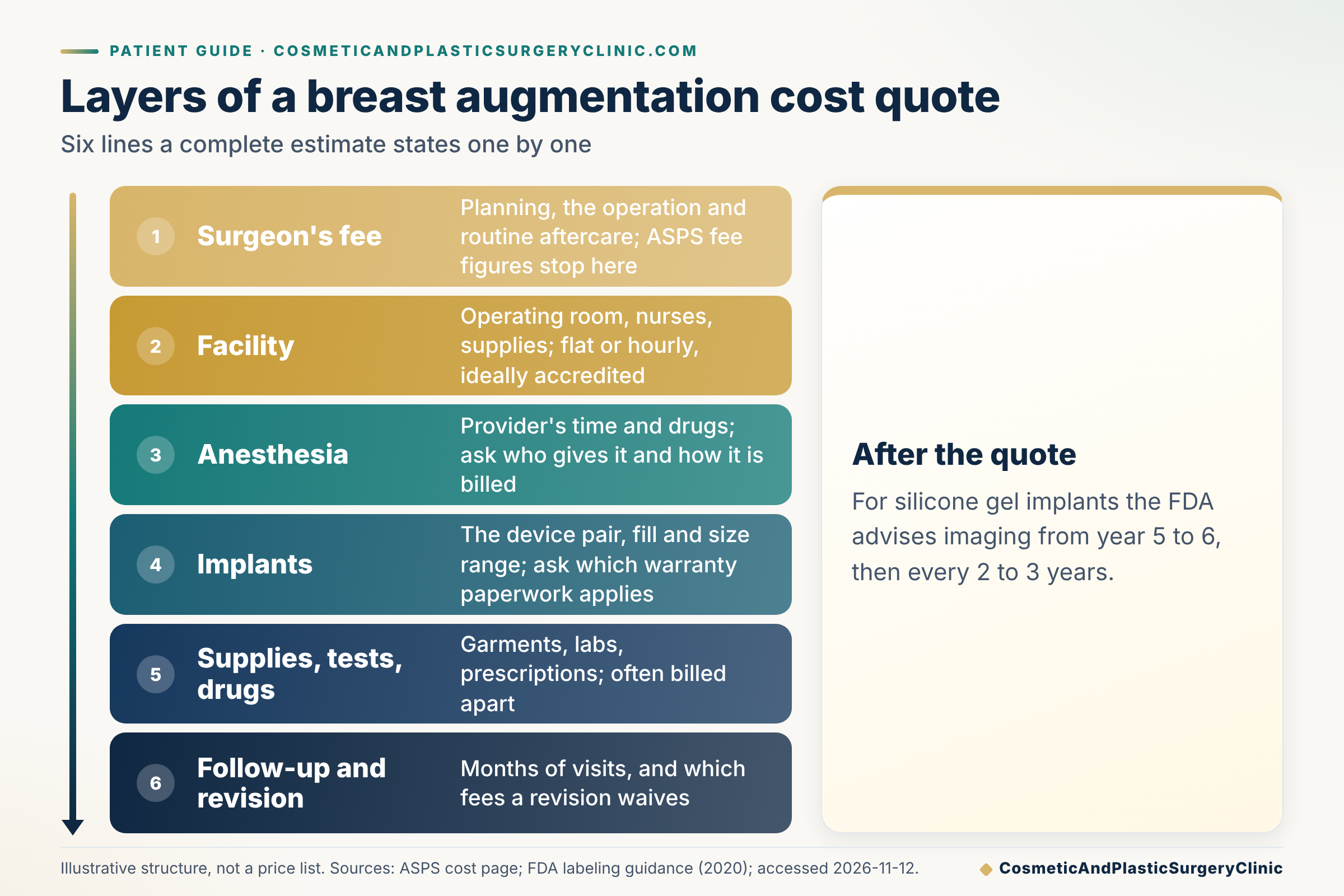
A complete breast augmentation cost estimate has eight lines. Some practices fold several into one package price, and that is acceptable as long as you can ask what the package contains. What matters is that no line is silently absent. The table gives each line’s reason, what moves it, whether someone other than the surgeon usually bills it, and the question that exposes it.
| Quote line | Why it is charged | What moves it | Often billed separately? | Question to ask |
|---|---|---|---|---|
| 1. Surgeon’s fee | Planning, the operation and routine aftercare | Experience, technique, region | No | Which operation and which pocket and incision plan does this fee describe? |
| 2. Facility | Operating room, nurses, sterile supplies, recovery bed | Setting, accreditation, hours booked | Often yes | Is the facility named, accredited, and billed flat or by the hour? |
| 3. Anesthesia | An anesthesia professional’s time and drugs | Provider type, length of the operation | Often yes | Who provides it, and is the figure flat or hourly? |
| 4. Implants | The pair of devices and their documentation | Fill, shape, size range, supplier pricing | Sometimes | Is the device cost inside the fee, and what if the size changes on the day? |
| 5. Garments and supplies | Surgical bra, dressings, support garments | Practice protocol | Sometimes | Which garments are included and which do I buy? |
| 6. Tests and prescriptions | Pre-operative tests, clearance, medicines | Health history, outside lab or pharmacy | Usually yes | Which tests are required and who bills them? |
| 7. Follow-up visits | Wound checks, implant position review, questions | Practice policy | No | For how many months are visits included? |
| 8. Revision and warranty terms | A second operation, or a device replacement, if one is advised | Reason, timing, who pays facility and anesthesia | Often partly | Which fees are waived, for which reasons and for how long? |
Lines the surgeon’s office usually bills
The first, fourth, fifth and seventh lines normally come from the practice. They are also the easiest to leave vague. A fee described only as “breast augmentation” says nothing about whether it covers saline or silicone gel implants, a particular pocket plan or the number of visits. Different operations carry different device costs and different operating times, so a quote that does not name them cannot be compared with one that does. The article on saline versus silicone implants explains why fill choice also changes long-term imaging costs.
Lines that arrive from other people
The facility, the anesthesia professional, a laboratory or pharmacy and sometimes an imaging center bill on their own terms. A practice that quotes only its own lines of the breast augmentation cost is not hiding anything, but you are left to estimate the rest. Ask whether the figure you were given is the total you will pay across all of these billers, or only the part the practice collects. If it is only the practice’s part, ask for the others in writing.
The implant line and the breast augmentation cost that arrives years later
Device price, exchange terms and warranties
What a manufacturer warranty can and cannot cover
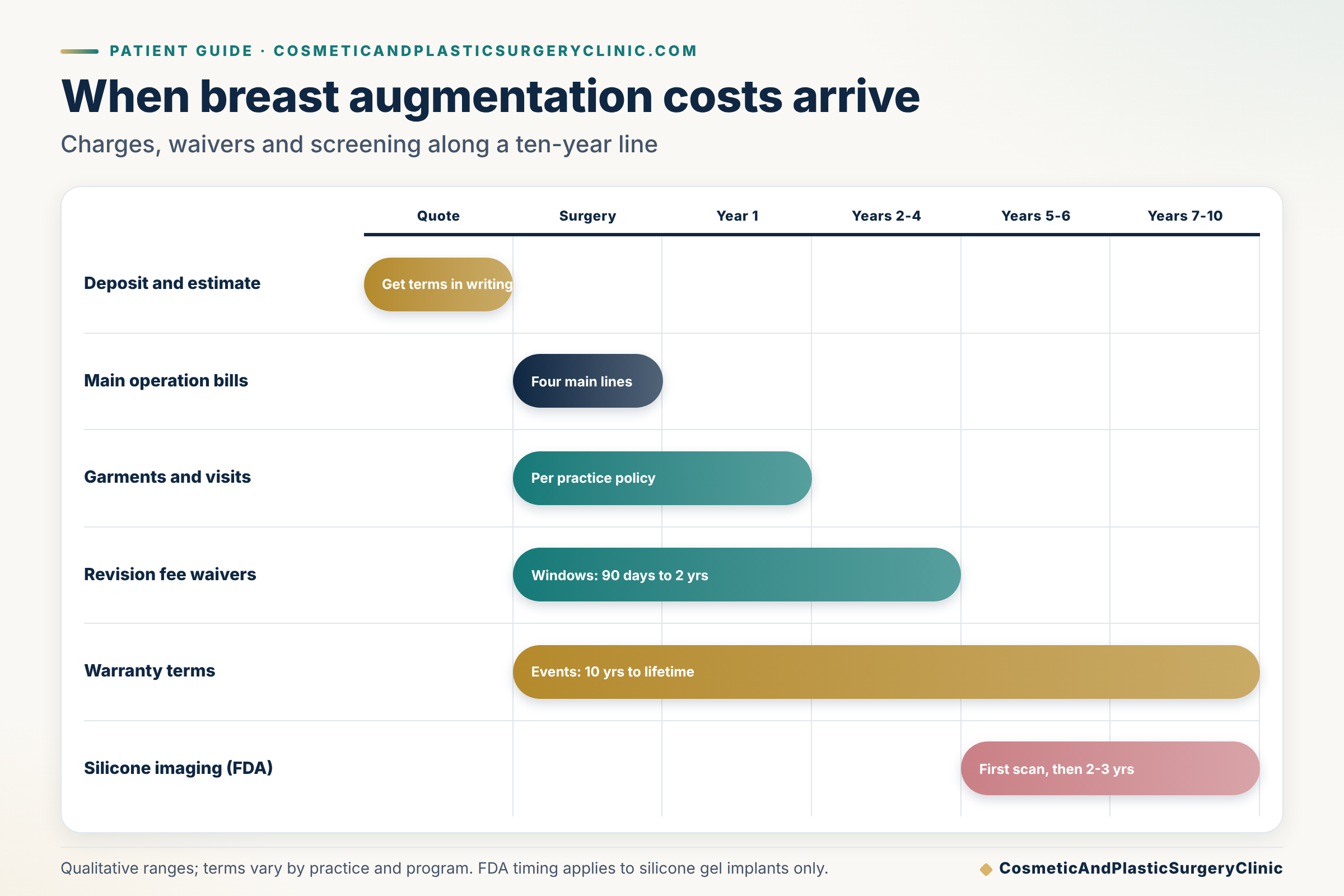
Implant manufacturers publish written warranty terms, and a quote should say which program applies and who handles the paperwork. The two documents this article opened show the pattern. One U.S. manufacturer’s 2018 document says that for a qualifying rupture it replaces the implant free for the patient’s lifetime, and for Baker grade III or IV capsular contracture, double capsule and late seroma it does so for ten years from implantation. It adds a basic plan that pays up to $3,500 toward out-of-pocket costs of replacement surgery after a rupture.
A second manufacturer’s 2023 document lists lifetime product reimbursement for rupture, ten years for contracture and late seroma, and financial assistance of up to USD 3,500 for surgical fees within ten years. That document names an Asia-Pacific complaint address, so its terms may differ for U.S. patients. The point is not which program is generous. Both are written, limited, and tied to specific events, so ask for the exact version that applies to the implants you are offered.
Read the exclusions as carefully as the benefits. Both documents exclude removal of intact implants for dissatisfaction with size, and both exclude removal for wrinkling or rippling. The second also excludes elective or preventive removal. Neither document pays anything unless the claim follows its procedure. Both require removed devices to be returned within 60 or 90 days, one has the surgeon file the claim, and one requires a signed patient release before it pays reoperative expenses.
Changing implant size on the day or years later
Wanting a different size is a reason for a second operation that neither warranty document pays for, so it belongs in the cost conversation before surgery. Ask what the practice charges if the surgeon recommends a different implant volume at the time of the operation, and what a later exchange for a different size would cost in surgeon, facility and anesthesia fees. The guide to breast implant size explains how size is chosen and why it matters for the lifetime bill.
Imaging and reoperation: costs that follow the implants
FDA screening for silicone gel implants
For silicone gel-filled implants the FDA’s September 2020 final labeling guidance recommends a first ultrasound or MRI at 5 to 6 years after the initial implant surgery and then every 2 to 3 years. An MRI is recommended at any time for symptoms or an uncertain ultrasound. The guidance exempts saline-filled implants because rupture can be detected without screening. Elsewhere the FDA calls MRI the most effective method for finding silent rupture and ultrasound an acceptable alternative for people without symptoms.
The cost point is stated in the FDA’s own sample patient checklist, which says imaging evaluations may not detect every rupture or leak, may be costly, and that the expense may not be covered by medical insurance. No national price for these scans was found, so treat the figure as something to ask for. A practice or imaging center can tell you its self-pay price for an ultrasound and for an MRI, and that figure belongs in your ten-year view of breast augmentation cost.
Reoperation and removal: what FDA data say and who pays
The FDA says plainly that breast implants are not lifetime devices, that the longer they are in place the greater the chance of complications, and that you should assume additional surgeries. Its 2011 safety update, last revised in 2018, reports that in the manufacturers’ core studies between 20 and 40 percent of augmentation patients had reoperations in the first 8 to 10 years, and that as many as one in five primary augmentation patients required implant removal in post-approval studies.
Those are population figures from manufacturer-sponsored studies of specific devices, and they do not forecast any one person. They do justify treating a second operation as a possible line item rather than a surprise. On payment, the FDA states that even with complications, the cost of implant removal or replacement may not be covered by insurance, and some insurers decline coverage even when the first operation was covered. The overview of plastic surgery risks explains how to read numbers like these.
Facility and anesthesia: where the setting changes the bill
Facility fees and the accreditation question
Flat or hourly, and what the fee pays for
The facility line pays for the operating room, the nurses, the equipment and the recovery area. Many facilities bill a flat amount for a stated block of time; others bill by the hour. A first-time augmentation is usually a shorter operation than a combined plan, so the difference between the two methods matters less than in a long day, but it still matters if the operation is extended by a revision of the pocket or a change in plan. Ask which method applies and what happens when the booked time runs over.
Why a low facility line in a breast augmentation cost quote deserves a question
ASPS requires its member surgeons to operate in facilities that are accredited by AAAASF, AAAHC or the Joint Commission, certified for Medicare or licensed by the state, with an exemption for procedures needing only local anesthetic or mild oral sedation. Its accreditation page advises verifying a facility’s status directly with the accrediting body. A 2016 ASPS blog post by Heather Furnas, MD, whose views the post says are her own, states that most office surgical facilities are unaccredited, function without inspections or peer review, and are far cheaper to run than accredited ones.
So a low facility line can reflect a lower-cost setting rather than efficiency. The post gives no statistics, and the exemption means some legitimate plans use settings outside the list, so treat it as a reason to ask, not a verdict. The guide to choosing a plastic surgeon walks through verifying a facility and a surgeon’s credentials.
Anesthesia: who gives it and how it is billed
The anesthesia professional and the billing method
Anesthesia is its own line in a breast augmentation cost estimate and often its own biller. The same ASPS blog post says deep levels of anesthesia should be given by an anesthesia professional, either a physician anesthesiologist or a certified registered nurse anesthetist. Two questions follow for a quote: who exactly will provide it, and is the figure a flat fee for a stated number of hours or an estimate that moves with the clock? A named provider and a stated method let you compare like with like.
When the plan changes on the day
Anesthesia and facility time are the two lines most likely to grow if a plan changes, for instance if the surgeon recommends a different pocket or an additional procedure once you are in the room. Ask in advance how a change would be priced and who would approve it. If a lift is part of the conversation, for example because tissue has descended, the added operation changes the whole bill. The article on breast lift cost covers that line, and the breast augmentation candidate article explains why surgeons raise it.
Revision terms and the costs that never reach the quote
What “revisions included” can mean
A survey of how practices waive revision fees
A revision is a second operation, and a breast augmentation cost quote should say who pays for it. A 2023 study in Aesthetic Surgery Journal Open Forum from one academic outpatient cosmetic center in Wisconsin counted 125 revisions among 1,491 aesthetic procedures from 2016 to mid-2022, an overall 8.4% revision rate pooled across many operation types. It is not a rate for breast augmentation. The same authors surveyed similar practices and 20 responded (80%).
Three of the 20 offered no-cost revisions. Nine did not charge the surgeon’s fee but still charged anesthesia and facility fees. Two decided the surgeon’s fee case by case and still charged anesthesia and facility fees, and three decided both case by case. One relied on insurance and two did not cover revisions. Where a time limit applied it ran from 90 days (one practice) to six months (three), one year (four) and two years (one).
Questions that turn a promise into a term
The survey is small, the practices had contact with the authors’ institution and no revision cost data were collected, so it describes a spread of policies rather than a standard. The lesson is that “free revisions” can mean very different things. Ask in writing which of the surgeon, facility and anesthesia fees are waived, for how many months, for which reasons, and who decides whether a revision is medically advised or simply a change of preference.
Ask separately how the practice’s revision policy fits with the implant warranty. They are two different promises from two different parties, and it is common for the warranty to cover a device while the practice’s policy covers a fee, or the reverse. Having both documents in one folder before surgery is the practical way to see which events are covered and which are not.
Costs that sit outside every quote
Complication care, removal and replacement
If a complication needs treatment, the quote’s revision terms are the first place to look, and an insurer’s policy is the second. The FDA’s sample patient checklist says that treatment of a BIA-ALCL diagnosis may be at the patient’s own expense and is not always covered, and that additional surgeries or procedures after augmentation will likely be at the patient’s own expense. Those are statements in a labeling example, not a promise about any one plan.
One insurer’s written policy shows how this can look. Cigna’s breast implant removal policy, effective April 15, 2026, treats removal solely to improve appearance of cosmetic augmentation implants as not medically necessary. It lists medically necessary removal for a rupture confirmed on imaging, Baker grade IV capsular contracture, a confirmed BIA-ALCL diagnosis, and infection, exposure or tissue death, among others. It also treats replacing an implant after removal as not medically necessary outside breast reconstruction. Other plans differ, and your own plan document decides.
Time off, childcare and help at home
The quote ends at the practice’s door, but the real breast augmentation cost includes the days after it. Time away from work, help with lifting or driving, and childcare for a short period all have a price, and none has a verified national figure. Price your own situation instead: what would you need on each of the first several days, and who would provide it? The breast augmentation recovery article describes the usual arc so you can plan the calendar before you plan the budget.
Who pays: insurance, taxes and payment plans
Cosmetic and reconstructive billing are different things
Why most breast augmentation cost is paid by the patient
ASPS says most health insurance plans will not cover cosmetic breast augmentation and typically do not cover related complications or revision surgery, and that some carriers even exclude breast disease in people who have implants. Reading your own policy for that last exclusion before surgery is sensible, because it affects how a later problem would be billed. The words in the policy matter more than a practice’s reassurance, and a sentence on a consultation call is not a coverage decision.
The IRS takes a similar line for taxes. Publication 502, for 2025 returns, says that generally you cannot include the cost of cosmetic surgery in medical expenses, defines it as a procedure directed at improving appearance, and allows an exception for correcting a deformity from a congenital abnormality, an accident or trauma, or a disfiguring disease. It deals only with the itemized medical deduction, which applies to expenses above 7.5% of adjusted gross income. Whether an HSA or FSA reimburses a given expense is up to the plan administrator, so ask before paying with one.
The mastectomy exception
One federal rule covers a narrow case. According to a 2025 ASPS explainer, the Women’s Health and Cancer Rights Act requires group health plans and insurers that cover mastectomies to cover all stages of reconstruction of the affected breast, surgery on the opposite breast to produce a symmetrical appearance, prostheses, and treatment of physical complications such as lymphedema. Plans may apply ordinary deductibles and coinsurance but cannot deny coverage outright.
That law concerns reconstruction after mastectomy. It does not make an elective augmentation a covered benefit.
Total cost matters more than the monthly payment
Interest, fees and the deferred-interest trap
A monthly figure makes a large breast augmentation cost feel small. Consider a hypothetical $13,150 total financed over 36 months at an invented 15% APR with no fees: the payment is about $456 and the total repaid about $16,400, roughly $3,260 more than the quote. A different rate or term changes every one of those numbers. The plastic surgery financing guide covers the mechanics in full.
Medical credit cards need extra care. The CFPB’s 2023 report gives the typical medical card APR as 26.99%, against roughly 16% for general-purpose cards, and says deferred-interest promotions run six to eighteen months. If the balance is not paid in full by the end, interest is charged on the full purchase amount from the purchase date, not just the remaining balance. About 20% of healthcare purchases with deferred interest were assessed interest in the period the report studied, and 65% of medical cards are signed in provider offices. Reading the agreement away from the front desk is reasonable.
ASPS notes that many plastic surgeons offer patient financing plans and says to ask. Treat that as a starting point for questions about rate, term, fees and what happens if you pay early.
Deposits, cancellations and good faith estimates
Ask what a deposit secures, whether it is refundable, and what happens to it if surgery is postponed because of illness, a change in plans or the surgeon’s decision to wait. Policies vary and no standard was found, so get the answer in a signed document.
Self-pay patients also have a federal tool. CMS says providers usually must give a good faith estimate to people who do not have or use health insurance, when you ask or when you schedule at least three business days ahead, and you may be able to dispute a bill that is at least $400 more than the estimate. Ask whether the practice issues one for cosmetic services.
Comparing two quotes and planning ten years ahead
A worked comparison with invented numbers
Normalizing two quotes line by line
Suppose two practices quote the same operation in November 2026: primary breast augmentation with silicone gel implants. Every number below is hypothetical, including the figures Quote A gives after questions. They show how to compare a breast augmentation cost estimate, not what one costs. Quote A is a single package price. Quote B lists each line. The first step is to ask Quote A’s practice to name the missing lines.
| Line | Quote A as written | Quote B as written | Quote A after questions (assumed) |
|---|---|---|---|
| Operation named | “Breast augmentation with implants”; fill and pocket not stated | Silicone gel implants; pocket and incision stated | Confirmed same as Quote B |
| Surgeon’s fee | $6,200 package | $5,600 | $6,200 |
| Facility | Not stated | $2,600, named accredited center | $2,900 |
| Anesthesia | Not stated | $1,300, flat for two hours | $1,100, hourly; two hours assumed |
| Implants | Not stated | $2,400 listed | $2,600 |
| Garments, tests, prescriptions | Not stated | Garments included; medicines from a pharmacy | $350 |
| Follow-up and revision | 90 days; surgeon’s fee waived 12 months; other fees extra | 12 months; surgeon and facility fees waived if the surgeon advises revision | Same as written |
| Total | $6,200 as written | $11,900 plus medicines | $13,150 |
How missing lines can reverse the ranking
As written, Quote A looks $5,700 cheaper than Quote B. After the practice names its facility, anesthesia, implant and supply charges, it comes out $1,250 higher, and its revision terms still leave facility and anesthesia fees to the patient where Quote B’s cover the facility. Nothing in the example says one practice is better. The ranking changed because of what was missing, not because of a hidden choice. Price cannot tell you which surgeon, facility or plan is safer; that comparison belongs to a consultation, which the consultation guide prepares you for.
A ten-year view of breast augmentation cost
Three hypothetical paths over ten years
The FDA recommends imaging for silicone gel implants and says to assume more surgery, so a fair breast augmentation cost comparison looks past the first invoice. The table builds on Quote B above. Every figure is invented: each imaging session is set at $1,200, and the second operation at a surgeon’s fee of $4,200, facility and anesthesia of $3,900 and implants of $2,400. Under the FDA schedule a silicone patient would have a first scan at 5 to 6 years and another 2 to 3 years later, so two sessions are assumed. A third scan could fall near year ten.
| Line | No further surgery | Second operation, event covered by warranty | Second operation, event not covered |
|---|---|---|---|
| First operation (Quote B) | $11,900 | $11,900 | $11,900 |
| Two imaging sessions | $2,400 | $2,400 | $2,400 |
| Second operation, gross | $0 | $10,500 | $10,500 |
| Warranty offset (assumed maximum) | $0 | minus $5,900 | $0 |
| Ten-year total | $14,300 | $18,900 | $24,800 |
What the scenarios do and do not show
The offset in the middle column assumes a qualifying event, a replacement implant pair at $2,400 and the $3,500 fee-assistance maximum, all of which depend on the written terms and on a claim being filed.
The right-hand column could be a change of size, which both warranty documents exclude. The numbers say nothing about how likely either path is for your own breast augmentation cost. The FDA’s 2011 figures suggest a second operation is a real possibility rather than a remote one, and saline implants are not subject to the same screening recommendation, which changes the table. The mommy makeover cost article shows how a combined plan changes the first line.
Warning signs and a written-estimate checklist
Pressure tactics, vague settings and unnamed providers
A figure that looks low because it comes from abroad may leave out the cost of aftercare at home, an issue the medical tourism article discusses. Whatever the source of a low number, the question is the same: which of the eight lines is missing?
What to have in writing before a deposit
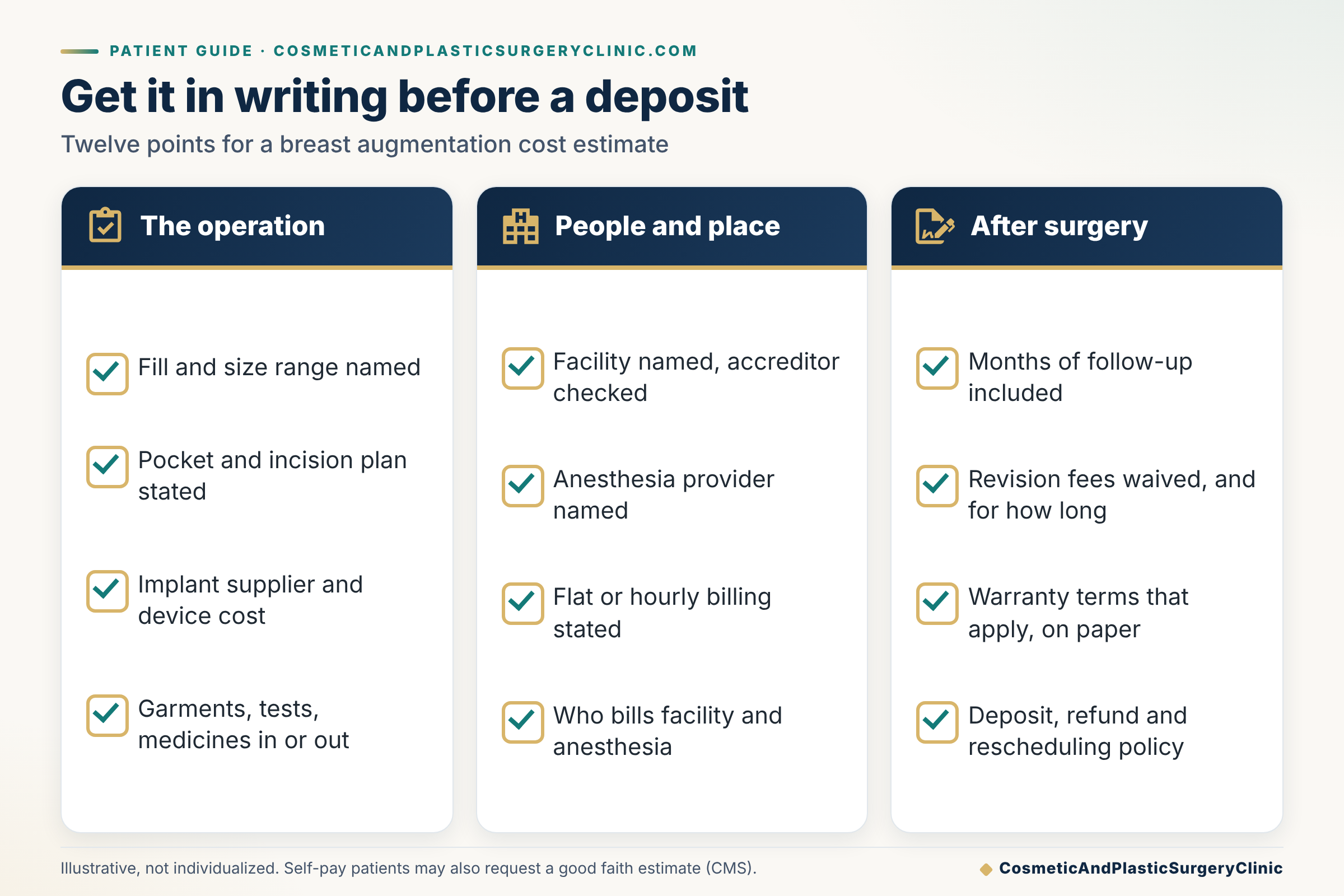
Before paying a deposit, have the practice put in writing: the operation, implant type and who supplies it; the named facility and its accreditor; the named anesthesia provider and the billing method; the garments and tests included; the follow-up period; the revision terms with waived and unwaived fees; the warranty document that applies; the self-pay price of later imaging if you choose silicone; and the refund and rescheduling policy. The checklist graphic condenses that list.
Frequently asked questions
Does breast augmentation cost more with silicone than with saline implants?
No source opened for this article gives a national price difference, so ask each practice for its own device prices. What the FDA does say is that silicone gel implants carry a screening recommendation, a first ultrasound or MRI at 5 to 6 years and then every 2 to 3 years, while saline implants are exempt because rupture can be detected without screening. That recurring imaging belongs in a long-run comparison even if the first invoices look similar. The saline-versus-silicone article covers the other differences between the two fills.
Why do advertised breast augmentation cost figures look so low?
Advertised figures often describe only the surgeon’s fee, which is the number ASPS publishes. ASPS says its average excludes anesthesia, operating room facilities and related expenses, and its 2024 projected range of $4,575 to $8,000 covers surgeon fees alone. A low headline breast augmentation cost may therefore leave out the facility, the anesthesia provider, the implants and the revision terms. Ask for a written estimate with every line, and compare totals only after both estimates describe the same operation in the same kind of setting.
Will insurance pay to remove or replace implants later?
It depends on the plan and the reason. The FDA says that even with complications, removal or replacement may not be covered, and some insurers decline coverage even if the first operation was covered. One insurer’s written policy, effective April 2026, covers removal for a confirmed silicone rupture, Baker grade IV contracture or confirmed BIA-ALCL but treats removal solely for appearance, and replacement outside reconstruction, as not medically necessary. Check your own plan document before surgery.
Is fat-transfer breast augmentation cost higher than implants?
On ASPS’s published figures it is higher: $5,719 against $4,875 on its cost page, and a 2024 projected range of $5,500 to $9,500 against $4,575 to $8,000 for implants. Those are surgeon fees only and describe different operations, so they say little about total cost. Fat grafting also involves harvesting fat elsewhere on the body. The article on fat transfer versus implants compares what each method can and cannot do.
Can I use an HSA or FSA, or deduct breast augmentation cost on my taxes?
IRS Publication 502 says you generally cannot include the cost of cosmetic surgery in medical expenses, with exceptions for deformities from a congenital abnormality, accident or trauma, or disfiguring disease, and the itemized deduction only counts expenses above 7.5% of adjusted gross income. HSA and FSA rules are set by the plan administrator, and this article did not verify any plan, so ask the administrator before paying. A tax professional can answer questions about your own return.
What is a good faith estimate, and can I ask for one for breast augmentation cost?
CMS says providers usually must give a good faith estimate to people who do not have or do not use health insurance, when you request one or when you schedule at least three business days in advance. If a bill comes in at least $400 above the estimate, you may be able to dispute it. Whether a cosmetic practice treats a consultation as a scheduled service is a question to put to the practice. Keep the document with your quote, your warranty paperwork and your deposit receipt.
How much time off and help should I budget for after surgery?
No verified national figure exists for the cost of help, childcare or lost income, so the budget has to be your own: price what you would actually need during the first several days and weeks. The surgeon’s written instructions set the real restrictions, and they differ by operation and by person. The recovery article describes the usual arc. If your work offers no paid leave, count lost income as a line in your breast augmentation cost plan.
Sources and further reading
- ASPS — Breast augmentation cost (accessed 2026-11-12) — average fee, exclusions, cost items, insurance and financing statements
- ASPS — 2024 Procedural Statistics Release: Average Surgeon/Physician Fees (accessed 2026-11-12) — projected fee ranges and methodology
- ASPS — 2025 Plastic Surgery Statistics Report (accessed 2026-11-12) — procedure counts and methodology; no fee data
- FDA — Things to consider before getting breast implants (accessed 2026-11-12) — implant lifespan, reoperations, insurance coverage, 2021 labeling changes
- FDA — Risks and complications of breast implants (accessed 2026-11-12) — complications, screening imaging and coverage statements
- FDA — Breast Implants: Certain Labeling Recommendations to Improve Patient Communication, final guidance (September 2020) (accessed 2026-11-12) — rupture screening schedule, boxed warning, patient decision checklist and its cost statements
- FDA — Guidance document page for the labeling recommendations (accessed 2026-11-12) — date and purpose of the final guidance
- FDA — Update on the safety of silicone gel-filled breast implants (2011), executive summary (accessed 2026-11-12) — reoperation and removal figures from core and post-approval studies
- FDA — Statement on continued efforts to protect women’s health (October 23, 2019) (accessed 2026-11-12) — draft labeling proposals and earlier screening advice
- Mentor Worldwide — MENTORPromise and Enhanced Protection Plan terms (2018 document) (accessed 2026-11-12) — example of a U.S. manufacturer’s warranty terms, caps, fee and exclusions
- Allergan Aesthetics — ConfidencePlus Warranty Terms and Conditions (2023-04-28) (accessed 2026-11-12) — second example of warranty terms and exclusions
- Cigna — Breast implant removal coverage policy, effective 2026-04-15 (accessed 2026-11-12) — medical-necessity criteria for implant removal and replacement
- Moura et al. — Offering no-cost cosmetic revisions, Aesthetic Surgery Journal Open Forum, 2023 (accessed 2026-11-12) — revision rate and revision-fee practices of surveyed practices
- ASPS — Accreditation (accessed 2026-11-12) — accepted facility accreditations and the anesthesia exemption
- ASPS blog — 10 features of a safe operating room (Furnas, January 19, 2016) (accessed 2026-11-12) — accreditation, anesthesia professional, unaccredited office facilities
- ASPS — WHCRA: past, present and the push for modernization (McNulty and Billington, 2025) (accessed 2026-11-12) — reconstruction and symmetry coverage law
- IRS — Publication 502, Medical and Dental Expenses (2025) (accessed 2026-11-12) — cosmetic surgery exclusion, exceptions and 7.5% threshold
- CFPB — Medical credit cards and financing plans, May 2023 (accessed 2026-11-12) — typical APR, deferred interest, share assessed, sign-ups at provider offices
- CMS — Good faith estimates for uninsured or self-pay patients (accessed 2026-11-12) — timing and $400 dispute threshold