If you are searching for what makes someone a breast augmentation candidate, you are probably trying to answer a practical question before you spend time or money on a consultation: does anything about my goals, my body, my health, or my calendar make this a poor fit right now? That is a sensible thing to sort out early. This guide walks through the factors plastic surgeons commonly review, explains why each one matters, and flags the situations in which many surgeons suggest waiting, adding a step, or looking at a different option.
One boundary up front. This article cannot tell you whether you are or are not a candidate, and nothing here is a diagnosis or a treatment plan. Candidacy is a judgment that comes out of an in-person evaluation: an examination, a medical history, measurements, and a frank conversation about what you want. What a general article can do is help you arrive at that conversation informed, so you can ask better questions and recognize which answers deserve a second look.
Breast augmentation means enlarging or reshaping the breasts, most often with implants and sometimes with fat transfer. It is the second most common cosmetic surgical procedure in the American Society of Plastic Surgeons (ASPS) 2025 procedural statistics, which count 304,234 procedures that year. Popularity says nothing about whether a specific person is well matched to it, which is why the screening questions below matter more than the headline number.
Here is how the page is organized. The first sections cover what the word “candidate” means and what the operation can and cannot change, then goals, anatomy, health, and timing. A dedicated section reports what the U.S. Food and Drug Administration (FDA) says about breast implants, with the dates the pages were last updated and the date this article’s research accessed them. After that come mental health and money, reasons to pause, a decision-readiness checklist, consultation preparation, and surgeon selection. Where a topic has its own deeper article, such as the breast augmentation cost guide or the risks and complications article, we summarize and point you there instead of repeating it. For the full procedure overview, start with the complete guide to breast augmentation.
A note on language. “Breast augmentation” and “breast enlargement” are used interchangeably in everyday speech, and “augmentation mammoplasty” is the formal surgical name. “Breast implants” refers to the devices themselves. Where the FDA or another source uses the word “women,” we sometimes echo that wording when quoting its scope, but anyone considering breast surgery, whatever their gender identity, benefits from the same type of planning conversation.
Breast augmentation candidate basics: what the term means and what surgery can change
Before getting into factors, it helps to agree on vocabulary. People use “candidate” loosely, surgeons use it a little differently, and the gap between the two explains a lot of confusion on forums and in consultation rooms.
What “candidate” means in a consultation
In plain English, a candidate is someone for whom the likely benefits of a procedure outweigh its risks and costs, given their goals, anatomy, health, and circumstances. That is a moving target. The same person can be a reasonable fit at one point in life and a poor fit at another, which is why timing shows up in nearly every section of this article.
A terminology map for candidacy conversations
Several terms get mixed together, and separating them makes the rest of the page easier to follow. A contraindication is a circumstance in which a treatment should not be used at all, at least until something changes. The FDA’s patient-labeling guidance for breast implants lists a short set of these, covered in the FDA section below. A relative risk factor is a circumstance that raises the chance of a problem without ruling the operation out, such as nicotine use, certain medications, or a condition that slows healing. A timing issue is something that may resolve on its own, such as a recent pregnancy, active breastfeeding, or a weight that is still moving.
Then there are the softer categories. An expectation gap is a mismatch between what a person hopes for and what the procedure can do. A readiness issue covers practical things like childcare, time off, and money. And an unresolved symptom means a breast change, lump, or discharge that has not been evaluated yet. Surgeons sort concerns into roughly these buckets, and a concern in one bucket is handled differently from a concern in another. A timing issue might mean “come back in several months.” A contraindication might mean “not with implants.” An expectation gap might mean “let’s talk about what we can realistically address.”
You will also see the phrase “appropriate candidate” in patient education materials. It carries a useful hedge: appropriate for this procedure, by this approach, at this time, in the judgment of a particular clinician. Another surgeon looking at the same person could reasonably frame the plan differently, which is one reason many people seek a second consultation.
What a candidacy review usually involves
Although every practice runs its visits differently, the ingredients are similar. The conversation typically starts with goals, in your words: what bothers you, what you hope will change, and what a good outcome looks like in daily life. Then comes a medical history, including prior surgeries, chronic conditions, medications and supplements, allergies, smoking or vaping, family history of breast cancer, and pregnancy and breastfeeding history or plans. The FDA’s page on breast implant surgery says the surgeon should discuss during the consultation whether you are a good candidate for implants, which makes it the point of the visit rather than a formality.
The physical portion usually involves examining and measuring the chest and breasts: how much breast tissue is present, how stretchy or thin the skin is, where the nipples sit relative to the fold beneath the breast, whether the two sides match, and how the rib cage and shoulders are shaped. Some surgeons use sizers, which are trial implants placed in a bra or held against the chest, to talk about proportion. Many also take standardized photographs for the medical record. The FDA’s page on breast implant surgery adds that you should tell the surgeon about your pregnancy status and medical history, which is straightforward but easy to overlook when you are focused on size and shape.
A good evaluation ends with a discussion, not a sales close. You should come away understanding what was recommended and why, what the alternatives are, which risks matter most for your situation, what recovery looks like, what the fee covers, and what the next step is. If the visit ends with pressure to book immediately, treat that as information about the practice. Our guide to what happens at a breast augmentation consultation goes through the visit in more detail.
What breast augmentation can and cannot change
Candidacy is partly about fit between a goal and a tool. Knowing what the tool does, and what it doesn’t, is the quickest way to spot an expectation gap on your own.
What implants or fat transfer are designed to do
According to the ASPS, breast augmentation can increase fullness and projection, improve body proportions, restore volume that changed after pregnancy or weight change, and address some natural differences between the breasts. The two main methods are breast implants and fat transfer, in which fat taken from another part of the body by liposuction is injected into the breasts. Implants come in saline-filled and silicone gel-filled forms, with different sizes, shapes, and shell surfaces, and the FDA notes that the shells are either smooth or textured.
Implants can be placed behind the breast tissue and over the chest muscle, or partly beneath the pectoral muscle, and the ASPS lists three common incision locations: along the lower edge of the areola, in the fold beneath the breast, and in the armpit. It also cautions that an approach through the navel carries higher complication risk. Which combination suits a particular person depends on anatomy, the implant chosen, and the surgeon’s training, so these are consultation topics rather than something to decide from an article.
Fat transfer works differently. It tends to suit a modest increase in size rather than a dramatic one, because only some of the injected fat is expected to survive, and surgeons often plan for that. We cover the option in our overview of fat transfer breast augmentation, and the sibling guide to alternatives to breast augmentation compares it with other approaches side by side.
What they cannot do
The limits matter just as much as the capabilities. The ASPS states plainly that breast augmentation does not correct severely drooping breasts; when sagging is a major part of the concern, a breast lift may be needed, either at the same time or in a separate operation. A cosmetic surgery presentation published by the American Academy of Cosmetic Surgery makes the same point in blunter language: implants do not lift a breast, and a low nipple before augmentation will still be low afterward.
Other limits are less obvious. An implant cannot change the shape of the rib cage underneath it, cannot make two naturally different breasts identical, and cannot hold a fixed look forever. Tissue continues to age, weight changes, pregnancy changes the breast, and the FDA is explicit that breast implants are not lifetime devices. The longer someone has implants, the greater the chance of complications, and some of those require more surgery. Finally, no procedure can be promised to deliver a specific cup size, because bra sizes are not standardized across manufacturers, and the same volume can look different on different frames. The table below sorts these points into what is commonly addressed, what is addressed only partly, and what is not addressed.
| Concern | Often addressed | Addressed only partly | Not addressed by augmentation alone |
|---|---|---|---|
| Small overall breast volume | Yes, by adding an implant or transferred fat | Fat transfer usually offers a smaller, less predictable increase | Natural limits of skin and tissue still apply |
| Upper-pole fullness after pregnancy or weight change | Often improved by adding volume | Depends on how much skin has loosened | Lost skin tightness |
| Sagging with low nipple position | Not the main purpose | Mild changes may be managed with a larger implant, at the cost of other trade-offs | Lift of the nipple and breast tissue, which typically calls for a breast lift |
| Differences between the two breasts | Can be reduced with different sizes or techniques | Chest wall and nipple height may stay different | Perfectly matched breasts |
| Long-term stability | Not a one-time fix | Aging, weight, and pregnancy continue to change tissue | Lifetime durability of implants |
| Mood or confidence outside the body | May contribute for some people | Benefit varies by person and expectation | Underlying mental health conditions or relationship concerns |
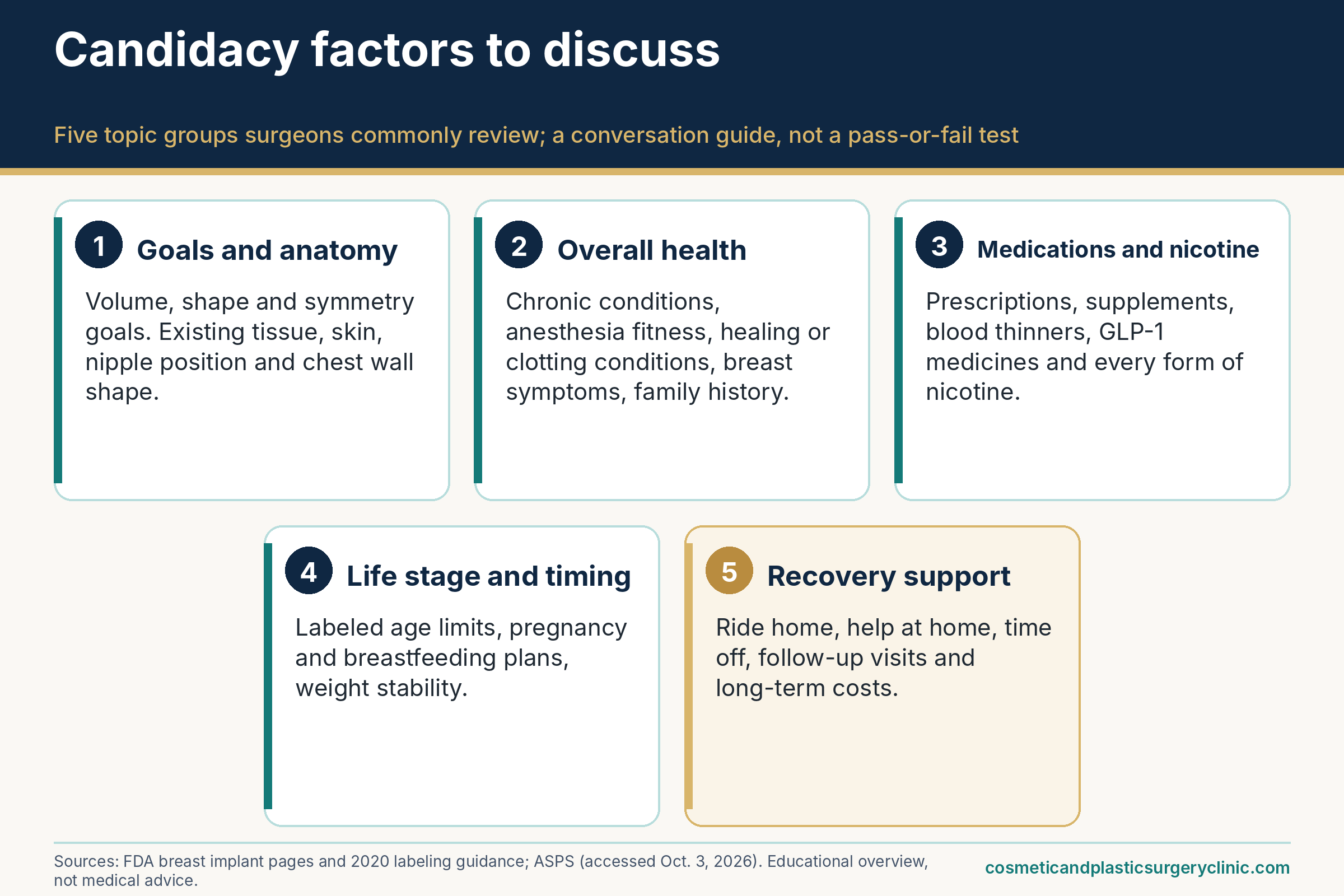
Goals and expectations: volume, shape, symmetry, and the long game
Almost every candidacy conversation comes back to goals. A surgeon can plan an operation around a clear goal far more easily than around “I just want to look better,” and you can judge a surgeon’s answer far more easily when you can say precisely what you are hoping for.
Defining what you want to change
People often arrive with a single word, usually “bigger,” when the underlying wish is really a cluster of different wishes. Pulling them apart is the most useful homework you can do before a consultation.
Volume, shape, projection, and proportion are four different goals
Volume is how much breast there is. Shape is how that volume is distributed: fuller on top or fuller below, rounder or more gently sloped. Projection is how far the breast stands out from the chest wall. Proportion is how the breasts relate to the shoulders, waist, and hips. Someone whose main wish is more fullness in the upper chest after pregnancy is describing something different from someone who wants a noticeably larger silhouette, and both differ from a person whose main concern is clothes that fit across the chest and hips at the same time.
Why does this matter for candidacy? Because the tool and the plan change with the goal. A modest, natural-looking increase may be a reasonable target for a person with adequate tissue and good skin quality. A large increase on a narrow frame raises questions about tissue coverage, implant visibility, and long-term wear on the tissue, which a surgeon will want to discuss. The ASPS describes the aim of augmentation as increasing fullness and projection and improving proportion, but its patient pages do not tie that to a particular size, which fits the reality that the right size depends on the person.
It also helps to separate what you want from what you assume you need to get there. If the real goal is “feel comfortable in fitted tops,” a surgeon might talk about a range of volumes. If the real goal is “restore what I had before breastfeeding,” the conversation may involve both volume and a lift. You will get better advice, and spot a mismatched recommendation sooner, when you describe the destination rather than the operation. The table below translates common phrases into what a surgeon may hear and a question worth asking.
| What people often say | What it may point to | A question worth asking |
|---|---|---|
| “I want to go up a cup size” | Volume goal; cup sizes vary between bra makers and are not a surgical measure | How will you describe volume in cubic centimeters and show me what that looks like on my frame? |
| “I want my old shape back” | Possibly volume loss plus skin changes; a lift may enter the conversation | Is my main issue volume, skin, or nipple position, and do I need more than one step? |
| “I want a natural look” | Often a preference for softer slope, moderate size, and limited visibility of the implant edge | What does “natural” mean in your practice, and how do my tissue and skin affect it? |
| “I want my breasts to match” | Symmetry goal; some difference usually remains because of chest wall and nipple position | Which differences can be reduced and which will probably stay? |
| “I want to fill out my tops without looking too big” | Proportion goal that often has more than one workable answer | Can you show a range of sizes on me and explain the trade-offs at each? |
| “I want the lowest-maintenance option” | Interest in longevity; every option carries some long-term upkeep | What follow-up, imaging, and possible future operations come with each approach? |
Symmetry goals and the limits of matching
Most people have some asymmetry. One breast sits slightly larger, a nipple rides a little higher, or the fold beneath the breast lands at a different level. In a published series of 312 augmentation patients operated on in 2007 and analyzed by Khan in the European Journal of Plastic Surgery in 2011, volume differences between the breasts were recorded in roughly 46.5 percent, and vertical differences in nipple position in about 32.8 percent. This is a single observational series, so treat the percentages as an illustration that asymmetry is common among people who seek augmentation rather than a benchmark for any individual.
For candidacy, the useful point is how much asymmetry exists and what it is made of. Differences in breast volume can often be softened by choosing different implant sizes or by adjusting technique, but differences that come from the chest wall, from the position of the nipple, or from the fold are harder to equalize and may remain visible afterward. Surgeons generally document asymmetry before surgery for exactly this reason, so that you and they can talk about it in advance rather than discovering it in the mirror afterward. If asymmetry is your main concern rather than size, you may want to read about breast asymmetry surgery, where a different set of options may apply.
A reasonable symmetry goal sounds like “make the difference less noticeable in clothes and in a bra.” A less reasonable one sounds like “make them identical.” If a surgeon promises identical breasts, that is a signal to ask more questions, because the biology does not support the promise.
Expectations, motivation, and how you will judge the result
Satisfaction depends on whether the result lines up with what you were hoping for, and that depends on whether your hopes were realistic and your own to begin with.
Doing it for yourself, not for someone else
The ASPS candidacy page is direct about motivation. It describes breast augmentation as a deeply personal procedure and says that people who want the operation for themselves tend to report high satisfaction. The mirror image of that statement is a common red flag in clinics: a person who is considering surgery mainly because a partner wants it, because social media suggests it, or because of a comment about their body from someone else.
Pressure does not have to be dramatic to count. It can be a joking remark, an anniversary gift, a friend’s enthusiasm, or a sense that everyone around you has already done it. A helpful test is to ask what you would decide if nobody else would ever see or comment on the result. If your answer is the same, outside pressure may be a small factor. If it changes, that deserves some quiet reflection, and perhaps a conversation with someone you trust who has no stake in the outcome.
Surgeons who work carefully often ask about motivation directly, and you should not feel judged by the question. It is part of the same safety logic as asking about medications. A person who feels pushed into surgery may be less able to accept the normal bumps of recovery, and a person who says “I thought this would fix everything” may end up disappointed no matter how technically well the operation goes.
Size labels, photos, and what “natural-looking” means
Several common reference points are less reliable than they look. Bra cup sizes vary from brand to brand and do not map neatly to surgical volumes. Photos of other people show what happened on a different body with different tissue, a different frame, and often different lighting and posing. Before-and-after galleries can be useful for judging a surgeon’s aesthetic, and the ASPS encourages reviewing them, but they should never be read as a forecast of your result.
“Natural-looking” is a goal rather than a promise, and it means different things to different people. For one person it means a modest increase that can’t be spotted under a T-shirt. For another it means a gentle slope in the upper chest that reads as a healthy breast in a swimsuit. Say which you mean. Also consider the situations you care about, because a result that looks right standing in a mirror can look different lying down, in a sports bra, or in a low-cut top. Bring photos of looks you like, but also bring photos of looks you don’t like; the second set is sometimes more informative.
One more expectation worth naming: surgery changes the breasts, not the rest of the day. Recovery takes time, swelling and tenderness taper gradually, and early results can look different from later ones as tissue settles. The ASPS recovery page emphasizes following the surgeon’s instructions on support garments and activity, and describes soreness and swelling that can last for weeks. Hold your expectation of the final look loosely until your surgeon tells you healing has progressed far enough to judge.
Anatomy factors: existing volume, skin envelope, sagging, asymmetry, and chest wall shape
If goals are the question, anatomy is the context that shapes the answer. Two people can ask for the same change and need quite different plans because of what is already there: how much tissue, how elastic the skin, where the nipples sit, and how the chest is built.
Existing breast tissue, skin, and nipple position
Breasts consist mostly of glandular tissue, fat, and connective tissue, and they rest on top of the pectoralis major muscle rather than containing muscle themselves. An implant or transferred fat has to fit inside the envelope of skin and tissue that already exists, so the envelope sets limits that goals alone can’t override.
Existing volume, tissue coverage, and skin elasticity
Surgeons commonly assess how much natural breast tissue there is, how thick it is over the area where an implant would sit, and how well the skin stretches and recoils. Someone with ample tissue and elastic skin generally has more flexibility than someone with very little tissue and thin skin, because tissue coverage helps soften an implant’s edges and skin quality affects how well the breast holds its shape over time. None of this is a pass-or-fail test. It informs the choice of implant size, the plane in which an implant is placed, the incision, and whether to consider fat transfer instead.
The skin envelope is a particularly important concept. When someone has lost volume after pregnancy, breastfeeding, or weight loss, the skin that once held a fuller breast may now be looser than the tissue inside it. Adding an implant fills part of that space, but if the skin is stretched far enough, the nipple can end up sitting low on the breast and the implant can look like it has slipped to the bottom of a loose pocket. A surgeon evaluating this will usually pay attention to how far the nipple sits below the fold beneath the breast, and to how much breast tissue hangs below that fold.
Another practical point concerns size requests relative to the existing frame. Requests for a very large increase raise additional questions: does enough tissue exist to cover the implant, how will the weight affect the tissue over years, and what happens to the result if the person’s weight changes? These aren’t moral questions. They are physical ones, and a candid surgeon will explain the trade-offs rather than simply saying yes or no.
Sagging (ptosis) and when a breast lift enters the conversation
Ptosis is the medical word for breast sagging. It is graded by comparing the nipple’s position with the fold beneath the breast, often called the inframammary fold, and with the lowest point of the breast. A classification attributed to Regnault is widely used, and a continuing-education presentation from the American Academy of Cosmetic Surgery summarizes it this way: in the normal pattern the nipple sits above the fold, in first-degree ptosis the nipple sits at the fold, in second-degree ptosis it sits below the fold but above the lowest point of the breast, and in third-degree ptosis it sits below both. A related category, pseudoptosis, describes a nipple above the fold with the lower portion of the breast hanging below it.
Why does grade matter for candidacy? Because an implant adds volume, not lift. The same presentation states the principle bluntly: a low nipple before augmentation will be low afterward, and attempting to fix significant ptosis with an implant alone is a mistake. The ASPS makes a similar point when it says augmentation does not correct severely drooping breasts and that a lift may be needed, either together with augmentation or as a separate stage.
A lift (mastopexy) removes excess skin and repositions the nipple and breast tissue. It leaves scars, and a lift combined with an implant in one operation involves more variables than either alone, which is why some surgeons prefer to stage the procedures. Our overview of breast lift surgery explains the techniques and scar patterns, and the article on combining breast augmentation with other procedures covers the single-stage versus two-stage discussion. The table below summarizes how grade relates to the conversation, without suggesting what any individual needs.
| Pattern | Nipple position | Why it matters for augmentation | Topics often raised |
|---|---|---|---|
| Normal | Above the fold; lowest breast point at the fold | Implant volume is not working against sagging | Size, placement, incision, tissue coverage |
| Pseudoptosis | Above the fold; lower breast hangs below it | Nipple height may be adequate while the lower breast has relaxed | Whether an implant alone can fill the lower pole; whether a lift is also useful |
| First degree | At the fold | Mild sagging; outcome depends on skin quality | Implant alone versus lift; trade-offs of each |
| Second degree | Below the fold, above the lowest breast point | An implant alone is less likely to correct nipple position | Lift with or without implant; one stage or two |
| Third degree | Below the fold and below the lowest breast point | Implant alone typically does not address position | Lift planning, scar patterns, staging, revision likelihood |
Asymmetry, chest wall shape, and development patterns
The third group of anatomical factors is easy to miss because it is partly hidden under the breasts themselves. The shape of the chest and the pattern of breast development can influence the plan as much as the breasts do.
Asymmetry in volume, nipple height, and fold position
Asymmetry comes in several forms, and each is handled a little differently. Volume asymmetry means one breast holds more tissue than the other. Nipple asymmetry means the nipples sit at different heights, or point in different directions, or the nipple-areola complexes differ in size. Fold asymmetry means the creases beneath the breasts sit at different levels. Khan’s 2011 observational series on 312 augmentation patients tracked these separately, and the pattern was mixed: some patients had one kind of difference, some had several, and some had none that stood out.
The author’s conclusion was that many patients with these differences might not need additional surgical maneuvers beyond the planned augmentation, while documenting the differences beforehand remains important for planning and sizing. That is a reasonable way to think about it as a patient too: asymmetry is common, it is often workable, and it deserves to be seen and discussed before surgery. Ask your surgeon to show you the asymmetries they see in your own measurements and photographs, and ask which ones they expect to change and which they expect to remain.
Chest wall shape and unusual breast development
The rib cage, breastbone, and spine give the breasts their foundation. A chest that is more prominent on one side, a breastbone that sits unusually inward or outward, or a trunk with a curve can influence how an implant sits and how symmetrical the final appearance is. In Khan’s series, chest wall deformities were recorded in a minority of patients, around 8.6 percent. The FDA’s list of local complications associated with breast implants also includes chest wall deformity, which is a reminder that the relationship between implant and chest wall deserves attention in both directions.
Breast development patterns matter too. The ASPS lists abnormal breast development among the concerns that may bring people to augmentation, and elongated or unusually shaped breasts can call for different approaches than a typical round breast. Because these shapes vary widely, there is no single standard plan, and a surgeon with experience in your particular pattern is worth seeking. If the shape of your breasts is the main concern, it is reasonable to ask how many cases like yours the surgeon has handled and what the typical sequence of operations looks like.
For readers who are already thinking about alternatives, it can be useful to know that fat transfer, lift procedures, and implant-based approaches fit different anatomical profiles, and that some people benefit from combining or sequencing them. We lay out those trade-offs in the guide to breast augmentation alternatives. The point for candidacy is that anatomy often narrows the list of reasonable paths rather than leaving them all open.
Health factors: overall health, anesthesia fitness, medications, bleeding conditions, and nicotine
Breast augmentation is elective, which means there is no medical urgency and a lot of room to get the preparation right. That is also why surgeons and anesthesia teams tend to be conservative about health factors: with no urgency, there is rarely a reason to proceed when something can be improved first.
General health, anesthesia, and the situations FDA labeling flags
Two sets of questions overlap here. One is about the operation and anesthesia in general. The other is about the implant device specifically, for which the FDA has published labeling guidance with named conditions.
Overall health and anesthesia readiness
Surgery places temporary demands on the heart, lungs, circulation, and immune system, and anesthesia adds its own. The ASPS procedure page says that breast augmentation can be performed with intravenous sedation or general anesthesia, with the surgeon recommending the better choice for the situation. The FDA says most people receive general anesthesia for breast implant surgery, that local anesthesia is an option, and that the operation can last from one to several hours depending on the procedure and personal circumstances.
Because of that, a preoperative review usually covers chronic conditions such as high blood pressure, diabetes, heart or lung disease, sleep apnea, thyroid disease, and anemia; past reactions to anesthesia in you or in blood relatives; allergies, including to adhesives, latex, and antibiotics; and prior surgeries. Some practices ask for blood work, an electrocardiogram, or a clearance letter from a primary care physician or specialist. Whether you need any of those depends on your history and on the facility’s policies, so the right question is “what testing do you require, and why?” rather than assuming a standard list. Our plastic surgery anesthesia checklist goes through the topics to raise with the anesthesia team.
It’s worth separating “healthy enough for surgery” from “healthy” in general. A person with a well-managed chronic condition may be an entirely reasonable candidate once the condition is stable and the right clinicians have weighed in. A person with a poorly controlled condition may be asked to wait while it is brought under control, which isn’t a verdict on them. Honest reporting is the foundation of all of this. Anesthesia teams can plan around many things, but they can’t plan around something they never hear about.
Conditions the FDA’s implant labeling guidance names
The FDA’s September 2020 final guidance on breast implant labeling describes a patient decision checklist, and part of that checklist is a set of conditions that surgeons are expected to go through with prospective patients. The checklist sorts them into three groups. The first group is situations in which the device should not be used: an active infection anywhere in the body, an existing cancer or pre-cancer of the breast tissue that has not been adequately treated, and being pregnant or nursing. The second group is conditions that may increase risk. The third is conditions that have not been well studied, which the checklist asks readers to discuss with their surgeon. The table below lays these out, using the guidance’s own categories and our paraphrase of its wording.
| Group in the checklist | Examples named in the guidance | What it means for the conversation |
|---|---|---|
| Situations in which the device should not be used | Active infection anywhere in the body; breast cancer or pre-cancer not adequately treated; pregnant or nursing | These are the firmest items on the list and usually mean addressing the situation first |
| Conditions that may increase risk | A medical condition that affects healing (diabetes and connective tissue disorders are given as examples); current or former smoking; drugs that weaken the body’s resistance to disease; past or planned chemotherapy or radiation; conditions that interfere with wound healing or blood clotting; reduced blood supply to breast tissue | Risk is raised, not guaranteed; the surgeon weighs severity, stability, and alternatives |
| Conditions that have not been well studied | Autoimmune disease (Hashimoto’s disease, lupus, and rheumatoid arthritis are given as examples) or a family history of autoimmune disease; a clinical diagnosis of depression or another mental health disorder, including body dysmorphic disorder or an eating disorder; other products permanently placed in the breast | The data are thin, so the discussion focuses on what is and isn’t known, rather than on a clear yes or no |
Two things stand out in the way the checklist is built. First, “may increase risk” is not the same as “disqualifying,” and the guidance does not say it is. Second, the “not well studied” group is a statement about evidence, not a warning that something specific will happen. The sections on autoimmune conditions and mental health below return to that group in more detail, because it is the one that readers most often misread in one direction or the other.
Medications, supplements, bleeding risk, and nicotine
Most of what is on your bathroom shelf can matter in the weeks before surgery, which is why surgeons ask for a complete list rather than a short one.
Medications, supplements, and bleeding or clotting conditions
Bleeding is a recognized risk of breast augmentation, and the ASPS safety page lists bleeding and hematoma, which is a collection of blood near the surgical site, among the possible complications. Medications and supplements that affect clotting can add to that risk. The Mayo Clinic’s patient guide notes that aspirin and similar blood-thinning medicines typically need adjusting before surgery. The American Society of Anesthesiologists (ASA) has a patient brochure on herbal and dietary supplements that names garlic, ginkgo, ginseng, and vitamin E among products that can increase bleeding risk, warns that some supplements can interact with anesthetic drugs, and notes that stopping certain supplements at least two weeks before a procedure may be advised, with timing varying by product. It also cites survey findings that many supplement users don’t tell their doctors, which is the part that makes the problem preventable. Bring the bottles, or photos of the labels, to the preoperative visit.
People with a personal or family history of bleeding or clotting disorders should say so early. The FDA checklist lists conditions that interfere with wound healing or blood clotting among those that may increase risk. A history of blood clots in the legs or lungs, a known clotting disorder, easy bruising, or heavy bleeding after minor procedures can all be relevant. Hormonal medications, including some contraceptives, are also something to mention because the surgical team may want to take them into account when planning for clot prevention. Do not stop or change any prescribed medication on your own, since stopping some medications abruptly causes its own problems; the point is to ask the prescribing clinician and the surgical team to coordinate.
Newer medication classes deserve a mention as well. In June 2023, the ASA issued consensus-based guidance on preoperative handling of GLP-1 receptor agonists, a class of drugs used for diabetes and weight management, because they can slow stomach emptying and raise concern about aspiration during sedation or general anesthesia. The ASA’s own page now notes that guidance was superseded by multisociety guidance in October 2024. The practical takeaway is not a rule for you to follow from an article but a prompt: tell the surgical and anesthesia teams about these medications and ask what they want you to do about them, because current recommendations are individualized and have changed.
Cannabis and other substances belong on the list too. The ASPS’s 2024 practice reference on smoking mentions marijuana as a potential perioperative risk affecting anesthesia and cardiovascular and respiratory function. Disclosure is not about judgment; it is about letting the anesthesia team plan.
Nicotine, wound healing, and what counts as nicotine
Nicotine narrows small blood vessels, and healing depends on blood flow. That is the mechanism behind nearly every surgeon’s insistence on stopping nicotine before and after surgery. An ASPS practice reference issued in October 2024 describes smoking as increasing complications such as infection, skin and tissue death, and in the context of breast surgery, implant loss and infection of implants or tissue expanders. It recommends stopping four to eight weeks before surgery and for at least four weeks afterward. An ASPS blog post by a plastic surgeon in 2016 suggested three to six weeks before through three to six weeks after, and the Mayo Clinic’s patient guide advises stopping four to six weeks before and after. Recommendations differ by source and by surgeon, so the number that applies to you is the one your surgeon gives you.
The ASPS reference treats all nicotine delivery methods similarly: cigarettes, e-cigarettes and vaping, patches, gum, lozenges, and chewing tobacco. It acknowledges that clinical data on e-cigarettes specifically are limited but recommends treating them like cigarettes because the drug is the same. This matters for people who have switched to vaping or nicotine replacement and assume that counts as stopping. It doesn’t, and the honest approach is to tell the surgeon exactly what you use. Some practices test for nicotine before surgery, and a few decline to operate on current users; ask about the policy, because it’s easier to plan around than to learn about at the last moment.
For readers who are still smoking and thinking about surgery, the useful reframe is that quitting is not a tax on candidacy but part of the preparation, and that support exists. A primary care clinician can discuss cessation options, and the surgeon can advise on timing. Our guide to smoking and nicotine before plastic surgery goes deeper on the mechanics and timelines.
Timing and life stage: age, pregnancy, breastfeeding, weight, and your calendar
Many people who are told “not right now” at a consultation hear it as rejection, when it is usually a statement about sequence. Timing questions are some of the most practical in the entire candidacy conversation, and they are also the ones you can most easily plan around.
Age: labeled limits, and what the usage data show
Age comes up early in most searches, so it deserves a precise answer. The labeling answer is firm. The real-world picture is broader and less tidy.
FDA-approved age limits for saline and silicone gel implants
The FDA’s “Types of Breast Implants” page states that saline-filled breast implants are approved for breast augmentation in women age 18 or older, and silicone gel-filled breast implants are approved for breast augmentation in women age 22 or older. Both are approved for breast reconstruction at any age, and both types are used in revision surgery. The page content is dated October 23, 2019, and was republished on January 30, 2025; we accessed it on October 3, 2026.
This is a statement about the approved, labeled use of the devices, and it helps to read it for exactly what it says. A labeled indication describes the use, and the group of people, for which the FDA reviewed the manufacturer’s evidence. It is not a statement about development, and the page does not explain the reason for the specific thresholds. A person who is under 22 and considering silicone gel implants for augmentation should ask the surgeon directly how the labeled age limit applies, rather than relying on forum posts or on an assumption that a birthday alone settles the question.
We have a separate article on the age question, which includes more context on development, life-stage considerations, and how surgeons talk about it: best age for breast augmentation. Here the point for candidacy is narrower: the ASPS candidacy page lists fully developed breasts as a feature of a good candidate, and the labeled age limits are one of several things surgeons verify before planning.
What the ASPS 2025 age data show, and why age is context rather than a score
ASPS statistics give a sense of who actually has the procedure. According to the ASPS 2025 procedural statistics report, which draws on member surgeon data, data from an ASPS endorsed partner (CosmetAssure), and a national claims-based dataset that together represent more than 3,000 board-certified plastic surgeons, there were 304,234 breast augmentation procedures in the United States in 2025, up 11 percent from 273,302 in 2024. The report splits the 2025 total by age group. The table below reproduces the counts and adds each group’s share of the age-coded total, which we calculated ourselves from the report’s figures.
| Age group | Procedures (2025) | Share of age-coded total | Change vs. 2024 (as reported) |
|---|---|---|---|
| 18 to 25 | 15,292 | about 5.0% | down 13% |
| 26 to 35 | 57,821 | about 19.0% | down 4% |
| 36 to 45 | 96,016 | about 31.6% | up 12% |
| 46 to 55 | 65,410 | about 21.5% | up 21% |
| 56 to 65 | 44,748 | about 14.7% | up 21% |
| 66 and older | 24,946 | about 8.2% | up 34% |
Two cautions apply. First, these are counts of procedures performed, not recommendations, and they say nothing about satisfaction, outcomes, or suitability. Second, we could not confirm from the sections we reviewed whether the age counts include revision and replacement operations, so they should not be read as counts of first-time augmentations. What the table does show is that adults across a wide span of life stages have the operation, and that no single age bracket owns it.
The better way to think about age is as context. Younger adults may have breasts and bodies that are still changing, and may face a longer stretch of life with implants and the maintenance that comes with them. Older adults may have more skin laxity, more medical conditions to coordinate, and different considerations around screening mammography. Neither group is excluded by age alone, but both have different questions to work through.
Pregnancy, breastfeeding, weight, and the rest of your calendar
Breasts respond to hormones, to weight, and to time, so the question of when is entangled with the question of whether.
Pregnancy and breastfeeding: before, during, and after
The firmest statement comes from the FDA’s patient decision checklist, which lists being pregnant or nursing among the situations in which breast implants should not be used. The ASPS candidacy page likewise describes a good candidate as someone who is not pregnant or breastfeeding. The reason is partly that the breasts change substantially during these periods, so measurements taken then don’t predict the final shape, and partly that elective surgery and anesthesia are typically deferred during pregnancy and nursing.
The harder question is what happens to breasts with implants when a person later becomes pregnant, and whether they will be able to breastfeed. The ASPS notes that pregnancy and breastfeeding are among the factors that change breast shape over time, alongside weight fluctuations, aging, gravity, and heredity. That means someone who is planning to have children may see a result change after pregnancy, and may reasonably decide to wait until their family is complete. Others prefer not to wait. Both are legitimate choices, and a surgeon should discuss the likelihood of needing further work later. Our article on breast augmentation after pregnancy picks up the timing question for people who have already had children.
On breastfeeding, the evidence is mixed, and the honest summary is that outcomes vary. The FDA’s risk page says that breastfeeding success after augmentation varies, that it found no evidence of elevated silicone levels in breast milk, and that two human studies reported no increased risk of birth defects. The Mayo Clinic’s patient guide similarly says that some people are able to breastfeed after augmentation while others have difficulty. A 2016 report in Aesthetic Surgery Journal from a post-approval study of one manufacturer’s silicone implants, covering 4,927 participants, found lactation problems in a minority of those who attempted breastfeeding, with a somewhat lower rate among people whose incision was around the areola than among those with an incision in the fold beneath the breast; the authors noted that the outcomes were self-reported by physicians, that there was no control group, and that the differences were not statistically significant. An older 1990 study summarized by the National Center for Health Research reported more milk insufficiency among women who had previously had breast surgery of various kinds (not only augmentation), with periareolar incisions linked to the highest rates; that work predates today’s implants and techniques, and no single result settles the question. If breastfeeding matters to you, ask the surgeon how the incision location and implant placement might affect it, and what they would do differently.
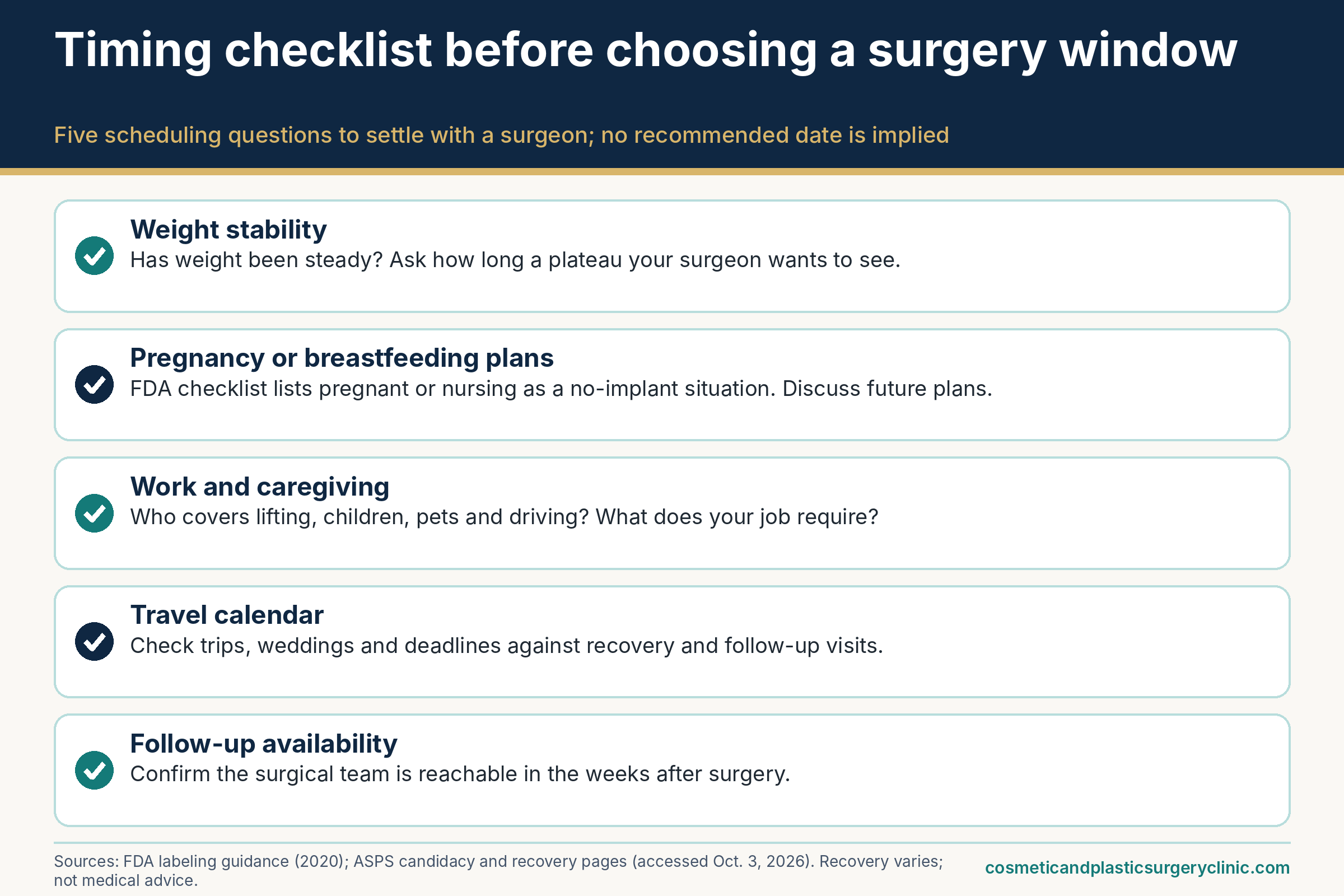
Weight stability and the rest of the calendar
Breast volume tends to track body weight, so a weight that is still changing is a moving target for sizing. A person who has lost a substantial amount of weight may find their breasts have lost volume and skin tone, and may need a different plan from someone whose weight has been steady for a long time. Someone who is actively dieting, using weight-loss medication, or recovering from bariatric surgery is often advised to let the weight settle first. Surgeons differ on how long a plateau they want to see, and the ASPS pages do not set a universal duration, so this is another number to ask about. Our articles on breast augmentation after weight loss and on staying weight-stable before plastic surgery go into the details.
Then there is the practical calendar. The ASPS recovery guidance describes wearing a support garment around the clock as instructed, taking it easy for several days after surgery because of the bleeding risk, and getting your surgeon’s approval before resuming exercise and normal activities; it describes soreness and swelling that can linger for weeks. The Mayo Clinic’s guide tells patients to arrange transportation and help at home. From these ingredients, you can build a realistic picture: someone needs to drive you, someone may need to help with lifting, children, and pets, and your job and workouts need a plan.
Consider two illustrative situations. A person with a desk job and flexible remote hours has an easier time absorbing the first days and may be able to adjust their schedule gradually, subject to the surgeon’s guidance. A person whose job involves lifting patients, stocking shelves, or caring for toddlers all day has more logistical work to do before a surgery date makes sense, and may need to talk about longer time away or modified duties. Athletes and gym regulars should ask when and how upper-body exercise resumes, because chest muscle activity may matter when an implant sits beneath the muscle. These scenarios are examples, not predictions; ask your surgeon about your own job, sport, and household. Our guides to breast augmentation recovery and returning to work after breast augmentation give the recovery side in more detail.
Finally, avoid scheduling collisions. A wedding, a vacation, a big work deadline, a move, or a planned pregnancy can each interfere with recovery or follow-up care. Many surgeons want to see you in the days and weeks after surgery, and some ask you to avoid long trips early in recovery. Check follow-up availability, because a surgeon who is unavailable during the key first weeks defeats the purpose of choosing carefully.
What the FDA says about breast implants, screening, and long-term safety
Candidacy for implants is not only about your body; it is also about the device. The FDA regulates breast implants, publishes patient-facing information, and has recommended specific labeling. This section reports what the agency’s pages say, with the date each page shows and the date this research accessed it, October 3, 2026. FDA pages are revised from time to time, so before you decide anything, open the current versions through the FDA breast implants overview and read them in full. Our article on breast implant FDA safety information follows the regulatory story in more depth.
The FDA’s labeling tools: boxed warning, decision checklist, and device card
In September 2020, the FDA issued final guidance titled “Breast Implants – Certain Labeling Recommendations to Improve Patient Communication.” The guidance recommends a set of labeling elements designed to make sure prospective patients see the key risks before surgery rather than after it.
The boxed warning and the patient decision checklist
As the guidance describes it, the boxed warning carries a short list of messages. Breast implants are not considered lifetime devices, and the longer someone has them, the greater the chance of complications, some of which require more surgery. Breast implant-associated anaplastic large cell lymphoma (BIA-ALCL), a cancer of the immune system, has been reported with breast implants, is more common with textured implants than with smooth ones, and has led to some deaths. Patients have reported a range of systemic symptoms, such as joint pain, muscle aches, confusion, and chronic fatigue, and the level of individual risk is not well defined. Some patients report that their symptoms resolved when the implants were removed without replacement.
The patient decision checklist is a longer document designed to be read, discussed, and signed. According to the FDA’s “Things to Consider Before Getting Breast Implants” page, last updated March 8, 2023, the provider is expected to review the checklist with the prospective patient, and both patient and provider sign it before surgery. Its sections cover who should not receive implants, which conditions raise risk, which have not been well studied, the surgical and long-term risks, BIA-ALCL, systemic symptoms, imaging recommendations, and questions about the surgeon’s training. We summarized its condition groups in Table 4 above.
The guidance also describes a device identification card that the patient should receive after surgery. It carries the device’s serial or lot number, style and size, and unique device identifier, plus a link to the current checklist and boxed warning. That card sounds like paperwork, but it becomes valuable years later, when a new surgeon, an imaging center, or an emergency room needs to know exactly what was implanted. Keep it with your medical records, and ask for it if you aren’t given one.
For candidacy, the practical point is timing: the checklist is something to read before the consultation ends and ideally well before a surgery date is fixed. If a practice offers it only at the last minute, together with a pile of consent forms, it is reasonable to ask to take it home. The FDA’s own wording invites you to discuss any questions with the surgeon before deciding.
Not lifetime devices, reoperation, and silicone screening
The FDA’s risk page, updated in December 2023, says breast implants are not considered lifetime devices, and that the longer people have them, the greater the chance they will develop complications. The “Types of Breast Implants” page makes the same point in terms of surgery: the longer a person has implants, the more likely they will need to have them removed or replaced. Neither page gives a specific replacement age, and we aren’t going to supply one either. What matters for planning is that choosing implants means accepting a possible lifetime of follow-up and a meaningful chance of further operations.
The risk page lists local complications, including asymmetry, breast pain, capsular contracture, changes in nipple and breast sensation, infection, hematoma, seroma, implant malposition, rupture, deflation, rippling, visibility, and unsatisfactory size or style. It also lists reoperation as a major complication category, with reasons that include implant removal or replacement, capsulectomy, scar revision, drainage of a hematoma, and repositioning. Capsular contracture is the tightening of scar tissue around an implant, graded in four stages, and the more severe grades may call for surgery. Our deeper article on breast augmentation risks and complications covers each of these in plain language.
For silicone gel-filled implants, rupture can be silent: unlike saline implants, which visibly deflate, a ruptured silicone implant may produce no symptoms. The FDA risk page states that magnetic resonance imaging (MRI) is the most effective way to detect silent rupture and that ultrasound is an acceptable alternative. In the 2020 guidance, the patient labeling tells people with silicone gel implants that, even without symptoms, they should have a first ultrasound or MRI five to six years after the initial surgery and then every two to three years. The ASPS safety page repeats this recommendation. Imaging is a recurring cost and a recurring appointment, and it belongs in a candidacy discussion for anyone considering silicone.
The FDA’s “Things to Consider” page also notes that the costs of removing or replacing implants may not be covered by insurance. We come back to that in the finance section.
Screening, cancer, and conditions that deserve a direct conversation
Some of the questions people hesitate to ask are the ones the FDA and cancer organizations answer most plainly.
Mammography, breast-cancer screening, and family history
The FDA checklist contains an explicit sentence on this point: all breast implants can interfere with mammography and breast exams, which could delay the diagnosis of breast cancer. The FDA risk page adds that calcifications around an implant can resemble cancer on a mammogram and may lead to unnecessary biopsies. The American Cancer Society (ACS) page on mammograms for people with implants, last revised July 23, 2026, says that people with implants who still have breast tissue should continue regular screening mammograms. It advises mentioning the implants when booking, so the facility can confirm it has experience, and telling the technologist before the exam. The standard four pictures are supplemented by four extra “implant displacement” views, which push the implant back and pull breast tissue forward. Implants of either type can block the view of tissue directly behind them, those extra views can be uncomfortable when scar tissue has formed, and the ACS notes that, very rarely, a mammogram can rupture an implant.
As for when screening starts, ACS guidance for people at average risk lets those aged 40 to 44 choose to begin yearly mammograms, recommends yearly mammograms from 45 to 54, and lets people 55 and older switch to every other year or continue yearly if they are in good health. The ACS describes higher-risk categories, including a lifetime risk of roughly 20 to 25 percent or more by family-history models, a known BRCA1 or BRCA2 mutation, chest radiation before age 30, and certain genetic syndromes, and recommends yearly MRI plus mammography for those groups, typically starting at age 30. We are summarizing a long guideline, so treat this as orientation rather than a screening plan.
How does this connect to candidacy? In three ways. First, a family history of breast cancer, a prior biopsy, a known genetic variant, or an unresolved breast symptom is something to disclose, because it may change what imaging or evaluation is done before surgery. The Mayo Clinic notes that a baseline mammogram may be needed before augmentation. Second, someone who is at high risk and may later need MRI-based screening should ask how implants fit into that plan. Third, any lump, discharge, skin change, or other new breast symptom should be evaluated first, not after surgery, because the FDA checklist names breast cancer or pre-cancer that hasn’t been adequately treated as a situation in which implants should not be used.
BIA-ALCL, systemic symptom reports, and autoimmune conditions
These are the topics where careful wording matters most, so we will stay close to what the FDA says. BIA-ALCL is a type of non-Hodgkin lymphoma, a cancer of the immune system; the FDA states that it is not breast cancer. The agency’s question-and-answer page, dated October 23, 2019, says the risk is higher with textured-surface implants than with smooth-surface ones. The main symptoms are persistent swelling, a mass, or pain near the implant, often years after surgery and after the incision has healed. Most cases are described as treated successfully with surgery to remove the implant and surrounding scar capsule, and some patients also receive chemotherapy and radiation therapy. The FDA’s overview page also links to a safety communication, issued in September 2022 and updated in March 2023, about squamous cell carcinoma in the scar tissue around implants; read the current text before relying on any summary.
Systemic symptoms are the other group of concerns. Some people with breast implants report symptoms such as fatigue, joint pain, and difficulty concentrating, and the term “breast implant illness” is common online. The FDA page on systemic symptoms, dated February 6, 2025, says the cause of these symptoms and the degree to which they may be related to the implants are unclear, and that breast implant illness is not recognized as a formal medical diagnosis, with no specific tests or recognized criteria. The agency notes that some patients report improvement after implants are removed, but says that does not establish a cause. The ASPS acknowledges that some patients attribute symptoms to implants and that causation remains disputed, and the Mayo Clinic describes research as not having established a definitive link.
That leaves autoimmune and connective tissue conditions. The FDA checklist lists autoimmune disease, with Hashimoto’s disease, lupus, and rheumatoid arthritis as examples, and a family history of autoimmune disease, in the group of conditions that have not been well studied. Being in that group is a statement about the amount of evidence, not a finding that implants cause these conditions or that a person with one cannot have implants. If you have an autoimmune or connective tissue condition, or a close relative does, a sensible approach is to bring it to the consultation, ask the surgeon what they know and don’t know, and, where it is relevant, ask the specialist who treats the condition to weigh in. The table below collects the FDA topics in this section with their page dates.
| Topic | What the FDA page says (paraphrased) | Date shown on page | Question to bring |
|---|---|---|---|
| Approved ages for augmentation | Saline-filled: age 18 or older. Silicone gel-filled: age 22 or older. Both approved for reconstruction at any age and also used in revision | Current as of Oct. 23, 2019; republished Jan. 30, 2025 | How does the labeled age limit apply to my situation? |
| Boxed warning and decision checklist | Not lifetime devices; BIA-ALCL; systemic symptoms reported; checklist reviewed with the patient and signed | 2020 guidance; Considerations page updated Mar. 8, 2023 | Can I take the checklist home before I decide? |
| Risks and complications | Local complications, reoperation, capsular contracture, rupture; longer time with implants raises complication chance | Updated Dec. 2023 | Which complications matter most for my anatomy and history? |
| Silicone rupture screening | First ultrasound or MRI at 5 to 6 years, then every 2 to 3 years, even without symptoms; MRI most effective, ultrasound acceptable | 2020 guidance; risk page Dec. 2023 | Who orders the imaging, and what does it cost over time? |
| BIA-ALCL | A lymphoma, not breast cancer; higher risk with textured implants; symptoms are persistent swelling, a mass, or pain, often years later | Oct. 23, 2019 | Which surface does the device I am considering have, and why? |
| Systemic symptoms (“breast implant illness”) | Cause and relationship to implants unclear; not a formal diagnosis; no specific test | Feb. 6, 2025 | How would you approach symptoms that appear after surgery? |
Readiness and red flags: mental health, money, and reasons to pause or reconsider
Some of the most important candidacy questions are neither anatomical nor medical. They concern how you feel about your body, how you will pay for the long haul, and whether the circumstances around surgery are in order. A pause in any of these areas is not a failure; it’s the type of information that tends to prevent regret.
Body image, mental health, and money
These two topics are grouped because both are easier to talk about before a surgery date exists than after one is on the calendar.
Body image, body dysmorphic disorder, and the screening conversation
Plastic surgeons commonly ask about mood, stress, and how you see your body. The questions are not meant as a judgment. They exist because the FDA’s patient decision checklist places a clinical diagnosis of depression or another mental health disorder, including body dysmorphic disorder or an eating disorder, in its “not well studied” group, and because satisfaction with a result depends on more than the technical outcome.
Body dysmorphic disorder (BDD) is a mental health condition in which a person becomes preoccupied with perceived flaws in appearance that are minor or not visible to others, to the point that it causes significant distress or interferes with daily functioning. The Mayo Clinic’s overview, dated December 2022, describes behaviors such as repeated mirror checking, grooming, or seeking reassurance, avoiding social situations, and comparing oneself with others. It adds that people with BDD often pursue cosmetic procedures hoping to fix the perceived flaw, and that the typical pattern is temporary satisfaction or reduced distress followed by a return of the anxiety. The same overview says BDD usually does not get better on its own, that treatment commonly involves cognitive behavioral therapy and medication, and that suicidal thoughts and behavior are common with the condition.
If any of this sounds familiar, the helpful step is a conversation with a mental health professional, not a decision to avoid or to pursue surgery. BDD is treatable, and treatment doesn’t forbid cosmetic procedures forever; it simply means the sequence matters, and that a surgeon and a mental health clinician may need to coordinate. If you are having thoughts of harming yourself, contact a crisis line right away; in the United States you can call, text, or chat with the 988 Suicide and Crisis Lifeline, which describes its service as free, confidential, and available around the clock.
Most people considering augmentation do not have BDD, and most surgeons are not trying to diagnose anyone in a consultation. They are listening for signals: a preoccupation that seems out of proportion to what’s visible, a pattern of dissatisfaction with multiple parts of the body, repeated requests for revisions to results that appear fine, or the hope that surgery will fix something it can’t, like a relationship or a sense of worth. You can run your own version of the screening. Ask yourself how much time you spend thinking about your breasts each day, whether the thoughts feel distressing or hard to control, whether you avoid things because of them, and whether you’ve felt this way for a long time or only recently after a particular event. Honest answers, shared with a clinician, make for better decisions. Everyone has days when they feel critical of their body; the concern is a persistent pattern that disrupts life.
Sometimes the gentlest thing a surgeon does is slow down a conversation. If you’re told to see a mental health professional first, or to wait while you work through a major life event such as grief, divorce, or a new diagnosis, that is usually about timing, not worth. Treat it as a reasonable answer to the question “is now the right moment?”
Lifetime costs: what to plan for beyond the surgical fee
Money belongs in a candidacy conversation because the up-front fee is only one part of the cost of having implants. We keep this discussion qualitative; for current price context, see our breast augmentation cost guide, which explains what drives quotes, and the ASPS cost page, which publishes average surgeon fees with an important caveat: its average covers only part of the total and does not include anesthesia, operating room facilities, or related expenses. The ASPS page does not state the year of its statistic in the text we reviewed, so we do not reproduce the dollar amounts here.
Several cost categories are easy to miss. There is the surgeon’s fee, the facility fee, and the anesthesia fee, which may be quoted separately. There is the implant itself, if it is billed separately. Then come the extras: preoperative testing, a baseline mammogram if requested, prescription medications, compression or support garments, and follow-up visits, which some practices include and others bill. There is lost income during recovery and the cost of help at home, whether that means childcare or a ride to appointments.
Then there is the long view. Because the FDA says implants are not lifetime devices, a realistic plan includes the possibility of future surgery to replace, remove, or revise them, and the FDA’s page on considerations warns that removal or replacement costs may not be covered by insurance. The ASPS cost page says most health insurance plans will not cover cosmetic breast augmentation, related complications, or additional surgery to revise appearance, and that some insurers exclude certain breast conditions in people who have implants. Silicone gel implants add a recurring imaging expense because of the screening schedule described above. None of these costs can be predicted for you, but all of them can be asked about.
Good questions include: what does the quoted fee include and exclude; what is the policy if I need a revision; what is the fee for a revision related to my original operation, and for one that isn’t; who pays for imaging; and what happens to the fee if I decide not to proceed? Ask for the answers in writing. If financing is part of the plan, our guide to plastic surgery financing explains how to compare loan and payment-plan terms before signing. If paying for surgery would strain your household in a way that leaves no margin for a complication or a revision, that’s itself a signal worth taking seriously.
Reasons to postpone or reconsider
Nearly every reason to pause falls into one of two groups: things that have a physical or medical dimension, and things that are about circumstances, expectations, or support.
Medical and timing reasons that often lead to a pause
Pregnancy and nursing top the list, because the FDA checklist treats them as situations in which implants should not be used and because the breasts are changing. An active infection anywhere in the body is on the same FDA list, and surgeons generally want an infection treated and resolved before an elective operation. An unresolved breast symptom, such as a new lump, bloody nipple discharge, a skin change, or a result on a recent screening exam that has not been followed up, also calls for evaluation first. Existing cancer or pre-cancer that hasn’t been adequately treated is another situation the FDA lists.
Unstable weight is a common timing reason. A person in the middle of significant weight loss or gain, or still adjusting to a weight-loss medication, may be asked to wait because the breasts will change as weight changes. Active nicotine use is a frequent reason for postponement, as described in the health section. A health condition that is not yet well controlled, such as uncontrolled blood pressure or diabetes, may be a reason to hold off while the condition is stabilized. And a recent change in medications that affect healing, bleeding, or the immune system can mean sequencing the care with the prescriber.
None of these is permanent for most people. A pause for pregnancy and breastfeeding may last a year or two or longer depending on your plans; a pause for nicotine may last weeks to months; a pause for weight stability depends on your trend. The consistent logic is that elective surgery can wait for a better moment, while a complication cannot be undone as easily.
Personal and practical reasons to reconsider
The second group is quieter but just as important. Unrealistic goals, such as wanting a result that anatomy won’t permit, or wanting surgery to change how others treat you, are a reason to slow down. Pressure from a partner, a friend, an employer, or an online community is another. The ASPS notes that satisfaction is high when patients want the procedure for themselves, which is the flip side of this concern.
Practical gaps count as well. If no one can drive you home, help you the first days, or cover childcare and household tasks, recovery can become harder than it needs to be. If your job offers no flexibility and you can’t realistically take the time the surgeon recommends, the pressure to return early can make healing more difficult. If you can’t commit to follow-up visits and long-term imaging, implants may not be the best match. And if you feel rushed by limited-time pricing, a social media countdown, or a coordinator who keeps reminding you of the calendar, that is a reason to step back; there is no medical urgency in elective augmentation, and honest practices do not manufacture one.
An illustrative scenario may help. Imagine a person in their early thirties who is six months postpartum, still breastfeeding, and eager to “get their body back.” They are asking a good question, and a careful surgeon will likely suggest waiting until breastfeeding has finished and the breasts have settled before measuring for anything. Now imagine a different person in their forties, weight stable for years, nonsmoking, no breast symptoms, with a clear goal and a plan for time off, who has simply never gotten around to a consultation. Their conversation may focus on implant choice and imaging rather than timing. These are made-up examples, not templates; the point is that the same procedure produces very different candidacy conversations depending on the circumstances.
| Situation | Type | Why it matters | What the next conversation often covers |
|---|---|---|---|
| Pregnant or nursing | Timing; named in FDA checklist | Breasts are changing; elective surgery and anesthesia are generally deferred | Waiting until nursing has ended and breasts have settled |
| Active infection | Medical; named in FDA checklist | Infection near or inside a surgical site raises concern for the implant | Treating the infection and confirming it has resolved |
| Unresolved breast symptom or abnormal screening result | Medical | The FDA lists untreated cancer or pre-cancer as a situation in which implants should not be used | Evaluation and follow-up before planning surgery |
| Weight still changing | Timing | Breast volume and shape follow weight | Letting weight settle; asking how long the surgeon wants stability |
| Current nicotine use | Medical; risk factor in FDA checklist | Nicotine reduces blood flow and can impair healing | Stopping nicotine for the period the surgeon requires; testing policies |
| Goals surgery cannot meet | Expectations | Disappointment is likely when the goal exceeds what anatomy or the procedure allows | Reframing the goal, exploring alternatives, or a second opinion |
| Pressure from others | Personal | Satisfaction is higher when the choice is the patient’s own | Taking time, discussing with a neutral person, deciding without a deadline |
| No recovery support or no schedule flexibility | Practical | Early recovery involves restrictions and help with daily tasks | Building a support plan or choosing a different window |
From candidacy to consultation: readiness, questions, surgeon selection, and alternatives
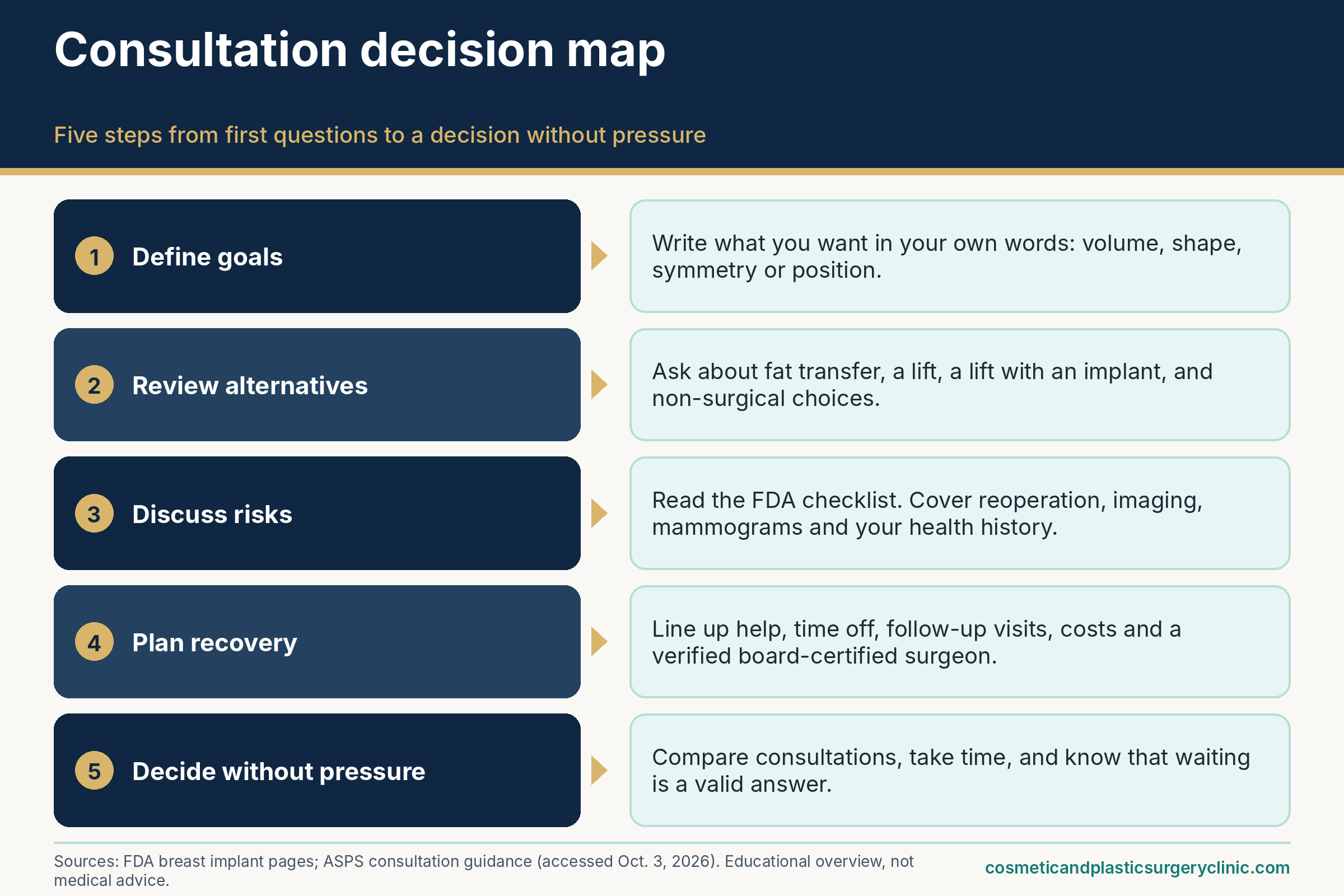
By this point you have a long list of factors. The last stage is converting that list into a calm, organized plan for the one conversation that can resolve it: an in-person consultation with a qualified plastic surgeon. Think of the consultation as a two-way interview, in which you are evaluating the surgeon as much as being evaluated.
Decision readiness and consultation preparation
Readiness is not a feeling of certainty. It’s a set of conditions that make a decision, in either direction, a well-informed one.
A decision-readiness checklist
Use the list below as a private self-check before booking a surgery date, not before booking a consultation. A consultation is a fact-finding step, and you can attend one with questions still unanswered. Surgery dates are different. If several of these statements don’t yet apply to you, that is useful information about what to work on first, and it doesn’t mean you should or shouldn’t proceed.
- I can describe in my own words what I want to change, and whether it is volume, shape, symmetry, position, or something else.
- I know which parts of my goal surgery may not be able to address, and I have asked the surgeon about them directly.
- I am making this decision for myself, and I would feel the same if no one else ever commented on the result.
- I have read the FDA’s current information and the manufacturer’s patient decision checklist for the device I am considering, and I understand that implants are not lifetime devices.
- I understand that further surgery, imaging, or removal may be part of my future, and I have a general sense of what that could cost.
- I have told the surgeon about every medication, supplement, nicotine product, and medical condition, including family history of breast cancer, bleeding disorders, and autoimmune disease.
- My weight has been steady for long enough that the surgeon is comfortable measuring, and I know my plans for pregnancy and breastfeeding.
- I have confirmed my surgeon’s board certification through an independent source and know where and with whom the surgery would take place.
- I have lined up transportation, help at home, time away from work, and follow-up appointments that fit my calendar.
- I do not feel rushed, and I am willing to take more time or get a second opinion.
Notice that the list contains no item about being “ready to look different.” Looking different follows from the operation. What you’re checking is whether the supporting conditions are in place.
Preparing for the consultation
A well-prepared patient gets a better consultation. Before the visit, write down your goals in a few sentences, and assemble a one-page medical summary: conditions, surgeries, allergies, medications with doses, supplements, nicotine use, pregnancy and breastfeeding history, and any breast biopsies, imaging, or family history of breast and ovarian cancer. If you’ve had a recent mammogram or breast ultrasound, bring the report, and ask the office how they want records sent. Gather photos that illustrate what you like and what you don’t. Wear or bring a fitted top, since many surgeons will want to see how clothes fit.
Bring a trusted person if you can, and ask permission to take notes or to record, since many people remember only part of a consultation. Ask the same set of questions at every consultation, so you can compare answers rather than impressions. The ASPS suggests, in a 2019 article by a plastic surgeon on breast augmentation consultations, five questions: whether the surgeon is board certified, where the operation will take place, what implant size will suit your body, what you can do to improve your outcome, and what the scars will look like. A 2017 ASPS article by another plastic surgeon on questions before any plastic surgery adds hospital privileges, experience with your specific procedure, before-and-after photos, risks and complications, the anesthesia provider, recovery timeline, a second opinion, and patient references. Our general plastic surgery consultation questions and the breast augmentation preparation guide expand on these. The table below arranges questions by candidacy topic.
| Topic | Questions to ask | What a useful answer includes |
|---|---|---|
| Goals and fit | Based on my measurements, what is realistic for volume and shape? What would you not recommend, and why? | Specifics tied to your anatomy, with trade-offs, and an acknowledgment of limits |
| Anatomy | Do I have sagging, asymmetry, or chest wall differences that affect the plan? Would a lift be part of this? | Pointing out your own findings, and explaining one-stage versus two-stage options |
| Health and medications | Do my conditions, medications, or supplements change the plan or timing? What testing do you require? | A clear list of what to stop, continue, or coordinate, and who to talk to |
| Device and long-term | Which implant and surface are you proposing and why? How do I get the device card and the decision checklist? What imaging and follow-up will I need? | Device details by name, FDA labeling discussed openly, and a follow-up plan |
| Pregnancy and breastfeeding | How might future pregnancy or breastfeeding affect results or options? Does incision choice matter? | Candid discussion of uncertainty and possible future revision |
| Safety setting | Where will surgery take place, who gives the anesthesia, and what is the plan if something goes wrong? | Named facility, accreditation status you can verify, and an anesthesia provider with defined credentials |
| Money and policies | What does the fee include? What is your policy if I need a revision? What would future imaging or removal cost? | A written estimate with inclusions and exclusions, and revision terms in writing |
Choosing a surgeon and comparing paths
The best candidacy review in the world is only as good as the clinician doing it. Choosing carefully is part of being a prepared candidate.
Verifying board certification and asking about experience
The American Board of Plastic Surgery (ABPS) maintains a public verification tool. The page, which we confirmed loads and which lets you search by name or by location, describes certification as a voluntary credential and says it indicates a surgeon has completed the appropriate training and passed written and oral examinations covering plastic surgery. You can verify a surgeon’s certification at the ABPS verification page. Do the check yourself, even if a practice’s website says “board certified,” because a credential should be confirmed at the source. It is also reasonable to confirm the surgeon’s state medical license through your state medical board.
Be precise about wording. Not every physician who performs cosmetic procedures holds the same certification, and titles such as “cosmetic surgeon” do not tell you which board, if any, issued a credential. Our articles on ABPS board-certified plastic surgeons and on how to choose a plastic surgeon explain how to compare credentials, facilities, and experience without leaning on marketing.
The FDA’s page on breast implant surgery suggests considering the surgeon’s experience, board certification, patient follow-up, and your comfort level, and asking about the surgeon’s complication and reoperation rates and specific experience. Treat any numbers you receive as that surgeon’s own reporting rather than an independent statistic, and ask how they’re measured and over what period. Ask also about before-and-after photos, with the understanding that galleries show selected results; look for patients with anatomy and goals comparable to yours, and ask how many cases like yours the surgeon performs.
Also ask about the facility and the anesthesia provider. The ASPS suggests operating in an accredited ambulatory surgery center, accredited surgical facility, or hospital, with anesthesia given by a physician anesthesiologist or a certified registered nurse anesthetist. A surgeon who welcomes these questions is a good sign; one who deflects them is another kind of information.
Alternatives to consider, and what to do next
Candidacy for one approach does not rule out others. Depending on your goals and anatomy, a surgeon may discuss fat transfer, a breast lift, a lift combined with an implant, or no surgery at all, including well-fitted bras and tailoring, which cost less and carry no surgical risk. Our guide to alternatives to breast augmentation compares them across goals, scars, downtime, and long-term maintenance, and it covers products marketed as nonsurgical enlargement. If sagging is the main concern, the breast lift article is the better starting point.
If the factors in this guide leave you leaning toward an evaluation, the sensible next steps are straightforward. Verify two or three board-certified plastic surgeons and book consultations, taking your written goals and medical summary. Read the FDA’s current breast implant pages and the manufacturer’s patient decision checklist for any device you are offered. Ask for a written estimate with inclusions and exclusions. Give yourself time between the consultation and the decision, since nothing about elective augmentation benefits from speed. If you decide the answer is “not now,” that is a complete and respectable outcome. And if you decide to go ahead, you will do so with the main questions already asked.
For the individual pieces, the consultation guide covers the visit itself, the cost guide covers pricing factors, and the risks and complications guide covers what can go wrong and what the warning signs are.
Questions people ask about breast augmentation candidacy
Can I get silicone implants if I’m 20?
The FDA lists silicone gel-filled implants as approved for cosmetic augmentation at age 22 and older, while saline-filled implants are approved from age 18. That means a 20-year-old asking about silicone for augmentation is outside the labeled age range, and a surgeon should explain how they handle that and what the alternatives are. Some young adults consider saline instead, which comes with its own trade-offs. Whatever you hear, ask the surgeon to tell you in plain words what the labeling says and why they are recommending a particular device, then compare their answer with the FDA’s current Types of Breast Implants page.
How do I know whether I need a breast lift instead of just implants?
You can’t determine that from home, and surgeons examine several things together: where the nipple sits compared with the fold under the breast, how much breast tissue hangs below that fold, and how loose the skin is. A common reference point is where the nipple sits relative to that fold, though the answer varies from person to person. Because implants add volume rather than lift, the ASPS says severely drooping breasts may need a lift, which can be done with augmentation or in a separate stage. Ask a surgeon to show you the measurements and explain why they recommend one path over the other.
Can I have breast augmentation if I vape or use nicotine gum?
Most surgeons will ask you to stop all nicotine for a period before and after surgery, not just cigarettes. An ASPS practice reference issued in 2024 treats vaping, patches, gum, and lozenges like smoking because nicotine itself narrows blood vessels. The length of the nicotine-free window varies between sources and surgeons, so ask for your surgeon’s exact instruction in writing, along with whether they test. If quitting is hard, your primary care clinician can talk through cessation support, and it is reasonable to postpone a surgery date rather than rush through the preparation.
Will I be able to breastfeed after breast implants?
Many people can, but the honest answer is that outcomes vary and nobody can promise one for you. The FDA says breastfeeding success after augmentation varies, and it reports finding no evidence of elevated silicone in breast milk. The Mayo Clinic says some people nurse without trouble and others do not. If you hope to breastfeed, raise it during the consultation and ask how the incision and implant placement the surgeon prefers might affect milk production, whether they have a different option, and how that choice changes other trade-offs.
How long after having a baby should I wait?
There is no single number that appears in the ASPS candidacy page or the FDA pages we reviewed. The FDA checklist excludes people who are pregnant or nursing, and the ASPS candidacy page describes good candidates as not pregnant or breastfeeding. Beyond that, surgeons often consider when breastfeeding has ended, how long breast size and shape have been stable, and whether you plan more children. Ask your surgeon what they want to see before measuring, and read our article on augmentation after pregnancy for the longer discussion.
Do breast implants make mammograms harder or unsafe?
Implants can make mammograms more complicated, but the American Cancer Society says people with implants who still have breast tissue should keep getting screened. Tell the scheduler and the technologist about your implants so the facility can plan extra views, which push the implant back and pull tissue forward. Implants of either type can hide tissue behind them, and the FDA checklist notes that implants can interfere with mammography and breast exams. Very rarely, a mammogram can rupture an implant, according to the ACS. Ask your surgeon and your screening provider how they coordinate care.
Will insurance pay if I think my breasts are too small?
According to the ASPS cost page, most health insurance plans do not cover cosmetic breast augmentation, complications arising from it, or additional surgery to revise appearance. The FDA also warns that removal or replacement costs may not be covered. Because coverage rules differ by plan and by the reason for surgery, the practical step is to ask your insurer how it treats augmentation, complications, and implant-related imaging, and to ask the practice for written estimates. Do not assume a quote covers anesthesia and facility fees without confirming what is included.
Can someone with lupus, rheumatoid arthritis, or another autoimmune condition get implants?
The FDA decision checklist lists autoimmune disease, and a family history of it, among the conditions that have not been well studied with breast implants. That wording describes how much evidence exists, and it does not forbid implants or claim that they cause autoimmune disease. A reasonable approach is to tell the surgeon about the diagnosis and medications, ask what they know about the evidence, and request that your treating specialist weigh in on timing and any medication changes. Some people decide to avoid implants in this situation, and others consider alternatives; the choice belongs to you and your clinicians.
My breasts are different sizes. Does that rule out augmentation?
No, asymmetry on its own is not generally treated as a reason to rule out augmentation, and published series of augmentation patients have found it to be common. What matters is how large the difference is, whether it comes from volume, nipple position, or the chest wall, and what you expect afterward. Surgeons may use different implant sizes or adjust technique, but some differences usually remain. Ask for your own asymmetries to be pointed out and documented, and ask which ones the surgeon expects to improve. If asymmetry is your main concern, look at surgery designed for it.
Is it worth getting a second consultation?
Many people find it helpful, and the ASPS lists seeking a second opinion among the things to consider before plastic surgery. Different surgeons may weigh the same factors differently, describe different sizes or techniques, and state different timing preferences. Compare the same questions across offices rather than the style of the pitch. If two board-certified surgeons give you very different advice, ask each one to explain the reasoning. A second visit also gives you time, and time is one of the best protections against a decision made under pressure.
Sources and further reading
- U.S. Food and Drug Administration — Breast Implants (overview; content current as of 12/15/2023; accessed 2026-10-03) — entry point to FDA breast implant pages, boxed warning and checklist references
- FDA — Types of Breast Implants (current as of 10/23/2019, republished 1/30/2025; accessed 2026-10-03) — age limits for saline-filled and silicone gel-filled implants; implants not lifetime devices
- FDA — Risks and Complications of Breast Implants (updated December 2023; accessed 2026-10-03) — local complications, reoperation, rupture, MRI or ultrasound for silent rupture, mammography, breastfeeding
- FDA — Things to Consider Before Getting Breast Implants (updated March 8, 2023; accessed 2026-10-03) — decision checklist review and signature, cost implications
- FDA — Breast Implants: Certain Labeling Recommendations to Improve Patient Communication (final guidance, September 2020; accessed 2026-10-03) — boxed warning elements, patient decision checklist conditions, device card, silicone imaging schedule
- FDA — Questions and Answers about BIA-ALCL (content dated October 23, 2019; accessed 2026-10-03) — what BIA-ALCL is, textured-implant association, symptoms, treatment
- FDA — Systemic Symptoms in Women with Breast Implants (page dated February 6, 2025; accessed 2026-10-03) — breast implant illness is not a formal diagnosis; cause unclear
- FDA — Breast Implant Surgery (March 8, 2023; accessed 2026-10-03) — anesthesia, operation length, choosing a surgeon, disclosing pregnancy status and history
- American Society of Plastic Surgeons — Breast Augmentation Candidates (accessed 2026-10-03) — candidate factors, motivation, preparation
- ASPS — Breast Augmentation Procedure (accessed 2026-10-03) — anesthesia, incision locations, implant placement
- ASPS — Breast Augmentation Safety (accessed 2026-10-03) — risk list, implants not guaranteed lifetime, FDA imaging recommendation
- ASPS — Breast Augmentation overview (accessed 2026-10-03) — what augmentation addresses; does not correct severe sagging
- ASPS — Breast Augmentation Cost (accessed 2026-10-03; year of statistic not stated) — fee scope and insurance statements
- ASPS — Breast Augmentation Recovery (accessed 2026-10-03) — support garment, early activity, soreness and swelling
- ASPS — 2025 Plastic Surgery Statistics Report (accessed 2026-10-03) — breast augmentation counts and age groups, United States, 2025
- ASPS — Breast Lift (candidate page; accessed 2026-10-03) — factors that change breast shape over time
- ASPS — Practice reference on managing the risks of smoking (issued October 9, 2024; accessed 2026-10-03) — nicotine products, cessation windows, complications
- ASPS blog — How nicotine sabotages plastic surgery (Furnas, December 12, 2016; accessed 2026-10-03) — nicotine and healing, all nicotine forms
- ASPS blog — Ten things to ask before having plastic surgery (Rohrich, August 15, 2017; accessed 2026-10-03) — surgeon and facility questions
- ASPS blog — Five questions to ask during your breast augmentation consultation (Somayazula, May 7, 2019; accessed 2026-10-03) — consultation questions
- American Board of Plastic Surgery — Verify Certification (accessed 2026-10-03) — public tool to verify a surgeon’s certification
- American Cancer Society — Mammograms for women with breast implants (last revised July 23, 2026; accessed 2026-10-03) — screening with implants, extra views
- American Cancer Society — Recommendations for the early detection of breast cancer (accessed 2026-10-03) — average-risk and higher-risk screening
- Mayo Clinic — Breast augmentation (updated September 10, 2024; accessed 2026-10-03) — preparation, medications, smoking, baseline mammogram, breastfeeding
- Mayo Clinic — Body dysmorphic disorder (December 13, 2022; accessed 2026-10-03) — symptoms, cosmetic procedures, treatment
- American Society of Anesthesiologists — Herbal and dietary supplements and anesthesia (patient brochure, 2015; accessed 2026-10-03) — telling the anesthesia team about supplements
- American Society of Anesthesiologists — Consensus-based guidance on preoperative management of GLP-1 receptor agonists (June 29, 2023; marked superseded; accessed 2026-10-03) — why anesthesia teams ask about these medications
- American Academy of Cosmetic Surgery — Breast anatomy, reduction and mastopexy (CME presentation, 2022; accessed 2026-10-03) — ptosis classification, implants do not lift
- Khan UD. Breast and chest asymmetries in patients requesting augmentation mammoplasty. European Journal of Plastic Surgery 2011;34(5) (abstract-level review; accessed 2026-10-03) — prevalence of asymmetry in one series of 312 patients
- Lund HG et al. Low risk of skin and nipple sensitivity and lactation issues after primary breast augmentation with form-stable silicone implants. Aesthetic Surgery Journal 2016 (accessed 2026-10-03) — lactation outcomes in a post-approval study; limitations
- National Center for Health Research — Breast surgery likely to cause breastfeeding problems (published 2010, modified 2020; accessed 2026-10-03) — older research on lactation after breast surgery
- 988 Suicide and Crisis Lifeline (accessed 2026-10-03) — crisis support in the United States