Ask three surgeons what a mommy makeover includes and you may hear three different lists. That is not a contradiction. The phrase names a planned combination of operations, and mommy makeover procedures are chosen one problem at a time: a stretched abdominal wall, skin that no longer recoils, breasts that lost volume or changed position, a pocket of fat that ignores diet and exercise.
This article reads the menu line by line. It explains what each component is meant to change, which pairings are commonly planned together, which ones need a longer conversation, and how the order and timing of operations are decided. The overall idea of a combined plan is covered in the mommy makeover overview; this page stays on mommy makeover procedures themselves and how they fit together.
Reading the menu: what mommy makeover procedures include
A menu is only useful if you know what each item does and what it leaves alone. The next two sections define the standard components of mommy makeover procedures and explain why the combined label says so little about safety or price.
The components, and what each is meant to change
The torso side: tummy tuck, muscle repair and liposuction
The American Society of Plastic Surgeons (ASPS) says a tummy tuck removes excess fat and skin and, in most cases, restores weakened or separated muscles. Mayo Clinic describes the same operation as tightening the abdominal fascia to narrow the waist, and notes that liposuction is often added to contour the area. Those are three separate jobs: skin and fat removal, muscle-layer repair, and fat reduction.
Liposuction earns its place only where skin can follow the new contour. ASPS states that it does not reshape loose or thin skin well and is not a treatment for obesity. Variants of the tuck itself, from a shorter lower-abdomen version to a full or extended one, are compared in the mini versus full tummy tuck article.
The breast side: lift, implants, reduction and their pairings
A 2024 ASPS article quotes a surgeon who calls the breast component and the torso component the two core pieces of a mommy makeover. The breast component can be augmentation, a lift, or both. A lift raises the breasts by removing excess skin and tightening tissue, but ASPS says it does not significantly change breast size or add upper fullness.
That is why ASPS suggests considering a lift with augmentation for people who want fuller breasts, and a lift with reduction for those who want smaller ones. An implant adds volume; a lift changes position; a reduction removes weight. Each answers a different question, and one cannot stand in for another. Which breast operation joins the plan also changes which other mommy makeover procedures sit beside it, because the incisions, anesthesia time and recovery add up.
Why “package” is a planning word, not a medical one
Every component is its own operation with its own risks
Combining operations does not merge them into one. ASPS lists risks for a tummy tuck that include bleeding, infection, poor wound healing, skin loss, fluid buildup (seroma), fat necrosis and unfavorable scarring. Its breast lift page lists hematoma, asymmetry, fluid accumulation, poor incision healing, changes in nipple sensation and, rarely, partial or total loss of the nipple and areola.
When both parts of mommy makeover procedures are done together, you carry both lists, plus the effects of a longer anesthetic. The risk side of that trade is the subject of the mommy makeover risks article; here the point is only that a bundle price is not a bundle of safety.
Terms that shift from practice to practice
There is no standard list. A 2018 ASPS blog post by a Houston surgeon says a mommy makeover “has no set components,” and a 2017 post by a Nashville surgeon adds labiaplasty, eyelid surgery and facial treatments to the possibilities. A 2026 ASPS article goes further and quotes a surgeon saying some makeovers involve no breast or body surgery at all.
So when a website says “mommy makeover includes X,” read it as one practice’s usual combination. Ask any office for an operation-by-operation list with each component named, because that list, not the label, is what your quote, consent form and recovery plan will be built on.

How pregnancy-related changes narrow the list
The reason certain mommy makeover procedures get paired is anatomical. Pregnancy and breastfeeding change several tissues at once, but they do not change them equally in every person, so the same menu produces different plans.
The abdomen: muscle, skin and fat are three separate questions
When the question is the muscle layer
Pregnancy can leave the two vertical abdominal muscles separated, a finding called diastasis recti. A tummy tuck can tighten that layer, but skin removal alone does not, and nonsurgical options are weighed separately. The diastasis recti article covers how separation is assessed and what repair can and cannot address.
For planning, the useful point is that a flat-looking but bulging abdomen and a loose-skinned one are different problems. A surgeon who examines you may find one, the other, or both, and the answer changes whether the plan needs a muscle repair at all. A hernia is a separate finding that the same exam can raise.
When the question is skin or a fat pocket
ASPS says liposuction results depend on skin quality: firm, elastic skin follows the new contour, while soft or thin skin from stretch marks, weight change or aging does not, and the extra skin may need excision. So a small fat pocket over elastic skin and a lax lower abdomen are not the same conversation, even if both people say “stubborn belly.”
This is also where the choice between a shorter and a longer tuck gets made. The tummy tuck techniques article explains how incisions and navel handling differ, and Mayo Clinic adds that past abdominal surgery can limit what a tuck achieves.
The breasts: volume, shape and position are not the same thing
Deflated, drooping, or both
An ASPS blog post notes that breasts can grow by a full cup size or more during pregnancy and breastfeeding, and that returning toward earlier size can bring volume loss and sagging. Volume loss and sagging are separate. A breast can be smaller but still sit high, or keep its volume but hang low on the chest.
Surgeons tend to sort the concern first: volume points toward implants, position toward a lift, excess weight toward reduction. A person with both complaints may be offered a lift with an implant. Candidacy for any of these is an in-person judgment, which the breast augmentation candidate pages on this site describes in general terms.
Breastfeeding history and timing
The 2024 ASPS article quotes one surgeon who prefers that breastfeeding be finished, with at least six weeks off and ideally three months, before breast surgery. Another surgeon in the same article calls one year after birth her own “sweet spot” but says there is no single right answer. Surgeons differ, and these are preferences, not rules.
Whether surgery will affect later nursing is a separate question. The FDA says that some women with breast augmentation can breastfeed and some cannot. If you may nurse another child, bring that up first. The timing article goes through the waiting-period logic in more detail.
Which pairings are commonly planned together, and which need more weight
Some mommy makeover procedures come up together so often that surgeons plan them as a matter of course. Others are legitimate but carry a longer list of things to settle first. The evidence for both is mostly surgeon-reported series, so treat the numbers below as illustrations of a pattern, not as odds for any one person.
Pairings that appear most often on mommy makeover procedures plans
A tummy tuck with a breast operation
The 2024 ASPS article describes tummy tuck and breast surgery as the most frequently paired components, with liposuction as an add-on. Frequency tells you what surgeons are asked to plan. It does not tell you that every pairing within mommy makeover procedures carries the same risk.
A 2024 single-center review in Aesthetic Plastic Surgery looked at 738 breast reduction patients in Nova Scotia, 44 of whom also had an abdominoplasty. The authors reported no significant increase in breast-related or total complications from adding the tuck. Total revisions, however, were significantly more likely (odds ratio 6.6, 95% confidence interval 2.7 to 16.1).
A 2025 retrospective comparison of 92 women found more complications in the group that had a combined mommy makeover than in the group that had a tuck alone. That record is a single-author, nonrandomized, single-center comparison with some reporting inconsistencies, and the groups had undergone different amounts of surgery. Read together, the two studies say that outcomes depend on what is combined and who is counted.
A tummy tuck with liposuction
An ASPS practice advisory, approved in 2003 and published in 2004, says limited volumes of liposuction are routinely and safely combined with other plastic surgery procedures in office settings. It also says that combining large-volume liposuction, defined as 5,000 cc or more of aspirate, with certain other operations has caused serious complications, and it names abdominoplasty as one example. The advisory notes that some states restrict combining procedures.
The advisory is old, but its logic still frames the question: how much fat is planned, from where, and in addition to what? The liposuction overview explains what the fat-removal side of a plan involves, and the liposuction versus tummy tuck comparison helps when you are unsure which tissue is the real problem.
Pairings that call for a longer planning conversation
A breast lift and implants in one operation
Lifting a breast and enlarging it together is two corrections at once, and the reported revision rates reflect that. In a 2013 Plastic and Reconstructive Surgery series described in an ASPS press release, reoperation for tissue-related problems after a combined lift and implant was about 13%, against about 10% for lifts alone. In a 2006 Aesthetic Surgery Journal series of 186 patients, 31 (16.7%) had some revision over an average of 42 months.
Both series come from surgeons reporting their own practices. The 2006 authors argue the revision rate is comparable to augmentation alone and well below that of a staged approach; the ASPS release notes that some have suggested the two should not be done at the same time. That is a live disagreement among surgeons, not a settled rule, and it is worth hearing how yours weighs it.
Implants add a list of their own. The FDA says local complications occurring in at least 1% of patients include asymmetry, breast pain, capsular contracture, deflation, infection, malposition, rupture and seroma, with complete rates in the labeling of each approved implant. That list belongs to the implant whether or not a lift happens the same day, so ask which items the surgeon considers most relevant to your plan.
Arm, thigh and lower body lift add-ons
ASPS lists thigh lift and arm lift among the optional extras that can be added to a mommy makeover. A body lift, according to ASPS, can include the abdomen extending around the sides into the lower back, the buttocks, and the thighs, and it is not meant mainly for fat removal. Those are large operations on their own, and adding them turns mommy makeover procedures into a much longer plan.
ASPS estimated 173,251 tummy tucks in the United States in 2025, against 26,088 arm lifts, 11,866 thigh lifts and 10,868 lower body lifts. National counts say nothing about mommy makeovers specifically, but they show these add-ons are far less common than the tuck, which fits how often surgeons treat them as separate planning problems and separate dates.
| Component | What is done | Intended advantage | Main limitation | Evidence note |
|---|---|---|---|---|
| Tummy tuck (mini, full, extended) | Excess skin and fat removed; muscle layer usually tightened | Smoother, firmer abdominal profile | Not weight loss; stretch marks outside the removed skin remain | Described by ASPS and Mayo Clinic; complication figures vary by series |
| Muscle repair | Separated muscles brought together during the tuck | Addresses separation that skin removal cannot | Extent depends on exam findings | A separate decision from skin removal |
| Liposuction | Fat suctioned from chosen areas | Reduces localized fat | Does not tighten loose skin | ASPS advisory: limited volumes combined routinely; large volume with a tuck avoided |
| Breast lift | Excess skin removed, tissue tightened, nipple repositioned | Raises breast position | Little change in size; scars; sensation changes possible | Risks listed by ASPS |
| Breast implants | Implant placed to add volume | Restores fullness | Not lifetime devices; replacement or removal may follow | FDA and ASPS safety pages |
| Lift plus implant, one operation | Both corrections in one session | Treats volume and position together | Two problems at once; revision is a recognized risk | Two surgeon series: about 13% tissue reoperation (2013); 16.7% any revision (2006) |
| Breast reduction | Breast tissue removed to reduce weight and size | Lighter, smaller breasts | Effects on sensation and later nursing are surgeon-specific questions | 2024 single-center series: adding a tuck raised revisions, not total complications |
| Arm, thigh or body lift | Skin removed from arms, thighs or around the torso | Reaches areas beyond abdomen and breasts | Larger operations; not mainly for fat removal | Far fewer procedures than tummy tucks in ASPS 2025 counts |
The order of operations and the decision to stage
Once the mommy makeover procedures are chosen, two questions remain: what happens in which order, and whether everything belongs in one session. Neither has a universal answer, but both have usable logic.
What gets settled before the first incision
Order inside a single session
The sources opened for this article do not describe a standard order for the abdomen and breasts, which suggests it is a surgeon preference tied to positioning, team and facility. That is itself useful information. Ask which part comes first, who performs each part if more than one surgeon is involved, and what the plan would be if time runs long.
For plans that include liposuction, the ASPS advisory adds that fluid management should be coordinated closely with the anesthesia provider, with fluid intake and output recorded. That is a reminder that combined plans involve the anesthesia team as much as the surgeon.
Operative time as a shared budget
Mayo Clinic says a tummy tuck alone often takes less than four hours. Every added component draws on the same anesthetic, so a combined plan of mommy makeover procedures spends from one budget. Longer, deeper anesthesia and reduced movement are the reasons clot risk is part of the sequencing conversation.
The 2024 ISAPS patient safety update says no validated clot-risk scale exists yet for aesthetic surgery and points to the Caprini score as the most widely used tool. A 2010 systematic review of 30 articles in Plastic and Reconstructive Surgery pooled clot rates of 0.35% for abdominoplasty alone and 0.79% when another plastic procedure was added, rising to 2.17% with an intra-abdominal operation and 3.40% for circumferential abdominoplasty. These are pooled historical figures across different eras and protocols, not a forecast.

Signals that point toward staging, and what staging costs
Clinical signals
An ASPS blog post says procedures can be done in one operation or across several sessions “for safety reasons,” depending on the surgeon and the plan. The liposuction advisory similarly allows large-volume cases to be split into serial procedures. Total time, a high clot-risk assessment, a large amount of fat removal, and medical conditions are the usual reasons for splitting mommy makeover procedures into stages.
Staging is not automatically safer, though. The 2006 augmentation-and-lift authors argue that a second operation brings its own revision rate and its own anesthetic. A surgeon should be able to explain, for your combination, what is being traded and why. The staged mommy makeover article sets out that trade in detail.
Practical signals
Staging mommy makeover procedures doubles several things: facility and anesthesia fees, recovery windows, time off, and childcare arrangements. It also leaves you living with an interim result. The ASPS release on the 2013 study notes that patients often prefer a single operation because it costs less, avoids two surgeries and avoids that in-between stage.
Those preferences are real but they do not settle the safety question. Weigh them with the clinical signals, and the mommy makeover cost article shows how a combined quote compares with two separate ones.
| Situation | Pairing under discussion | What the planning turns on | Question to ask |
|---|---|---|---|
| Loose lower-abdominal skin and some breast volume loss | Tuck with implants | Which goal matters more; total time | What if I do only one of these first? |
| Separated muscles, loose skin and drooping breasts | Full tuck with muscle repair plus lift | Combined wounds and time; clot assessment | What is the total time estimate, and how is clot risk scored? |
| Fat pockets plus loose skin | Tuck with liposuction | Fat volume; skin quality | How much liposuction is planned, and what is your volume limit? |
| Breast volume and position both changed | Lift with implants, one operation or two | Revision likelihood against a second anesthetic | What revision rate do you see for this combination, and what does revision cost me? |
| Another pregnancy is possible | Possibly none yet | ASPS advises postponing a tuck if more pregnancies are planned | What changes if I wait? |
| Limited help at home | Staged plan | Length of each recovery window | Which stage limits lifting and driving, and for how long? |
Claims about mommy makeover procedures, and what they leave unsaid
Marketing for mommy makeover procedures leans on a handful of phrases. Most are not false. They describe logistics or frequency and then let the reader assume safety or results. The table further down pairs each phrase with the question that exposes what it does not cover.
Phrases that describe packaging, not safety
“All in one day” and “one bundled price”
A single-day schedule describes the calendar. What matters medically is how many hours of anesthesia the whole plan needs, how many people are in the room, and what monitoring follows. A 2017 ASPS post by a Nashville surgeon says the surgeon helps determine the combination that balances safety with the patient’s goals; it does not say that more is better.
A bundled price can hide as much as it shows. Facility time, anesthesia, implants, garments and follow-up visits are all separate components elsewhere, so ask which are inside the number. The like-for-like comparison method is laid out in the cost article.
“Custom plan” and “routinely combined”
“Custom” can mean a plan built from your exam or a menu with boxes to tick. The way to tell with mommy makeover procedures is the reasoning: a surgeon who customized a plan can say which finding led to each component and what would be dropped if one of them did not apply.
“Routine” usually refers to how often a practice does something. The ASPS liposuction advisory shows why that is not enough: limited liposuction volumes are described as routinely and safely combined, while large volumes with some operations are not. Frequency of a combination and its suitability for your anatomy are different claims.
Facility, anesthesia and monitoring: what a price list leaves out
Accreditation and its limits
A 2016 ASPS blog post by a Houston surgeon names three accrediting bodies: The Joint Commission, the Accreditation Association for Ambulatory Health Care, and the American Association for Accreditation of Ambulatory Surgery Facilities. It also says ASPS members must operate in facilities that hold one of those accreditations, have Medicare certification or hold a state license. The post is a decade old and reflects its author’s views, so check current requirements directly.
Accreditation describes a facility’s systems, not any one surgeon’s results. It is still a sensible floor to ask about before comparing prices for mommy makeover procedures. The surgeon selection article walks through how to verify credentials and facility status.
The anesthesia provider and what happens overnight
The same 2016 post says anesthesia should be delivered by a licensed anesthesiologist. For plans with large-volume liposuction, the ASPS advisory recommends that vital signs and urinary output be monitored overnight in an appropriate facility by staff familiar with perioperative liposuction care.
You do not need to evaluate those standards yourself. You need to ask who will administer anesthesia, whether that person stays for the whole case, and what monitoring is planned for the first night. A clear, specific answer is a good sign; a vague one is worth noting.
| Phrase | What it may mean | What it does not prove | Question to ask |
|---|---|---|---|
| “Everything in one day” | One scheduled session | That the total anesthesia time suits you | How many hours of anesthesia are planned? |
| “One bundled price” | A packaged fee for several operations | That facility, anesthesia, implants and garments are inside it | Which line items are excluded? |
| “Routinely combined” | A pairing the practice often does | The same outcome for your anatomy | How often do you do this exact combination, and how many needed revision? |
| “Hidden scars” | Incisions placed in folds or under clothing | That scars will be short, faint or invisible | Where will each scar lie and how long will it be? |
| “Minimal downtime” | Early walking, shorter time away from work | A return to lifting a child or driving | When can I lift my toddler, and when can I drive? |
| “Board-certified” | Certified by some board | That it is plastic surgery or that the facility is accredited | Which board certified you, and where will surgery take place? |
From the menu to a consultation: questions that test the plan
The last step is turning all of this into specific questions about mommy makeover procedures. They work best when asked in the same order for every surgeon you see, so the answers can be compared. The general format of a first visit is described in the consultation questions article; the questions below are specific to combined plans.
Questions about the plan of mommy makeover procedures
Why these components, and why in this order?
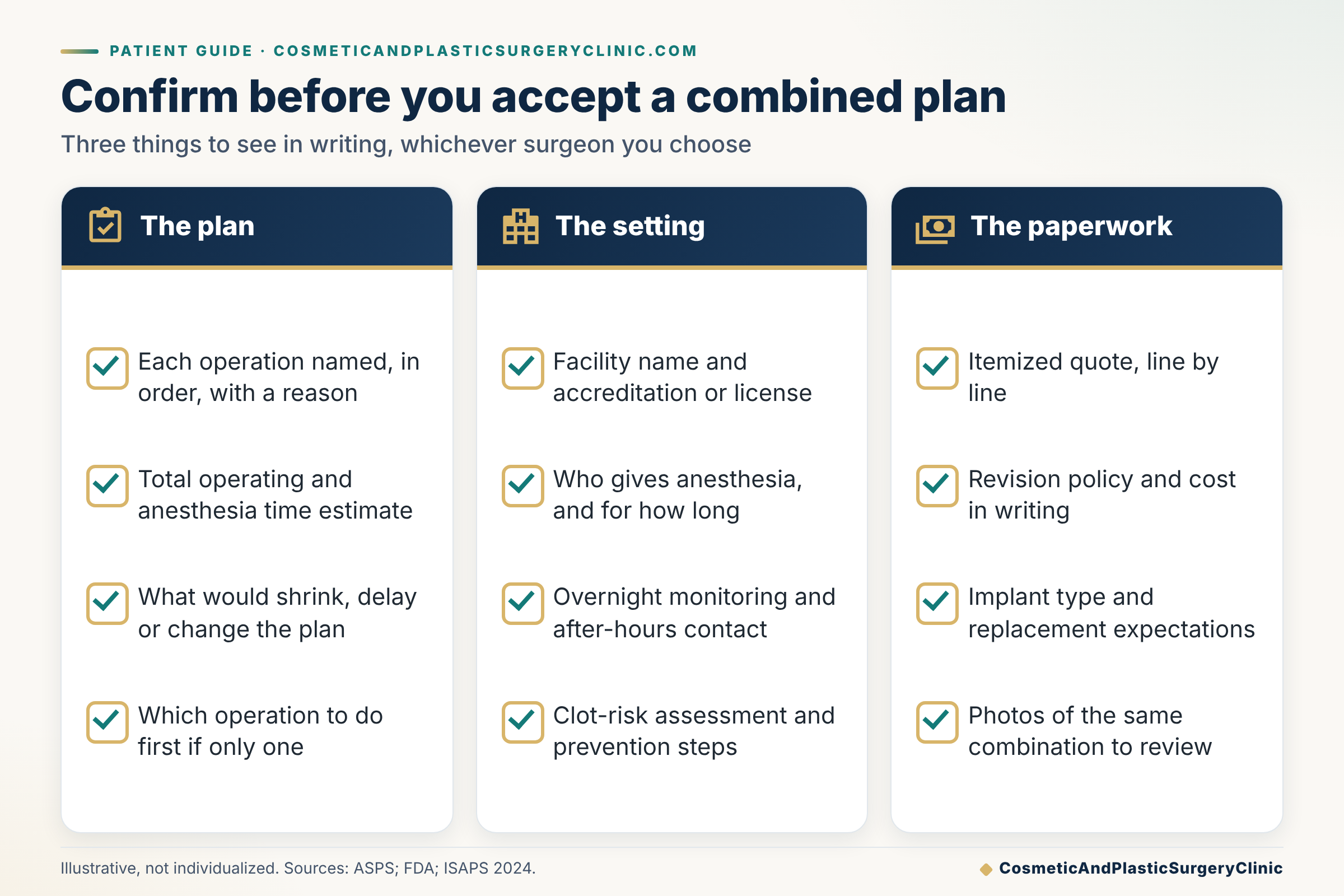
Ask which finding on your exam led to each item: muscle separation, loose skin, fat that does not respond to exercise, breast volume, or breast position. Then ask which single component the surgeon would do first if you could only have one, and why. A plan that can be ranked is usually a plan that was reasoned.
Ask also how the surgeon would sequence the work and who else will be operating. The answers should match what the written consent form says, not only what was said in the room.
What would change the plan?
Good plans for mommy makeover procedures have conditions. A new finding at the exam, a change in weight, another pregnancy, or a medical issue should each have a stated effect: smaller plan, delay, or staging. Mayo Clinic advises a stable weight for about six to twelve months before a tummy tuck, and ASPS advises postponing one if more pregnancies are planned.
An ASPS blog post also advises stopping smoking at least four weeks before and after surgery; ask what your surgeon requires for any form of nicotine. A plan that never changes no matter what the exam shows deserves a second look.
Questions about alternatives, risk and revision
Smaller plans, delay, or no surgery
ASPS says a tummy tuck is not a substitute for weight loss, and the 2026 ASPS article says some makeovers involve no breast or body surgery. The 2024 ASPS article notes that finishing childbearing first is not a hard rule, while ASPS advises postponing a tuck when more pregnancies are planned. All of that points the same way: mommy makeover procedures are a flexible menu, and “not yet” is a legitimate answer.
Consider a hypothetical reader whose main concern is a loose lower abdomen and whose youngest child is still nursing. A conversation about timing, a tuck-only first stage, or waiting until weaning would all be reasonable agenda items, and none of them requires committing to the full list on a menu.
A smaller first plan, a delay of months, or a second opinion costs little compared with an operation that did not fit. The candidacy article describes what surgeons weigh, without deciding anything for you.
A one-page worksheet to bring
Print or copy this list and fill it in for each consultation about mommy makeover procedures, so answers line up side by side.
- Each operation by name, in the order planned, with the reason for each.
- Estimated total operating and anesthesia time, and who gives anesthesia.
- Facility name, accreditation or license, and the overnight monitoring plan.
- How clot risk is assessed and what prevention steps are planned.
- If implants are planned: type, expected replacement and screening schedule.
- Itemized quote, revision policy and what a second operation would cost.
- Photos of the same combination in a similar pregnancy history, which the photo-reading article explains how to evaluate.
- Who to call, and how, if something feels wrong after hours.
Frequently asked questions
Can mommy makeover procedures include just one operation?
Yes. The 2024 ASPS article says a mommy makeover can be one procedure or a combination, and the 2026 ASPS article quotes a surgeon saying some makeovers involve no breast or body surgery. If the main concern is the abdomen, a tummy tuck alone is a legitimate plan. A single operation avoids combination-specific questions about time and sequencing, though it still carries its own risks and recovery.
Is there a standard order for mommy makeover procedures?
None of the sources reviewed here describes one for mommy makeover procedures. Sequence appears to be a surgeon preference shaped by positioning, team and facility. That makes it a question to ask, not an assumption to make. Ask which component is done first, why, whether more than one surgeon operates, and what the plan is if the case runs longer than estimated. The answers should be consistent with the written consent form.
How many mommy makeover procedures can be done in one session?
There is no fixed number of mommy makeover procedures per session. Mayo Clinic puts a tummy tuck alone at often less than four hours, and each added component adds time. The ASPS liposuction advisory says no scientific data identify a specific volume at which liposuction becomes unsafe, though risk rises with volume and the number of sites treated. Surgeons set their own limits, so ask for an hour estimate and the reasoning behind it.
Will implants placed during a mommy makeover need to be replaced?
Possibly. The FDA says breast implants are not lifetime devices and that complications become more likely the longer they remain, and ASPS says implants may need replacing in future surgery. For silicone implants, ASPS notes FDA-recommended MRI or ultrasound screening five to six years after placement and every two to three years after that. Ask what replacement or screening would involve and what it might cost.
Does the muscle repair in a tummy tuck also fix a hernia?
Not by definition. ASPS says a tummy tuck in most cases restores weakened or separated muscles, and that is a different finding from a hernia, which is a defect that needs its own evaluation by a surgeon. Whether a hernia is present is a question for an exam and, sometimes, imaging. If you have noticed a bulge, say so at the consultation so it can be assessed before a plan is built.
Can liposuction replace the tummy tuck in a mommy makeover plan?
Only when the problem is fat over skin that can follow a new contour. ASPS says liposuction does not reshape loose or thin skin well and that extra skin may need excision. It is also not a treatment for obesity. If your concern includes loose skin or separated muscles, liposuction alone addresses only part of it. A surgeon who examines you can say which tissue is driving the shape.
Do the figures in studies of combined surgery apply to my own risk?
Not directly. The studies cited here are single-center or single-surgeon series, pooled reviews from different eras, and a press-release summary, with differing definitions of a complication. ISAPS says no validated clot-risk scale exists for aesthetic surgery and points to the Caprini score as a common tool. Your own risk depends on your health, medicines, nicotine use and the plan, which only an examining surgeon can assess.
Sources and further reading
- American Society of Plastic Surgeons — What is included in a mommy makeover? (2018 blog; accessed 2026-11-12) — no set components; breast changes after pregnancy; one operation or several sessions; smoking guidance
- American Society of Plastic Surgeons — Mommy makeovers: what women should know about postpartum surgical procedures (2024; accessed 2026-11-12) — breast and torso components; timing quotes; most frequent pairings
- American Society of Plastic Surgeons — Mommy makeover: what it is and isn’t (2017 blog; accessed 2026-11-12) — component list; not a weight-loss operation
- American Society of Plastic Surgeons — Five mommy makeover myths (2026; accessed 2026-11-12) — makeovers are customized; some involve no breast or body surgery
- American Society of Plastic Surgeons — Tummy tuck (accessed 2026-11-12) — fat, skin and muscle repair; not a weight-loss substitute; pregnancy timing
- American Society of Plastic Surgeons — Tummy tuck safety (accessed 2026-11-12) — listed risks
- American Society of Plastic Surgeons — Breast lift (accessed 2026-11-12) — lift does not significantly change size; pairing with augmentation or reduction
- American Society of Plastic Surgeons — Breast lift safety (accessed 2026-11-12) — listed risks; implant in the same or a second operation
- American Society of Plastic Surgeons — Breast augmentation safety (accessed 2026-11-12) — implant lifespan; screening intervals; revision
- American Society of Plastic Surgeons — Liposuction (accessed 2026-11-12) — what liposuction does and does not do; skin quality
- American Society of Plastic Surgeons — Body lift (accessed 2026-11-12) — areas treated; not mainly for fat removal
- American Society of Plastic Surgeons — 2025 Plastic Surgery Statistics Report (accessed 2026-11-12) — national procedure counts, estimated and extrapolated
- American Society of Plastic Surgeons — Combined breast lift and augmentation press release on a 2013 Plastic and Reconstructive Surgery study (accessed 2026-11-12) — 430 lifts, 332 with implants; complication and reoperation rates (press-release level)
- American Society of Plastic Surgeons — Practice Advisory on Liposuction (Plast Reconstr Surg 2004; accessed 2026-11-12) — aspirate volumes; combining liposuction with other operations; overnight monitoring
- American Society of Plastic Surgeons — Why an accredited surgery center matters (2016 blog; accessed 2026-11-12) — accrediting bodies; ASPS facility requirements; anesthesia provider
- International Society of Aesthetic Plastic Surgery — Patient Safety Update on DVT and pulmonary embolism (December 2024; accessed 2026-11-12) — clot-risk stratification; Caprini score; no validated aesthetic scale
- Mayo Clinic — Tummy tuck (abdominoplasty) (accessed 2026-11-12) — operating time; weight stability; pairing with other procedures
- U.S. Food and Drug Administration — Risks and complications of breast implants (accessed 2026-11-12) — implants not lifetime devices; breastfeeding statement
- Hatef DA, Trussler AP, Kenkel JM — Procedural risk for venous thromboembolism in abdominal contouring surgery: a systematic review (Plast Reconstr Surg 2010; abstract record; accessed 2026-11-12) — pooled clot rates by combination
- Pouramin P, Dow T, Williams J — Breast reduction versus combined breast reduction with abdominoplasty (Aesthetic Plast Surg 2024; abstract record; accessed 2026-11-12) — complications and revisions in a Nova Scotia series
- Stevens WG et al. — Is one-stage breast augmentation with mastopexy safe and effective? (Aesthet Surg J 2006; abstract record; accessed 2026-11-12) — 186 cases; 16.7% revision at 42 months
- Meliešiūtė K — Comparative analysis of aesthetic and safety outcomes: abdominoplasty alone versus mommy makeover (2025; repository record; accessed 2026-11-12) — retrospective 92-patient comparison with noted limitations