Choosing between a mini vs full tummy tuck feels like choosing a size, as if one operation were a smaller copy of the other. In practice the two are separated by a landmark, not a scale: the navel. Tissue below it can be reached through a short, low incision. Tissue above it generally cannot, unless the surgeon works around the navel itself, and that single trade-off drives most of the differences in scars, muscle repair, recovery and cost.
This page explains how surgeons reason about the mini vs full tummy tuck boundary, where the published evidence is thin, and what to ask so the plan fits your tissue rather than a label. It cannot say which operation suits you; that takes an in-person exam. For the whole-operation overview, see the tummy tuck guide. The technique families that this page does not re-explain are covered in tummy tuck techniques explained.
Mini vs full tummy tuck starts with where the loose tissue sits
The navel is the working boundary between the two operations
Why tissue above the navel is out of reach for a short scar
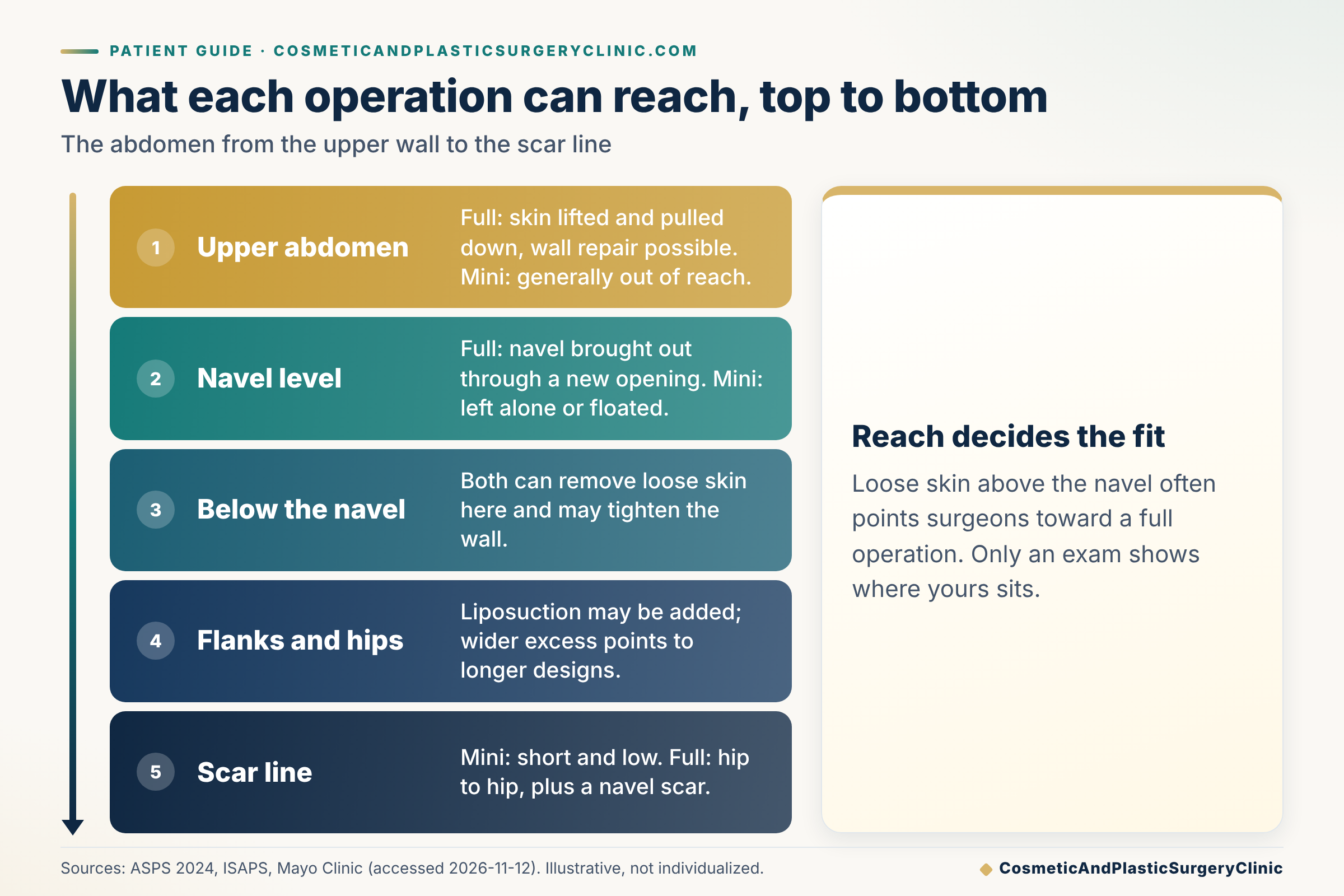
In a full tummy tuck, the surgeon makes a low incision from hip to hip and a second one around the navel, lifts the upper abdominal skin and fat to reach the muscle wall, repairs it if needed, then pulls the upper flap down and trims what overhangs (ASPS, 2024; Mayo Clinic, 2025). That downward pull is how skin above the navel ends up tightened.
A mini works through a shorter low incision and treats mainly the zone beneath the navel. The International Society of Aesthetic Plastic Surgery (ISAPS) describes it as suited to a small amount of excess skin and tissue confined below the belly button, with good skin quality above it.
In a mini vs full tummy tuck comparison, the practical consequence is easy to miss. A person with looseness above the navel can end up with a smaller change than expected from a mini. ISAPS says people with significant loose skin above the belly button, extensive rectus diastasis or more widespread laxity are generally better served by a full operation.
Why a low-lying navel pushes the plan toward a full operation
Surgeons who float the navel in a mini, releasing it from its base and reattaching it lower, watch its height closely because it can end up too low. In a 2019 case series in Plastic and Reconstructive Surgery, Wan, Hubbard and Byrd floated the navel 1 to 3.5 cm in 31 women and had 20 blinded evaluators rate the photographs. Five patients ended with a navel rated too low, all at the level of the front tip of the hip bone.
The authors advise starting with the navel at or above the top of the hip bone, keeping the final position above the front tip, and leaving at least 10 cm of hairless skin between the scar and the navel. A technique paper by Hoyos and Perez Pachon (Clinics in Plastic Surgery, 2020) likewise notes that a navel sitting in the lower third of the span between breastbone and pubic bone makes a full operation more likely.
“Mini” is a spectrum, not one standard operation
Four details that vary under the same name
Two quotes for a “mini” can describe quite different surgery. These are the details that most often differ:
- Muscle tightening. ISAPS says tightening of the abdominal fascia may be performed “in selected patients”; some minis include it and some do not.
- The navel. It may be left alone, or released and reattached when the surgeon needs to tighten muscle above it. A 2021 Italian protocol (Klinger and colleagues) detaches and repositions it in its original location when upper plication is needed.
- Liposuction. It is sometimes added to the lower abdomen, flanks or mons, which changes both the plan and the recovery.
- Scar length. One technique series describes a suprapubic incision of about 10 to 12 cm, while Cleveland Clinic gives 3 to 6 inches as a range.
A surgical atlas chapter on mini abdominoplasty, reproduced on Plastic Surgery Key, calls it “a spectrum of surgical procedures” and says the incision length is “somewhat variable.” That is why the first consultation question in a mini vs full tummy tuck discussion is not “can I have a mini” but “what exactly would be done to my navel, muscle and fat.”
How often surgeons choose a mini at all
Two single-practice series give a rough sense of how often a mini vs full tummy tuck plan ends with the smaller operation. In an 11-year review of 264 abdominoplasties by one US surgeon (Friedman and colleagues, ASPS meeting abstract, 2015), 63 patients, or 24 percent, had a mini; 27 of those were “extended” minis. In an Italian series of 582 consecutive women who had abdominal reshaping between 2008 and 2020 (Klinger and colleagues, 2021), 62, about 11 percent, had a mini.
These are individual teams with their own selection rules, not national figures. They do suggest that a mini is a minority choice: most patients in both series needed a larger operation or a different one, such as liposuction alone. The surgeons in the first series concluded that most patients remain candidates for a traditional abdominoplasty.
Muscle repair, navel handling and scar length, compared point by point
Table 1 lines up the typical mini vs full tummy tuck differences described by ASPS, ISAPS, Mayo Clinic and Cleveland Clinic. Surgeons vary in how they define and perform each operation, so treat the cells as starting points for questions, not as a specification.
| Feature | Mini | Full | Question to ask |
|---|---|---|---|
| Skin treated | Limited excess below the navel | Excess across the central abdomen, upper flap pulled down | Where exactly is my excess, standing? |
| Muscle repair | Optional; mainly below the navel unless the navel is released | Broader repair, up to the full length of the wall when needed | How far up would you tighten, and how? |
| Navel | Usually no incision; sometimes floated | Incision around it; brought out through a new opening | Will my navel move, and by how much? |
| Scar | Short and low; often compared to a C-section scar | Hip to hip, plus a scar around the navel | Where does the scar end, marked on me? |
| Liposuction | Sometimes added to the lower abdomen or flanks | Often added to the hips and flanks | Which areas, and does it change the risk? |
| Recovery | Usually described as shorter, but varies with add-ons | Typically weeks off work and about six weeks of lifting limits | Which parts of the plan drive my downtime? |
| Cost logic | Less operating time, but add-ons count | More surgeon, anesthesia and facility time | What changes the fee if the plan changes? |
Muscle repair and navel handling are linked decisions
How far up the wall a repair can go
Many people hear “mini” and assume the muscles are skipped. Not necessarily: ASPS says underlying muscles may be tightened in a mini, and ISAPS allows fascia tightening in selected patients. The limit is reach. ISAPS says a full operation allows broader correction of wall laxity or rectus diastasis, and the atlas chapter says plication runs from the lower tip of the breastbone to the pubic bone when laxity is significant.
Reaching above the navel through a short low scar needs either a navel incision or a released navel. In a mini vs full tummy tuck comparison, the muscle question and the navel question are really one decision. If a bulge bothers you more than loose skin, the wall may matter more than the skin; the diastasis page explains how surgeons assess it, and a hernia is a separate finding that can change the plan in either operation.
Three ways a navel can be handled
First, it can be left untouched. ASPS and ISAPS both say a mini usually involves no incision around the belly button and no repositioning, which also means no new navel scar. Second, it can be floated: released from its base, held while the lower skin is tightened, and sewn back to the muscle wall at a slightly different height. A Brazilian series of six women (Pignatti and colleagues, 2017) used this approach and reported umbilical scarring rather than an external scar.
Third, in a full tummy tuck the navel stays attached to its stalk and is brought out through a new opening cut in the lifted skin. Mayo Clinic describes it as repositioned through a small incision and stitched in place.
Scar length and position: what a short scar buys
Typical lengths and where the scars sit
Scar length is the most visible difference in a mini vs full tummy tuck, and published figures are loose. Cleveland Clinic gives 3 to 6 inches for a mini scar and describes the full version as running from one hip bone to the other, sometimes wrapping partly around the navel. An ASPS article by Katerina Gallus, MD (2020) says the mini scar is often the same length as, or a bit longer than, a typical C-section scar. In a full operation the navel adds its own small scar.
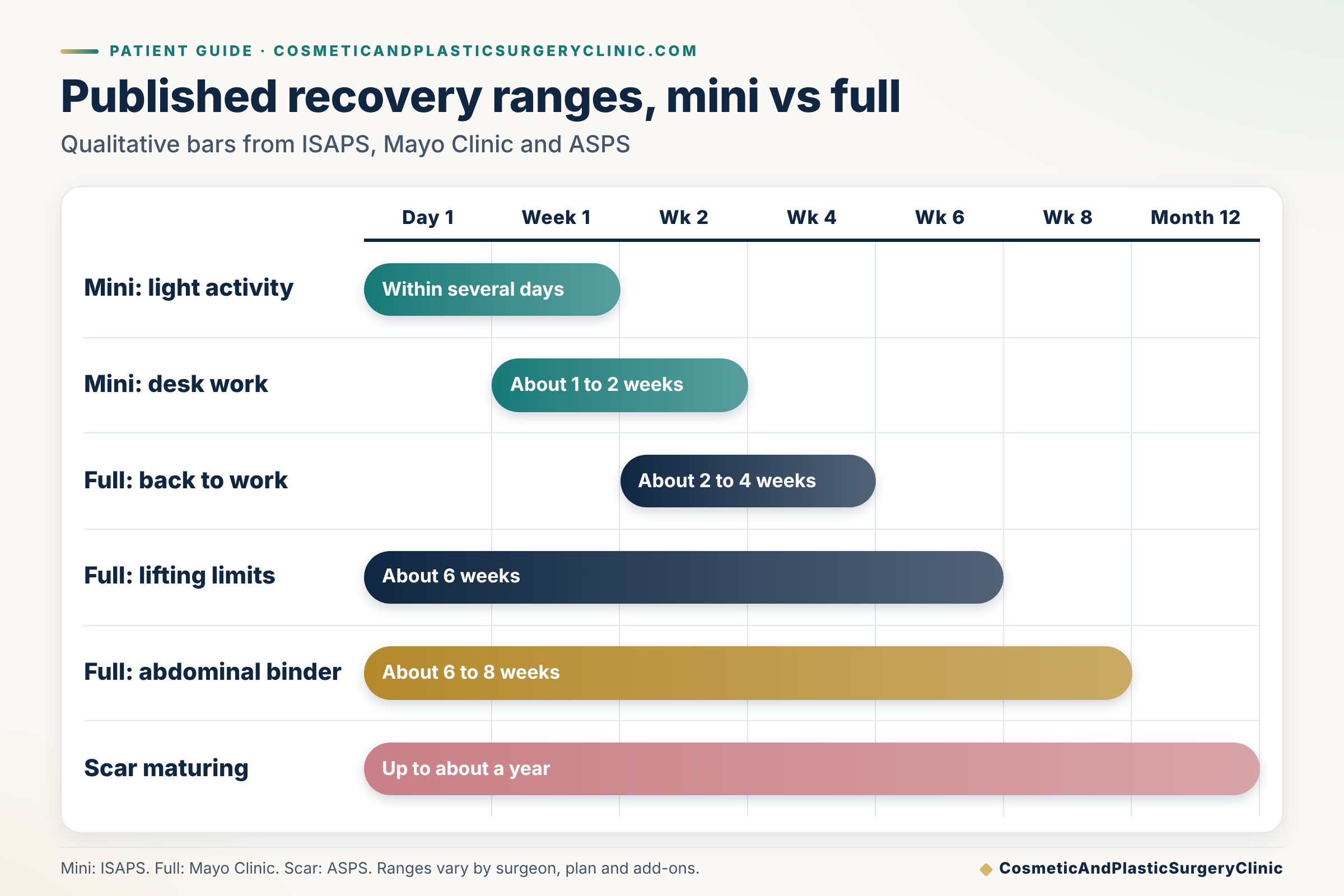
Scars from either operation are red or raised early and mature slowly. The same ASPS article says a scar takes a full year to completely fade; Cleveland Clinic says small or fine scars may fade completely after about a year but most people keep a visible scar, and that revision is usually delayed 12 to 18 months.
When a short scar becomes a trade-off
A short incision limits how much skin can be removed. The atlas chapter warns that pairing a short incision with a large excision can leave lateral dog-ears, the bulges of skin that pile up at the ends of the scar. Its pearls include placing the incision as low as possible, marking while the patient is standing and pulling up the lower abdominal tissue, and checking in the smallest underwear or swimsuit the patient wears that the scar will be hidden.
Longer designs exist, and the term “extended” is used loosely: the Friedman series labeled 27 of its 63 minis that way. The extended and fleur-de-lis page covers the longer horizontal and vertical patterns. A useful consultation request is to see the planned scar drawn on you while you stand.
Recovery, risk and cost: what “mini” changes and what it does not
Recovery after a mini vs full tummy tuck
Published ranges, and where they disagree
Recovery ranges for a mini vs full tummy tuck come from different organizations and do not line up exactly. For a mini, ISAPS says patients are encouraged to walk gently soon after surgery, many return to light daily activities within several days and to desk work in about one to two weeks, and a compression garment may be recommended for several weeks.
For a full operation, Mayo Clinic gives about two to four weeks before most people return to work, an abdominal binder for about six to eight weeks, no lifting or straining for about six weeks and no sports for at least eight weeks.
Cleveland Clinic is more compressed: on average at least one week off work, strenuous exercise postponed four to six weeks, and up to three months to see the final result. The atlas chapter on mini abdominoplasty warns that recovery “can often be very similar” to a full operation. Plan around the longer end of the range, and see the tummy tuck recovery page for the week-by-week arc.
What actually drives downtime: the add-ons, not the scar
ISAPS says recovery after a mini varies with liposuction or abdominal-wall tightening. The same logic applies upward: a review by Matarasso and colleagues notes that most postoperative discomfort after lipoabdominoplasty comes from plication rather than from drains. A short-scar operation with liposuction and a muscle repair can therefore feel closer to a full operation than the name implies.
Some effects do not scale with operation size at all. ASPS notes that swelling can take up to a year to resolve fully and that sensation over the abdomen can be lost where nerves are cut, with regrowth taking up to a year. In a mini vs full tummy tuck comparison, compare plans by what is added, not by what the operation is called.
Risk: what the numbers can and cannot tell you
Why no source gives a clean mini-versus-full risk gap
A smaller operation with less undermining plausibly carries less wound-healing risk, and several surgeon-authored papers say so. Plausible is not proven, and no source reviewed ranks a mini vs full tummy tuck by risk. Table 3 collects the figures that surface most often; read the last column first.
| Source | Population and design | Finding | Limit |
|---|---|---|---|
| Friedman et al., ASPS meeting abstract, 2015 | 264 abdominoplasties by one US surgeon over 11 years; 63 minis | No hematoma, skin loss or navel necrosis in the minis; one reoperation for recurrent seroma | One surgeon, retrospective, abstract only |
| Gado et al., Journal of Surgery, 2020 | 30 patients, one Egyptian center; 5 minis and 21 full | Complications in 1 of 5 minis and 8 of 21 full; difference not significant (p=0.691) | Five minis; not randomized; follow-up up to six months |
| Wan et al., Plastic and Reconstructive Surgery, 2019 | 31 women, umbilical-float minis, two surgeons, 2010 to 2017 | Navel floated 1 to 3.5 cm; five ended too low per 20 blinded raters | Selected patients; no comparison group |
| Klinger et al., PRS Global Open, 2021 | 582 women, one Italian center, 2008 to 2020; 62 minis | Mini was about 11 percent of cases; overall complications reported as similar to earlier literature | No mini-specific complication rate in the abstract |
| Winocour et al., 2015 (via ASPS release) | Nearly 25,000 abdominoplasties, CosmetAssure insurance data, 2008 to 2013 | Major complications 3.1% alone; up to 10.4% with body contouring plus liposuction | Major complications only; no mini and full split |
The only direct comparison in the ledger, Gado and colleagues, had five minis. One complication in five and eight in twenty-one cannot be read as a ranking, and the authors themselves found the difference not significant. Treat any claim that a mini is “safer” as a hypothesis the surgeon should explain in terms of your tissue, not a result.
What moves mini vs full tummy tuck risk more reliably than the name
The Winocour analysis, described in an ASPS release, found major complications in 3.1% of abdominoplasties done alone and up to 10.4% when combined with body contouring plus liposuction; after adjustment, combined procedures carried about 50% higher relative risk. Male sex, age 55 or older and obesity were also linked to more major complications. The database counted only serious events, mainly hematomas, infections, blood clots and lung problems.
So what you add, and who you are, can matter more than whether the incision is short. The atlas chapter advises deferring or limiting surgery for smokers who will not quit and omitting concurrent liposuction in that case, and recommends a clotting work-up when there is a personal or family history of DVT or pulmonary embolism. Read the tummy tuck risks page for complication definitions, and treat group figures as context, not a forecast.
Cost: how one word produces two different quotes
What moves the fee up or down
ASPS lists an average tummy tuck figure of $8,174 on its cost page, with no data year stated, and says the figure does not include anesthesia, operating-room facilities or other related expenses. It makes no split between mini and full. In practice the quote follows scope: operating and anesthesia time, whether muscle repair or liposuction is included, where the surgery takes place, garments and follow-up visits.
A shorter operation usually means less time, but the add-ons often decide the price. ASPS also says most health plans do not cover a tummy tuck or its complications. Cost mechanics are covered in the tummy tuck cost page, so this page keeps to what a mini vs full tummy tuck quote should spell out.
How to compare a mini vs full tummy tuck quote on equal terms
A quote for a mini and a quote for a full operation are only comparable once the scope lines are written out. Ask each office to itemize five things: whether the navel is untouched, floated or recreated; whether muscle tightening is included and how far up; whether liposuction is included and where; the facility and anesthesia fees separately; and what the fee does if the plan changes during surgery.
The last item matters because a plan can grow. The atlas chapter says patients should be told that conversion to a full operation is possible if the result is unsatisfactory, with added cost, recovery and risk. An itemized quote that already says what happens in that case prevents an unpleasant surprise.
Five selection mismatches to avoid when matching the operation to your tissue
These mismatches in a mini vs full tummy tuck choice appear whenever a label, rather than anatomy, drives the choice. Each is a decision rule with a question to carry into the appointment.
Mismatches about anatomy
Mismatch 1: shopping by scar length instead of by tissue
Scar length follows from how much skin has to go; it is not a setting to select. When the excess is larger than a short incision can address, the possible outcomes include dog-ears, a result that falls short of what was hoped, or an incision lengthened on the day. A short scar is a reasonable outcome of a small problem, and an unreasonable demand on a large one. Ask: “Show me where my excess is while I stand, and where each version of the scar would end.”
Mismatch 2: overlooking looseness above the navel
A mini vs full tummy tuck conversation that only discusses the pouch below the navel is incomplete. The atlas chapter describes the usual mini candidate as having good skin at and above the navel, free of stretch marks. ASPS says a tummy tuck can improve stretch marks only on skin that is removed, so marks above the navel generally remain after a mini. Ask: “Which findings above my navel would change your recommendation?”
Mismatch 3: treating “mini” as one standard operation
Do not accept the word as the plan. Ask each office to write a one-line scope covering navel, muscle, fat and scar length, then compare it with a second surgeon’s. Two offices that both say “mini” may be quoting different operations, so a price gap can reflect scope, not skill or margin. The same applies to “full,” which describes scope rather than a fixed recipe.
Mismatches about sequence and timing
Mismatch 4: treating a mini as a trial run for a full operation
A larger operation after a mini is possible, but it is not free. The atlas chapter tells surgeons to disclose that conversion to a full operation may be needed, with added cost, recovery and risk. Matarasso and colleagues note that secondary abdominoplasty is increasingly needed for recurrence after mini or short-scar procedures. An ASPS article by Tarick Smaili, MD adds that liposuction can leave scar tissue that may complicate a later tummy tuck. Choose the operation for the tissue you have, and ask how an earlier mini would change a later one.
Mismatch 5: choosing before weight and family plans are settled
Shrinking the operation does not shrink the timing problem. Mayo Clinic lists planned significant weight loss and a future pregnancy among the reasons a surgeon may advise against a tummy tuck. An ASPS interview with Orlando Llorente, MD says candidates should ideally be finished with pregnancies because a later one could stretch out the muscle repair. When plans are open, waiting is a legitimate plan, and the candidate page lists what surgeons evaluate.
Mini vs full tummy tuck scenarios: choosing by anatomy instead of declaring a winner
Table 2 shows hypothetical profiles and the finding that could reverse each starting hypothesis. They illustrate reasoning; they do not predict what an examination would find in anyone.
| Hypothetical anatomy and goal | Option often favored | Reason | What could reverse it |
|---|---|---|---|
| Low pouch after two births; firm skin and a flat wall above the navel | Mini, possibly with liposuction | Every finding sits in the zone a short scar reaches | Looseness or a bulge above the navel found on exam |
| Same pouch, plus an upper bulge when the abdomen relaxes | Full, or a navel-float mini in selected anatomy | Upper wall repair needs access through or around the navel | A hernia, or fat rather than muscle separation, as the cause |
| Loose skin above and below the navel and at the flanks | Full, sometimes extended | More skin must be trimmed than a short scar allows | Planned weight change that calls for staging or waiting |
| Mostly firm fat, taut skin, no wall separation | Liposuction alone | There is no skin to remove, so a scar adds burden without need | Skin that does not retract well after healing |
| Navel sits low; small excess below it | Full, or a plan that protects navel height | A float can leave the navel too low | Measured navel height leaving room for a small float |
| Another pregnancy or large weight change expected | Wait, whichever size is considered | Pregnancy or large weight change can undo either result, per ASPS and Mayo Clinic | A settled family plan and a stable weight |
Scenario one: a low pouch with firm skin above the navel
Why a mini is the usual starting hypothesis
Consider a hypothetical person with a small pouch of loose skin and some fat below the navel after two pregnancies, a flat upper abdomen, firm skin above the navel, steady weight and no plan for more children. This is close to the profile that ISAPS and ASPS describe for a mini, and the atlas chapter calls the ideal candidate someone with isolated soft-tissue laxity of the lower abdomen. Because every finding sits below the navel, a short low scar can reach all of it, and liposuction may be added for the surrounding fat.
The findings that would reverse it
Several things could flip the plan without being visible in a photograph: looseness above the navel, a navel that already sits low, a hernia, a weight that has not settled, or nicotine use that raises wound-healing concerns. Each is a reason a surgeon might move toward a full operation, a staged plan or a wait. A good consultation names which of these were checked, rather than moving straight from “pouch” to “mini.”
Scenario two: the same pouch, with a bulge above the navel
Changing one variable changes the plan
Add one finding to the first scenario: the upper abdomen bulges forward when relaxed because the wall above the navel has separated. The question shifts from skin to muscle. A short low scar cannot reach that repair without either a navel incision or a navel float, and the authors of the float series limit the technique to patients with minimal to mild skin excess above the navel. This is the scenario in which a mini vs full tummy tuck recommendation depends most on the surgeon’s technique and judgment.
Questions that only a qualified surgeon can answer
An article cannot answer these, but they are worth bringing:
- Is the bulge muscle separation, a hernia or fat, and how was that determined?
- How would you reach the wall above the navel, and what would that do to my navel’s height?
- What would make you change the plan during surgery, and how would that be priced?
- Where is the surgery performed, and who provides the anesthesia?
Taking a mini vs full tummy tuck decision into the consultation room
Preparing for the appointment
Questions that expose the actual plan
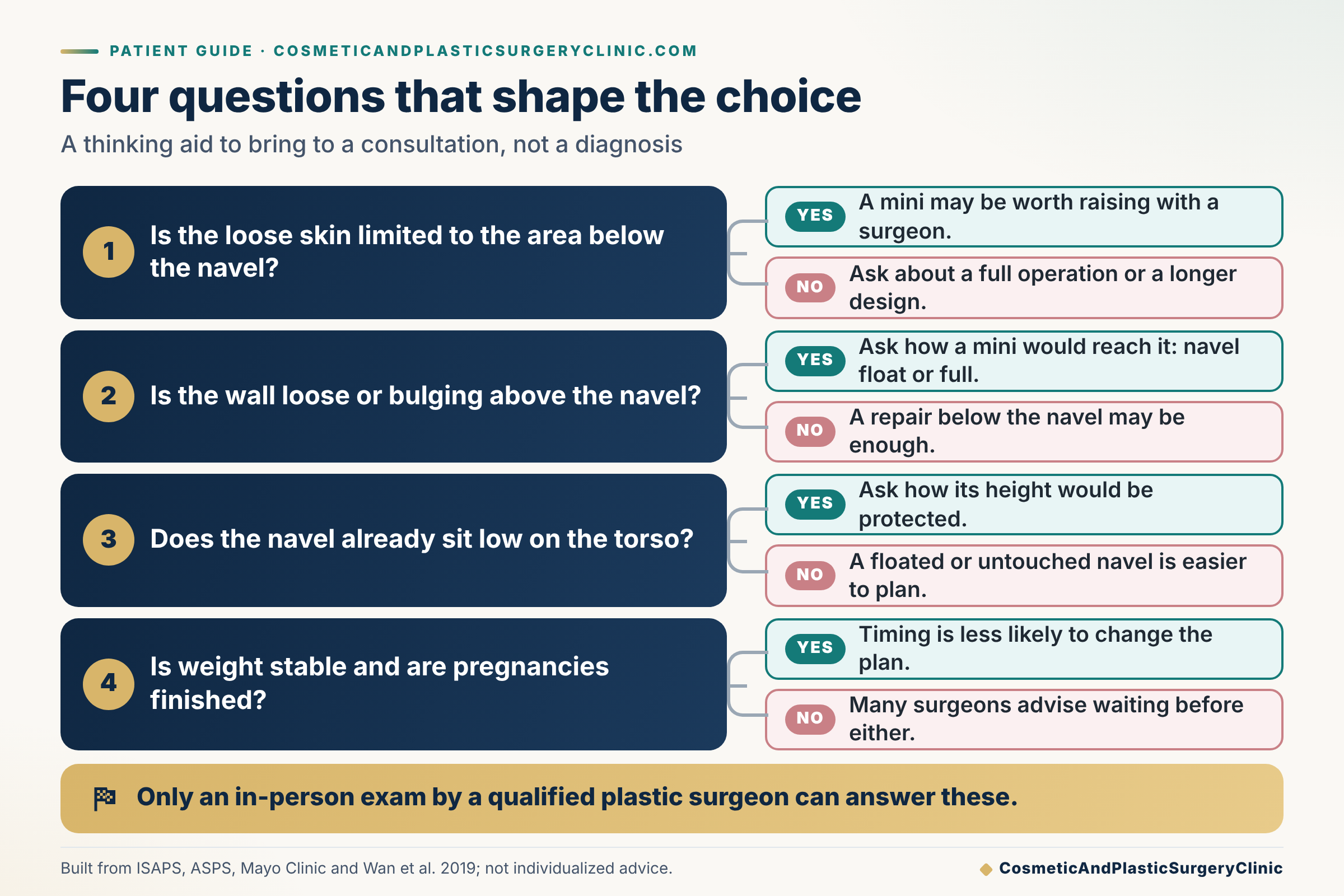
Beyond the scenario questions above, five more settle most mini vs full tummy tuck confusion. Ask which of your tissues, specifically, the operation treats. Ask what will happen to the navel and where it will end up. Ask how far up the muscle would be tightened. Ask to see the scar marked while you stand. Ask what share of the surgeon’s abdominal cases are each version, and what patients with your anatomy usually need.
For the history, medication and informed-consent side of the visit, the consultation guide covers what to bring and how to judge answers.
Reading photos from a mini vs full tummy tuck practice
Photos help only when the anatomy matches yours. Ask for standing photos from the front, side and angled view, taken at the same distance, of patients whose skin above the navel, pregnancy history and weight resembled yours. Ask whether a photo labeled “mini” also involved liposuction or muscle repair, and how many months after surgery it was taken. Ask for several angles of the navel, since a single front view can hide its height and shape. The tummy tuck photo page goes further.
Alternatives, second opinions and the option of waiting
Liposuction alone, staging and waiting
ASPS notes that patients with little or no skin laxity may suit liposuction alone, which leaves several tiny incisions rather than one long one. Some patients have liposuction first and wait about three to four months to judge their satisfaction before deciding on a tummy tuck, according to an ASPS article by Tarick Smaili, MD (2016). How well skin retracts shows only after healing, which is the reason for the wait. The liposuction comparison page works through that choice, and waiting is itself a reasonable decision.
If you are also weighing breast or other procedures after children, the mommy makeover page explains how an abdominal operation fits into a combined plan.
A second opinion when surgeons disagree
Two qualified surgeons can disagree on mini vs full tummy tuck for the same body, usually because they weigh the upper abdomen, the navel or scar length differently. Treat the disagreement as information: ask each one to mark the plan and explain what finding would change it. Compare scope lines, not labels. Verification steps for credentials and facilities are on the surgeon-selection page, and no appointment slot or promotional deadline should hurry an elective decision.
Frequently asked questions
Does a mini vs full tummy tuck choice change the type of anesthesia?
Usually not by itself. ISAPS says a mini is commonly performed under general anesthesia, though the approach varies with the extent of surgery, and Mayo Clinic says patients typically receive general anesthesia for a tummy tuck. Either can be outpatient in suitable patients. The anesthesia plan depends on your health, the planned scope and the facility, so ask who provides it, what their credentials are and where they work.
Will a mini tummy tuck remove a C-section scar?
Sometimes, depending on where the old scar sits. The atlas chapter advises placing the incision as low as possible and ideally below existing scars so they are removed with the skin. An ASPS article notes that removing a cesarean scar during a tummy tuck can leave a single, better-looking scar. Ask the surgeon to mark the planned line against your existing scar while you stand.
Does a mini tummy tuck leave a scar around the belly button?
Usually no. ASPS and ISAPS both say the navel is typically not repositioned in a mini and needs no incision around it. If the surgeon floats the navel to reach muscle above it, the navel is released from its base inside, and a Brazilian case series described umbilical scarring rather than an external scar. A full operation does leave a scar around the navel. Ask which version is planned.
Does a mini vs full tummy tuck improve stretch marks?
Only on skin that is removed. ASPS says a tummy tuck can remove or somewhat improve stretch marks located on the excess skin that is excised, and cannot correct stretch marks outside that area. A mini removes skin only below the navel, so marks above it remain. A full operation removes more skin, but marks outside the removed area, such as on the hips or flanks, remain.
How long should weight be stable before a mini vs full tummy tuck?
Mayo Clinic says that, ideally, weight should be stable for at least 6 to 12 months before a tummy tuck. ASPS adds that significant weight fluctuations can greatly diminish results, and advises people planning substantial weight loss or pregnancies to postpone. Your surgeon sets the actual criterion for you, and it can be stricter or looser depending on your history and the plan.
Can liposuction be added to a mini vs full tummy tuck on the same day?
Often it can, but not always. An ASPS article by Dr. Smaili says some patients can have both at once, while surgeons generally stage the procedures when large fat volumes must be removed, to limit surgical trauma and bleeding. Combined procedures also carried higher major-complication risk in the Winocour data. Ask what volume is planned and why combining or staging suits your case.
When can the result of a mini vs full tummy tuck be judged?
Later than most people expect. Cleveland Clinic says it can take up to three months to see the final result, ASPS notes that swelling can take up to a year to resolve fully, and scars continue to mature for about a year. Judging early photographs or your own mirror at a few weeks therefore says little. Ask your surgeon when they themselves evaluate results in follow-up.
Sources and further reading
- American Society of Plastic Surgeons — There’s more than one type of tummy tuck (Brumby, 2024) (accessed 2026-11-12) — mini vs full tummy tuck scope (plus fleur-de-lis), navel, scars, swelling
- American Society of Plastic Surgeons — What kind of scar can you expect after a tummy tuck? (Gallus, 2020) (accessed 2026-11-12) — mini vs full tummy tuck scar length comparisons, scar maturation
- American Society of Plastic Surgeons — Tummy tuck or liposuction? (Smaili, 2016) (accessed 2026-11-12) — liposuction alone, staging, same-day combination
- American Society of Plastic Surgeons — How can a tummy tuck help with separated abdominal muscles? (Brumby, 2024) (accessed 2026-11-12) — muscle repair, C-section scar, limits of exercise for skin
- American Society of Plastic Surgeons — Abdominoplasty or panniculectomy (Frankeny, 2025) (accessed 2026-11-12) — pregnancy timing, weight and health before surgery
- American Society of Plastic Surgeons — Tummy tuck procedure page (accessed 2026-11-12) — stretch marks, weight fluctuation, limits of the operation
- American Society of Plastic Surgeons — Tummy tuck cost (accessed 2026-11-12) — average figure without a data year, exclusions, insurance statement
- American Society of Plastic Surgeons — Tummy tuck complications: study looks at rates and risk factors (2015 release on Winocour et al.) (accessed 2026-11-12) — 3.1% alone, up to 10.4% combined, risk factors
- International Society of Aesthetic Plastic Surgery — Mini abdominoplasty (accessed 2026-11-12) — mini vs full tummy tuck candidates, navel, fascia, anesthesia, recovery, risks
- Mayo Clinic — Tummy tuck (published 2025-01-17, accessed 2026-11-12) — recovery ranges, weight stability, reasons to advise against, navel
- Cleveland Clinic — Tummy tuck (abdominoplasty) (accessed 2026-11-12) — mini vs full tummy tuck types, duration, recovery ranges, final result timing
- Cleveland Clinic — Tummy tuck scar: healing, treatment and revision (accessed 2026-11-12) — mini scar length, revision timing
- Plastic Surgery Key — Mini abdominoplasty (short scar abdominoplasty), chapter of an atlas of abdominoplasty (accessed 2026-11-12; partial text, authors not named) — mini vs full tummy tuck indications, pearls, pitfalls, conversion disclosure
- Friedman, Gordon, Kaufman and Menn — Expanded role and usefulness of the mini-abdominoplasty (ASPS annual meeting abstract, 2015) (accessed 2026-11-12) — 264 abdominoplasties, 63 minis
- Wan, Hubbard and Byrd — Achieving aesthetic results in the umbilical float mini-abdominoplasty, Plastic and Reconstructive Surgery 2019 (abstract record, accessed 2026-11-12) — navel float, patient selection
- Pignatti et al. — Minilipoabdominoplasty with umbilicus detachment, Revista Brasileira de Cirurgia Plástica 2017 (abstract, accessed 2026-11-12) — six-patient series, umbilical scarring
- Klinger et al. — Aesthetic and functional abdominoplasty: anatomical and clinical classification, PRS Global Open 2021 (abstract, accessed 2026-11-12) — 582 patients, 62 minis
- Klinger et al. — Aesthetic and functional abdominoplasty, full-text repository copy (accessed 2026-11-12) — mini indication, navel handling in the protocol
- Matarasso, Suri and Stein — Lipoabdominoplasty technique, Plastic and Aesthetic Research 2021 (accessed 2026-11-12) — type II mini, secondary abdominoplasty, navel landmark
- Hoyos Ariza and Perez Pachon — High-definition excisional body contouring, Clinics in Plastic Surgery 2020 (proof copy, accessed 2026-11-12) — mini incision length, navel position
- Gado et al. — Clinical outcome of abdominoplasty techniques for abdominal wall deformities, Journal of Surgery 2020 (accessed 2026-11-12) — 30-patient comparison, five minis