
Arm thigh lift risks share a root cause: both operations trade skin for a long incision, and that incision sits where the body moves and swells. Upper-arm and inner-thigh wounds are pulled on by every reach, step and seated hour, so separated wound edges, fluid pockets and widened scars are the problems surgeons discuss most. Rarer events, including nerve injury, lymphatic swelling and blood clots, matter more per case. This page sorts arm thigh lift risks into expected effects, complications and emergencies, and it gives every number with its source, year and population.
An arm lift (brachioplasty) removes loose upper-arm skin and some fat; a thigh lift (thighplasty) does the same for the inner, outer or whole thigh. For what each operation treats, read the arm lift and thigh lift overviews first. For how to read any risk figure, see plastic surgery risks. Nothing here diagnoses a symptom, judges whether you are a candidate, or recommends surgery.
Arm thigh lift risks in three tiers: expected effects, complications and emergencies
The word “risk” covers very different things. Swelling along an incision and a clot in the lung both appear on a consent form, yet they call for opposite responses. Sorting arm thigh lift risks into three tiers is the quickest way to know whether a symptom means follow the aftercare sheet, call the surgeon today, or go to an emergency department now.
Expected effects that are not complications
Swelling, tightness, bruising and drains
The American Society of Plastic Surgeons (ASPS) recovery pages for both operations say a small, thin tube may be placed temporarily under the skin to drain excess fluid or blood, and that dressings may cover the incisions. For arms, the ASPS page adds that the arms may be wrapped in an elastic bandage or compression garment to limit swelling. None of these pages gives a timeline, so drain use, garment wear and activity limits are your surgeon’s to set. This is ordinary healing; the arm thigh lift risks that follow are the ones that depart from the plan.
What turns an expected effect into a complication is direction and size: swelling that is easing versus a firm area that keeps growing, soreness that is improving versus pain that is spreading. The arm lift recovery and thigh lift recovery articles cover the week-by-week arc.
A long scar is the intended trade, not a surprise
Both operations relocate the scar to a less exposed line instead of removing it, and the line is long. Its position depends on the technique: studies cited below describe medial versus more posterior incisions on the arm, and horizontal, short-scar or full-length vertical designs on the thigh. The ASPS lists “unsightly scarring” for arms and “unfavorable scarring” for thighs among the risks, which is the society’s way of saying that scar quality is not fully controllable.
That is why a scar that looks red, thick or wide in the first months is not automatically a complication. A scar that keeps widening, lifts into a ridge or migrates is a different matter, and later sections give the published rates for this part of arm thigh lift risks.
Complications that need a call to the surgical team
Fluid, wound edges and redness
Cleveland Clinic’s seroma page (updated February 2026) describes a seroma as a pocket of fluid, usually clear and pale yellow, that builds up under the skin after surgery, with symptoms typically appearing seven to 10 days afterward. Small ones that do not hurt are often watched; larger ones may be drained with a needle, sometimes repeatedly because “some refill,” and a temporary drain is another option. It advises contacting a provider if the seroma is uncomfortable, growing, showing signs of infection or not improving after several weeks.
UMass Memorial Health’s patient page on wound dehiscence, meaning an incision that opens, lists worsening pain, redness, swelling or bleeding, smelly drainage, fever of 100.4°F (38°C) or higher, or stitches pulling apart as reasons to call. It names smoking, diabetes and poor nutrition as risk factors, and it says stitches give way when stress or tension overcomes their strength, as with coughing, lifting or strenuous exercise.
Numbness, lumps and sutures that surface
The ASPS safety pages list numbness or other changes in skin sensation, fat necrosis (fatty tissue under the skin that dies and may form a firm lump), pain that may persist, and sutures that work their way to the surface and cause irritation, drainage and redness. None is usually urgent alone. All deserve a mention at follow-up, and a lump that grows, reddens or hurts deserves a call before the next scheduled visit.
Emergencies among arm thigh lift risks: signs that mean emergency care now
Chest, lungs and legs
MedlinePlus (reviewed October 2025) lists sudden shortness of breath, chest pain that often worsens with deep breathing, fainting, a fast heart rate and leg pain, redness or swelling as symptoms of a pulmonary embolus, and says to go to the emergency room or call 911. The CDC (reviewed March 2025) adds that about half of people with a deep vein clot have no symptoms at all, which is one reason prevention and early walking are planned in advance.
The hand, the wound and the skin
Not every emergency is a clot. UMass Memorial Health tells patients to call a provider for numbness, coldness, tingling or skin color change around an incision, and for wounds that open or stitches that pull apart. That is why hand changes after an arm lift are on the emergency list, and why a groin or thigh wound that opens with tissue showing is too. If you cannot reach the surgeon within minutes, go to an emergency department and bring the operative report.
Before surgery, ask how early follow-up is scheduled, which number is answered at night, and which hospital the surgeon uses if something goes wrong. Those three answers are part of the arm thigh lift risks, not paperwork.

Table 1 lays the tiers side by side. It is a reading aid for the sorting above and a prompt for questions at the pre-operative visit, not a tool for diagnosing yourself.
| What is noticed | Category | General response | Basis |
|---|---|---|---|
| Swelling, bruising and tightness near the incision, easing over time | Expected effect | Follow the written aftercare; mention changes at follow-up | ASPS recovery pages, 2026 |
| Soft fluid-filled bump near the incision, often in the second week | Complication | Call the surgical team; watching or drainage may follow | Cleveland Clinic, Feb 2026 |
| Wound edge pulling apart, spreading redness, smelly or pus-like drainage | Complication | Call the same day; it may be urgent | UMass Memorial Health |
| Numb patches, firm lumps, stitches surfacing, a widening scar | Complication, often minor | Raise at the next visit; call sooner if a lump grows or hurts | ASPS safety pages, 2026 |
| Chest pain, breathlessness, fainting, racing heartbeat, painful swollen calf | Emergency | Call emergency services; say you recently had surgery | MedlinePlus, Oct 2025; CDC, Mar 2025 |
| Cold, pale or numb hand after arm surgery; skin turning dusky or black; fever with foul drainage | Emergency | Call the surgeon at once; go to an emergency department if unreachable | UMass Memorial Health warning list |
What published studies report about arm thigh lift risks on the arm side
The question is practical for a lot of people: ASPS statistics counted 26,088 arm lifts and 11,866 thigh lifts in the United States in 2025, up 21% and 20% from 2024, using member surgeons, a partner insurance program and a claims dataset.
Almost every number on arm thigh lift risks comes from retrospective chart reviews, often written by the surgeons who did the operations. That does not make the numbers useless, but it shapes how to read them: complication definitions differ, follow-up is uneven, nobody is randomized, and authors sometimes promote their own technique. The arm lift evidence below was read at abstract level or better, and each figure carries its year and population.
Pooled and large arm lift data
The 2022 meta-analysis: 29 studies and 1,578 patients
Aljerian and colleagues (Plastic and Reconstructive Surgery, January 2022) pooled 29 observational studies covering 1,578 brachioplasty patients. The pooled arm thigh lift risks on the arm side were aberrant scarring 9.9%, ptosis or recurrence of looseness 7.79%, wound dehiscence 6.81%, seroma 5.91%, infection 3.64%, nerve-related complications 2.47%, lymphedema or lymphocele 2.46%, skin necrosis or delayed healing 2.27% and hematoma 2.06%. Each came with a wide confidence interval; scarring, for example, ran from 6.1% to 15.6%.
The same review put operative reintervention at 7.46% when done for aesthetic reasons and 1.62% for non-aesthetic reasons. It found that medial incision placement was associated with more complications, and that adjunctive liposuction was associated with a lower incidence of certain complications. The authors write that, without large clinical trials, the pooled figures serve as a reference for informed consent.
Older series and a large insurance database
Knoetgen and Moran (Plastic and Reconstructive Surgery, 2006) followed 40 bilateral arm lifts, all in women, for a mean of 50 months and reported a 25% overall complication rate and a 12.5% revision rate. A 2013 review of 96 patients at a multipractice center, also in Plastic and Reconstructive Surgery, reported major complications in 17.7% and minor in 44.8%, hypertrophic scarring in 24.0%, infection in 14.6% and revision in 22.9%.
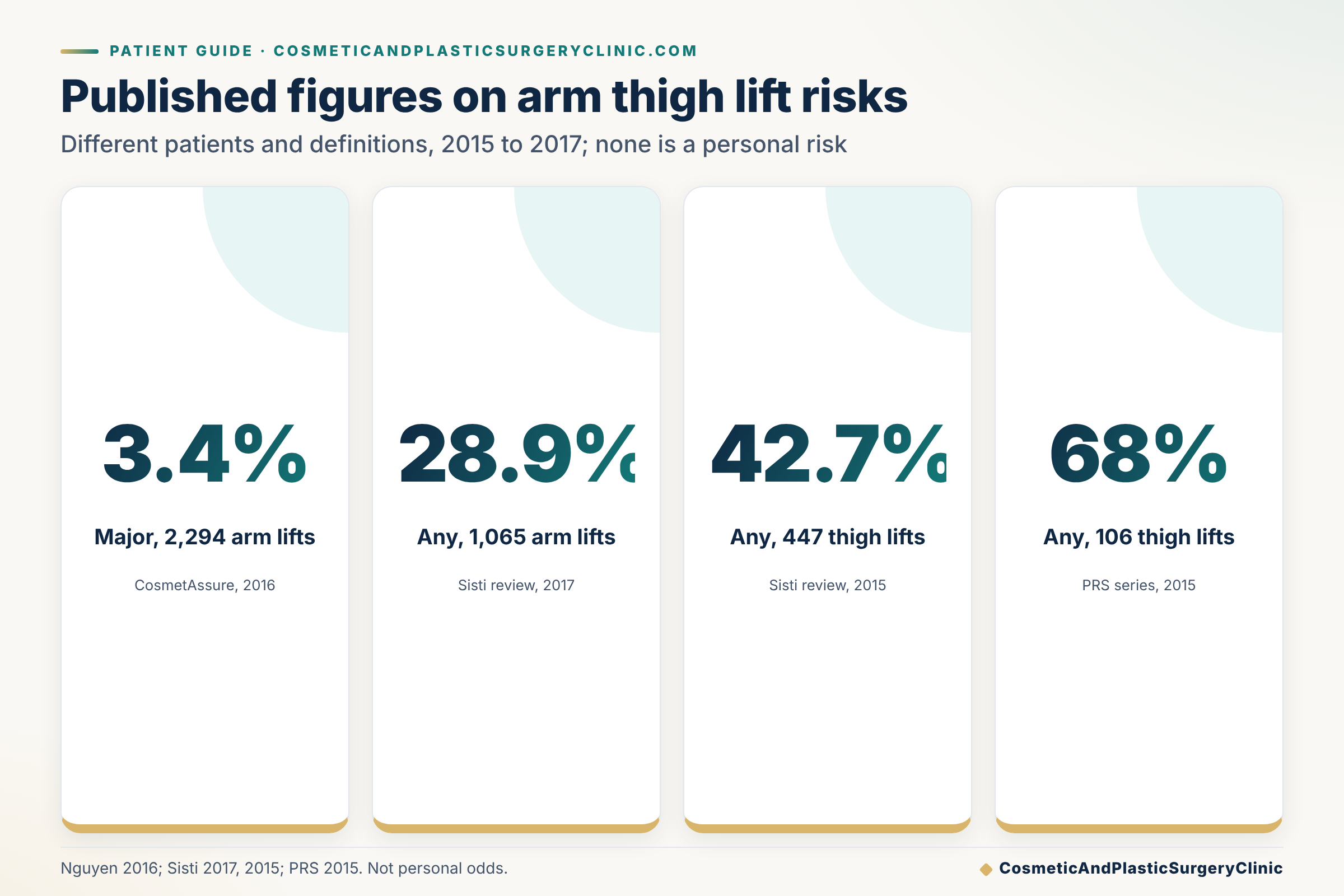
The largest source is a prospective insurance database. Nguyen and colleagues (Aesthetic Surgery Journal, 2016) analyzed 2,294 brachioplasty patients enrolled in the CosmetAssure program from 2008 to 2013, defining a major complication as an emergency room visit, hospital admission or reoperation within 30 days. The rate was 3.4%, with infection 1.7% and hematoma 1.1%. The authors called this much lower than previously reported.
| Source and year | Patients and design | Figures reported | Main limit |
|---|---|---|---|
| Knoetgen and Moran, Plastic and Reconstructive Surgery, 2006 | 40 bilateral arm lifts in women, mean follow-up 50 months | 25% any; 12.5% revision; two patients (5%) with a major nerve injury | Small; one surgeon’s practice |
| Multipractice review, Plastic and Reconstructive Surgery, 2013 | 96 patients, record review | 17.7% major, 44.8% minor; hypertrophic scar 24.0%; revision 22.9% | Minor events counted; retrospective |
| Nguyen et al., Aesthetic Surgery Journal, 2016 | 2,294 patients in an insured, prospective database, 2008 to 2013 | 3.4% major within 30 days; infection 1.7%; hematoma 1.1% | Counts only major events in 30 days |
| Sisti et al., Acta Biomedica, 2017 | 27 studies, 1,065 patients, literature review | 28.9% any; hypertrophic scar 10.79%; seroma or lymphedema 6.94%; nerve damage 1.5% | Mixed techniques; follow-up often short |
| Aljerian et al., Plastic and Reconstructive Surgery, 2022 | 29 studies, 1,578 patients, meta-analysis | Scarring 9.9%; dehiscence 6.81%; seroma 5.91%; reintervention 7.46% (aesthetic) | All studies observational |
Reading arm thigh lift risks figures from 3.4% to 44.8% without being misled
Why “any complication” and “major complication” are different questions
Three things move the number. First is what counts: a few millimeters of edge separation that heals with dressings is a complication in a record-review series and invisible in a database that counts only emergency visits, admissions and reoperations. Second is the patient mix: the 2013 multipractice review found that prior bariatric surgery was associated with more major complications (p = 0.02), while the insurance database enrolled insured cosmetic patients.
Third is time. The 2017 Sisti review noted that only 13 of its 27 studies followed patients beyond 12 months, and it counted nerve damage only when electrical testing or clinical signs persisted for at least a year. That is stricter than the 2.47% “nerve-related” figure in the 2022 meta-analysis, so the two cannot simply be compared.
What pooled arm thigh lift risks figures cannot tell you
The 2017 reviewers listed the gaps plainly: high heterogeneity in populations and techniques, only nine of 27 studies with more than 40 patients, comorbidities and BMI often unreported, bleeding inconsistently evaluated, and scar outcomes not measured with a validated tool. They found no thromboembolism or sepsis among the pooled patients, but small series can miss a rare event entirely.
So treat any pooled arm thigh lift risks figure as a map of what has been reported, not a forecast. The practical question for a surgeon is how complications are defined in their own numbers, over what period.
What published studies report about thigh lift complications
Thigh data on arm thigh lift risks are thinner and, on wound healing, less reassuring. Many patients in the series below had massive weight loss, whose skin, nutrition and tissue quality differ from a person with milder laxity, so the figures below may overstate or understate risk for others.
Arm thigh lift risks on the thigh: wound problems after a medial lift
A review of 16 studies and 447 patients
Sisti and colleagues (Journal of Cutaneous and Aesthetic Surgery, 2015) reviewed 16 studies from 1988 to 2015 covering 447 medial thigh lift patients. Overall, 191 patients (42.72%) had a complication, with wound dehiscence in 18.34% and seroma in 8.05%. The reviewers found no major complications such as thromboembolism or sepsis, and they concluded that patients should be told dehiscence and seroma are common. Minor complications were frequent regardless of technique, though the abstract gives no separate figure.
A 106-patient series by incision design
A 2015 Plastic and Reconstructive Surgery series of 106 massive weight loss patients (90 women, 16 men) who had thigh lifts from 2003 to 2012 split the results by scar design. Any complication occurred in 43% of 14 horizontal lifts, 67% of 24 short-scar lifts and 74% of 68 full-length vertical lifts; overall, 68% of patients had at least one. Dehiscence affected 51%, seroma 25%, infection 16% and hematoma 6%. The authors called the rate of minor wound-healing problems high.
The same series linked hypertension to seroma, linked age, hypothyroidism and liposuction outside the resected area to infection, and linked the full-length vertical incision to leg edema. Those are associations in one Level III series, not proof of cause.
Lymphatic swelling, groin scars and what small series suggest
Edema and the lymphatic question
In the same 106-patient series, 25 patients (23%) developed edema and two still had it at 12 months.
MedlinePlus (updated 2019) explains lymphedema as swelling from lymph fluid building up in soft tissues, usually in the arms or legs, when the lymph system is damaged or blocked, and lists scar tissue from removing lymph nodes during surgery or from radiation among the causes. It does not mention thigh lifts, and whether a given postoperative thigh swelling is ordinary edema or something lymphatic is a clinical call, so the point for planning is that the inner thigh and groin carry lymph channels, and longer vertical incisions were the ones tied to edema.
Scar migration, labial spreading and technique claims
A groin-crease scar sits close to the labia and carries the weight of the thigh’s skin, so studies track scar descent and labial distortion. A 2020 Journal of Cutaneous and Aesthetic Surgery study of 54 women compared standard excision (28) with a liposuction-assisted technique (26). In the excision group, 9 had dehiscence, 8 seroma and 8 scar enlargement or migration; none in either group had labial deformation. The authors argued that the liposuction-assisted method preserves lymphatic and blood vessels and should replace the standard one, but they also said more studies were needed.
That is one center, retrospective, with groups treated in different periods and arithmetic inconsistencies in the paper itself, so it is a hypothesis, not a verdict. A 2013 series of 25 women reported no wound complications and no labial distortion, with one transfusion and one thrombophlebitis. Results this different, in different patients, are a reminder that technique and selection matter.
| Source and year | Patients and design | Figures reported | Main limit |
|---|---|---|---|
| Sisti et al., Journal of Cutaneous and Aesthetic Surgery, 2015 | 16 studies, 447 medial thigh lifts, review | 42.72% any; dehiscence 18.34%; seroma 8.05%; no major events | Pooled mixed techniques |
| Plastic and Reconstructive Surgery series, 2015 | 106 massive weight loss patients, 2003 to 2012, Level III | 68% any; dehiscence 51%; seroma 25%; infection 16%; edema 23% | Record review; minor events counted |
| Di Pietro et al., Journal of Cutaneous and Aesthetic Surgery, 2020 | 54 women, two techniques, 2011 to 2017 | Excision group: dehiscence 9, seroma 8, scar migration 8 of 28; no labial deformation | Small; groups from different periods |
| Aboueldahab, Journal of Cutaneous and Aesthetic Surgery, 2013 | 25 women, one surgeon, liposuction in the same session | No wound complications; scar descent in 2 (8%); one transfusion | No control group; internal inconsistencies |
Set side by side, arm thigh lift risks differ in emphasis. On the arm, the sources stress scar quality, residual looseness and a sensory nerve running close to the dissection. On the thigh, they stress wound separation, seroma and swelling, with the longest incisions doing worst. Seroma, infection and revision appear on both sides, which is why the same consent conversation applies to either operation.
Arm thigh lift risks that belong to the limb: scars, nerves, lymph and clots
Some problems follow the general rules of any operation. Others come from where these particular incisions run and what lies beneath them. This section takes the limb-specific arm thigh lift risks one at a time and says plainly where the sources stop.
Scars that widen, thicken or migrate
How often scars go wrong in published series
Scar problems are the most frequently reported arm-side event. The 2022 meta-analysis put aberrant scarring at 9.9% and ptosis or recurrence of looseness at 7.79%; the 2017 review put hypertrophic scarring, a raised, thick scar that stays within the line of the wound, at 10.79%; the 2013 multipractice review reported 24.0%. For the thigh, the 2020 comparison counted scar enlargement or migration in 8 of 28 excision patients.
Scarring also drives revision, which makes it a bridge to the later arm thigh lift risks of a second operation. In that 2013 review, residual contour deformity accounted for 40.9% of revisions and hypertrophic scarring for 36.4%. The 2017 review found revision rates ranging from 0% to 21% across studies. None of the pages opened for this article gave a month-by-month scar timeline, so ask your surgeon when they judge a scar and what they do for one that thickens.
What photos and consultations can and cannot show
A gallery photo taken at three months shows a scar before it has finished changing, and one at two years shows a survivor of the process. Ask which time points a photo set shows, whether the lighting and arm or leg position are the same, and whether the patients have a similar weight history to yours. The before-and-after photos guide explains how to judge selection bias and retouching.
No photo shows how your own skin scars. Previous raised scars, a family pattern of keloids or earlier slow healing are worth raising at the consultation, because they change what the surgeon can honestly promise about scar quality.
Nerve injury and altered sensation as arm thigh lift risks
The arm: a sensory nerve that travels with the basilic vein
A cadaver study in ePlasty (Chowdhry and colleagues, volume 10) dissected eight fresh arms and found that the medial brachial cutaneous nerve courses with the basilic vein. The nerve gave off cutaneous branches about 7.8 cm above the medial epicondyle, the bony bump on the inner elbow, and its branches pierced the fascia to reach the skin about 15.3 cm above it. The authors advised placing incisions more posteriorly and taking care when lifting flaps near those two points, and they warned that a liposuction cannula can injure these nerves in a limited-incision arm lift.
Knoetgen and Moran (2006) reached a similar conclusion from 10 cadaver arms, finding that the medial antebrachial cutaneous nerve pierces the deep forearm fascia about 14 cm above the epicondyle and lies within the plane of the standard dissection. Two of their 40 patients (5%) had injury to it. Papers use slightly different names for these sensory branches; the point is the same, which is that numbness along the inner arm is a known, discussed risk and depends on dissection depth and incision position.
The thigh: what the sources do and do not say
The ASPS thigh lift page lists numbness or other changes in skin sensation, persistent pain and skin discoloration or swelling. The thigh papers opened for this article gave no separate nerve-injury rate and did not name specific thigh nerves, so a number would be invented. The reasonable consultation question is which sensory changes this surgeon sees in the first months, how many resolve, and whether any patients have reported lasting numbness of the inner thigh or groin.
For the arm, the pooled figure is 2.47% for nerve-related complications in the 2022 meta-analysis and 1.5% for nerve damage proven by testing or lasting a year or more in the 2017 review. Temporary tingling was noted in some patients but not counted.
Clots, anesthesia and setting: arm thigh lift risks beyond the incision
Clot risk differs by operation
The ASPS thigh lift page lists deep vein thrombosis and cardiac and pulmonary complications among the risks. The ASPS arm lift list opened for this article does not name clots, yet clots have been counted after arm lifts too, as the next box shows. Clots are uncommon but dangerous, which is why the emergency tier above includes chest pain, breathlessness and a swollen calf. The CDC advises moving around as soon as possible after surgery, and your surgeon decides when, how much and with what medication.
The same analysis found that body procedures as a group (relative risk 12.9), combined procedures (2.3), a BMI of 25 or higher (2.0) and age 40 or older (1.8) were associated with more clots, while diabetes, smoking, gender and facility type were not significant for clots specifically. That last point does not make smoking harmless; for wound healing, the evidence points the other way, as the next section shows.
Anesthesia and the facility
The ASPS lists anesthesia risks for both operations, and the pages opened for this article do not set out type-specific rates. What they establish is that anesthesia is a separate risk with its own team. The American Society of Anesthesiologists notes that smoking can increase anesthesia-related problems and that smokers may need a ventilator after surgery, which links nicotine to an event that has nothing to do with the incision.
The Aesthetic Society’s lower body lift safety page (2021) says complication rates are low when an experienced, board-certified aesthetic plastic surgeon operates in an accredited facility, and the choose a plastic surgeon article covers how to verify both. Ask who gives the anesthesia, what their credentials are, and whether the same team is present at discharge.
Why arm thigh lift risks differ from person to person
Two people can have the same operation with the same surgeon and face different risks. The published modifiers of arm thigh lift risks fall into patient factors and procedure or team factors. For most of them the evidence is an association in a retrospective series, so it should shape your questions rather than predict your outcome.
Patient factors
Weight history, BMI and the post-bariatric patient
Much of the thigh data read for this article, and part of the arm data, come from people after massive weight loss. The 2013 multipractice arm review linked prior bariatric surgery to more major complications. In the CosmetAssure arm lift data, a BMI of 30 or higher (relative risk 1.92) and male sex (3.44) were independent risk factors for any complication, and male sex was linked to hematoma (8.89). In the 106-patient thigh series, hypertension was linked to seroma.
Weight change after surgery can bring looseness back, which is the ptosis or recurrence line in the meta-analysis. The arm lift after weight loss article covers timing and nutrition for this group; here the point is that history is a modifier of arm thigh lift risks, not a footnote.
Nicotine, nutrition and chronic conditions
The American Society of Anesthesiologists (2015) says smoking reduces blood flow, which slows healing and makes an incision more likely to become infected, and it cites one study in which over half of smokers had complications compared with under 20% of those who quit. It recommends stopping as soon as possible, preferably a week or more before surgery; your surgeon may require a longer, written nicotine-free period and may test for it. UMass Memorial Health lists smoking, diabetes and poor nutrition as risk factors for wound separation.
In the 54-patient thigh comparison, smoking was flagged as a risk factor for minor complications with an odds ratio of 32. That is an estimate from a very small sample, so the size is unreliable even though the direction agrees with the other sources. Ask whether the rule covers vaping, patches and gum, and how it is checked. Of all the modifiers of arm thigh lift risks, nicotine is the one a patient can most directly change.
Procedure, team and facility factors
Combined procedures, liposuction and incision design
Evidence on combining operations conflicts. In the CosmetAssure arm lift data, 66.8% of cases were combined with another procedure, and those had a 4.4% major complication rate versus 1.3% for brachioplasty alone, with a relative risk of 3.58 for any complication. The 2013 multipractice review found that concomitant procedures and arm liposuction did not significantly raise complications, and the 2022 meta-analysis found adjunctive liposuction associated with fewer of certain complications. In the thigh series, liposuction outside the resected area was linked to infection.
These findings are not contradictory so much as built on different definitions and patients. The same meta-analysis linked a medial arm incision to more complications. Arm lift versus arm liposuction and liposuction risks cover what liposuction itself adds.
Surgeon experience, setting and the anesthesia team
The ASPS says choosing a board-certified plastic surgeon is an important decision and that its member surgeons have at least three years specifically in plastic surgery. The American Board of Plastic Surgery runs a certification lookup. None of the studies above report outcomes by surgeon volume, so a credential is a floor for safety, not a rate.
Ask how many arm and thigh lifts the surgeon performs a year, what share are after massive weight loss, and how the surgeon’s complication numbers compare with those in Tables 2 and 3. A surgeon who treats arm thigh lift risks as a reasonable topic is giving you information; one who deflects the question is giving information too.
| Factor | Why it matters | Question to ask | Evidence caveat |
|---|---|---|---|
| Prior bariatric surgery or large weight loss | Linked to more major arm complications; much of the thigh data come from this group | What is your complication record in post-weight-loss patients? | Retrospective; one medical center |
| BMI of 30 or higher; male sex | Independent risk factors for any complication and for hematoma in 2,294 arm lifts | How do my numbers change your plan or timing? | Insured cosmetic cohort; arm only |
| Nicotine in any form | Reduced blood flow slows healing and raises infection and anesthesia problems | What nicotine-free period do you require, and do you test? | Surgeon rules vary; ASA: preferably a week or more |
| Combined procedures | Major arm complications 4.4% combined versus 1.3% alone in one database; clot risk also higher | Why combine, and what is the staged alternative? | Other series found no added risk |
| Incision design | Medial arm incisions and full-length vertical thigh incisions were linked to more problems | Where will my scar run, and why that design? | Associations, not trials |
| Setting and anesthesia team | Determines monitoring, transfer plan and who answers at night | Is the facility accredited, and who gives anesthesia? | No outcome-by-setting data found |
Eight questions that turn arm thigh lift risks into specific answers
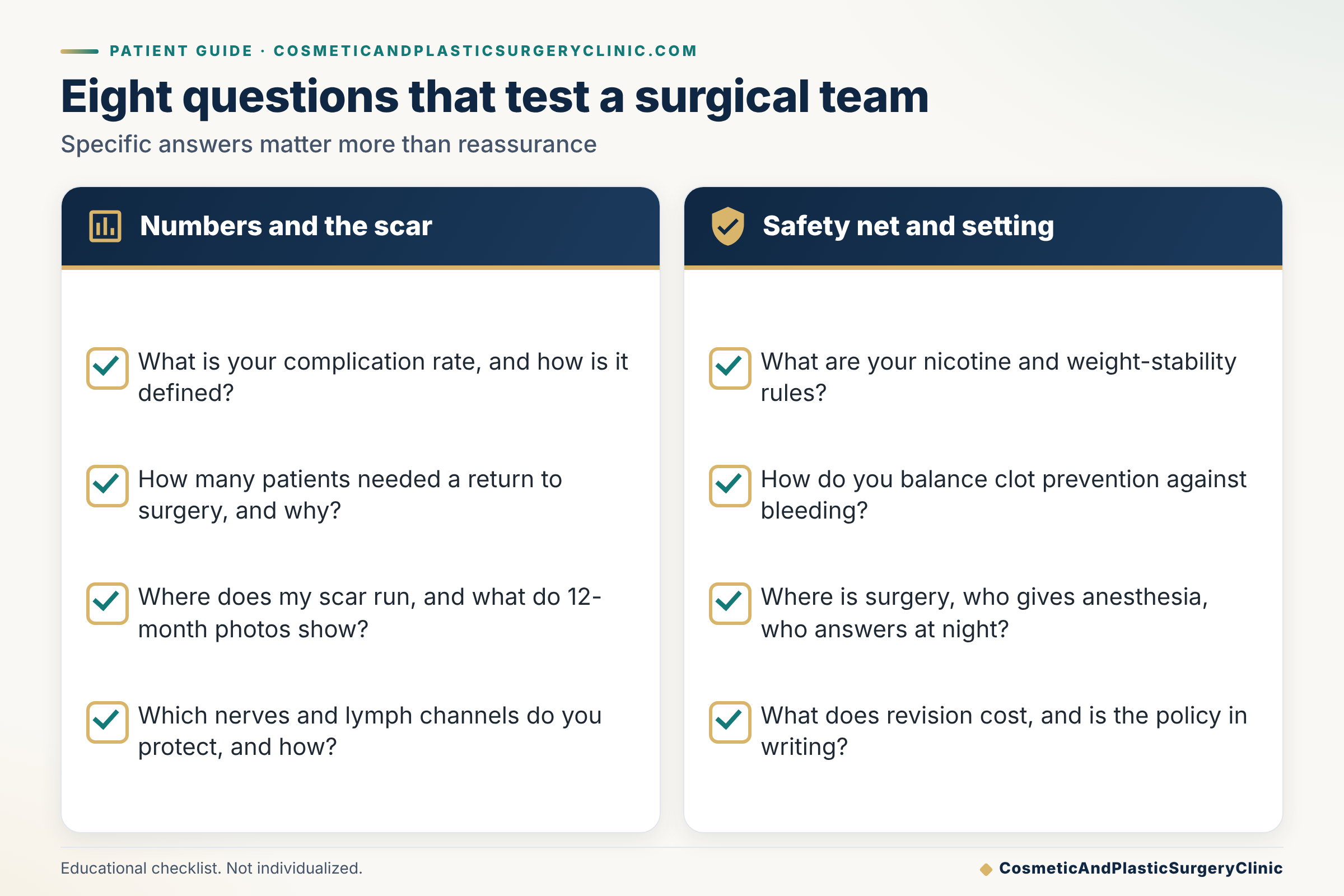
A consent form lists risks in general terms. A consultation is where you can turn them into a surgeon’s own numbers, plans and policies. Plastic surgery consultation covers the visit as a whole; the eight questions below are the ones that test arm thigh lift risks directly, and they are the checklist in the third graphic.
Questions that make the numbers and the scar specific
Ask for the surgeon’s own figures and definitions
- What complication rate do you see for this exact operation, and how do you define “complication”?
- What share of your arm or thigh lift patients returned to the operating room, and for what?
- Where will the scar run, why that design, and what do your own photos at 12 months or later show?
- Which nerves, veins and lymphatic channels near the incision are you protecting, and how?
Good answers are specific: a count, a time period and a definition. An answer that offers only “very low” or “rare” leaves you with no number to compare against Tables 2 and 3. If the surgeon quotes a very low rate, ask how many patients it is based on and how long they were followed.
Ask about the safety net and the setting
- What are your nicotine, weight-stability and health-clearance rules, and which are firm?
- How do you balance clot prevention against bleeding, and when do patients start walking?
- Where will surgery take place, who gives the anesthesia, and what happens at 2 a.m. if I have a problem?
- What does a revision cost, what does the written policy cover, and how long do you wait before judging a result?
Question 7 matters more if the operation is far from home. A surgeon in another city or country may be unreachable when a seroma or open wound appears, and a local emergency department will not know the operation. The medical tourism article covers that trade-off.
Revision, waiting and the option of not operating
What revision involves and who pays
The ASPS lists possible need for revisional surgery as a risk of both operations. The published rates range widely: 7.46% for aesthetic-purpose reintervention in the 2022 meta-analysis, 12.5% in the 2006 series, 22.9% in the 2013 multipractice review and 0% to 21% across studies in the 2017 review, with residual contour problems and scarring the usual reasons. Many revisions are small, such as scar refinement, but some are a second operation under anesthesia. Treat revision as one of the arm thigh lift risks to price and plan for, not as a sign that something went wrong with the plan.
Before surgery, get the revision policy in writing: what is covered, for how long, and whether the surgeon’s fee, facility fee and anesthesia fee are each included. The arm lift cost article explains how revision terms fit into a quote, and a policy that excludes the facility and anesthesia is a cost you carry.
When waiting, staging or a smaller operation is reasonable
Nothing in the evidence says everyone with loose arm or thigh skin must operate. The ASPS thigh lift page notes that liposuction alone may suffice where skin elasticity is good, and a lift with liposuction may be recommended where it is poor; thigh lift versus liposuction works through that decision. For people with large weight loss across several regions, staged body contouring explains why surgeons sometimes space operations, and body lift risks covers the trunk-side equivalent.
Waiting for a stable weight, stopping nicotine, getting a second opinion or deciding not to have surgery are all consistent with the evidence on arm thigh lift risks above. A discount that expires before you can think it over is information about the clinic, not about the risks.
Frequently asked questions
Do arm thigh lift risks rise when both are done in one session?
None of the sources read for this page isolated a same-day arm plus thigh lift. What they show is that adding procedures changes the picture: one insurance database found major arm lift complications of 4.4% when combined versus 1.3% alone, while a multipractice review found no significant difference. A longer total operating time and anesthesia exposure are practical reasons surgeons sometimes stage. Ask whether your surgeon would operate on both regions in one day, what the plan is if the first region goes badly, and what staging would cost.
How long does numbness last after an arm lift?
The sources opened give no timeline. One 2017 review counted nerve damage only when testing or clinical signs lasted at least a year, and noted that temporary tingling occurred in some patients without counting it. A 2006 series followed patients for a mean of 50 months and reported two of 40 with injury to the medial antebrachial cutaneous nerve. Report new numbness, weakness or a cold hand promptly, and ask your surgeon what they tell patients to expect in the first months; sensory change is one of the arm thigh lift risks with the least published detail.
Can a seroma, one of the arm thigh lift risks, be prevented?
The sources opened do not establish a reliable prevention method for either operation. What they describe is management: Cleveland Clinic says small seromas that do not hurt are often watched, larger ones may be drained with a needle and some refill, and a temporary drain may be placed if fluid keeps returning. The ASPS notes drains may be used after both operations. Whether your surgeon uses drains, tension sutures or compression, and how they handle a seroma that appears after discharge, are fair questions for the pre-operative visit.
Can a thigh lift scar distort the labia or groin?
It is a recognized concern that studies track. A 2020 comparison of 54 women reported no labial deformation in either technique group, and a 2013 series of 25 women reported none, but both are small, retrospective and from single surgeons, so they cannot establish how often it happens. The 2020 study did count scar enlargement or migration in 8 of 28 patients treated with standard excision. Ask the surgeon how the groin closure is anchored, where the scar sits, and whether they have patients with scar descent.
Are limited-incision arm lifts lower in arm thigh lift risks?
The sources opened do not show that. An anatomical study in ePlasty warned that a liposuction cannula can injure sensory nerves in a limited-incision arm lift, and a 2022 meta-analysis linked medial incision placement to more complications while also linking adjunctive liposuction to fewer of certain ones. A limited approach treats less skin by design, so it is a question of fit, not a safety shortcut. Ask what the surgeon expects to remain after it.
Is there a BMI at which arm thigh lift risks become too high?
The ASPS arm and thigh lift pages opened give no BMI limit, and the studies do not offer a cutoff. One insurance database found a BMI of 30 or higher independently associated with any complication in arm lifts (relative risk 1.92), and a clot analysis linked a BMI of 25 or higher to more clots across cosmetic surgery (relative risk 2.0). Those are associations across large groups, not cutoffs for arm thigh lift risks. Surgeons set their own thresholds, weight-stability requirements and health checks, so ask for yours in writing.
Do arm thigh lift risks continue after the first month?
Different risks run on different clocks. Cleveland Clinic says a seroma usually appears seven to 10 days after surgery and may take up to six weeks to resolve. UMass Memorial Health notes stitches can give way when coughing, lifting or exercise stress them. Scars and contour keep changing for months, and looseness can return, which the 2022 meta-analysis counted as ptosis or recurrence in 7.79% of patients. Your surgeon’s follow-up schedule sets when each risk is checked, so keep every visit even if you feel well, because arm thigh lift risks do not all peak in week one.
Sources and further reading
- American Society of Plastic Surgeons — Arm lift: risks and safety (accessed 2026-11-13) — list of risks for arm lift
- American Society of Plastic Surgeons — Thigh lift: risks and safety (accessed 2026-11-13) — list of risks for thigh lift, including clots and major wound separation
- American Society of Plastic Surgeons — Arm lift: recovery (accessed 2026-11-13) — drains, dressings, compression wrap
- American Society of Plastic Surgeons — Thigh lift: recovery (accessed 2026-11-13) — drains; symptoms needing immediate attention
- American Society of Plastic Surgeons — Thigh lift overview (accessed 2026-11-13) — liposuction alone versus lift when skin elasticity differs
- American Society of Plastic Surgeons — 2025 Plastic Surgery Statistics Report (accessed 2026-11-13) — 2025 and 2024 arm lift and thigh lift counts; methodology
- American Society of Plastic Surgeons — Patient safety (accessed 2026-11-13) — board certification and member training
- The Aesthetic Society — Thigh lift: safety considerations (published October 22, 2021; accessed 2026-11-13) — risk list and statement that major complications are infrequent
- The Aesthetic Society — Lower body lift: safety considerations (published October 22, 2021; accessed 2026-11-13) — board-certified surgeon in an accredited facility
- Aljerian et al., Plastic and Reconstructive Surgery — Complications in Brachioplasty: A Systematic Review and Meta-Analysis (2022; abstract via library catalog; accessed 2026-11-13) — 29 studies, 1,578 patients, pooled rates
- Sisti et al., Acta Biomedica — Complications associated with brachioplasty: a literature review (2017; accessed 2026-11-13) — 27 studies, 1,065 patients, 28.9%
- Nguyen et al., Aesthetic Surgery Journal — Incidence and Risk Factors of Major Complications in Brachioplasty: Analysis of 2,294 Patients (2016; abstract; accessed 2026-11-13) — 3.4% major, risk factors
- Knoetgen and Moran, Plastic and Reconstructive Surgery — Long-term outcomes and complications associated with brachioplasty (2006; abstract; accessed 2026-11-13) — 40 patients, nerve injury, cadaver findings
- Plastic and Reconstructive Surgery — Brachioplasty outcomes: a review of a multipractice cohort (2013; abstract; accessed 2026-11-13) — 96 patients, scarring, revision, bariatric history
- Chowdhry et al., ePlasty — Avoiding the Medial Brachial Cutaneous Nerve in Brachioplasty: An Anatomical Study (volume 10; accessed 2026-11-13) — eight cadaver arms, nerve and basilic vein
- Sisti et al., Journal of Cutaneous and Aesthetic Surgery — Complications Associated With Medial Thigh Lift: A Comprehensive Literature Review (2015; abstract; accessed 2026-11-13) — 16 studies, 447 patients
- Plastic and Reconstructive Surgery — Medial thigh lift in the massive weight loss population: outcomes and complications (2015; abstract; accessed 2026-11-13) — 106 patients, incision design, edema
- Di Pietro et al., Journal of Cutaneous and Aesthetic Surgery — Medial Thigh Contouring After Massive Weight Loss: The Liposuction-Assisted Medial Thigh Lift (2020; accessed 2026-11-13) — 54 women, two techniques
- Aboueldahab, Journal of Cutaneous and Aesthetic Surgery — Liposuction-Assisted Medial Thigh Lift in Obese and Non Obese Patients (2013; accessed 2026-11-13) — 25 women, one surgeon
- Winocour et al., ASPS annual meeting — Venous Thromboembolism in the Cosmetic Patient (2015; meeting abstract; accessed 2026-11-13) — clot rates by procedure, risk factors
- American Society of Anesthesiologists — Stop Smoking for Surgery (2015; accessed 2026-11-13) — blood flow, healing, infection, anesthesia
- Cleveland Clinic — Seroma (updated February 11, 2026; accessed 2026-11-13) — timing, treatment, when to call
- UMass Memorial Health — Understanding wound separation after surgery (accessed 2026-11-13) — causes, risk factors, warning signs
- MedlinePlus — Pulmonary embolus (reviewed October 21, 2025; accessed 2026-11-13) — symptoms and emergency guidance
- CDC — About blood clots (reviewed March 5, 2025; accessed 2026-11-13) — DVT and PE symptoms, moving after surgery
- MedlinePlus — Lymphedema (updated January 22, 2019; accessed 2026-11-13) — definition and causes
- American Board of Plastic Surgery — Verify certification (accessed 2026-11-13) — where to confirm board certification


