Tummy tuck recovery is often summed up as “two weeks off work,” and the sources behind that phrase disagree more than it suggests. Published guidance on returning to work after abdominoplasty runs from about one week to eight, and the ranges for lifting limits and strenuous exercise are almost as wide. Some of the gap is real variation between jobs, surgeons and operations. The rest comes from sources counting different things: a drain, a garment, a symptom or a specific activity.
This article lays tummy tuck recovery out as overlapping clocks: drains and garments, swelling, lifting, work, driving, exercise, scars and sensation. It shows where the main sources differ, sorts what you might notice into routine, call-today and call-911, and ends with the questions that turn a vague plan into a written one. It does not explain how the operation is done (see what a tummy tuck changes and what it cannot) or compare techniques (see tummy tuck techniques). Your surgeon’s written instructions override everything here.
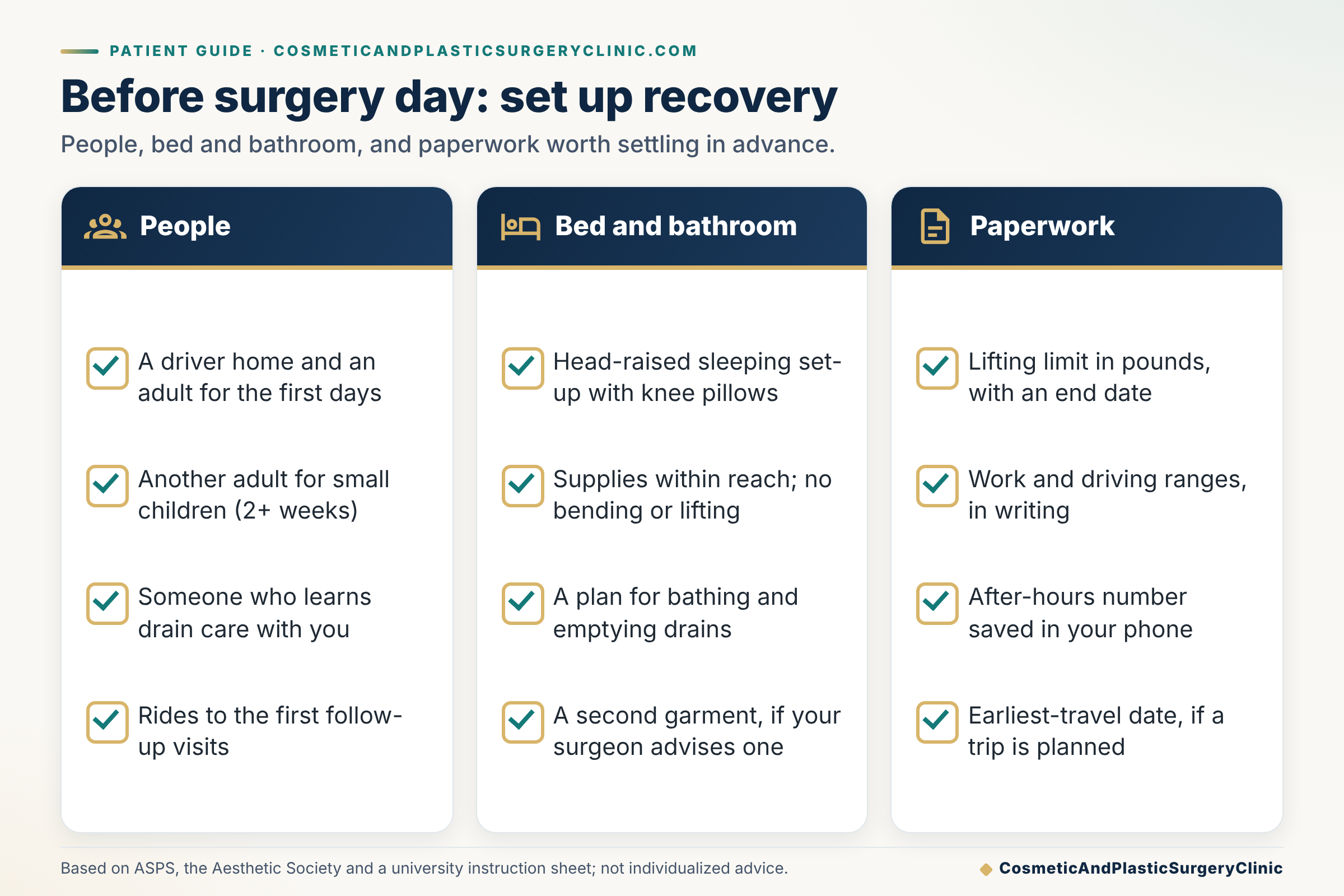
Before surgery day: what tummy tuck recovery asks of you and the people around you
What the early changes in your body usually represent
Swelling, bruising, tightness, numbness and fatigue are five different things
After abdominoplasty the abdomen is swollen, often bruised, and tight in a way people describe as pulling. Cleveland Clinic says the first week is uncomfortable, that bruising and numbness are common early on, and that tightness fades as swelling decreases over several months. MedlinePlus says pain lasts several days and that resting with the legs and hips bent may reduce pressure on the abdomen. The Aesthetic Society calls the first two days the most uncomfortable, settling to a nagging level by days five to seven.
Each of the five parts of tummy tuck recovery answers to a different clock. Bruising fades first: the Aesthetic Society puts redness, bruising and swelling subsiding within one to three weeks, while Cleveland Clinic says swelling keeps going down over several months. Numbness is a change in skin sensation that, according to Mayo Clinic, usually improves over the months after surgery. Fatigue is the one nobody schedules; a University of Michigan instruction sheet says it may last weeks to months.
Why ranges are more honest than exact-day promises in tummy tuck recovery
Put seven reputable sources side by side and the disagreement is plain. The table uses only what each page states, and a blank answer means the page does not say. The widest gap is work, from about a week to six to eight weeks. The likeliest explanation is that the sources describe different jobs, different drain and garment protocols and sometimes different operations.
| Source | Garment or binder | Lifting, straining, exercise | Return to work |
|---|---|---|---|
| ASPS blog, 2023 | Continuous for 2 weeks, then as much as possible for about another month | More strenuous exercise from about week 6, with approval | Some patients in week 2 |
| Mayo Clinic, updated 2025 | Binder for about 6 to 8 weeks | No lifting or straining for 6 weeks; no sports for at least 8 | About 2 to 4 weeks |
| Cleveland Clinic, updated 2024 | Not mentioned | Strenuous exercise postponed 4 to 6 weeks; avoid heavy lifting | At least 1 week on average |
| MedlinePlus, reviewed 2025 | Elastic support for 2 to 3 weeks | No strenuous activity or straining for 4 to 6 weeks | 2 to 4 weeks |
| The Aesthetic Society | Wide elastic garment for several weeks | No heavy lifting or strenuous exercise for 4 to 6 weeks | About 2 weeks |
| University of Michigan, 2016 | Around the clock for 6 weeks | Nothing over 5 pounds for 6 weeks; strenuous activity restricted 8 weeks | 6 to 8 weeks |
| Hackensack Meridian, 2024 | Binder for several weeks | Heavy items and exercise limited for several weeks | Up to a month, longer with heavy lifting |
Three patterns stand out across these tummy tuck recovery ranges. Strenuous exercise clusters around four to six weeks, with two sources putting sports or strenuous activity at eight. Garments run from two or three weeks to six or eight. Work is the outlier. Larger and combined operations sit toward the slow end: the Aesthetic Society says recovery is typically longest for traditional abdominoplasty and for combined procedures compared with a mini tummy tuck, and mini versus full tummy tuck explains how surgeons choose between them.
Setting up the house, the helpers and the paperwork
Driver, caregiver, children, bed and bathroom
For tummy tuck recovery at home, the ASPS blog says most patients go home the same day and should arrange a driver plus someone to help for the first several days. MedlinePlus mentions a hospital stay of one to three days, so ask which applies to you. The Aesthetic Society suggests help at home for at least the first three days and, with small children, another adult caring for them for at least two weeks.
Bed and bathroom matter more than most checklists admit. Michigan’s sheet has patients sleep with the head slightly raised and pillows under the knees to reduce tension on the incision, and describes drains that you empty and log; the Aesthetic Society likewise says to empty them several times a day and record the output. The Michigan sheet also addresses constipation directly, suggesting walking, fluids and, if prescribed, a stool softener. Put supplies where you can reach them without bending or lifting, and rehearse getting in and out of a flat bed before surgery.
What written tummy tuck recovery instructions should contain
ASPS lists the questions a written tummy tuck recovery plan should answer: how long you will wear the garment, when stitches come out, how you will bathe, when you can resume normal activity and exercise, and when you return for follow-up. Add the most variable items: who removes drains and when, the lifting limit in pounds, driving clearance, a work note, the after-hours number, and what the office counts as an urgent call. Ask for the document before surgery day instead of at discharge, when you will be tired and medicated.
A week-by-week tummy tuck recovery timeline
Dates mislead in tummy tuck recovery; stages hold up better. The table strings together the ranges from the sources above and ends each row with a planning issue and a red flag. The ranges overlap on purpose, and where your surgeon’s schedule differs, the surgeon’s schedule wins.
| Stage | Common changes | Practical limits described | Planning issue | Red flag |
|---|---|---|---|---|
| Days 0 to 3 | Tiredness, discomfort, swelling, dressings; drains and a garment or binder in place | Slow, short walks from day one; no lifting | Driver, an adult at home, prescriptions filled | Chest pain, trouble breathing or fainting: 911. Fever, bleeding or leaking fluid: same-day call |
| Days 4 to 14 | Discomfort settles to a nagging level by days 5 to 7; first follow-up visit; drains typically out within 3 to 14 days | Garment worn continuously in some protocols; walking slightly bent in one | Drain log, first visit, ride to appointments | Pus or cloudy fluid, rising pain, spreading redness, swelling that grows |
| Weeks 3 to 4 | Feeling more like yourself; bruising largely gone; posture straightening | Lifting and strenuous exercise still restricted in most sources | Work plan, garment fatigue, who lifts what | New one-sided swelling or fluid after things had improved |
| Weeks 5 to 8 | Swelling subsiding (about 5 weeks in one source, 6 to 8 in another) | Strenuous exercise from about 4 to 6 weeks if cleared; sports at 8 in two sources | Driving clearance, exercise restart plan | Calf pain or swelling; any chest or breathing symptom |
| Months 3 to 6 | Last of the swelling eases; scar still red; sensation still changing | Most restrictions lifted as the surgeon directs; sun protection on the scar | Dated photos in the same conditions | Incision edges separating, or a new hot, tender patch |
| Months 6 to 12 and beyond | Scar fades and flattens over a year or longer; full recovery 6 months or more (one source) | Sun care continues; weight stability matters for the result | Revision conversation, if any, on the surgeon’s schedule | A burn or wound on numb skin; a scar that thickens or changes |
The first two weeks
The first walk, the drains and the garment
Mayo Clinic says staff help you walk as early as the first day because moving lowers the risk of blood clots, and the Aesthetic Society says to walk on day one, slowly. These walks are short and frequent, not exercise. Drains, where used, are thin tubes under the skin that collect fluid. The Aesthetic Society says they are typically removed 3 to 14 days after surgery depending on output, and Michigan’s protocol schedules removal once output stays under 30 milliliters for 24 hours on two consecutive days.
Drain use itself varies in tummy tuck recovery. A 2024 review in Plastic Surgery (Oakville) reports that 89 percent of surveyed board-certified surgeons still use drains, while studies described under seroma below test whether sutures that anchor the skin flap to the tissue beneath can supplement or replace them. If your surgeon uses no drains, ask what the plan is for fluid instead of assuming the course is easier.
In tummy tuck recovery the garment or binder supports the abdomen and is meant to limit swelling, according to ASPS. The evidence behind it is thin: a 2024 systematic review in JPRAS Open (Arkoubi) of five trials and about 130 patients found weak evidence for abdominal binders, and the author rated the studies as low quality. That is a reason to ask your surgeon about their protocol, not a reason to take the garment off.
Walking bent, sleeping propped, and why posture advice differs
Posture is where the sources visibly disagree. Michigan’s sheet says to walk slightly bent forward and return to normal posture gradually over about three weeks, and Mayo Clinic says to avoid quick bending at the waist. ASPS says that within a week or two you should be standing tall, while also noting that final results can be hidden by swelling and by not standing fully upright until internal healing is complete. None of the pages explains why the timing differs, so treat it as a question for the surgeon who knows how your closure was done.
For resting, the sources agree more. Michigan suggests the head slightly raised with pillows under the knees, MedlinePlus says legs and hips bent may reduce pressure, and Cleveland Clinic says to sit or lie in whichever position causes the least pain, as your surgeon advises. Test the arrangement before surgery, because the bed is where much of the first two weeks happens.
Calls that belong in the first two weeks of tummy tuck recovery
Michigan’s sheet lists a temperature over 100.4 degrees Fahrenheit, increasing swelling, bruising or redness, severe or increasing pain that medicine does not relieve, yellow or green or foul-smelling drainage, bleeding that light pressure can’t control, and loss of feeling or motion as reasons to call. Cleveland Clinic’s list is severe pain, excessive bleeding, swelling, and fluid or pus leaking from an incision. CDC says redness and pain at the site, cloudy drainage and fever may signal a surgical site infection and to call your provider immediately. The full sort into routine, same-day and emergency comes in the last section.
Weeks three through twelve
Energy returns before the restrictions lift
Cleveland Clinic says you should start feeling more like yourself after a couple of weeks, and the ASPS blog says that by week four most usual activities can be resumed. Mayo Clinic, meanwhile, says to avoid lifting, straining and strenuous tasks for the first six weeks and sports for at least eight, and notes that straining might reopen the wound. The gap between feeling better and being cleared is the part of tummy tuck recovery most likely to cause trouble, because nothing about a good day tells you what the incision can tolerate.
Measuring progress by what you can do
A useful way to track weeks three to twelve is by function instead of by the mirror: how far you can walk, whether you can get out of bed without bracing, how much pain medicine you still need, whether stairs are comfortable. None of the sources offers a validated scale for these, so keep them as notes to share with the surgeon, not a scorecard. One trial did measure function objectively, and its result runs against intuition.
The trial tested reminders, not effort, so it cannot say that pushing harder is pointless. It does suggest that a calendar reading “back to normal by week four” is optimistic for tummy tuck recovery. The study also counted steps, not lifting, work or driving, which is why those get their own section next.

Work, driving, lifting, and exercise: what tummy tuck recovery limits and when
Work and exercise ranges are in the comparison table above. This table covers the rest of daily life, states what the sources say, what moves the answer, and what to ask for in writing.
| Activity | What published sources describe | What shifts it | Ask for |
|---|---|---|---|
| Desk or light work | About 1 to 4 weeks across sources; up to a month in one | Job demands, drain status, pain-medicine use | A minimum, a likely range and a trigger to extend |
| Physical work | 6 to 8 weeks in one detailed 2016 protocol; longer with heavy lifting (Hackensack) | Lifting load, hours on your feet | A written lifting limit and a review date |
| Driving | About 4 weeks in one protocol, tied to arm range and emergency braking; 1 to 2 weeks “if not longer” in another | Sedating medicine, comfort turning and braking | Clearance wording, and no driving while sedated |
| Lifting and carrying | 5-pound limit for 6 weeks (Michigan); 4 to 6 weeks for heavy lifting (Aesthetic Society) | Children, groceries, pets, laundry | The limit in pounds and an end date |
| Showering and bathing | Shower 48 hours after drain removal; no tub soaking for 6 to 8 weeks (Michigan) | Drains, dressings, closure method | A written bathing plan |
| Flights and long trips | Trips over 4 hours within 3 months of surgery carry added clot risk (CDC) | Trip length, other clot risk factors | An earliest-travel date, in writing |
| Sun on the scar | Cover it; SPF 30 or higher when clothing won’t (AAD); 12 months of sun avoidance (Michigan) | Season, swimwear, scar position | When incisions may be exposed |
Work and driving
Why one week and eight weeks both appear in print
One way to read the spread: the number you are given in tummy tuck recovery advice is really a bundle of rules. Cleveland Clinic words its figure as a minimum, “at least one week,” while Michigan’s six to eight weeks arrives alongside a six-week round-the-clock garment and a five-pound lifting limit. A date that comes with those rules means something different from a date quoted on its own. Ask which restrictions travel with each return-to-work estimate, and whether part-time or remote work shortens the gap.
Leave paperwork, employer conversations and help at home are covered in plastic surgery recovery planning. Here the point is narrower: a tummy tuck recovery plan should hold a range and a condition for extending it, because a single date turns any slow week into a sense of failure.
Driving, pain medicine and the first errand
Driving has the fewest solid numbers in tummy tuck recovery. Hackensack Meridian says no driving for one to two weeks “if not longer.” Michigan’s sheet ties driving to function, meaning full arm range of motion and the ability to stop or swerve in an emergency, typically about four weeks, and says not to drive on narcotic pain medicine unless the surgical team says otherwise. CDC says prescription opioids can cause sedation and dizziness even when taken as directed, and that combining them with alcohol or other drowsiness-causing drugs is very dangerous.
The sensible question is therefore three-part: are you cleared, is anything sedating still in your system, and can you turn, brake and react without bracing? Arrange rides to the first follow-up visits instead of treating the drive as a test of readiness.
Lifting, exercise and travel
Lifting limits, children and groceries
Lifting is the tummy tuck recovery restriction that surprises people, because it covers ordinary objects. Michigan’s limit of five pounds for six weeks is less than a gallon of milk. Mayo Clinic says to avoid lifting, straining and strenuous tasks for the first six weeks, the Aesthetic Society asks for four to six weeks and wants another adult caring for small children for at least two weeks, and Hackensack counts small children among the heavy items to avoid.
Straining counts too: both Mayo and Michigan list it alongside lifting. Ask for the limit in pounds and an end date, and decide in advance who carries the toddler, the laundry and the groceries.
Restarting exercise, flights and long drives
Exercise guidance in tummy tuck recovery is the most consistent in the first table: four to six weeks in the Aesthetic Society, Cleveland Clinic and MedlinePlus, about six weeks with approval in the ASPS blog, and eight weeks for sports in Mayo’s guidance and for strenuous activity in Michigan’s. Treat “cleared” as permission to start, not to resume the old routine, and ask what to do if swelling or soreness rises the next day.
Travel during tummy tuck recovery has a documented clot angle. CDC says trips longer than four hours by air, car, bus or train carry a small risk of blood clots that rises with other risk factors, lists surgery within the past three months as one, and recommends moving and doing calf exercises every one to two hours. CDC’s medical tourism page advises delaying air travel for 10 to 14 days after major surgeries. Whether and when you can fly is your surgeon’s call; medical tourism for plastic surgery covers the wider trade-offs.
Swelling, scars and the final result after a tummy tuck
Swelling, fluid and when the shape appears
Why the week-two mirror misleads
ASPS says final results may be initially obscured by swelling. Cleveland Clinic says it could take up to three months to see the final result, and the ASPS blog says several months. The Aesthetic Society says swelling should subside within five weeks and full recovery takes six months or more, while Michigan’s sheet says bruising and swelling should mostly resolve in six to eight weeks. The spread reflects what is being counted: visible puffiness fades first, and the last fullness, the part that matters when comparing photos, fades last.
Take dated photos in the same light, posture and clothing, and judge the trend instead of a single image. Reading other people’s photos with the same caution is the subject of tummy tuck before and after photos. ASPS adds that no outcome is certain and that previous abdominal surgery may limit results, and Mayo Clinic says results are usually long lasting if your weight stays stable.
Seroma: the swelling that needs a surgeon
A seroma is a pocket of fluid that collects under the skin where tissue was lifted, and it is the best-known swelling problem specific to abdominoplasty. The 2024 review in Plastic Surgery (Oakville) gives a seroma range of 5 to 25 percent and a hematoma rate of about 2 percent. ASPS, Mayo Clinic, Cleveland Clinic and MedlinePlus all list seroma among the risks, and MedlinePlus says it may need draining. Do not press on or try to drain a suspected pocket yourself; describe it to the surgeon’s office.
Prevention is still being tested. A 2017 meta-analysis in Aesthetic Surgery Journal (Jabbour and colleagues; seven studies, three randomized) found that adding progressive tension sutures to drains lowered seroma rates compared with drains alone, at about 23 extra minutes of operating time. A 2025 meta-analysis of 24 studies, read here from its summary page only, reported lower seroma and reoperation rates when sutures were combined with liposuction than with drains. Both call for larger, better studies. Ask which method your surgeon uses and who checks the area; tummy tuck risks covers the full complication list.
Scars and sensation
Scar care: what has evidence and what is habit
A full tummy tuck leaves a scar from hip to hip and around the navel, and surgeons aim to keep it low enough to sit under underwear or swimwear (ASPS blog). Scar timelines in tummy tuck recovery differ: several months to a year (ASPS results), up to a year (Mayo), up to a year with some scars remaining widened (Cleveland Clinic), and three months to two years (Aesthetic Society). Michigan’s sheet says scars stay red for about six months before fading and softening.
Silicone gel sheets are the aid named most often. The ASPS blog says they may be recommended, and the American Academy of Dermatology says sheets can help prevent a raised scar after surgery, worn daily and often for months, with skin breakdown or rash as possible side effects.
The research is weaker than the habit. A 2013 Cochrane review of 20 trials with 873 participants found low-quality evidence, with a possible preventive benefit only in people prone to abnormal scarring and in trials highly susceptible to bias. Sun protection has the clearest rationale: Michigan advises avoiding sun on the scar for at least 12 months or using SPF 30 or higher.
Numb skin, heat and the hot-water-bottle burn in tummy tuck recovery
Numbness is expected. Cleveland Clinic lists it as common during early healing, and Mayo Clinic says changes in skin sensation usually improve over the months after surgery. Usually is not always. A 2004 study in Plastic and Reconstructive Surgery tested 20 abdominoplasty patients 12 to 60 months after surgery (average 31.5 months) against 20 people with no abdominal incisions. It found reduced pressure sensitivity in every area tested and reduced hot and cold sensitivity in at least one. The authors concluded that this may raise the risk of burns.
A 2026 case report makes the point concrete. A 34-year-old woman developed a severe lower-abdominal burn two years after a lipoabdominoplasty, after holding a hot-water bottle over her shirt for a few minutes for menstrual pain. She felt nothing at the time; the burn needed surgical debridement and about 30 days to heal. One case says nothing about how often this happens, but the authors’ advice is plain: be cautious with heat sources on insensate skin. Ask when sensation is likely to return and what to avoid until it does.
When tummy tuck recovery stops being routine
Most tummy tuck recovery is uncomfortable but expected. A short list of findings is not. The sort below turns the sources’ lists into three bins without making every twinge a crisis.
Routine, call today, call 911
Same-day calls to the surgeon’s office
Those items come from Michigan’s sheet, Cleveland Clinic and CDC. Incision edges that separate appear on Mayo’s risk list and skin loss on ASPS’s, so show the surgeon any area where the skin or the wound looks wrong instead of waiting to see.

Clots can appear late and without a loud signal
A clot in a leg vein, and the lung clot it can become, give the least warning. CDC says about half of people with a deep vein clot have no symptoms. Swelling, pain or tenderness, warmth, and redness or discoloration in a leg mean seeing a doctor as soon as possible. Lung-clot signs are trouble breathing, chest pain that worsens with a deep breath or cough, a fast or irregular heartbeat, coughing up blood, and lightheadedness or fainting; CDC says to seek help immediately. Call 911 for those, and do not drive yourself.
How common is it? The 2024 review in Plastic Surgery (Oakville) puts clots after abdominoplasty at 0.35 to 1.21 percent overall, and up to 9.4 percent for circumferential procedures. A 2018 analysis in Aesthetic Surgery Journal of outpatient aesthetic cases reported to a quality program from 2001 to 2011 found abdominoplasty made up 58 percent of clot cases, with age over 40 and BMI over 25 as predictors.
And when? Timing is not limited to the first days: in a 2025 single-surgeon series of 333 patients, two had a pulmonary embolism, one on day 5 and one diagnosed on day 25. These are group figures, not a forecast. The planning lesson for tummy tuck recovery is to know the symptoms for weeks, not days. General clot and complication literacy is in plastic surgery risks.
Follow-up, revision timing and what to ask
What a good follow-up schedule looks like
Mayo Clinic says you will likely need regular visits with your plastic surgeon. The Aesthetic Society says to expect a visit within about five days, when drains are often removed, with traditional stitches out within one to two weeks. A schedule that fits the stages of tummy tuck recovery would also include a check when the garment ends and visits through the months when swelling and the scar change, with dated photos at each.
ASPS lists revision surgery among the risks and says a single procedure may not be enough in some situations. None of the pages opened sets a revision timeline, so ask for the surgeon’s own rule, what a second procedure would cost, and whether facility and anesthesia fees are billed separately; tummy tuck cost explains how to compare quotes. Take the list below to the consultation, along with plastic surgery consultation questions.
Eight questions to settle before the surgery date
- Will I have drains, who removes them, and what output or timing triggers removal?
- How many hours a day and for how many weeks will I wear the garment, and do I need a second one?
- What is my lifting limit in pounds, and until what date?
- When may I drive, return to desk work, return to physical work and exercise, and what would extend those dates?
- How do you prevent and check for fluid collections, and how should I report a suspected one?
- Which clot-prevention steps do you use, for how long, and for which patients?
- Which symptoms should I call about, who answers the after-hours number, and what should I do if no one picks up?
- What does your revision policy cover, and what is billed separately?
Seven planning mistakes that make tummy tuck recovery harder
None of these is a character flaw. Each is a reasonable assumption that the sources above contradict, and each has a cheap fix before surgery day.
Mistakes of timing and effort
Building the plan on a single date
- Mistake 1: picking one return-to-work date and arranging all of tummy tuck recovery around it. Published guidance spans about one week to eight. Ask for a minimum, a likely range and a condition that extends it, and tell your employer the range.
- Mistake 2: booking a flight, wedding or vacation inside the first weeks. CDC counts surgery in the previous three months as a clot risk factor for trips over four hours. Ask for an earliest-travel date in writing before paying for anything.
Doing more than the restrictions allow
- Mistake 3: treating the first good week as clearance. Energy returns around weeks two to four, while Mayo’s restriction on lifting, straining and strenuous tasks runs about six weeks. Let the written limit, not your mood, set the date.
- Mistake 4: lifting a child, groceries or a laundry basket “just once.” Michigan’s five-pound limit lasts six weeks. Line up a second adult for those weeks.
Mistakes about what the body is telling you
Trusting signals that are quiet
- Mistake 5: using a heating pad or hot-water bottle on numb skin. Numb skin cannot warn you, and the case report above shows how that goes. Ask which heat sources to avoid and for how long.
- Mistake 6: assuming a quiet leg or a calm chest rules out a clot. About half of deep vein clots cause no symptoms (CDC), and one lung clot in the 2025 series was diagnosed on day 25. Learn the emergency signs for weeks and ask about the clot-prevention plan.
Waiting too long to call
- Mistake 7: sitting on a worrying sign because it is evening or the weekend. CDC says to call right away for redness, pain, drainage or fever at the surgical site. Save the after-hours number in your phone before surgery; Michigan’s sheet, for example, lists weekday clinic hours and tells patients to ask for the surgeon on call at other times.
Frequently asked questions
Do I have to take opioids during tummy tuck recovery?
In tummy tuck recovery the answer depends on the surgeon’s pain-control plan. A 2023 chart review of 80 consecutive outpatient abdominoplasty patients from one surgeon (Plastic and Reconstructive Surgery Global Open) compared an opioid-based plan with a multimodal plan: non-opioid medicines before surgery plus a long-acting local anesthetic block. In the multimodal group 10 of 38 patients (26 percent) used no oral opioids, against 1 of 42 (2 percent), and refills fell from 36 to 4. It was retrospective and used prescriptions as a stand-in for use, so treat it as a question to ask, not a promise.
Will I need blood thinners after a tummy tuck?
Protocols for tummy tuck recovery differ. Mayo Clinic says a surgeon might prescribe a blood thinner for a short time. A 219-patient French series (JPRAS Open, 2025) gave every patient low-molecular-weight heparin for 14.9 days on average, plus compression stockings. A 333-patient single-surgeon U.S. series gave enoxaparin for one week, or one month for higher Caprini scores, plus leg compression devices at home for two weeks or more. Both were retrospective. The 2024 review says combined hormonal contraceptives raise clot risk two to three times, so tell your surgeon every medicine you take, and ask about your plan.
How do smoking and nicotine affect tummy tuck recovery?
Mayo Clinic lists tissue damage among the risks of abdominoplasty and says smoking raises it. Michigan’s sheet tells patients not to smoke or be around smokers, and the Aesthetic Society says not to smoke after the procedure. In the 2024 review, nonsmoker status was linked to lower clot odds (odds ratio 0.63). None of the pages opened says how many weeks to stop before or after surgery, or addresses vaping and nicotine replacement, so ask your surgeon for a written rule. Tummy tuck candidacy covers how surgeons weigh these factors.
When can I shower, soak in a tub or have sex?
ASPS lists “How will I bathe?” as a question for your surgeon, so tummy tuck recovery has no universal answer. Michigan’s 2016 sheet says to shower 48 hours after drain removal, to avoid tub soaking while drains are in and for 6 to 8 weeks after surgery, and that sexual activity may resume as comfort allows, usually at two to three weeks. That is one institution’s protocol, and other practices may differ, so ask for bathing and intimacy guidance in your written instructions and follow those if they conflict with a general page.
Is tummy tuck recovery longer when it is combined with other procedures?
Generally, yes. The Aesthetic Society says recovery is typically longest for traditional abdominoplasty and for combined procedures compared with a mini tummy tuck, and MedlinePlus puts the abdominoplasty itself at two to six hours before anything is added. Ask for one combined schedule instead of two overlapping ones. Mommy makeover describes the common combination, and liposuction recovery shows the garment and swelling course when liposuction is done on its own, for contrast.
Is recovery different after major weight loss?
The tummy tuck recovery ranges in this article come from general abdominoplasty descriptions and may not fit a massive-weight-loss operation. The 2024 review in Plastic Surgery (Oakville) reports wound complications of up to 50 percent in patients with obesity and massive weight loss, which is why wound care and follow-up deserve extra questions in that group. These are literature figures, not forecasts for any one person. Tummy tuck after weight loss covers that decision; ask your surgeon how the plan and the restrictions differ for you.
Sources and further reading
- American Society of Plastic Surgeons — Tummy tuck recovery (accessed 2026-11-12) — tummy tuck recovery drains, garment and questions to ask; no timelines
- American Society of Plastic Surgeons — Tummy tuck safety (accessed 2026-11-12) — listed risks including seroma, clots, numbness, wound healing, revision
- American Society of Plastic Surgeons — Tummy tuck results (accessed 2026-11-12) — swelling and posture, scar fading, no guarantee
- ASPS blog, Weiler J — Your guide to a tummy tuck: before, during and after (2023; accessed 2026-11-12) — week-by-week tummy tuck recovery outline, garment, scar
- Mayo Clinic — Tummy tuck, updated January 2025 (accessed 2026-11-12) — tummy tuck recovery drains, binder, lifting, work, risks, scar
- Cleveland Clinic — Abdominoplasty (tummy tuck), updated January 2024 (accessed 2026-11-12) — tummy tuck recovery, final result, when to call
- MedlinePlus — Abdominoplasty, reviewed January 2025 (accessed 2026-11-12) — support garment, activity, work, risks
- The Aesthetic Society — Tummy tuck aftercare and recovery (accessed 2026-11-12) — tummy tuck recovery drains, activity, help at home, scars, mini versus traditional
- University of Michigan Plastic Surgery — Abdominoplasty post-operative instructions, revised 2016 (accessed 2026-11-12) — one institution’s detailed protocol; may differ from current practice
- Hackensack Meridian Health — Abdominoplasty healing time (2024; accessed 2026-11-12) — binder, driving, lifting, work
- CDC — About blood clots, reviewed March 2025 (accessed 2026-11-12) — deep vein clot and lung clot signs and urgency
- CDC — Blood clots and travel, reviewed May 2024 (accessed 2026-11-12) — trips over four hours, recent surgery
- CDC Travelers’ Health — Medical tourism (accessed 2026-11-12) — flying after surgery, care after returning home
- CDC — About surgical site infections, reviewed April 2024 (accessed 2026-11-12) — infection signs
- CDC — Prescription opioids, reviewed June 2025 (accessed 2026-11-12) — sedation, dangerous combinations
- American Academy of Dermatology — Scars (accessed 2026-11-12) — sunscreen, silicone gel sheets
- Cochrane — Silicone gel sheeting for preventing and treating hypertrophic and keloid scars, 2013 (key messages; accessed 2026-11-12) — 20 trials, low-quality evidence
- Stein MJ, Karaev S, Matarasso A — A primer on abdominoplasty safety, Plastic Surgery (Oakville) 2024 (accessed 2026-11-12) — narrative review: seroma, hematoma, wound, clot and drain-use figures
- Jabbour S et al. — Progressive tension sutures with drains and seroma after abdominoplasty, Aesthetic Surgery Journal 2017 (abstract; accessed 2026-11-12) — meta-analysis of seven studies
- The Aesthetic Society Academy — Systematic review and meta-analysis of progressive tension sutures versus drains in abdominoplasty, 2025 (summary page; accessed 2026-11-12) — 24 studies; summary only, authors not shown
- Arkoubi AY — Compression garments after abdominoplasty: systematic review, JPRAS Open 2024 (DOAJ record; accessed 2026-11-12) — five trials, about 130 patients, weak evidence
- Abbott EN et al. — Wearable fitness tracker and time to return to baseline activity after abdominoplasty, Aesthetic Surgery Journal Open Forum 2025 (accessed 2026-11-12) — randomized trial, step counts
- Claytor RB et al. — Mechanical and chemoprophylaxis algorithm for venous thromboembolism in lipoabdominoplasty, Aesthetic Surgery Journal Open Forum 2025 (accessed 2026-11-12) — 333-patient series, late pulmonary embolism, protocol
- Asiry A et al. — Caprini risk assessment and clot prophylaxis after abdominoplasty, JPRAS Open 2025 (accessed 2026-11-12) — 219-patient retrospective series
- Incidence and predictors of venous thromboembolism in abdominoplasty, Aesthetic Surgery Journal 2018 (PubMed record; accessed 2026-11-12) — quality-program data, 2001 to 2011
- Price MS, Fryer RH — Multimodal pain control and narcotic use after outpatient abdominoplasty, Plastic and Reconstructive Surgery Global Open 2023 (accessed 2026-11-12) — retrospective single-surgeon review
- Sensibility of the abdomen after abdominoplasty, Plastic and Reconstructive Surgery 2004 (PubMed record; accessed 2026-11-12) — 20 patients versus 20 controls, burn-risk conclusion
- Bruno A, Foti R, Cilluffo M — Burn risks in postabdominoplasty patients: a case report, Revista Brasileira de Cirurgia Plástica 2026 (accessed 2026-11-12) — single case, heat on insensate skin