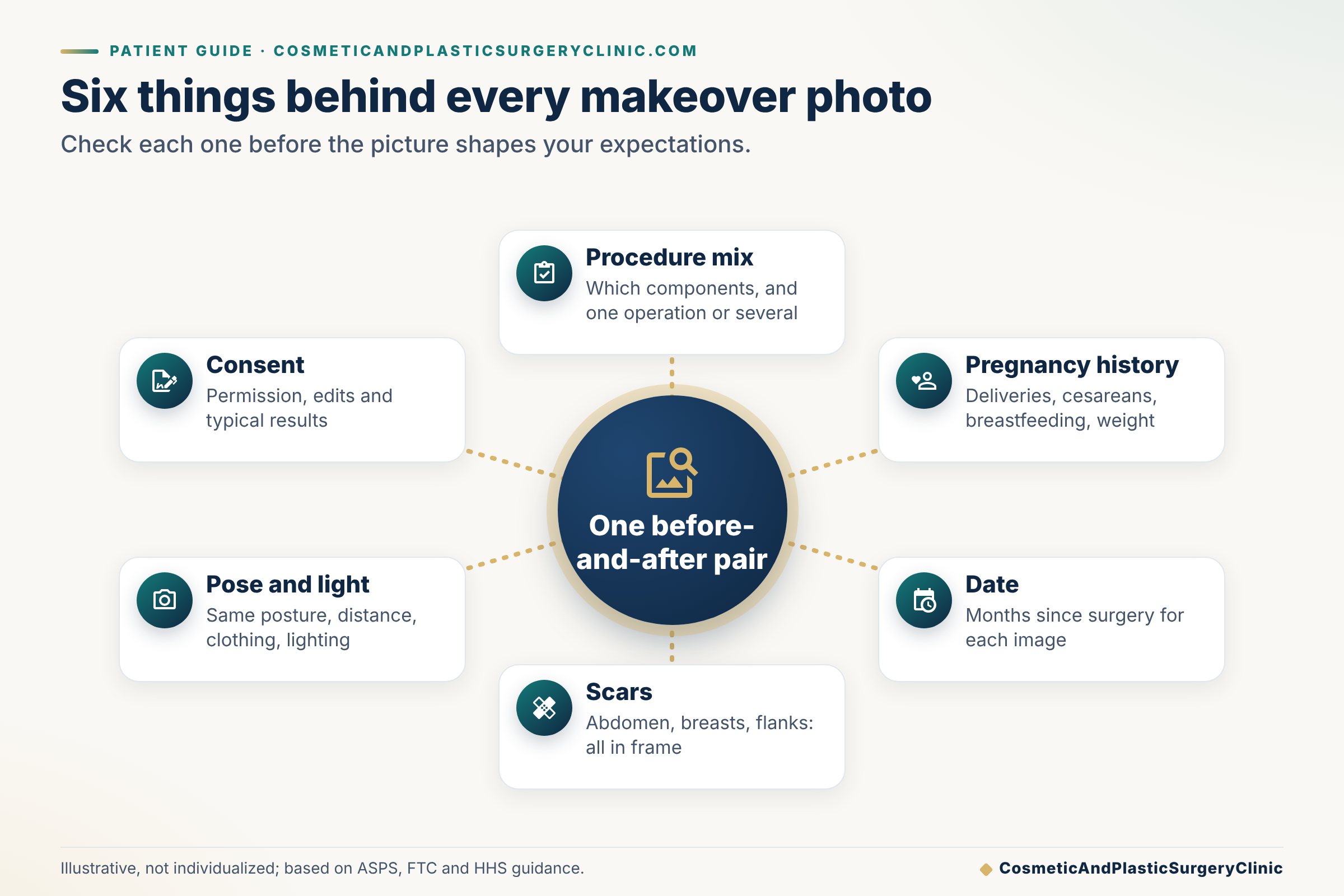
Mommy makeover before and after photos look like the easiest kind of evidence to read: a torso on the left, a torso on the right, and a visible difference. The catch is the caption. “Mommy makeover” names a planned combination, so two galleries under the same label can show different operations on different bodies at different dates. A pair tells you something real only after you know what was combined, who the patient was before, and how long ago the “after” was taken.
This page is about that comparison work. The planning logic behind the combination is in the main mommy makeover guide, and the rules that apply to any gallery, such as consent and advertising law, are in the article on reading before and after photos. Here the focus is narrower: how to match a procedure mix, a pregnancy history and a time point before a picture is allowed to shape your expectations.
A mommy makeover before and after pair starts with a list, not a picture
The American Society of Plastic Surgeons (ASPS) describes a mommy makeover as a collection of procedures a plastic surgeon can perform together, aimed at restoring the shape and appearance of the body after childbearing. Its overview names the breasts, abdomen, waist, genitalia and buttocks as the areas most often addressed, and lists breast augmentation, breast lift, buttock augmentation, labiaplasty, liposuction and tummy tuck as the building blocks. That is a menu, not a recipe, which is why the first step with any mommy makeover before and after pair is to reconstruct the order that was placed.
The label covers a menu, not a single operation
ASPS says the surgery is individualized and that the techniques are chosen according to the amount of restoration wanted, the incision placement and the implant type. Two patients can therefore both appear under “mommy makeover” with no component in common beyond one. The practice’s gallery may not tell you, either: the ASPS photo page for the procedure labels each case only as “Mommy Makeover” with a surgeon’s name, a location and a case number, and does not list what was done.
Find the components in each pictured case
Start by writing the mix next to the photo, in plain terms: abdominal skin removal with or without muscle tightening, breast lift, implants, liposuction of the flanks or back, anything else. If the caption lists only “mommy makeover,” ask for the full list. A pair that moved the nipple upward and a pair that only added volume are different breast operations, and a pair where liposuction trimmed the waist is a different abdominal story from one without it. The guide to mommy makeover procedures covers what each component does.
Do not compare a combined plan with a single-procedure gallery
A reader who plans a tummy tuck and a breast lift is not well served by a tummy-tuck-only album in place of mommy makeover before and after photos, even a very good one, because the breasts and the abdomen change the proportions of the whole torso together. The reverse is also true: a combined gallery tells you little about a plan limited to one area. Single-area photos are still useful for the area they cover. The pages on tummy tuck before and after photos and liposuction before and after photos explain how to read those areas in depth.
| Component in the mix | What appears in a photo | What a photo cannot show | Question for the practice |
|---|---|---|---|
| Tummy tuck, with or without muscle repair | Flatter profile, low scar line, navel position | Whether the midline was tightened; the state of the deeper wall | Which variant was done, and was muscle repair included? |
| Breast lift | Nipple position, breast shape, scar pattern | Volume change (a lift does not significantly change size, per ASPS) | Which incision pattern, and how was the areola handled? |
| Breast implants | Fullness, upper-pole shape, early implant height | Implant type, size and pocket; how the breast will look at five or ten years | What implant and size, and what is the follow-up date? |
| Liposuction | Waist, flank or back contour | Which areas were treated; liposuction does not tighten loose skin (ASPS) | Which areas, and how much of the waist change is fat removal? |
| Other add-ons | Hips, buttocks or arms, depending on the case | Whether the change came from implants, transferred fat or removed tissue | Was anything else done in the same operation? |
Pregnancy and breastfeeding history belong in a mommy makeover before and after caption
The body in a “before” photo is the product of its history. Two women with the same height and weight can have different abdominal walls, different skin and different breasts because of how many pregnancies they have had, whether they had cesarean deliveries, how long they breastfed and how long ago they stopped. A gallery that omits all of this asks you to assume your history matches the patient’s.
Count of pregnancies, deliveries and time since the last one
Pregnancy leaves traces that keep changing for months. In a study of 300 first-time mothers published in the British Journal of Sports Medicine in 2016, Sperstad and colleagues measured diastasis recti, the widened gap between the two halves of the abdominal muscle, and found it in 60.0% of women at 6 weeks after delivery, 45.4% at 6 months and 32.6% at 12 months. The study was not about surgery, but it shows why a photo of a body a few months postpartum is a different starting point from one several years later.
A cesarean scar matters too. ASPS notes that an existing cesarean scar may be merged into a new tummy tuck scar. The article on mommy makeover after a C-section explains how earlier abdominal surgery changes planning, and a before photo that shows a low horizontal scar is a better match for a reader with one than one that does not.
Breastfeeding, age, weight and smoking history shape the breast starting point
Research on breast sagging after pregnancy is less dramatic than folk wisdom. A 2008 study in the Aesthetic Surgery Journal, reported by News-Medical, looked at 93 women with at least one pregnancy who sought breast surgery between 1998 and 2006, graded ptosis from preoperative photographs, and found breastfeeding was not a significant risk factor, even as duration increased. Older age, higher BMI, more pregnancies, a larger pre-pregnancy bra cup size and smoking history were associated with more ptosis. It was a single-center series of surgical patients, so it is not a forecast for anyone.
The practical point for photo reading: a before image does not tell you the age, BMI or number of pregnancies behind a breast shape. Ask for them. If you are still deciding when to operate, the discussion of mommy makeover after pregnancy covers timing.
Reading each region of a combined result on its own terms
A full-torso photo invites one impression, “she looks different,” when the useful reading is regional. The abdomen, the breasts and the flanks heal on different schedules, show different scars and depend on different decisions. Reading them separately is also how you keep a comparison of mommy makeover before and after pictures honest when only some regions resemble yours.
Abdomen: scar line, navel and the waist you are really seeing in mommy makeover before and after photos
The abdomen is the most photographed region in mommy makeover before and after galleries, and the one covered in most detail elsewhere on this site. The short version is that ASPS says early swelling can obscure the result of a tummy tuck, that a person may not stand fully upright at first, and that the scar can take several months to a year to fade as much as it will. Mayo Clinic says the scar sits along the swimsuit line and that the navel is brought out through a small incision and stitched back in its usual position.
Check the scar against the date, and the waist against the other components
In a combined case, a narrower waist can come from skin removal, from liposuction of the flanks, from muscle tightening, from a smaller or larger bust changing proportions, or from a garment. Mayo Clinic notes that liposuction is often added to a tummy tuck to contour the whole abdomen, so a waist change in a mommy makeover before and after pair may owe much of its shape to fat removal. The practical test is the scar: if the stated interval is a few weeks, the scar should look like a fresh incision, not a faint line.
Use the tummy tuck pages for navel and scar detail
Rather than repeat them, this page points to the scar-length comparison in the tummy tuck photo guide. Cleveland Clinic’s scar page gives the range: a mini tummy tuck scar is roughly 3 to 6 inches, a full one runs hip bone to hip bone, and a fleur-de-lis adds a vertical line. Which variant was done is part of the mix, so keep asking.
Breasts: shape, volume and position are three separate questions
In mommy makeover before and after photos the breast result is often described with one word, “lifted” or “fuller,” when at least three things can change. Position is where the nipple and the breast mound sit. Shape is how tissue is distributed within the mound. Volume is how much of it there is. Different components move different ones.
A lift changes position; an implant changes volume
ASPS describes a breast lift as raising the breasts by removing excess skin and tightening the surrounding tissue to reshape and support the new contour, and says it does not significantly change breast size or fill out the upper breast. For fuller breasts, ASPS points to a lift combined with augmentation. So a pair showing both higher nipples and more upper fullness is probably a lift plus implants, and a pair showing only higher nipples is probably a lift alone. Do not assume, ask. The page on breast lift before and after photos goes deeper on the lift itself.
The scar pattern tells you how much skin was removed
ASPS describes three common breast lift incision patterns: around the areola only; around the areola and vertically down to the breast crease; and around the areola, vertically down, and horizontally along the crease. The page says the surgeon chooses the technique based on breast size and shape, areola size and position, degree of sagging, skin quality and the amount of extra skin.
It also says some incision lines are hidden in natural contours while others show on the breast surface. In a photo, a longer scar pattern is not a worse result. It is evidence of a different starting breast, so match it to yours.
Implants are not a one-time fix, and a photo cannot show age
FDA’s page on breast implant risks states that breast implants are not considered lifetime devices, that the longer someone has them the greater the chance of complications, and that reoperation may be needed. ASPS says the same in its safety pages for augmentation. Its augmentation results page adds that incision lines may take several months, even a couple of years, to fade, and that breasts keep changing with aging, weight fluctuation, hormones and gravity. A six-month photo is therefore a snapshot of the early months. Ask whether the practice has pictures from years later.
Flanks, back and the extras that rarely get named
Beyond the abdomen and breasts, the rest of the torso is where captions go quiet. ASPS lists liposuction, buttock augmentation and labiaplasty among the possible components, yet a standard front and side torso photo may show only the first.
Liposuction shapes the waist but does not tighten skin
ASPS says it may take several months for liposuction swelling to fully dissipate and that it is not possible to improve lax skin tone with liposuction. For a photo, that means a “flank” change at three months can still be settling, and loose skin that stays loose is consistent with what the procedure does. If a pair shows crisp contour on skin that was clearly loose before, ask what else was done. The liposuction photo guide explains skin retraction cues.
Buttock work and intimate procedures change the question, not the framing
If the mix includes buttock augmentation, a front-facing torso pair cannot show it at all, and a rear view should be offered. If it includes labiaplasty, expect the practice to show nothing, which is reasonable for privacy. In that case the only evidence is the surgeon’s description, which is another reason to ask a board-certified plastic surgeon how a given component was done. The guide to choosing a plastic surgeon covers how to check training and facility.
The date on a mommy makeover before and after photo decides what you can conclude
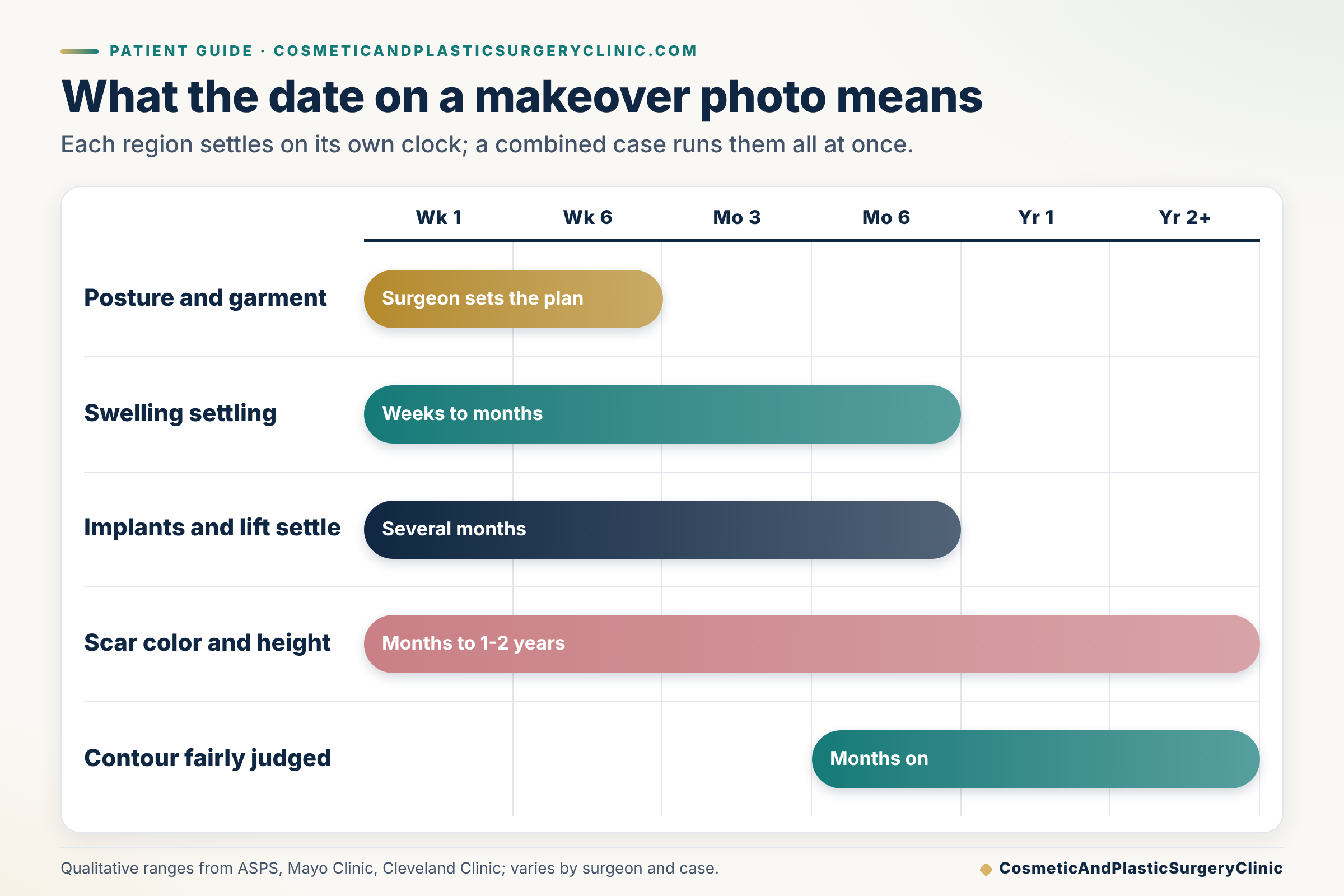
The same mommy makeover before and after pair can be an honest early-recovery picture and a misleading “results” picture, depending on the caption. Abdomen, breasts and flanks reach their settled appearance at different points, and a combined case has all of them running at once. A caption without a date leaves you guessing which stage you are looking at.
Early weeks and months: what swelling, posture and garments hide in mommy makeover before and after photos
ASPS says the final results of mommy makeover surgery may not be apparent for several months, and that scar lines improve over time without disappearing completely. The pieces are described one by one on the pages for each component. They overlap in a combined operation, so the early photo is a composite of several unfinished results. The mommy makeover recovery guide covers the logistics of those weeks.
Abdomen and flanks: upright posture, garments and swelling
For the abdomen, ASPS says people may not be able to stand fully upright at first and are typically standing straighter within about one to two weeks. Mayo Clinic mentions an abdominal binder for about 6 to 8 weeks. A mommy makeover before and after pair from the first weeks is therefore a picture of a body in a garment and a different posture. It tells you almost nothing about what the waist will look like later.
Breasts: early fullness, high implants and swelling
ASPS says breasts look larger right after augmentation and that the final result may take a few weeks as swelling subsides and the skin stretches. Its mommy makeover results page says that over time the implants will settle, with no more specific timeframe than several months for final results. For a lift, ASPS says results are visible right away and that final shape and position take several months to settle. An early photo of a mommy makeover with implants shows the beginning of that process.
Scars: the one thing a photo date can be checked against
Scars are the most useful audit tool in any mommy makeover before and after gallery because they age predictably. They are also the most often cropped, darkened or lightened. A scar that does not match the stated interval is a reason to ask questions, not a reason to conclude anything.
What the scar should look like at the stated interval
In a March 2025 ASPS article on judging photos, a plastic surgeon is quoted saying that if there are zero scars but the image says the patient is only a few weeks or months postoperative, that is not normal, and that incisions are often visible for a year or two before they fade. Cleveland Clinic says small or fine tummy tuck scars may fade completely after about a year, though most people still have a visible scar, and that most people wait 12 to 18 months before considering scar revision.
Breast incision lines, per ASPS, may take several months to a couple of years to fade.
Why a mommy makeover multiplies the scars to check
A combined case can have a hip-to-hip abdominal scar, a navel scar, two breast scars of whichever pattern was used and tiny liposuction marks. Each ages on its own timetable and sits in a different clothing zone: the swimsuit line, the bra line, and the natural creases. A gallery that shows a flattering abdominal scar and crops the breast scars, or the reverse, is showing half the trade-off. Ask for all of the scars in one case, from the front and side.
What happens after the “after” photo
An “after” image in a mommy makeover before and after pair records one moment, but bodies keep changing. This matters more for a mommy makeover than for most procedures, because the starting point was shaped by pregnancy, and the result can be affected by future ones.
Weight change, aging and later pregnancies
Mayo Clinic says a person should ideally keep a stable weight for at least 6 to 12 months before a tummy tuck and that significant weight loss afterward can change results, which are usually long lasting if weight stays stable.
ASPS says on its breast lift results page that surgery is recommended after you have finished having children, that pregnancy-related changes can reduce or reverse the benefits of a lift and that significant weight loss can negatively affect how the breasts look. ASPS’s candidate page likewise lists no plans to become pregnant again as a feature of good candidates.
Ask for a mommy makeover before and after set that spans years, not only months
If you can, request a case with photos at several months and again at a year or more, and ask whether weight and pregnancies changed in between. If the practice only has early photos, that is not a failing, since many galleries are built from the first year. It simply means the picture speaks to the short term. The article on candidacy factors explains what surgeons weigh about stability and plans.
Is her mix close enough to yours to learn anything from it?
After the components and the date, the remaining question is fit. A mommy makeover before and after pair is only informative when the combination, the history and the body type resemble yours. This section turns that into a procedure you can run on three or four cases before a consultation.
Build a two-column comparison before you look at the images
Write your own plan, or your current questions, in one column: which areas bother you, which operations you have heard about, and your pregnancy, breastfeeding and surgical history. Then write each gallery case in a second column with whatever the caption provides. The gaps, not the similarities, are the useful output, because they are the questions for the consultation.
One operation or several, and who decided
ASPS says a mommy makeover is usually done in one stage, and that surgeons choose among techniques according to the desired amount of restoration, incision placement and implant type. Some plans are split into more than one operation. A pair photographed after a staged series is not the same evidence as one after a single combined operation, particularly for recovery and total cost. Ask whether the pictured result came from one operation or several. The comparison between the approaches is in staged versus combined mommy makeover.
What the extra component does to the picture
Adding a component changes both the appearance and the question of risk. In a 2015 analysis in Plastic and Reconstructive Surgery of 25,478 abdominoplasties in the CosmetAssure insurance database from 2008 to 2013, Winocour and colleagues found major complications in 4.0% overall, 3.1% when abdominoplasty was done alone, 4.3% with a breast procedure and 10.4% with liposuction plus another body-contouring procedure.
The data come from an insurance program, count only major complications and are observational, so they describe patterns, not your risk. The point for photo reading is that a gallery cannot show how many cases in the same series had complications, which is why mommy makeover risks deserve a separate read.
| Item | A usable entry states | Warning pattern | Limit even when present |
|---|---|---|---|
| Case similarity | Age range, pregnancies, delivery type, weight at each date | Only “34-year-old mom” | One person is still one person |
| Time point | Months since surgery for every image in the series | “Results” with no date | Settling continues beyond the last photo |
| Procedure list | Every component, plus whether it was one operation or staged | “Mommy makeover” alone | Hidden work such as muscle repair stays invisible |
| Edits and consent | Statement that images are unedited and used with permission | Matching skin tone shifts, cropped scars, filters | A statement is not verification |
| Revision disclosure | Some cases that needed adjustments, explained | A gallery with only ideal outcomes | Rates are rarely published per gallery |
Three hypothetical readers and what each one should still ask
A partial match is still useful if you name the gap
Consider a hypothetical reader who wants a tummy tuck and a breast lift after two pregnancies, and who finds a gallery of augmentation-lift cases. The abdomen photos may be informative, but the breast photos include fullness that she is not planning. The gap to ask about is volume. The table below runs a few such cases to show how the exercise works. These are illustrations, not patient stories.
| Reader’s plan | Gallery shown | Most useful gap to ask about |
|---|---|---|
| Tummy tuck and breast lift, no implants | Tummy tuck, lift and implants | How much of the breast change is volume, and how does the lift alone look? |
| Breast implants and lift, with liposuction of the flanks | Tummy tuck and liposuction, breasts cropped | Can I see breast cases and all scars in the same patient? |
| Tummy tuck only, two cesareans | Combined cases of first-time mothers, no cesarean history | Which cases had prior abdominal scars, and how did the new scar relate to them? |
| Plan not decided | Any combined gallery | What would you do first, and what could wait? |
An undecided plan is a legitimate starting point
The last row of the table matters most for readers who do not yet know which components they want. Photos can help you decide which areas bother you, but a surgeon cannot match you to a gallery without examining you. Asking what could wait, or be done separately, keeps the option of doing less open. Waiting, getting a second opinion and deciding against surgery all remain reasonable outcomes of a consultation.
Checking the image itself: pose, edits and permission
Even a correctly labeled mommy makeover before and after pair at a stated date can be a weak comparison if the two pictures were taken under different conditions. A body photo is more sensitive to pose than most people expect, and a combined result covers more of the body than a face does, so there is more surface on which a mismatch can hide. None of the checks below needs medical training. They need a few minutes with the pictures side by side.
Same pose, same light, same clothing, both sides
ASPS published a guide to reading photos in the age of AI in October 2026. It says surgeons use standardized poses so that the treatment, not the pose, is what is judged, and quotes a surgeon saying good medical photography should “document, not perform.” The article lists matching lighting, background, camera distance, clothing and image scale as basic requirements, and notes that a result at six weeks differs from one at a year.
Posture, camera distance and clothing change a torso more than you might think
Standing with the shoulders pulled back, tilting the pelvis, holding the breath in or lifting the chin all change the outline of a torso without any surgery. ASPS notes that patients are typically photographed in simple garments that show the body clearly, and that mismatched clothing between the before and after shots is a concern. For a mommy makeover before and after pair, check that the underwear, bra or covering is comparable on both sides and that the camera sits at the same height. Camera height and distance change apparent proportions too, which is why matching them matters.
Filters, retouching and generated images leave visible cues
The ASPS article lists warning signs of editing: unnatural skin texture, warped backgrounds, inconsistent shadows, wavy lines or pixelation around the body, and features that look too symmetric or out of proportion. A March 2025 ASPS article adds that images which “defy gravity,” such as an earring that does not hang, may be altered. The same article cautions against relying on these tells alone, so the better defense is a consistent body of work across many cases rather than a single suspicious one.
Permission, privacy and what “results may vary” does not fix
Patients are entitled to privacy, and a practice that publishes before and after pictures needs the patient’s agreement. What you can reasonably expect to see, and what you cannot, follows from that.
Why many pictures have no face, and what that does not tell you
The U.S. Department of Health and Human Services lists “full-face photographs and any comparable images” among the identifiers that must be removed for health information to count as de-identified under HIPAA’s Safe Harbor method. That is one reason body galleries so often crop above the chin or blur the head. A cropped head is common and not a warning sign by itself. What matters is whether the practice says the patient agreed to the use of the image, and whether tattoos, birthmarks and distinctive scars were handled with the patient’s knowledge.
A “not typical” note does not make a dramatic example representative
The Federal Trade Commission’s health products compliance guidance addresses testimonials in advertising. It says testimonials reporting results more dramatic than users can generally expect are likely to be deceptive, that a “results not typical” disclaimer does not cure the deception, and that the remedy is a clear and conspicuous disclosure of the results a typical consumer can actually expect.
That guidance is about health product marketing, but the principle transfers to how you read a standout mommy makeover before and after photo: a footnote does not tell you how often that outcome occurs. Ask the practice what a typical case looks like.
Whose gallery you are looking at
Source matters as much as content. A mommy makeover before and after gallery on the operating surgeon’s own site is evidence about that surgeon, and one on social media or from an unverified account is much harder to trace.
Prefer pictures from the surgeon who would operate on you
The ASPS article advises checking whether photos come from a member’s practice website or from social media or unverified individuals, and considering board certification, training and experience. Photos of another practitioner’s results, or stock images, say nothing about the surgeon you may see. The pages on preparing for a consultation and on checking credentials cover the next steps.
A gallery is a sample, so ask how it was chosen
Any mommy makeover before and after gallery is a selection. Ask whether the cases shown are consecutive or chosen, how many mommy makeover cases the surgeon has done that match your mix, and whether any revisions are included. A confident practice will often show a few ordinary cases and explain adjustments. A practice that only shows a few spectacular ones, with discounts nearby, is selling.
Turning a mommy makeover before and after gallery into consultation questions
The end product of reading mommy makeover before and after galleries is not a conclusion but a list of questions. The pictures cannot say whether you should have surgery, which components you need or when. They can help you notice what you want to ask.
Questions to bring from the gallery
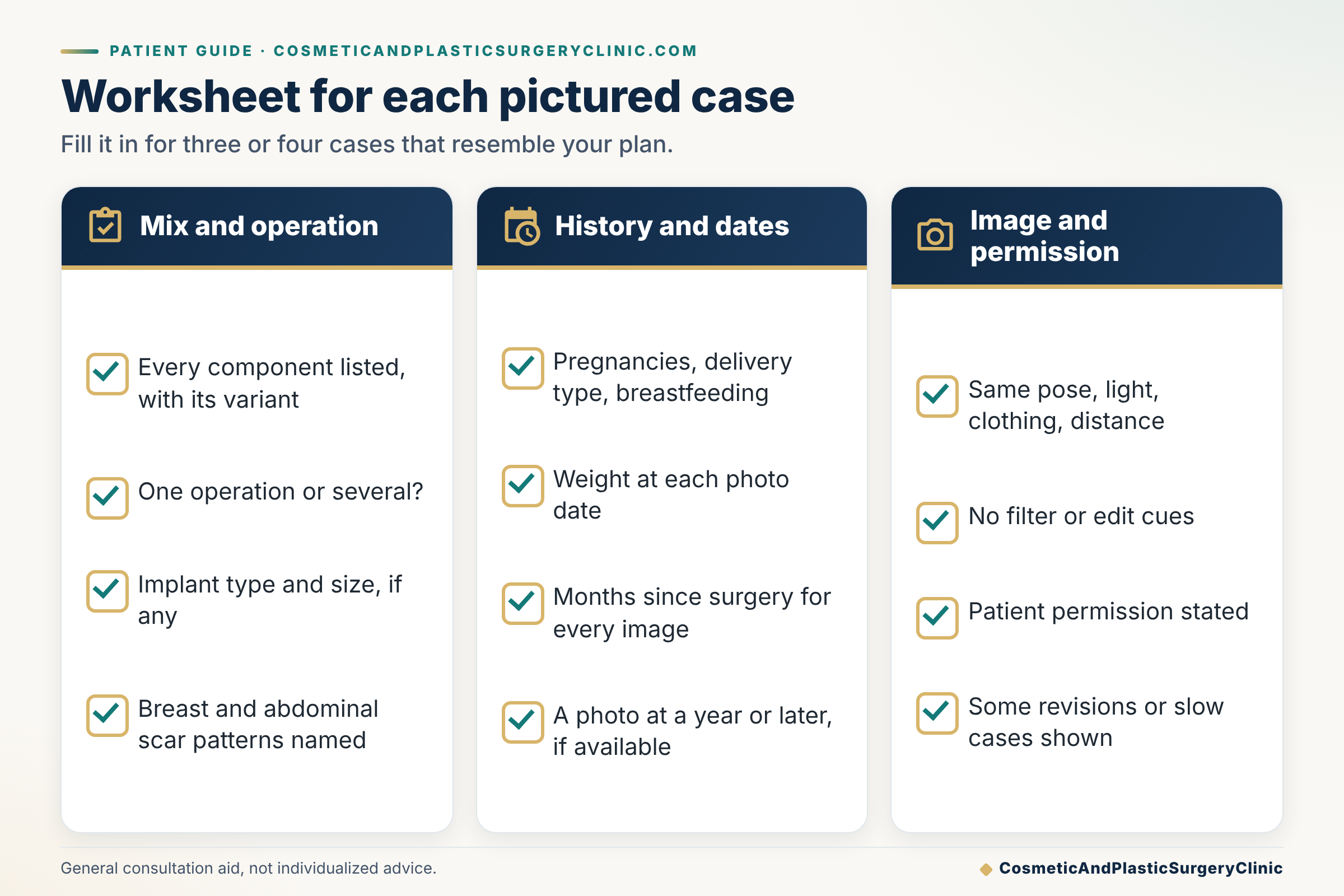
Keep them short and specific, one case per question. The aim is for the surgeon to explain the gap between the pictured case and your own anatomy, not to approve or reject the album.
About the mix and the operation
Which components were performed in this case, and which variant of each? Was it a single operation or a series? What implant type and size, if any? Which incision patterns were used on the breasts and abdomen, and why? How would your plan differ for a body like mine, and would you recommend doing less, doing it in stages, or waiting? These questions also help you judge how the surgeon thinks: clear reasoning matters more than a polished pair.
About the dates, the history and the revisions
How many months after surgery was each picture taken, and do you have the same patient at a year or later? What were the pregnancy and breastfeeding histories in these cases? Did weight change between the pictures? Were any of the pictured cases revised, and what was the reason? The last question is not accusatory. It tells you whether the practice is willing to show the full range, which is the main thing a gallery cannot show on its own.
When the pictures should slow you down
Sometimes the most helpful outcome of a photo review is a reason to wait. Images are persuasive, and a convincing gallery can speed a decision that deserves more time.
Pregnancy plans, weight and recovery capacity
ASPS lists being in overall good health, being at or near ideal body weight, having no plans to become pregnant again and having realistic expectations as traits of good candidates, and says the best way to determine candidacy is an in-person consultation with a qualified, board-certified plastic surgeon. If you are still weighing pregnancy plans, weight changes or the practical load of recovery with small children, the guides to timing after pregnancy and to the weeks of recovery may change how persuasive a gallery feels.
Mommy makeover before and after photos are supporting evidence, not a promise
ASPS states on its mommy makeover results page that the practice of medicine and surgery is not an exact science, that no outcome is assured and that it may not be possible to achieve optimal results with a single operation. It also says there are trade-offs, which most women consider small compared with the improvement in self-confidence. Both statements can be true. Your job, with a gallery in hand, is to understand the trade-offs that apply to your mix, including the risks and the costs, before you decide.
Frequently asked questions
How many mommy makeover before and after photos should I look at before a consultation?
No source sets a number for mommy makeover before and after photos, so aim for fit over volume. Three or four cases that match your planned components, your pregnancy history and a similar follow-up interval will teach you more than dozens of unlabeled images. Bring them on a phone or printed, and ask the surgeon to point out what differs from your anatomy. If the practice cannot show a comparable case, that is information too.
Are social media mommy makeover before and after posts reliable?
They are harder to verify. ASPS advises checking whether photos come from a member’s practice website rather than social media or unverified accounts, and warns that filters and editing distort results. Posts also tend to feature the most dramatic cases. They can show you what exists, but compare them against a gallery from the surgeon you may actually see, and ask for dates and procedure lists.
Why do the breasts and the tummy look finished at different times in mommy makeover before and after photos?
They heal on different schedules. Sources cited here describe abdominal swelling and posture settling over weeks, breast implants and lifts taking several months, and scars changing for a year or longer. A combined case therefore passes through stages where one region looks finished while another does not. Ask for dated pictures of each region.
Can a mommy makeover before and after photo show whether muscle repair was done?
Not directly. Muscle repair works underneath the skin, and in a photo it shows up only as a flatter profile, which liposuction, skin removal or posture could also produce. If a pictured patient had a visible bulge down the middle of the abdomen before, the caption should say whether the midline was tightened. The diastasis recti guide explains what that repair addresses.
Is it a red flag if mommy makeover before and after photos show no faces?
Not by itself. Full-face photographs are among the identifiers HHS lists under HIPAA’s Safe Harbor de-identification method, so cropping the head is a common privacy practice. The more useful questions are whether the patient gave permission, whether the pictures show the whole scar and torso, and whether the dates and procedure lists are given.
Should I trust a “results not typical” note on mommy makeover before and after photos?
Treat it as a reminder, not reassurance. The FTC’s health products guidance says that such a disclaimer does not cure the deception of a testimonial more dramatic than usual, and that a clear statement of the typical result is the remedy. When you see a standout pair, ask the practice what a typical result looks like and how many cases resemble it.
What if my planned mix does not appear in any gallery?
Ask the surgeon why, and whether the combination is usually done together or in stages. Some mixes are rare, some are done in separate operations and some practices simply do not photograph certain areas. Ask for single-component cases that resemble yours and for the surgeon’s reasoning. If you are uneasy, a second opinion is reasonable.
How long after surgery is a mommy makeover before and after photo considered final?
No source gives one date. ASPS says the final results of a mommy makeover may not be apparent for several months, and describes scars improving over time, with fine tummy tuck scars sometimes fading after about a year per Cleveland Clinic. Breasts and bodies continue to change with weight, age and hormones. Use the interval as a range and ask the practice which interval its own galleries use.
Sources and further reading
- American Society of Plastic Surgeons — Mommy Makeover overview (accessed 2026-11-12) — definition, target areas, component procedures, usually one stage
- American Society of Plastic Surgeons — Mommy Makeover before and after photos page (accessed 2026-11-12) — how its gallery cases are labeled
- American Society of Plastic Surgeons — Mommy Makeover procedure page (accessed 2026-11-12) — individualized components, anesthesia choices
- American Society of Plastic Surgeons — Mommy Makeover results (accessed 2026-11-12) — final results after several months, scars, no assured outcome
- American Society of Plastic Surgeons — Are you a good candidate for a mommy makeover? (accessed 2026-11-12) — candidate traits and consultation advice
- American Society of Plastic Surgeons — Breast lift overview (accessed 2026-11-12) — what a lift does and does not change
- American Society of Plastic Surgeons — Breast lift procedure (accessed 2026-11-12) — three incision patterns and scar visibility
- American Society of Plastic Surgeons — Breast lift results (accessed 2026-11-12) — settling, pregnancy and weight effects
- American Society of Plastic Surgeons — Breast augmentation results (accessed 2026-11-12) — early fullness, scar fading, changes over time
- American Society of Plastic Surgeons — Breast augmentation safety (accessed 2026-11-12) — revision and implant lifespan
- American Society of Plastic Surgeons — Tummy tuck results (accessed 2026-11-12) — swelling, upright posture, scars, cesarean scar
- American Society of Plastic Surgeons — Liposuction results (accessed 2026-11-12) — swelling, skin tone limits
- American Society of Plastic Surgeons — Can you trust that transformation? Reading before and after photos in the age of AI (October 13, 2026; accessed 2026-11-12) — pose, lighting, editing cues, source checks
- American Society of Plastic Surgeons — What is reality? Determining if a before-and-after is too good to be true (March 11, 2025; accessed 2026-11-12) — scar and date cues
- American Society of Plastic Surgeons — 2025 plastic surgery by the numbers (accessed 2026-11-12) — procedure counts are not patient counts
- Mayo Clinic — Tummy tuck (abdominoplasty) (accessed 2026-11-12) — scar location, navel, liposuction, binder, stable weight
- Cleveland Clinic — Tummy tuck scar (accessed 2026-11-12) — scar length by variant, fading, revision timing
- U.S. Food and Drug Administration — Risks and complications of breast implants (accessed 2026-11-12) — implants not lifetime devices, reoperation
- Federal Trade Commission — Health products compliance guidance (accessed 2026-11-12) — dramatic testimonials and “not typical” disclaimers
- U.S. Department of Health and Human Services — HIPAA de-identification guidance (accessed 2026-11-12) — full-face photographs as identifiers
- Winocour et al., Plastic and Reconstructive Surgery 2015 — Abdominoplasty: risk factors, complication rates and safety of combined procedures, abstract (accessed 2026-11-12) — complication rates by combination
- News-Medical — Study assesses abdominoplasty complication rates, risk factors (2015; accessed 2026-11-12) — data source and limitations of the Winocour study
- News-Medical — Breastfeeding and breast sagging, shape (2008; accessed 2026-11-12) — report of a 2008 Aesthetic Surgery Journal study of 93 women
- British Journal of Sports Medicine — Sperstad et al. 2016, diastasis recti in pregnancy and postpartum (accessed 2026-11-12) — prevalence at four time points in 300 first-time mothers
- Revista Brasileira de Cirurgia Plastica — Breast region measurements: direct or indirect anthropometry? (2020; accessed 2026-11-12) — photo versus tape measurement