BBL results are easy to misjudge because the first picture and the final picture are different things. BBL (Brazilian butt lift, or gluteal fat grafting) moves fat taken from other areas of the body by liposuction into the buttocks and hips, and the buttocks look larger within days. Much of that early look is swelling, and some of the transferred fat will not survive, so BBL results keep changing for months.
This page is about time and numbers: what a result looks like at each checkpoint, what the published fat-retention figures actually measured, how weight and aging act on transplanted fat, and what to do when a result looks uneven. The procedure itself is covered in the Brazilian butt lift overview, healing logistics in BBL recovery, and the safety evidence in BBL risks. Nothing here predicts your own outcome.
What BBL results are made of: swelling, surviving fat and donor-site change
A BBL result is not one thing that appears on one day. At any checkpoint the mirror shows the sum of fluid, fat that has taken, fat that is still being absorbed and the contour left behind where fat was removed. Separating those layers explains most of the confusion about timelines.
Three layers of change that a mirror cannot separate
Swelling comes first and leaves first
An ISAPS patient article from 2017 says early results are “completely masked by swelling caused by tissue damage.” Research supports the point. In a 2006 MRI series of 10 patients who received an average of about 350 mL of fat, gluteal circumference was larger by roughly 1 to 3 cm two weeks after surgery and had returned to its earlier values by three months. The authors attributed the early rise to postoperative edema that resolved.
A 2019 ultrasound study of 50 women found subcutaneous thickness up by an average of 56.51 percent immediately after surgery. That immediate figure is not the one-year figure, and nobody should use it to judge BBL results.
Fat that survives and fat the body absorbs
ASPS states that some of the fat producing the initial shape will be reabsorbed, and gives an average retention of 60 to 80 percent, with some patients retaining more and others less. A surgeon quoted in a 2022 ASPS article put average fat take at about 60 percent and said surgeons overfill slightly for that reason.
That has a practical meaning. The shape at two weeks includes fat expected to disappear, so BBL results are best described as a share of what was injected that remains once swelling resolves, not as the number of milliliters placed on surgery day.
What BBL results can and cannot change
Projection, proportion and the waist they are measured against
Buttock volume is only part of the visual change. In a 2024 prospective study of 35 women with a body mass index between 18 and 26, the average waist-to-hip ratio moved from 0.78 to 0.74 by the end of follow-up, which reflects added hip and buttock fullness against an unchanged waist. Liposuction at the donor sites contributes as well.
A surgeon quoted by ASPS notes that liposuction results keep evolving while grafted fat stabilizes, and that swelling around liposuction sites can last into months three to six. Donor-site contour therefore belongs in any honest discussion of BBL results; liposuction recovery describes how that area heals.
Loose skin and added volume are separate problems
ASPS describes a gluteal lift as the operation for soft tissue looseness and says it will not make the buttocks larger, while volume is what fat grafting, implants or auto-augmentation add. Fat grafting is therefore a volume tool. No ASPS page opened for this article claims that transferred fat tightens skin, so a plan built on that assumption deserves a direct question at consultation.
For readers whose main issue is a lack of donor fat, BBL vs butt implants compares the other volume route, and BBL candidate covers how surgeons evaluate donor fat and goals.
The first year of BBL results, checkpoint by checkpoint
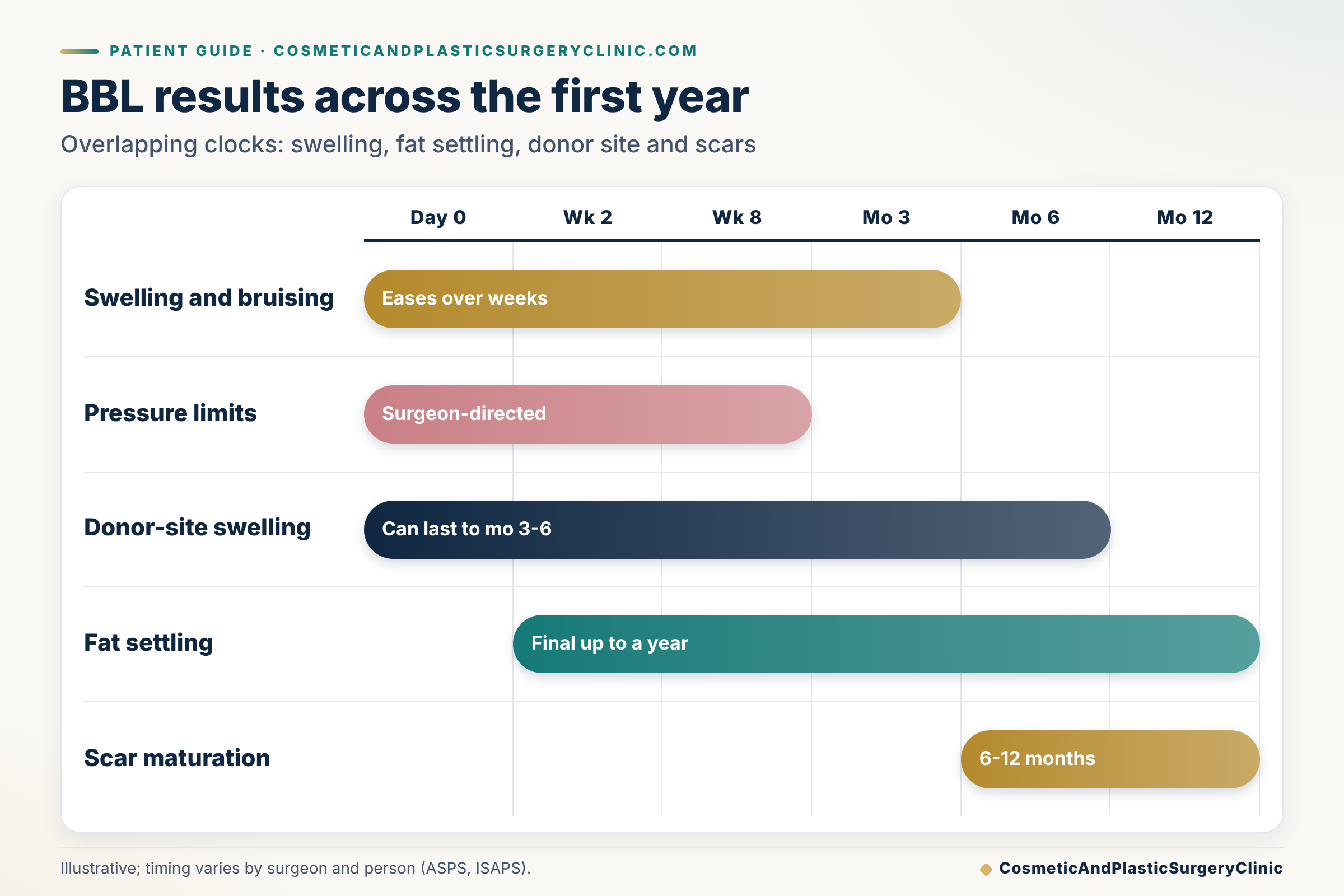
Published timelines disagree by months, partly because they describe different things: when swelling clears, when fat loss slows, when the shape finishes refining and when scars mature. The table lays out the checkpoints in the sources, and the sections after it explain where each comes from.
| Checkpoint | What may be visible | Still changing | Question to ask your surgeon |
|---|---|---|---|
| First two weeks | A larger shape that is largely swelling | Fluid, bruising, fat that has not yet taken | What should I do or avoid to protect the grafted area? |
| Weeks 2 to 8 | Swelling easing as the garment period continues | Swelling at donor sites, graft stabilizing | How long do you want me to limit sitting and wear a garment? |
| About month 3 | Shape surgeons treat as a first indicator of what stays | Further volume loss is still possible | What do you check at this visit to judge fat survival? |
| Months 3 to 6 | Curves becoming more defined | Residual swelling near liposuction areas | Which findings would you wait on before calling any area uneven? |
| About month 6 | Shape that surgeons citing a six-month window treat as near final | Subtle settling; scars may still look red | What do you photograph and measure at this visit? |
| Month 12 | The point ASPS gives for final fat-transfer results | Scar maturation; changes with weight and age | What is your policy if I want an adjustment? |
Weeks 0 to 8: swelling, pressure and a result still in motion
The first two weeks: a shape that is mostly swelling
ASPS says buttock enhancement results are visible almost immediately. One surgeon quoted by ASPS describes mild to moderate pain for the first four to five days, and another says patients may return to work between days 7 and 10. Neither statement says BBL results have reached their final size.
Photographs and measurements taken now mostly record fluid. They are a poor basis for judging BBL results, and a poor basis for deciding that something has gone wrong, unless the change is sudden, one-sided or painful. In that case the surgeon’s office should hear about it, as described in the warning signs below.
Weeks two to eight: why sitting and garment advice belongs in a results discussion
Pressure is the one thing patients can influence. ASPS asks patients to avoid prolonged sitting for about two weeks, with some surgeons preferring longer, and warns that prolonged sitting will damage the fat. A surgeon quoted in the 2022 ASPS recovery article limits sitting to about 10 minutes at a time for six weeks and describes a garment worn nearly around the clock for the first month, then at least 12 hours a day in the second.
The ranges differ because the protocols are set by individual surgeons. The BAAPS recommendations published in 2023 suggest keeping pressure off the grafted area for two weeks and describe themselves as guidelines rather than rules, and none of the pages read for this article cites a trial comparing sitting protocols. ASPS says exercise generally resumes after six to eight weeks. Follow your own surgeon’s written plan, because the protocol shapes how BBL results settle.
Months 3 to 12: when volume is judged
Month three, the checkpoint surgeons name
A March 2022 ASPS article quotes the society’s president at the time saying that around month three the risk of losing fat drops off, and that the buttocks’ appearance then becomes a “pretty good indicator of what’s going to stay there.” That is an expert impression, not a measurement, and it is worth reading beside the data on BBL results.
In the 2024 study of 35 women, three-dimensional imaging put fat retention at 77.9 percent at three months and 64.7 percent at six months. Measured loss in that group continued after the month-three mark. A month-three visit is therefore a fair moment to take stock of BBL results, not a moment when every change has stopped.
Months six to twelve: refinement, scars and the one-year mark
A surgeon quoted by ASPS expects the shape to refine between months three and six, with the curve becoming more apparent. ISAPS has said it can take upwards of six months to see final results, and ASPS says up to a year after fat transfer. These are not contradictions so much as different definitions of final BBL results.
Scars follow their own clock. ASPS reporting from June 2026 describes scar maturation as a process of roughly six months to a year, with redness fading over that period. A 2019 ultrasound study measured subcutaneous thickness at 12 months and reported it down by an average of 18.16 percent; the abstract does not spell out the baseline for that percentage. Either way, a one-year photograph is a fairer benchmark than a six-week one.
Why published timelines and numbers disagree
Different yardsticks: tape measure, ultrasound, 3D volume and photographs
Studies of BBL results do not share a ruler. The 2006 series used MRI and a tape measure, the 2019 series used ultrasound thickness, and the 2024 series used three-dimensional imaging plus ultrasound. Inside that 2024 study the two methods disagree: 3D imaging gave 64.7 percent retention at six months while ultrasound thickness had fallen 15.1 percent.
Neither is wrong. They measure different quantities, which is why one retention figure cannot be set beside another without asking what was measured. Even large series can lean on photographs: a 2024 series of 1,815 patients reported efficacy only through before-and-after photos, with no quantitative measure.
Different eras, samples and follow-up lengths
The MRI series enrolled 10 patients in 2003 and 2004, before the safety guidance of 2018 to 2022, and its abstract does not say which tissue plane was used. The ultrasound study had 50 patients and the 3D study 35, treated by one surgeon with a median follow-up of six months.
Whether older retention figures carry over to today’s subcutaneous-only practice is not something these abstracts settle. A 2024 analysis of the 100 most-cited gluteal augmentation papers found 55 at the lowest evidence level and one at the highest, and only 20 used patient-reported outcome measures. Treat every number on this page as a range of experiences, not a forecast.
How much fat stays: what the BBL results percentages measure
Retention is the number patients ask about most when they research BBL results, and the sources answer it with three different kinds of evidence: society statements, small measured studies and a general fat grafting review. They overlap, but they are not interchangeable.
The figures in circulation and what each one measured
Society and surgeon statements
For BBL results, ASPS gives an average retention of 60 to 80 percent for fat grafting to the buttocks. A surgeon quoted in a 2022 ASPS article estimated that 20 to 40 percent of injected fat is absorbed during healing, which is the same range expressed the other way, and a second surgeon in that series said about 60 percent survives.
These are statements from clinicians, and the pages do not cite the dataset behind them. They are useful as a planning range and weak as evidence, particularly because surgeons also overfill slightly to offset the expected loss, as noted earlier.
Measured studies, side by side
The table lists the measured studies found for this article. Each is small, most are single-surgeon, and only the general fat grafting review reaches beyond the buttocks.
| Source and year | What was measured | Reported figure | Main limit |
|---|---|---|---|
| Wolf et al., 2006 | MRI at 3 months in 10 patients; about 350 mL injected | Calculated reabsorption 24 to 36 percent | Enrolled 2003 to 2004; 3-month follow-up; plane not stated in the abstract |
| Cansancao et al., 2019 | Ultrasound thickness in 50 women, subcutaneous-only grafting | Thickness down an average 18.16 percent at 12 months | Thickness is not volume; Level IV evidence |
| Wang, He and Zhao, 2024 | 3D imaging and ultrasound in 35 women, BMI 18 to 26 | Retention 77.9 percent at 3 months, 64.7 percent at 6 months | One surgeon; median follow-up 6 months; weight change over 5 percent excluded |
| Gause et al., 2014 review | Fat grafting in general, many sites and animal models | Reported retention 20 to 80 percent at one year | Not buttock-specific; authors call the evidence sparse |

What shapes retention for one person
How the fat is handled and where it is placed
The Gause review looked at harvest technique, cannula size, suction pressure and processing in fat grafting generally. It concluded that current evidence supports excisional harvest and larger-bore cannulas to limit cell damage, while stating that the ideal harvest method and particle size are not known. Much of the work it covers is in animal models with short follow-up.
None of that translates into a rule for one person’s BBL results. It does explain why two surgeons using different harvest and processing steps can report different retention, and why asking how your fat will be collected and handled is a fair question rather than a technical aside.
Body, habits and what research has not isolated
Nicotine is the one modifiable factor the sources address. MedlinePlus says smoking decreases the oxygen that reaches cells in a surgical wound and that most providers advise stopping at least four weeks before surgery. BAAPS recommends no smoking for four weeks before and after gluteal fat grafting. How much smoking changes fat survival specifically is not quantified in the pages read.
In the pages read, the same gap applies to body mass index, injected volume and age. The 2024 study above excluded anyone whose weight changed by more than 5 percent during follow-up, a sign that researchers treat weight change as a confounder. No source opened for this article gives an individual a retention number.
BBL results after the first year: weight, aging and life events
The retention conversation ends at about a year, but BBL results keep changing afterward. The longer question is how the buttocks behave afterward, and the sources are consistent on one principle: grafted fat behaves like fat elsewhere in the body.
Weight gain and weight loss
When weight goes up
For BBL results after year one, ASPS states that transferred fat can behave like any other fat, and that if you gain weight the fat in the buttocks may grow. A 2023 systematic review of facial fat grafting found six clinical studies, all reporting poor cosmetic outcomes from fat that grew out of proportion after weight gain, and noted that fat keeps characteristics of its original donor site.
That review concerns the face, and no equivalent buttock study was found, so it shows a mechanism rather than a prediction. It does support asking where fat will be harvested and how weight gain would be expected to change the result.
When weight goes down
ASPS says losing weight may reduce buttock volume as the fat shrinks. The liposuction donor areas follow the same principle: ASPS says liposuction results are long lasting provided weight and fitness remain steady.
For readers planning significant weight loss, the practical point is order of operations. No source reviewed quantifies how much volume would shrink, and that uncertainty is one reason surgeons ask about weight stability before surgery. Surgeons ask about weight stability for the same reason.
| Factor | Effect described in sources | Maintenance or revision implication | Review point |
|---|---|---|---|
| Weight gain | Grafted fat may grow, like other body fat | Shape can change in ways surgery did not plan for | Discuss harvest site and expected change before surgery |
| Weight loss | Buttock volume may shrink as fat shrinks | Restoring lost volume would be a new surgical decision | Weigh stability before booking |
| Aging | Size and shape continue to change with aging and gravity | Gradual change is expected, not a complication | Compare to your own year-one photographs |
| Nicotine | Less oxygen reaches healing tissue | BAAPS advises stopping four weeks before and after | Tell the surgeon about every nicotine product |
| Pregnancy | BAAPS lists it as a contraindication at the time of surgery; later effect not studied in sources read | Unknown; plan timing with your surgeon | Ask what is known and what is not |
Aging, pregnancy and the limits of the evidence
Aging and gravity
ASPS says that over time the buttock’s size and shape can continue to change because of aging and gravity, that some firmness is naturally lost, and that most of the initial improvement should remain if weight and fitness are maintained. That sentence appears on the page for buttock augmentation and lift in general rather than for fat transfer alone.
The honest expectation for BBL results at five or ten years is gradual change, not a fixed outcome, and the sources give no measured BBL data at those distances.
Pregnancy, medications and time horizons beyond two years
The follow-up periods in the studies read here run from three months to two years. Beyond that, expectations rest on general fat behavior and expert statements. No study among the sources reviewed describes buttock volume after pregnancy, after starting or stopping weight-affecting medications, or after menopause.
That is not a reason for alarm, only a reason to treat any precise description of BBL results at year ten as extrapolation. Someone who may become pregnant, or who is changing medications that affect weight, should raise it at consultation.
When BBL results look uneven: asymmetry, firm areas and the second-look decision
Most of what disappoints people about BBL results is not a dramatic complication. It is a side that looks fuller, a dip that was not there before, or a firm spot under the skin. The sources describe how often these appear and, just as important, how little certainty exists about when to act.
What the literature reports about shape and texture problems
Asymmetry and contour irregularity: reported frequencies
A 2025 cohort of 114 women, treated with an average of 745 mL into the buttocks and hips and followed with ultrasound, reported asymmetry in 5 percent and contour irregularities in 2 percent. It was a single private practice that excluded smokers, with six months of follow-up. ASPS lists asymmetries, fat necrosis, poor wound healing and the possible need for revisionary surgery among buttock enhancement risks.
A 2025 meta-analysis pooled four observational studies covering 6,235 women and put minor complications at 6.32 per 100 patients, with a wide confidence interval of 3.23 to 10.27. Its authors rated all four studies at serious risk of bias and found high heterogeneity, so the pooled figure is imprecise and says little about any one person.
Firm lumps, oil cysts and fluid pockets
Cleveland Clinic describes fat necrosis as fat tissue that dies after losing its blood supply, often as a firm lump that may not hurt. It can appear months or years after surgery, and usually resolves without treatment, although that can take months to years. In the 2025 cohort above, 7 fat cysts and 1 area of necrosis accounted for the 8 minor complications, and two cysts were still present at six months.
A 2024 chart review of 1,815 patients reported fat necrosis in 0.3 percent and seroma in 1.2 percent. The rates differ, and the sources do not say why; the groups, definitions and how closely patients were scanned all differ. Cleveland Clinic says a seroma usually appears seven to 10 days after surgery and that larger ones can take up to six weeks to resolve.

| Situation | Pathway surgeons describe | Trade-off | Key question |
|---|---|---|---|
| One side looks fuller in the first weeks | Watch as swelling resolves; report a sudden or painful change | Reassurance may be premature if the change is not swelling | What difference would make you want to see me sooner? |
| Firm lump under the skin | Examination, observation, sometimes drainage or removal | Many resolve slowly; a lump that grows or hurts needs review | When should I call about a lump? |
| Fluid pocket (seroma) | Observation or needle drainage by the surgeon | Repeat drainage and infection checks may be needed | Who treats this, and where, if I am traveling? |
| Dips or irregularity after swelling settles | Wait for settling, then discuss adding or smoothing | Another anesthetic and recovery period | What does a revision cost and who pays? |
| Volume smaller than hoped at 12 months | Reassess against year-one photos; consider a second graft or an implant | Added risk, added cost, uncertain retention again | What would be different the second time? |
| Wish for a smaller result | Liposuction-based reduction, sometimes with skin tightening | Evidence is single-center and short term | How many reductions have you performed? |
Waiting, revising, reducing or leaving it alone
How long surgeons ask people to wait before judging a revision
An ASPS recovery article quotes a surgeon saying some patients have a second BBL to correct irregularities or asymmetry, or to seek more volume. ASPS also says it may not be possible to reach optimal results with a single procedure and that another surgery may be needed. None of the pages read gives a universal waiting period.
The checkpoints above suggest why: swelling resolves over weeks, fat settles by months three to six and ASPS gives a year for final fat-transfer results. A decision to revise belongs with the surgeon who examined the area after that settling. Revision BBL covers options and the records to bring, and BBL cost explains how revision policy appears on a quote.
Reduction and reversal requests
A 2025 single-surgeon review followed 123 patients who had buttock reduction or revision with liposuction between 2018 and 2023. Patients cited excess fat placement, poor shape, weight gain since the BBL and social pressure for a smaller shape, and the authors noted a rise in requests after 2020. About 75.7 percent were satisfied, 12 percent returned for additional liposuction or skin tightening, and follow-up ran from three to 24 months.
ASPS estimates 25,662 buttock augmentations with fat grafting in 2025, down 5 percent from 27,059 in 2024, extrapolated from member and claims data. Popularity is not satisfaction, and a falling count is not a verdict on any outcome; both are context for the reader who feels pressure to follow a trend.
Judging promises about BBL results, and the safety context behind them
Every claim about BBL results is made inside a safety record that the plastic surgery societies have publicly called serious. That context does not make a good result impossible. It does change what a surgeon’s promise is worth when the surgeon cannot explain how the fat will be placed.
Reading a promise about BBL results
A photo is one case, not a forecast
The Federal Trade Commission’s 2022 health products guidance says testimonials reporting results more dramatic than users can generally expect are likely to be deceptive, and that a “results not typical” disclaimer does not cure the problem. A gallery picture is evidence that one outcome happened.
Reading angles, timing and editing is its own skill; BBL before and after teaches it for this procedure, and before and after photos covers the general rules on consent and advertising. Ask for pictures taken at the same time point you will be judged, preferably twelve months.
Injected shortcuts that promise volume
In 2017 the FDA warned that injectable silicone for body contouring is unapproved, and that some people seeking larger buttocks were told they were getting an FDA-approved filler. The agency said injected silicone can migrate, with risks including blocked blood vessels, infection and death, often given by unlicensed practitioners in homes or hotels.
That is a different category from regulated treatments. If a nonsurgical route interests you, BBL vs Sculptra butt lift compares one filler-based approach with surgery, and the question to settle before any injection is what the product is, who may inject it and what its label says.
Safety is part of the result
What the societies have said, and why the numbers vary
A 2018 multisociety release said mortality could be as high as 1 in 3,000, far above other cosmetic surgery, and counted about 20,300 buttock augmentations with fat in 2017. A 2022 ASPS interview cited about 1 in 15,000, and BAAPS authors in 2023 called an earlier 1 in 2,351 estimate potentially misleading. Estimates differ in method and period, so none should be read as your personal risk.
The August 2022 joint statement from ASPS, the Plastic Surgery Foundation, the Aesthetic Society and ASERF supported placing fat only in the subcutaneous space and real-time ultrasound. Florida’s rule, last amended in September 2024, prohibits intramuscular injection. BBL risks covers the evidence in depth.
Who performs it, where, and who follows up
The American Board of Plastic Surgery offers a public tool to verify certification, and the 2022 joint statement says office-based gluteal fat grafting should be performed only by surgeons with privileges at a licensed ambulatory surgery center or hospital, and that surgeons should remain available for complications whether the patient is local or traveled.
For travelers, CDC advises delaying air travel 10 to 14 days after major surgery, warns that flying can raise clot risk and notes that follow-up care for complications may be costly. Choose a plastic surgeon gives the verification steps and medical tourism surgery covers the travel trade-offs.
Deciding whether BBL results fit your goals
Questions that turn a results promise into something checkable
These questions work at plastic surgery consultation because each has an answer that can be compared between surgeons:
- How do you define and measure fat retention, and what range do you see at one year in comparable patients?
- Do you use ultrasound during injection, and in which steps?
- What overfill, if any, do you plan, and what happens if the result is larger than expected?
- When do you judge the result, and what do you photograph at that visit?
- What would a revision cost, who performs it and what does my contract say?
- What do you expect if my weight changes by 10 percent?
A surgeon who cannot answer the first two plainly has told you something. A written answer to the last two is worth more than a verbal one.
Waiting, alternatives and the body-image check
ASPS advises that the decision be made for yourself rather than to fulfill someone else’s desires or to fit an ideal image. Mayo Clinic describes body dysmorphic disorder as preoccupation with a perceived flaw that others cannot see or find minor, and lists seeking many cosmetic procedures with little satisfaction as a sign; it advises speaking to a health or mental health professional.
That is not a screening tool, only a reason to pause when dissatisfaction seems to move after each change. Waiting, a second opinion, a different procedure or no procedure all remain reasonable. Plastic surgery offers a wider decision framework.
Frequently asked questions
Can BBL results look worse at week three than at week one?
They can look different. Early volume includes fluid, and in the 2006 MRI series gluteal circumference was larger at two weeks and back to earlier values by three months. As swelling resolves, the buttocks can look smaller or flatter even when the fat is surviving as expected. Compare photographs at the same time point and angle, and ask your surgeon which changes are expected and which would prompt a call.
Is a size difference between sides normal in early BBL results?
Mild differences are common while swelling resolves, but the sources do not define a normal difference. A change that is sudden, grows, is painful, or comes with fever, drainage or discoloration needs prompt attention from the surgical team. A difference that persists after the swelling phase belongs in the revision discussion, which depends on the surgeon’s examination and the checkpoints in the timeline above. Photographs taken at the same angle each week make the comparison easier to describe by phone or at a visit.
Do BBL results change with exercise or muscle building?
No source read for this article measured that. ASPS says exercise generally resumes after six to eight weeks, and your surgeon sets the actual plan for your case. Muscle beneath the fat would be a separate tissue from the graft, but how it changes the shape over years has not been studied in the pages opened. Ask what activities your surgeon expects you to resume and when, and what sitting or pressure limits still apply during that period.
Should I trust a surgeon’s quoted percentage for BBL results?
Treat it as a starting question. The published figures range from about 60 to 80 percent average retention to 24 to 36 percent reabsorption at three months, and they come from different measures. Ask how the surgeon measures retention, at what time point, in how many comparable patients and whether the numbers are recorded or recalled. A precise number with no method is less informative than a range with one.
Does ultrasound guidance change how long BBL results last?
The evidence read here relates ultrasound to safety, not to retention. The 2024 and 2019 studies used ultrasound to measure results and reported retention or thickness changes, but none of the sources compared guided and unguided grafting for volume. The 2022 joint statement supports real-time ultrasound to help place fat in the intended plane. Ask whether your surgeon uses it, during which steps, and why it matters to your safety rather than to your final size.
Does where the fat is taken from affect how BBL results age?
For the face, a 2023 systematic review found that grafted fat can keep characteristics of its donor site and overgrow with weight gain. No buttock-specific study was found, so it is not known how much this applies to a BBL. The practical step is to ask where fat will be harvested, how that was chosen and what the surgeon expects if your weight changes later. A surgeon who has thought about it will usually explain the reasoning in plain terms.
What happens to BBL results if a second procedure is needed?
A second BBL, a smoothing procedure or a reduction is another operation with its own anesthetic, healing period and cost, and retention is uncertain again. ASPS says another surgery may be necessary in some cases. Ask before the first operation how revisions are priced and who performs them, and read the contract for what is covered. Ask also whether a revision is performed at the same facility, whether new anesthesia fees apply and how long you would wait between operations.
Sources and further reading
- American Society of Plastic Surgeons — Buttock enhancement procedure (accessed 2026-11-12) — 60 to 80 percent average retention, final results at a year, weight change
- ASPS — Buttock enhancement results (accessed 2026-11-12) — settling times, reabsorption, aging, possible need for further surgery
- ASPS — Buttock enhancement recovery (accessed 2026-11-12) — sitting, garment and exercise guidance; urgent symptoms
- ASPS — Buttock enhancement candidates (accessed 2026-11-12) — motivation and realistic expectations
- ASPS — Buttock enhancement risks and safety (accessed 2026-11-12) — asymmetry, fat necrosis, seroma and revision listed as risks
- ASPS — Buttock enhancement overview (accessed 2026-11-12) — lift versus volume routes
- ASPS news — Seven things you need to know about a Brazilian butt lift (Mar. 28, 2022; accessed 2026-11-12) — 20 to 40 percent absorption, month three, mortality estimates
- ASPS news — Six things you need to know about recovering from a Brazilian butt lift (Aug. 11, 2022; accessed 2026-11-12) — fat take, overfill, garment and sitting protocols, second procedures
- ASPS — Societies issue urgent warning about Brazilian butt lifts (Aug. 6, 2018; accessed 2026-11-12) — mortality estimate and 2017 procedure count
- ASPS, PSF, Aesthetic Society and ASERF — Joint safety statement on gluteal fat grafting (Aug. 18, 2022; accessed 2026-11-12) — subcutaneous placement, ultrasound, facility and follow-up positions
- ASPS — Plastic surgery statistics report 2025 (accessed 2026-11-12) — 25,662 procedures in 2025 versus 27,059 in 2024
- ASPS news — What to expect as a scar heals following plastic surgery (June 5, 2026; accessed 2026-11-12) — scar maturation timing
- ASPS — Liposuction results (accessed 2026-11-12) — donor-site results and weight stability
- ISAPS — Brazilian butt lift recovery tips (Sept. 4, 2017; accessed 2026-11-12) — swelling masking early results, six-month timing, garment and sitting guidance
- Wolf et al. — Magnetic resonance imaging assessment of gluteal fat grafts, Aesthetic Plastic Surgery (2006; accessed 2026-11-12) — 10-patient MRI series, circumference and reabsorption
- Cansancao et al. — Subcutaneous-only gluteal fat grafting: long-term results with ultrasound analysis, Plastic and Reconstructive Surgery (2019; accessed 2026-11-12) — thickness change at 12 months (catalog record of the abstract)
- Wang, He and Zhao — B-ultrasound-assisted gluteal fat grafting in Asians, Journal of Plastic, Reconstructive and Aesthetic Surgery (2024; accessed 2026-11-12) — 3D retention, ultrasound thickness, waist-to-hip ratio
- Gause et al. — Particle size in fat graft retention, Adipocyte (2014; accessed 2026-11-12) — 20 to 80 percent retention at one year; harvest and processing evidence
- Vidal-Laureano et al. — Ultrasound-guided gluteal fat transfer, 1,815 patients, Aesthetic Surgery Journal (2024; accessed 2026-11-12) — complication rates; efficacy shown by photographs
- Milani Reis et al. — Ultrasound-guided gluteal fat grafting meta-analysis, Aesthetic Surgery Journal (2025; accessed 2026-11-12) — pooled minor complications and risk of bias
- Durán Vega et al. — Linear retrograde infiltration technique for buttock fat infiltration, Aesthetic Surgery Journal (2025; accessed 2026-11-12) — asymmetry, irregularity and cyst rates
- Daneshi et al. — Bibliometric analysis of the top 100 papers on gluteoplasty, Aesthetic Surgery Journal Open Forum (2024; accessed 2026-11-12) — evidence levels and patient-reported measures
- Okoro and Lamb — Brazilian butt lift reversal and buttock reduction, Aesthetic Surgery Journal Open Forum (2025; accessed 2026-11-12) — reduction reasons, satisfaction and follow-up
- Tillo, Nassab and Pacifico — BAAPS gluteal fat grafting safety review, Aesthetic Surgery Journal (2023; accessed 2026-11-12) — smoking, pressure, subcutaneous placement and mortality-estimate commentary
- PubMed record 37350541 — systematic review of weight gain and facial fat hypertrophy after grafting (2023; accessed 2026-11-12) — six studies; donor-site characteristics and overgrowth
- Cleveland Clinic — Fat necrosis (accessed 2026-11-12) — appearance, timing and resolution
- Cleveland Clinic — Seroma (accessed 2026-11-12) — onset and duration
- Centers for Disease Control and Prevention — About venous thromboembolism (accessed 2026-11-12) — clot symptoms and urgent care
- CDC Travelers’ Health — Medical tourism (accessed 2026-11-12) — flying after surgery, follow-up care
- MedlinePlus — Smoking and surgery (accessed 2026-11-12) — oxygen delivery to wounds and quitting timelines
- Federal Trade Commission — Health products compliance guidance (Dec. 20, 2022; accessed 2026-11-12) — atypical-result testimonials
- U.S. Food and Drug Administration — FDA warns about illegal use of injectable silicone for body contouring (Nov. 13, 2017; accessed 2026-11-12) — unapproved silicone injections
- Florida Administrative Code Rule 64B8-9.009 via Cornell LII (accessed 2026-11-12) — subcutaneous-only rule and amendment history
- Mayo Clinic — Body dysmorphic disorder (accessed 2026-11-12) — preoccupation and repeated cosmetic procedures
- American Board of Plastic Surgery — Verify certification (accessed 2026-11-12) — certification lookup