BBL vs butt implants is a choice between two different materials, two different surgical routes and two different kinds of risk. A BBL (Brazilian butt lift, or gluteal fat grafting) takes fat from your own abdomen, flanks or thighs by liposuction and injects part of it into the layer just under the skin of the buttocks. Butt implants are solid silicone devices placed through an incision, in a pocket in or above the gluteal muscle, and they add a fixed amount of volume.
This page compares BBL vs butt implants on what each can add, how their complications differ, recovery, upkeep, cost and the situations in which a surgeon might raise one before the other. The BBL side carries a documented fat-embolism risk that shaped society guidance from 2018 onward, so it is treated plainly here. The full procedure is described in the Brazilian butt lift overview. Nothing below says which option, if either, suits your body.

BBL vs butt implants starts with what each can actually add
What a BBL adds: contour from your own tissue
Fat as the raw material in a BBL vs butt implants decision
The American Society of Plastic Surgeons (ASPS) describes the fat-transfer route in three steps. Liposuction through small incisions loosens and removes fat, the fat is processed and loaded into syringes, and it is placed through a special cannula in many small injections across the buttocks. ASPS adds that a surgeon may remove up to three times the fat that will be injected, so the harvest is larger than the graft. The liposuction page covers the harvest step.
Placement matters more than volume. A 2018 multi-society task force advisory states that fat should go only into the subcutaneous tissue, never into the muscle. One literature review by Oranges and colleagues (Aesthetic Surgery Journal, 2017) also notes that fat can be placed in the lateral third of the buttock, while implants mainly reshape the medial two-thirds. That difference is why width and hip shape often steer the BBL vs butt implants conversation.
Where fat grafting runs out of room in BBL vs butt implants
Not all injected fat stays. The 2017 Oranges review cites a long-term survival of roughly 50% to 75% in one series of 556 patients, and a 2026 WebMD page reviewed by a physician gives the same range. The surviving share varies, so the early swelled shape is not the final one. The subcutaneous layer also holds only so much, and the British Association of Aesthetic Plastic Surgeons (BAAPS) advises considering a staged operation rather than injecting deeper when a goal needs more fat than that layer can take.
Fat grafting does not tighten loose skin, according to the same WebMD page. Settled volume is the subject of the BBL results article. Anyone weighing BBL vs butt implants should treat a quoted “take” figure as a range from group data, not a promise for one body.
What butt implants add: fixed volume in a pocket
How the device sits: planes, incisions and implant type
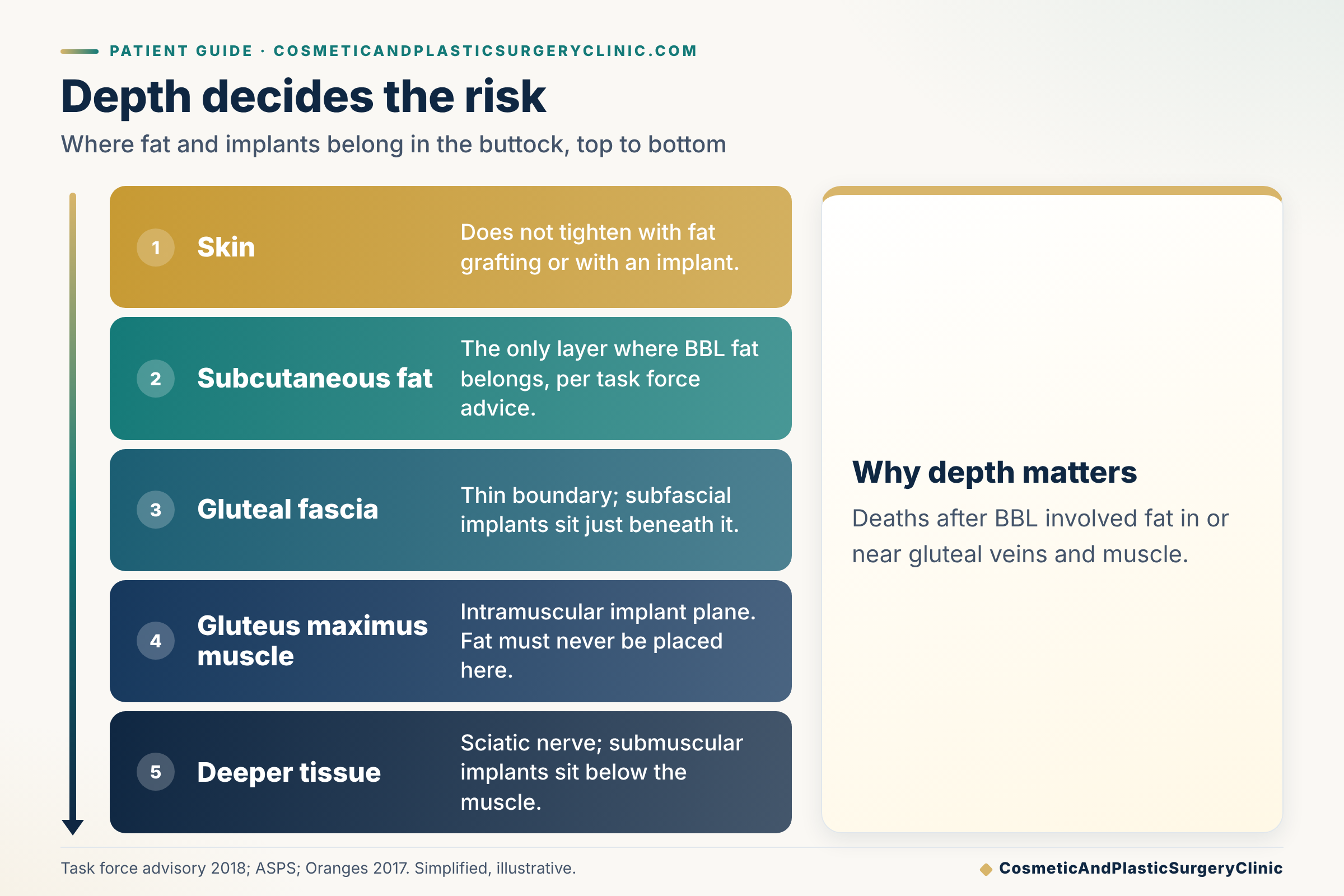
ASPS says a silicone implant is placed either in the muscle or above the muscle on each side, through an incision at the top of the buttocks, in the lower creases, between the cheeks or down the center. Oranges and colleagues describe four planes relative to the gluteus maximus: subcutaneous, subfascial, intramuscular and submuscular. Cleveland Clinic and WebMD both note a trade-off: inside the muscle lowers the chance of sciatic nerve injury but the implant may show more, while below the muscle looks more natural and carries more nerve risk.
Implants in this field are usually solid silicone. A 2025 case-study article by plastic surgeon Barry Eppley states that gel implants approved for the breast are used off-label in the buttock and are unlikely to be approved for it in the United States. That is one author’s characterization, not an FDA document, but it explains why “which implant, exactly” belongs on the question list for BBL vs butt implants.
The pocket itself is still debated. A 2013 review of 30 articles (Flores-Lima and colleagues, Aesthetic Plastic Surgery) reported the lowest complication rate for one intramuscular method (13.18%) and the highest for the subfascial plane (54.84%), while Senderoff’s 2011 series of 200 patients found no significant difference between planes. Pooled figures like these mix surgeons, eras and definitions, so they describe the literature more than any one operating room.
Where implants fall short in BBL vs butt implants
An implant adds the same volume wherever it sits, and it does not recruit the sides. Cleveland Clinic lists poor candidates as people who cannot stop smoking around surgery, whose weight changes often, who have excess sagging skin or who want a quick fix. It lists good candidates as people with too little body fat for a BBL and a flat or square profile. Oranges and colleagues describe ideal implant candidates as having moderate sagging and asymmetries that do not involve the lateral buttocks.
A device also needs enough overlying tissue to cover it, and a surgeon, not a web page, judges that. For a nonsurgical middle route, the BBL vs Sculptra butt lift comparison covers injectable collagen stimulation. Table 1 puts the surgical pair side by side.
| Factor | BBL (fat grafting) | Butt implants |
|---|---|---|
| What it adds | Your own processed fat in the subcutaneous layer; can reach the sides | Fixed-volume solid silicone device; mainly the central two-thirds |
| Indication | Enough donor fat to harvest; shape and width goals | Little donor fat; flat profile; asymmetry correction |
| Invasiveness | Liposuction at donor sites plus many injection points | One or more incisions and a pocket in or above muscle |
| Reversibility | Surviving fat cannot be removed like a device; revision means more grafting or liposuction | Device can be removed or replaced, which is another operation |
| Scars and downtime | Small scattered incisions; sitting limits of about two weeks or longer | Incision in or near the cleft; sitting limits of two to three weeks |
| Main risks | Fat embolism if fat enters muscle or veins; irregularity; fat loss | Wound opening, seroma, infection, shifting, sciatic nerve pain |
| Cost logic | Surgeon fee plus liposuction, ultrasound, facility, anesthesia | Surgeon fee plus device, facility, anesthesia |
BBL vs butt implants safety: a rare fatal mechanism and common wound problems
The BBL concern: fat embolism and why depth matters
How a BBL can turn fatal, and what the task force advised
The multi-society Task Force for Safety in Gluteal Fat Grafting, formed in 2018 by ASPS, the Aesthetic Society, ISAPS and two other groups, described the cause in its July 2018 advisory. Deaths were uniformly from fat embolism: fat entering the venous circulation after injury to the gluteal veins. At autopsy, fat was found within the gluteal muscle in every patient who died, and none of the reviewed deaths involved fat only in the subcutaneous plane. Its first recommendation was that fat never be placed in the muscle.
The advisory also asked surgeons to discuss the risk of death and to name alternatives, specifically gluteal implants or autologous flap augmentation. That line matters for BBL vs butt implants, because it means a fully informed BBL consultation should include the implant option. The task force noted that no published series of intramuscular injection was large enough to show it could be done without embolism risk. The BBL risks article covers the mechanism and the guidance in more depth.
Mortality estimates over time, and how to read them
An August 2018 ASPS press release said BBL mortality was “estimated to be as high as 1:3,000,” higher than any other cosmetic operation, and reported about 20,300 fat-graft buttock augmentations in 2017. Earlier, a 2017 task force survey estimated 1:2,351 and 1:6,214, with a 14% response rate, according to a 2020 editorial by Rohrich and colleagues. That editorial reports a May 2019 survey of two societies’ members covering the 24 months after the recommendations, with a rate of 1:14,921.
BAAPS reviewed these figures in September 2022 and concluded that mortality from superficial buttock fat grafting appears similar to abdominoplasty. Every one of these numbers comes from a voluntary survey or an extrapolation, and the four societies’ own August 2022 statement says statistics are hard to obtain and that fat-embolism deaths were still occurring “with disturbing frequency.” A falling estimate is encouraging for BBL vs butt implants comparisons. It is not zero, and it depends on the guidance being followed in the room where you would be treated.
The implant concern: wounds, fluid and hardware
What pooled reviews count for implants and for fat
A 2016 systematic review in Plastic and Reconstructive Surgery covered 44 articles on BBL vs butt implants outcomes. It found an overall complication rate of 21.6% among 2,375 silicone-implant patients, led by wound dehiscence (9.6%), seroma (4.6%), infection (1.9%) and temporary sciatic tingling or numbness (1.0%). Among 3,567 fat-injection patients it found 9.9%, led by seroma (3.5%), undercorrection (2.2%), infection (2.0%) and pain along the sciatic nerve (1.7%).
The 2017 Oranges review pooled 52 studies and 7,834 patients and reported 30.5% for implants and 10.5% for fat grafting. A 2019 meta-analysis led by Asserson, covering 46 articles and 4,362 patients, reported 31.4% for implants and 6.8% for fat. All three point the same direction. The authors of the 2019 paper add that anatomy can leave only one option for some people, so a lower rate in a pooled group is not a ruling on any single body.
Why a lower count does not settle BBL vs butt implants
These reviews count events, not severity. Delayed wound healing that closes with dressings and a death from fat embolism both enter a tally as one event, if they enter it at all. The 2017 review found fat embolism in 0.2% of fat-grafting cases with one death, a figure far below the society estimates above, which may mean that published case series capture rare events poorly. A complication percentage is also only as good as its follow-up and definitions.
Single-surgeon series show how much technique moves the numbers. In a 2011 chart review of 200 patients and 400 implants, Senderoff reported seroma in 28% and reoperation in 13% over a mean three years. A 2023 series of 175 cases with a dual-plane pocket reported complications in 7.43%. A 2024 review by Kazmouz and colleagues found 16.6% per implant with a single incision against 6.6% with two. Table 2 sets these beside the reviews.
| Source | What it covered | Implants | Fat grafting | Caution |
|---|---|---|---|---|
| Systematic review, Plastic and Reconstructive Surgery, 2016 | 44 articles; 2,375 implant and 3,567 fat patients | 21.6% overall complications | 9.9% overall complications | Satisfaction could not be compared; studies defined outcomes differently |
| Oranges et al., Aesthetic Surgery Journal, 2017 | 52 studies, 7,834 patients, 1969 to 2015 | 30.5% overall | 10.5% overall; embolism 0.2%, one death | No statistical comparison between techniques; published series only |
| Asserson et al., 2019 meta-analysis | 46 articles, 4,362 patients, 1992 to 2017 | 31.4% overall | 6.8% overall | Local flaps were 23.1%; anatomy can limit the choice |
| Senderoff, Aesthetic Surgery Journal, 2011 | One surgeon; 200 patients; mean 3-year follow-up | Seroma 28%; infection 6.5%; reoperation 13% | Not studied | Retrospective; implants only; no significant difference by plane |
| Kazmouz et al., Aesthetic Plastic Surgery, 2024 | One surgeon; 181 patients, 338 implants | 16.6% per implant single incision; 6.6% double | Not studied | Evidence level III; the surgeon changed technique during the study |
Recovery, scars and upkeep in BBL vs butt implants: what you live with afterward
The first weeks: sitting, garments and incisions
Sitting rules in BBL vs butt implants recovery
Both operations restrict sitting, for different reasons. ASPS tells fat-graft patients to avoid prolonged sitting for about two weeks, noting that some surgeons prefer longer, because “prolonged sitting will damage the fat.” It describes a support garment worn around the clock, sleeping face down or on the side, and exercise resuming after about six to eight weeks. Cleveland Clinic’s BBL page gives a longer window of about eight weeks of avoiding direct sitting on the buttocks.
For implants, the sources read here give a range rather than a rule. WebMD says at least two weeks, Cleveland Clinic two to three weeks plus a pillow under the hamstrings for at least eight, and one surgeon’s published aftercare sheet says three weeks. The reason is wound strain and pocket settling, not graft survival. Treat all of these as examples, since your surgeon’s written plan governs. The BBL recovery article maps the weeks in detail.
Scars, drains and donor sites in BBL vs butt implants
A BBL leaves its marks in more places: the liposuction sites that supplied the fat, plus the small entry points for injection. ASPS says liposuction is done through small, inconspicuous incisions and that small temporary drains may be placed. Donor areas swell and need garments too, so a BBL means recovering from two or more regions at once, not only the buttocks.
Implants concentrate the healing in one place. The incision lies at the top of the buttocks, in the lower creases, between the cheeks or down the center, and its closure carries tension from the pocket beneath it. That may be why wound problems lead the implant complication lists above. In the 2024 Kazmouz series the double-incision approach had fewer wound complications per implant than the single-incision approach. Scar visibility depends on incision location, as Cleveland Clinic notes.
Years later: upkeep, revision and reversibility
What changes over time with fat and with a device
Fat that survives behaves like the rest of your body fat, so large weight changes can alter it. Cleveland Clinic says BBL results should last several years and may last over a decade, and that a consistent weight helps preserve them. That is a patient-page statement, not a measured trial result. Surgeons judge a BBL after swelling and early fat loss have settled, a process that spans months.
For implants, none of the sources opened here gives a lifespan, and Cleveland Clinic’s page lists shifting, contracture, chronic pain and rupture among the possible problems without a timeline. Senderoff recorded capsular contracture in 1% of patients over a mean three years. A missing lifespan number is itself information in BBL vs butt implants comparisons: when someone quotes how long a gluteal implant “lasts,” ask what study they are drawing on.
How revision paths differ for BBL vs butt implants
After a BBL, adjustments usually mean more fat or less: a second grafting session, or liposuction to smooth an irregular area, each with its own recovery. Fat cannot be pulled back out the way a device can. The revision BBL article covers the options and waiting periods.
After an implant problem, the usual routes are removal or replacement. A 2025 report by Colli and colleagues reviewed 108 patients across four private practices (2013 to 2022) who had a failed or dislocated intramuscular implant replaced with a submuscular one. Any complication occurred in 15.7%, sciatic pain lasting more than 10 days in 7.4%, implant flipping in 6.5% and hematoma in 5.6%. It had no comparison group, so it shows what revision can involve, not whether it beats alternatives.
Cost and quotes: reading two BBL vs butt implants price lists side by side
What the national averages cover and what they leave out
ASPS averages for BBL vs butt implants
The ASPS cost pages list an average of $7,264 for a Brazilian butt lift and $7,964 for buttock implants. ASPS gives no year for those figures on the pages read here, and says they are only part of the total price, excluding anesthesia, operating room facilities and related expenses. A gap of $700 between two undated averages is smaller than the uncertainty in what each one includes, so it should not drive the choice.
Neither average is a quote, and a fair BBL vs butt implants price comparison needs itemized offers. ASPS says the surgeon’s fee depends on experience, the procedure type and office location. For a general breakdown of how plastic surgery quotes are built, see the plastic surgery cost article, and for BBL-specific line items, the BBL cost article.
Line items that differ between the two quotes
A like-for-like comparison starts with what each quote names. A BBL quote should say how many areas are liposuctioned, whether ultrasound guidance is included, how long anesthesia is booked for, whether garments and an overnight stay are covered, and what happens if a second session is needed. An implant quote should name the device by maker and model, the pocket plan, the facility and the revision policy.
Consider a hypothetical pair: one quote lists “BBL” as a single bundled number, the other itemizes surgeon, facility, anesthesia and device. The bundled number may hide exactly the items that matter, and an itemized one may omit follow-up. Ask both offices to list what is excluded. ASPS adds that most health insurance plans do not cover buttock enhancement, so the quoted total is typically what you pay.
Quote traps specific to each route in BBL vs butt implants
Package pricing, daily case volume and distance
For BBL, the societies tie price pressure to safety. Their August 2022 statement flags concern about high case volumes per surgeon per day and says untrained assistants should not perform critical parts of the procedure. Florida’s emergency rules limit gluteal fat grafting to three procedures per day, and BAAPS recommends the same cap. Del Vecchio and Kenkel reported that most Florida BBL deaths fell late in the week and linked this to fatigue or distraction.
Low prices and travel packages add another problem: aftercare. The societies say a surgeon treating patients who travel needs comprehensive protocols for pre- and postoperative care, and that the operating surgeon should be available for complications. Where you would turn at home if something went wrong is a cost, even when it is not on the invoice. The medical tourism article covers that trade-off.
Is the implant cleared, and for what?
FDA records show gluteal implants cleared through the 510(k) pathway as silicone carving blocks for augmentation and reconstructive surgery, for example in 2002 and 2005. That wording is general, and a clearance record is not a long-term outcome study. The FDA also lists a Class 2 recall of AART Gluteal Implants, posted in December 2025, covering 118 implants. The agency’s cause was “No Marketing Application,” and the firm said the products were distributed without required FDA approvals or clearances.
One recall does not describe the whole market, and it is no reason to assume any particular device is a problem. It does show that “implant” is not one product. Ask for the maker, model and size, how the device is cleared, and whether you will receive a device record to keep.
Scenarios instead of a winner: how BBL vs butt implants shifts with the facts
Scenario one: little donor fat and a flat profile
Why a surgeon may raise implants first
Consider a hypothetical adult with a slim frame, stable weight, a flat profile and no nicotine use, who wants more central projection. Cleveland Clinic lists too little body fat for a BBL among the features of good implant candidates, and WebMD says implants usually work best when weight is stable and there is little excess skin. A BBL would depend on fat that may not be there. The task force’s consent advice also names implants as the alternative, so BBL vs butt implants may open with the device.
Oranges and colleagues suggest that when the subcutaneous tissue lacks width, an intramuscular silicone implant supplemented by subcutaneous fat injection is an option, and ASPS says augmentation sometimes combines both. A 2023 series of 175 dual-plane cases, with or without added fat, reported complications in 7.43% of cases. That is one practice’s experience. It supports asking about combinations, not choosing one.
The fact that could reverse the decision
An examination might find more harvestable fat than expected, which would reopen fat grafting. A history of slow wound healing, a past infection or ongoing smoking could weigh against an incision-based device, since wound opening leads the implant complication lists. A different reversal is personal: someone who does not want a device that may need replacing may prefer staged fat grafting despite its limits.
Weight that is still changing is another reason to wait. Neither a graft nor the tissue covering an implant stays the same when weight moves. These are facts a surgeon’s examination and history reveal. A web page cannot, and nothing here says whether any reader fits this scenario.
Scenario two: moderate donor fat and a wider-hip goal
Why fat grafting may be the first conversation
Take a second hypothetical adult with stable weight, moderate harvestable fat in the abdomen and flanks, and a goal of fuller sides and hips with a softer transition. Fat can be placed in the lateral third of the buttock, which implants mainly do not reach, and it uses no device. For this profile, BBL vs butt implants may favor fat on shape grounds alone.
The societies attach conditions to that conversation. Fat belongs only in the subcutaneous layer, real-time ultrasound is endorsed to confirm the cannula stays above the fascia, the surgeon should hold privileges at a licensed ambulatory surgery center or hospital, and case volume per day should be capped. The BBL candidate article covers what surgeons evaluate before recommending the operation.
Change one variable and the answer moves
Suppose the same person wants strong central projection. With a 50% to 75% survival range and a layer that holds limited fat, one session may fall short, and staging, an implant or a combination enters the discussion. Suppose a weight-loss plan is under way: waiting becomes reasonable. Suppose the person reads the mortality estimates and decides the risk is not acceptable. Implants, or no surgery, remain legitimate answers, and the task force advises surgeons to say so.
One more variable is the setting. If a surgeon cannot explain an ultrasound plan, where the operation will be done and who will assist, the sound move is to pause and get a second opinion. Table 3 collects the scenarios, and it is a set of discussion prompts, not a decision tool.
| Goal and anatomy | Option raised first | Reason | Fact that could reverse it |
|---|---|---|---|
| Slim frame, flat profile, little harvestable fat | Implants, or staged fat | Little to harvest; the device supplies the volume | Exam finds usable donor fat; wound-healing history or smoking |
| Fuller sides and hips, moderate donor fat | BBL with subcutaneous-only placement | Fat reaches the lateral third; no device | No ultrasound plan or privileges; weight likely to change soon |
| Strong central projection, some donor fat | Implant, fat or a combination | Fat survival of 50% to 75% and limited space may cap one session | Loose skin calls for a lift; unwillingness to accept possible device revision |
| Weight loss planned this year | Wait, then reassess | Weight change alters grafts and implant coverage alike | Weight has been stable for the period the surgeon sets |

Seven questions that keep the BBL vs butt implants choice honest
Verify the surgeon and the setting before comparing techniques
Credentials, privileges and accreditation for BBL vs butt implants
ASPS urged anyone considering a BBL in 2018 to consult a board-certified plastic surgeon, and the August 2022 four-society statement adds that gluteal fat grafting should be performed by surgeons who hold privileges for it at a state-approved or licensed ambulatory surgery center or hospital. The same logic applies to implants, which are an operation under anesthesia with a wound to manage. The guide to choosing a plastic surgeon walks through verification of certification, licensure and facility.
Credentials do not predict a result for you. They narrow the field to surgeons trained in the anatomy, the anesthesia and the management of complications. A cooling-off period helps too: BAAPS recommends at least two weeks between consultation and operation, so a decision made in the consulting room is not made on the same day.
Who performs which part of the operation
The four societies say under-trained surgeons and non-surgeon assistants should not carry out critical parts of a BBL, and that members should avoid facilities that allow it. Ask who harvests the fat, who injects it and who places the implants, and whether each of them is the surgeon you met. Ask who monitors your recovery that night and who answers the phone the next week.
Seven questions to bring to a consultation
Four questions about the plan
- Which part of my buttocks needs volume, and which option reaches that area?
- How much donor fat do you expect to harvest, and what is the plan if it is not enough?
- If you suggest an implant, which maker, model, plane and incision, and how is the device cleared?
- What finding would make you advise waiting, a different operation or no surgery?
A good answer to the first question names a region and a limit in plain words. An evasive one promises “a bigger, rounder shape” without saying how much of the sides the option can change. The consultation questions article shows how to judge answers.
Three questions about safety and aftercare
- If I have a BBL, will you use real-time ultrasound, keep every injection in the subcutaneous layer and show me how that is documented?
- Where will the operation take place, who assists, and how many procedures will you perform that day?
- Who treats a complication, what does your revision policy cover and what would it cost?
Clear answers to these three are as important as the technique. A practice that cannot say where a complication would be treated, or that dismisses the ultrasound question, has told you something about how the BBL vs butt implants decision is being handled.
Frequently asked questions
Can BBL vs butt implants become a combined operation?
Sometimes. ASPS says augmentation may use implants, fat transfer or a combination, and the 2017 Oranges review suggests an intramuscular implant supplemented by subcutaneous fat when tissue is thin. A 2023 series of 175 dual-plane cases used this approach. Combining adds the liposuction and fat-placement considerations of a BBL to the pocket and wound considerations of an implant, so a surgeon weighs both sets of risks together. Whether that is reasonable depends on examination findings, not on a rule.
Do implants feel different from fat in the buttock?
Cleveland Clinic’s patient page says a BBL looks and feels more natural than implants, but no controlled study comparing feel was found in the sources read. Feel plausibly depends on the thickness of tissue over a device and the plane it sits in, since an intramuscular implant may show more than one below the muscle, according to Cleveland Clinic and WebMD. Ask to see how the surgeon describes the plan for covering the device, and treat claims about natural feel as opinion.
Which route leaves the more visible scars in BBL vs butt implants?
Neither source set ranks them. A BBL leaves small liposuction and injection marks in several places, while implants concentrate the scar in one incision at the top of the buttocks, in the lower creases, between the cheeks or down the center, as ASPS describes. Scar appearance depends on location, tension, healing and skin type, so the incision plan matters more than the label. Ask where each cut would go and how it would be closed.
Is a BBL still dangerous after the 2018 recommendations?
Estimates fell after the recommendations, from “as high as 1:3,000” in 2018 to about 1:14,921 in a May 2019 survey, and BAAPS concluded in 2022 that mortality from superficial grafting appears similar to abdominoplasty. These are voluntary surveys with limits, and the four societies still described fat-embolism deaths as occurring with disturbing frequency in 2022. In BBL vs butt implants, risk is lower when fat stays in the subcutaneous layer, ultrasound is used and case volume is limited, but it is not zero.
Will insurance help if an implant has a problem?
Probably not. ASPS states that most health insurance plans do not cover buttock enhancement or its complications, and that many plastic surgeons offer financing plans. That makes the practice’s revision policy more important than usual when comparing BBL vs butt implants. Ask in writing what is covered if an implant shifts, a wound opens or a second grafting session is needed, who pays for the facility and anesthesia in that case, and how long the policy applies.
Can I switch from one option to the other later?
Switching is a revision operation, not a simple swap, and it needs its own plan. After a BBL, a surgeon might consider implants if there is too little fat for more grafting. After implants, removal or replacement is possible, and the 2025 Colli series of 108 replacements reported complications in 15.7%. Soft-tissue quality, scars from the first operation and weight stability all affect the choice. The revision BBL article covers the planning.
Does popularity matter in BBL vs butt implants?
Popularity says little about fit. The ASPS 2025 statistics report lists 25,662 Brazilian butt lifts for 2025 against 27,059 for 2024, a 5% decline, and does not list implant counts. ISAPS reported 820,762 buttock augmentations worldwide in 2022, a 56.8% rise, but as one combined category that does not split fat from implants. Counts reflect marketing, access and survey methods as much as outcomes, so they cannot rank the two options.
Sources and further reading
- American Society of Plastic Surgeons — Buttock augmentation overview (accessed 2026-11-12) — implant and fat-transfer definitions
- American Society of Plastic Surgeons — Buttock augmentation procedure (accessed 2026-11-12) — incisions, planes, liposuction harvest, combination
- American Society of Plastic Surgeons — Buttock augmentation candidates (accessed 2026-11-12) — general candidacy statements
- American Society of Plastic Surgeons — Buttock augmentation risks and safety (accessed 2026-11-12) — risk list, consent
- American Society of Plastic Surgeons — Buttock augmentation cost (accessed 2026-11-12) — $7,264 and $7,964 averages, exclusions, insurance
- American Society of Plastic Surgeons — Buttock augmentation recovery (accessed 2026-11-12) — fat-graft sitting, garment, exercise, emergency symptoms
- American Society of Plastic Surgeons — Plastic surgery societies issue urgent warning about the risks associated with Brazilian butt lifts (2018-08-06; accessed 2026-11-12) — 1:3,000 estimate, 20,300 procedures, task force
- Multi-Society Task Force for Safety in Gluteal Fat Grafting — Safety advisory (July 2018; accessed 2026-11-12) — autopsy findings, subcutaneous-only rule, alternatives in consent
- ASPS, PSF, The Aesthetic Society and ASERF — Gluteal fat grafting safety statement (2022-08-18; accessed 2026-11-12) — privileges, ultrasound, aftercare, case volume
- American Society of Plastic Surgeons — Improving safety for the Brazilian butt lift (2023-02-23; accessed 2026-11-12) — Florida ultrasound order, three-per-day limit
- Del Vecchio and Kenkel, Aesthetic Surgery Journal — Practice advisory on gluteal fat grafting (2022; record and abstract; accessed 2026-11-12) — end-of-week deaths in Florida, ultrasound, case limit
- Rohrich, Savetsky and Avashia, Plastic and Reconstructive Surgery Global Open — Assessing cosmetic surgery safety: the evolving data (2020; accessed 2026-11-12) — 1:2,351, 1:6,214 and 1:14,921 estimates
- British Association of Aesthetic Plastic Surgeons — Gluteal lipofilling safety and recommendations (2022-09-30; accessed 2026-11-12) — recommendations, abdominoplasty comparison, staging, cooling-off
- Plastic and Reconstructive Surgery — Determining the safety and efficacy of gluteal augmentation: a systematic review (2016; abstract record via QxMD; accessed 2026-11-12) — 21.6% and 9.9% complication rates
- Oranges et al., Aesthetic Surgery Journal — Gluteal augmentation techniques: a comprehensive literature review (2017; accessed 2026-11-12) — 7,834 patients, planes, history, retention, lateral third
- Asserson et al. — Differences in complication rates of gluteoplasty procedures that utilize autologous fat grafting, implants, or local flaps (2019; abstract record; accessed 2026-11-12) — 31.4%, 6.8% and 23.1%
- Flores-Lima et al., Aesthetic Plastic Surgery — Surgical pocket location for gluteal implants: a systematic review (2013; abstract; accessed 2026-11-12) — complication rates by pocket
- Senderoff, Aesthetic Surgery Journal — Buttock augmentation with solid silicone implants (2011; abstract; accessed 2026-11-12) — 200-patient series
- Morales et al., Aesthetic Surgery Journal — Subfascial/intramuscular dual-plane gluteal implantation and supplemental fat grafting (2023; abstract record; accessed 2026-11-12) — 175 cases
- Kazmouz et al., Aesthetic Plastic Surgery — Implant-based gluteal augmentation: single- versus double-incision (2024; abstract record; accessed 2026-11-12) — per-implant complication rates
- Colli et al., Journal of Clinical Medicine — Secondary submuscular gluteal implant replacement (2025; abstract; accessed 2026-11-12) — 108-patient revision series
- International Society of Aesthetic Plastic Surgery — Global Survey 2022 (released 2023-09-01; accessed 2026-11-12) — combined buttock augmentation count
- American Society of Plastic Surgeons — 2025 plastic surgery statistics report (accessed 2026-11-12) — Brazilian butt lift counts for 2025 and 2024
- Cleveland Clinic — Butt implants (updated 2022-06-27; accessed 2026-11-12) — recovery, risks, candidates, planes
- Cleveland Clinic — Brazilian butt lift (updated 2022-06-19; accessed 2026-11-12) — results duration, sitting, risks
- WebMD — What to know about butt implants (medically reviewed 2026-02-08; accessed 2026-11-12) — placement, sitting, candidacy, fat survival range
- Gutowski — Buttock implant aftercare instructions (one surgeon’s sheet; accessed 2026-11-12) — example of a three-week sitting restriction
- U.S. Food and Drug Administration — Recall record, AART Gluteal Implant, Z-0945-2026 (posted 2025-12-18; accessed 2026-11-12) — Class 2 recall, 118 implants, cause
- U.S. FDA 510(k) K052504, Implantech gluteal implant (2005), as mirrored by Innolitics; accessed 2026-11-12 — silicone carving block clearance
- U.S. FDA 510(k) K021839, AART gluteal implant (2002), as mirrored by Innolitics; accessed 2026-11-12 — clearance indication wording
- Eppley, Explore Plastic Surgery — Gel buttock implants case study (2025-09-17; accessed 2026-11-12) — author’s statement on off-label gel implants