Thigh lift recovery has an unusual difficulty built into it: the main incision often sits in the groin crease, one of the warmest, moistest and most mobile places on the body, and every step, every seat and every stairway pulls on it. Healing is rarely about pain alone. It is about protecting a closure that your own legs keep testing.
This page follows thigh lift recovery from the first night to the second year: drains, garments, walking, driving, work, exercise, travel, scars and the signs that something is no longer routine. It does not re-explain the operation itself, which the thigh lift overview covers. The ranges below come from society and hospital pages and published studies. They are not instructions, and your surgeon’s written plan outranks every number here.
Why thigh lift recovery is a friction and tension problem, not only a pain problem
Most operations leave a wound that the patient can leave alone. Inner thigh surgery does not, because the thighs touch, the groin folds and the closure sits where skin meets skin. That single fact explains most of the advice in this article. The American Society of Plastic Surgeons (ASPS) counted 11,866 thigh lifts in its 2025 statistics report, up 20 percent from 9,901 in 2024, so a growing number of people are asking how thigh lift recovery goes.
Where the incisions sit and why that sets the rules
Medial, vertical and lateral lifts load different movements
The Aesthetic Society describes an inner (medial) thigh lift as an incision in the groin area, with a lengthwise cut along the inner thigh when more skin must come off. An outer (lateral) lift places an incision just below the buttock crease and may run from the groin around the hip. An ASPS article published June 30, 2026, quoting two plastic surgeons, adds that a vertical lift is used when laxity runs along the inner thigh, and that scars may extend toward the calf or groin depending on how much skin is removed.
The practical consequence is simple. Groin-crease scars are stressed by hip flexion and by spreading the legs. Vertical scars are stressed by walking and by the rubbing of one thigh on the other. Lateral and hip scars are stressed by sitting and by getting out of chairs. Ask which of these applies to your planned incision pattern, because the written restrictions should follow it.
Groin wounds heal under friction, moisture and tension
The ASPS article says inner thigh and groin wounds are harder to heal than most because of friction, moisture and tension, and because of their closeness to the genital and perineal area. The International Society of Aesthetic Plastic Surgery (ISAPS) names the most common side effect of the operation as wound breakdown at the point where suture lines meet in the groin, caused by excessive stretch of a tight closure when the patient moves.
The ISAPS page also says widened scars can result from tension in these areas. Women may notice pulling on the labia or vulvar area, with irritation, dryness or distortion, according to the same ASPS article; it is worth raising this at the consultation instead of discovering it during recovery.

What published thigh lift recovery numbers can and cannot say
Society pages give ranges, not promises
Almost every thigh lift recovery timeline in this article is a range lifted from a society page or hospital guide, and those ranges do not always agree. The Aesthetic Society says recovery is at least two weeks, ISAPS says three to four weeks of restricted movement, and Cleveland Clinic’s general page on skin removal gives six weeks without heavy lifting. They are describing different things: going back to a desk, going back to leg-spreading movement, going back to a gym.
No source opened for this article reports a controlled comparison of recovery schedules, so none of the numbers is the right pace for a given person. A surgeon who writes dates for you is using knowledge of your closure, skin and health that a page cannot have.
How to use a range when you plan
Plan for the long end of each range: book time away from work for the full stated period, line up help for the longest drain estimate, and treat the earliest date for any activity as a question for the surgeon rather than a green light. The plastic surgery recovery planning page covers logistics that apply to every procedure; this page concentrates on what is specific to the thighs.
Setting up thigh lift recovery at home before surgery day
Planning for thigh lift recovery is mostly an exercise in removing hip flexion and leg spreading from daily life for a few weeks. The same movements that open a groin closure are the ones involved in getting into a car, using a low toilet and climbing stairs.
Help, transport and the first two days
Drivers, helpers and the first night
The Aesthetic Society notes that anyone who goes home the same day will need a driver, and that you may spend a night or two in the hospital when more extensive surgery is planned. It suggests arranging help at home and with medicines for at least the first two days. Cleveland Clinic, writing about excess skin removal in general, suggests someone drive you for at least the first week and says that surgery may be done in a hospital with an overnight stay or at a surgical center with same-day discharge.
The Aesthetic Society’s detailed procedure page calls a thigh lift typically an outpatient procedure, while ISAPS lists operating times of two to four and a half hours and says anesthesia can be general or local with sedation. What matters for you is who watches you on night one, who teaches drain care if drains are placed, and who answers a phone at two in the morning.
Stairs, toilets, low chairs and car seats
ISAPS says the operation requires three to four weeks of restricted movement, including no spreading of the legs or excessive flexion. Cleveland Clinic notes that pain after skin removal surgery is worse when moving, climbing stairs or getting up from a couch. Put those together and a home audit writes itself.
Look at where you sleep and whether it requires stairs, how high the toilet is, what your chairs are like to get out of, and how you will manage the car. A raised toilet seat, a firm chair with arms, a ground-floor bed and a plan for getting in and out of a car without a wide leg swing are typical items to ask the surgical team about. They are questions, not prescriptions.
The written plan to ask for
What the ASPS recovery page suggests asking
Instructions given while tired or sedated rarely survive the ride home. The ASPS thigh lift recovery page lists questions worth putting to the surgeon in advance: where you will be taken after surgery, what medication you will be given, whether you will have dressings and when they come off, whether stitches are removed and when, when you can resume normal activity and exercise, and when you return for follow-up.
Add three that are specific to the thighs: which leg positions are restricted and for how many weeks, how groin wound care is done and when you can wash, and what the surgeon wants to hear about if a stitch line opens.
Time off, children and pets
The Aesthetic Society suggests planning about two weeks away from work depending on job demands, with light activity only for the first ten to fourteen days. The ASPS article says most people are back at work within two weeks, though some are still wearing compression garments, and back to normal life within two to three weeks. Both describe a floor, not a ceiling: the Aesthetic Society says recovery takes longer if the thigh lift is combined with a lower body lift.
Small children and large dogs are an underrated risk to thigh lift recovery because both pull, lunge and need picking up. Arrange another adult for lifting and floor-level tasks, and ask what weight limit applies and for how long.
| Situation | Planning issue | Question for the surgical team |
|---|---|---|
| Lives alone | Drain emptying, meals, bathing and getting up from low seats without a wide leg swing | Can a helper stay the first days, or is a recovery facility an option? |
| Small children or a large dog | Lifting, floor play and sudden pulls load the groin closure | What weight limit applies, and for how many weeks? |
| Standing or physical job | Long periods on the feet, squatting and lifting compete with a healing groin scar | Is a modified or staged return acceptable, and what note do you need? |
| Desk job | Sitting with hips flexed for hours may conflict with movement limits | Which chair set-up and break pattern do you recommend, and from which date? |
| Bedroom upstairs | Several stair trips a day in week one with a garment and possibly drains | Is a ground-floor bed practical, and how many trips are reasonable? |
| Surgery far from home | Flights, hotel stay and local follow-up if a stitch line opens | Who treats complications near my home, and will they talk to the surgeon first? |
Thigh lift recovery week by week: what the sources describe
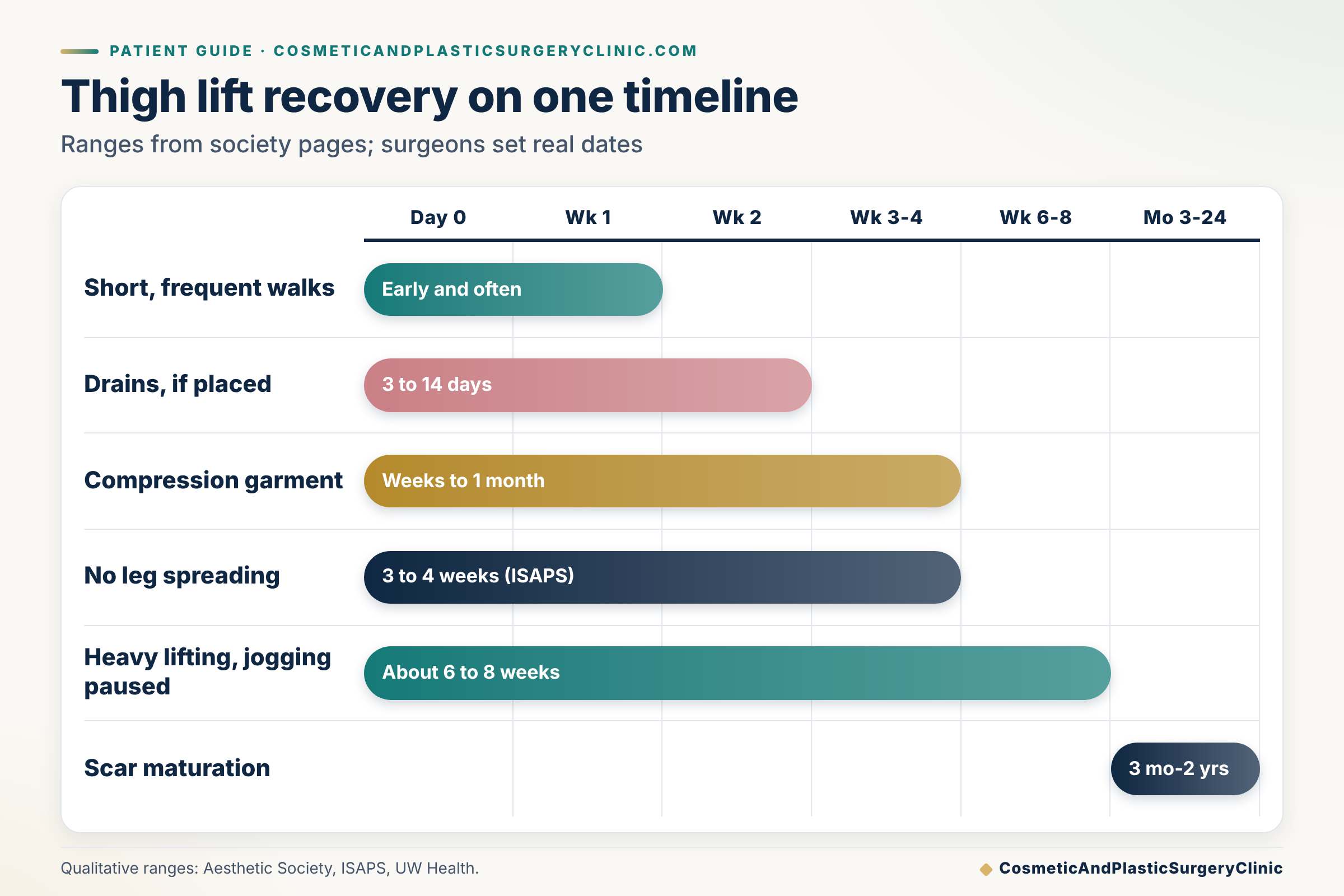
The table below lines up the thigh lift recovery milestones that society and hospital pages describe, so you can see where they overlap. Dates are ranges, and the last column is the thing to ask about, not a diagnosis.
| Phase | Common changes | Practical limits | Planning issue | Report to the surgeon |
|---|---|---|---|---|
| Days 1 to 2 | Most uncomfortable period; dressings in place; drains if used | Help at home for at least two days; short walks | Driver, pain plan, who answers a night call | Chest pain, breathlessness, fainting, heavy bleeding |
| Days 3 to 14 | Discomfort eases to a nagging level by about day five to seven; swelling and bruising | Light activity only for about ten to fourteen days | Drain care, first visit, stitch removal if not absorbable | Rising drain output, spreading redness, fever, an opening stitch line |
| Weeks 2 to 4 | Bruising and early swelling fade; garment still worn | Return to work near two weeks; driving and walking when pain-free; no leg spreading or deep flexion | Desk versus standing work, chair set-up | Swelling that grows, one-sided leg swelling, wound edges separating |
| Weeks 4 to 8 | Swelling often settling by three to five weeks; tightness and patchy numbness may remain | Heavy lifting and jogging paused for six to eight weeks | Return-to-exercise plan agreed in writing | Pain that increases, a lump that enlarges, a garment that digs in |
| Months 3 to 24 | Scars fade and flatten; remaining swelling and contour settle | Sun protection for scars; scar care per surgeon | Judging results late; revision talk only after settling | A raised or spreading scar, new leg swelling, a scar that pulls |
Thigh lift recovery in days 1 to 14: drains, dressings, pain and first walks
Drains, if placed, stay roughly three to fourteen days
The ASPS recovery page says small thin tubes may be placed under the skin to drain excess fluid or blood. The Aesthetic Society adds that drains are emptied a few times a day with the output tracked, and are usually removed three to fourteen days after surgery depending on how much fluid drains, with a follow-up visit within five days. Cleveland Clinic’s general page for skin removal surgery gives a week or two (the page lists its last update as November 2021).
Not every surgeon uses drains for every thigh lift. The ASPS 2026 article does not mention them at all. If your surgeon does not plan drains, ask what the plan is for fluid collections instead, because that choice changes how you watch the legs in week two.
The pain curve and the first walks
The Aesthetic Society says the first two days are the most uncomfortable and that discomfort drops to a nagging level by about five to seven days. Cleveland Clinic says pain can last a few weeks and is worse with movement. Both pages are describing averages, and neither reports a pain score study. Pain control is a medication plan that belongs to your surgeon.
Walking is the one activity that every source on thigh lift recovery encourages early. The ASPS article says early walking lowers the risk of blood clots, and the Centers for Disease Control and Prevention (CDC) advises moving around as soon as possible after surgery. Short, frequent walks on level ground, taken at the pace your surgeon sets, are the usual shape of this advice. Wide strides and uphill walking are worth asking about.
Stitches, dressings and the first follow-up
The Aesthetic Society says traditional stitches are typically removed in the first week or two, while absorbable stitches do not need removal. The ASPS safety page lists stitches that surface through the skin, become visible or irritate, and need removal, among the possible problems. Dressing changes, ointments and the date you can wash are surgeon-specific; the Aesthetic Society says only that your surgeon will give detailed instructions.
Use the first visit of thigh lift recovery, usually within five days, to ask the questions that matter for the groin: how the wound looks, whether any area is under tension, and what a stitch line that starts to open should prompt you to do.
Thigh lift recovery in weeks 2 to 12: garments, driving, lifting and exercise
Compression garments: what the evidence shows and what it does not
The Aesthetic Society describes a wide elastic garment worn for several weeks, and for the first month to help contour the thighs. The ASPS article says garments help control swelling and support tissues as they heal. ISAPS stresses that the post-operative garment is important enough to affect when the operation should be scheduled.
A 2023 practical review in Plastic and Reconstructive Surgery Global Open found the evidence for compression garments highly variable across procedures. Compression did not show an effect on seroma rates, it carries costs, and possible harms include discomfort, venous stasis and skin defects. The authors said evidence is especially thin for limb contouring such as brachioplasty and urged surgeons to reassess routine use. Treat a garment as support that your surgeon has chosen, not as protection against fluid or swelling.
Driving, work and lifting ranges
The second table below sets the cited ranges for work, driving, walking and lifting side by side. Two points need more than a table cell. Neither the Aesthetic Society nor Cleveland Clinic gives a test for driving readiness beyond pain, so the practical question is whether you can brake hard and turn to check a blind spot without hesitating or pulling at the groin. And Cleveland Clinic’s one to three weeks for work covers skin removal surgery in general, not thigh lifts specifically.
Lymphatic massage and swelling that lingers
Swelling is the most common frustration in the ASPS article, and it can last longer than patients expect. One surgeon quoted there says patients are still doing postoperative lymphatic massage after they return to work. MedlinePlus describes lymphedema as swelling that occurs when lymph builds up in soft tissues, and lists exercise, compression devices, skin care and massage among treatments, though that page is not about thigh lifts.
A small 2008 study in Obesity Surgery used lymphoscintigraphy in 14 patients (26 limbs) before and six months after medial thigh lift after bariatric surgery. All limbs were normal before surgery; eight of 26 (30.8 percent) showed abnormal results afterward, which the authors read as a change in lymphatic drainage. The abstract does not say how many had symptoms. Ask your surgeon whether massage is planned, who performs it and when it begins.
Thigh lift recovery in months 3 to 24: scars, settling and the final contour
Scar timelines and the care the sources mention
The Aesthetic Society says scars fade and flatten over three months to two years, and that incision lines do not disappear but in most cases improve significantly. UW Health describes scar maturation as a one- to two-year process, with the active scar-building phase lasting roughly six weeks.
UW Health also advises protecting scars from sunlight for at least the first six months, warns that a sunburn can set healing back, says there is some evidence that silicone sheets and gel help prevent and treat early excessive scarring, and suggests daily massage for four to eight weeks. That page is general scar advice, not thigh-specific, and a groin closure under tension is a place to ask your surgeon before massaging or applying anything.
Scar migration, widening and when the shape is judged
The ASPS article warns that even when a scar is placed in the groin crease, it can migrate downward onto the upper thigh, and the ISAPS page says tension can widen scars. Both are tied to tension on the closure, which is why movement limits dominate the first weeks of thigh lift recovery.
For judging shape, the Aesthetic Society says to evaluate the aesthetic outcome after several months, ASPS describes swelling lasting weeks to months, and Cleveland Clinic says final results can take up to two years. Photographs at four weeks show a swollen, garment-shaped thigh and are a poor basis for deciding that anything needs to change. The thigh lift overview explains what the operation is designed to change.
| Activity | Range cited | Where it comes from | Ask the surgeon |
|---|---|---|---|
| Return to work | About two weeks; one to three weeks for skin removal in general | Aesthetic Society, ASPS 2026, Cleveland Clinic | Which date for my job, and with what modifications? |
| Driving | After two to three weeks if pain-free; a driver for the first week | Aesthetic Society, Cleveland Clinic | Can I brake hard and turn without pulling at the groin? |
| Walking for exercise | Short walks early; longer walks after two to three weeks if comfortable | ASPS 2026, Aesthetic Society | How far, how often, and on what terrain? |
| Leg spreading and deep flexion | Restricted for three to four weeks | ISAPS | Which positions count, and for how long in my case? |
| Heavy lifting and jogging | Paused six to eight weeks | Aesthetic Society; at least six weeks per Cleveland Clinic | What is the weight limit and the written exercise plan? |
| Compression garment | Several weeks to the first month | Aesthetic Society, ISAPS, ASPS 2026 | Which garment, how many hours a day, and until when? |
| Scar protection | Sun protection at least six months; maturation one to two years | UW Health, Aesthetic Society | What may I put on the scar, and from what date? |
Recognizing when thigh lift recovery stops being routine
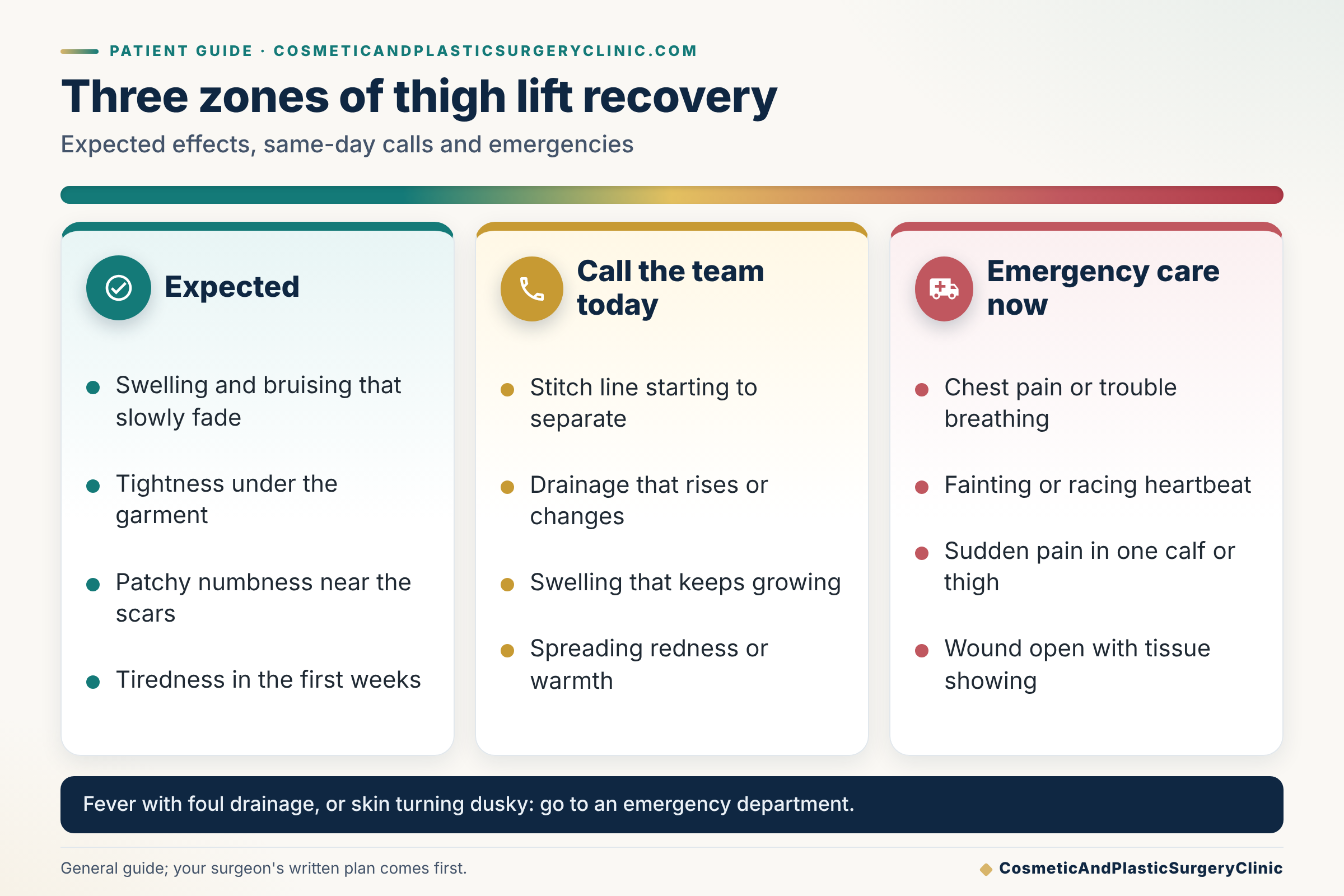
A good thigh lift recovery plan separates three things: effects that are expected, problems that deserve a call to the surgical team, and emergencies. The complications below are the ones that published series and society pages describe most often. They are general education, not a way to diagnose yourself.
Expected effects in thigh lift recovery, and the fluid collection that surprises people
Swelling, bruising, tightness and numbness
The Aesthetic Society says bruising and swelling typically subside within one to three weeks, with swelling taking three to five weeks to settle fully. The ASPS article calls swelling the most common frustration and lists compression garment discomfort, temporary tightness, asymmetry during healing, numbness and slow scar maturation among the other complaints. The ASPS safety page lists changes in skin sensation as a possible effect, and persistent pain among the risks.
The useful distinction is direction. Swelling and tightness that gradually ease, and patchy numbness that does not worsen, fit the expected arc. Swelling that grows, a leg that is larger than the other, or pain that increases after the first week are reasons to call.
Seroma: fluid that can show up after the drains are out
Cleveland Clinic describes a seroma as a pocket of fluid under the skin, most often after surgery, that usually starts one to ten days afterward, typically around day seven to ten. Small ones may shrink in a little over a week and larger ones may take up to six weeks. It lists observation, needle aspiration (which may need repeating), a temporary drain, a sclerosing agent and, as a last resort, surgery.
The same page says to contact your provider if a seroma causes discomfort, gets bigger, shows signs of infection such as discoloration, warmth, severe pain or fever, or does not improve after several weeks. Fluid that looks thick, milky to yellow and foul-smelling needs a call. Do not drain it yourself.
Wound separation in the groin and thigh
What the published series report, and why the numbers differ
A 2015 review in the Journal of Cutaneous and Aesthetic Surgery pooled 16 studies from 1988 to 2015 covering 447 medial thigh lift patients. It reported an overall complication rate of 42.72 percent, wound dehiscence in 18.34 percent and seroma in 8.05 percent, with no thromboembolism or sepsis. The authors called the common problems minor and said patients should hear about dehiscence and seroma before surgery.
A 2015 Plastic and Reconstructive Surgery series from the University of Pittsburgh looked at 106 patients after massive weight loss. Sixty-eight percent had at least one complication: 43 percent after the least extensive horizontal technique and 74 percent after full-length vertical thighplasty. Dehiscence occurred in 51 percent, seroma in 25 percent, infection in 16 percent and hematoma in 6 percent. The university’s news release said most problems were minor and that 6 percent needed further surgery for a complication.
The two sets differ because of who was studied, how extensive the operations were and how each study defined dehiscence. A 2025 pooled analysis in the Journal of Clinical Medicine (19 studies, 1,113 patients) reported dehiscence as the most common complication at 23.6 percent and deep vein thrombosis as the least common at 0.1 percent, but its authors noted inconsistent definitions and sparse reporting of patient health. None of these figures predicts your own result. The arm and thigh lift risks page sorts complications by type, and the general plastic surgery risks page explains how to read a percentage.
A small opening: why to call instead of improvising
No source opened gives a home-care protocol for a groin wound that begins to open, which is itself informative: this is a judgment for the surgeon, who can see depth, drainage and tension. The ISAPS page says breakdown usually follows stretch of a tight closure during movement, which is why the activity limits exist. Cleveland Clinic lists fever, redness and yellow discharge as signs of infection at an incision.
Call the surgical team the same day for a stitch line that separates, drainage that increases or changes character, or spreading redness. Ask in advance how the practice wants to see you in that situation, and how quickly. An opening that exposes deeper tissue, or skin that turns dusky or dark, is an emergency department visit.
Clots, breathing and other emergencies
Walking, clot-prevention plans and one-sided leg swelling
The ASPS safety page lists deep vein thrombosis and cardiac and pulmonary complications among the risks, and the 2015 review above reported none in its pooled group. The CDC says deep vein thrombosis can cause swelling, pain or tenderness, warmth, and redness or discoloration in the affected leg, and that about half of people with a clot have no symptoms. Its advice after surgery is to move around as soon as possible.
Because swelling in both legs is common after thigh surgery, one leg that becomes larger, warmer or tender than the other is the pattern that stands out. Ask what clot-prevention plan your surgeon uses, including leg devices or medication, and who decides on it. That plan is individual and belongs with the surgeon and anesthesia team.
Same-day call or emergency services: where the line sits
The Aesthetic Society tells patients to call the surgeon right away for increased swelling, pain, redness, drainage or bleeding, for fever, dizziness, nausea or vomiting, and for shortness of breath, chest pain or an unusual heartbeat. ASPS says to seek medical attention immediately for shortness of breath, chest pains or unusual heartbeats. The CDC lists pulmonary embolism signs as difficulty breathing, a fast or irregular heartbeat, chest pain that often worsens with a deep breath, coughing blood, and lightheadedness or fainting.
Thigh lift recovery after major weight loss, with liposuction, or beside other surgery
The ranges above describe a typical elective thigh lift. Three starting points shift them: a large weight loss, added liposuction and a larger combined plan. Each changes what the surgeon watches, not only how long thigh lift recovery takes.
Thigh lift recovery after major weight loss: a different healing profile
Complications rise with the extent of the scar
In the Pittsburgh series of 106 post-weight-loss patients, the share with any complication climbed from 43 percent for horizontal thighplasty to 74 percent for full-length vertical thighplasty, and leg edema was linked to the vertical incision. Of the 25 patients who developed edema, two still had it at twelve months. The longer the scar line and the more skin removed, the more wound and the more lymphatic territory there is to heal.
That is a retrospective series from one center, and it does not tell you your own odds. It does help explain why a surgeon who plans a long vertical scar may describe a more watchful thigh lift recovery. The page on arm and thigh lifts after weight loss covers candidacy and timing for that group.
Nutrition belongs in the recovery plan, not only the pre-surgery checklist
An ASPS press release from August 26, 2026 summarizes a Plastic and Reconstructive Surgery review of nutrition after massive weight loss. It advises laboratory screening before surgery, attention to protein, B vitamins and vitamin D, enhanced nutrition starting at least several weeks beforehand and continuing through recovery, and individualized plans with a dietitian. It cites complication rates of 20 to 70 percent after body contouring in this group, with deficiencies linked to impaired healing.
Trade-press coverage of the Pittsburgh study (Plastic Surgery Practice) said its authors suggested that evaluating and optimizing iron, calcium and vitamin B12 could reduce wound-healing complications. That is a suggestion, not a proven effect, but nutrition is a modifiable part of recovery that is worth discussing in writing.
Combined with liposuction or other procedures
Liposuction alongside the lift: mixed evidence
The ASPS thigh lift page notes that liposuction alone can remove fat where skin has good elasticity, and that a lift with liposuction may be recommended where elasticity is poor. For recovery, the evidence points in more than one direction. In the Pittsburgh series, liposuction outside the resected area was associated with infection. In the 2025 pooled analysis, groups that received liposuction had a lower overall complication rate (36.75 versus 70.68 percent) with no significant difference in dehiscence, though the studies were mixed and not randomized.
Both findings are associations in observational data. The honest summary is that the effect of adding liposuction on recovery is unsettled, so ask your surgeon why liposuction is or is not included. The thigh lift versus liposuction page works through that decision, and the liposuction recovery page shows what recovery from liposuction alone looks like.
With a lower body lift or a staged plan
The Aesthetic Society says recovery takes longer when a thigh lift is combined with a lower body lift. A lower body lift adds a circumferential scar and its own movement rules, covered in the lower body lift and body lift recovery pages, and the combined plan is a longer operation under anesthesia.
If two regions need work, one practical question is whether the surgeon recommends doing both at once or in separate operations, and how recovery time and the number of facility visits compare. The upper-arm equivalent of this page is the arm lift recovery guide.
Returning to ordinary life after a thigh lift: work, travel, sleep and workouts
The end of thigh lift recovery is a sequence of small decisions, each tied to a movement the groin closure dislikes. The sources give ranges for some and silence for others.
Work, driving and household routines
Desk work and standing work are different problems
Sitting with the hips flexed for hours cuts against the ISAPS restriction on excessive flexion, while standing and walking all day add friction at the groin and swelling at the ankles. For a desk, ask about a chair with arms, a footrest and a break rhythm. For standing work, ask about a staged return and how to manage a garment under work clothes.
The ASPS article says most people are back at work within two weeks, though some are still in compression garments. A return date is therefore a conversation about what you will actually be doing at the workplace, not a calendar entry.
Household load: shopping, laundry and stairs
Everyday tasks involve more hip flexion than people expect: loading a washing machine, picking something up from the floor, getting into a bathtub, putting on shoes. The Aesthetic Society allows light activity only for the first ten to fourteen days. A grocery delivery, clothes that do not require lifting a leg high and a long-handled grabber are small adjustments that spare the closure. The general recovery planning page has a longer home set-up checklist.
Travel, sleep and getting back to exercise
Flights, long drives and surgery far from home
The CDC says flying after surgery can increase the risk of blood clots, including deep vein thrombosis, and advises waiting about two weeks after major surgery. It also says travelers may need care in the United States if complications develop after returning home, and that follow-up for complications can be expensive and may not be covered by insurance.
A thigh lift with leg-movement limits for three to four weeks does not pair well with a long economy flight or a long drive in the first weeks of thigh lift recovery. If you are considering surgery far from home, the medical tourism surgery page sets out the questions about follow-up and who treats a stitch line that opens.
Sleep position and the order in which exercise returns
Cleveland Clinic says to sleep with pillows elevating the knees after lower body procedures, but its page does not say whether that applies to thigh lifts, so ask which sleep position your closure needs. The sources opened give no single rule on sleep, no shower date and no stepwise exercise program. Treat any website claiming one with caution.
What the sources do say is consistent: walking comes first. The ASPS article advises avoiding strenuous exercise, heavy lifting, aggressive stretching and tension on incisions, and the Aesthetic Society places heavy lifting and jogging at six to eight weeks. Stretching and deep squats are the movements most likely to pull on a groin scar, so ask when they return.
Long-term follow-up after thigh lift recovery: sensation, weight, revision and who is on call
The first month gets the attention, but thigh lift recovery continues for a year or two. Follow-up care is part of what you are choosing when you choose a surgeon.
What can still be changing after the early months
Numbness, tightness and leg swelling
Patchy numbness and tightness are listed among the frustrations in the ASPS article and among the possible effects on the ASPS safety page. Swelling is the item most likely to linger: in the Pittsburgh series, edema occurred in 23 percent of patients after medial thighplasty and persisted at twelve months in two of them. These are numbers from one center after massive weight loss, and not typical of every patient.
Keep dated notes: when a swollen area started, whether it changes with the time of day or the garment, and whether one leg differs from the other.
Weight change and the lasting result
Weight change interacts with thigh lift recovery and results: the Aesthetic Society says weight gain afterward may affect results, and the ASPS article notes that surgeons usually look for a stable low weight, typically for about six months, before operating. A thigh lift removes skin and fat from the treated area; it does not stop the body from storing or losing weight later, and it does not reverse the changes that come with age.
Ask your surgeon what weight change would prompt a conversation and how they follow patients over time.
Revision, aftercare access and verifying the team
When another operation enters the conversation
The ASPS safety page lists the possibility of revisionary surgery among the risks, and the Aesthetic Society says a secondary procedure may be needed to correct unevenness or bumps. In the Pittsburgh series, 6 percent of patients needed further surgery for a complication, according to the university’s news release.
Revision decisions belong months after surgery, once swelling and scars have settled. Before the first operation, ask what the practice’s revision policy is, what it covers and what it does not, and whether facility and anesthesia fees would apply again. A written answer prevents misunderstandings later.
Verify the team before the date: certification, facility and nicotine
The American Board of Plastic Surgery (ABPS) lets you check a surgeon’s certification by name or location and notes that certification requires an active, unrestricted medical license; if a state board action has been reported, the status shows “See FSMB”. The page on choosing a plastic surgeon walks through the full verification steps, including facility accreditation and who provides anesthesia.
MedlinePlus says most providers advise stopping cigarettes and tobacco at least four weeks before surgery, that stopping at least ten weeks beforehand may lower complications further, and that nicotine gum around the time of surgery is not encouraged because nicotine still interferes with wound healing. The Aesthetic Society says patients must not smoke and must quit before surgery if they do. Ask your surgeon how the practice handles nicotine in any form, since a groin wound under tension has little margin.
Frequently asked questions
How long does swelling last during thigh lift recovery?
Sources describe thigh lift recovery in stages. The Aesthetic Society says bruising and swelling usually subside within one to three weeks and that swelling can take three to five weeks to settle fully. The ASPS article says swelling can persist for weeks to months. After more extensive vertical lifts, a 2015 series reported leg edema in about one in four patients after massive weight loss, with two patients still affected at twelve months. Mild swelling that fades overnight and returns with activity is a follow-up topic; swelling that grows or affects one leg needs a call.
When can I shower during thigh lift recovery?
No source opened gives a date for showering. The Aesthetic Society says only that your surgeon will give detailed instructions on showering, bandage changes and ointments, and the ASPS recovery page lists dressing removal among the questions to ask. The date depends on dressings, drains and stitches, so it is an instruction to get in writing. Do not guess, because a groin closure that stays damp under a garment has the friction and moisture problems described above. Ask how to dry the area and when the garment may be removed to wash.
When can I have sex during thigh lift recovery?
None of the sources opened gives a date, and it is an ordinary question to put to the surgeon. The relevant fact is that ISAPS describes three to four weeks of restricted movement, including no spreading of the legs or excessive flexion, and that the groin closure is where wounds most often separate. Ask directly, and mention any pulling or discomfort near the groin or vulvar area, which the ASPS article says some women notice after surgery. A frank answer given early costs nothing and can prevent a wound problem.
Is thigh lift recovery harder than liposuction recovery?
Thigh lift recovery is usually longer than recovery from liposuction alone. The ASPS article describes liposuction alone as often allowing light activity within several days, with swelling and soreness that can last several weeks, while a thigh lift usually means about two weeks of limited activity, sometimes longer. The difference is the wound: liposuction uses small access sites, while a lift leaves a long closure under tension at the groin. The two approaches treat different tissue problems, so the choice usually rests on skin elasticity, not on recovery time.
Do I need lymphatic massage during thigh lift recovery?
The sources opened do not test it. The ASPS article quotes a surgeon saying patients are still doing postoperative lymphatic massage after they return to work, and a small 2008 study found altered lymphatic drainage on scans in 8 of 26 limbs six months after medial thigh lift. Neither shows that massage prevents problems. Whether it is useful, who should perform it, and when to start are decisions for your surgeon. Massage too early or too firmly near a groin incision is a reasonable concern, so ask before booking a therapist.
What if my scar looks wide during thigh lift recovery?
Scars change throughout thigh lift recovery, for one to two years, and early appearances are often not final. ISAPS says tension can widen scars, and the ASPS article says a scar placed in the groin crease can migrate downward onto the upper thigh. UW Health advises contacting your doctor early if a scar becomes raised or spreads beyond its borders. Photograph the scar monthly in the same light, show your surgeon, and ask what they would want to watch. Revision decisions are usually made months later, after the tissue has settled.
Is numbness along the inner thigh normal in thigh lift recovery?
Changes in sensation are listed as a possible effect on the ASPS safety page, and the ASPS 2026 article lists numbness among common frustrations after thigh surgery. The Aesthetic Society’s safety page also lists changes in sensation. None of the pages opened gives a typical duration, so there is no number to hold on to. Report numbness that is spreading, is accompanied by weakness, or is paired with a cold, pale or discolored foot, because that needs a clinician to examine you. Stable patchy numbness is something to raise at follow-up visits.
Does smoking or nicotine use change thigh lift recovery?
Nicotine matters in thigh lift recovery because, as MedlinePlus says, smoking reduces the oxygen that reaches the cells in a surgical wound, so healing can be slower and infection more likely, and smokers have a higher chance of leg clots. It says most providers advise stopping tobacco at least four weeks before surgery, with ten weeks or more possibly lowering risk further. It does not give an after-surgery timeframe. The Aesthetic Society says patients considering a thigh lift must quit before surgery. Ask your surgeon how they handle vaping, nicotine gum and patches, since the same wound-healing concern applies.
Sources and further reading
- ASPS — Thigh lift (accessed 2026-11-13) — definition, liposuction alone versus thigh lift when skin elasticity is poor
- ASPS — Thigh lift recovery (accessed 2026-11-13) — drains, dressings, questions to ask the surgeon, warning signs
- ASPS — Thigh lift safety (accessed 2026-11-13) — listed risks including wound separation, seroma, numbness, revision
- ASPS — What you actually want to know about thigh refinement (June 30, 2026; accessed 2026-11-13) — two-week limited activity, work, garments, lymphatic massage, scar migration, friction and moisture
- ASPS — 2025 Plastic Surgery Statistics Report (accessed 2026-11-13) — thigh lift counts for 2025 and 2024
- ASPS — Nutrition recommendations support healing after body contouring (press release, August 26, 2026; accessed 2026-11-13) — labs, protein, B vitamins, vitamin D, 20 to 70 percent complication band
- The Aesthetic Society — Thigh lift (accessed 2026-11-13) — overview, at least two weeks recovery, smoking, weight gain, secondary procedures
- The Aesthetic Society — Thigh lift aftercare and recovery (accessed 2026-11-13) — drains, garments, pain curve, work, driving, lifting, swelling, scar timeline
- The Aesthetic Society — Thigh lift incisions and scars (accessed 2026-11-13) — incision locations, scar fading, skin elasticity after outer lift
- ISAPS — Thigh lift (accessed 2026-11-13) — restricted movement, garments, colder months, groin wound breakdown, widened scars, operating time
- Cleveland Clinic — Excess skin removal surgery (page last updated November 2021; accessed 2026-11-13) — setting, drains, driver, work, lifting, pillows, warning signs
- Cleveland Clinic — Seroma (accessed 2026-11-13) — timing, duration, treatment options, infection signs
- Sisti et al. — Complications associated with medial thigh lift: a comprehensive literature review (Journal of Cutaneous and Aesthetic Surgery, 2015; abstract, accessed 2026-11-13) — 16 studies, 447 patients, dehiscence and seroma rates
- Medial thigh lift in the massive weight loss population: outcomes and complications (Plastic and Reconstructive Surgery, January 2015; abstract record, accessed 2026-11-13) — 106 patients, complication rates by technique, edema, risk factors
- EurekAlert — News release on medial thigh lift in massive weight loss (December 29, 2014; accessed 2026-11-13) — severity, reoperation share, authors’ conclusions
- Plastic Surgery Practice — Two-thirds of thigh lift patients develop complications (December 30, 2014; accessed 2026-11-13) — trade-press summary of the Pittsburgh series, micronutrient suggestion
- Albanese et al. — A comprehensive review of medial thighplasty: the role of liposuction in reducing complications (Journal of Clinical Medicine, 2025; accessed 2026-11-13) — 19 studies, 1,113 patients, pooled complication and dehiscence rates
- Moreno et al. — Thighplasty after bariatric surgery: evaluation of lymphatic drainage in lower extremities (Obesity Surgery, 2008; abstract, accessed 2026-11-13) — lymphoscintigraphy before and six months after surgery
- Ormseth et al. — The use of postoperative compression garments in plastic surgery: necessary or not? (Plastic and Reconstructive Surgery Global Open, 2023; abstract record, accessed 2026-11-13) — garment evidence, seroma, risks, limited limb-contouring data
- UW Health — Better scar care (accessed 2026-11-13) — scar maturation, sun protection, silicone, massage
- MedlinePlus — Smoking and surgery (accessed 2026-11-13) — stopping tobacco before surgery, wound healing, leg clots, nicotine gum
- MedlinePlus — Lymphedema (accessed 2026-11-13) — definition and treatment options
- CDC — About blood clots (accessed 2026-11-13) — deep vein thrombosis and pulmonary embolism symptoms, moving after surgery
- CDC Travelers’ Health — Medical tourism (accessed 2026-11-13) — flying after surgery, care after returning home, follow-up costs
- American Board of Plastic Surgery — Verify certification (accessed 2026-11-13) — certification lookup, license requirement