Being a BBL candidate is not a status you can claim by reaching a number on a scale, and an article cannot grant it. BBL (Brazilian butt lift, or gluteal fat grafting) takes a person’s own fat from one area, processes it and places it under the skin of the buttocks and hips. So the question a surgeon answers is narrower than “do you want this?” It is whether there is enough usable fat, whether the body can tolerate liposuction plus injection, and whether the operation can follow current safety guidance.
This page walks through what a BBL candidate evaluation checks, in roughly the order a consultation covers it: donor fat, skin and shape, health history, medications and nicotine, weight and life plans, goals, and the safeguards around the operation. The whole procedure is described in the Brazilian butt lift guide, and the detailed risk discussion is in BBL risks. Nothing here is a verdict on any individual; that takes an in-person examination.
Candidacy is a clinical judgment, not a quiz result
Online quizzes and “am I a BBL candidate” checklists compress a decision that depends on anatomy, health and the setting of surgery. Professional societies describe general profiles, but each also says the technique and plan are individual.
Two questions hiding inside every BBL candidate evaluation
A consultation answers two different questions, and mixing them up causes much of the confusion online. One is whether the operation can produce the shape a person wants. The other is whether it should be done now, on that person, with the safety steps available. Someone can be a BBL candidate on the first question and need to wait on the second, or the reverse.
Can it be done: donor fat, skin and anatomy
Feasibility is mostly arithmetic and tissue. ASPS says the technique chosen depends on buttock size and shape, the amount of fat available through liposuction, goals and activity level, and skin quality and elasticity. If the harvest areas cannot supply enough fat, the plan changes before health even comes up. Feasibility is also where a surgeon looks at asymmetry, earlier scars and how new volume will sit under the skin that is already there.
Should it be done now: health, timing and the safety plan
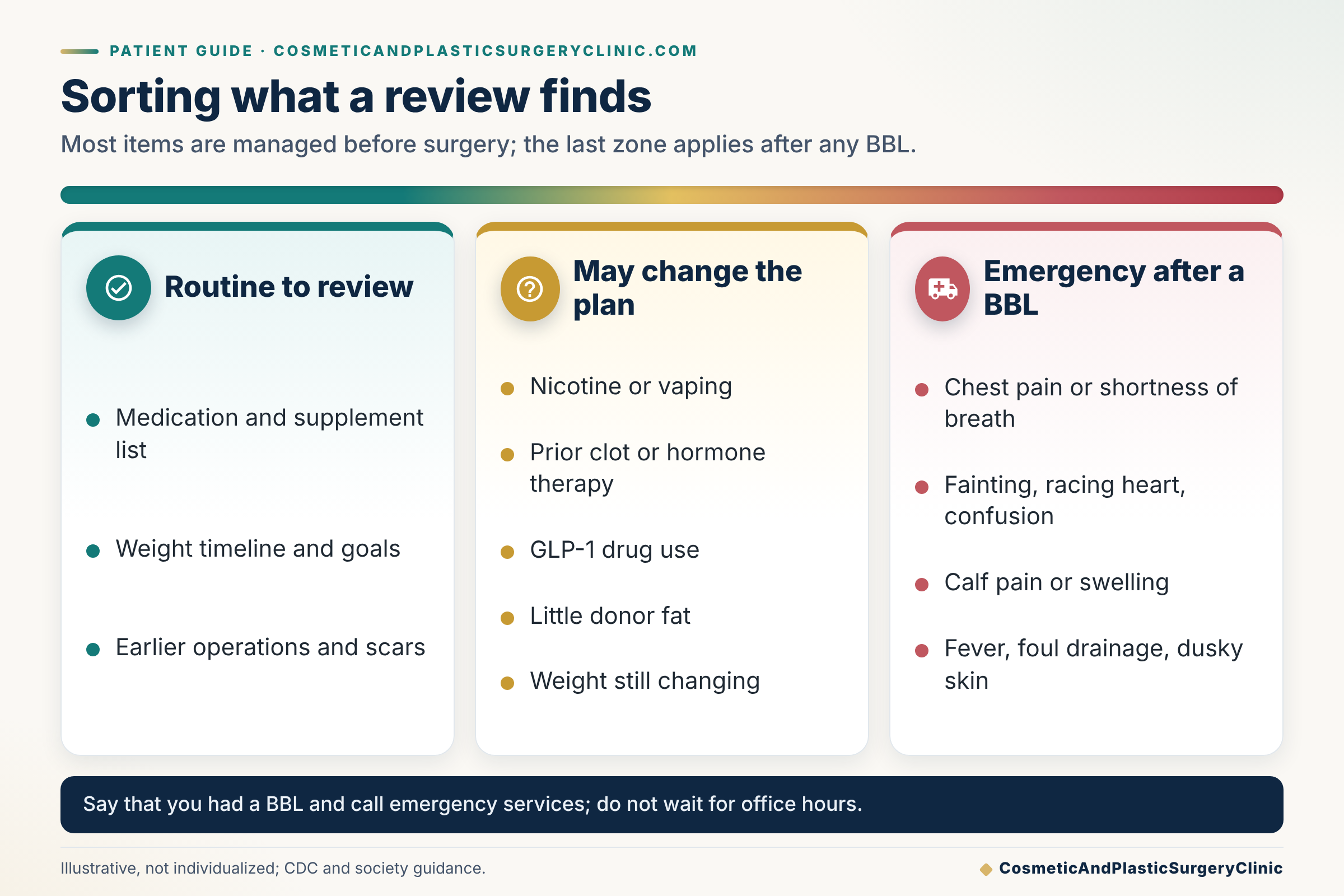
Suitability asks different things: blood-clot history, heart and lung health, blood count, nicotine, medications, a steady weight, and whether the surgeon can place fat above the gluteal fascia, under ultrasound, in an accredited setting. These items can move a date, and several can change with time. That is why “not yet” is a legitimate outcome of a consultation and not a rejection.
What the professional societies say about a BBL candidate
The general profile ASPS describes
ASPS’s page on BBL candidates lists generally good physical health, expectations that match what surgery can deliver, a feeling that the buttocks are smaller than wanted, dissatisfaction with roundness or shape, and unevenness in size or shape. A March 2022 ASPS article quotes Dr. Steven Williams saying an ideal BBL candidate has realistic expectations, is relatively close to an ideal body weight, is in good health and does not smoke. No numeric weight target was given, so “ideal” is for a surgeon to define for your frame.
What the safety statements leave out
The August 2022 joint statement from ASPS, the Plastic Surgery Foundation, The Aesthetic Society and ASERF, and the 2023 statement endorsed by ISAPS and other societies, cover privileges, ultrasound, case volume and aftercare. In the copies opened for this page, neither sets a BMI limit, a donor-fat minimum or a fat-volume ceiling. That gap is why individual judgment, and a surgeon who can explain theirs, carries so much weight. The question is not only “do I qualify?” but “what would you do differently for my anatomy?”

Donor fat, body type and skin: what limits the shape
A BBL moves volume; it does not create it. That single fact explains why two people with the same wish can get different answers, and why the first screening step is a look at the places fat will come from.
Harvest, retention and why volume placed is not volume kept
Two numbers matter to every BBL candidate: how much fat can reasonably be harvested, and how much of what is injected will still be there once healing is done. Neither can be known exactly in advance.
More fat is harvested than is injected
ASPS’s procedure page says a surgeon may liposuction up to three times the amount of fat that will actually be injected, and says the fat is processed before injection. Typical sources, according to a 2022 ASPS article, are the abdomen, flanks, thighs or back. The donor areas therefore set the first limit. Harvest is liposuction, so the liposuction candidate page applies here too.
Harvest volume also has legal and safety ceilings that vary by place and setting. Florida’s office-surgery rule 64B8-9.009, in a Cornell Law School copy showing an amendment effective September 16, 2024, caps liposuction at 4,000 cc of supernatant fat in the office setting. Ask what limits apply where you would be treated.
What studies show about graft volume over time
No one keeps all of it. ASPS says patients retain 60 to 80 percent of transferred fat on average, and Dr. J. Peter Rubin put the share absorbed during healing at 20 to 40 percent in a 2022 ASPS article. Measured studies are small. A 2019 Plastic and Reconstructive Surgery series of 50 women (Cansancao and colleagues) found gluteal subcutaneous thickness rose by an average of 56.5 percent right after surgery and had decreased by an average of 18.2 percent at 12 months. A 2006 MRI study of 10 patients calculated 24 to 36 percent reabsorption.
The methods differ, so treat these as ranges, not promises. For a BBL candidate the practical lesson is that the volume in the syringe is not the volume that remains; BBL results covers how that settles.
BMI and body type: no single number decides a BBL candidate
Online forums trade BMI cutoffs as if they were rules. The sources opened for this page do not support a single threshold, in either direction.
Slim bodies: shape instead of volume
A 2025 ASPS article quotes Dr. Johnny Franco saying people with little body fat typically have less tissue to harvest, and that patients with a BMI under about 22 or 23 were once not considered BBL candidates. He describes a shift toward shape and proportion, restoring volume lost through weight loss or fitness changes instead of building curves. The article also describes a processed donor-fat product as one way to get more volume. No safety or outcome data for it were opened for this page, so it is a question to raise, not a recommendation.
A slim person who wants a large change is the clearest example of a goal that donor fat may not be able to meet. That is a reason to compare routes early, not a judgment about the body.
Higher BMI: what selected studies do and do not show
Published series mostly describe selected groups. A 2024 Aesthetic Surgery Journal analysis of reports to the AAAASF (QUAD A) accreditation program found BMI was not associated with readmission or reoperation among the gluteal augmentation complications it described, whose mean BMI was about 28. Case series report BMI ranges that reach the mid-30s: 22.2 to 34.6 in an 1,815-patient series and 18.1 to 33.2 in a 114-patient series.
These reports describe who was treated; they do not set a BMI limit. Separately, the CDC lists overweight and obesity among blood-clot risk factors, so a surgeon may weigh BMI together with other health findings, not as a pass-or-fail line.
Skin quality and shape goals for a BBL candidate
Volume added under the skin reads differently depending on the skin above it. This is the part of a BBL candidate review that photographs hide best.
Elasticity, scars and prior surgery
ASPS lists skin quality and elasticity among the factors that decide the technique. Surgeons ask about earlier liposuction, abdominal surgery and buttock procedures because scars and altered tissue become part of the plan, so list every operation and bring operative reports when you have them. For harvest areas, the ASPS liposuction page says skin can contract only so much after liposuction and that excess skin may need to be removed, for example with a tummy tuck.
When laxity points toward a different operation
Adding volume is not designed to tighten loose skin. If the main concern is looseness of the lower abdomen, the tummy tuck candidate page explains that route, and some people consider combining procedures, which lengthens anesthesia time and changes the risk picture. A useful consultation question is “what will this not change?”, asked as seriously as “what will it change?”
Health history: the factors that change timing or the answer
Fat grafting to the buttocks combines multi-area liposuction, anesthesia, injection and a recovery with limits on movement and position. The health questions below follow from that combination. Most of them are reasons for a conversation, not automatic exclusions.
Clots, heart, lungs and blood count
A BBL candidate is asked about circulation first, because blood clots and heart or lung complications are named risks of buttock augmentation on ASPS’s safety page, alongside anesthesia problems, bleeding, infection and fat tissue death.
Personal and family clot history, hormones and pregnancy
The CDC lists major surgery, estrogen-containing contraceptives, hormone replacement therapy, pregnancy and the period just after it, overweight or obesity, a previous deep vein thrombosis or pulmonary embolism, a family history of either, and long periods of limited movement among blood-clot risk factors. These are the items a surgeon will want to hear about before anything is scheduled.
Never stop or start a hormone or any other prescription on your own to look more eligible. Changes belong to the prescriber and the surgical team, who can see the whole picture.
Anemia, bleeding and common over-the-counter drugs
ASPS’s preparation page says patients may be asked to get a blood test, adjust current medications and avoid aspirin and certain anti-inflammatory drugs because they can increase bleeding. Blood count matters because large harvests can lower hemoglobin. In a 2025 single-surgeon review of 137 lower body lift patients with large-volume liposuction, nearly all with a BBL (Cabbabe, Aesthetic Surgery Journal Open Forum), mean hemoglobin fell from 13.25 to 9.72 g/dL and two patients were transfused. That is a bigger operation than a typical BBL, but it shows why a baseline matters.
Nicotine, GLP-1 drugs and other medications
Nicotine and wound healing for a BBL candidate
MedlinePlus says smoking slows wound healing, raises infection risk and reduces oxygen reaching the wound, and that smokers who have surgery are more likely to form clots in the legs. It advises stopping at least 4 weeks before surgery, and says stretching that to at least 10 weeks lowers the risk of problems further. ASPS includes non-smoking in its BBL candidate descriptions, and one 2025 series excluded active smokers. Ask how the practice handles all nicotine use, including vaping and replacement products.
GLP-1 drugs and anesthesia planning
GLP-1 receptor agonists slow stomach emptying, which can raise the chance that stomach contents are inhaled during anesthesia. An October 2024 multisociety guidance from the AGA, ASMBS, ASA, ISPCOP and SAGES says most patients may continue them before elective surgery, that individual risk should be assessed, that people at higher risk of digestive side effects may be placed on a liquid diet for 24 hours, and that in rare cases a procedure should be postponed.
That guidance covers surgery broadly, not BBL specifically, and the continue-or-pause decision belongs to the anesthesia team and prescriber. A 2025 ASPS article also notes interest in BBL among people using GLP-1 drugs who want to restore lost volume. Both facts land in the same consultation: tell every clinician exactly what you take.
Weight stability and life plans
Fat is a living tissue that responds to what the body does afterward. A BBL candidate is therefore also being asked about the next year, not only today.
Why a steady weight matters for a BBL candidate
ASPS’s results page says transferred fat behaves like other body fat: if you gain weight the buttocks may grow, and if you lose weight you may lose some of the volume. Someone still losing weight is being operated on a moving target, and the donor areas themselves may change. A 2015 Plastic and Reconstructive Surgery series of 106 women (Rosique and colleagues) evaluated results only in patients without major weight change in the year after surgery, a reminder that published outcomes often come from people who stayed stable.
| Factor | Effect on outcome | Maintenance or revision implication | Review point to raise |
|---|---|---|---|
| Weight gain or loss | ASPS says buttock fat may grow with weight gain or shrink with weight loss | Volume can change without any new surgery | Which weight range does the plan assume, and when is it checked? |
| Graft retention | Some injected fat is reabsorbed; ASPS cites 60 to 80 percent retained on average | A second session may be discussed if the goal needs more volume | What retention does the plan assume, and what would staging involve? |
| Settling time | ASPS says final fat-transfer results can take up to a year | Judging a result or planning revision too early may mislead | When will you be photographed and re-examined, and by whom? |
| Aging and gravity | ASPS notes buttock size and shape continue to change with age | Shape keeps evolving after any operation | How long do the surgeon’s own long-term cases look stable? |
| Nicotine use | MedlinePlus links smoking to slower healing and more infection | Wound problems can complicate recovery and later revision | How is nicotine use screened before and managed after surgery? |
Table 1 turns the long-term side of a BBL candidate decision into review points.
Pregnancy, major weight loss and other planned changes
Pregnancy, a planned large weight loss, or starting a medication that changes weight each alter either the volume or the risk profile. The CDC lists pregnancy and the period just after it as a clot risk factor. None of the sources opened for this page sets a waiting time after pregnancy or weight loss, so the interval is a question for your surgeon, and honest answers differ. Scheduling after a life change has settled is an ordinary decision; the plastic surgery consultation page covers how to raise it.

Safety guidance as a filter on who can be offered a BBL
Gluteal fat grafting carries a severe risk that depends more on technique than on any trait of the patient: fat entering the large gluteal veins and traveling to the lungs and heart. The BBL risks page covers the mechanism. Here the question is narrower: how that guidance changes who can be offered a BBL, and on what terms.
What changed between 2017 and 2023
Candidacy discussions today are shaped by a short sequence of reports and statements. Each added a constraint that a surgeon either follows or does not.
The 2017 survey and the 2018 advisory
The ASERF Task Force report in Aesthetic Surgery Journal (2017) drew on a 2016 survey in which 692 of 4,843 surgeons responded and reported 198,857 cases. Its mortality estimates ranged from about 1 in 2,351 to 1 in 6,214 cases depending on method, and the authors cautioned that none should be taken as the actual rate. Deep-muscle injection and a downward-angled cannula were associated with more fatal embolism. The version of the report opened for this page does not analyze BMI.
A multisociety advisory dated January 31, 2018 cited a death rate of approximately 1 in 3,000, reported autopsy findings of fat in or under the gluteal muscle with gluteal vein damage, and recommended subcutaneous placement only. It added that if more fat is wanted than the subcutaneous layer can take, surgeons should consider staging the procedure instead of injecting deeper. In practical terms, a thin subcutaneous layer limits what can be placed in one session, whatever the patient hopes for.
Ultrasound, privileges and case limits, 2022 to 2023
The August 2022 joint statement supports real-time ultrasound to keep fat above the gluteal fascia and supports regulatory mandates for it. It says office-based surgeons should hold privileges for the procedure at a licensed ambulatory surgery center or hospital, and it notes Florida’s emergency limit of three procedures per day. The 2023 statement published in Aesthetic Plastic Surgery repeats these points and says out-of-area patients need aftercare protocols and a surgeon available for complications.
In the Cornell copy of Florida rule 64B8-9.009, fat may be injected only into the subcutaneous space and must never cross the gluteal fascia; intramuscular or submuscular injection is prohibited. Rules differ by state and change over time, so ask what your surgeon does and whether it is required where you live.
Reading complication numbers from selected patient groups
Recent reports look reassuring, and some may well reflect better technique. They also describe people who passed a filter, and a filter is part of being a BBL candidate too.
Single-center series and their entry rules
An 1,815-woman series (Vidal-Laureano and colleagues, Aesthetic Surgery Journal 2024) reported any complication in 4 percent and no macroscopic fat embolism or deaths, using ultrasound-guided subcutaneous injection. A 114-woman series (Durán Vega and colleagues, 2025) reported 7 percent minor complications and no fat embolism. Both enrolled selected people: ASA class I or II in the first, and active smokers and people with rheumatic disorders excluded from the second. A 185-patient series (Elsaftawy and colleagues, 2024) required a BMI of 20 to 30 and 20 to 30 percent body fat.
All three were retrospective, without comparison groups, and written largely by the operating surgeons. They show what was achieved under specific conditions. They do not predict results for someone outside those entry rules.
| Source | Who was studied | Reported outcome | What it cannot tell you |
|---|---|---|---|
| Vidal-Laureano et al., ASJ 2024 | 1,815 women, median age 34, ASA class I or II, BMI 22.2 to 34.6, two surgeons | 4% any complication; no macroscopic fat embolism or deaths | No comparison group; no postoperative imaging to confirm the absence of intramuscular fat |
| Durán Vega et al., ASJ 2025 | 114 women, mean BMI 25; active smokers and rheumatic disorders excluded | 7% minor complications, mostly fat cysts; no fat embolism | Six-month follow-up; small sample; one private practice |
| Elsaftawy et al., JCM 2024 | 185 women; entry required BMI 20 to 30 and 20 to 30% body fat | 7.03% complications, mostly seroma at 5.41%; no deaths reported | Operating surgeons judged results; about two-thirds answered the satisfaction survey |
| Weidman et al., ASJ 2024 (QUAD A data) | 153 gluteal patients in accredited-facility reports, 2019 to 2021; mean BMI about 28 | Estimated gluteal complication rate 2.10 to 3.80%; 4 deaths among 103 described complications | Denominators were estimated; fat embolism is not a reporting category; facility participation may bias the sample |
Table 2 sets the sources side by side. The rates differ partly because the people, settings and definitions differ, which is why a single “complication rate” quoted in an advertisement deserves a follow-up question.
Accreditation data and its limits
The QUAD A analysis (Weidman and colleagues, 2024) found 436 fat grafting complications reported in 2019 to 2021, an overall rate of 0.94 percent, of which 164 involved gluteal augmentation. It also estimated a gluteal-specific rate of about 2.10 to 3.80 percent from estimated denominators. The authors said it was unclear whether the single pulmonary embolism death was caused specifically by fat embolization.
Death-risk estimates disagree. The 2018 advisory said about 1 in 3,000, while in a February 2023 ASPS article Dr. Rubin cited recent survey data of about 1 in 15,000, similar to tummy tuck. The August 2022 statement says statistics are difficult to obtain, and the 2023 statement urges surgeons to enter cases in the GRAFT registry. Honest BBL candidate counseling states that uncertainty instead of choosing the friendliest number.
Motivation and expectations: the part no exam measures
Anatomy and blood tests can be measured. The reasons behind a request, and the picture of the result in a person’s mind, cannot, and they are where many dissatisfied outcomes begin. A thoughtful BBL candidate evaluation makes room for both.
Whose goal is it?
A trend can feel like a personal wish, especially when the images are everywhere. The test is whether the goal survives without them.
Trend, partner or personal preference
ASPS’s buttock augmentation pages stress that the decision is highly individual and should be made for the patient’s own reasons, not to meet someone else’s wishes or an idealized image. In a December 2022 ASPS article, Dr. Ryan Neinstein framed the starting question as whether the aim is to get rid of stubborn fat or to recreate the shape of the body, and Dr. Williams advised asking whether the procedure is for yourself, for someone else or to follow a trend.
A practical test is to describe the change you want without naming a person, a photograph or an account. If that is hard, more time with the question costs little.
When worry about appearance is the real issue
Mayo Clinic describes body dysmorphic disorder as being unable to stop thinking about perceived flaws that are minor or invisible to others. People with it often seek cosmetic procedures, it says, and the relief is usually temporary. Treatment may include cognitive behavioral therapy and medication. If worry about your appearance feels overwhelming or constant, talking with a mental health professional before surgery is a reasonable step, not an admission that you are unsuitable for care.
Setting goals a BBL candidate can reasonably test
Goals expressed in the vocabulary of surgery, such as projection, proportion and symmetry, can be discussed with evidence. Goals expressed as “like this photo” cannot.
Proportion rather than size
In the December 2022 ASPS article, Dr. Jerry Chidester said even a minimal amount of fat, in a safe amount, can create a nice shape. A 2015 Plastic and Reconstructive Surgery paper by Rosique and colleagues, a 106-woman series in which about half a liter of fat was transferred on average, stated that a good result does not depend on a lot of fat infiltration. Ninety-seven percent were satisfied with the buttocks at one year, and three had further procedures. The authors were the operating surgeons, so read it as a surgeon’s view.
The reading for a BBL candidate is that a goal framed as balance and proportion may be reachable with less fat than a goal framed as a particular size.
Staging and revision as part of the plan
Dr. Chidester also said reaching a goal may take two sessions, maybe three. The 2018 advisory likewise advised discussing staging if the desired outcome may need another procedure. Ask in advance what a second session would involve, when it could happen and how fees are handled; the BBL cost page covers fee structure, and revision BBL explains when secondary procedures are considered.
Alternatives and the option to wait
The most useful consultations compare routes before choosing one.
Implants, flaps and Sculptra
A follow-up multisociety advisory said consent discussions should include alternatives such as gluteal implants or autologous flap augmentation. Implants add a fixed-volume prosthesis with their own risk profile; BBL vs butt implants compares them. Sculptra (poly-L-lactic acid) is a gradual non-surgical approach with different limits, covered in BBL vs Sculptra butt lift. For a person with little donor fat who wants visible volume, one of these may fit the goal better, which is why comparison belongs before booking.
Waiting, second opinions and doing nothing
Waiting is a decision with information value: a stable weight over several months, a nicotine-free interval, a medical review, or simply time. A second consultation with another board-certified plastic surgeon is ordinary practice, and declining to proceed is always an option. The table below summarizes common situations and the pathways surgeons may discuss for each.
| Situation | Pathway that may be discussed | Possible benefit | Trade-off | Key question |
|---|---|---|---|---|
| Little donor fat, wants visible volume | Smaller fat-only change, staging, or comparing implants | Plan matches available tissue | Result may be subtler than the goal; implants carry their own risks | What can you realistically harvest from me, and what if it falls short? |
| Moderate donor fat, goal is proportion | Fat grafting placed in the subcutaneous layer under ultrasound | Uses own tissue; shape can be tuned across hips and buttocks | Some fat is reabsorbed; a second session may be needed | What retention does your plan assume? |
| Loose skin is the main concern | Evaluation for skin-removal surgery before or instead of volume | Treats the actual tissue problem | Separate or longer surgery; scars | What would adding volume leave unchanged? |
| Smoker or recent nicotine use | Stop nicotine, then reschedule | Lower wound-healing and clot concerns, per MedlinePlus | Delay; may need cessation support | How long a nicotine-free interval do you require, and how is it checked? |
| Prior clot, clotting disorder or hormone therapy | Medical review with the prescriber or a specialist before scheduling | Risk is planned for, not discovered late | May lead to a different plan or to no surgery | Who decides about my medication, and what clot prevention is used? |
| Weight is still changing | Wait for a stable period, then reassess | Plan fits the body that will exist afterward | Delay | What weight change would alter the plan? |
Table 3 is not a list of exclusions. Most findings change the sequence or the method, and each has a question that lets you compare surgeons’ answers.
Choosing who evaluates you, and what to ask
An answer about whether you are a BBL candidate is only as reliable as the person and the setting behind it. Two surgeons can read the same body differently, and a clinic can answer “yes” to everyone.
Credentials, facility and travel
Verify certification, privileges and the facility
ASPS says all its members are certified by the American Board of Plastic Surgery (ABPS), and the ABPS site offers a Verify Certification tool; how to choose a plastic surgeon walks through the full lookup. The 2022 and 2023 statements go further: office-based surgeons should hold privileges for this operation at a licensed ambulatory surgery center or hospital, and untrained or non-surgeon staff should not perform critical parts such as the liposuction or the injection. ASPS says surgery may take place in an accredited office-based facility, an ambulatory surgery center or a hospital.
Dr. Williams said consultations should be with a physician, not front-desk staff. In a January 2025 ASPS article, Dr. Ravi Somayazula advised choosing a board-certified plastic surgeon with competency in the procedure who performs no more than two or three a day, and warned against discount clinics where non-surgeons perform procedures with little physician oversight. Ask who performs each step and how many BBLs the surgeon does on a typical day.
When a BBL candidate considers traveling for surgery
The CDC says cosmetic surgery is among the most common procedures medical tourists undergo, that complication risk depends on the destination, the facility and the traveler’s health, and that flying after surgery can increase the risk of blood clots, including deep vein thrombosis. Travelers may need care in the United States after returning, and follow-up for complications can be expensive and may not be covered by insurance. The CDC advises getting copies of all medical records before leaving.
The 2022 and 2023 statements ask surgeons to establish a relationship before surgery and to be available for complications, including for patients who travel. A BBL candidate review done by video or by a coordinator, followed by a flight, can skip both. The medical tourism page covers the wider checks.
A consultation plan for a BBL candidate
What to bring to a BBL candidate consultation
Bring a written list of every prescription, over-the-counter drug, supplement and hormone, including any GLP-1 drug and when you started it. Add a note on blood clots in you or close relatives, dates and operative reports for earlier surgeries, a rough weight timeline for the past year or two, and any recent blood work. Write your goal in plain words. If you bring reference photos, expect the surgeon to explain whether they fit your anatomy.
Seven questions that test whether you are a BBL candidate
These seven questions turn the checks above into words you can say aloud, and the answers are easy to compare between two consultations.
- How much usable fat can you harvest from me, and what would the result look like if I keep only the low end of the 60 to 80 percent retention range?
- Which of my health findings, such as clot history, blood count, medications, nicotine or GLP-1 use, change your plan or timing, and who decides?
- In which tissue layer do you place the fat, and do you use real-time ultrasound to confirm it stays above the gluteal fascia?
- Where would surgery take place, who performs the liposuction and the injection, and how many BBLs do you do in a day?
- What would make you postpone or decline my surgery, and what would you suggest instead?
- What weight range and life plans does your plan assume, and what happens to the result if they change?
- Who do I call at any hour if I develop chest pain, shortness of breath or calf swelling, and where would I be taken?
Clear, specific answers are a good sign, and so is a surgeon who volunteers reasons not to operate. Vague reassurance, hesitation about where the fat is placed, or pressure to book quickly are reasons to slow down and get a second opinion.
Frequently asked questions
What BMI does a BBL candidate need?
No single BMI is set by the society statements opened for this page. ASPS describes a BBL candidate as relatively close to an ideal body weight, and a 2025 ASPS article says patients with a BMI under about 22 or 23 were once not considered BBL candidates. Published series report ranges, such as 20 to 30 required in one 185-patient series, but they describe who was treated. A better question is which of your measurements, beyond BMI, drive the plan, including where fat would come from and how much is expected to remain.
Can someone with very little body fat be a BBL candidate?
It depends on how much fat can be harvested and what the person wants to change. A 2025 ASPS article says people with little body fat typically have less tissue to harvest, and that surgeons now emphasize shape and proportion over volume. A surgeon may propose a smaller change, a staged plan, a different operation such as an implant, or waiting. Hearing that the goal exceeds the available fat is a statement about tissue, not about worth, and a second opinion is reasonable if the explanation is unclear.
Can I be a BBL candidate if I plan to get pregnant?
No source opened for this page sets a waiting time. Two facts are relevant: the CDC lists pregnancy and the period just after it as a clot risk factor, and ASPS says weight changes can change buttock volume. Because pregnancy changes both weight and risk, ask your surgeon how it would affect the plan and whether they advise scheduling afterward. Many people find it simpler to settle family plans first, but that is a personal and medical decision to make with a clinician who knows your history.
Does a history of blood clots rule out a BBL?
This page cannot say, and no article can. The CDC lists a previous deep vein thrombosis or pulmonary embolism and a family history of clots among risk factors. The surgeon, and the clinician who manages your clotting history, decide whether surgery is reasonable and what prevention would be used. Bring records, do not change blood-thinning medication on your own, and accept that “not with this plan” can be the correct answer. After any surgery, calf swelling or pain, chest pain or shortness of breath needs emergency care.
Can a BBL candidate combine the operation with a tummy tuck?
Combination plans appear in published reports. A 2025 single-surgeon review of 137 lower body lift patients, with large-volume liposuction, listed a BBL as an add-on in 99.3 percent of cases, and it also reported a mean hemoglobin drop of 3.66 g/dL. Adding procedures lengthens anesthesia and increases the number of things that can go wrong, so some plans are staged. Whether combining makes sense depends on your anatomy, health and support at home.
Do I need medical clearance or blood tests before a BBL?
ASPS says patients may be asked to get a blood test, adjust current medications, stop smoking and avoid aspirin and certain anti-inflammatory drugs before buttock augmentation. What is required in your case is decided by the surgeon and the anesthesia team, and may include input from your own clinicians if you have a heart, lung, blood or metabolic condition. Ask which tests are needed, when they must be done, who reviews the results, and what findings would delay surgery, so there are no surprises close to the date.
Is an online quiz or video call enough to show I am a BBL candidate?
No. A quiz cannot examine your tissue or review your history, and a coordinator is not a physician. ASPS says consultations should be with a physician and the society statements say surgeons should establish a doctor-patient relationship before surgery. A video call can be a useful first step, but approval before a health history, no examination, a price led pitch or pressure to put down a deposit quickly are signs to pause. Ask who will perform the procedure and whether you will meet that person in advance.
Which symptoms after a BBL need emergency care?
Chest pain, shortness of breath, sudden dizziness or fainting, a racing heartbeat, confusion, calf pain or swelling, severe or spreading pain, fever, foul-smelling drainage, or skin turning dusky or black needs emergency care immediately. Call emergency services or go to an emergency department right away, and tell the staff that you had a BBL. Do not wait for the surgeon’s office to open, and do not drive yourself if you feel faint. This is also why a BBL candidate should know before surgery who is reachable and where the nearest emergency department is.
Sources and further reading
- American Society of Plastic Surgeons — Buttock augmentation overview (accessed 2026-11-12) — fat grafting definition, goals of fullness and projection
- American Society of Plastic Surgeons — Buttock augmentation candidates (accessed 2026-11-12) — general profile of a BBL candidate, individual motivation
- American Society of Plastic Surgeons — Buttock augmentation procedure (accessed 2026-11-12) — factors that set the technique, up to three times harvest, 60 to 80 percent retention, anesthesia choices
- American Society of Plastic Surgeons — Buttock enhancement preparation (accessed 2026-11-12) — blood test, medication adjustment, smoking, aspirin and anti-inflammatory drugs, facility types
- American Society of Plastic Surgeons — Buttock augmentation results (accessed 2026-11-12) — reabsorption, up to a year to final result, weight change effects
- American Society of Plastic Surgeons — Buttock augmentation risks and safety (accessed 2026-11-12) — named risks including clots and fat tissue death, consent
- American Society of Plastic Surgeons — Seven things you need to know about a Brazilian butt lift, March 28, 2022 (accessed 2026-11-12) — candidate description, 20 to 40 percent absorbed
- American Society of Plastic Surgeons — Less is more: the emergence of the skinny BBL, August 22, 2025 (accessed 2026-11-12) — thin patients, BMI history, GLP-1 users, shape over volume
- American Society of Plastic Surgeons — What do you really need to know about BBLs, December 9, 2022 (accessed 2026-11-12) — goal question, staging, physician consultation
- American Society of Plastic Surgeons — Possible dangerous complications of Brazilian butt lifts and how to prevent them, January 27, 2025 (accessed 2026-11-12) — surgeon volume, discount clinics, ultrasound
- American Society of Plastic Surgeons — Improving safety for the Brazilian butt lift, February 23, 2023 (accessed 2026-11-12) — survey-based mortality estimate of about 1 in 15,000, Florida rules
- American Society of Plastic Surgeons — Study proposes new standards for safely performing Brazilian butt lift, May 20, 2019 (accessed 2026-11-12) — cadaver study supporting subcutaneous-only injection
- American Society of Plastic Surgeons — Liposuction candidates (accessed 2026-11-12) — skin contraction limits, non-smoker and non-vaper profile
- Multi-Society Task Force — Gluteal fat grafting practice advisory, dated January 31, 2018, ASPS-hosted copy (accessed 2026-11-12) — about 1 in 3,000, autopsy findings, staging recommendation
- Multi-Society Task Force — Gluteal fat grafting safety advisory update, ASPS-hosted copy labeled July 2018 (accessed 2026-11-12) — subcutaneous plane only, consent covering alternatives such as implants and flaps
- ASPS, Plastic Surgery Foundation, The Aesthetic Society and ASERF — Gluteal fat grafting safety advisory, August 18, 2022 (accessed 2026-11-12) — ultrasound, privileges, case-volume limits, aftercare
- Plastic Surgery News — Gluteal fat grafting: a joint safety statement, August 18, 2022 (accessed 2026-11-12) — statements on risk and difficulty obtaining statistics
- ISAPS-endorsed Statement on Patient Safety During Gluteal Fat Grafting, Aesthetic Plastic Surgery 2023;47:894–896 (accessed 2026-11-12) — positions on privileges, ultrasound, aftercare, GRAFT registry; no BBL candidate criteria
- Aesthetic Surgery Education and Research Foundation — Task Force press release, November 28, 2017 (accessed 2026-11-12) — origin of the gluteal fat grafting task force
- Mofid et al. — Report on mortality from gluteal fat grafting: recommendations from the ASERF Task Force, Aesthetic Surgery Journal, 2017 (accessed 2026-11-12) — 692 respondents, 198,857 cases, mortality range, deep-muscle injection
- Mofid et al. — full text of the ASERF Task Force report, PMC (accessed 2026-11-12) — adjusted incidence ratios, recommendations; BMI not analyzed
- Cornell Legal Information Institute — Florida Administrative Code 64B8-9.009, Standard of Care for Office Surgery (accessed 2026-11-12) — subcutaneous-only fat injection, 4,000 cc office liposuction cap
- American Society of Plastic Surgeons — 2025 Plastic Surgery Statistics Report (accessed 2026-11-12) — BBL counts by year, age and gender; methodology
- Weidman et al. — Complications from fat grafting and gluteal augmentation in outpatient plastic surgery: QUAD A data, Aesthetic Surgery Journal, 2024 (accessed 2026-11-12) — accredited-facility complication reports and limits
- Vidal-Laureano et al. — Augmented safety profile of ultrasound-guided gluteal fat transfer: 1815 patients, Aesthetic Surgery Journal, 2024 (accessed 2026-11-12) — selected-cohort outcomes, ASA class I or II
- Durán Vega et al. — The linear retrograde infiltration technique for buttock fat infiltration, Aesthetic Surgery Journal, 2025 (accessed 2026-11-12) — 114-woman cohort, entry exclusions, BMI range
- Elsaftawy et al. — Buttock augmentation with ultrasonic liposuction and ultrasound-guided fat grafting: 185 patients, Journal of Clinical Medicine, 2024 (accessed 2026-11-12) — BMI and body-fat entry criteria, complications
- Cansancao et al. — Subcutaneous-only gluteal fat grafting: prospective long-term results with ultrasound analysis, Plastic and Reconstructive Surgery, 2019 (accessed 2026-11-12, catalog record of the abstract) — thickness change at 12 months in 50 women
- Wolff Idárraga et al. — Magnetic resonance imaging assessment of gluteal fat grafts, 2006 (accessed 2026-11-12, catalog record of the abstract) — MRI-based reabsorption estimate in 10 patients
- ScienceDaily — Gluteoplasty with autologous fat tissue, report on Rosique et al., Plastic and Reconstructive Surgery, 2015 (accessed 2026-11-12) — 106-woman series, satisfaction, limits of fat volume
- Cabbabe — Drainless lower body lift with large-volume liposuction and adjunctive procedures, Aesthetic Surgery Journal Open Forum, 2025 (accessed 2026-11-12) — hemoglobin change and transfusions in a combined-procedure series
- Centers for Disease Control and Prevention — Risk factors for blood clots (accessed 2026-11-12) — surgery, hormones, pregnancy, obesity, prior clots, family history
- MedlinePlus — Quitting smoking before surgery (accessed 2026-11-12) — healing, infection and clot risk; 4 and 10 week timing relevant to a BBL candidate
- American Gastroenterological Association — Most patients can continue GLP-1 anti-obesity drugs before surgery (multisociety guidance, accessed 2026-11-12) — aspiration concern, individual assessment
- Mayo Clinic — Body dysmorphic disorder: symptoms and causes (accessed 2026-11-12) — preoccupation with perceived flaws, cosmetic procedures, treatment
- Centers for Disease Control and Prevention — Medical tourism: travel to another country for medical care (accessed 2026-11-12) — flying after surgery, follow-up care, records
- American Board of Plastic Surgery — home page and Verify Certification (accessed 2026-11-12) — certification lookup before any BBL candidate consultation