A facelift moves living tissue: skin, the fibrous layer beneath it, small blood vessels and nerves that run close to the surface. Facelift risks follow from that anatomy. Some are the ordinary cost of healing, some are complications a surgeon needs to see within days, and a few are emergencies. Telling them apart is the useful skill, and it is harder than it sounds when a face is swollen, bruised and numb all at once.
This page sorts facelift risks into those three groups, looks at what published numbers can and cannot say, and ends with questions to take to a consultation. Healing week by week is covered in facelift recovery, who surgeons consider suitable in facelift candidate, and how techniques differ in deep plane vs SMAS facelift. Nothing here predicts what will happen to your face.
Sorting facelift risks into expected effects, complications and emergencies
Most anxiety about facelift risks comes from not knowing which bucket a symptom belongs in. A tight, swollen cheek on day two and a tight, swollen cheek with sharp pain on one side only can look alike to the person wearing them. The sorting below is general education drawn from patient pages and published reviews. It does not replace the written instructions your surgeon gives you.
What is expected after a facelift
Swelling, bruising, tightness and numbness
MedlinePlus (reviewed November 2025) says the face may look pale, bruised and puffy at first and should look normal in about 4 to 6 weeks, while swelling, bruising, discoloration, tenderness and numbness can last 10 to 14 days or longer. Mild swelling may linger for several weeks. Mayo Clinic lists pain, fluid draining from the incisions, swelling, bruising and numbness as expected after surgery, and notes that a small drain behind one or both ears is often removed the day after.
Expected does not mean comfortable. It means the direction is right: each day a little less swelling, a little less tenderness, a little more feeling. The same swelling that is routine on both sides becomes a different conversation when it grows, hardens or sits on one side only.
Why the ears and neck feel odd for months
Skin lifted from its attachments loses feeling because the small sensory nerves in it are stretched or divided. An American Society of Plastic Surgeons (ASPS) educational article for residents says disturbances of the great auricular nerve, which supplies the lower ear and angle of the jaw, usually resolve, and that lower-ear numbness is initially observed rather than treated. MedlinePlus puts numbness of the face and ears at up to several months. Ask your surgeon what timeline to expect for your incisions.
When a finding becomes a complication
One-sided, growing or worsening changes
A complication is usually defined by trajectory and function, not by how alarming a symptom looks. Swelling that tightens on one side, a cheek that becomes firm and painful, a smile that pulls to one side after the first days, or a drain that fills quickly are findings to report the same day. Mayo Clinic specifically lists bad pain on one side of the face or neck within 24 hours of surgery as a reason to contact the surgical team right away.
Slow-healing skin and pain that persists
ASPS lists poor wound healing, skin loss and persistent pain among facelift risks, and calls the risks rare. Mayo Clinic attributes skin loss to reduced blood supply to the lifted skin. That is why a patch near the incision that darkens, blisters or breaks open is something to report rather than wait out. Early review gives the surgeon more options than late review does.
Emergencies that should not wait
Warning signs that justify an emergency call
Why after-hours coverage is a question to settle before surgery
Mayo Clinic says a hematoma usually forms within 24 hours, so the first night matters. Before the operation, ask who answers the phone after hours, whether it is the surgeon or a covering colleague, and which hospital would receive you. If the facelift is far from home, work out where a local emergency department would send you and whether your surgeon will speak to that team.
| What you notice | Often expected when | Complication when | Action level |
|---|---|---|---|
| Swelling and bruising | Slowly easing over days to weeks, even and symmetrical | One side grows, tightens or turns firm | Routine call; same day if growing |
| Pain | Soreness controlled by prescribed medicine | Sharp, one-sided or rising pain within the first day | Call right away |
| Bleeding or drain output | Some fluid draining from incisions; drain output falling | Soaked dressings or output that suddenly increases | Call right away; 911 if heavy and unstoppable |
| Face movement | Stiffness from swelling and local anesthetic early on | Brow, lip or smile weakness that persists or appears later | Tell the surgeon at the next visit or sooner |
| Feeling | Numb ears, cheeks or neck that slowly improve | Burning pain or numbness that is not improving by months | Raise at follow-up |
| Skin near incisions | Pink or bruised edges that settle | Dark, blistered or open skin | Same-day call |
| Fever or redness | Mild warmth and tenderness along incisions | Fever, spreading redness, pus | Same-day call |
| Breathing or chest | Not expected | Shortness of breath, chest pain, racing heart | 911 or emergency care |

Hematoma: the first of the facelift risks to understand
A hematoma is a collection of blood trapped under the lifted skin. Mayo Clinic calls it the most common complication of facelift surgery, says it usually forms within 24 hours, and says that fast treatment can prevent tissue damage. The ASPS resident article says treatment is prompt return to the operating room to evacuate it. Because the clock matters, hematoma shapes how surgeons plan, how they medicate blood pressure and how they watch you in the first night.
How often it happens, and why the range is wide
Published hematoma figures
A 2019 narrative review in Plastic and Reconstructive Surgery Global Open by Rohrich and colleagues gives a hematoma incidence of 0.9% to 9%, higher in men. In the 2016 CosmetAssure cohort of 11,300 facelifts, hematoma was the most common complication at 1.1%. A single-surgeon series of 136 facelifts reported in 2022 found 3 hematomas (2.21%). A 2025 systematic review of 31 deep plane studies with 8,841 patients reported an overall rate of 2.7% and a major-hematoma rate of 0.97%.
These numbers disagree because they measure different things. The CosmetAssure figure counts events that sent a patient to an emergency room, back to the hospital or back to surgery within 30 days. Other series count small collections treated in the office. A rate with no definition attached is a rumor, not a statistic.
What a hematoma can lead to
Among facelift risks, hematoma is the one with the clearest link to skin loss. A large untreated collection can press on the skin flap and reduce its blood supply, which links hematoma to the skin loss discussed later. That is the reasoning behind Mayo Clinic’s advice that fast treatment prevents tissue damage. Most hematomas found early and drained do not leave lasting harm, but the sources opened do not give a rate for lasting effects, so none is stated here.
Who is more likely to bleed
Male sex, blood pressure and medicines
In the CosmetAssure analysis, male sex carried a relative risk of 3.9 for hematoma. The ASPS resident article lists male sex, hypertension, NSAID use, higher body mass index and smoking as hematoma risk factors, and says strict perioperative blood-pressure control with clonidine significantly reduced incidence, especially in men. Rohrich’s review describes controlling hypertension as a modifiable factor and uses a clonidine patch in men.
Mayo Clinic names blood thinners and some supplements, including warfarin, clopidogrel, aspirin, ibuprofen, ginseng, ginkgo and fish oil, as raising hematoma risk, and says a surgeon may give instructions about them before surgery. Never stop or start a prescribed medicine on your own. The surgeon and the clinician who prescribes it should decide together.
Facility and plan factors
The same CosmetAssure abstract reports a relative risk of 2.6 for hematoma by facility type, without saying in the abstract which setting carried more. It also found that combined procedures raised overall complications, up to 3.7% compared with 1.5% for facelift alone. Those two findings are why the questions about where surgery takes place and what else is added belong in every consultation about facelift risks.
What the evidence says about prevention
Tranexamic acid, sealants and hemostatic nets
A 2024 meta-analysis in Aesthetic Surgery Journal covered 388 facelift patients, 170 of whom received tranexamic acid. It found a significantly lower risk of minor hematoma (odds ratio 0.18) and lower drain output, with no significant difference in major hematoma. Its level of evidence was 3, meaning limited comparative data. In the 2025 deep plane review, major hematoma rates were 1.53% with tranexamic acid, 1.25% with tissue sealants and 1.23% with hemostatic nets, and the authors concluded that no adjunct was clearly superior.
Blood pressure control during and after surgery
Hypertension appears as a hematoma risk factor in both technique sources opened for this page, Rohrich 2019 and the ASPS resident article, and both discuss clonidine. Neither tells you what to take. The practical step is to ask your surgeon how blood pressure will be managed around the operation, and to mention any history of high readings, including readings taken when you are anxious in a clinic.
Nerve injury and numbness among facelift risks
The face has two nerve systems to protect. Motor nerves move muscle: the brow, eyelids, cheek, mouth and lower lip. Sensory nerves carry feeling from skin that a facelift lifts and repositions. Injury to either is on the ASPS list of facelift risks, which uses the phrase “facial nerve injury with weakness” and calls such events rare. The details differ by nerve, by how long the problem lasts and by what, if anything, is done about it.
Motor branches: weakness of the brow, mouth or lower lip
Which branches surgeons worry about most, and why
According to the ASPS resident article, the frontal branch, which lifts the brow, and the marginal mandibular branch, which moves the lower lip, are the most feared to injure because they overlap little with neighboring branches. Injuries to the buccal and zygomatic branches are described as often clinically insignificant. The same article says dissection in the subcutaneous plane is considered safe from the nerve, and that branches outside the parotid region cross between deep and superficial fascia, which raises the risk where dissection goes deeper.
What pooled numbers say about weakness and recovery
A 2025 systematic review and meta-analysis in Aesthetic Plastic Surgery by Gandra, Silva and Horta pooled 67 publications covering 15,404 patients. Overall motor nerve damage, including transient weakness, was 0.66%; permanent motor damage was 0.047%. The authors describe motor damage as mostly transient. Their limits matter: most studies were retrospective, at least 21 included non-primary facelifts, adjunct procedures such as eyelid surgery could confuse attribution, and none compared techniques directly.
On timing, the ASPS resident article says weakness right after surgery is common and often from local anesthetic.
It adds that dysfunction lasting beyond the early period should resolve within three to four months, with botulinum toxin on the opposite side sometimes used to improve symmetry meanwhile. Rohrich’s review says marginal mandibular weakness is usually neuropraxia, a bruised-nerve injury, resolving within 3 months, and Mayo Clinic says effects can last a few months to a year. Among facelift risks, then, motor weakness is the one most likely to be temporary.
Technique may matter too. A 2019 meta-analysis of 183 SMAS-technique studies found temporary nerve injury highest for high lateral SMAS flaps (1.85%) and composite facelifts (1.52%), with no significant difference in permanent injury.
Sensory nerves: ears, cheeks and neck
The numb earlobe and why it is so common
Numbness near the ear is the sensory problem the sources describe most often. The great auricular nerve supplies the skin of the lower ear and angle of the jaw, and it lies close to the area surgeons work in. In Gandra’s pooled data, overall sensory damage was 0.39% and permanent sensory damage was 0.045%, with affected areas that included the preauricular and retroauricular skin and the earlobe. Those are rates of reported injury in published series, not of every patch of numbness patients experience while healing.
Pain or numbness that does not fade
The ASPS resident article says numbness and allodynia, pain from a touch that normally does not hurt, that persist 6 to 12 months may need surgical exploration or neuroma excision, while a lower-ear numbness is initially watched. Gandra’s authors describe most sensory lesions as resolving spontaneously within a year, and name dysesthesia with chronic pain as a permanent problem in a few cases. If burning, electric or worsening sensations appear, tell the surgeon early rather than at month nine. Of the facelift risks in this section, this is the one most easily missed because it develops quietly.

Skin loss, scars, hair and ears: the facelift risks you can see
Some facelift risks are felt, and others are seen in a mirror, in photographs and in how a hairline or an ear looks months later. They matter to people differently. A faint scar behind the ear may bother nobody, while a displaced sideburn can bother the person wearing it every day. Both belong in the planning conversation.
Skin loss and the role of nicotine
Why lifted skin depends on blood supply
Among facelift risks, skin loss is the one most tied to blood supply. Mayo Clinic describes it as rare and caused by reduced blood supply to the skin. Rohrich’s review links complications to excess skin tension, to leaving too little fat on the lifted flap (it recommends at least 3 mm) and to surgery on the submandibular gland, without quantifying those links. When the lifted skin is pulled tight over incisions, the vessels that feed its edge are squeezed, and the edge is the first place to show trouble.
What the smoking evidence says and where it thins out
A 1984 paper in Plastic and Reconstructive Surgery by Rees, Liverett and Guy reported that a significant share of facelift skin sloughs were attributed to cigarette smoking, and said the implications for patient selection and counseling were considerable. The full numeric results were not retrievable for this article. Mayo Clinic says smoking greatly raises the risk of poor wound healing, hematomas and skin loss after a facelift, and the ASPS resident article cites a 12-fold increase in wound-healing complications among active smokers.
How long to stay nicotine-free is not settled. A 2014 conference review abstract found no consensus on the optimal smoke-free period, though many authors agree on about 4 weeks, and suggested cotinine testing because self-reports can be inaccurate. Rohrich’s protocol asks for at least 3 months and uses urine testing. Surgeons set their own rules, so ask about yours, including whether nicotine replacement and vaping count.
Scars, hair loss and hairline change
Where the incisions sit and why scars vary
ASPS says a traditional facelift incision often begins in the hairline at the temples and continues around the ear. Mayo Clinic says the scars are permanent but usually hidden by the hairline and ears, and that raised scars are rare and may improve with corticosteroid injections. Dibbs and colleagues, in a 2021 review of revision facelifts, note that scar tissue and tension can pull scars into unfavorable positions. ASPS lists unfavorable scarring and poor scar placement among facelift risks.
Nobody controls skin biology completely: how an individual scars is partly genetic, and tension at closure is partly the surgeon’s craft.
Temporal and sideburn hair
ASPS lists temporary or permanent hair loss at the incisions. Mayo Clinic says hair loss may be brief or lasting and that hair-follicle skin transplant may help if it persists. In the revision-facelift review, a temporal incision placed within the hairline suits patients whose distance from the outer eye socket to the front hairline is under 5 cm, while longer distances favor an incision along the hairline; a beveled incision helps camouflage scars, and hair transplantation may be needed for severe sideburn displacement. Ask where your incisions will be drawn and why.
Ear shape, asymmetry and contour
Pixie ear and tragal distortion
Ears can show tension. A pixie ear, an earlobe pulled forward and tethered, arises from skin tension along the lobule, according to both the revision review and the ASPS resident article. The review also describes a tragal distortion, sometimes called a shotgun ear, usually linked to incisions behind the tragus and excess tension, which a pretragal incision generally helps prevent. Closure tension is the common thread, which links back to scars and skin loss.
Asymmetry, irregularities and visible stitches
ASPS lists asymmetry, poor scar placement and visible deformities at the ends of incisions among unsatisfactory results, and lists sutures that surface through the skin as another problem. Faces are never exactly symmetrical to begin with, and swelling is often uneven in the first weeks, so a judgment about asymmetry needs time and a before-surgery photograph. The Aesthetic Society lists unsatisfactory results that may need additional procedures among the risks it discusses with patients.
Whole-body facelift risks: anesthesia, clots and infection
Not all facelift risks are on the face. The operation is typically long, uses anesthesia and keeps a patient still for hours, so risks shared by most surgeries apply. Mayo Clinic puts surgery time at 3 to 6 hours. The ASPS safety page lists anesthesia risks, deep vein thrombosis, cardiac and pulmonary complications, bleeding and infection together with the facial ones.
Anesthesia and where the operation happens
Sedation or general anesthesia
ASPS says facelift medications are given for comfort and names intravenous sedation and general anesthesia as the choices, with the surgeon recommending which fits. The ASPS resident article states that IV sedation has been associated with lower deep vein thrombosis and pulmonary embolism risk than general anesthesia, but it gives no figures here, and the right choice depends on health, operative time and the anesthesia professional. Ask who will give anesthesia, what training that person has and how long you should expect to be under, since time under anesthesia is part of how facelift risks add up.
Accredited facility questions
An ASPS blog post from 2016, written as a surgeon’s opinion and not as data, argues that accredited facilities monitor and report complications and are staffed to handle emergencies, and names the Joint Commission, the AAAHC and the AAAASF as accreditors. It gives no numbers, so treat it as a checklist rather than evidence. The CosmetAssure finding of a hematoma risk difference by facility type points the same direction: where you operate is a safety question. Verification steps are in how to choose a plastic surgeon.
Blood clots and the prevention balance
What facelift-specific clot data can and cannot show
A 2022 retrospective review at one institution looked at 136 facelift patients who did not receive chemical clot prophylaxis, and found no deep vein thrombosis or venous thromboembolism. The authors rated the evidence level 4, and the sample is far too small to estimate a rare event. The International Society of Aesthetic Plastic Surgery’s 2024 patient safety update adds that deep vein thrombosis is often silent and difficult to diagnose from symptoms. Mayo Clinic notes that hormone replacement therapy raises the risk, which is a reason to tell the surgeon about every medicine.
Why prevention is a judgment, not a rule
Clot-preventing medicine works against bleeding, and facelift has its own bleeding risk. The ISAPS update lists active bleeding among contraindications to chemical prophylaxis, and the 2022 facelift review noted that, by Caprini score, all of its patients would ordinarily have been candidates for prophylaxis, yet none had an event without it. Surgeons weigh these pulls case by case. Ask what your plan is: walking early, compression devices, medicine or none, and why. Chest pain or shortness of breath after surgery needs emergency care.
Infection and slow healing
How often infection is reported
In the CosmetAssure cohort, infection occurred in 0.3% of facelifts within the 30-day window. Combined procedures carried a relative risk of 3.5 and a body mass index of 25 or higher a relative risk of 2.8 for infection. ASPS and the Aesthetic Society both list infection among facelift risks, and MedlinePlus lists it among general surgical ones. Fever, spreading redness or pus belong in the same-day-call column of the table above.
Medical conditions that slow healing
Mayo Clinic says poorly controlled diabetes or high blood pressure can increase healing problems, hematomas and heart complications, that bleeding disorders can rule out surgery, and that repeated weight gain and loss may affect facial shape, skin condition and long-term satisfaction. The ASPS resident article adds that some inherited skin conditions, such as Ehlers-Danlos syndrome, raise wound-healing risk and are screened for. Whether any of these applies to you is a question only an examination can answer. General risk literacy for plastic surgery is covered separately.
Reading published numbers on facelift risks without over-reading them
Numbers calm people, which is both their value and their hazard. A percentage describes a group, in a time window, with a definition of what counted. It does not describe you. The figures below on facelift risks are the ones opened for this article, with the population and the limit stated next to each.
What large studies and reviews reported
Cohorts and pooled reviews side by side
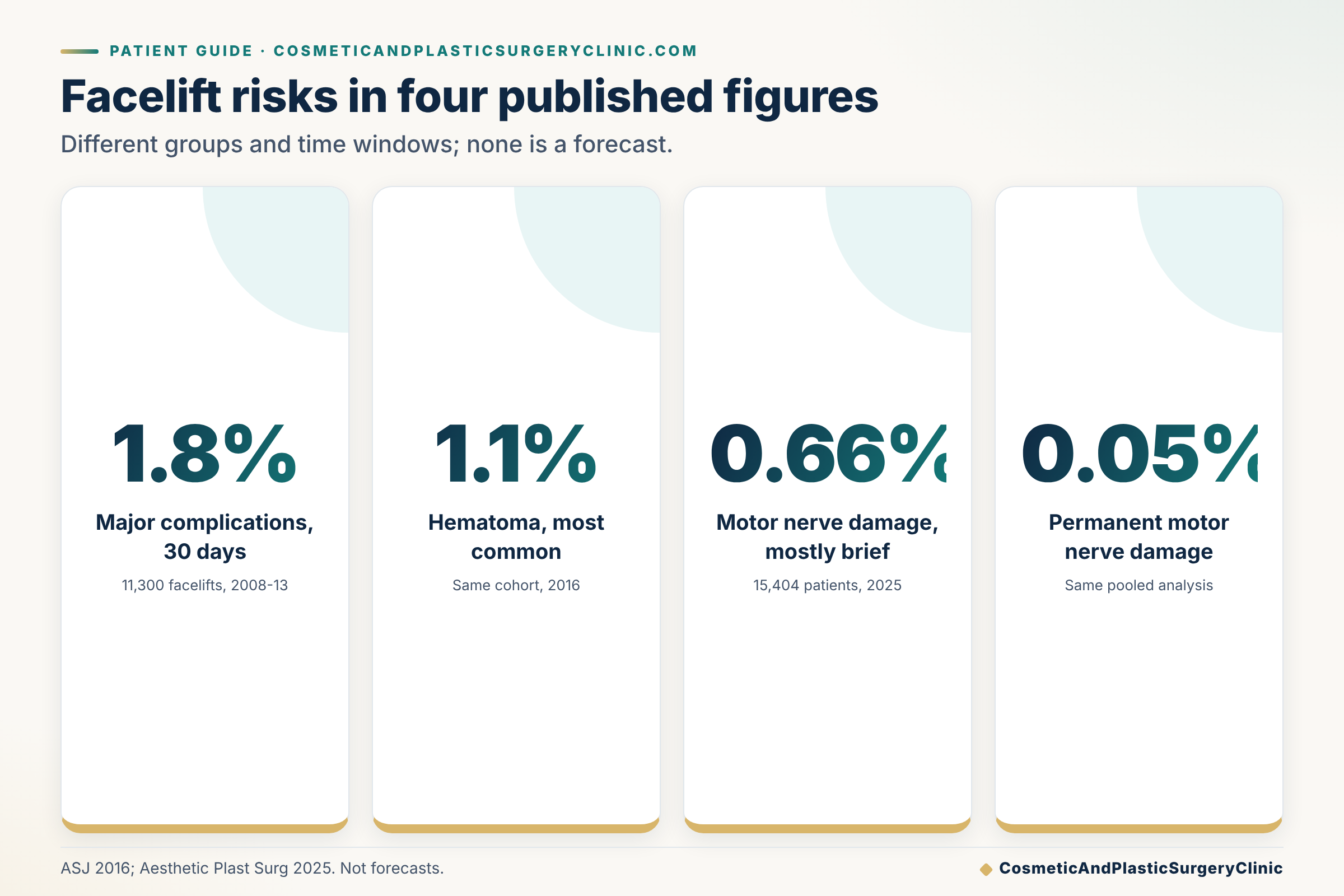
The largest prospective facelift cohort opened is the 2016 CosmetAssure analysis in Aesthetic Surgery Journal: 11,300 facelifts from 2008 to 2013 in the CosmetAssure database, mean age 59.2. Major complications, meaning an emergency visit, hospital admission or reoperation within 30 days, occurred in 1.8%. The authors called facelift very safe in the hands of board-certified plastic surgeons. That conclusion describes this enrolled group and does not transfer to every surgeon or setting.
| Source and year | Population | What it reported | Main limit |
|---|---|---|---|
| CosmetAssure analysis, 2016 | 11,300 facelifts, 2008 to 2013, prospective | 1.8% major complications in 30 days; hematoma 1.1%; infection 0.3% | Counts only the first 30 days |
| Nerve injury meta-analysis, 2025 | 67 publications, 15,404 patients | Motor damage 0.66%, permanent 0.047%; sensory 0.39%, permanent 0.045% | Mostly retrospective; no technique comparison |
| SMAS technique meta-analysis, 2019 | 183 studies | Temporary nerve injury up to 1.85%; major hematoma 1.22% to 1.92% by technique | Abstract-level reading; authors advise choosing by results |
| Deep plane review, 2025 | 31 studies, 8,841 patients | Hematoma 2.7%; major hematoma 0.97% | Secondhand summary; limits not reported |
| Clot prophylaxis review, 2022 | 136 patients, one institution | No venous thromboembolism without prophylaxis; hematoma 2.21% | Small, retrospective, level 4 evidence |
| Secondary facelift series, 2013 | 60 repeat facelifts among 800-plus operations, one surgeon | About 5% complications, similar to first facelifts | Press-release summary; single practice |
How to use a number in a consultation
Ask the surgeon for personal numbers instead of national averages: how many facelifts a year, how many hematomas needing a return to the operating room in the last few years, how many temporary and lasting nerve injuries, how many revisions. A surgeon who tracks outcomes can answer. One who changes the subject has told you something too. These answers are about the surgeon’s own practice and still not about you, but they are better evidence than a brochure.
Why every figure comes with a limit
Time windows, definitions and who was counted
A 30-day window catches hematoma and early infection but not a hairline that migrates over months or a scar that widens. A hospital or insurer database may say little about surgery in other settings. The nerve meta-analysis pooled studies that included non-primary facelifts and adjunct procedures, so it cannot say which operation caused which injury. Narrow definitions produce small rates, and broad ones produce large rates, which is how the same complication can be quoted at 0.9% or 9%.
Technique, surgeon and setting
It is tempting to read the technique figures as a scoreboard: deep plane here, SMAS imbrication there. The 2019 meta-analysis reported differences in hematoma, necrosis and temporary nerve injury across techniques, yet its authors concluded that technique choice should rest on the quality of results, not the complication profile. No source opened for this page compared techniques head to head in a way that controls for surgeon skill, so the figures cannot say that one name is safer.
When facelift risks lead to a second operation
A second operation can follow one of the facelift risks coming true, an unwelcome result or simply time. Which of those applies changes the plan, the timing and the expectations. The sources opened for this page do not publish a rate for revision after a primary facelift, so none is given here.
What surgeons describe in revision work
Hairline, ear and scar problems
Dibbs and colleagues, writing in Seminars in Plastic Surgery in 2021, list the deformities seen after earlier facelifts: hairline distortion, ear deformities, neck skin pleats, recurrent platysmal bands (vertical neck cords), visible or poorly positioned scars and incomplete correction. They note that an occipital incision designed poorly can leave a step-off at the hairline behind the ear. They describe secondary procedures as safe, effective and well received, which is the surgeons’ view and not a promise of any outcome.
Secondary facelifts as a group
A 2013 series by Rohrich and colleagues, reported by ASPS, followed 60 secondary facelifts among more than 800 performed from 1990 to 2010. Complications ran about 5%, similar to first facelifts, and facial nerve injury did not increase. Those patients averaged 51 at the first facelift and 60 at the second. People who return for a second facelift are, by definition, those who chose to, so the interval says nothing about how long a result lasts for everyone; see how long does a facelift last for that question.
Timing and expectations
How long to wait before judging a result
The sources opened give no standard waiting period before a facelift revision, so ask. MedlinePlus says the face should look normal in four to six weeks, which is the point where most swelling has settled and not the point where the final contour is judged. Consider a hypothetical patient who notices at week three that one cheek looks fuller. Swelling is the likeliest explanation, but dated photographs and a visit let the surgeon separate swelling from structure.
When the worry is about expectations, not anatomy
ASPS lists unsatisfactory results, including asymmetry and poor scar placement, among facelift risks. Sometimes the face is as planned and the person is still unhappy, and surgeons try to explore that before surgery, not after. Mental health professionals can help anyone whose worries about appearance feel consuming; this is general information, not a diagnosis. Waiting, or choosing a less invasive path, remains a legitimate decision; facelift alternatives lays out those options and their limits.
Turning facelift risks into consultation questions
Information about facelift risks is useful only if it changes what you ask and what you ask for in writing. The matrix and checklist below turn the earlier sections into questions that a surgeon can answer in a visit. They are not a substitute for the examination.
A risk-factor matrix to bring to the visit
Patient and health factors
Several factors that sources tie to facelift risks are about the person and not the surgeon: nicotine, blood pressure, medicines and supplements, male sex, body mass index, inherited skin conditions, prior facial surgery and weight swings. Some can be changed before surgery and some cannot. The surgeon’s job is to say which is which for your face, and to say so before you commit to a date.
Plan, team and facility factors
Other factors belong to the plan: technique, length of surgery, anesthesia, accredited setting and companion procedures. A neck lift or eyelid surgery on the same day may be reasonable, but the CosmetAssure data tie combined procedures to more complications, so ask what each addition buys. Companion operations are explained in neck lift and, for eyelids, blepharoplasty risks and complications.
| Factor | Why it matters | Question to ask | Uncertainty |
|---|---|---|---|
| Nicotine | Linked to skin loss, poor wound healing and hematoma | How long nicotine-free, how is it checked, do patches or vaping count? | No consensus on the interval |
| Blood pressure | Hypertension is a hematoma risk factor | How will it be controlled before, during and after surgery? | Evidence mostly from technique reviews |
| Medicines and supplements | Blood thinners, NSAIDs and some supplements can raise bleeding risk | Which of mine matter, and who decides any change? | Individual; never self-adjust |
| Male sex | Higher hematoma risk in several sources | Does my plan include extra blood-pressure measures? | Reason for the sex difference not established |
| Combined procedures | More operative time; more complications in one large cohort | What does each add, and could any be staged? | Cohort did not prove cause |
| Setting and anesthesia | Facility type was linked to hematoma; anesthesia choice affects clot and monitoring plans | Who accredits the facility, who gives anesthesia, how long under? | Which setting did better was not stated |
| Prior surgery or skin condition | Scar tissue and inherited conditions change healing | Do my history and skin change the technique or incisions? | Few comparative data |
Questions to bring and papers to keep
Seven checks before you book
These are the checks that turn the facelift risks above into something concrete. Take them to at least two consultations and compare the answers, as described in plastic surgery consultation questions.
- Which facelift risks does the surgeon consider most relevant to my face and health, and how does the team prevent and manage each?
- What are the written rules for nicotine, blood pressure and medicines before and after surgery?
- Which technique is planned, why, and how does it change nerve and hematoma considerations?
- Where will surgery happen, who accredits the facility, and who provides anesthesia for how long?
- Who answers calls overnight, and which hospital would receive me in an emergency?
- What are the surgeon’s own recent rates for hematoma, nerve injury and revision?
- Which companion procedures are proposed, and what does each add to the risk and recovery?
What to have in writing after surgery
Ask for written instructions that name warning signs, an after-hours number, drain care, medicines to avoid and follow-up dates, along with the revision policy and whether any fees apply. Credentials and training are covered in cosmetic surgeon credentials. Keep a dated set of before photographs, and take your own at each visit, because asymmetry, hairline position and scars are easier to discuss with a baseline.
Frequently asked questions
What is the difference between a seroma and a hematoma among facelift risks?
A hematoma is a collection of blood; a seroma is a collection of clear fluid. The Aesthetic Society lists both among facelift complications and says they may need to be removed. ASPS lists fluid accumulation as a risk, and its resident article describes a related problem, a sialocele (saliva collection near the parotid gland), treated first with repeated aspiration and diet changes. Hematomas usually appear within a day and call for prompt review. Only an examination can tell the two apart.
Do facelift risks differ for men?
Several sources say yes for hematoma. The CosmetAssure analysis found a relative risk of 3.9 for male sex, and Rohrich’s review reports higher hematoma incidence in men and uses a clonidine patch for blood-pressure control. No source opened explains the reason, and sex is one factor among many. Ask how your plan accounts for the higher hematoma risk among facelift risks reported in men and which measures you would receive.
Are facelift risks higher if a neck lift or eyelid surgery is added?
In the CosmetAssure cohort, 57.4% of facelifts were combined with other procedures, and the 30-day complication rate was up to 3.7% in combined cases compared with 1.5% for facelift alone. Combined procedures were also tied to infection (relative risk 3.5). These facelift risks rise with added procedures in the cohort, but a cohort cannot show cause, and which additions carry the most risk was not specified in the abstract. Ask why each addition is proposed, how much time it adds under anesthesia and whether staging is an option.
Does the type of anesthesia change facelift risks?
It can change the risk profile, but sources disagree about how far. ASPS lists intravenous sedation and general anesthesia as the options. The ASPS resident article states that IV sedation has been associated with lower deep vein thrombosis and pulmonary embolism risk than general anesthesia. The choice also depends on health history, operative time, airway considerations and the anesthesia professional’s judgment. Ask who will give anesthesia, what monitoring is used and why that approach suits your plan.
Is a mini facelift lower on the facelift risks scale?
ASPS says limited-incision lifts, often called mini-lifts, are usually reserved for people with less skin relaxation. No source opened gave comparative complication rates for mini facelifts and full facelifts, so a lower risk is plausible because less tissue is handled but is not demonstrated here. A shorter scar does not remove the possibility of hematoma, numbness or asymmetry. The scope differences and who they suit are explained in mini facelift vs facelift.
Can a facelift leave me looking pulled or unnatural?
An unnatural look is a recognized unsatisfactory result. ASPS lists asymmetry, poor scar placement and visible deformities at the ends of incisions, and the revision review names lateral sweep, joker lines and commissural distortion as deformities that revision surgeons treat. Excess tension is a recurring theme in the sources, linked also to wider scars and ear deformities. Ask to see a surgeon’s results at one year or more, and ask what they consider a natural outcome for your face.
Is a second facelift riskier than the first?
One surgeon’s 2013 series of 60 secondary facelifts found complications of about 5%, similar to first facelifts, and no increase in facial nerve injury. A revision-facelift review says scar tissue can complicate scar position and anatomy, and that surgeons usually reuse the original incisions. The series is small and from one practice. Ask your surgeon how many revision facelifts they do each year and how they plan for scar tissue, since earlier surgery changes which facelift risks apply.
What if I take a blood thinner or have a bleeding disorder?
Tell the surgeon at the first visit. Mayo Clinic lists warfarin, clopidogrel and aspirin among agents that raise hematoma risk and says bleeding disorders can rule out surgery. It also says that a surgeon may give instructions about stopping blood-thinning medicines or supplements. Do not stop a prescribed medicine yourself, because medicines change facelift risks in both directions: the surgeon and the clinician who prescribed it should decide together, because the reason you take it matters. Bring a complete list, including supplements and over-the-counter pain relievers.
Sources and further reading
- American Society of Plastic Surgeons — Facelift safety (accessed 2026-11-12) — list of risks, described as rare
- American Society of Plastic Surgeons — Facelift recovery (accessed 2026-11-12) — bandages, drains, questions to ask the surgeon
- American Society of Plastic Surgeons — Facelift procedure (accessed 2026-11-12) — anesthesia options, incisions, limited-incision lifts
- American Society of Plastic Surgeons — InService Insights: facelift anatomy, pre-op evaluation, techniques and complications (accessed 2026-11-12) — nerve anatomy, hematoma factors, smoking, auricular nerve, pixie ear
- Mayo Clinic — Face-lift (accessed 2026-11-12) — hematoma, nerve injury, scars, hair loss, skin loss, smoking, medicines, warning signs
- MedlinePlus — Facelift (reviewed 2025-11-17; accessed 2026-11-12) — risks, early healing timeline
- The Aesthetic Society — Facelift safety considerations (accessed 2026-11-12) — hematoma, seroma, infection, unsatisfactory results
- Rohrich RJ, Sinno S, Vaca EE — Getting better results in facelifting, Plastic and Reconstructive Surgery Global Open (2019; accessed 2026-11-12) — hematoma range, nicotine protocol, blood pressure, tension
- Preoperative risk factors and complication rates in facelift: analysis of 11,300 patients, Aesthetic Surgery Journal (2016; accessed 2026-11-12) — CosmetAssure cohort, hematoma, infection, risk factors
- Gandra G, Silva BS, Horta R — Facelift surgery and nerve injury: a systematic review and meta-analysis, Aesthetic Plastic Surgery (2025; accessed 2026-11-12) — pooled motor and sensory injury rates, limits
- A meta-analysis of complication rates among different SMAS facelift techniques, Aesthetic Surgery Journal (2019; accessed 2026-11-12) — 183 studies, technique-level rates (abstract)
- ReachMD — Systematic review examines hematoma reduction techniques in facelifts, reporting a Facial Plastic Surgery & Aesthetic Medicine review (2025; accessed 2026-11-12) — deep plane hematoma rates and adjuncts
- Alenazi AS et al. — Impact of tranexamic acid on bleeding outcomes and complication rates in facelift, Aesthetic Surgery Journal (2024; accessed 2026-11-12) — minor hematoma, drain output (record)
- Gupta R et al. — Venous thromboembolism prophylaxis in plastic surgery patients undergoing facelift, Aesthetic Surgery Journal Open Forum (2022; accessed 2026-11-12) — 136 patients, no events without prophylaxis (abstract)
- International Society of Aesthetic Plastic Surgery — Patient safety update: DVT and PE (December 2024; accessed 2026-11-12) — silent DVT, prophylaxis contraindications
- Rees TD, Liverett DM, Guy CL — The effect of cigarette smoking on skin-flap survival in the face lift patient, Plastic and Reconstructive Surgery (1984; accessed 2026-11-12) — smoking and skin slough (abstract)
- Smoking cessation prior to elective plastic surgery: why, when and how?, Tobacco Induced Diseases (2014 conference abstract; accessed 2026-11-12) — no consensus on smoke-free interval, cotinine testing
- Dibbs RP, Chamata E, Ferry AM, Friedman JD — Revision facelift and neck lift, Seminars in Plastic Surgery (2021; accessed 2026-11-12) — hairline, ear and scar deformities in secondary facelifts
- American Society of Plastic Surgeons — Secondary facelift achieves good results, reports Plastic and Reconstructive Surgery (2013; accessed 2026-11-12) — 60 secondary facelifts, complication rate
- American Society of Plastic Surgeons — Why an accredited surgery center matters (2016 blog; accessed 2026-11-12) — accreditation bodies and facility questions (opinion)