Few cosmetic labels hide as much variation as the word “mini.” A mini facelift vs facelift comparison sounds like a choice between a smaller and a larger version of one operation, yet surgeons do not use the word the same way, and some nonsurgical treatments are sold under the same name. What actually differs is the amount of work: how long the incision runs, how deep the surgeon goes, whether the neck is treated, and how much skin is trimmed.
This page owns one decision: when a mini facelift vs facelift comparison favors the smaller operation, when it does not, and what to ask so that a label does not make the choice for you. It is education, not a verdict on any face. The wider map of anatomy, planning and companion procedures sits in the facelift overview; here the focus stays on scope, scars, recovery and how long each approach is reported to hold.
How a mini facelift vs facelift differs: the operation, not the nickname
A mini facelift is defined by what is left out
Four things “mini” can mean in a consultation
An American Society of Plastic Surgeons (ASPS) article from June 2025 quotes one surgeon saying there is “no standard term or understanding of what a mini facelift is.” Another says that any procedure called mini “just means that the full procedure is not being done.” In practice the word usually points to a short-scar lift, with a more limited dissection and less work on the tissues, and it may be aimed at the upper face, mid-face, lower face or neck.
It can also mean a mid-facelift that focuses on cheek tissue, or a named technique such as the MACS lift, which one surgical team described in a 300-patient series as a short-scar, vertical-vector operation without an incision behind the ear. And it can mean something that is not an operation at all: the same ASPS article notes that threads, filler and neuromodulator combinations and energy-based treatments are sometimes marketed as mini facelifts too. Those belong in the facelift alternatives discussion, not in this comparison.
Where the incisions run in a mini facelift vs facelift
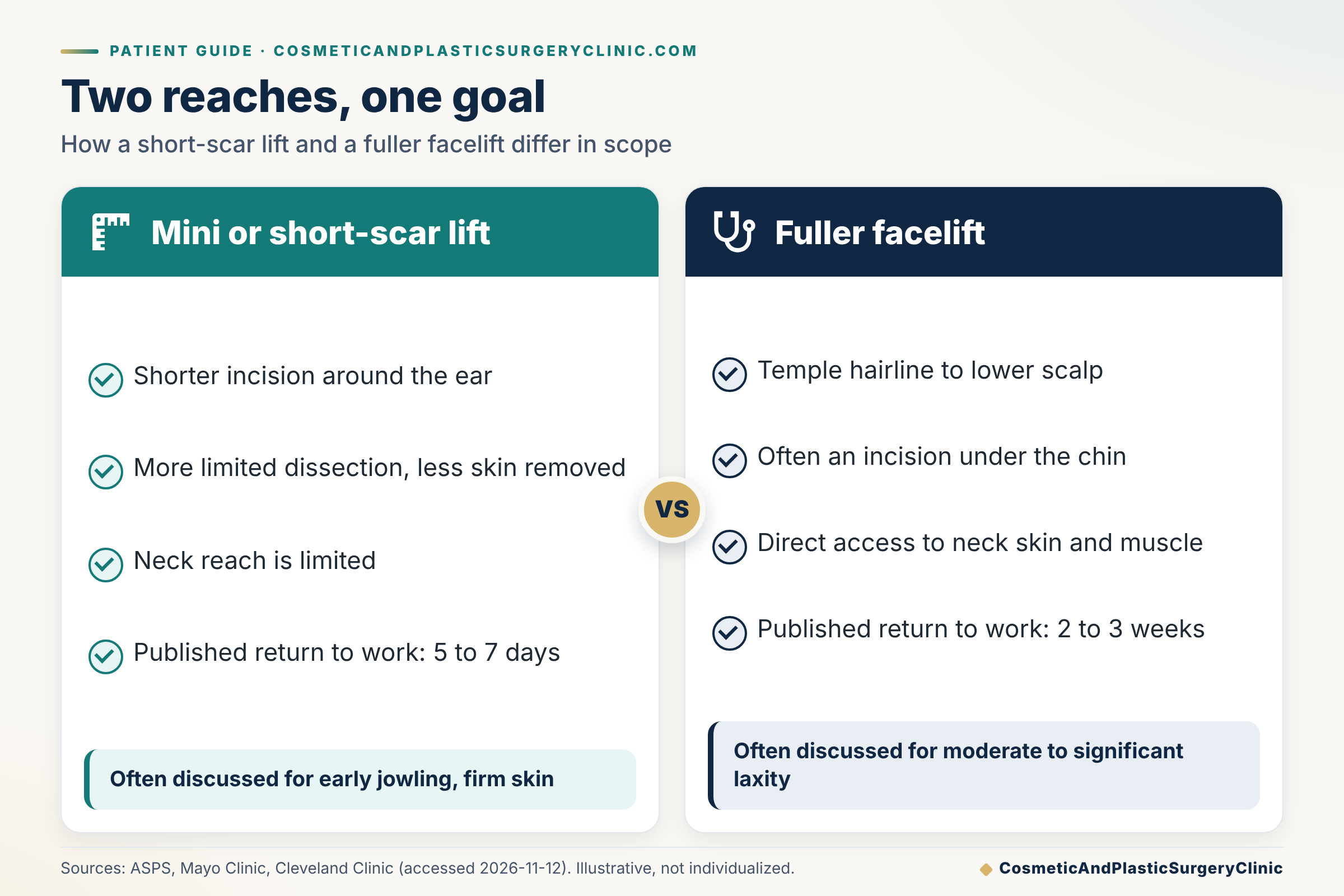
ASPS describes a traditional facelift incision as beginning in the hairline at the temples, passing around the ear and ending in the lower scalp, with a second incision under the chin sometimes added to improve the neck. Its limited-incision alternative uses shorter incisions at the temples that continue around the ear. Mayo Clinic’s description is similar: a shorter cut that starts in the hairline just above the ear, wraps the front of the ear and stops before the lower scalp.
A surgeon quoted in the 2025 ASPS piece pictures the short-scar version as a horseshoe in front of and behind the ear. Whichever outline is used, ASPS says the closed incisions end up hidden in the hairline and the natural contours of the face and ear, while Mayo Clinic is blunt that facelift scars do not go away.
What a fuller facelift reaches that a mini facelift usually does not
The neck and the skin behind the ear
The extra length of a traditional incision is not decoration. Running behind the ear to the lower scalp and, often, under the chin gives the surgeon a path to the neck skin and the muscle sheet beneath it. ASPS lists excess neck skin among the signs of aging a facelift addresses, and an ASPS article from 2023 noted that a neck lift is often best done together with a facelift for overall harmony.
Sources do not even agree on whether the smaller side of a mini facelift vs facelift pairing reaches the neck. Cleveland Clinic says mini-facelift surgeries focus on the lower face and neck, while the 2025 ASPS article says the operation often targets one area of the face. For the neck on its own, the neck lift page covers what that operation changes.
Depth of dissection is a separate dial from incision length
A short incision does not automatically mean shallow work. Facelift techniques differ by the layer they lift: skin only, the superficial muscular layer called the SMAS, or the SMAS, fat and skin together as one unit in a deep plane lift, as Cleveland Clinic describes it. A MACS-type operation, for example, suspends tissue vertically through a limited incision.
So a mini facelift vs facelift conversation really involves two questions: how long are the scars, and how deep and how far does the surgeon mobilize tissue? The layer-by-layer comparison belongs to the deep plane vs SMAS facelift article; here the point is only that the two dials move independently, so ask about both.
| Factor | Mini or short-scar lift | Fuller facelift | Basis |
|---|---|---|---|
| Typical indication | Early jowling or mid-face descent, good skin quality, little neck laxity | Moderate to significant laxity of the face and neck | ASPS 2025; Cleveland Clinic |
| Incision | Around the ear; may stop short of the lower scalp | Temple hairline, around the ear to the lower scalp, often under the chin | ASPS procedure page; Mayo Clinic |
| Neck access | Limited; often paired with separate neck work or left alone | Direct access to neck skin and muscle | ASPS 2025; Antell 2016 |
| Published downtime | Return to work about 5 to 7 days | Two to three weeks for more invasive lifts | Cleveland Clinic; varies by surgeon |
| Reversibility | Not reversible; scars remain | Not reversible; scars remain | Mayo Clinic |
| Maintenance | Aging continues; one small study found neck relapse by about year five | Results usually described as lasting around 7 to 10 years | Antell 2016; Cleveland Clinic |
| Risk profile | Pooled complication frequency 3.2% in limited-incision series | Same categories; rates vary by technique and series | Amador 2023; ASJ 2019 |
| Cost logic | Often less operating and anesthesia time; no published price comparison | More time and scope; ASPS average $11,395, excluding facility and anesthesia | ASPS cost page (year not stated) |
What the evidence says about mini facelift vs facelift outcomes
The evidence base is thinner than the marketing. The only head-to-head mini facelift vs facelift comparison in the sources opened for this article involved eleven people, and the larger reviews either pool one approach alone or compare a short-scar technique with a deep technique across a handful of retrospective studies. That does not make the data useless; it makes every number below a description of a group, not a forecast for one face.
Complications: low in published series, but not a head-to-head
Pooled limited-incision series: 3.2% overall
A 2023 systematic review in Aesthetic Surgery Journal (Amador and colleagues) pooled 20 articles covering 4,451 patients who had limited-incision facelifts, including MACS, S-lift, lateral SMASectomy and bidirectional techniques. The overall complication frequency was 3.2%. Hematoma, a collection of blood under the skin, was the most common event at 2% and rarely needed a return to the operating room; temporary nerve injury was 0.2% and skin necrosis or wound problems 0.06%.
Eighty-four percent of those patients had local, wide-awake surgery or conscious sedation and 16% had general anesthesia. Drains or tissue sealants were associated with an 86% decrease in complications. The record available for this review was an abstract-level summary. It has no full-facelift comparison group, so it describes how limited-incision lifts fared in skilled hands, not how they fared relative to anything else.
MACS against deep SMAS: four small retrospective studies
A 2026 meta-analysis in Medicina (Pandkhahi and colleagues) found 20 papers and kept four, published between 2005 and 2018, covering 286 patients: 186 with a MACS lift and 100 with a deep SMAS lift. Complications did not differ significantly (15 with deep SMAS, 20 with MACS), nor did hematoma. There was one transient nerve neuropraxia in the MACS group and no permanent nerve injury. Operating time was shorter with MACS, around 165 minutes against 190 and 222 minutes in the two studies that reported it.
One study reported higher pain scores after MACS (6.1 against 4.1, on a scale the review did not specify), so “less invasive” and “less uncomfortable” are not the same claim. The authors rated the evidence as at moderate to serious risk of bias, noted that surgeons had no standard way of choosing a technique, and called for randomized trials. None of these studies compared a mini facelift vs facelift in the everyday sense of a shorter versus a full scar.
What facelift-wide numbers add to a mini facelift vs facelift decision
Two larger reviews cover facelift surgery as a whole rather than by incision length. A 2025 meta-analysis in Aesthetic Plastic Surgery (Gandra and colleagues; 67 publications, 15,404 patients) put overall motor nerve damage at 0.66% and sensory at 0.39%, with permanent injury below 0.05% for each. A 2019 meta-analysis in Aesthetic Surgery Journal of 183 studies found that temporary nerve injury, hematoma and skin necrosis differed modestly between SMAS techniques, while permanent nerve injury did not.
The 2019 authors concluded that technique should be chosen for quality of results rather than complication profile. That is a useful frame for a mini facelift vs facelift choice too: because the complication categories are the same, the question is mostly which operation reaches what you need. Detail on each risk sits in the facelift risks article.
Longevity: one twin study and what it can and cannot show
Why identical twins make an unusually clean mini facelift vs facelift comparison
Most mini facelift vs facelift comparisons, like other technique comparisons, are muddied by the fact that surgeons choose the operation to suit the patient, so the groups differ before surgery. Identical twins share genes that influence skin quality and the pattern of aging, which removes much of that noise. Randomizing which sibling received the full incision, and having graders who did not know the technique rate the jawline, neck and nasolabial folds, were design strengths that most facelift comparisons lack.
Why a five-year neck gap does not settle a mini facelift vs facelift choice
The study’s limits matter as much as its design. Eleven people is a very small sample, a single surgeon performed every operation, the techniques are those of 2006, and judgments came from photographs, not measurements. The difference appeared only in the neck, not the jawline or nasolabial folds, which fits the idea that a short incision is a poorer tool for loose neck tissue but says little about a patient whose neck is already firm.
The authors concluded that, although a shorter incision is appealing, the full incision may offer a superior long-term result in the neck. A reasonable reading is narrower: ask any surgeon proposing a short scar how the neck is expected to look in five years, and on what basis. The how long a facelift lasts article takes up duration in general.
Headlines that run ahead of the data
Claims of durability deserve the same scrutiny in the other direction. A 2005 trade-press report on a short-incision lift carried the headline “better, longer-lasting,” yet its text described one surgeon’s experience with about 50 patients over two years, with no comparison group and no follow-up data on how long results held. A surgeon’s enthusiasm is a hypothesis. When a consultation offers longevity claims for either approach, ask for the follow-up period behind them.
| Source | Design and population | Main finding | Main limit |
|---|---|---|---|
| Amador and colleagues, Aesthetic Surgery Journal 2023 | Systematic review of limited-incision lifts; 20 articles, 4,451 patients | Overall complications 3.2%; hematoma 2%; temporary nerve injury 0.2% | No full-facelift comparison group; mixed techniques |
| Pandkhahi and colleagues, Medicina 2026 | Meta-analysis of MACS vs deep SMAS; 4 retrospective studies, 286 patients | No significant complication difference; MACS operations shorter | Selection bias; moderate to serious risk of bias |
| Antell and colleagues, Plastic and Reconstructive Surgery 2016 | Identical twins and triplets, 11 people, one surgeon; blinded photo grading | No difference at 1 year; neck scored higher after full incision at about 5 years | Tiny sample; one surgeon; 2006 techniques |
| Gandra and colleagues, Aesthetic Plastic Surgery 2025 | Meta-analysis of facelift nerve injury; 67 publications, 15,404 patients | Permanent motor and sensory injury each below 0.05% | Not split by mini vs full |
| Aesthetic Surgery Journal meta-analysis 2019 | 183 studies grouped by SMAS technique | Complication rates differ modestly by technique; permanent nerve injury did not | Compares SMAS techniques, not incision length |
Scars, downtime and second operations: the burden of each route
Scars: shorter is not the same as invisible
Where the scars sit and what hides them
A fuller facelift places a longer line from the temple hairline, in front of the ear or tucked at its edge, around the lobe and behind the ear into the lower scalp, with a short extra line under the chin in some plans. A short-scar lift trims that map, most often by shortening or leaving out the segment that reaches the lower scalp. Hairline and ear folds are the camouflage in both cases, so in a mini facelift vs facelift comparison the practical question is how each line looks on a person with your hairstyle, skin tone and healing pattern.
Mayo Clinic notes that facelift scars are lasting and that the hairline and ears usually hide them. ASPS says closure is with stitches that may dissolve or be removed after a few days, or with skin glue. For judging scars in a surgeon’s photo album, the facelift before and after article explains which views to ask for.
Hair, ear contour and sensation trade-offs
Mayo Clinic lists brief or lasting hair loss around the incisions, and numbness is among the common effects it describes during recovery. A StatPearls chapter on the deep plane technique lists alopecia and pixie ear deformity, a pulled-down earlobe, among possible complications. A shorter incision changes where these problems can occur, and it may avoid some of the lower-scalp line, but none of the sources opened shows that it eliminates them.
Cleveland Clinic similarly lists scarring, prolonged swelling, skin color irregularities and facial nerve injury among rare facelift complications without separating them by size of operation. Treat any promise of a scar nobody will notice with the same caution you would give a promise of no recovery at all.
Downtime: published ranges and marketing nicknames
Two clinical sources, two different scales
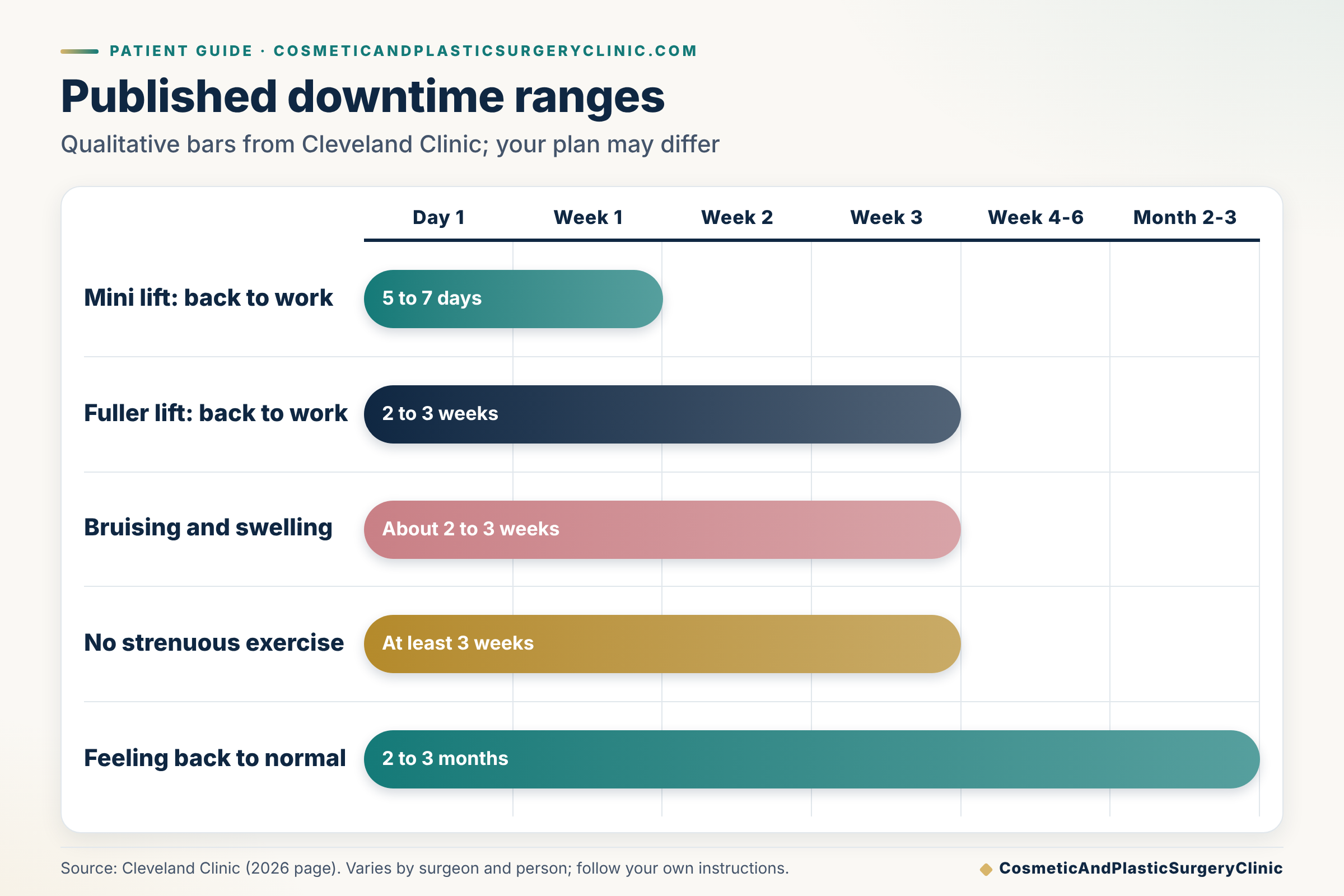
Cleveland Clinic gives the clearest published mini facelift vs facelift contrast. Bruising and swelling last about two to three weeks, and feeling fully back to normal can take two to three months. People who have a more invasive facelift generally take two to three weeks before returning to work, while a mini facelift usually takes five to seven days. Strenuous exercise is avoided for at least three weeks. A separate Cleveland Clinic Q and A from 2024 puts swelling and bruising after a basic facelift at 10 to 14 days.
Those figures differ because they describe different operations and surgeons. Names like “lunchtime” or “weekend” lift describe the marketing promise, not a measured recovery; the ASPS surgeon quoted in 2025 calls the shorter recovery of a mini “a trade-off.” Compare your own plan against the day-by-day detail in the facelift recovery article.
Anesthesia and setting are decisions, not size labels
It is tempting to assume a small lift means a small anesthetic. ASPS lists the choices as intravenous sedation or general anesthesia, selected by the surgeon for each patient, and Cleveland Clinic says the same. In the 2023 limited-incision review, 84% of patients had local wide-awake surgery or conscious sedation, so lighter anesthesia is clearly used, but it is a plan made between you, the surgeon and the anesthesia provider, not something the word “mini” ensures.
Ask where the operation will be done, who provides the anesthesia and what level of monitoring is used. The plastic surgery consultation article lists general questions that apply to any operation.
If a smaller lift is not enough later
Second lifts and what the sources do not quantify
Neither side of the mini facelift vs facelift choice stops aging. Mayo Clinic says facelift results are not lifelong, and Cleveland Clinic notes that some people have a second “update” in their 60s. What no source opened here reports is how often a mini facelift is followed by a fuller one, or how long a typical interval is, so any figure offered in a consultation should come with its source.
Logically, a later operation is a new surgery with its own anesthesia, recovery and risk, performed through or alongside existing scars. That is an argument for discussing the long game at the first consultation: ask how the surgeon would approach a second lift after the operation proposed today, and whether starting small makes the next step easier, harder or unchanged.
Cost logic without a price list
ASPS publishes an average facelift cost of $11,395 but states neither the data year on its page nor any split by technique, and notes that the figure excludes anesthesia, facility and related expenses. It adds that most health insurance plans do not cover facelift surgery or its complications. No authoritative source opened for this article gives a separate average price for a mini facelift.
A smaller operation often means less operating and anesthesia time, which can lower some line items. It is not automatically better value: if it falls short of your goals and leads to a second operation, the total may exceed a single fuller procedure. The line-by-line breakdown is in the facelift cost article; for a mini facelift vs facelift quote, ask that both be itemized the same way.
Matching anatomy and goals: how surgeons sort a mini facelift vs facelift
Findings that tend to favor a smaller operation
Early jowls, good skin quality and modest neck laxity
In the 2025 ASPS article, one surgeon says a mini facelift has a place “in very selected patients,” usually in their 40s and 50s, who show early jowling, a softening jawline or mid-face sliding. Another says good candidates typically have good skin quality, which fits an operation that removes little skin and leaves the remaining skin to redrape.
A separate 2025 ASPS article on the mid-facelift describes cheek and malar repositioning as suited to early volume loss or descent in the cheek when there is no significant skin laxity or sagging along the jawline or neck. These are descriptions of who surgeons say may suit a smaller plan in a mini facelift vs facelift discussion, not tests you can pass at home; the facelift candidate article covers what a surgeon actually examines.
The limit: asking a mini to do the work of a neck lift
The ASPS procedure page states that limited-incision lifts are usually reserved for patients with less skin relaxation and give less rejuvenating results than a full facelift. One surgeon in the 2025 article added that only a limited amount of skin is removed and the muscle tightening is also very limited, and said she rarely finds anyone who is a good candidate for a short-scar facelift or an isolated neck lift.
That candid view is one surgeon’s, not a consensus, but it matches the twin study’s neck finding. If the main complaint is loose neck skin, visible banding or a heavy area under the chin, ask whether a short-scar plan can truly address it or whether the neck needs its own operation, as outlined in the neck lift page.
Findings that tend to favor a fuller operation
Moderate to significant laxity, including the neck
Cleveland Clinic describes the traditional facelift, with incisions around the ears, the hairline and below the chin, as generally recommended for moderate to significant aging, and a mini facelift as quicker, less invasive and usually recommended for younger people with early sagging. The 2025 mid-facelift article makes a similar point from the other side: a full facelift, in its surgeon’s words, “remains the definitive answer” for more extensive signs of aging.
Some of that language is promotional in tone, and “definitive” overstates what any operation can do, but the underlying logic of any mini facelift vs facelift discussion is consistent across sources: the more skin and deep tissue laxity there is, the more reach the operation needs. Surgeons weigh that on examination, not by age alone.
Volume loss: neither operation refills a face
Lifting repositions tissue; it does not restore lost volume or change skin quality. Mayo Clinic says a facelift does not treat fine lines, sun damage, creases around the nose and upper lip or changes in skin color, and ASPS says it cannot stop the aging process or change your fundamental appearance. The 2025 mid-facelift article adds that facelifts are less effective at repositioning cheek volume, which is why surgeons often pair them with fat grafting or other techniques.
That applies equally to a mini facelift vs facelift choice: neither replaces volume. Hooded upper eyelids are a different operation again; see blepharoplasty cost for how eyelid surgery is priced. For nonsurgical ways to address volume, with their limits, see facelift alternatives.
Age and health are poor shortcuts
Age is a rough proxy for tissue, not a rule
The ASPS surgeon who describes a mini facelift for people in their 40s and 50s also notes a trend toward people in their 30s asking for one and advises caution about too much surgery too soon. Cleveland Clinic’s surgeon says patients typically are in their late 50s to early 60s, though people in their 40s or 80s also have facelifts, and that results last longer when skin is elastic at the time of surgery.
Together these point to skin elasticity, laxity and goals as what matters, with age a loose stand-in. A 45-year-old with heavy jowls and a 62-year-old with firm skin and one early jowl may each fit the opposite stereotype, which is why a mini facelift vs facelift decision cannot be made from a birthday.
Nicotine, bleeding risk and body-image screening
Mayo Clinic says smoking greatly raises the risk of poor wound healing, hematoma and skin loss after a facelift, and a StatPearls chapter lists active smoking, bleeding risk and body dysmorphic disorder among contraindications for the deep plane technique, noting that skin flap necrosis has historically been more common in smokers. Those cautions apply to both sides of a mini facelift vs facelift choice, because both lift skin.
Questions about medications, supplements and nicotine products belong with the surgeon who will operate, and nobody should change a prescription on the strength of an article. A surgeon who asks about these things, and about why you want surgery now, is screening for safety and expectations rather than being difficult.
Two hypothetical cases instead of a winner in the mini facelift vs facelift choice
The cases below are invented to show how reasoning changes when one variable changes. They are not patient stories, not predictions and not advice about any real person.
Case one: early jowling, firm skin and little neck laxity
Why a shorter-scar plan may be discussed
Consider a hypothetical person in their mid-forties who notices a soft line forming at the jaw, has firm skin that has recoiled well after weight changes, and sees little looseness under the chin. A surgeon may reasonably put a limited-incision or mid-facelift approach on the table, because the problem is modest, the skin is likely to redrape, and the smaller operation trades some reach for less dissection and, in the published ranges, a shorter recovery.
Even here, the surgeon would examine the neck while the person is relaxed and while the muscle bands are tensed, check how the skin behaves when pinched, and talk through what a surgeon cannot see in a mirror. The plan stays provisional until that exam.
The finding that could reverse it
If the examination finds platysma banding or neck skin that the short-scar approach is not expected to reach, the argument for the smaller operation weakens, because the twin study’s neck difference at about five years is exactly the area in question. Likewise, a history of heavy nicotine use or a strong preference for the longest-lasting result may move the discussion toward a fuller procedure or toward waiting.
The reverse can also happen: if the person’s main wish is a very short recovery before a fixed event and the neck is acceptable, the smaller operation may stay appropriate. In a mini facelift vs facelift decision, the deciding fact is what the exam finds, not the label.
Case two: the same age, more jowl and neck laxity
Changing one variable changes the plan
Keep the same hypothetical age but change the anatomy: deeper jowls, a loose neck, visible bands and a blunted jaw-neck angle. The same surgeon who suggested a shorter plan in case one may now describe a fuller facelift, often with neck work, because the area needing correction has expanded beyond what a limited incision is described as reaching.
Nothing about the person’s age changed, which is the point: a mini facelift vs facelift recommendation follows anatomy. Two surgeons can legitimately differ on borderline cases, which is why a second opinion is a normal part of this decision, not a sign of distrust.
Adding a second variable: the shortest recovery possible
Now add a constraint: a person in case two wants the shortest possible downtime for work reasons. The honest options become explicit trade-offs: a smaller operation now that may not fully correct the neck, a fuller operation timed for a quieter period, a staged plan, or no surgery at present. Each carries different scar, cost and recovery consequences.
A surgeon who lays out those options, including the choice to wait, is doing what an informed consent process should. One who steers toward a single answer, whether the smallest or the largest operation, without explaining what would change the recommendation deserves more questions.
| Goal or anatomy | Option often favored | Reason | Fact that could reverse it |
|---|---|---|---|
| Early jowl, firm skin, little neck laxity | Short-scar lift or mid-facelift discussed | Modest problem; skin likely to redrape; less dissection | Neck bands or loose neck skin found on exam |
| Moderate jowls with a loose neck and visible bands | Fuller facelift, often with neck work | Reach to the neck skin and muscle is needed | Patient prefers a staged or smaller first step after counseling |
| Cheek flattening with a clean jawline | Mid-facelift, possibly with volume restoration | Problem sits in the cheek, not the jaw or neck | Volume loss is the main issue, so lifting alone falls short |
| Tight deadline, short recovery wanted | Smaller operation or a later date | Published downtime is shorter for mini lifts | The smaller plan would not reach the area that bothers you |
| Current nicotine use or bleeding risk | Wait or address the risk first | Smoking raises healing and hematoma risk in both operations | Surgeon clearance after the risk is addressed |
Questions to settle before a mini facelift vs facelift decision
Six questions that show what a quote really covers
Three questions about the plan
- What exactly is being lifted, and through which incisions, for my anatomy?
- What will this plan do for my neck and jawline, and what will it leave alone?
- Is any part of the operation different from what you would do for a fuller facelift, and why?
Good answers name specific structures and findings from your exam, not general reassurance. If the response to the second question is “the neck will look great,” ask what the neck looks like at five years in patients like you, and whether those photographs are available.
Three questions about proof and fallback
- How many of these operations do you perform a year, and what follow-up do your photographs cover?
- What would a second operation involve, and who covers its cost if the first falls short of what we agreed?
- What would make you recommend the other approach, or no surgery?
The last question tests honesty. A surgeon who can name the findings that would change the recommendation understands the mini facelift vs facelift trade-off. A surgeon who cannot may be selling one product. Compare written answers from two consultations before you decide.
Checking the surgeon and the photos behind a mini facelift vs facelift quote
Credentials and who actually operates
Because “mini” is not a standard term, the surgeon matters more than the nickname in a mini facelift vs facelift decision. The choose a plastic surgeon article explains how to verify board certification, state licensure and the accreditation of the facility. Confirm who performs the dissection and closure, who provides anesthesia, and where emergencies would be handled, especially if the plan is for lighter anesthesia.
Reading before-and-after photos in a mini facelift vs facelift comparison
For either operation in a mini facelift vs facelift comparison, look for matched views (front, three-quarter and side), the same lighting and expression, and follow-up at 6 to 12 months or longer. Because the twin study found its difference in the neck at about five years, ask specifically for neck photographs from patients who had the same technique and are several years out, and for scar photographs once healed.

Frequently asked questions
Can a mini facelift be done under local anesthesia?
Sometimes. In the 2023 review of limited-incision lifts, 84% of patients had local wide-awake surgery or conscious sedation. Yet ASPS lists intravenous sedation and general anesthesia as the usual choices and says the surgeon recommends the option that suits each patient. The decision depends on how much tissue is mobilized, whether other procedures are combined, your health and comfort, and the facility. Awake surgery is not automatically safer or lesser, so ask who provides the anesthesia, what monitoring is used and what happens if the plan expands during the operation.
Is a thread lift the same as a mini facelift?
No. The 2025 ASPS article notes that threads, filler and neuromodulator combinations and energy-based treatments are sometimes marketed as mini facelifts, which confuses patients. A surgical short-scar lift involves incisions and tissue repositioning. ASPS also says minimally invasive treatments cannot achieve the same results as a facelift, though they may help delay the time at which a facelift becomes appropriate, and it calls stem cell facelifts unproven. If a quote uses the word mini, ask what is physically being placed or cut and what published follow-up supports the claim.
Can I have a mini facelift now and a full facelift later?
In principle a later operation is possible, but it is a new surgery with its own anesthesia, recovery and risks, done alongside existing scars. Cleveland Clinic notes that some people have a second update in their 60s, and no source opened here reports how often a mini is followed by a fuller lift. At the first consultation, ask how the surgeon would plan a second operation, whether the same surgeon would do it, and what the practice’s revision policy says about cost.
Will a mini facelift fix a neck that looks loose?
That depends on what is loose. The ASPS procedure page says a second incision under the chin may be needed to improve an aging neck, and a surgeon in the 2025 ASPS article said muscle tightening with a short-scar lift is very limited. The twin study also found its difference in the neck at about five years. A surgeon may pair a short-scar lift with separate neck work, recommend a fuller incision, or suggest that the neck is acceptable as it is. Ask what the exam found.
At what age does a mini facelift vs facelift decision usually come up?
There is no age at which one becomes the right choice. ASPS surgeons describe mini lifts in selected patients in their 40s and 50s and caution against surgery too soon in people in their 30s, while a Cleveland Clinic surgeon says patients typically are in their late 50s to early 60s, with some in their 40s or 80s. Skin elasticity, the amount of laxity, general health, nicotine use and goals carry more weight than the number of birthdays, and only an examination can sort them.
Do the scars of a mini facelift vs facelift heal differently?
No source opened for this article shows that shorter scars heal better. How a scar looks depends on skin type, closure tension, genetics, sun exposure, smoking and care. A shorter line covers less length, but it is not the same as a faint one, and Mayo Clinic says facelift scars do not go away. One 2005 trade report quoted a surgeon who believed minimal skin removal reduced closure tension, which is an opinion, not a measured result. Ask to see healed scars at 6 to 12 months or later.
What if two surgeons disagree about mini facelift vs facelift?
Disagreement is common in borderline cases and is not a red flag by itself. Ask each surgeon to name the examination findings behind the recommendation, to describe what would change it, and to put the plan in writing. A surgeon’s experience with a technique legitimately shapes what is offered, so also ask how often each one performs the operation proposed. A third opinion is reasonable, and waiting remains a valid option while you gather answers.
Sources and further reading
- American Society of Plastic Surgeons — Facelift (rhytidectomy) overview (accessed 2026-11-12) — definition, limits, combined procedures, unproven treatments
- American Society of Plastic Surgeons — Facelift procedure steps (accessed 2026-11-12) — anesthesia, traditional and limited incisions, neck incision, closure
- American Society of Plastic Surgeons — Summer ready in a flash: The mini facelift (Willson, June 26, 2025; accessed 2026-11-12) — meanings of “mini,” short-scar incision, candidates, trade-offs
- American Society of Plastic Surgeons — The shifting focus of facial aesthetics: Rise of the mid-facelift (Frankeny, July 1, 2025; accessed 2026-11-12) — mid-facelift scope, cheek volume limits
- American Society of Plastic Surgeons — Lifting the veil on face and neck lifts (Brumby, October 10, 2023; accessed 2026-11-12) — limited incision, neck lift with facelift
- American Society of Plastic Surgeons — Facelift cost (accessed 2026-11-12) — average cost figure, exclusions, insurance
- American Society of Plastic Surgeons — Facelift risks and safety (accessed 2026-11-12) — risks listed, consent
- Mayo Clinic — Face-lift (accessed 2026-11-12) — hematoma, scars, hair loss, smoking, results not lifelong, limited incision
- Cleveland Clinic — Facelift (rhytidectomy) (accessed 2026-11-12) — types, mini-facelift recovery ranges, results duration
- Cleveland Clinic Health Essentials — How long does a facelift last and other FAQs (January 31, 2024; accessed 2026-11-12) — swelling duration, age, skin elasticity
- Amador, Hamaguchi, Bartlett and Sinha — Limited incision facelifts: a contemporary review of approaches and complications, Aesthetic Surgery Journal 2023 (indexed record, accessed 2026-11-12) — 4,451 patients, complication rates
- Pandkhahi et al. — Comparison of deep SMAS lift and MACS in facelift: a meta-analysis, Medicina 2026 (accessed 2026-11-12) — 286 patients, complications, operating time, limits
- Antell, May, Bonnano and Lee — A comparison of the full and short-scar face-lift incision techniques in multiple sets of identical twins, Plastic and Reconstructive Surgery 2016 (abstract record, accessed 2026-11-12) — twin study design and results
- ScienceDaily — Full vs short-scar facelift incision twin study news release (May 2016; accessed 2026-11-12) — ages, grading, follow-up
- Gandra, Silva and Horta — Facelift surgery and nerve injury: a systematic review and meta-analysis, Aesthetic Plastic Surgery 2025 (accessed 2026-11-12) — pooled nerve injury rates
- A meta-analysis of complication rates among different SMAS facelift techniques, Aesthetic Surgery Journal 2019 (abstract record, accessed 2026-11-12) — 183 studies, technique-level complications
- Hohman, Raggio and Patel — Deep plane facelift, StatPearls (updated January 31, 2026; accessed 2026-11-12) — contraindications, complications, smoking
- Tonnard and Verpaele — 300 MACS-lift short scar rhytidectomies: analysis of results and complications, European Journal of Plastic Surgery 2005 (abstract record, accessed 2026-11-12) — description of a named short-scar technique
- Dermatology Times — Short incision facelift may be better, longer-lasting (November 1, 2005; accessed 2026-11-12) — example of a surgeon-reported series without follow-up data