One clinic’s website says “deep plane,” another’s consultation sheet says “SMAS facelift,” and both sound like a technical claim you are supposed to be impressed by. The deep plane vs SMAS facelift question deserves more care than the labels invite, because each word describes which layer of the face the surgeon works in. Neither word describes how well an operation will turn out for a particular person.
This article handles that single decision. It explains the anatomy behind each label, what the research comparing them does and does not show, which situations tend to raise one option over the other, and the questions that turn a brand name into usable information. The wider map of the operation lives in the facelift overview; this page stays with technique.
The layers behind both labels
Skin, fat, SMAS and platysma: a four-layer stack
Where the SMAS sits and why surgeons lift it
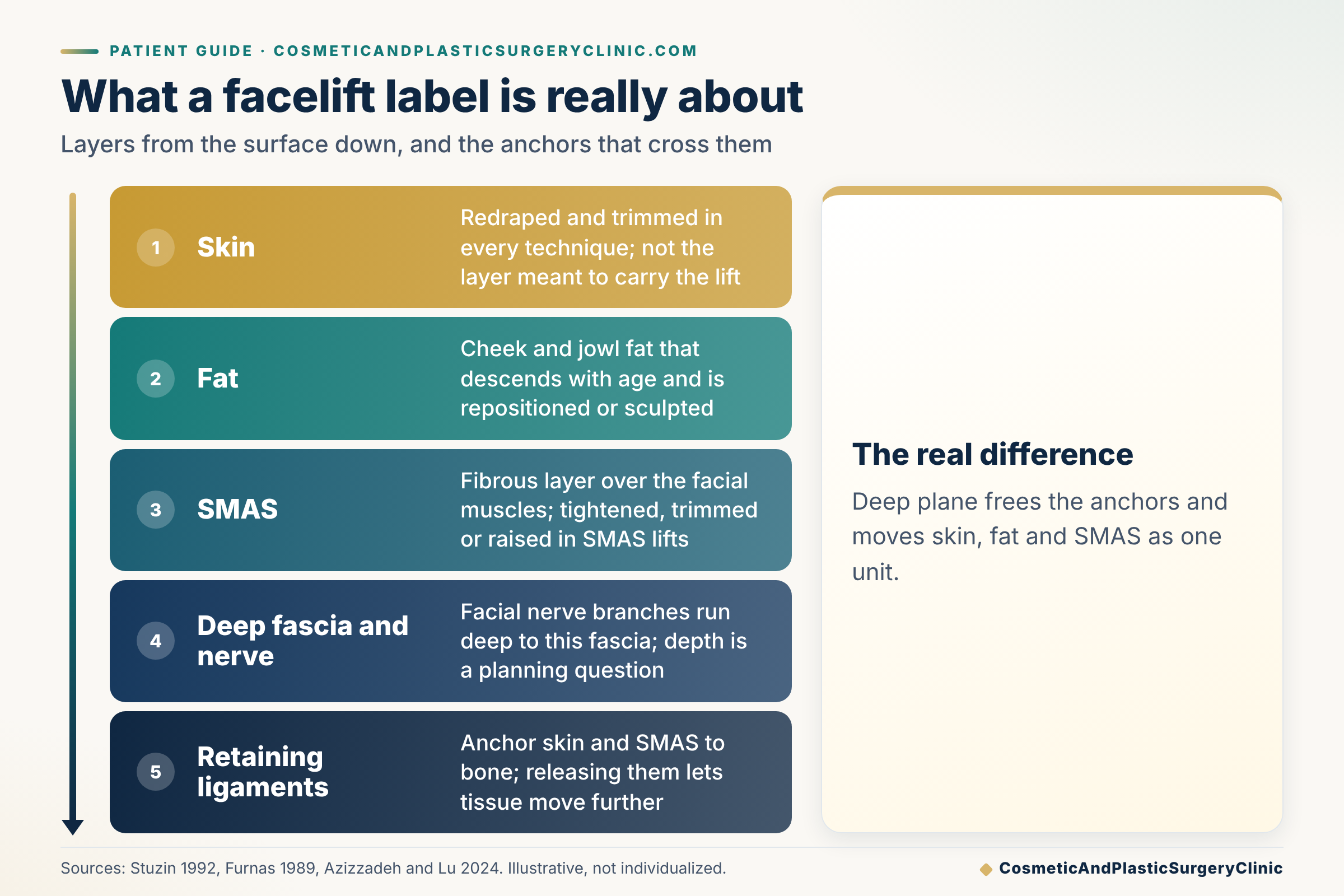
Stuzin, Baker and Gordon’s 1992 cadaver study described facial soft tissue as a stack: skin, then fat, then a superficial fascia that covers the muscles of expression, then a deeper fascia that shields the nerve branches in the cheek. In the cheek that superficial fascia is the SMAS, short for superficial musculoaponeurotic system. It is continuous with the platysma, the thin muscle that runs down the neck.
Mitz and Peyronie’s 1976 report in Plastic and Reconstructive Surgery, based on dissections, radiographs and tissue slides, is the usual starting point for the term. They suggested the layer could be used in face-lifting. A later review by Ryu (2014) argues the principle: the SMAS flap, not the skin, should carry the lifting force. Skin pulled alone tends to be asked to hold more tension than it comfortably can.
Retaining ligaments: the anchors that limit how far tissue moves
Furnas described four retaining ligaments of the cheek in 1989. The zygomatic ligaments, sometimes called McGregor’s patch, anchor cheek skin to the lower edge of the cheekbone and help define the front border of the jowl. The mandibular ligaments tether skin to the front of the jawbone. Furnas concluded that the zygomatic and mandibular ligaments must be released to achieve the maximum upward movement of facial skin.
Stuzin and colleagues added the aging side of the story: these ligaments weaken over time, which contributes to jowling and deeper nasolabial folds. Almost every real difference in the deep plane vs SMAS facelift debate comes back to one question: how much of that anchoring is released, and in which plane.
The facial nerve in the same neighborhood
Branches that surgeons work around
The facial nerve sends motor branches to the muscles of expression, and they run below the SMAS. Azizzadeh and Lu, two surgeons who perform deep plane operations, write that the branches lie deep to the masseteric fascia, which is why a deep plane dissection is carried out on the surface of that fascia. Mitz and Peyronie noted in 1976 that working beneath the layer was safe over the parotid gland but could be dangerous in front of it.
A 2025 pooled review of facelift nerve injury found that motor weakness, when it occurred, mostly involved the temporal, zygomatic, marginal mandibular and buccal branches, and that sensory changes affected the preauricular area, earlobe, midface and forehead or scalp.
Why nerve injury belongs in every technique’s risk talk
Nerve risk is not owned by one label. Azizzadeh and Lu point out that the older sub-SMAS method already approached the lower and midface branches, and that deep plane dissection extended that territory. Sensory nerves can be affected by skin-layer work too. Numbers from pooled reviews appear in a later section; the point here is that a surgeon who says one approach has “no nerve risk” is describing a hope, not an anatomy fact.
How the two approaches differ in the operating room
SMAS-based lifts: tighten, fold, trim or elevate the layer
Low-SMAS methods: plication, imbrication and SMASectomy
A 2019 meta-analysis in Aesthetic Surgery Journal sorted facelifts into six named techniques: SMAS plication, SMASectomy or imbrication, SMAS flap, high lateral SMAS flap, deep plane and composite. A 2025 review grouped the first three into a low-SMAS family. In plication the layer is folded onto itself with sutures. In imbrication it is overlapped and fixed. In SMASectomy a strip is removed and the edges are joined.
Cleveland Clinic describes the SMAS facelift as a variation of the traditional facelift that focuses on the lower two-thirds of the face, tightening the muscular layer and trimming excess skin or fat in the cheeks and lower face. The skin is still separated from the tissue below, then redraped and trimmed.
Extended and high SMAS flaps: lifting further than plication
Not every SMAS technique stays in the lower face. Ryu’s review describes an extended SMAS lift that releases the zygomatic and upper masseteric ligaments in the plane under the SMAS, and a high SMAS lift that raises the layer above the top edge of the cheekbone arch to reach the midface, the area under the eye and the region around the mouth. The same review notes a steep learning curve for extended sub-SMAS dissection.
That matters for anyone weighing a deep plane vs SMAS facelift. A “SMAS facelift” can be a modest tightening or a deep, ligament-releasing operation, and the extended versions overlap in concept with deep plane surgery.
Deep plane: release the ligaments and move the layers as one unit
What the 1990 description added
The technique’s founding paper, “The deep-plane rhytidectomy” (Plastic and Reconstructive Surgery, 1990, attributed to Hamra by later authors), set out to fix a problem earlier lifts often missed: sagging nasolabial folds. According to the abstract, the surgeon starts with a Skoog-type sub-SMAS dissection and extends it over the zygomaticus muscles and past the folds to free all SMAS attachments. The result is a thick flap of skin, cheek fat and platysma.
The abstract reports 403 patients with few complications and marked fold improvement. That was the originating surgeon’s own series, without blinded raters, so it explains the rationale rather than proving superiority. Cleveland Clinic summarizes the idea in one line: the SMAS, fat and skin are lifted as one unit, so several areas are often treated at once.
Extended deep plane and composite relatives
Names multiply from there. A 2024 systematic review in Cureus listed deep plane and extended deep plane lifts alongside stepped SMAS lifts, mini-invasive facelifts and others, and the 2019 meta-analysis counted composite rhytidectomy as its own category. These names usually trace to particular surgeons’ modifications, so they signal lineage more than a fixed recipe.
Why one label can describe several different operations
Names signal lineage, not a standard recipe
Two surgeons who both say “deep plane” can differ in how far the release extends, how the neck is handled, how skin is trimmed and where the incisions run. Review authors cope with this by grouping names into families, such as the low-SMAS and extended-SMAS groups used in the 2025 nerve-injury review. The label tells you the family at best.
For that reason, this discussion of deep plane vs SMAS facelift options treats each label as shorthand for an anatomical plan. The practical question for a consultation is never “deep plane or not” but “which layer, which ligaments, and what else is done in the same operation.”
A side-by-side deep plane vs SMAS facelift decision matrix
The matrix below compares the typical SMAS-based lift (plication, imbrication, SMASectomy) with a deep plane lift. Cells describe what sources report or what a surgeon would need to specify; blanks in the evidence are stated plainly.
| Feature | SMAS-based lift (plication, imbrication, SMASectomy) | Deep plane lift |
|---|---|---|
| Layer handled | SMAS folded, overlapped or trimmed; skin separated and redraped | SMAS, cheek fat and skin lifted together as one unit |
| Retaining ligaments | Often left in place in simpler versions; extended versions release some | Released, so layers can move together |
| Usual focus | Lower two-thirds of the face and jowls | Midface, nasolabial folds and jowls together |
| Dissection and time | Generally less extensive; no verified head-to-head minutes | Wider release; longer than MACS in two small retrospective studies |
| Revision issues | Depends on remaining layer and scar planes; ask the surgeon | SMAS can be thin or absent in revision cases |
| Scars and downtime | Set by incision plan and skin trimming; no verified difference | Same incision options; no verified difference in healing time |
| Cost logic | Fee reflects experience, procedure and location; no verified price gap | Same logic; deeper work may add operating time, not a documented premium |
What the research on deep plane vs SMAS facelift results can and cannot show
Head-to-head comparisons are few and point in different directions
Two photo-rating studies with opposite conclusions
In a 2004 comparative study in Archives of Facial Plastic Surgery, Becker and Bassichis had four board-certified facial plastic surgeons review masked, randomized before-and-after photographs from 20 deep plane and 20 SMAS plication patients. SMAS plication scored higher overall, with more cases in the best category and equal numbers in the poorest. Plication led in the 50-to-59 and 60-to-69 age groups; deep plane scored slightly higher in the 70-to-80 group. The authors concluded that deep plane “does not seem to offer superior results” in patients younger than 70.
A 2007 study in the same journal looked at midface effects in 25 deep plane and 25 SMAS plication patients, using three blinded observers and a 7-point scale across five areas. All three rated the deep plane group significantly better in two of the measured locations, with improvements about twice as large. The authors called the deep plane lift better in the midface and neck. The record page I opened did not say how patients were assigned or which two locations differed.
Both studies were small, short-term and photo-based, and neither can be assumed to describe your face or your surgeon’s hands. Read together, they show how a deep plane vs SMAS facelift comparison can flip with the sample, the raters and the measure.
A 2025 pooled review found one direct comparison
Vayalapra and colleagues pooled complication data in Annals of Plastic Surgery in 2025: 47 studies, 10,766 patients, searched through May 2024. Only one included study compared the two technique families directly, and it found better midface rejuvenation with the deep approach. The authors judged safety comparable, called the efficacy evidence suggestive rather than settled, and asked for prospective comparative studies with standardized outcome measures.
A 2026 meta-analysis in Medicina compared deep SMAS lifts with MACS (minimal access cranial suspension) lifts. Four retrospective single-center studies, 286 patients, showed no significant difference in complications. Aesthetic results were assessed qualitatively and not pooled, and the MACS operation was significantly shorter. The comparison matters because a deep plane lift is often weighed against shorter-scar options as well; see mini facelift vs facelift for that decision.
Complication figures for deep plane vs SMAS facelift: reading them without turning them into forecasts
What pooled reviews report for hematoma, nerve injury and overall complications
Vayalapra’s team reported major hematoma in about 3 percent of deep technique lifts and 2 percent of SMAS lifts. Nerve injury rates were similar between groups, mostly temporary, with permanent injury rare. A 2019 meta-analysis of 183 studies in Aesthetic Surgery Journal reported temporary nerve injury from 0.69 percent (deep plane and plication) up to 1.85 percent (high lateral SMAS flap), no significant difference in permanent injury, and major hematoma of 1.22 percent after deep plane.
Weigh that 2019 paper with its context: a trade-press summary named its senior author as a surgeon who prefers the deep plane approach and cited his own center’s release. A 2026 review in Aesthetic Plastic Surgery pooled 45 deep-plane-only studies with 10,784 patients and reported 6.6 percent overall complications, about 1.2 percent temporary nerve injury, about 1.8 percent hematoma and no permanent nerve injury. It called aesthetic assessment subjective and asked for longer follow-up.
Not every pooled estimate agrees. An Egyptian university meta-analysis of nine studies, whose record page lacked a journal and year, reported complications of 12.12 percent for deep plane against 4.18 percent for SMAS. A 2025 review of 67 studies and 15,404 patients put pooled motor nerve damage after facelift at 0.66 percent and permanent motor damage at 0.047 percent, but it did not split results by technique.

Why none of these figures is your number
Pooled rates in deep plane vs SMAS facelift reviews blur together different surgeons, patients, anesthetics and definitions of “complication.” Most included studies were retrospective. Many reported combined operations, such as eyelid surgery alongside the lift, which confounds cause. Surgeons who publish a series of hundreds of deep plane operations are usually highly experienced, so their results may not transfer to a surgeon doing the technique occasionally.
A 2024 Cureus review also cited a database of 11,300 facelift patients in which the overall complication rate was 1.8 percent, rising to 3.7 percent when the lift was combined with other cosmetic procedures against 1.5 percent for a facelift alone. It listed male sex and a body mass index of 25 or higher among risk factors for major complications. Those patient factors often move risk more than the technique label does.
There is also the question of what “better” means. Blinded photo ratings measure what surgeons see in photographs, not how a person feels, functions or ages afterward. Koroma’s team called aesthetic assessment subjective, Vayalapra’s team called outcome measures heterogeneous, and the 2011 review asked for standardized efficacy and patient-reported measures. Until those exist, a deep plane vs SMAS facelift claim of superiority rests on small series and surgeon opinion.
| Source and year | Design | What it reported | Main limit |
|---|---|---|---|
| Becker and Bassichis, 2004 | Masked photo review, 20 deep plane vs 20 plication | Plication rated higher overall; deep plane not superior under age 70 | Small; short follow-up; photos only |
| Midface study, 2007 | Blinded photo ratings, 25 vs 25 | Deep plane significantly better in two locations; about twice the improvement | Assignment not stated; locations not named on record |
| Vayalapra et al., 2025 | Meta-analysis, 47 studies, 10,766 patients | Hematoma 3% vs 2%; similar nerve injury; one direct comparison | Heterogeneous outcome measures |
| Pandkhahi et al., 2026 | Meta-analysis, 4 retrospective studies, 286 patients | Deep SMAS vs MACS: no complication difference; MACS shorter | Retrospective; likely selection bias |
| Aesthetic Surgery Journal, 2019 | Meta-analysis, 183 studies | Temporary nerve injury 0.69% to 1.85% by technique | Senior author prefers deep plane |
| Koroma et al., 2026 | Meta-analysis, 45 deep plane studies, 10,784 patients | 6.6% overall complications; no permanent nerve injury | Subjective aesthetics; durability unknown |
Which concerns and situations tend to raise one approach over the other
Matching the facial concern to the layer involved
Jowls, the jawline and the neck
Jowls and a softened jawline are the classic reasons for a facelift of either type. Cleveland Clinic describes the SMAS facelift as aimed at the lower two-thirds of the face, and the 2004 photo study found plication rated higher in patients under 70. Many surgeons therefore discuss SMAS-based lifts first when sagging is limited to the lower face and skin quality is reasonable.
Neck banding is a separate maneuver. Platysma tightening or neck contouring is added to either technique; the neck lift page explains that operation, and neck lift techniques covers how it is done. When you hear a quote, check whether neck work is included or priced separately.
Midface descent and nasolabial folds
The deep plane approach was designed for nasolabial folds, and the 2007 study and the single direct comparison in the 2025 review both leaned toward better midface effects. In a deep plane vs SMAS facelift conversation, that is a reasonable basis for asking whether midface descent is part of your concern. It is not proof, and the 2004 study found the opposite trend in younger patients.
Folds also reflect volume loss and skin quality. ASPS lists lost or fallen facial fat among the causes of an aging face, and a lift repositions tissue rather than replacing it. What surgeons weigh before recommending a technique is outlined in the facelift candidate article.
Neither lift addresses everything a person may notice in the mirror. Mayo Clinic says a facelift does not treat fine lines, sun damage, creases around the nose and upper lip, or skin color changes. ASPS calls it a restorative operation that cannot stop aging. A deep plane vs SMAS facelift choice therefore sits beside, not in place of, decisions about skin care, resurfacing, volume or eyelid work, whose costs are outlined in blepharoplasty cost.
Situations that can change the plan
Revision surgery and thin tissue
Azizzadeh and Lu note that the SMAS is often thinner or absent in revision cases, which can leave the nerve branches in a shallower layer. Previous incisions also leave scar planes. A person who has had an earlier lift, a thread procedure or other work should expect the surgeon to ask for operative records and to explain why the chosen technique suits the tissue that remains.
Health, anesthesia time and recovery tolerance
Mayo Clinic puts a facelift at roughly three to six hours. In two small retrospective studies in the Medicina review, deep SMAS lifts ran roughly 190 and 222 minutes against 165 for MACS. When a deep plane vs SMAS facelift is compared for someone with heart, lung or clotting concerns, operating time matters, because more time means more time under anesthesia. ASPS describes good candidates as healthy nonsmokers with realistic expectations.
ASPS says comfort during the operation comes from intravenous sedation or general anesthesia, chosen by the surgeon for each patient. Anesthesia plans are individual, so the practical question is who will give it, where, and how a longer operation changes that plan.
Mayo Clinic and Cleveland Clinic both list blood thinners, smoking, weight fluctuation and certain medical conditions as factors that raise complication risk. Anyone taking medications should raise them with the surgeon and follow that surgeon’s instructions; this article cannot advise on changing any prescription.
Deep plane vs SMAS facelift scenarios and the facts that could reverse them
| Goal and anatomy | Option often discussed | Reason | Fact that could reverse it |
|---|---|---|---|
| Early jowls, good skin, lower-face concern | SMAS-based lift | Targets the lower two-thirds with less release | Hidden midface descent seen on exam or photos |
| Heavier midface descent with deep nasolabial folds | Deep plane or extended SMAS | Designed to free ligaments and move the cheek fat pad | Folds that are mostly volume loss; a surgeon whose best results are with another method |
| Neck bands with moderate jowls | Either, plus platysma work | Neck work is a separate step in both | Neck fat or skin laxity that needs a different plan |
| Prior facelift, thin tissue | Surgeon-specific | Remaining SMAS and scar planes limit options | Operative records showing what was done before |
| Mild sagging, shortest recovery priority | Short-scar or mini approach | Smaller dissection; see the mini comparison | Tissue laxity beyond what a limited lift can address |
Healing, risk, price and durability: where a deep plane vs SMAS facelift label matters less
Recovery and scars look much alike under either label
The shared healing pattern
Incision options come from the plan, not the label. ASPS describes a traditional incision that starts at the temple hairline, runs around the ear and ends in the lower scalp, a limited incision with shorter temple cuts for people with less skin relaxation, and a neck lift incision that starts in front of the earlobe and wraps behind it. Either technique can use any of them.
Cleveland Clinic gives general ranges: bruising and swelling that typically last two to three weeks, two to three months before things feel back to normal, a small drain that may be placed behind the ears, and strenuous exercise generally avoided for at least three weeks. Your own surgeon’s instructions override any general range; the facelift recovery article follows the weeks in detail.
Numbness, tightness and ear sensation
Skin numbness is on ASPS’s list of possible effects, and the 2025 nerve-injury review described sensory changes around the ear, earlobe and cheek. These sensations often improve over time, but how long they last varies and no source I opened separates a deep plane vs SMAS facelift on this point. If a surgeon says deep plane surgery carries less or more numbness, ask what that statement rests on.
Risk, price and durability: what is known and what is missing
The risk conversations that do differ
ASPS lists facial nerve injury with weakness, bleeding, fluid buildup, infection, skin numbness, lasting pain, poor healing or skin loss, hair loss at the incisions, poor scarring and asymmetry among facelift risks, and calls them rare. None of those is exclusive to a technique. What can differ is the plane and extent of dissection, so questions about nerve branches, hematoma control and skin blood supply are fair to ask of either approach.
The full list, with what is expected, what is a complication and what is an emergency, is in facelift risks.
Quotes and how long results last
ASPS reports an average facelift cost of $11,395 without a data year on its page, and says the figure excludes anesthesia, facility fees and other expenses. It adds that the surgeon’s fee depends on experience, the type of procedure and the office location. No source I opened gave a price difference between the two techniques, so ask each quote to state what is included, including neck work. The facelift cost article breaks down a quote.
On durability, Cleveland Clinic says results usually last about seven to ten years while the face keeps aging, and Mayo Clinic says results are not lifelong. The 2026 deep-plane review lists long-term follow-up as a gap. I found no study that compares how long a deep plane vs SMAS facelift lasts, so a claim that one lasts longer is an opinion. The how long does a facelift last article covers the evidence that does exist.
Questions that turn a label into information
Six questions to ask about a deep plane vs SMAS facelift recommendation
Questions about the plan itself
- Which layer will you work in, and are the retaining ligaments released? A clear answer names the layer and the ligaments, not just the brand.
- Why does that suit my anatomy? Look for reasons tied to what the exam showed: jowl position, midface descent, skin quality, prior surgery.
- What else is part of the operation? Neck work, fat grafting, skin treatments and eyelid surgery change time, cost and risk.
If the answers come back as slogans rather than anatomy, that is information too. A surgeon who can draw the layers on a diagram of your own face is easier to evaluate than one who recites a technique name. The planning conversation itself is described in the plastic surgery consultation article.

Questions about experience, evidence and aftercare
- How many of each technique do you perform, and how often? Since the literature says surgeon skill dominates, volume and routine matter.
- Can I see healed photos, at least a year out, of patients with faces like mine? Photo reading has its own pitfalls, covered in facelift before and after.
- Who handles a hematoma, a nerve problem or a revision, and at what cost? Ask where emergencies are treated and what the revision policy says in writing.
Credentials and facility questions come before technique. The checks for board certification and accredited facilities are laid out in choosing a plastic surgeon, and the meaning of titles in cosmetic surgeon credentials.
Claims that outrun the evidence
Superiority and longevity claims
Watch for statements such as “deep plane lasts longer,” “SMAS lifts are outdated,” or “there is no nerve risk with my method.” The deep plane vs SMAS facelift evidence reviewed above does not support any of them. Pooled safety looks comparable, direct comparisons are few and conflict, and durability data by technique were not found. A surgeon who states the limits of the evidence is easier to trust than one who does not.
Marketing may also pair the technique label with a promise of a “natural” result or a short recovery. Treat those as questions to test with photos and references, not as facts to accept.
Credentials, facility and the value of a second opinion
Technique is only one input. The surgeon’s training, the accreditation of the facility, the anesthesia provider and the follow-up plan shape safety at least as much. A second opinion from a second board-certified surgeon can show whether a recommendation is driven by your anatomy or by what one practice offers. Waiting, or choosing not to operate, remains a reasonable decision.
Frequently asked questions
Is a deep plane vs SMAS facelift decision mostly about the surgeon?
To a large extent. Reviewers reporting on the evidence ask for prospective comparisons because direct data are scarce, and the early photo studies disagreed with each other. Outcomes depend on how often a surgeon performs the technique, how well the plan fits your anatomy and how problems are handled. That is why credentials, volume and healed-photo evidence deserve at least as much attention as the technique name.
Does a deep plane vs SMAS facelift differ in price?
For a deep plane vs SMAS facelift, no source I opened documents a price premium. ASPS says the surgeon’s fee reflects experience, the procedure and geography, and its average excludes anesthesia and facility fees. A longer operation can raise facility and anesthesia charges. Ask each quote to list the surgeon fee, facility, anesthesia, neck work and revision policy so you compare like with like.
Can the deep plane vs SMAS facelift choice change after a first SMAS lift?
Sometimes, but it depends on what tissue remains. A 2024 article on facial nerve considerations notes the SMAS may be thin or absent in revision cases. Scar planes from earlier surgery also matter. A surgeon will usually ask for the operative report and examine you before saying whether another technique is workable.
Is a deep plane vs SMAS facelift different for the facial nerve?
The data do not give a clean answer on a deep plane vs SMAS facelift. A 2025 review found similar nerve injury rates between technique families, mostly temporary, and the 2026 deep-plane review found no permanent nerve injury among its pooled studies. Other reviews report different figures, and most studies were retrospective. Ask your surgeon how nerve branches are identified and protected in the planned operation.
Do the terms “deep plane” and “extended SMAS” mean the same thing?
Not exactly. An extended SMAS lift releases some retaining ligaments beneath the SMAS and raises the layer further, so it overlaps in concept with the deep plane lift, which frees all SMAS attachments and moves skin, fat and SMAS together. Names reflect different surgeons’ lineages. Ask what is actually released and where the dissection stops.
Who is a poor fit for a deep plane vs SMAS facelift?
Only an examination can say. ASPS describes good candidates as healthy nonsmokers with realistic expectations, and Mayo Clinic lists blood thinners, smoking and some conditions as factors that raise risk. Skin texture, surface lines and volume loss are not repositioned by either lift, and what surgeons evaluate is outlined above.
How do I compare two surgeons who disagree on a deep plane vs SMAS facelift?
Ask each to explain the choice in terms of your anatomy, then ask for healed photos of similar faces, case numbers for the recommended technique, the revision policy and the emergency plan. A surgeon who recommends the technique they perform most is not necessarily wrong, but you are entitled to hear why the alternative was set aside.
Sources and further reading
- American Society of Plastic Surgeons — Facelift overview (accessed 2026-11-12) — purpose, limits, contributing factors
- American Society of Plastic Surgeons — Facelift procedure steps (accessed 2026-11-12) — incisions, tissue repositioning, anesthesia
- American Society of Plastic Surgeons — Facelift safety (accessed 2026-11-12) — listed risks, including facial nerve injury
- American Society of Plastic Surgeons — Facelift candidates (accessed 2026-11-12) — health, nonsmoking status, expectations
- American Society of Plastic Surgeons — Facelift cost (accessed 2026-11-12) — average cost, exclusions, what affects the fee
- American Society of Plastic Surgeons — Facelift recovery (accessed 2026-11-12) — bandage and drains; no fixed timelines
- Mayo Clinic — Facelift (accessed 2026-11-12) — duration, hematoma, risks, results not lifelong
- Cleveland Clinic — Facelift (accessed 2026-11-12) — technique types, recovery ranges, warning signs, durability
- The superficial musculo-aponeurotic system (SMAS) in the parotid and cheek area, Plastic and Reconstructive Surgery 1976 (abstract record, accessed 2026-11-12) — origin of the SMAS description
- The deep-plane rhytidectomy, Plastic and Reconstructive Surgery 1990 (abstract record, accessed 2026-11-12) — technique description, 403 patients
- Furnas — The retaining ligaments of the cheek, Plastic and Reconstructive Surgery 1989 (indexed record, accessed 2026-11-12) — four ligaments, release for upward movement
- Stuzin, Baker and Gordon — The relationship of the superficial and deep facial fasciae, 1992 (indexed record, accessed 2026-11-12) — layered anatomy, ligament aging
- Chang, Pusic and Rohrich — A systematic review of comparison of efficacy and complication rates among face-lift techniques, Plastic and Reconstructive Surgery 2011 (accessed 2026-11-12) — article counts, lack of quality data
- Becker and Bassichis — Deep-plane face-lift vs SMAS plication face-lift: a comparative study, Archives of Facial Plastic Surgery 2004 (accessed 2026-11-12) — masked photo comparison
- Midface effects of the deep-plane vs the SMAS plication face-lift, Archives of Facial Plastic Surgery 2007 (abstract record, accessed 2026-11-12) — 25 vs 25 blinded ratings
- Vayalapra et al. — Comparing the safety and efficacy of SMAS and deep plane facelift techniques, Annals of Plastic Surgery 2025 (repository record, accessed 2026-11-12) — 47 studies, 10,766 patients
- Koroma et al. — Deep plane facelifts: a systematic review and meta-analysis of outcomes, Aesthetic Plastic Surgery 2026 (repository record, accessed 2026-11-12) — 45 studies, complication rates
- Pandkhahi et al. — Comparison of deep SMAS lift and MACS in facelift: a meta-analysis, Medicina 2026 (accessed 2026-11-12) — four retrospective comparisons, operating time
- A meta-analysis of complication rates among different SMAS facelift techniques, Aesthetic Surgery Journal 2019 (abstract record, accessed 2026-11-12) — 183 studies, nerve injury and hematoma by technique
- Plastic Surgery Practice — Deep plane facelifting technique, other methods equally safe, study suggests (2019; accessed 2026-11-12) — trade-press summary and author context
- Gandra, Silva and Horta — Facelift surgery and nerve injury: a systematic review and meta-analysis, Aesthetic Plastic Surgery 2025 (accessed 2026-11-12) — 67 studies, pooled nerve damage
- Azizzadeh and Lu — Facial nerve considerations for the deep plane facelift and neck lift, Facial Plastic Surgery 2024 (accessed 2026-11-12) — nerve depth, revision cases
- Meretsky et al. — A systematic review and comparative analysis of reconstructive rhytidectomy, Cureus 2024 (accessed 2026-11-12) — technique variants, combined-procedure risk
- Ryu — Consideration of facelift methods and facial retaining ligaments in Asians, Archives of Aesthetic Plastic Surgery 2014 (accessed 2026-11-12) — extended and high SMAS lifts, ligament release
- Comparison between superficial and deep plane facelift: meta-analysis study, Zagazig University faculty of medicine authors (record page; journal and year not stated; accessed 2026-11-12) — conflicting complication figures