Almost nobody is declared a facelift candidate by a website, and the people who search for the term are usually asking something more personal: is my face, my health history and my reason for wanting this a fit for an operation that lifts and repositions tissue? The honest answer comes from an examination, not from a quiz. A surgeon looks at how the skin behaves, where volume has moved, what the neck is doing, and what else in the medical history could change healing.
This article opens up that evaluation so you can arrive prepared. It covers the anatomical checks for a facelift candidate, the health and nicotine questions, the goals conversation and the timing questions, with the numbers that exist and their limits. It is education, not a verdict on any individual. The facelift overview covers the operation itself; technique choices, cost, recovery, risks and alternatives each have their own pages, linked where the reader needs them.
What a facelift candidate evaluation is really deciding
The surgeon is answering three linked questions. Does this face have the kind of change a facelift can address? Is this person healthy enough to heal from it? And do the person’s goals match what the operation can deliver? A yes to all three leads to a plan; anything else leads to more information, another route or a later date.
The problem a facelift is designed to address
Which tissues the facelift candidate’s exam is looking at
Mayo Clinic’s patient page describes the basic aging change: skin gets looser and does not snap back as easily when stretched, and facial fat shifts, which can make the face look tired or heavy. The targets of a facelift are sagging cheeks, excess skin along the lower jawline, deep folds from the nose to the corners of the mouth and, when a neck lift is added, the neck. ASPS lists jowls and loose neck skin among them.
The practical translation is that an examiner assessing a facelift candidate is judging layers: the skin, the fat beneath it, the deeper supporting tissue and, in the neck, the platysma muscle.
Bone also matters, because the structure under the soft tissue sets how much a lift can reshape. A cheekbone that projects well supports a lifted cheek differently from a flat one. That is one more reason a facelift candidate cannot be assessed from a flat photograph.

What a facelift does not treat, even in a good facelift candidate
Mayo Clinic is blunt that a facelift does not treat fine lines, sun damage, the creases around the nose and upper lip, or changes in skin color. ASPS adds that a facelift does not change a person’s fundamental appearance and cannot stop aging, and it lists brow lift, eyelid surgery, fat transfer and skin resurfacing as treatments that are sometimes combined with it. Eyelids and brows sit above the area a facelift lifts. For that part of the face, the blepharoplasty cost page explains how eyelid surgery is priced and planned on its own.
A useful test for any goal is to ask which layer is responsible. Jowls and a loose jawline are mostly a lower-face support problem. A hollow under the eye is a volume problem, and crepey skin on the cheek is a skin-quality problem. A single operation rarely fixes all three, which is why surgeons ask which one bothers you most.
Why age is not the entry ticket
What the numbers say about who has facelifts
ASPS reported 77,933 facelifts in the United States in 2025, up 13 percent from 69,097 in 2024. By age band, 30,332 were in people 56 to 65 and 33,004 in people 66 and older; 11,603 were in the 46 to 55 band and 2,620 in the 36 to 45 band. Those are reported procedure counts, so they show who chose surgery, not who was well advised to. Popularity is not suitability.
The American Academy of Facial Plastic and Reconstructive Surgery (AAFPRS) says there is no ideal age for a facelift and that most patients fall between 40 and 70. An ASPS article from 2023 says no single age is ideal and quotes surgeons who see some patients ready in their mid-40s and others much later, with genetics, sun exposure and lifestyle shaping the pace.
When age does enter the conversation
Age works as a proxy for other things: how much laxity has developed, how the skin responds, and how many other health conditions have accumulated. A 2009 to 2012 analysis of the U.S. National Inpatient Sample (6,964 facelift patients, available as a manuscript PDF whose journal is not stated) found more major complications in patients 65 and older than in younger ones, 3.4 percent versus 2.1 percent, and an adjusted odds ratio of 1.77 for age 70 and over.
The same analysis linked hypertension and diabetes to larger increases, and it found no significant difference in major complications among patients without other medical conditions.
That dataset covers hospital inpatient stays, a selected subset of facelifts, and it was observational, so it cannot say what happens to any one person. The reasonable reading is that health status often counts for more than the birth year, and that the surgeon’s medical review is where age gets weighed.
Skin laxity, volume and jowls: the anatomical checks for a facelift candidate
This is the part of the evaluation that photographs can hint at but cannot settle. Surgeons usually examine the face at rest and in expression, sitting and lying, and often pull the tissue gently to see how it moves.
What the exam looks for in the face and neck
Laxity, volume loss and the supporting structures
An ASPS article on facelift timing describes patients in their mid-40s who are losing facial fat and developing jowls and sagging around the mouth and neck. Laxity means the skin and its supports have stretched, so tissue can be moved back; volume loss means there is less underneath, so moving skin may reveal hollows rather than smooth them. Many faces have both.
An ASPS blog from 2019 says a facelift is the option that can help when skin easily pulls away from the face and neck or hangs loosely, and suggests considering it when creams, serums and nonsurgical treatments no longer help.
The balance between laxity and volume loss steers the plan. More laxity points toward lifting; more volume loss may point toward adding volume, sometimes alongside a lift. Which mix a given facelift candidate has is a question for the examination.
The neck, the jawline and the platysma
Neck findings often decide the scope of the operation. Loose skin, fat under the chin and vertical bands from the platysma muscle each respond to different maneuvers. Cleveland Clinic notes that anterior-only neck lifts suit people most concerned about the neck, a double chin or mild to moderate neck skin excess. The neck lift page explains those steps, and the chin liposuction versus neck lift page covers the case where fat is the main issue rather than laxity.
When another route may fit better
Mild laxity, early change and shorter operations
Cleveland Clinic says short-scar facelifts are suited to younger people with mild to moderate aging, and it describes mid-face lifts as addressing the eyelid, eyebrow and upper cheek but not the jowl or neck. Whether a shorter operation is enough depends on the anatomy, and the mini facelift versus facelift page compares the scopes. A person with early changes may also be a better fit for a nonsurgical approach, which has its own limits and is covered on the facelift alternatives page.
Volume loss after rapid weight loss
An ASPS article from July 2026 describes surgeons seeing the face deflate faster than expected after rapid weight loss, with the loss of deep and superficial fat compartments and, often, descent and laxity. The surgeons quoted use fillers or fat grafting for volume and consider a facelift when descent is present. One says he prefers to wait until weight has stabilized or is close to target, because treating too early raises the risk of under- or overcorrection and extra procedures. The article gives about 65 to 70 percent long-term survival for grafted fat.
Mayo Clinic makes a related point for facelifts: repeated gain and loss can affect facial shape and skin. The practical question for a facelift candidate whose weight is still changing is whether to wait, since the face a lift was planned on may change.
| Situation | Pathway a surgeon may discuss | Benefit | Trade-off | Key question |
|---|---|---|---|---|
| Jowls and loose lower-face skin, volume mostly intact | Facelift, sometimes with neck work | Addresses descent and excess skin directly | Incisions, recovery time, surgical risks | Which technique do you use for my anatomy, and why? |
| Early sagging, mild laxity | Short-scar operation or nonsurgical care | Smaller scope, shorter recovery | May not reach the neck or last as long | Would a smaller operation really reach my concern? |
| Hollow cheeks and temples more than sagging | Volume restoration, with or without a lift | Targets the layer that changed | Fat survival varies; touch-ups possible | Is my concern laxity, volume or both? |
| Weight is still dropping or fluctuating | Wait and re-evaluate | Plan fits the final face | Months of living with the concern | When would you consider my weight stable enough? |
| Neck bands or fat under the chin dominate | Neck lift or chin liposuction, possibly with a facelift | Matches the procedure to the neck anatomy | Neck work can add operative time | What is causing my neck contour, skin, fat or muscle? |
| Main concern is fine lines or sun-damaged skin | Skin treatments; facelift is not the tool | Matches the layer responsible | Resurfacing has its own recovery | What would improve texture, and how long does it last? |
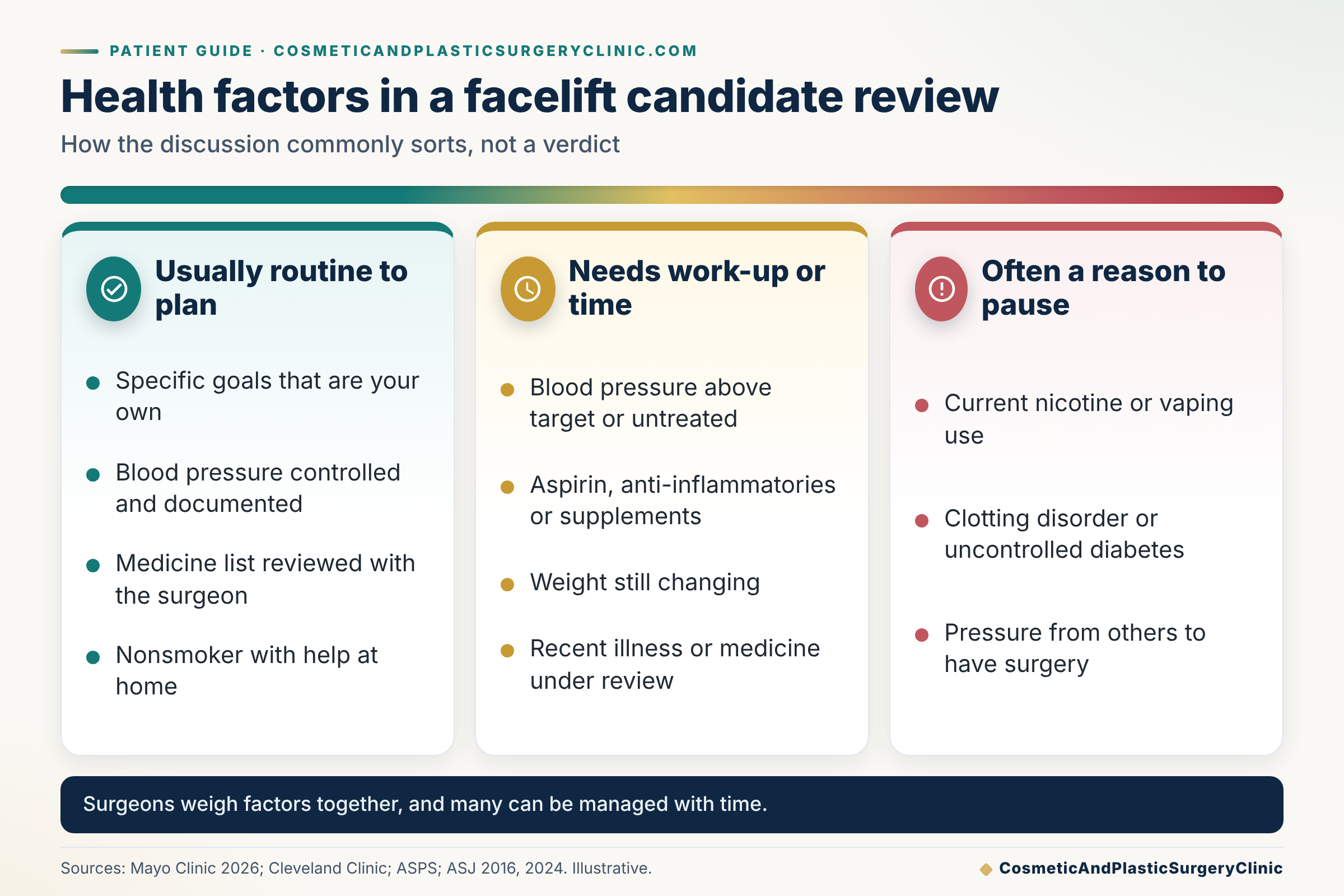
Smoking, blood pressure and medicines: health factors that shape a facelift candidate’s safety
The ASPS lists two health criteria for a facelift candidate: no medical condition that impairs healing, and not smoking. Behind those short lines sits a specific worry. A facelift raises flaps of skin and then closes them under tension, so the quality of the blood supply and the control of bleeding matter more here than in many operations.
Nicotine and healing in a facelift candidate
What the sources say about skin loss
Mayo Clinic states that smoking greatly raises the risk of poor wound healing, hematomas and skin loss after a face-lift. A 1984 study in Plastic and Reconstructive Surgery on skin-flap survival in facelift patients is the classic citation; a 2014 meeting abstract reviewing the literature summarizes it as a strong association between smoking and higher skin slough rates. The abstract did not report the study’s numbers, so this article does not either.
For a facelift candidate who smokes, Cleveland Clinic says the healing risk is greater than for nonsmokers or former smokers, and that many surgeons advise stopping at least one month before surgery. The 2014 abstract says there is no consensus on the best smoke-free interval, although many authors agree that four weeks reduces smoking-related complications. Each surgeon sets the rule for their own practice, and a longer gap is generally regarded as better.
Vaping, patches, gum and testing
Nicotine is the issue, not only cigarettes, so a facelift candidate who vapes or uses replacement products should say so at the first visit rather than assume the rule does not apply. The 2014 abstract notes that unaided quit rates are low, about one in eight, that nicotine replacement and medication can improve success, and that patient history can be unreliable, which is why some practices measure cotinine, a nicotine by-product. Whether a surgeon accepts replacement products during the waiting period, and how they confirm abstinence, varies and is worth asking.
Blood pressure, bleeding and medicines
Hematoma: the complication that candidacy is built around
A hematoma is a collection of blood under the skin. Mayo Clinic calls it the most common facelift complication and says it usually forms within 24 hours. Published rates range widely. An ENTtoday summary from 2015 puts the range in the literature at 0.2 to 8 percent and the generally accepted figure at about 3 to 4 percent.
A 2016 analysis in Aesthetic Surgery Journal of 11,300 insured facelifts tracked in the CosmetAssure database between 2008 and 2013 found a 1.1 percent hematoma rate and a 1.8 percent overall rate of major complications, defined as an emergency visit, hospital admission or reoperation within 30 days.
Men had a higher hematoma risk in that analysis, a relative risk of 3.9. The ENTtoday summary likewise reports higher rates in men. Because the database covers insured patients and counts only major events, it understates minor problems and may not match any individual surgeon’s results.
Blood pressure and aspirin: what the studies suggest
A 2024 review in Aesthetic Surgery Journal on hematoma prevention (Stewart and colleagues, level 3 evidence, mostly retrospective studies) gathers the data. It cites a 1,078-facelift series in which systolic pressure above 150 carried a 3.6 odds ratio for hematoma, and a 502-patient series from one of its own authors reporting 0.5 percent hematomas with strict pressure control below 120 mmHg versus 3.76 percent with looser control. Two small randomized trials of blood-pressure drugs reported fewer hematomas, but their samples were small.
The same review reports aspirin users having more hematomas even after stopping the drug: 18 percent versus 4.1 percent in a 630-patient series, and a risk ratio of 2.3 in the 1,078-patient series. A 2014 chart review of 229 facelifts found hematoma in 6.5 percent, and a history of hypertension predicted it in simple analysis but not once other factors were counted; only male sex and a preoperative systolic pressure above 160 remained independent risks. In plain terms, the pressure on the day matters, and a diagnosis of hypertension is something to manage, not an automatic bar.
Medicine decisions for a facelift candidate belong to the surgeon and the doctor who prescribes them. Never stop a prescribed medicine on your own because of something you read; ask both clinicians what to do, and bring a full list of prescriptions, over-the-counter products and supplements, because Mayo Clinic and Cleveland Clinic both say some of them can raise bleeding risk and that the surgeon may ask for adjustments before surgery.
Other health factors that change the plan
Conditions, weight and combined operations
Mayo Clinic says a clotting disorder rules out surgery, and that poorly controlled diabetes or high blood pressure raises risk. It also mentions hormone replacement therapy as something the surgeon may ask about because of clot risk. The 2016 CosmetAssure analysis found a relative risk of 2.8 for infection with a body mass index of 25 or higher, and a complication rate up to 3.7 percent when procedures were combined, compared with 1.5 percent for facelift alone.
That does not mean combining is wrong; it means added operating time and added surgery carry added risk, which belongs in the planning talk when a neck lift or eyelid surgery is bundled in.
In the National Inpatient Sample analysis mentioned earlier, adjusted odds ratios for major complications were 5.1 for hypertension and 3.3 for diabetes, and the group without comorbidities showed no significant age difference. Anesthesia fitness, usually reviewed with the anesthesia team before the operation date, is a separate check that no article can predict.
Why these numbers are not cutoffs
Every figure above comes from groups of patients, not from a single facelift candidate, and many are retrospective. None gives a threshold below which surgery is safe or above which it is not. A body mass index, a blood-pressure reading or an age is one input among many. Surgeons look at combinations, and many conditions are manageable once they are controlled. The right reading is a list of questions to raise with the surgeon and the primary care doctor, not a score to calculate.
How the factors link to long-term planning for a facelift candidate
The second table moves from the single decision to the years afterward: how each factor can affect the result, what it implies for maintenance or revision, and what should prompt a conversation with the surgeon. It describes the logic in the sources, not a forecast for anyone.
| Factor | Effect on outcome | Maintenance or revision implication | Warning sign or review point |
|---|---|---|---|
| Nicotine use | Higher risk of healing problems and skin loss | Healing trouble can mean scars or a later revision | Skin that darkens or looks dusky after surgery: call the surgeon promptly |
| High or poorly controlled blood pressure | Associated with more hematomas in several series | A hematoma may need a return to the operating room | Severe one-sided pain in the first 24 hours |
| Aspirin, anti-inflammatories, supplements | Can raise bleeding risk | Surgeon may adjust before surgery | Bring a complete list; never stop prescriptions alone |
| Weight change after surgery | Can alter facial contour and skin | May change how long the result looks as planned | Discuss goal weight before choosing a date |
| Sun exposure and skin quality | Thin or damaged skin shows aging that a lift does not treat | Skin care and treatments may be needed alongside | Ask which skin concerns surgery will not touch |
| Prior facelift or facial procedures | Scar tissue and altered anatomy can change the plan | Secondary operations are planned differently | Bring records and dates of earlier procedures |
Goals and expectations: does the wish match what a facelift can do?
Candidacy is not only about tissue and health. ASPS lists a positive outlook and realistic expectations among its criteria, and says the decision should be made for oneself rather than to satisfy someone else or an idealized look. A surgeon who hears a facelift candidate describe a goal the operation cannot reach is just as likely to redirect the plan as to schedule it.
What a realistic goal sounds like
Specific goals that map to what a facelift changes
Goals that fit the operation for a facelift candidate are anatomical and modest: a softer jawline, less hanging skin under the chin, shallower folds beside the mouth, a neck that no longer looks heavy. An ASPS article describes the aim as looking good for one’s age, such as looking the way a patient did at 55 or 60. A small 2019 French multicenter study of 36 patients (median age 58.5) found higher FACE-Q appearance scores at three months, stable at six and twelve months, with patients estimating they looked about six years younger.
It was small, self-reported and level IV evidence, so treat it as an illustration of the typical framing, not a promise.
Consider a hypothetical person whose main concern is a jawline that has softened over ten years and whose skin is otherwise comfortable. That goal is concrete, and a surgeon can say what a lift is likely to change. A different person who says they want to look thirty again is describing something no operation does, and a good consultation turns that into a conversation about which features matter most.
The gap between a promise and a plan
Be cautious about any practice that tells a facelift candidate a precise outcome from a photo or a phone call. Surgeons can describe likely changes in general terms, and the ASPS safety page says the risks will be fully discussed before consent forms are signed. Phrases like “years younger” are marketing shorthand unless they are tied to a specific method and population. A plan sounds like a description of what will be lifted, where the incisions go, and what will not change.
Whose goal is it, and what about body-image distress
Surgeons screen for expectations because some people seeking cosmetic procedures live with body dysmorphic disorder, a condition in which a perceived flaw causes distress out of proportion to what others see. A 2015 study in JAMA Facial Plastic Surgery of 234 consecutive adults at one academic facial plastic surgery clinic found it in 13.1 percent of cosmetic patients and 1.8 percent of reconstructive patients, and showed a brief questionnaire could screen for it. The study covered facial cosmetic patients generally, not facelifts specifically, at a single center.
What the operation cannot control
Scars, asymmetry, sensation, aging and healing
Scarring is expected to some degree after any operation with incisions. Mayo Clinic says facelift scars are usually hidden by the hairline and the face and ear shape; ASPS lists unfavorable scarring, asymmetry, numbness and changes in skin sensation, hair loss at the incisions and facial nerve injury among the risks. No face is exactly symmetric to start with, and healing varies from one side to the other. The facelift risks page covers each of those in depth.
Aging also continues. Mayo Clinic says face-lift results are not lifelong and do not stop the face from aging, and an ASPS article puts the average at about a decade, with touch-ups or nonsurgical treatment extending results. How long a result lasts for a given face is a separate question, taken up on the how long does a facelift last page.
Why photos cannot establish candidacy
A selfie flattens depth, distorts distance and cannot show how tissue moves or how thick the skin is. A before-and-after gallery shows other people’s faces, and the best-looking images are the ones selected for display. Both are useful for starting a conversation and neither can tell you whether you are a good facelift candidate. The facelift before and after page explains what to look for in photographs, including angle, lighting and timing.
Timing and life circumstances: when a facelift candidate may wait
Medical readiness is only half the calendar. A good facelift candidate on paper can still be better off waiting if the next few months cannot absorb two to three weeks of visible recovery.
Life factors that can move the date
Weight, health changes and help at home
Weight that is still changing, a recent illness, a new medicine under review or an unresolved blood-pressure problem can each shift the date. Mayo Clinic advises arranging a ride home if you are discharged the same day and having someone help the first night. Cleveland Clinic says bruising and swelling typically last two to three weeks and that most people return to ordinary activities within that window, though traditional facelifts may take longer than minimally invasive versions. Surgeons set their own timelines, so ask for theirs.
Work and social calendars matter too. Visible bruising and swelling that last a few weeks can clash with a wedding, a big presentation or a family trip, and the most useful planning question is how much visible healing you are willing to have in public.
Budget, commitments and pressure
Surgery for a facelift candidate is elective, so no clinical clock forces the date. Money pressure, offers that expire quickly and deposits that lock in a slot can distort that. The facelift cost page breaks down what the quote should include, and a sound plan allows for follow-up visits and the possibility of revision. If the budget needs a loan or a long payment plan to fit, waiting is a legitimate choice.
Earlier procedures and what to tell the surgeon
Prior surgery, injectables and skin treatments
A facelift candidate should tell the surgeon about every earlier facial operation, filler, fat transfer, thread lift, resurfacing treatment and energy-device session, with dates and, if possible, records. Earlier surgery can leave scar tissue and altered tissue planes, and the ASPS lists fat transfer, fillers and skin treatments as procedures sometimes combined with a facelift, so the surgeon needs to know what is already in place. No source reviewed here says earlier injectables disqualify anyone, but the details change how the exam and plan are done.
Planning for the years after surgery
Mayo Clinic says follow-up visits continue for two months, and Cleveland Clinic recommends sun protection, a healthy lifestyle and follow-up visits to help maintain results. A facelift candidate who is realistic about maintenance, touch-ups and the chance of another operation years later is thinking about the same questions the surgeon will raise. Ask what the practice’s policy is on revision and how any fees are handled.
Preparing for the consultation: questions that need an exam
The first visit works best as an information-gathering appointment. ASPS says members should be board certified by the American Board of Plastic Surgery or the Royal College of Physicians and Surgeons of Canada, and that surgery should take place in an accredited, state-licensed or Medicare-certified facility. The choose a plastic surgeon page walks through verifying those credentials, and the plastic surgery consultation page covers the visit in general terms.
Questions to bring to the appointment
Anatomy, technique and alternatives
Ask what the surgeon sees in your face, which layers are responsible for your main concern, and which technique they would use and why. Ask whether a shorter operation would reach your concern, what a nonsurgical option could and could not do, and whether the neck needs separate work. Surgeons use different techniques, and the facelift overview explains the main families.
Risk, recovery and what photos cannot answer
Ask about your own risk factors, what the plan is for blood pressure and medicines, and what happens if a hematoma or other complication occurs after hours. The table below separates questions that a photo or website can help with from those that need an examination.
| Question | Can a photo or quiz answer it? | What the exam adds | Who answers |
|---|---|---|---|
| How loose is my skin, and how does it move? | Hints only; angle and lighting distort | Hands-on assessment at rest and in expression | Examining surgeon |
| Is my concern laxity, volume or both? | Partly; photos can show shadows, not layers | Evaluation of fat, skin and support in motion | Examining surgeon |
| Is my blood pressure or medicine list a problem? | No | Medical history, readings and a review with the prescriber | Surgeon, anesthesia team and your doctor |
| Which technique fits my anatomy? | No; galleries show others’ faces | A plan tied to your anatomy and the surgeon’s experience | Examining surgeon |
| What will my scars and hairline look like? | Only in general terms | Marking of incision paths against your hairline and ears | Examining surgeon |
When to wait or seek another opinion
Signals to slow down
Slow down if a practice quotes a price and a date from photos alone, skips a medical history, offers a discount that expires in days, or cannot describe what happens in an emergency. Slow down also if you feel hurried or unsure of your own motives. A second opinion is routine in elective surgery, and a surgeon who welcomes it is showing a good sign. The facelift alternatives page is a reasonable place to look if you are still unsure that surgery is the right route.
A discussion checklist, not self-approval
The graphic below turns the article into a short list for the appointment: what to bring, what to ask and what to leave with. It is not a test you pass; a facelift candidate is a person a surgeon has examined and chosen to plan for, and only that conversation can establish it.

Frequently asked questions
Can I be a facelift candidate in my 40s?
Possibly, depending on the anatomy. ASPS counted 2,620 facelifts in the 36 to 45 age band and 11,603 in the 46 to 55 band in 2025, and Cleveland Clinic says short-scar versions suit younger people with mild to moderate aging. The deciding question is whether laxity has reached the point where lifting helps more than a smaller step would. A surgeon can compare options in person, and nonsurgical care may suit earlier changes.
Am I too old to be a facelift candidate?
No source reviewed sets an upper age limit. An ASPS article quotes a surgeon who would operate on an older patient in good medical condition who can undergo anesthesia, and AAFPRS says there is no ideal age. In national data, 33,004 of the 77,933 facelifts in 2025 were in people 66 or older. What matters more is the medical review of heart, blood pressure, diabetes and medicines, which a surgeon and anesthesia team complete before any date.
What if a surgeon tells me I am not a facelift candidate?
Ask for the specific reasons, whether they can change and what the surgeon would suggest instead. Reasons can be temporary, such as nicotine use, unstable weight or an unmanaged medical condition, or about fit, such as a concern that a lift does not treat. A second opinion from another board-certified surgeon is routine. Waiting and rechecking, a different procedure or a nonsurgical approach are all legitimate paths, and none of them is a failure.
Do men qualify differently for a facelift?
The criteria are the same, but some risk figures differ. The 2016 CosmetAssure analysis found a relative risk of 3.9 for hematoma in men, and the 2024 hematoma review lists male sex as a risk factor in several series. ASPS also treats the facelift incision for men as its own topic. If you are a man considering a facelift, ask how incisions would be planned for you, how the surgeon handles blood pressure and what the plan is if bleeding occurs after hours.
Does a GLP-1 weight-loss medicine affect a facelift candidate’s timing?
It can. The ASPS July 2026 article describes facial deflation with rapid weight loss, and surgeons quoted there prefer a stable weight or one close to target, with a long-term plan agreed with the prescriber, before grafting or lifting. Timing depends on the pace of weight change and the plan for maintenance. Do not change or stop a prescribed medicine for surgery on your own; raise it with both the prescriber and the surgeon.
Is a facelift candidate also a candidate for neck or eyelid surgery?
Often these are discussed together, but each has its own anatomy and its own reasons. The neck may need skin tightening, muscle work or fat removal, and eyelids sit above the zone a facelift lifts. Combining procedures lengthens surgery, and in the 2016 CosmetAssure analysis, combined procedures had a complication rate of up to 3.7 percent versus 1.5 percent for facelift alone. Ask whether staging or combining better suits your health and goals.
Should I pick a surgeon before I know if I am a candidate?
Start with credentials, because the surgeon who examines you also decides whether you are a facelift candidate. ASPS says to choose a plastic surgeon certified by the American Board of Plastic Surgery or the Royal College of Physicians and Surgeons of Canada, and warns that no recognized board has “cosmetic surgery” in its name. Look for an accredited facility, then book a consultation. The surgeon’s answer on your anatomy and risks tells you more than any website.
Sources and further reading
- American Society of Plastic Surgeons — Facelift overview (accessed 2026-11-12) — what a facelift addresses, limits, combined procedures
- American Society of Plastic Surgeons — Facelift candidates (accessed 2026-11-12) — health, nonsmoking and realistic-expectation criteria; deciding for oneself
- American Society of Plastic Surgeons — Facelift safety (accessed 2026-11-12) — risk list and informed-consent language
- American Society of Plastic Surgeons — Facelift surgeon selection (accessed 2026-11-12) — board certification and accredited facilities
- Mayo Clinic — Face-lift: About (published March 28, 2026; accessed 2026-11-12) — aging changes, hematoma, smoking, medicines, weight change, preparation, results not lifelong
- Cleveland Clinic — Facelift (accessed 2026-11-12) — candidacy, short-scar and mid-face lifts, smoking, blood pressure, recovery
- American Society of Plastic Surgeons — The facelift timeline (Oct. 24, 2023; accessed 2026-11-12) — no single ideal age, mid-40s changes, goals, average duration
- American Society of Plastic Surgeons — Five common facelift questions (Aug. 2, 2019; accessed 2026-11-12) — when skin hangs loosely and nonsurgical care no longer helps
- American Academy of Facial Plastic and Reconstructive Surgery — Facelift surgery (accessed 2026-11-12) — no ideal age, ages 40 to 70, health, medicines
- American Society of Plastic Surgeons — 2025 Plastic Surgery Statistics Report (accessed 2026-11-12) — 77,933 facelifts in 2025, 69,097 in 2024, age-band counts
- American Society of Plastic Surgeons — 2025 statistics press release (accessed 2026-11-12) — 13 percent facelift increase
- Aesthetic Surgery Journal 2016 — Preoperative risk factors and complication rates in facelift: analysis of 11,300 patients (abstract; accessed 2026-11-12) — 1.8 percent major complications, 1.1 percent hematoma, relative risks
- Chattha and colleagues — The impact of age on rhytidectomy outcomes: a national analysis of 6,964 patients (manuscript PDF, journal not stated; accessed 2026-11-12) — inpatient data, major complications, adjusted odds ratios
- The safety of rhytidectomy in the elderly (record page, journal and year not stated; accessed 2026-11-12) — 216 patients, age groups, complication rates, prior facelift
- Becker’s Hospital Review — Cleveland Clinic study shows age not a single risk factor (May 31, 2011; accessed 2026-11-12) — study years, group sizes
- Aesthetic Surgery Journal 2024 — Evidence of hematoma prevention after facelift (review PDF; accessed 2026-11-12) — blood pressure, aspirin and NSAID data, evidence limits
- Aesthetic Plastic Surgery 2014 — Facelift complications related to median and peak blood pressure evaluation (record page; accessed 2026-11-12) — 229 patients, 6.5 percent hematoma, independent risk factors
- ENTtoday — Minimizing risk of hematoma formation after rhytidectomy (Aug. 11, 2015; accessed 2026-11-12) — hematoma range, risk factors, prevention limits
- Tobacco Induced Diseases 2014 — Smoking cessation prior to elective plastic surgery: why, when and how? (meeting abstract; accessed 2026-11-12) — facelift skin slough association, four-week guidance, cotinine, nicotine replacement
- JAMA Facial Plastic Surgery 2015 — Body dysmorphic disorder in a facial plastic and reconstructive surgery clinic (record page; accessed 2026-11-12) — 234 patients, prevalence, screening questionnaire
- American Society of Plastic Surgeons — Beyond filler: how fat grafting restores the face after GLP-1 weight loss (July 6, 2026; accessed 2026-11-12) — facial deflation, weight stability, fat survival
- Aesthetic Plastic Surgery 2019 — Patient satisfaction after facelift using the FACE-Q scales (record page; accessed 2026-11-12) — 36 patients, 3-, 6- and 12-month scores, self-estimated age